e99 Online Shopping Mall

Geometry.Net - the online learning center Help  
Home  - Artists - De Chirico Giorgio (Books)

  1-20 of 100 | Next 20
A  B  C  D  E  F  G  H  I  J  K  L  M  N  O  P  Q  R  S  T  U  V  W  X  Y  Z  

click price to see details     click image to enlarge     click link to go to the store

$11.22
1. Hebdomeros & Other Writngs
$3.39
2. Giorgio De Chirico: 1888-1978,
$12.13
3. The Memoirs of Giorgio de Chirico
$21.89
4. The Enigma of Giorgio De Chirico
 
5. Giorgio de Chirico e il teatro
 
6. Giorgio de Chirico
 
7. Giorgio de Chirico (Die Siebente
 
$71.44
8. de Chirico
 
9. Georgio De Chirico
 
10. G. de Chirico: [catalogue of an
11. De Chirico: The New Metaphysics
 
12. De Chirico
 
13. De Chirico: Gli anni Trenta
 
14. Giorgio De Chirico and the Myth
 
15. Giorgio de Chirico 1920-1950
$34.62
16. Modern Art Despite Modernism
 
17. Giorgio De Chirico
 
$139.95
18. Giorgio de Chirico: Metafisica
$11.95
19. The Case of Giorgio De Chirico
$2.31
20. Giorgio De Chirico: The Endless

1. Hebdomeros & Other Writngs
by Giorgio De Chirico
Paperback: 280 Pages (2004-02-02)
list price: US$17.95 -- used & new: US$11.22
(price subject to change: see help)
Asin: 1878972065
Average Customer Review: 5.0 out of 5 stars
Canada | United Kingdom | Germany | France | Japan
Editorial Review

Book Description
The artist Giorgio de Chirico's novel, Hebdomeros is a dream-like book of situations and landscapes reminiscent of his paintings. In his introduction John Ashbery calls the book "the finest work of Surrealist fiction," noting that de Chirico "invented for the occasion a new style and a new kind of novel . . . his long run-on sentences, stitched together with semi-colons, allow a cinematic freedom o f narration . . . his language, like his painting, is invisible: a transparent but dense medium containing objects that are more real than reality." Hebdomeros is accompanied by an appendix of previously untranslated or uncollected writings, including M. Dudron's Adventure, a second, fragmentary novel translated by John Ashbery. ... Read more

Customer Reviews (4)

5-0 out of 5 stars Hebdomeros - Giorgio De Chirico

Giorgio De Chirico is considered one of the founders of the Surrealist school of art, and this is his only novel. De Chirico is famous for a body of work created early in the Twentieth Century, approximately coinciding with the First World War, whose works are classified as "Metaphysical Painting"; these works depict haunting, desolate landscapes and odd arrangements of seemingly incongruous arrangements of objects, depicted with illogical perspectives. Hebdomeros - published in 1929, about ten years after De Chirico abandoned his earlier style in favor of a neo-classical style he was to embrace for the rest of his career - is in the spirit and has the feel of his earlier works; it is a prose version of those haunting landscapes and still lifes.

Hebdomeros cannot be said to have a story or a plot; it is more like an extended series of visions, a tour through the protagonist's dreamlike experiences. The story has an odd familiarity in the form of a similarity to the disconnectedness and illogicality of our dreams or reveries. It feels like being immersed in somebody's dream. Hebdomeros is a featureless being; this novel is not about him but about his experiences.

This novel is like a form of prose poetry. The scenes and images he strings together paint for the mind's eye the same sort of haunting, desolate images represented in his famous works. People, places, things and events have an inner logic of their own, but they all somehow harmonize together into a coherence reminiscent of our dreams.

This is perhaps one of the few novels that can make you look forward to reading it a second time.It is a testament to De Chirico's genius as an artist that he was able to so successfully translate into another medium the world created by his famous works of visual art.

5-0 out of 5 stars De Chirico's paintings in verbal form
Those who've sampled the often arrogant and self-glorifying work of Breton and other surrealists will find Hebdomeros to be unique.De Chirico's novel is poignantly shameful and delicately heart-wrenching.It isn't easily forgotton.

5-0 out of 5 stars Unearthly
HEBDOMEROS is quite unearthly and would be a disappointment to anyone looking for a conventional novel. But you are likely here for something else. It moves with the logic of a dream, passing from one scene to thenext with the same warp of tension a plotted novel might have, yetHEBDOMEROS has no plot, it is errant, distracted. "It's strange,"Hebdomeros was thinking, "as for me, the idea that something had escaped myunderstanding would keep me awake at nights, whereas people in general arenot in the least perturbed when they see or read or hear things that theyfind completely obscure." This from the opening page, a comment on its ownstrangeness, instructs the reader a little in what is to come. And whatfollows is completely beautiful. Here is something to finish on:"Hebdomeros turned his steps again toward the rivers with the concretebanks, toward the decaying palaces whose domes and weather vanes rose upunder the ever-fleeing clouds. This forbidding place whose solemn door wasclosed at the moment ought to have saddened him, but the recollection ofwhat he had seen there during moments spent in the midst of a scattered andindifferent public was quite enough to console him. He saw, moving upslowly out of the chiaroscuro of his memory and little by little definingthemselves in his mind, the shapes of those temples and sanctuaries builtin plaster that stand at the foot of sheltering mountains and rocks throughwhich ran narrow passes that made one strangely aware not only of theunknown worlds nearby, but also of those distant horizons heavy withadventure that ever since his unhappy childhood Hebdomeros had alwaysloved."

5-0 out of 5 stars Unearthly
HEBDOMEROS is quite unearthly and would be a disappointment to anyone looking for a conventional novel. But you are likely here for something else. It moves with the logic of a dream, passing from one scene to thenext with the same warp of tension a plotted novel might have, yetHEBDOMEROS has no plot, it is errant, distracted. "It's strange,"Hebdomeros was thinking, "as for me, the idea that something had escaped myunderstanding would keep me awake at nights, whereas people in general arenot in the least perturbed when they see or read or things that they findcompletely obscure." This from the opening page, a comment on its ownstrangeness, instructing the reader a little in what is to come. And whatfollows is completely beautiful. Here is something to finish on:"Hebdomeros turned his steps again toward the rivers with the concretebanks, toward the decaying palaces whose domes and weather vanes rose upunder the ever-fleeing clouds. This forbidding place whose solemn door wasclosed at the moment ought to have saddened him, but the recollection ofwhat he had seen there during moments spent in the midst of a scattered andindifferent public was quite enough to console him. He saw, moving upslowly out of the chiaroscuro of his memory and little by little definingthemselves in his mind, the shapes of those temples and sanctuaries builtin plaster that stand at the foot of sheltering mountains and rocks throughwhich ran narrow passes that made one strangely aware not only of theunknown worlds nearby, but also of those distant horizons heavy withadventure that ever since his unhappy childhood Hebdomeros had alwaysloved." ... Read more


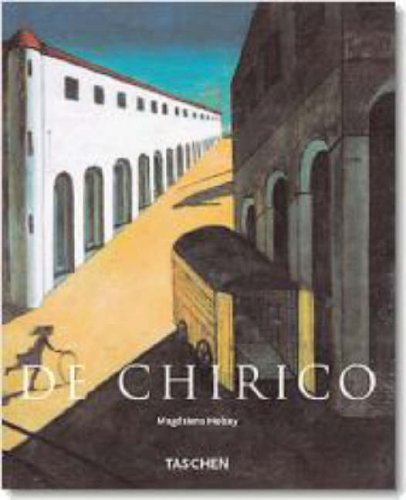
2. Giorgio De Chirico: 1888-1978, the Modern Myth (Taschen Basic Art Series)
by Magdalena Holzhey
Paperback: 96 Pages (2005-10-01)
list price: US$9.99 -- used & new: US$3.39
(price subject to change: see help)
Asin: 3822841528
Average Customer Review: 5.0 out of 5 stars
Canada | United Kingdom | Germany | France | Japan
Editorial Review

Book Description
Greek-born Italian painter Giorgio De Chirico (1888-1978) was hugely influential in the early years of the Surrealist movement. His paintings during the teens in Paris, where he moved in 1911, caused such a stir that such important figures as Picasso and Paul Eluard immediately praised them. This phase of his work, which he later termed pittura metafisica (metaphysical painting) was marked by dramatic compositions involving sharp perspective, striking shadows, geometrical planes, voids of space, and a general feeling of anxiety and loneliness; the sense of absurdity evoked by the mannequin-like figures in almost nightmarish landscapes seemed to suggest a Freudian expression of the unconscious. After 1930, De Chirico turned to a more classical style of painting and continued in the same vein for the rest of his career; his later work was widely criticized, especially by the Surrealists who had so admired his early paintings. ... Read more

Customer Reviews (1)

5-0 out of 5 stars Solid introduction to a great 20th century artist
Taschen's Basic Art series is a wonderful value for the money.You get dozens of color plates on glossy paper and well-informed, sensitive scholars discussing the work.

This volume on Giorgio de Chirico is one of the best - the author clearly establishes how de Chirico's childhoold memories and various dreams and visions led him to create some of the most enigmatic, mysterious and philosophical pictures ever painted.

"What shall I love if not the enigma?" ... Read more


3. The Memoirs of Giorgio de Chirico
by Giorgio De Chirico
Paperback: 280 Pages (1994-04-01)
list price: US$16.95 -- used & new: US$12.13
(price subject to change: see help)
Asin: 0306805685
Average Customer Review: 4.5 out of 5 stars
Canada | United Kingdom | Germany | France | Japan

Customer Reviews (2)

4-0 out of 5 stars Comical, obsessive, paranoid, ironic, and brilliant.
In the first section, this book is the best set of personal memoirs I have ever read, surpassing even Robert Graves' "Goodbye to All That". De Chirico could have been a great novelist, had he chosen that path. His descriptions of a childhood in Greece are unforgettable.

But his novel "Hebdomeros" was also a beautiful piece of writing. It's interesting that three major painters associated with surrealism, De Chirico, Dali and Magritte, were also great writers. (De Chirico would hate to be associated with surrealism, but like it or not - he's their Daddy.)

I'm disappointed in part II of the memoirs. I'm also disappointed in what de Chirico does not tell us in part I. He barely touches on his relationship with Apollinaire, wherein the poet would give titles to some of de Chirico's paintings. He doesn't mention his thoughts on learning of Apollinaire's death. He doesn't tell us which paintings he titled, and which were given names by Apollinaire.

On one page, Paul Eluard had good enough taste to purchase his paintings, and thus was not beyond redemption. Yet on the very next page, Eluard was an onanist and a mystical cretin. What happened in a few paragraphs to change his opinion of the man? De Chirico doesn't tell us, except to blame the corruption of Eluard on Andre Breton.

Many details important to students of the era were not even mentioned. Isabella Far is written about at length. Yet de Chirico does not even mention his wedding to her. They are companions for decades and suddenly, he refers to her as his wife.Duh?When did you get married? Where were you? What was the wedding like?Somebody correct me if I overlooked something.

He outlived almost all of his enemies, (and according to de Chirico, his enemies were more numerous than the stars in the sky). He outlived almost all of the surrealists. What did he think when learning of the deaths of Eluard or Breton? What was his opinion of Magritte, to whom he had once written a friendly thank you note? What was it Magritte had written to him?

Unfortunately, details like this are not to be found. Instead, we get an enemies list of Italian critics and modernist painters, whose names most readers in the English-speaking world will not recognize.

Even so, the character revealed in these memoirs is unique. He's obsessive, paranoid, romantic, imperious to the modern world, and at times comical. But he is always guided by a stubborn integrity and a search for what he called "mystery and poetry".

Yet, he is involved in such comical episodes. He's been accused of forging his early paintings and selling them. He's accused of denouncing some of his genuine early paintings as forgeries because he was jealous of the high prices they were drawing. His later work could not command such high prices. Even stranger and more ironic, he's accused of forging his own paintings and then denouncing his forgeries as forgeries!

Despite these absurd adventures, no painter ever left a body of work that was more replete with mystery. No painter was ever more poetic. Rene Magritte credits de Chirico with teaching him that the supreme art was poetry, and that a painter at his best, could be a poet with his brush and canvas.

More than any 20th Century painter, de Chirico's greatest paintings were like that. They were poems, songs of love. And they will haunt generations to come, long after Picasso, Matisse, and Monet have been forgotten. At their best, these memoirs are a haunting, unforgettable poem.

5-0 out of 5 stars Autobiography of genius (in both senses)
De Chirico, historically the first (small s) surrealist (even the Surrealists admit this) was exalted as a visionary for his earliest paintings, then conveniently vilified by his followers (led by the despicable Andre Breton) when he radically changed his style. The bitterness and frustration of this situation (and it was a long frustration -- De Chirco lived well into his nineties) is very much to the fore in this remarkable book. The mysterious qualities of his painting, too, are much in evidence, and great care is lavished on seemingly trivial incidents whose significance is left very much to the reader's own cogitations. Unforgettable are such passages as his defense of "maisons closes" (whorehouses) as decent workplaces, his memories of the Dalcroze-inspired Braun sisters, and the strange juxtaposition of his being required as a boy to kiss a priest's hand with the frustration of having always to refuse his barbers' offers of a rubdown. Not a book for everyone, surely, but for those seeking to unravel one of the great enigmas of 20th century art, essential.Footnote: De Chirico's status as a painter is currently going through a fascinating process of re-evaluation, and the "new" case for De Chirico is perhaps most eloquently put forth in a beautifully produced catalogue from Hunter College and the Fondazione Giorgio e Isa DeChirico in Rome, titled "Giorgio De Chirico and America," filled with superb reproductions, documentary photographs and stimulating essays. ... Read more


4. The Enigma of Giorgio De Chirico
by Margaret Crosland
Hardcover: 158 Pages (1998-12)
list price: US$44.95 -- used & new: US$21.89
(price subject to change: see help)
Asin: 0720610427
Average Customer Review: 3.5 out of 5 stars
Canada | United Kingdom | Germany | France | Japan

Customer Reviews (2)

2-0 out of 5 stars Not a definitive study, IMO.
This is a short and not terribly well written biography ofGiorgio de Chirico. The author should refrain from interpreting what motivated the paintings because she seems to have a superficial understanding of what art is really all about. I would not consider this a serious study of the painter. As well, this book should have been better edited. For example, on page 114, following the death of the painter's mother: "When he go back, in 1938, he had intended to have a splendid tomb built ..." Fortunately, I bought this book as a remainder and even then paid too much at $16.98. Look elsewhere for depth on the great painter Giorgio de Chirico

5-0 out of 5 stars Art And Metaphysics
This biography of Giorgio de Chirico reveals that the artist considered himself more of a metaphysical painter than a surrealist. I think this provides a clue to a more interesting perspective on his work, that his paintings should be viewed as explorations of philosophical mysteries rather than the haunting imagery of dreams. The author also frequently points out that Giorgio de Chirico's paintings bring the real and the unreal together. In a philosophical context, this is not the same as saying they represent the surreal. The only objection I have to this book is that she places too much emphasis on his relationship with women which seems a bit self-conscious. ... Read more


5. Giorgio de Chirico e il teatro in Italia: Gabinetto disegni e stampe degli Uffizi, Firenze, 23 maggio-31 agosto 1989
by Giorgio De Chirico
 Unknown Binding: 143 Pages (1989)

Isbn: 8839800212
Canada | United Kingdom | Germany | France | Japan

6. Giorgio de Chirico
by Giorgio, 1888-1978. Legrand, Gerard [Text] De Chirico
 Hardcover: Pages (1979)

Asin: B000VZBZVC
Canada | United Kingdom | Germany | France | Japan

7. Giorgio de Chirico (Die Siebente Seite des Wurfels)
by Giorgio De Chirico
 Paperback: 158 Pages (1976)

Isbn: 3792502399
Canada | United Kingdom | Germany | France | Japan

8. de Chirico
by Giorgio de Chirico
 Paperback: 64 Pages (1995-09)
list price: US$10.45 -- used & new: US$71.44
(price subject to change: see help)
Asin: 8434307758
Canada | United Kingdom | Germany | France | Japan

9. Georgio De Chirico
by Giorgio De Chirico
 Hardcover: 164 Pages (1998-12-31)

Isbn: 8843527835
Canada | United Kingdom | Germany | France | Japan

10. G. de Chirico: [catalogue of an exhibition held at the Wildenstein Gallery] 7th to 28th April 1976
by Giorgio De Chirico
 Unknown Binding: 48 Pages (1976)

Isbn: 0902128213
Canada | United Kingdom | Germany | France | Japan

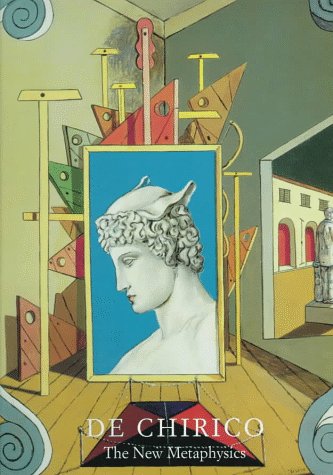
11. De Chirico: The New Metaphysics
by Giorgio De Chirico, Mario Ursino
Hardcover: 158 Pages (1997-07)
list price: US$70.00
Isbn: 9057030217
Canada | United Kingdom | Germany | France | Japan

12. De Chirico
by William, et al, Illustrated by de Chirico, Giorgio Rubin
 Paperback: 141 Pages (1982)

Isbn: 2851992597
Canada | United Kingdom | Germany | France | Japan

13. De Chirico: Gli anni Trenta
by Giorgio De Chirico
 Unknown Binding: 328 Pages (1998)

Isbn: 882021301X
Canada | United Kingdom | Germany | France | Japan

14. Giorgio De Chirico and the Myth of Ariadne
by Michael Taylor, Giorgio De Chirico, Guigone Rolland, Matthew Gale, Max Ernst, Gerard Francis Tempest
 Hardcover: 216 Pages (2002-09)

Isbn: 0876331630
Average Customer Review: 5.0 out of 5 stars
Canada | United Kingdom | Germany | France | Japan
Editorial Review

Book Description
The enigmatic paintings of Giorgio de Chirico (1888-1978), with their dreamlike imagery of deserted city squares filled with mysterious shadows, stopped clocks, and sleeping statues, had a profound influence on modern art. A key to understandingde Chirico's œuvre is an early series of eight paintings of the mythical Greek princess Ariadne. This theme, to which de Chirico returned again and again throughout his life, exhibits a serial approach to making art that foreshadows the work of Andy Warhol. Some 180 paintings, drawings, sculptures, and documentary photographs, as well as essays considering the literary, artistic, historical, and philosophical meanings of this series of paintings, including an unpublished text by Max Ernst, constitute an unparalleled range of primary research materials, and provide the best overall account of de Chirico's career. ... Read more

Customer Reviews (1)

5-0 out of 5 stars rethinking de chirico
this catalogue and the exhibition that accompanied it offer a brilliantly argued, revisionist account of the post-1919 work of giorgio de chirico, who remains one of the most important and influential artists of the 20th century. overturning decades of negative opinion regarding the paintings that de chirico made after the first world war, when he abandoned his earlier metaphysical style, michael taylor convincingly argues that the artist continued to create highly interesting and often thought provoking works of art. taylor uses the theme of the myth of ariadne, which runs throughout de chirico's long career, as a lens by which to explore the diverse range of stylistic changes that the artist underwent in response to external factors such as the return to order movement espoused by his friend jean cocteau. i would heartily recommend this book to anyone interested in the history of modern art, especially surrealism and metaphysical painting, which has been forever changed by this superb account.

alan charlton,@tokyo university ... Read more


15. Giorgio de Chirico 1920-1950
by Massimo et al. (Eds.) Di Carlo
 Hardcover: Pages (1990)

Asin: B000IBLCPS
Canada | United Kingdom | Germany | France | Japan

16. Modern Art Despite Modernism
by Robert Storr, Glenn Lowry, Balthus, Giorgio De Chirico, Ben Shahn, Francis Bacon, Max Beckmann, Francesco Clemente, Salvador Dali, Lucian Freud, Henri Matisse, Georgia O'Keeffe, Gerhard Richter, George Grosz, Glenn D. Lowry
Hardcover: 248 Pages (2002-07-15)
list price: US$55.00 -- used & new: US$34.62
(price subject to change: see help)
Asin: 0870700316
Average Customer Review: 5.0 out of 5 stars
Canada | United Kingdom | Germany | France | Japan
Editorial Review

Book Description
Throughout the 20th century, the evolution of mainstream modernism in the arts has been shadowed and complicated by alternative expressions, intended either to set back the clock or to redirect the stream of progress. Modern Art Despite Modernism explores the anti-modernist impulse as exhibited in painting and sculpture through the social, political, and cultural conflicts of the 1920s, 30s, and 40s. Texts by Robert Storr remind the reader of the strengths of some of this work--paintings and drawings by Otto Dix, Lucian Freud, Francesco Clemente, and even Pablo Picasso--and of the enduring popularity of such artists as Pavel Tchelitchew, whose Hide and Seek, along with Andrew Wyeth's Christina's World, are among the public's favorite pictures. Storr also discusses taste and vulgarity and their implications, both part and present, for institutions like The Museum of Modern Art that are thought of as canon builders. This book was published as the second in a series of three titles, in conjunction with the millennial exhibitions schedule of MoMA2000 at The Museum of Modern Art, New York. ... Read more

Customer Reviews (1)

5-0 out of 5 stars MODERN ART DESPITE MODERNISM
A superior book and fun to read!In this publication Robert Stoor, Senior Curator of MOMA's Department of Painting and Sculpture, gives an extraordinary account of some carefully chosen examples of the museum's artcollection.After viewing the exhibit, I purchased this book primarilybecause of its stunning assortment of color plates and illustrations.Thevalue of Stoor's commentary, however, becomes quickly apparent.Thenarrative gives a brief but very revealing insight into most all of theworks pictured in the book and adroitly articulates the conflicts,reactions, disparities, and shifting paradigms of modern art - often inconflict with twentieth century modernism.The book walks us through ourlast century, pausing at all the right places and examining all the rightartists.The theme is easy to follow; the book is profoundly instructive. ... Read more


17. Giorgio De Chirico
by Soby
 Hardcover: Pages (0000)

Asin: B000J0KUK6
Canada | United Kingdom | Germany | France | Japan

18. Giorgio de Chirico: Metafisica dei bagni misteriosi
by Maurizio Fagiolo Dell'Arco
 Unknown Binding: 164 Pages (1998)
-- used & new: US$139.95
(price subject to change: see help)
Asin: 8881184176
Canada | United Kingdom | Germany | France | Japan

19. The Case of Giorgio De Chirico
by Jerry Caruana
Hardcover: 39 Pages (2007-09-10)
list price: US$17.95 -- used & new: US$11.95
(price subject to change: see help)
Asin: 053315748X
Canada | United Kingdom | Germany | France | Japan

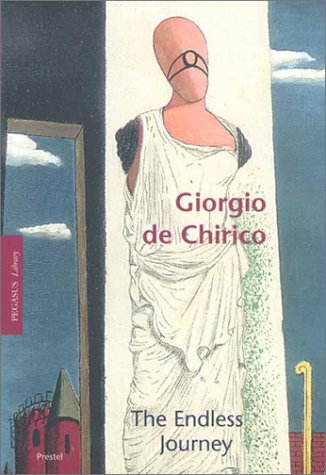
20. Giorgio De Chirico: The Endless Journey
by Wieland Schmied
Paperback: 96 Pages (2002-09)
list price: US$9.95 -- used & new: US$2.31
(price subject to change: see help)
Asin: 3791327941
Canada | United Kingdom | Germany | France | Japan
Editorial Review

Book Description
Giorgio de Chirico's idiosyncratic symbolic style had a powerful influence on 20th-century art, and in particular on Surrealism. His strange dreamscapes, featuring classical statues, Italian piazzas, sinister shadows, geometric objects, and mannequins are filled with enigma. This richly illustrated book focuses on the artist's mysterious and fascinating representations of the human form and describes how events and friendships in his life influenced his artistic development.

At a young age de Chirico was deeply impressed by Arnold Boecklin's painting of Odysseus on the island of Calypso. De Chiroco appropriated Boecklin's Odysseus for his own paintings, at first with little modification, then pushing it ever further into the background until it appeared only as a shadow. The author explains how the figure underwent numerous additional alterations in later paintings before returning to centerstage as the famous "manichino" figure, the faceless tailor's dummy. ... Read more


  1-20 of 100 | Next 20
A  B  C  D  E  F  G  H  I  J  K  L  M  N  O  P  Q  R  S  T  U  V  W  X  Y  Z  

Prices listed on this site are subject to change without notice.
Questions on ordering or shipping? click here for help.

site stats