e99 Online Shopping Mall

Geometry.Net - the online learning center Help  
Home  - Astronomy - Astronomy Software (Books)

  1-20 of 77 | Next 20

click price to see details     click image to enlarge     click link to go to the store

$21.50
1. Making Beautiful Deep-Sky Images:
 
$19.95
2. Software for Photometric Astronomy
 
$140.00
3. Advanced Software and Control
$71.57
4. Astronomy on the Personal Computer
 
5. Astronomy Star Finder for Windows:
$7.64
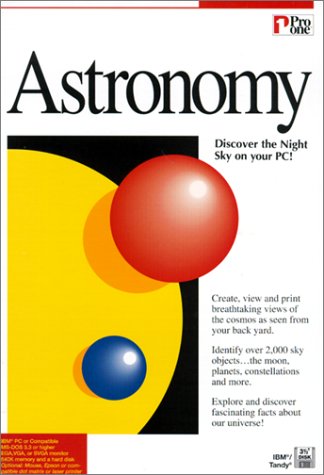
6. Astronomy: Discover the Night
 
$165.00
7. Advanced Software, Control, And
 
$10.00
8. Starry Night: Complete Space and
$45.00
9. The Essential Cosmic Perspective
 
$21.73
10. Complete Space & Astronomy
$75.00
11. Essential Cosmic Perspective with
 
$143.76
12. Space Technology and Applications
 
13. Final technical report astronomical
 
14. Generic astronomy mission planning
$15.73
15. Software and Data for Practical
 
$24.98
16. Complete Space & Astronomy
 
$5.95
17. An Internet-Based Introductory
 
18. ASURV, a software package for
 
19. An astronomical software documentation
 
20. Completer Space & Astronomy

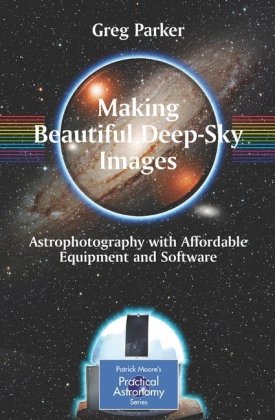
1. Making Beautiful Deep-Sky Images: Astrophotography with Affordable Equipment and Software (Patrick Moore's Practical Astronomy Series)
by Greg Parker
Paperback: 178 Pages (2007-10-11)
list price: US$34.95 -- used & new: US$21.50
(price subject to change: see help)
Asin: 0387713522
Canada | United Kingdom | Germany | France | Japan
Editorial Review

Book Description

This book is based around the authors beautiful and sometimes awe-inspiring color images and mosaics of deep-sky objects.

The images were used as the basis of a public exhibition held at the University of Southampton (Summer 2006), attended by the press, local radio and TV interviewers as well as the public. The book describes how similar images can be created by amateur astronomers, using commercially available telescopes and CCD cameras. Subsequent processing and image enhancement in the electronic darkroom is covered in detail as well.

Not everybody can afford the biggest and best telescopes and CCD cameras, so a range of telescopes and equipment is considered, from the authors 11-inch with Hyperstar camera, down to more affordable instruments.

Appendices provide links to free softwarenot available from a single sourceand are themselves an invaluable resource.

... Read more

2. Software for Photometric Astronomy
by Silvano Ghedini
 Paperback: 219 Pages (1982-08)
list price: US$19.95 -- used & new: US$19.95
(price subject to change: see help)
Asin: 094339600X
Canada | United Kingdom | Germany | France | Japan

3. Advanced Software and Control for Astronomy (Proceedings of SPIE)
by Hilton Lewis, Alan Bridger
 Paperback: 684 Pages (2006-07-30)
list price: US$140.00 -- used & new: US$140.00
(price subject to change: see help)
Asin: 0819463396
Canada | United Kingdom | Germany | France | Japan

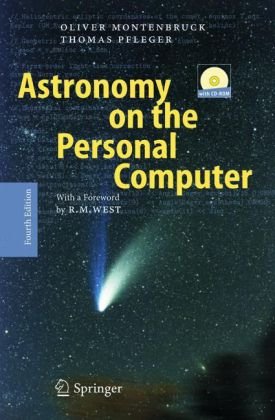
4. Astronomy on the Personal Computer
by Oliver Montenbruck, Thomas Pfleger
Hardcover: 300 Pages (2005-07-21)
list price: US$79.95 -- used & new: US$71.57
(price subject to change: see help)
Asin: 3540672214
Average Customer Review: 5.0 out of 5 stars
Canada | United Kingdom | Germany | France | Japan
Editorial Review

Book Description
Astronomy on the Personal Computer provides the reader with a thorough introduction to the computation of celestial mechanics, which is of particular significance to astronomical observation. Covering everything from astronomical and computational theory to the construction of rapid and accurate applications programs, this book supplies the necessary knowledge and software solutions for determining and predicting the positions of the Sun, Moon, planets, minor planets and comets, solar eclipses, stellar occultations by the Moon, phases of the Moon and much more. This completely revised edition makes use of the widely implemented programming language C++, and individual applications may be efficiently realized through the use of a powerful module library. The accompanying CD-ROM contains, in addition to the complete, fully documented and commented source codes, the executable programs for use with the Windows 98/2000/XP and LINUX operating systems. ... Read more

Customer Reviews (3)

5-0 out of 5 stars Good C++ book for astromical calc
This book does not use c-like/c++ but true c++.It begins with Vec3D class hiding private menbers.I learn many things of objective astronomical calc from this book.

5-0 out of 5 stars Exceptional value for money
What I appreciate about this book is that details of many aspects of astronomical computations are clearly explained together with extensively documented full C++ source code and references for further information. As a bonus, extensive star catalogues are supplied, for use with, for example, astrometry.

C++ is *not* my language of choice, but the authors seem to have done a masterful job of using C++ features well, while avoiding obfuscation. Initially at least, I am translating things as I go into Mathematica, as a check that I am understanding what I am reading.

All in all, for getting under the hood, I think Montenbruck and Pfleger provide exceptional value for money.

5-0 out of 5 stars Good book
I`m very intresting this book (disk ... Read more


5. Astronomy Star Finder for Windows: Sirius a Planetarium for Your Pc/With Disk
by Franz Hack
 Hardcover: 80 Pages (1993-10)
list price: US$19.95
Isbn: 1557552150
Canada | United Kingdom | Germany | France | Japan

6. Astronomy: Discover the Night Sky on Your PC!
Diskette: Pages (1994-12)
list price: US$7.64 -- used & new: US$7.64
(price subject to change: see help)
Asin: 1571633715
Canada | United Kingdom | Germany | France | Japan

7. Advanced Software, Control, And Communication Systems For Astronomy (Proceedings of S P I E)
by Hilton Lewis
 Paperback: 780 Pages (2004-09-14)
list price: US$165.00 -- used & new: US$165.00
(price subject to change: see help)
Asin: 0819454281
Canada | United Kingdom | Germany | France | Japan

8. Starry Night: Complete Space and Astronomy Pack
 Audio CD: Pages (2005-04)
list price: US$49.95 -- used & new: US$10.00
(price subject to change: see help)
Asin: 1894395352
Canada | United Kingdom | Germany | France | Japan

9. The Essential Cosmic Perspective Media Update with Astronomy Place website, Skygazer Planetarium Software, eBook CDROM and Astronomy media workbook (3rd Edition)
by Jeffrey O. Bennett, Megan Donahue, Nicholas Schneider, Mark Voit
Paperback: 550 Pages (2005-02-09)
list price: US$108.33 -- used & new: US$45.00
(price subject to change: see help)
Asin: 0805389563
Average Customer Review: 4.5 out of 5 stars
Canada | United Kingdom | Germany | France | Japan
Editorial Review

Book Description

The Essential Cosmic Perspective, Third Edition Media Update features a new an effective learning program that uses chapter openers, headers, callouts in the text, and highly-visual chapter summaries to make learning goals more explicit and to tie together important astronomy concepts.

DEVELOPING PERSPECTIVE, Our Place in the Universe, Discovering the Universe for Yourself, The Science of Astronomy, KEY CONCEPTS FOR ASTRONOMY, Making Sense of the Universe -Understanding Motion, Energy and Gravity, Light - The Cosmic Messenger, LEARNING FROM OTHER WORLDS, Our Solar System and Its Origin, Earth and the Terrestrial Worlds, Jovian Planet Systems, Remnants of Rock and Ice: Asteroids, Comets, and Pluto, STARS, Our Star, Other Stars, Star Stuff, The Bizarre Stellar Graveyard, GALAXIES AND BEYOND, Our Galaxy, A Universe of Galaxies, Dark Matter and the Fate of the Universe, The Beginning of Time, LIFE ON EARTH AND BEYOND, Life in the Universe: Prospects for Microbes, Civilizations, and Interstellar Travel.

For all readers interested in important astronomy concepts.

... Read more

Customer Reviews (2)

4-0 out of 5 stars Good book but I believe there are better
The good: This book is easy to read and understand, assumes very little of the reader other than a general understanding of current science. Explainations are clear and build logically throughout the book. Very little math - any high school math would be enough to understand what little there is in this book. Information is up to date and the book has many good pictures and diagrams to aid in understanding.

The not as good: I would have liked more in depth detail. I know this is somewhat subjective the book still has nearly 500 pages, however the text often only covers 60% of a page. In comparison to the at least two compeating books "Astronomy Today" and "The Universe" have over 700 pages each and more like 90% of a text page coverage just to grossly compare them. Each of these books also are easy to read, have good pictures and diagrams too.

So all in all this book is good and covers the subject well, but if you wish more detail other books may be better choices.

5-0 out of 5 stars Everything you want to know, plus a great CDRom!
This book is really good, especially for those interested in the universe and its formation. It also comes with a CDRom with video clips and a study guide for students. A useful, and interesting book! ... Read more


10. Complete Space & Astronomy
by Countertop Video
 Unknown Binding: Pages (2000-03)
list price: US$29.95 -- used & new: US$21.73
(price subject to change: see help)
Asin: 1886089396
Canada | United Kingdom | Germany | France | Japan

11. Essential Cosmic Perspective with MasteringAstronomy(TM) and Voyager SkyGazer Planetarium Software, The (4th Edition) (MasteringAstronomy Series)
by Jeffrey O. Bennett, Megan Donahue, Nicholas Schneider, Mark Voit
Paperback: 550 Pages (2006-12-30)
list price: US$111.60 -- used & new: US$75.00
(price subject to change: see help)
Asin: 0805393927
Average Customer Review: 4.5 out of 5 stars
Canada | United Kingdom | Germany | France | Japan
Editorial Review

Book Description

KEY MESSAGE: The Essential Cosmic Perspective, Fourth Edition has been thoroughly revised to include more quantitative coverage, an enhanced illustration and photo program, and an unparalleled new media package. Built from the ground up on our new understanding of the universe, the Fourth Edition retains all of the features that have made this text so popular, while adding new features and supplements that enhance the book’s pedagogy to make it the strongest text in the one-semester astronomy market. The Fourth Edition features optional quantitative reasoning boxes, basic equations throughout the text, new end-of-chapter problems, and a consolidated math appendix to emphasize quantitative understanding. Key figures have been annotatedto guide reader interpretation of difficult concepts. New two-page illustrations throughout the text, and at the end of every part, visually tie together key concepts from across chapters to drive home main ideas in a meaningful way. Developing Perspective: Our Place in the Universe, Discovering the Universe for Yourself, The science of Astronomy. Key Concepts for Astronomy: Making Sense of the Universe: Understanding Motion, Energy, and Gravity, Light: The Cosmic Messenger Our Solar System and Its Origin, Earth and the Terrestrial Worlds, Jovian Planet Systems, Remnants of Rock and Ice: Asteroids, Comets, and the Kuiper Belt. Stars: Our Star, Surveying the Stars, Star Stuff, The Bizarre Stellar Graveyard.Galaxies and Beyond: Our Galaxy,A Universe of Galaxies, Dark Matter, Dark Energy, and the Fate of the Universe,The Beginning of Time.Life on Earth and Beyond: Life in the Universe.AUDIENCE: For all readers interested in astronomy and a new understanding of the universe.

... Read more

Customer Reviews (3)

4-0 out of 5 stars good textbook
It's rather interesting to read, although it's a bit challenging too since I'm very unfamiliar with Astronomy. The best part of it is mentioning the uncertainties of the universe, and it's very up to date, making it exciting and intriguing.

5-0 out of 5 stars The Most Exceptional Textbook This Side of the Galaxy!
I love this book!I don't even read text books very often, but this one is one of the most fun text books I've ever read--the fourth edition of "The Essential Cosmic Perspective."Perhaps I say this because I like Astronomy.I've never taken the course before, so this is really the only college text book in this subject I've looked at.Still, everything in here is interesting.

It has been updated with the most recent expansions with two notable points.It contains the most recent alterations of language by the International Astronomical Union (IAU).Did you know that Pluto isn't a planet?It's actually a comet!In August of 2006, the IAU changed the definition of planet to account for the differences of the planet Pluto, an object whose composition recently discovered is essentially the same as a comet from the belt of comets just outside of the Solar system: called "the Kuiper belt (pronounced like "viper," but with a K.In 2006, the IAU changed the designation of Pluto to a new category of Solar body: the dwarf planet.

Dwarf planets are not planets, as the definition of a planet now has a finer meaning, changed by the IAU.Planet designations are based on composition and size: the inner four planets--Mercury, Venus, Earth, and Mars--are referred to as "terrestrial planets," because their compositions are made up mostly of metal and rock, they're all about the same size, and they have two moons or less.Asteroids also have the composition of rock and metal, and so the belt of asteroids lying just outside of Mars gives an interesting connotation about our system which I will explain soon.Then, the four outer planets--Jupiter, Saturn, Uranus, and Neptune--are called "Jovian planets," meaning "Jupiter-like," because their compositions are mostly gaseous, and because of their sizes: "gas giants."These Jovian, gas giants are several times the mass and diameter of the terrestrial planets, and so their sizes make them considerable to the system.What sets these solar bodies apart the most is THE WAY THEY WERE FORMED which accounts for their composition differences, and therefore the asteroid belt is the boundary line between the inner-terrestrial and outer-Jovian planets of the Solar system.

Every Solar body with an orbit on a somewhat-similar elliptical plane and beyond Neptune is a comet of the Kuiper belt.Although Uranus and Neptune also have essentially a similar gaseous composition as comets like Pluto, the main difference is Pluto has a radius of about 1000 kilometers.Anything that small is considered to be a comet, and, because the comets of the Kuiper belt are usually very small, Pluto resembles them more than a planet, as it is much smaller than even Earth's Moon.Pluto's mass is about 18 percent that of the Moon.

Remember the tenth planet, "Planet X?"Planet X, the tenth planet, was known as "Planet X" because scientists thought that, because it was so small and had the composition of a comet, that these were fundamental differences between comets and planets of the solar system.They felt that, if every newly-discovered comet of the Kuiper belt orbiting the Suncould be called a planet because it revolved around the Sun, our new computerized telescopes would be discovering planets quite frequently; comets, no matter how small they are, would be called "planets," by old definitions.That's why these new definitions are in place now.Pluto has enjoyed the stature of a planet for about 75 years since its discovery, but now that designation is over.

Additionally, the Jovian worlds are known for their multiple moons.Pluto has a moon, but, because its center-of-gravity lies outside of its moon Charon, both Pluto and Charon should actually be referred to as "binary planets," or more correctly "binary dwarf planets" by IAU's new definition--or rather a "binary system of dwarf planets."A planet and a dwarf planet are separate categories of solar bodies and not the same.

Incidentally, speaking of the Moon, the Moon is thought to have been a planet that, at one time, moved around the Sun.Scientists think this because of the size which is roughly the same as Mercury, a terrestrial composition, and it has a similarly substantial amount of gravity.It theoretically took an orbit around the Earth after they collided based on the attractions of their gravity, after which the Moon started orbiting around the Earth.The Moon is also similar to Mercury in that neither of these bodies maintain any atmosphere.

If you hate Al Gore, well--guess what--the same charts used in Al Gore's film "An Inconvenient Truth" are in this book: a major subsection of one of the chapters.This may be a point of either hostility or remorse for those Americans who were comforted by the anti-Gore beliefs of "the Flat World Society": apparently, some scientists think Al Gore actually has facts within his determinations.This book also states the reasons for these conclusions and relates them to a runaway greenhouse effect.If anyone needs an explanation of why people should be concerned, this is as pedestrian as it comes.

Although Venus is thought to be Earth's sister planet, there is nothing there to comfort any human.It has clouds of battery acid!Until 2006, no one could even see through its thick atmosphere due to an extreme greenhouse effect, and in the past only a form of radio technology could view the planet only slightly.In 2006, the European Space Agency (ESA) landed an unmanned spacecraft there to take pictures and send back data about the surface.The "Venus Express" lander, a specially-made craft designed to withstand Venus' harsh atmosphere, lasted for only about an hour on the surface, then corroded into uselessness and dissolved from the extremities of the atmosphere there.You see, there is no water or oxygen on Venus: the extreme greenhouse effect would've caused its oceans to evaporate into space.The atmosphere on Venus is so thick, the pressure at its surface translates to the pressure of one mile beneath the surface of one of Earth's oceans.This book refers to Venus' surface as resembling "a traditional view of hell" (144).

More importantly, although Mercury orbits the Sun at half the distance as Venus, Mercury's surface temperatures are substantially lower than Venus'.This sounds counter intuitive, and it is.But, the reason for it is the extreme greenhouse effect on Venus.And so, although Venus is twice as far from the Sun, it is MUCH hotter there than on Mercury!While Mercury's temperature goes back-and-forth between 700 kelvins (K) in the day and 100 K at night, Venus has a constant average temperature of 740 K (880-degrees Fahrenheit) all the time!

All this information is located within this book.The writing all seems very well put.The glossary has all the terms located in the chapter questions sections, so students should have an easy time finding anything.The chapter information, as it is introduced, is labeled nicely in easy-to-read bold upon its introduction, so eyes can quickly move right to the place where to find that information.The index is large and covers anything I would want to know.It has beautiful photos, images, and tables, in color of course.Many of these shots are brand-new images from off-earth, satellite telescopes and unmanned space vehicles.Of course, I have some doubt about the context of a few of the pictures, but there's surely nothing missing that NASA or other space agencies have allowed to be released: the book is up-to-date.

The book comes with interactive things like on-line supplements and a CD-Rom.The CD-Rom contains a program allowing a student to view any known place from any other known place through a telescope: one can look at Earth from the Moon for instance, and receive technical information about it.You can copy the CD-Rom onto another blank CD or put it on a hard drive for free.The book's included on-line supplemental course features are interactive and reiterate the book's material.

I have not opened the envelope containing the on-line password for fear of reducing the sell-back cost at my college--once a student has opened the envelope containing the on-line pass code key, the envelope cannot be sold back, can only be used once.I regret not having used it, because the Pearson, Addison-Wesley website was extremely helpful in one other course in which I used its on-line supplements.I can only imagine how beautiful the on-line astronomical images are.I would steal the images and put them on my computer desktop, or make a screen saver with them.Maybe I'll open it now, anyway, even though I'm nearly through the course.

If you purchase this text book here at Amazon, make sure you also receive the envelope, because it is worth around thirty or forty dollars.Students can buy the code at the web site without the envelope, but know that the envelope is part of the text book and should come with it unless the seller provides product information stating otherwise.I once had someone sell me a text for college algebra on Amazon with a price about thirty dollars less than Amazon's price.When I received the algebra text, it didn't have the envelope with it!The text was also used-but-wrapped-in-plastic, even though that product description stated the book was new!It may have come to me in plastic, but it wasn't new!Because the envelope containing the on-line code was missing, I peered closely at the book itself and confirmed that the book was USED, because of dirty palm prints on the book.I called the seller and sent it back at the seller's cost with the included mail-return sticker.I don't like people selling me something under false pretenses!Make sure the envelope is in the wrapper; otherwise, you're giving away thirty or forty bucks.Make sure also that the CD-Rom is in there, too.

5-0 out of 5 stars Very happy with this purchase
I received the book I ordered faster than I had expected and it was brand new.
I couldn't be happier.
Would do business with this seller without any hesitation. ... Read more


12. Space Technology and Applications International Forum - 2001: Albuquerque, New Mexico, 11-14 February 2001 (AIP Conference Proceedings / Astronomy and Astrophysics)
 CD-ROM: 1251 Pages (2001-04-27)
list price: US$150.00 -- used & new: US$143.76
(price subject to change: see help)
Asin: 1563969815
Canada | United Kingdom | Germany | France | Japan
Editorial Review

Book Description
The theme for this year's conference is "Space Exploration and Transportation: Journey into the Future." The proceedings document the most recent advances in a number of key areas of space science, engineering, and technology, as well as on the current potential and future opportunities for space science on board the international space station. It covers topics ranging from basic research to the most recent advances in hardware development, space exploration missions, space commercialization, next generation launch systems, human physiology in space, breakthrough propulsion physics, interstellar propulsion, material processing in microgravity, and spaceport development. It is an excellent forum for interaction among members of academia, industry, and government, and among program managers and managers of space technologies worldwide. ... Read more


13. Final technical report astronomical software directory service : contract no. NAS5-32496, funded by NRA-OSSA-92-15, Astrophysics Data Program (SuDoc NAS 1.26:207174)
by R. J. Hanisch
 Unknown Binding: Pages (1998)

Asin: B000110SD2
Canada | United Kingdom | Germany | France | Japan

14. Generic astronomy mission planning and scheduling the AXAF solution (SuDoc NAS 1.15:111065)
by O. T. Guffin
 Unknown Binding: Pages (1994)

Asin: B00010RF3O
Canada | United Kingdom | Germany | France | Japan

15. Software and Data for Practical Astronomers: The Best of the Internet (Patrick Moore's Practical Astronomy Series)
by David Ratledge
Paperback: 184 Pages (1998-12-28)
list price: US$44.95 -- used & new: US$15.73
(price subject to change: see help)
Asin: 1852330554
Average Customer Review: 4.0 out of 5 stars
Canada | United Kingdom | Germany | France | Japan
Editorial Review

Book Description
BLECK:

JOURNAL OF THE BRITISH ASTRONOMICAL ASSOCIATION "Anyone who wants to know where on the internet to find astronomical information and programs will find this book useful...The book is well organized and easy to read...This book is a must for any club library and it is nice to see something dedicated to astronomy on the Internet. It's worth buying just for all the software and reference documents on the CD-ROM."

SKY & TELESCOPE "SOFTWARE & DATA serves as an excellent jumping-off point for would-be practical astronomers." ... Read more

Customer Reviews (1)

4-0 out of 5 stars Software and Data for _PC_ Astronomers
I would have enjoyed this book better if the author would have touched on platforms beyond the DOS-Windows PC. There are enough files on the disc that are readable on other platorms: images, text, html, and PDFs, but no programs for anything beyond the DOS-Windows PC. Many astronomers use UNIX, LINUX, Macintosh, and other operating systems. These astronomers need to communicate their findings with each other. The overview of the various web sites is the strength of this book. It gives one a good starting point for finding astronomical information on the internet. ... Read more


16. Complete Space & Astronomy 2.0
 Unknown Binding: Pages (2002-03)
list price: US$29.99 -- used & new: US$24.98
(price subject to change: see help)
Asin: 193110218X
Canada | United Kingdom | Germany | France | Japan

17. An Internet-Based Introductory College Astronomy Course with Real-Time Telescopic Observing.(Internet/Web/Online Service Information): An article from: ... (Technological Horizons In Education)
by David G. Iadevaia
 Digital: 7 Pages (1999-01-01)
list price: US$5.95 -- used & new: US$5.95
(price subject to change: see help)
Asin: B00098KNKU
Canada | United Kingdom | Germany | France | Japan
Editorial Review

Book Description
This digital document is an article from T H E Journal (Technological Horizons In Education), published by T.H.E. Journal, LLC on January 1, 1999. The length of the article is 2067 words. The page length shown above is based on a typical 300-word page. The article is delivered in HTML format and is available in your Amazon.com Digital Locker immediately after purchase. You can view it with any web browser.

From the supplier: Criteria used to design an introductory Internet-based college course in astronomy with an observation laboratory are discussed. Many students learn better when they can interact with a professor in person, and the course design allows engagement in the learning process to more closely simulate real-time interaction. A low-cost video-server program can send a live video stream to the student's browser that allows eye contact as well as text chat, and the software sends frame-by-frame updates for a 'Show and Tell' mode. Giving students a sense of the lecturer's personality is more difficult, but the teacher wrote his own electronic text book that gives students a core set of basic scientific ideas as well. The 'lab' component of the course lets the professor help students through difficult visual tasks in Show and Tell and has a CCD imager for collecting telescope data. The course requires a fast, reliable Internet connection.

Citation Details
Title: An Internet-Based Introductory College Astronomy Course with Real-Time Telescopic Observing.(Internet/Web/Online Service Information)
Author: David G. Iadevaia
Publication: T H E Journal (Technological Horizons In Education) (Refereed)
Date: January 1, 1999
Publisher: T.H.E. Journal, LLC
Volume: 26Issue: 6Page: 71(1)

Distributed by Thomson Gale ... Read more


18. ASURV, a software package for statistical analysis of astronomical data with upper limits (Penn State astronomy)
by Takashi Isobe
 Unknown Binding: 27 Pages (1987)

Asin: B00071BOW0
Canada | United Kingdom | Germany | France | Japan

19. An astronomical software documentation collection at the Smithsonian Astrophysical Observatory (Harvard-Smithsonian Center for Astrophysics preprint series)
by Carol Rhodes
 Unknown Binding: Pages (1988)

Asin: B00071I0WM
Canada | United Kingdom | Germany | France | Japan

20. Completer Space & Astronomy
 Unknown Binding: Pages (2000-12)
list price: US$9.99
Isbn: 1931102074
Canada | United Kingdom | Germany | France | Japan

  1-20 of 77 | Next 20

Prices listed on this site are subject to change without notice.
Questions on ordering or shipping? click here for help.

site stats