e99 Online Shopping Mall

Geometry.Net - the online learning center Help  
Home  - Authors - Abe Kobo (Books)

  1-20 of 96 | Next 20
A  B  C  D  E  F  G  H  I  J  K  L  M  N  O  P  Q  R  S  T  U  V  W  X  Y  Z  

click price to see details     click image to enlarge     click link to go to the store

$7.86
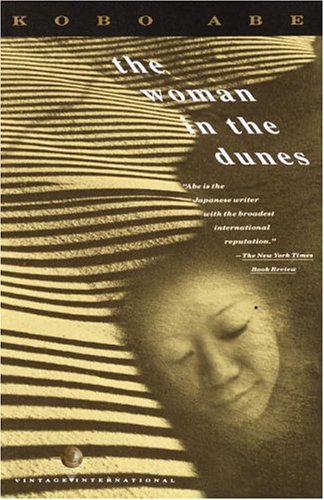
1. The Woman in the Dunes
 
2. Inter Ice Age 4
$8.10
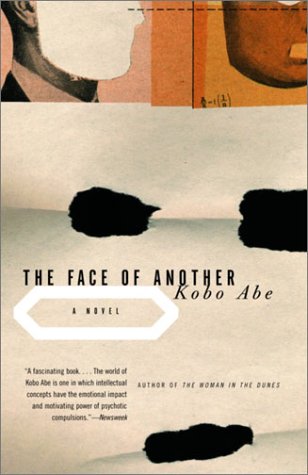
3. The Face of Another
$7.93
4. Secret Rendezvous
$7.29
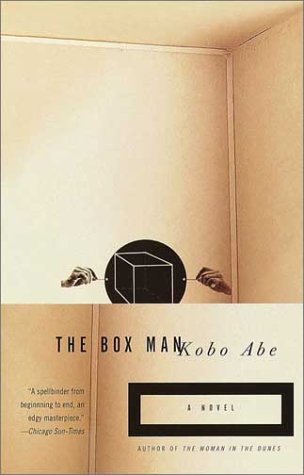
5. The Box Man: A Novel
 
6. The Man Who Turned into a Stick:
$6.49
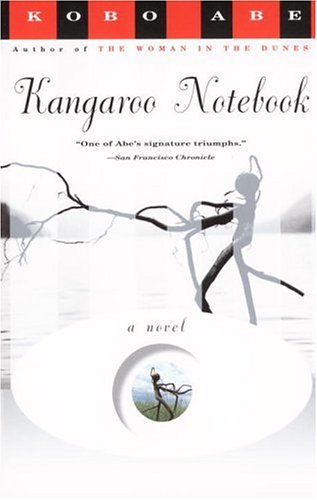
7. Kangaroo Notebook: A Novel
$19.75
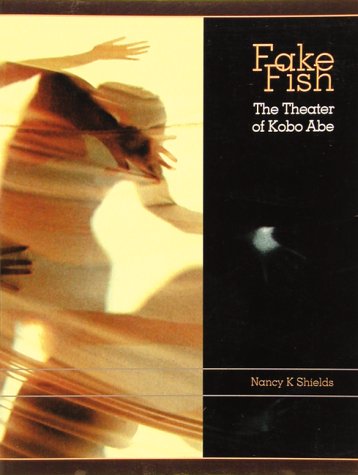
8. Fake Fish: The Theater Of Kobo
$11.90
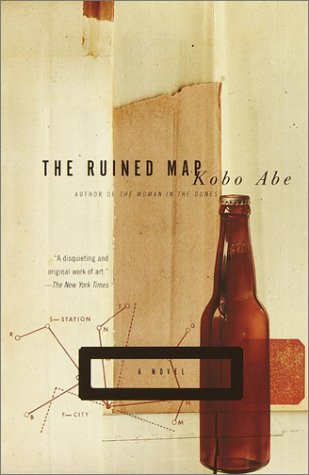
9. The Ruined Map: A Novel
$12.98
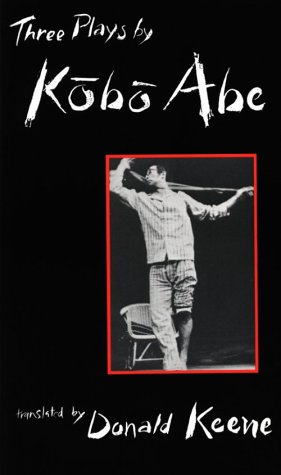
10. Three Plays by Kobo Abe
11. Beyond the Curve (Modern Japanese
$66.11
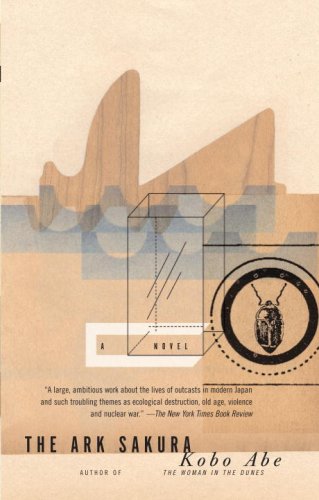
12. Ark Sakura
 
13. Friends, a Play By Kobo Abe
$5.95
14. Kobo Abe's "The Man Who Turned
 
$5.95
15. Inter Ice Age 4.
$14.00
16. Chuzhoe litso. (audiokniga Mp3)
$19.97
17. Abe Kobo: An Exploration of His
 
$46.68
18. Le sanatorium des malades du temps:
 
19. Fake Fish the Theater of Kobo
$5.95
20. Kobo Abe's "The Woman in the Dunes":

1. The Woman in the Dunes
by Kobo Abe
Paperback: 256 Pages (1991-04-16)
list price: US$13.95 -- used & new: US$7.86
(price subject to change: see help)
Asin: 0679733787
Average Customer Review: 4.5 out of 5 stars
Canada | United Kingdom | Germany | France | Japan
Editorial Review

Amazon.com
This beautiful novel by one of Japan's most important writers is also one of the most strangely terrifying and memorable books you'll ever read. The Woman in the Dunes is the story of an amateur entomologist who wanders alone into a remote seaside village in pursuit of a rare beetle he wants to add to his collection. But the townspeople take him prisoner. They lower him into the sand-pit home of a young widow, a pariah in the poor community, who the villagers have condemned to a life of shoveling back the ever-encroaching dunes that threaten to bury the town. An amazing book.Book Description
One of the premier Japanese novels of the twentieth century, The Women in the Dunes combines the essence of myth, suspense, and the existential novel. In a remote seaside village, Niki Jumpei, a teacher and amateur entomologist, is held captive with a young woman at the bottom of a vast sand pit where, Sisyphus-like, they are pressed into shoveling off the ever-advancing sand dunes that threaten the village. ... Read more

Customer Reviews (53)

3-0 out of 5 stars Grains of Sand Bash my Brain
Why did I read this? Yeah Yeah Yeah Grains of Sand. Bla Bla Bla. I gave it three stars only to be fair, because as a person who finds Kafka tiresome, I shouldn't have attempted a bad imitation. I guess I am just not deep enough for this sort of thing.If you are NOT a person who revels in existentialism don't torture yourself like I did. I had to struggle not to skim. I only kept reading because I wanted to like it. I mean, look at all the intelligent praising reviews. If I didn't find meaning in this book wouldn't I be a dullard? Half-way through I didn't care. So I am a shallow reader of Iris Murdoch and Saul Bellow. They aren't so bad. I read this novel in preparation for the movie. Now I think I won't watch the movie. I am grateful that, at least the novel was short and screeched to a predictable halt. To the reviewers who loved the book: You are wonderful writers. I enjoyed your reviews much more than the book.

5-0 out of 5 stars Images cascaded in my mind
The Kobo Abe novel "Woman in the Dunes is a Japanese novel written in the 1960s and made in the same person. It traces, in a small book of less then 300 pages, the implications of being alienated and the contradictions of conformity freedom if that conformity has a purpose.

Niki Junpei a teacher trapped in a empty teaching job, a failed relationship and a life mapped up to retirement and death goes a secret 3 day trip- done to wind up his work colleagues. He is an amateur entomologist (bug collector!) which in Japan of the period is an equally conforming hobby. (The imagery of trapping, collecting, recording and pinning is an important an important motif.

Junpei is interested in sand bugs so goes to area of sand dunes. When he misses the last bus back, a group of locals suggest he stays the night in their village. They send him down a rope-ladder to a house at the bottom of a sandpit, where a young widow lives alone. She has been tasked along with a handful of other households by the village with preventing the sands from destroying the house (if their houses succumbs to the dunes then the other houses in the village will be threatened).

When Junpei tries to leave the next morning he finds the ladder removed. The villagers inform him that he must help the widow in her endless task of digging sand. Junpei initially tries to escape, upon failing he takes the widow captive, but is forced to release her when the house almost collapses after several days of sand build up outside. At one point he does escape only to be captured and gradually Junpei eventually becomes the widow's lover but still continues to plot his escape. Through his persistent effort on trapping a crow for messenger, he discovers a way to draw water from the damp sand at night. He thus is able to choose his when he can escape.

At the end of the book Junpei gets his chance to escape, as he discovers what the sand is being used for and that assumption of who bad-good guys are is less clear. He refuses to take it as he now has the power to leave when he chooses and a purposeful if bleak life with a community that depends on him. We at the end of the novel know what the meaning of his official declaration of death that is reported at the beginning of the novel.

The book raised powerful questions on what is our purpose and what we sacrifice if that life is to have any meaning. Its central "character "is the ever changing sand dunes described and struggled with in writing that is evocative, mythical and deeply psychological... the silences, gestures and actions all revealing more in the spaces between. But, and this is important it also suspenseful!

5-0 out of 5 stars The World Takes a Psychological Shape
Many of Abe's novels are narratively disorienting and confusing to read. I often find elements in his other works (The Box Man, The Ruined Map) that grab me, but otherwise I'm often left somewhat dissapointed. Not so for The Woman in The Dunes. In my opinion this is Abe's best novel.

In terms of its narrative structure, the novel is inescapable. It's difficult to put down, and the ambiguous, hazy, and indefinite suspense that characterizes his other works takes a very clear and satisfying shape here. The story is tangible, richly described, and beautifully written. What I love about this book is that it acheives that perfect balance point where the world and events of the story have profound symbolic value, and yet are not in any way a slave to that symbolic value. Symbolism can be cliche or cheesy when it's telegraphed by the narrative, but Abe is way ahead of that in his playfulness. One thing Abe is not is cliche; he's a master, and he follows the gut impulse of the story.

Abe has been compared to Kafka by many critics and fans. This is probably right. But remember Abe is Japanese, and he brings a Japanese sensibility to his work. The elegant combination of minimal description, the use of natural elements as material and metaphor, and the mix of tragedy with absurdity and humour, all situate Abe within a rich Japanese literary and artistic tradition.

This is a great book. You should read it.

4-0 out of 5 stars a very good and haunting book
The plot of the novel is easily summarized: an amateur entymologist
finds himself imprisoned in a sandpit and forced to endlessly shovel
the encroaching sand with only a woman as a companion.The comparisons
to Kafka are justified, to an extent.The focus is on the inner experience
of a mostly rational, and "normal" protagonist who finds himself
in this bizarre predicament.However, his inner turmoil is nicely juxtaposed
with his companion's acceptance of the situation.The woman in
the dunes is not only resigned to her situation, but she accepts it as someone
who has never known anything different.She quietly tolerates, but never
understands the yearning of the man to escape the pit. As pieces of the life
the man has left behind are revealed, one gains the strange impression that the
ritualized life in the pit is not so bad in comparison.

4-0 out of 5 stars Kafkaesque and accessible
Like other reviewers, this book reminded me of Kafka's "The Castle".However, I found "The Woman in the Dunes" to be a more enjoyable read.There isn't much background story.The plot is very self-contained to one small area, much like a Kafka novel.This, along with its Existential aspects, are the beauty of the novel.
I felt that the descriptions of life within a sand pit, with it's daily rigour of shoveling sand to be amazing.Also, the protaganist's reactions were spot on.I could see myself and others reacting the same way if presented with a similar situation.In fact, we often see others react to our daily life (read: rat race) in much the same way: frustration, acceptance, despair, etc.
I highly recommend "The Woman in the Dunes". ... Read more


2. Inter Ice Age 4
by Kobo Abe
 Paperback: Pages (1972)

Asin: B000J5JRFK
Canada | United Kingdom | Germany | France | Japan

3. The Face of Another
by Kobo Abe
Paperback: 256 Pages (2003-02-04)
list price: US$13.95 -- used & new: US$8.10
(price subject to change: see help)
Asin: 0375726535
Average Customer Review: 4.0 out of 5 stars
Canada | United Kingdom | Germany | France | Japan
Editorial Review

Book Description
Like an elegantly chilling postscript to The Metamorphosis, this classic of postwar Japanese literature describes a bizarre physical transformation that exposes the duplicities of an entire world. The narrator is a scientist hideously deformed in a laboratory accident–a man who has lost his face and, with it, his connection to other people. Even his wife is now repulsed by him.

His only entry back into the world is to create a mask so perfect as to be undetectable. But soon he finds that such a mask is more than a disguise: it is an alternate self–a self that is capable of anything. A remorseless meditation on nature, identity and the social contract, The Face of Another is an intellectual horror story of the highest order. ... Read more

Customer Reviews (7)

4-0 out of 5 stars A face to meet the faces that we meet...
Everyone knows that in Japanese society there's hardly anything worse than losing face. Kobo Abe starts with this cultural taboo and amplifies it to its logically nightmarish extreme as he explores the existential horror experienced by a scientist who literally loses his face in a laboratory accident. Hideously disfigured and shunned even by his former friends and colleagues, the narrator of *The Face of Another* describes in harrowing detail the totality of his isolation from human contact--especially from his conventional, well-meaning wife--and his desperate plan to create for himself a life-like mask that will reopen the `doorway' between him and the community of others.

The novel itself is written as an extended address to the aforementioned wife and meant to be read after he carries out his intention of seducing her as the `stranger' the mask allows him to become. Between the elaborate preparation of the mask and the ill-fated seduction, Abe's narrator travels a zig-zag path between cynicism and self-loathing, psychological breakdown and philosophical speculation as he confronts the elusive nature of human relations and personal identity. His mask gives him a passport to cross the border forbidden the faceless and to re-enter society. Even more, it grants him the radical freedom to be someone else, to be anyone else...to be everyone else. But at what price? If he must wear a mask has he really accomplished anything? Is he really being seen by others or is his `true' self as invisible as before--and just who is he, anyway? How does he choose his mask? Does a mask ultimately reveal or conceal? Which mask will his estranged wife be seduced by? And if she is seduced, has she been unfaithful? Has she betrayed him with himself? As he contemplates these labyrinthine questions, Abe's narrator comes to understand how even people with undamaged faces are also wearing a mask when they're with others. Is the face itself nothing but a mask made of flesh?

This eerie, thought-provoking novel operates on several different levels. But what makes it more than just another Jeckyll & Hyde tale of evil doubles, shadow-selves, and dual identities is the profound philosophical dialectic that Abe engages in throughout. A mystery, thriller, horror novel all in one, *The Face of Another* is a sophisticated meditation on that most enigmatic question of all: who exactly are we?

At times Abe's story drags, at other times his musings are difficult to follow, almost as if some vital connection between his observations had been lost in translation, and, therefore minus one-star, but, the last fifty pages or so are as powerful as anything you're likely to read. For the most part, *The Face of Another* is a riveting and disturbing work that, like Abe's classic *The Woman in the Dunes,* I won't soon--if ever--forget. You probably won't either.


5-0 out of 5 stars The absurdity is almost a character.
This book begins odd and gets creepy and ends, I believe, scary.At the outset you have a feeling of sympathy for the character, which grows into 1 of 2 things as the book progresses - detached fascination with Abe's character study, or revulsion.Possibly both.

The philosophical musings are there, but what hasn't been mentioned here is the flawed narrator.The musings themselves may be bs, but because our sympathy hasn't been completely destroyed when they begin, we give them the benefit of the doubt.That they become more and more absurd is to give an idea of the heightened sense of fear in the narrator about the impending action.At first we disagree with what he says (early on) but at the same time, due to our involvement, ask 'to what extent could that be true, or to what extent is it in fact true, if we look at it in a slightly different light?'

I personally prefer this to Kangaroo Notebook, which, while outrageous and a fun read, is effective not for its realism, but for its fantasy.This book, on the other hand, produces its effects more believably, because there's really nothing to prevent this exact person from existing.

I feel it is an interesting predecessor to Vanilla Sky based of course on the mask and also on the theme of isolation.It also reminds me of Palahniuk's 'Survivor' through the looking glass - a very opposite character, introverted, but also because of the ending - a very similar truncation that implies...

Engrossing read.

5-0 out of 5 stars 5-stars for the eerie film version by master director Hiroshi Teshigahara
Criterion (Collection DVD) is releasing (July 2007) THE FACE OF ANOTHER (TANIN NO KAO), director/artist Hiroshi Teshigahara's 1966 film version of Kobo Abe's novel. The film version is a fine complement to the book. Tatsuya Nakadai, perhaps best known to American filmgoer's as the "king" in RAN (1985; Akira Kurosawa's adaptation of Shakespeare's KING LEAR) is the lead, joined by the famous, esteemed Machiko Kyo as his wife. The film is in black and white (often high-contrast), which adds to the overall weirdness. The 60s atmosphere is amusing yet not in conflict with the serious philosophical and psychological themes. The memorable, haunting "waltz" from the film is available in a compilation CD from the Nonesuch label, "The Film Music of Toru Takemitsu." Film Music of Takemitsu

The Region 2 version DVD is currently available from Eureka/MoC (Masters of Cinema) and is sold on Amazon's British web site. It has a full-length audio commentary by Tony Rayns. Region-Free DVD players are available here at Amazon.

Also coming in July, Criterion will release DVDs of two more Teshigahara adaptations of Kobe Abe novels: WOMAN IN THE DUNES and PITFALL. All three films will be available with a fourth DVD (extras) in a Teshigahara DVD box-set. Criterion Coll: Three Films By Hiroshi Teshigahara

5-0 out of 5 stars Suspensefulwith a mind boggling affect!
I loved this book and will be giving it for holiday gifts this year.The philosophical musings are incredibly powerful and thought provoking, while the prose is intense and suspenseful.After page 83, I found myself yelling outloud to the narrator whose journal we read as he attempts to deal with the aftermath of an accident that has stolen his face. I dare you to read this book and look at your self and others the same way you did before.

1-0 out of 5 stars a disgrace to Abe
I've loved most of the Abe that I've read, but this one was terrible.The "philosophical musings" mentioned by one reviewer are complete BS.The main character constantly reads deep philosophical meaning intothings that are very straightforward.Don't waste your money on this--readThe Woman in the Dunes or Kangaroo Notebook instead. ... Read more


4. Secret Rendezvous
by Kobo Abe
Paperback: 192 Pages (2002-07-09)
list price: US$13.95 -- used & new: US$7.93
(price subject to change: see help)
Asin: 0375726543
Average Customer Review: 4.0 out of 5 stars
Canada | United Kingdom | Germany | France | Japan
Editorial Review

Book Description
From the acclaimed author of Woman in the Dunes comes Secret Rendezvous, the bizarrely erotic and comic adventures of a man searching for his missing wife in a mysteriously vast underground hospital.
From the moment that an ambulance appears in the middle of the night to take his wife, who protests that she is perfectly healthy, her bewildered husband realizes that things are not as they should be. His covert explorations reveal that the enormous hospital she was taken to is home to a network of constant surveillance, outlandish sex experiments, and an array of very odd and even violent characters. Within a few days, though no closer to finding his wife, the unnamed narrator finds himself appointed the hospital’s chief of security, reporting to a man who thinks he’s a horse. With its nightmarish vision of modern medicine and modern life, Secret Rendezvous is another masterpiece from Japan’s most gifted and original writer of serious fiction. ... Read more

Customer Reviews (5)

5-0 out of 5 stars A Japanese "Kafka" at His Best
Surrealism exemplified some of the most famous works by Kobo Abe (1924-1993), earning him comparisons to Franz Kafka.Surrealism as a 20th-century literary and artistic movement attempted to express the workings of the subconscious.

His work Mikkai (Secret Rendezvous) is worth a read for its use of fantastic imagery and the incongruous juxtaposition of scientific data with bizarre nightmare-like scenarios.Secret Rendezvous is relevant in its description of the trappings of an increasingly technological society and its critique of a hospital system gone haywire. Each patient requires a secret agent to penetrate the bureaucratic system, and each person also appears to be under surveillance, mimicking the modern-day question, "Is Big Brother watching you?"

5-0 out of 5 stars A sort of pseudo-Freudian sex nightmare...


From the very start of this short, but densely labyrinthine and surreally intense novel, you know that you're in strange territory. An ambulance comes unbidden in the middle of the night, spirits away a man's perfectly healthy wife, and he's left to begin a Kafkaesque search to find out what's become of her in a hospital whose nightmarish bureaucracy is concealing a bizarre and ominous program of sex research.

Abe has the rare talent of making even the most outlandish situations seem perfectly plausible and that's what lends *Secret Rendezvous* its riveting sense of psychological truth and subjective terror. Like a powerful myth, there's something more *real* than real about the protagonist's endlessly frustrating search, his alternating states of inexplicable omnipotence and paralyzing impotence, his longing to find his missing wife and his fear of doing so.

Like Robbe-Grillet, Abe is a master of moody erotic dread and the hint of horrors forever just out of view. Unlike Robbe-Grillet, Abe's storyline, though fractured, is not obsessively repetitive; though detailed, it's not frozen in time--events move forward towards a conclusion that, although ambiguous, nevertheless seems eerily inevitable.

Explicit, often shocking, never purely prurient, and, at times, even surprisingly funny, *Secret Rendezvous* is a disturbing and thought-provoking novel by a writer who strikes me as one of the most under-appreciated of the 20th century. His sexually-charged themes and dark insights into psychological dilemmas flatly without resolution make a point about the problematic nature of the human condition that is not easily assimilated to a culture that still believes in solutions...in fact, that still believes in the concept of `humanity' at all.

Perhaps, that makes Abe more relevant now than ever.

3-0 out of 5 stars the mind's capacity for self-deception

Through the meticulous detail and persistent narrative rhythm of "Woman in the Dunes," Kobo Abe masterfully creates an emotional experience of visceral intensity, inculcated word by word like so many grains of sand, ever encroaching."Secret Rendezvous" is marked by the same ability to convey vivid viscerality thru the use of detail, narrative rhythm, and the careful cultivation of image, but in some important ways this book fails to bring its sense of confusion beyond much more than muddled mystery.

This book invokes a claustrophobic sense of bureaucratic ambivalence, existential bewilderment and ethical ambiguity, all complicated by veiled and bizarre sexual depravity. This is a dark and increasingly surreal book.If it fails to be deeply disturbing, it seems only because certain elements and characters are not presented with enough clarity to give their confusions full resonance.Despite this, the novel is effective in exploring the mind's capacity for self-deception, and finds a certain manic comedy in our capacity to shape reality according to our delusions.

I find this to be a psychological novel of warped vision, insightful but difficult to read. Once in the concrete corridor of my apartment building, I found a praying mantis, apparently lost. I tried to escort him out a window, but he retreated and I was forced to leave him be. Weeks later, amongst a tangle of dust and hair, I saw the mantis' stiffened carcass, and when I tried to imagine the last weeks of his life, wandering in that empty concrete hollow, I was vividly reminded of this book...

5-0 out of 5 stars The labyrinth of a Hospital
The hospital is a labyrinth of human depravity. A man wanders through it searching for his wife, constantly assaulted by odd and insane sights, sounds, and people. Written with mind piercing clarity and description.

3-0 out of 5 stars Not one of Abe's best, but worth a read
Having read Abe's "Woman in the Dunes" (a masterpiece) already, I was expecting a strange story filled with odd characters and challenging situations. However, I felt that the book wasn't as tightly written as Iexpected. He changes perspective and has some characters that meld togetherwhich are confusing. There didn't seem to be a satisfactory explanation ofthe character's motivation or actions. There is also a bizarre sexualelement that doesn't seem to pay-off. The book is an interesting read, butI would recommend that you read "Women in the Dunes" as it is afar better novel. ... Read more


5. The Box Man: A Novel
by Kobo Abe
Paperback: 192 Pages (2001-07-10)
list price: US$12.95 -- used & new: US$7.29
(price subject to change: see help)
Asin: 0375726519
Average Customer Review: 4.0 out of 5 stars
Canada | United Kingdom | Germany | France | Japan
Editorial Review

Amazon.com
The nature of identity itself is the ostensible subject of this bizarrely fascinating existential novel from the great Japanese fiction writer and dramatist Kobo Abe. In the story, a man decides to give up the self that he has been all his life to attain a state of blissful anonymity. He leaves his world behind and moves onto the streets of Tokyo. He puts a large box over his head, cuts a hole for his eyes. It is as strange as it sounds, but Abe's light touch and narrative innovation makes it compelling.Book Description
Kobo Abe, the internationally acclaimed author of Woman in the Dunes, combines wildly imaginative fantasies and naturalistic prose to create narratives reminiscent of the work of Kafka and Beckett.

In this eerie and evocative masterpiece, the nameless protagonist gives up his identity and the trappings of a normal life to live in a large cardboard box he wears over his head. Wandering the streets of Tokyo and scribbling madly on the interior walls of his box, he describes the world outside as he sees or perhaps imagines it, a tenuous reality that seems to include a mysterious rifleman determined to shoot him, a seductive young nurse, and a doctor who wants to become a box man himself. The Box Man is a marvel of sheer originality and a bizarrely fascinating fable about the very nature of identity.

Translated from the Japanese by E. Dale Saunders. ... Read more

Customer Reviews (9)

2-0 out of 5 stars Don't take this out of the box
I picked this up on a whim at the library and read the back:

"...the nameless protagonist gives up his identity and the trappings of a normal life to live in a large cardboard box he wears over his head."

I thought that sounded like an intriguing concept and have enjoyed other works by Abe in the past and his Kafka-esque sense of reality so I took it out.

I was quite disappointed once I finished it.I did not enjoy reading The Box Man and struggled to finish it.

There are things I liked about it - the concept is intriguing, the intricate narrative structure, and I liked the mystery of just who the Box Man is.It is also quite original but that alone doesn't make it a good book.The Box Man simply isn't a pleasure to read, the story and the characters are about as compelling as watching grass grow, it's overwritten, pretentious, boring, and at less than 200 pages, too long.I also think that Abe explores the nature of identity much better in his other books, particularly The Ruined Map: A Novel.Here it just seems forced and muddled.

If you're going to read Abe, I recommend the aforementioned Ruined Map or The Woman in the Dunes over this.

5-0 out of 5 stars It's hip to be square...
Having put off reading this book until I moved back to Tokyo I'd say the box man mentality fits nicely with foreigners trying to understand Japan.Someone first descibed living in Tokyo to me like floating in a warm bubble.Unless you speak the language or fit in culturally you'll always be a casual observer.The longer you stay in that bubble the more distorted your view becomes.For those on the fringes of Japanese society it's easy to see how one might simply want to stick a box on their head and call it a day.

Aside from the obvious Japanese angle on things Abe weaves a nice commentary on communication in general.Mary M. Watkins' "Invisible Guests" treads a similar path by examining how we construct imaginary personas.Over time what we imagine and what we experience blend into the same thing.Part of the appeal in reading The Box Man is that we're dumped right into the main character(s) head and it's left up to us to figure how many people and scenarios are actually "real".For all we know the whole thing might be in the box man's head - or not.The uncertainty when reading it can be rather disorienting.Anyone who reads it is ultimately a box man themselves; a passive observer just trying to digest some weirdness.His reality is in now your head whether you like it or not.

4-0 out of 5 stars Soul of the Minimalistic Realism
Accordingly to my very high standards of judgement, I give this book a Very High Rating of Four Stars which is just slightly under Excellent, Marvellous, Superb, Wonderful rating because some ratings by other readers who gave it 1 to 3 stars made sense to me, though I'd not give this book only 1 star even if I was mad on the author.

I love to read books (and watch movies) where individual's freedom is self-inflictingly limited though with a little help of the society and the people whom the individual is surrounded by as well, but not without the individual's own "guilt" for limiting his/her own freedom of movement so to speak of. This unconscious or semi-conscious masochistic limitation of one's freedom (of choice) mixed with realistic and at the same minimalistic happenings is fun to read all the way. Be it a state prison, a mandatory military service, self-exile in another country, even exile by self-guilt by committing something unacceptable by society one lives in, a creation of circumstance where one limits his amenities and pleasures or changes the values of life to a more simplistic and minimalist, but at the same time more soulful, - that all is so wonderful to discover in your own mind by reading, - to some (extent) - even experiencing it all yourself (in a physical world).

Therefore this book is worth 4 stars out of 5 - as the least, or 9 stars out of 10 as the Real.

This book has a SOUL!

1-0 out of 5 stars Completely nonessential.
I think of The Box Man by Kobo Abe and I try to recall one memorable image, or one compelling character, or one trenchant observation, or indeed one particularly inventive or colourful turn of phrase. I can't come up with a single one. It baffles me how someone can write something as memorable, compelling, trenchant, inventive and colourful as Woman in the Dunes, and then write something as devoid of any of these qualities as The Box Man. My only explanation is that this was written by a Kobo Abe from a strange parallel universe where Abe never wrote anything good, and somehow made its way here through a rift in space and time.

Upon picking up The Box Man and reading the first page, I naively and laughably thought that this was to be a sort of social commentary or just a story about homeless people. No, that wasn't at all the case. Apparently, unlike a regular homeless person, a "box man" has some sort of extremely deep philosophy that singles him out as someone who lives on a higher plane of existence. Except after reading the book, I came not a bit closer to understanding what this philosophy is, or to caring about finding out. This was exacerbated by Abe's extremely self-indulgent style, in which no concern is exhibited for time or flow, random unidentified narrators come and go with no warning, pages and pages are occupied with pseudo-intellectual "societal observations" and uninteresting non sequiturs, and so forth.

Keep in mind that such a style doesn't have to be bad. Plenty of authors like to jump around in time and make up their own stylistic rules. Plenty of authors like to wax eloquent about society. Plenty of authors come up with absurd premises and make great works out of them. But there are authors who do this well, and those who do not. The Box Man has laughably been called "surreal." But something like, say, Un Chien Andalou, though it also has absolutely no actual narrative structure, is chock full of striking images, which are memorable despite having nothing to do with reality or even with each other. The Box Man tries to be like that. It tries very, very hard, and it is very self-conscious about it. But it fails, because there is nothing above the norm in it - just a desire to "break conventions" for the sake of breaking conventions, to break conventions as a substitute for narrative, commentary, characterization, originality, emotion, and any worthwhile thought. Supposedly there is a nominal narrative here (there's something about an unsolved murder in places), and supposedly there's an existential parable here (some people ask themselves and each other some wooden and ham-handed questions about existence), but really, there is nothing even original (to say nothing of "masterful") about any of this. And don't even get me started on the oh-so-affected "photo inserts" with their oh-so-affected captions.

Woman in the Dunes leaves me spellbound, but The Box Man is an utter waste of time. It's shorter than Woman in the Dunes (178 pages in my edition) but every single line is an excruciating exercise in tedium. And as you read, you'll get the feeling that Abe is deliberately insulting your intelligence by writing such pretentious nonsense when he has shown himself to be capable of masterpieces. Stay far, far away from this "novel."

3-0 out of 5 stars a title for your review
Half the time I wasn't sure what the heck was going on so I consider this book to be, in part, a book questioning reality/ontology. The "box man" would ramble on about some scenario/reality/happening and then reveal that it was all his imagination. That's pretty much how my life goes about, more imagination than substance, so this book is a rather effective looking-glass. Given that, this plays a significant role in the play of "my dissatisfaction with the book." I don't want to be reminded of my anonymity and social lackings. I have little problem recommending this book to others--sometimes i recommend bad books to people for my own kicks--but there are other books I'd prefer to see sittin in my lap. In keeping with the question of reality, if its even addressed in this book (what the heck do i know--answer: nothing) I'd prefer to read Mark Daneilewski's House of Leaves or Joseph Heller's Catch-22 and definitely The Medusa Frequency by Russell Hoban (I list these books only to impress you.It's pure show.).

There are elements of identity problems in this book, as far as I can see anyway. The person lives in a box, he/she doesnt have a name, and he/she usually only looks at people while they in turn, people, only see a box, if that. That's pretty cut n'dry. Again, there are other books that attack this idea more vicously. See: Fight Club

My biggest problem with the book is this: I have no clue if the box man was a murder or not. I love biggest problems and I consider this to be a rather large one, unanswered questions. So, Ill give this my recommendation, but, will the joke be on you?

Nah. ... Read more


6. The Man Who Turned into a Stick: Three Related Plays
 Hardcover: 84 Pages (1975-12)
list price: US$14.50
Isbn: 0860081478
Canada | United Kingdom | Germany | France | Japan

7. Kangaroo Notebook: A Novel
by Kobo Abe
Paperback: 192 Pages (1997-04-29)
list price: US$12.95 -- used & new: US$6.49
(price subject to change: see help)
Asin: 0679746633
Average Customer Review: 4.0 out of 5 stars
Canada | United Kingdom | Germany | France | Japan
Editorial Review

Book Description
In the last novel written before his death in 1993, one of Japan's most distinguished novelists proffered a surreal vision of Japanese society that manages to be simultaneously fearful and jarringly funny. The narrator of Kangaroo Notebook wakes on morning to discover that his legs are growing radish sprouts, an ailment that repulses his doctor but provides the patient with the unusual ability to snack on himself. In short order, Kobo Abe's unraveling protagonist finds himself hurtling in a hospital bed to the very shores of hell. Abe has assembled a cast of oddities into a coherent novel, one imbued with unexpected meaning. Translated from the Japanese by Maryellen Toman Mori. ... Read more

Customer Reviews (13)

4-0 out of 5 stars Marsupials, radishes, and hospital beds...
A man wakes up one morning with radish sprouts growing out of his shins. Just the day before, the wise-aleck dropped a note in the suggestion box at work proposing the manufacture of a new product: kangaroo notebooks. Is there a connection?

In the dreamy, surreal world depicted by Kobo Abe, it's not so much that things are connected as that they develop out of each other like the unexpected pattern of a rapidly mutating crystal. Seeking medical attention at a strange urology/dermatology clinic, the narrator of *Kangaroo Notebook* is wheeled into a makeshift operating room only to wake up in a world that may all be a post-op hallucination or--well, it's left up to you decide what else it could possibly be.

In the meantime, the narrator recounts his mock-heroic adventures through a hellish landscape of ghosts, goblin children, ghoulish invalids, and, maybe most peculiarly of all, an American biker. It's like a funhouse ride through an updated Dante's Inferno aboard the self-propelled hospital bed upon which the narrator travels from one bizarre episode to another. What coherence there is to this absurd tragicomedy is strictly of the sort you feel within a complex dream. There's no rhyme or reason to any of it--and, yet, somehow it's rich with the intimations of deep levels of meaning.

It's not particularly hard to write a text like *Kangaroo Notebook.* But it's very hard to do it well. Often such narratives are rambling, arbitrary, and completely dependent on an ever escalating series of shocks--violence, sexual, scatological. All these elements are present in *Kangaroo Notebook,* but Abe manages to imbue it with the `artless' art of a genuine dream--symbolic, transgressive, thematic, enigmatic--and he implants a subtle narrative drive that pushes this comic, yet ultimately disturbing tale forward to its logically illogical and haunting conclusion. *Kangaroo Notebook* is one of the better examples Ive yet come across of a style of wild absurdism that can too often read like an exercise in automatic writing.

A mind-bending novel, Abe's last, and filled with paradox, acute anxiety, and intimations of mortality, *Kangaroo Notebook* is an odd--and yet oddly fitting--final testament from one of the 20th century's more original literary voices.

3-0 out of 5 stars Bizarre
I've enjoyed several of Abe novels, so I decided to try this one.I didn't enjoy it as much as I had his other novels.First of all, you're never really sure if it is a story about someone's real bizarre experience, or if it is a trip through the underworld.At certain points, it's really strange, but then at other points, it is very mundane.Perhaps it is a journey through the underworld, as the underlying theme is death.It explores how to approach the end when it comes.

If you're interested in Abe, then you might want to read this, but if you haven't read Abe before, I recommend trying some of his other books.

4-0 out of 5 stars Kangaroo Notebook
Kangaroo Notebook is a darkly surreal novel, at turns bizarre and ridiculous then just as easily becomes normal and calm. While lacking a sense of continuity through a few odd narrative choices, Kangaroo Notebook remains an interesting experiment into imagination.

One day, our nameless narrator wakes to find that he has radish sprouts growing from his knees. Not particularly alarmed at this, he soon discover to his pleasure that they are edible and quite tasty. A doctor's appointment lands him in the hospital where he is knocked out with drugs. From there, using his trusty Atlas bed as a transportation device, we are led through bizarre scene after bizarre scene, from hairy American martial arts experts to the souls of aborted children who perform plays on the banks of the river Sai for charity.

The narrator is on one hand an interesting fellow - he IS growing radish sprouts from his knees, after all - and his adventures are quite entertaining, but there is a lack within him. He show no great curiosity as to why everything is happening to him, nor does he really seem interested in getting everything back to normal. He is content to go with the flow, and throughout the novel, he acts more as a spectator than an actual character. Almost, but not quite, he is an omniscient narrator, in the sense that his voice does nothing more than record what is happening. Not quite though, because he does participate in a few interesting conversations along the way. Unfortunately, his lack of personality is a definite crutch.

The nameless narrator ricochets from bizarre sequence to stunningly normal locale, then back to bizarre with a speed that is at time dizzying. Often, scene changes are precipitated by the narrator being knocked unconscious, a fairly weak literary device that is used far too often here. The end sequence is the most bizarre of them all, juxtaposing the lengthy normal hospital scene that proceeds it.

The novel ended, to my mind, abruptly and without closure. There is a cryptic message at the end - which, I'll admit, I was expecting something of the sort - but I couldn't really decipher it at first. But, after thinking about the novel for a few hours after I had finished, I realised that the ending was, in fact, perfect.

To my mind, appreciation of this book comes down to a personal choice. If you enjoy bizarre series of events that don't seem to be going anywhere but suddenly illuminate at the end, then by all means read it. If however, you don't like barely connected scenes with a personality-less narrator, steer clear.

5-0 out of 5 stars Inventive, intriquing, ambiguous reading
Kangaroo Notebook is the last book written by Kobo Abe; in many ways, itis a reflection on the approach of death, on being an outsider, and,perhaps, on outsider as a kind of death."Perhaps" because thisbook is written in a very ambiguous style that allows, even encourages,readers to find different interrelationships between the parts.

Thenarrator begins the story at his suggestion in his workplace being selectedas the best - his suggestion, originally a joke, was a product, a kangaroonotebook.This leads to the proposition that marsupials are outcasts - themammal version of each species being more viable than the marsupialcounterpart. Within this context, the narrator notes that his shins aresprouting radishes.

Seeking treatment at a dermatologist is the beginningof a series of occurrences - real, dream, illusion, post-anesthetiaconfusion?This are absolutely delightful, humorous events - a bedtraveling in the city through the narrator's mental efforts, of ahell-based sulfur springs treatment, of child demons, of dead mothers incabbage fields, of an American graduate student studying fatal accidents,of euthansia ...

This astounding romp is a serious consideration ofdeath, our beliefs regarding death (the limbo children) and ofsuicide/murder/euthansia/accident.

5-0 out of 5 stars A Dream World Just This Side of Madness
"Which situation should I declare 'real' and which one a 'dream?'"This is the question that plagues the narrator of Kobo Abe's Kangaroo Notebook, the last novel written before his death in 1993. We can consider ourselves lucky, indeed, that one of the world's mostdistinguished novelists left us with this surreal and unique vision ofJapanese society that is both disturbingly fearful and hilariouslyfunny.

On a morning that should have turned out like any other morning,the first person narrator of Kangaroo Notebook awakens to find radishsprouts growing out of his shins.Although his doctor in repulsed, thenarrator finds he now possesses the strange and unique ability to snackon...himself.

An eerie adventure to rid himself of his malady takes thebook's protagonist into an increasingly hostile and mysterious world, onethat in turn, is surreal, playful and almost unassailably enigmatic.

Theplot is a weird and wild ride to say the least.Unlike Kafka's narrator inMetamorphosis, our slowly unraveling protagonist checks into a dermatologyclinic and soon finds himself hurtling on a hospital bed to the very brinkof hell.

An attractive nurse, known only as Damselfly, straps him to ahospital bed and begins to administer huge quantities of unknown drugs.Ashort time later, still strapped to this hospital bed, still hooked up tohis IV and still suffering from his mysterious malady, our protagonist issummarily discharged.

A cast of spooky characters is then introduced viavisits to a glitzy department store, a cabbage field that serves as thefinal resting place of the narrator's dead mother and Damselfly's ownapartment.

One of those characters, the hirsute Mister Hammer Killer, anAmerican karate expert, has such a love of violence that our narrator onceagain finds himself confined to a hospital.

His situation only worsenswith the arrival of the "Help Me! Club," a club whose membersconsist solely of demonic chanting children.

The sexy Damselfly, herself,turns out to be a bit of a vampire.Her quest to collect enough blood towin the "Dracula's Daughter" medal is nothing short ofrelentless.Despite these bizarre plot twists and turns, the finale ofKangaroo Notebook is undeniably perfect and, almost surrealistically, makesperfect sense.

Abe's typical protagonist is an "outsider" whois haunted by a sense of alienation and anxiety over the fragility ofindividual identity.Although seeking relief from society's pressure toconform, he still yearns for communal emotional connection.

Theseuniversal themes, combined with an ironic, satiric and often bizarre mannerof expression, have led many to assume that Abe's writing bears a closerresemblance to Western writers, Kafka, in particular, than to traditionalJapanese literary models.Yet Abe's fiction reflects his strong Japaneseheritage in its vividly imagistic prose, its abundant incorporation ofJapanese cultural icons and its satirical treatment of Japanesepsychosocial dynamics.

Kangaroo Notebook is one of Abe's signaturetriumphs.He deftly uses a swiftly-moving barrage of morbidly fascinatingimages, characters and places to reflect cleverly-disguised, but recurringthemes, and he balances hysterical humor with deadpan lines, such as,"Something's really odd."Sure, we think.You don'tsay.

Surrealistic fiction is so often not given its due since the bizarreand original happenings must, of necessity, supplant traditional storylineand character development, thus distancing readers emotionally.But forthose readers who have achieved intellectual maturity and originality ofthought, surrealistic fiction offers insights surely lacking in moremainstream works.

In Kangaroo Notebook, Kobo Abe takes us on a masterful,dizzyingly original romp to the razor-thin line between life and death, atheme-park of his own life and art. ... Read more


8. Fake Fish: The Theater Of Kobo Abe
by Nancy Shields
Paperback: 192 Pages (1996-04-01)
list price: US$19.95 -- used & new: US$19.75
(price subject to change: see help)
Asin: 0834803542
Canada | United Kingdom | Germany | France | Japan

9. The Ruined Map: A Novel
by Kobo Abe
Paperback: 304 Pages (2001-12-04)
list price: US$14.00 -- used & new: US$11.90
(price subject to change: see help)
Asin: 0375726527
Average Customer Review: 3.5 out of 5 stars
Canada | United Kingdom | Germany | France | Japan
Editorial Review

Book Description
Of all the great Japanese novelists, Kobe Abe was indubitably the most versatile. With The Ruined Map, he crafted a mesmerizing literary crime novel that combines the narrative suspense of Chandler with the psychological depth of Dostoevsky.

Mr. Nemuro, a respected salesman, disappeared over half a year ago, but only now does his alluring yet alcoholic wife hire a private eye. The nameless detective has but two clues: a photo and a matchbook. With these he embarks upon an ever more puzzling pursuit that leads him into the depths of Tokyo's dangerous underworld, where he begins to lose the boundaries of his own identity. Surreal, fast-paced, and hauntingly dreamlike, Abe’s masterly novel delves into the unknowable mysteries of the human mind.
Translated from the Japanese by E. Dale Saunders. ... Read more

Customer Reviews (5)

3-0 out of 5 stars Good, but not "The Woman in the Dunes'
I bought this novel in hopes of rekindling that passion I had for 'Woman in the Dunes,' but I was a little disappointed with 'The Ruined Map.' It's still a good novel, but the author, Kobo Abe, seems to get lost in the details. The characters are rich but the story is hazy and unsure. It's still enjoyable to read, but there are lots of other books I would recommend first.

3-0 out of 5 stars Is it fair to ask a man to always live up to his best work?
Kobo Abe became famous with his first novel, The Woman In The Dunes. He deserved the fame. Though written in a very simple style, The Woman In The Dunes has an unworldly atmosphere, simultaneously beautiful and frightening. Its premise is not very realistic, but the description makes it very convincing.

Unfortunately, a man can only write a book like that once, when he is young. After The Woman In The Dunes, Abe became the most prominent avant-garde novelist in Japan. But from that point on, his books became increasingly uninspired and similar to one another. The Ruined Map (1967), The Box Man (1973), and The Ark Sakura (1984) have different storylines, but eventually it becomes obvious that, fundamentally, the three novels are exactly the same.

Every Abe novel after The Woman In The Dunes revolves around some kind of search. The main character is looking for something, or other people lead him to look for something. Abe rarely reveals why it's so important to find this thing, or even what it is. But Abe is a very vague author. His characters talk in oblique hints. It is almost never explained just what they're hinting at. If this irritates you, then you probably won't like Abe's books.

In his vague search, the main character runs into the same three people:

1. "The Helpless Femme Fatale"

This archetype is the main female character in an Abe book. She is usually described sympathetically, as being feminine and vulnerable. However, she also serves to draw the main character into some kind of crisis from which he cannot escape. Abe sometimes drops vague hints that she knows more than she lets on, but this matter is never adequately clarified. In The Box Man, this is the female doctor; in The Ark Sakura, it's the shill's assistant; and here in The Ruined Map, it's the missing man's wife.

2. "The Malicious Observer"

This is always a man who verbally antagonizes the main character. Abe hints that this character not only knows the truth about the main character's situation, but is in some way responsible for it. However, the malicious observer never really does anything. He just stands there and says a lot of very vague words to the main character, hence his status as "observer." In The Box Man, this is the doctor; in The Ark Sakura, it's the shill; in The Ruined Map, it's the woman's brother.

3. "The Dangerous Prey"

Abe's main characters are always searching for the dangerous prey. The dangerous prey doesn't have to actually physically appear (although he does in The Ark Sakura). He's more important for his status as "prey" that the main character must hunt down. However, even if he doesn't physically appear, he still has a great deal of influence over the main character. Along with the helpless femme fatale, he lures the main character into some kind of trap, hence why he is dangerous. In The Box Man, this is the box man; in The Ark Sakura, it's the main character's father; and here, it's the missing man himself.

This formula does not seem to add up to much. Personally, I think that The Box Man is totally unreadable, and The Ark Sakura becomes unreadable by piling on irrelevant, bizarre absurdities as it progresses. But although The Ruined Map is still basically the same novel as the other two, it leaves a much better impression. This is because The Ruined Map is nominally written as a mystery novel, in which a private detective is hired to locate a man who disappeared without a trace. And as it turns out, this genre is perfect for Abe's vague style. Mysteries are supposed to be vague. They're supposed to lead the reader on. After The Woman In The Dunes, Abe does nothing but lead the reader on. It's a perfect match.

Thus, by happy coincidence, the chosen setting makes Abe's style interesting. Most of the book is fairly empty of content, as usual, with endless vague monologues and grotesque imagery. But there are two things that stand out.

First, by virtue of the plot, the helpless femme fatale looks particularly helpless this time around. The way she resorts to alcohol because she can't make sense of what happened to her husband is even touching. She looks truly helpless, more than her counterparts in the other books. This provides an effective contrast to the arrogance of the malicious observer, and to the sleazy places where the main character tries to find clues.

Second, because of the helpless femme fatale, the ending is especially sudden and effective. This is really the last time in Abe's career as a writer when he could create a genuinely powerful scene. In some sense, it lacks substance, because it consists of an absurd event that happens for no particular reason, and without explanation. On the other hand, it perfectly encapsulates a feeling of being overwhelmed by events beyond one's control. And it highlights the pathetic, yet dangerous attraction posed by the helpless femme fatale to the main character. Unsurprisingly, it recalls The Woman In The Dunes.

The Woman In The Dunes is Abe's best work. In comparison, his later novels are superfluous. But, if you really want to read one of them, The Ruined Map is by far the best choice.

4-0 out of 5 stars Truly mind-bending!
Surrealism is not really my cup of tea, but I did enjoy reading this book, which treads on slightly firmer grounds of realism than Abe's other works.The structure is certainly interesting, as the reader is given as few clues to understand the story as the protagonist has in his case, and things get progressively more confusing and unclear.The whole thing has a dreamlike quality to it.I can't say I loved it, but if you are looking for a challenging and slightly avant-garde read with a surrealist bent then this is worth a try.

5-0 out of 5 stars One of Kobo Abe's finest writings
Kobo Abe, one of the greatest surrealistic novelists, liked to depict, with the precise calculation and unconstrained freedom of mind that Picasso gave his work, entangled and precarious relatiionships between an individual and the society to which he "belongs". In "The Ruined Map", Kobo Abe casts spotlight on his lifelong motif from a different angle. Unlike his other books such as "The Box Man" and "Kangaroo Note", "The Ruined Map" is based on a relatively realistic situation. Almost all characters act apparently normally, and there seems to be nothing that makes us question sanity in the situation that surrounds them. The hero, who is a private investigator, is asked to find a young woman's husband who suddenly disappeared several months ago. He tries to find "rational explantions" of her husband's abrupt disapearance, but however, the notion of rationality soon traps him, challenging his conventional understanding of the relationship between an individual and the society. Kobo Abe explores his unique conception of identity with more restrained techniques of surrealism than in his most famous work "The Women in the Dunes". Yet, an insightful reader should realize that Abe ingeniously embedded the surrealistic subject in a realistic setting.

3-0 out of 5 stars Reversing the psychology of Woman in the Dunes.
Though not assuccessful in achieving its aims as The Woman in the Dunes, this is stillan intriguing twilight-zone type of story. A young private investigatoris set on the trail of a man who, we are led to believe, has run away fromhis wife. The only clues are a torn piece of paper with a sketched map ofwhere he last met someone in connection with his work. But as he carriesout his investigation everything gets more and more uncertain, rather thanbecoming clearer. Each person he comes into contact with at the beginningof his investigation has an identity, a relation of some sort to someoneelse in the story, but as events unfold, each and every one of them becomesclouded in a mini-mystery of their own, until, after falling into the handsof the wrong people and receiving one hell of a beating, even the haplessinvestigator, who has by now lost his job and livelihood, loses his ow! nidentity and is left wandering off we know not where. In some sense The Ruined Map is an attempt at a reversal of the psychologicaldrama of The Woman in the Dunes. Rather than re-establishing his identityand fitting in in a totally bizarre environment, our hero drops out of anenvironment he is familiar with and apparently loses all sense of his ownidentity. While it is convincing, I feel that my liking for Abe's weird world is all that got me through the middle section of this book, though the odd beginning and the truly chaotic ending are very enjoyable. I suggest reading this one first before going on to The Woman in the Dunes which is all round a better read. ... Read more


10. Three Plays by Kobo Abe
Paperback: 233 Pages (1997-04-15)
list price: US$27.00 -- used & new: US$12.98
(price subject to change: see help)
Asin: 0231082819
Canada | United Kingdom | Germany | France | Japan
Editorial Review

Book Description

--New England Theatre Journal

... Read more

11. Beyond the Curve (Modern Japanese Writers Series)
by Kobo Abe
Paperback: 248 Pages (1993-02)
list price: US$9.00
Isbn: 4770016905
Average Customer Review: 4.0 out of 5 stars
Canada | United Kingdom | Germany | France | Japan

Customer Reviews (5)

4-0 out of 5 stars Hit and miss, but mostly hit
KA is best known as a novelist, but his short fiction, here in "BTC" is quite engaging.It's too bad this book is not more widely available.Kafka is a strong influence throughout - somewhat shamelessly at times, but who cares:good writing is good writing.'Intruders' is the best in the collection, about a strange family that knocks on a man's apartment door in the middle of the night and proceeds to take over his apartment and life, making him into a sort of servant.In the opening story, a man comes home to find a corpse in his bed.His decision making is engaging.A few of the stories are duds, but that's generally the case.Worth the time, if you like KA's novels, and Japanese fiction, especially Murakami, who was clearly influenced by KA.

3-0 out of 5 stars Surrealism
This collection of short stories by Kobo Abe was a challenge for me.I don't generally enjoy short stories that much, and my interest in surrealism is limited.Still, I found them compelling despite the tendency toward studies in frustration."Intruders" was especially so, with the protagonist powerless against those taking over first his apartment, then his livelihood, and finally his life.My favorite story was "Beguiled," where in a confrontation between two men, one is the pursuer, the other the pursued . . . but which is which?This book was translated from Japanese, and although some of the phrasing seems awkward at times, it actually enhances the overall surrealism of Abe's writing.Definitely worth reading, but only worth full price if this is your favorite genre.Try the local library or used book shop.

4-0 out of 5 stars Beyond realism
This collection of short stories, translated from the Japanese by Juliet Winters Carpenter, is a surreal foray into the illogical and improbable.Kobo Abe is the kind of writer who reminds one of other writers.His Kafkaesque "An Irrelevant Death" places an unexplained corpse in the apartment of A- who must then decide how to dispose of it without suspicion.In another story that recalls Kafka, "Dendrocacalia," a man named Common experiences an unexpected metamorphosis into a rare and sought-after plant.But not all stories evoke Kafka."The Life of a Poet" embraces the lyrical mythology of Latin American magic realism as a crone is accidentally made into thread and a deadly snow falls made of "crystalline dreams, souls, and desires."Lewis Carroll's convoluted logic surfaces in "The Bet" when an architect for a particular demanding advertising company discovers a world of small doors, head-shaking conversations, and stairs that lead not to an expected succession of floors but instead to places governed by a red light and adages.The bizarre building teaches the architect the logic of the illogical.When he designs "the path of the president's office as a mathematical function of the System," he resolves the story in an entirely fitting way.

Despite the derivative feel to these stories, they are distinctly Abe's.His Japanese sensibilities give them a different twist, for while Kafka chose to change his character into a cockroach, Abe chooses instead to transform his bewildered character into a scrubby plant that grows at high altitudes and which would be quite at home in a government funded hothouse.The author's confidence in the wildness of his imagination gives these stories an authority of voice, allowing for the needed suspension of disbelief. Abe's fictional realm is a difficult one to leave.

It took me a couple of stories to fully appreciate Abe's talents, but I'm glad I continued reading.Readers of Japanese and international fiction should most definitely take a look at Abe's work.Don't expect realism - or anything close to it - because Kobo Abe's fiction exists on another plane.

4-0 out of 5 stars Really good
I really recommend this book, although I only gave it four stars because the stories might be too similar to each other for my taste. I'd like just a little more variety in the range of emotions and plot twists. It is easy to say that Abe is good, of course, because he is such a widely recognized writer. I'd like to say, though, that he is so good that he can actually make a reader angry (many of his stories create a feeling of boxed-in, controlled frustration I never encountered in any other writer).

5-0 out of 5 stars One of Japan's greatestliterary exports!
Beyond the Curve by Kobo Abe is one of the best compilations of short stories I've read.His style is like a blend of Rod Serling, Stephen King and Salvador Dali.Each tale is strange and unique and tests the limits ofyour imagination.As much as I like his other books, this one is myfavorite because it runs the gamut of his storytelling style from novelslike Woman in the Dunes to the outrageously surreal Kangaroo Notebook.Ifyou haven't read any of Abe's work, Beyond the Curve is a greatintroduction. ... Read more


12. Ark Sakura
by Kobo Abe
Paperback: 352 Pages (1989-03-13)
list price: US$15.00 -- used & new: US$66.11
(price subject to change: see help)
Asin: 0679721614
Average Customer Review: 3.5 out of 5 stars
Canada | United Kingdom | Germany | France | Japan

Customer Reviews (6)

1-0 out of 5 stars Novel is a weird waste of paper..
The plot of this book is absurd.A survivualist tries to find "crew" for his underground "ship".Various odd things happen, some including crude toilet humor, and nobody cares what happens.I hated this book by the time I was finished.It isn't the very worst book I've read, but it's close.Only read this if you're a masochist.

5-0 out of 5 stars Expert modern fable
Thematically, this novel is similar to Abe's more famous book, 'The Woman in the Dunes;' it emphasizes a sense of community and connection with others. What I like about it (among other things) is that it's hardly a sledgehammer philosophical message; it allows for vaguery. The main character is a misanthrope whose personal philosophy seems to be the target of criticism, yet he is never overtly punished and is capable of questioning his views. The other characters are liars, criminals and dirty old men, but all are made sympathetic to some degree in the face of global holocaust. As far as the writing goes, it is very straightforward. I think Abe does an amazing job of both developing character and allowing the reader to visualize such an outlandish setting as the Ark.

3-0 out of 5 stars This ark has a few leaks....
Pig, who prefers to be called Mole, has taken up residence in an abandoned stone quarry, slowly converting it into an ark to save humanity during the inevitable nuclear holocaust.He has room for a little over 300 people to become his crew, but must be selective in his choosing.Only those who he deems acceptable will be offered safe harbor in his huge ship.

During one of his few outings to buy provisions for the ark, he comes across Komono, an insect dealer, and after lunching with him, offers one of the keys to the ark.Komono asks if he can think on it and walks off to use the bathroom.In the meantime, two sakura, or shills, trick Mole into giving up two keys.They immediately make a run for the ark, followed by Komono and Mole in hot pursuit.When they reach the ark, they discover that they are not alone in the depths of the quarry.

The remainder of the book discusses a wide variety of topics from old age in the form of the Broom Brigade, environmentalism, survivalism, murder, loyalty, sex, humanity and nuclear devastation.More and more chaacters are added as the book progresses, each with a different story to tell, making it difficult to follow along and unenjoyable to read.I still am not sure exactly what point the author is trying to make with this novel, or even if there is a point to it.The characters themselves were not believable to me, especially Mole, a big, fat man who is obsessed with the end of the world and the female shill's behind, continually wanting to pat it even when his life is in danger.

The only saving grace for me is Abe's writing.He has a very fluid style that's descriptive and easy to read. But, with the piling on of characters and story lines, I can't say that I would add this to a must-read list.

2-0 out of 5 stars Don't bother.
In many ways, The Ark Sakura is practically a rewrite of The Box Man, an earlier Abe novel which I greatly disliked. Note just how much from that novel recurs here: there's your mysterious and often antagonistic figure of "the pretender," the doctor in The Box Man and the "shill" in The Ark Sakura; there's his nameless female companion who often acts excessively girlish but who, it is stressed with much pomposity, never reveals her "true nature"; and there's a bizarre murder mystery which appears out of nowhere, is constantly mentioned, but never is explained. Also instantly recognizable from The Box Man is Abe's infuriating noodling - all those nonsensical metaphors for life with all the subtlety of a plum pudding, described lovingly in the most roundabout style imaginable, in which very many words are expended with very little meaning. The canonical example of this in The Ark Sakura is, without a doubt, the "eupcaccia," a legless and completely fictional insect. Abe takes great pains to describe it, with all the grotesque details that will make you wish he'd just stop, and of course, _of course_ finishes with "At the risk of sounding pretentious, let me say I believe that the eupcaccia is symbolic of a certain philosophy or way of life." This is predictably referred back to countless times later, with phrases along the lines of "If only humanity decided to live more like the eupcaccia!" I hate to be the one to say it, but yes, sir, you do sound pretentious, and your metaphor makes no sense.

It's not a total loss. For all the similarity to The Box Man, The Ark Sakura is certainly better. It's about twice as long as The Box Man, but reads _very_ quickly; it took me only a few hours. There's only one mercifully short occasion where Abe delves into the incomprehensible nonsense that comprised most of The Box Man. That is to say, this time around he actually remembered to include an actual _story_ along with his philosophical burbling. And the story is by far the most successful part of the novel - the whole idea of the "ark" is so good that it really deserves a better book to be built around it. The same goes for the twist in the ending. With the exception of the very end, however, for the entire second half of the book Abe is too enamoured of his own cleverness for his own good. Hence we get the thrilling tale of The Broom Brigade (intimidating, is it not?), which is a neofascist militant cult comprised entirely of retired old men who make a living by sweeping the streets. I don't blame you if you're blankly staring at the preceding sentence trying to make sense of it; rest assured, there's none to be made. With the appearance of The Broom Brigade on the scene, the book falls headfirst into a bog of meaninglessness from which it does not emerge until the last two pages. It's vaguely reminiscent of Beckett's Pozzo, except more ridiculous and, in this setting, rather artless; with the way the story "develops," the whole backdrop becomes completely irrelevant and an initially promising premise is wasted. Abe's entitled to all the postmodernist irony he can exude, no doubt, but it won't make his books good. I've heard it said that he concentrates on "the inner workings of people's minds," but in my view he doesn't concentrate on people at all; he has some vaguely defined notions that he'd like us to pay attention to, and by and large, he only bothers with his characters insofar as he can make them reflect those notions. As a result, he creates neither convincing people nor a convincing philosophy. So, read Woman in the Dunes, a novel deservedly added to the modernist canon, but feel no obligation to explore Abe's other "works"; you're not missing much.

5-0 out of 5 stars Kobo Abe, Japanese Beckett
A truly weird and amusing novel, Ark Sakura by Kobo Abe (The Woman in the Dunes) has the extraordinary ability to abolish your everyday reality in favor of its vivid, voyeuristic depiction of the bizarre consequences of anutterly unsupervised reality, a twisted kindergarten of mad adults,ungoverned and unpredictable.the Mole has retreated, along with hisdisturbing family background and unpleasant appearance, into a secret worldbeneath the crust of Japan, and in these dank, reverberating caverns of anabandoned underground quarry has been able to rejuvenate his despairingperspectives by creating a smaller living world from the refuse of anothergreater world, utterly self-sufficient, certainly more than capable ofsurviving and surviving well any imminent global apocalypse.setting offinto the common life above ground, having decided it is time to considerpopulating his subterranean ark in preparation for the expectedcatastrophe, Mole encounters a peculiar group of human cast-offs, allbecoming irrevocably enmeshed in a strange and surreal tale that is abeautiful open sore in the skin of the human condition.admirers ofBeckett will be unable to resist Kobo Abe's magnificent ability to evokesituations and settings at the same time vast and apparently endless, yetisolating and confining; fantastic prisons of the exiled and forgotton. ... Read more


13. Friends, a Play By Kobo Abe
 Paperback: Pages (1986)

Isbn: 4805302380
Canada | United Kingdom | Germany | France | Japan
Editorial Review

Product Description
Friends, a Play By Kobo Abe. Translator Donald Keene, from Japanese. Author of Woman in the Dunes. ... Read more


14. Kobo Abe's "The Man Who Turned Into a Stick": A Study Guide from Gale's "Drama for Students" (Volume 14, Chapter 9)
Digital: 28 Pages (2002-07-23)
list price: US$5.95 -- used & new: US$5.95
(price subject to change: see help)
Asin: B00006G3EG
Average Customer Review: 3.0 out of 5 stars
Canada | United Kingdom | Germany | France | Japan
Editorial Review

Book Description

Term paper due tomorrow? Need to cram for a test? Or just looking for the best information about a favorite literary work?

Turn to "Drama for Students" to get your research done in record time. Brought to you by Thomson Gale--the world's leading source of literary criticism and analysis--this e-doc contains: plot summary; character analysis; author biography; an overview of the play's themes, style, and historical context; a compendium of in-depth critical material; study questions; suggestions for further reading; and much more.

Why choose "Drama for Students"? Because no other source offers so much in such a compact package. Trust the experts: Thomson Gale--and "Drama for Students."Download Description

Term paper due tomorrow? Need to bone up for a test? Or just looking for the best information about a favorite literary work?

Turn to "Drama for Students" to get your research done in record time. Brought to you by the Gale Group--the world's leading source of literary criticism and analysis--this e-doc contains: plot summary; character analysis; author biography; an overview of the play's themes, style, and historical context; a compendium of in-depth critical material; study questions; suggestions for further reading; and much more.

Why choose "Drama for Students"? Because no other source offers so much in such a compact package. Trust the experts: The Gale Group--and "Drama for Students." ... Read more

Customer Reviews (1)

3-0 out of 5 stars Not easily understood.. But then again it wasn't meant to be
Kobo abe was an amazing author, no doubt about it. My high school performed this play not all too long ago. Afterwards, many of the audience members were confused. This is not uncommon.. Kobo Abe wanted his audience to work and think during his plays.. It's almost as if he wanted us to analyze our own lives afterwards. All in all.. It's worth reading.. and definitely worth thinking about. :D ... Read more


15. Inter Ice Age 4.
by Kobo Abe
 Hardcover: Pages (2009-06)
list price: US$5.95 -- used & new: US$5.95
(price subject to change: see help)
Asin: 0394430611
Average Customer Review: 5.0 out of 5 stars
Canada | United Kingdom | Germany | France | Japan

Customer Reviews (3)

5-0 out of 5 stars Abe's best entertaining novel
I think I am familiar with Abe's works quite well. I've read all his works including short stories, plays, essays, interviews and novels (in Japanese). (I first encountered with his work when I was in a junior high school in Japan. One of his short stories was in the junior high's Contemporary Japanese textbook. That introduced me to "The Crime of Mr. S. Karma", but it was a bit too tough for the junior high kid.) I read his works quite extensively while he was completing "Box Man". After its publication, I claimed myself Abe's devoted fan. Since "Ark Sakura", I somewhat lost interest in his works, but I still readall his publications.

If someone asked me what is his best novel, I'd say it's "Box Man", but "Inter-Ice age 4" is his novel I enjoyed the most. Like "Face of Another", it's a suspense story and easy to read. Its theme, the present is to be judged by its future, is clear, too. Also, I particularly like its prologue and epilogue; they're very poetic.

Abe is probably best known by his deep thinking and explosive creativity, but he is an excellent Sci-Fi writer, too. Abe's philosophical works are good to read, but his entertaining works are also fun to read. I feel "Inter Ice age 4" is under-evaluated (in Japan, too).

Yes, "Inter Ice age 4" is my best favorite.

5-0 out of 5 stars Twisted Science Fiction
In Abe's novel 'Inter Ice Age 4', he explores the edge of psychological science fiction.The character at the center of this tale is Dr. Katsumi, a scientist who sets out to created an AI computer capable of predicting the future, in imitation of a successful Soviet model.As he get closer to his objective, the government begins putting up obstacles to slow his progress.He is no longer allowed to test political questions on his machine, but when he tries to develop questions that will be acceptable to the committe overseeing his research, it turns out that everything is connected to politics.Finally he decides to reduce the scale of his research.He'll focus on a single human instead.He goes out with his assistant to choose a suitable subject.Later, they are surprised to learn that the subject they chose has been murdered.This murder pulls Dr. Katsumi unwillingly into a conspiracy that involves genetic engineer on a massive scale.

This novel is surprisingly fresh for a novel that was written in 1958.The topics covered--AI computers, genetic engineering, and global warming are all very current.The story spirals to a tense conclusion, so the reader is pulled in.The story also has a strong psychological edge.It explores the difference between what a person wants to do and what a person has to do.Also, it brings up a lot a questions about the nature of the future.Can people in the present judge the future?Abe argues that the future cannot be judged.In Abe's words, who could say whether the people from the past would consider our present a heaven or a hell.Only the present can judge the past, not vice versa.

For those who aren't sure where this fits into science fiction, I think I could recommend this to fans of Phillip Dick.It has a similar dark undertone with a strong psychological basis.

5-0 out of 5 stars Perhaps Abe's Most Surreal
This was a beautiful book by Abe, and certainly the most engaging one for me. The dire outlook on the future, the concept of genteic engineering, is frightening in view of the world we live in today as opposed to when KoboAbe first wrote this book. I would certainly recommend this to any lover ofJapanese fiction. ... Read more


16. Chuzhoe litso. (audiokniga Mp3)
by Abe Kobo.
Audio CD: Pages (2004)
-- used & new: US$14.00
(price subject to change: see help)
Asin: B000QG27X6
Canada | United Kingdom | Germany | France | Japan

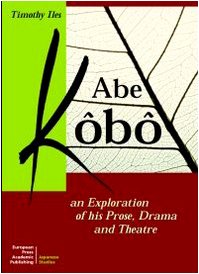
17. Abe Kobo: An Exploration of His Prose, Drama and Theatre (Tessere)
by Timothy Iles
Paperback: 232 Pages (2002-02)
list price: US$27.00 -- used & new: US$19.97
(price subject to change: see help)
Asin: 8883980034
Canada | United Kingdom | Germany | France | Japan

18. Le sanatorium des malades du temps: Temps, attente et fiction, autour de Julien Gracq, Dino Buzzati, Thomas Mann, Kobo Abe
by Eric Faye
 Unknown Binding: 236 Pages (1996)
-- used & new: US$46.68
(price subject to change: see help)
Asin: 2714305806
Canada | United Kingdom | Germany | France | Japan

19. Fake Fish the Theater of Kobo Abe
by N.K. Shields
 Paperback: Pages (1996)

Isbn: 0756754879
Canada | United Kingdom | Germany | France | Japan
Editorial Review

Product Description
This is the first study of an important part of Japanese author Kobo Abe's life, his work in the theater. Professor Nancy Shields attended all of the rehearsals & witnessed Abe's plays as they evolved under his guidance. She also accompanied his troupe on its American tour. In this volume she describes both the process & the art of a man who was no less gifted as a man of the theater than as a novelist. Abe directed his own plays because he felt that "writing a play & staging it were almost the same thing." The book is illustrated with over 100 black-&-white photos of Abe & the rehearsals & performances of his plays, & has an illuminating foreword by Donald Keene, an authority on Japanese culture. ... Read more


20.