e99 Online Shopping Mall

Geometry.Net - the online learning center Help  
Home  - Authors - Aristotle (Books)

  Back | 21-40 of 100 | Next 20
A  B  C  D  E  F  G  H  I  J  K  L  M  N  O  P  Q  R  S  T  U  V  W  X  Y  Z  

click price to see details     click image to enlarge     click link to go to the store

$6.00
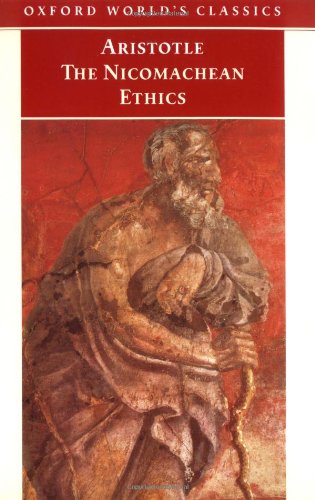
21. Aristotle: Nicomachean Ethics
$25.74
22. Phenomenological Interpretations
$9.13
23. Aristotle's Children: How Christians,
$6.00
24. Aristotle: The Politics and the
$21.95
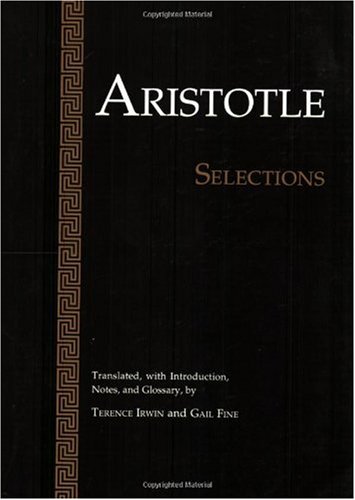
25. Aristotle: Selections
$24.00
26. Aristotle: Art of Rhetoric, Volume
$11.99
27. Aristotle -Ethics and Politics
$27.50
28. Essays on Aristotle's Ethics (Major
$56.13
29. Patterns of Light: Chasing the
$14.28
30. What Would Aristotle Do? Self-Control
$30.00
31. Introduction to Aristotle (Modern
$27.71
32. The Blackwell Guide to Aristotle's
$19.75
33. Commentary on Aristotle's Politics
$24.95
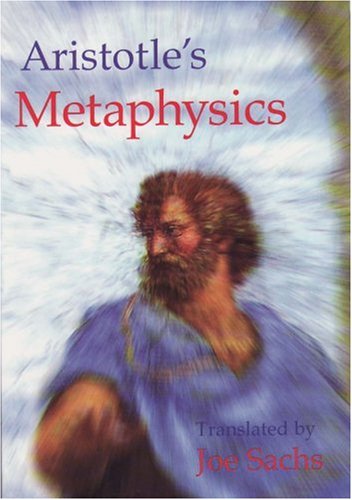
34. Aristotle's Metaphysics
$19.20
35. Aristotle: Metaphysics, Books
$23.90
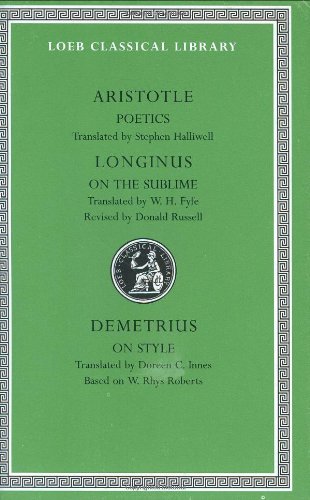
36. Aristotle:Poetics.; Longinus:
 
$18.99
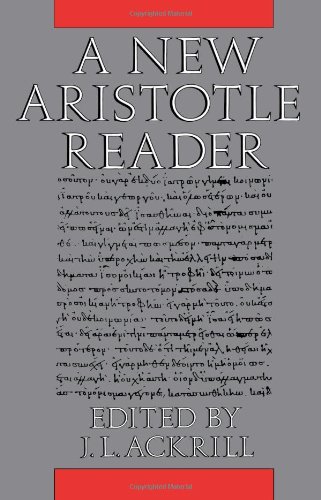
37. A New Aristotle Reader
 
$34.95
38. Aristotle: Introductory Readings
$11.55
39. Aristotle
$26.36
40. One and Many in Aristotle's Metaphysics:

21. Aristotle: Nicomachean Ethics (Cambridge Texts in the History of Philosophy)
by Aristotle
Paperback: 258 Pages (2000-04-13)
list price: US$14.99 -- used & new: US$6.00
(price subject to change: see help)
Asin: 0521635462
Average Customer Review: 5.0 out of 5 stars
Canada | United Kingdom | Germany | France | Japan
Editorial Review

Book Description
Aristotle's Nicomachean Ethics, based on lectures that he gave in Athens in the fourth century BCE, is one of the most significant works in moral philosophy, and has profoundly influenced the whole course of subsequent philosophical endeavor. Topics covered include the role of luck in human wellbeing, responsibility, courage, justice, friendship and pleasure. This accessible new translation follows the Greek text closely and also provides a non-Greek reader with something of the flavor of the original. The volume also includes a historical and philosophical introduction and notes on further reading.Download Description
This text gives great insight to the history of philosophy, and changes the way you think about ethics and morals.Excellent philosophical reading.A very important book for anyone who takes interest in their beliefs. Please note:This book is easy to read in true text, not scanned images that can sometimes be difficutl to decipher.This eBook has bookmarks at chaper headings and is printable. ... Read more

Customer Reviews (1)

5-0 out of 5 stars Doing the right thing
Aristotle was a philosopher in search of the chief good for human beings. This chief good is eudaimonia, which is often translated as 'happiness' (but can also be translated as 'thriving' or 'flourishing'). Aristotle sees pleasure, honour and virtue as significant 'wants' for people, and then argues that virtue is the most important of these.

In the Nicomachean Ethics, Aristotle makes the claim that happiness is something which is both precious and final. This seems to be so because it is a first principle or ultimate starting point. For, it is for the sake of happiness that we do everything else, and we regard the cause of all good things to be precious and divine. Moreover, since happiness is an activity of the soul in accordance with complete and perfect virtue, it is necessary to consider virtue, as this will be the best way of studying happiness.

How many of us today speak of happiness and virtue in the same breath? Aristotle's work in the Nicomachean Ethics is considered one of his greatest achievements, and by extension, one of the greatest pieces of philosophy from the ancient world. When the framers of the American Declaration of Independence were thinking of life, liberty, and the pursuit of happiness, there is little doubt they had an acquaintance with Aristotle's work connecting happiness, virtue, and ethics together.

When one thinks of ethical ideas such as an avoidance of extremes, of taking the tolerant or middle ground, or of taking all things in moderation, one is tapping into Aristotle's ideas. It is in the Nicomachean Ethics that Aristotle proposes the Doctrine of the Mean - he states that virtue is a 'mean state', that is, it aims for the mean or middle ground. However, Aristotle is often misquoted and misinterpreted here, for he very quickly in the text disallows the idea of the mean to be applied in all cases. There are things, actions and emotions, that do not allow the mean state. Thus, Aristotle tends to view virtue as a relative state, making the analogy with food - for some, two pounds of meat might be too much food, but for others, it might be too little. The mean exists between the state of deficiency, too little, and excessiveness, too much.

Aristotle proposes many different examples of virtues and vices, together with their mean states. With regard to money, being stingy and being illiberal with generosity are the extremes, the one deficient and the other excessive. The mean state here would be liberality and generosity, a willingness to buy and to give, but not to extremes. Anger, too, is highlighted as having a deficient state (too much passivity), an excessive state (too much passion) and a mean state (a gentleness but firmness with regard to emotions).

Aristotle states that one of the difficulties with leading a virtuous life is that it takes a person of science to find the mean between the extremes (or, in some cases, Aristotle uses the image of a circle, the scientist finding the centre). Many of us, being imperfect humans, err on one side or the other, choosing in Aristotle's words, the lesser of two evils. Aristotle's wording here, that a scientist is the only one fully capable of virtue, has a different meaning for scientist - this is a pre-modern, pre-Enlightenment view; for Aristotle, the person of science is one who is capable of observation and calculation, and this can take many different forms.

Aristotle uses different kinds of argumentation in the Nicomachean Ethics. He uses a dialectical method, as well as a functional method. In the dialectical method, there are opposing ideas held in tension, whose interactions against each other yield a result - this is often how the mean between extremes is derived. However, there are other times that Aristotle seems to prefer a more direct, functional approach. Both of these methods lead to the same understanding for Aristotle's sense of the rational - that humanity's highest or final good is happiness.

There is a discussion of the human soul (for this is where virtue and happiness reside). Aristotle argues that virtue is not a natural state; we are not born with nor do we acquire through any natural processes virtue, but rather through 'habitation', an embedding process or enculturation that makes these a part of our soul. However, it is not sufficient for Aristotle's virtue that one merely function as a virtuous person or that virtuous things be done. This is not a skill, but rather an art, and to be virtuous, one must live virtuously and act virtuously with intention as well as form.

Of course, one of the implications here is that virtue is a quantifiable thing, that periodically resurfaces in later philosophies. How do we calculate virtue?

This is a difficult question, and not one that Aristotle answers in any definitive way. However, more important than this is the key difference that Aristotle displayed setting himself apart from his tutor Plato; rather than seeing the possession of 'the good' or 'virtue' as the highest ideal, Aristotle is concerned with the practical aspects, the ethics of this. Based on Aristotle's lectures in Athens in the fourth century BCE, this remains one of the most important works on ethical and moral philosophy in history.

... Read more


22. Phenomenological Interpretations of Aristotle: Initiation into Phenomenological Research
by Martin Heidegger
Hardcover: 240 Pages (2001-12-01)
list price: US$37.95 -- used & new: US$25.74
(price subject to change: see help)
Asin: 0253339936
Average Customer Review: 4.0 out of 5 stars
Canada | United Kingdom | Germany | France | Japan
Editorial Review

Book Description
Preceding Being and Time, this work shows Heidegger attempting, through the use of novel vocabulary, to find his personal philosophical voice. As he elaborates a phenomenology of factical life--concrete human life as it is lived in relation to the world--Heidegger prepares readers for actual engagement in the work of phenomenology and introduces a phenomenological interpretation of Aristotle, one of the pivotal influences in the development of his philosophy. ... Read more

Customer Reviews (4)

5-0 out of 5 stars A perfect example of hermeneutics
This is one of the best examples of hermeneutics I have ever come across. Gadamer systematized the dicipline of hermeneutics but it was Heidegger's genius who developed the practice of hermeneutics years before, explaining the development of the history of philosophical ideas.

4-0 out of 5 stars Not for the Faint-Hearted, But an Excellent Book
This text holds a key place in the development of Heidegger's thought.As such, it is a must-read for scholars or philosophers who are already familiar with Heidegger's work.It is not, however, a good place to begin studying Heidegger.This is due more to the bizarre translation than to the much lamented difficulty of Heidegger's thoughts.Here, the reader should keep in mind that this text is a compilation of lecture notes by both Heidegger and his students, and so naturally lacks the polished form of a philosophical paper or book.Our translator, however, did not assist our understanding in the slightest by his inaccuracies and rigid word usages.

As for this being a book on Aristotle, one should have no illusions.However, the reader who found this disappointingly "flaky" seems to have missed the subtitle of the book (which our translator inscrutably renders as), "Initiation into Phenomenological Research."The lecture, like the "Natorp Report" of 1922, represents Heidegger's attempt to articulate a "hermeneutics of facticity" as the systematic starting point for a reading of key Aristotelian texts.

This book contains fascinating explorations of the idea of philosophy, critiques of culture and of intellectual discourse, and difficult but insightful expositions of the basic "categories" of everyday human life.Here is the early Heidegger at his best, if not at his most reader-friendly.

4-0 out of 5 stars Heidegger's Aristotle
Even though the way in which Heidegger scholars concentrate on his relationship to Aristotle is extremely conservative, this book itself is very interesting.If you are looking for an introductory book on Aristotle, this is not it.

2-0 out of 5 stars Misleading title
I was hoping for a book that would present some new slant on Aristotle's thought.I didn't get it.This is just another attempt by Heidegger to set out his own philosophy, with all of the tortured grammatical constructions and neologisms that one might expect. I think that Heidegger is most interesting when he's actually engaging other philosophers, and less so when setting out his own bizarre and flakey ideas.So if you're expecting to get some new insight into Aristotle, look elsewhere. ... Read more


23. Aristotle's Children: How Christians, Muslims, and Jews Rediscovered Ancient Wisdom and Illuminated the Middle Ages
by Richard E. Rubenstein
Paperback: 384 Pages (2004-09-20)
list price: US$15.00 -- used & new: US$9.13
(price subject to change: see help)
Asin: 0156030098
Average Customer Review: 4.0 out of 5 stars
Canada | United Kingdom | Germany | France | Japan
Editorial Review

Book Description

Europe was in the long slumber of the Middle Ages, the Roman Empire was in tatters, and the Greek language was all but forgotten, until a group of twelfth-century scholars rediscovered and translated the works of Aristotle. His ideas spread like wildfire across Europe, offering the scientific view that the natural world, including the soul of man, was a proper subject of study. The rediscovery of these ancient ideas sparked riots and heresy trials, caused major upheavals in the Catholic Church, and also set the stage for today's rift between reason and religion.

In Aristotle's Children, Richard Rubenstein transports us back in history, rendering the controversies of the Middle Ages lively and accessible-and allowing us to understand the philosophical ideas that are fundamental to modern thought.


... Read more

Customer Reviews (36)

4-0 out of 5 stars Compelling intellectual history
Author Richard Rubenstein explores one of the more perplexing questions of intellectual history with "Aristotle's Children" - if the wisdom of the Greek philosopher Aristotle was lost to Western Europe for centuries during the Dark Ages, how did he re-emerge as the linchpin of the "Western" mind?

In this well-researched, lean book, Rubenstein credits the great thinkers of Judaism, Islam, and Christianity with their various, critical contributions to keeping Aristotelean thought alive.While the book focuses more on the contributions of the Christian thinkers (Thomas Aquinas, Peter Abelard, etc.), all three faiths are represented.This seemingly dry topic makes for a riveting read, as the battle for the Western mind was literally life and death for thousands, if not millions, of Europeans.

Toleration of dissent was not a hallmark of the later Middle Ages, when Aristotle was rediscovered during the twelfth century.And yet as Aristotle's rational, worldly philosophy took hold among the religious minds of the age, many Christians (who seemingly should have shunned Aristotle out of hand on numerous grounds) nevertheless devoured his works and expounded upon their application.Rubenstein punctures the myth that the Middle Ages were bereft of critical intellectual leaps forward.

Ultimately, Rubenstein admires the efforts of the great religious thinkers to try and reconcile Aristotle's rational worldview with the faith-based religiosity of the day.One may quibble with Rubenstein's conclusion that our rational world could benefit from a more religious approach to how we order our society, but one cannot argue that he has not made a compelling case.

All in all, an excellent history and a fun read to boot.

5-0 out of 5 stars A Book About What???
Okay. A book about the middle ages, right? Uh-huh. But wait, not only about the (ugh!) middle ages, but about PHILOSOPHY in the middle ages? You're kidding, right? But, you say, there's more? It's not just about medieval philosophy and philosophers, but also about the intricate, and delicate balance between rationalism and faith in revelation, is that what you're telling me? And about how three distinct strains emerging? One that rejected faith for reason, one that rejected reason for faith, and one that desperately tried to hold the other two together? Yeah, like anyone would want to read THAT!!!

Well, this is one of the most beautifully written, intelligent, intriguing, and thought-provoking books I've read in a long time, and it was actually FUN TO READ. It was like a good novel, with surprisingly vital characters, even though they've all been dead for a millennium or so.

Go on. Give it a try!

3-0 out of 5 stars So-so analysis of fascinating history
First of all, the author is clearly not an Aristotle scholar.Still, he does a decent job of presenting Aristotle's basic ideas to the layman.However, he makes a few factually incorrect claims, such as that Aristotle, as opposed to Plato, had no use for mathematics.In fact, Aristotle inherited and accepted the Platonic view that mathematics, and geometry in particular, is the archetypal science--which led him to some unfortunate views, such as that ethics, lacking mathematical precision, cannot arrive at certain truths.

The author then does a fair job of tracing Aristotle's ideas through medieval Europe to the Rennaissance, though here again he makes some strange errors.For instance, he cites the Cathar heresy as a major example of an Aristotelian movement, though their ideas, as he describes them, are much more Platonic than Aristotelian, again as he himself describes the views of Plato and Aristotle.I am not a scholar of Catharism, but if they themselves claimed to be Aristotelian, then they badly misinterpreted Aristotle, and the author doesn't cite them making such claims anyway.The author also cites several other more Platonic thinkers such as William of Ockham as Aristotelians.It seems that he simply assumes any deviation from the explicitly Platonic Augustinian orthodoxy must by that fact alone be Aristotelian, and nothing could be further from the truth.

He does treat some thinkers more accurately, however, such as a fair exposition of Thomas Aquinas, and a nice account of Peter Abelard.And despite some of the errors of analysis, the book is definitely worth a read for those interested in intellectual history.

4-0 out of 5 stars Reading the book or reading into the book?
As most of the reviews below have noted, this book is well worth the read. I note only a couple of points: one might easily gain the impression from numerous reviewers' comments that Rubenstein confirms the shop-worn and frankly wrong religion-against-science dichotomy held by many. This is what he actually says "In a way that violated all of my modernist preconceptions, the leading force for transformative change in Western thinking turned out to be the leadership of the Catholic church... Rather than choose between the new learning and the old religion, the popes and scholars of the High Middle Ages tried to modernize the church by reconciling faith and reason. This Heculean task generated one of the richest,most searching debates in Western history... Their great passion was to integrate their understanding of the way things are and the way things should be. Their mission as Aristotelians and as Christians was to bring intellectual and moral order into a transforming world." (Preface, xi). Secondly, R, understandably perhaps in creating an immensely readable book, occasionally misrepresents even caricatures various figures most of whom, interestingly enough, he judges as representing the forces of tradition; i.e. on the wrong side. But, e.g. if Bernard's opposition to Abelard was merely that of an arch-conservative how does Rubenstein explain B.'s very different attitude to Anselm who thought in very similar ways? What R. seems to miss, ironically especially in view of his last chapter, is that Bernard cared deeply for community--he was a prolific letter writer who cared about relationships and spiritual friendship. It was Abelard's self-infatuation and arrogance that Bernard saw as threatening to tear Europe apart.I wonder if this might be one of the great lessons from this period: it's not just the ideas we hold but how hold we them, and what that says about our view of other persons (especially those who disagree with us, Hitchens and Dawkins are you listening?), that creates as much conflict as anything else.

4-0 out of 5 stars Very Good And Unique Introduction to Scholastic Thought
The traditional notion of church reformers in the middle ages has been one of rational scientific, if somewhat slightly aetheistic, monks and scientists in deadly battle with reactionary literal interpretation types, ever ready with the faggots to burn those who transgressed too much.

That is not merely oversimplified, it is completely wrong, and Rubenstein's very readable and unique prose shatters the traditional interpretation and shows how Aristotlianism was actually a prime embodiemnt of reasoning within the Church that allowed not only the calm and rational uinderstanding of "God's Plan", while allowing for the rise of science. Indeed, it was the church itself the, in the end allowed the flowering of Aristole's empirical and rational thought to teach deeper underpinnings of Christian thought.

Admittedly a lot of this work sounds extremely spurious by today's standards... most people outside of rather dated interpretations of faith would find the whole concept of rational confirmation for the devine essence of Christ a little abstract... but these matters were central to the Church or the Middle Ages.

One of the hallmarks of Christianity until the present, and one sure reason for its success as a mystical faith, has been its ability to incorporate the early advent of scientific thought and control it, at least initially, and use it to buttress the faith. St. Augustine, Thomas Aquinas, St Francis and Peter Abelard, Grossteste, Meister Ekhert and Willian of Occum, were all within the Church, and were all instrumental in the rise of scientific thought.

As Rubenstein relates, the strain eventually built between the conception of extreme reason and faith and Aristotilian faith imploded to generate cold scientifism and reactionary faith. But for the span of over 400 yrs Scholasticism allowed Christianity a new lease on life, while all the time pulling it away from purely faith based interpretations of the Bible.

Scholasticism has in fact yeilded the traditional mainstream churches that define western society and it is effectively what allows and extension of faith in a world where it is all too clear the scientific mode of thinking has been and will continue to strenghthen people's rational approach to the world. It is how the Vatican is able to reconcile the very evident fact of natural selection with faith in Godly creation.

In the current "God Debate" - with the vocerfious new Bulldogs of Dawkins and Harris on one hand, and the know-nothingism of fundamentalism, it is a shame, in Rubenstien's opinion that Scholasticism has declined, because it offers a way to bridge this devide, if there were but the will to reach out to each other -- for both sides to drop Dogma.

It is surely too late to put the genie of science back in bottle, there are always people who are ready to argue that Galilleo's telescope must be malfunctioning because it tells us the earth revolves around the sun (an assertion more powerfully held in the middle ages than creationism is adhered to by traditionalist fanatics in the present day). I cannot help thinking however that the world would be a much better place if those who disagree could engage in enlightened discourse in much the same way that Scholasticism developed.

Moreover the flowering of rational thought was the ... Read more


24. Aristotle: The Politics and the Constitution of Athens (Cambridge Texts in the History of Political Thought)
by Aristotle
Paperback: 328 Pages (1996-10-13)
list price: US$13.99 -- used & new: US$6.00
(price subject to change: see help)
Asin: 0521484006
Average Customer Review: 4.0 out of 5 stars
Canada | United Kingdom | Germany | France | Japan
Editorial Review

Book Description
This new collection of Aristotle's political writings provides the student with all the necessary materials for a full understanding of his work as a political scientist. In addition to a revised and extended introduction, this expanded Cambridge Texts edition contains an extensive guide to further reading and an index of names with biographical notes. Presentation of The Politics and The Constitution of Athens in a single volume will make this the most attractive and convenient student edition of these seminal works currently available. ... Read more

Customer Reviews (1)

4-0 out of 5 stars Aristotle's 'Politics' still essential
The Greek philosopher and scientist Aristotle possessed one of the most remarkable intellects of all time.He contributed to the body of knowledge in areas as diverse as logic and biology, ethics and physics, psychologyand politics.Although his work 'The Politics' has been widely published,few versions have been as effective as this in placing his politicalcommentary into the conext of his time.Certainly this contextualisationis this edition's greatest strength, and the feature which most clearlysets it apart from most other currently availabletranslations.

'ThePolitics' remains an essential feature in the literature of politics andphilosophy.Whether the reader is a first year political science studentor a senior lecturer seeking to replace that well-worn second (or third)copy of an earlier edition, the particular book will be the ideal choice. ... Read more


25. Aristotle: Selections
Paperback: 650 Pages (1995-10)
list price: US$21.95 -- used & new: US$21.95
(price subject to change: see help)
Asin: 0915145677
Canada | United Kingdom | Germany | France | Japan

26. Aristotle: Art of Rhetoric, Volume XXII (Loeb Classical Library No. 193)
by Aristotle
Hardcover: 544 Pages (2006-09-30)
list price: US$24.00 -- used & new: US$24.00
(price subject to change: see help)
Asin: 0674992121
Average Customer Review: 4.0 out of 5 stars
Canada | United Kingdom | Germany | France | Japan
Editorial Review

Book Description

Aristotle, great Greek philosopher, researcher, reasoner, and writer, born at Stagirus in 384 BCE, was the son of Nicomachus, a physician, and Phaestis. He studied under Plato at Athens and taught there (367-347); subsequently he spent three years at the court of a former pupil, Hermeias, in Asia Minor and at this time married Pythias, one of Hermeias's relations. After some time at Mitylene, in 343-2 he was appointed by King Philip of Macedon to be tutor of his teen-aged son Alexander. After Philip's death in 336, Aristotle became head of his own school (of 'Peripatetics'), the Lyceum at Athens. Because of anti-Macedonian feeling there after Alexander's death in 323, he withdrew to Chalcis in Euboea, where he died in 322.

Nearly all the works Aristotle prepared for publication are lost; the priceless ones extant are lecture-materials, notes, and memoranda (some are spurious). They can be categorized as follows: I Practical: Nicomachean Ethics; Great Ethics (Magna Moralia); Eudemian Ethics; Politics; Economics (on the good of the family); On Virtues and Vices. II Logical: Categories; Analytics (Prior and Posterior); Interpretation; Refutations used by Sophists; Topica. III Physical: Twenty-six works (some suspect) including astronomy, generation and destruction, the senses, memory, sleep, dreams, life, facts about animals, etc. IV Metaphysics: on being as being. V Art: Rhetoric and Poetics. VI Other works including the Constitution of Athens; more works also of doubtful authorship. VII Fragments of various works such as dialogues on philosophy and literature; and of treatises on rhetoric, politics and metaphysics.

The Loeb Classical Library edition of Aristotle is in twenty-three volumes.

... Read more

Customer Reviews (7)

5-0 out of 5 stars Ace of Spades
Holy Crap, its Faulders!My eyes are in disbelief at that chance of that, chance being one of the seven ways things come about in the world of men.We have to talk again, I miss your tutelage.Anyway,Aristotle has all the symptons of his thought fully functional in this treatise; meticulous detail, raging logic, a plethera of topics.But The Art of Rhetoric separates itself with ocean-sized gap from the rest of his work due to its immense practicality.Yes we know all about his logical prowlness, but ever tried to argue with a person who does not use logic?Not easy...But the methods Aristotle outlines to provoke enthusiasm, move crowds, and dominate in court apply to all human beings.Those who read (and reread because it does require that), will notice their communication skills increase drastically. He goes beneath the skin, into the unconscience of humanity to deliver unto us, an ace in up our sleeve, what can only be described as an intagible that will remain present the rest of our lives.The knowledge of rhetoric installs an intrinsic set of skills usefull in all walks of life, in any situation.I myself cannnot recall maybe even a few sentences of his actual work, but I put the book to full use every day of my life now, whether I'm aware of it or not.You need not be a philosphical mind, or have any interest at all in any sort of intellectual discovery, and this book still applies to you.We all need to speak; we all get to where we want to be by speaking.Might as well be good at it don't you think?READ IT AND GET POWERFUL!

5-0 out of 5 stars Greatness
How couldyou not give this book five stars? Aristotle's Rhetoric contains the greatness of an all-time classic and I shall praise the book following Aristotle's instructions on how to praise something (1. 9). The Rhetoric is either the first or among the first books that teaches a speaker how to address an audience. It comes from the time of great scholarly activity in Ancient Greece and clearly exceeds one's expectations. Every page is consistently insightful and each paragraph teaches something new about human nature. We should invent an "Aristotelian Rhetoric" award and give it to speakers who are trying their best to persuade an audience. Finally, Aristotle compares to Shakespeare when it comes to clarifying the deepest and most obvious concerns we all have as human persons.

The translation of Lawson-Tancred is very readable and clear. His notes before each chapter makes one's reading of the Rhetoric smooth and enjoyable. Two things made me sad when I first opened the book: the chapters have been re-organized and I am depending on the Bekker numbers (ex. 1354a1) to find my way in other texts and the font is kind of tiny. But I do understand that the re-organized chapters logically follow the text and the tiny font becomes easier to read and allows for a modest-sized tome.

Aristotle writes that we pity the person who cannot enjoy a good thing, and a person who cannot enjoy the Rhetoric certainly ought to be pitied.

5-0 out of 5 stars The Art Of Rhetoric
The content of this book is a key to modern democracy understanding, and the art of persuasiveness. The kind of book that you want to make sure your child read. I couldn't put it away. You should read it.

1-0 out of 5 stars Very weak translation of a very important book
Both the introduction and the translation by Hugh Lawson-Tancred are very much below the standard one expects from Penguin. Most importantly, the English of the translation is frequently incomprehensible. I advise everyone who wants to study this masterpiece of a book to use another edition, e.g. that of George Kennedy, published by Oxford in 1991, or the Loeb edition. That is, if you want to understand why so many people in so many ages found this book brilliant!

4-0 out of 5 stars The Headwaters of the River of Persuasion
As a trial lawyer and a pragmatist, I've long dismissed philosophy as the useless art of contemplating one's navel.That assessment began to change recently when I audited a continuing legal education seminar in which the speaker analyzed trial advocacy on the model of Aristotle's "Rhetoric."His speech was brief and his analysis superficial, but he'd aroused my curiosity.I got this book and read it.

The general principles Aristotle formulated for forensic rhetoric over 2,000 years ago still hold true in the 21st century courtroom.Some of the specifics have changed (e.g. no torture for slave witnesses), but human nature hasn't, and human persuasion hasn't, either. Aristotle's "Rhetoric" should be required reading for all first year law students.I regret not reading it 30 years ago.Apparently philosphers do more than just stare at their navels. ... Read more


27. Aristotle -Ethics and Politics
by Aristotle
Paperback: 280 Pages (2006-01-01)
list price: US$21.95 -- used & new: US$11.99
(price subject to change: see help)
Asin: 0977340015
Average Customer Review: 5.0 out of 5 stars
Canada | United Kingdom | Germany | France | Japan
Editorial Review

Book Description

The monumental importance of Aristotle's philosophy on Western thought cannot be overstated.It has overshadowed the entire field of philosophical and political thought for well over two millennia. Along with Socrates and Plato, Aristotle is considered to be among the foremost philosophers of all time.His philosophical views have cast a long shadow and continue to be required reading for students at most intuitions of higher learning throughout the world.

The Ethics of Aristotle is one half of a single treatise of which his Politics is the other half. Both deal with one and the same subject. This subject is what Aristotle calls in one place the "philosophy of human affairs;" but more frequently Political or Social Science. In the two works taken together we have their author's whole theory of human conduct or practical activity, that is, of all human activity, which is not directed merely to knowledge or truth. The two parts of this treatise are mutually complementary, but in a literary sense each is independent and self-contained.

In these two major works, Aristotle assumes the characteristic Platonic view that all men seek the good, and go wrong through ignorance, not through evil will.The end of all action, individual or collective, is the greatest happiness of the greatest number. There is, Aristotle insists, no difference of kind between the good of one and the good of many or all.He naturally regards the state as a community that exists for the sake of the good life. It is in the state that that common seeking after the good, which is the profoundest truth about men and nature, becomes explicit and knows itself. Hence for Aristotle as for Plato, the natural state or the state as such is the ideal state, and the ideal state is the starting-point of political inquiry. ... Read more

Customer Reviews (3)

5-0 out of 5 stars Great Book!

Aristotle -Ethics and Politics is a great book. It is considered to be a classic for good reasons:it is a good read, it deals with really important matters, it is superb literature and it is a landmark in the history of civilization.

For about two thousand years, it has been on the reading list of most educated people in the Western Hemisphere.Undoubtedly, it will still be part of the curriculum at most of the world's colleges and universities two thousand years from now.You just can't consider yourself to have received a proper education without having read this great Greek classic.

While you are at it, you should also read:
Homer - The Iliad and The Odyssey
History of the Peloponnesian War
and
Anabasis: The March Up Country

Classics like these are not stuffy, pompous, overblown literature as some ignorant anti-intellectuals might think.They are genuine looks at life by excellent writers who had something important to say - and said it well.

5-0 out of 5 stars First and Finest Example of Political Logic

Aristotle was not right about everything - but his immense intellect touched just about everything - and established the point of departure for earnest discussion into the affairs of mankind.He has often been considered to be a god, or nearly so, much to the detriment of his stated aim - to arrive at the view closest to that elusive quantity Truth.

So great is his reputation that when you read Aristotle, try as you might, it is nearly impossible to read him with an open mind, but that is what is required in order to see his philosophy for what it really is and not for what you have been told that it is. Do you have what it takes?

5-0 out of 5 stars Good Book - Two for the Price of One

Aristotle was not a God, but for centuries his writings were taken as gospel.He left a legacy that has left an indelible impression on the intellectual history of this planet.His support for the intuition of slavery has been consistently overlooked by the supporters of the other elements of his political philosophy.The founding fathers of the United States were right at home with Aristotle's views.

Unless one has read and contemplated the important works of Aristotle (the two most important are combined in this volume), it is not reasonable to expect them to really grasp the political roots of Western Civilization and how the offshoots have evolved.In reading these works, with some knowledge of the intervening history, Aristotle's errors of judgment become apparent.

The flaws notwithstanding, "Ethics" and "The Politics" are essential to a decent education.If nothing else, understanding where some of the inconsistencies in our society came from can help provide better solutions to the problems.
... Read more


28. Essays on Aristotle's Ethics (Major Thinkers Series ; 2)
Paperback: 438 Pages (1981-03-17)
list price: US$27.50 -- used & new: US$27.50
(price subject to change: see help)
Asin: 0520040414
Average Customer Review: 4.0 out of 5 stars
Canada | United Kingdom | Germany | France | Japan
Editorial Review

Book Description
Aristotle's Nicomachean Ethics deals with character and its proper development in the acquisition of thoughtful habits directed toward appropriate ends. The articles in this unique collection, many new or not readily available, form a continuos commentary on the Ethics. Philosophers and classicists alike will welcome them. ... Read more

Customer Reviews (1)

4-0 out of 5 stars Getting Back to Aristotle
In this collection of 21 essays, most written during the 1970s, Amelie Rorty has pulled together some penetrating and diverse analyses of the Nicomachean Ethics (and related works) of Aristotle.One of the valuable features of the book is its arrangement: the essays are grouped according to the books of the Ethics of which they treat.Thus, the essays on *akrasia* are grouped together. The two best essays in the book, in my humble opinion, are John M. Cooper's "Aristotle on Friendship," and Martha Craven Nussbaum's "Shame, Separateness, and Political Unity: Aristotle's Criticism of Plato."Both lead one to pursue further reading in these interesting topics.Nussbaum, for example, not only provides a critique of Plato's concept of self-respect, particularly in The Republic, and compares it to Aristotle's presentation in the Ethics and the Politics; she also brings in John Rawls' A Theory of Justice, and two novels by Henry James. For those looking for some guidance, and some analytic tools, in reading Aristotle's ethical works, this is a great resource. ... Read more


29. Patterns of Light: Chasing the Spectrum from Aristotle to LEDs
by Steven Beeson, James W. Mayer
Hardcover: 196 Pages (2008-01-03)
list price: US$69.95 -- used & new: US$56.13
(price subject to change: see help)
Asin: 0387751068
Canada | United Kingdom | Germany | France | Japan
Editorial Review

Book Description

This book begins by addressing properties of light as seen in the everyday world: events such as refraction in a pool, lenses in the form of glasses, the colors of objects, atmospheric events, etc. Latter chapters would explain these events at the atomic and subatomic level and address the use of electron and optical microscopy in observing the worlds unseen by the unaided eye. The book is an elegant, and aesthetically pleasing volume that is intended for science students, and will be enjoyed by those with a background in optics. Exercises and activities will be found in an appendix, but the primary volume can stand alone if the reader so desires. There are several well-written and extensive volumes in the "physics of light and color" market; however, Patterns of Light will fill a niche by providing an overview of the entire electromagnetic spectrum, rather than simply focusing on visible light.

... Read more

30. What Would Aristotle Do? Self-Control Through the Power of Reason
by Elliot D. Cohen
Paperback: 251 Pages (2003-05)
list price: US$21.00 -- used & new: US$14.28
(price subject to change: see help)
Asin: 1591020700
Average Customer Review: 4.5 out of 5 stars
Canada | United Kingdom | Germany | France | Japan
Editorial Review

Book Description
Do you get upset easily, even about small things, or have trouble getting along with others? Do you feel down most of the time? Are you plagued by loneliness, grief, guilt, or a gnawing feeling of life's futility? Philosopher Elliot D. Cohen offers an uncommonly commonsense approach to these and many other problems and reveals how you can gain genuine insight into the confusions of everyday life by harnessing your own natural powers of reason and critical thinking. ... Read more

Customer Reviews (8)

3-0 out of 5 stars okay
i learned a lot about Aristotle, but didn't find the book as provocative as i'd hoped. Writing and thinking is decent but bland.

5-0 out of 5 stars What Would Aristotle Do?
Elliot D. Cohen's personal insight on how to think and use reasoning in your everyday life is a useful tool to anyone. He shows us how to logically and rationally approach our inner struggles of life. He shows by changing the way one thinks and looks at life then one can successfully deal with their negative outlooks. He helps you tackle your behavioral and emotional problems through rules and reports (how you should think about things). He also shows that there are fallacies in reasoning, and he provides you antidotes to over come these fallacies.

This book is a fantastic guide to helping someone think in the approved manner. Cohen's logic and personal experiences gives you a ray of hope. He turns on a light and shows you that you do not have to live a life in the dark. You do not have to be a philosopher or psychologist to have good reasoning.

5-0 out of 5 stars Short term therapy for long term results.
I am taking the liberty of quoting Dr. Albert Ellis. Albert Ellis wrote A Guide to Rational Living almost fifty years ago. Arguably one of the best self help books ever writen.

In "What Would Aristotle do", Mr. Cohen builds upon the brilliant revelations and keen insight of "Rational Living". Mr. Cohen adds to the science of self help with humor and simplicity. You can't go wrong with this one. I expect most everyone's life will be a little happier for taking the time to read a couple hundred pages.

5-0 out of 5 stars Excellent REBT Therapy for Neurosis and Depression
The field of psychology is in disarray. What began in the late nineteenth-century as an exploration into the dynamics of the mind (i.e., psyche) and human behavior has been torn asunder by the variant "schools" of psycho-dynamics. After years of psychoanalysis, more people found "relief" in Wayne Dyer's "Your Erogenous Zones" than benefitted from twenty years of Freudian or Jungian psychoanalysis. With the advent of TCAs and SSRIs, even more people found relief in a little pill than in two centuries of talk therapy. What we know or don't know about psychiatry and psychology is more baffling now than ever will. For whatever it is worth, the human psyche is more evasive than tangible, and I'm not sure more damage than good has been done under its various mentors.

I have come to believe that three aspects of human behavior are unquestionable: (1) What we learned as children plays a more significant role in human dynamics than we'll ever know; (2) no matter what era one lives in, there's always a degree of alienation, anger, and angst; and (3) that certain chemical imbalances in the brain play an important, if not vital, role in how we adapt to life in general, and to change in particular. Treatment of neurosis and affective disorders usually requires that we adapt better than we have, and "traditional" psychoanalysis has been found seriously wanting. That having been said, I want to evaluate two books outside that domain and within the domain of "self help" that appear to be of enormous benefit. They are: (i) Albert Ellis' and Robert Harper's "A Guide to Rational Living, and (ii) Elliot Cohen's "What Would Aristotle Do?"

Both books are in the domain of Cognitive, or Rational-Emotive, Behavioral Therapy. The more I've studied the historical, intellectual, and hermeneutic influences from the Hellenistic Period, the more I am convinced that the cognitive "therapy of desire" and the cognitive "treatment of upheavals of thought" play a significant role in how we adapt to our daily lives than anything approaching Freud or Jung will ever do. Simply by changing our attitudes, reactions, and plights against our most basic emotions, the more we are adept at, and adapt to, leading more successful, healthy, and balanced lives. Both "A Guide to Rational Living" and "What Would Aristotle Do?" are in this latter venue. Both books are invaluable in teaching the reader how to overcome obstacles in one's life in a way that is both realistic and therapeutic.

The first misconception to get over is that the passions (i.e., emotions) are somehow separate and distinct from our ratiocinative faculties of the mind. Both cognitive and evolutionary psychology have demonstrated, without argument, that the two function occur within the same mental framework (cf., Daniel Goleman's "Emotional Intelligence," which locates all emotions in the amygdala). The second misconception to overcome is that emotions, qua emotions, are generally unhealthy, e.g., the Stoics. Take one example: The fright/flight response is an evolutionary response to fear that all of us animals, including human ones, have for self-preservation. This emotion, like many others, are key to our survival. As Martha Nussbaum argues cogently, even love and compassion are survival-oriented emotions (see her "Upheavals of Thought.").

Most debilitating emotions arise because we have not taught ourselves how to think/emote rationally. Both books argue and attempt to treat this. The difference between the two is that "A Guide to Rational Living" is less adept at how to change our rational control over our emotions, while "What Would Aristotle Do?" explicates the process in considerable detail. Either book is better than nothing, but clearly the later gives explicit directions on how to overcome irrational thinking. Aristotle (yes, him) distinguished between theoretical and practical reasoning over two millennia ago, and his assessment has not been devalued over time. In practical reasoning - the reasoning that determines how we act either ethically or emotionally, one begins with a universal premise, then supplying a particular premise, and then coming up with a conclusion or action. For example: "Do good, avoid evil" is a universal premise; than add the particular premise: "If I am good to John, he'll be good to me." In this case the universal premise is probably correct, but the particular premise is fallacious. Just because I love John does not mean he'll love me. When John fails to be good to you, the usual response is something like, "he hates me," "because he hates me, I am no good," "you idiot, I did my best, and you didn't reciprocate," etc. Sometimes, it's because of a faulty universal premise: "If I'm good, others should be good."In either case, both universal and particular premises are irrational. First, no one is wholly good, and secondly, even if one believes himself good, doesn't mean someone else is.

Both books illustrate the fallacies of such arguments. And, once one sees the fallacy of this kind of argument, the more one feels anger, frustration, and depression dissipate. I personally think, "What Would Aristotle Do?" brings out these fallacies more clearly, but both books touch on the same irrational beliefs that lead to the same irrational emotions. Whether it is the universal premise or the particular premise, or both, that cause our fallacies and lead us into emotional grief, it is, after all, our faulty thinking that leads us to disappointment, anger, frustration, depression, etc.. Learning how to detect and correct such premises is what both books are about. "What Would Aristotle Do?" tends to be more attractive to those who are more "rational" about their thinking process, whereas "A Guide to Rational Living" tends to more attractive to those who are more emotive. Both books will get you to the desired end. And either book will "get you there" for less than one-fifth the price of a single psychoanalysis. And, for those seriously depressed, another book worth considering is "Feeling Good: The New Mood Therapy," which also uses CBT to alleviate much distress. I wasn't impressed with it as I was the other two. But whatever you do, invest in at least one of these books; unhealthy emotions and depression are not necessary, as each shows.

5-0 out of 5 stars How to Think, Not What to Think
Cohen's "What Would Aristotle Do?" is an important and welcome contribution not just to the fields of talk therapy in general and philosophical counseling in particular, but also to the long forgotten field of common sense and for this very simple reason: he teaches you how to think and not what to think. For over 2000 years people have been taught, to the demise of independent thought, what to think and not how to think. To quote a master on the subject, Paul Thyry, Baron D'Holbach, wrote in the preface to his book "Le Bons Sens" that

"When we examine the opinions of men, we find that nothing is more uncommon, than common sense; or, in other words, they lack judgment to discover plain truths, or to reject absurdities, and palpable contradictions."

Cohen's book offers people not only the conceptual tools they need but the conceptual tooks they must have to extricate themselves from the "lives of quiet despiration" they lead to the life they would lead if they only knew how. He does this, as only a philosopher can, by first distinguishing "thinking about things" from "thinking about one's own thinking." He then goes on to offer examples of how thinking about one's own thinking can lead a person from faulty and/or gratuitous assumptions to sound reasoning about the true nature of the problems people face. He identifies common fallacies in reasoning, demonstrates their fallaciousness, and illuminates, using his own logic-based REBT (Rational Emotion Behavior Therapy), how to think correctly.

Unlike most books on talk therapy, as Thoreau said about newspapers, Cohen's book offers more than a change of names and dates; the content, as well as the approach, is decidedly and refreshingly different. For those people who have not yet learned how to think -- and if you do not understand what the phrase "how to think" means -- then this book will teach you how to think about the life you would lead if you only could.

Kenneth Cust RPN, Ph.D.
Central Missouri State University ... Read more


31. Introduction to Aristotle (Modern Library)
by Aristotle
Hardcover: 752 Pages (1992-09-05)
list price: US$24.95 -- used & new: US$30.00
(price subject to change: see help)
Asin: 0679600272
Average Customer Review: 4.0 out of 5 stars
Canada | United Kingdom | Germany | France | Japan
Editorial Review

Book Description
Includes the complete Posterior Analytics, De Anima, Nichomachean, Ethics, and Poetics with selections from Physics, Metaphysics, and Politics ... Read more

Customer Reviews (1)

4-0 out of 5 stars A useful and comprehensive introduction.
It's been said somewhere, don't remember by whom, that all of western philosophy is a series of footnotes to Plato and Aristotle. This may be a bit of an exaggeration, but the fact remains that these two seminal figures of western thought have left at least an indirect mark on all of the subsequent thinkers. And yet, it's been my experience that Plato ismuch more widely read and studied, in college courses and otherwise, than his equally famous erstwhile disciple. This probably has to do a lot with the style: Plato's "Socratic dialogs" have been written in a form that makes them instantly accessible to readers of all ages, and tends to belie the complexities and subtleties of the underlying ideas. Aristotle's style is much more pedantic and scholarly. One could easily see his writings appearing in peer-reviewed journals.

In part due to the above considerations, it took me a while to finally pick up a book of Aristotle's writings and try to go through at least some of them. This volume brings a few of his works in their entirety, but for most part only more important excerpts are given. Reading it requires some effort on the part of the reader, especially if you are not used to the style and substance of ancient Greek thought. However, the effort was worthwhile, and I've come away from reading this work with renewed and deepened appreciation for Aristotle. In terms of the sheer breadth of his inquiry, there has not been anyone quite like him before or since. ... Read more


32. The Blackwell Guide to Aristotle's Nicomachean Ethics (Blackwell Guides to Great Works)
Paperback: 384 Pages (2006-02-06)
list price: US$36.95 -- used & new: US$27.71
(price subject to change: see help)
Asin: 1405120215
Canada | United Kingdom | Germany | France | Japan
Editorial Review

Book Description
The Blackwell Guide to Aristotle’s Nicomachean Ethics illuminates Aristotle’s ethics for both academics and students new to the work, with sixteen newly commissioned essays by distinguished international scholars.


  • The structure of the book mirrors the organization of the Nichomachean Ethics itself.
  • Discusses the human good, the general nature of virtue, the distinctive characteristics of particular virtues, voluntariness, self-control, and pleasure.
... Read more

33. Commentary on Aristotle's Politics
by Aquinas, Saint Thomas
Paperback: 213 Pages (2007-03)
list price: US$19.95 -- used & new: US$19.75
(price subject to change: see help)
Asin: 0872208699
Canada | United Kingdom | Germany | France | Japan
Editorial Review

Book Description
The first complete translation into modern English of Aquinas'unfinished commentary on Aristotle's Politics, this translationfollows the definitive Leonine text of Aquinas and moreover reproduces inEnglish those passages of William of Moerbeke's famously accurate yetelliptical translation of the Politics from which Aquinas worked. Bekker numbers have been added to passages from Moerbeke's translation foreasy reference. ... Read more


34. Aristotle's Metaphysics
by Aristotle, Joe Sachs
Paperback: 303 Pages (1999-03-12)
list price: US$24.95 -- used & new: US$24.95
(price subject to change: see help)
Asin: 1888009039
Average Customer Review: 3.5 out of 5 stars
Canada | United Kingdom | Germany | France | Japan

Customer Reviews (3)

3-0 out of 5 stars A Word or Two on This Translation
I preface this with one caveat: I am not a Greek scholar. I have, however, read this book, in toto, in this translation. I have also read, though not in its entirety, another translation.Joe Sachs, positively a very intelligent scholar of these texts, has tried to put it into what he considers to be true to the Greek. Again, I am not a scholar of the Greek language, but I think that Sachs goes 'overboard,' if you will, in presenting to us, the laypeople, a translation beyond what is really necessary to get the job done. By that, I mean that a traditional translation is more than adequate, so long as you don't try to get at the Thomistic textual analysis at first go-round, or so I'm told. There are several chapters (keeping in mind, this is Aristotle's Metaphysics we're talking about) where I had trouble discerning pages at a time, reading and re-reading just for an objective account of what Aristotle was saying, or trying to say through Dr. Sachs.The Metaphysics should be read; that is not the question. The question is whether this is the translation for you. I, for one, will say that it is not. Not because of uncanny foresight, but due to the difficult readability of such a complex exposition on reality, being, and, in the concluding chapters of course, God.So, I give this version 3 stars: as a text in itself, it is good; it is not a wonderfully understandable translation, however.I hope that this verbose review has been beneficial for you.

4-0 out of 5 stars Meticulous translator of Aristotle
I've not read Sachs's translation of the Metaphysics, though I did work through his version of the Physics during a summer at St. John's College (where he teaches).His Metaphysics was circulating as a xerox copy at the college bookstore; I'm glad to see it in print.

Anyone unfortunate enough (as I am) to read Aristotle in English rather than ancient Greek, can benefit from Sachs's translations, though it remains worthwhile to have something like the classic Oxford translation alongside, to compare their senses of the Greek text.Sachs's object is to recover what Aristotle may've been up to, by avoiding the Latinate terminology that haunts Aristotle studies and trying to find more "authentic" meanings for the Greek words.Whatever his ultimate success or failure, it's wonderful to have such a fresh approach to the translation of Aristotle available.

3-0 out of 5 stars Maybe Aristotle wasn't interested in philosophy
This translation of Aristotle from the Greek directly into modern English makes use of the scholarship surrounding the efforts which have been most successful with Heidegger.

`Thus, the way I understand *to ti en einai* departs from, but is rooted in, Owen's understanding of it.The same is true of my rendering *ousia* as "thinghood," when it is used in a general sense, and as "an independent thing" when it is used of singulars.I have heard two sorts or criticism of my use of the word thinghood in Aristotle's PHYSICS.The one sort, that it occasions laughter or embarrassment, is a general instance of Heidegger's observation in WHAT IS A THING? that philosophy is that at which thoughtless people laugh.Let the laughter or embarrassment subside, and then judge the meaning carried by the word, both on its own and in its context, on its merits.The other sort of criticism regrets the fact that thinghood is not as closely related to being as *ousia* is to *to on.* . . .' (p. xxxvii).

"Lassie is an *ousia,* and the *ousia* of Lassie is dog."(p. xxxviii).

Intellectuals need to pay attention to the concepts that are used in their own fields, if nowhere else, and Aristotle was close to the peak of ancient Greek intellectual attainment.

"Aristotle invents a second word, being-at-work-staying-itself (entelecheia), converging with it in meaning, to sharpen and clarify his use of being-at-work, and he gives an array of examples in which we are meant to `see at a glance by means of analogy,' what it means (1048a 39)."(p. xxxix).

In the beginning of this book, ARISTOTLE'S METAPHYSICS, Translated by Joe Sachs, there is a Greek Glossary with 49 words or phrases on three pages, followed by an English Glossary of 43 words or phrases on eleven pages."This is a slightly revised version of the glossary that appears with the translation of the PHYSICS, based upon those passages in which Aristotle explains and clarifies his own usage.Bekker page numbers from 184 to 267 refer to the PHYSICS; those from 980 to 1093 are in the METAPHYSICS."(p. xlix).

Chapters are short, especially in Book V (Book Delta), which Joe Sachs calls "Things Meant in More than One Way."This has usually been considered "a dictionary, but Aristotle himself, at the beginnings of Books VII and X, says that it is about the various ways things are meant.The point is not to define words but to collect and organize the distinct senses of important words meant in more than one way.These ambiguities are not verbal but inherent in things, and Aristotle steadfastly preserves them."(p. 77, n. 1).

I am not particularly fond of this book.If undergraduate college courses are meant to provide students with general outlook on likely events, and graduate schools at major universities are intended to select those students who want to qualify for cutting edge work in a highly specialized professional discipline, the works of Aristotle seem to be the high point of a Greek attempt to create an upper level above anything that had previously been considered possible.Alexander the Great, as a student of Aristotle, might be faulted for aspiring to far more than what could be useful, just as Heidegger seemed to be pushing for a German spirit that was sure to damn the rest of the world to misery when he assumed a place in the leadership of a German university backing Hitler and the Nazi party.

I did not find Aristotle's approach to religion in Book VI to be inspiring, though it does seem to be intellectual."But if there is anything that is everlasting and motionless and separate, . . .

"And while it is necessary that all causes be everlasting, these are so most of all, since they are responsible for what appears to us of the divine.Therefore there would be three sorts of contemplative philosophy, the mathematical, the natural, and the theological; for it is not hard to see that if the divine is present anywhere, it is present in a nature of this kind, and that the most honorable study must be about the most honorable class of things.The contemplative studies, then, are more worthy of choice than are the other kinds of knowledge, and this one is more worthy of choice than are the other contemplative studies."(pp. 110-111).

This is a nice priority for an established church to maintain its dignity, but it is far more ancient than modern.It is not clear how infinite his "triangle containing two right angles" (p. 112) is supposed to be.Even his attempts to tiptoe around the major stereotypes of ancient bookworms seem limp."For instance, it is neither always nor for the most part that someone pale has a refined education, but since it sometimes happens, it will be incidental (or if not, everything would be by necessity)."(p. 113).

The Index only mentions three pages in Aristotle's text for Socrates, though Aristotle often uses his name as an example:"And since Socrates exerted himself about ethical matters and not at all about the whole of nature," (p. 14) and "so that whether Socrates is or is not, one might become like Socrates, and it is obvious that it would be the same even if Socrates were everlasting."(p. 23).Two generations of seeking lessons from Socrates, ignoring whatever meaning the hemlock had, took place before we find Aristotle finally admitting "For there are two things one might justly credit Socrates with, arguments by example and universal definition,"(p. 260).A real philosopher ought to do better than that. ... Read more


35. Aristotle: Metaphysics, Books I-IX (Loeb Classical Library No. 271)
by Aristotle
Hardcover: 512 Pages (1979-06)
list price: US$24.00 -- used & new: US$19.20
(price subject to change: see help)
Asin: 0674992997
Average Customer Review: 5.0 out of 5 stars
Canada | United Kingdom | Germany | France | Japan
Editorial Review

Book Description

Aristotle, great Greek philosopher, researcher, reasoner, and writer, born at Stagirus in 384 BCE, was the son of Nicomachus, a physician, and Phaestis. He studied under Plato at Athens and taught there (367-347); subsequently he spent three years at the court of a former pupil, Hermeias, in Asia Minor and at this time married Pythias, one of Hermeias's relations. After some time at Mitylene, in 343-2 he was appointed by King Philip of Macedon to be tutor of his teen-aged son Alexander. After Philip's death in 336, Aristotle became head of his own school (of 'Peripatetics'), the Lyceum at Athens. Because of anti-Macedonian feeling there after Alexander's death in 323, he withdrew to Chalcis in Euboea, where he died in 322.

Nearly all the works Aristotle prepared for publication are lost; the priceless ones extant are lecture-materials, notes, and memoranda (some are spurious). They can be categorized as follows: I Practical: Nicomachean Ethics; Great Ethics (Magna Moralia); Eudemian Ethics; Politics; Economics (on the good of the family); On Virtues and Vices. II Logical: Categories; Analytics (Prior and Posterior); Interpretation; Refutations used by Sophists; Topica. III Physical: Twenty-six works (some suspect) including astronomy, generation and destruction, the senses, memory, sleep, dreams, life, facts about animals, etc. IV Metaphysics: on being as being. V Art: Rhetoric and Poetics. VI Other works including the Constitution of Athens; more works also of doubtful authorship. VII Fragments of various works such as dialogues on philosophy and literature; and of treatises on rhetoric, politics and metaphysics.

The Loeb Classical Library edition of Aristotle is in twenty-three volumes.

... Read more

Customer Reviews (1)

5-0 out of 5 stars Useful for the specialist and the student
Like most volumes in the Loeb series, the emphasis is not on word-for-word precision in the translation, but on acheiving greater readability in broader terms. Since the original text in ancient Greek is provided on the facing page, the editors assume that anyone with a little knowledge of Greek can supplement the looseness of the translation by referring to the original. And in general, the compromises made in this way are good ones throughout the series. Tredennick's translation may be a little too loose, and also given over to some unfortunate jargon that can distort Aristotle's meaning. But even so, this is still a very useful text for the specialist or the student. ... Read more


36. Aristotle:Poetics.; Longinus: On the Sublime; Demetrius: On Style (Loeb Classical Library No. 199)
by Aristotle, Longinus, Demetrius
Hardcover: 560 Pages (1996-03)
list price: US$24.00 -- used & new: US$23.90
(price subject to change: see help)
Asin: 0674995635
Average Customer Review: 5.0 out of 5 stars
Canada | United Kingdom | Germany | France | Japan
Editorial Review

Book Description

This volume brings together the three most influential ancient Greek treatises on literature. Aristotle's Poetics contains his treatment of Greek tragedy: its history, nature, and conventions, with details on poetic diction. Stephen Halliwell makes this seminal work newly accessible with a reliable text and a translation that is both accurate and readable. His authoritative introduction traces the work's debt to earlier theorists (especially Plato), its distinctive argument, and the reasons behind its enduring relevance.

The essay On the Sublime, usually attributed to "Longinus" (identity uncertain), was probably composed in the first century CE; its subject is the appreciation of greatness ("the sublime") in writing, with analysis of illustrative passages ranging from Homer and Sappho to Plato. In this edition, Donald Russell has revised and newly annotated the text and translation by W. Hamilton Fyfe, and supplied a new introduction.

The treatise On Style, ascribed to an (again unidentifiable) Demetrius, was perhaps composed during the second century BCE. It is notable particularly for its theory and analysis of four distinct styles (grand, elegant, plain, and forceful). Doreen Innes' fresh rendering of the work is based on the earlier Loeb translation by W. Rhys Roberts. Her new introduction and notes represent the latest scholarship.

... Read more

Customer Reviews (1)

5-0 out of 5 stars EXCELLENT TRANSLATION - EXCELLENT STUDY GUIDE
I certainly refuse to be presumptuous enough to write a critique addressing the works of Aristotle, but do give this particular translation and particular publication five stars.It is an excellent study guide.It is quite superior to the Classics Club Edition. Recommend it highly.The cross references to the orginal greek are wonderful and quite useful.You need to add this one to your library if your interest points in this direction. ... Read more


37. A New Aristotle Reader
 Paperback: 600 Pages (1988-01-01)
list price: US$29.95 -- used & new: US$18.99
(price subject to change: see help)
Asin: 0691020434
Average Customer Review: 4.5 out of 5 stars
Canada | United Kingdom | Germany | France | Japan

Customer Reviews (2)

4-0 out of 5 stars Very usable and useful
This volume contains a well-chosen selection of Aristotle's works. As another reviewer suggests, this book is a welcome middle ground between 'pocket' editions and a full blown Oxford edition.

The translations (though I am by no means a scholar of Greek) seem to be quite proper, and despite the fact that different sections may be translated by different people, there is no apparent unevenness.

Ackrill laments in the introduction that it would have been more proper to leave about 30-40 Greek words (such as 'logos', 'aitia', 'ousia') untranslated, since no single English word does them justice. But that since there aretranslations by several people involved, that was not possible.

All in all, this would be a very handy book for anyone interested in Aristotle.

5-0 out of 5 stars An Excellent Compendium
For students who desire neither the whole Oxford corpus or who need a more condensed version of the Oxford translation, this edition, edited by the renowned Aristotlean scholar Ackrill, will be pleasantly kept in good company.

I own both books, and oddly find myself picking up this volume rather than the two-volume set, for easy reference. All the essential material is here, and none of the important elements are injudiciously edited. Thus for a single volume, it does double duty -- providing the most current translation of Aristotle, while appropriately editing the most salient parts for the specialist and non-specialist alike.

The book is appropriate for undergraduate and graduate semester courses as a complete enough text for either venue. It also has a nice topical index in the back that refers the reader to many essays written in the scondary literature. ... Read more


38. Aristotle: Introductory Readings
by Aristotle
 Hardcover: 359 Pages (1996-10)
list price: US$34.95 -- used & new: US$34.95
(price subject to change: see help)
Asin: 0872203409
Average Customer Review: 1.0 out of 5 stars
Canada | United Kingdom | Germany | France | Japan

Customer Reviews (1)

1-0 out of 5 stars not useful - get fuller volume
Irwin's and Fine's translations merit a five-star rating. They are expert scholars who have for decades been at the forefront of Aristotle research. Besides 100% technical accuracy they helpfully subscript (i) Aristotle's keyterms which can't be uniformly translated and (ii) those keyterms which have only one English equivalent ('form', 'being', 'knowledge', etc).

However, I warn customers NOT to get this book (I made the mistake) but instead get Fine and Irwin's "Aristotle: Selections" (Hackett 1995) from which the "Introductory Readings" are excerpted. You'll need their full glossary and the more extensive notes if you want to understand Aritotle AT ALL. In that regard Introductory Readings is useless and that's why it merits a one-star.

Two coments in closing.
1) Every translation of Aristotle is an interpretation, and Irwin's and Fine's even more so than others due to its high frequency of interpolations. It's therefore indispensable to have another reader - say, Ackrill's (Princeton 1987) - beside you to compare what's going on.
2) "Selections" contains Irwin's phenomenal translation of the Nichomachean Ethics. However, if you are predominantly interested in that work be sure to get Irwin's full translation (Hackett 1999) first. His extensive commentary, targeted at beginners, scores a ten-star! ... Read more


39. Aristotle
by Sir David Ross
Paperback: 336 Pages (2004-11-23)
list price: US$38.95 -- used & new: US$11.55
(price subject to change: see help)
Asin: 0415328578
Average Customer Review: 4.0 out of 5 stars
Canada | United Kingdom | Germany | France | Japan
Editorial Review

Book Description
Written by renowned Aristotle scholar Sir David Ross, this study has long been established as one of the foremost surveys of Aristotle's life, work and philosophy.
With John L. Ackrill's introduction and updated bibliography, created for the sixth edition, the book continues to serve as a standard guide, both for the student of ancient history and the general reader. ... Read more

Customer Reviews (2)

3-0 out of 5 stars Aclassic review of Aristotle
Unfortunately I can not be extremely positive about this work of Ross. Still how you will benefit from the work will depend on your expectations.If you need some summary to draw upon in an undergraduate course, this work will be helpful.But the work will not give you real insight, either because it does not intend it, or simply because it can not achieve it.Sorry that I have to talk like this on a great scholar's book.

5-0 out of 5 stars Aristotle unraveled
Sir David Ross' explication of Aristotle's philosophy is most helpful. Aristotle's works that have survived to today seem to be post-lecture notes, a sort of "here's what I covered in today's lecture"recap. As such, Aristotle's books are sometimes confusing, occasionallycontradictory and often just plain difficult to understand. In addition,Aristotle was a scientist first and philosopher second. This makes hisworks, which we read for their philosophical content, more difficult tograsp in some cases. Further, as with any translated works, varioustranslators convey Aristotle's assertions in different ways, some of themmore useful than others.

Ross' deep understanding of The Philosopher,gained through years of study, teaching and translation, gives him thebackground needed to help the reader understand more clearly Aristotle'sposition on various subjects. Ross is able to reconcile some apparentcontradictions, to point out some of Aristotle's underlying assumptions andmake confusing passages clear.

As a graduate student in philosophy, Ifind Ross' work to be very helpful and expect to use it extensively asbackground material for my thesis. But the value derived from reading andunderstanding Aristotle is not limited to students or philosophers, and thevalue of Ross' book is wide-ranging as well. Aristotlewill be helpful tostudents, teachers or lay readers interested in philosophy but strugglingwith some of the archaic attitudes presented in many translations of ThePhilosopher's work. ... Read more


40. One and Many in Aristotle's Metaphysics: The Central Books
by Edward C. Halper
Hardcover: 357 Pages (2005-12-01)
list price: US$38.00 -- used & new: US$26.36
(price subject to change: see help)
Asin: 1930972059
Canada | United Kingdom | Germany | France | Japan

  Back | 21-40 of 100 | Next 20
A  B