e99 Online Shopping Mall

Geometry.Net - the online learning center Help  
Home  - Authors - Artaud Antonin (Books)

  1-20 of 100 | Next 20
A  B  C  D  E  F  G  H  I  J  K  L  M  N  O  P  Q  R  S  T  U  V  W  X  Y  Z  

click price to see details     click image to enlarge     click link to go to the store

$7.51
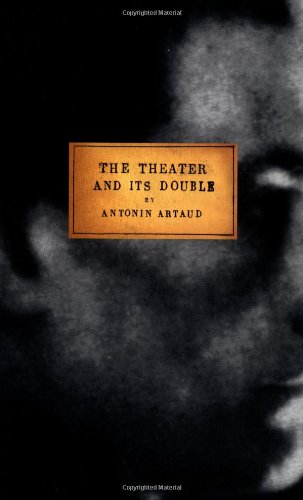
1. The Theater and Its Double
$24.00
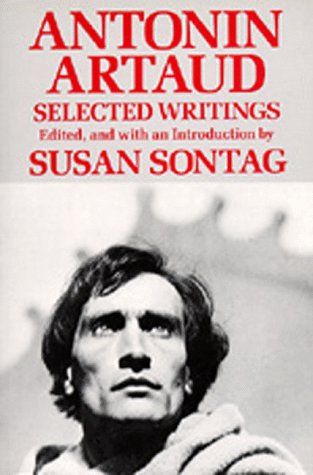
2. Antonin Artaud: Selected Writings
$10.50
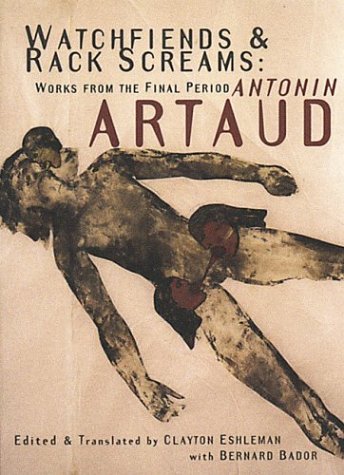
3. Watchfiends & Rack Screams
$15.56
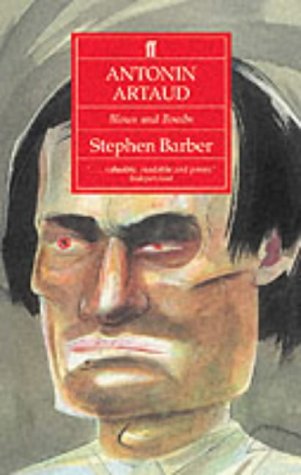
4. Blows and Bombs: Antonin Artaud,
$11.62
5. Artaud: The Screaming Body
$124.73
6. Antonin Artaud: Blows and Bombs
$30.74
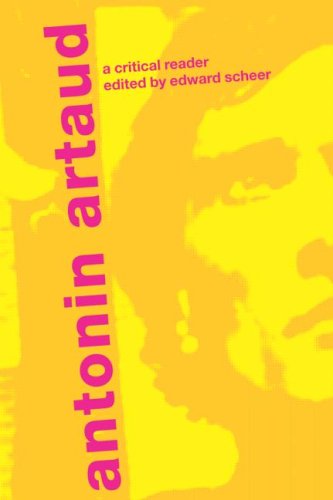
7. Antonin Artaud: A Critical Reader
$8.82
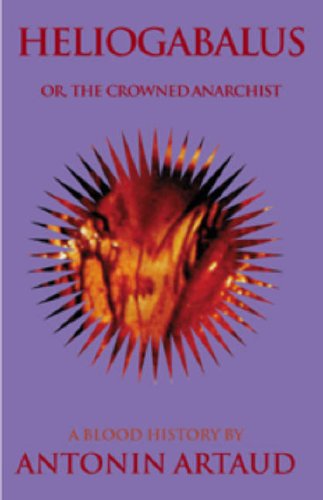
8. Heliogabalus: Or, the Crowned
$18.95
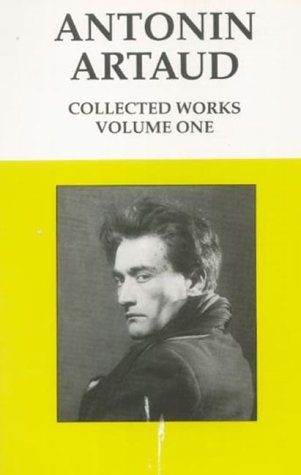
9. Antonin Artaud : Collected Works
$8.86
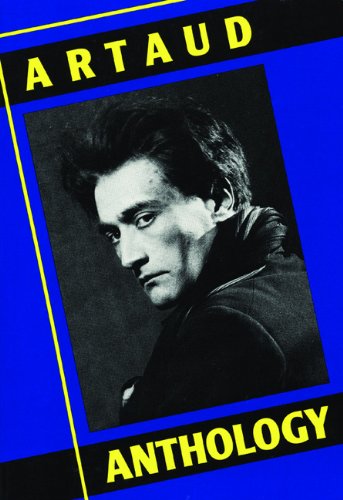
10. Anthology
$21.10
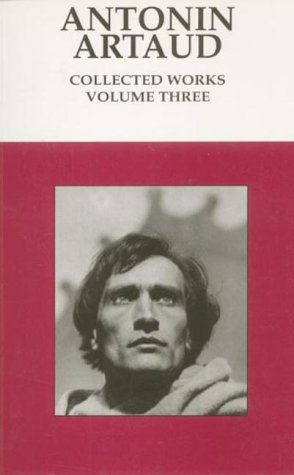
11. Antonin Artaud : Collected Works
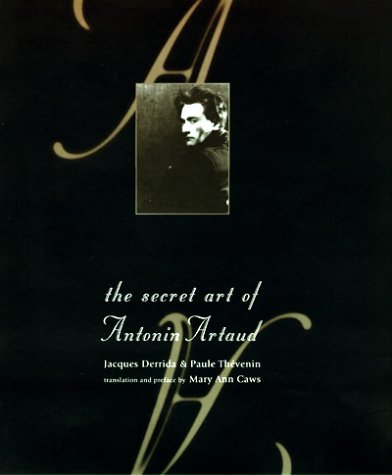
12. The Secret Art of Antonin Artaud
 
$145.00
13. Antonin Artaud: Works on Paper
$14.35
14. Antonin Artaud's Writing Bodies
$5.95
15. Antonin Artaud's "The Cenci":
 
$6.44
16. Antonin Artaud: Man Of Vision
 
$11.01
17. El Cine (El Libro De Bolsillo)
$43.26
18. Antonin Artaud (Les contemporains)
 
$110.28
19. Antonin Artaud and the Modern
$8.95
20. The Actor and His Double: Mime

1. The Theater and Its Double
by Antonin Artaud
Paperback: 176 Pages (1994-01-07)
list price: US$13.00 -- used & new: US$7.51
(price subject to change: see help)
Asin: 0802150306
Average Customer Review: 5.0 out of 5 stars
Canada | United Kingdom | Germany | France | Japan
Editorial Review

Amazon.com
Since its first publication in 1938, The Theater and Its Double by the French artist and philosopher Antonin Artaud has continued to provoke, inspire, enrage, enliven, challenge, and goad any number of theatrical debates in its call for a "Theater of Cruelty." A trio of theatrical manifestos, the book is an aggressive attack on many of the most treasured beliefs of both theater and Western culture. According to Artaud, the theater's "double" is similar to its Jungian "shadow," the unacknowledged, unconscious element that completes it but is in many ways its opposite. As "culture" inexorably draws the artistic impulse into safe channels, the repressed irrational urges of theater, based on dreams, religion, and emotion, are increasingly necessary to "purge" the sickness of society. Artaud identifies language itself as one of the major cultural culprits, and his attacks on it occasionally makes his text rough going. But his challenge to restore relevance to the heart of the theatrical experience remains fundamental to the vitality of theater, and his insistence on the sensory experience of drama as opposed to the literary (and such innovative ideas as the use of unconventional "found spaces") continues to be the clarion call of the theatrical avant-garde. --John Longenbaugh Book Description

A collection of manifestos originally published in 1938, The Theater and Its Double is the fullest statement of the ideas of Antonin Artaud. “We cannot go on prostituting the idea of the theater, the only value of which is in its excruciating, magical relation to reality and danger,” he wrote. He fought vigorously against an encroaching conventionalism he found anathema to the very concept of theater. He sought to use theater to transcend writing, “to break through the language in order to touch life.”
... Read more

Customer Reviews (8)

5-0 out of 5 stars The Theater and it's double
I have read this at least once a year for the past four years and it changes my life every time.As I get older and more mature, so does my theatre theory.This is a theatre theory book that all collaborators should read.. from actors to designers, to dramaturgs and directors to Stage mangers and so on.

5-0 out of 5 stars Tread Lightly
This is definitely required reading for theatre students.It will help you better understand the shift in modern and experimental theatre that has transpired over the course of the last century.It will also help you better understand the basis for a lot of horrible theatre concepts staged by overzealous students and professors, the world over.... Be wary of people throwing around the Theatre of Cruetly catchphrase as if they know what it means....

5-0 out of 5 stars Essential
Antonin Artaud's forward thinking and innovatiove views on the theatre are an essential read for any practisioner of the theatrical arts. Wade through the madness and see the light.

3-0 out of 5 stars Signaling furiously through the flames
Antonin Artaud's obsession -- and I don't think that's too strong a word in this context -- lay in building a new philosophical framework for live theater, one that would give audiences unmediated access to powerful metaphysical truths. This book is keystone text that illuminates the rest of his life's work. Ultimately, it's not a satisfying one because of its repetitive and mystical nature and because, placed in historical context, Artaud's conception of what should constitute living theater seems somewhat constricted to later, media-saturated generations.

Let there be no mistake, however. The theatre francais of Artaud's day was hidebound by convention, a convention that surrealism took as somewhat of a challenge to overturn. Artaud's plea for a theater that would de-emphasize the spoken text and accord more emphasis on light, sound, movement and elaborate combinations of anything non-verbal that could be brought to bear on audiences is part and parcel of the surrealist rejection of theatrical convention. It is striking that Artaud, himself a marvelous film actor, dismissed out of hand the notion that motion pictures as an art form could do what live theater could not. In this respect lies the most obvious example of his limited vision. Film would eventually provide the director with all the tools that Artaud dreamed of for his Theatre of Cruelty. Bergman, Fellini, Kurosawa and Tarkovsky would all draw heavily on the notion of subordinating conventional dialogue to image and sound. Artaud's notion of theater is further undercut by the rise of television, its ubiquity and, in the age of digital electronics and computers, its raw immediacy. Television gives us unmediated images of real violence and conflict, of death on a horrendous scale, but many of us would rightly question whether being directly confronted by the unreasoning cruelty of the world we live in is especially ennobling or enlightening. In fact, many of us might argue the opposite, that it coarsens us, that it hardens the soul against outrage.

So, why give Artaud three stars for this book? Because there are some very crucial things that he gets right in this collection of essays. Most importantly, Artaud draws repeated attention to the flaws of complacency in theatrical production. It took an Artaud to remind Western civilization that theater's roots lay in public spectacle and religious rite and that its estrangement from those roots was killing theater as a living form of art. It took an Artaud to take theater off the stage and put it into the public space surrounding the audience, breaking the plane of conformity that separated actors from audience. Artaud, perhaps most ironically, reminds us that we call theatrical performers "actors" for a very good, but forgotten, reason -- their art at its peak acts upon the audience with a transformative power.

This very dense and, at times, mystifying collection is worth the effort required to read through it and come to grips with intellectually. I would especially encourage anyone interested in film as an art form to read Artaud and ponder how his insistence that a wide range of sense data can reconnect an audience with vital truths could be adapted to the cinema. For here, in a new art form that is still willing to tap into daring innovation, is where Antonin Artaud's passion is most likely to find a permanent home.

5-0 out of 5 stars "The only cure for madness is the innocence of facts" (150).
I'll admit that this is the first time I've read Artaud. And I'll admit that when I began reading the first section, The Theater and the Plague, I thought on numerous occasions, "Where is this guy going with this?" Upon concluding this section, and after picking myself up off the floor, I returned to the beginning for a another read through, and again, afterward, found myself floored. Artaud presents a take on theatre like none other. A take that many may disagree with, but few can deny the illuminating profundity of his analogies, correlations, and general theatrical philosophizing. But don't think Artaud is without a sense of humor.With a blurt like, "I saw some sort of human snakes, otherwise known as playwrights, explain how to worm a play into the good graces of a director...", whose not going to let out a chuckle? (Especially if you're guilty). In addition, this book boasts some of the best writing that I've ever read. His writing is crisp, unmasked, and intellectually and visually stimulating. And as an added bonus, nine "I'm an ugly man smoking a cigarette" black and white photos precede the text. At $10, "The Theater And Its Double" won't disappoint. ... Read more


2. Antonin Artaud: Selected Writings
by Antonin Artaud
Paperback: 720 Pages (1988-10-10)
list price: US$27.50 -- used & new: US$24.00
(price subject to change: see help)
Asin: 0520064437
Average Customer Review: 4.5 out of 5 stars
Canada | United Kingdom | Germany | France | Japan
Editorial Review

Book Description
A revolutionary figure in the literary avant-garde of his time, Antonin Artaud (1896-1948) is now seen to be central to the development of post-modernism. His writings comprise verse, prose poems, film scenarios, a historical novel, plays, essays on film, theater, art, and literature, and many letters. Susan Sontag's selection conveys the genius of this singular writer. ... Read more

Customer Reviews (8)

5-0 out of 5 stars Tome essential to all theatre artists
Studying Artaud is one way of taking a deep dive off into the realm of the unknown.His struggle to fully comprehend and describe lucidly his thought process and the clockwork of his soul; his obsessive desire and drive to break beyond the mundane level of median psycological theatre to rediscover the fiery roots and potent magic of the theatre event; and his visionary words---all of these combine to give us a man who was deep, profound and troubled---hence, utterly human, and truly inspirational to any theatre artist or artist in general. This translation of some of his most essential writings is essential to anyone who wishes to study the avant garde theatre.His influence is at times lucid and clearly defined; at other times, one sees that the myth of Artaud has distorted what the actual man wanted and worked for. In dealing with any artist who has created such a controversy (in his own time as well as in our time), one has to approach his work with the discipline of a tightrope walker. And Sontag's work provides the researcher with a straight, keen and powerful translation. Among the other translations of Artaud, this one is the best anthology available for the experienced researcher and the burning initiate.Read it as an athlete of the heart.

5-0 out of 5 stars The theatre, life and writings of a brilliant lunatic
This isn't a book that you read from cover to cover. Find a subject that interests you. Then another. And then another. Soon you'll find yourself caught in his web of genius. His madness came from his endless spring of sanity that could no longer hold up under the insanity of the world he lived in. Genius suffers. He suffered too much. Years ago I saw a one man play "Artaud's Project" in Chicago. Best piece of theatre I've ever seen. This was my introduction to Artaud. This book captures this brilliant lunatic's crystal clear vision and pain. His letters are prehaps the highlight of this collection. This book is not for the masses, though, I wish it were. So much insanity and ignorance could be wiped out in a single stroke if people understood this man. Of course the sane appear to be insane in an insane world. If any of what I've said makes the least bit of sense to you this book is for you!

5-0 out of 5 stars Artaud: what and where and how were you thinking?
Selected Writings isn't an easy read.I jumped around a lot.This stuff is the most intense stuff I've ever come across.Artaud is one of the most important writers to rationalise beyond logic.His ideas on Van Goghprove, beyond doubt, that his sense of aesthetics was far more acute thanhis contemporaries. They always said weird stuff about Neitszche, how hewas more 'in touch with himself' than other writers or, indeed, society atlarge.But Artaud explodes that idea, since he continually toys with hisown sense of himself to the extreme. Reading Artaud for prolonged periodsis like going beyond this (his) sense of self to another place, somethingcompletely new and agonizing. His ideas abouty the theatre are quite wellestablished but there is other stuff here. The poems, monologues and justthe sheer variety of 'inner scenarios' at play here really astounds you. 'To have done with the judgement of God' must be the most extreme form ofself expressed mental torture around!(incidentally, am I correct inthinking there is a recording of this piece knockin' around?) Anyways,please take a slice of the insanity, you never know where it will leadyou...

4-0 out of 5 stars Full of Sympathy for Van Gogh
This book offers selections on a much broader range of interests than my own.Understanding the nature of deep empathy seems easiest to me in the 1947 work, "Van Gogh, the Man Suicided by Society" on pages 481to 512.Artaud only lived from 1896 to 1948, but he seemed to be strangelyaffected by the coronation of Heliogabalus which began in the year 217. Artaud was not reading the history of events lightly when he reported"that the historians begin to go mad with rage."(p.317)Artaudwas on the side of the emperor who picked his victims from among thearistocrats in "a kind of superior anarchy" which "runs fromjewel to jewel, from outburst to outburst, from form to form, and fromflame to flame, as if he were running from soul to soul in a mysteriousinterior odyssey which no one after him ever repeated."(p. 329) Strangely enough, this seems very modern to me, approaching what is nowconsidered the height of entertainment.

5-0 out of 5 stars Essential!
Artaud is more pertinant to today's world and the battle for sanity in an insane world than any other writer save William Burroughs. As Poe, Rimbaud,Lautreamont and De Nerval were influentual to generations ofwriters decades after their work; so does Artaud promise to be the nextgreat muse of the new. This book is for anyone who is interested in themost intrigueing of experimental literature. ... Read more


3. Watchfiends & Rack Screams
by Antonin Artaud
Paperback: 352 Pages (2004-01-02)
list price: US$17.95 -- used & new: US$10.50
(price subject to change: see help)
Asin: 1878972189
Average Customer Review: 4.0 out of 5 stars
Canada | United Kingdom | Germany | France | Japan
Editorial Review

Book Description
Clayton Eshleman's translations are the finest and most authentic which have yet been made from Artaud's writing. Artaud's final work is his strongest and most enduring, and this collection has been wisely selected and magnificently realized. Artaud is being taken into the 21st century.--Stephen BarberAmong Antonin Artaud's most brilliant works are the scatological glossolalia composed in the final three years of his life (1945-1948), during and after his incarceration in an asylum at Rodez. These represent some of the most powerful outpourings ever recorded, a torrent of speech from the other side of sanity and the occult. In this collection, the most complete representation of this period of Artaud's work ever presented in English, and the first new anthology of Artaud published in the U.S. since Helen Weaver's 1976 Selected Writings, cogent statements of theory are paired with the raving poetry of such pieces as Artaud the Momo, Here Lies, and To Have Done with the Judgment of God. These are translated with drama and accuracy by Clayton Eshleman, whose renditions of Vallejo and C saire have won widespread acclaim, including a National Book Award. ... Read more

Customer Reviews (7)

4-0 out of 5 stars To much of a good thing?
Antonin Artaud, Watchfiends and Rack Screams (Exact Change, 1995)

Will Exact Change ever put out a bad book? I fervently hope the answer to that question is "no." That said, Watchfiends and Rack Screams suffers from much the same problem as most ponderous tomes of selected works from major poets; it's simply too much of a good thing.

The translation here is in the hands of the always capable Clayton Eshleman, who treats Artaud with all the reverence the man deserves. Eshleman is certainly no stranger to translating Artaud's later work (the translation of "Artaud le Momo" which appears here first appeared in Eshleman's fantastic anthology of translations Conductors of the Pit, which I cannot urge you enough to seek out), and he does the same fine job as usual here. Almost three hundred pages of it, however, tends to be a bit much all at once. This is a book to be lingered over for months, perhaps years, going back to it again and again as time passes and absorbing another bit of it at a time, rather than one to be read straight through. As well, Eshleman's introduction runs close to fifty pages. While it's certainly interesting enough stuff, fifty-page introductions are, in general, bad form. If you're going to add a fifty-page essay to a book of poetry, please, for the sake of the reader's sanity, make it an afterword, not a preface.

All that said, the influence of the work of Antonin Artaud on modern poetry cannot be understated, and any serious aficionado-- and certainly any serious poet-- should have a copy of this on the bookshelf. It is a fascinating, disturbing portrait of a man's mind torn not only by the inner workings of his own nature, but also by a convergence of brutal external forces that cannot be comprehended by most living human beings. *** ½

4-0 out of 5 stars Artaud: A Vision Of Man In An Alien Fire
This attractive and nicely put together volume presents in English translation- some pieces happily having a facing French text - the available written works from the last three years of Antonin Artaud's life. The translations, as such, are adequate and serviceable and succeed in revealing some of the astonishing raw heat, brilliance and startling shapes that emerged from Artaud in his last years, but they do remain only an approximation of a unique body of French word-art. However unpleasant the thought may be for readers who do not read French, reality requires an acknowledgment of the fact that Artaud in English, however good, is Artaud obscured to some degree. And this fact raises the deeper issue/question that has clung like a cloud of noxious microbes to these last writings, namely: Even with the original texts, is it possible to be sure of what Artaud is presenting in these works and to assess it and value it correctly? There are many who would still maintain that in these last years Artaud was in a state of confusion so deep as to warrant the word `insanity' and there are many `reputable' critics who are more than ready to simply dismiss Artaud's last works on this ground alone. Well, so much for reputation and we can happily return the favor and wave good-bye to these hyper-delicate, dried up academics who get into a venomous and articulate panic when they feel the fire of reality coming too close. But even those critics who have more open, mixed, and ambiguous feelings about Artaud are still confronted with a formidable problem which is that the very standard called `sanity' which they measure Artaud against is not really separable from the common behaviors and mind-sets of a society and culture that Artaud has almost completely rejected and which they mostly accept. So where do they draw the line between what is sane and what isn't without making the grotesque gesture of merely affirming themselves at the expense of Artaud. Robert Duncan's assessment of Artaud tells me far more about Duncan than it does about Artaud. But my main point is that no one with any genuine intelligence can possibly deny that Artaud, in these last works, elucidates questions whose validity is disputed only at the cost what I might also call `sanity'. And here is the real core of the question surrounding Artaud: How many are willing to face the questions he raises with a seriousness and commitment comparable with his own? Obviously, the fear involved is the fear of gambling with one's own sanity, but if the questions are valid and yet they are a threat to sanity, then there is clearly something dubious about this sanity. To dismiss Artaud as `insane' is the grotesque height of irresponsibility. However imperfect he may be as a personality, he is one of the most awesomely courageous and honest depth-explorers of his, or any, time. Andre Breton is a mere pompous, self-concerned diddler compared with Artaud. Artaud is worth your very serious consideration and I can recommend this volume as a useful aid in your study, but please understand if you are new to Artaud or even fairly familiar with his work that the purpose of his work is the literal undoing of ordinary consciousness which he saw as a form of death and divorcement from reality. Even if you go back to his early ideas about theater, you must understand that Artaud's `theater of cruelty' was a destruction of ordinary theater, it was theater not as entertainment or even as an acting out of serious fiction, but was rather a transforming of both life and art by obliterating the falsity of art and thereby the correlative falsity of life, obliterating the line that separated life from art, a theater in which the act is the reality and is a vital inflaming exercise of life. A new, open-ended reality. Artaud was a human revolution who walked the line that so many only fantasized or theorized about and he inevitably and willingly lost his bearings, as defined by the society that surrounded him, and it cost him years of brutal suffering that most people could not have endured. But he endured and recreated himself by means of new bearings, not those of a fantasizing flower child, but those of a man who has been through the fire of other worlds and come back to us with a new and strangely shaped creating blade that is essentially vital and deadly sharp. Respect him. We really owe him who took so little and gave so much. Not only is modern theater inconceivable without Artaud, but he also, I believe, outlined a view of reality in these last years that will prove to be the most profound human vision of his and our time. If you feel that you do not see what this vision is and you would like to talk about it, feel free to email me.

2-0 out of 5 stars They don't translate Artaud like they used to....
I am a huge Artaud fan.He was a true visionary, a prophet of brutal truth in a lazy, complacent world.So I was really looking forward to reading this new anthology of works from his ultra-disturbing late period.But I have to say I found it disappointing.The translations, by noted language poet Clayton Eshleman, sound stilted and wooden to my ear, favoring cleverness over raw power.The exhaustively researched notes don't quite make up for this poetic deficiency.I turned to my beloved copy of City Light's "Artaud Anthology" (one of my all-time favorite books) and did line by line comparisons of Eshleman's work with the brilliant Ferlinghetti and David Rattray translations in the older book, and there was just no comparison.It really isn't surprising that the 60's beat-era poet-translators just had a much better grasp of Artaud's earth-shattering radicalism than poets of today.The City Lights one is the keeper for sure (it's still in print): take that one with you to a desert island and I guarantee you won't even want to be rescued and brought back to "civilization."

5-0 out of 5 stars I have come to offer judgment on your brain
Artaud's genius was too much for his head, and it spilled out like corkscrews into a series of spiralling texts and flickered in a shower of sparks across the oceans, from France to the rest of the planet. Here Clayton Eshleman, the great translator of Artaud, assisted by another less successful translator, brings us a number of the more arcane texts. This book doesn't have everything in it, but what it does have is choice. You have to hand it to Exact Change. They may not do everything they do for the first time (although there are many texts in WATCHFIENDS previously available only in French, if at all) but when they do something, baby, it stays "done."

Ideally this book would come with a DVD in which we could watch the recorded performances of the living Artaud, for even though he was not, as an actor, the very best exemplum of his theories, some memorable glimpses of him linger on via film.

4-0 out of 5 stars Artaud the Momo
This anthology documents work from Artaud's final period spent mainly in a mental institution.The poems are by far the strangest that I have encountered.Filled with odd incantatory stanzas fashioned in Artaud's own language, the poetry and prose in this collection requires some patience from the reader.Some of the poems/prose in this collection I found virtually impenetrable (e.g., "Artaud the Momo") but this only seems to heighten and augment my appreciative awe for Artaud as an artist/poet/prose magician.Even Artaud's letters venture into strange and unknown territory as they combine prose, poetry, and Artaud's own creative argot to produce an inexplicably chaotic amalgamation that can count as a literary genre unto itself.

Although incredibly weird and convoluted, Artaud's work from this tumultuous period still manages to shine by dint of its strange qualities and inherent loopiness.If you happen to be interested in this type of enigmatic, dada-esque poetry/prose pick up this volume ASAP. ... Read more


4. Blows and Bombs: Antonin Artaud, the Biography
by Stephen Barber
Paperback: 224 Pages (2003-08)
list price: US$19.95 -- used & new: US$15.56
(price subject to change: see help)
Asin: 1840680822
Average Customer Review: 3.0 out of 5 stars
Canada | United Kingdom | Germany | France | Japan
Editorial Review

Book Description

The only biography of avant-garde Surrealist artist, filmmaker and theorist Antonin Artaud is now re-published in a new, expanded and updated edition. Spanning his involvement with the Surrealist movement, the seminal Theatre of Cruelty and his 9-year asylum incarceration, this is the definitive biography on this legendary figure of 20th century culture.

Stephen Barber is a noted cultural historian and the leading authority on Artaud. Previous publications include: The Burning World (Edmund White biography), Caligula and Artaud: The Screaming Body (Creation).

... Read more

Customer Reviews (1)

3-0 out of 5 stars Mediocre
After reading this my first thought was: "Well, maybe some day they really will come out with a definitive biography of Artaud."
Antonin Artaud, the enigmatic and crazed King of Modern Poetry, is ripe for a huge biography detailing his childhood, the intricacies of his tremendous psychological difficulties, his revolutionary approach to theatre, etc.Maybe Barber does his best with the nearly incomprehensible subject he chose--blurbs about his drug use, his migraine filled childhood, and the standard boring crap about his disagreements with and eventual expulsion from the surrealist movement.The analysis of his 'poetry' is pedestrian, nothing special.I gave it three stars because there are some amusing stories and hitherto untold tales about Artaud's bizarre exploits toward the end of his life.All in all, though, a disappointment. ... Read more


5. Artaud: The Screaming Body
by Stephen Barber, Antonin Artaud
Paperback: 111 Pages (2005-03-28)
list price: US$16.95 -- used & new: US$11.62
(price subject to change: see help)
Asin: 1840680911
Average Customer Review: 3.0 out of 5 stars
Canada | United Kingdom | Germany | France | Japan
Editorial Review

Book Description

The Screaming Body gives a full and authoritative account of Artaud's film projects and his conception of surrealist cinema. It examines his unique series of drawings of the fragmented human body, begun in the ward of a lunatic asylum and finished in a state of furious liberation. The book captures Artaud's ultimate experiment with the screaming body in the form of his censored recording To Have Done with the Judgement of God-an experiment which is unprecedented in the history of art.

... Read more

Customer Reviews (2)

2-0 out of 5 stars Disappointing
This book is simply a journal article padded to book length.Moreover, there is really nothing new or interesting that cannot be learned from a rigorous reading of Artaud's published work. Barber should have published this in ArtForum and we readers could have saved our money. A profound disappointment.

4-0 out of 5 stars Fascinating obsession this Artaud
There are many who consider Antonin Artaud a madman, yet there's no question that he revolutionized contemporary theater. Artaud was such a powerful, anarchic force that critics and fans alike are still trying to find the right place for him in cultural history.

Stephen Barber has just written his second book on this visionary: Artaud: The Screaming Body. It's not a major work on the artist, but it is one of the many (and much-needed) pieces of the Artaud puzzle. At present there is not an essential English-language book on Artaud. There are anthologies here and there, but not one big critical book on this fascinating figure. Perhaps it's an impossible task; Artaud influenced not only the theater, but also poetry, drawing, radio performances, and the cinema. He's worthy of many volumes.

Artaud started out as an actor and was involved in two key films in cinema history: Carl Dreyer's 1927 film classic, The Passion of Joan of Arc, and Abel Gance's 1927 masterpiece, Napoléon. Due to his stunning looks, he was on his way to becoming a major movie star, but Artaud decided to veer in another direction. He believed that performance was not a job, but rather a way of life. He felt the world was damned, and that there needed to be a new language to convey to the world that it had lost its ability to speak. Artaud was frustrated by the uselessness of contemporary gestures and language to express what he was thinking and feeling. In response, he single-handedly invented a new theater, which later became the foundation for the Theater of the Absurd and for the works of the Living Theater, as well as the springboard for Jean Genet, Eugène Ionesco, and Samuel Beckett. Artaud created a new form that ran screaming from a dependence on language and logical thought.

While his presence was hugely felt in the theater, Artaud believed it was the cinema that would prove to be the perfect medium for his theories. Between 1924 and 1935 Artaud wrote 15 film scenarios. Only one became a film: La Coquille et le Clergyman ("The Seashell and The Clergyman") (1927). The brilliant Germaine Dulac directed the film and, as legend has it, there was a major battle between her and Artaud. Dulac added her own thoughts to the screenplay; Artaud was especially annoyed when she suggested that the events of the film were all part of a dream, since he had wanted to blur the line between reality and dream. Something that's a dream is, after all, merely a dream.

Artaud: The Screaming Body is a good introduction to the world beyond Artaud's theater essays and theories. Barber focuses mostly on Artaud's work in the cinema, his influence on drawing, and his radio performances, which took place just before Artaud's death in 1948. What we need now is the ultimate, sweeping biography of Antonin Artaud. This small, well-written book offers only a peek at the man and his magnificent, disturbed visions. ... Read more


6. Antonin Artaud: Blows and Bombs
by Stephen Barber
Paperback: 182 Pages (1994-04)
list price: US$10.95 -- used & new: US$124.73
(price subject to change: see help)
Asin: 0571172520
Average Customer Review: 4.0 out of 5 stars
Canada | United Kingdom | Germany | France | Japan

Customer Reviews (1)

4-0 out of 5 stars Excellent bio.
Stephen Barber, Antonin Artaud: Blows and Bombs (Faber and Faber, 1993)

When I grew up, I wanted to be Antonin Artaud. I first discovered his early poetry in Michael Benedikt's must-own anthology The Poetry of Surrealism early on in my high school career, discovering his late work and film work in college. Artaud's expressive, antagonist writing style captured me from the beginning, and the surface details of the tortured artist were immensely appealing. It is only now (I'd flirted with this book for some time, but didn't get round to picking it up until after seeing it receive the greatest acclain Clay Eshleman could give it-- he used it as a reference in the introduction to the English-language version of Artaud's Watchfiends and Rack Screams a few years later) that I get the full story. I still want to be Antonin Artaud when I grow up, but there are some pieces of his life I'd rather avoid, if possible.

Barber's biography, weighing in at less than two hundred pages, is like to be looked on by some folks as spare-- after all, we live in an age where some folks get biographies that are longer than L. Ron Hubbard's never-ending Mission Earth. And to some minor extent, those folks do have a point; there are some odd omissions here (Barber never even glosses over, for example, the commonly-levelled charge that Artaud was "abandoned" at Ville-Evrard, and the privations which followed-- not even to say "these allegations cannot be confirmed or denied," or to refer to the sources of those allegations in Artaud's own work). That said, the amount of space given seems otherwise just enough.

Barber is presenting a "just the facts, ma'am"-style biography here, with only as much cultural context as is necessary to explain Artaud's actions every now and again. Because of this, the reader familiar with the actions and lives of the main characters of the surrealist movement, especially Andre Breton, are likely to be able to mentally fill in some gaps that others will probably notice. Having been relatively immersed in the life and culture of the surrealists for two decades, it's hard for me to look at this and see it as someone who'd only heard the name and seen, maybe, a few of the paintings would approach it. I do think, however, that Barber's sparse prose style will make for a readable, if somewhat dry, biography even for those without much experience of the life and times of its subject before they pick it up.

Not something I'm now aching to have go into my permanent collection, but I'll likely pick it up again at some point. Antonin Artaud's life is a stunning mass of contradictions, and they're well-presented by Barber; a good book about a great artist. *** ½ ... Read more


7. Antonin Artaud: A Critical Reader
by Edward Scheer
Paperback: 208 Pages (2003-11-13)
list price: US$39.95 -- used & new: US$30.74
(price subject to change: see help)
Asin: 0415282551
Canada | United Kingdom | Germany | France | Japan
Editorial Review

Book Description
Addicted to drugs from an early age and incarcerated in a series of mental asylums throughout his adult life, Antonin Artaud was nevertheless one of the most brilliant artists to emerge from the twentieth century. His writing influenced entire generations, from the French post-structuralists to the American beatniks. He was a key figure in the European cinema of the 1920s and 30s, and his drawings and sketches have been displayed in some of the major art galleries of the Western world. Possibly best known for his concept of a 'theatre of cruelty,' his legacy has been to re-define the functions and possibilities of live performance.
This unique resource brings together for the first time a selection of the best critical writing available on the key themes of Artaud's life and work from critics such as Jacques Derrida, Julia Kristeva, Maurice Blanchot, Herbert Blau, Leo Bersani and Susan Sontag.
Containing some of the most intellectually adventurous and emotionally passionate writings on this classic and controversial figure, this book is an essential read for Artaud scholars working in a number of arts disciplines, including theatre, film, philosophy, literature and fine art. ... Read more


8. Heliogabalus: Or, the Crowned Anarchist
by Antonin Artaud
Paperback: 144 Pages (2007-01-31)
list price: US$14.95 -- used & new: US$8.82
(price subject to change: see help)
Asin: 0971457808
Average Customer Review: 5.0 out of 5 stars
Canada | United Kingdom | Germany | France | Japan
Editorial Review

Book Description
Translated into English for the first time, this novelized biography of the 3rd-century Roman Emperor Heliogabalus is simultaneously Araud's most accessible and his most extreme book. Written in 1933, at the time when Artaud was preparing to stage his legendary Theatre of Cruelty, Heliogabalus is a powerful concoction of sexual excess, self-deification and terminal violence. Reflecting its author's preoccupations with the occult, magic, Satan, and a range of esoteric religions, this account of Heliogabalus' reign invents incidents in the Emperor's life in order to make the print of the author's own passionate denunciations of modern existence.

Heliogabalus is Artaud's greatest and most revolutionary masterpiece: an incendiary work that reveals both the divine cruelty of the Roman Emperor and that of Artaud himself. -- Stephen Barber ... Read more

Customer Reviews (1)

5-0 out of 5 stars Incredible Book
This book is Antonin Artaud's prose-history of the emperor Heliogabalus in which he explores philosophically the world of sperm cults, sun-worship, castration rituals, sodomy and extravagant theatrics in which the child king rose to his bizarre and decadent reign. This book has only recently become available in the English language - a tremendous contribution for anglophone readers. Rest assured that Artaud's arcane poetry has been translated with mastery by Lykiard. An excellent read for anyone interested in themes of anarchy, mysticism, or avant-garde theater. ... Read more


9. Antonin Artaud : Collected Works (Volume 1)
by Antonin Artaud
Paperback: 247 Pages (1999)
list price: US$18.95 -- used & new: US$18.95
(price subject to change: see help)
Asin: 0714501700
Canada | United Kingdom | Germany | France | Japan

10. Anthology
by Antonin Artaud
Paperback: 256 Pages (1963-06)
list price: US$14.95 -- used & new: US$8.86
(price subject to change: see help)
Asin: 0872860000
Average Customer Review: 4.0 out of 5 stars
Canada | United Kingdom | Germany | France | Japan
Editorial Review

Book Description

"I am the man," wrote Artaud, "who has best charted his inmost self." Antonin Artaud was a great poet who, like Poe, Holderlin, and Nerval, wanted to live in the infinite and asked that the human spirit burn in absolute freedom.

To society, he was a madman. Artaud, however, was not insane but in luciferian pursuit of what society keeps hidden. The man who wrote Van Gogh the Man Suicided by Society raged against the insanity of social institutions with insight that proves more prescient with every passing year. Today, as Artaud's vatic thunder still crashes above the "larval confusion" he despised, what is most striking in his writings is an extravagant lucidity.

This collection gives us quintessential Artaud on the occult, magic, the theater, mind and body, the cosmos, rebellion, and revolution in its deepest sense.

... Read more

Customer Reviews (4)

5-0 out of 5 stars NOT madness, but an asphyxiating dive into reality
So many seem to associate the name of Artaud with madness, decadence, the postmodern "I'm-too-hip-to-care-but-I-still-think-deeply" attitude.Nothing could be further from the truth.Antonin Artaud was a man interested in nothing less than the violent exhumation of real life from the cold, icy tomb that civilization has attempted to seal it in.

As we see here in his letters to the sympathetic, but ultimately helpless Jacques Riviere, Artaud's suffered from a kind of hypochondria of the mind which resulted from his scorching intensity of thought.He explicitly rejected happiness as the goal of human existence, and this is what separated him not only from the surrealists but from other thinkers of his age and ours.Perhaps he put it best himself in his own strange, archaic language:

"For nothing bestializes a being like the taste for eternal happiness, the search for eternal happiness at any price, and mademoiselle Lucifer is that slut who never wanted to abandon eternal happiness."

There will be nothing in this anthology that the Artaud admirer has not already seen, although the whole text (particularly the photographs of Artaud starring in Dreyer's "Joan of Arc" and Gance's "Napoleon"), comes together like a bizarre little work of art.I have referred to it repeatedly, given it away, purchased it again.The most important piece that this little publication has to offer is "I Hate and Renounce As a Coward"..., which is at the very end:the closest thing we have to a coherent philosophical position from Artaud.Also, "Van Gogh:The Man Suicided By Society", which is more about Artaud than Van Gogh, gives us an indispensable glimpse into the psyche of the genuinely tortured, doomed artist.

There are moments in which Artaud becomes as important in his commentary on the human condition, as thinkers like Nietzsche, Plato, Pascal, and all of the greats.Unlike in their work, though, it is not maintained consistently.This is also the case with his poetry.His internal anguish did not allow him to consummate his enormous potential.His value lies in the threat he poses to our complacency simply by virtue of his memory.

Read "The Theatre And It's Double" first, and then tear through this.Savor Artaud's sentences as you would a delicate meal you'd never tasted before.

May the looming shadow of this demented renaissance man never stop haunting us.

5-0 out of 5 stars Artaud's thoughts on fire.....
This book really puts Artaud's thoughts into perspective. The wonderful madness that inspires one to escape reality and see over that edge of sanity is written here.

5-0 out of 5 stars Cruel World
Of all twentieth century dramatists, Antonin Artaud is perhaps the most enigmatic. The facts of his life are stark and austere, and his work is a painful movement through many silences and journeys.

Even the less initiated student of Artaud will know this writer as someone who deals with uncomfortable and taboo subjects. Among more established critics, too, Artaud continues to attract highly polarised critical opinions. When faced with Artaud's works, the critic's approach seems to be either resolutely textual, bracketing off the human element and referring only to the language on the printed page, or it is predicated on the notion that the biography of the writer must be taken into account in showing how Artaud's texts came to be written. In the first kind of reading, Artaud's texts aredehumanized. In the second, Artaud's works are bracketed off as symptoms of the dramatist's deviant mental or spiritual state, and the labels that have been attached to him (from gnostic to schizophrenic) are taken as reliable pointers to his works. While textual readings offer a definite advantage, in that they approach Artaud's writings without preconceived ideas about the writer's life, aspects of Artaud's life, in particular his scabrous attitude to the traditions of the literary world, seem too important to leave out of account in any discussion of the dramatist's works. Within Artaud's writings here, there is a specific, reflexive relationship between art and life, the one illuminating the other. One can see there is no convenient distinction to be made between Artaud the man and Artaud the writer, he was one and the same, these writings are an ejoyable entrance into that sphere...

2-0 out of 5 stars A bit dissapointing.
I must admit that I expected more from an anthology of Artaud's work.His book "Theatre and It's Double" is one of the "holy tomes" of my book collection. It has influenced me as a theatre artist for the last 20 years.

This is a hodge podge collection of obscurewritings and such.It is more a study in Artaud's sanity -- I'm afraidthat it shows just how strange he actually was.I always figured that hewas a misunderstood genius. . .but after this I'm wondering if he wasn'tsimply a confused mad man. ... Read more


11. Antonin Artaud : Collected Works (Volume 3)
by Antonin Artaud
Paperback: 255 Pages (1999)
list price: US$18.95 -- used & new: US$21.10
(price subject to change: see help)
Asin: 0714507792
Average Customer Review: 3.0 out of 5 stars
Canada | United Kingdom | Germany | France | Japan

Customer Reviews (1)

3-0 out of 5 stars The unknown Artaud
This third volume of A. Artaud for whom Sartre siad that he is "the new poet of horror" continued the complete edition of his works. It is not as important as the "Theatre and its double" or Artaud'spoems, but includes some of his Scenarios, views on the Cinema, Interviewsheld with Artaud, as well as his correspondance with Mademoiselle YvonneGilles, Madame Yvonne Allendy, Louis Jouvet and others. Although thisvolume might not be as significant as those containing his poetry and viewson the theatre, it is an important link if we want to understand - as faras this is possible - the inner world of a man of tragic insolubilitywithout gaining a distance of safety - that of an audience. Despite beingknown for his thetre of cruelty, Artaud is more a poet of sharp realizationof existence; this volume adds to this understanding. ... Read more


12. The Secret Art of Antonin Artaud
by Jacques Derrida, Paule Thýývenin
Hardcover: 176 Pages (1998-05-15)
list price: US$27.50
Isbn: 0262041650
Canada | United Kingdom | Germany | France | Japan
Editorial Review

Book Description
"This volume brings us face to face with one of the great artistic singularities of the modern age. One comparison is still possible, however: Derrida writing on Artaud is astonishing and definitive rather as Artaud himself was when he wrote on Van Gogh." -- Malcolm Bowie, Marshal Foch Professor of French Literature, All Souls College, Oxford

"I salute Antonin Artaud," wrote André Breton, "for his passionate, heroic negation of everything that causes us to be dead while alive." Antonin Artaud (1896-1948)--stage and film actor, director, writer, drug addict, and visual artist--was a man of rage and genius. The Secret Art of Antonin Artaud is the first English translation of two famous texts on his drawings and portraits. In one, Jacques Derrida examines the works that he first saw on the walls of Paule Thévenin's apartment. His text, as frenzied as Artaud's, struggles with Artaud's peculiar language and is punctuated by footnotes and asides that reflect this strain ("How will they translate this?"). The more straightforward text of Paule Thévenin describes the history of Artaud's drawings and portraits.

Due to a dispute between Artaud's heirs and Paule Thévenin, the book does not contain reproductions of Artaud's artwork. Instead, there is a series of haunting photographs of Artaud by Georges Pastier. Artaud most likely would have approved of the irony of publishing a book entitled The Secret Art of Antonin Artaud without reproductions of the work--a catalogue irraisonn as it were. "We won't be describing any paintings," says Derrida in the text, which is addressed to that which underlies both language and art. ... Read more


13. Antonin Artaud: Works on Paper
by Antonin Artaud, Margit Rowell
 Hardcover: 168 Pages (1996-10)
list price: US$35.00 -- used & new: US$145.00
(price subject to change: see help)
Asin: 0870701185
Average Customer Review: 5.0 out of 5 stars
Canada | United Kingdom | Germany | France | Japan

Customer Reviews (1)

5-0 out of 5 stars Artaud From the Inside
I have been reading, disecting, and deconstructing Artaud for well over ten years and find this volume to be indispensible.Well worth theprice.The immedicacy and visceral quality of Artaud's words are captured on paper, and where as tapes of his anguished voice might crackle and fade in time, this first hand document of his perceptual experience is truly timeless.This is not only a firmly woven tapestry for those in the know, but also a good starting point for those wondering what all the fuss is about. ... Read more


14. Antonin Artaud's Writing Bodies (Oxford Modern Languages and Literature Monographs)
by Adrian Morfee
Hardcover: 248 Pages (2005-12-01)
list price: US$99.00 -- used & new: US$14.35
(price subject to change: see help)
Asin: 0199277494
Canada | United Kingdom | Germany | France | Japan
Editorial Review

Book Description
Antonin Artaud (1896-1948), perhaps best known as a dramatic theorist, is an important but extremely difficult writer. This book studies the development of his thinking, from the early texts of the 1920s through to the acclaimed but lesser known 1940s writings, on such issues as the body, theology, language, identity and the search for an elusive and unsayable self-presence, and then uses this as a framework in which to read his late texts. New attention is paid to the processes by which his texts generate meanings, the logics that hold these meanings together, and the internal contradictions of the late poetry. This allows a new picture to emerge that accounts for the coherent if unequal development of his ideas as well as the drive towards systematisation to be found in even his most opaque writings. By returning to the texts and focusing on the specific terms of Artaud's writing, as well as their gleeful resourcefulness and ludicity, it is argued that Artaud needs to be considered not as a contestatory psychotic but as a writer of the first magnitude.Accessible to both scholar and newcomer, this illuminating and original study will refocus critical thought on both the development of Artaud's thinking and the significance of his oft-neglected later work. ... Read more


15. Antonin Artaud's "The Cenci": A Study Guide from Gale's "Drama for Students" (Volume 22, Chapter 3)
Digital: 23 Pages (2005-09-21)
list price: US$5.95 -- used & new: US$5.95
(price subject to change: see help)
Asin: B000BIPE48
Canada | United Kingdom | Germany | France | Japan
Editorial Review

Book Description

Term paper due tomorrow? Need to cram for a test? Or just looking for the best information about a favorite literary work?

Turn to "Drama for Students" to get your research done in record time. Brought to you by Thomson Gale--the world's leading source of literary criticism and analysis--this e-doc contains: author biography; plot summary; character analysis; an overview of the play's themes, style, and historical context; a compendium of in-depth critical material; study questions; suggestions for further reading; and much more.

Why choose "Drama for Students"? Because no other source offers so much in such a compact package. Trust the experts: Thomson Gale--and "Drama for Students." ... Read more


16. Antonin Artaud: Man Of Vision
by Bettina L. Knapp
 Paperback: 256 Pages (1980-07-01)
list price: US$19.95 -- used & new: US$6.44
(price subject to change: see help)
Asin: 0804008094
Canada | United Kingdom | Germany | France | Japan

17. El Cine (El Libro De Bolsillo)
by Antonin Artaud
 Paperback: 144 Pages (2005-06-30)
list price: US$12.95 -- used & new: US$11.01
(price subject to change: see help)
Asin: 8420672963
Canada | United Kingdom | Germany | France | Japan

18. Antonin Artaud (Les contemporains)
by Camille Dumoulie
Unknown Binding: 173 Pages (1996)
-- used & new: US$43.26
(price subject to change: see help)
Asin: 2020254018
Canada | United Kingdom | Germany | France | Japan

19. Antonin Artaud and the Modern Theater
 Hardcover: 285 Pages (1994-08)
list price: US$42.50 -- used & new: US$110.28
(price subject to change: see help)
Asin: 0838635504
Canada | United Kingdom | Germany | France | Japan

20. The Actor and His Double: Mime and Movement for the Theatre of Cruelty
by Mark V. Rose
Paperback: 56 Pages (1986-01)
list price: US$8.95 -- used & new: US$8.95
(price subject to change: see help)
Asin: 0961608706
Canada | United Kingdom | Germany | France | Japan

  1-20 of 100 | Next 20
A  B  C  D  E  F  G  H  I  J  K  L  M  N  O  P  Q  R  S  T  U  V  W  X  Y  Z  

Prices listed on this site are subject to change without notice.
Questions on ordering or shipping? click here for help.

site stats