e99 Online Shopping Mall

Geometry.Net - the online learning center Help  
Home  - Authors - Auden W H (Books)

  1-20 of 100 | Next 20
A  B  C  D  E  F  G  H  I  J  K  L  M  N  O  P  Q  R  S  T  U  V  W  X  Y  Z  

click price to see details     click image to enlarge     click link to go to the store

$11.88
1. Voice of the Poet: W.H. Auden
$33.20
2. W. H. Auden: Prose, Volume III,
$7.00
3. Auden: Poems (Everyman's Library
$8.89
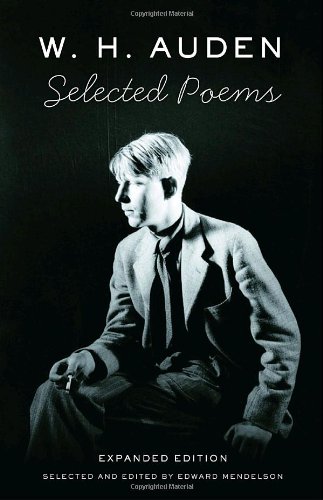
4. Selected Poems
$24.78
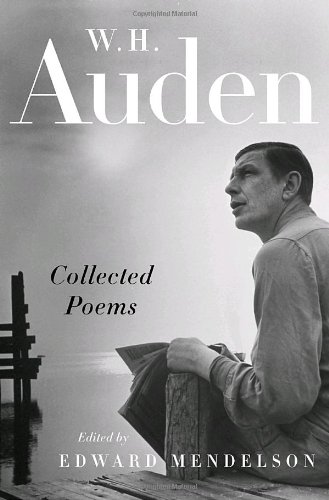
5. Collected Poems (Modern Library)
$57.80
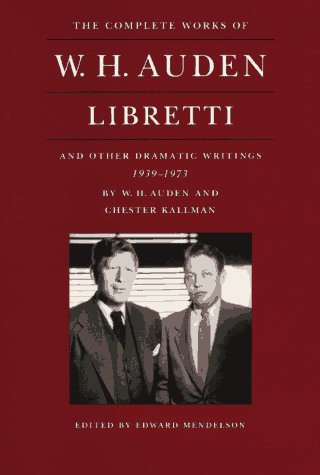
6. The Complete Works of W.H. Auden:
$7.00
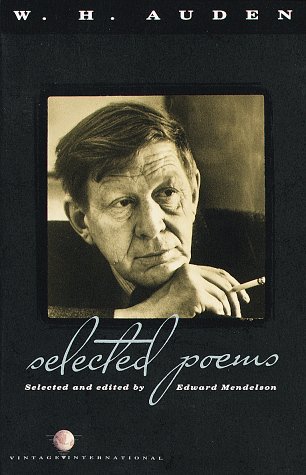
7. W.H. Auden: Selected Poems
$16.15
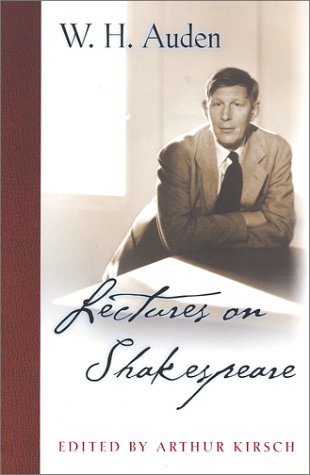
8. Lectures on Shakespeare (W.H.
 
$55.00
9. Collected Shorter Poems 1927-1957.
$8.04
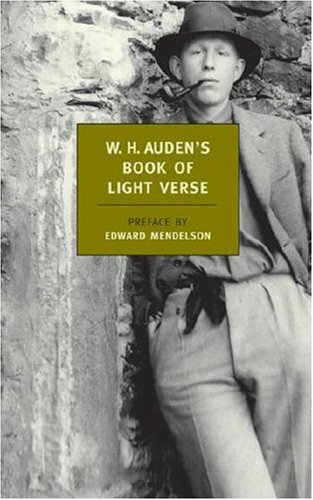
10. W. H. Auden's Book of Light Verse
 
11. W.H. Auden Collected Poems
$79.90
12. The Complete Works of W. H. Auden:
$64.95
13. W. H. Auden
 
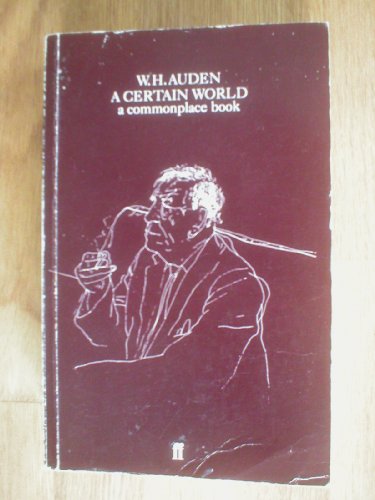
14. A Certain World. A Commonplace
$13.86
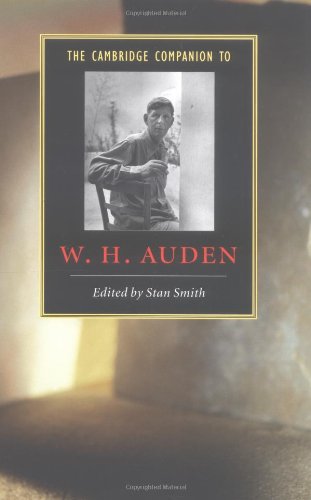
15. The Cambridge Companion to W.
$6.94
16. February House:The Story of W.
$4.00
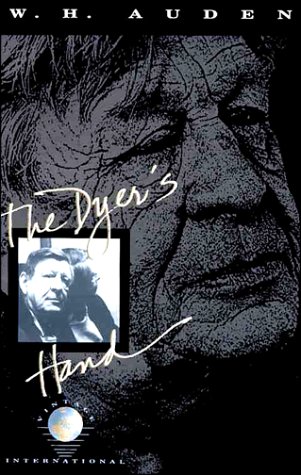
17. The Dyer's Hand
 
18. W. H. Auden Collected Poems
19. Auden's Prose (The complete works
$11.77
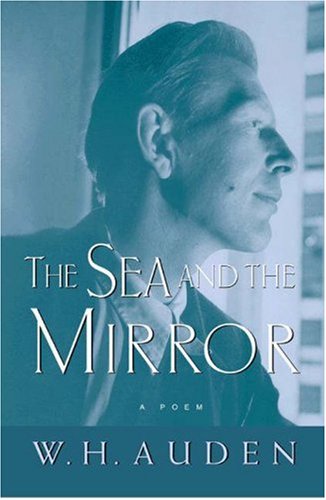
20. The Sea and the Mirror: A Commentary

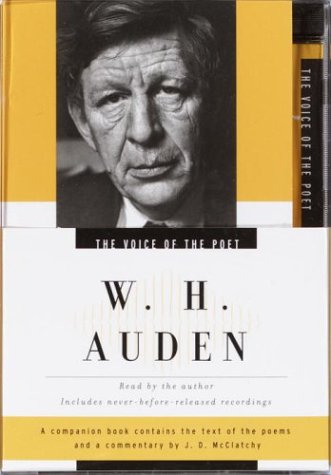
1. Voice of the Poet: W.H. Auden (Voice of the Poet)
by W. H. Auden
Audio CD: Pages (2004-03-16)
list price: US$19.95 -- used & new: US$11.88
(price subject to change: see help)
Asin: 0739308068
Average Customer Review: 5.0 out of 5 stars
Canada | United Kingdom | Germany | France | Japan
Editorial Review

Amazon.com Audiobook Review
W.H. Auden describes the experience of poems read aloud:

The formal structure of a poem is not something distinct from its meaning but as intimately bound up with the latter as the body is with the soul. When one reads a poem in a book one grasps the form immediately, but when one listens to a recitation, it is sometimes very difficult to "hear" the structure.
Thankfully, the throaty growlings unearthed on this rare audio collection are accompanied by text for each of the 23 selections. The handsome booklet also includes a substantial introduction by editor J.D. McClatchy. Highlights from Voice of the Poet--which is being released along with works by Sylvia Plath and James Merrill--include three sonnets from Auden's judicial "In Time of War," "The Wanderer," the elegy "In Memory of W.B. Yeats," and the ballad "As I Walked out One Evening." Listen to Auden read from "As I Walked out One Evening." Visit our audio help page for more information. Used with permission of the estate of W.H. Auden. All rights reserved. (Running time: 1 hour, 1 cassette) Book Description
Some of the most enduring poetry of the twentieth century, read by the legendary Auden himself.This collection features such favorites as "As I Walked Out One Evening," "Musee des Beaux Arts" and "The Shield of Achilles," among many others.

A companion book is included with these never-before-released recordings. ... Read more

Customer Reviews (2)

5-0 out of 5 stars Voice of the Poet: W.H. Auden
This a an excellent collection of auden's poetry, read by the poet. The CD is well recorded and presented in an attractive package, and comes with a book of the poems on the CD in words.

5-0 out of 5 stars Outstanding!
Not all poets make great readers of their own work.But Auden's voice-- so warm, so musical, so passionate-- is a joy to listen to.The recordings, done in many places over many years, are of a varying quality.But in each the voice comes shining through.

The poem selections are top-notch across the board, containing such favorites as "As I Walked Out One Evening," "Fish in the Unruffled Lakes," "Musee des Beaux Arts," four sonnets from "In Time of War," "Under Which Lyre," "The More Loving One" and "The Shield of Achilles."The CD version is supposedly abridged, but it is 57 minutes compared to the Audio Cassette version's hour.This also comes with a book containing the final text of the selected poems (sometimes slightly different than what he reads).The book also contains a nice introduction and background on Auden by poet J.D. McClatchy.

My favorite tracks have to be "Under Which Lyre," read with such wit that it made me laugh several times, and the powerful "Friday's Child".I believe one can listen to a streaming version of "Under Which Lyre" on poets.org -- although it sounds much better on this CD since streaming audio is generally scratchy.It could give you an idea if this CD is right for you.

This could hardly be bad when it contains such great poetry, but it manages to be appropriate for both long-time Auden fans and those who are just beginning.An outstanding product.5/5 stars. ... Read more


2. W. H. Auden: Prose, Volume III, 1949-1955 (The Complete Works of W.H. Auden)
by W. H. Auden
Hardcover: 816 Pages (2008-01-03)
list price: US$49.50 -- used & new: US$33.20
(price subject to change: see help)
Asin: 0691133263
Canada | United Kingdom | Germany | France | Japan
Editorial Review

Book Description

This volume contains all of W. H. Auden's prose works from 1949 through 1955, including many little-known essays that exemplify his range, wit, depth, and wisdom. The book includes the complete text of Auden's first separately published prose book, The Enchafèd Flood, or, The Romantic Iconography of the Sea, followed by more than one hundred separate essays, reviews, introductions, and lectures, as well as a questionnaire (complete with his own answers) about the reader's fantasy version of Eden. Two reviews that Auden wrote for the New Yorker, but which the magazine never printed, appear here for the first time, and a series of aphorisms previously published only in a French translation are printed in English. Among the previously unpublished lectures is a long account of the composition of his poem "Prime," complete with his comments on early rejected drafts.

The variety of style and subject in this book is almost inexhaustible. Auden writes about the imaginary mirrors that everyone carries through life; French existentialism and New Yorker cartoons; Freud, Kierkegaard, Dostoyevsky, and Camus; Keats, Cervantes, Melville, Colette, Byron, Virgil, Yeats, Tolkien, and Virginia Woolf; opera, ballet, cinema, prosody, and music; English and American poetry and society; and politics and religion.

The introduction by Edward Mendelson places the essays in biographical and historical context, and the extensive textual notes explain obscure contemporary references and provide an often-amusing history of Auden's work as an editor of anthologies and a series of books by younger poets.

... Read more

3. Auden: Poems (Everyman's Library Pocket Poets)
by W. H. Auden
Hardcover: 256 Pages (1995-05-10)
list price: US$12.50 -- used & new: US$7.00
(price subject to change: see help)
Asin: 0679443673
Average Customer Review: 5.0 out of 5 stars
Canada | United Kingdom | Germany | France | Japan
Editorial Review

Amazon.com
"You can never step in the same Auden twice," wrote the critic Randall Jarrell, alluding both to the etymology of Auden's name--which comes from river--and the rapid transformations of his poetic style.Wystan Hugh Auden began as a cryptic voice of the Thirties, with alluring yet mysterious creations like "The Secret Agent." Next he made himself into the very model of an engagé artist with "Refugee Blues" or "Spain"--explicitly political utterances that the poet later renounced. Finally, Auden shocked his public by moving from England to the United States, where he fulfilled his ambition to become a "minor Atlantic Goethe" (although many would insist on calling him a major one). Early or late, however, the music of Auden's verse is instantly recognizable, and fantastically memorable. Readers need only hear "In Praise of Limestone" or "The Fall of Rome" or "O Tell Me the Truth About Love" a single time to have selected lines imprinted on their brains. Nor did Auden ever lose his touch as one of the sublime love poets of our age, which was evident from the moment he published his celebrated "Lullaby": "Lay your sleeping head, my love, / Human on my faithless arm; / Time and fevers burn away / Individual beauty from / Thoughtful children, and the grave / Proves the child ephemeral: / But in my arms till break of day / Let the living creature lie / Mortal, guilty, but to me / The entirely beautiful." So what if his face got all wrinkled?Book Description
The Everyman's Library Pocket Poets hardcover series is popular for its compact size and reasonable price which does not compromise content. Poems: Auden is just another reminder of his exhilarating lyric power and his understanding of love and longing in all their sacred and profane guises. One of English poetry's great 20th century masters, Poems: Auden is the short collection of an exemplary champion of human wisdom in its encounter with the mysteries of experience. ... Read more

Customer Reviews (2)

5-0 out of 5 stars Pleasurable Volume
Auden reaches the general public in a way most poets, especially contemporary literary poets, fail. His themes, language, rhythm, imagery and form are no less brilliant for being understood. So many of his pieces reach across decades to contemporary experience, and most general readers come to his anthologies having heard one of his poems used effectively in contemporary media. Everyone who saw "Four Weddings and a Funeral" fell in love with "Funeral Blues," which was read in the funeral scene. This volume has it.

His poem "September 1, 1939" circulated widely, especially via e-mail, as the anniversary of September 11 came around, is also attracting new interest. Unfortunately, that particular work is not included in this collection. All the same, it is a fine sampling of what Auden did across a long and prolific career. The edition has a nice physicality--a well produced hardcover, at a bargain price--perfect for leaving on the bedside or on an occasional table. This is poetry in an accessible package made for reading. It makes a good gift.

5-0 out of 5 stars Some of the best poetry of the last century
This substantial selection from Auden's poems may well help the American reader get a first impression of one of the best poets of the last century. Born in England in 1907, Auden moved to the US in 1940 and became an important influence on many American poets of his time.Unfortunately heusually seems to be regarded as too British to become part of the canon.While there is a very British sense of irony and self-deprecation in manyof these poems, the feelings they express are truly universal.

Whatalways strikes me about Auden is the musical quality of his poems and thehuge number of memorable lines. There are so many verses which you won'tforget although you've only read them one time or two, from the quirky:

"I'll love you, dear, I'll love you /Till China and Africameet, /And the river jumps over the mountain /And the salmon singin the street." to the more serious: "If equal affection cannotbe /Let the more loving one be me."

As these lines do alreadyshow, you do not need a dictionary do understand Auden. In contrast to thegeneration of Eliot and Pound before them, Auden and his friends wanted towrite for the common reader and express the feelings of the people aroundthem. Even today people can relate to this, as the Auden renaissance afterthe reading of one of his poems in the movie "Four Weddings and aFuneral" proved. ... Read more


4. Selected Poems
by W.H. Auden
Paperback: 384 Pages (2007-02-13)
list price: US$14.95 -- used & new: US$8.89
(price subject to change: see help)
Asin: 0307278085
Average Customer Review: 5.0 out of 5 stars
Canada | United Kingdom | Germany | France | Japan
Editorial Review

Book Description
This significantly expanded edition of W. H. Auden’s Selected Poems adds twenty poems to the hundred in the original edition, broadening its focus to better reflect the enormous wealth of form, rhetoric, tone, and content in Auden’s work. Newly included are such favorites as “Funeral Blues” and other works that represent Auden’s lighter, comic side, giving a fuller picture of the range of his genius. Also new are brief notes explaining references that may have become obscure to younger generations of readers and a revised introduction that draws on recent additions to knowledge about Auden.

As in the original edition, the new Selected Poems makes available the preferred original versions of some thirty poems that Auden revised later in life, making it the best source for enjoying the many facets of Auden’s art in one volume. ... Read more

Customer Reviews (1)

5-0 out of 5 stars For lovers of Auden's poetry
W.H. Auden was a twentieth century English poet. He emphasized the individual, past and present, in their frail condition.

Auden's writing varied as to subject, style, and type as he aged. Love poems, politics, culture, morals, individuals; what a wealth of poetry the public has from Auden because of the number of years he lived and wrote. Twenty poems have been added to this expanded edition including some of Auden's lighter poems. This aids the reader, student, or lover of Auden to see a more complex, complete, fuller and well-rounded poet.

A nice touch within the volume was the inclusion of brief notes explaining references that might be unclear. Other positive features consisted of chronological arrangement of material, and an index of titles and first lines.

Armchair Interviews says: A must for all Auden students, whether a casual reader or lover of his poetry. ... Read more


5. Collected Poems (Modern Library)
by W.H. Auden
Hardcover: 976 Pages (2007-02-13)
list price: US$40.00 -- used & new: US$24.78
(price subject to change: see help)
Asin: 0679643508
Average Customer Review: 4.5 out of 5 stars
Canada | United Kingdom | Germany | France | Japan
Editorial Review

Book Description
To commemorate the centennial of W. H. Auden’s birth, the Modern Library offers this elegant edition of the collected poems of one of the greatest poets of the twentieth century.

This volume includes all the poems that Auden wished to preserve, in a text that includes his final revisions, with corrections based on the latest research. Auden divided his poems into sections that corresponded to what he referred to as chapters in his life, each one beginning with a change in his inner life or external circumstances: the moment in 1933 when he first knew “exactly what it means to love one’s neighbor as oneself”; his move from Britain to America in 1939; his first summer in Italy in 1948; his move to a summerhouse in Austria in 1958; and his return to England in 1972.

Auden’s work has perhaps the widest range and the greatest depth of any English poet of the past three centuries. From the anxious warnings of his early verse through the expansive historical perspectives of his middle years to the celebrations and thanksgiving in his later work, Auden wrote in a voice that addressed readers personally rather than as part of a collective audience. His styles and forms extend from ballads and songs to haiku and limericks to sonnets, sestinas, prose poems, and dozens of other constructions of his own invention. His tone ranges from spirited comedy to memorable profundity–often within the same work. His poems manage to be secular and sacred, philosophical and erotic, personal and universal.

“All the poems I have written were written for love,” Auden once said. This book includes his famous early poems about transient love (“Lay your sleeping head, my love,” “Stop all the clocks, cut off the telephone”) and his later poems about enduring love (“In Sickness and in Health,” “First Things First”). The book also includes Auden’s longer, more thematically varied poems, from the expressionist charade “Paid on Both Sides” to the formal couplets of “New Year Letter”; the darkly comic sequel to The Tempest, “The Sea and the Mirror”; and a baroque eclogue set in a wartime bar, “The Age of Anxiety.”

This new edition includes a critical appreciation of Auden by Edward Mendelson, the editor of the present volume and Auden’s literary executor.

“W. H. Auden had the greatest gifts of any of our poets in the twentieth century, the greatest lap full of seed.”
–James Fenton, The New York Review of Books

“At the beginning of the new century, [Auden] is an indispensable poet. Even people who don’t read poems often turn to poetry at moments when it matters, and Auden matters now.”
–Adam Gopnik, The New Yorker ... Read more

Customer Reviews (17)

1-0 out of 5 stars No.
This is a poet who has no emotional or spiritual depth. He is poet of shame. His sarcasm and wit is anything but remarkable. I was actually looking foward to reading his poetry in my class, but was terribly disappointed. It's not worth it.

5-0 out of 5 stars My favorite poet
Since the first time I read Auden's "The Unknown Citizen" in the 10th grade, I have been captivated by his writing style and the pure emotion his poems express. The meaning isn't lost in needless words, but is clear and passionate. I could spend hours just reading his works and oftentimes do. Everyone should read a poem or two of his.

5-0 out of 5 stars Auden's collected poems
The softcover book arrived in excellent condition and in a timely manner.

5-0 out of 5 stars Auden of the anthologies
The work of Auden I knowis not the complete Auden, but rather the Auden of the anthologies. It is the Auden of Musee de Beaux Arts and September 1,1939 and Elegy for W.B. Yeats. It is the Auden of memorable lines, ' The universal error bred in the bone , not to be loved/ but to be loved alone'. It is Auden who is a public poet speaking in lines held together not only by internal rhyme, but by a certain majestic authority of statement. It is the Auden whose poetry at its best seems to be saying something significant about the human condition at a particular time of our history.
This I know is not the whole Auden but it is rather that part given to the widest audience in anthology - the public Auden. Here I sense Auden's poetry spoke with a clarity and sense rare especially in his own time.
He does not have the music of Yeats and Wallace Stevens at their best. He is not as some readers on Amazon have suggested the greatest poet in English in the twentieth century. But my own sense he is one of the best.

5-0 out of 5 stars I;m Willing to go with Joseph Brodsky
I feel for people like Nate Dorwood who wrote the comment
about the first line in "musee des beaux arts" being "fatuous."
This may be Auden's greatest poem.Ian McEwan recently paid
tribute to it's greatness, and Russian poet Joseph Brodsky,
who admired this poem in particular, claimed that Auden had
"the greatest mind of the 20th Century."Neither of them,
both geniuses themselves, found anything about "Musee" to
be "fatuous."
Perhaps it's time to re-read? ... Read more


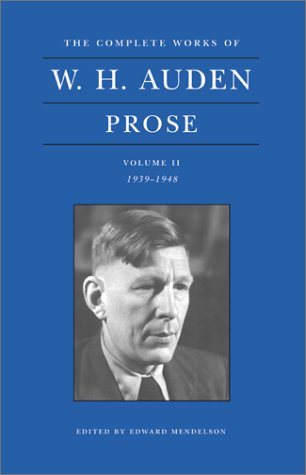
6. The Complete Works of W.H. Auden: Prose: Volume II. 1939-1948 (The Complete Works of W.H. Auden)
by W. H. Auden
Hardcover: 592 Pages (2002-04-15)
list price: US$72.00 -- used & new: US$57.80
(price subject to change: see help)
Asin: 0691089353
Canada | United Kingdom | Germany | France | Japan
Editorial Review

Book Description

W. H. Auden's first ten years in the United States were marked by rapid and extensive change in his life and thought. He became an American citizen, fell in love with Chester Kallman, and began to reflect on American culture and to explore the ideas of Reinhold Niebuhr and other Protestant theologians. This volume contains every piece of prose that Auden wrote during these years, including essays and reviews he published under pseudonyms. Most have never been reprinted in any form since their initial publication in such magazines and newspapers as the Nation, the New Republic, Common Sense, Vogue, and the New York Times.

Auden's prose during this period is frequently directly autobiographical even as he comments on literature, psychology, politics, and religion. The writings range from a dialogue about W. B. Yeats through a respectful parody of Gertrude Stein to Jamesian essays on Henry James. They also include lively and often profound responses to ancient and modern history as well as to contemporary issues in politics and religion. Other highlights include writings on opera and poetry as well as reports of Auden's lectures and the text of an unfinished autobiographical book, The Prolific and the Devourer. Throughout, Edward Mendelson's extensive and illuminating editor's notes explain all contemporary and private allusions.

By making available a large cache of important but previously difficult-to-obtain writings on key subjects, this volume will be of obvious appeal to Auden's legions of admirers. It will also be enjoyed by everyone interested in twentieth-century literature, religion, and culture.

... Read more

7. W.H. Auden: Selected Poems
by W. H. Auden
Paperback: 352 Pages (1989-01-16)
list price: US$13.95 -- used & new: US$7.00
(price subject to change: see help)
Asin: 0679724834
Average Customer Review: 5.0 out of 5 stars
Canada | United Kingdom | Germany | France | Japan
Editorial Review

Book Description
This edition presents the original versions of many poems, which Auden revised to conform to his evolving political and literary attitudes later in his career. In this volume, Edward Mendelson has restored the early versions of some thirty poems generally considered to be superior to the later versions, allowing the reader to see the entire range of Auden's work. Selected and edited by Edward Mendelson ... Read more

Customer Reviews (7)

4-0 out of 5 stars Poetry to "disenchant and disintoxicate"
W.H. Auden is truly, as noted by editor Edward Mendelson, a twentieth century poet.Auden had a firm grasp on the essence of contemporary politics and culture and possessed a knack for bringing a reader into his world.This selection spans the entire body of Auden's work, and contains several early poems which are hard to find, as Auden refused to have them republished in later collections of his work.It is a good introduction to Auden, but I recommend reading it along with Collected Shorter Poems 1927-1957, as that contains the revisions that Auden made to his poems over time, in his fervor for complete honesty in his work.

While Mendelson's selection is well put together and a good representation of Auden's early craft, the revised poems are generally much stronger (though often bleaker in tone).Many changes, such as the famous revision of September 1, 1939 to read "we must love one another and die" rather than "we must love one or die" were made to reflect the author's shifting attitudes.However, other poems improve significantly with Auden's editing, and if this book is the only Auden you read, you'll miss out on the full depth of his power as a poet.

5-0 out of 5 stars About suffering they were never wrong : The old masters
Auden wrote much poetry in many different forms. He was a very learned poet with strong connection to English poetic tradition. Among his most known poems are those which are also my favorites,"Musee des Beaux Arts", "In Memory of W. B. Yeats" and "September 1,1939". The concluding stanza of this last poem gives a good idea of the special colloquial power of Auden's rhyme and rhythm.

"Defenceless under the night
Our world in stupor lies;
Yet, dotted everywhere,
Ironic points of light
Flash out wherever the Just
Exchange their messages:
May I, composed like them
Of Eros and of dust,
Beleaguered by the same
Negation and despair,
Show an affirming flame.

In that poem also contains the great stanza, " Lest we should see we are/ Lost in a dark haunted wood/ Children afraid of the night/ Who have never been happy or good."
Auden wastoo a considerable critic of Literature, an outstanding Anthologist, a man-of- letters in a true sense.
I do not know the range of his poetry well, but the anthology pieces are filled with memorable lines.
Edward Mendelson, a well- known Auden scholar, in this work presents a number of original poems which Auden as he was wont to do improved for the worse.

5-0 out of 5 stars The Quintessential Collection
For many of us,the poems that we read in childhood and adolescence are those that stick with us the most.When I was fifteen, I bought this volume and promptly fell in love with Auden's poetry.His work showed a restlessness with the social and political state of his world, and I found that I could connect with it both intellectually and emotionally.To this day, I can revisit this book's pages feeling like I am visiting a childhood friend.Auden expressed some feelings I shared with him, and I was moved by his ability to express them better than I ever could: with frankness, wit, and grace.A must for any literary enthusiast (or any curious fifteen-year-old, for that matter).

5-0 out of 5 stars A marvelous introduction
I can do little more than echo the other reviewers here.This is all a 'selected poems' shoud be: introductory and selective.Yes, "Funeral Blues" is missing.But no one can complain about what is here, which includes "In Time of War", the great sonnet sequence; "The Quest", another long sequence; and the entirety of THE SEA AND THE MIRROR, which is based on Shakespeare's THE TEMPEST.If you are, however, only interested in his love poems, I'd have to steer you toward TELL ME THE TRUTH ABOUT LOVE, a nice little chapbook containing only those.

My own personal experience with this book may be relevant.It has served to introduce me to one of the finest poets of the last century and sparked a desire to read THE COLLECTED POEMS, also edited by Mendelson, to see how Auden re-wrote thirty of the brilliant poems here included.I'm continuing on my voyage; hope you are starting on yours.

5-0 out of 5 stars Worth singing about
The poetry is splendid -- Auden is a brilliant, sensitive, musical and entertaining writer -- and the selection is fairly representative. Mendelson prefers Auden's later poems to his earlier ones, so the twee middle-aged sequences "Bucolics" and "Horae Canonicae" are included complete, while most of "Twelve Songs" (which has some terrific love poems like "Fish in the unruffled lakes", "Funeral Blues" and "Tell me the truth about love") is not. Still, there is enough in here, esp. in the first two-thirds of the book, to give you a fair enough taste of Auden's verse to entice you to buy his Collected Poems.

(You'll still need the Selected; it has a couple of good poems that Auden decided not to republish, and superior versions of some early poems.) ... Read more


8. Lectures on Shakespeare (W.H. Auden: Critical Editions)
by W. H. Auden
Paperback: 488 Pages (2002-09-09)
list price: US$24.95 -- used & new: US$16.15
(price subject to change: see help)
Asin: 0691102821
Average Customer Review: 4.0 out of 5 stars
Canada | United Kingdom | Germany | France | Japan
Editorial Review

Amazon.com
After transplanting himself from England to the United States in 1939, W.H. Auden immediately became a kind of academic knight-errant, teaching at five different schools in as many years. Little evidence survives of most of these gigs. But in 1946, Auden gave a course on Shakespeare at Manhattan's New School, and luckily, several of the students attending took maniacally assiduous notes. Now Arthur Kirsch has collated the whole batch--and, one assumes, done some major nip-and-tuck work on this textual nightmare. The result is an insightful, eccentric, and perhaps essential slice of Bardolatry, which tells us as much about Auden as his subject.

Nobody can accuse Auden of parroting the party line on this greatest of English writers. In one of the nuttier moments in the lecture series, in fact, he expressed his distaste for The Merry Wives of Windsor by declining to say a word about it--instead he simply played a recording of Verdi's Falstaff for the perplexed audience. Elsewhere his tendency was to view Shakespeare's creations asflesh-and-blood characters rather than poetic constructs: "If Antony and Cleopatra have a more tragic fate than we do, that is because they are far more successful than we are, not because they are essentially different." He's harder pressed to locate any success stories in Julius Ceasar: the protagonist strikes him as a fading despot, Octavius is "a very cold fish," and Cassius "a choleric man--a General Patton." And sometimes, as in this discussion of Falstaff's role in the double-decker Henry IV, Auden spins off his own freestanding riffs, which amount to short prose poems on Shakespearean themes:

A fat man looks like a cross between a very young child and a pregnant mother. The Greeks thought of Narcissus as a slender youth, but I think they were wrong. I see him as a middle-aged man with a corporation, for, however ashamed he may be of displaying it in public, in private a man with a belly loves it dearly--it may be an unprepossessing child to look at, but he's borne it all by himself.
Auden would return to the Bard's terrain many times in his career, most notably in "The Sea and the Mirror." But for sheer penetration and puckish humor, Lectures on Shakespeare is hard to beat, and demonstrates that for all their differences, both the speaker and his subject had a crucial thing in common--what Auden calls "a fabulously good taste for words." --James MarcusBook Description

"W. H. Auden, poet and critic, will conduct a course on Shakespeare at the New School for Social Research beginning Wednesday. Mr. Auden has announced that in his course . . . he proposes to read all Shakespeare's plays in chronological order." The New York Times reported this item on September 27, 1946, giving notice of a rare opportunity to hear one of the century's great poets comment on one of the greatest poets of all time. Published here for the first time, these lectures now make Auden's thoughts on Shakespeare available widely.

Painstakingly reconstructed by Arthur Kirsch from the notes of students who attended, primarily Alan Ansen, who became Auden's secretary and friend, the lectures afford remarkable insights into Shakespeare's plays as well as the sonnets.

A remarkable lecturer, Auden could inspire his listeners to great feats of recall and dictation. Consequently, the poet's unique voice, often down to the precise details of his phrasing, speaks clearly and eloquently throughout this volume. In these lectures, we hear Auden alluding to authors from Homer, Dante, and St. Augustine to Kierkegaard, Ibsen, and T. S. Eliot, drawing upon the full range of European literature and opera, and referring to the day's newspapers and magazines, movies and cartoons. The result is an extended instance of the "live conversation" that Auden believed criticism to be. Notably a conversation between Auden's capacious thought and the work of Shakespeare, these lectures are also a prelude to many ideas developed in Auden's later prose--a prose in which, one critic has remarked, "all the artists of the past are alive and talking among themselves."

Reflecting the twentieth-century poet's lifelong engagement with the crowning masterpieces of English literature, these lectures add immeasurably to both our understanding of Auden and our appreciation of Shakespeare.

... Read more

Customer Reviews (6)

4-0 out of 5 stars Quick and Collected
What we read as Aristotle is actually nothing he wrote, but rather notes collected from students of his, compiled into something that looks like a lecture.This is exactly what we have here in the form on Auden's Lectures on Shakespeare.He gave a Shakespeare course at New College in New York one summer and this book is a transcription of some copious scribes and pupils.Let me say first that they are wonderful.Auden's insight is not only a poet's-though it is that-but a scholar's also, and one of such penetrating originalityhe makes these works appear sometimes without the heavy critical histories they worry under.This is aided by the fact that he reads all of Shakespeare's plays (one per week) for this course, even the lesser known ones, and also by the fact that the notes can't help but distill his lectures only into their most interesting points.As such, it seems that he effortlessly moves from one new vision to the next with a nonchalance that I can only assume is British, or else a character marking of someone so consistently called "Augustain."We know of Auden as a reader of Shakespeare primarily from his long poem about The Tempest, now we have another, more direct view of his reading.

2-0 out of 5 stars Tabloid Shakespeare?
WH Auden's poem Funeral Blues is arguably one of the most powerful poems of loss ever written - vide the last stanza:

"The stars are not wanted now: put out every one;
Pack up the moon and dismantle the sun;
Pour away the ocean and sweep up the wood,
For nothing now can ever come to any good."

One would expect Auden on Shakespeare to be a marvel. However, the views attributed to Auden in this book have a tabloid feel - or the feel of a collection of essays written by very industrious but hopelessly lost English undergraduates. One is left with the surmise (expressed by other reviewers) that because, like all of Aristotle's works, this is a compilation of lecture notes taken by students, what we may have here is a collection of views with which WH Auden would have taken very strong issue. The views attributed to Auden re Shakespeare's play Hamlet - universally agreed by literary scholars such as James Joyce, CS Lewis, Harold Bloom et alia to be Shakespeare's master work - are a good example:

1. "I would question whether anyone has succeeded in playing Hamlet without appearing ridiculous.... Hamlet, the one inactive character, is not well integrated into the play and not adequately motivated, though the active characters are excellent" (pages 159, 162).

If you've seen the Kenneth Branagh version of Hamlet, or are well read in Hamlet, you understand how inexplicable that first remark is. Next, Hamlet refuses to "cast to earth" his mourning clothes in defiance of accepted norms and the King's command; he pursues and speaks with his father's ghost against his friends' pleading, then resolves to avenge his murdered father; he conceives of the mousetrap play "to catch the conscience of the king"; he savagely berates his mother (Act III sc 4) after slaying Polonius; he foils the deadly scheme of Rosencrantz and Guildenstern then engineers their deaths; he out-fences Laertes then successfuly avenges his father by slaying the "adulterate and incestuous" King Claudius. Hamlet does all these things - but we're to understand he is "the one INactive" character?

2. "The soliloquies of Hamlet as well as other plays of this period are *detachable* both from the character and the plays.... Hamlet's disgust and revulsion towards his mother, for example, seem out of all proportion to her actual behavior" (page 162).

Again, could Auden really have said this? Let's examine the play: The ghost of Hamlet's father implies that Hamlet's mother had an extramarital affair with the fratricidal Claudius. If true, the unforeseen consequences of that adultery implicate her both in the murder of Hamlet's father and the consequent moral poisoning of all Denmark. Further, her marriage to her brother-in-law in the medieval-Renaissance context of the play is a public scandal and "incestuous". Moreover, her decision to marry while still in mourning led to Hamlet's not becoming King. Do such unfortunate events justify Hamlet's anger with his mother - "in all proportion"? (For brevity, there's no need also refuting the similarly questionable remarks about the four soliloquies of Hamlet.)

3. "Ophelia is a silly, repressed girl and is obscene and embarrassing when she loses her mind over her father's death.But though her madness is very shocking and horrible, it is not well motivated" (page 163).

Had Auden forgotten what this play was about since reading it as an Oxford undergraduate - or was he misquoted? (Would Auden have considered anyone profoundly moved by his own Funeral Blues as similarly "obscene", "repressed", and "silly"? My guess is not.) As written, the play indicates Ophelia is desperately in love with Hamlet - the sort of transporting passion for which women have been known to give up empires and even their lives. Her father and brother both repeatedly impress upon Ophelia that this man she desperately loves is just flirting her to bed her, and that she certainly isn't good enough for him; she discovers Hamlet has apparently gone mad, presumably because of love for her - love thwarted by her father's cynicism; she is compelled - again by her father - to allow her intimate love letter from Hamlet to be read before the King and Queen; she is impressed - again by her father - into an attempt to entrap Hamlet, thus provoking his wounded rage; finally, Ophelia learns Hamlet has murdered her father. Isn't it logical this "silly, repressed girl" is under the horrible impression that her beloved Hamlet has murdered her father out of unrequited love - the love her father repeatedly frustrated - leading to Hamlet's madness, and that somehow she is therefore to blame? Isn't it clear Ophelia can now never marry Hamlet, her father's murderer? And isn't her "following" Hamlet in madness an awful testimony of the power of cynicism and lies to destroy a woman's heart? No, none of this is clear, apparently.

The specious reasoning attributed to Auden is not confined to assessments of Hamlet. The Taming of the Shrew Auden [?] calls "the only play of Shakespeare's that is a complete failure" (page 63). Auden's remarks [?] on Othello are plain odd, eg, "It's easy for us to see that Othello and Desdemona should not have married, but he [Othello] never does" (page 205). While WH Auden has been described as a sardonic Oxonian, it strains belief this book of redacted student lecture notes is a faithful representation of Auden's literary insight. At best, the views in this work are indefensible on purely literary grounds; at worst, what we may have here is a work of posthumous literary libel.

Not recommended for the reasons noted.

4-0 out of 5 stars Auden's lectures are enjoyable conversations on the plays
Reading each of Auden's lectures will not make you an expert on any aspect of the plays or poems - he doesn't aim to be comprehensive. Instead, Auden engages you in one or two key aspects from each play. Subsequently, the book could have been called "Conversations about Shakespeare."

Occasionally, as in "Julius Caesar" or "King Lear," Auden is direct and focused. Here you will get a good, general view of these plays. But more often he dives into a theme, leaving the specifics of the play far behind. Reading some lectures I would ask myself, "Is he going to talk about the play or is he going to stick with this?" In the lecture about "As You Like It," he goes on for the first seven pages about the pastoral play. You would think this would be annoying, but Auden's easy manner keeps you hooked. Then in the end you will have learned something new, something special to Auden's perspective.

Some of the themes can be pretty high brow, but usually the are educational and entertaining. And this off-the-beaten-path approach is what makes the lectures unique.

If you're looking for the exact historical context of a play or a lengthy essay about some character, read the introduction from a paperback copy of a play. Auden's lectures will teach you a little extra you won't find anywhere else.

5-0 out of 5 stars An astonishing piece of literary detective work
Imagine trying to assemble lectures made close to 50 years ago from assorted notes and other papers. This is what Kirsch has managed to achieve in an excellent book that is superbly edited and written. W.H. Auden appears as a sensible and balanced critic of Shakespeare and his observations are always telling. I really like his chapter on Macbeth even though Auden claims that he has nothing to offer. I am just so pleased that Kirsch took the time to research and compile this book. An intense labour of love that will repay countless readings.

3-0 out of 5 stars Refreshing but not as impressive as I thought it would be
Although we should all be grateful to have WH Auden's thoughts on the Bard - and they are very novel observations - I can't help but feel slightly disappointed by this collection of lectures. It is amazing that his students took such diligent notes and that Arthur Kirsch managed to transcribe them so that we can almost feel Auden talking to us.However, I was forced to give it three stars because (and this is irrational) I just didn't feel like I connected with his ideas. His analysis of the characters is very modern and is definitely a new and refreshing perspective from what we all learned. His lecture on the Merchant of Venice, I thought, was the most interesting. However, I think that it was maybe a little too novel and provoking, a little too detached from the actual symbolism of the plays. I enjoyed this book, but I'm just not sure I have been convinced or particularly impressed with these lectures. Maybe it's just me... ... Read more


9. Collected Shorter Poems 1927-1957.
by W. H. Auden
 Hardcover: 351 Pages (1966)
-- used & new: US$55.00
(price subject to change: see help)
Asin: B0000CN8U9
Canada | United Kingdom | Germany | France | Japan

10. W. H. Auden's Book of Light Verse (New York Review Books Classics)
by W.H. Auden
Paperback: 556 Pages (2004-07-31)
list price: US$17.95 -- used & new: US$8.04
(price subject to change: see help)
Asin: 159017089X
Average Customer Review: 3.0 out of 5 stars
Canada | United Kingdom | Germany | France | Japan
Editorial Review

Book Description
Auden's celebrated anthology of light verse is packed with surprising finds while also offering a striking rethinking of the poetic canon. Commissioned by Oxford University Press in the 1930s, when Auden's own work was at its boldest, the book caught its original publisher off guard. For it is less a collection of humorous verses than a celebration of the popular voice in English, in which the work of great satirists like Swift and Byron keeps company with ballads, chanteys, ditties, nursery rhymes, street calls, bathroom graffiti, epitaphs, folk songs, vaudeville turns, limericks, and blues. Turning away from the post-Romantic cult of the sentimental lyric, Auden features poetry that is clear, enjoyable, and, no matter its age, absolutely modern.

This new edition includes previously censored poems, together with Auden's remarkable introduction and a new preface by his literary executor, Edward Mendelson. ... Read more

Customer Reviews (1)

3-0 out of 5 stars A Mixed Bag
I finished reading W.H. Auden's Book of Light Verse and I found it to be a mixed bag.First some definitions:this book was originally published as part of the Oxford University Press' collection of books of poetry.Commissioned in the 1930s, it is not, simply stated, a book of comedic verse, although many of the pieces are quite humorous.

It is rather a collection of poetry of popular verse, beginning with poems in Middle English ("Sitteth alle stile and herkneth to me ! / the kyng of Alemaignr, bi mi leaute,") and carrying through to Auden's contemporaries ("Spirits of well-shot woodcock, partridge, snipe / Flutter and bear him up the Norfolk sky:").Representing many forms, from nursery rhymes (the original "Jack and Gill went up the Hill" is in here -- Gil, who knew it was Gil) to elegies to limericks to odes, and many voices (some American, Irish and Scottish, though mostly British) it is a thorough collection.

And therein lies my problem with it.As a collection, I found myself thumbing through, looking at particular pieces and savoring them, and skipping others completely.It is collection which, to me, is often excellent, and occasionally horrible.

One of my favorite pieces (which I have marked since I am sure to read and re-read it) is "The Careless Gallant" by Thomas Jordon.It begins "Let us drink and be merry, dance, joke, and rejoice, / With claret and sherry, thorbo and voice ... In frolics dispose your pounds, shillings, and pence / For we shall be nothing a hundred years hence."

Another seemed particularly relevant to our current time.John Gay's "Ode for the New Year" makes fun of King George, and I drew some inspiration from it, and wrote my own re-interpretation of this poem, titled "Ode for a Second Inauguration."Much of the piece is based on the original John Gay piece -- grab the original to compare and see for yourself.

So, in short, a worthwhile piece to add to a poetry collection, but not one to start your library.


... Read more


11. W.H. Auden Collected Poems
 Leather Bound: 737 Pages (1978)

Asin: B000JW2H9Q
Canada | United Kingdom | Germany | France | Japan
Editorial Review

Product Description
Limited Edition published exclusively for subscribers to The Greatest Books of the Twentieth Century. Leather bound with hubbed spine. gilt edges and gold cover letters and designs. ... Read more


12. The Complete Works of W. H. Auden: Prose and Travel Books in Prose and Verse, 1926-1938
by W. H. Auden
Hardcover: 952 Pages (1997-02-03)
list price: US$100.00 -- used & new: US$79.90
(price subject to change: see help)
Asin: 0691068038
Canada | United Kingdom | Germany | France | Japan
Editorial Review

Book Description

This book contains all the essays and reviews that W. H. Auden wrote during the years when he was living in England, and also includes the full original versions of his two illustrated travel books, Letters from Iceland (written in collaboration with Louis MacNeice) and Journey to a War (written in collaboration with Christopher Isherwood). Auden's early prose ranges from extravagant indiscreet travel diaries through sharply observed critiques of writers from John Skelton to Winston Churchill. It includes studies of Communism and Christianity; audaciously wide-ranging essays on literature, psychology, and politics; and writings about gossip, sex, prisons, and schools.

The editor's notes include explanations of contemporary and private allusions. The long "Last Will and Testament" written in verse by Auden and MacNeice, which Evelyn Waugh described as a "gossip column," is annotated in full. The book will interest not only Auden's many admirers, but everyone concerned with twentieth-century literature and culture.

About the series:

In 1928, Stephen Spender hand-printed thirty copies of a small volume of poems by his friend W. H. Auden--the first published book by a man who was to become the dominant literary figure of his generation and one of the century's greatest poets. Sixty years later, Princeton University Press inaugurated an edition of the complete works of Auden, which is intended to serve as the definitive text for all the works Auden published or intended to publish in the form in which he expected to see them printed: his plays and other drama, libretti, essays and reviews, and poems.

The Complete Works of W. H. Auden will provide a unique opportunity to solve the numerous textual problems connected with the severe revisions Auden made in his own works. The texts are newly edited from Auden's manuscripts by Edward Mendelson, the literary executor of the Auden estate.

... Read more

13. W. H. Auden
by John Fuller
Hardcover: 640 Pages (1998-09-14)
list price: US$80.00 -- used & new: US$64.95
(price subject to change: see help)
Asin: 0691004196
Average Customer Review: 5.0 out of 5 stars
Canada | United Kingdom | Germany | France | Japan
Editorial Review

Book Description
This is an indispensable reference guide to the works of one of the most important poets of the twentieth century. W. H. Auden's writing is notoriously complex--full of puzzling allusions and shaped by influences as diverse as Old English poetry and Auden's own theory of psychosomatic illness. To help readers understand Auden's work, the poet and scholar John Fuller examines all of Auden's published poems, plays, and libretti, leaving out only some juvenilia. In unprecedented detail, he reviews the works' publishing history, paraphrases difficult passages, and explains allusions. He points out interesting variants (including material abandoned in drafts), identifies sources, looks at verse forms, and offers critical interpretations. Along the way, he presents a wealth of facts about Auden's works and life that are available in no other publication.

The book is a major revision of Fuller's critically acclaimed Reader's Guide to Auden, published in 1970. It contains more than twice the material of that earlier volume. Fuller organizes the book on the basis of the individual collections that Auden himself originally published, with sections of "uncollected" work interwoven. Clear, meticulously researched, and carefully designed for ease of use, it is an essential guide for anyone interested in Auden's remarkable and sometimes elusive writing. ... Read more

Customer Reviews (1)

5-0 out of 5 stars The wide richness of a poet's commentary
W. H. Auden's work is in a way a challenge to the reader. Many times (Specially in the so called english Auden) it happens that you don't really know what the poem is about or why you like it. As Mr. Fuller sayssometimes "Auden's merit lies in his vagueness".The Oxfordprofessor Mr. John Fuller has written a highly accurate work in which hecomments every single work published and unpublished by Auden.He statesin his prologue that this is not a book for reading "in the normalway", meaning that "W. H. Auden: A Commentary" is a bookjust as a dictionnary is: A book in which you look for some information butyou don't read from the first page until the last as you do it with a novelfor instance. I actually don't think Mr. Fuller's opinion to be in thiscase too fair. In spite of the evident, permanent and necessary referenceto Auden's work I beleive the tone and mood of his own comments make thisbook readable not only as an information book but also as a work in itself.The very word "Commentary" moves to think in a work written inorder to illuminate another text. But Mr. Fuller builds his commentary froma wide range of "starting points". Sometimes isAuden'smeter,sometimes the structural likness with other poetic form (As the"Sagas" - a nordic poetic form completelyunknown to me) or justa philosophical or psychological concept used by Auden in a quite hiddenway or lastly Mr. Fuller's own perplexity like in his comment to the poem"The Wanderer". Mr. Fuller's comments never exceed a couple ofpages, but there he develops his own way of reading the poem and give usthe chance to see this simple fact in action: How does a man read. Inaddition to this the book provides the whole technical and theoreticalbackground required to enjoy the poem even more than after our vagueintuitons.If you look for general observations about Auden's life or workthis is not the book for you. But if you are looking for a way to refineyour own readings by learning a lot of information hidden in Auden's poemsand at the same time contemplate how works the interpretive mind of a greatpoet when he reads a 20th century classic, this is a perfect chance. ... Read more


14. A Certain World. A Commonplace Book by W.H. Auden
by W.H. Auden
 Hardcover: Pages (1970)

Asin: B000YG17KM
Canada | United Kingdom | Germany | France | Japan

15. The Cambridge Companion to W. H. Auden (Cambridge Companions to Literature)
Paperback: 285 Pages (2005-02-07)
list price: US$27.99 -- used & new: US$13.86
(price subject to change: see help)
Asin: 0521536472
Canada | United Kingdom | Germany | France | Japan
Editorial Review

Book Description
Offering original perspectives from new amd established Auden critics and others, this volume brings together specially commissioned essays by some of the world's leading experts on the life and work of W.H. Auden, one of the major English-speaking poets of the twentieth century. The volume's contributors include prize-winning poets, Auden's literary executor and editor, and his most recent, widely acclaimed biographer. The Companion also examines his language, style and formal innovation, his prose and critical writing and his ideas about sexuality, religion, psychoanalysis, politics, landscape, ecology, and globalization. ... Read more


16. February House:The Story of W. H. Auden, Carson McCullers, Jane and Paul Bowles, Benjamin Britten, and Gypsy Rose Lee, Under One Roof in Brooklyn
by Sherill Tippins
Paperback: 336 Pages (2006-07-12)
list price: US$13.95 -- used & new: US$6.94
(price subject to change: see help)
Asin: 061871197X
Average Customer Review: 5.0 out of 5 stars
Canada | United Kingdom | Germany | France | Japan
Editorial Review

Book Description
The ramshackle Brooklyn brownstone dubbed "February House" has itself been demolished, but the legacy of this literary bastion lives on in Sherill Tippins's wonderful account that, as the San Francisco Chronicle notes, is a "tribute to the location that gives it mythical status." This is the incredible story of an artistic fraternity that included, among others, Carson McCullers, W.H.Auden, Paul Bowles, and the famed burlesque performer Gypsy Rose Lee, all living together under one roof.In the one year of its existence, these burgeoning talents composed many of their most famous, iconic literary works while experiencing together a crucial historical moment America at the threshold of World War II. ... Read more

Customer Reviews (16)

5-0 out of 5 stars February House
For me this was an amazing discovery. I read a review of it in a literary magazine in the waiting room of my optician and when I got home I immediately ordered it from Amazon.
What caught my eye in the review were the names of the inhabitants of the February House - Auden, Britten,McCullers... in that amazing year. I knew of their work individually but to read of them living under the same roof was a revelation.What a cauldron of creativity! All against the background of the war in Europe and the period leading up to Pearl Harbour.As I read the book I felt as though I were there. I hope that someone will make a documentary about it or better still a dramatised reconstruction. The two Truman Capote films have blazed the trail.

5-0 out of 5 stars What a great read!!!
A friend just recommended this book to me and it's fabulous!!!I live in an artist bldg and it's nothing compared to the energy of Middagh Street. The book is a great read and the research is most impressive. I cannot wait to read the one she's writing about the Chelsea Hotel!

5-0 out of 5 stars That House on Middagh Street
Thomas Wolf once famously said "only the dead know Brooklyn."There might be some truth in that, but some of us know Brooklyn, N.Y.,U.S.A., pretty well,and are still very much alive.Quite a few people are aware of Brooklyn's brownstone belt, that swath of historic houses stretching from the East River to Prospect Park and beyond.Many of these people would declare Brooklyn Heights the ultimate Brooklyn brownstone neighborhood.It's beautiful, and gets scenic views of Manhattan.It's got history galore--an important Revolutionary War battle was fought here;and it's been, and still is,home to a lot of well-known important people.

One little-known fact is that a number of celebrated people shared a house on Middagh Street, in 1940-41, right in the middle of the Second World War.That house, which came to be known as February House-- a number of its residents had February birthdays-- has long since been torn down to make room for the Promenade that provides storied views of Manhattan.But among occupants of February House were poet W.H.Auden, writer Carson McCullers, writers Jane and Paul Bowles,composer Benjamin Britten, and stripper Gypsy Rose Lee.

Writer Sherill Tippens has produced an interesting, pleasantly gossipy book about the house's residents and their accomplishments.Jane Bowles began "Two Serious Ladies," her only completed novel here.The young lesbian Carson McCullers had just tasted, at the age of 23, great success with her novel "The Heart is a Lonely Hunter." She began two other great successes, "The Member of the Wedding," and "The Ballad of the Sad Cafe," between drinking bouts, right here on Middagh Street.

Auden and Britten, both homosexual, but not involved with each other, were being raked over the coals at the time by the British press for choosing to sit out World War II in the U.S. But they were working: they collaborated on the opera "Paul Bunyan,"not critically well-received. Auden who continued to live in the Heights, on his own, to pursue his lifelong, unrequited love for the young American Chester Kallman, was working hard in the interstices of his personal soap opera: He produced "The Double Man" in February House.Britten produced "Peter Grimes;"considered one of the great masterpieces of 20th century opera.Meanwhile, he pursued his own personal soap opera: many critics believe this opera echoes developments with his partner, tenor Peter Pears, at the time.

The most unexpected resident of February House would have to be Gypsy Rose Lee, burlesque artiste.She was talked into joining the fun by George Davis, homosexual himself, fiction editor of "Harpers Bazaar" magazine, whose idea February House was, and who worked hard to keep it alive.Davis had published some of his own writing, but he was best known for the talented writers he kept on discovering.

In Gypsy Lee's case, she brought some money, a lot of common sense,and a cook to Middagh Street.The house's residents needed all the above.Her reward for her support: George Davis, great editor, midwifed her book, "The G-String Murders," a publishing sensation for many years.

George Davis continued to live at 7 Middaagh Street after its time as an artistic commune had passed.After Kurt Weill's death, Davis married his widow, Lotte Lenya, and devoted his life to introducing America to Weill's great works,such as "Three Penny Opera,"from which we get "Mack the Knife."

There are some informative photographs, extensive notes and acknowledgements in February House.Tippins evidently did a lot of primary research, but she managed to organize the voluminous results in a very readable style.February House well rewards the reader.

5-0 out of 5 stars The bump and grind of a literary bawdy house
Sherill Tippins has done an amazing job of finding the significant narrative threads in the chaotic convergence of creative lives that occurred in the months before Pearl Harbor when Harper's Bazaar editor George Davis and British expatriate poet W.H. Auden rented a brownstone on 7 Middagh Street in Brooklyn Heights and actively recruited other creative artists to live with them. Among the co-renters were Carson McCullers who had recently published her highly acclaimed first novel, "The Heart Is A Lonely Hunter," soon-to-be famous British composer Benjamin Britten and his parnter, singer Peter Pears, unpublished novelists Paul and Jane Bowles, Broadway set designer Oliver Smith, writer Richard Wright and his wife, and burlesque sensation Gypsy Rose Lee, who it turns out was the most reliable in the rent-paying department and joined the little "creative commune" on the condition that she could bring her own cook and maid. Her fiscal reliability and drive along with Auden's willingness to take on the unpleasant role of house disciplinarian (collecting rent and other "dues" and establishing and enforcing many house rules) are probably sufficient explanation for why this menage managed to last the two or three years it did.

Tippins wisely focuses her attention on the leading figures (without neglecting to name the many others who partied but did not reside at 7 Middagh--Salvador and Gala Dali, Lincoln Kirstein, George Balanchine, Erika Mann and her brothers Klaus and Golo, to name a few). One passer-through, Anais Nin, christened the dwelling "February House" because so many of the residents had February birthdays. Tippins has a good knowledge of the works of these creative people and is able to see how one of the artists intentionally or inadvertantly influenced a subsequent work of one of his or her co-residents. For example, McCullers was struggling with the novel that would later become "The Member of the Wedding" when she was able to appropriate an experience from Chester Kallman's childhood to explain her heroine's profound sense of alienation and abandonment (Kallman was Auden's lover).

Tippins other great achievement here was her ability to slice through history and palpably recreate the political atmosphere in pre-war New York and to do so in a way that reflects on both British and US perspectives. She takes a good hard look at the criticism expatriates like Auden, Christopher Isherwood, Britten, and Pears faced from the British press and fellow artists who chose to remain in Great Britian during the war. She is similarly insightful in her analysis of the role the Mann family had in trying to get an apathetic America to respond to the European crisis. A lesser writer might not have bothered with these issues and chosen to report only the salacious and saleable anecdotes about the goings-on of the February House residents.

I highly recommend this book to anyone even passingly interested in one of the artists who lived at 7 Middagh Street (you're sure to learn something new), to anyone who ever wondered how great works of art come about, or to anyone interested in knowing how history and art intersect. I'm sure I'm going to use Tippins's Selecte Bibliography as a basis for future Amazon.com purchases.

5-0 out of 5 stars Timely and beautifully written
Sherill Tippins' volume fills a tantalizing gap that fans of Auden, McCullers, Britten, and Gypsy Rose Lee have long wished could be filled.Most overdue is Tippins' portrait of George Davis: failed literary wunderkind; editor extraordinaire (who "discovered" McCullers and got much-needed writing jobs for her and W. H. Auden in the lean months before Pearl Harbor); husband to Lotte Lenya and the catalyst that re-invented her for American audiences in Marc Blitzstein's staging of Weill's "Threepenny Opera"--the list goes on and on.Davis and Auden are central to Tippins' account and to the amazing colony of artists who called 7 Middagh Street in Brooklyn Heights their home in 1940-41.But Tippins gives everyone in that circle his/her due.Her depictions of Auden's rocky romance with Chester Kallman, of Benjamin Britten's coming to terms with his artistic destiny in England, not America, and Gypsy Rose Lee's ability to charm and disarm everyone she met are more than engaging--they are extremely moving.

Tippins' research is exhaustive and impeccable, and she lets her characters speak naturally and eloquently.I could not put this book down and practically read it at one sitting.I was hungry for the kind of information Tippins delivered, and I finished the book with the deepest satisfaction.Gracefully written, carefully organized and researched, and extremely relevant:this book wins on all counts. ... Read more


17. The Dyer's Hand
by W. H. Auden
Paperback: 544 Pages (1990-02-19)
list price: US$19.95 -- used & new: US$4.00
(price subject to change: see help)
Asin: 0679724842
Average Customer Review: 4.5 out of 5 stars
Canada | United Kingdom | Germany | France | Japan
Editorial Review

Book Description
In this volume, W. H. Auden assembled, edited, and arranged the best of his prose writing, including the famous lectures he delivered as Oxford Professor of Poetry.  The result is less a formal collection of essays than an extended and linked series of observations--on poetry, art, and the observation of life in general.  The Dyer's Hand is a surprisingly personal, intimate view of the author's mind, whose central focus is poetry--Shakespearean poetry in particular--but whose province is the author's whole experience of the twentieth century. ... Read more

Customer Reviews (2)

5-0 out of 5 stars excellent, thoughtful work of general criticism
This book of essays is a wonderful and surprising work, by the clear-minded and perceptive poet W.H. Auden.It is not a formal methodical work, like one would expect from a critic, but rather a poetic creation that provokes thought rather than defining thoughts.Auden's way of relating all sorts of things to each other, from opera to art to Shakespeare to everyday life, makes for a very mind-refreshing read.For anyone who has an interest in literature, art, or philosophy, this is a great choice.

4-0 out of 5 stars An enjoyable read
Casual in a sense, not twist your brain all up in the ugly way that a lot of "theorists" seem to like to. It's straight talk about poetry. Great length too. ... Read more


18. W. H. Auden Collected Poems
by W.H. Auden
 Hardcover: 696 Pages (1976-09-12)
list price: US$39.95
Isbn: 0394408950
Average Customer Review: 4.0 out of 5 stars
Canada | United Kingdom | Germany | France | Japan

Customer Reviews (1)

4-0 out of 5 stars One of the great poets of the twentieth century
Wystan Hugh (W. H.) Auden is rightly regarded as one of the great poets of the twentieth century.He is one of my favorites because of his great skill with language, his ability to talk about everyday life in wonderfully insightful ways, and to sing while he helps us see what he sees.His even greater gift is to make his words feel as if they came from out of our own mind and heart.We want to possess them.

Yet, he was also a very learned man, but his learning always has a point about life rather than allowing him to step into a spotlight for our adulation.You can flip to any page of this volume and find something to wonder at.Even the plainest poems have depths to plumb and the seemingly obscure yield to patient reading.

While Auden has a somewhat complicated biography, it would be a mistake to get sidetracked in too many details.While knowing the life of an artist often aids our understanding of his work, it is also a mistake to see too many parallels in his work with the happenstance of his life.Great artists draw on their lives, but they also transcend them.

I am very grateful to have this volume in my library. ... Read more


19. Auden's Prose (The complete works of W.H. Auden)
by W.H. Auden
Hardcover: 800 Pages (1997-07-01)

Isbn: 0571178995
Canada | United Kingdom | Germany | France | Japan

20. The Sea and the Mirror: A Commentary on Shakespeare's "The Tempest" (W.H. Auden: Critical Editions)
by W. H. Auden
Paperback: 152 Pages (2005-09-12)
list price: US$18.95 -- used & new: US$11.77
(price subject to change: see help)
Asin: 0691123845
Canada | United Kingdom | Germany | France | Japan
Editorial Review

Book Description

Written in the midst of World War II after its author emigrated to America, "The Sea and the Mirror" is not merely a great poem but ranks as one of the most profound interpretations of Shakespeare's final play in the twentieth century. As W. H. Auden told friends, it is "really about the Christian conception of art" and it is "my Ars Poetica, in the same way I believe The Tempest to be Shakespeare's." This is the first critical edition. Arthur Kirsch's introduction and notes make the poem newly accessible to readers of Auden, readers of Shakespeare, and all those interested in the relation of life and literature--those two classic themes alluded to in its title.

The poem begins in a theater after a performance of The Tempest has ended. It includes a moving speech in verse by Prospero bidding farewell to Ariel, a section in which the supporting characters speak in a dazzling variety of verse forms about their experiences on the island, and an extravagantly inventive section in prose that sees the uncivilized Caliban address the audience on art--an unalloyed example of what Auden's friend Oliver Sachs has called his "wild, extraordinary and demonic imagination."

Besides annotating Auden's allusions and sources (in notes after the text), Kirsch provides extensive quotations from his manuscript drafts, permitting the reader to follow the poem's genesis in Auden's imagination. This book, which incorporates for the first time previously ignored corrections that Auden made on the galleys of the first edition, also provides an unusual opportunity to see the effect of one literary genius upon another.

... Read more

  1-20 of 100 | Next 20
A  B  C  D  E  F  G  H  I  J  K  L  M  N  O  P  Q  R  S  T  U  V  W  X  Y  Z  

Prices listed on this site are subject to change without notice.
Questions on ordering or shipping? click here for help.

site stats