e99 Online Shopping Mall

Geometry.Net - the online learning center Help  
Home  - Authors - Barnes Djuna (Books)

  1-20 of 100 | Next 20
A  B  C  D  E  F  G  H  I  J  K  L  M  N  O  P  Q  R  S  T  U  V  W  X  Y  Z  

click price to see details     click image to enlarge     click link to go to the store

$2.23
1. Djuna: The Life and Work of Djuna
$7.44
2. Nightwood
$8.00
3. The Review of Contemporary Fiction
$30.00
4. Silence and Power: A Reevaluation
 
$32.50
5. Fancy's Craft: Art and Identity
 
6. A Book
 
7. Greenwich Village As It Is
$7.33
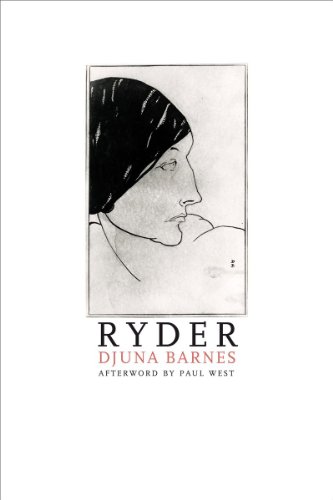
8. Ryder
 
9. Nightwood
$2.23
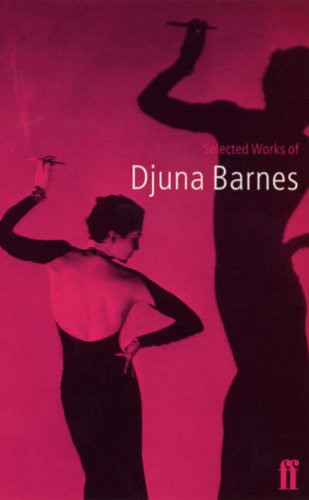
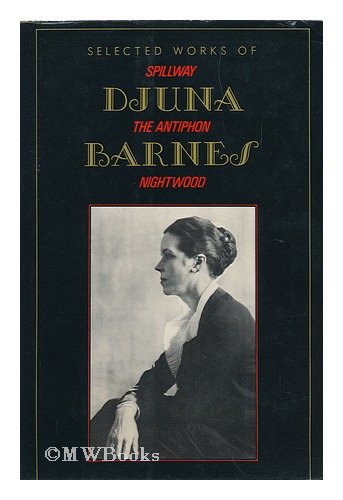
10. The Selected Works of Djuna Barnes
 
$5.95
11. A book of repulsive Jews?: rereading
12. Collected Stories (Sun and Moon
 
13. Djuna, the life and times of Djuna
 
$5.99
14. Djuna Barnes Life Is Painful Nasty
 
15. Nightwood: With a pref. by T.S.
 
$5.95
16. Modern (post) modern: Djuna Barnes
 
$5.95
17. Spectacular confessions: "How
$8.24
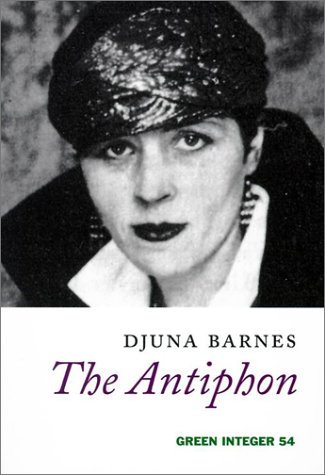
18. The Antiphon: A Play (Green Integer
$17.58
19. Nightwood: The Original Version
$5.46
20. Nightwood ; Ladies almanack (Triangle

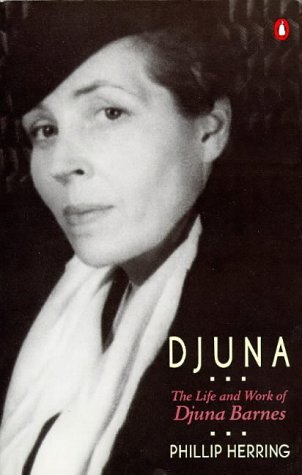
1. Djuna: The Life and Work of Djuna Barnes
by Phillip Herring
Paperback: 416 Pages (1996-12-01)
list price: US$14.95 -- used & new: US$2.23
(price subject to change: see help)
Asin: 0140178422
Average Customer Review: 3.5 out of 5 stars
Canada | United Kingdom | Germany | France | Japan

Customer Reviews (3)

3-0 out of 5 stars Too much of Herring in a book on Barnes
While I appreciated being able to find something about Djuna Barnes whose life is quite fascinating but little told, I was put off by some of Phillip Herring's style. In several places he makes reference to claims Barnes was molested as a child by either her father or possibly even her paternal grandmother. But in instance when he is suggesting the grandmother molested Barnes he says it might have been a case of "good-natured fondling." Say what???

Barnes did not make it easy for anyone to write about her. She lived a long and eventful life but to the end she refused to cooperate with those wishing to write about her life rather than those who shared her life. She was an important facet of a stunningly creative time; Paris of the twenties, when many Americans sought refuge with each other as the entire world tried to put the tremendous tragedy of World War I behind them.

Although Barnes' writing does not have the acclaim today of many others from that time (Hemingway, Stein, Joyce and Eliot to name a few) she was lauded by some of those writers who would be acclaimed as literary giants as a great source of inspiration and encouragement. It is too bad we do not have more written about her other than this florid, rather precious account of her life.

JLH

3-0 out of 5 stars Interesting life, dull book
I came across a reference to Djuna Barnes' name in another review comparing the author to Barnes.I had never heard of her despite her notoriety in the 40's.She was known for her alternate lifestyle as well as her writings, and hobnobbed with many well known artists. I purchased her book "Nightwood" at the same time I bought her biography but have not yet read it.Herring makes references to her books (with page numbers)throughout the biography and draws parallels to Barnes'life.Evidently all of her books were based on her family and their lifestyle. Her grandmother was a free soul, advocating sexual freedom and passed her views onto her son,Wald, Djuna's father.Not surprisingly, he was less than an ideal father.At one time in Djuna's childhood, her household consisted of her grandmother, her father and his wife,her many siblings, and her father's mistress and their multiple children.Despite the fascinating characters, I found Herring's book rather dry and mired in minutia.What kept me reading was the unfolding of the life of an extremely unusual and interesting person. I look forward to reading "Nightwood" and hearing about Djuna's life in her own words.I anticipate a more exciting read.

4-0 out of 5 stars Powerful book and very disturbing
Biographies are sometimes the powerful of all writing to me. The best ones are the books that open a person's life, that reveal without judgement how the person became what they were.

Djuna Barnes's early life was horrific almost beyond understanding. Rape(?),incest(?), paternal abandonment and grinding poverty -she was the financial supporter of her extended family while she was still in her late teens. Yet it is a mark of her genius that she was able to overcome all the odds and become a true modern author.

All of her best works were autobiograpical and all dealt with the critical tragedies of her life. 'Ryder' was an attempt to deal with her father - incest or rape,'Nightwood' to deal with her failed relationship with Thelma Wood, and finally 'Antiphon' to deal with her entire disfunctional family. The wellspring of her most bitter invective was her own life.

This biography is good, thorough and complete. Djuna suffered pain and repaid that pain over and over again. Her venom, her rage, the sheer angst she had flows like blood on every page. But in spite of all that, her artistry was able to give her pain a rich voice and this book captures her spirit as well as her wraith.

But in some ways, this book is almost like watching a car wreck...there is a human impulse to look away not see such suffering. I was both repelled by and drawn into the recounting of such public agony by such a private person. Djuna Barnes's writing is not meant for everyone, and this biography isn't either. ... Read more


2. Nightwood
by Djuna Barnes
Paperback: 208 Pages (2006-09-26)
list price: US$12.95 -- used & new: US$7.44
(price subject to change: see help)
Asin: 0811216713
Average Customer Review: 3.5 out of 5 stars
Canada | United Kingdom | Germany | France | Japan
Editorial Review

Amazon.com
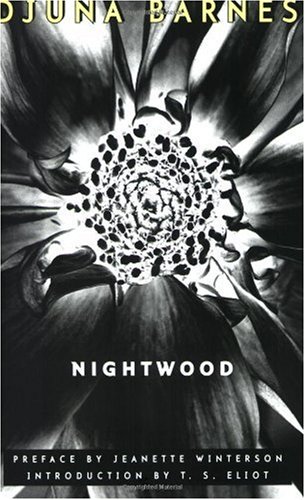
Nightwood is not only a classic of lesbian literature, but was also acknowledged by no less than T. S. Eliot as one of the great novels of the 20th century. Eliot admired Djuna Barnes' rich, evocative language. Lesbian readers will admire the exquisite craftsmanship and Barnes' penetrating insights into obsessive passion. Barnes told a friend that Nightwood was written with her own blood "while it was still running." That flowing wound was the breakup of an eight-year relationship with the lesbian love of her life.Book Description
The fiery and enigmatic masterpiece—one of the greatest novels of the Modernist era.

Nightwood, Djuna Barnes' strange and sinuous tour de force, "belongs to that small class of books that somehow reflect a time or an epoch" (TLS). That time is the period between the two World Wars, and Barnes' novel unfolds in the decadent shadows of Europe's great cities, Paris, Berlin, and Vienna—a world in which the boundaries of class, religion, and sexuality are bold but surprisingly porous.

The outsized characters who inhabit this world are some of the most memorable in all of fiction—there is Guido Volkbein, the Wandering Jew and son of a self-proclaimed baron; Robin Vote, the American expatriate who marries him and then engages in a series of affairs, first with Nora Flood and then with Jenny Petherbridge, driving all of her lovers to distraction with her passion for wandering alone in the night; and there is Dr. Matthew-Mighty-Grain-of-Salt-Dante-O'Connor, a transvestite and ostensible gynecologist, whose digressive speeches brim with fury, keen insights, and surprising allusions. Barnes' depiction of these characters and their relationships (Nora says, "A man is another person—a woman is yourself, caught as you turn in panic; on her mouth you kiss your own") has made the novel a landmark of feminist and lesbian literature.

Most striking of all is Barnes' unparalleled stylistic innovation, which led T. S. Eliot to proclaim the book "so good a novel that only sensibilities trained on poetry can wholly appreciate it." Now with a new preface by Jeanette Winterson, Nightwood still crackles with the same electric charge it had on its first publication in 1936. ... Read more

Customer Reviews (21)

3-0 out of 5 stars Angels on all-fours and other night creatures...

*Nightwood* is a novel composed in poetic prose, as T.S. Eliot asserts in his preface, the kind of writing that "demands something of the reader that the ordinary novel-reader is not prepared to give." Most novels are not composed at such white-hot intensity, at a level of personal emergency such as Djuna Barnes has conveyed in *Nightwood.* This is a book that doesn't let you rest for a moment, the rare sort of novel that is all conflict and climax. It's a work that you don't doubt was torn living from the author's very being, less a "novel" per se, than an organic and all-but-impossible to dissect whole that loses more the more you attempt to analyze it.

What Barnes records in *Nightwood* is the experiential agony, as opposed to merely the "story," of a love-lost. Robin Vote is a Sapphic femme fatal, an androgynous, alcoholic, nymphomaniac enigma who is beloved, successively, by three different characters, who she subsequently leaves an emotional wreck. Nora Flood, who stands in for the author, is the narrative center of *Nightwood* and the woman around whom the others orbit, with Robin, like a doomsday asteroid, orbiting them all. It is Nora who struggles and suffers and indeed understands Robin better than anyone, even if that only means understanding better the tragedy inherent in knowing her at all. Her utter despair at losing Robin is stunningly captured by Barnes who, it is said, based *Nightwood* closely on a real-life love catastrophe from which she never recovered. One can believe it reading *Nightwood.* A good deal of the novel's intensity comes from its unquestionable authenticity. In Robin Vote, Barnes has created the personification of the unsolvable mystery of every beloved who, as if by destiny, eludes, indeed must elude, our grasp.

Much is made--and rightly so--of *Nightwood's* most famous character, Dr. Matthew O'Connor, an impoverished, drunken, charlatan with dubious medical credentials and a penchant for cross-dressing. A good deal of the novel is devoted to O'Connor's rambling monologues which vibrate between madness, comedy, and transcendent wisdom...sometimes all three together. But the transgendered O'Connor is only the most flamboyantly unconventional of *Nightwood's* inhabitants. All of Barnes's characters are misfits and outsiders, sexually and/or socially; interestingly it is the very displacement they feel within their own time and place that most enables the contemporary reader to sympathize with them. The sense of being out-of-step is, perhaps, timeless. But it's more than mere sexual and social deviance that connect the contemporary reader to these characters--it's a sense of the secret life of us all, the inherent "deviance" of our private lives from the "normal" daylight existence of moderated emotions, rational desires, and objective viewpoints we all pretend to share. "Nightwood" is the country we inhabit when the sun goes down, "society" dissolves, and the inexplicable, uncontrollable, and irrational in us emerges.

I found the first chapter of *Nightwood* dull and dated and almost considered putting the book down. Don't do it. Hang in there until the second chapter...if Barnes doesn't catch your attention at that point, chances are she won't. This is a challenging text, elusively and elliptically written, ejaculatory, jumping from peak to peak, a shout from the soul of despair, a cry from the dark night. The characters don't so much interact with each other, but, as in real life, they are merely declaiming to themselves, using the declamations of others as cues to their own speeches. They affect, deflect, and "aggravate" each other in a sort of vacuum, forcing them to even greater degrees of solitude and despair.And yet, through all these characters, we hear one voice, one lament...the author's, ours, every lover's. As uniquely particular and personal *Nightwood* may be, as idiosyncratically composed, and as inimitable, it is nonetheless an emotional document as common and identifiably human as any kidney or pancreas.

A rare thing, a "novel" that is also a work of art -*Nightwood* is a gnomic utterance of the apocalypse of love.

2-0 out of 5 stars Bizarre and over-rated.
This book's three main characters ("the doctor", Nora and Robin) did not hold my interest. This is the most bizarre thing I've read despite its vivid imagery and the doctor's often insightful observations. The story is one big whine about being captive to one's sexual/emotional nature and needs. Here are 2 lesbians and a transvestite fortunate enough to live in Paris, the capital of free thinking in the 1920's and a genial place that acceptedpeople with these sensibilities. Yet, Nora and the doctor never feel comfortable with themselves. The character who did touch me is a secondary one, Felix (Baron Volkbein) who, despite fabricating an aristocratic lineage to raise others' regard for him, is capable of responding with compassion to someone who needs him just for who he is.

This novel has been used in academic studies of gender matters. But it could also serve as an aid in tracking the practice of perceiving oneself as a victim when one's personal choice creates a problem. In "Nightwood", the characters are very aware that their choices are their own and they accept responsibility for them.That is decades before people began blaming the consequences of their decisions on others, before the politicization and institutionalized endorsement of victimhood as a method of transferring responsibility for one's actions onto others.

My dissatisfaction with this book stems from its slack attention to time and place. At each page, I had to remind myself that the story is set in the 1920's and not the latter half of the 1800's as I instinctively felt. Archaic phrases rich with signs of an earlier period combined with an absence of any 20th century flavour has produced characters who float in from the past and seem therefore devoid of physical mass. Similarly, Paris, the story's primary location, is reduced to an icon of itself like a backdrop assembled in haste for a play. Mentions of "rue du Cherche-Midi" and "Hotel Recamier" sound promising but lead only to the next bout of the doctor's enrapturing but ultimately meaningless rants. The best I can think about this neglect is that the author may have been demonstrating how self-obsession robs its holder of the capacity to interact with hisenvironment beyond the narrow confines of its demands. No one seems affected by where they are. In the end, this is about people who experience love as torture and a direct route to hell.

2-0 out of 5 stars Very Disappointing
I had such high hopes going in, what with Eliot's singing praises and all sorts of reputable people claiming this book to be a lost Modernist gem, but they were dashed by actually trying to read the work. Grueling is perhaps the best word that can be used to describe the feeling that overwhelms the reader attempting to tackle this book. This quickly fades to annoyance with the realization that it is all for naught. Contrary to what Eliot says in relation to its poetic qualities, her writing is messy and unfulfilling. And the content? It was often very hard to discern what it even was(which, for me, is not an automatic strike against a book) and, even worse, was very, very dated. However, there were some moments when, as another reviewer has noted, Barnes will have a single sentence or phrase that makes one's heart skip a beat, but these are few and far between. And, as one last note, before actually reading this book, I disregarded many of its negative reviews as being indicative of laziness or incompetence on the other reviewers' parts in relation to my superior reading skills, but now, I must abashedly say, that this is just not a very good book.

3-0 out of 5 stars The Night Is A Hunter
Djuna Barnes' short modernist novel Nightwood (1936) is one of the genuine odd ducks of 20th century literature.Written in an uneven, semi - comic, and baroque style, the book is more likely to impress young readers rather than older and more experienced individuals who have lost their appetite for decadent romantic entanglements.Nightwood is certainly an original work, and Barnes' vision of the factors shaping human destiny - especially time, heritage, and evolution - are uniquely expressed.But despite its fluidity of language, many of Barnes' seemingly brilliant observations concerning life, consciousness, and human suffering are more specious than acute, which is important, since Barnes' emotionally marooned cast is badly in need of answers, wisdom, and salvation.

Hiding under the text's antique lathering is a sparse, skeletal plot, one top heavy with philosophical speculations but reflecting little grasp of basic psychological truths about human nature.Nora Flood meets and falls destructively in love with passive - aggressive Robin Vote, a strange, corpse - eyed, and inexplicably charismatic woman who, despite marriage and motherhood, is spiritually, psychologically, and emotionally adrift in the world. When their affair evolves into a love triangle, Nora turns increasingly for advice to charlatan doctor and Greek chorus Matthew O'Connor, a poverty - stricken alcoholic who is pleasurably inclined towards homosexuality, transvestitism, and self - demoralization ("I'm a lady in no need of insults," "I was born as ugly as God dare premeditate"). Significantly, all of the book's characters are in some way stunted, crippled, or pathologically predisposed.

Barnes excels at dramatizing the failure of romantic love, especially the kind that displays active neurotic factors, elements of codependence, and spontaneous psychological transference.Those pages which detail Nora's isolation and sad obsession with her abandoning lover are deeply felt, haunting, and moving indeed.

In "The Squatter," Barnes spends an entire chapter fulfilling a personal vendetta by brilliantly depicting widow Jenny Petherbridge's status as a rapacious black hole and non - entity. Jenny is ugly ("she had a beaked head and the body, small, feeble, and ferocious, that somehow made one associate her with Judy," "only severed could any part of her been called "right"), stupid ("when anyone was witty about a contemporary event, she would look perplexed and a little dismayed"), incapable of establishing her own values ("Someone else's wedding ring was on her finger...the books in her library were other people's selections...her walls, her cupboards, her bureaux, were teeming with second - hand dealings with life...the words that fell from her mouth seemed to have been lent to her"), spiritually empty but power hungry ("she wanted to be the reason for everything and so was the cause of nothing"), and lacks poise, maturity, and dignity ("being one of those panicky little women, who, no matter what they put on, look like a child under penance," or, as O'Connor calls her, "a decaying comedy jester, the face on a fool's -stick, and with the smell about her of mouse - nests"). Barnes makes an excellent case for the argument that it is not the powerful that are to be feared, but the weak, frustrated, and incapable.

Robin the "somnambulist" is also lengthily described, largely via the use of symbols and metaphors: throughout the text, the boyish, bird - named Robin is described in animal, vegetable, and mineral terms.When first encountered, Robin, who is later recognized as a kindred spirit by a wild circus animal and a ferocious dog, is found lying unconscious in a small apartment crowded with a superabundance of plant life.Barnes describes Robin's abode as "a jungle trapped in a drawing room" and Robin as the "ration of the carnivorous flowers."

The flamboyant, limp - wristed ("his hands...he always carried like a dog who is walking on his hind legs"), dirty - kneed, rhetoric - spewing Dr. Matthew O'Connor, the book's most famous character, is a figure of high camp whom today's readers are more likely to find mildly distasteful rather than shocking. O'Connor is given an entire long chapter in which to pontificate ("Watchman, What Of The Night?"), though the chapter reflects badly on the wounded Nora, whose continuous exclamations of "But what am I to do?" and "What will become of her?" and "How will I stand it?" reduce her from the genuinely tormented human being of earlier chapters to a one - dimensional cartoon damsel in distress.

Intelligent, perceptive readers are likely to find one passage in every five that sounds profound and poetically illuminating like the others, but means absolutely nothing on careful examination (for example: "Your body is coming to it, your are forty and the body has a politic too, and a life of its own that you like to think is yours. I heard a spirit new once, but I knew it was a mystery eternally moving outward and on, and not my own.")Despite Barnes' often incredible use of language, the ultimate effect of Nightwood is one of shallowness, slickness, and almost hysterical distance from its own primary sources. When compared to other literary books written by women also primarily focused on women, such as the five novels of Jean Rhys or Muriel Spark's The Driver's Seat, Nightwood seems sketchy, brittle, and, as one critic said about Isak Dinesen's Seven Gothic Tales, seemingly more concerned with mystification than with genuine mystery. Though bold and intrepid as a beautiful young big city journalist, and later as an expatriate modernist writer living among the Parisian glitterati, Barnes closed the door on the rest of the world in very early middle age, and became a notorious New York City recluse known primarily for bitterness and explosive outbursts of anger.Readers of Nightwood, with its essential focus on theoretical, airy philosophy rather than psychological home truths, may find clues as to how Barnes's life went sorrowfully wrong.

4-0 out of 5 stars An elegant classic
There are few books that can be safely called classics--and out of those, fewer are as deserving of the term as Djuna Barnes' 'Nightwood'. Elegant and mesmerizing, difficult and beautiful, it is a measured and balanced work of art.

Another reviewer said this wasn't a 'celebration of lesbian love'--this much is true. What makes this book truly remarkable is that it *doesn't* set any boundaries--hearts are fickle, hearts are cruel, and every character in the novel is inflicted with his/her own brand of emotional anxiety. Barnes makes no distinction between 'lesbian' love and any other--it is as normal, and as abnormal, as any other human affection. That alone makes this book a classic (but of course, the writing too is intoxicating). In fact, what is truly surprising (to me, at least!) is that despite her exquisite elegance, Djuna Barnes manages to take such a no-nonsense approach to human emotions. She never seeks to simplify anything--and makes her work difficult for the reader in the most rewarding of ways. (I mean that she doesn't let us get away with pre-conceptions or romantic illusions. She manages to make the imperfect reality as arresting as the myth of perfection.) Most of us, in our lives, don't *really* know what we're doing, or what we feel. Barnes makes her characters real by putting them through the same confusing maelstrom of experiences--where one emotion often morphs into another--love into indifference, respect into insecurity, and so on. There are no answers--there is only endurance--endurance of others, endurance of ourselves.

I don't want to be more specific and give out details of the plot. This book has to be experienced to be believed... ... Read more


3. The Review of Contemporary Fiction (Fall 1993): Djuna Barnes
by John O'Brien, Marian Urquilla
Paperback: 253 Pages (1993-09)
list price: US$8.00 -- used & new: US$8.00
(price subject to change: see help)
Asin: 1564781240
Canada | United Kingdom | Germany | France | Japan

4. Silence and Power: A Reevaluation of Djuna Barnes
Paperback: 440 Pages (1991-04-08)
list price: US$36.00 -- used & new: US$30.00
(price subject to change: see help)
Asin: 0809312557
Canada | United Kingdom | Germany | France | Japan
Editorial Review

Book Description

Roughly chronological, these essays explore Barnes’ early work in the New York newspaper world of the ‘teens, proceed through the 1954 publication of The Antiphon, and include several approaches to such works as Ryder, Ladies Almanack, and Nightwood. This judicious mix of essays—many of them illustrated by photographs and drawings—presents a comprehensive picture of the creative imagination of Djuna Barnes.

Essayists include Mary Lynn Broe, Nancy J. Levine, Ann Larabee, Joan Retallack, Carolyn Allen, Carolyn Burke, Sheryl Stevenson, Marie Ponsot, Frances M. Doughty, Susan Sniader Lanser, Frann Michel, Karla Jay, Jane Marcus, Judith Lee, Julie L. Abraham, Meryl Altman, Lynda Curry, Louise A. DeSalvo, and Catharine Stimpson. Individuals sharing personal recollections of Barnes are Ruth Ford, James B. Scott, Alex Gildzen, Hank O’Neal, Chester Page, Andrew Field, and Frances McCullough. Janice Thom and Kevin Engel provide an updated bibliography.

From The Book of Repulsive Women to The Antiphon, Barnes challenged old gender dichotomies as she shaped radical sociopolitical views. Her textual methods celebrated a multiplicity of voices, heterodox forms, and genres, transgressing those tenets of modernism that privilege the “high art” of a single, unified textual identity or a discrete discourse. These essays offer various critical approaches and sinuous readings of the full range of Barnes’ achievement. Interwoven through the essays and reminiscences is a lively commentary from Barnes’ friends and contemporaries as well as Barnes herself.
... Read more

5. Fancy's Craft: Art and Identity in the Early Works of Djuna Barnes
by Cheryl J. Plumb
 Hardcover: 118 Pages (1987-02)
list price: US$32.50 -- used & new: US$32.50
(price subject to change: see help)
Asin: 0941664171
Canada | United Kingdom | Germany | France | Japan

6. A Book
by Djuna Barnes
 Hardcover: Pages (1923)

Asin: B000NUL1Y6
Canada | United Kingdom | Germany | France | Japan

7. Greenwich Village As It Is
by Barnes Djuna
 Hardcover: Pages (1978)

Asin: B000UDI7EI
Canada | United Kingdom | Germany | France | Japan

8. Ryder
by Djuna Barnes
Paperback: 250 Pages (1995-09)
list price: US$11.95 -- used & new: US$7.33
(price subject to change: see help)
Asin: 0916583554
Average Customer Review: 5.0 out of 5 stars
Canada | United Kingdom | Germany | France | Japan
Editorial Review

Book Description
Barnes's extraordinary first novel, illustrated ... Read more

Customer Reviews (2)

5-0 out of 5 stars an astonishing writer
It wasn't only T.S. Eliot who described Djuna Barnes's style as Elizabethan. (Though the poet Marie Ponsot has described her as Jacobean.) What period could encompass this twentieth century writer's talent for casting spells both psychological and atmospheric?I've never read anyone quite like her.If only James Joyce had been a little more talented, he might have been Barnesian--but few of us know this; join us!

5-0 out of 5 stars A Great Achievement
This is an amazing work.A mostly autobiographical parody, Barnes uses Ryder as sort of a twisted extended metaphor for the rest of the world.The beautiful and inventive prose, though often obscure, illustrates thelife of the Ryder family poignantly and indignantly.Written in variousstyles, the book is bound to touch each and every reader. ... Read more


9. Nightwood
by Djuna Barnes
 Mass Market Paperback: Pages (1961)

Asin: B000GZZQ58
Canada | United Kingdom | Germany | France | Japan

10. The Selected Works of Djuna Barnes
by Djuna Barnes
Paperback: 384 Pages (1998-06-22)
-- used & new: US$2.23
(price subject to change: see help)
Asin: 0571193919
Canada | United Kingdom | Germany | France | Japan

11. A book of repulsive Jews?: rereading 'Nightwood.' (Djuna Barnes): An article from: The Review of Contemporary Fiction
by Meryl Altman
 Digital: 20 Pages (1993-09-22)
list price: US$5.95 -- used & new: US$5.95
(price subject to change: see help)
Asin: B00092SKDI
Canada | United Kingdom | Germany | France | Japan
Editorial Review

Book Description
This digital document is an article from The Review of Contemporary Fiction, published by Review of Contemporary Fiction on September 22, 1993. The length of the article is 5772 words. The page length shown above is based on a typical 300-word page. The article is delivered in HTML format and is available in your Amazon.com Digital Locker immediately after purchase. You can view it with any web browser.

From the supplier: Djuna Barnes's portrayal of Felix, as a Jew attempting to fit into a society which despises him and getting more alienated in the process, is an exploration of displacement and homelessness. Barnes use of images commonly associated with anti-semitism complicates interpretation. Barnes seems to see assimilation as inevitable but it is not clear whether she sees this as positive. Her treatment of Felix, by being open to varied interpretations, becomes a telling comment on the Jewish experience in the 20th century.

Citation Details
Title: A book of repulsive Jews?: rereading 'Nightwood.' (Djuna Barnes)
Author: Meryl Altman
Publication: The Review of Contemporary Fiction (Refereed)
Date: September 22, 1993
Publisher: Review of Contemporary Fiction
Volume: v13Issue: n3Page: p160(12)

Distributed by Thomson Gale ... Read more


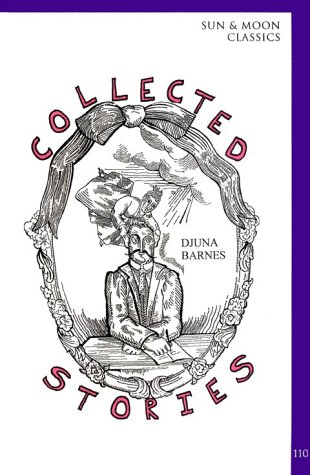
12. Collected Stories (Sun and Moon Classics)
by Djuna Barnes
Paperback: 478 Pages (1997-10)
list price: US$16.95
Isbn: 1557133557
Average Customer Review: 5.0 out of 5 stars
Canada | United Kingdom | Germany | France | Japan
Editorial Review

Amazon.com
Djuna Barnes, best known for her 1936 novel Nightwood, was a modernist with a fertile talent, who worked as an illustrator, a reporter, and a feature writer for newspapers and avant-garde magazines in the first half of this century. In their playfulness with words and syntax, the short stories in this volume, written between 1914 and 1942 and collected by her biographer, Phillip Herring, show the influence of James Joyce and Gertrude Stein. Many were written for magazines and end with a plot twist. As one might expect from a visual artist, these stories are full of symbolic images, often hauntingly grotesque.Book Description
Beginning in 1914, Djuna Barnes contributed regularly to numerous magazines and newspapers works of fiction, poetry, essay, and drama. Unlike some works in other genres in which she wrote, Barnes held her stories in particularly high regard, revising several of the stories collected in A Book (1923; reprinted as A Night Among the Horses in 1929) late in her life. These stories from Spillway, her other early tales, and other stories never before published are collected in this volume. What they reveal is the breadth and consistency of Barnes's story writing, and should help establish her as one of the most interesting and vital storytellers of the great period of American literary output after World War I.

Barnes is recognized internationally for her masterwork Nightwood and for other works of fiction, including Ryder and Ladies Almanack. She also wrote plays, most notably The Antiphon-which will be republished by Sun & Moon Press next year-and shorter works collected in At the Roots of the Stars: The Short Plays. Her early poetic work, The Book of Repulsive Women, has increasingly gainer readers over the past few years. A selection of her drawings, which often accompanied her literary writing, has just been published by Sun & Moon Press as Poe's Mother. ... Read more

Customer Reviews (1)

5-0 out of 5 stars a road less traveled
Djuna Barnes tops the scale for underappreciated writer of this century.She exhibits a masterful command of the language; fresh metaphors startle on every page, in every paragraph.Each story is different; each characterstylistically flawless.For your own sake, please read this book! ... Read more


13. Djuna, the life and times of Djuna Barnes
by Andrew Field
 Hardcover: 287 Pages (1983)
list price: US$16.95
Isbn: 0399127402
Canada | United Kingdom | Germany | France | Japan

14. Djuna Barnes Life Is Painful Nasty
by Hank O'Neal
 Hardcover: 249 Pages (1990-11)
list price: US$6.98 -- used & new: US$5.99
(price subject to change: see help)
Asin: 1557783942
Canada | United Kingdom | Germany | France | Japan

15. Nightwood: With a pref. by T.S. Eliot
by Djuna Barnes
 Unknown Binding: 239 Pages (1963)

Asin: B0007JZ68K
Canada | United Kingdom | Germany | France | Japan

16. Modern (post) modern: Djuna Barnes among the others. (Djuna Barnes): An article from: The Review of Contemporary Fiction
by Donna Gerstenberger
 Digital: 14 Pages (1993-09-22)
list price: US$5.95 -- used & new: US$5.95
(price subject to change: see help)
Asin: B00092SHUO
Canada | United Kingdom | Germany | France | Japan
Editorial Review

Book Description
This digital document is an article from The Review of Contemporary Fiction, published by Review of Contemporary Fiction on September 22, 1993. The length of the article is 4158 words. The page length shown above is based on a typical 300-word page. The article is delivered in HTML format and is available in your Amazon.com Digital Locker immediately after purchase. You can view it with any web browser.

From the supplier: Djuna Barnes's writing does not lend itself to classification as modernist because it challenges aspects which are said to be tenets of T.S. Eliot, James Joyce and Virginia Woolf's modernism. . Barnes rejects the idea of a reasonable universe where the traditional riddle-communication can provide answers. There is no concept of satisfaction in Barnes's confused and confusing world and there is no place in it for children who suggest a continuity of life. Barnes's deconstruction of life denies the possibility of peace or understanding.

Citation Details
Title: Modern (post) modern: Djuna Barnes among the others. (Djuna Barnes)
Author: Donna Gerstenberger
Publication: The Review of Contemporary Fiction (Refereed)
Date: September 22, 1993
Publisher: Review of Contemporary Fiction
Volume: v13Issue: n3Page: p33(8)

Distributed by Thomson Gale ... Read more


17. Spectacular confessions: "How It Feels to Be Forcibly Fed." (essay) (Djuna Barnes): An article from: The Review of Contemporary Fiction
by Barbara Green
 Digital: Pages (1993-09-22)
list price: US$5.95 -- used & new: US$5.95
(price subject to change: see help)
Asin: B00092SK0Q
Canada | United Kingdom | Germany | France | Japan
Editorial Review

Book Description
This digital document is an article from The Review of Contemporary Fiction, published by Review of Contemporary Fiction on September 22, 1993. The length of the article is 7817 words. The page length shown above is based on a typical 300-word page. The article is delivered in HTML format and is available in your Amazon.com Digital Locker immediately after purchase. You can view it with any web browser.

From the supplier: Djuna Barnes's 1914 essay 'How It Feels to Be Forcibly Fed' is a rereading of her earlier celebrity interviews and an exploration of the feminist discourse associated with the forcible feeding of hunger-striking British suffragettes. Barnes's essay highlights her complex position with regard to the female body. Barnes places the suffragettes' representation of the female body in pain within the larger context of sensationalized representations of the women thus providing a critical reading of activism that hopes to find new followers through a sensationalizing the female body.

Citation Details
Title: Spectacular confessions: "How It Feels to Be Forcibly Fed." (essay) (Djuna Barnes)
Author: Barbara Green
Publication: The Review of Contemporary Fiction (Refereed)
Date: September 22, 1993
Publisher: Review of Contemporary Fiction
Volume: v13Issue: n3Page: p70(19)

Article Type: Biography

Distributed by Thomson Gale ... Read more


18. The Antiphon: A Play (Green Integer Books)
by Djuna Barnes
Paperback: 148 Pages (2000-12)
list price: US$12.95 -- used & new: US$8.24
(price subject to change: see help)
Asin: 1892295563
Canada | United Kingdom | Germany | France | Japan

19. Nightwood: The Original Version and Related Drafts (American Literature (Dalkey Archive)) (American Literature (Dalkey Archive))
by Djuna Barnes
Hardcover: 352 Pages (1995-08-05)
list price: US$25.95 -- used & new: US$17.58
(price subject to change: see help)
Asin: 1564780805
Average Customer Review: 4.5 out of 5 stars
Canada | United Kingdom | Germany | France | Japan
Editorial Review

Product Description
The version of Nightwood published in 1936 and revered ever since both as a classic modernist work and a groundbreaking lesbian novel differs in many ways from the book Djuna Barnes actually wrote. The Dalkey edition not only restores to the main text the material Barnes reluctantly allowed to be cut, but also reproduces in facsimile the seventy pages of discarded drafts that survive of earlier versions. More than sixty years after its publication, Nightwood is firmly established as a twentieth-century classic, and this critical edition will allow readers and scholars to gain a greater understanding and appreciation of this unforgettable work. ... Read more

Customer Reviews (2)

4-0 out of 5 stars amusing both historically and stylistically
Herein, my compatriot Barnes (she was born in a cabin about three miles from my birthplace) recounts her breakup with Putzi Hanfstaengl, "Hitler's piano player" and Harvard alumnus, who decided not to sacrifice continuity of the blood to his American romance. Excised from the published edition and nowhere mentioned by Hanfstaengl in his memoirs, naturally.

5-0 out of 5 stars A first and great incite into a mystery concerning manuscrip
It was thought for many years that there was another manuscript, or thatthere were more pieces to this book than the slim version which became aprose masterpiece included in the canon of American Lit 1900 to 1940. Because of the editing and work by Eliot etal, and because of Barne'sreclusiveness, wse didn't know much about this manuscript.Thus CherylPlumb's work helps us understand more about the process of this book, it'sstarts and stops, it's magic and mystery.A must for Djuna Barnes fans ... Read more


20. Nightwood ; Ladies almanack (Triangle classics)
by Djuna Barnes
Unknown Binding: 296 Pages (2000)
-- used & new: US$5.46
(price subject to change: see help)
Asin: 0965041778
Canada | United Kingdom | Germany | France | Japan
Editorial Review

Product Description
Two books in one by lesbian-interest author Djuna Barnes: Nightwood, first published in 1937; and Ladies Almanack, first published in 1928. ... Read more


  1-20 of 100 | Next 20
A  B  C  D  E  F  G  H  I  J  K  L  M  N  O  P  Q  R  S  T  U  V  W  X  Y  Z  

Prices listed on this site are subject to change without notice.
Questions on ordering or shipping? click here for help.

site stats