e99 Online Shopping Mall

Geometry.Net - the online learning center Help  
Home  - Authors - Borges Jorge Luis (Books)

  1-20 of 100 | Next 20
A  B  C  D  E  F  G  H  I  J  K  L  M  N  O  P  Q  R  S  T  U  V  W  X  Y  Z  

click price to see details     click image to enlarge     click link to go to the store

$11.26
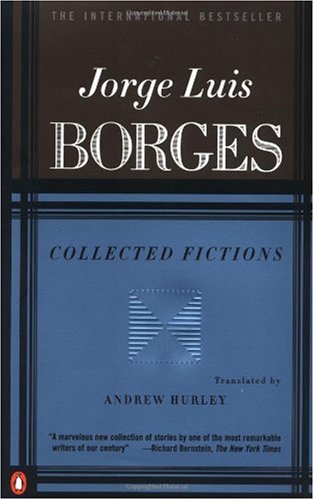
1. Borges: Collected Fictions
$9.99
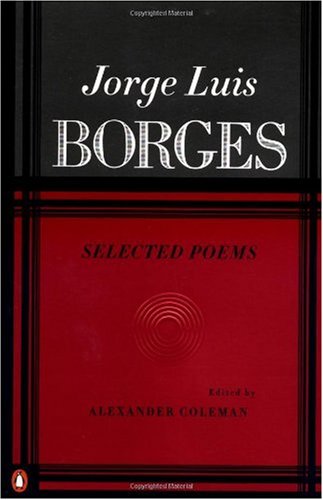
2. Borges: Selected Poems
$5.30
3. Seven Nights
 
4. The Aleph and Other Stories 1933-1969
$17.11
5. Jorge Luis Borges: Ficciones (BCP
$8.00
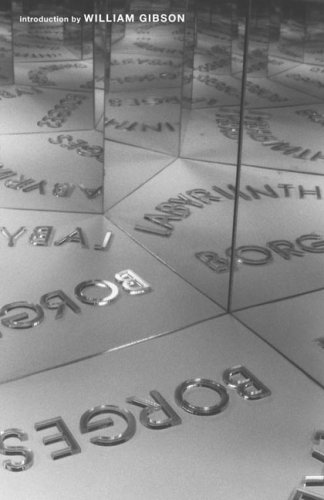
6. Labyrinths: Selected Stories &
$6.87
7. A Personal Anthology
$7.91
8. The Aleph and Other Stories (Penguin
$12.99
9. Los Mejores Cuentos Policiales
$40.86
10. El Libro De Los seres Imaginarios/The
 
11. Jorge Luis Borges: a Personal
 
$4.62
12. Everything & Nothing
 
$10.85
13. Ficciones
$9.98
14. Borges: Selected Non-Fictions
$96.45
15. Jorge Luis Borges Obras Completas
 
$32.81
16. Ficciones/ Fiction
$9.60
17. Jorge Luis Borges (Spanish Reader)
$8.75
18. Los Mejores Relatos Fantasticos
$33.22
19. Obras Completas 4 - Jorge Luis
$5.34
20. A Universal History of Iniquity

1. Borges: Collected Fictions
by Jorge Luis Borges
Paperback: 576 Pages (1999-09-01)
list price: US$20.00 -- used & new: US$11.26
(price subject to change: see help)
Asin: 0140286802
Average Customer Review: 4.5 out of 5 stars
Canada | United Kingdom | Germany | France | Japan
Editorial Review

Amazon.com
Although Jorge Luis Borges published his first book in 1923--doling outhis own money for a limited edition of Fervor de Buenos Aires--he remained in Argentinian obscurity for almost three decades. In 1951, however, Ficciones appeared in French, followed soon after by an English translation. This collection, which included the cream of the author's short fictions, made it clear that Borges was a world-class (if highly unclassifiable) artist--a brilliant, lyrical miniaturist, who could pose the great questions of existence on the head of pin. And by 1961, when he shared the French Prix Formentor with Samuel Beckett, he seemed suddenly to tower over a half-dozen literary cultures, the very exemplar of modernism with a human face.

By the time of his death in 1986, Borges had been granted old master status by almost everybody (except, alas, the gentlemen of the Swedish Academy). Yet his work remained dispersed among a half-dozen different collections, some of them increasingly hard to find. Andrew Hurley has done readers a great service, then, by collecting all the stories in a single, meticulously translated volume. It's a pleasure to be reminded that Borges's style--poetic, dreamlike, and compounded of innumerable small surprises--was already in place by 1935, when he published A Universal History of Iniquity: "The earth we inhabit is an error, an incompetent parody. Mirrors and paternity are abominable because they multiply and affirm it." (Incidentally, the thrifty author later recycled the second of these aphorisms in his classic bit of bookish metaphysics, "Tlon, Uqbar, Orbis Teris.") The glories of his middle period, of course, have hardly aged a day. "The Garden of the Forking Paths" remains the best deconstruction of the detective story ever written, even in the post-Auster era, and "Pierre Menard, Author of the Quixote" puts the so-called death of the author in pointed, hilarious perspective.

But Hurley's omnibus also brings home exactly how consistent Borges remained in his concerns. As late as 1975, in "Avelino Arredondo," he was still asking (and occasionally even answering) the same riddles about time and its human repository, memory: "For the man in prison, or the blind man, time flows downstream as though down a slight decline. As he reached the midpoint of his reclusion, Arredondo more than once achieved that virtually timeless time. In the first patio there was a wellhead, and at the bottom, a cistern where a toad lived; it never occurred to Arredondo that it was the toad's time, bordering on eternity, that he sought." Throughout, Hurley's translation is crisp and assured (although this reader will always have a soft spot for "Funes, the Memorious" rather than "Funes, His Memory.") And thanks to his efforts, Borgesians will find no better--and no more pleasurable--rebuttal of the author's description of himself as "a shy sort of man who could not bring himself to write short stories." --James MarcusBook Description
The New York Times bestseller, "a marvelous new collection of stories by . . . one of the most remarkable writers of our century" --Richard Bernstein, The New York Times

Jorge Luis Borges has been called the greatest Spanish-language writer of our century. Now for the first time in English, all of Borges' dazzling fictions are gathered into a single volume, brilliantly translated by Andrew Hurley. From his 1935 debut with The Universal History of Iniquity, through his immensely influential collections Ficciones and The Aleph, these enigmatic, elaborate, imaginative inventions display Borges' talent for turning fiction on its head by playing with form and genre and toying with language. Together these incomparable works comprise the perfect one-volume compendium for all those who have long loved Borges, and a superb introduction to the master's work for those who have yet to discover this singular genius.

* Exquisitely packaged edition with French flaps and rough front, quality paper stock
* Named a Notable Book by the New York Times, Publishers Weekly, and the American Library Association

"An unparalleled treasury of marvels." --Chicago Tribune

"An event worthy of celebration . . . Hurley deserves our enthusiastic praise for this monumental piece of work." --San Francisco Chronicle ... Read more

Customer Reviews (65)

5-0 out of 5 stars Amazing deal
Bought this book for myself a while ago at a cheap used bookstore for $50 and loved it so much that I decided to get it for someone as a gift.I couldn't believe Amazon sold it for less than $15.Amazing deal on a great book - easily the cornerstone of a personal library.

5-0 out of 5 stars A book you and your doppelganger will both enjoy
There are works of fiction that change the way you look at life, and then there is the work of Jorge Luis Borges, which just might alter the way you look at everything, including yourself. The best way to explain Jorge Luis Borges is to compare him to painters - if you combined Picasso, Dali and Escher's imaginations into a writer, you would have Borges. His visions of doppelgangers, puzzles, labyrinths, infinite libraries and Argentine Gauchos are on a level of reality different from any other storyteller in history. My personal favorites here are Tlon, Uqbar, Orbis Tertius, The Aleph, and The Gospel According to Mark, among many others.Recommended for anyone interested in short stories or Latin American writers.

5-0 out of 5 stars Very impressive
Borges is my favourite contemporary author and I would rank him among the best thinkers of all eras in literature and philosophy.
I purchased this book as a gift. I looked at different books by this author but this particular one contained all the compositions that made great impression on me. I think this makes a great present and a great book for a home library.

5-0 out of 5 stars Sobering readings
After reading Borges Collected Fictins I have found it difficult to take most other authors seriously.
Borge's prose is fluent and easily read. The stories are short, sometimes even short-short, which makes them suitable for reading before going to sleep. The stories have a basic structure with a beginning, middle, and end.
So much for the easy part! There is the superficial text, of course, but within each story are metaphors and philosophical questions that stimulate my mind. Each story reads like a riddle - that's the closest simile I can think of. Borges is never obscure, even when the riddle is unsolvable it is very clear what he means. Borges himself does not claim too have any answers that are general. That makes his writings so very human.
Life for Borges is just too rich and complex to recude it just too a series of problems and their solutions. Therefore, and this is possibly Borges's only firm stance, he is decisively against any form of dictatorship or mass-movement, since they destroy the identities, and importance, of the individual.

4-0 out of 5 stars Magnificent
Excellent collection of Borges' Fictions. Borges transports you to reasonings and philosophies not so common in the world we live in. There is a message behind every single story, one has to look deeply to see it. ... Read more


2. Borges: Selected Poems
by Jorge Luis Borges
Paperback: 496 Pages (2000-04-01)
list price: US$20.00 -- used & new: US$9.99
(price subject to change: see help)
Asin: 0140587217
Average Customer Review: 4.5 out of 5 stars
Canada | United Kingdom | Germany | France | Japan
Editorial Review

Amazon.com
During his life, Jorge Luis Borges wore many hats. He was, variously, a poet, an essayist, a short-story writer, a librarian, and, for a short time, a poultry inspector. Born in Argentina in 1899, he lived for several years in Europe before eventually returning home to Buenos Aires in the early 1920s. It was here that Borges started his career as a writer. At the age of 24, he published his first volume of poetry, and though he would go on to garner considerable acclaim as an essayist and crafter of fiction, he always considered himself first and foremost a poet. This bilingual edition of Selected Poems, edited by Alexander Coleman, gathers together 200 poems from different periods of Borges's life, including some that will be appearing in English for the first time.

Whether he was writing fiction, essays, or poetry, there were certain themes and subjects that Borges returned to time and again. His home town became a favorite topic--in his first collection, Fervor de Buenos Aires, he wrote: "My soul is in the streets / of Buenos Aires," a sentiment that remained constant throughout his life. This collection reveals other preoccupations as well--with history in all its permutations, Borges's own ancestry, and his fascination with metaphysics, mazes, mirror images, and the blurry line between parallel realities:

The celibate white cat surveys himself
in the mirror's clear-eyed glass,
not suspecting that the whiteness facing him
and those gold eyes that he's not seen before
in ramblings through the house are his own likeness.
Who is to tell him the cat observing him
is only the mirror's way of dreaming?
This companion volume to Andrew Hurley's new translation of Collected Fictions boasts a stellar cast of translators, including W.S. Merwin, Mark Strand, and John Updike among others. Admirers of Borges will find Selected Poems a fitting memorial to the great man; and for those have never had the pleasure of reading him before, this book is a wonderful introduction. --Alix WilberBook Description
An unparalleled and long-overdue volume of poetry by "the most important Spanish writer since Cervantes"(Mario Vargas Llosa).

Though universally acclaimed for his dazzling fictions, Jorge Luis Borges always considered himself first and foremost a poet. This new bilingual selection brings together some two hundred poems--the largest collection of Borges' poetry ever assembled in English, including scores of poems never previously translated. Edited by Alexander Coleman, the selection draws from a lifetime's work--from Borges' first published volume of verse, Fervor de Buenos Aires (1923), to his final work, Los conjurados, published just a year before his death in 1986. Throughout this unique collection the brilliance of the Spanish originals is matched by luminous English versions by a remarkable cast of translators, including Robert Fitzgerald, Stephen Kessler, W. S. Merwin, Alastair Reid, Mark Strand, Charles Tomlinson, and John Updike.

"A surfeit of riches. . . . Jorge Luis Borges' poetry alone would be enough to underwrite his immense reputation."-- San Francisco Chronicle

Exquisitely packaged edition with French flaps and rough front, quality paper stock. ... Read more

Customer Reviews (11)

5-0 out of 5 stars Best bilingual Borges poetry book ever!
This is an excellent bilingual book for the fervent admirers of "el maestro Borges" as well as those just beginning to read him. An avid reader of the best poets of the Spanish and English canons of literature--and a very erudite literary critic--, Borges was an amazing poet. His poems are haunting and have traces of Francisco de Quevedo's "conceptismo," a literary school that emphasizes more on the concepts, or ideas, rather than form and complicated language, which is not to say that he is not a master of form. In his old age, Borges went back to classical Spanish forms, especially the sonnet; the kind modified and developed by Garcilaso and Boscan, which they in part took from the Italian sonnet. He went back to those forms because he became blind. He needed to compose poems in his head and dictate them to his loyal wife or his friends. One of his finest sonnets, "La lluvia" can be found on page 114 of this book. Take a peek at both the Spanish and English versions to get a taste of his gorgeous melancholy and depth of thought, while he plays with the notion of water and time.

You will also find works from his youth in Fervor de Buenos Aires and all of his other major poems. I cannot emphasize how much I love this book. You must have it if you love poetry. Who could ever dispute the beauty of his poetry? As he said:

To see in every day and year a symbol
of all the days of man and his years,
and convert the outrage of the years
into a music, a sound, and a symbol.

To see in death a dream, in the sunset
a golden sadness--such is poetry,
humble and immortal, poetry,
returning, like dawn and the sunset.

5-0 out of 5 stars The poet Borges less
This review is about a single question. Why if Borges considered himself a poet above all, and if this book contains as it does contain most of his major themes are his real readers and his real fame the readers of his stories essays and short prose-pieces ? Why is the most loved Borges not found in the poems when the poems too do at times like the stories tell stories?
Perhaps it is because the language of poetry is more dense and ambiguous and breaks the flow of the story. Perhaps it is because on the nonetheless more extended palette of the story a more extensive picture can be painted. Perhaps it is because too the element of mystery so great in Borges work comes to us in a stronger way in a narrative telling? Or perhaps too Borges whether he likes it or not is in his lists and his recollections really more a figure of prose than of poetry. And perhaps and this the real paradox Borges poetry is too more prose- like than poetic in many ways. Perhaps his way of going on in such intellectual questioning fashion renders his poetry more mind- like and less in deep lyric feeling than the deepest poetry means?
I ask this as prelude to saying a few words about these poems most of which I have read, and few of which I remember.And this too is part of it. The Borges name is connected with those tales from The Aleph to Funes to Borges and I . It is less connected with any of the poems
And all of this review seems now to me somehow unfair. Borges is a great writer and his words mean more than anything written about them. Reading these poems will give so much pleasure , so much material for reflection, so many characters, stories, moods, ideas, dreams, passages of life, labyrinths, ships, coffee cups, imitations, duels in the sun and duels in the darkness, light as a metaphor and light as light, darkness as darkness and darkness as sight, worlds within and more worlds within and more worlds within and without and words as literature true literature literature of the tradition that the maker Borges makes and remakes and makes and remakes a poem.

5-0 out of 5 stars This book is a treasure.
It is strange reviewing it. It's like reviewing some sacred book...
The whole World is here. And more... Here is Argentina with its familiar (to Borges) streets; here is a poem about chess, the Moon, tigers. Men. Here is Iceland in all its beauty and past; in a way no one else can ever portray it. Beautiful poems about art, God, history, mirrors, death, life, war, Shinto, Love, time, eternity, blindness, mortality, emotion, thoughts... everything and nothing...
Through this precious book we may perceive all of this through Borges' blind, ever watching, tired eyes.
I love to be lost in all those words...

4-0 out of 5 stars Worth the time, very translatable poet
Borges possesses a very universal mind, as anyone who has read him knows.For this reason his poetry is also relatively translatable.It contains almost every important poem, with conjectures being his most famous.The translation provided is fairly good, although there are several instances of misjudgement, or that is my opinion anyway.For instance, one work title ¨El enemigo generoso¨ (the generous enemy) is translated into english as ¨The generous friend¨.While I certainly can appreciate the irony of this translation and its potential irony, i think borges, as an incredible mind, should be left to decide these matters for himself.Unless the cover first lists the translators'names.Nonetheless Borges'poetry is overshadowed by his shortstories (Ficciones and El Aleph), and I recommend all to read this book.Great diversity, and a very original mind

4-0 out of 5 stars Borges shines, translations are uneven
Borges was fascinated by English.As a kid, he grew up speaking it with his English grandmother and he spent the rest of his life ransacking the treasure-chest of English and American literature.In a famous prose-poem published in 1960, "Borges and I", he could cite Robert Louis Stevenson's prose as one his favorite things (alongside the taste of coffee and the strumming of a guitar).And even after he lost his eyesight in mid-age, most of the books he went on reading in his mind were in English.

Consequently, he sounds good in translation.It's tough to make Neruda or Lorca or even a lot of novelists writing in Spanish sound clear and convincing in English.Lorca, for example, wrote in a distinctively Andalusian idiom, and nobody who has never read his poetry in the original can understand how stilted he sounds in English.Borges, by contrast, had a more universal intellect and the strands of his writing span many non-Hispanic cultures.His reading in many different literatures left a deep imprint on him linguistically and helps explain why his work translates so well into other languages.While it's true that much of his poetry has a distinctly Argentine "flavor", it has many other flavors, as well.Depending on the poem, Borges can evoke Quevedo, Leopoldo Lugones, "Beowulf", the Icelandic Prose Edda, Whitman, Omar Khayyam, or Ralph Waldo Emerson.And yet the English influence is present in virtually all of his work.

Thirteen translators are featured in this anthology and the quality varies.Barnstone and Merwin are, as usual, impeccably accurate and 1000% unadventurous.Robert Fitzgerald shows yet again that his last name must be some kind of cosmic byword for quality (F. Scott, Edward, Ella, now Robert...).His version of "Odyssey, Book Twenty-Three" is breathtakingly tight and sweeping, actually more of a rendition than a word-for-word translation.Unlike Barnstone's somewhat stilted versions of Borges' sonnets, Fitzgerald manages to stick to the original rhyme-scheme without sounding forced.Unfortunately, he only did five poems in this book.¡Qué lastima!

Alistair Reid did most of the work here.Reid is a perfect example of a fine translator who did some really great stuff back in the '60s, then apparently revised it to make stuffy literalists like Barnstone happy.For example, he took an excellent translation of "Limits" (which appeared in a 1967 book called "A Personal Anthology", which basically launched Borges's reputation in the United States) and altered it to make the words stick more closely to the original Spanish word order.It's still a good translation and all, but not as good as the first one.Other than that, though, I don't have any bones to pick with Reid. ... Read more


3. Seven Nights
by Jorge Luis Borges
Paperback: 121 Pages (1984-10)
list price: US$9.95 -- used & new: US$5.30
(price subject to change: see help)
Asin: 0811209059
Average Customer Review: 5.0 out of 5 stars
Canada | United Kingdom | Germany | France | Japan

Customer Reviews (9)

5-0 out of 5 stars Thanks to the other reviewers on the Amazon page
Thanks to the other reviewers on the Amazon page for reminding me about the contents of this book. It is one of the many I have read through the years which I do not hold most of in mind, but reminded of recall to a certain degree. ' Seven Nights' impressed me as lesser Borges. The Dante lecture, the lecture on nightmare, the lecture on Kabbalah seemed less essential than Borges words on poetry which too seemed to me only one definition among many .This book of course has those Borges qualities, tremendous learning, capacity to connect between different books and worlds, irony and humor, a certain kind of dignity , the great great love of Literature which inform all of Borges work.
In a way this work leads me to another thought about books. It is that there are writers we love so much that the discovery of an additional even minor work of theirs gives us great pleasure even though it cannot equal their greatest work.
So 'Seven Nights'. And again thanks to other Amazon reviewers who helped me with this review.

5-0 out of 5 stars Seven Remarkable Lectures Worth Seven Readings
I am fascinated by the genius of Jorge Luis Borges. "Seven Nights" is a short collection (121 pages) of seven lectures given over seven evenings in the summer of 1977 in Buenos Aires. Borges was almost fully blind and spoke informally, without notes, as was his usual style. He exercised his great memory with skill; he shifted effortlessly across literary genre, across the centuries, across languages, occasionally making unexpected connections. I almost believed that I was present at his lectures.

Each lecture can stand alone, but references to prior topics abound.

I first encountered "Seven Nights" some years ago. Having just read Dante's Inferno for the first time, I was having difficulty articulating the powerful impact that Dante's great work had made on me. In his first lecture, "The Divine Comedy", Borges provided the words.

He says, the Middle Ages "gave us, above all, the Divine Comedy, which we continue to read, and which continues to astonish us, which will last beyond our lives, far beyond our waking lives."He describes the joy of reading Dante's work as a narrative, ignoring - at least during the first reading - the extensively documented literary and historical criticism. "The Commedia is a book everyone ought to read. Not to do so is to deprive oneself of the greatest gift that literature can give us."

"Dreams are the genus; nightmares are the species. I will speak first of dreams, and then of nightmares." So begins lecture two. Borges takes us on a journey through history, literature, and poetry in search for understanding of that so common, but so unusual event, that we call dreams.

"A major event in the history of the West was the discovery of the East." And so begins lecture three on that great work that defines the mystery that is Arabia."These tales have had a strange history. They were first told in India, then in Persia, then in Asia Minor, and finally were written down in Arabic and compiled in Cairo. They became The Book of a Thousand and One Nights."

Borges lectures travel an elliptical orbit around his topic, sometimes approaching directly, other times looking outward, away from his stated subject. In his lecture on poetry (number five) he comments on literature in general: "A bibliography is unimportant - after all, Shakespeare knew nothing of Shakespearean criticism. Why not study the texts directly? If you like the book, fine. If you don't, don't read it. The idea of compulsory reading is absurd. Literature is rich enough to offer you some other author worthy of your attention - or one today unworthy of your attention whom you will read tomorrow."

His other lectures, "Buddhism", "The Kabbalah", and "Blindness", are equally intriguing.In once more rereading "Seven Nights" I found myself again astounded by Borges, by his seemingly inexhaustible knowledge of literature, by his capability to forge unexpected connections, and by his provocative statements. He has obviously given considerable thought to his conclusions, although Borges is anything but dogmatic. I enjoy a quote from a concluding paragraph in NIghtmares. "We may draw two conclusions, at least tonight; later we can change our minds."

Whether you are familiar with Borges or not, I highly recommend "Seven Nights". Borges is simply without peer, and I do not expect to change my mind later.

5-0 out of 5 stars Excellent Borges essay collection
The seven nights in question are off the cuff essays Borges delivered in Buenos Aires in the late seventies, written down by fans.He clearly did this sort of thing very well, and the regret one has at not being able to appreciate the performance at first hand is vitiated by these excellent transcriptions.Dante, the Thousand and One nights, Buddhism - all dealt with in exquisite thoughtful prose.All quotations are from memory (Borges was by now completely blind) and all conclusions paradoxical, lapidary, Borgesian.A stocking filler.Go ahead, treat yourself.

5-0 out of 5 stars Nuevas noches argentinas
Estas conferencias que Borges pronunció a lo largo de siete noches diferentes -¿o idénticas?- son una muestra acabada de su maestría verbal.
Quienes hemos leído estas deliciosas apreciaciones borgeanas volvemos a ellas cada noche que necesitamos regocijar nuestro éspiritu. (Entonces, es como comer con champagne)

5-0 out of 5 stars SEVEN NIGHTS READS IN A DAY
This is slightly over a hundred pages, but it is chock full of gems. By Seven Nights, Borges is referring to seven lectures that he gave at night. Now these aren't verbatim what he said, but fairly close. Here's my short breakdown of the Seven Nights and what I thought of them: FIRST NIGHT: THE DIVINE COMEDY. If you've never read Dante's Divine Comedy, this lecture will certainly pique your interest, as it did mine. Most memorable in this lecture is Borges' statement about "what is poetry?". Very well-worded and very quotable, that part is. SECOND NIGHT: NIGHTMARES. Borges quotes some from a few psychology books, discusses Dante's Inferno, and relates a humorous personal experience that he (Borges) had. He tops it off with a chilling ending paragraph. THIRD NIGHT: THE THOUSAND AND ONE NIGHTS. Also known as the ARABIAN NIGHTS. I love his explaination as to why it got called 1001 instead of 999. To sorta paraphrase him, he says that if you only got 999, you'd feel like you're being shortchanged. If you get 1001, you feel like you're getting a little bonus tossed in. I haven't read the Arabian Nights, but I can't help but feel curiousity after reading that lecture. FOURTH NIGHT: BUDDHISM. To be honest, I didn't glean much from this lecture, as I don't really understand Buddhism. For others, though, the experience may be different. FIFTH NIGHT: POETRY. Borges concentrates mostly on Banchs and Quevedo. Spanish poets, that I'm aware of. Borges is Argentine, by the way, so don't feel too bad if those names don't sound familiar. There are some good points in this lecture, but not, in my opinion, as compared to others. SIXTH NIGHT: THE KABBALAH. I know nothing really about Kabbalism, but I was interested in two words that may sound familiar--especially to you video-gamers out there: Sefirot and Jehovah. If you've played Final Fantasy 7, then you know that the antagonist's name is Sephiroth and that his mother's name is Jenovah. A direct parallel, beyond all doubt. In this lecture are also some other good points about God and His Word. SEVENTH NIGHT: BLINDNESS. Isn't it ironic that Borges should end the night with blindness? For those of you who don't know, Borges was blind, so he's speaking from experience. Poe, Coleridge, and Milton are some of the poets mentioned in this lecture. Borges discusses the origins of some words like "yellow". Yellow was one color that Borges could see fairly well when he was partially blind. FINAL JUDGEMENT: This is a really good book if you want page-turning lectures on a wide variety of subjects, some of which may be new to you. Keep in mind that these are LECTURES and not short stories. If this book didn't meet your expectations, then I recommend that you read THE BOOK OF SAND by the same author. Hope you like his books, I sure do! ... Read more


4. The Aleph and Other Stories 1933-1969
by Jorge Luis Borges, Norman Thomas di Giovanni
 Paperback: 28 Pages (1979-02-16)
list price: US$89.50
Isbn: 0525484442
Average Customer Review: 5.0 out of 5 stars
Canada | United Kingdom | Germany | France | Japan

Customer Reviews (1)

5-0 out of 5 stars The master of making great literature of great literature
There is no Borges like Borges and Borges is his only Borges. In these tales one becomes acquainted with a mysterious mixture of concepts and conjectures, of footnotes and findings which combine to move the mind and soul to pure love of reading.The title story alone ' The Aleph' contains in it a hint of containing everything, and yet the finding of it leads us not only to the Kabbalah but to a certain very specific cellar in the imagination of Borges. All the games and tricks of mind cannot conceal from us how wisely and wonderingly this great man has read and written.
Who reads this book touches the work of one of the great literary geniuses of mankind. The pleasure is all the reader's. ... Read more


5. Jorge Luis Borges: Ficciones (BCP Spanish Texts)
by Jorge Luis Borges
Paperback: 232 Pages (2007-05-23)
list price: US$20.00 -- used & new: US$17.11
(price subject to change: see help)
Asin: 1853995908
Average Customer Review: 5.0 out of 5 stars
Canada | United Kingdom | Germany | France | Japan
Editorial Review

Book Description
By common consent, the Argentinian Jorge Luis Borges (18990-1986) is one of the greatest writers to have emerged from Latin America. His finest work is "Ficciones" (1944), a collection of brilliantly-crafted, essay-like short stories. This edition, updated from the original 1976 edition by the same authors, offers a comprehensive selection of stories from the work with a full introduction, detailed notes, a generous vocabulary, bibliography, as well as chronological and other tables. ... Read more

Customer Reviews (1)

5-0 out of 5 stars A Fair Sample of Borge's Universe.
Jorge Luis Borges (1899 - 1986) was one of the greatest Argentinean's writers of all times. Since 1970 he was candidate to Nobel Literature Prize, which he never attained, but he well deserved. In 1980 he was bestowed Cervantes Prize, the Spanish major literary award. He influenced two generations of Latin American writers. Even those who despised him as "elitist writer" admired his powerful imagination and writing skills.

Jorge Luis was born in a high-class family. He was bilingual, due to his English grandmother. He moved with his parents to Europe where he resided from 1914 till 1921. When he returned to Argentina he fells in love with Buenos Aires. This love affaire begot several poetry volumes and inspired him many stories.
Borges was an omnivorous reader with a wide range of interests: from Cabbala thru Golems; from Mythology thru Gaucho's hardships; from Immortality thru Infinite; from Buddhism thru Christianity. His tales reflect this interest.

The present book contains a good 30 pages introduction in English and present Borge's texts in Spanish.
This volume encompasses two of the author earlier stories collections: "The Garden of Forking Paths" (1941) and "Fictions" (1944) and constitute a fair sample of his writings and style.
"La Loteria de Babilonia" describes an improbable world, ruled by fate embodied in a lottery game. "Funes el Memorioso" elaborates on what happens if a person may recall every instant of his whole life. "El Jardin de Senderos que se Bifurcan" is an elegant detective's story. "La Biblioteca de Babel", is one of Borge's best known texts, where he speculates on an infinite library containing every volume of human literature and gave way to mathematical conjecture.
In other tales the reader will get in touch with some themes very dear to Borges: mirrors, treason, solitary Hero, multiple divergent versions of the same character, whole universe created ex nihlo from his imagination and more much more.

This is a very good book for anyone interested in reading Jorge's work in his native language!
Reviewed by Max Yofre. ... Read more


6. Labyrinths: Selected Stories & Other Writings (New Directions Paperbook)
by Jorge Luis Borges
Paperback: 240 Pages (2007-05-30)
list price: US$13.95 -- used & new: US$8.00
(price subject to change: see help)
Asin: 0811216993
Average Customer Review: 4.5 out of 5 stars
Canada | United Kingdom | Germany | France | Japan
Editorial Review

Amazon.com
If Jorge Luis Borges had been a computer scientist, he probably would have invented hypertext and the World Wide Web.

Instead, being a librarian and one of the world's most widely read people, he became the leading practitioner of a densely layered imaginistic writing style that has been imitated throughout this century, but has no peer (althoughUmberto Eco sometimes comes close, especially inName of the Rose).

Borges's stories are redolent with an intelligence, wealth of invention, and a tight, almost mathematically formal style that challenge with mysteries and paradoxes revealed only slowly after several readings. Highly recommended to anyone who wants their imagination and intellect to be aswarm with philosophical plots, compelling conundrums, and a wealth of real and imagined literary references derived from an infinitely imaginary library.Book Description
Take a new look at Labyrinths, the classic by Latin America's finest writer of the twentieth century—a true literary sensation—with cyber-author William Gibson.

The groundbreaking trans-genre work of Argentinian writer Jorge Luis Borges (1899-1986) has been insinuating itself into the structure, stance, and very breath of world literature for well over half a century. Multi-layered, self-referential, elusive, and allusive writing is now frequently labeled Borgesian. Umberto Eco's international bestseller, The Name of the Rose, is, on one level, an elaborate improvisation on Borges' fiction "The Library," which American readers first encountered in the original 1962 New Directions publication of Labyrinths.

This new edition of Labyrinths, the classic representative selection of Borges' writing edited by Donald A. Yates and James E. Irby (in translations by themselves and others), includes the text of the original edition (as augmented in 1964) as well as Irby's biographical and critical essay, a poignant tribute by André Maurois, and a chronology of the author's life. Borges enthusiast William Gibson has contributed a new introduction bringing Borges' influence and importance into the twenty-first century. ... Read more

Customer Reviews (39)

3-0 out of 5 stars BORED BY BORGES
Having decided to find out what all the references to Borges were about, I bought and read (barely) this collection. I have read and enjoyed several Latin American writers and have several more I am looking forward to. Borges, however, is unique. I just haven't figured out - uniquely what? Frankly, I was bored 80% of the time I was reading this. I have given 3 stars for the mental workout and the occasional gem.

5-0 out of 5 stars Writings of a great reader
In "How To Read a Book" Mortimer J. Adler and Charles Van Doren describe the fourth level of reading. Synoptical reading challenges the reader who, having carefully and thoroughly understood several individual works, strives to hear the conversation of their ensemble. "Labyrinths" brings us the dreamlike reflections of Argentine author Jorge Luis Borges's profoundly synoptical reading. Borges heard the conversation of writers across cultures, centuries, languages, genres. Then he came back to outline over and over the one nearly infinite and unattainable truth in these stories, essays, and parables.

Yet Borges's writings remain humble and personal. With the voice of a shy, erudite uncle, Borges recounts magical reveries that came to him deep in the stacks of some dim basement of the library. Throughout the text the reader feels at once the quiet loneliness of the bookworm, the presence of the immortal, and the terrible portents in the twilight rustling of leaves.

4-0 out of 5 stars Enjoy Borges
A nice light book for travel if you do not need all his works in one volume.

5-0 out of 5 stars The place to start with Borges
First, a memory:at the age of 19, I walked into a college elective course on Latin American literature, and was presented with a syllabus which included several works by Gabriel Garcia-Marquez, Carlos Fuentes, Manuel Puig, Julio Cortazar, and Jorge Luis Borges.We were to begin with Borges, which became a life-changing discovery.

Since then, Borges has come to stand alongside Vladimir Nabokov as my favorite writer; they are two people whose writing I couldn't imagine not knowing.And LABYRINTHS is the place to begin - it's where I started, and once a year or so, it's the collection I most readily return to.

Other reviewers have done an excellent job of summing up his style, so instead of rehashing, I'll zero in on some favorites:"Death And The Compass," which blends Borges' vast knowledge of global histories and religions with his love of pulp and genre conventions; the end results are a metaphysical mystery like no others.Or "The Sect Of The Phoenix," which - in the most simplistic analysis - is a birds-and-bees discourse undertaken with unusual originality, and enhanced with anthropological allegories.

Other high-water marks include "A New Refutation Of Time," "The Garden Of Forking Paths," the brief "Borges And I" and "Pierre Menard, Author Of The Quixote."I would note that there's not a false moment to be found here, and after dozens of re-readings, I still enjoy finding new secrets hidden within these crystalline fictions, parables and essays.

Anyone with a love of literature should get to know Borges.

-David Alston

5-0 out of 5 stars Timeless literature
This is a very fine collection, which in its condensed form manages to distill the essence of Borges' writing. The book contains selected fictions and essays of the great Argentine writer. A brief preface by Andre Maurois serves as a useful introduction to Borges.

In the short fictions and the essays that follow, the reader gets to freely partake in the world of Borges; all of his great themes and motifs are here - labyrinths, mirrors ("mirrors and copulations are abominable, because they increase the number of men"), time distortion (he was intrigued by Zeno's paradox since his childhood days), dreams in which characters are actors in others' dreams, infinite libraries that contain exhaustive sets of linguistic permutations...

Borges' writing style is precise and taut, almost scientific; one does not find extended, florid passages in his prose. The short fictions are not so much about poetic description (though Borges also wrote poetry) - instead the beauty of the writing lies in its ideas and their wonderful intelligence. Every word seems to have its specific function - this is doubly true because toward mid-life Borges lost his eyesight. He composed his wonderful thoughts and stories in his head and then had them dictated. For the average reader this means that to read Borges requires some effort and the full capture of one's attention - these are not writings that you breeze through, read once and then forget about. The enjoyment lies in the contemplation. Borges was a genuine `man of letters', probably one of the most widely read and erudite people in the recent history of literary discourse. He was especially fond of Berkeley and Schopenhauer and the philosophy of idealism is a topic that he found immensely interesting (this is evident in many of his stories). Today, the writings of Borges are not only treasures to lovers of literature - he is also highly regarded among some contemporary philosophers and scientists. Dan Dennett has written that while Borges is not traditionally considered a philosopher (he once defined philosophy as "that organization of the essential perplexities of man") in his brief meditations, he has given to philosophy some of the most fascinating thought-experiments. Dennett makes extensive use of `The Library of Babel' in particular. Oliver Sacks has often quoted from and referred to `Funes the Memorious' in his discussions on mnemonists.

"Labyrinths" is not by any means a complete collection of Borges' work - in fact, some of my favorite Borges pieces are not included here (`The South', `The Other Death'. `The Aleph' to name a few) but it is still an excellent resource. The translations are of high quality and for a reader not familiar with Borges this makes the perfect first book to buy.

Borges was truly a giant of South American and for that matter, world literature. Italo Calvino was right to be thoroughly exasperated that Borges never received the Nobel; he famously said that having given the Nobel to Marquez before Borges was tantamount to giving it to the son before the father. This is timeless literature, by which I mean that it belongs to a rare class of books which do not have an `expiry date' - one can keep returning to them, over and over, throughout life, reading and re-reading and never exhausting. I often imagine Borges as a kind of eternal figure - one thinks of him still inhabiting his beloved libraries, blind to the world and dreaming of labyrinths and mirrors that reflect infinity. ... Read more


7. A Personal Anthology
by Jorge Luis Borges
Paperback: 224 Pages (1994-01-14)
list price: US$12.00 -- used & new: US$6.87
(price subject to change: see help)
Asin: 0802130771
Average Customer Review: 5.0 out of 5 stars
Canada | United Kingdom | Germany | France | Japan
Editorial Review

Book Description

After almost a half a century of scrupulous devotion to his art, Jorge Luis Borges personally compiled this anthology of his work—short stories, essays, poems, and brief mordant “sketches,” which, in Borges’s hands, take on the dimensions of a genre unique in modern letters.
... Read more

Customer Reviews (4)

5-0 out of 5 stars A selection of some ofBorges' bestwork
This work contains some , but no means all, or even most of Borges' best work. It contains ' The Maker' and 'Everything and Nothing'. It also contains the great memory story ' Funes' and one of Borges' signature stories' 'Death and the Compass'. It has an introduction by Anthony Kerrigan.
On principle it is difficult to read any work of Borges without coming away enriched.
He takes us somewhere else into a literary world of his own which resembles other literary worlds yet has a mysterious and wondrous quality all its own.
It is by this timea cliche to say that Borges is a great writer but I will repeat the cliche as I suspect most readers who have not read him yet and who will come to his work , will feel the very same thing.

5-0 out of 5 stars His Own Selected Choice.
Jorge Luis Borges (1899 - 1986) was one of the greatest Argentinean's writers of all times. Since 1970 he was candidate to Nobel Literature Prize, which he never attained. In 1980 he was bestowed Cervantes Prize, the Spanish major literary award. He influenced two generations of Latin American writers. Even those who despised him as "elitist writer" admired his powerful imagination and writing skills.

Jorge Luis was born in a high-class family. He was bilingual, due to his English grandmother. He moved with his parents to Europe where he resided from 1914 till 1921 and profited from enhanced education. When he returned to Argentina he fells in love with Buenos Aires. This love affaire begot several poetry volumes and inspired him many stories.
He actively participates in Literary Cenacles, collecting life long friends and unflinching foes. He used a mixture of irony and naivety to disarm his detractors and his quotes (real or attributed) are famous and endearing.
Borges was an omnivorous reader with a wide range of interests: Cabbala, Golems, Classic Mythology, Gaucho's life and hardships, Immortality, Predestination, Buddhism, Tango, Christianity and Reincarnation are just a sample. His tales, poetries and essays reflect this interest.

The present volume was the first of Borges' works I've read when I was in the last high-school year. It was a delightful experience. In just one dose I enjoyed all the genres of his creations.
"Funes the Memorious" elaborates on what happens if a person may recall every instant of his whole life. "The Aleph" deals with magic reality. "The Golem", is situated in the Middle Ages inside a European Ghetto. "Biography of Tadeo Isidoro Cruz" is a story derived from Jose Hernandez's epic poem "Martin Fierro"; here Borges cleverly creates a mini-biography of an important, yet secondary character.

With this book the reader has the unique opportunity of tasting a complete sample of this wonderful writer's work. More: a selection of his own chooses!
Give this book a chance, you will no be disappointed!
Reviewed by Max Yofre.

5-0 out of 5 stars Borges' anthology of his work
Jorge Luis Borges was born in Buenos Aires in 1899. His parents, multilingual intellectuals, would soon travel to Europe with their childrenin the hopes of finding medical treatment for the progressive (inherited) failing eyesight that Borges' father was experiencing. Borges was a brainy, precocious, nearsighted and bookish child who was deeply attached to his sister Norah,with whom he played nearly exclusively and happily, mainly in the protected indoors ofthe family's library, or in the garden, and at the Buenos Aires Zoo, where Borges adored tigers most of all. (Stroking the fur of a living tiger was a lifelong dream and one that he finally attained - in old age).

Borges wrote his first short story at age six and, amazingly,at the age of nine translated Oscar Wilde's short story "The Happy Prince" from English to Spanish, publishing the story in a local newspaper. It was simply assumed that his father (also "Jorge Borges") had done the translation.Borges was educated in the classics, was multilingual, and was eventually named Director of the National Library of Argentina. The irony of being blind - and also in direct control of "800,000 volumes" did not escape him.

This book was assembled by Borges himself, in the 1960s.It's an assortment ofshort stories, essays, fictions and nonfictions, and poems. It is a demanding and rewarding read. Like most of his work, his human subjects here are mainly males- of history, myth, and his own invention. Women are not much included in his oevre. I add that so that readers new to Borges are informed, in advance.

He does not court the reader so much as respect readerly intelligence.As such his work sometimes initially intimidates students - and later, thrills. It stays with you, permanently.

Borges was a master of several forms, and they are here. Most of his areas of interest are 'big'themes : art, poetry, mortality, loyalty, destiny, ancient and world history.(He even wrote articles about books or other articles that, in fact, did not exist - other than for his express purposes.)In his poetry and other pieces, notions of eternity versus mortality(for example: one's knowing that one will never again open a certain beloved book, travel a familiar street, or know or see a still-living loved one)is approached with profound humility and grace. There are meditations on a variety of men and topics, among them Shakespeare, 'the Aleph,' and Shih Huang Ti, the Chinese emperor who ordered that the Wall of China be built, and "likewise ordered all books antedating him to be burned."

Borges loves details, material culture, and even minutiae, too. There is much to hang on to in these pieces. It'sa deliberate and purposeful sampling of some of his work - not a "best of," since one volume of 200 pages can't really do that. His writing demands full engagement. Many of his stories lack characters of romance, drama, or overt emotionality - but have great power nonetheless.

Several of his most well-known poems are included. "The Art of Poetry," as able an explication of the meaning of art, life, and eternity as you might ever read and "The Tango," a poem about (among other things) Argentina ("The South, behind suspicious walls,/Keeps a knife and a guitar." In conclusion: "An impossible recollection of having died/ Fighting, on some corner of a suburb.")

Borges is considered to be a modern master, and this collection illustrates why.

5-0 out of 5 stars Borges!
Borges is with Joyce, Proust, and Kafka among the titans of literature of this century.This personal anthology ranks with his best work, and will be read when the second rate books, and second rate reviews, have been forgotton.Order now! ... Read more


8. The Aleph and Other Stories (Penguin Classics)
by Jorge Luis Borges
Paperback: 224 Pages (2004-07-27)
list price: US$14.00 -- used & new: US$7.91
(price subject to change: see help)
Asin: 0142437883
Average Customer Review: 4.5 out of 5 stars
Canada | United Kingdom | Germany | France | Japan
Editorial Review

Book Description
Full of philosophical puzzles and supernatural surprises, these stories contain some of Borges’s most fully realized human characters. With uncanny insight he takes us inside the minds of an unrepentant Nazi, an imprisoned Mayan priest, fanatical Christian theologians, a woman plotting vengeance on her father’s “killer,” and a man awaiting his assassin in a Buenos Aires guest house. This volume also contains the hauntingly brief vignettes about literary imagination and personal identity collected in The Maker, which Borges wrote as failing eyesight and public fame began to undermine his sense of self. ... Read more

Customer Reviews (8)

2-0 out of 5 stars english?
I was trying to get this book in Spanish,the language it was written .I didn't .

5-0 out of 5 stars The path you are to take is endless
Trying to full describe the writings of Jorge Luis Borges is like trying to explain exactly why Leonardo da Vinci's art still captivates. The man wrote works of art.

"The Aleph and Other Stories" includes two different books of Borges', very different in their styles -- one is rich and epic, while the other is sort of short and quirky. But this collection is a shining example of why people enjoy Borges -- magical, rich in language, and lets us glimpse the minds of anything and anyone he can conjure up.

The title story involves a sort of fictional version of Borges, who makes regular pilgrimages to the house of a woman he loved, and encounters her slightly nuts first cousin Daneri, who is composing a horrible epic poem describing the whole world. When Daneri's house is threatened, he reveals how he's composed the poem -- the Aleph, which he discovered as a child, and he allows Borges to catch a glimpse of... everything.

The other stories have tales of heretics and holy men, of a man's last days awaiting an assassin's bullet, of a girl who coldly seeks revenge for her father, and the Zahir (the opposite of the Aleph), which can cause an all-encompassing obsession in the one who sees it, until they shut out reality.

And in the second book, he spins up a long string of very, VERY short stories (some only a paragraph). Some are musings on his toes, and nothing much more. But there are also brief stories of startling depth, such as God speaking to Dante and the "Divine Comedy's" leopard, and assuring them of their literary immortality.

The main flaw with this collection is that it's basically split into two very dissimilar styles -- some of them are short and relatively plain, while the others are dense pockets of philosophy. In fact, all the stories in the first portion of the book are based on the idea of shared experiences and infinite time, where there are no "new" experiences but only repetition.

And Borges wraps these stories in lush, digified prose that takes a little while to wade through, but the richness of the words he uses is worth it ("every generation of mankind includes four honest men who secretly hold up the universe and justify it"). And his writing takes on many different people's selves -- he even makes readers squirm by taking us into the mind of a loyal Nazi.

It's almost like another world, Borgeworld, which is almost like ours, but where magical items are hidden in the cellars, soldiers are forgotten, the Minotaur plays in his maze, and God dreams of mortal lives. The most entrancing foray into Borgeworld is "The Immortal," about a Roman soldier who goes searching for a city of immortals, and finds an ancient poet who seems very familiar.

"The Aleph and Other Stories" is a brilliant collection of Borges' exquisite stories. Magical and gritty, beautiful and haunting -- this collection should be cherished.

4-0 out of 5 stars Interesting collection of ideas
This collection of short stories covers a huge array of concepts and ideas, ranging from history and religion, through philosophy to science.One recurring theme involves taking a well known story or idea and looking at it from a different angle or viewpoint.

The translation is well handled and the translator's notes are designed to give a background to place names or people that a non Argentinean would not necessarily know without getting in the way of the text.

This is the first of JLB's books that I have read; I will certainly look out more.

5-0 out of 5 stars Maker of Stories
I was surprised to find when I picked up this book that it is not the same selection of stories as the earlier published THE ALEPH AND OTHER STORIES 1933-1969, translated by Norman Thomas di Giovanni in collaboration with Borges himself. Instead, it is a translation of two volumes published by Borges in Argentina, THE ALEPH and THE MAKER (EL HACEDOR), translated by Andrew Hurley.

As for the stories themselves, I can say only that they are some of the most magical tales written in the last hundred years, perhaps even ever. Stories like "The Immortal," "Story of the Warrior and the Captive Maiden," "The Zahir," and "The Aleph" are worthy of being read over and over again.

Since I already have these stories in other form by other translators, I wanted to determine how good Hurley's translation is. To that end, I'll compare some of my favorite passages. Let's start with the title story in the Hurley translation:

"Under the step, toward the right, I saw a small iridescent sphere of almost unbelievable brightness. At first I thought it was spinning; then I realized that the movement was an illusion produced by the dizzying spectacles inside it. The Aleph was probably two or three centimeters in diameter, but universal space was contained inside it, with no diminution in size. Each thing (the glass surface of a mirror, let us say) was inifinite things, because I could clearly see it from every point in the cosmos."

Here di Giovanni with the same paragraph:

"On the back part of the step, toward the right, I saw a small iridescent sphere of almost unbelievable brilliance. At first I thought it was revolving; then I realized that this movement was an illusion created by the dizzying world it bounded. The Aleph's diameter was probably little more than an inch, but all space was there, actual and undiminished. Each thing (a mirror's face, let us say) was infinite things, since I saw it distinctly from every angle of the universe."

I'd say that Hurley did a workmanlike job, but I like di Giovanni, especially with "the dizzying world it bounded," much more idiomatic than "the dizzying spectacles inside it." Now here's Hurley with "A Biography of Tadeo Isidoro Cruz":

"As Cruz was fighting in the darkness (as his body was fighting in the darkness), he began to understand. He realized that one destiny is no better than the next and that every man must accept the destiny he bears inside himself."

From di Giovanni's "The Life of Tadeo Isidoro Cruz":

"Cruz, while he fought in the dark (while his body fought in the dark), began to understand. He understood that one destiny is no better than another, but that every man must obey what is within him."

Again, I accept the Hurley, but prefer di Giovanni."Every man must obey" is simpler, more idiomatic than "every man must accept the destiny."

One complaint I have against both translations is that neither bothers to provide translations of quotations from the Latin. This is particularly disturbing in the case of "Story of the Warrior and the Captive Maiden," in which two four-line excerpts are taken from a Latin tomb of a Lombard warrior that turn out to be quite interesting. I finally had to turn to Thomas Hodgkin's THE BARBARIAN INVASIONS OF THE ROMAN EMPIRE to find the whole epitaph Englished.

In summary, it is better to read Hurley than not to read Borges at all; but, given the chance, I would prefer di Giovanni by a slight margin.


5-0 out of 5 stars Borges and the 'Aleph"
It was as if in the writing of many stories he was seeking to conceal the fact that he had only one story to write. And in that one story was contained the essence of all stories, so that to read it and understand it was to become the story itself.
So too with the Aleph the single letter in which the whole of the Universe is contained. Once one finds it and reads it and loses oneself in it one has read all stories and need not read any other again.
Yet when the other stories come, and they do come, and they have letters and shapes 'The Aleph' itself does not know,they remind us that basically the 'Aleph ' is at best a metaphor, and in its heart of hearts ,unreal.
All of us today are readers of Borges. And as such we are contained in the Aleph of his work.
But he is far away and above us all.
For he is the great literary genius whose works will be read and reread.
And it is fair to say that the letter 'Aleph' alone is not enough to contain him. ... Read more


9. Los Mejores Cuentos Policiales
by Adolfo Bioy Casares, Jorge Luis Borges
Paperback: 320 Pages (1997-12)
list price: US$15.95 -- used & new: US$12.99
(price subject to change: see help)
Asin: 9500418169
Average Customer Review: 5.0 out of 5 stars
Canada | United Kingdom | Germany | France | Japan

Customer Reviews (1)

5-0 out of 5 stars Amazing collection !
This book is far beyond any other considerations the best proof the policial literature must never be neglected . Two unexhausted readers and best writers such Casares and Borges decided to make a smart and brilliant exercise of imagination and superb good taste , and decided to translate the best police tales in Spanish .
Imagine the list : Ellery Queen , William Faulkner , Agatha Christie among the mpost remarkable of this passionate genre.
If you go back to the ancient memories the origins of this literature genre begin in China.
But what it really concerns in this case is the absilut respect for the real spirit of the origunal meaning in every tale . They are brief stories but written with magister criterion and best translation .
Please acquire this text and forget all the minor considerations about the possible sins of this kind of literature .
And please remind every moment the well known statement of Albert Eisntein : "It's easier to destroy an atom instead a prejuice" ... Read more


10. El Libro De Los seres Imaginarios/The book of the imaginery beings
by Jorge Luis Borges, Margarita Guerrero
Paperback: 229 Pages (2005-05-30)
list price: US$17.95 -- used & new: US$40.86
(price subject to change: see help)
Asin: 950042651X
Average Customer Review: 4.5 out of 5 stars
Canada | United Kingdom | Germany | France | Japan
Editorial Review

Book Description
Ciento dieciseis seres imaginarios pueblan las paginas de este libro. Jorge Luis Borges los ha hecho venir de todos los rincones del mundo y la Mitología.¿ Pero, hasta donde son realmente imaginarios? Mística, metafísica, poesía, viejos relatos y realidades. ... Read more

Customer Reviews (2)

5-0 out of 5 stars The Best Book In The World
I love this book and have probably read it about 15 times in the course of a long life.In his introduction Borges mentions "the pleasure of useless erudition" so I must be that I am particularly sensitive to this pleasure.But it is really a book for everybody.It's such an odd subject I would have at first thought it might have a small audience but I have turned lots of friends on to it and they like it too.None of can adequately express just what it is that makes this book so enchanting, and how reading it takes us pleasurably miles away from the world of telephones, anger, bank statements, and cellphones.

4-0 out of 5 stars Seres fantásticos de todos los tiempos.
Jorge Luis Borges, reconocido autor de primerísima pluma, alcanza con este libro a presentarnos con algunos de los personajes imaginarios que conoció y conoce la humanidad.

Nos trae seres de distintas culturas a través de distintos tiempos de una manera breve, más descriptiva que biográfica.

Este libro es para tenerlo en la mesa de noche donde da mejor paso al camino imaginario.

... Read more


11. Jorge Luis Borges: a Personal Anthology
by Jorge Luis Borges
 Paperback: Pages (1968)

Asin: B000LZGFRG
Canada | United Kingdom | Germany | France | Japan

12. Everything & Nothing
by Jorge Luis Borges, Jorge Borges, Eliot Weinberger, James E. Irby
 Paperback: 108 Pages (1999-04-01)
list price: US$8.95 -- used & new: US$4.62
(price subject to change: see help)
Asin: 0811214001
Average Customer Review: 4.5 out of 5 stars
Canada | United Kingdom | Germany | France | Japan
Editorial Review

Book Description
Fiction.Translated by Donald Yates, James Irby, John Fein, and Eliot Weinburger, and with an h an introduction by Donald Yates, Everything and Nothing celebrates the centennial of Borges' birth by compiling his finest fiction. ... Read more

Customer Reviews (5)

2-0 out of 5 stars A superb selection of the Borges who was and is
This work contains a number of Borges' most- well known 'ficciones'. 'Pierre Menard Author of the Quixote' starts off with a catalogue of the surviving known writings of this 'fictive' author. It then describes his great project the rewriting or writing anew of 'Don Quixote' and his completion of chapters nine, and thirty- eight, and partial completion of chapter twenty- two. It goes on to explore the meaning and implication of a writing which word- by- word is identical with the original and yet reads differently.
The other stories are also among Borges' most well- known. 'Tlon, Uqbar, Orbis Tertius' 'The Lottery in Babylon' 'The Garden of Forking Paths' 'Death and the Compass'.
Among the non- fiction works are 'Kafka and his Precursors' the now legendary 'Borges and I' ' Everything and Nothing' ' Nightmares' and 'Blindness'.
Borges games with Identity and Time are played here in the most masterful way. His depiction of the elusiveness and non- apprehendable reality of the private self is complemented by his celebration of the communal cooperative creation which is Literary Tradition.
This does not mean the work is not moving on a private confessional level. For however metaphysical it may seem Borges and I tells us much about the man himself, coffee- drinker, map- reader and student of Stevenson and Kipling. The concluding essay is of course a most moving one, as it is impossible not to be touched by the voice of 'sightlost creators who heroically persist in creating literature for the world- Homer, Milton and Borges who God 'provides day- labor for, light denied.'
The mystery and joy of great Literature is in these pages.
Read and delight.

5-0 out of 5 stars 100th anniversary of Borges' birth
The introduction to this celebratory volume "shocked" me - Borges was first published in English in 1962.Within five years, a farm kid like myself was familiar with him.Obviously, he work immediately was recognized as exceptional, out of the ordinary ...This slim volume provides an enjoyable reminder of his other works or a great introduction to the themes and style of Borges.

The volume begins with a handful of stories - the rewriting of Don Quixote, the imagined world, life as chance, spies and detectives.All of which explore language, imagination, reality, labyrinth ... In all, Borges displays a broad education, mingling literature, psychology, philosophy, philology, the occult in a manner both entertaining and provocative.

The stories are followed by essays - a meditation on the Great Wall of China and the destruction of history, a consideration of precursors to Kafka with provocative ideas of how Kafka affects our reading of his precursors, Shakespeare and self-identity, Borges and self-identity.In reading these, one is reminded how thin the line between essay and fiction is in the work of Borges.

Finally, the book closes with transcriptions of two speeches - one on dreams and nightmares, the other on blindness and the poet.

This wonderful selection provides a representative and varied introduction to Borges that is not to be missed.The translations are excellent, the writing superb.

5-0 out of 5 stars the stone and the shell
This beautiful little book contains just a few of Borges' best works from his 1944 work Ficciones (also widely available in the 1964 collection of English translations entitled Labyrinths).

It also includes important later works of Borges, Nightmares and Blindness (transcriptions of two lectures from 1977).

His own worst nightmare involves discovering the King of Norway, with his sword and his dog, sitting at the foot of Borges' bed. "Retold, my dream is nothing; dreamt, it was terrible." Such is the power of describing, of reading this father of modern literature.

In Blindness, he examines his own loss of sight in the context of examining poetry itself. In a story right out of, well, Borges, he discusses his appointment as Director of a library at the very time he has lost his reading sight. (Two other Directors are also blind.)

"No one should read self-pity or reproach
into this statement of the majesty
of God; who with such splendid irony
granted me books and blindness at one touch."

This lecture is a moving (and brief, just 15 pages) ode to poetry . If one wants ironic context, just consider that these lectures on Nightmares and Blindness were delivered in Buenos Aires at the height of the State of Siege of the Argentine Generals.

...

5-0 out of 5 stars A Finely Pointed Look at Borges
It seems alternately true and false that Jorge Luis Borges lives inside each of his writings in a completely symbiotic or photosynthetic way, feeding off his own product until the man and his work areindistinguishable; the man never seemed to be able to detach himself fromhis story and simply write, and yet at times his expected voicingdisappears and one might believe another author has usurped Borges' pen tocomplete another metaphysic tale.Borges wore many masks, and that fact isacknowledged by the man himself here, in the tiny, fascinating "Borgesand I," in which Stevenson is both invoked and mentioned, crafting aJekyll-and-Hydean bit of self-awareness with the unmistakable tango twistof Borges' playful Argentinian idiom.Everything and Nothing is a samplerof Borges' finest work from his fiction and nonfiction batteries, which arealmost indistinguishable.They overflow with Borges' fascination withlogic, labyrinths, language, and the relation between the three (for a finenonfiction work in this vein, read Poundstone's Labyrinth of Reason) andhow they figure in philosophy and metaphysics.For a more whole view ofBorges, try the new large collections of his work, but for a tiny glance atthe genius of this literary superstar, Everything and Nothing is perfect.

5-0 out of 5 stars The riddle of multiplicity and personal identity
The indefinability of the self and the multiplicity of personal identity are the main lines of thought connecting these 11 pieces of excellent literature, among the finest of Borges's. An author of short fictionstories, essayist and poet -though perhaps too much of a thinker forpoetry-, Borges is, without hesitation, one of the greatest writers of alltime. This careful, well-thought selection gives a brilliant account of oneof Borges's conspicuous, recurrent themes: the difficulty of definingself-identity, since a man's distinctive features, whether mental, physicalor even metaphysical, are not unique to him. As in some of the most notedmasterpieces of literature, the philosophical substrate provides thebackground for fascinating and intriguing stories, frequently trespassingthe fantastic or the bizarre. So, we witness the struggle of an early 20thCentury French novelist to write The Quixote -not a contemporary version ofCervantes's renowned work, but the original -- and succeeding! We have theoccasion to come to terms with the strange world of Tlön and its uncannyunderstanding of reality, as shown by its diverse, odd languages. TheLottery of Babylon gives every man the opportunity to become rich, powerfuland exultant...or appallingly miserable and abject -by chance? The Garden ofForking Paths is a legacy of innumerable futures -which, however, does notinclude all of them. Death and the Compass displays the confrontation of adetective with his murderer, whom he is chasing, in a labyrinth of cluesspread throughout space and time. The brief historical and literaryessays concerning the elusive and somewhat contradictory character of theEmperor of China, builder of the Great Wall and destructor of books, andthe precursors of Kafka, paving the way for something they ignore and beinglater re-created, explore the indefinability of man's essence, in much thesame way as the previous fiction stories, since one never knows quite whatare the limits between fiction and fact, both inside and out of Borges'swork. Borges and I and Everything and Nothing -the latter is theoriginal title by the author in English, though the work was written, asthe rest of the compilation, in Spanish- express succinctly the coreargument of the book, raising an uneasy metaphysical question: Whereas manmay not know exactly who he is, does God know? Finally, twoconferences given by Borges close the volume, turning to episodes fromBorges's own life, in order to resume somehow the book's contents byinvoking the fantastic worlds of dreams -rather, of nightmares- and ofblindness, that suggest a vaster and more weird reality with perhapsblurrier limits than we can possibly understand. However, there is spacefor man if we are able to accept what we cannot understand, as a startingpoint for creating our own-made life. ... Read more


13. Ficciones
by Jorge Luis Borges
 Paperback: 304 Pages (2008-05-01)
list price: US$15.95 -- used & new: US$10.85
(price subject to change: see help)
Asin: 0061565377
Canada | United Kingdom | Germany | France | Japan

14. Borges: Selected Non-Fictions
by Jorge Luis Borges
Paperback: 560 Pages (2000-11-01)
list price: US$20.00 -- used & new: US$9.98
(price subject to change: see help)
Asin: 0140290117
Average Customer Review: 5.0 out of 5 stars
Canada | United Kingdom | Germany | France | Japan
Editorial Review

Amazon.com
Jorge Luis Borges was our century's greatest miniaturist, perpetually cramming entire universes onto the head of a pin. Yet his splendid economy, along the wafer-thin proportions of such classic volumes asFicciones andLabyrinths, has given readers the impression that Borges was miserly with his prose. In fact, he was something of a verbal spendthrift. His collected stories alone run to nearly 1,000 pages. And his nonfiction output was even more staggering: the young Borges cranked out hundreds of essays, book notes, cultural polemics, and movie reviews, and even after he lost his sight in 1955, he continued to dictate short pieces by the dozens. Eliot Weinberger has assembled just a fraction of this outpouring in Selected Non-Fictions, and the result is a 559-page Borgesian blowout, in which the Argentinean fabulist takes on being and nothingness, James Joyce and Lana Turner, and (surprisingly) racial hatred and the rise of Nazism. So much for our image of the mandarin bookworm! The very engagé author of this book seems more like a subequatorial Camus, with a dash of Siskel and Ebert on the side.

Selected Non-Fictions demonstrates just how quickly Borges began wrestling with such brainteasers as identity, time, and infinity. Indeed, the very first piece in the collection, "The Nothingness of Personality" (1922), already finds him fiddling with the self: "I, as I write this, am only a certainty that seeks out the words that are most apt to compel your attention. That proposition and a few muscular sensations, and the sight of the limpid branches that the trees place outside my window, constitute my current I." There are many such meditations here, including "A History of Eternity" (in which Borges maps out his own, disarmingly empty version of the eternal, "without a God or even a co-proprietor, and entirely devoid of archetypes"). But it's more fun--and more revelatory--to see the author venturing beyond his metaphysical stomping grounds. Borges on King Kong is a hoot, and a cornball masterpiece such as The Petrified Forest elicits this terrific nugget: "Death works in this film like hypnosis or alcohol: it brings the recesses of the soul into the light of day." His capsule biographies are a delight, his critiques of Nazi propaganda are memorably stringent, and nobody should miss him on the tango. True, the sheer variety and mind-boggling erudition of Selected Non-Fictions can be a little forbidding. But, taken as a whole, the collection surely meets the specifications that Borges laid out in a 1927 essay on literary pleasure: "If only some eternal book existed, primed for our enjoyment and whims, no less inventive in the populous morning as in the secluded night, oriented toward all hours of the world." Oh, but it does. --James MarcusBook Description
This unique volume presents a Borges almost entirely unknown to American readers: his extraordinary non--fiction prose. Borges' unlimited curiosity and almost superhuman erudition become, in his essays, reviews, lectures, and political and cultural notes, a vortex for seemingly the entire universe: Dante and Ellery Queen; Shakespeare and the Kabbalah; the history of angels and the history of the tango; the Buddha, Bette Davis, and the Dionne Quints.

Winner of the National Book Critics Circle Award in criticism
Chosen International Book of the Year by George Steiner in the Times Literary Supplement ... Read more

Customer Reviews (12)

5-0 out of 5 stars The supreme chef of Literary-Philosophical Delicacies
To read Borges, you become Borges. You see yourself in his mirrors, you regard the books you read as the books he reads. You appreciate what he appreciates, loving the literature he has absorbed, finding your way through the complex interweaving of his passions: Romantic English Poetry, Shakespeare, H.G. Well, Edgar Allan Poe, Dante, Icelandic Sagas, German Idealism, the Kabbala, Schopenhauer, Bergson, English Empiricism, Sufism, etc... All literary roads lead to Borges.

He lived a long, rich life. He is the Librarian you might meet in heaven. If only he were still alive to guide the reading public. If only he lived today and had a website, to think of all the books he might recommend. And wouldn't it be wonderful, to learn about his opinions on modern writers.

With the Collected Fictions, this book is a testament to the literary critic/philosphical wanderer in us all. Each essay is a delicate delicacy. This book is for you if you're a gourmand of good writing, great thinking and the pleasure of exploring the vast expanding world of literature. This book is rich, complex and wondrous. His writings on Dante and Shakespeare, his reviews, his philosophical essays... just read the book and become Borges becoming you.

5-0 out of 5 stars A True Lover of Books
Borges claims in one of these articles that he was "more proud of the books he has read than the books he has written."I imagine I would feel the same way, had I written any books! And I think this statement captures the unifying theme of this compendium.Herein Borges will astonish and charm you with the breadth, variety, and whimsy of his literary taste.

The book is a compilation of critical essays, social commentary, reviews of the fledgling film art, and other oddities published in various media from throughout Borges's literary life.Each offers you new horizens for literary pursuit and further reading, and all are executed with Borges's renowned concision.

What I like most of all is that Borges is more interested the kinds of books people really enjoy reading, such as Bradbury, HG Wells, Lord Dunsany, and Kipling, rather than the fossilized academic "classics."One of my favorite features are the several recommended reading lists, in which Borges passes on his own most pleasurable reading experiences.There is also a refreshing eclecticism in Borges's taste--for example, this book lead me to Mathematics and the Imagination, a fun popular math book.Another personal highlight is the essay on Edward Fitzgerald.

This volume is not something one would read from cover to cover in several sittings, but rather a treasure trove to be mined from time to time, like the famous cave discovered by Ali Baba in that book so dear to Borges's heart!

5-0 out of 5 stars What a great and most interesting writer
Eliot Weinberger has done a real service to the world of literature by selecting, and translating these pieces. They show the range of interest, the incredible ability to make inventive creative cross- connections of one of Modern Literature's true masters, Borges.
Borges covers worlds in his writing, worlds of Literature , worlds of the Argentinean society he and some of his ancestors grew up in, worlds given in a universal encycopediac reading, which seems to cover all continents and all cultures.
Borges greatest work is considered to be his ' Ficciones'. But his signature is present in all , in a single page of a book- review or a philosphical meditation.
For him worlds mingle and combine, and are retranslated in such a way as to reappear as Literature.
He also in this work reveals himself to be a decent and courageous opponent of Fascism.
He confounds and surprises us at times with these strange mixings of things, but the poetic and parable- like element is so strong in this work that it engages us, and forces us to question our own small pictures of reality.
What a great and interesting writer. What a pleasure to have this work to enrich our minds with.

3-0 out of 5 stars Something for everyone and some things for no one
Because Borges lived and worked in Argentina, few have heard of him in the English-speaking world.Those that have are probably most familiar with his fiction stories.This book of non-fiction essays shows the vast knowledge and wide variation of interests of Borges.Therefore, this collection really does have something for everyone.Unfortunately, there are also many essays that are unreadable, some annoying repititions, and some essays are just plain dull.

So, what does Borges write about?He covers some metaphysical ground on the nature of time and infinity.He defines heaven as an infinite library, and then goes into the nature of infinity.On the more mundane end, he reviews movies and gives capsule biographies of authors - King Kong, Citizen Kane, and more obscure (and not necessarily Hollywood) films.He writes on contemporary (at the time) politics - Nazi Germany, the curators of the national library, etc.He gets intensely personal - there is one essay on the progression of his blindness.But if there is a main theme that permeates these pieces, it's his love of literature in all languages - Spanish, English (old and modern), German.He has an abiding love of the Greek classics (Homer, Virgil) and great admiration for Joyce, Poe, and Chesterton.

Unfortunately, those of us with a less classical education cannot keep up to everything that Borges says - I, for one, will never have the time to learn ancient Greek! - which makes certain essays difficult.There are other essays (especially early on) that are simply unintellegible (this may be the fault of the translators, especially since there are times when two or three essays cover the same ground with increasing degrees of murkiness).But it always happened that a real gem would appear just when I was getting frustrated with a series of uninteresting essays.

On the balance, about a third of the essays are not interesting (or badly translated, or repetitions), a third are interesting if not spectacular, and the final third have at least one moment of sheer brilliance.It's well worth buying, but it's unlikely you'll read it from cover to cover without taking a break - I took many breaks to read other things, and it took me over 1.5 years to complete the whole book.But you know what? - on the balance, I like his non-fiction better than his fiction

5-0 out of 5 stars not for the weak of mind
I read first one of his books titled "Ficciones" which really struck me because I never imagined a writer such book. It was fantastic so I proceeded to read this one.
This book just blew me away. I wonder how came up with all these ideas. I never get tired of reading his books. Sometimes I get a little bit dizzy because his ideas and concepts are hard to comprehend.
This book is like to read math theorems. If you like theorems, get this book. It breaks all of them. ... Read more


15. Jorge Luis Borges Obras Completas II: 1952-1972 (Obras Completas)
by Jorge Luis Borges
Hardcover: 526 Pages (1993-04)
list price: US$64.30 -- used & new: US$96.45
(price subject to change: see help)
Asin: 9500409488
Average Customer Review: 5.0 out of 5 stars
Canada | United Kingdom | Germany | France |