e99 Online Shopping Mall

Geometry.Net - the online learning center Help  
Home  - Authors - Brecht Bertolt (Books)

  Back | 21-40 of 100 | Next 20
A  B  C  D  E  F  G  H  I  J  K  L  M  N  O  P  Q  R  S  T  U  V  W  X  Y  Z  

click price to see details     click image to enlarge     click link to go to the store

$46.43
21. The Cambridge Companion to Brecht
$4.98
22. Stories of Mr. Keuner
$6.03
23. Mother Courage and Her Children
$13.37
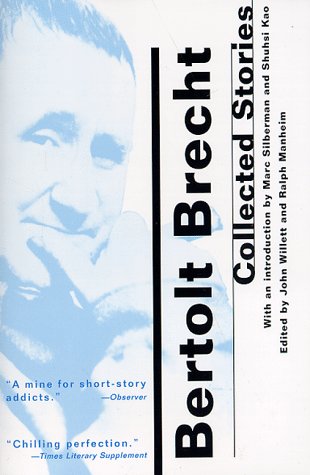
24. Collected Short Stories
$27.43
25. Brecht Sourcebook
$5.02
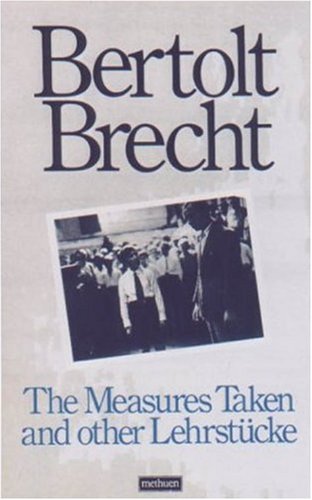
26. Measures Taken and Other Lehrstucke
 
$1.67
27. Two Plays by Bertolt Brecht
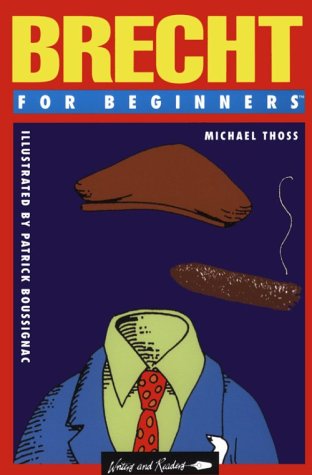
28. Brecht for Beginners (A Writers
$7.99
29. The Good Woman of Setzuan
$5.95
30. Bertolt Brecht's "Mother Courage
$35.78
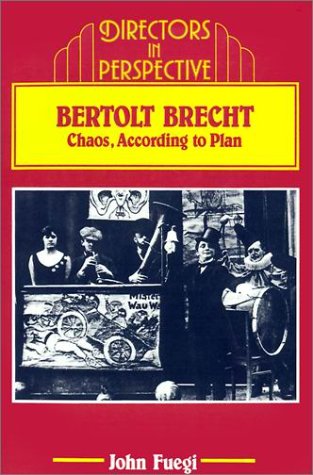
31. Bertolt Brecht: Chaos, according
$23.46
32. Bertolt Brecht's Berlin: A Scrapbook
 
$52.90
33. The Days of the Commune (Modern
$20.25
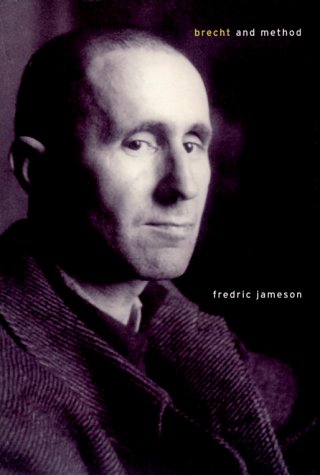
34. Brecht and Method
 
35. Brecht: A Biography = Bertolt
 
$121.88
36. Understanding Brecht
 
37. Parables For The Theatre - Two
 
38. Poems 1913-1956: Bertolt Brecht
$4.94
39. Jungle of Cities and Other Plays:
$24.13
40. Brecht Collected Plays: Five:

21. The Cambridge Companion to Brecht (Cambridge Companions to Literature)
Hardcover: 364 Pages (2007-01-29)
list price: US$75.00 -- used & new: US$46.43
(price subject to change: see help)
Asin: 0521857090
Average Customer Review: 4.0 out of 5 stars
Canada | United Kingdom | Germany | France | Japan
Editorial Review

Book Description
This updated Companion offers students crucial guidance on virtually every aspect of the work of this complex and controversial writer. It brings together the contrasting views of major critics and active practitioners, and this new edition introduces new voices and themes. The opening essays place Brecht's creative work in its historical and biographical context and are followed by chapters on single texts, from The Threepenny Opera to The Caucasian Chalk Circle, on some early plays and on the Lehrstücke. Other essays analyse Brecht's directing, his poetry, his interest in music and his work with actors. This revised edition also contains new essays on his early experience of cabaret, his significance in the development of film theory and his unique approach to dramaturgy. A detailed calendar of Brecht's life and work and a selective bibliography of English criticism complete this provocative overview of a writer who constantly aimed to provoke. ... Read more

Customer Reviews (1)

4-0 out of 5 stars The proof of the pudding is in the reading.
The problem with delivering Brecht to an English student audience is the fact that he is such a man of his time, culturally and historically, that the first few lectures end up being as much about 'Sturm und Drang', theWeimer republic and the rise of fascism, as they do about any theory by ourBertie. This wonderfully concise and pragmatic guide has been a real find.Dealing with the magor Brechtian themes and theories in a way that appliesthem both practically and with due reference to their historical/culturalsignificance. A real 'must buy' for students and teachers of drama! ... Read more


22. Stories of Mr. Keuner
by Bertolt Brecht
Paperback: 128 Pages (2001-07-01)
list price: US$9.95 -- used & new: US$4.98
(price subject to change: see help)
Asin: 0872863832
Average Customer Review: 5.0 out of 5 stars
Canada | United Kingdom | Germany | France | Japan
Editorial Review

Book Description

Bertolt Brecht's Stories of Mr. Keuner is a collection of fables, aphorisms, and comments on politics, everyday life, and exile. From 1930 til his death in 1956, Brecht penned these ironic portraits of his times as he was "changing countries more often than shoes." An ardent antifascist, Brecht roamed across Europe just ahead of Hitler's armies-only to wind up poolside in Los Angeles and then interrogated by Senator Joe McCarthy's infamous committee.

Bertolt Brecht wrote The Threepenny Opera, Mahagonny, Mother Courage, The Life of Galileo, and many other plays. A major poet of the twentieth century, Brecht also wrote extensively on the theater. At war's end, Brecht became director of the renowned Berliner Ensemble in East Germany.

... Read more

Customer Reviews (1)

5-0 out of 5 stars Keuner Stories Are Unfinalizable
Bakhtin wrote that great literature was "unfinalizable," meaning that great writing continues to grow new meanings as it ages.This is certainly true of Brecht, and as we move into a new period of global repression, his writings increase in value.In The Stories of Mr. Keuner, Brecht speaks in the voice the common man, not the grand or grandiose hero. Keuner is witty, visionary, and intent on survival in a world that can crush him with a whim. These stories are short(paragraph length) and incisive.Carry them in your pocket.Put them on the back of the john.Keep them in your car for traffic jams.The Stories of Mr. Keuner are a survival guide for the coming storm. ... Read more


23. Mother Courage and Her Children (Penguin Classics)
by Bertolt Brecht
Paperback: 192 Pages (2007-12-18)
list price: US$11.00 -- used & new: US$6.03
(price subject to change: see help)
Asin: 0143105280
Canada | United Kingdom | Germany | France | Japan
Editorial Review

Book Description
Mother Courage and Her Children is a classic in the repertory of Western theater. Written in response to the outbreak of World War II, this “chronicle play” of the Thirty Years War follows one of Brecht’s most enduring characters, Courage, as she trails the armies across Europe, selling provisions from her canteen wagon. However, Courage pays the highest price of all. One by one, her children are devoured by violence, but she will not give up her livelihood—the wagon and the war. ... Read more


24. Collected Short Stories
by Bertolt Brecht
Paperback: 256 Pages (1998-02-10)
list price: US$18.99 -- used & new: US$13.37
(price subject to change: see help)
Asin: 1559704020
Average Customer Review: 4.0 out of 5 stars
Canada | United Kingdom | Germany | France | Japan

Customer Reviews (2)

4-0 out of 5 stars The other facet of Brecht
The author is best known for his theatrical work and poems, while his narrative prose has been underestimated.This collection of 37 short stories (reprinted for Brecht's centenary) shows another facet of Brecht's literatry gift.This is writing with an unpretentious tone and reporting style.The composition of the stories falls into three distinct periods.The Bavarian stories written between 1920 and 1924 treat mainly autobiographical problems of a young man in his early twenties.The Berlin stories written between 1924 and 1933 marks his most intense period in this genre.These stories have a sober and realistic style, thematically dominated by topical issues of the 1920's, aiming to reveal the social behavior of individuals.The third group refers to stories written during Brecht's exile (1937-1940), the first pieces serve as ammunition in the struggle against fascism, and the later ones have a strong socially critical orientation.The reader familiarized with the work of Brecht (poems and plays) will certainly recognize the author's style stamped in these short stories, his determination to represent reality accurately, lack of affectation, anecdotal but with a sense of dread.Quite a treat for a lover of short stories!

4-0 out of 5 stars Another facet of Bertolt Brecht
The author is best known for his theatrical work and poems, while his narrative prose has been underestimated.This collection of 37 short stories (reprinted for Brecht's centenary) shows another facet of Brecht's literary gift.This is writing with an unpretentious tone and reporting style.The composition of the stories falls into three distinct periods.The Bavarian stories written between 1920 and 1024 treat mainly autobiographical problems of a young man in his early twenties.The Berlin stories written between 1924 and 1933 marks his most intense period in this genre.These stories have a sober and realistic style, thematically dominated by topical issues of the 1920's, aiming to reveal the social behavior of individuals.The third group refers to stories written during Brecht's exile (1937-1940), the first pieces serve as ammunition in the struggle against fascism, and the later ones have a strong socially critical orientation.The reader familiarized with the work of Brecht (poems and plays) will certainly recognize the author's style in these short stories, his determination to represent reality accurately, lack of affectation, anecdotal but with a sense of dread.Quite a treat for a lover of short stories! ... Read more


25. Brecht Sourcebook
Paperback: 256 Pages (2000-01-31)
list price: US$44.95 -- used & new: US$27.43
(price subject to change: see help)
Asin: 0415200431
Average Customer Review: 4.5 out of 5 stars
Canada | United Kingdom | Germany | France | Japan
Editorial Review

Book Description
A fascinating anthology that brings together in one volume many of the important articles written about Brecht between 1957 and 1997.The collection explores a wide range of viewpoints about Brecht's theatre theories and practice, as well as including three plays not otherwise easily available in English: The Beggar or the Dead Dog, Baden Lehrstuck and The Seven Deadly Sins of the Lower Middle Class.This unique compendium covers all the key areas including: the development of Brecht's aesthetic theories, the relationship of Epic theatre to orthodox dramatic theatre, Brecht's collaborations with Kurt Weill, Paul Dessau, and Max Frisch, and Brecht's influence on a variety of cultures and contexts including England, Italy, Moscow, and Japan.
Contributors: Lee Baxandall, Eric Bentley, Henry Bial, Hans-Joachim Bunge, Paul Dessau, Martin Esslin, Henry Glade, Barclay Goldsmith, Mordecai Gorelik, Karen Laughlin, Carol Martin, W. Stuart McDowell, Erica Munk, Jean-Paul Sartre, Ernst Schumacher, Diana Taylor, Tadashi Uchino, Carl Weber, and Kurt Weill. ... Read more

Customer Reviews (3)

5-0 out of 5 stars Best Introduction to Brecht
This book brings together Brecht's aesthetic theories, the practice of his theories, and the various ways he has been intrepreted abroad. The essays are readable and are by Brecht, practitioners, and scholars.

4-0 out of 5 stars Part of it is useful.
I agree that part of the book is useful for newcomers: essays of Brechts own, and key papers in Brecht studies. But the third part can be improved upon. Here thecriteria for selection take a nose dive: geologicaldistribution becomes priority number 1 and the editors onlystrive to keep a balance regardless of the quality of the paper. Martin's essay is especially ill informed and hopelessly outdated. Why not use something by AntonyTatlow, the leading authority?

Readers should also be aware that the selection here seems to be limited to articles that appeared in past TDR. Translate: you will only get a partialview of the Brecht Studies through a North American lense. The third part just fails to balance this "prejudice" out.

4-0 out of 5 stars Demystifying the Complex
For me, like many in the "mainstream," my first taste of Brecht was "The Threepenny Opera."I was lucky enough to be in a theatre class taught by a very sharp and open-minded professor who allowedme to gain a better understanding of the work by writing (and"casting") a film script based on it, instead of the usualcritical paper.

But the complexities of Brecht have remained difficultfor me to crack, and I was delighted to find this Sourcebook.Martin andBial, the editors, have compiled a powerful selection of criticism,including translations of a couple of Brecht's own essays.

Sartre'spiece on looking beyond bourgeouis theatre found its mark for me and openedmy eyes about conventions and assumptions.Kurt Weill on musical theatreprovided me with new understanding on his intentions in parting ways witheasy tradition.

But it was particularly the section on Brechtinterpreted abroad that enlightened me to his enormous influence as awriter and director.Tadashi Uchino skillfully gets at how a theatricalculture as drastically different as Japan's can adopt and adapt externalviewpoints to expand its own horizons; and editor Carol Martin brings greatinsight to Brecht's early revolutionary views on alienation in Chinesetheatre as they relate to feminism.

I don't pretend to be an authorityon Brecht after reading this sourcebook (though I did sleep at a HolidayInn Express last night).But those looking to understand his work and hisviews better, particularly those who already have respect for his work andhis lasting influence, will find the book quite useful. ... Read more


26. Measures Taken and Other Lehrstucke (Arcade Brecht)
by Bertolt Brecht
Paperback: 80 Pages (2001-02-11)
list price: US$9.95 -- used & new: US$5.02
(price subject to change: see help)
Asin: 1559705442
Average Customer Review: 4.0 out of 5 stars
Canada | United Kingdom | Germany | France | Japan

Customer Reviews (1)

4-0 out of 5 stars Plays with the quality of parables
"The Measures Taken and Other Lehrstucke," by Bertolt Brecht, brings together four theater pieces by this important German playwright. The book is edited by John Willett and Ralph Manheim. Included is an introductory note entitled "The Lehrstuck or Learning-Play," which is excerpted from an essay by Brecht. The pieces in this book, all of which were written from 1929 to 1930, are as follows:

"The Measures Taken," translated by Carl R. Mueller, is the story of a group of Communist agitators from Moscow who go to spread ... in China. It's a compelling story about the conflict between idealism and doctrinal orthodoxy. "The Exception and the Rule," translated by Ralph Manheim, is about an expedition headed by an exploitative merchant. It's a story of greed, violence, and law. "He Who says Yes" and "He Who Says No," both translated by Wolfgang Sauerlander, are a linked pair of plays; each one tells the story of a young man's quest to get medicine for his ailing mother.

Overall, the plays have a very ritualized quality; three of them make use of a chorus. The stories told in these plays have the flavor of parables. Overall, I found these pieces very intriguing, particularly in a post-Cold war context. ... Read more


27. Two Plays by Bertolt Brecht
by Bertolt Brecht
 Paperback: 256 Pages (1983-05-10)
list price: US$11.95 -- used & new: US$1.67
(price subject to change: see help)
Asin: 0452010551
Average Customer Review: 5.0 out of 5 stars
Canada | United Kingdom | Germany | France | Japan

Customer Reviews (1)

5-0 out of 5 stars Hard are the words of truth, like dry bread that can't be eaten.
I findin Brecht's Good Womana Mary Magdalen : 11 good men and a woman to wash
their feet can change the world. Is truth reality? Can a playwright get by with telling it as he sees it? Any Sophist can tell you that materialism rules the earth.
The first play is about goodness and the last is about justice,theyhave some common sense together.
In this day when the world is pregnant around us, who will be judged the father? Both Communism and Capitalism have been materialistically raising these planet breaking industrial children.
And we are left looking for a good person to raise the chaos child of disaster? ... Read more


28. Brecht for Beginners (A Writers and Readers Documentary Comic Book)
by Michael Thoss
Paperback: 187 Pages (1994-09)
list price: US$11.95
Isbn: 0863161006
Canada | United Kingdom | Germany | France | Japan

29. The Good Woman of Setzuan
by Bertolt Brecht
Paperback: 112 Pages (1999-11-01)
list price: US$10.00 -- used & new: US$7.99
(price subject to change: see help)
Asin: 0816635277
Average Customer Review: 4.5 out of 5 stars
Canada | United Kingdom | Germany | France | Japan

Customer Reviews (2)

5-0 out of 5 stars Very Recommendable!
"The Good Woman of Sezuan" is my favourite play of Brecht's and I really recommend it to anyone who is interested in german literature and plays. It's also a good one to start if this is your first contact with Bertolt Brecht!

4-0 out of 5 stars Good book
Well written, talented authors!I really liked it! ... Read more


30. Bertolt Brecht's "Mother Courage and Her Children": A Study Guide from Gale's "Drama for Students" (Volume 05, Chapter 9)
Digital: 29 Pages (2002-07-23)
list price: US$5.95 -- used & new: US$5.95
(price subject to change: see help)
Asin: B00006G3AS
Canada | United Kingdom | Germany | France | Japan
Editorial Review

Book Description

Term paper due tomorrow? Need to cram for a test? Or just looking for the best information about a favorite literary work?

Turn to "Drama for Students" to get your research done in record time. Brought to you by Thomson Gale--the world's leading source of literary criticism and analysis--this e-doc contains: plot summary; character analysis; author biography; an overview of the play's themes, style, and historical context; a compendium of in-depth critical material; study questions; suggestions for further reading; and much more.

Why choose "Drama for Students"? Because no other source offers so much in such a compact package. Trust the experts: Thomson Gale--and "Drama for Students."Download Description

Term paper due tomorrow? Need to bone up for a test? Or just looking for the best information about a favorite literary work?

Turn to "Drama for Students" to get your research done in record time. Brought to you by the Gale Group--the world's leading source of literary criticism and analysis--this e-doc contains: plot summary; character analysis; author biography; an overview of the play's themes, style, and historical context; a compendium of in-depth critical material; study questions; suggestions for further reading; and much more.

Why choose "Drama for Students"? Because no other source offers so much in such a compact package. Trust the experts: The Gale Group--and "Drama for Students." ... Read more


31. Bertolt Brecht: Chaos, according to Plan (Directors in Perspective)
by John Fuegi
Paperback: 238 Pages (1987-01-30)
list price: US$43.00 -- used & new: US$35.78
(price subject to change: see help)
Asin: 0521282454
Average Customer Review: 2.5 out of 5 stars
Canada | United Kingdom | Germany | France | Japan
Editorial Review

Book Description
This is the first full-length study in any language of Bertolt Brecht's day-to-day work as a theatre director. Professor Fuegi has researched his subject extensively over many years, and this book is the result of interviews with Brecht's closest associates (including Helene Weigel, Angelika Hurwicz, Elisabeth Hauptmann and Hans Bunge), inspection of the unpublished typescripts recording several years of Brecht rehearsals at the Berlin Ensemble, and consultation of archival materials in Moscow, Berlin and Harvard University. Although Brecht is acknowledged worldwide as having changed our whole conception of playwriting, acting and directing, virtually nothing has been previously published which tells how he worked and reacted with actors, and how his productions were actually put together in rehearsal. John Fuegi now tells the story, evoking the excitement and controversy which surrounded Brecht's work on the stage. He examines the way Brecht applied his manic but brilliant character, in both personal and professional life (though these cannot easily be separated), in order to create the tension and confusion, contradiction and chaos, from which his best productions emerged. He shows how the plays must be seen in the light of their evolution on the stage through innumerable arduous rehearsals, themselves conditioned by the intense magnetism, spontaneity and unpredictability of Brecht's personality. Most importantly, the book charts the evolution of Brecht's own dramatic theory from his early rejection of Stanislavskian realism and his demands for emotional coolness from the spectator to his later acceptance of the power of theatre to involve, even to move, the audience. The book goes behind the scenes to look at the playwright's negotiation of contracts for his productions, commercial agreements which were often highly beneficial to himself but markedly less so to his collaborators such as Kurt Weill, Ruth Berlau and Elisabeth Hauptmann, and it talks frankly of Brecht's use of the 'casting couch', bestowing and withholding favours with the same volatility that characterized his remarkable love-life. The story is accompanied by illustrations, many of which have not been published before. It provides a much-needed antidote to some of the more sterile accounts of Brechtian theory, concentrating very much on the 'practice' but remaining at the same time vividly aware of the social and political context in which and about which Brecht was writing. The book will be of interest to scholars and students of theatre and of dramatic and comparative literature, and it is presented in a lively style that should also appeal to the general reader. ... Read more

Customer Reviews (2)

4-0 out of 5 stars Are we reading the same book??
I don't quite understand the previous reviewer's comments.
This book is a very good introduction from a technical point of
view. It surveys the career of Brecht as a stage director. This aspect of Brechtian studies in the Anglo-American circle is lacking. Carl Weber and John Rouse are leading scholars on this topic, but you have to dig hard and deep to find their articles.
If anything, the detailed record on the production of the Caucasian Chalk Circle at the Berliner Ensemble which forms the core of chapter six is an absolute keeper. It details how Brecht directed this play himself. What kind of things he was looking for? What to focus on? What to work on? How? It's invaluable but it's ignored again and again by college teachers who try to piece together theorectical expressions from defferent periods in Brecht's career. I say none of this nonesense; instead, study chapter six, if your German is not good enough and then you will get a handle on Brecht.
The rest of the book is a little chaotic, and his writing is a bit imprecise sometimes. People familiar with Eric Bentley's or Martin Esslin's books will recognize that the lack of political consciouness does not start with Fuegi. Fuegi really has some contributions to the study of the theatricality in Brecht by focusing upon the so-called "theatre" side.
What fouls Fuegi's reputations as a scholar and a biographer is his notorious biography published later. That volume is now deservedly out of print.

1-0 out of 5 stars American neurosis
This book is a compendium of America's neuroses, from its puritanism through its hatred for anything smacking of socialism all the way to its feminist-inspired guilt feelings towards women. These neuroses are then projected on Germany, leading to countless misunderstandings concerning the nature of German history and life. As an account of Bertolt Brecht and the world in which he operated this book is all but worthless. If you want to understand how crazy Americans really are, however, by all means go ahead and study it as carefully as you can. ... Read more


32. Bertolt Brecht's Berlin: A Scrapbook of the Twenties
by Wolf Von Eckardt, Sander L. Gilman
Paperback: 172 Pages (1993-11-01)
list price: US$25.00 -- used & new: US$23.46
(price subject to change: see help)
Asin: 0803296126
Average Customer Review: 5.0 out of 5 stars
Canada | United Kingdom | Germany | France | Japan
Editorial Review

Book Description

In 1936, at the age of eighteen, Wolf Von Eckardt and his mother and sister fled Berlin and came to New York. With Sander L. Gilman, he as brought into focus, through words and pictures, an uneasy era that divided two great catastrophes.
... Read more

Customer Reviews (1)

5-0 out of 5 stars After the wall fell
It is a scrapbook.Berlin dreams included many things, art, architecture, theater, sport.In the 1950's the city'sdividedness became an occasion for more riches of artistic expression.

Brecht died in 1956.His daughter took over his company--the Ensemble-- and the right to produce his plays.The Berlin of the 1920's became frozen in time.After reunification the question arose as to whether the Berlin Ensemble should be preserved.

Friedrich Ebert was the first President of the Weimar Republic.German inflation, 1919-1923, was more demoralizing than the defeat of armies.Berlin is surrounded by beautiful lakes and woods but most of the inhabitants stayed within the city's confines which produced a multitude ofemployment opportunities and leisure pursuits.There was also the issue of a lack of low cost housing which some of the architects and planners sought to overcome.

Berlin night life defied description.There was political cabaret.There were night clubs one does not talk about.Criminal gangs were camouflaged as social clubs.Franz Werfel, Stefan Zweig, Erich Maria Remarque, and Stefan George were active.Kathe Kollwitz and Georg Grosz were inevitably involved in showing the ugliness of life in the city.Other artists included Otto Dix, Ernst Barlach, Paul Klee, Max Beckmann, Otto Muller, Lyonel Feininger, Ernst Ludwig Kirchner.The Bauhaus group influenced the avant garde.

The first public psychoanalytic institute was established in Berlin in 1921.The Berlin theater attracted the best talent.German film makers used Espressionism.Another genre of film was the mountain film.The music scene included Wilhelm Furtwangler, Arnold Schonberg, Paul Hindemith, Otto Klemperer, Erich Kleiber, Arthur Schnabel, and Kurt Weill.The Wandervogel movement was apolitical.Notes and index are provided. ... Read more


33. The Days of the Commune (Modern Plays)
by Bertolt Brecht
 Paperback: 88 Pages (1978-01-12)
-- used & new: US$52.90
(price subject to change: see help)
Asin: 0413387704
Canada | United Kingdom | Germany | France | Japan

34. Brecht and Method
by Fredric Jameson
Paperback: 184 Pages (2000-05)
list price: US$19.00 -- used & new: US$20.25
(price subject to change: see help)
Asin: 1859842496
Average Customer Review: 4.5 out of 5 stars
Canada | United Kingdom | Germany | France | Japan
Editorial Review

Book Description
The legacy of Bertolt Brecht is much contested, whether by those who wish to forget or to vilify his politics, but his stature as the outstanding political playwright and poet of the twentieth century is unforgettably established in this major critical work. Fredric Jameson elegantly dissects the intricate connections between Brecht's drama and politics, demonstrating the way these combined to shape a unique and powerful influence on a profoundly troubled epoch. Jameson sees Brecht's method as a multi-layered process of reflection and self-reflection, reference and self-reference, which tears open a gap for individuals to situate themselves historically, to think about themselves in the third person, and to use that self-projection in history as a basis for judgement. Emphasizing the themes of separation, distance, multiplicity, choice and contradiction in Brecht's entire corpus, Jameson's study engages in a dialogue with a cryptic work, unpublished in Brecht's lifetime, entitled Me-ti; Book of Twists and Turns. Jameson sees this text as key to understanding Brecht's critical reflections on dialectics and his orientally informed fascination with flow and flux, change and the non-eternal. For Jameson, Brecht is not prescriptive but performative. His plays do not provide answers but attempt to show people how to perform the act of thinking, how to begin to search for answers themselves. Brecht represents the ceaselessness of transformation while at the same time alienating it, interrupting it, making it comprehensible by making it strange. And thereby, in breaking it up by analysis, the possibility emerges of its reconstitution under a new law. ... Read more

Customer Reviews (2)

4-0 out of 5 stars Jameson is always brilliant and useful, but ...
Relatively accessible as this book is in Jameson's oeuvre--short, under 200 pages, 20 bite-sized chapters--it also has all the drawbacks of Jameson's usual dense thinking-out-loud style. His casual erudition is overwhelming, and he comes up with great idea after great idea; but because he's there in the room with you, wracking his brain for the next insight, what he does with his great ideas is uneven. Sometimes he reduces one to a list that belabors the obvious; other times he hits a deadend, and instead of backing off and rethinking and rewriting, he just burrows deeper. The book often has the feel of a Balzac or Dickens novel, scribbled hastily and torn page by page from his hands and rushed to the printer. There are odd errors that make Jameson sound like a non-native speaker of English: "That it might well be possible to reconcile both alternatives is illustrated by THE play like The Good Person of Szechuan." He provides Brecht's original German and an English translation for every quotation, often enough his own; when he borrows an existing translation, he often edits it without indicating that he has done so, often substantially, often strangely. For example, when Brecht writes "so m?ssen wir annehmen, dass wir hierbei an Interessen teilnehmen, die tats?chlich allgemein menschlich waren," and John Willett translates that as "we have to conclude that we are partaking in interests which really were universally human," Jameson tacitly changes that to: "we must suppose that in doing so we are sharing interests that are actually universally human." Some of those emendations are more or less synonymous (conclude>suppose, partake>share, really>actually), no big deal to change, but it IS ethical to indicate such editing; changing Brecht's past tense ("waren") to the present tense ("are actually universally human") is more problematic. Does Jameson really believe that Brecht believed that these interests ARE universally human? We could argue about what Brecht's tense shift (teilnehmen>waren) means, but at the very least it points to a complex temporal dynamic that Jameson either uncritically or puristically eliminates. He's also careless in typing Brecht's German into his book: in that same quote on p. 176, for example, he inserts "Arbeit" for "Art" in "Es findet da eine Verallgemeinerung interessantester Arbeit [should be Art] statt." Each of these cases is fairly minor, but such cases are everywhere, and the cumulative effect is (for me, anyway) to undermine Jameson's credibility.

The biggest problem for me in the book, though, is that Jameson's odd eclectic form of structuralist Marxism seems ill-suited to Brecht's theory and practice of theater. He argues, for example, that Brecht rejected empathy because empathetic identification simply never happens, doesn't exist: "`third-person acting' ... is the result of a radical absence of the self, or at least the coming to terms with a realization that what we call our `self' is itself an object for consciousness, not our consciousness itself: it is a foreign body within an impersonal consciousness, which we try to manipulate in such a way as to lend some warmth and personalization to the matter." This isn't Brecht; this is Jameson's Prison-House of Language, the dogmas of depersonalized death-of-the-subject structuralism. And Jameson doesn't even bother to develop the point out of Brecht--to read it out of some early dismissive remark about emotion and reason (plays "ought to be presented quite coldly, classically and objectively. For they are not matter for empathy; they are there to be understood. Feelings are private and limited. Against that the reason is fairly comprehensive and to be relied on"); he just states it as a bare fact, and uses it to impose a Greimasian model on Brecht. Brecht himself moved from a complete rejection of empathetic/emotional appeal, through various middle stages, to a reluctant willingness to oscillate between empathetic and estranging appeals, to a recognition that even estrangement is a form of empathetic or "infectious" appeal--something that, needless to say, Jameson never mentions.

One last point: in his review on this page, Martin Carrillo calls Jameson's book "the first serious attempt since Benjamin, to interpret the methodology of one of the more important playwrights and formal experimenters of our century." This is absurd, unless what he means is "the first serious attempt by a scholar lionized by current thought." There is a whole Brecht industry interpreting his methodology, and it is very serious. And while it may not have the clout of a Benjamin or a Jameson, it's often far more solidly grounded in the study of Brecht, his theories, his plays, his influences, and his reception, than either Benjamin or Jameson.

5-0 out of 5 stars Methodical Measures Taken
This work by Jameson is perhaps the first serious attempt since Benjamin, to interpret the methodology of one of the more important playwrights and formal experimenters of our century.Jameson's seminars and work at Duke University are captured here in an elegant and intricate map of the Aesthetic which revolutionized theatre and, subsequently film and new media.Jameson understands how important the notion "Brecht" is outside of the man whose personal life remains controversial and open for debate.An excellent piece. ... Read more


35. Brecht: A Biography = Bertolt Brecht, Eine Biographie (412p)
by Klaus Voelker
 Hardcover: 412 Pages (1978-10)
list price: US$14.95
Isbn: 0816493448
Canada | United Kingdom | Germany | France | Japan

36. Understanding Brecht
by Walter Benjamin
 Paperback: 125 Pages (1977-04-21)
-- used & new: US$121.88
(price subject to change: see help)
Asin: 0902308998
Average Customer Review: 4.0 out of 5 stars
Canada | United Kingdom | Germany | France | Japan

Customer Reviews (1)

4-0 out of 5 stars Important Benjamin
This is an invaluable collection of essays and diary entries that sheds as much light on Benjamin himself as it does on his truculent and difficult friend Brecht. Another way of putting that is that the Brecht this book sheds light on is Benjamin's Brecht, who is also, due to the high esteem we hold Benjamin in, a Brecht with a good deal of currency in the field today. Brigid Doherty, for example, in "Test and Gestus in Brecht and Benjamin" (MLN 115.3 (2000): 442-81), explores the Benjaminian Brecht (and perhaps the Brechtian Benjamin) in persuasive and useful ways:

"Interruption, as we have seen, is also the epic theater's technique for representing Gesten and making them quotable. 'The more frequently we interrupt someone engaged in an action, the more gestures we obtain. Hence the interrupting of action is one of the principal concerns of epic theater' [a quotation from this edition of Benjamin on Brecht, p. 3]. In epic theater, that mode of interruption resembles techniques of photographic representation employed in psychotechnical testing. Interruption fixes, as if cinematographically, the 'strict, frame-like enclosure of each element of a Haltung (i.e., each gesture)' (UB 3; GS II.2, 521). The frames of the gesture are like the frames of a strip of film, and hence they are also like the projections that hovered behind the action in the 1931 production of Mann ist Mann, which was designed by Caspar Neher. Those projections recapitulated elements of the action in telegraphic prose and, you will recall, in arithmetic. In epic theater, projections are gestic; they function as interruptions, and their own form is punctuated either paratactically or mathematically. Seen that way, the projections call to mind Benjamin's likening of the epic actor's presentation of quotable gestures to the setting of type for emphasis: 'he must be able to space [sperren] his gestures as the compositor spaces words' (UB 11; GS II.2, 529). That metaphor in turn recalls Brecht's assertion of the need for 'footnotes' in dramatic writing, as well as his emphasis on the writer's desire to emulate the apparatus, a point I have said we should understand in relation to Benjamin's claims about the 'training regimen' of Hemingway's prose, and hence in relation to his thoughts on Haltung as the interrupted action of a body in motion. All of which underscore the mechanical aspects of writing, understood in terms of a text's capacity to represent Gesten" (Doherty 474-75).

Doherty has here selected from the first version of "What Is Epic Theatre?"--the first essay in Benjamin's book--some of the most strongly structuralizing of Benjamin's interpretations of Brecht, making it seem as if for Benjamin epic theater was largely an abstract matter of forms or frames or spacings, rather than, say, a series of complex interactions. This is not entirely accurate: Benjamin does in passing recognize the importance to epic theater of the various relationships "between stage and public, text and performance, producer and actors"--"For the stage, the public is no longer a collection of hypnotized test subjects, but an assembly of interested persons whose demands it must satisfy" (2)--and indeed Doherty's first quotation, from page 3 of that essay, seems to take us to a rehearsal, where Brecht is pushing his actors to complicate their gestic movements: "The more frequently we interrupt someone engaged in an action, the more gestures we obtain. Hence the interrupting of action is one of the principal concerns of epic theater." But that "we" is not Brecht running a rehearsal but people in general, indeed a kind of generalized or universalized principle of human behavior disguised rhetorically as an interactive intervention. And in any case Benjamin's emphasis on the quantification of interruptions and gestures ("The more frequently we interrupt someone engaged in an action, the more gestures we obtain") comes out of his remarks just previous on the framing of the gesture ("it has a definable beginning and a definable end ... this strict, frame-like, enclosed nature of each moment of an attitude ...," 3), which in turn set up his discussion of the serial spatialization of gesticity, the likening of interruptions or "haltings" to cinematic frames on a strip of celluloid, "punctuated either paratactically or mathematically," or to typesetting, and thus to "the mechanical aspects of writing." Hence also, presumably, the temptation to use the literary text of Mann ist Mann to represent the estranging effect of the Brechtian Gestus (Benjamin 2-3, 8-9, 12-13): for a depersonalizing or desomatizing critique, the truest form of any theatrical or literary effect is one that has been abstracted out of the realm of human interaction.

And this is largely what Benjamin gives us of Brecht: a Brecht removed from the context he most insistently inhabited, the theater, the interaction between actors and audience, the impact of actor bodies on audience bodies and minds. Benjamin is brilliant, of course, but his is the brilliance of the study, the text, the abstract structure, and that is largely what he finds in Brecht as well. If you're a depersonalizing poststructuralist or a structuralist Marxist like Fredric Jameson (see his Brecht and Method), you'll find this book indispensable. If you're doing performance studies or working in the theater and are mostly interested in Brecht's thoughts on estranging gestic acting styles, you may want to give this book a pass, and read John Willett's superb collection from 1964, Brecht on Theatre. ... Read more


37. Parables For The Theatre - Two Plays By Bertolt Brecht - The Good Woman Of Setzuan and The Caucasian Chalk Circle
by Bertolt; Revised English versions by Bentley, Eric and Apelman, Maja Brecht
 Paperback: Pages (1963)

Asin: B000IWGBF8
Canada | United Kingdom | Germany | France | Japan

38. Poems 1913-1956: Bertolt Brecht
by Bertolt Brecht
 Hardcover: 627 Pages (1980-03)
list price: US$29.95
Isbn: 0416000819
Canada | United Kingdom | Germany | France | Japan

39. Jungle of Cities and Other Plays: Includes: Drums in the Night; Roundheads and Peakheads (Brecht, Bertolt)
by Bertolt Brecht
Mass Market Paperback: 283 Pages (1994-01-27)
list price: US$10.95 -- used & new: US$4.94
(price subject to change: see help)
Asin: 0802151493
Canada | United Kingdom | Germany | France | Japan
Editorial Review

Book Description

The three plays gathered in this volume are among Bertolt Brecht's most remarkable; the best-known is Jungle of Cities, here translated by the poet Anselm Hollo. Set in Chicago in a climate of rampant capitalism, it is the story of a savage battle waged between two men, whose relationship is at once homosexual and sadomasochistic and whose tightly choreographed hostility is a metaphor for their cultural surround.
... Read more

40. Brecht Collected Plays: Five: Life of Galileo and Mother Courage and Her Children (Methuen World Classics)
by Bertolt Brecht
Mass Market Paperback: 389 Pages (1995-01-01)
list price: US$19.95 -- used & new: US$24.13
(price subject to change: see help)
Asin: 0413699706
Canada | United Kingdom | Germany | France | Japan
Editorial Review

Book Description

The fifth volume in the Collected Plays series brings together two of Brecht's best-known plays, Life of Galileo and Mother Courage and Her Children. Life of Galileo, which examines the conflict between free inquiry and official ideology, contains one of Brecht's most human and complex central characters. Mother Courage is also one of Brecht's great creations: she clings to her livelihood-her canteen wagon-in this "chronicle play of the Thirty Years War," while one by one she loses her children to the war.

This volume, edited and introduced by John Willett and Ralph Manheim, gives full translations of each of the plays and includes Brecht's own notes and all the most important textual variants.

... Read more

  Back | 21-40 of 100 | Next 20
A  B  C  D  E  F  G  H  I  J  K  L  M  N  O  P  Q  R  S  T  U  V  W  X  Y  Z  

Prices listed on this site are subject to change without notice.
Questions on ordering or shipping? click here for help.

site stats