e99 Online Shopping Mall

Geometry.Net - the online learning center Help  
Home  - Authors - Canetti Elias (Books)

  1-20 of 100 | Next 20
A  B  C  D  E  F  G  H  I  J  K  L  M  N  O  P  Q  R  S  T  U  V  W  X  Y  Z  

click price to see details     click image to enlarge     click link to go to the store

$8.95
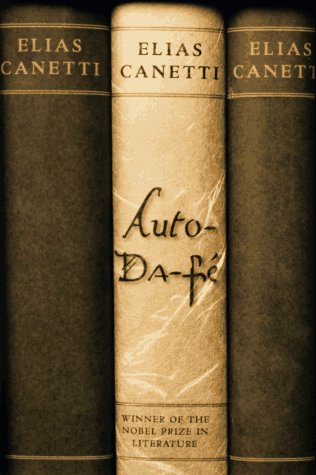
1. Auto-da-Fe
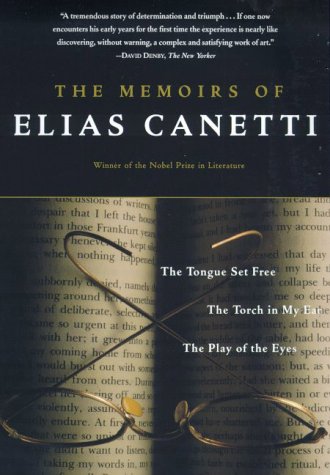
2. The Memoirs of Elias Canetti:
$10.05
3. Crowds and Power
$7.31
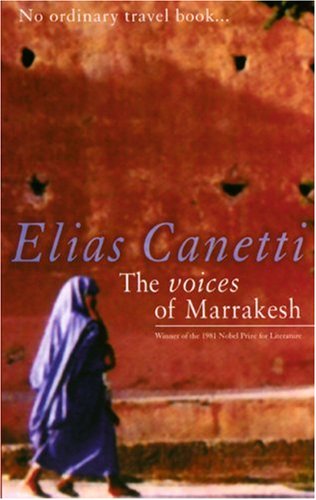
4. The Voices of Marrakesh
$13.70
5. Party in the Blitz: The English
$79.99
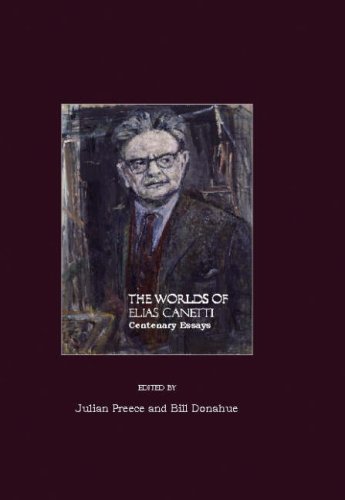
6. The Worlds of Elias Canetti: Centenary
$8.40
7. Kafka's Other Trial: The Letters
$11.95
8. Agony of Flies: Notes and Notations
 
9. Critical Essays on World Literature
$11.58
10. The Secret Heart of the Clock
$19.50
11. Torch in My Ear
 
$14.50
12. Conscience of Words
 
13. Soziale Kritik im Werk Elias Canettis
 
14. Zu Elias Canetti (LGW-Interpretationen)
 
$13.98
15. The human province
 
16. Huter der Verwandlung: Beitrage
 
$32.98
17. Structures of Disintegration:
 
$12.89
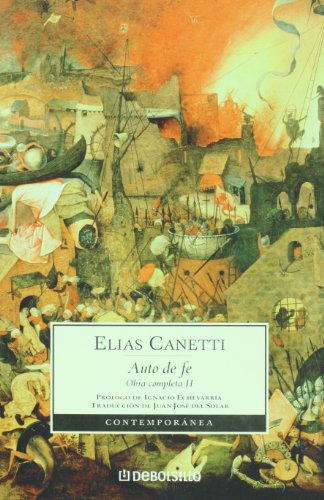
18. Auto de Fe / Act of Faith: Obra
 
$9.95
19. Elías Canetti (1905-1994): a
 
20. Essays in Honor of Elias Canetti.

1. Auto-da-Fe
by Elias Canetti
Paperback: 464 Pages (1984-12-01)
list price: US$18.00 -- used & new: US$8.95
(price subject to change: see help)
Asin: 0374518793
Average Customer Review: 4.0 out of 5 stars
Canada | United Kingdom | Germany | France | Japan
Editorial Review

Book Description

Auto-da-Fé, Elias Canetti's only work of fiction, is a staggering achievement that puts him squarely in the ranks of major European writers such as Robert Musil and Hermann Broch. It is the story of Peter Kien, a scholarly recluse who lives among and for his great library. The destruction of Kien through the instrument of the illiterate, brutish housekeeper he marries constitutes the plot of the book. The best writers of our time have been concerned with the horror of the modern world--one thinks of Kafka, to whom Canetti has often been compared. But Auto-de-Fé stands as a completely original, unforgettable treatment of the modern predicament.
... Read more

Customer Reviews (20)

5-0 out of 5 stars Very pleased
I received this book in a timely manner and in very good condition.

5-0 out of 5 stars Auto-Da-Fe
Took me several months to read this book.The story crept through me and began to take over my thoughts--as schizophrenic as that appears, it's how I felt.I put the book down, and when I felt able to go on, sometimes page by page, I did so.Amazing, unforgettable, horrifying, remarkable, and beautifully translated; should be at or near the top of every must-read list of books.

4-0 out of 5 stars The bizarre Homeric odyssey of a reclusive bookworm
The history of Canetti's odd, inventive novel provides clues to its understanding. According to his memoirs, Canetti originally conceived the "Human Comedy of Madmen," a fictional cycle portraying eight characters. Of these, only one character lived on in his imagination: Brand the Book Man. Inspired by Gogol, modeled after Stendhal's "The Red and the Black," and informed by Jacob Burckhardt's "History of Greek Civilization," Canetti's surviving portrait is an allegorical odyssey of a recluse who lives only for his books.

Yet those already familiar with "Auto da Fe" know that there is no character named Brand in the book. During the year (1930-31) that Canetti finished his novel, he changed the main character's name from Brand [German for conflagration] to Kant and the novel's title to "Kant Catches Fire." Canetti explains in the second volume of his memoirs that the lingering emotions he felt from his presence when a mob burned down Vienna's Palace of Justice in 1927 made this new title "hard to endure." And so "Kant became Kien [German for resinous pinewood]; the ignitability of the world, a threat that I felt, was maintained in the name of the chief character." Likewise, he changed the title to Die Blendung [The Blinding], a reference to the biblical legend of Samson. It was under this title that the book was published in 1935, but it was soon banned by the Nazis.

The main character is a leading Sinologist whose meticulous scholarship and linguistic expertise make him famous among an elite group, but Kien's lack of social skills ultimately defines him: he refuses to be part of the crowd (the dynamics of which is one of Canetti's real-life intellectual preoccupations). Kien's 25,000-volume library overtakes his entire apartment, the 40,000 characters of the Chinese alphabet challenge his intellect, and his only human relationships are daily contacts with a housekeeper of eight years and morning ventures to the bookshops that dot the city of Vienna. His cloistered life is shattered, however, when he decides to marry the housekeeper; her conniving greed is eventually wedded to the brute force of the building's superintendent, a retired police officer whose nascent fascism finds full expression in his treatment of Kien. Eventually, Kien conflates his fear and hatred of his wife with the misogyny he has learned from his vast readings.

Simultaneously bizarre and uncomplicated, the story reads like a 450-page Homeric epic filtered through the psychoses of the Brothers Grimm. Expelled from his book-dominated oasis, Kien descends into the underworld of Vienna, a journey that results in the destruction of the world as he knows it. Dwarfs, prostitutes, blind men--each of the major and minor characters develops his or her own perspective of the events through which they live; when their internally consistent yet outwardly incongruent worlds clash, the results alternate between absurdity and madness. What it is all supposed to mean will engage the patient reader's imagination for weeks.

4-0 out of 5 stars A masterpiece without human feeling
This work is considered a great twentieth- century masterpiece. Written in 1931 when Canetti was twenty-six it is the story of the booklover and Sinologist Peter Kien who lives alone with his twenty- five thousand volumes until he is deceived and marries his housekeeper the sixty year old Theresa who he mistakenly believes will preserve his library when gone.
The book is written with a kind of ferocious descriptive clarity, and it goes on to tell the story of Theresa's conspiring with the fascist concierge of the building to disposses the distinguished professor, and send him reeling through a hellish world of dispossesion ending in madness and death.
The work is taken to be a parable of the self-destructive quality of a life devoted to intellect alone.
However the writer succeeds far too well in portraying the coldness of obsession, the inhumane character of life by mind alone.
And there is something grotesquely unreal, unsympathetic , not simply in the relations of the characters to each other but in the whole feeling and tone of the work itself.
This work has the feeling of having been written by a person with a very hard heart indeed.
Canetti in a small subsequent work wrote of Kafka, and one can see the same strange quality of human detachment in both writers. However the world of Kafka is so much richer in human feeling in fear, and even in sympathy that there is to my mind no comparison.
Canetti in pillorying an exclusive reliance on intellectual brilliance , it seems to me, is describing first and above all himself.

4-0 out of 5 stars This Book is Enjoyable
Like many of the comments before mine, this book is not for everyone. The narrative structure is a slight bit challenging and all of the answers are not straight forwards. But this book is not more difficult than anything that could be considered postmodern American fiction. It's an engaging story that is conducive for reading for extended periods of time.

I'm not sure that I would read anything else from Canetti because I found his grammar irritating to a degree. If you can let the phrasing pass by you, the book is an amazing story with a sinister hook. I think that if you like the absurdity of either Pynchon or Gass, you'll enjoy this book a lot. ... Read more


2. The Memoirs of Elias Canetti: The Tongue Set Free, The Torch in My Ear, The Play of the Eyes
by Elias Canetti
Paperback: 840 Pages (2000-04-26)
list price: US$20.00
Isbn: 0374527148
Average Customer Review: 4.5 out of 5 stars
Canada | United Kingdom | Germany | France | Japan
Editorial Review

Book Description

A compelling account of the development of a great artist, and a portrait of the tragic character of an entire era

The uncompromising achievement of Elias Canetti has been matched by few writers this century. Canetti worked brilliantly in many forms, but the three volumes that comprise his autobiography are where his genius is perhaps most evident. The first volume, The Tongue Set Free, presents the events, personalities, and intellectual forces that fed Canetti's early creative development. The Torch in My Ear explores his admiration for the first great mentor of his adulthood, Karl Krauss, and also describes his first marriage. The final volume, The Play of the Eyes, is set in Vienna between 1931 and 1937, with the European catastrophe imminent; here he vividly portrays relationships with Hermann Broch and Robert Musil, among others.
... Read more

Customer Reviews (5)

3-0 out of 5 stars Great for the Specialist, Good for the Casual Reader
Canetti, a Nobel Prize winner in Literature (1981), is little known but his works and ideas remain for the interested reader.This autobiography is a long read but worth it for those interested in early 20th century Europe and in the German literature of that period.

The highlights of the book are the fluid, likable prose and the rich characterization offered.Canetti draws some very memorable characters, some of which went on to people his writings.The most valuable aspect of the book will be to those with a passion for German literature because Canetti offers his personal impressions and insights about many of his era's great writers, especially Bloch and Musil.He also charts the inspiration and development of his own great works.

Reading some of the other reviews I think is misleading.Nice a read as this book is, I hardly found it to be the masterpiece that so many others claim it to be.It is a major investment of reading time and should be taken only by those with particular interest in the subject matter.Pound for pound, I think Canetti's most famous writings (Crowds and Power, Auto-Da-Fe) are a much better introduction to this thinker.The insights he offers in his long autobiography are relatively sparse.And, as warm and personal as the style of the autobiography is, I would hardly class it `candid.'He doesn't get racy in any way; one would assume his love affairs were all about literary conversations.And the impressions he gives are usually reserved and non-confrontational.One reads about his mother's incredibly controlling behavior but never does he rail against the irrationality of it and express what are surely his true feelings about her.I expected a lot more about the burgeoning Fascism and atmosphere of horror that was rapidly closing in on Europe in the 1930s.Instead, all of this is represented in inchoate concerns about the future.I would have greatly appreciated hearing about his own flight from the Nazis and his feelings about that whole nightmare.He stopped the autobiography well before WWII leaving it as nothing but a looming specter.

But, all in all, it is a nicely done autobiography.His respect for his mentor, Dr. Sonne, speaks volumes about the missing father in his life.His sum-up of Dr. Sonne's agenda gives a wonderful design for the book as a whole:

"What a man touched upon, he should take with him.If he forgot it, he should be reminded.What gives a man worth is that he incorporates everything he has experienced.This includes the countries where he has lived, the people whose voices he has heard.It also takes in his origins, if he can find out something about them.By this he [Sonne] meant not only one's private experience but everything concerning the time and place of one's beginnings.The words of a language one may have spoken and heard only as a child imply the literature in which it flowered.The story of a banishment must include everything that happened before it as well as the rights subsequently claimed by the victims.Others had fallen before and in different ways; they too are part of the story.It is hard to evaluate the justice of such a claim to history.To Sonne's mind history was eminently the area of guilt.We should know not only what happened to our fellow men in the past but also what they were capable of.We should know what we ourselves are capable of.For that, much knowledge is needed; from whatever direction, at whatever distance knowledge offers itself, one should reach out for it, keep it fresh, water it and fertilize it with new knowledge."

5-0 out of 5 stars I don't know anything better.
I have never known better literature. I myself am not a good writer so I'll just say is this: Canetti heightend my sensitivity towards life - fundamentally. His autobiography showed me how complex and interesting life can be, if you see it through a mind like Canetti's who is able to describe his perception in a more profound yet boad way than anybody and who chose a corresponding path of life. I'm glad I read him while still in college, because otherwise I had not known how narrowminded I really was before I met Canetti.
My favorite book.

(PS. English is not my first language so please excuse whatever you don't like about my writing.)

5-0 out of 5 stars A Genius Way Ahead of his Time
I first read Auto-da-Fe on the recommendation of my German teacher at school. Even then, I was astounded by Canetti's humour and intelligence. I was delighted to come across a rather shabby hardbound copy of The Torch in my Ear on sale for £1.00 outside Surrey County Council Library recently.

I settled down to reacquaint myself with Canetti and, like a reunion with an old friend, I was overjoyed to rediscover his warmth, his wit, and his searing intellect. For such a clever man, though, Canetti is still aware he has a reading public eager to hear tales of the famous names, with whom he rubbed shoulders during his very brief time in Berlin. To learn that the great George Grosz was indeed a misogynist and Brecht a slave to fashion gave me that wry smile that I remembered from reading Canetti before.

For anyone wanting to gain a really deep insight into Central Europe in the 1920's and 30's, this is the book to read and not the titillating, ever-so-British accounts of Christopher Isherwood.

5-0 out of 5 stars a perfect piece of literary fiction
what a book, what a writer! having read plenty of literary autobiographies, i am still stunned at the depth and insight of these three volumes. the first, tongue set free, is the most lyrical; the other twofocus more on young canetti's developement as a writer and thinker. such iscanetti's art that only after reading the books several times the readernotices all the things he is not told...although this autobiography is agreat source of enjoyment to everyone who is interested in literature, itshould be read with a bit of caution: never to forget that this is, despiteeverything, literary fiction. i am not implying that canetti is lying (heis not), but he has more purpose than just presenting his times and lifes,and some scenes (like the describtion of café museum) seem to be justdescribtions while they are full or literary quotes etc. i think it is thisthat sets canetti's work apart from other writers of the era.

5-0 out of 5 stars Wonderful: A High Point of 20th Century Literature
I'm at a loss to convey how great this book is. I think anyone who enjoys literature and fine writing should read it. Canetti was one of the leading writers and intellectuals of the 20th century, and he brings all hisformidable talent and insight to this work.

The biography is excellent onmany levels. First, it works as a simple biography. Canetti led a veryinteresting life, and he does an excellent job presenting the importantevents and influences that shaped him. Because of this, it is a requiredread for anyone who has enjoyed his other major works (_Auto Da Fe_ and_Crowds and Power_.)

Second, it is great literature. Canetti was anexcellent writer, clear and lucid without being bland, with a wonderfulability to see and present the fundamental elements of individuals. Hismemoirs are full of rich and fascinating characters, which Canetti is ableto present either in a few quick strokes or in full detail, depending ontheir role in his life.

Third, it is a fascinating record of the time.Canetti came of age during and after WWI, and spent much of his earlyadulthood in the intellectual turmoil of interwar Vienna. Canetti focusesmainly on the intellectual life, describing his interactions with RobertMusil, Bertolt Brecht, Hermann Broch, Karl Kraus, Isaac Babel, and others.Inevitably, though, the memoirs also give some details of everydayexistence in central Europe during this chaotic period.

The memoir is nottold as a single continuous narrative. Instead, the book gives a series ofvivid incidents and characters, the things that Canetti remembered abouthis life. Because of this, his memoir has a universally high level of powerand detail, without long flat stretches of filler. It was his autobiographythat finally generated enough support for Canetti to be awarded the NobelPrize. In my opinion it is is best, most accessible work, and one which canstand with the greatest of 20th century literature. ... Read more


3. Crowds and Power
by Elias Canetti
Paperback: 496 Pages (1984-04-01)
list price: US$18.00 -- used & new: US$10.05
(price subject to change: see help)
Asin: 0374518203
Average Customer Review: 5.0 out of 5 stars
Canada | United Kingdom | Germany | France | Japan
Editorial Review

Amazon.com
Elias Canetti's 1981 Nobel Prize was awarded mainly on the basis of this, his masterwork of philosophical anthropology about la condition humaine on an overpopulated planet.

Ranging from soccer crowds and political rallies to Bushmen and the pilgrimage to Mecca, Canetti exhaustively reviews the way crowds form, develop, and dissolve, using this taxonomy of mass movement as a key to the dynamics of social life. The style is abstract, erudite, and anecdotal, which makes Crowds and Power the sort of work that awes some readers with its profundity while irritating others with its elusiveness.Canetti loves to say something brilliant but counterintuitive, and then leave the reader to figure out both why he said it and whether it's really true. --Richard FarrBook Description

Crowds and Power is a revolutionary work in which Elias Canetti finds a new way of looking at human history and psychology. Breathtaking in its range and erudition, it explores Shiite festivals and the English Civil war, the finger exercises of monkeys and the effects of inflation in Weimar Germany. In this study of the interplay of crowds, Canetti offers one of the most profound and startling portraits of the human condition.
... Read more

Customer Reviews (8)

5-0 out of 5 stars It's a man eat man world out there...


Well, if I'd ever once been a cockeyed optimist or a believer in the inherent goodness of humanity, this book would certainly have knocked the foundations out from under me and brought all my idealism crashing down. Fortunately, I guess, I already stand in the after-world of shattered illusions and so Canetti's *Crowds and Power* didn't disturb my uninterruptedly black view of human nature with even the briefest flicker of light. It only gave me another way to look at a bleak landscape.

This book is a massive--and for the most part massively entertaining--indictment of the human being at virtually every level of its existence. Whether alone, in packs, or full-sized crowds, our goal is not just survival, but to be the last man standing beside a pile of corpses. No kidding. Crudely put, that's the bottom line, but its how Canetti adds up the facts to arrive at his thesis, or, perhaps more accurately, subtracts all the subterfuges we hide behind, that provides the real fascination of *Crowds and Power.*

Somewhat reminiscent at times of Frazer's *Golden Bough,* Canetti's masterpiece explores, in part, ancient as well as more recent, but still `primitive' native cultures to reveal the power principle that drives civilizations and those who rule them. At the same time, he shows how the same ruthless dynamic is at work in modern society and in practically all human relationships. Animal behavior, paranoid schizophrenics, the hidden symbolism in the act of standing up, it's all brought to bear. Canetti's dazzling insights and audacious intellectual leaps, some more convincing than others, are startling, shocking--and maybe even true. The teeth in their smooth rows as mankind's first inspiration for order, weapons, and eventually prisons? Is it possible? We laugh when someone trips and falls because it reminds us--in less `civilized' times--of the fatal stumble of prey. As Canetti succinctly puts it, "Laughter is our physical reaction to the escape of potential food."

Supporting ideas and examples for such unsettling observations come from the most unexpected places and yet somehow they all come together through the medium of Canetti's astounding intellect to provide a powerful and plausible view of life that you're going to have to put out of your mind the next time you find yourself at a party, in the office, or in a crowded theater--well, really anywhere you find yourself confronted with other people. You see, they all have one driving passion: to survive you.

There's a short cautionary epilogue to the book in which Canetti holds out some scant hope, but you get the sense that he really didn't feel it.

At times, *Crowds and Power* becomes mired in its own attempt at comprehensiveness; excerpts from source material, for instance, is either too long or repetitive or both and some of Canetti's theories seem more the result of poetic imagination than philosophical speculation. But these are small caveats beside a work of such monumental scholarship and scope--a courageous work that stares relentlessly at the darkest places in the human psyche and doesn't once squint. If you follow Canetti's lead, you'll surely come away changed by what you see.

5-0 out of 5 stars Packed
This book is incredible, I've owned it for a year now, and still have not managed to finish the entire book. The information is tightly packed, and it's unforgiving to pass by and not pay any attention to its details. The book strives slowly, meticulously separating each crowd type, and categorizing its habits. From there on Elias takes his historical, and anthropological interpretations of many different civilizations, and introduces us to the impact of crowds in such investigations.

4-0 out of 5 stars Canetti's Grim but Truthful World
Canetti's book is somewhat strange; it is also gripping and often uncannily accurate about the nature of power.At the same time it is full of conceptual nodes and holes that reflect the peculiarities of his own life and the times in which he lived (e.g., can the world's wide array of political arrangements be reduced to the narrow spectrum of paranoid rulers, their enablers, and the preponderanthuman majority of quasi-slaves that Canetti presents as typical throughout all of human history?) Taking into account his own early life as an "undesirable element" (a Jew) who wasnot fully welcome in the land of his birth (Bulgaria) and who was then cast out of the society of his adolescence and early manhood in Vienna (where he acquired his higher education and the language of his thought andwriting) his focus in Crowds and Power makes sense in a very personal way--had you led his life with all of its insults you too might have arrived at similar conclusions about the dismal nature of "power relationships" among people, especially if you came of age during the pan-European turmoils of the first half of twentieth century, a very bad time for the human race.

The work is "Nietzschean" in its construction and often in its tone (and, from the light shed on human thinking, there are shades of Kafka in the work as well -man as beset, mortified and made anxious by the social walls that surround him and metastasize in growth and shape in his mind.)As in Nietzsche, there are idiosyncratic topic groupings and unexpected leaps between groupings.Canetti illuminates his central point by setting intellectual bonfires in a circle around it.There are strikingly original chapters that deal with topics such as "transformation" (the key to understanding totemism), "the mask", and the blatant intrusiveness of asking any but the simplest question.The style is often aphoristic, and many of its aphorisms are slaps in the reader's face, prodding us gently with the message that it's time to wake up.

Unusual typologies and word-usages abound (e.g., "increase pack", "lamentation pack", "crowd crystals", "command stings", "paralytic sensibility", and, most importantly, his catholic terms "Crowd" and "Survivor", each of which embraces a wealth of pathologies.) These oddities are not a product of faulty translation, since Canetti knew Englishwell enough not to allow his key terms to be misrepresented by a lazy choice in that language.The workranges widely through history, cultural anthropology, psychology, and evolutionary theory asthese analytical frameworks were applied in his day to the explanation of specific behavior patterns in men, monkeys, and other animals, all within his general interpretation that discrete pieces of evidence from these disciplines fall under the heading of "the crowd phenomenon", either literally or metaphorically.

We are left with considering men to be either Survivors orSlaves.The only "free" man who avoids the "sting" built into every command and its acceptance or rejection is the man who altogether evadessituations in which commands are given and responded to.By avoiding the normal situation of playing a part in a social hierarchy he becomes free; such a man has to be, by definition, marginal, perhaps even a social isolate. (Canetti was well-known for his individualism and his prickliness, brutally self-illuminated in Partyin the Blitz - one wonders if he considered his behavior to be the tokens of such a hypothetical "free man"?)There is something in Canetti's typology that is akin to Raul Hilberg's Holocaust-studies classification of hundreds of millions of Europeans as either perpetrators, victims, or (not entirely innocent) bystanders - for Canetti seems to see human history as a sort of continuous political holocaust, a repetitive nightmare of power relations from which we cannot awake.

Canetti's Survivor runs the gamut from the winner of a duel or contest through the warrior (especially the warrior as a general or commander of troops) through the ordinary king to the most paranoid (and therefore bloodthirsty) absolute ruler --undoubtedly the unsavory careers of Hitler and Stalin were prompting him in this typological direction.The ultimate Survivor best differentiates himself from the Crowd by standing alone amid a pile of corpses his commands have created; yet he remains anxious that the vast majority of humanity (i.e., the dead) will still try to interfere in his life, control his thoughts, and suck him into their bleak vortex.Canetti lived long enough to entertain the cases of Mao or Pol Pot, and these could only strengthen his conviction about the correctness of his analysis of power and its recurring tendency to manifest itself in psychotic demi-godly rulers.

In spite of the level of Germanic abstraction and reification in the presentation of his ideas about power, much of the evidentiary material he draws upon is still useful in the analysis of contemporary social and ideological phenomena.Some of the material is surprisinglygermanetoday --who could have guessed the present temporal consequences ofthe basic outlook of Shiite Islam, which, sixty years ago, he characterized as a wounded and resentful cult of lamentation that could only be soothed and healed by a yearned-for apocalyptic ending of human history?Wounded beasts are dangerous, especially when new-found wealth is coupled to old resentments.

He summarizes his equations by his closing comments on the case of Daniel Paul Schreber. (On a parenthetical note, reading of Schreber's father's exploits-- inventing devices to physically restrain his own children --goes a long way toward explaining not only the substance of many of Schreber's delusions, but also the popularity in 19th century Germany of illustrated childhood discipline manuals, some of them presented in darkly comical form, e.g., Heinrich Hoffmann's Struwwelpeter. What dark roads this mania led to, hardly comical, is left to the reader's imagination.)Schreber became the demented sounding-board of Kraeplein, Bleuler, Freud and many other observors who wished to generalize about something (and even everything) important about all of us,based on minute examination of the delusions of this most famous, and most eloquent, late Victorian madman.The correct medical diagnosis of Schreber's condition was that he suffered from "paranoid schizophrenia" accompanied by florid delusions of grandeur.According to Canetti it is these attributes which also characterize history's great men, and what delusional power over man and the universe Schreber wielded inhis fantasies, those great men have wielded over our bodies and minds. It's a grim picture and may even be an accurate one.

The work concludes with a brief epilogue in which hope of escape from our almost biological thralldom to power might be based on our understanding the roots of our craven condition as they are diagnosed by the author.If the success of the "talking cure" in psychiatry is taken as our model, then we're still in for a long and gloomy night.

5-0 out of 5 stars MASTERPIECE
In this essay you will explore the turns and bends, ins and outs, of the mind of one of the most transcendental writers of the twentieth century. He will tell you -without sparing any concept, any idea, any word- his vision of the nature of human beings and their relations. It is a penetrating perspective. Very original. And harsh.
Read the book to its very last page. The way you appreciate the world, your world, will never, ever, be the same.

5-0 out of 5 stars excellent
It requires a deeply individual experience to understand 'Crowds and Power'. According to Canetti, The concept of crowd is ontologically prior to Man; a crowd is not just a bunch of people. In one of the most illuminating books ever written, Canetti takes one through two of the most important traits that have shaped Man's destiny on this planet - the formation of crowds and the facet of power. This is not a book about crowds. Its about Man. What emerges is no mere dry academic treatise, but an absolutely fascinating journey through topics such as the rain dances of the Pueblo Indians, the finger exercises of monkeys, and the hallucinations of alcoholics.

The kaliedoscopic journey for the reader includes a vast range of topics from Australian aborigines,pueblo indians, jivaro indians, etruscans to ants, monkeys, kangaroos to Islam, Christianity, Judaism. This is anthropology at its best. The study psychology of crowds in human history: crowd behaviour, crowd symbols, types of crowds, crowd mentalities; the individual vs the crowd, the crowd in contemporary history; there are anecdotes about everything from primitive tribal cultures, ancient African rulers, modern European history etc... For example, in describing the psychology of mass fear as it relates to its twin, the desire to out-survive others, he cites unexpected examples: burial customs in rural India in which a strenuous attempt is made to appease the spirit of the child if it dies a preventable death; the peculiar madness of Roman emperors; and the Viking warriors' tradition of piling up a mound of stones before going into battle.

Canetti defines crowd as a cumulation of small units into a large ensemble, causing it to become something entirely different from the units that make it up. He sees nature as the teacher that taught man to behave as a crowd, as a liquid. For example, for the Germans, it is the forest with its innumerable trees, standing vertically, that has inspired the German soul since time primordial in its aspiration to become a marching liquid. For the Arabs, it is the sand of the desert. For the Dutch, it is the threatening sea itself. For the Mongols, the horse. ... Read more


4. The Voices of Marrakesh
by Elias Canetti
Paperback: 104 Pages (2002-12)
list price: US$12.95 -- used & new: US$7.31
(price subject to change: see help)
Asin: 0714525804
Average Customer Review: 4.5 out of 5 stars
Canada | United Kingdom | Germany | France | Japan
Editorial Review

Book Description

Winner of the 1981 Nobel Prize for Literature, Elias Canetti uncovers the secret life hidden beneath Marrakesh's bewildering array of voices, gestures and faces. In a series of sharply etched scenes, he portrays the languages and cultures of the people who fill its bazaars, cafes, and streets. The book presents vivid images of daily life: the storytellers in the Djema el Fna, the armies of beggars ready to set upon the unwary, and the rituals of Moroccan family life. This is Marrakesh -described by one of Europe's major literary intellects in an account lauded as "cosmopolitan in the tradition of Goethe" by the New York Times. "A unique travel book," according to John Bayley of the London Review of Books.

... Read more

Customer Reviews (3)

5-0 out of 5 stars fresh, original and brilliantly written account
"The voices of Marrakesh. A Record of a Visit" is one of the sharpest and most original accounts of the life in the Moroccan city written by a tourist. The1981 Nobel Prize winner, and author of the famous "Auto da Fe", Elias Canetti, has described his impressions from the stay in Marrakesh. He was indeed a tourist, although the better word in his case might be "a visitor", and many of his observations are typical for such, but his language and style would make this slim book exciting anyway. His view makes the streets of Marrakesh interesting and mysterious, the camels have their own personal life, the donkeys accept their sad fate and the art of negotiation at the souk is a starting point for the divagations on the human nature.

There are, however, many chapters on not-so-touristically-obvious subjects. Canetti, being Jewish, was especially interested in the life of the Jewish minority and explored the Jewish quarter, which resulted in amazing observations, central to the book. His perception is acute and his opinion of people he encountered (he loved the native women!) are witty and deep at the same time. His voice is very fresh, the book does not sound like a guide, and one of the best points is that, despite his obvious fascination with his exotic surroundings, he can be very critical without being offensive and retaining the respect for the people he describes. His use of words is superb and the translation does not cause the loss of the flow and atmosphere he evoked.

Although written more than 50 years ago, "The Voices of Marrakesh"did not lose the charm and magnetizing quality.

4-0 out of 5 stars Marrakesh Resident Likes the Book
As a twelve-year foreign resident of Marrakesh, I read with interest this slim volume in about two hours.Before reading, I thought this was something written in the past 20 years.But I quickly discovered that the author's sejour in Morocco must have occurred in about 1959 (according to my Moroccan husband) due to certain events mentioned.(The book was first published in 1967.)

The book takes place in the time when Morocco was still part of the French Colonial Empire, and when the French had placed a "puppet" sultan on the throne.The author speaks of camel markets in Bab Khemis, the camels having walked in a train of 105 animals from the Western Sahara.Those not purchased by butchers (yes, for eating) in Marrakesh were to continue walking north to Settat, the end of the line for the camel trains (just outside of Casablanca).This must have been before trucking was the common method of transport.Occassional "blue men" of the Sahara could still be seen in Marrakesh.

This book will be of particular interest to any visitors of Moroccan Jewish origin who may be returning to visit the land of their parents.The author, we find out, is Jewish, and just happens to meet up with some members of the Jewish community.He gets pulled into their own little world (which no longer exists in Marrakesh, as most of that community emmigrated to Israel after 1967).He relates his experiences.

If you are thinking of traveling to Marrakesh, or anywhere in Morocco, this little book will open your eyes to the sights, sounds, and smells of the city.Much of the city has changed, but the atmosphere has remained the same.

5-0 out of 5 stars A vivid record of Marrakesh
"The Voices of Marrakesh," by Elias Canetti, has been translated from German by J.A. Underwood.The copyright page of the 2001 edition notes that both text and translation have a 1967 copyright date.The back cover notes that author Canetti was born in Bulgaria and received the Nobel Prize for Literature in 1981.

"Voices," which is divided into 14 short chapters, is the first person account of a visit to the Moroccan city of the title.Canetti tells of encounters with and observations of camels, beggars, donkeys, merchants, and other inhabitants of the city.The book is a fascinating record of cross-cultural contact, and includes an intriguing view into the Mellah, the Jewish quarter of Marrakesh.

The book is full of vividly rendered scenes; Canetti really brings these people and animals to life on the page.The book also has a dark edge as he recounts the exploitative underside of the city.Literacy and linguistic difference are also key themes.

"Voices" is a short text (103 pages), but rich in mystery, tragedy, and wonder.As a companion text I recommend "The Jaguar Smile," by Salman Rushdie. ... Read more


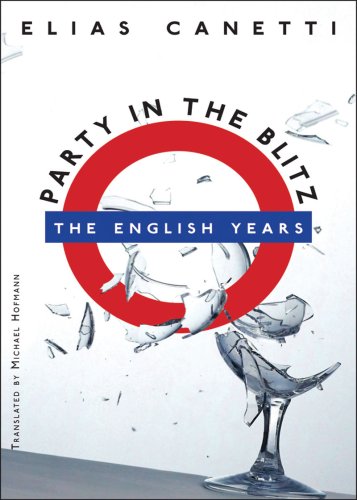
5. Party in the Blitz: The English Years
by Elias Canetti
Hardcover: 208 Pages (2005-09-30)
list price: US$22.95 -- used & new: US$13.70
(price subject to change: see help)
Asin: 0811216365
Average Customer Review: 4.0 out of 5 stars
Canada | United Kingdom | Germany | France | Japan
Editorial Review

Book Description
A stunning and unexpected new volume of Elias Canetti's autobiography. A surprise gift to celebrate the Nobel Laureate's 100th birthday.

Nobel Prize winner Elias Canetti, at 85, beset by the desire to come to terms with his years of exile in Britain, wrote Party in the Blitz. He waited half a century to confront these memories, perhaps because "in order to be truthful, I should have to track down every needless humiliation I was offered in England, and relive it as the torture it was." Party in the Blitz dissects that torture with unrestrained acerbity, recounting the ordeal of being in a new country where not a soul knew his writing. But not one to be ignored, "the godmonster of Hempstead" (as John Bayley dubbed Canetti) soon knew everyone and everyone knew him. Enoch Powell, Bertrand Russell, Iris Murdoch, Empson, Wittgenstein, Kokoshka, Kathleen Raine, Henry Moore, Ralph Vaughn Williams: Canetti knew them all, and in Party in the Blitz he mercilessly rakes some of them over the coals. He detested T.S. Eliot and came to bitterly despise Iris Murdoch, with whom he had an affair: Every word of his devastating portrait of her quivers with rage. "He must have been a frequent party-goer," as Jeremy Adler remarks in his excellent afterword, "to judge by the well-informed distaste with which he recalls them." Gorgeously translated by Michael Hofmann, Party in the Blitz lives up to Canetti's injunction that "when you write down your life, every page should contain something no one has ever heard about." ... Read more

Customer Reviews (2)

5-0 out of 5 stars Canetti on Canetti
I worship the late Elias Canetti.If nobody's heard of him, it's because we live in a culture that is fundamentally ignorant and under-educated.CROWDS AND POWER should be required reading in every school in this nation.Canetti's cycle of memoirs collectively comprises some of the best intellectual history of the twentieth century.PARTY IN THE BLITZ is the great man's last piss-blast in the face of a world he saw as hostile, stupid, and bent on destruction.The price of this book is justified alone by what Canetti says about T.S. Elliot.Elliot was one of the biggest anti-semites of all time, a cold prude who hated Jews, wrote bad pretentious poetry so arcane it needed footnotes (which he himself supplied), and desperately wanted to be an Englishman when in fact he was from St. Louis, Missouri.Canetti recognized what a sham Elliot was, and doesn't hesitate to let us know what Elliot was really like, through the eyes of an objective observer and not some fawning Catholic biographer.

It's true that Canetti rips just about everyone to shreds in this book, but he has some amazingly kind things to say, too.He remembers, for instance, a mere street sweeper, who he talked to just in passing for many years, and whom he considered one of the most intelligent men he ever met.Canetti was a man who refused to suffer fools; he despised airs and pretentiousness.He was probably one of the most intelligent men of his age, which was almost certainly his great curse.He saw through the masks people wear, the illusions they use to disguise their flaws and insecurities, with ease.It was this great lucidity of his, this ability to perceive and understand things as they really are, that made him impatient, and ultimately, incredibly bitter.

3-0 out of 5 stars Party of One
I would wager that this is a Nobel Prize winning author most Americans (including me, prior to reading this book) have not heard of, let alone read. And from this memoir of that part of his life while living in England-- mostly during World War II--, it will probably stay that way.

Elias Canetti comes off as an arrogant, dour, and self-centered intellectual with brutal views of some women and fellow authors and no discernable concern that-- apparently-- he made no meaningful contribution to the war effort of that good country which hosted and protected him during a time of extreme trials.

He seems to me an example of the type of high intellectual who thinks nothing of being utterly cruel toward individuals in print, then wonders why countries so stupidly go to war.

From this patched together book, one can appreciate the essence of Mr.Canetti's fine writing skills without being brought to liking this now deceased author.

The useful afterword by Jeremy Adler is very good in that it puts both the book and the author into some context for the non-expert reader.

... Read more


6. The Worlds of Elias Canetti: Centenary Essays
Hardcover: 295 Pages (2007-11-01)
list price: US$79.99 -- used & new: US$79.99
(price subject to change: see help)
Asin: 1847183522
Canada | United Kingdom | Germany | France | Japan
Editorial Review

Product Description
Though he died in the last decade of the twentieth century, the satirist, social thinker, memoirist, and dramatist Elias Canetti lives on into the present. Testifying to the author s undeniable culturalafterlife,the essays gathered together here represent a wide swath of the latest Canetti scholarship. Contributors examine Canetti s Jewish identity; the Marxist politics of his youth; his influence on writers as diverse as Bachmann, Jelinek, and Sebald; the undiscoveredpoetryof his literary testament (Nachlass); his status as a self-cancelling satirist; and his complex and sometimes ambivalent citation of Chinese and French cultural icons. In addition, this volume presents a treatment of Canetti as philosopher; as contributor to the great debate on the genesis of violence; as a chronicler of the WWII exile experience; as well as a personal reminiscence by one of the great Canetti scholars of our time, Gerald Stieg. The Worlds of Elias Canetti challenges conventional wisdom about this Nobel laureate and opens up new areas to scholarly investigation. ... Read more


7. Kafka's Other Trial: The Letters to Felice
by Elias Canetti
Paperback: 128 Pages (1988-04-12)
list price: US$15.00 -- used & new: US$8.40
(price subject to change: see help)
Asin: 0805207058
Average Customer Review: 4.5 out of 5 stars
Canada | United Kingdom | Germany | France | Japan

Customer Reviews (2)

5-0 out of 5 stars The Flaubertain writer for whom nothing is trivial as long as it is right
Elias Canetti fascinated with the genius of Kafka reads one set of the 'letter- diary' literature , that between Kafka and his two - time fiancee Felice Bauer. Canetti sees the letters of Kafka to Bauer as an astounding work of literature, a guidebook to the soul.
Kafka met Felice Bauer in August 1913 a day after gathering together the writings of his first published work, "Meditations" . Two days after meeting her he sat down and wrote for nine hours straight , his breakthrough story 'The Judgment' As Cannetti sees it the meeting with Felice Bauer led to one of the most productive literary periods of his life.
The three- month idyll ended when the efficient, strong, but not very literary- Bauer showed no enthusiasm for Kafka's first work, and instead praised the works of those whose names we do not know today.
This small work traces one chapter in the life of one mankind's greatest literary artists, the one who more than any other made the precise description of his own anxieties and fears an eternal part of the collective human soul portrait.
This work is too filled with many insightful passages by Canetti who reads the life of Kafka with sympathy admiration and understanding.

4-0 out of 5 stars An intriguing aperitif, but not quite the main attraction
Canetti presents a readable overview of Kafka's intense correspondence with Felice Bauer, providing a rough biographical sketch of theauthor during this turbulent (two abortive engagements to the same woman) yetproductive (Metamorphosis, e.g.) time in his life. I don't think Canettisucceeded in proving his notion that Kafka's landmark novel The Trial is afictionalized representation of his oddly doomed relationship with Felice,but he does point out several interesting parallels which can enhance yourenjoyment of Joseph K's misadventures. The real value of Canetti's book is,in my opinion, the fact that it will probably inspire you to read Kafka'sown diaries and the actual letters to Felice themselves, and probably witha greater appreciation as well. ... Read more


8. Agony of Flies: Notes and Notations
by Elias Canetti
Paperback: 236 Pages (1994-08-31)
list price: US$14.00 -- used & new: US$11.95
(price subject to change: see help)
Asin: 0374524106
Average Customer Review: 5.0 out of 5 stars
Canada | United Kingdom | Germany | France | Japan

Customer Reviews (1)

5-0 out of 5 stars A man of words, and humor
Elias Canetti has written many timeless classics, but this perhaps is a book not for a serious read, but for a casual reading of words at play, words in quotations, or small paragraphs, just laid out unrelated.

By the way one half is in Dutch and the other in English...

Several of his quotations were written as he agonized over life or death or during moments of contemplation as he wrote his books.These quotations are to be treasured, for many reasons besides just humor.

For example, Elias writes," Praise first animates the spirit, which then desires to deserve it." Or, "He collected all opinion to show how few there are." and, "When ever he has nothing to say, he mentions god."

Any how, you can't help but fall in love with Canettie; the words are a constant source of amusement, and surly enlightenment.
... Read more


9. Critical Essays on World Literature Series - Elias Canetti (1905-1994) (Critical Essays on World Literature Series)
by Dorby
 Board book: 299 Pages (2000-01-14)
list price: US$52.00
Isbn: 0783804555
Canada | United Kingdom | Germany | France | Japan
Editorial Review

Book Description
This Austrian writer and Nobel Laureate (Auto-da-Fé, Crowds and Power) is hailed as one of the canonical authors of the modern period. ... Read more


10. The Secret Heart of the Clock
by Elias Canetti
Paperback: 160 Pages (2005-12-30)
list price: US$16.00 -- used & new: US$11.58
(price subject to change: see help)
Asin: 0374530602
Canada | United Kingdom | Germany | France | Japan

11. Torch in My Ear
by Elias Canetti
Paperback: Pages (1983-09)
list price: US$29.00 -- used & new: US$19.50
(price subject to change: see help)
Asin: 0374518041
Average Customer Review: 4.0 out of 5 stars
Canada | United Kingdom | Germany | France | Japan

Customer Reviews (2)

4-0 out of 5 stars BEST OUT OF THREE
Of Canetti's three volumes of memoirs, this is the most useful and widely appealing. The first volume is strictly about his family--well written but of narrow interest. This second volume covers the artistic ferment of 1920s Vienna and Berlin. Everything is fresh and beautifully rendered, but the finest section concerns his time in Berlin in 1928. At that point Canetti was a humble unpublished writer lucky enough to meet everybody. His profiles of Brecht, Grosz, and Isaac Babel are extraordinary, particularly because there is so much action and dialogue to supplement his acute judgments. But in the third volume, "Play of the Eyes," he is now an ambitious writer and completely full of himself. The tone becomes sour and self-referential and his portraits of other writers like Broch and Joyce say little and do so patronizingly. If you want anything beyond Canetti himself, the third volume is worthless. For best results, concentrate on the Berlin section of this second volume: a really tasty slice of life in that time and place.

4-0 out of 5 stars on the trail of the Noblists
Very good writing.Intellectually stimulating.Great deal of philosophy and study of human nature.Just a bit too much of literary rambling but in 85% keept my attention properly.I liked the insider scoop on the 1920s art scene of Berlin and Vienna.I don't like tha he doesn't hint the outcome of his only true romance in this book ( in real life he marries her).
ps
Even with his fascination with the "crowd" one feels that deep down he never belonged to any.And good for him...:) ... Read more


12. Conscience of Words
by Elias Canetti
 Paperback: 246 Pages (1984-12)
list price: US$8.95 -- used & new: US$14.50
(price subject to change: see help)
Asin: 0374518815
Average Customer Review: 5.0 out of 5 stars
Canada | United Kingdom | Germany | France | Japan

Customer Reviews (1)

5-0 out of 5 stars Beyond Words
These essays are, in simple terms, beautiful.Carefully crafted,
precise, and most of all beautiful, Canetti explores in shorter form much of his philosopical world.

The collection of essays, Das Gewissen der Woerter, is also a great place to enter the world of Elias Canetti.Each essay is a gem that once you set your eyes on you can not let go of until having digested it in entirety.

When I first began this book it was 10 minutes before I was to meet a friend for lunch.After reading the first paragraph, I was hooked.I ended up missing my lunch date and it was worth it. ... Read more


13. Soziale Kritik im Werk Elias Canettis (1929-1952): Studien zum Begriff des Verwandlungsverbotes (Historisch-kritische Arbeiten zur deutschen Literatur)
by Eva M Meidl
 Perfect Paperback: 217 Pages (1994)

Isbn: 3631458835
Canada | United Kingdom | Germany | France | Japan

14. Zu Elias Canetti (LGW-Interpretationen)
 Perfect Paperback: 184 Pages (1983)

Isbn: 3123978001
Canada | United Kingdom | Germany | France | Japan

15. The human province
by Elias Canetti
 Hardcover: 281 Pages (1978)
-- used & new: US$13.98
(price subject to change: see help)
Asin: 0816493359
Average Customer Review: 5.0 out of 5 stars
Canada | United Kingdom | Germany | France | Japan

Customer Reviews (1)

5-0 out of 5 stars Thirty years of thinking about nearly everything
Trans from the German by Joachim Neugroschel.Jottings, thoughts from 1942 to 1972."Many men have tried to grasp their lives in the full spiritual and intellectual context, and those who have succeeded will never grow old."This is a book that can be dipped into at random.Wisdom on every page."We have no standard any more for anything, ever since human life is no longer the standard.""Everything one records contains a grain of hope, no matter how deeply it may come from despair.""The enemy of my enemy is NOT my friend." ... Read more


16. Huter der Verwandlung: Beitrage zum Werk von Elias Canetti
 Hardcover: 303 Pages (1985)

Isbn: 3446142568
Canada | United Kingdom | Germany | France | Japan

17. Structures of Disintegration: Narrative Strategies in Elias Canetti's Die Blendung (Studies in Austrian Literature, Culture, and Thought)
by David Darby
 Hardcover: 236 Pages (1992-01)
list price: US$33.00 -- used & new: US$32.98
(price subject to change: see help)
Asin: 0929497503
Canada | United Kingdom | Germany | France | Japan

18. Auto de Fe / Act of Faith: Obra completa II/Complete Works II (Contemporanea / Contemporary)
by Elias Canetti
 Paperback: 620 Pages (2006-02-28)
list price: US$18.95 -- used & new: US$12.89
(price subject to change: see help)
Asin: 8497936787
Canada | United Kingdom | Germany | France | Japan

19. Elías Canetti (1905-1994): a cien años de su nacimiento.(autor)(Columna)(Biografía): An article from: Siempre!
by Javier Sicilia, Patricia Gutiérrez-Otero
 Digital: 2 Pages (2005-10-16)
list price: US$9.95 -- used & new: US$9.95
(price subject to change: see help)
Asin: B000KG5QGM
Canada | United Kingdom | Germany | France | Japan
Editorial Review

Book Description
This digital document is an article from Siempre!, published by Thomson Gale on October 16, 2005. The length of the article is 572 words. The page length shown above is based on a typical 300-word page. The article is delivered in HTML format and is available in your Amazon.com Digital Locker immediately after purchase. You can view it with any web browser.

Citation Details
Title: Elías Canetti (1905-1994): a cien años de su nacimiento.(autor)(Columna)(Biografía)
Author: Javier Sicilia
Publication: Siempre! (Magazine/Journal)
Date: October 16, 2005
Publisher: Thomson Gale
Volume: 52Issue: 2731Page: 70(1)

Article Type: Columna, Biografía

Distributed by Thomson Gale ... Read more


20. Essays in Honor of Elias Canetti.
b
 Hardcover: Pages (1987)

Asin: B0012SB0G2
Canada | United Kingdom | Germany | France | Japan

  1-20 of 100 | Next 20
A  B  C  D  E  F  G  H  I  J  K  L  M  N  O  P  Q  R  S  T  U  V  W  X  Y  Z  

Prices listed on this site are subject to change without notice.
Questions on ordering or shipping? click here for help.

site stats