e99 Online Shopping Mall

Geometry.Net - the online learning center Help  
Home  - Authors - Coetzee J M (Books)

  1-20 of 100 | Next 20
A  B  C  D  E  F  G  H  I  J  K  L  M  N  O  P  Q  R  S  T  U  V  W  X  Y  Z  

click price to see details     click image to enlarge     click link to go to the store

$9.83
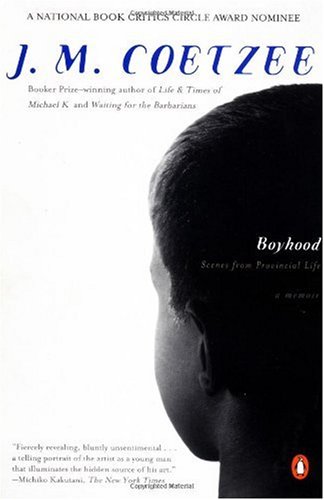
1. BOYHOOD
$13.75
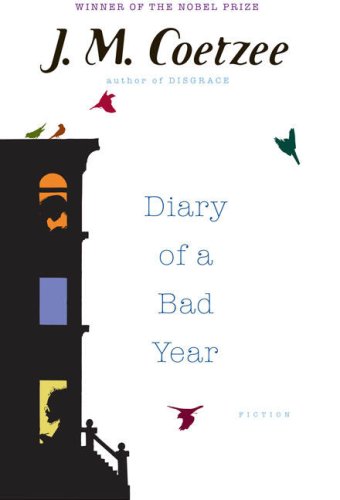
2. Diary of a Bad Year
$12.90
3. Slow Man
$8.29
4. Dusklands
$19.59
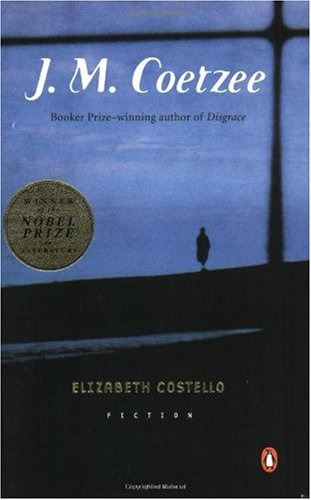
5. Elizabeth Costello
$9.21
6. Giving Offense: Essays on Censorship
$9.00
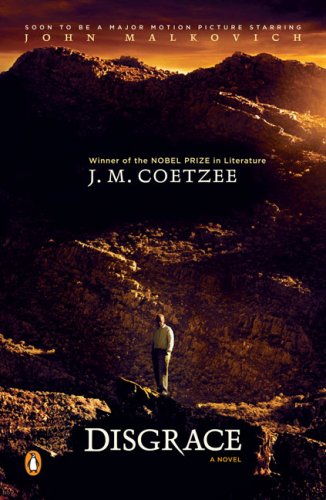
7. Disgrace (Penguin Essential Editions)
$7.50
8. Waiting for the Barbarians (Penguin
 
9. Disgrace (A Spectrum book)
$10.75
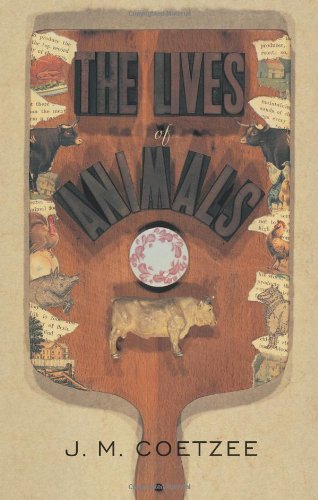
10. The Lives of Animals (The University
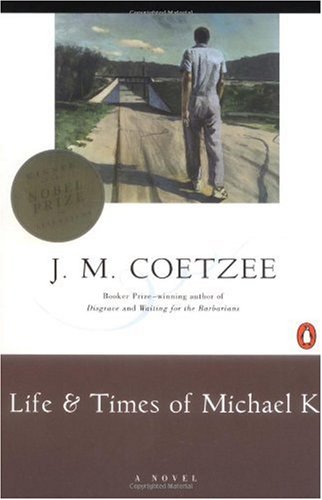
$9.45
11. The Life and Times of Michael
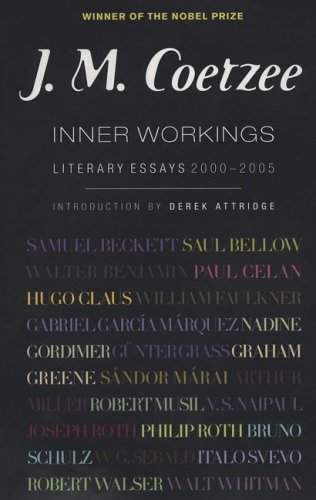
12. Inner Workings: Literary Essays
$16.21
13. Bookclub-in-a-Box Discusses Disgrace,
 
14. Slow Man
$1.19
15. The Nobel Lecture in Literature,
$21.95
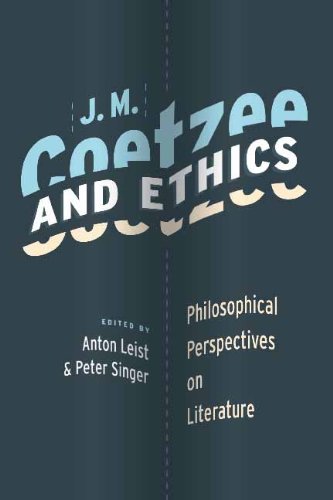
16. J. M. Coetzee and the Idea of
$23.70
17. Stranger Shores: Literary Essays:
$21.30
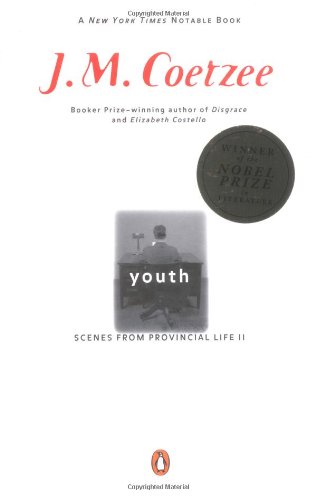
18. Youth: Scenes from Provincial
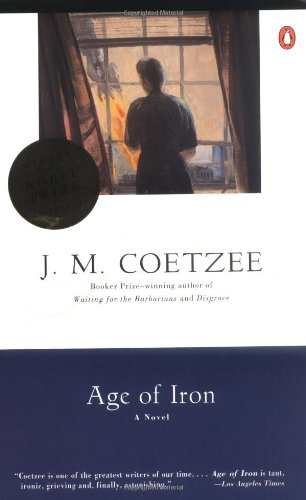
$7.20
19. Age of Iron
$9.95
20. Biography - Coetzee, J. M. (1940-):

1. BOYHOOD
by J.M. COETZEE
Paperback: 162 Pages (1998)
-- used & new: US$9.83
(price subject to change: see help)
Asin: 0099268272
Canada | United Kingdom | Germany | France | Japan
Editorial Review

Book Description
The first volume of memoirs from the two-time winner of the Booker Prize. ... Read more


2. Diary of a Bad Year
by J. M. Coetzee
Hardcover: 240 Pages (2007-12-27)
list price: US$24.95 -- used & new: US$13.75
(price subject to change: see help)
Asin: 0670018759
Average Customer Review: 3.5 out of 5 stars
Canada | United Kingdom | Germany | France | Japan
Editorial Review

Book Description
A new work of fiction by the Nobel Prize–winning author of Disgrace

In this brilliant new work of fiction, J. M. Coetzee once again breaks new literary ground with a book that is, in the words of its main character, “a response to the present in which I find myself.” Diary of a Bad Year takes on the world of politics—a new topic for Coetzee—and explores the role of the writer in our times with an extraordinary moral compass.

At the center of the book is “Señor C,” an aging author who has been asked to write his thoughts on the state of the world by his German publisher. These thoughts, called “Strong Opinions,” address a wide range of subjects and include a scathing indictment of Bush, Cheney, and Blair, as well as a witheringly honest examination of everything from Machiavelli and the current state of the university to music, literature, and intelligent design, offering unexpected perceptions and insightful arguments along the way. Meanwhile, someone new enters the writer’s life: Anya, the beautiful young woman whom he hires to type his manuscript. The relationship that develops between Señor C and Anya has a profound effect on both of them. It also changes the course of Anya’s relationship with Alan, the successful, swaggering man whom she lives with—and who has designs on Señor C’s bank account. Through these characters, Coetzee creates an ingenious literary game that will enthrall readers and surprise them with its emotional power. Bold, funny, and sad, as well as intellectually clever and satisfying, Diary of a Bad Year is a journey into the mind and heart of one of the world’s most acclaimed and accomplished writers. ... Read more

Customer Reviews (9)

4-0 out of 5 stars Coetzee is smarter than that
Short version: the opinions are intentionally pompous and banal. J.C. is not Coetzee.

Long version:

This is the third book in a series that began with Elizabeth Costello and continued with Slow Man. These books are fundamentally about being a writer who has won the Nobel Prize. Perhaps Coetzee keeps writing them because some people haven't yet figured out that his fictional characters' opinions are not his own; perhaps, as a writer already drowning in consciousness of tradition and context, he feels that these are the only sorts of books he can now write. I tell people when they read these books: remember that Coetzee has won the Nobel Prize, and think about what that means to him and what it means to people's opinions of him. In having this title thrust on him, he is no longer any old author, but a certain sort of elder statesman. And being the sort of writer he is, he cannot let that stand unquestioned. And since academics are still using the animal rights sections in Elizabeth Costello as though they were freestanding philosophical essays, Coetzee takes further steps in Diary of a Bad Year to make it clear that the "philosophy" in the book is hardly meant to be taken seriously as philosophy. Out goes Elizabeth Costello; in comes J.C., a Nobel Prize winning South African novelist now living in Australia, just like Coetzee, except dumber.

The structure of the novel, in brief: several voices, those of a writer, J.C.; his amanuensis and crush, a cosmopolitan Filipina named Anya; Anya's financier/scammer husband Alan; and most of all, the writings of J.C. as typed up by Anya. The writings are divided into two sections, one called "Strong Opinions," written for some sort of German literary publication, and later on, "Soft Opinions," written for Anya. Since these sections co-exist on each page, the book resists reading in an easy rhythm, as any attempt to read the three sections in parallel, especially early on, results in continual jarring shifts as the highfaluting tone of the "Strong Opinions" is undercut by J.C.'s earnest and vaguely creepy obsession with Anya and Anya's own sardonic detachment. In some ways it comes as a respite, as the "Strong Opinions"--on the War on Terror, on torture, on intelligent design, and on other urgent political issues of the day--quickly become unbearably pompous, banal, and irritating. They are filled with cliched homilies familiar to anyone who has read the New York Review of Books in the last seven years and dilettantish excursions into areas that J.C. knows nothing about. I winced when reading his "opinion" on Guantanamo Bay that begins:

"Someone should put together a ballet under the title Guantanamo, Guantanamo! A corps of prisoners, their ankles shackled together, thick felt mittens on their hands, muffs over their ears, black hoods over their heads, do the dances of the persecuted and desperate...In a corner, a man on stilts in a Donald Rumsfeld mask alternately writes at his lectern and dances ecstatic little jigs."

Had I read these opinions in a Philip Roth or John Updike book, I would take them at face value and discount the author accordingly. But Coetzee is too smart, and any comparison of the "Strong Opinions" to his real opinions in his thoughtful, careful essays makes the difference blindingly apparent. (It does take something approaching guts for a Nobel Laureate to write something so profoundly trite and irritating and attribute it to his own ostensible fictional proxy.) As with many literary intellectuals, J.C.'s excursions into math and science are particularly stupid. By the time J.C. writes, "I continue to find evolution by random mutation and natural selection not just unconvincing but preposterous as an account of how complex organisms come into being" and invokes Heisenberg without knowing what uncertainty even is, it's obvious that Coetzee has no wish even to defend thes opinions; he is making them transparently foolish so that readers examine the rhetoric rather than the opinions. Underneath the sanctimonious white male liberal pablum, including defenses of pornography, Adorno-esque cultural snobbery in indictments of rock music, latent sexism (captured especially well, complete with tired attack on Catherine MacKinnon), and sympathy with enemies of whom he knows nothing, there bleeds the personality that is revealed in J.C.'s internal voice lower on the page. With most would-be political commentators in the literati, it is not quite so obvious, but in J.C., Coetzee gives us tools for easily making the connection.

For it is Anya who carries the voice objecting to the "Strong Opinions." Alan picks up this critique later in a less sympathetic fashion, but it is Anya who connects J.C.'s emotional life with what he writes on the page. I felt great relief to hear her articulate my thoughts (and no doubt those of many other readers) when she politely tells J.C.:

"OK. This may sound brutal, but it isn't meant that way. There is a tone--I don't know the best word to describe it--a tone that really turns people off. A know-it-all tone. Everything is cut and dried: I am the one with all the answers, here is how it is, don't argue, it won't get you anywhere. I know that isn't how you are in real life, but that is how you come across, and it is not what you want. I wish you would cut it out. If you positively have to write about the world and how you see it, I wish you could find a better way."

So we lead to the real problem, which is J.C.'s impotence in the face of the current world horrors and the disastrous results of the obligation he feels to be relevant. As the book continues on and reveals J.C.'s ignorance of the world in several ways, Coetzee spares him little criticism, but does ultimately make a case for his real art in the form of the lovely, impressionistic "Soft Opinions," short lyrical reflections in the last half of the book that mercifully replace the "Strong Opinions." These vignettes are written with Anya in mind and with no attempt to be politically incisive. J.C. describes his dreams, his doubts, his age, his friends, and his passions, as antiquated and pedantic as they may be. Most of all, he makes no attempt to suppress the "I" out of the fear that he must pretend to be something he is not in order to address the world with urgency. There is some resignation in this shift, but also great relief; J.C.'s mask has fallen and he returns to himself. It puts him in correct proportion to the thoughtful but non-bookish Anya and her powerful but cowardly husband Alan, and the shift in tone allows him to have a visible, evident effect on Anya, one (it is implied) far greater than that of telling a bunch of would-be intellectual liberals what they already know and having them feel good about it because it's coming from a Nobel Prize winner.

4-0 out of 5 stars Very fresh
Why wouldn't I rate it as a five stars book? Because, Mr Coetzee has books like Age of Iron, Life and Times of Michael K, Youth and such - which forces me to be a little more perfectionist. Otherwise, it's a wonderful effort in which the writer allows (gives freedom)to the reader to swing different opinions and, literaly, gets the fans on a tour through the thoughts one can certainly locate in his previous efforts, like the ones I mentioned. And not only, the book brings the world in in a set of indeed brave and original opinions (questionable, of course and thank's God).
Very refreshing and uncommonly funny for Coetzee's standards.

1-0 out of 5 stars Diary of a Very Bad Book
J.M. Coetzee should have titled this one "Diary of a Very Bad Book" if he wanted to give readers a true indication of what is in store for anyone who reads it because it is nothing more than Coetzee's very thinly veiled excuse to proclaim his hatred and contempt for the likes of George W. Bush, Dick Cheney, Tony Blair, and American society, in general. In a time when little more is required to win a Nobel Prize than to express contempt for each of those subjects, it is not surprising that Coetzee would write a book like this one for those who feel as he does. But anyone expecting a novel of quality from J.M. Coetzee is probably a few books too late and should not waste time with Diary of a Bad Year.

The premise of the book finds a German publisher seeking strong opinions from a group of literature's elder statesmen, all of which are to be published in a single volume. Coetzee creates a stand-in for himself, a South African author now living in Australia, and calls him "Senor C." Each page of the book is rather neatly divided into three sections. The upper one-third of each page in the book contains one of Coetzee-C's "strong opinions," usually on politics and usually a rant against something American. The middle third of each page is written from "C's" point-of-view and involves his relationship with the young lady he has become smitten with as she types up his rants. The bottom third of each page is written from the point-of-view of the young woman and often describes the exact scene just seen earlier from "C's" vantage point.

Coetzee had the makings of a dull little novel going with the second two-thirds of each page but even that was ruined by his childish rants on the upper part of each page. Never offering alternatives to any of the things he so despises, and actually doing little more than name-calling, ends up making Coetzee look like a simpleton who is filled more with hate than writing talent. Whatever he was aiming for, if it was more than an excuse to ridicule those he despises, he missed by a wide margin. This one is so bad that I suspect it will be the worst book I read in 2008.

Do yourself a favor and avoid Diary of a Bad Year.

3-0 out of 5 stars What effect does a Nobel Prize have?
What effect does a Nobel Prize have on a novelist? I have no idea. But it has a pernicious, pervasive, clinging effect on a reader. I try to forget it, but it seeps into my thinking. A number of times Coetzee goes on too long -- he lets his alter-ego in the book pontificate, partly for novelistic effect, and partly because he can't help it -- and then I think: does the Nobel, and everything that goes with it, create an atmosphere in which he feels justified in taking any liberties? Other times the clever pagination of the book doesn't quite work out -- a dozen or so instances, the sentences don't end on the page, but flow on to the next, compelling the reader to read across pages instead of down the page -- and then I wonder: does the Nobel, and everything that goes with it, give Coetzee the sense that things like that need not matter, that they will be eclipsed and forgotten by the force of the concept? The Nobel (by which I mean the steady warmth of adulation and writers' appearances and awards) has this effect: it cushions the writer, so it seems, and it makes it that much harder for a reader trying to gauge what is measured and intended and what is simply permitted.

But that is not my principal objection to this book. Its crucial problem, to my mind, is the quality of the disquisitions that the narrator permits himself. As the other reviews point out, the narrator goes on at length about his opinions. In the logic of the novel, those opinions are being prepared for publication, so that is their immediate excuse for being in the novel. And Coetzee himself criticizes his own opinions, both in the voice of the principal female character and in the voice of that character's partner. At one point, he even uses his own voice -- the voice of the person who writes the opinions -- to criticize the opinions. But none of those criticisms is enough.

The problem with many of the opinions is not that they are harsh and inhuman (as the female character says), or that they are ineffective (as the male character says). It is that they are ill-informed and ill-argued. Coetzee is just not as interesting a thinker as, say, Musil, or Rochefoucauld, or Chamfort, or Lichtenberg, or Badelaire, or Brecht, or Broch, or any number of others. His opinions, mostly, are not interesting. And they are frequently ill-informed. Coetzee needs to read more about numbers and statistics (one of his topics), and more about theories of capitalism and democracy. He comes across as the kind of person who writes in to a newspaper of magazine, and doesn't know the subject as well as he should. I am not criticizing his ideas because they are radical: I am criticizing them because they are not radical enough. In "Disgrace," he had one absolutely stunning idea -- that animals could be as important as people, or more important. Here there are few such interesting ideas.

For me this is exemplified by a passage on page 203, where the narrator, in the course of writing one of his "opinions," one titled "On having thoughts," says: "But do I really qualify as a thinker at all, someone who has what can properly be called thoughts, about politics or about anything else?" And he answers: "I have never been easy with abstractions or good at abstract thought." Let me suggest that Coetzee is fooling himself here. Theshortcomings of his "opinions" are not related to a skill at abstract thinking: that's a red herring. His "opinions" are limited by what he knows, and by a lack of original thinking. "Elizabeth Costello" was translarently a mouthpiece for Coetzee's opinions, and it was the kind of book that someone who is not feted, who is not a Nobel laureate, would not have been allowed to write; his editor would have stopped him, and said something like this:

"Coetzee, you need to realize that your characters' opinions need to be allowed to become truly monomaniacal, really nuts, dangerously obsessive, intentionally boring -- otherwise they will appear to be what they really are, the very serious opinions of the author, whose only thought is to broadcast them to the world. It is your lack of understanding of the uninteresting nature of those opinions -- bolstered, I know, by the many people who continuously take them seriously, and praise you for them -- that makes them intractable as materials for a fully imagined fictional setting. A reader knows that they are not under your control: you think of them too highly, too primly, to seriously. Let themrisk dying a natural death: put them at the mercy of the fiction, not the other way around."

I do not know if I will read another Coetzee novel.

3-0 out of 5 stars Tips for reading
J.M. Coetzee's latest book is a 3-tiered work comprised of essays and a pair of dual narratives - all on the the same page - in 2 parts.Most of the book's content is devoted to the essays, known as Strong Opinions, and I advise reading all of the essays first, in both parts.Then read the middle-of-the-page section, in Part 1, which is narrated by a solitary, psuedo-JMCoetzee-type novelist who has written the above essays and is having them typed up by a young, attractive woman named Anya who lives in his building, in Sydney, Australia; his perception of their relationship is featured here.The bottom-of-the-page section is narrated by Anya, and concerns her take on "Senor C's" essays, and his attraction to her, and her overbearing boyfriend Alan's jealousy toward the situation - and sinister ideas to capitalize on it.In Part 2, the bottom (Anya) section should be read before the middle (Senor C) section, and the text sets the reader up for this.

The essays cover a number of topics and Coetzee has adopted the format of Montaigne or Bacon, giving them titles such as "On this" and "On that", etc,; however they are nowhere near as profound.Compelling at times, yes; but too often he writes banal pieces about contemporary politics and world events that would be more at home in the letters-to-the-editor pages, and editorials, of any newspaper than in a book written by a Nobel Prize winner.We readers deserve better.But he makes up for his nugatory essays with good ones about other writers and friends, concepts and story ideas.

The dual narratives work well together once you get a handle on the order in which to read them. Some of the essay topics are discussed, played out, and the vulnerability of both narrators and Anya's witless and devious boyfriend Alan builds toward a touching climax.

It's a book about honesty:the solitary writer trying to be honest with himself and the world he lives in, no matter the outcome, a struggle that seeps into the lives of the few people he comes in contact with. ... Read more


3. Slow Man
by J. M. Coetzee
Hardcover: 265 Pages (2005-09-22)
list price: US$24.95 -- used & new: US$12.90
(price subject to change: see help)
Asin: B000GUJHB2
Average Customer Review: 3.5 out of 5 stars
Canada | United Kingdom | Germany | France | Japan
Editorial Review

Book Description
J. M. Coetzee , one of the greatest living writers in the English language, has crafted a deeply moving tale of love and mortality in his new book, Slow Man. When photographer Paul Rayment loses his leg in a bicycle accident, he is forced to reexamine how he has lived his life. Through Paul’s story, Coetzee addresses questions that define us all: What does it mean to do good? What in our lives is ultimately meaningful? How do we define the place we call “home”? In his clear and uncompromising voice, Coetzee struggles with these issues and offers a story that will dazzle the reader on every page. ... Read more

Customer Reviews (33)

1-0 out of 5 stars Going Nowhere Fast
First, let me say that I am not a reader who is annoyed by ambiguity as long as there is some sort of explanation. As a literature major and a heavy reader of fiction, I am used to ambiguity. I just defended a novel in a review, The Zero, that was highly ambiguous. Please read my criticisms with that in mind.

Paul Rayment is a man in his sixties who loses much of a leg due to an accident. For no apparent reason he chooses not to have a prosthesis, even though he preferred the life of a loner prior to his accident, and even though a prosthesis would help him become self-sufficient again. By choosing not to have a prosthesis, he not only severely limits his ability to transport himself, but becomes quite dependent on others. Thus, in the first few pages we have a decision that makes no sense based on what we know about Paul. Okay, so be it. Let's see what happens. He eventually gets a nurse who he falls in love with. He is now in a dilemma because he is not exactly a "catch," and the woman he has fallen in love with is married and has three children. Yet how he yearns for her! At least things are getting a little interesting.

Enter Elizabeth Costello out of nowhere, who not only presses herself upon Paul, but moves in with him despite his protests. (He later throws her out and for no apparent reason she sleeps with the homeless). Why does he not simply show her the door from the moment he first finds her to be obnoxious? How did she find him? She says he sought her out, but he has no such recollection, nor is there any evidence in the novel to support her claim. Is she his alter ego or, as she claims, a novelist who has chosen him to be her subject? If she chose him, 1) how did she find him and 2) what made her decide to choose him as her protagonist when she knows so little about him? None of these questions is answered. So her continued reappearances become extremely annoying rather than riveting.

It is exactly as "Bookmarks Magazine" reads, "Simply, Coetzee's postmodern literary trick overwhelms what could have been a provoking rumination on love, old age, and life. Instead, the novel flounders under the weight of ambiguity, cerebral analysis, and lack of scintillating conversation and action." Put more simply, this is an awful novel.

3-0 out of 5 stars motivational novel
The novel begins when an Australian photographer who is riding his bicycle gets hit by a car and ends up loosing one leg. It begins very well, but as the books name says it, it then begins a slow , difficult to read novel.
I think one should look at it as an inner reflection of what happens when an way of life is changed. Our identity changes, and this is what happens to the main character in this novel.
The reader should think of this novel as more than just a novel but as a meditation on what we have and what we can loose and how to cope with it

2-0 out of 5 stars Huh?Beautifully written, but weird, with a screechingly abrupt ending
I really enjoyed the writing in this book, and the characters.However, the story got strange halfway through, and ended abruptly, leaving nothing resolved at all, to my mind.I was left scratching my head.

Maybe the book is just too "smart" for me, and I didn't "get it".

Were it not for the fine writing and characterization, I'd have considered my time wasted.

This was sort of like a David Lynch film, the way I see it, except the characters were more likable.It had the same bizarre, disconnected quality to it.(I hate David Lynch films, in case you didn't guess that already.)

Finely honed characters and prose that are sadly wasted on a stunted, bizarre, truncated storyline.

2-0 out of 5 stars Pointless
Not sure of the point of this novel. Paul loses a leg in an accident and must hire a nurse. OK SO far, so good.
He falls in love with this nurse and tries to help her family. Then Elizabeth Costello turns up (Why?) Out of the blue. No explaination as to why she is there, her purpose or even why she is in the book at all. How does she know things about Paul Maryna? Did I just not get this book??? Forget it and get a different one.

1-0 out of 5 stars Dreadful reading!
I continued to read this book because I read good reviews about it. But once I finished reading the book, I was upset that I wasted my TIME on this book. ... Read more


4. Dusklands
by J M Coetzee
Paperback: 144 Pages (1998)
-- used & new: US$8.29
(price subject to change: see help)
Asin: 0099268337
Average Customer Review: 3.5 out of 5 stars
Canada | United Kingdom | Germany | France | Japan
Editorial Review

Book Description
A specialist in pyschological warefare is driven to breakdown and madness by the stressed of a project of macabre ingenuity to win the war in Vietnam. A meglomaniac Boer frontiersman wreaks hideous vengence on a Hottentot tribe for undermining the 'natural' order of his universe with their anarchic rival order,mocking him and subjecting him to the humiliations of his own all too palpable flesh. Both the 18th century Jacobus Coetzee and the 20th century Euguene Dawn are in the business of pushing back the frontiers of knowledge and are dealers in death who denounce their own humanity and spurn their feelings of guilt. With immense power and economy in these two narratives, Coetzee has crystalized in their absurdity and horror the extremes of scientific evangelism and heroic exploration. ... Read more

Customer Reviews (7)

4-0 out of 5 stars Inspiring
This book is very inspiring, very deep and very complex. I lked more "In the heart of the country".

By the way, the guy down here (writesbooksforfood) that rated it one star and barks against J L Borges (you can imagine) also rated another book: "How to improve your racquetball". You can imagine a guy that reads that kind of books, and later he goes and tries to enjoy Borges or Coetzee? My god.

4-0 out of 5 stars Power's subtle threads of meaning
DUSKLANDS is Coetzee's first book, and it is in some significant ways different from some of his other works, though alike in others. It is a meditation on power, colonialism, the brutal meeting of cultures that occurs when imperialist goals are served and also a study of language, language's conveyance of power and propaganda as well as "self-propaganda" or delusion. It is more oblique in its themes and points, though, than even "In the Heart of the Country," I think.

The book is broken into two distinct sections. The first is a first-person narrative by an Amercian propagandist for a (government?) project about Vietnam and how the native people there can be influenced in favor of the invading army, the United States. The propagandist is an unhappy and an unappealing narrator. He has problems with his marriage, and the artfulness of his work is not respected by his superior, a fictional "Coetzee," who tells him that he needs to be plainer in language and subtler in idea for the military personnel who will read his assessment. The report is included in the narrative, and one can read the narrator's (who works in the field of "mythography") focus on cultural myth as a motivator and shaper of a people's beliefs and the outcomes of those beliefs (behaviors).

And so we must ask ourselves what is the mythology of the man who is writing this report? We see his eventual break with his routine and society by the end of this section, and his own mythology in his trying to heal that break in his own mind. Coetzee, the author, begs the question here of what the narrator's break has to do with the subject of his report, colonialism and its attendant propaganda, both public and "self," in Vietnam.

The second section of this slim book (125 pages), "The Narrative of Jacobus Coetzee," is the story of a Boer frontiersman in the 1700s who means to take revenge on the native people because they have slighted his superiority as a white man. This section has more of narrative plot line as we follow the journey and its outcome, but deals, again, with the themes of colonialism, power, cultural identity and communication. Given the insertion of the Coetzee character again in this section, I was left to wonder what this means? Is Coetzee saying he is heir to the imperialism of his ancestors? Is he saying we are indistinguishable as individuals if we inherit the benefits of the sin of colonialism? I don't know...

This was a more challenging read for me than I have found with other books by Coetzee, but it was very rewarding, especially now as our nation copes with the consequences of the means through which imperialism asserts itself in a globalizing world. I recommend this book, but not as a first look at Coetzee.

5-0 out of 5 stars Dark and incisive
"Dusklands" consists of two very different parts. In "The Vietnam Project", Mr Coetzee tells the story of Eugene Dawn, a specialist in psychological warfare whose task it is to establish a document called the Vietnam Project dealing with the so-called Phase IV of the Vietnam conflict in the years 1973-1974. To give his imagination a helpful impulse, Dawn carries with him photographs that will illustrate the report. They show gruesome scenes of the war like for example sergeant Clifford Houston copulating with a Vietnamese woman or two other sergeants, Berry and Wilson, posing with several severed Vietnamese heads as trophies. But soon Dawn is driven to breakdown and madness by the stress of this macabre project to win the war in Vietnam. After having been driven to a nearly fatal assault on his child Martin, Dawn is placed in an institution. The text closes with Dawn reflecting as follows: "I have high hopes of finding whose fault I am."
"The narrative of Jacobus Coetzee" is actually a translation from Afrikaans by J.M. Coetzee of a text published in 1762. It is the account of a hideous vengeance of a frontiersman on a tribe of Hottentots in South Africa.
Both Eugene Dawn in the 1970s and Jacobus Coetzee in the 1760s are dealers in death who claim their humanity and impressively express their feelings of guilt.

3-0 out of 5 stars Bad debut
Collection of two separate novels, being what it is, Coetzee's first published book, shouldn't stand high in your exceptations. Author himself hasn't yet built his narrative style which often lead to confusing storytelling, often misleading reader and leving him on not-so-firm-ground of bad litterature. When I say bad i mean that it is involuntarilly bad (and what, you can say, was written bad in ones own will?), though I must confess, Vietnamese project is intelectually provoking, but lacks well developd charater with justified action. You shouldn't start with Coetzee on this book

3-0 out of 5 stars Vietnamese and Hottentots
Coetzee's 'Dusklands' is composed by two totally different stories: the first one about the Vietnamese war and the second one about the destruction of a Hottentot village by a Dutch explorer.
The small thematic link between the two is the violent intrusion of foreigners into national (tribal) territories and affairs.

The original treatment of the two stories is also completely different. The 'Vietnam Project' is a psychological analysis, while the South African story is an excerpt of a diary relating the facts.
The 'Vietnam project' portraits a US Ministry of defence employee who works on a psychological warfare project for Vietnam, while in fact he is against the war. This schizophrenic situation and his guilty feelings turn into a depression.
The diary relates the conflict between an explorer and a Hottentot village which leads to a sadistic extermination of the inhabitants.
Both stories seem to be influenced by Freudian psychology, and the last one more specifically by Freud's 'Totem und Tabu'.

The writing becomes sometimes a 'text' in the manner of the French 'nouveau roman', a disastrous literary movement influenced by such conceptual deliriums as structuralism and linguistics. The results were cold and empty novels without deep feelings or distinctive social reality, a mere playing with words and esoteric symbols.

Coetzee's stories are certainly a worth-while read, but they don't attain a general human level, like e.g. the political novels of Ismail Kadare. They stay more or less pasted to the treated themes. ... Read more


5. Elizabeth Costello
by J. M. Coetzee
Hardcover: 230 Pages (2003-11-01)
list price: US$21.95 -- used & new: US$19.59
(price subject to change: see help)
Asin: B0002X7VY8
Average Customer Review: 3.5 out of 5 stars
Canada | United Kingdom | Germany | France | Japan
Editorial Review

Amazon.com
For South African writer J.M. Coetzee, winner of two Booker Prizes and the 2003 Nobel Prize for Literature, the world of receiving literary awards and giving speeches must be such a commonplace that he has put the circuit at the center of his book, Elizabeth Costello. As the work opens, in fact, the eponymous Elizabeth, a fictional novelist, is in Williamstown, Pennsylvania, to receive the Stowe Award. For her speech at the Williamstown's Altona College she chooses the tired topic, "What Is Realism?" and quickly loses her audience in her unfocused discussion of Kafka. From there, readers follow her to a cruise ship where she is virtually imprisoned as a celebrity lecturer to the ship's guests. Next, she is off to Appleton College where she delivers the annual Gates Lecture. Later, she will even attend a graduation speech.

Coetzee has made this project difficult for himself. Occasional writing--writing that includes graduation speeches, acceptance speeches, or even academic lectures--is a less than auspicious form around which to build a long work of fiction. A powerful central character engaged in a challenging stage of life might sustain such a work. Yet, at the start, Coetzee declares that Elizabeth is "old and tired," and her best book, The House on Eccles Street is long in her past. Elizabeth Costello lacks a progressive plot and offers little development over the course of each new performance at the lectern. Readers are given Elizabeth fully formed with only brief glimpses of her past sexual dalliances and literary efforts.

In the end, Elizabeth Costello seems undecided about its own direction. When Elizabeth is brought to a final reckoning at the gates of the afterlife, she begins to suspect that she is actually in hell, "or at least purgatory: a purgatory of clichés." Perhaps Coetzee's Elizabeth Costello, which can be read as an extended critique of clichéd writing, is a portrait of this purgatory. While some readers may find Coetzee's philosophical prose sustenance enough on the journey, some will turn back at the gate. --Patrick O'KelleyBook Description
In 1982, J. M. Coetzee dazzled the literary world with the now classic Waiting for the Barbarians. Five novels and two Booker prizes later, Coetzee is a writer of international stature and a novelist whose publication of a new work is heralded as a literary event. Now, in his first work of fiction since The New York Times bestselling Disgrace, he has crafted an unusual and deeply affecting tale.

Elizabeth Costello is a distinguished and aging Australian novelist whose life is revealed through an ingenious series of eight formal addresses. From an award-acceptance speech at a New England liberal arts college to a lecture on evil in Amsterdam and a sexually charged reading by the poet Robert Duncan, Coetzee draws the reader inexorably toward its astonishing conclusion.

Vividly imagined and masterfully wrought in his unerring prose, Elizabeth Costello is, on its surface, the story of a woman's life as mother, sister, lover, and writer. Yet it is also a profound and haunting meditation on the nature of storytelling that only a writer of Coetzee's caliber could accomplish. ... Read more

Customer Reviews (49)

2-0 out of 5 stars an overly cerebral, boring mess
I have read some wonder novels by Coetzee, and so without hesitation I purchased 'Elizabeth Costello'.What a mistake!'Elizabeth Costello' is really not so much of a novel but rather a forum for the other to pontificate on a whole slew of life and death philosophical matters.Such verbage might be of interest to the top 0.1% of the populace with multiple doctorates and too much time on their hands.For everyone it's simply the sort of book that screams out "don't read me!".


Bottom line: maybe better served as fodder for a doctoral thesis?

4-0 out of 5 stars Coetzee's Costello
The 2003 Nobel Prize did not mean resting on one's own laurels for novelist J.M. Coetzee, author of Foe, Waiting for the Barbarians and the formidable Disgrace among others. Since the Nobel he has already published another novel, Slow Man (Viking, 2005). Coetzee's latest novel, however, calls for a reading of his previous novel, Elizabeth Costello (Secker and Warburg, 2003) that for many reasons, offers a J.M Coetzee at his best. The novel picks up from the final years of novelist Elizabeth Costello, who is handed over to us as a renowned writer.

Almost every chapter exposes a speech, monologue or dialogue given by Costello on several occasions, mostly as guest speaker, when she is not engrossed in her private ruminations. The novel does not foreground a dense or over-eventful plot. On the contrary, the simple narrative strand allows Coetzee to utilize each new chapter as a point of departure for reflection on a particular subject. Thus, the elderly, cynical Costello is regularly involved in squabbles with intellectuals, fellow writers and intellectual relations alike.

It is difficult to discern whether Coetzee ventriloquizes through Costello or merely browses the range of subjects addressed in Costello's encounters: animal rights, the post-Cartesian questioning of human subjectivity, belief versus faith, the fiction of homeland, the oral and the written, evil, the nature of authorship and other areas. Sometimes one gets the impression that the novel is biting more than it can chew. Perhaps more than in any other of his novels, Coetzee here indulges the meta-literary: Costello's frequent ponderings about Kafka, and the Kafkaesque predicament as an oblique metaphor for her own existence as writer and human being lend an overall apocalyptic aura to the text. The Kafkaesque and the Swiftian intertext is dense.

It is a text of constant questioning: `Where is home?' How far can the writer be considered, as Costello words it, a 'secretary of the invisible?' Who is the supreme judge of literature, as one among many other human activities liable to judgment, and what, after all, can be the perils of literary activity? Elizabeth Costello sports Coetzee's crude signature style and espouses it with philosophical issues ranging from the Rousseau-Hobbes debate regarding the nature of good and evil in man to Heidegger's poignant exposition, in Being and Time of the meaning of "dying" as opposed to "perishing". Which is proper to man, and which to animal? But then, Costello herself is never sure, and within that tottering state of the human mind is where Coetzee's novel makes headway.

3-0 out of 5 stars Mind over matter
Elizabeth Costello is a curious novel. More a patchwork of Coetzee's intellectual essays than a straight work of fiction, delivered through an invented protagonist: ageing Australian novelist, Elizabeth Costello, who tours the world giving lectures to various audiences and being venerated for an earlier novel 'The House on Eccles Street' inspired by Ulysses.

Philosophy, ideas, can often prove to be a wobbly set of poles upon which to construct a work of fiction. Although some of Coetzee's essays, delivered as a series of 'lessons' by Elizabeth, present interesting diadactical positions on issues such as animal rights and the status of African fiction, much of the novel comes across as fairly tired and careworn. In the end, poor Elizabeth seems plagued with doubt and regret. She ponders that if she had her life again, she would have more fun. None of this writerly business. And she acknowledges the ephemerality of even high quality literature such as her own. Her books, she muses, 'teach nothing, preach nothing; they merely spell out as clearly as they can, hear how people lived in a certain time and place.'

For me the most fascinating aspect was the way in which Elizabeth so reluctantly inhabits her guise as a venerated novelist, late in life. How this obviously translates into Coetzee's misgivings about literary celebrity. The global 'intellectual community' must present a tiring obstacle for world class writers who find themselves constantly forced to account for opinions, the provenance of which they themselves are not sure. This aspect is not brought out fully though. Coetzee deliberately keeps the structure flat and two dimensional so character development is kept predominantly to the minor characters that Elizabeth encounters during her intellectual wanderings rather than the author herself.

5-0 out of 5 stars A compelling read, and re-read
This is such a tricky book that short reviews can't really capture it, even if the premise is simple: Elizabeth Costello goes around the world on the celebrity-writer circuit delivering lectures.Poorly.Those lectures are not cryptic but they are challenging and frequently original; the stories around the lectures are well-observed and clever; and it ends with a series of surprises.

It is not a coincidence that Ulysses is evoked on the first page.Give it a chance: Elizabeth Costello will actually become more and more interesting, and the puzzles, the tricks, the insinuations of the novel build up around those lectures - however poorly they are delivered.

3-0 out of 5 stars A Search for Something to Believe In
"Elizabeth Costello" is the fourth book by J. M. Coetzee that I've read.It, for me, is clearly the least of the four.I found it awkward and, at times, fairly irrelevant for me.It tells the story of an aging Australian writer who expounds several theories in a series of lectures.We come to know a bit about her along the way but, frankly, what we discover is not very compelling.In the end, she is challenged in the hereafter to state her beliefs.She is unable to do so and her efforts are very instructive.

What I take away from "Elizabeth Costello" is the story of a writer who is looking for herself.She reaches for new meaning and new direction in her life.She expounds animal rights, she attacks fellow writers for their work, she reflects on her youth, etc.I got the sense of a person who is tired with life and looking for a purpose for her remaining years.

I enjoyed "Disgrace" and "Youth" because Coetzee showed us what he wanted us to see through the actions and reactions of his characters.We can relate to these individuals."Elizabeth Costello" is too wrapped up in the academic world of the title character.Her limited associations fail to be meaningful to most readers.There are some interesting discussions of issues.I particularly enjoyed the debate regarding animal rights.I thought Coetzee did a good job of exploring both sides of the issue.

I'll gladly read more by Coetzee.After all, three out of four ain't bad.
... Read more


6. Giving Offense: Essays on Censorship
by J. M. Coetzee
Paperback: 297 Pages (1997-11-08)
list price: US$15.00 -- used & new: US$9.21
(price subject to change: see help)
Asin: 0226111768
Average Customer Review: 5.0 out of 5 stars
Canada | United Kingdom | Germany | France | Japan
Editorial Review

Amazon.com
In this collection of eight essays, South African novelist J. M. Coetzee examines the complexities of censorship beyond the model of villainous censor and victimized artist. Having lived in a police state, Coetzee's experience is that "the same censors patrol the boundaries of both politics and esthetics." By contrast, in the United States, the way for artists to get away with representations that some find offensive or forbidden is to argue that their work has some political worth. Though Coetzee admits he doesn't know what to think of artists who "break taboos and yet claim protection of the law," he remains committed to free speech, conscious of how easily oppressive righteousness can rear its viscous head.Book Description

Winner of the 2003 Nobel Prize in Literature.

J. M. Coetzee presents a coherent, unorthodox analysis of censorship from the perspective of one who has lived and worked under its shadow. The essays collected here attempt to understand the passion that plays itself out in acts of silencing and censoring. He argues that a destructive dynamic of belligerence and escalation tends to overtake the rivals in any field ruled by censorship.

From Osip Mandelstam commanded to compose an ode in praise of Stalin, to Breyten Breytenbach writing poems under and for the eyes of his prison guards, to Aleksander Solzhenitsyn engaging in a trial of wits with the organs of the Soviet state, Giving Offense focuses on the ways authors have historically responded to censorship. It also analyzes the arguments of Catharine MacKinnon for the suppression of pornography and traces the operations of the old South African censorship system.

"The most impressive feature of Coetzee's essays, besides his ear for language, is his coolheadedness. He can dissect repugnant notions and analyze volatile emotions with enviable poise."—Kenneth Baker, San Francisco Chronicle Book Review

"Those looking for simple, ringing denunciations of censorship's evils will be disappointed. Coetzee explicitly rejects such noble tritenesses. Instead . . . he pursues censorship's deeper, more fickle meanings and unmeanings."—Kirkus Reviews

"These erudite essays form a powerful, bracing criticism of censorship in its many guises."—Publishers Weekly

"Giving Offense gets its incisive message across clearly, even when Coetzee is dealing with such murky theorists as Bakhtin, Lacan, Foucault, and René; Girard. Coetzee has a light, wry sense of humor."—Bill Marx, Hungry Mind Review

"An extraordinary collection of essays."—Martha Bayles, New York Times Book Review

"A disturbing and illuminating moral expedition."—Richard Eder, Los Angeles Times Book Review
... Read more

Customer Reviews (2)

5-0 out of 5 stars the fewer legal restraints, the better
In these essays, J.M. Coetzee analyzes thoroughly and attacks the role and the (mis)use of censorship in arts.

Taking Offense
State censorship is an inherently bad thing. The cure is worse than the disease.
`A censor pronouncing a ban, whether on an obscene spectacle or a derisive imitation, is like a man trying to stop his pen.s from standing.'

Lady Chatterley's Lover
LCL is a tale about the transgression of boundaries - sexual and sexualized social boundaries.
D.H. Lawrence wanted `the end of taboos, the end of dirty language, the end of dirty books.'

The Harm of Pornography (Catharine MacKinnon)
MacKinnon treats pornography as a political issue, not as a moral one. She sees pornography as an instrument of male power, not pleasure. For her, male desire is one of the avenues through which male dominance realizes itself.
She shows a `striking absence of insight into the desire as experienced by man.'
Her analysis is also parochial, based only on specific US situations.

Censorship and Polemic: Solzhenitsyn
The heroic battle of one man against an enormous censor bureaucracy (more than 70,000 men).

Osip Mandelstam and the Stalin Ode
Stalin and his apparatus castrated a generation of writers, robbing it from its political power and its power of historical witness.

Zbigniew Herbert and the censor
In the face of the paranoia of state censorship, Z. Herbert opted for the `silence' solution.
He chose to work with allegories, thereby defending the autonomy of art (the power of art to validate itself) and proving that poetry can give a vision of an ideal world.

South-African censorship
For the censor, the call for the end of censorship in the name of free speech is part of a plot to destroy the existing order. The censor has the right to take what steps are necessary to protect society.
André Brink's device is Ars Longa: In the end, it is always the artist who wins, because one way or another truth will come out.
For Breyten Breytenbach, `censorship is an act of shame. It has to do with manipulation, power, and repression. For the writer to consent to being censored equals self-castration.

Erasmus: Madness and Rivalry
Erasmus disguised himself into a fool in order to be able to criticize the Catholic Church (The Praise of Folly). Coetzee's portrait shows us Erasmus as an independent and impartial individual, but therefore insulted from all sides: `I would rather die than join a faction'.
Coetzee's analysis is based on postmodernist theories. He shows us Lacan as a vitalist, an adept of Bergson's `acte gratuit' (`it is not at all necessary that the poet knows what he is doing; in fact, it is preferable that he doesn't know.') and Foucault as a romantic (`madness as a voice to contest reason').

J.M. Coetzee's book unmasks the real goal of censorship and the methods authors (try to) used to circumvent it. It is the work of a superb free mind.
A must read for all lovers of art, and specifically literature.

5-0 out of 5 stars Exceptional writing
I'll resist writing a large review for this book, because the reader should be allowed to make up their own mind. I bought this book after reading many of Coetzee's novels, and 'Stranger Shores'. 'Giving Offense', in my opinion, is a much stronger collection of work than 'Stranger Shores', which is also exceptional, simply because the essays relate to each other far better than those included in 'Stranger Shores'. One can read 'Giving Offense' essay after essay and stay within the same frame of mind. His essays about 'Lady Chatterley's Lover', Osip Mendelstam and Solzhenitsyn are my personal favourites. A very impressive book. ... Read more


7. Disgrace (Penguin Essential Editions)
by J. M. Coetzee
Paperback: 224 Pages (2005-08-30)
list price: US$16.00 -- used & new: US$9.00
(price subject to change: see help)
Asin: 0143036378
Average Customer Review: 4.0 out of 5 stars
Canada | United Kingdom | Germany | France | Japan
Editorial Review

Amazon.com
David Lurie is hardly the hero of his own life, or anyone else's. At 52, the protagonist of Disgrace is at the end of his professional and romantic game, and seems to be deliberately courting disaster. Long a professor of modern languages at Cape Town University College, he has recently been relegated to adjunct professor of communications at the same institution, now pointedly renamed Cape Technical University:

Although he devotes hours of each day to his new discipline, he finds its first premise, as enunciated in the Communications 101 handbook, preposterous: "Human society has created language in order that we may communicate our thoughts, feelings and intentions to each other." His own opinion, which he does not air, is that the origins of speech lie in song, and the origins of song in the need to fill out with sound the overlarge and rather empty human soul.
Twice married and twice divorced, his magnetic looks on the wane, David rather cruelly seduces one of his students, and his conduct unbecoming is soon uncovered. In his eighth novel, J.M. Coetzee might have been content to write a searching academic satire. But in Disgrace he is intent on much more, and his art is as uncompromising as his main character, though infinitely more complex. Refusing to play the public-repentance game, David gets himself fired--a final gesture of contempt. Now, he thinks, he will write something on Byron's last years. Not empty, unread criticism, "prose measured by the yard," but a libretto. To do so, he heads for the Eastern Cape and his daughter's farm. In her mid-20s, Lucy has turned her back on city sophistications: with five hectares, she makes her living by growing flowers and produce and boarding dogs. "Nothing," David thinks, "could be more simple." But nothing, in fact, is more complicated--or, in the new South Africa, more dangerous. Far from being the refuge he has sought, little is safe in Salem. Just as David has settled into his temporary role as farmworker and unenthusiastic animal-shelter volunteer, he and Lucy are attacked by three black men. Unable to protect his daughter, David's disgrace is complete. Hers, however, is far worse.

There is much more to be explored in Coetzee's painful novel, and few consolations. It would be easy to pick up on his title and view Disgrace as a complicated working-out of personal and political shame and responsibility. But the author is concerned with his country's history, brutalities, and betrayals. Coetzee is also intent on what measure of soul and rights we allow animals. After the attack, David takes his role at the shelter more seriously, at last achieving an unlikely home and some measure of love. In Coetzee's recent Princeton lectures, The Lives of Animals, an aging novelist tells her audience that the question that occupies all lab and zoo creatures is, "Where is home, and how do I get there?" David, though still all-powerful compared to those he helps dispose of, is equally trapped, equally lost.

Disgrace is almost willfully plain. Yet it possesses its own lean, heartbreaking lyricism, most of all in its descriptions of unwanted animals. At the start of the novel, David tells his student that poetry either speaks instantly to the reader--"a flash of revelation and a flash of response"--or not at all. Coetzee's book speaks differently, its layers and sadnesses endlessly unfolding. --Kerry FriedBook Description
From the author of Waiting for the Barbarians and the Booker-Prize-winning Life & Times of Michael K, a dazzling new novel--his first in five years

Disgrace--set in post-apartheid Cape Town and on a remote farm in the Eastern Cape--is deft, lean, quiet, and brutal. A heartbreaking novel about a man and his daughter, Disgrace is a portrait of the new South Africa that is ultimately about grace and love.

At fifty-two Professor David Lurie is divorced, filled with desire but lacking in passion. An affair with one of his students leaves him jobless and friendless. Except for his daughter, Lucy, who works her smallholding with her neighbor, Petrus, an African farmer now on the way to a modest prosperity. David's attempts to relate to Lucy, and to a society with new racial complexities, are disrupted by an afternoon of violence that changes him and his daughter in ways he could never have foreseen. In this wry, visceral, yet strangely tender novel, Coetzee once again tells "truths [that] cut to the bone." (The New York Times Book Review)

"The kind of territory J.M Coetzee has made his own. . .By this late point in the century, the journey to a heart of narrative darkness has become a safe literary destination . . . Disgrace goes beyond this to explore the furthest reaches of what it means to be human: it is at the frontier of world literature."--Sunday Telegraph (UK)Download Description
Set in post-apartheid Cape Town, Professor David Laurie attempts to relate to his daughter, Lucy, and to a society with new racial complexities. But that is disrupted by an afternoon of violence that changes him and his daughter in ways he could never have foreseen. Coetzee is the only writer awarded the Booker Prize twice, and this work is a finalist for the National Book Critic Circle Awards. ... Read more

Customer Reviews (328)

5-0 out of 5 stars a recent favorite
this is one of the best books i've read in a while, and i haven't been able to stop thinking about it since i finished.the plot is disturbing but it isn't gratuitous -- the violence is jarring but necessary.i highly recommend this novel.

3-0 out of 5 stars Somewhat lost
This was a good book, short and easy to read.But, I felt like I was missing a few points by not knowing any French and bynot being familiar at all with South Africa.A few things were left unexplained and maybe these two things would have helped.

1-0 out of 5 stars Booker Badly
A very disappointing while extraordinary depressing Novel. As an Ex-South African Coetzee's Book is a constant reminder to me that all to often Critic's award rubbish with accolades. I am not entirely sure how these Booker Prizes are handed out but perhaps the Educators are the same dim-wits that give the likes of Desmond Tutu a Nobel Peace Prize.

4-0 out of 5 stars A review of Disgrace by J M Coetzee
Disgrace is a novel of a man's, even a family's decline. David Lurie is a university teacher, the kind of teacher who was at home with academic material that current course requirements no longer demand. He is also divorced, twice, and even on his best form he has to grapple with the trials and tribulations that his frayed life and career present.

He needs regular sex and visits a prostitute with regularity, always the same one, and harbours suspicions that he provides her with more than just business. He also suffers from self-delusion. So when he has an affair with one of his students, he really believes that she wants him for what he is, despite his thirty years of seniority. He convinces himself that she is a willing participant. It turns sour. She reports him. There is a committee. He cooperates, perhaps, but not in the way required by mores with which he cannot identify. Conveniently, messily, he resigns. And he loses his benefits.

David goes off to live with his daughter in a rural area in the Eastern Cape. He discovers complexities in the relationship between white and black which were at least less apparent in the urban setting of Cape Town. He is willing to make compromises, but it is not going to be easy.

David and his daughter are then viciously attacked. Motives are clear, and then unclear. Relations between the father and daughter, and between the two of them and their black neighbours become difficult and strained. Old scores are being settled, perhaps. Older scores are being tallied. A new world demands that new details of inter-relation and inter-dependence be drawn, except that for David the art seems like freehand. No-one seems to be able to say what they want or what they feel.

To me, Disgrace seems to be about change and how we do or do not cope with it. It's about how we want to continue asserting, for want of a better word, values - assumptions, perhaps - that might no longer apply. We would only know by reading the unspoken assumptions of others and interpreting them correctly. Disgrace is also about vengeance and punishment, about settling scores, about inclusion and exclusion. The story line is strong, but the overtones are stronger.

Disgrace is a book that presents individual experience and through that manages to comment on change within South Africa and its society, What has changed is not always for the better and what is retained is not always relevant. But these are reactions to assumptions, perhaps, rather than to any external reality, no matter whose it might be. On reflection, the overt simplicity of Disgrace is part of its complexity.

5-0 out of 5 stars Tremendous and Thoughtful - almost Greek in scope
without giving away too much, this novel is about a downfall of a man, who loses his job teaching at a university in south afria because of an affair with a student, and goes to live with his estranged daughter in the country. there they experience a horrific crime the aftermath of which they must deal with going forward. I was taken aback with how pulled back emotionally the novel was - in a good way, that is. It doesn't delve into dramatics, and sometimes downplays some of the events, which to us would sound savage, shocking, horrific. Yet, in that Coetzee conveys the incredible resiliency of human spirit and need/desire for pure survival. Beautifully written! ... Read more


8. Waiting for the Barbarians (Penguin Great Books of the 20th Century)
by J. M. Coetzee
Paperback: 160 Pages (1999-10-01)
list price: US$15.00 -- used & new: US$7.50
(price subject to change: see help)
Asin: 0140283358
Average Customer Review: 4.0 out of 5 stars
Canada | United Kingdom | Germany | France | Japan
Editorial Review

Book Description
These deluxe editions are packaged with French flaps, acid-free paper, and rough front.

"A real literary event."--The New York Times Book Review

"A story of profound beauty, clarity and eloquence, which even at its most melodramatic holds to a biblical nobility."--Chicago Tribune Book World

Other Penguin Great Books of the 20th Century:

The Grapes of Wrath by John Steinbeck
Heart of Darkness by Joseph Conrad
Love in the Time of Cholera by Gabriel Garcia Marquez
The Adventures of Augie March by Saul Bellow
The Age of Innocence by Edith Wharton
A Portrait of the Artist as a Young Man by James Joyce
Swann's Way by Marcel Proust
My Antonia by Willa Cather
On the Road by Jack Kerouac
White Noise by Don DeLillo ... Read more

Customer Reviews (67)

4-0 out of 5 stars Terrific
I won't lie; the book moves very slowly at the beginning. It is slightly confusing at the start as well, as it seems just like a slew of thoughts from the Magistrate (the main character) rather than a real story line. However, once the book picks up, it is absolutely tremendous. Incredible depth to such a short story. With deft writing skill and description, it delves into the mind of a very real character.

Please do not believe anyone who calls this book tedious, boring, or too confusing (as I said, it can be at times in the beginning, but don't give up, give it a chance!). If you have any shred of literary appreciation, if you are sick of people like Dan Brown getting literary merit they do not deserve, or if you just want to read a really, really well-written book, pick this one up.

5-0 out of 5 stars Literature for the Post 9/11 Era


"Waiting for the Barbarians" seems like it was published in 2003 instead of 1980. It's an exploration of the psychic realities of living along the borders of a society that is bureaucratic, militaristic, terrorist-paranoid, and perhaps justifiable so. Perhaps.


And it's not simply political cant either. It has insight rather than just reaffirmation of typical beliefs. Coetzee questions everything and he knows more questions than most of us and dares to ask them too.

This is certainly a work for politicians and those in power, but it's a work for the rest of us too.I couldn't put it down.

5-0 out of 5 stars So much depth to explore
To me, this is a book mostly about the strange and ambiguous nature of intimacy. Intimacy between people just as persons, between the sexes, between the torturer and his victim, between races, between present and past.

Coetzee points us to this in several places: here is a key one, where the magistrate is just beginning his strange, almost sexless relation with the half-blind girl: "I prowl around her, talking about our vagrancy ordinances, sick at myself. Her skin begins to glow in the warmth of the closed room. She tugs at her coat, opens her throat to the fire. The distance between myself and her torturers, I realize, is negligible; I shudder."But he washes her, caresses her - yet never has sex with her until near the end of the story, and in so doing destroys the relationship. It was founded on one kind of intimacy, one which did not break a surface, and also on another blindness, his, because it turns outthe girl hated his care of her.

In the same way, he hovers between initially staying on the surface regarding knowledge of what the psychopathic torturers from the central Empire are doing to people, and breaking through into protest - which then destroys his comfortable life and his career and puts him on the run. Yet when the Empire's hounds have him in their power and could easily have killed him, they too hold back... perhaps it is just the thought of holding him available for the intimacy of further torture. The torturers feel that they gradually penetrate all layers to ultimately reach the truth...even when facts show them otherwise: the "truth" is meaningless, or the victim dies.

The one fully sexual relationship the magistrate has is really the least intimate..."in the middle of the sexual act I found myself losing my way like a storyteller losing the thread of his story."Intimacy is not to be found where one might expect it.

The "barbarians" (really just simple nomads) are seen by the Empire's citizens as completely alien - the closest they come to contact is when some are stripped naked and brutally, bloodily beaten in public. On the viewers' faces he sees "...the same expression: not hatred, not bloodlust, but a curiosity so intense that their bodies are drained by it and only their eyes meet, organs of a new and ravening appetite."

And again ..his excavations of ancient sites represent an attempt to reach an intimacy with the past - "In a heap of ashes I have found fragments of sun-dried clay pottery and something brown which may once have been a leather shoe or cap but which fell to pieces before my eyes."

This is a profound work, not one to take in fully at one reading. There is room for much contemplation on the theme of eyes and sight, the role they play: and on the idea of "belonging" - where does one feel at home, what is the emotional depth that stems from long acquaintance with a place, or way of life, or person. All really relate to the central concept of intimacy.

5-0 out of 5 stars Timeless Classic
While this book is only 152 pages in length, it is written with a tremendous sense of authority and simplicity by Coetzee.The novel follows the last days of a civilian magistrate in the frontier outpost of an unnamed empire.We encounter the magistrate as the the Empire sends a military commander, Captain Joll (the only named character in the book)to help prevent the encroachment of the "barbarians".During the early course of the book, the magistrate comes to question both the real threat of the barbarians and righteousness of the empire-- while the magistrate was begin to reflect on this during the latter years of his life, this became more evident to him through his encounter with a "barbarian" girl after her torture by the military.

This book can be read as a reflection and allegory on previous colonial times but also is quite relevant for America today.The powerful messages contained in this book force the reader to reflect on any culture that is different than us and the way we perceive threat -- real or not --in a modern world.
The beauty

5-0 out of 5 stars Pain is truth; all else is subject to doubt
Twenty-five years, a couple of masterpieces and a Nobel ago, J. M. Coetzee wrote a short novel o large relevance. "Waiting for the Barbarians" is nowadays as important and urgent as when it was published. Little could the writer know in what chaos the world would be in the early 21st Century and that the events as close as the ones narrated in his novel were taking place in the name of freedom.

"Waiting for the Barbarians" is set in a time and place never identified which makes the novel sort of a universal version of a known time and place. But, at the same time, this distinguishes the book as both timeless and placeless. Coetzee writes, above all, about politics - even though for some he is talking about the human condition. As a matter of fact, both aspects are closely linked in this novel.

The main character and narrator is a man we only know as the Magistrate. He works for a certain Empire. Close to it there are barbarian tribes that rarely reach the border. The Empire suspects that the barbarians are preparing to mutiny. Nomads are captured and interrogated in the most ugly form, including violence and humiliation. Someone realizes that ''pain is truth; all else is subject to doubt.''

The Empire sees threat in everywhere and everybody. Just like a contemporary empire whose government invades countries and kills people in the name of what he thinks is right, disguising these events and something helpful.

"Waiting for the Barbarians" exploits the chain between human condition and politics. The narrative reaches the dark side of both. And however much the narrative can be called an allegory it is still to close to our reality forpretending that it is just fiction. ... Read more


9. Disgrace (A Spectrum book)
by J.M. Coetzee
 Paperback: 182 Pages (1973)

Isbn: 0131929143
Canada | United Kingdom | Germany | France | Japan

10. The Lives of Animals (The University Center for Human Values Series)
by J. M. Coetzee
Paperback: 130 Pages (2001-07-01)
list price: US$17.95 -- used & new: US$10.75
(price subject to change: see help)
Asin: 069107089X
Average Customer Review: 3.5 out of 5 stars
Canada | United Kingdom | Germany | France | Japan
Editorial Review

Book Description

The idea of human cruelty to animals so consumes novelist Elizabeth Costello in her later years that she can no longer look another person in the eye: humans, especially meat-eating ones, seem to her to be conspirators in a crime of stupefying magnitude taking place on farms and in slaughterhouses, factories, and laboratories across the world.

Costello's son, a physics professor, admires her literary achievements, but dreads his mother's lecturing on animal rights at the college where he teaches. His colleagues resist her argument that human reason is overrated and that the inability to reason does not diminish the value of life; his wife denounces his mother's vegetarianism as a form of moral superiority.

At the dinner that follows her first lecture, the guests confront Costello with a range of sympathetic and skeptical reactions to issues of animal rights, touching on broad philosophical, anthropological, and religious perspectives. Painfully for her son, Elizabeth Costello seems offensive and flaky, but--dare he admit it?--strangely on target.

Here the internationally renowned writer J. M. Coetzee uses fiction to present a powerfully moving discussion of animal rights in all their complexity. He draws us into Elizabeth Costello's own sense of mortality, her compassion for animals, and her alienation from humans, even from her own family. In his fable, presented as a Tanner Lecture sponsored by the University Center for Human Values at Princeton University, Coetzee immerses us in a drama reflecting the real-life situation at hand: a writer delivering a lecture on an emotionally charged issue at a prestigious university. Literature, philosophy, performance, and deep human conviction--Coetzee brings all these elements into play.

As in the story of Elizabeth Costello, the Tanner Lecture is followed by responses treating the reader to a variety of perspectives, delivered by leading thinkers in different fields. Coetzee's text is accompanied by an introduction by political philosopher Amy Gutmann and responsive essays by religion scholar Wendy Doniger, primatologist Barbara Smuts, literary theorist Marjorie Garber, and moral philosopher Peter Singer, author of Animal Liberation. Together the lecture-fable and the essays explore the palpable social consequences of uncompromising moral conflict and confrontation.

Download Description
The idea of human cruelty to animals so consumes novelist Elizabeth Costello in her later years that she can no longer look another person in the eye: humans, especially meat-eating ones, seem to her to be conspirators in a crime of stupefying magnitude taking place on farms and in slaughterhouses, factories, and laboratories across the world. Here the internationally renowned writer J.M. Coetzee uses fiction to present a powerfully moving discussion of animal rights in all their complexity. He draws us into Elizabeth Costello's own sense of mortality, her compassion for animals, and her alienation from humans, even from her own family. In his fable, presented as a Tanner Lecture sponsored by the University Center for Human Values at Princeton University, Coetzee immerses us in a drama reflecting the real-life situation at hand: a writer delivering a lecture on an emotionally charged issue at a prestigious university. As in the story of Elizabeth Costello, the Tanner Lecture is followed by responses treating the reader to a variety of perspectives, delivered by leading thinkers in different fields. ... Read more

Customer Reviews (14)

3-0 out of 5 stars Excellent Narrative Outweighs Boring Commentary
I picked up The Lives of Animals by J.M. Coetzee on a whim while browsing the "Literature" section at Borders; it stood out to me in the way small books by big authors always do.

I will spare anyone reading this review a synopsis of the book other than to say it is split into three sections: The first two, written by Coetzee, are excellent and well written narratives interjected into a light fictional story; the third section is a boring "we're telling you what you just read" section that is not needed, especially given that Coetzee's audience is intended to be well educated.Perhaps it is just my personal preference, but I always scoff at these follow-ups.

The only real negative aspect of the written book is not even relevant to Coetzee's work, but I must subtract a star because the "Reflections" section comprises nearly half of The Lives of Animals.I must also subtract another star because of the pricing due to this fact - this is really only a roughly 60 page story yet is priced the same as a good 300-plus page novel.

Five-star writing by Coetzee outweighs the flaws of this book (largely credited to the publisher, I suspect) in the end, and if you don't care about book prices, and/or are interested in the subject matter, it is a good read.But the book is being reviewed, not J.M. Coetzee, and it gets three stars.

5-0 out of 5 stars great book
Book arrived in perfect condition, and it arrived earlier than i expected.Also, it's a great book that everyone should read.

1-0 out of 5 stars Don't bother
Rarely do I just write off a book especially of such a prolific writer as Coetzee but this book is such an utter disappointment in his career and its only value lies in that it will prepare you for the even bigger disappointment of his most recent novel, Elizabeth Costello which this book is a precursor. I am not violently opposed to this book neither is the writing that excessively bad...the book is a definition of the utter waste of time.

4-0 out of 5 stars Warmth seeps
Introducing his character, Elisabeth Costello, which latter became standalone novel, Coetzze dives himself into the world of animal rights, and humane in intself. Main question that dominates the book is the on that say: "Why does the reason (logos) must be center of judgment?"
And Coetzee does not gives us the answer.
Nor shhould he.
Presented in the form of imaginary lectures that are held by aging writer Elisabeth Costello, this book in his simplest form outshines many that are written of the same subject. In simple terminology, without large philosophical words, Coetzee presents the argument, and doesen't choose to stay on any side of it.
Without giving so much thought on fabula, or even the characters, Coetzee managed to write very inspiring book for every activist out there... and others as well :)

5-0 out of 5 stars Brilliant clarification of the questions involved
This is an ingenuous work about animal rights, ethical treatment of animals and vegetarianism. I expected it to be a persuasive polemic on animal rights, and what I found was that it was a brilliant complilation of writings on a theme that raises many issues and questions on the relationships between humans and other animals with great respect for many viewpoints.

Coetzee (1940-), who won the Nobel Prize for Literature in 2003, is a critic and writer who was born in Cape Town, South Africa. His novels include: Dusklands, In the Heart of the Country, Waiting for the Barbarians, Life and Times of Michael K, Foe, Age of Iron, The Master of Petersburg and Elizabeth Costello. He's won the Booker Prize twice (the first author to do so). He also has written two volumes of autobiography. He has a Ph.D. in literature from the University of Texas at Austin,and also spent time, between his master's and doctorate, as a computer programmer. He's spent several stints in the United States as a visiting scholar.

I share this level of background on Coetzee because I think in this case, it is warranted. THE LIVES OF ANIMALS is a volume comprising many kinds of writing, fiction, argument, scholarly responses and, even I think, memoir in context. And it asks and doesn't answer the question of what Coetzee, personally, thinks of the ideas raised within.

The main text of THE LIVES OF ANIMALS comes from the 1997-1998 Tanner Lectures at Princeton University. Atypical of the usual philosophical essays given in the series, Coetzee read two short stories on the way humans treat and view and philosophize on animals, and within these stories, are lectures and question-and-answer series on animal issues. The main character, Elizabeth Costello (an apparent pre-apparition ofthe so-named Elizabeth Costello of his most recent novel), has been invited to lecture at Appleton College in America. A writer, she has been invited to speak on whatever she likes, and she chooses humanity's treatment of animals to talk about at several events. Her son, John, is a physics and astronomy professor there, and is hosting her -- he calls her interest in animal rights her "hobbyhorse." The son's wife, a philosophy professor who can't seem to get a tenure-track position in the same city as her husband, and his mother do not get along, and Costello's "radicalism" on animal rights confounds the son and irritates his wife to no end.

Coetzee's lecture was broken up into two sections, "The Philosophers and the Animals" and "The Poets and the Animals." In each, Costello deals with human treatment of animals in that context, among others. In the first, she gives a philosophical essy on animal treatment at the college, and in the second, she addresses a literature class using poets' treatment of animals as inspiration for her talk. Her last event is a debate.

During her lecture, Costello, who deeply and emotionally values the lives of animals, makes a connection between the Holocaust and the mechanized system of animal slaughter for food and byproducts in the developing world. This likening offends a literature professor, Dr. Stern, who declines to dine with Costello and her son along with other college elites that night at a special dinner. The next day, she receives a letter from him, including the lines, "You took for your own purposes the familiar comparison between the murdered Jews of Europe and slaughtered cattle. The Jews died like cattle, therefore cattle die like Jews, you say. That is a trick with words which I will not accept. ... Man is made in the likeness of God, but God does not have the likeness of man. If Jews were treated like cattle, it does not follow that cattle are treated like Jews..."

This is one example of an exchange within the main story of the book, and the rest follows this style, in which Costello raises issues, and an opposing point, in various settings, is raised in various demeanors and humors. Often, they are not settled, and the narrative gives no hint as to a right or moral authority on the issue. At the lecture, at the dinner, in the classroom, at the debate and in pillow talk at John's home with his philosopher wife. The point and counter point is woven within a compelling character sketch.

What follows in the book are essays in response to Coetzee's lectures by Wendy Doniger, the Mircea Eliade Distinguished Service Professor of the History of Religions at the University of Chicago; Marjorie Garber, William R. Kenan, Jr., professor of English at Harvard University and Director of Harvard's Center for Literary and Cultural Studies; Amy Gutmann (who wrote the introduction), Laurance S. Rockefeller University Professor at Princeton University, founding director of the University Center for Human Values; Peter Singer, professor in the Centre for Human Bioethics at Monash University; and Barbara Smuts, professor of psychology and anthropology at the University of Michigan. Each essay focuses on various aspects of Coetzee's characters' statements and viewpoints, drawing them out and parsing them, elaborating on the cultural background, and providing more point and counter point for consideration. One particularly charming piece is written as a fictional account of a poor professor asked to write a response to a lecture that was actually a short story... what is he to do?

I found the final piece by Smuts almost as compelling as the Coetzee fiction she was responding to. Smuts has spent countless hours observing wild primates, and she writes movingly of her interaction with baboons in the wild and Diane Fossey's gorilla groups. She writes also of her close relationship with her dog, Safi, who understands complete sentences and cooperates with Smuts out of mutual respect, not because Smuts controls her, Smuts asserts. She makes one of the most thoughtful observations in the book, that personal relationships are had with animals. "In the language I am developing here," she writes, "relating to other beings as persons has nothing to do with whether or not we attribute human characteristics to them. It has to do, instead, with recongizing that they are social subjects, like us, whose idiosyncratic, subjective experience of us plays the same role in their relations with us that our subjective experience of them plays in our relationships with them. If they relate to us as individuals, and we relate to them as individuals, it is possible for us to have a personal relationship."

The book, taken as a whole, invites strong consideration of how we use, view and relate to animals. Costello, who refuses to eat meat, admits that she wears leather shoes, stating it's "degrees of obscenity." Another writer asks if an unanticipated death after a happy life is cruel to the animal. And if it isn't, perhaps it is still bad -- bad for the killers even if not bad for the killed. Taken as a whole, the book reads as if the issue is still a question for Coetzee and the other writers, who continue to ask after the moral and ecological role of humanity as a whole. If not a question, the book is, certainly then, respectful, and for that reason alone should be read by anyone who wants to make a considered decision on the issue, whatever his or her final decision may be. ... Read more


11. The Life and Times of Michael K
by J.M. Coetzee
Paperback: 192 Pages (2005-03-28)
list price: US$14.45 -- used & new: US$9.45
(price subject to change: see help)
Asin: 009947915X
Average Customer Review: 4.0 out of 5 stars
Canada | United Kingdom | Germany | France | Japan
Editorial Review

Book Description
In a South Africa torn by civil war, Michael K sets out to take his mother back to her rural home. On the way there she dies, leaving him alone in an anarchic world of brutal roving armies. Imprisoned, Michael is unable to bear confinement and escapes, determined to live with dignity. Life and Times of Michael K goes to the centre of human experience -- the need for an interior, spiritual life, for some connections to the world in which we live, and for purity of vision. ... Read more

Customer Reviews (45)

2-0 out of 5 stars Affecting, but simplistic
On the first page of The Life and Times of Michael K there is a beautiful similie - the newly born Michael's hare lip curling 'like a snail'. That's all you are going to get in terms of finely wrought imagery from here on in. The rest of this compact novel unfolds in tough, sinewey prose. Hard, spare and with a dry elegance that is Coetzee's signature style.

Michael K is a gardener, a man of limited intelligence who lives a sort of hunkered down life, battling bravely on his own terms to live his life, and care for his mother in a South Africa riven by a war depicted in almost science fiction terms - it is ever present and brutal, though the political realities of it are rarely alighted upon. Michael ends up being treated appalingly - as a prisoner of war, and goes on hunger strike. But still he insists on connecting with the natural world in a feral way - there are many pages devoted to his careful tending of the world around him, growing tubers, finding fresh water to drink. He persists on living life on his own terms.

It is an affecting story, but this novel, one of Coetzee's earlier efforts, fails to life off with the core human values, raising up worlds in the space of a sentence, that he has managed in some of his more accomplished works (in particular 'Disgcrace'). Much of the prose unfolds in a fairly wooden, workaday style, and I found reading it a little like chewing on bland oatmeal. It is sustenance allright, but nothing inspirational.

5-0 out of 5 stars un shock
este libro me re shockeó. me impactó mucho el punto de vista del protagonista, que me llevó de paseo por lugares que me eran desconocidos. me impresionó cómo está contada la historia, con un lenguaje crudo, llano, visceral, contundente, pero sin golpes bajos. también me impresionó la falta de piedad del autor con su personaje. y el grado de verosimilitud que logra siendo que le pasan tantas cosas que uno podría decir "no puede ser". pero es. y es y es y uno no puede parar de leer. la dimensión histórica del libro también me flasheó. hacía mucho que no leía algo que me shokeara tanto. un libro que enhebra el contexto social con la problemática del protagonista de una manera tan radical y al mismo tiempo, lo lleva de una manera que nos obliga a repensar un montón de cosas que suelen darse por sentadas. lo terminé de leer hoy y aún estoy impactada.

4-0 out of 5 stars A novel you won't forget
People just will not let you live a way of life they don't understand. Michael K, misunderstood by just about everybody, finds out in this dark but beautiful novel. Coetzee describes the struggle of someone who, being neither smart or beautiful, finds it impossible to withdraw from the world. Michael is a simple man with a hare lip who wants to be left alone and live life on his own terms. However, in the war-torn South Africa through which he ends up journeying, no hiding place is secure from bullying war fractions or unwanted beneficiaries.
The style is strong, plain, dark and very efficient in picking the right details to make any situation come to life. For all his faults, I was able to relate to Michael and suffer with him. And even though there was a lot of suffering, the book didn't depress me. I still don't know why.
The only pity is that the author added part 2 with the external viewpoint (at least I do not understand the purpose). It gives us interpretations that we can perfectly make ourselves, and a certain baroqueness - that is so pleasantly absent in the rest of the book- creeps into the prose. Otherwise a beautiful book on a great theme.

5-0 out of 5 stars A tale at once subsumed by race and yet never mentioning it
Literary historians credit much of Ireland's rich literary tradition to its often tragic history.No surprise then that the nation of South Africa, likewise so rich in grief that it might as well diamonds, has produced so many extraordinary writers, two of whom, Coetzee included, who can boast a Nobel Prize.Which brings us to one of his many fine novels, the Life and Times of Michael K.

Telling the tale of a black man caught in the twisted and violent web of Apartheid might appear at first an obvious tale, but then again, so might the story of a child who turned to crime in London in the 19th century or one of a boy and his friend journeying down the Mississippi.It is in this vein which one must see The Life and Times of Michael K, one which captures a place and an age.Other reviewers have focused on the tale of the central character, Michael K, so I would instead look at another aspect of the novel.Despite writing about a place and a story where race surrounds every character and facet like smog, Coetzee never once tells us anyone's race.At first I found this strange, discerning it in its broad aspects but finding the absence the stated fact more than a little strange.It was then that a south African friend explained to me that while I could tell only the characters' races in the broadest sense, she could tell it easily, immediately, and down to which subgroup each belonged.Indeed, like an Englishman knowing the class of a countrymen by their accent, she knew this based on job, dress, and dialogue.

This then is to me part of the genius of Coetzee's novel, giving his reader a story that is at once subsumed by race and yet never mentioning it.True, as some complain, Michael K does not grow to a character larger than life, becoming some hero; no he is a simple man, living to the best of his common ability in a world where evil is so common that it deserves no mention.

I would be remiss not to mention Coetzee's gift for prose, his ability to distill a scene or a feeling down to a few words, like grain alcohol.Many Americans remain unfortunately ignorant of this writer and his country's other extraordinary authors, like Freed and Gordimer.This is a tragedy, which I urge every reader to correct.

5-0 out of 5 stars Haunting tale of the essence of South Africans
Having read all the reviews on this novel, I have one thing to add.
I was born and raised and spent most of my life in the very places described in this novel. It is a perceptive, haunting "what if" account and captures the essence of the places and people. I have known so many people like the characters in this book -- and the underlying psyche of the people and placesis so authentic, I still think of the images months later in the strangest, most mundane periods of my day to day life.
I loved it. ... Read more


12. Inner Workings: Literary Essays 2000-2005
by J M Coetzee
Paperback: 256 Pages (2008-04-22)

Isbn: 0099506149
Average Customer Review: 3.5 out of 5 stars
Canada | United Kingdom | Germany | France | Japan
Editorial Review

Book Description
A collection of essays on literature by one of the world’s finest writers.

Following on from Stranger Shores, which contained J.M. Coetzee’s essays from 1986 to 1999, Inner Workings gathers together his literary essays from 2000 to 2005.

Of the writers discussed in the first half of the book, several — Italo Svevo, Joseph Roth, Bruno Schulz, Sandor Marai — lived through the Austro-Hungarian fin-de-siècle and felt the influence of Schopenhauer, Nietzsche and Freud. Coetzee further explores the work of six of twentieth-century German literature’s greatest writers: Robert Musil, Robert Walser, Walter Benjamin (the Arcades Project), Joseph Roth, Gunter Grass, W.G. Sebald, and the poet Paul Celan, in his “wrestlings with the German language.”

There is an essay on Graham Greene’s Brighton Rock and on the short fiction of Samuel Beckett, a writer whom Coetzee has long admired. American literature is strongly represented by Walt Whitman through William Faulkner, Saul Bellow and Arthur Miller to Philip Roth. Coetzee rounds off the collection with essays on three fellow Nobel laureates: Nadine Gordimer, Gabriel Garcia Marquez and V.S. Naipaul. ... Read more

Customer Reviews (3)

5-0 out of 5 stars Magisterial
This bundle of essays contains superb reviews of important authors and (part of) their work.
Hereafter, a brief summary of Coetzee's comments and evaluations, with a few remarks.

Italo Svevo considered himself as a peer, a fellow researcher of Freud into the grip of the unconscious on conscious life.
Robert Musil (Young Törless) was skeptical of the power of reason to guide human conduct.
Robert Walzer (Jakob von Gunten) considered himself as a `Man von Unten' (an underdog).
Bruno Schulz's book `Cinnamon Shops' is a recreation of childhood consciousnesses, full of terror, obsessions and crazy glories.
Joseph Roth's `The Radetzky March' is a great poem of elegy to Habsburg Austria.
Sándor Márai considered himself as a dupe of history. He behaved like a caricature of the bourgeois intellectual, scorning the rabble of the right and the left.
Günter Grass's `Crabwalk' should be considered a breakthrough, as war crimes against Germans during WW II are not taboo anymore.
Graham Greene's `Brighton Rock' is a confrontation between religious Good and Evil and materialist right and wrong.
For Saul Bellow, literature is an interpretation of the chaos of life.
Philip Roth's `The Plot against America' paints a vision of a world based on hatred and suspicion, a world of them and us.
Nadine Gordimer's `The Pickup' is a dismissal of the false gods of the West, the gods of market capital.
Gabriel García Márquez's so-called magic realism is simply a matter of telling hard-to-believe stories.
For V.S. Naipaul, self-denial is the road of weakness.
J.M. Coetzee pierces the veil of Walt Whitman's amativeness. Whitman's democracy is a civic religion energized by a broadly erotic feeling.
J.M. Coetzee gives brilliant comments on translation problems for hermetic poetry (Paul Celan). Hermetic poetry seems to be mostly, as it is here, more puzzle work than poetry.
I only disagree with the author's review of Samuel Beckett's work. Here I side with another Nobel Prize winner, Naguib Mahfuz (Adrift on the Nile).

This book is a must read for all lovers of world literature. Of course, one should read most of the books reviewed in these essays.

3-0 out of 5 stars Nice Collection
Coetzee has recently emerged as one of the leading figures in contemporary fiction. His style is dark, obscure, and undeniably Kafkaesque. If you'd like to learn who his other literary influences are, this volume is an excellent help.

Coetzee is highly preoccupied with modernist German literature. There are some excellent reviews in here on Walter Benjamin, Paul Celan, Gunter Grass, and Robert Musil. He also weighs in on American heavy-weights like William Faulkner and Saul Bellow.

The bulk of the content in here is predominantly biographical. I particularly enjoyedhis discussion of Faulkner's peculiarly hermetic life, as well as his elaboration on the common view of Benjamin's final days in Europe.

All in all, 'Inner Workings' is a fine collection of essays, and a very enjoyable read, though it is far from landmark literary criticism.

3-0 out of 5 stars Occasional Thoughts on Literature
"Inner Workings" represents a collection of J.M. Coetzee's literary essays from 2000-2005. The majority, even those on important figures, are little more than book reviews or occasional work; they are almost never "critical" in either sense of the term. Coetzee's usual approach is to provide a general summary of the book under consideration, an overview of the author's life story, and a brief concluding remark that is more often than not laudatory or so gnomic as to hardly provide any literary perspective. That being said there is a great deal to be learned from this volume, especially in regard to the Central European authors who either influenced Kafka or were influenced by him. A majority of these authors were Jewish and Coetzee comprehensively discusses the manner in which their lives were compromised either through surrender to the majoritarian culture or through outright physical annihilation. The roster of middle European authors includes Italo Svevo, Robert Walser, Robert Musil, Walter Benjamin (a fine essay), Bruno Schulz, Joseph Roth, and (by extension)Paul Celan; an essay on Franz Kafka would have been a logical inclusion. Coetzee is very good on the hazards of translation, especially in regard to German-speaking writers. The second area of emphasis is on post-World War II American and English authors like Graham Greene, Beckett, Faulkner, Bellow, Arthur Miller and Philip Roth. He takes Roth's measure accurately and his love of Bellow as perhaps the greatest writer of his generation is evident. As a poet I especially enjoyed his explications of Celan and Whitman. His essay on Gabriel Garcia Marquez is somewhat dismissive, critiquing "Memories of My Melancholy Whores" as an updating and apologia for "Love in The Time of Cholera", the brilliance of which he severely underestimates. Of most of his opinions there is little to argue with; whether we read these writers with more intelligence because of what he himself has written is subject to dispute. At times it seems as if he writes only to acknowledge his fellow Nobel Laureates but he does manage to humanize them, and for that we can be grateful. ... Read more


13. Bookclub-in-a-Box Discusses Disgrace, the Novel by J.M. Coetzee (Bookclub-In-A-Box)
by J M Coetzee
Paperback: 93 Pages (2005-08-01)
list price: US$19.95 -- used & new: US$16.21
(price subject to change: see help)
Asin: 0973398450
Average Customer Review: 4.0 out of 5 stars
Canada | United Kingdom | Germany | France | Japan
Editorial Review

Book Description

Discusses the novel, "Disgrace".
... Read more

Customer Reviews (1)

4-0 out of 5 stars in-depth and incisive guide to Disgrace
The Bookclub-in-a-Box consists of a large-format paperback guide packaged in a box (this is merely a waste of paper; all you need is the guide).The novel is not included, nor is it advertised that it is included.This is the first one of these guides I have purchased, and my expectations have been exceeded.This is an incredibly in-depth and book-specific guide.It is not a generic how-to-run-a-book-group guide.It is rather a specific guide to analyzing this particular novel.It provides information on the author and historical background as well as analysis and examples regarding character, setting, symbolism, narration, theme, style, etc.I highly recommend it.My only complaint would be the overpackaging, as the box merely contains the paperback guide, a needless paper bookmark, and post-it notes. ... Read more


14. Slow Man
by J.M. Coetzee
 Paperback: Pages (2005)

Asin: B000J1A974
Canada | United Kingdom | Germany | France | Japan

15. The Nobel Lecture in Literature, 2003
by J. M. Coetzee
Hardcover: 32 Pages (2004-12-07)
list price: US$12.00 -- used & new: US$1.19
(price subject to change: see help)
Asin: 0143034537
Average Customer Review: 5.0 out of 5 stars
Canada | United Kingdom | Germany | France | Japan
Editorial Review

Book Description
In his acceptance speech for the 2003 Nobel Prize in Literature, J. M. Coetzee delivered an intriguing and enigmatic short story, “He and His Man.” The story features Robinson Crusoe, long after his return from the island, reflecting on death and spectacle, writing and allegory, solitude and sociability, as he searches his mind for some true understanding of the “man” who writes of and for him. In the spare and powerful prose for which Coetzee is renowned, The Nobel Lecture in Literature, 2003 is a provocative testament to the uncompromising vision of one of the world’s most profound writers. ... Read more

Customer Reviews (1)

5-0 out of 5 stars A speech in the form of an allegorical story
Coetze does not make the usual direct statement on the role of the writer and the situation of mankind. Instead he tells a story of Robinson Crusoe returned to England after the long years of exile, observing and reflecting upon the worlds around him. He sees the cruelty of life in a story of ducks entrapping fellows of their own species. He tells stories of the great plague, one moving one of a father who bring provisions for his wife and family but cannot come to be with them because they are already infected by the plague. Robinson tells of his writing and his slow coming to the task and continuing even in his old age.The solitary Cruesoe is perhaps the figure for Cooetze himself, the writer , seeking to connect with and yet deeply isolated from all of mankind.
... Read more


16. J. M. Coetzee and the Idea of the Public Intellectual
Paperback: 264 Pages (2006-08-15)
list price: US$21.95 -- used & new: US$21.95
(price subject to change: see help)
Asin: 0821416871
Canada | United Kingdom | Germany | France | Japan
Editorial Review

Book Description
In September 2003 the South African novelist J. M. Coetzee was awarded the Nobel Prize for Literature, confirming his reputation as one of the most influential writers of our time. J. M. Coetzee and the Idea of the Public Intellectual addresses the contribution Coetzee has made to contemporary literature, not least for the contentious forays his work makes into South African political discourse and the field of postcolonial studies. Taking the author’s ethical writing as its theme, the volume is an important addition to understanding Coetzee’s fiction and critical thinking. While taking stock of Coetzee’s singular, modernist response to the apartheid and postapartheid situations in his early fiction, the volume is the first to engage at length with the later works, Disgrace, The Lives of Animals, and Elizabeth Costello. J. M. Coetzee and the Idea of the Public Intellectualexplores Coetzee’s roles as a South African intellectual and a novelist; his stance on matters of allegory and his evasion of the apartheid censor; his tacit critique of South Africa’s Truth and Reconciliation Commission; his performance of public lectures of his alter ego, Elizabeth Costello; and his explorations into ecofeminism and animal rights. The essays collected here, which include an interview with the Nobel Laureate, provide new vantages from which to consider Coetzee’s writing. ... Read more


17. Stranger Shores: Literary Essays: 1986-1999
by J. M. Coetzee
Hardcover: 295 Pages (1901-08)
list price: US$24.95 -- used & new: US$23.70
(price subject to change: see help)
Asin: B0000VV2HO
Average Customer Review: 4.5 out of 5 stars
Canada | United Kingdom | Germany | France | Japan
Editorial Review

Book Description
The only author ever to win the Booker Prize twice, J. M. Coetzee is, without question, one of the world's greatest novelists. Now his many admirers will have the pleasure of reading his significant body of literary criticism. This volume gathers together for the first time in book form, twenty-six pieces on books and writing, all but one previously published. Stranger Shores opens with "What is a Classic?" in which Coetzee explores the answer to his own question-"What does it mean in living terms to say that the classic is what survives?"-by way of T. S. Eliot, Johann Sebastian Bach and Zbigniew Herbert. His subjects range from the great eighteenth and nineteenth century writers Daniel Defoe, Samuel Richardson and Ivan Turgenev, to the great German modernists Rilke, Kafka, and Musil, to the giants of late twentieth century literature, among them Harry Mulisch, Joseph Brodsky, Jorge Luis Borges, Salman Rushdie, Amos Oz, Naguib Mahfouz, Nadine Gordimer, and Doris Lessing. ... Read more

Customer Reviews (2)

4-0 out of 5 stars A Good Resource
This is, overall, an excellent book, and provides exemplary models of both the literary essay and sympathetic criticism. Coetzee also sets the bar at fluency in (at least) five languages.

The standout pieces are those focusing on T.S. Eliot, Gass's Rilke, Dostoevsky, and Turgenev. Overall, his treatments of German, South African, and Russian literatures are the strongest, and essays are grouped more or less by subject nationalities. There are also thematic threads running between pieces that give the book a sense of organization by chapter, rather than of separate works grouped together. Coetzee is careful to balance the strengths and weaknesses of each author, referring to collective works to find explanations when they are not readily available in the individual pieces. He is highly sympathetic with the process of writing a novel, and treats most of his subjects in light of this recognition.

Given all this, I was a little baffled when I came to his essay on Brodsky. Though he does acknowledge Brodsky's genius in the final paragraph, the piece as a whole feels like the expulsion of a long-held grudge against the writer. He thoroughly undermines Brodsky's philosophies and politics (whose identical characteristics he supports wholeheartedly when they appear in Borges' and Dostoevsky's works); and does so to the exclusion of an actual discussion of Brodsky's writing.

As a whole, however, this is an excellent collection.For those new to literary criticism, it brings a clear and unique insight to the evaluation of (and creation of) a novel's structure; and for those who are much more well-read in criticism, a clear respect for the author and a unique manipulation of a reader's curiosity and intelligence.I think that's enough caveats for one review:)I definitely recommend this book.

5-0 out of 5 stars Novelist and literary observer
Coetzee writes that T.S. Eliot was invested in his English identity by 1944.Eliot wrote an essay about Virgil, about the Aeneid, about the classics at that time.He sensed the war would bring about change.The classics are what survives.The music of Bach, for example, has survived.

The author disliked watching the TV version of Richardson's CLARISSA.He writes that in 1740 there was an idea of beauty.Lovelace is a rake.Richardson is a Christian, but not a religious writer.Clarissa is trapped in a certain mythic dualism.She suffers ontological damage.Clarissa's self-interpretation carries conviction.Lovelace is a thoroughly debased version of the lover worshipper of female beauty.

The principal subject of the Dutch writer, Marcellus Emants, is love and marriage.He is pessimistic and is interested in psychological processes.The Dutch writer Harry Mulisch wrote a fictional account of the story of his own parents.A theme of his has been the failure of the imagination in the face of the atrocious evil of, say, Auschwitz.Mulisch has an intensely felt personal preoccupation with the historical trauma of European facism.

Cees Nooteboom, another Dutch novelist, is too intelligent to commit himself to constructing the grand illusions of realism.Nooteboom has a version of Andersen's "The Snow Queen."Nooteboom's initial reputation was gained as a travel writer.One of the constants of his life has been his love of Spain.Religious tourism makes up a large part of the tourism industry in Europe.

Coetzee notes that Rainer Maria Rilke was attracted to a non-German identity.Rilke visited Russia and after Word War I visited Switzerland.He was attacked as a cultural renegade but claimed he was merely being a good European.Rilke had a gift for languages.

Edwin and Willa Muir became professional translators.They produced translations of Kafka.Edwin Muir was also a poet of some note.At any rate, the Muir's conception of Kafka was that he was a religious writer.Coetzee claims that the Muir monopoly has assumed a scandalous air in that it has produced numerous misreadings.Their knowledge of German terms pertaining to law and the legal bureaucracy was sketchy. The Muirs are uncertain guides to the everyday material culture of middle Europe.Max Brod, who delivered Kafka to the world, was, of course, no ordinary editor.He saved Kafka's manuscriptsfrom destruction.Coetzee describes Kafka's language as clear, specific, and neutral.His language may have been influenced by the precision of good legal prose.

Robert Musil served the Hapsburg Empire in World War I and died during World War II.THE MAN WITHOUT QUALITIES was left unfinished.In 1938 Musil and his wife became trapped in Switzerland.Musil thought German culture was retrogressive in compartmentalizing intellect from feeling.Nietzsche's influence on Musil was decisive.

1865-1871 were the years of Dostoevsky's greatest achievement.Dostoevsky's biographer calls him a literary proletarian.His second wife was able to divorce his gambling mania from his personality.In Dostoevsky's novels there are competing voices and discourses.Dostevsky's historical intuitions were usually right.

Joseph Brodsky criticizes Aleksandr Solzhenitsyn for refusing to accept that humankind is radically bad.The author writes of A.S. Byatt, Aharon Appelfeld, Naguib Mahfouz, Nadine Gordimer and Doris Lessing in addition to the literary figures covered above at greater length.

The essays by this Nobel Prize winner are useful guides to various writers and works without being overly scholarly. ... Read more


18. Youth: Scenes from Provincial Life II
by J. M. Coetzee
Hardcover: 144 Pages (2002-07-01)
list price: US$22.95 -- used & new: US$21.30
(price subject to change: see help)
Asin: B0002NKDSY
Average Customer Review: 4.0 out of 5 stars
Canada | United Kingdom | Germany | France | Japan
Editorial Review

Amazon.com
After the brooding, dark menace of his Booker Prize-winning novel Disgrace, J.M. Coetzee's Youth is a slighter, more restrained work. Written in succinct, almost cold prose, it's a painfully maudlin bildsrungsroman that explores the dreary follies of youth rather than its more celebrated joys. The unprepossessing protagonist John is a South African mathematics graduate with literary aspirations, a dreamer who constantly yearns to meet a girl who will serve as his lover and muse. Having abandoned Cape Town after Sharpeville he finds Swinging '60s London grey, damp, and uninviting. Reluctantly he finds employment as a computer programmer. In between trundling from his grimy Archway bedsit to his soulless job, this autodidactic Pooter dabbles on a study of Ford Maddox Ford, composes an Ezra Pound-inspired poem (ostentatiously entitled "The Portuguese Rock-Lobster Fisherman"), and embarks on "one humiliating affair after another." Despite his artistic and romantic endeavors, John seems only able to cultivate "dull, honest, misery" and, broken by London, flees to a new programming job in Berkshire. Here he practically renounces literature and, for a while at least, concentrates on chess problems and feeding primitive computers magnetic tape. His creative and sexual drives appear to have gone, leaving him to consider the possibility that he might actually have grown up.

Like the halting, self-interrogating consciousness of John's computers, Coetzee renders his character's inner life through a series of rhetorical questions. These lend the book a curiously existentialist air but also contribute to its slightly dilatory gait. (It feels far longer than its 170-odd pages.) Coetzee's tone is so laconic it's hard, on occasions, to be entirely certain if John's poetic ambitions should be pitied or simply laughed at. However, this novel does offer an unflinchingly acute dissection of the adolescent male psyche. --Travis Elborough, Amazon.co.uk Book Description
A searing portrait of a young colonial in early 1960s London -- from the two-time winner of the Booker Prize.

Youth’s narrator,a student in 1950s South Africa, has long been plotting an escape from his native country. Studying mathematics, reading poetry, saving money, he tries to ensure that when he arrives in the real world he will be prepared to experience life to its full intensity, and transform it into art.

Arriving at last in London, however, he finds neither poetry nor romance. Instead he succumbs to the monotony of life as a computer programmer from which random, loveless affairs offer no relief.Devoid of inspiration, he stops writing and begins a dark pilgrimage in which he is continually tested and continually found wanting.

Youth is a remarkable portrait of a consciousness turning in on itself. J.M. Coetzee explores a young man’s struggle to find his way in the world, with tenderness and a fierce clarity. ... Read more

Customer Reviews (1)

4-0 out of 5 stars EVEN COETZEE CAN BE FUNNY
It seems that Coetzee, winner of two Bookers, is taken awfully seriously.And, that this is a book based upon his own formative years, adds to that pontificating ouvre.I found the book to be awfully funny, as a Salinger-like view of youthful naivete and stumbling ambition, that may well be a look back with some wiser perspective and storytelling exaggeration.Indeed, the novel's insulated viewpoint, exclusively that of this immature lad, cannot disguise the hilarity of his views of D. H. Lawrence, for instance, or his hormonal lassitudes with the women visiting his bed, for better or for worse.That he takes it all so seriously cannot, it seems to me, be mistaken for the author's meaning it to be experienced at some remove as the follies and misplaced assured utterances of the would-be writer.The ending is typically ambiguous, but does seem to be a turn into the temporary trap of middle-class white-collar life, which does not smoothly fit what has come before it.That it is the subject of such a somber at-face-value reading does not match a closer (and less awe-struck) examination of the book.
... Read more


19. Age of Iron
by J. M. Coetzee
Paperback: 208 Pages (1998-09-01)
list price: US$14.00 -- used & new: US$7.20
(price subject to change: see help)
Asin: 0140275657
Average Customer Review: 4.5 out of 5 stars
Canada | United Kingdom | Germany | France | Japan
Editorial Review

Book Description
In Cape Town, South Africa, an old woman is dying of cancer. A classics professor, Mrs. Curren has been opposed to the lies and brutality of apartheid all her life, but has lived insulated from its true horrors. Now she is suddenly forced to come to terms with the iron-hearted rage that the system has wrought. In an extended letter addressed to her daughter, who has long since fled to America, Mrs. Curren recounts the strange events of her dying days. She witnesses the burning of a nearby black township and discovers the bullet-riddled body of her servant's son. A teenage black activist hiding in her house is killed by security forces. And through it all, her only companion, the only person to whom she can confess her mounting anger and despair, is a homeless man, an alcoholic, who one day appears on her doorstep.

Brilliantly crafted and resonant with metaphor, Age of Iron is "a superbly realized novel whose truths cut to the bone." (The New York Times Book Review) ... Read more

Customer Reviews (12)

5-0 out of 5 stars A taut and gripping book
In this novel first published in 1990, Mr Coetzee gives the grim account of both a human being facing imminent death and a country - South Africa - still immersed in the tragedy of the apartheid regime. Mrs Curren, a professor of classics in Cape Town, has just received the fatal news from her doctor, Dr Syfert, that she suffers from an incurable form of cancer. Part of the narrative consists in an imaginary letter Mrs Curren will never write to her daughter who left for America in 1976. Indeed she does not consider it to be just to share her burden with her daughter but, as she puts it, "to resist the craving to share my death", "to take my leave without bitterness" and "to embrace death as my own, mine alone." But since it is nearly impossible for her to approach death without the support of another human being, she ends up sharing her thoughts and life with Mr Vercueil, a tramp she finds one morning sleeping in the garden of her house.
Death is omnipresent in Mr Coetzee's work, not only Mrs Curren's but in the townships of Cape Town where the lives of the coloureds are worth next to nothing and therefore death is as common as life for the people obliged to live there. A powerful, sad and unforgettable tale whose characters and events cut to the bone.

3-0 out of 5 stars Important, but not his best work
As usual, we can trust Coetzee to deliver some brilliant insights on the human condition, most specifically as it related to South Africa during the last years of Apartheid. Here, however, I felt Coetzee's stiff, cold prose style and his inability to create rich and whole characters undermined the storytelling and left me wishing it held together a bit more tightly; as it is the characters feel very flat and the book loses its emotive force because of this. Still, it's definitely worth reading to get a sense of the reality of Apartheid and how a government can keep its own citizenry ignorant.

4-0 out of 5 stars Personal!
One can't help but be touched by the personalities woven in this story.Far from stereotypes, the characters are given credibility as individuals, each with their own stories, each with their own reasons for action.Even with the fall of official apartheid, this book goes into the human condition, and with or without governmental promotion, apartheid or something very much like it, will always be with us.

4-0 out of 5 stars You can be in the middle of hell and not see it
Interesting and non-obvious look at apartheid.This book raises questions such as: what responsibility does one have for the crimes of a government that have benefitted you - even if you find those crimes repulsive and didn't ask for them; what kind of future can a nation have when it's children have been so brutalized that they become brutalizors themselves.I also think, as my title implies, that this book really exposes the way a community can blind itself or be blinded by others, gov't, media, etc., to the carnage and horror taking place all around them.If you can believe that a South African would be blind to the inhumanity trangressing in their country, then it's not so hard to believe how people in less brutal situations can also not understand or believe what goes on in their community.

4-0 out of 5 stars Worth your time
Coetzee presents us with a picture of apartheid from the perspective of an old woman in South Africa who had never had a chance to get close to her own country's reality.

Definitely worth your time. Easy to read too. ... Read more


20. Biography - Coetzee, J. M. (1940-): An article from: Contemporary Authors Online
by Gale Reference Team
Digital: 27 Pages (2006-01-01)
list price: US$9.95 -- used & new: US$9.95
(price subject to change: see help)
Asin: B0007SAW30
Canada | United Kingdom | Germany | France | Japan
Editorial Review

Book Description
Word count: 7846. ... Read more


  1-20 of 100 | Next 20
A  B  C  D  E  F  G  H  I  J  K  L  M  N  O  P  Q  R  S  T  U  V  W  X  Y  Z  

Prices listed on this site are subject to change without notice.
Questions on ordering or shipping? click here for help.

site stats