e99 Online Shopping Mall

Geometry.Net - the online learning center Help  
Home  - Authors - Dante Alighieri (Books)

  1-20 of 100 | Next 20
A  B  C  D  E  F  G  H  I  J  K  L  M  N  O  P  Q  R  S  T  U  V  W  X  Y  Z  

click price to see details     click image to enlarge     click link to go to the store

$11.25
1. The Divine Comedy of Dante Alighieri:
$8.99
2. Dante Alighieri: His Life and
$13.87
3. The New Life, La Vita Nuova, of
$13.93
4. The Divine Comedy: Inferno; Purgatorio;
$6.78
5. The Divine Comedy, Part 2: Purgatory
$11.56
6. Purgatorio (Kirkpatrick) (The
$6.98
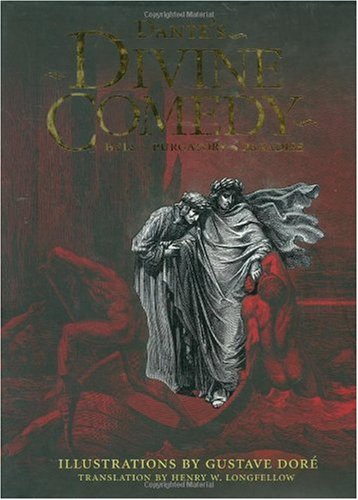
7. The Dore Illustrations for Dante's
$11.03
8. Paradiso (Kirkpatrick) (Penguin
$2.79
9. Divina comedia, La
$8.79
10. Dante: Poet of the Secular World
$0.99
11. The Divine Comedy of Dante Alighieri,
$9.95
12. Vita Nuova, La (Penguin Classics)
$8.40
13. The Inferno of Dante Alighieri
$6.98
14. The New Life (New York Review
$9.43
15. The Portable Dante (Penguin Classics)
$10.84
16. The Divine Comedy (The Inferno,
$6.35
17. The Divine Comedy Part 3: Paradise
$10.63
18. Dante's Daughter
$5.56
19. Dante's Purgatorio (The Divine
$15.24
20. The Divine Comedy of Dante Alighieri:

1. The Divine Comedy of Dante Alighieri: Volume 1: Inferno (Divine Comedy of Dante Alighieri Reprint Series)
by Dante Alighieri
Paperback: 672 Pages (1997-03-06)
list price: US$19.95 -- used & new: US$11.25
(price subject to change: see help)
Asin: 0195087445
Average Customer Review: 4.5 out of 5 stars
Canada | United Kingdom | Germany | France | Japan
Editorial Review

Book Description
This new translation presents the Italian text of the Inferno, and, on facing pages, Robert Durling's new prose translation, which brings a new power and accuracy to the rendering of Dantes extraordinary vision of Hell, with all its terror, pathos, and sardonic humor, and its penetrating analyses of the psychology of sin and the ills that plague society. Readers will prize the directness and clarity, the rich expressiveness, and the rigorous accuracy of this contemporary prose translation, which preserves to an unparalleled degree the order and emphases of Dante's syntax, unhampered by any constraints of meter or rhyme. The Italian text has been newly edited with a view to the needs of American and English readers.Martinez' and Durling's Introduction and Notes are designed with the first-time reader of the poem in mind, but will be useful to others as well. The concise Introduction presents essential biographical and historical background and a discussion of the form of the poem. The Notes are more extensive than those in most translations currently available, and they contain much new material. In addition, sixteen short essays explore the autobiographical dimension of the poem, the problematic body analogy, the question of Christ's presence in Hell, and individual cantos that have been the subject of controversy, including those on homosexuality. There is an extensive bibliography, and the indexes (to foreign words, passages cited, proper names in the Notes, and proper names in the text) will make the volume particularly useful.Robert Turner's illustrations include detailed maps of Italy, clearly labeled diagrams of the cosmos and of the structure of Hell, and line drawings of objects and places mentioned in the poem. ... Read more

Customer Reviews (6)

5-0 out of 5 stars Dante's Inferno: Reprint Series
I found this edition of Dante's most famous book of the Divine Comedy to be excellent in all respects.The translation seemed excedingly accurate -- as an Italian prof. I was working almost exclusively from the original -- in a modern, clean style.Here the attempt is not to replicate the hendecasyllabic verse or the "third rhyming" ("terza rima").
More successful still are the notes that follow each canto, replete with explications of historical and theological references or simply of difficult lines.Not to be discounted too is the introduction which admits to not being exhaustive but is powerfully pithy and a nice springboard from which to attack the text.
Dr. Joseph A. DiLuzio

5-0 out of 5 stars Dante's Inferno
I absolutely love this book! The English translations and the notes at the end of each Canto are incredibly helpful.

5-0 out of 5 stars Best of the Series
Volume 1: Inferno is the best title of Dante's Divine Comedy.He presents a great look into the history of renaissance Italy around the 14th century.Robert M. Durling translates the old Italian in a simplistic yet powerful manner which allows anyone familiar with the language to understand.There are excellent notes at the end of every chapter to help reiterate the points and what they meant in that era.Also, keep a bible handy because several references come directly from the old text.

3-0 out of 5 stars NOT WHAT IT CLAIMS TO BE !
This translation was a major disappointment.It claims to be highly literal and accurate, regardless of any awkwardness resulting in the English translation.Well it does manage to be awkward but not accurate.Word choice is often capricious and occasionally downright wrong.The notes, however, are excellent.They reflect the latest in Dante scholarship.

But the notes to the Hollander translation are even better and the translation is faithful and a much smoother read.

5-0 out of 5 stars Stunning clarity of meaning...
This edition of the Inferno is by far the best English translation available for the serious student of Dante.No absurd attempt to emulate the poetic style is made here, it's strictly prose.Moreover, it's clear, easy to read prose.Remember, it was written in the vernacular, and therefore should be read in the simplest vernacular available to the English speaking reader. ... Read more


2. Dante Alighieri: His Life and Works
by Paget Toynbee
Paperback: 368 Pages (2005-08-02)
list price: US$14.95 -- used & new: US$8.99
(price subject to change: see help)
Asin: 048644340X
Canada | United Kingdom | Germany | France | Japan
Editorial Review

Book Description

One of the most frequently cited texts on the great Florentine poet's life and writings, this invaluable study is the work of an influential Dantean scholar. Its concise, accessible account covers historical background, traces the poet's private and public life, and explores the Vita Nuova, the Convivio, the Divine Comedy, and Dante's Latin works.
... Read more

3. The New Life, La Vita Nuova, of Dante Alighieri
by Dante Alighieri
Paperback: 164 Pages (2004-12-30)
list price: US$21.95 -- used & new: US$13.87
(price subject to change: see help)
Asin: 1417972610
Average Customer Review: 5.0 out of 5 stars
Canada | United Kingdom | Germany | France | Japan

Customer Reviews (1)

5-0 out of 5 stars What has never been written of any other woman
Anyone who has read Dante's legendary "Divine Comedy" will know of his passion for a woman named Beatrice, who was his tour guide through heaven.

But that is only the tip of the iceberg, as "La Vita Nuova (The New Life)" shows in detail. This exquisite little book describes Dante's passion for Beatrice, and the emotional rollercoaster he went through as a result. This is Dante's unsung, more intimate masterpiece.

"La Vita Nuova" is a series of poems and anecdotes centering around the life-changing love of Dante for a young woman named Beatrice. The two first met when they were young children, of about eight. Dante instantly fell in love with her, but didn't really interact with her for several years.

Over the years, Dante's almost supernatural love only increased in intensity, and he poured out his feelings (grief, adoration, fear) into several poems and sonnets. During an illness, he has a vision about mortality, himself, and his beloved Beatrice ("One day, inevitably, even your most gracious Beatrice must die"). Beatrice died at the age of twenty-four, and Dante committed himself to the memory of his muse.

It would be a hard task to find another book overflowing with such incredible love and passion as "La Vita Nuova"; it's probably the most romantic book I have ever seen. Dante's feelings might seem a bit odd by modern standards, because Dante and Beatrice were never romantically involved. In fact, both of them married other people. But at the time, courtly love was considered the best, purest kind there is, and Dante's emotions are a perfect example of this.

But Dante's love for Beatrice shows itself to be more than infatuation or crush, because it never wanes -- in fact, it grows even stronger, including Love manifested as a nobleman in one of Dante's dreams. There is no element of physicality to the passion in "La Vita Nuova"; Dante talks about how beautiful Beatrice is, but that's only a sidenote. (We don't hear of any real details about her)

And Dante's grief-stricken state when Beatrice dies (of what, we're never told) leads him to deep changes in his soul, and eventually peace. And though Beatrice died, because of Dante's love for her and her placement in the "Comedia," she has achieved a kind of immortality.

One of the noticeable things about this book is that whenever something significant happens to Dante (good, bad, or neither), he immediately writes a poem about it. Some readers may be tempted to skip over the carefully constructed poems, but they shouldn't. Even if these intrude on the story, they show what Dante was feeling more clearly than his prose.

It's impossible to read this book and come out of it jaded about love or passion. Not the sort of stuff in trashy romance novels, but love and passion that come straight from the heart and soul. A true-life romance of the purest kind. ... Read more


4. The Divine Comedy: Inferno; Purgatorio; Paradiso (Everyman's Library)
by Dante Alighieri
Hardcover: 960 Pages (1995-08-01)
list price: US$24.00 -- used & new: US$13.93
(price subject to change: see help)
Asin: 0679433139
Average Customer Review: 4.5 out of 5 stars
Canada | United Kingdom | Germany | France | Japan
Editorial Review

Book Description
(Book Jacket Status: Jacketed)

The Divine Comedy begins in a shadowed forest on Good Friday in the year 1300. It proceeds on a journey that, in its intense recreation of the depths and the heights of human experience, has become the key with which Western civilization has sought to unlock the mystery of its own identity.

Allen Mandelbaum’s astonishingly Dantean translation, which captures so much of the life of the original, renders whole for us the masterpiece of that genius whom our greatest poets have recognized as a central model for all poets.

This Everyman’s edition–containing in one volume all three cantos, Inferno, Purgatorio, and Paradiso–includes an introduction by Nobel Prize—winning poet Eugenio Montale, a chronology, notes, and a bibliography. Also included are forty-two drawings selected from Botticelli's marvelous late-fifteenth-century series of illustrations. ... Read more

Customer Reviews (51)

4-0 out of 5 stars Very Nice!
Clean, well bound book with ribbon bookmark. It was a perfect gift, my son loved it.

4-0 out of 5 stars Fine Introduction to Dante's World
The Everyman's Library edition of Dante's Divine Comedy in an English translation makes this classic text accessible to students, interested readers, and literary researchers. In a convenient size, the volume contains not only the entire text in translation, but an excellent introduction by an Italian Nobel-prize winner, as well as very useful notes. Dante's journey through hell, purgatory, and heaven is steeped in the philosophy, theology, and social history of medieval Italy, yet there is much to learn from his grasp of the human condition. Any modern-day reader can appreciate its poetic substance; the effort to understand Dante's world is rewarded by the richness of description, insight, and transcendence in this artful and epic masterpiece. The Everyman's edition belongs on the bookshelf of all those who consider themselves to be well educated.

5-0 out of 5 stars The Best Single Volume Available Today
First. The Divine Comedy is an ur-text: one of the select few that have been passed down through centuries, almost millenia, to create a foundation on which is built our Western literary tradition.

Second. Allen Mandelbaum's translation is excellent. It has the readability of prose but stays lyrical. It does not strain itself to be lyrical, though, as I think Ciardi's translation does too often.

Third. The notes are fantastic. Dante constantly alludes to the Greek mythology and his contemporary Italy. Without the excellent notes it can be very difficult to interpret what point the author is trying to make. Most importantly, the notes make reference to the original work on which Dante based the allusion. If you have a copy of Ovid's Metamorphoses or Virgil's Aeneid you can easily cross-reference and get more out of the Divine Comedy than you would otherise. (Mandelbaum's translations of Metamorphoses and Aeneid are also great and recommended, though not as nicely packaged as this work.)

Finally, and my Main Point. This is physically the nicest single volume of the Divine Comedy you can buy new today.

The dust jacket is very attractive. But if you're like me you take off the jacket immediately and read it without. Under the jacket you'll find a very handsome cover and spine, as you do with all Everyman's Library editions. This volume will not only look good on your shelf, but it should last through many readings and be a very nice to hand down to a child or grandchild someday.

The physical dimensions are perfect. Some volumes of the complete Divine Comedy I have seen are just unwieldly; they are too tall or too thick to comfortably read while kicking back in a chair or lounging in bed. This also has a perfect heft. It feels like you are holding and reading an important work.

The paper is very nice. Just thick enough, it easily turns without fear of tearing while not being too heavy to be cumbersome. It won't fall to pieces in five year's time either. (Unfortunately, the current printing of Mandelbaum's translation of Virgil's Aeneid by Bantam Classics is a mass-market paperback and already rotting on the shelf.)

Most importantly, the text is very readable. A very friendly typeface is used. It is put on the paper with modern methods - not as a facsimile of a photo of an old metal type pressing as so many classics appear. And a professional actually spent time on the layout. Too many classics are thrown together cheaply. The people at Everyman's Library do a consistently great job at this. By contrast, old Penguin Classics volumes are terrible to read because the type, press, and layout are poorly done and painful to read. (To be fair Penguin Classics has gotten much better recently. In particular their "Deluxe Editions" are very nice. I have the "Deluxe Edition" of Odyssey, Iliad, and Candide and recommend them.)

Summary. After growing tired of the genre fiction that filled my leisure reading, I began reading the classics. This book was one of the first I picked up and it has completely spoiled me. Everyman's Library sets the bar against which all other printings of the classics must be compared.

If you are looking for the best single volume of Dante's Divine Comedy, this is it. It will make a handsome addition to your library and you will easily be able to say you have actually read it too.

5-0 out of 5 stars The divine journey
"Midway life's journey I was made aware/that I had strayed into a dark forest..."

Those eerie words open the first cantica of Dante Alighieri's "Divine Comedy," the legendary poem that takes its author through the eerie depths of hell, heaven and purgatory. It's a haunting, almost hallucinatory experience, full of the the metaphorical and supernatural horrors of the inferno, and joys of paradise.

The date is Good Friday of the year 1300, and Dante is lost in a creepy dark forest, being assaulted by a trio of beasts who symbolize his own sins. But suddenly he is rescued ("Not man; man I once was") by the legendary poet Virgil, who takes the despondent Dante under his wing -- and down into Hell.

But this isn't a straightforward hell of flames and dancing devils. Instead, it's a multi-tiered carnival of horrors, where different sins are punished with different means. Opportunists are forever stung by insects, the lustful are trapped in a storm, the greedy are forced to battle against each other, and the violent lie in a river of boiling blood, are transformed into thorn bushes, and are trapped on a volcanic desert.

Well, that was fun. But after passing through hell, Dante gets the guided tour of Purgatory, where the souls of the not-that-bad-but-not-pure-either get cleansed. He and Virgil emerge at the base of a vast mountain, and an angel orders him to "wash you those wounds within," then lets them in.

As Virgil and Dante climb the mountain, they observe the seven terraces that sinners stay on, representing the seven deadly sins -- the angry, the proud, the envious, the lazy, the greedy, the lustful and the gluttons. It's a one-way trip, and you don't even get to look back.

The road up the mountain leads to the gates of Heaven, and soon Dante has been purified to the point where he's allowed to go inside. Virgil doesn't get to enter Heaven, so he passes Dante on to the beautiful Beatrice, the woman he loved in his younger years.

She whisks him up to the spheres of those who are now pure of soul -- the wise, the loving, the people who fought for their religion, the just, the contemplative, the saints, and finally even the angels. And after passing through heaven's nine spheres, he passes out of the physical realm and human understanding -- and sees God, the incomprehensible, represented by three circles inside each other, but all the same size.

Needless to say, it's a pretty wild trip.And admittedly "Purgatorio" and "Paradiso" aren't quite on the writing level of "Inferno," which has the most visceral, skin-crawling imagery and lines ("Fixed in the slime, groan they, 'We were sullen and wroth...'"), and a wicked sense of irony. It makes the angels and saints seem a bit tame.

But there's plenty of power in the second two books, particularly when Dante tries to comprehend God, and almost blows out his brain in the process -- "my desire and my will were turned like a wheel, all at one speed by the Love that turns the sun and all the other stars." It's haunting, and sticks with you long after the story has ended.

More impressive still is his ability to weave the poetry out of symbolism and allegory, without it ever seeming preachy or annoying. Even at the start, Dante sees lion, a leopard and a wolf, which symbolize different sins, and a dark forest that indicates suicidal thoughts. Not to mention Purgatory as a mountain that must be climbed, or Hell as a Hadesian underworld.

Dante's vivid writing and wildly imaginative journey makes the "Divine Comedy" a timeless, spellbinding read, and hauntingly powerful from inferno to paradiso.

5-0 out of 5 stars The Divine Comedy: Inferno; Purgatorio; Paradiso
It's a good book, it's new and i received it in a timely manner for a really low price. ... Read more


5. The Divine Comedy, Part 2: Purgatory (Penguin Classics)
by Dante Alighieri
Paperback: 400 Pages (1955-08-30)
list price: US$12.00 -- used & new: US$6.78
(price subject to change: see help)
Asin: 0140440461
Average Customer Review: 4.5 out of 5 stars
Canada | United Kingdom | Germany | France | Japan

Customer Reviews (6)

5-0 out of 5 stars Terrific spiritual classic
After seeing Dante referred to by so many Christian authors over the years, I finally decided I'd better read this "timeless spiritual classic."I was expecting a dry, dull slog.
Fortunately, I consulted a friend who is a Classicist.I told him I wanted to read Dante for spiritual value, not just as great literature (I'm no poetry expert, nor do I speak a word of Italian).He recommended Dorothy Sayer's translation.
Wow.Reading Dante during Lent is one long, detailed examination of conscience!It is great, and Sayers' explanations and commentaries are terrific: erudite, informative, drily witty, and full of spiritual insight.

5-0 out of 5 stars Poetry even for us monoglots
Let's begin with Dante. Called "the divine poet" (hence the adjective attached to his humbly titled Commedia), it is a difficult moniker to argue with, not because Dante is writing of heaven but because his imagery, his imagination, and his humility are true imitations of the creative activity of God. Dante is a sublime "sub-creator" to use the coinage of JRR Tolkien. If you can read theCommedia and not be moved to tears, one is tempted to doubt your humanity for Dante portrays the race in all its beauty and putridness and denies neither. He neither celebrates mankind's faculties and achievements beyond their due nor fears to recognize the vileness of which humans are capable.

And it is Canticle II, the poet's ascent through Purgatory, which stirs so deeply the soul and inspires the very penitence and hope of purgation which Dante describes there. One need not be a Roman Catholic or ascribe to Purgatory as doctrine in order to recognize and appreciate what Dante has done in describing the landscape of repentance and hope. (Being a Christian may help, but even on this point one suspects that the divine poet may well perform the function of evangelist, as well as exegete, and lead the searching soul to beatific vision of its own.) Clearly his purpose is not merely to describe what sinners of the past are doing in the afterlife to purify their souls for Paradise, but also to inspire his contemporary readers (who are, of course, yet living when the poem is published in 1321) to examine themselves just as the joyful penitents do on the cornices of Mount Purgatory. It is refreshing--a sort of glorious wound, the healing of which leaves one stronger and more whole than he had been before the hurt.

But what of the translation? We who do not (yet) enjoy the privilege of reading the Commedia in Italian must read the poem in translation--and there are plenty to choose from! Given its primacy among the works of Western Literature in the Middle Ages, the poem has been translated by everyone from Dryden and Pope to Allen Mandelbaum and John Ciardi. So first of all, without question one MUST insist on a verse translation! Prose translations can hardly suffice to communicate the rhythm and terseness of Dante's terza rima which is so integral to the poem. Nor can the majesty of the subject, the grandeur of the poet's climb toward Paradise with all its anticipation and awe be fully communicated in a prose rendering. How well various attempts at verse have succeeded in doing so is the big debate.

In this reviewer's humble opinion, Dorothy L Sayers has succeeded to a degree which surpasses any extant English translation. Are there occasional awkwardnesses? Yes. Is the literal meaning of some lines lost from time to time? Yes, but always for the sake of a gain in some other important respect and always with explanation. Sayers' is the only translation of note which manages to render in English the full terza rima rhyme scheme employed by Dante--and even that feat is worth a few awkward passages or archaisms, it seems to me. One feels much closer to the Divine Poet reading Sayers' translation aloud than, say, Ciardi's half-attempted rhymes, lucid as he can often be.

Whatever else you do, read the Commedia--all of it! It is rather unfortunate that it has become common practice to publish the poem in three volumes rather than presenting it as an integrated whole. Though the familiarity of many ends with Inferno, those who press on I suspect will love Purgatorio best (but fortunately one is not forced to choose), and I am confident readers will be well rewarded for reading Sayers' brilliant translation. One would be hard pressed to find a translator who was more passionate about her subject and who labored more lovingly and meticulously over her rendering of this beloved work than Dorothy L Sayers.

5-0 out of 5 stars DOROTHY L. SAYERS' GENIUS GLOWS IN HER TRANSLATION OF THE COMMEDIA
This project was her dying effort after a lifetime of great achievements in scholarship and literature. She again proves her genius here with Dante, as in her translation of the Inferno, making an intelligent translation into her contemporary and scholarly English. Incredible achievement for a woman, the first to graduate from Oxford, who wrote treatises in THeology as well as the wonderful Lord Whimsey detective series.

5-0 out of 5 stars Pleasant Guide
A warning: this is by now an rather old translation, and theres always more to explore in Dante. That being said, it has many insights newer translations lack, and its a brilliant example of a period - if you want to understand how the understanding of Dante has developed, this is a must.
Oh, and by the way, if one can read of the Earthly Paradise and not be moved, one is cheating oneself (as I found out, fortunately). Purgatory is just as much worth the effort as its two Higher and Lower brothers.

5-0 out of 5 stars Feel Purgatory
It was always hard for the majority of readers to feel purgatory just like the inferno. That the own Dante knew, he wrote about this in "Purgatory" because here, differently from "Inferno", Dante desired a crescent climax with connected episodes, the specific episodes are not passionate as inferno`s, that is the purpose: those in purgatory do not feel passions as desirable, "isn't it one more irony of Dante?". Think about it for solving more this enigm of the Divine Comedy. ... Read more


6. Purgatorio (Kirkpatrick) (The Divine Comedy)
by Dante Alighieri
Paperback: 592 Pages (2008-02-26)
list price: US$17.00 -- used & new: US$11.56
(price subject to change: see help)
Asin: 0140448969
Canada | United Kingdom | Germany | France | Japan
Editorial Review

Book Description
Climbing out of Hell, Dante in the Purgatorio reaches an island set in the southern ocean. This is Mount Purgatory, where he encounters the penitents who heroically endure their sufferings and speak of their time on Earth. Strange and fresh at every turn, Dante’s narrative evokes the mountain landscape in terms of intense physical sensation, right up to the summit. There, before rising to heaven, he enters the Earthly Paradise, where he is movingly reunited with his lost love, Beatrice. This gloriously vivid portrayal of the search for redemption transformed the traditional conception of Purgatory and affirmed the dignity of human will and compassion. ... Read more


7. The Dore Illustrations for Dante's Divine Comedy
by Gustave Dore
Paperback: 141 Pages (1976-06-01)
list price: US$14.95 -- used & new: US$6.98
(price subject to change: see help)
Asin: 048623231X
Average Customer Review: 4.5 out of 5 stars
Canada | United Kingdom | Germany | France | Japan
Editorial Review

Book Description

135 fantastic and grotesque scenes depict the passion and grandeur of one of Dante's most highly regarded works — from the depths of hell onto the mountain of purgatory and up to the empyrean realms of paradise. Includes plates produced for The Inferno, Purgatory and Paradise. Illustrations accompanied by appropriate lines from the Longfellow translation.
... Read more

Customer Reviews (17)

5-0 out of 5 stars Dore Illustrations
Book arrived in promised condition, and in a timely fashion.I would buy from this seller again.

1-0 out of 5 stars Skip this comic book
This guy is pretty much in the same league as Jack Kirby. Whereas Kirby's all soft lines and images pancaked on the page, Dore looks like he's carving his cartoons into a tree. And all these scary demons and things look tired, like they've been running marathons all day. The victims kind of look like they're enjoying it, so I guess if you're into S&M, I could recommend it. Me, I prefer "Spawn" by Todd McFarlane. The Violator? Now that's a monster you can sink your eyeballs into. And I know it's like super-uber hip, but I don't know why these illustrators feel they are so special when they work exclusively in shades of black. Like my momma used to say, "A little rouge really accents the cheekbones."

5-0 out of 5 stars An Excellent book for the Doré or Dante lover
The quality of this book - along with an amazingly affordable price tag - quickly persuaded me to pick up a copy. Its really everything you could ask for in an art book;

The pictures are all very big, but not overwhelming; Its easy to see minute detail, and the overall scope of the image. I actually blew up some of the prints in photoshop and printed them on huge poster paper for my room, while not sacrificing a drop of detail.

Also, I had to put quite a good deal of pressure onto the spine of the book in order to get a good scan from them, and im happy to say that doing so didn't even leave an annoying "bookmark" crease in the book, and the spine didn't even crease. Dover books really did produce a fine quality book, and the note on the back really is true: This book IS permanent.

If you have read or are reading the divine comedy this book is a great reference to glance at every now and again to truly suck you into Dante's epic poem, and bring you to the Heights of Heaven, The Depths of Hell, or the pain of purgatory in a way you could never have imagened.

The woodcuts done here by dore are so elaborate and vivid you could spend a good portion of a day just gazing into the faces of cursed souls writhing in hell, or the beauty of millions of angels soaring in the highest heaven. Dore illustrates every picture so full of movement and depth its the next best thing to a movie.

4-0 out of 5 stars Absolutely Wonderful (Really 4 and a half stars)
I have looked at a variety of Dante artists. Some well known and some are not. Suloni Robertson, John Flaxman, Willam Blake, Sandro Botticelli, Sandow Birk, Herb Roe. Do a google search to look at the works of some of these like Sandow Birk. There are some that are more obscure which in a way documents the Comedy, more specifically the Inferno. I'm not going to say who I don't like but Dore is the best. I am rather specific about artists. Dore makes the grade. He is good, really good and when you look at this book, you feel like you are in the terrible depths of hell. I like purgatorio too. I feel the religious prayer songs in my head as I see Beatrice's entrance. There is so much symbolism in these pictures, especially in Paradiso. Though I do disagree with the depiction of Muhammad in hell, the rest is fantastic. I mean that he looks more like he's British then Middle Eastern. I imagine him with blonde hair in the plate. The tortured look on Dante's face in the plate with Betrand de Born, (The cover pic) is extraordinary. I felt how he felt. That is why Dore is so good. I had also hoped for more detail with Ugolino because his story is fantastically horrifying.

The book is a must for any Dante fan. I look at it a lot, even if I have seen the pictures hundreds of times. I really don't think that you can get bored with this. There is always something new to look at. Some detail you looked over. Buy this book because the scans online don't give the justice that this book has. Buy it, look it over, get inspired by it. Maybe we will see your work on Amazon in the near future.

5-0 out of 5 stars The Dore's Illustrations for Dante's Commedia are great.
The Illustrations from the 1st canto in the Inferno to the last of Paradiso are great because they help as a visual aid when reading the Divina Commedia.One can really see how and in which ways Dore, when he design the illustrations, followed the text very closely. ... Read more


8. Paradiso (Kirkpatrick) (Penguin Classics: the Divine Comedy)
by Dante Alighieri
Paperback: 496 Pages (2008-02-26)
list price: US$13.00 -- used & new: US$11.03
(price subject to change: see help)
Asin: 0140448977
Canada | United Kingdom | Germany | France | Japan
Editorial Review

Book Description
The second part and the radiant climax to Dante’s awe-inspiring epic, in a definitive new translation

Having plunged to the utmost depths of Hell and climbed Mount Purgatory in the first two parts of The Divine Comedy, Dante now ascends to Heaven, guided by his beloved Beatrice, to continue his search for God. As he progresses through the spheres of Paradise, he grows ever closer to experiencing divine love in the overwhelming presence of the deity. Examining eternal questions of faith, desire, and enlightenment, Dante exercised all of his learning and wit, wrath and tenderness in his creation of one of the greatest of all Christian allegories. ... Read more


9. Divina comedia, La
by Dante Alighieri
Paperback: 276 Pages (1993-01-01)
list price: US$12.50 -- used & new: US$2.79
(price subject to change: see help)
Asin: 9583000760
Average Customer Review: 5.0 out of 5 stars
Canada | United Kingdom | Germany | France | Japan

Customer Reviews (1)

5-0 out of 5 stars Excellente trabajo Literario (Excellent literary work)
Dante's estilo literario en La Divina Comedia es poetico y creativo.Leer esta obra es un placer que motiva la mente a poner al lector dentro de la obra de el Autor.

Dante's Literary style in La Divina Comedia is creative and poetic.It is a pleasure to read this work which transports the reader into the Authors work. ... Read more


10. Dante: Poet of the Secular World (New York Review Books Classics)
by Erich Auerbach
Paperback: 208 Pages (2007-01-16)
list price: US$14.95 -- used & new: US$8.79
(price subject to change: see help)
Asin: 1590172191
Average Customer Review: 5.0 out of 5 stars
Canada | United Kingdom | Germany | France | Japan
Editorial Review

Book Description
Erich Auerbach’s Dante: Poet of the Secular World is an inspiring introduction to one of world’s greatest poets as well as a brilliantly argued and still provocative essay in the history of ideas. Here Auerbach, thought by many to be the greatest of twentieth-century scholar-critics, makes the seemingly paradoxical claim that it is in the poetry of Dante, supreme among religious poets, and above all in the stanzas of his Divine Comedy, that the secular world of the modern novel first took imaginative form. Auerbach’s study of Dante, a precursor and necessary complement to Mimesis, his magisterial overview of realism in Western literature, illuminates both the overall structure and the individual detail of Dante’s work, showing it to be an extraordinary synthesis of the sensuous and the conceptual, the particular and the universal, that redefined notions of human character and fate and opened the way into modernity.

CONTENTS
I. Historical Introduction; The Idea of Man in Literature
II. Dante's Early Poetry
III. The Subject of the "Comedy"
IV. The Structure of the "Comedy"
V. The Presentation
VI. The Survival and Transformation of Dante's Vision of Reality
Notes
Index ... Read more

Customer Reviews (1)

5-0 out of 5 stars a way
Auerbach's Dante book was published first in 1929 before the period of his Turkish teaching as Michael Dirda's helpful preface relates. In this book one can see Auerbach working out his thoughts both on mimesis, which would bear fruit in his most celebrated work, and on typology or that would become the focus of a stellar essay. What is most dazzling about this work here is its simultaneous attention to historical sweep and poetic detail. One works one's way from Homer, Greek tragedy and comedy, Aristotle and Virgil through Augustine, Guizinelli and Cavalcanti. By the time Dante's early works appear for discussion, the reader has amassed a tremendous background. Auerbach's writing on the Comedy is as impressive where he shows the ability to ponder the value of white petals on a rose or the necessity of the Veltro, or greyhound as the foe to the She-wolf that menaces Dante. Also, I was struck by Auerbach's attention to Dante's word order and period construction. After all that, it is remarkable to discover how sparsely emulated and admired Dante's poetry was for centuries after its completion. This little book fits scintillating learning within its 180 pages. I do recommend it. ... Read more


11. The Divine Comedy of Dante Alighieri, Longfellow translation
by Dante Alighieri
Kindle Edition: Pages (2008-01-02)
list price: US$0.99 -- used & new: US$0.99
(price subject to change: see help)
Asin: B00126U3ZI
Canada | United Kingdom | Germany | France | Japan
Editorial Review

Book Description
The Longfellow translation.This is the translation at the center of the plot of the recent bestseller "The Dante Club" by Matthew Pearl. (Text improved for the Kindle 2/25/2008. If you bought a copy earlier, you should be able to download the latest version at no extra cost. The product number is the same.) ... Read more


12. Vita Nuova, La (Penguin Classics)
by Dante Alighieri
Paperback: 128 Pages (1969-08-30)
list price: US$11.00 -- used & new: US$9.95
(price subject to change: see help)
Asin: 0140442162
Average Customer Review: 4.5 out of 5 stars
Canada | United Kingdom | Germany | France | Japan
Editorial Review

Book Description
La Vita Nuova marked a turning point in European literature, introducing personal experience into the strict formalism of medieval love poetry. The sequence of poems tells the story of Dante’s passion for Beatrice, the beautiful sister of one of his closest friends, transformed through his writing into a symbol of love that was both spiritual and romantic. From unrequited passion to the profound grief he experiences at the loss of his love, this work intersperses exquisite verse with Dante’s own commentary on the structure and origins of each poem, offering a unique insight into the poet’s art and skill. Barbara Reynolds’s translation, acclaimed for its lucidity and faithfulness to the original, is now enhanced with a new introduction and other material. ... Read more

Customer Reviews (13)

2-0 out of 5 stars Wake me up when it's over
I LOVED The Inferno, so I approached this book with the enthusiasm of a gourmand at an all-you-can-eat buffet.Sadly, the bread turned out to be stale, the steak overdone and the desserts moldy. Okay. Now that I've run that metaphor into the ground, let's talk about Vita Nuova.I found it to be pretty darn tedious and highly melodramatic.The prose is self-indulgent and dry; the poetry, while slightly better, falls into the same camp.You just want to say to the guy--get a life!At several points during the book, Dante's fellow townspeople mock him because of his constant waterworks and woe-is-me-ing. I sympathized with them, found myself laughing at this whiny, timid little man.Dante, as he portrays himself in this book, is a bore, a sniveling, spoiled child.

5-0 out of 5 stars Brilliant
Dante will remain my favorite author, ever, final, no questions asked, and though I love the Divine Comedy, it was refreshing to read something that told more of his own story: the agony over Beatrice and the trials of his own life.This is a must read for any Dante fan...understand the man behind the art...understand one of the most beautiful poets the world will ever know.

4-0 out of 5 stars Sweet unrequited first love
This is a beautiful collection of poetry inspired by Beatrice, the great love of Dante's life, even though she barely even knew him and they were never together romantically, not even as childhood sweethearts.It's also mixed in with autobiographical remembrances.Dante and Beatrice first happened to see one another when they were nine and eight years old, respectively, and didn't cross paths again for nine more years, but Dante always remembered how stunningly beautiful this girl was.Every single time he saw this woman from their second meeting on (in church, on the street, by his house, wherever else she was) he was even more and more inflamed by love for this beautiful otherworldly creature, and so began writing the poetry which comprises much of this slim but poignant volume.Dante was so madly in love that he prefaced each poem or sonnet by explaining in detail what every bit of them meant, if it's broken down into sections by theme, everything that would let him gush on and on about his beloved one even more.One of the sonnets tells about a terrifying dream/premonition Dante had about a year before Beatrice died on 8 June 1290, in the prime of her life, a dream which was so strong, real, and terrifying that he was actually brought to tears and asked by one of Beatrice's friends whatever the matter was with him.He said he'd had a horrifying vision that his lady had died, but didn't provide her name and so let Beatrice's friend believe it was some other woman he was madly passionately head over heels in love with.Shortly after Beatrice really did die, one of her brothers visited Dante asking him to write some poetry for a certain death that recently occurred.The man has disguised himself and not told Dante the details about the death in question, but he knows that this is one of Beatrice's five brothers, and that Beatrice is the dead person in question whom he's being asked to immortalise in poetry.Because he doesn't want anyone to get the wrong impression about his feelings for Beatrice, Dante goes through three poems in the quest for creating just the right one.

After the sad untimely death of Beatrice, Dante was visited by another beautiful woman who cheered him up and inspired him to write poetry again, this time for her and not for Beatrice, but very soon after this occurs he feels upset and ashamed of himself because he let another woman be his muse.The last chapter of this book contains the genesis of the idea that would eventually lead to the writing of Dante's longest and most greatest work, the Divine Comedy.Dante wanted to write a much much longer poem celebrating his great love for her and how beautiful Beatrice was, immortalising her for all time even though they were never husband and wife, lovers, or even sweethearts.It's true there's a fine line between love and obsession, but in this case whichever of the two it might have been doesn't matter, since the end result was a beautiful timeless work of art.

5-0 out of 5 stars What has never been written of any other woman
Genuine romance and passion is missing from most books, either fiction or nonfiction. As a result, it's hard to come across both in such quantity as there is in "La Vita Nuova" ("The New Life"), the unsung masterpiece of poet Dante Alighieri, author of the classic Divina Comedia.

"La Vita Nuova" is a series of poems and anecdotes centering around the life-changing love of Dante for a young woman named Beatrice. The two first met when they were young children, of about eight. Dante instantly fell in love with her, but didn't really interact with her for several years. Over the years, Dante's almost supernatural love only increased in intensity, and he poured out his feelings (grief, adoration, fear) into several poems and sonnets. During an illness, he has a vision about mortality, himself, and his beloved Beatrice ("One day, inevitably, even your most gracious Beatrice must die"). Beatrice died at the age of twenty-four, and Dante committed himself to the memory of his muse.

It would be a hard task to find another book overflowing with such incredible love and passion as "La Vita Nuova"; it's probably the most romantic book I have ever seen. It's brief and only includes one part of Dante's life overall, but it's a truly unique love story. Dante and Beatrice were never romantically involved. In fact, both of them married other people.

But Dante's love for Beatrice shows itself to be more than infatuation or crush, because it never wanes -- in fact, it grows even stronger, including Love manifested as a nobleman in one of Dante's dreams. There is no element of physicality to the passion in "La Vita Nuova"; Dante talks about how beautiful Beatrice is, but that's only a sidenote. (We don't hear of any real details about her) And Dante's grief-stricken state when Beatrice dies (of what, we're never told) leads him to deep changes in his soul, and eventually peace. And though Beatrice died, because of Dante's love for her and her placement in the "Comedia," she has achieved a kind of immortality.

One of the noticeable things about this book is that whenever something significant happens to Dante (good, bad, or neither), he immediately writes a poem about it. Some readers may be tempted to skip over the carefully constructed poems, but they shouldn't. Even if these intrude on the story, they show what Dante was feeling more clearly than his prose.

It's impossible to read this book and come out of it jaded about love or true passion. Not the sort of stuff in pulp romance novels, but love and passion that come straight from the heart and soul, in a unique and unusual love story. A true-life romance of the purest kind.

5-0 out of 5 stars What has never been written of any other woman
Genuine romance and passion is missing from most books, either fiction or nonfiction, and I don't think I've ever come across both in such quantity as there is in "La Vita Nuova" ("The New Life"), the unsung masterpiece of poet Dante Alighieri, author of the classic Divina Comedia.

"La Vita Nuova" is a series of poems and anecdotes centering around the life-changing love of Dante for a young woman named Beatrice. The two first met when they were young children, of about eight. Dante instantly fell in love with her, but didn't really interact with her for several years. Over the years, Dante's almost supernatural love only increased in intensity, and he poured out his feelings (grief, adoration, fear) into several poems and sonnets. During an illness, he has a vision about mortality, himself, and his beloved Beatrice ("One day, inevitably, even your most gracious Beatrice must die"). Beatrice died at the age of twenty-four, and Dante committed himself to the memory of his muse.

It would be a hard task to find another book overflowing with such incredible love and passion as "La Vita Nuova"; it's probably the most romantic book I have ever seen. It's brief and only includes one part of Dante's life overall, but it's a truly unique love story. Dante and Beatrice were never romantically involved. In fact, both of them married other people.

But Dante's love for Beatrice shows itself to be more than infatuation or crush, because it never wanes -- in fact, it grows even stronger, including Love manifested as a nobleman in one of Dante's dreams. There is no element of physicality to the passion in "La Vita Nuova"; Dante talks about how beautiful Beatrice is, but that's only a sidenote. (We don't hear of any real details about her) And Dante's grief-stricken state when Beatrice dies (of what, we're never told) leads him to deep changes in his soul, and eventually peace. And though Beatrice died, because of Dante's love for her and her placement in the "Comedia," she has achieved a kind of immortality.

One of the noticeable things about this book is that whenever something significant happens to Dante (good, bad, or neither), he immediately writes a poem about it. Some readers may be tempted to skip over the carefully constructed poems, but they shouldn't. Even if these intrude on the story, they show what Dante was feeling more clearly than his prose.

It's impossible to read this book and come out of it jaded about love or true passion. Not the sort of stuff in pulp romance novels, but love and passion that come straight from the heart and soul, in a unique and unusual love story. Every true romantic should read this book. ... Read more


13. The Inferno of Dante Alighieri (New York Review Books Classics)
by Dante Alighieri
Paperback: 328 Pages (2004-10-31)
list price: US$14.95 -- used & new: US$8.40
(price subject to change: see help)
Asin: 1590171144
Average Customer Review: 4.0 out of 5 stars
Canada | United Kingdom | Germany | France | Japan
Editorial Review

Book Description
This startling new translation of Dante's Inferno is by Ciaran Carson, one of contemporary Ireland's most dazzlingly gifted poets. Written in a vigorous and inventive contemporary idiom, while also reproducing the intricate rhyme-scheme that is so essential to the beauty and power of Dante's epic, Carson's virtuosic rendering of the Inferno is that rare thing—a translation with the heft and force of a true English poem. Like Seamus Heaney's Beowulf and Ted Hughes's Tales from Ovid, Ciaran Carson's Inferno is an extraordinary modern response to one of the great works of world literature. ... Read more

Customer Reviews (6)

4-0 out of 5 stars Terrific translation of a classic
When I finally decided to try to plug some of the holes that my 'classical education' had somehow left unfilled, "The Inferno" was high on my list. Since I don't know any Italian, choosing a decent translation was one of the first questions to be addressed. I spent an hour in Cody's comparing various options (there are a gazillion translations out there) - this was one of two that I ended up buying.

Surprisingly (to me at any rate), roughly half of the available translations chose the low road of not even bothering to preserve Dante's famous terza rima metric scheme, with the excuse that only a 'literal translation' can convey the meaning adequately. Fie on your laziness, say I - it obviously can be done, even if you are too lamebrained to try. So I rejected the 'literal translations' out of hand, for the same reason that I would not choose a translation of 'Eugene onegin' that didn't at least try to preserve Pushkin's meter, when it is obviously such an intrinsic aspect of the work.

I can't vouch for the fidelity of Carson's translation, but I liked it a lot. He does well by the terza rima, while managing to achieve an overall natural flow of the language. At times it is highly colloquial, which might disturb the purists:

"Ratbreath, when he heard this, rolled his eyes,
and hissed 'Don't listen, it's a dirty trick,
so he can jump. He must think we're not wise.'

And he, whose AKA was Señor Slick,
replied: 'It's dirt indeed, to get my comrades
in the s**t; in fact, it's rather sick.'

Now Harley Quinn, unlike the other blades,
was eager for some sport. "

Canto XXII, lines 107-114.

As for the work itself, I think everyone knows the story. I haven't read "Purgatorio" or "Paradiso" yet - it seems highly likely to me that the "Inferno" is the most fun of the three, if only because it's entertaining to see how he uses it as a vehicle for getting even with his enemies. But, if you've been putting it off for years because you're intimidated by its status as a "classic", don't be put off any longer. It's actually a lot of fun, and easy to read.

Comparing translations is an auxiliary source of entertainment, for those (like myself) who enjoy that kind of thing

5-0 out of 5 stars Medieval vision of the afterlife
This was required reading for a graduate course in medieval history.
Dante Alighieri's (1265-1321) "Devine Comedy" weaved together aspects of biblical and classical Greek literary traditions to produce one of the most important works of not only medieval literature, but also one of the great literary works of Western civilization.The full impact of this 14,000-line poem divided into 100 cantos and three books is not just literary.Dante's autobiographical poem Commedia, as he titled it, was his look into the individual psyche and human soul.He explored and reflected on such fundamental questions as political institutions and their problems, the nature of humankind's moral actions, and the possibility of spiritual transformation; these were all fundamental social and cultural concerns for people during the fourteenth-century.Dante wrote the Commedia not in Latin but in the Tuscan dialect of Italian so that it would reach a broader readership.The Commedia was a three-part journey undertaken by the pilgrim Dante to the realms of the Christian afterlife: Hell, (Inferno), Purgatory, (Purgatorio), and Paradise, (Paradisio).

The poem narrated in first person, began with Dante lost midlife.He was 35 years old in the year 1300 and in a dark wood.Being lost in the dark wood was certainly an allegorical device that Dante used to express the condition of his own life at the time he started writing the poem. Dante had been active in Florentine politics and a member of the White Guelph party who opposed the secular rule of Pope Boniface VIII over Florence.In 1302, The Black Guelphs who were allied with the Pope, were militarily victorious in gaining control of the city and Dante found himself an exile from his beloved city for the rest of his life.Thus, Dante started writing the Commedia in 1308 and used it to comment on his own tribulations of life, and to state his views on politics and religion, and heap scorn on his political enemies.

Dante's first leg of his journey out of the dark wood was through the nine concentric circles of Hell (Inferno), escorted by his favorite classical Roman poet Virgil, author of the Aeneid.Dante borrowed heavily from Virgil's Aeneid.Much of Dante's description of hell had similarities to Virgil's description in his sixth book of the Aeneid.Dante's three major divisions of sin in hell where unrepentant sinners dwelled, had their sources in Aristotle and Augustinian philosophy.They were self-indulgence, violence, and fraud.Fraud was considered the worst of moral failures because it undermined family, trust, and religion; in essence, it tore at the moral fabric of civilized society.These divisions were inversions of the classical virtues of moderation, courage, and wisdom.The fourth classical virtue, justice, is what Dante came to believe after his journey through hell that all its inhabitants received for their unrepentant sins.There were nine concentric circles of hell inside the earth; each smaller than the previous one.For Dante the geography of hell was a moral geography as well as a physical one, reflecting the nature of the sin.Canto IV describes the first circle of hell, Limbo, which is where Dante met the shades, as souls where called, of the virtuous un-baptized such as Homer, Ovid, Caesar, Aristotle, and Plato.

In the four circles for the sin of self-indulgence Dante met shades who where lustful, gluttons, hoarders and wrathful.In the second circle of Hell, lustful souls were blown around in a violent storm.In Canto V, one of the great dramatic moments of the poem, Dante had his first lengthy encounter with an unrepentant sinner Francesca da Rimini, who committed adultery with her brother-in-law.Like all the sinners in hell, Francesca laid the blame for her sin elsewhere.She claimed to be seduced into committing adultery after reading the story of Lancelot and Guinevere.At the end of the scene, Dante fainted out of pity for Francesca.

In Canto X, the sixth circle of hell reserved for heretics who are punished by being trapped in flaming tombs, Dante took the opportunity to use the circle to chastise political leaders for participating in political partisanship.A Florentine who was a leader in the rival Ghibbelline political party, Farinata degli Uberti, accosted Dante.Both men aggressively argued with each other, recreating in hell the bitterness of partisan politics in Florence.Farinata predicted Dante's exile.Dante used this Canto to show the dangerous tendencies of petty political partisanship that he harbored.

The seventh circle of hell was subdivided into three areas where sinners were punished for doing violence against themselves, their neighbors, or God.In Canto XIII Dante encountered Pier della Vigne in the wood of the suicides.The shades there were shrubs who had to speak through a broken branch.Pier spoke to Dante about how he had been an important advisor to Emperor Frederick II, and how he blamed his fall, and his suicide, on the envy of other court members.This Canto was especially important because Dante came to grips with his own "future" fall from political power and exile.Pier's behavior served as a strong example to Dante how not to act in exile.Whether he had been tempted to commit suicide is not clear; however, he certainly had been prone to the selfish and despairing attitude that Pier represented.

The last two circles of hell contained the sinners of fraud.In the eighth circle, there were ten ditches for the various types of fraud such as Simony, thievery, hypocrisy, etc.Canto XIX described the third ditch, which contained those guilty of Simony, the sin of church leaders perverting their spiritual office by buying and selling church offices.Simonists were buried upside down in a rock with their feet on fire.Pope Nicholas III mistakenly addressed Dante as Pope Boniface VIII who was the current Pope in 1300, and whose place in hell was thereby predicted.This is not surprising since Boniface was the person most responsible for Dante's exile.In an interesting literary twist, Nicholas "confessed" to Dante, as if he was a priest, his sin of greed and nepotism.He admitted that even after becoming Pope he cared more for his family's interests than the good of the whole Church.Dante responded to Nicholas' "confession" with a stinging condemnation of Simony drawn from the Book of Revelation.After this encounter, Dante came to understand that hell was a place of justice.

Canto XXXIV, the last one in the Inferno, depicted Satan with three heads.Each head was chewing the three worst sinners of humankind.The middle head was chewing on the head of Judas Iscariot, who was a disciple to Jesus and his betrayer.The other two heads were chewing Brutus and Cassius; the murderers of Julius Caesar, and the two men Dante faulted for the destruction of a unified Italy.Dante considered the two ultimate betrayals against God and against the empire as the worst betrayals perpetrated in the history of humankind.

Thus, Dante's intent in his Commedia was to teach fourteenth-century readers that if one wanted to ascend spiritually towards God then one needed to learn the nature of sin from the unrepentant.By doing this, one could learn to overcome the same tendencies found in themselves.He wanted people to realize what he had come to learn that political partisanship would only stand in the way of unifying Italy and keep it from regaining any of its former glory that it enjoyed during the time of the Roman Empire.

Recommended reading for anyone interested in literature and medieval history.

5-0 out of 5 stars Medieval vision of the afterlife
This was required reading for a graduate course in medieval history.
Dante Alighieri's (1265-1321) "Devine Comedy" weaved together aspects of biblical and classical Greek literary traditions to produce one of the most important works of not only medieval literature, but also one of the great literary works of Western civilization.The full impact of this 14,000-line poem divided into 100 cantos and three books is not just literary.Dante's autobiographical poem Commedia, as he titled it, was his look into the individual psyche and human soul.He explored and reflected on such fundamental questions as political institutions and their problems, the nature of humankind's moral actions, and the possibility of spiritual transformation; these were all fundamental social and cultural concerns for people during the fourteenth-century.Dante wrote the Commedia not in Latin but in the Tuscan dialect of Italian so that it would reach a broader readership.The Commedia was a three-part journey undertaken by the pilgrim Dante to the realms of the Christian afterlife: Hell, (Inferno), Purgatory, (Purgatorio), and Paradise, (Paradisio).

The poem narrated in first person, began with Dante lost midlife.He was 35 years old in the year 1300 and in a dark wood.Being lost in the dark wood was certainly an allegorical device that Dante used to express the condition of his own life at the time he started writing the poem. Dante had been active in Florentine politics and a member of the White Guelph party who opposed the secular rule of Pope Boniface VIII over Florence.In 1302, The Black Guelphs who were allied with the Pope, were militarily victorious in gaining control of the city and Dante found himself an exile from his beloved city for the rest of his life.Thus, Dante started writing the Commedia in 1308 and used it to comment on his own tribulations of life, and to state his views on politics and religion, and heap scorn on his political enemies.

Dante's first leg of his journey out of the dark wood was through the nine concentric circles of Hell (Inferno), escorted by his favorite classical Roman poet Virgil, author of the Aeneid.Dante borrowed heavily from Virgil's Aeneid.Much of Dante's description of hell had similarities to Virgil's description in his sixth book of the Aeneid.Dante's three major divisions of sin in hell where unrepentant sinners dwelled, had their sources in Aristotle and Augustinian philosophy.They were self-indulgence, violence, and fraud.Fraud was considered the worst of moral failures because it undermined family, trust, and religion; in essence, it tore at the moral fabric of civilized society.These divisions were inversions of the classical virtues of moderation, courage, and wisdom.The fourth classical virtue, justice, is what Dante came to believe after his journey through hell that all its inhabitants received for their unrepentant sins.There were nine concentric circles of hell inside the earth; each smaller than the previous one.For Dante the geography of hell was a moral geography as well as a physical one, reflecting the nature of the sin.Canto IV describes the first circle of hell, Limbo, which is where Dante met the shades, as souls where called, of the virtuous un-baptized such as Homer, Ovid, Caesar, Aristotle, and Plato.

In the four circles for the sin of self-indulgence Dante met shades who where lustful, gluttons, hoarders and wrathful.In the second circle of Hell, lustful souls were blown around in a violent storm.In Canto V, one of the great dramatic moments of the poem, Dante had his first lengthy encounter with an unrepentant sinner Francesca da Rimini, who committed adultery with her brother-in-law.Like all the sinners in hell, Francesca laid the blame for her sin elsewhere.She claimed to be seduced into committing adultery after reading the story of Lancelot and Guinevere.At the end of the scene, Dante fainted out of pity for Francesca.

In Canto X, the sixth circle of hell reserved for heretics who are punished by being trapped in flaming tombs, Dante took the opportunity to use the circle to chastise political leaders for participating in political partisanship.A Florentine who was a leader in the rival Ghibbelline political party, Farinata degli Uberti, accosted Dante.Both men aggressively argued with each other, recreating in hell the bitterness of partisan politics in Florence.Farinata predicted Dante's exile.Dante used this Canto to show the dangerous tendencies of petty political partisanship that he harbored.

The seventh circle of hell was subdivided into three areas where sinners were punished for doing violence against themselves, their neighbors, or God.In Canto XIII Dante encountered Pier della Vigne in the wood of the suicides.The shades there were shrubs who had to speak through a broken branch.Pier spoke to Dante about how he had been an important advisor to Emperor Frederick II, and how he blamed his fall, and his suicide, on the envy of other court members.This Canto was especially important because Dante came to grips with his own "future" fall from political power and exile.Pier's behavior served as a strong example to Dante how not to act in exile.Whether he had been tempted to commit suicide is not clear; however, he certainly had been prone to the selfish and despairing attitude that Pier represented.

The last two circles of hell contained the sinners of fraud.In the eighth circle, there were ten ditches for the various types of fraud such as Simony, thievery, hypocrisy, etc.Canto XIX described the third ditch, which contained those guilty of Simony, the sin of church leaders perverting their spiritual office by buying and selling church offices.Simonists were buried upside down in a rock with their feet on fire.Pope Nicholas III mistakenly addressed Dante as Pope Boniface VIII who was the current Pope in 1300, and whose place in hell was thereby predicted.This is not surprising since Boniface was the person most responsible for Dante's exile.In an interesting literary twist, Nicholas "confessed" to Dante, as if he was a priest, his sin of greed and nepotism.He admitted that even after becoming Pope he cared more for his family's interests than the good of the whole Church.Dante responded to Nicholas' "confession" with a stinging condemnation of Simony drawn from the Book of Revelation.After this encounter, Dante came to understand that hell was a place of justice.

Canto XXXIV, the last one in the Inferno, depicted Satan with three heads.Each head was chewing the three worst sinners of humankind.The middle head was chewing on the head of Judas Iscariot, who was a disciple to Jesus and his betrayer.The other two heads were chewing Brutus and Cassius; the murderers of Julius Caesar, and the two men Dante faulted for the destruction of a unified Italy.Dante considered the two ultimate betrayals against God and against the empire as the worst betrayals perpetrated in the history of humankind.

Thus, Dante's intent in his Commedia was to teach fourteenth-century readers that if one wanted to ascend spiritually towards God then one needed to learn the nature of sin from the unrepentant.By doing this, one could learn to overcome the same tendencies found in themselves.He wanted people to realize what he had come to learn that political partisanship would only stand in the way of unifying Italy and keep it from regaining any of its former glory that it enjoyed during the time of the Roman Empire.

Recommended reading for anyone interested in literature and medieval history.

5-0 out of 5 stars Hell of a good book
Anyone at all familiar with Carson's previous work would have expected his version of the Inferno to be a brilliant accomplishment and a not-to-be-missed event.They will not be disappointed.The translation is simply stunning, capturing the fire and guts of Dante in a series of vivid, visceral phrases and images.Carson's version is both literary and cinematic; it also maintains a strong narrative line -- something very few translations manage (particularly those which, like this one, stick to the original rhyme scheme.)

It is, of course, a translation, Carson's work (and spiritual autobiography) as much as Dante's.Literal translations of greater and lesser fidelity are available (as is the original Italian text, for those who can enjoy it), but to my mind it's more interesting to see what one creative spirit can do with the work of another.So if Carson says 'my life' where Dante said 'our life', it's a choice, not an error; Dante may have felt himself to represent the human community, but Carson, caught in the predicament of modern man, must go it alone.(This is not to deny, of course, that the reader goes with him; hw could it be otherwise?)Indeed, his journey is all the more perilous: for Carson, unlike Dante, lives in a world where heaven is doubtful, but where hell, in various forms, is dismayingly real.

Highly recommended.

1-0 out of 5 stars Wrong Wrong Wrong
The first line in the Inferno is "Nel mezzo del camin del nostra vita." This translates roughly as "In the middle of the journey of our life." The first line in this translation is "In the middle of the journey my life." Translational freedom aside, "nostra" is the Italian possessive pronoun for "our" not "my." Part of the point of the Inferno is that the reader goes with Dante and Virgil. Changing "our" to "my" cahnges the entire point and tenor of the poem. When a translation has this glaring an error in the first line, it does not bode well for the rest of the text. On a less academic note, this version does not have the original Italian on the opposite page. Even to non-speakers, the original language is still beautiful to read in comparison to the English. My opinion in the world of Dante scholars may not carry much weight, but for what little weight it has, this translation is bad bad bad. ... Read more


14. The New Life (New York Review Books Classics)
by Dante Alighieri, Dante Alighieri
Paperback: 108 Pages (2002-02)
list price: US$12.95 -- used & new: US$6.98
(price subject to change: see help)
Asin: 1590170113
Average Customer Review: 5.0 out of 5 stars
Canada | United Kingdom | Germany | France | Japan
Editorial Review

Book Description
The New Life is the masterpiece of Dante's youth, an account of his love for Beatrice, the girl who was to become his lifelong muse, and of her tragic early death. An allegory of the soul's crisis and growth, combining prose and poetry, narrative and meditation, dreams and songs and prayers, this work of crystalline beauty and fascinating complexity has long taken its place as one of the supreme revelations in the literature of love.

The New Life is published here in the beautiful translation by the English poet Dante Gabriel Rossetti, an inspired poetic re-creation comparable to Edward Fitzgerald's Rubaiyat of Omar Khayyam and a classic in its own right. ... Read more

Customer Reviews (2)

5-0 out of 5 stars A mythic love
The 'Vita Nuova' is more than anything else a prelude to 'The Divine Comedy'. The Beatrice Dante falls in love with and longs for is on the one hand a figure unattainable, the love- goddess of courtly love. On the other hand she is to become the very essence of the spiritual and to guide Dante later through the Paradiso of the Comedy. The real figure and her life who he falls in love with truly is transformed in myth and mind to a kind of image and essence of Divine Beauty.
As with Petrarch and his Laura the love Dante writes of ' La Vita Nuova' does not somehow strike me and move me in the deepest way, and seems somehow too literary and artificial. Lines of love of Rilke and Kafka sound more authentic to me, but perhaps this is because I am apoor reader and no medievalist.
In any case this is a small classic which is prelude to a far greater one. And the real Beatrice is a small figure beside the mythic one Dante will transform into a literary immortal.

5-0 out of 5 stars What has never been written of any other woman
Genuine romance and passion is missing from most books, either fiction or nonfiction, and I don't think I've ever come across both in such quantity as there is in "La Vita Nuova" (translation: The New Life), the unsung masterpiece of poet Dante Alighieri (who wrote the classic Divina Comedia).

It is a series of poems centering around the life-changing love of Dante for a young woman named Beatrice. The two first met when they were young children, of about eight. Dante instantly fell in love with her, but didn't really interact with her for several years. Over the years, Dante's almost supernatural love only increased in intensity, and he poured out his feelings (grief, adoration, fear) into several poems and sonnets. During an illness, he has a vision about mortality, himself, and his beloved Beatrice ("One day, inevitably, even your most gracious Beatrice must die"). Beatrice died at the age of twenty-four, and Dante committed himself to the memory of his muse.

I have never in my life read a book overflowing with such incredible love and passion as "La Vita Nuova"; it's probably the most romantic book I have ever seen. It's only a little over a hundred pages long, but it's a truly unique love story. Dante and Beatrice were never romantically involved. In fact, both of them married other people.

But Dante's love for Beatrice shows itself to be more than infatuation or crush, because it never wanes -- in fact, it grows even stronger, including Love manifested as a nobleman in one of Dante's dreams. There is no element of physicality to the passion in "La Vita Nuova"; Dante talks about how beautiful Beatrice is, but that's only a sidenote. (We don't hear of any real details about her) And Dante's grief-stricken state when Beatrice dies (of what, we're never told) leads him to deep changes in his soul, and eventually peace. (And though Beatrice died, because of Dante's love for her and her placement in the "Comedia," she has achieved a kind of immortality)

One of the noticeable things about this book is that whenever something significant happens to Dante (good, bad, or neither), he immediately writes a poem about it. Some readers may be tempted to skip over the carefully constructed poems, but they shouldn't. Even if these intrude on the story, they show what Dante was feeling more clearly than his prose.

It's impossible to read this book and come out of it jaded about love or true passion. Not the sort of stuff in pulp romance novels, but love and passion that come straight from the heart and soul, in a unique and unusual love story. Every true romantic should read this book. ... Read more


15. The Portable Dante (Penguin Classics)
by Dante Alighieri
Paperback: 704 Pages (2003-07-29)
list price: US$18.00 -- used & new: US$9.43
(price subject to change: see help)
Asin: 0142437549
Average Customer Review: 4.5 out of 5 stars
Canada | United Kingdom | Germany | France | Japan
Editorial Review

Book Description
Dante Alighieri paved the way for modern literature, while creating verse and prose that remain unparalleled for formal elegance, intellectual depth, and emotional grandeur. The Portable Dante contains complete verse translations of Dante's two masterworks, The Divine Comedy and La Vita Nuova, as well as a bibliography, notes, and an introduction by eminent scholar and translator Mark Musa.

Translated and edited by Mark Musa. ... Read more

Customer Reviews (16)

5-0 out of 5 stars Excellent translation, but some drawbacks to this edition
First, a word about Mark Musa's translation of Dante's works. His interpretations of the Divine Comedy and La Vita Nuova are very beautiful, extremely readable, and as true to Dante as you can be in English. Musa's scholarship is excellent, and his introductory essays on Dante and his works are a pleasure to read, offering a broad understanding of what Dante is all about.

However, it is important that you keep in mind that a number of concessions had to be made for this book. Collecting the massive poems of the Divine Comedy, along with La Vita Nuova, is no mean task - I'm astounded Penguin Classics pulled it off in such a compact and readable volume. But this collection comes at the expense of some features that range from minor to outright baffling.

First, the minor stuff. This edition lacks the informative diagrams and illustrations of the standalone Divine Comedy volumes from Penguin Classics (Inferno, et al). Given the complexity of Dante's creation, it is very helpful to have maps to show you where the various parts of the afterlife are, and who inhabits them. Puzzlingly, /The Portable Dante/ includes a detailed map of Purgatory, but only a very vague and un-labeled map of Inferno, and NO map of Paradiso and the celestial spheres. Very strange and disappointing.

More unfortunate is the lack of a glossary. The Penguin Classics /Inferno/ has an excellent glossary of people and places that appear in the poem. This is a phenomenal resource for figuring out who is where in Hell, what they represent, and what Dante is doing with them.

However, the most (potentially) major issue with this volume is the sparse commentary. The individual books of The Divine Comedy have extensive endnotes, detailing broad sections and individual passages in great detail. The notes offer a better understanding of what Dante is doing, because virtually every line of poetry includes multi-faceted references to classical mythology, Christian scripture, and contemporary or historical Italian culture. For the majority of the Divine Comedy, well over 50% of the notes (as compared with the individual Penguin Classics books) have been removed.

The endnotes have been converted to non-intrusive footnotes, which is a welcome shift. But I can't help but feel that also including a detailed endnotes section would have added much, so that at the very least the reader could explore the more obscure references (passages from the Aeneid, the Bible, and so on) if they so desire. I also noticed some notes rather crucial to understanding have been removed completely, which is very unfortunate.

So how come, after all this whining and moaning, I still give /The Portable Dante/ a full five stars? Because Mark Musa's translation is so fluid and vital, and having such a beautiful collection in a compact volume is extremely valuable. There is enough supplementary material that casual readers can enjoy Dante's mastery and creativity, and they will perhaps be tantalized to explore the deeper meanings he plants throughout.

Here's the bottom line: /The Portable Dante/ is what I use when I wish to read Dante to others, or to simply read through for my own enjoyment. If you need extensive scholarly information, I recommend also buying the Penguin Classics editions of the individual parts of The Divine Comedy. But as a smooth and very readable base camp for your exploration of Dante, I can think of no better book than this.

Highly recommended, whatever your level of interest in this fascinating poet and his works.

4-0 out of 5 stars Good basic text
good translation - not excellent, but good, and the footnotes are helpful. The translator also makes an attempt at explaining the contrapasso for each Canto of Inferno, which can be helpful to the independant reader.

5-0 out of 5 stars The All-In-One Dante
"The Portable Dante" provides readers with the complete "Divine Comedy" (Inferno, Purgatory, Paradise), an excellent biography on the author, historical background, a great translation by one of the the best translators of the genre, and Dante's often forgotten work "La Vita Nuova". What more could you ask for? Essentially, this volume has it all. I would highly recommend it for anyone who wishes to read the entire "Divine Comedy" from Hell to Heaven. It's better than having to buy each book separately. And nothing is lost from putting it all into one place. Each Canto is complete and excellently translated into verse form (as it should be). This edition makes the often difficult work easier to read by providing a summary at the beginning of each Canto (though I often skip over these because I don't want to spoil the surprise, but they're there if you need them) and notes at the bottom of each page (instead of in the back of the book like another edition I read), making them easy to refer to while reading.

There are a lot of editions of this timeless work out there, but this is the one to get. Great translation and excellent organization.

5-0 out of 5 stars Dante - My admittedly poor review
Dante has always been a difficult writer for me. His long established greatness and unquestioned place in the pantheon of man's great literary creators is not something I question or doubt. I understand that he is the major writer of the Christian Middle Ages, and for many along with Shakespeare at the very pinnacle of the world's literary creators.My own difficulty with Dante may in part relate to the fact that he is presenting a Christian vision of life on earth, hell, purgatory and heaven. And that this vision is something I as a Jew have difficulty giving full emotional sympathy to. But there is another difficulty which I found in reading even the most colorful portrayals of those suffering in the Inferno. I found it all to be cruel. And I was repelled by the idea that God would so delight in the tremendous sufferings inflicted on sinners, who are after all too God's creatures. In other words the whole emotional landscape of Dante's lower world, and the great imaginative effort made to portray various strange and unusual sufferings repelled me. I found it in so many way petty and wrong and outside my sense of what God who made all creatures great and small , would condone. Could God who is Good really take delight in all these unending torments? I prefer to think of God as One who rather would seek a way to help save others even those who have sinned, rather than condemn them.
Thus the very premise of this great work seems to put it outside my own particular grasp or emotional comprehension.
Moreover as Dante moved to Purgatory and then later to Paradise I found myself somehow sleeping and not interested. These ' spiritual landscapes ' were too outside my own sense as a Jew of what the world is truly about . Of course God wants our penitence but there does not have to be some special realm in order for God to get it.We can repent and change everyday where we are in our own life.
I realize that what I am providing the review reader here is a very poor review indeed. It shows no knowledge or appreciation of the beauties of the language and other strengths of Dante's writing.
It is