e99 Online Shopping Mall

Geometry.Net - the online learning center Help  
Home  - Authors - Eliot T S (Books)

  1-20 of 100 | Next 20
A  B  C  D  E  F  G  H  I  J  K  L  M  N  O  P  Q  R  S  T  U  V  W  X  Y  Z  

click price to see details     click image to enlarge     click link to go to the store

$22.24
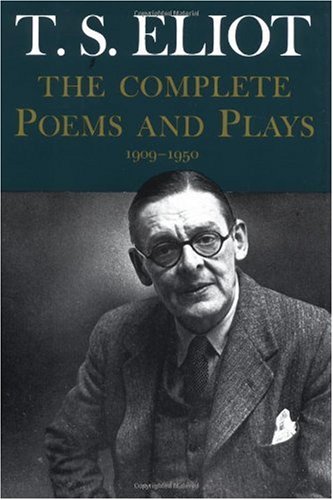
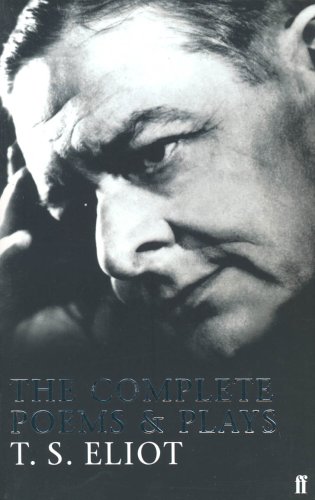
1. Complete Poems and Plays,: 1909-1950
$4.11
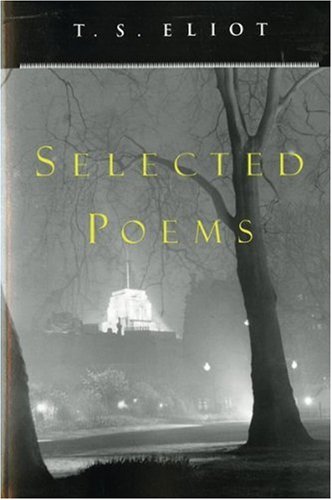
2. T.S. Eliot: Selected Poems (Library
$11.46
3. Voice of the Poet: T.S. Eliot
$16.71
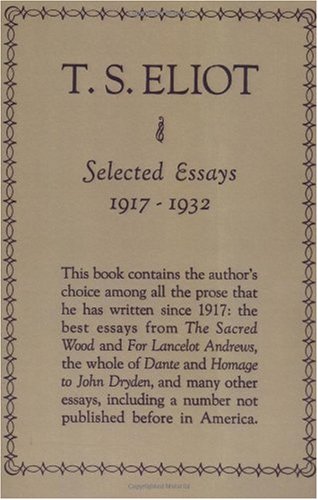
4. Selected Essays
$16.06
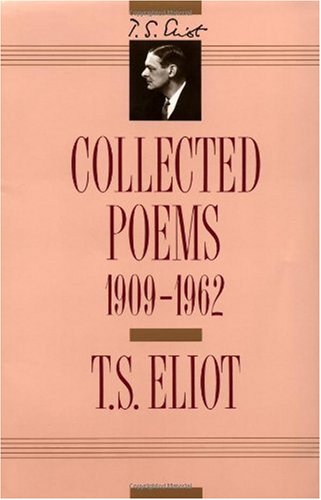
5. Collected Poems, 1909-1962 (Faber
 
$23.19
6. Letters of T.S. Eliot: 1898-1922
$9.47
7. Old Possum's Book of Practical
$10.00
8. The Cambridge Companion to T.
 
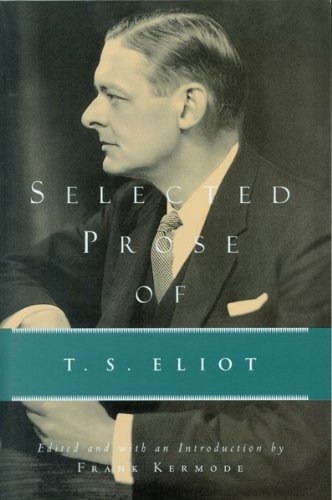
9. Selected Prose of T.S. Eliot
$13.10
10. T.S. Eliot: An Imperfect Life
$13.48
11. Notes Towards a Definition of
$3.73
12. The Waste Land, Prufrock And Other
$24.90
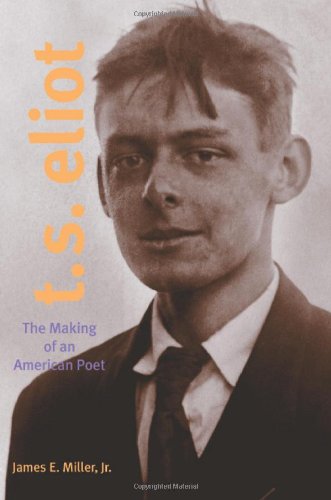
13. T. S. Eliot: The Making of an
$27.95
14. Christianity And Culture
$6.99
15. Painted Shadow: The Life of Vivienne
$7.50
16. A Guide to the Selected Poems
$3.36
17. Old Possum's Book of Practical
 
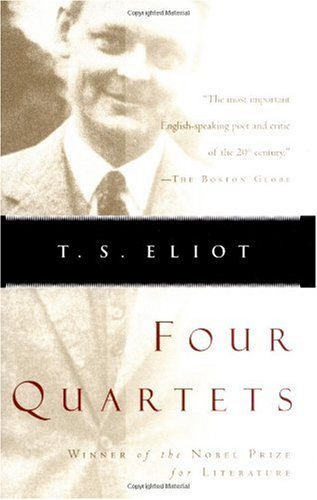
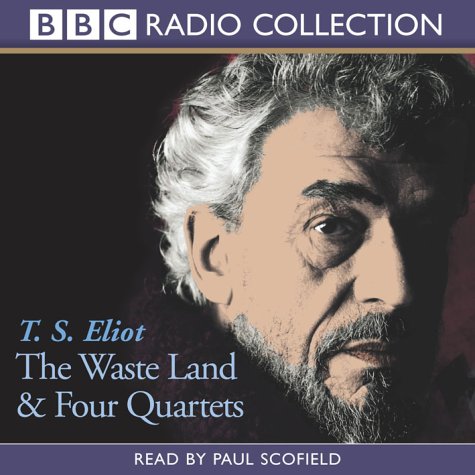
18. Four Quartets
$9.60
19. The Waste Land (Norton Critical
 
20. Selected Essays of T. S. Eliot

1. Complete Poems and Plays,: 1909-1950
by T. S. Eliot
Hardcover: 400 Pages (1952-11-20)
list price: US$35.00 -- used & new: US$22.24
(price subject to change: see help)
Asin: 015121185X
Average Customer Review: 5.0 out of 5 stars
Canada | United Kingdom | Germany | France | Japan
Editorial Review

Amazon.com
Eliot's poetry ranges from the massively magisterial( The Waste Land), to the playfully pleasant (Old Possum's Book of Practical Cats). This volume of Eliot's poetry and plays offers the complete text of these and most all of Eliot's poetry,including the full text of Four Quartets. Winner of theNobel Prize in Literature, Eliot exerted a profound influence on his contemporaries in the arts generally and this collection makes his genius clear.Book Description

This omnibus collection includes all of the author’s early poetry as well as the Four Quartets, Old Possum’s Book of Practical Cats, and the plays Murder in the Cathedral, The Family Reunion, and The Cocktail Party.
... Read more

Customer Reviews (17)

3-0 out of 5 stars Prufrock, yay!Wasteland, boo.
The Love Song of J. Alfred Prufrock is T.S. Eliot at his best.He depicts an entire generation by painting a beautiful and tragic image of the one main character.Eliot's words are both flowing and concise, which is no small feat, and his metaphors and allusions are well chosen and relevant.This poem is absolutely worth reading several times over.


T.S. Eliot's The Wasteland is like the fourth season of Family Guy. It's more of the same from a source that has produced quality work in the past, but falls short this time. Family Guy and T.S. Eliot are each known for their strange connections; T.S. Eliot once compared a skyline to a patient etherized on a table, and Family Guy once compared Ronald Reagan to a toaster. However, in both the newest season of Family Guy and The Wasteland, the randomness gets confusing and just not worth it. Here is how to write a poem like The Wasteland. Copy and paste an introduction and a conclusion from an alternative religion book, come up with some outside the box metaphors, and fill the rest in with pirated foreign literature.

--Ian M.

5-0 out of 5 stars For a T.S. Eliot amateur, this was an excellent introduction!!
While I am only an amateur when it comes to poetry, I believe this collection will satisfy any reader looking for a stimulating and engaging experience.I was introduced to T.S. Eliot in my high school English class and read only two of his poems from this collection:one, The Love Song of J. Alfred Prufrock and two, The Wasteland.If I had more time to spend with these poems and really analyze them, I would get even more out of them.

TS Eliot portrays an intriguing setting in The Wasteland.He alludes to various religions and gods.In particular, Eliot portrayed a modern European society lacking a sense of unity and control.He makes eccentric references to anything from religious structures, blooming flowers, praised figures, historical events, and influential European cities.After reading this poem, I highly recommend reading the novel The Road, by Cormac McCarthy.This piece by McCarthy was strongly influenced by this particular poem.

Who is Prufrock?In Eliot's, The Love Song of J. Alfred Prufrock, he depicts a modern middle-aged man who is very self-conscious; he does not dare speak of love to a woman, which is ironic to the poem's title. The poem epitomizes the frustration and self-consciousness in any human being, which makes it easy to relate to the character.What reader does not enjoy finding familiar satire between the lines of a love poem?

Eliot also references Shakespeare's Hamlet in The Love Song, alluding to his personal insecurity and mental weaknesses, as well as his incapability to handle love appropriately.

Though this is only a small window into T.S. Eliot's assorted collection, I hope I can give you an apposite perspective on his engaging work.I recommend reviewing this collection and strongly encourage spending time with these particular pieces.

5-0 out of 5 stars Eliot Update
Faber and Faber has recently announced they will print "The Complete Prose of T.S. Eliot" in a gargantuan seven-volume set!

Also announced the much anticipated, eagerly awaited second volume of Letters of T.S. Eliot: 1898-1922 edited by Mrs. Valerie Eliot, as well as a completely revised edition of the first volume which will include nearly 200 letters that has surfaced since the initial printing!

Both the seven-volume set and the second edition letters are due out late 2008.

To the all the Eliot nuts out there, this is good news. To those who have not read Eliot's Selected Essays, they are as affecting as his poetry, as important as Johnson, Arnold, and Coleridge in the their times.

5-0 out of 5 stars Still Point of the Turning World
I'm not at all rating this book five stars; that's my rating for T.S. Eliot's plays. This book was the typical library edition and has everything wrong with it: the cover of an old, wise Eliot (why not a young maverick one?), "Complete" in the title when it's not at all complete, big, heavy, hardback and way too literary looking for the passing reader to crack the cover.

But look how much T.S. Eliot you already know. The Wasteland may be a maddingly obscure poem sequence built around a book by Jessie Weston, but Pete Townshend used the idea in a song: "Teenage Wasteland." You know from another song that T.S. Eliot, in "The Love Song of J. Alfred Prufrock" said that life was measured out in coffee spoons. We all know that Old Possum's Book of Practical...plays out dramatically in a musical titled for the last word of that book...Cats. You could have tackled (or rather relaxed with) his most famous poem sequence, Four Quartets and the accompanying readers' guide by Thomas Howard.

But for all those bits of poetic imagery, you still might not stumble on the plays. I've never seen one of Eliot's plays put on, but they make wonderful reading. As an astute reviewer suggested, don't get this volume, which leaves out two of the five plays (or six if you include "Choruses from the Rock," which is not among the best). That reviewer also provided the helpful advice to track down the Faber edition which really does have all the plays. Some of them, notably Murder in the Cathedral, are available in single editions. But don't miss The Confidential Clerk, The Cocktail Party and The Elder Statesman for a great reading experience.

The only other play I know that reads this well is J. M. Barrie's original play of Peter Pan. Murder in the Cathedral is notable because it falls in the Church of England (Anglican) tradition of putting on plays at the Canterbury Festival. Charles Williams also wrote plays related to this event (Thomas Cranmer of Canterbury), as did Dorothy L. Sayers (The Zeal of Thy House, The Devil to Pay). All of which is to say that there is a lot of great dramatic writing to be rediscovered as reading as well as performance (see also my review of Christopher Fry's plays A Phoenix Too Frequent and The Lady's Not for Burning). Many Sayers readers are also aware that she wrote the first radio play for the BBC on the life of Jesus (and updated it to common language), as well as essays on her experience dealing with the Gospel accounts in dramatic form. The best known of these is "The Dogma is the Drama," available in various collections.

5-0 out of 5 stars A pleasure to own!
His language is effortless in its flow and it is conducive to deep meditation in its style. After reading 'Prufrock', and the 'Hollow Men' I got the sense that this is something truly withstanding and classic - one of our bards of the 20th century.
Only a handfull of modern poets stick in my mind - Elliot, Cummings, Rilke, and Yeats are among them! ... Read more


2. T.S. Eliot: Selected Poems (Library of Classic Poets)
by T.S. Eliot
Hardcover: 96 Pages (2006-03-07)
list price: US$7.99 -- used & new: US$4.11
(price subject to change: see help)
Asin: 0517227223
Average Customer Review: 5.0 out of 5 stars
Canada | United Kingdom | Germany | France | Japan
Editorial Review

Book Description
This new addition to the elegant Library of Classic Poets series features selections from one of the best-loved poets of the early twentieth century. Elegantly packaged in a handsome edition with a satin ribbon marker, this volume is the perfect addition to any poetry library. From the prolific T.S. Eliot, a pioneer of modernism, here are his most groundbreaking works, including:

• "The Wasteland"
• "The Love Song of J. Alfred Prufrock"
• "Mr. Eliot's Sunday Morning Service" ... Read more

Customer Reviews (6)

4-0 out of 5 stars The strange and haunting visions of T.S Eliot
It took me sometime before I could genuinely come to understand and appreciate his poetry: yet, nevertheless, the writings of American-born, anglocized author T.S Eliot have always held a peculiar fascination for me, and, it seems, for a number of other writers and laypeople as well. From the personal yet somehow universal, melancholy and self-doubting music of "The love song of J. Alfred Prufrock" to the wild, multi-cultural, history spanning visions of urban chaos in "The Wasteland", Eliot's oeuvre is rich in religious, political, and philosophical themes, and played an enormous role in shaping the development of poetry in the twentieth-century (not to mention, on an obviously less signficant level, my own writing). Reading Eliot's serious poetry, however, requires a great deal of analytical prowess and is often a rather depressing experience (particularly in the beautiful "Prufrock"): nevertheless, those with patience will find that it is richly rewarding and can be appreciated on a superificial level simply for the entrancing rhythm of the music and haunting nature of the imagery, which, though informed by a number of sources, including Shakespeare, Dante, and Baudelaire, are written in a voice which is always distinctive and wholly original.

5-0 out of 5 stars A very good collection of Eliot's poems
If you can only get one book of poems, get this one. It has the most important poems before "Four Quartets". If you want more,get also "Four Quartets" and "Murder in the Cathedral" or, even better,get the collected poems.

5-0 out of 5 stars Inspiring
I admit I don't know a lot about poetry. For that reason I acknowledge that my review of Eliot's work is written with deference to other reviewers, i.e., I rely on their comments after having read Eliot's work. So this review is somewhat synergistic in that I've taken their comments into account as I offer my own observations.

One of my favorites in this work is from "Choruses From 'The Rock'":

"The Lord who created must wich us to create and employ our creation again in His service.
Which is already His service in creating.
For man is joined spirit and body.
Visible and invisible, two worlds meet in man;
Visible and invisible must meet in His temple;
You must not deny the body.
...For the work of creation is never without travail;"

5-0 out of 5 stars The great Eliot at his greatest
T.S. Eliot is a major figure in 20th century literature for criticism, publishing and poetry. On the critical front he is known for his ýrediscoveryý of the Metaphysical poets Donne and Marvell, his collections of essays ýThe Sacred Woodý and ýThe Use of Poetry and the Use of Criticismý; as a publisher he was a director of Faber and built up a stable of ýmoderný poets such as Auden and Ezra Pound.

It is, however, for his poetry that he will surely last and this collection gives a marvelous selection of his works. The first poem in this collection ýThe Love Song of J. Alfred Prufrocký is a masterwork with superb imagery and a marvelous sense of humour and irony as it gives us the words of a man who seems much older than Eliot must have been when he wrote it, it was first published while he was in his twenties.

While some of his poetry seems to miss the mark as too dense and perhaps overly constructed others have rich layers of imagery and allusion that reward a little effort and rereading with a sense of large and vivid meaning and depth. ýThe Waste Landý, one of Eliotýs most famous poems and responsible, along with other poems of the period such as ýThe Hollow Mený, in giving Eliot a reputation as one of the ýdisillusionedý modern poets. Eliot denied this, saying he gave ýthe illusion of being disillusioned.ý ýThe Wasteland is four hundred lines long and is quite enigmatic, some scholars have said that it may have been less enigmatic before Ezra Pound helped and convinced Eliot to cut it back from an original 800 lines.

The last major work in this volume is ýThe Four Quartets.ý It is impossible in a short review to summarise the brilliance of these works. Written in the late thirties they are a masterful summation of the concerns of Eliotýs earlier works and a culmination of his examination of his own personal Christianity.

Between these three peaks are many works almost their equal. ýSweeney Agonistesý, ýAsh Wednesdayý, ýThe Hollow Mený, and excerpts from the ýThe Rocký among them.

To conclude this collection is a wonderful summary of the poetic works of one of the major literary figures of the twentieth century. For a complete overview of Eliot you should read at least one of his plays (ýMurder In The Cathedralý is my favourite) and one of his volumes of critical essays such as the two mentioned earlier. I would recommend this volume to anyone who enjoys poetry, particularly those who enjoy reading poetry over and over again.

5-0 out of 5 stars Great Introduction to T. S. Eliot
I thought that this book was a great introduction to T. S. Eliot. It contains most of his really famous pieces, including The Waste Land, The Hollow Men, Ash Wednesday, A Love Song for J. Alfred Prufrock, and manyothers.If you like it, you might also try "Murder in theCathedral." ... Read more


3. Voice of the Poet: T.S. Eliot (Voice of the Poet)
Audio CD: Pages (2005-03-29)
list price: US$19.95 -- used & new: US$11.46
(price subject to change: see help)
Asin: 0739315358
Average Customer Review: 5.0 out of 5 stars
Canada | United Kingdom | Germany | France | Japan
Editorial Review

Book Description
Featuring rare archival recordings of the featured poet reading his own work!Each program in Random House Audio Voices' exclusive THE VOICE OF THE POET series is accompanied by a book containing the text of the poems and a commentary by J.D.McClatchy. ... Read more

Customer Reviews (5)

5-0 out of 5 stars Reading the peoms the way they were meant to be read.
This audio CD is a must-have for all fans of T. S. Eliot. Poetry is supposed to be read out loud; it is a pleasure and privilege to hear one of the greatest poets of the 20th century read his poems out loud, allowing us to hear the lines the way they were meant to be heard--and read.

This collection contains a short book with an introduction by J. D. McClatchy and the text of all the poem found on the audio CD. The CD contains 9 tracks: La Figlia Che Piange, The Love Song of J. Alfred Prufrock, Gerontion, Sweeney Among the Nightingales, The Waste Land, The Hollow Men, The Journey of the Magi, Ash-Wednesday, and East Coker. The poems are arranged in chronological order, offering insights into the development of both language and themes throughout Eliot's career.

The first track, "La Figlia Che Piange," is one of Eliot's earliest poems and explores, like much of his earlier poetry, the frustrations of a young man and thwarted love. It is a lovely short poem, full of the images that Eliot is well known for. Published at the same time (in the same volume in fact) was also "The Love Song of J. Alfred Prufrock." One of the most well known poems, "The Love Song" is a culmination of Eliot's early poetry.

The highlight of the CD is the reading of "The Waste Land." The epic poem is the longest found in this collection, going over 25 minutes. "The Waste Land" by far is one of my personal favorites and I have read it countless of time. However, reading the poem along with this CD has allowed me to shed new meaning to this enormously difficult and marvelous poem. Eliot dramatizes his reading, allowing the dozens of narratives and narrators to come through. Spinning a multifaceted account of the deterioration of society in the early 20th century, a collage of the decay of love and fidelity, a haunting vision of the death of man and his rebirth; all shifting through time and space, drawing upon different histories and languages and cultures, all coalesced through the eyes of Tiresias.Indeed, "a heap of broken images."

"The Hollow Men" is the worst quality recording found on this CD.However it is still evocative as ever. Eliot's hypnotizing monotone, which prevails much of his readings, is exetremely effective in this case, bringing to life the hopelessness and stagnation of the hollow men.

"The Journey of the Magi" is a particularly fitting poem for December and the holiday season. It marks a progression of Eliot's poetry to more theological themes yet still picks on Eliot's fascination with death and rebirth, ending and beginnings.

"East Coker" is the second highlight of the CD. It is the last track and also one of the last poems Eliot composed before his death in 1965. "East Coker" is the second volume in his masterpiece "The Four Quartets." The poem draws upon Eliot's study into Christianity, philosophy, and mysticism. It is a deep exploration of the meaning of time and change. The poem is almost 15 minutes on the CD. Eliot's reading highlights his supreme command of the English language, his sophistication in diction, rhythm and meter. The first and last of the "East Coker" is engraved on Eliot's grave site in England as his chosen epitaph: in my beginning is my end, in my end is my beginning.

This is a well chosen collection of poems which highlights the body of Eliot's work. Hearing the poems being read by their author is a valuable experience. I definitely recommend this to anyone who reads Eliot and would like to learn more about his poetry.

5-0 out of 5 stars The Voice of the Poet:T.S. Eliot
This is an audiobook of T. S. Eliot reading nine of his best known poems aloud.Among these are "The Lovesong of J. Alfred Prufrock", "Gerontion", "The Wasteland", "The Hollow Men", and "Four Quartets" (also known as "East Coker").

Much of the time, Eliot reads with with a flat monotone, often ending a poem abruptly on a questioning note.Ironically, this technique is surprisingly effective -- particularly with Prufrock and Gerontion.In contrast, Eliot's reading of "The Wasteland" is animated and dramatic.

Before hearing Eliot's reading of "The Wasteland", I never quite connected with or understood that poem -- something which often frustrated me since the remainder of Eliot's poetry resonates with me unlike any other poetry.Although I must confess that much of "The Wasteland" remains a mystery to me, Eliot's reading helped me see the beauty, anxiety and yearning expressed in that poem.I think I even understand what Eliot was getting at in the sections subtitled "A Game of Chess" and "What the Thunder Said".

This audiobook is accompanied by a brief introduction to T. S. Eliot by J. D. McClatchy, a short bibliography and the text of the poems.This audiobook makes an excellent gift or stocking stuffer for a bibliophile or an Eliot aficionado.This is true of the other audiobooks in the Voice of the Poet series as well.

5-0 out of 5 stars Superb!
This was better than expected.I read a lot, esp TSE, have many cds of recorded poetry and already had recordings of his work by "specialist" or celebrity actors, most absolutely dissappointing: you get the feeling that they were going for an effect without having grasped the essences of TSE's poetry, especially wrt the Wasteland from a recorded version of which I expect a lot of specific nuances and hues.When I ordered this product, I didn't set my expectation too high, as poets, though they are the creators, are not always necessarily the best oral communicators.However, TSE was not only amazing in his delivery, pace and colour, his readings actually gave me fresh insights, in some cases revelatory.This is an absolute must for any lovers of poetry.I must add, I was quite surprised at the extent of his accent's anglification.

5-0 out of 5 stars Excellent
You can hear The Waste Land as it was meant to be heard.T. S. Eliot's reading made the poem come alive.Be warned.Not all of the CD is high quality recordings.Some have background noise. Some are low quality.I don't think the tracks are listed anywhere, so I'll list them for you.

1. La Figlia Che Piange
2. The Love Song of J. Alfred Prufrock
3. Gerontion
4. Sweeney Among the Nightingales
5. The Waste Land
6. The Hollow Men
7. The Journey of the Magi
8. Ash-Wednesday
9. East Coker

This is worth it for The Wate Land alone.The rest is just icing on the cake.

5-0 out of 5 stars Just a wonderful experience.
It is a great experience to hear the voice of this master poet. ... Read more


4. Selected Essays
by T. S. Eliot
Paperback: 460 Pages (1950-10-05)
list price: US$23.00 -- used & new: US$16.71
(price subject to change: see help)
Asin: 0151803870
Average Customer Review: 4.5 out of 5 stars
Canada | United Kingdom | Germany | France | Japan
Editorial Review

Book Description

37 essays in an expanded edition of the author's major volume of criticism.
... Read more

Customer Reviews (3)

5-0 out of 5 stars A useful book
The Collected essays are quite useful to my study. They help readers to get further understanding about Eliot's thinking and insight to politics and society in seventeenth and eighteenth centuries. Also, Elito clearly elucidates his idea in logical writing which may be benefitial to readers' writing.

5-0 out of 5 stars Stimulating for any student of literature
T.S. Eliot was the dominant figure in modernist literature not just because of his poetry, but also because of his criticism which changed our view of English literature in ways which can still be felt today. Heresurrected the forgotten John Donne and had him eclipse John Milton asidol of poetry. He showed that Shakespeare was not the only playwright ofhis time. He was brillitant at explaining what made modernist literaturedifferent from its perdecessors.

Eliot's style is a pleasure to readcompared to what passes as lit crit today. Many of his insights may seemoutdated, but any student of literature will find fascinating views,especially about Elizabethan literature.

4-0 out of 5 stars Only a Poet?
I was very surprised that I got through this book.It is not every day that a person will pick up a collection of essays on Classical, Elizabethan and other types of literature, for enjoyments sake.Eliot really outdidhimself with his reviews of the literature that he was surrounded by.Thedefinite reads, if you do not want to go through all the essays, are theessays "Dante", "Hamlet and his Problems" and "ADialogue on Dramatic Poetry"."Dante" is a beuatiful studyon both the "Divina Comedia" and "Vita Nouva". "Hamlet" is a putdown on the play that everyone "loves"so much--with the exception of the writer of this sentence. "Dialogue" is a well crafted arguement of the essence of thepoetic plays and how they fit into modern--it was written in 1922--times. This book is pure genius, although at points rather"holier-than-thou."Eliot was a genius and he makes sure to letyou know it in his essays. ... Read more


5. Collected Poems, 1909-1962 (Faber Paper Covered Editions)
by T. S. Eliot
Paperback: 238 Pages (1974-01)
list price: US$25.81 -- used & new: US$16.06
(price subject to change: see help)
Asin: 0571105483
Average Customer Review: 5.0 out of 5 stars
Canada | United Kingdom | Germany | France | Japan
Editorial Review

Book Description

Published two years before his death, this collection includes all of Eliot’s poetry that he wished to preserve.
... Read more

Customer Reviews (23)

5-0 out of 5 stars Delightful additionto our collection!
This a great collection of poems from the past!If you enjoy whimsy, this is for you!

5-0 out of 5 stars one of the best ever
with eliot, a maximum of content is achieved through a FORM worked with a
care and conciousness not seen perhaps since the greeks. he understood,
as he once wrote, that the novel form ended with flaubert. in the centuries after picasso and stravinsky there is no place for anything in
literature which makes people remain sitting, whithout standing and perhaps dancing. the same thing could be said about pound, very different though very twin.

4-0 out of 5 stars Greatness compromised
The Eliot of despair, the Eliot of 'Prufrock' and 'Wasteland' is contended with and overcome by the Eliot of the 'Quartets'. The message of modern mankind's meaninglessness, the broken fragments ( of Tradition) shored against his ruin is replaced by the vision of sacred turning, a Christian vision of redemption. Eliot is a writer whose work and life break down into these two distinct periods each of which has its champions in defining what is best in him.
As one raised on 'April is the cruelest month, breeding lilacs out of the dead land' and 'Let us go then you and I when the evening is spread out against the sky, like a patient etherized upon a table' the most memorable lines are certainly of the first phase where it ends not with a bang but with a whimper.
Yet my admiration for the hypnotic power of Eliot's memorable lines is strongly qualified by my knowledge of his 'Burbank with a Baedaker, and Bluestein with a Cigar' with his all too fashionable literary anti- Semitism. Of course Eliot was not preaching death camps and extermination but he did connect his work to the tradition of Christian Anti- Semitism.
Thus I have always had difficulty being comfortable with my 'enjoying of Eliot's poetry. And I have never been able to sympathetically read 'The Quartets.' They havealways seemed to me to be too impersonal characterless and abstract.
Eliot who for most of the century strode the English Departments as if he were a colossus did noble work in reviving interest in 'The Metaphysicals' but somehow failed in my mind to write a poetry humanly rich in the deepest sense.

5-0 out of 5 stars Truly, one of the giants
When you think of the best poets ever, T.S. Eliot is one of those that comes to mind. His work is well crafted, intelligent, beautifully written, and has a flow to it that few poets can match. And this is a fine collection for the Eliot lover or for the reader unfamiliar with Eliot. It's divided into several sections. The first section is his Prufrock section, poems from 1917, which contains probably his finest poems: "Prufrock", "Preludes" "Rhapsody on a Windy Night", "Hysteria", among others. Then there is the Poems 1920 section which also contains many fine poems ("Sweeney Erect" and "The Hippopotamus" being my favorites). Then follows his masterpiece The Wasteland. Then The Hollow Men which is followed by the wonderful Ash Wednesday. Then the Ariel Poems (which contains "Journey of the Magi"). Then there are two unfinished poems, "Sweeney Agonistes" and "Coriolan" which I thought were weak. Maybe they would have been great had he ever finished them. Then there is a section called minor poems followed by the mediocre "Choruses from 'The Rock.' And then there is what I consider to be his true masterpiece, "Four Quartets." And the book finishes with some occasional verses, one of which is a sweet and touching poem to his wife. This is a great collection of poems.

5-0 out of 5 stars Good stuff
Yep, this is a great collection of Eliot's works. I initially found out about Eliot throught the Movie 'Apocalypse Now' in which Brando is heard reciting the poem 'The Hollow Men'. The poem sounded so good I hunted it down and came across this little book.

My favourite poems would have to be 'The Hollow Men', 'Love song of Prufrock', 'Ash Wednesday' and 'Rannoch, by Glencoe (perfectly captured, drive through Rannoch and you'll see ;-)

Yep, definetly worth a read. ... Read more


6. Letters of T.S. Eliot: 1898-1922 (Letters of T. S. Eliot, 1898-1922)
by T. S. Eliot, Valerie Eliot
 Paperback: 704 Pages (1990-09)
list price: US$31.00 -- used & new: US$23.19
(price subject to change: see help)
Asin: 0156508508
Average Customer Review: 4.0 out of 5 stars
Canada | United Kingdom | Germany | France | Japan
Editorial Review

Book Description
Eliot's correspondence from his childhood in St. Louis until he had settled in England and published The Waste Land. Edited and with an Introduction by Valerie Eliot; Index; photographs.
... Read more

Customer Reviews (1)

4-0 out of 5 stars a poet in his prose
No biography of Eliot could better capture the thoughts and personality of the young poet than these letters.Eliot had a lively correspondence with so many, including family, friends, editors, and partners in verse.Eventhe short letters -- like the ones in which Eliot simply announces to hiscorrespondent that he's exhausted and doesn't want to write anything --give a glimpse of how Old Possum acted.

Eliot's poetry is so cerebral andallusive that when reading it, one can feel at his mercy.In his lettershe is far less in control, and the contrast is fascinating. ... Read more


7. Old Possum's Book of Practical Cats, Illustrated Edition
by T. S. Eliot
Hardcover: 64 Pages (1982-08-30)
list price: US$16.00 -- used & new: US$9.47
(price subject to change: see help)
Asin: 0151686564
Average Customer Review: 4.5 out of 5 stars
Canada | United Kingdom | Germany | France | Japan
Editorial Review

Book Description

Eliot’s famous collection of nonsense verse about cats-the inspiration for the Andrew Lloyd Webber musical Cats. This edition features pen-and-ink drolleries by Edward Gorey throughout.
... Read more

Customer Reviews (56)

5-0 out of 5 stars "Cats" lovers delight!
This is a must have for anyone who loves the broadway musical "Cats".Totally delightful!

5-0 out of 5 stars It's about cats, cats, and more Cats.
I had read this book before and loved it, but when I met Boris, a real, live version of Rum Tum Tugger, I had to buy a copy to show his owner.
It is amazing how little had to be done to turn these poems into a great musical comedy.I am, of course, talking about Cats. Most of the poems went directly into the show without any change whatever in their wording, and only three songs were added.Let's give full credit to Mr. Webber,It took a musical genius to do that, and one of the added songs, Memories, could stand alone as a masterpiece in any company, but most of the delight of the show comes from the wonderful feline characters created in this book.
Jennyanydots, Old Deuteronomy, Gus the theatre cat, Spindleshanks, Bustipher Brown, McCavity, Mr. Mistofflees, Mungo Jerry, and Rumpleteaser all moved effortlessly from page to stage with no changes.That has to be some sort of record.If you loved Cats (the show) you need to read this book.If you love cats (the critters) you'll want to read this book.If you like poetry, you should read this book. If you like dogs, read the battle of the Pekes and the Pollicles.(You can skip over the part about the intervention of the great rumpus cat.)
It was written for his godchildren, but it's a great read for everyone.It's not expensive, so get it to read to your children, but read it for yourself first.

5-0 out of 5 stars Cats
Great book for any cat lover

author of "Hobo Finds A Home"

3-0 out of 5 stars Keeping Up at the Opera
Read the book if you want to better understand the acts of the play CATs

4-0 out of 5 stars The basis for "CATS"
I enjoyed the poems so much that I gave the book to a friend as a gift. ... Read more


8. The Cambridge Companion to T. S. Eliot (Cambridge Companions to Literature)
Paperback: 279 Pages (1995-02-24)
list price: US$25.99 -- used & new: US$10.00
(price subject to change: see help)
Asin: 0521421276
Average Customer Review: 3.5 out of 5 stars
Canada | United Kingdom | Germany | France | Japan
Editorial Review

Book Description
An international team of leading T.S. Eliot scholars contribute studies of different facets of the writer's work to build up a carefully coordinated and fully rounded introduction. Five chapters give a complete account of Eliot's poems and plays, while others assess the major aspects of his life and thought. Later chapters place his work in historical perspective. There is a full review of Eliot studies, and a useful chronological outline. Taken as a whole, this Companion comprises an essential handbook for students and readers of T.S. Eliot. ... Read more

Customer Reviews (2)

3-0 out of 5 stars Kindle edition has problems
This is a very informative book, and it is well written.But, the Kindle edition has format problems.The end marks don't link, it is missing chuncks of words on some locations (one page has about 10% of the words are missing) several letters per word are missing so the page reads like having to solve a puzzle. On a different page the text is overwritten by other text.This is not in the part you get as the sample.I don't know how they will let anyone know the issue has been fixed, but I just wanted to apply an FYI.

4-0 out of 5 stars Good Guide
While nothing compares to actually reading T.S. Eliot, this book is a good introduction for new readers of T.S. Eliot. I would suggest that you read some of his major works first then read this book. ... Read more


9. Selected Prose of T.S. Eliot
by T. S. Eliot
 Hardcover: 320 Pages (1975-11)
list price: US$10.95
Isbn: 0151807027
Average Customer Review: 4.5 out of 5 stars
Canada | United Kingdom | Germany | France | Japan
Editorial Review

Book Description

Thirty-one essays-categorized as “essays in generalization,” “appreciations of individual authors,” and “social and religious criticism”- written over a half century. This volume reveals Eliot’s original ideas, cogent conclusions, and skill and grace in language. Edited and with an Introduction by Frank Kermode; Index. Published jointly with Farrar, Straus & Giroux.
... Read more

Customer Reviews (6)

5-0 out of 5 stars T.S. Elliot
Wonderful book, a treasure; it arrived quickly and in beautiful shape.I highly recommend this book.

4-0 out of 5 stars The Tradition read again with the years
When I was in graduate school Eliot was considered the great literary critic of the twentieth century, the person who set the tone . His understanding of the Literary Tradition and how each new author altered the way we read the whole was part of the ' religion' of literary studies. So too his essays on Dante and on the Metaphysicals ( his placing Donne at the center of the Tradition) and his famous reading of Hamlet in which he argued that there was emotion in excess of the objective situation, i.e. that there was no appropriate 'objective correlative'. As a graduate student I somehow went along with the crowd and did not have much to say about Bleider with a Burbank,and Bluestein with a Cigar' i.e. the culturally anti- Semitic Eliot. That Anti- Semitism along with a certain racism and anti- Feminism are too we have learned parts of the Literary Tradition .So some of the most beautiful and great works of literary creation are marred by moral failings. How ironic that Eliot who was a spiritual teacher in time should have been so faulty in this way .

4-0 out of 5 stars Ascerbic, crisp and correct-- brilliant essays.
An excellent selection of essays by Eliot. He is at his best in many of these-- ascerbic, crisp and correct. I am constantly amazedby the number of people who have opinions about the ideas and theories of Eliot, but who have never read his essays themselves. I suggest that before taking umbrage at what he is supposed to have said, a student of the modernists should at least read a bit of what he did say.

This selection is broken into two categories: Literary Criticism and Social and Religious Criticism. Essays such as "Tradition and the Individual Talent" and "What is a Classic?" (compare and contrast with G. Stein in "What are Masterpieces?") are particularly worth the time to read.

I wish that Kermode had included more of the social and religious essays and that he had not excerpted as heavily as he did throughout the book. I would personally rather read a longer book consisting of complete essays than having such a high percentage of the selection consisting of excerpts. Of the meagre three essays in the social and religious section, two were excerpted rather than being published in their entirety. Too bad.

5-0 out of 5 stars What criticism should be.
Eliot's reputation has taken a beating in the last 20 years. He has been charged with anti-semitism, racism, elitism, and even misogyny. All of these charges are basically true. Nevertheless, as a critic his judgements are sound and dead-on. Read either "Traditon and the individual Talent" or "Dante" from this book and tell me if you think I am wrong. The book is worth the price for these two essays alone.

4-0 out of 5 stars Worthy collection
I found this book to be a useful compendium of essays that are usually scattered or incompletely represented in anthologies.It's an excellent supplement for a course on Eliot's work or to learn more about his criticalperspectives and how they shifted over time.Very worthwhile. ... Read more


10. T.S. Eliot: An Imperfect Life
by Lyndall Gordon
Paperback: 752 Pages (1999-12)
list price: US$21.95 -- used & new: US$13.10
(price subject to change: see help)
Asin: 0393320936
Average Customer Review: 3.5 out of 5 stars
Canada | United Kingdom | Germany | France | Japan
Editorial Review

Book Description
Lyndall Gordon's biographical work on T. S. Eliot has won many dramatic accolades. In this "nuanced, discerning account of a life famously flawed in its search for perfection" (The New Yorker), Gordon captures Eliot's "complex spiritual and artistic history . . . with tact, diligence, and subtlety" (Boston Globe). Drawing on recently discovered letters, she addresses in full the issue of Eliot's anti-Semitism as well as the less-noted issue of his misogyny. Her account "rescues both the poet and the man from the simplifying abstractions that have always been applied to him" (New York Times), and is "definitive but not dogmatic, sympathetic without taking sides. . . . Its voice rings with authority" (Baltimore Sun). Praised by Cynthia Ozick as "daring, strong, psychologically brilliant," Gordon's study remains true to the mysteries of art as she chronicles the poet's "insistent search for salvation." ... Read more

Customer Reviews (10)

5-0 out of 5 stars One of the best biographies of anyone
I've probably read hundreds of biographies in my life and this one stands out as one of the most literate and fascinating.I've actually begun to read it a second time and I can't remember the last time I reread a biography.Yes, it's complex and not the standard "Eliot's favorite toothpaste was Crest" kind of minutiae that seldom are more than compendiums of trivia.It focuses on Eliot the poet and thinker and tortured soul.If that's not what you're looking for, read something else.

1-0 out of 5 stars The most frustrating and subjective biography ever written!!
I have always been impressed with the man T.S. Eliot but I cannot say the same about his biogrpaher, Lyndall Gordon.This book made my eyes go buggy and released the bats in the bellfry of my brain!I read this book when I was very sick and it was a very poor choice to say the least.I found her writing style thick with euphemisms, abrstractions, and other vague notions.Very little is mentioned about the man Eliot himself!What a ridiculous concept for a biography.She includes far too many segments of his poetry that only make sense in context.She spews them all over the book and leaves the reader wondering aloud, "Say what?".Though this book has a marvelous, intriguing cover it has nothing but blurry accounts of the man, T.S. Eliot.Find another biographer and you will be better off.

1-0 out of 5 stars The most frustrating and subjective biography ever written!!
I have always been impressed with the man T.S. Eliot but I cannot say the same about his biogrpaher, Lyndall Gordon.This book made my eyes go buggy and released the bats in the bellfry of my brain!I read this book when I was very sick and it was a very poor choice to say the least.I found her writing style thick with euphemisms, abrstractions, and other vague notions.Very little is mentioned about the man Eliot himself!What a ridiculous concept for a biography.She includes far too many segments of his poetry that only make sense in context.She spews them all over the book and leaves the reader wondering aloud, "Say what?".Though this book has a marvelous, intriguing cover it has nothing but blurry accounts of the man, T.S. Eliot.Find another biographer and you will be better off.

2-0 out of 5 stars Sort of awful
The biographer is so obsessed with Eliot's enigmatic inner state that she forgets to mention the things that happened to him during his life.Gordon speaks of Eliot's desire to enlist in WWI without ever explaining why; she never mentions his attitude toward World War II; she doesn't say that he was expelled from high school, what he majored in at college, what his income was during his years of fame, what kind of contact he kept in with his family and how they thought of him later in his life, what kind of contions he liked to write under in the early years, why he put so many allusions in his poetry if he disdained allusion-hunting.On the other hand, we do get excruciatingly detailed biographies of women like Emily Hale, Mary Trevelyan, and Vivienne Haighwood.The book tries to bore into Eliot's psyche and present all of his poetry as autobiographical, despite the damage done to readings of both the life and the poetry.

4-0 out of 5 stars Spirituality, a key to Eliot
This biography is well-done, far superior to Peter Ackroyd's dull and uninspired "Life."What's most important about Lyndall Gordon's biography is her ability to provide us with a roadmap of Eliot's spiritual life and growth, which is a key to grasping the import of Eliot's poems.The inner life, by definition, is extremely difficult for someone else to grasp, and even more difficult to describe for others, but Gordon has managed to arrive at an understanding of Eliot's spiritual life, and to put it into good solid prose for the rest of us.I found this book to be most helpful.Gordon's insights into the inner life of T.S. Eliot are recommended for anyone interested in the man and the poems. ... Read more


11. Notes Towards a Definition of Culture
by T.S. Eliot
Paperback: 124 Pages (1973-01-01)
list price: US$17.70 -- used & new: US$13.48
(price subject to change: see help)
Asin: 0571063136
Canada | United Kingdom | Germany | France | Japan

12. The Waste Land, Prufrock And Other Poems
by Caroldean K. Cummings, T. S. Eliot
Paperback: 80 Pages (2005-01-31)
list price: US$4.99 -- used & new: US$3.73
(price subject to change: see help)
Asin: 1420925784
Average Customer Review: 4.5 out of 5 stars
Canada | United Kingdom | Germany | France | Japan
Editorial Review

Amazon.com Audiobook Review
After sitting through T.S. Eliot's reading of "The Waste Land," listeners may be inclined to hang up the earphones for a spell. There are no flaws to Eliot's steady-toned interpretation; in fact, his delivery is quite remarkable in its ability to match the poem's constant, somber mood. It's just that 25-plus minutes of Eliot's desolate landscapes--rendered even more real by the author's incessant tones--can wear on the emotions.

In addition to the full-length version of "The Waste Land," this recording includes Eliot's stirring narration of "The Hollow Men," "Sweeney Among the Nightingales," and "Macavity the Mystery Cat." Listen to Eliot read from "The Waste Land." Visit our audio help page for more information. (Running time: 47 minutes, 1 cassette) --Rob McDonald Book Description

This volume includes the title poem as well as “The Love Song of J. Alfred Prufrock,” “Gerontion,” “Ash Wednesday,” “Sweeney Among the Nightingales,” and other poems from Eliot’s early and middle work. “Eliot has left upon English poetry a mark more unmistakable than that of any other poet writing in English” (Edmund Wilson).
... Read more

Customer Reviews (21)

2-0 out of 5 stars The Waste Land -- Audio CD-- www.bnpublishing.com
The Waste Land

From the listing this item appears to be a recording of The Waste Land by T.S. Eliot, read by the poet himself; but it's not, it's a performance by another reader, and therefore it had (to me) no interest; it was not what I wanted or needed.I suggest that the product description should be made clearer, so that other customers do not make the same mistake.

5-0 out of 5 stars Undead City
T.S. Eliot is a genius. The Wasteland is, by far, the best poem I have ever read. It is a bit difficult to get through, but I'm sure if you are thinking of picking up this book you are not looking for light reading. Also, of all the editions I've read, I think this one is the best. The notes on the reading are helpful and explain the text fairly well.

4-0 out of 5 stars a good edition of Eliot for the casual reader
I found this edition by Penguin to be very useful for a casual reading.The notes on the poems, in particular "the Waste Land," are detailed enough to give the reader a perception of Eliot's vast literary knowledge and its effect on his poems.However, the notes are inadequate if your purpose is to deeply understand the background of Eliot's complex and difficult poetry.So if you are looking for deep insights, I would recommend the Norton Critical Edition.For the normal reader, this is satisfying and straightforward.

5-0 out of 5 stars Greatest Poet of the Century
I think perhaps the wasteland has been to long interpeted as a lament, our a lecture, or even a statement about disillusioment. To me it seems to be the story of a non commital spiritualist lingering on the edge Nihilism, confused in pain and feeling empty as if no philosophy has prover satisfactory in his thirst for truth. I have known the morbid and dark mindstates Eliot describes, and I think that is what the wasteland is: a portrait of intense mental and spiritual torment, embellished with symbolism and shifting voices. But that is essentialy what it is, though each voice is distinct it seems to me that the torment of one man leaps between changing but always hinting that they are all his. It is in a way a dramatation of the utimate feelings of man between rationalism and Nihilism and hating both. Feeling that they are frauds and that the only truth is in the empty tired nothingness.

3-0 out of 5 stars The Life Of Man As A Dubious Experience
This volume includes T. S. Eliot's Prufrock and Other Observations (1917), Poems (1920), and The Waste Land (1922), and thus provides readers with a fair introduction to the work of one of the twentieth century's greatest poets. The American expatriate was a genuine original, bringing forth a new Modernist voice at a time when the movement was at its beginning and Edwardian poetry still carried the day in England.

Clipped, dry, angular, and intellectual if still emotionally sensitive, Eliot's vision of deserted midnight urban streets, ever-present enveloping yellow or brown fog, doubt-obsessed social misfits ("Shall I part my hair behind? Do I dare to eat a peach?" "Do I dare disturb the universe?"), and city dwellers quietly ensnared in a mundane round of workaday routine had an enormous impact on the cultural scene of the period. If the poet doesn't strictly focus on the ugly, he does focus on the unadorned and mundane detritus of civilization in the immediate: "morning comes to consciousness / of faint stale smells of beer / from the sawdust-trampled streets." He speaks of "grimy scraps" of "newspapers from vacant lots," "broken blinds and chimney-pots," and of "raising dingy shades / in a thousand furnished rooms," as if the inexorable void of outer space was present in the next flat and steadily closing in. Even "the evening" "is spread out against the sky / Like a patient etherized upon a table."

Human consciousness and human nature are hesitant at best and deeply troubled, in any number of ways, at worst: sleep reveals "a thousand sordid images" of which the "soul" is "constituted," and the palms of "both hands" are "soiled."The poet states that "There will be time to murder and create," and 'Sweeney Erect' describes the act of sexual intercourse in desperate, awkward, unfulfilling, and bestial terms. In fact, nature in all its manifestations is largely repugnant to Eliot; 'Sweeney Erect' literally describes female genitalia as the vagina dentata: "This withered root of knots of hair / Slitted below and gashed with eyes / This oval O cropped out with teeth." Nor are the seasons a source of comfort: "April is the cruellest month, breeding / Lilacs out of the dead land, mixing / Memory and desire," he says, and suitably, most of the early poems speak only gravely of autumn and winter. The "soft October night" mentioned in 'The Love Song of J. Alfred Prufrock' startles, since the image it conjures slightly betrays traditional associations of comfort and perceived beauty.

During the period in which the poems were written, Eliot was in the throes of a very troubled marriage to the mentally unstable Vivienne Haigh-Wood, which explains much of the revulsion and guilt-ridden despondency expressed. Eliot was projecting and transposing: history has shown that the poet frequently acted without responsibility and integrity towards Vivienne and their severe personal problems, and thus the vengeful Furies that appear among the dramatis personae in a later Eliot drama were real forces in the poet's psyche. Eliot's inability to cope with Vivienne resulted in moral and ethical failures on his part: the real waste land was Eliot's own perception of his life and reaction to it.

But in his later work, Eliot's fervent religious beliefs would blossom to the fore; much of that poetry would be underscored by a starkly expressed belief in Christian salvation and the potential resurrection of the spirit.

Eliot was not an admirer of the Romantic school, and thus his urban landscapes are neither post-Romantic nor decadent environments, but simply sterile cityscapes devoid of any quality that genuinely support the promise inherent in human existence. However, though Eliot decried the solipsism of the Romantics, his own early work is often pinched, parsimonious, and reductive to the point of constriction.

'The Waste Land,' which is accompanied by five dense author-imposed pages of tedious explanatory notes (which ostensibly insure that the reader understands the poem contains dozens of references to the Bible, Ovid, Sappho, St. Augustine, Dante, Milton, Shakespeare, Baudelaire, Frazer, and even Herman Hesse, among others) is particularly obscure, and therefore solipsistic in its own fashion: its intended audience was not the common man on the street by any means, but the clever, educated, well read, and competitive armchair intellectual of the kind that populated the literary circles in which the author then moved. Aptly titled, 'The Waste Land' is a tedious academic game and a triumph not of poetry but of marketing, with multiple lines like "Weialala leia Wallala leialala" and "Co co rico co co rico" that are guaranteed to lock its audience out.

Eliot may have shunned Romanticism, but he never escaped the powerful romantic elements in his own nature; this is apparent right at the beginning of his published work with 1917's 'The Love Song of J. Alfred Prufrock,' which famously ends with "the mermaids singing, each to each" and Prufrock observing, "I do not think they will sing to me." "I should have been a pair of ragged claws / Scuttling across the floor of silent seas" can also be interpreted in terms of romantic, even rebellious, longing: the tone is different from that broadly found in Blake, Wordsworth, Shelley, and Byron, but the desire for unrestricted freedom, even oblivious freedom, is actively present nonetheless.

Even if intended ironically, 'Rhapsody On A Windy Night' is romantically titled, and the later 'Marina' ("What images return...O my daughter"), 'Ash Wednesday' (1930), and 'Four Quartets' would be thoroughly suffused with longing, desire, and sense of loss. In fact, some may interpret Eliot's fervent Protestantism as the final manifestation of this restless trend in his personality.

Since in his early work Eliot's poetry is more satisfying on a line by line basis ("Webster was much possessed by death / And saw the skull beneath the skin"), a more complete portrait of the poet and his work is available in The Complete Poems and Plays 1909 - 1950 (1971).


... Read more


13. T. S. Eliot: The Making of an American Poet, 1888-1922
by James E. Miller Jr.
Paperback: 492 Pages (2007-01-01)
list price: US$25.00 -- used & new: US$24.90
(price subject to change: see help)
Asin: 0271027622
Average Customer Review: 5.0 out of 5 stars
Canada | United Kingdom | Germany | France | Japan
Editorial Review

Book Description
Late in his life T. S. Eliot, when asked if his poetry belonged in the tradition of American literature, replied: "I'd say that my poetry has obviously more in common with my distinguished contemporaries in America than with anything written in my generation in England. That I'm sure of. . . . In its sources, in its emotional springs, it comes from America." In T. S. Eliot: The Making of an American Poet, James Miller offers the first sustained account of Eliot's early years, showing that the emotional springs of his poetry did indeed come from America.Born in 1888 in St. Louis, Missouri, T. S. Eliot grew up along the Mississippi River, only a few miles down river from Hannibal, the boyhood home of another great American writer, Mark Twain. Miller recounts Eliot's early years in St. Louis schools and follows him in the summers as he vacationed with his family in their Gloucester, Massachusetts, home perched on the Atlantic Ocean's edge. In 1905 at the age of seventeen, Eliot left the Midwest for what would prove to be a lasting separation-attending Milton Academy in Massachusetts for one year and then Harvard for nine years, as an undergraduate and as a graduate student in philosophy. The first time he ventured abroad was 1910, when he spent a crucial year studying in Paris and forming a deep friendship with the Frenchman Jean Verdenal. It was not until 1914, when Eliot was 26 years old, that he left America for England-and found reasons to stay there permanently, becoming a British citizen in 1927.Miller challenges long-held assumptions about Eliot's poetry and his life. Eliot himself always maintained that his poems were not based on personal experience, and thus should not be read as personal poems. But Miller convincingly combines a reading of the early work-from his earliest poems through 1922, the year The Waste Land was published-with careful analysis of surviving early correspondence, accounts from Eliot's friends and acquaintances, and new scholarship that delves into Eliot's Harvard years. Ultimately, Miller demonstrates that Eliot's poetry is filled with reflections of his personal experiences: his relationships with family, friends, and wives; his sexuality; his intellectual and social development; his influences.Publication of T. S. Eliot: The Making of an American Poet marks a milestone in Eliot scholarship. At last we have a balanced portrait of the poet and the man, one that takes seriously his American roots. In the process, we gain a fuller appreciation for some of the best-loved poetry of the twentieth century. Eliot may have lived most of his life abroad, but he was and continued to be an American poet. ... Read more

Customer Reviews (1)

5-0 out of 5 stars Close-up of an enigmatic young man
This is a fascinating book that throws a flood of light on matters about which one had long been curious. Eliot's youth was intense and privileged, a crisscross of stimuli shaping a great poet, who here more than ever is seen as the product of American soil. There are "paths not taken" and "jolly corners" on every side and one could project from this biography a hundred possible Eliots. That the author of so revolutionary as poem as "Prufrock" (at age 23) should devote years to a thesis on F. H. Bradley is only one of the paradoxes of this career.

The puzzles of Eliot's sexuality are illuminated by the provision of a social context in Bostonian Bohemia (which gave Eliot a rather bad reputation among his Harvard elders). He had trouble loving, let alone falling in love with, women: "I should find it very stimulating to have several women fall in love with me -- several, because that makes the practical side less evident." Pacing city streets at night, he was tormented by restless urges, often perverse and obscene. His scabrous wit was laced with ancestral puritan contempt for sex.

The figure of Jean Verdenal, the most lovable in these pages, looms as being for Eliot what Hallam was for Tennyson, and we also meet a brilliant young Yorkshireman, Karl Henry Culpin. Both died in the Great War in 1917. "The Waste Land" offers itself to be read anew as an "anthem for doomed youth."

Eliot's impulsive, unconsummated and catastrophic marriage was the mutual gravitation of two radically conflicted people who thought they understood one another and could each be the other's salvation -- "the awful daring of a moment's surrender" made possible only by not giving themselves time to think.

Throughout the story one is aware of Eliot's stubborn, quirky intelligence, processing the material of his life with unfailing virtuosity and self-confidence, and able to take deep plunges into many domains of "knowledge and experience" (notably in three years' study of Sanskrit and Eastern religion under Woods, Lanman and Anesaki).

Miller commits some odd solecisms, calling the Pantheon (rue Soufflot) the Parthenon, attributing "pray for us at the hour of our death" to the Lord's Prayer, referring to "Wilde's opera, Salome," but his archeology of the poet's youth deals in a sensitive and scholarly way with its sources, making up for various Aspernian holocausts, and he does not exceed the bounds of sensible speculation in his biographical decipherment of the poems. ... Read more


14. Christianity And Culture
by T.S. Eliot
Paperback: 208 Pages (2007-03-15)
list price: US$27.95 -- used & new: US$27.95
(price subject to change: see help)
Asin: 1406758582
Average Customer Review: 4.0 out of 5 stars
Canada | United Kingdom | Germany | France | Japan
Editorial Review

Book Description
Text extracted from opening pages of book: Christianity and Culture The Idea of a Christian Society AND Notes towards the Definition of Culture BY T. S. Eliot A Harvest Book HARCOURT, BRACE AND COMPANY NEW YORK 1940, 1949 by T. S. Eliot All rights reserved. No part of this book may be reproduced in any form or by any mechanical means, including mimeograph and tape re corder, without permission in writing from the publisher. Printed in the United States of America Contents The Idea of a Christian Society I Preface 3 Notes 52 Postscript 69 Appendix 71 Notes towards the Definition of Culture 79 Preface 83 Introduction 85 i. The Three Senses of Culture 93 n. The Class and the Elite 107 in. Unity and Diversity: The Region 123 iv. Unity and Diversity: Sect and Cult 141 v, A Note on Culture and Politics 158 vi. Notes on Education and Culture: and Conclusion 171 APPENDIX: The Unity of European Culture 187 err? CP 6307542 The Idea of a Christian Society 4 Christianity and Culture has appeared too recently for me to have made use o it). And I am deeply indebted to the works of Jacques Maritain, es pecially his Humanisme integral. 1 trust that the reader will understand from the beginning that this book does not make any plea for a religious revival in a sense with which we are already familiar. That is a task for which I am incompetent, and the term seems to me to imply a possible separation of religious feeling from religious thinking which I do not accept or which I do not find ac ceptable for our present difficulties. An anonymous writer has recently observed in The New English Weekly ( July 13, 1939) that men have lived by spiritual institutions ( of some kind) in every society, and also by political institutions and, indubitably, by eco nomic activities. Admittedly, they have, at different periods, tended to put their trust mainly in one of the three as the real cement of society, but at no time have they wholly excluded the others, because it is impossible to do so. This is an important, and in its context valuable, distinc tion; but it should be clear that what I am concerned with here is not spiritual institutions in their separated aspect, but the organisation of values, and a direction of religious thought which must inevitably proceed to a criticism of political and economic systems. CHAPTER I THE fact that a problem will certainly take a long time to solve, and that it will demand the attention of many minds for several generations, is no justification for postponing the study. And, in times of emergency, it may prove in the long run that the problems we have postponed or ignored, rather than those we have failed to attack success fully, will return to plague us. Our difficulties of the moment must always be dealt with somehow: but our permanent dif ficulties are difficulties of every moment. The subject with which I am concerned in the following pages is one to which I am convinced we ought to turn our attention now, if we hope ever to be relieved of the immediate perplexities that fill our minds. It is urgent because it is fundamental; and its urgency is the reason for a person like myself attempting to address, on a subject beyond his usual scope, that public which is likely to read what he writes on other subjects. This is a subject which I could, no doubt, handle much better were I a profound scholar in any of several fields. But I am not writ ing for scholars, but for people like myself; some defects may be compensated by some advantages; and what one must be judged by, scholar or no, is not particularised knowledge but one's total harvest of thinking, feeling, living and observ ing human beings. While the practice of poetry need not in itself confer wis dom or accumulate knowledge, it ought at least to train the mind in one habit of universal value: that of analysing the meanings of words: of those that one employs oneself, as well 5 6 Christianity and Culture as the words of others. In using the term Idea** of a Chri ... Read more

Customer Reviews (5)

3-0 out of 5 stars Religion, Politics, & Philosophy
T.S. Eliot is not saying that the creation of a Christian state would be a utopia in which everything would be perfect. That would be foolish of him knowing that utopias seem to feel it is their duty to fall apart. This is an important idea to lay down. If Eliot's first essay feels utopian, it is because he is making a case for which type of society would function best, not perfectly. He acknowledges that a Christian society requires many tensions in order to function properly. What he has proposed is a society in which people can argue over dissenting viewpoints, but all discussions should be carried out with a common set of Christian values as their foundation. That is what would work best. He even relents by saying that another set of values could work, just not as well.

Unfortunately, his argument comes from a Christian perspective and bias, which clearly shines through. He bases much of his argument on the idea that one truth regarding God exists and that a society that departs from and forgets that is doomed to fail. This ideology enters into his concept of a Christian education and a national faith, which can only work if the society learns or assumes that the truth they are going to found their society on lies within the Christian faith. Otherwise, the society will not be a positive culture because it will be founded on a believed or actual lie, unless it can somehow happen that founding something on a lie can end with a positive culture, which might be a totally separate, although interesting, topic altogether.

In a distanced conjunction with his first essay, his second one focuses completely on culture. To him, culture is organic, analyzable, and balanced with regard unity and diversity in many areas. He mentions urbanity, civility, learning, philosophy, and the arts but would no doubt include many others, which should all be considered at the same time to get a whole grasp of culture. He has a gripe with the separation of the various areas of culture. The arts should continue to carry out cultural discourse and critique with religion, politics, etc. and vice versa. Culture becomes stagnant when the margins stop talking. If culture "includes all the characteristic activities and interests of a people," then the various areas should be in dialogue with each other so that the various mediums can stay representative of the culture in which they live.

Eliot's poetry and life must have followed this idea fairly closely. His poetry both argues and dances with concepts in religion, politics, philosophy, etc. It is also his communication with thinkers from other European countries. In "The Waste Land," his invocation of authors like Conrad and Dante, regions like Greece and Egypt, and other field of artistic endeavor like ragtime and common music halls puts skin on his belief that every aspect of culture, both national and continental, should be in discussion if new thought is to continue.

Reviewed by Jonathan Stephens

5-0 out of 5 stars Worth your time...for several reads
What strikes me about this book is that Eliot, for the most part, posits blatant assertions without much logical, analytic proof. And yet, he does not fail to convince, perhaps largely because his vision is so clear and relevant. He draws from common experience to validate what he says, and after reading his argument, one is impressed by the lucidity and transformational power of his argument. He does not come across as a man ranting on the apparent decadence and failure of modern society; rather, he leaves the impression of a man truly concerned with the condition of society and with a genuine desire for its improvement. When you look at the copyright date, it becomes even more impressive.

5-0 out of 5 stars What a fascinating book!
I bought this book unsure of how 'enlightened' it would be.To my surprise and delight I have found the book alarmingly courageous and specific in its ideas of the Christian person within a secular society.His writing is profoundly moving and expressive, but then again, he is one of the greatest modern poets.I literally had to refrain myself from highlighting every other line of this book, it is that original.I felt as though I were reading a classic novel instead of a book on cultural ideas.A life-changing book to be sure!

4-0 out of 5 stars T.S. Eliot: an astounding writer
T.S. Eliot is known as one of the world's foremost poets and playwrights, but this book shows him as a brilliant essayist, philosopher, and theologian as well. This book consists of two essays: "The Idea of aChristian Society" and "Notes Toward the Definition ofCulture." In these two essays, Eliot displays his mental prowess bycutting to the heart of the issues of culture in general in the secondessay and specifically Christian culture in the first. His analysis ofthese subjects is very orderly, well-thought, and deeper than most anywritten today, even by sociologists and the like who make a career ofstudying these things. Eliot breaks culture down into three subclasses:individual, group/class, and whole society. He begins with the individuallevel of society, analyzing personality characteristics and the like, andmoves his way up into group/class and then to the whole society, giving anextremely thoughtful and insightful argument into how these elementsrelate. Although this book was written over 50 years ago and isn't the mostconventional look at these subjects, many of the things Eliot asserts arebecoming obvious in today's society, proving him as not only a great writerbut also as an accomplished thinker. He goes into great detail on class,geographic regions, sects, politics, religion, and education in relation toculture and society. While the writing is a bit more verbose and difficultthan the average modern reader is used to, it is extremely logical; Eliotcarefully builds each argument one step at a time. This order makes itpossible to gain a great deal of understanding if the reader is willing towade through the text and ponder what is written. I guarantee that eventhough many readers won't necessarily understand initially or perhaps agreewith everything Eliot asserts in this book, anyone who reads it will end upwith a far greater understanding of the workings of society. I recommendthis book to anyone who is willing to be stretched in an intellectual wayand anyone who seeks to gain a great insight into culture at its variouslevels and as a whole.

4-0 out of 5 stars T.S. Eliot: an astounding writer
T.S. Eliot is known as one of the world's foremost poets and playwrights, but this book shows him as a brilliant essayist, philosopher, and theologian as well.This book consists of two essays: "The Idea of aChristian Society" and "Notes Toward the Definition ofCulture."In these two essays, Eliot displays his mental prowess bycutting to the heart of the issues of culture in general in the secondessay and specifically Christian culture in the first.His analysis ofthese subjects is very orderly, well-thought, and deeper than most anywritten today, even by sociologists and the like who make a career ofstudying these things.Eliot breaks culture down into three subclasses:individual, group/class, and whole society.He begins with the individuallevel of society, analyzing personality characteristics and the like, andmoves his way up into group/class and then to the whole society, giving anextremely thoughtful and insightful argument into how these elementsrelate.Although this book was written over 50 years ago and isn't themost conventional look at these subjects, many of the things Eliot assertsare becoming obvious in today's society, proving him as not only a greatwriter but also as an accomplished thinker.He goes into great detail onclass, geographic regions, sects, politics, religion, and education inrelation to culture and society.While the writing is a bit more verboseand difficult than the average modern reader is used to, it is extremelylogical; Eliot carefully builds each argument one step at a time.Thisorder makes it possible to gain a great deal of understanding if the readeris willing to wade through the text and ponder what is written.Iguarantee that even though many readers won't necessarily understandinitially or perhaps agree with everything Eliot asserts in this book,anyone who reads it will end up with a far greater understanding of theworkings of society.I recommend this book to anyone who is willing to bestretched in an intellectual way and anyone who seeks to gain a greatinsight into culture at its various levels and as a whole. ... Read more


15. Painted Shadow: The Life of Vivienne Eliot, First Wife of T. S. Eliot
by Carole Seymour-Jones
Paperback: 736 Pages (2003-10-14)
list price: US$18.00 -- used & new: US$6.99
(price subject to change: see help)
Asin: 0385499930
Average Customer Review: 3.0 out of 5 stars
Canada | United Kingdom | Germany | France | Japan
Editorial Review

Book Description
By the time Vivienne Eliot was committed to an asylum for what would be the final nine years of her life, she had been abandoned by her husband T.S. Eliot and shunned by literary London. Yet Vivienne was neither insane nor insignificant. She generously collaborated in her husband’s literary efforts, taking dictation, editing his drafts, and writing articles for his magazine, Criterion. Her distinctive voice can be heard in his poetry. And paradoxically, it was the unhappiness of the Eliots’ marriage that inspired some of the poet’s most distinguished work, from The Family Reunion to The Waste Land.This first biography ever written about Vivienne draws on hundreds of previously unpublished papers, journals and letters to portray a spontaneous, loving, but fragile woman who had an important influence on her husband’s work, as well as a great poet whose behavior was hampered by psychological and sexual impulses he could not fully acknowledge.
Intriguing and provocative, Painted Shadow gracefully rescues Vivienne Eliot from undeserved obscurity, and is indispensable for anyone wishing to understand T.S. Eliot, Vivienne, or the world in which they traveled. ... Read more

Customer Reviews (1)

3-0 out of 5 stars Bangs and Whimpers
700 pages of commonplace minutiae is probably tons more than anyone wants to know about Vivienne Eliot but, even allowing for such proffered particulars as V.E.'s 1934 cockroach problems, the story told by Carole Seymour-Jones is fascininating...and repulsive. If they are ever to pick up The Collected Works again without a shudder, devotees of T. S. Eliot will have to study a juggling denial/avoidance, while those who regard him as little more than a purveyor of era-bogged, clever-dick party pieces, will receive broad permission from this volume to dismissively despise him as an appalling, conniving, cheating, embezzling, slug-under-a-rock. (Of the "Uncollected" works , the less said the better.)


Difficult as it may be to generate sympathy for a person who set up household shrines to Oswald Mosley, Jones leaves us little doubt that Vivienne Eliot was certainly as talented as many another Bloomsburian, disgracefully dealt with--abused--by Eliot and her own family, but simplemindedly, to her captive last, holding out for the theory that Tom was not to blame.


With so much material to deal with, it is not surprising Jones occasionally seems to lose track of precisely what went before (early on she lays it out that TSE at least enabled V's affair with Bertrand Russell, certainly profited by it, possibly connived at it; hundreds of pages later Jones speaks of how hurt Eliot was by her infidelity). Jones' oracular certainty of who-felt-what, who-thought-what, who-did-what-why and her psychological pontificating become irksome to anyone not willing to concede her omniscience.But for a microscopic view of a time-dated literary milieu and its peculiar, self-aggrandizing denizens, and a disturbing look at what intellectual creeps can get up to, this book will reward even the non-trivialists among us. ... Read more


16. A Guide to the Selected Poems of T. S. Eliot
by B.C. Southam
Paperback: 288 Pages (1996-08-15)
list price: US$16.00 -- used & new: US$7.50
(price subject to change: see help)
Asin: 0156002612
Average Customer Review: 4.0 out of 5 stars
Canada | United Kingdom | Germany | France | Japan
Editorial Review

Book Description

A unique guide designed to help the readers of Eliot’s personally chosen collection, Selected Poems. Specific information about the poems and their development is included, as is a chronology of the poet’s life and work.
... Read more

Customer Reviews (5)

4-0 out of 5 stars Imperfect, but a great help for beginners to Eliot
In A GUIDE TO THE SELECTED POEMS OF T.S. ELIOT the critic B.C. Southam has prepared an ideal guide for students new to T.S. Eliot's poetry. Southam is adamant about seeking to help students who have already been attracted by Eliot's work to form their own appreciation and understanding.

Though I've been a fan of T.S. Eliot for many years, I learned quite a bit from Southam's notes. All four "Ariel Poems" - which are deceptively simple and difficult for students to penetrate - are covered in depth. The often-neglected "Chorus From The Rock" finally gets substantial attention here.

My largest complaint about the work is that it is indeed a guide only to the material which appears in Faber & Faber's SELECTED POEMS. As a result, the extremely tricky and allusive FOUR QUARTETS is not covered (too late), nor is Eliot's early turn at drama "Sweeney Agonistes" (not strictly poetry).

Another problem is that not all of the book has been updated after great discoveries in Eliot studies - such as Valerie Eliot's edition of the manuscript of "The Waste Land". Southam makes some assertions which are clearly informed from the latest evidence, but other mate