e99 Online Shopping Mall

Geometry.Net - the online learning center Help  
Home  - Authors - Genet Jean (Books)

  1-20 of 100 | Next 20
A  B  C  D  E  F  G  H  I  J  K  L  M  N  O  P  Q  R  S  T  U  V  W  X  Y  Z  

click price to see details     click image to enlarge     click link to go to the store

$5.97
1. Our Lady of the Flowers
$7.86
2. The Thief's Journal
$5.95
3. Selected Writings Of Jean Genet
$11.51
4. Jean Genet (Reaktion Books - Critical
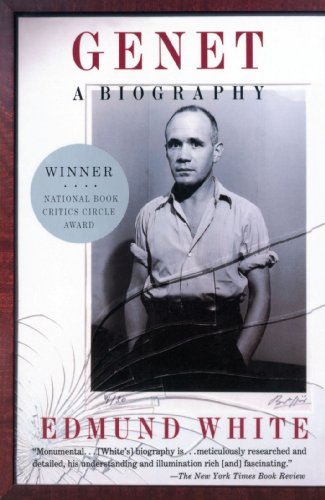
5. Genet: A Biography
$7.46
6. The Maids and Deathwatch: Two
$6.99
7. The Blacks: A Clown Show
$8.45
8. The Screens
$50.00
9. Fragments of the Artwork (Meridian,
$9.65
10. Prisoner of Love (New York Review
$7.59
11. Querelle
$9.00
12. Miracle of the Rose
 
$10.00
13. Saint Genet
$70.95
14. Jean Genet: Performance and Politics
$4.98
15. The Balcony
 
16. Funeral Rites.
 
17. Les Bonnes & L'Atelier d'Alberto
$13.00
18. Journal Du Voleur
$10.95
19. Jean Genet: Born To Lose
$4.65
20. Criminal Desires: Jean Genet &

1. Our Lady of the Flowers
by Jean Genet
Paperback: 272 Pages (1994-01-12)
list price: US$13.50 -- used & new: US$5.97
(price subject to change: see help)
Asin: 0802130135
Average Customer Review: 4.5 out of 5 stars
Canada | United Kingdom | Germany | France | Japan
Editorial Review

Book Description

Jean Genet's first, and arguably greatest, novel was written while he was in prison. As Sartre recounts in his introduction, Genet penned this work on the brown paper which inmates were supposed to use to fold bags as a form of occupational therapy. The masterpiece he managed to produce under those difficult conditions is a lyrical portrait of the criminal underground of Paris and the thieves, murderers and pimps who occupied it. Genet approached this world through his protagonist, Divine, a male transvestite prostitute. In the world of Our Lady of the Flowers, moral conventions are turned on their head. Sinners are portrayed as saints and when evil is not celebrated outright, it is at least viewed with a benign indifference. Whether one finds Genet's work shocking or thrilling, the novel remains almost as revolutionary today as when it was first published in 1943 in a limited edition, thanks to the help of one its earliest admirers, Jean Cocteau.
Download Description
Jean Genet's seminal Our Lady Of The Flowers (1943) is generally considered to be his finest fictional work. The first draft was written while Genet was incarcerated in a French prison; when the manuscript was discovered and destroyed by officials, Genet, still a prisoner, immediately set about writing it again. It isn't difficult to understand how and why Genet was able to reproduce the novel under such circumstances, because Our Lady Of The Flowers is nothing less than a mythic recreation of Genet's past and then - present history. Combining memories with facts, fantasies, speculations, irrational dreams, tender emotion, empathy, and philosophical insights, Genet probably made his isolation bearable by retreating into a world not only of his own making, but one over which he had total control. ... Read more

Customer Reviews (11)

5-0 out of 5 stars fantastic, but not for everyone
Jean Genet's seminal novel "Our Lady of the Flowers" is a glorious celebration of transvestites, lowlifes, prostitutes and murderers in the underworld of 1940s Paris.Our narrator, Jean, who may or may not be Genet himself, regales the reader from prison with stories he's created about fellow inmates between fits of furious masturbation.

The story begins with the death of Divine, a notorious drag queen and inmate of Jeans.From there Jean goes into the story of the recently canonized Divine, from "her" beginnings as the boy Culafroy to her living in an apartment overlooking the french cemetery Montmartre with her pimp Darling, and a young boy dubbed "Our Lady of the Flowers", whom recently committed a murder.

Our Lady is a brilliant exploration of the darker side of life.But naturally, a novel based around a perverted narrator inventing lives for people in order to help him masturbate isnt exactly for everyone.Id call it a healthy mix of Celine's stylistic sensibilities with Battaile's sexual overtones.An early influence on writers like Bukowski.And the 30 page, raving endorsement from Sartre in the preface should entice the existentialist crowd.So, give it a shot.You'll either be a little grossed out or particularly enthralled.

2-0 out of 5 stars Confusing tale of a gay man behind bars....I think
I figure to be the lone voice of dissent with this novel, which I found confusing and ultimately uninteresting.Genet's novel, written while in prison, jumps back and forth among the many characters, often following tangent upon tangent.I kept losing track of who was who, which one is supposed to be Genet (because I had the distinct impression that this novel might be autobiographical), sorting out the names and sequences of events, and trying to find a storyline that would last long enough to hold my interest.Genet would start on a good story and then all of a sudden jump in another reflection from that, never satisfactorily returning or finishing the original story.

It's very sexual and delves into the world of transvestism, but ultimately left me more confused than ever about what Genet was trying to say.

5-0 out of 5 stars A Most Beautiful Song of the Imagination
Jean Genet is surely one of the greatest thinkers of the 20th century - not to mention one of the greatest dreamers. In this book he presents us with a web of characters that can only reach mythical preportions. And, interestingly enough, he reveals that the only reason for their creation is for his own pleasure. So the book becomes like a walk through Genet's subconcious, in which we meet different aspects of the total personality that is Jean Genet. The book is like a dream and throughout it we are confronted with monsters, saints, nuns, prison guards, and the most secret of desires. Genet is the only author I have read who is capable of opening himself so completely - and we do get the feeling that this is written for his own pleasure - this makes it all the more enjoyable for us to read!

5-0 out of 5 stars "Crime Begins With A Carelessly Worn Beret"
Jean Genet's seminal Our Lady Of The Flowers (1943) is generally considered to be his finest fictional work.The first draft was written while Genet was incarcerated in a French prison; when the manuscript was discovered and destroyed by officials, Genet, still a prisoner, immediately set about writing it again.It isn't difficult to understand how and why Genet was able to reproduce the novel under such circumstances, because Our Lady Of The Flowers is nothing less than a mythic recreation of Genet's past and then - present history.Combining memories with facts, fantasies, speculations, irrational dreams, tender emotion, empathy, and philosophical insights, Genet probably made his isolation bearable by retreating into a world not only of his own making, but one over which he had total control.

The imprisoned narrator "Jean," who may or may not be identical with the author, masturbates regularly; like a perpetual motion machine, his fantasies fuel his writing and his writing spurs on his fantasies in turn.Nothing illustrates this more than the brief scene in which self - sustaining "Jean" describes his Tiamat....Legs thrown over shoulders, "Jean" is not only the serpent that eats its tail but becomes a small, circular, self - imbibing universe all his own.A motto attributed to the alchemists could be the narrator's own: "Every man his own wife."

Though the narrative is not the primary focus of this or any of Genet's novels, most responsible critics have failed to remark on the fact that the narrative of Our Lady Of The Flowers is the least compelling of any found in his five major novels.Our Lady Of The Flowers, does, however, lay the basic groundwork for the novels to come: The Miracle Of The Rose, Funeral Rites, Querelle, and The Thief's Journal (all written between 1944 and 1948).

While Our Lady Of The Flowers is Genet's only novel to feature a predominantly effeminate homosexual man (Divine, who is at least partially a transvestite) as its protagonist ("Our Lady Of The Flowers," a virile young thug, is a secondary character), most of the other elements of the book will be very familiar to those who have read the balance of his fiction.Transvestites and transvestite figures abound, as do handsome, amoral, and homosexual or bisexual "toughs," jokes and extended vignettes concerned with lice, flatulence, constipation, and feces, mordant examinations of manhood and the criminal's code of honor, obsession with personal power through emotional betrayal, the long vagabond road to "sainthood," theft, masochistic love, prostitution, and vivid examples of the way in which physical desire and sexuality secretly and subtly fuel, in Genet's view, almost every aspect of life.As in portions of his other novels, the characters here, even the swaggering, virile young men, are known among their friends by fey pet names like "Darling Daintyfoot," "Mimosa," and "Our Lady of the Flowers," which are intended to be simultaneously affectionate and mocking.To further confuse, Divine is referred to as a "he" and referred to his surname during his youth and as a "she" and "Divine" in maturity.As in the Miracle of the Rose and Funeral Rites, characters mesh into one another, exchange identities, and move backward and forward through time at the narrator's whim.Both "Jean" and the individual characters fuse their own and each other's personalities together as needed, and all occasionally lose control of this process: but Jean Genet, master puppeteer, never does.

Genet's readers are probably aware of the existence of haughty establishment critics who pretentiously embrace Genet's work but nonetheless treat it like something best held at the end of a very long stick."Evil" is the word most commonly used to describe Genet's fiction by stuffy, anxious middlebrow critics who, while distressingly stimulated by his work, feel duty - bound to officially decry its potential for pernicious influence.Many artists are said to create a "moral universe" within the body of their work; Genet is one of the few that actually does, though his is a mirror universe where amorality reigns.Genet's world is so exclusively concerned with flea - ridden prostitutes, child murderers who don't wipe themselves, handsome pimps who eat what they scratch out of their noses, [prostitutes] with rotting teeth, strutting, uneducated alpha male hustlers, and masochistic sodomites -- bourgeois emblems of horror all -- that the question of "evil" as such in Genet's work becomes obsolete.

While Genet loves and personally glorifies his memories, fictional recreations and their outcast lifestyles, he never objectively condones their actions to his audience.In all of his novels, Genet finds beauty, suffering, and vulnerability - humanity - in everyone, thus setting a far better example than his hypocritical reviewers.There is as much "evil" in Genet's books as there is represented by any typical novel's reality principle (for example, all of Genet's characters reveal more humanity and innate dignity than the crass, vacuous crowd Nick Carraway falls in with in Fitzgerald's The Great Gatsby) or, for that matter, as there is in the lives of those unstable, morally - confused critics who are simply too cowardly to recognize the world as the diverse, dangerous, devouring, and unstable place that it is.If Our Lady Of The Flowers proves anything, it's that fifty years after its initial publication, the book is still effectively upsetting the wormy apple carts Genet intended it to.

From the standpoint of Jung's psychological types, Genet's feeling and sensation functions probably predominated in both his life and his writing.However, his thinking and intuition functions were clearly constellated as well, giving Our Lady Of The Flowers and the masterpieces that followed it unmatched macrocosmic perceptiveness, poetic resonance, and gripping, all - inclusive dramatic power.Like alchemical "totality" the hermaphrodite, a shaman, or a legitimate Christian saint, mystic Genet seems to have written from a state of undifferentiated consciousness and enjoyed a state of perpetual participation mystique with life.

5-0 out of 5 stars like a narcotic!
Somebody should make an opera of this book!I've loved this book since high school, perhaps more than all the others!Genet as always is like adark narcotic; impossible to shake, and constantly ecstatic.His genius islike a kind of suffocating honey on the page, it pulls your heart out. This edition has a substantive Introduction by Sartre, whose "SaintGenet" is one of the seminal books of the late twentieth century.Ifyou've never read Genet, you've got something coming!What is there to sayabout literature of this standing?Read it and be ennobled. ... Read more


2. The Thief's Journal
by Jean Genet
Paperback: 216 Pages (2004-12-30)
list price: US$13.95 -- used & new: US$7.86
(price subject to change: see help)
Asin: 1596541377
Average Customer Review: 5.0 out of 5 stars
Canada | United Kingdom | Germany | France | Japan
Editorial Review

Download Description
Genet's fictionalized and distant account of his rambles through France, Czechoslavakia, Germany and elsewhere in the '30s and '40s, covering his time in prison, his relationships with men such as the one-armed Stilitano, along with erotic accounts of his lovers during the period, and interspersed with meditation and daydreams. ... Read more

Customer Reviews (10)

5-0 out of 5 stars Brilliant
Jean Genet's absorbing work of literary autobiography traverses the boundaries of genre with stunning ingenuity and imagination. This work is in some ways similar to Capote's use of the so-called "non-fiction novel," in that it recalls apparently true events through the lens of fiction. This is the reflection of a petty thief, and vagabond. Genet is a young man wandering Europe and immersing himself in a world of crime and depravity. He fuses his homosexuality with nefarious hooliganism to play off of our civilization's utter contempt for effeminate males. Genet blurs the boundary of morality with Nietzschean fury as he revels in his self projected "evil." Perhaps what is most astonishing about 'The Thief's Journal' is the way in which Jean Genet comments on his own commentary with startling frankness and lucidity. In many ways this work established many of the literary mechanics of what is now referred to as "post-modern," though Genet achieves the same level of complexity without sacrificing clarity or beauty in the process.

5-0 out of 5 stars Jean Genet at his most coherent
Genet was, without a doubt, one of the master prose stylists of the twentieth century.This "autofiction" memoir, based on the events of his life, follows the author/character Genet on his vagabond trip through 1930's Europe.While all of Genet's narratives are interesting, most do not follow a chronological sequence or have standard narration.This one does, and as such, I think it is the best introduction to his work.

In this "journal," Genet does more than detail the events of his everyday life--he describes the process by which he becomes a poet.In singing the praises of all that society rejects, Genet creates beauty from the abject, and puts all events and experiences on equal ground as inspirations and subjects of art.One of the great meditations on the creative process, and one of the great works of the 20th c.

4-0 out of 5 stars An insider's provocative look at the underworld
Both during and after my reading of Jean Genet's semi-autobiographical memoir of life as a criminal (later turned writer), I have been attempting to place its protagonist (aptly named "Jean") onto a psychoanalyst's couch.Here is a fascinating and often times sleezy character who has captured my imagination in a way that most central figures of a novel never have.Jean describes himself as having a very lonely boyhood; when he was not living in foster homes, he was out stealing from people, spending time in juvenile reformatories and prisons.Most of his friends have been individuals that he met while in jail or as collaborators in his crimes.These individuals were often pimps, drug dealers, thieves, and other such low lives.

I believe that the key to Jean's nature, a natural extention of his feelings of utter aloneness, is his desire for the love and approval by the most brutal and in his eyes, most masculine, of these malefactors.His robbing of unsuspecting, more well to do older "queers," as he calls them, who hire him for sex, gains Jean the respect and admiration of some of his friends.Interestingly, Jean is also a homosexual (probably self-hating). Although many of these men become his friends, only a few actually return his love.In Jean's unconventional society betrayal of those you most love is a common principle, and Jean desires to do just that.

_The Thief's Journal_ also has its moments of pathos, especially notable in the episode where Jean and a number of his acquaintances are homeless, in utter squalor, and middle-class tourists visiting their terrain comment on their "charm."

This book is not for every taste, but it is a very enthralling look at a world many of us may read about, but never see close up.

5-0 out of 5 stars Revealing
Genet's final novel is perhaps his most personal written document. All his desires are finely crafted here and his book is , as usual, crammed with idols and mystification. What prevents me from calling this his greatest novel is the influence of Sartre. By this point, as Genet's biographrer Edmund White has pointed out, Genet was conciously incorporating the use of Sartre's theories in his work (as Sartre at that time was Genet's friend - and sort of replacement for Jean Cocteau). The novel lacks the inovation of 'Our Lady' - but at the same time it has many more direct personal references to Genet himself.

What makes Genet, for me, one of the greatest writers of the 20th century is the way he embraces fate. He is always so clear in his novels about what is going to happen and the significance of what is going to happen. Thus, his writing always sounds so inevitable and profound - and his characters are like shrines of worship - he creates mythology. This is what makes Genet so refreshing to me - and he is, in my opinion, an equal to authors like Proust, Joyce, and Kafka - a gem of self-concious literature.

The Thiefs Journal is a good place to start with Genet. It is very clear and detailed and he pours the same great poetic prose into it - that he gave books like 'Our Lady' and 'Querelle'.

5-0 out of 5 stars beautiful work
I've read the Japanese translation of this book several times some years ago.It is a well known fact that western languages are so very difficult to transltate into Japanese language, but this book did not seem to suffer as much as others.

It is intellectually very satisfying, the language is exceptionally beautiful, and more than anything else, it is very gentle.

It does not have many dialogs, and not a story, since it's a journal, but it's a very readable book and easy to follow even for someone like me who can only read books in a story-telling format.

If you feel like something gentle, this book is a good companion. ... Read more


3. Selected Writings Of Jean Genet (Ecco Companions)
by Jean Genet
Paperback: 480 Pages (1995-05-01)
list price: US$22.95 -- used & new: US$5.95
(price subject to change: see help)
Asin: 0880014202
Average Customer Review: 5.0 out of 5 stars
Canada | United Kingdom | Germany | France | Japan

Customer Reviews (1)

5-0 out of 5 stars A Great Genet Starter Book
"The Selected Writings of Jean Genet" by Edmund White is arguably the best book to read if you are not familiar with Genet's writing. White is a biographer of Genet, but more importantly he is a great fan. The book includes his brief comments at the beginning of all the excerpts, which include portions of novels, plays, short stories, essays, and an interview. The comments lay out some background information which a first-time Genet reader will find useful. After reading this book, I read many of Genet's works and each time found myself referring to "Selected Writings" for added help in understanding and analysis ... Read more


4. Jean Genet (Reaktion Books - Critical Lives)
by Stephen Barber
Paperback: 156 Pages (2005-03-01)
list price: US$16.95 -- used & new: US$11.51
(price subject to change: see help)
Asin: 1861891784
Average Customer Review: 5.0 out of 5 stars
Canada | United Kingdom | Germany | France | Japan
Editorial Review

Book Description

An engaging and challenging introduction to Jean Genet, this concise biography of the French writer and his work cuts directly to the intersection of thought and life that was essential to Genet's creativity. Arguing that Genet's life was an extraordinary spectacle in which the themes of his most revolutionary works were played out, Stephen Barber gives both the work and its singular inspiration in Genet's life their full due.

Abandoned, arrested, and repeatedly incarcerated, Genet, who died in 1986, led a life that could best be described as a tour of the underworld of the twentieth century.

Similarly, Genet's work is recognized by its nearly obsessive and often savage treatment of certain recurring themes. Sex, desire, death, oppression, domination-these ideas, central to Genet's artistic project, can be seen as preoccupations that arose directly from the artist's travels, imprisonments, sexual and emotional relationships, and political engagements and protests. This trenchant volume focuses directly on the moments in Genet's life in which those preoccupations are vividly projected in his novels, theater works, and film projects.

Genet's works have been hugely influential for a vast array of writers, filmmakers, choreographers, and directors, especially at moments of social crisis; thus Genet's life is not only at the root of his own work but also that of many important artists of the twentieth century. With its frank and illuminating introduction by Edmund White, Jean Genet gives readers access to this brilliant and brutal mind.


... Read more

Customer Reviews (1)

5-0 out of 5 stars A Really Decent Little Book on Genet
This small volume published by Reaktion Books is a really decent biography on the great writer Jean Genet. Edmund White's masterful biography of course is wonderful, but this little book is something I couldn't put down.It is extremely well organized - and Barber gets Genet down on paper in a very straight forward matter. Not an easy job!

It seems Reaktion's Books series 'Critical Lives' is on a great start.I am looking forward to reading the other titles in this series. ... Read more


5. Genet: A Biography
by Edmund White
Paperback: 800 Pages (1994-10-04)
list price: US$17.00
Isbn: 0679754792
Average Customer Review: 5.0 out of 5 stars
Canada | United Kingdom | Germany | France | Japan
Editorial Review

Amazon.com
The definitive biography of Jean Genet, the incomparable French novelist whose works echo with themes of violent hierarchies, rituals of power and powerlessness and human identities as roles to be traded and manipulated. From his birth in 1911 to his adoption by foster parents and his tumultuous life as a runaway, thief, beggar and prostitute, Genet had remarkable powers of self-transformation, ultimately turning the pain of his life into writings that attracted the attention of literary trend-setter Jean Cocteau. Genet's work covered an amazing amount of social, political and intellectual territory. By diving into that which was awkward, ugly and painful, he emerged with the truth, transforming himself and others with its beauty.White earned the 1993 National Book Critics Circle Award for Biography for this fine work.Book Description
A meticulously researched biography of Jean Genet, one of France's most notorious writers. Acclaimed novelist and essayist Edmund White illuminates Genet's experiences in the worlds of crime, homosexuality, politics, and high culture, and gives a compelling analysis of Genet's plays, novels, and essays. Winner of the National Book Critics Circle Award for Biography. ... Read more

Customer Reviews (7)

5-0 out of 5 stars Exemplary portrait of a notoriously bad thief and a fascinatingly notorious writer
Edmund White is perhaps best known as a novelist but this biography of Jean Genet may well be his magnum opus. (And I find it astonishing that it seems to be out of print as of May 2007, since there is no other decent English biography of Genet available.) It's a monster of a book, but it's one of the more readable literary biographies that I've come across--not least because "literary" in Genet's case also means social and political and scandalous. Readers who have never read a word of Genet may question the need for perusing this book, but it was my introduction to the work and, as I work my way through Genet's prose, I appreciate difficult or seemingly unfathomable passages all the more because of White's memorable explication (although I can't share White's enthusiasm for the plays).

Genet's "rebellious" worldview--which often comes across as much a stage-managed affectation as a genuine philosophy--may be unattractive to those of a more traditional ethic (and I include myself among that group), but it's never boring. Much of Genet's writing depicts, glorifies, and justifies his careers as a thief, as an outsider, as an anarchist; he was also a notorious freeloader who forsook the attractions of materialism yet siphoned the wealth of others--and who sapped the remarkably patient generosity of his publishers).

Genet idealizes his years at Mettray (a colony for adolescent delinquents), his life as a thief (which ended in 1944, after he had completed two books and earned the approbation and support of Cocteau), and "the erotic charm of prison" (his many convictions for petty theft earned him sentences totaled nearly four years). And it's a good thing his writing is so remarkable: as White never tires of pointing out, Genet was a famously bad thief who spent so much time in prison because he was most adept at getting caught.

White covers far more than Genet's own life and work and lovers, however; this biography is also a decent introduction to the Parisian literary set that included such luminaries as Cocteau, Beauvoir, Duras, Giacometti, and Sartre. Since I was more interested in the literature, I had feared that the appeal of the biography would flag once I reached Genet's later years, after he had stopped writing and spent his time supporting various political causes (Algerian independence, pro-Palestinian movement, Black Panthers). But these chapters, too, were riveting and essential for an understanding both of his life's ethic and of his posthumously published "Prisoner of Love."

Overall, White makes a convincing case for Genet's importance, arguing "Genet and Celine are the most discussed twentieth-century French writers after Proust." I'm not sure I would go that far (Camus? Sartre? Beauvoir? Ionesco? Beckett? Gide?), although I suppose it depends on who's doing the "discussing." Nevertheless, White has certainly presented a solid case that Genet belongs in the top tier.

5-0 out of 5 stars The Ultimate Companion to Genet's Writing
This is the most detailed study of Genet ever written - and it deffinately sheds some light on his character both in writing and in life. I refer to it constantly when I am reading his books. I wish there were biographies like this of some of my other favorite authors - without a doubt I am excited to read White's book about Proust.

5-0 out of 5 stars Gay rollercoster ride
Following the rags to riches life of Jean Genet is an interesting reliving of French literature and history. Edmund White is certainly capable of empathy and psychological understanding for Genet, unlike in his biographies if William Burroughs and Allen Ginsberg. Though White makes the mistake of trying to incorporate some Michel Foucault, the homoseuxal philosopher, into his own penal insights into Jean Genet, the works and the man. Other than that fact, this handsome book is one long guitar solo at the altar of Genet.

Most of Genet's life is well-known, and partly used as the subjects for his novels. Genet was an orphan, had foster parents, and went to reform school. He had a bunch of early gay relationships, and he stole a lot of books. In prison Genet wrote Our Lady of The Flowers, and later shows it to Jean Cocteau, who is pissed off because he didn't write a similiar work first.

Genet wrote five novels and a few plays around and during World War II. They books are originally published anonymously. The books become an overnight sensation. As Genet becomes old and bald, and when the flamboyant Cocteau becomes bored with him, heterosexual Sartre and multisexual Simone de Beauvoir, both sort of yuppies of their time, become enamoured with the idea of hanging out and slumming it with Genet, a real thief.

Sartre saw him as a good example of his existential philosophy, and wrote Saint Genet. This book of his life came out when Genet was in his mid-forties. Genet doesn't write very much during the last years of his life. He does become involved with the Black Panthers and Palestinians.

Genet lived in Tangiers with his young Kiki. He wrote a final book that was banned before his death in 1986.

Genet's life was one long homosexual rollercoster ride. Genet's long life is an achievement which White gives a literary form in this tribute and gentle biography. As far as literary biographies go, this one is up there with the biographies of Oscar Wilde, Sade, and Frank O'Hara.

5-0 out of 5 stars A Masterpiece
Jean Genet wrote masterpieces,this autobiography is a masterpiece in itself !

5-0 out of 5 stars A Masterpece
Jean Genet wrote masterpieces...this autobiography is a masterpiece too !!! ... Read more


6. The Maids and Deathwatch: Two Plays
by Jean Genet
Paperback: 168 Pages (1994-02-16)
list price: US$14.00 -- used & new: US$7.46
(price subject to change: see help)
Asin: 080215056X
Average Customer Review: 5.0 out of 5 stars
Canada | United Kingdom | Germany | France | Japan
Editorial Review

Book Description

The two plays collected in this volume represent Genet’s first attempts to analyze the mores of a bourgeois society he had previously been content simply to vilify.
... Read more

Customer Reviews (3)

5-0 out of 5 stars Knowing the score
That's 3 stars for "Deathwatch" and 7 stars for "The Maids", for an average of 5 stars. It's not that "Deathwatch" is mediocre, it's just "The Maids" is that good.

If you can't find a performance, you may still be able to see "The Maids" performed as it has been available on VHS and DVD. The American Film Theatre presented the play in movie theatres back in the 70's. Not as a loose film adaptation of the play, but retaining the play's script by filming it. Solange and Claire were played by Glenda Jackson and Susannah York. I saw it but it was so long ago all I remember was its power.

Who, when honest, likes their job and the inevitable kowtowing to the boss? B.F. Skinner in "Science and Human Behavior" wrote: "Payment of wages is an obvious advance over slavery, but the use of a standard wage as something which may be discontinued unless the employee works in a given manner is not too great an advance."

Solange and Claire at least understand the tensions in boss-employee relationships. Each realizes how easy it is to lose oneself in a role. Have we, in adjusting to meet our boss's expectations, internalized too well what it is to be the boss?

But the extent to which our need to work shapes who we are isn't something we are usually conscious of. Perhaps it would be too painful. The desire to be like the boss, the resentment of the boss, the confusion due to our jobs about who we really are: this and more is explored by Genet thru Solange and Claire. Brilliant insights, brilliant language. Our unnoticed thoughts made explicit in ceremony by these maids: we fail to see ourselves performing at all. Not like you? Read or watch again.

5-0 out of 5 stars 5 stars for 'the Maids'
I have not read 'Deathwatch' yet but the'Maids' lived up to what I was expecting from Genet. To learn more about Genet, I would highly recommend his biography by Edmund White - this is one of the best biographies I have read.
The 'Maids' is a play in one act with three charactors. Within this act Genet captures the role-playing of the classes of society rather brilliantly. He does not capitalize on the brutality of the actual case of murder (it is based on an actual murder) but looks instead at the motivations for doing it. There is a film adaptation of the story called 'Murderous Maids' which is pretty good but focuses mainly on the act of murder - and throws in a lesbian twist.

5-0 out of 5 stars Horrific , violent existentialism at its mostabsurd.
Genet based 'The Maids' on an actual event, one he felt a certain kin-shipwith. In 1933 french police found Madame Lancelin and her daughter facedown, in their living room,utterly mutilated. The eyes had disappeared,all teeth had been knocked out, fragments of bone and flesh were strewnabout the floor, walls covered in blood. Upstairs the two servant-maids,the Papin sisters, were found naked, huddled together in one of two singlebeds. Immediately they confessed. Immediately, also, the papers picked upthe story. The public was facinated how these two soft-spoken,mild-mannered girls, without provocation could have acted with such wildbrutality. Senseless, irrational violence - Genet's speciality. He usesthis story as a means to attack conformaty. A massive revolt againstobedience, servitude, and the upperclass. A bloody triumph of individuality. Like other of Genet's works, it primaraly is concerned with Man's freewill, or lack there-of. It is an existential story , revealing the darkersides of freedom, and the horror of the responsibility that comes with it.A tale worthy of Genet's genious. Exellent translation. Fans of Genetshould also Check out Octave Mirbeau. ... Read more


7. The Blacks: A Clown Show
by Jean Genet
Paperback: 128 Pages (1994-01-18)
list price: US$13.00 -- used & new: US$6.99
(price subject to change: see help)
Asin: 0802150284
Average Customer Review: 2.5 out of 5 stars
Canada | United Kingdom | Germany | France | Japan

Customer Reviews (2)

1-0 out of 5 stars DON'T BUY THIS FAULTY EDITION!
The single star is for this edition, not the play itself, which is Genet's only true theatrical masterpiece--as his true masterpieces are otherwise his novels.PAGE 120 OF THE BOOK IS BLANK! That's right, so stay away from this one until a new printing comes out.I contacted the publisher personally, and all current copies share the defect.No date has been set for a reprint.I would commend the original French to able readers.The play contains notable amounts of prose poetry that translations tend to butcher--as they also, for some mysterious reason, tend to do the play's emotional impact; the French is much more touching.

4-0 out of 5 stars Be Patient w/The Blacks: A Difficult Read But Worth It!
Let me start off by saying that Jean Genet's "The Blacks" isn't for everyone. It's a very abstract work that demands patience from the reader. It's a play within a play so there are lots of times when you arenot sure when the characters are addressing themselves or the audience.That being said Genet originally wrote the play (In French) as an assaultagainst French Colonialism in Africa in the 1950's.....However "TheBlacks" most famous production came in New York in 1961. Directed byGene Frankel and starring Roscoe Lee Browne, James Earl Jones, Lou GossettJr., Cicely Tyson, and Maya Angelou "The Blacks" ushered in awhole new era of black actors in America. This version of the play containsbetween 10 and 15 pictures of that New York production. The pictures aloneare more than worth the price of the book! ... Read more


8. The Screens
by Jean Genet
Paperback: 210 Pages (1994-01-20)
list price: US$12.00 -- used & new: US$8.45
(price subject to change: see help)
Asin: 0802151582
Average Customer Review: 3.0 out of 5 stars
Canada | United Kingdom | Germany | France | Japan
Editorial Review

Book Description

Explicitly political, The Screens is set within the context of the Algerian War. The play’s cast of over fifty characters moves through seventeen scenes, the world of the living breaching the world of the dead by means of shifting the screens—the only scenery—in a brilliant tour de force of spectacle and drama.
... Read more

Customer Reviews (1)

3-0 out of 5 stars Get the soundtrack please
I bought this book because I loved the Phillip Glass soundtrack cd for this title.I read about 1o pages, then quit.Go buy the cd!!! the music is the best sounds the third world has to offer you.Then get Kiss Originals."I'm 93, she's 16, and I think I'm goin' blind"!!!!! Wa ... Read more


9. Fragments of the Artwork (Meridian, Crossing Aesthetics)
by Jean Genet, Charlotte Mandell
Hardcover: 200 Pages (2003-04-04)
list price: US$50.00 -- used & new: US$50.00
(price subject to change: see help)
Asin: 0804742863
Canada | United Kingdom | Germany | France | Japan
Editorial Review

Book Description

Fragments of the Artwork brings together Jean Genet’s critical writings and open letters on art and aesthetic issues. This collection testifies to Genet’s enormous influence on the modern theater, on the development of the novel, and on the representation of crime, sex, gender, and race. In lyrical essays and one candid interview, these works present an untutored, original, defiant Genet, displaying his provocative insights and acuities on a range of topics.

Genet wrestles with the athletic genius of Rembrandt, adores the intricate criminal resurrections of Dostoevsky, challenges our easy readings of Brecht, and, in what is one of the most exalting art historical essays ever written, provides us with his detailed personal account of the work and presence of Alberto Giacometti.Altogether these essays comprise a series of engrossing meditations on the central motives of theatricality and art.

... Read more

10. Prisoner of Love (New York Review Books Classics)
by Jean Genet
Paperback: 430 Pages (2003-01-31)
list price: US$16.95 -- used & new: US$9.65
(price subject to change: see help)
Asin: 1590170288
Average Customer Review: 5.0 out of 5 stars
Canada | United Kingdom | Germany | France | Japan
Editorial Review

Book Description
Starting in 1970, Jean Genet—petty thief, prostitute, modernist master—spent two years in the Palestinian refugee camps in Jordan. Always an outcast himself, Genet was drawn to this displaced people, an attraction that was to prove as complicated for him as it was enduring. Prisoner of Love, written some ten years later, when many of the men Genet had known had been killed, and he himself was dying, is a beautifully observed description of that time and those men as well as a reaffirmation of the author's commitment not only to the Palestinian revolution but to rebellion itself. For Genet's most overtly political book is also his most personal—the last step in the unrepentantly sacrilegious pilgrimage first recorded in The Thief's Journal, and a searching meditation, packed with visions, ruses, and contradictions, on such life-and-death issues as the politics of the image and the seductive and treacherous character of identity. Genet's final masterpiece is a lyrical and philosophical voyage to the bloody intersection of oppression, terror, and desire at the heart of the contemporary world. ... Read more

Customer Reviews (3)

5-0 out of 5 stars A travel memoir, a masterpiece which can never be equaled
If the reader is looking for easy explanations to the Palestinian refugees' war with the nation of Israel, Jean Genet's book is not the place to seek them.And I don't advise readers to pick through the text looking for the succinct sentences in which Genet clearly states why he's on the side of the Palestinians, or if he's anti-Israel, or anti-American.There is no proof of reviewer Tim Keane's conclusion that Genet "seethes with hatred of Israel"; there are no such violent emotions in Prisoner of Love.At 430 pages, be prepared to find subtleties of experience shaded by conflicting responses--nuances completely unavailable via print journalism or network news, CNN, or Al Jazeera.But the very fact that Genet wanted to observe life in the refugee camps shows that he had to make a choice.Nearly all the protagonists of his memoir, this textual "souvenirs," are Palestinians and generally Muslim.Indeed, the compelling force which drives the relatively plotless Prisoner of Love are the individuals to whom Jean attachments himself: the dynamic Lieutenant Mubarak, Dr. Mahjoub and the charismatic female doctor, Dr. Nabila, Khaled Abu Khaled and Abu Omar, and an accomplished woman friend, a blond Lebanese guide and translator, Nidal, and dozens of other people.Genet was particularly attached to Hamza and his mother, who he attempts to find again after his absence from Palestine for nearly 14 years.We cannot forget the common fedayee rebel, the fedayeen as a whole who fought to make the Palestinian plight known.

When evaluating Prisoner of Love, it's important to remember that Genet is a writer.Throughout his work, Genet tells us how difficult it is to recount his experiences since he's not sure at times what he's seeing, and he must make his writing conform to the necessities of craft.And whatever writing craft decisions Jean made it is clear that the Palestinians "wrote" him as well; Jean was seldom in control of his experience.As I read, I realized that Genet is the ultimate refugee; he seeks to be with people who are like him.My conclusion is this: Palestine chose him.

Only Genet could have written this book.He is a bruised romantic searching for a resting place that will caress both his homeless intellect and his orphaned body: "A little while ago I wrote that though I shall die, nothing else will.And I must make my meaning clear.Wonder at the sight of a corn-flower, at a rock, at the touch of a rough hand--all the millions of emotions of which I'm made--they won't disappear even though I shall.Other men will experience them, and they'll still be there because of them.More and more I believe I exist in order to be the terrain and proof which show other men that life consists in the uninterrupted emotions flowing through all creation" (361).As an orphan with prison experience, and disaffected from France, Genet was willing to try on other peoples' lives; I suspect that without the structure dictated by the craft of writing, and his talent coming to the attention of well-known writers, Genet would have disappeared into the French prison system.

Another conclusion I came to: Genet shows us the difference between terrorism and Arab nationalism.Is there any hope that the U.S., of which I am a native-born citizen, will ever figure out this difference?

Overwhelmingly, the single image I have of Prisoner of Love is that to read it is to travel the land that dwelled *in* Jean Genet, this traveler who was intelligent enough to let his emotions guide him.And only by reading can I share in living a life which speaks so eloquently of rebellion and blood, of life and death.

5-0 out of 5 stars intense,compelling as he allows, Genet a poet,a writer,first
Genet allows you to feel the immediacy of the Palestinian situation with particles from lives,from ill-defined fragments of lives disrupted with no future,he stayed with a family in 1980 a half-day and a whole night where the young son,Hamza a fedayee went off at night to fight. Genet hearing gun fire in the distance inhabited his bed and was brought Turkish coffee and water in the night as a replacement for the young man,by his mother. Genet is a writer/poet,a political thinker,but never a man of politics, a deeply sensitive man,a virtuoso of the sensual image, as the starry-night reflected against the curtain in his room with the small blue table. "Of course it's understood that the words,nights,forests,septet,jubilation desertion and despair are the same words that I have to use to describe the goings on at dawn in the Bois de Boulogne in Paris when the drag queens depart after celebrating their mystery,doing their accounts and smoothing banknotes out of the dew."

Genet was allowed with special permission to visit the massacre site at the camps at Sabra and Chantila,smelling the rotting flesh, "They happened I was affected by them. I talked about them. But while the act of writing came later, after a period of incubation,nevertheless in a moment like that or those when a single cell departs from its usual metabolism and the original link is created of a future,unsuspected cancer,or a piece of lace, so I decided to write this book."

Genet has an intense need for passion of any dimension,scouring the vigours of whatever parts of fragments of the lifeworld's complexity presents itself to him. I once thought of this book as a romantic means of portrayel a betrayel of a political situation,one, the only one that excited Genet.It means something that only encounterings lives in struggle,bent into a repressive state that Genet finds the only life worth encountering,sensing and feeling about. This book was completed in 1986 after suffering from throat cancer, he died on the night of 14-15th of April,1986,while correcting proofs.

5-0 out of 5 stars A great and unique work.
This book is absolutely essential to any understanding of the Palestinian situation. It is also the mostimportant work of Genet's entire career. ... Read more


11. Querelle
by Jean Genet
Paperback: 288 Pages (1994-01-13)
list price: US$15.00 -- used & new: US$7.59
(price subject to change: see help)
Asin: 0802151574
Average Customer Review: 4.5 out of 5 stars
Canada | United Kingdom | Germany | France | Japan
Editorial Review

Book Description

Regarded by many critics as Jean Genet’s highest achievement in the novel –– certainly one of the landmarks of postwar French literature. The story of a dangerous man seduced by peril, Querelle deals in a startling way with the Dostoyevskian theme of murder as an act of total liberation.
... Read more

Customer Reviews (9)

4-0 out of 5 stars Murder as Metaphor, Poetry as Perversion
Genet's world is a man's world. Men fight, steal, hate, lust, and love each other with a primacy that all but excludes women, where it grudgingly admits of their existence at all. In Genet, men encompass even femininity, or, rather, those traits we usually associate with it. Even the straightest characters in *Querelle* are sexually attracted to each other. This ever-present sexual attraction, inevitably mixed with violence even under the best of circumstances, can be seen as metaphoric--an ever-shifting game of domination and submission, victor and vanquished, killer and sacrificial victim that is only made clearer by being raised in intensity through illustration in the sexual act. Genet makes overt what is always and forever sublimated: the connections between sex, power, evil, and pleasure in virtually all human interactions.

The title character of Genet's novel is a handsome, seductive, sociopathic sailor who has linked the act of theft and murder into a ritual of mystical transcendence. Not that Querelle himself would see it that way inasmuch as he is a figuration of Genet's ideal beautiful male--a pretty brute, an amoral monster of transcendent physical perfection. Querelle travels the world by ship, murdering and stashing loot at every port, loving them and leaving them, whoever they may be.

It helps if you can put aside your own sexual proclivities while reading *Querelle* otherwise it's easy to feel alienated by his creation of the quintessential "homo-fatale." The novel is a rat's warren of crime, sex, and betrayal between its cast of characters--cops, dockworkers, informers, pimps, naval officers, and drug dealers that might be summed up in the words of Mick Jaeger's and Keith Richards' *Sympathy for the Devil*: "Every cop is a criminal and all the sinners saints." Querelle attracts them all--the good, the bad, and the beautiful--and betrays each of them to each other and leaves the port of Brest no different than when he arrived, a trail of shattered bodies, devastated psyches, and forever altered lives behind him.

Genet is never an easy read and *Querelle* has the reputation of being one of his more accessible and conventional novels--and I think that's a fair assessment. Still, it's not casual reading. Genet is a demanding prose stylist--elliptical, dense, philosophical. He's given to flights of poetic--and, at times surrealistic--verbal fancy. It's breathtakingly beautiful if you care to follow him into the rarefied atmosphere he inhabits--disorienting and suffocating if you don't. Innovative without being totally obscure, classic but not outdated, Genet's *Querelle* still has much to say and unlike his better known French contemporaries, Sartre, Camus, etc., Genet hasn't enjoyed the appreciation or assimilation he richly deserves. He's opened paths in literature and consciousness that haven't yet been fully traveled all the way to their ends and if for that reason alone he merits reading. Like all true trailblazers, he remains endlessly original.

5-0 out of 5 stars A Truly Unique Fantasy
Querelle is perhaps Genet's most interesting novel, indeed, it's his only novel that does not contain directly autobiographical references. Thus, it is an interesting trip into the imagination of this great thinker - and his world of fantasy is enlightening and in a strange way quite profound and poetic.

Querelle can be interpreted in many ways - but it cannot be disputed that this story is in a way about the double nature of all human beings. Readers of 'Our Lady of the Flowers' will be familiar with this rich puzzling theme. Genet creates a world, in which, the most hidden desires of men are amplified to the extent that these very desires become a personality unto themseselves. In a way these characters become prisoners to their own fantasies (much of Genet's writing has something to do with prison) and in a most tragic way. The character of Madame Lysiane, for example, is the clearest picture of this imprisonment. She is involved with the two brothers and the neglective Nono - never fully accepted or loved by any one person - she has to live a fragmented life giving parts of herself to many different people at the same time.

What makes Genet brilliant is not necesarrily just his portrait of the double, however. There is a certain inevitability in his writing. He seems to believe in a certain fate for all things. His embracing of fate consistently in his prose - makes him, like Kafka, stand out among other writers. He truly was a poet of the highest order. I would recommend starting with 'Querelle' - it is a nice introduction to Genet's work and is perhaps the easiest of all his books to get into.

5-0 out of 5 stars What else is there to say?
Well, I'll try to be a little more brief than other reviewers...

I wouldn't even write this review, except that I thought there was one area I could add to what has already been said.Querelle is the most concrete and least biographical of Genet's novels.The story could easily be outlined for one of those obnoxious english classes we all had to suffer through.

There is no other author in the world like Genet.No one to even compare him to, although people often do (Dostoevsky is a good comparison here though, but not because they write the same way, but rather because of the similar fascination with murder as a liberating act).If you haven't read one of his books, it's difficult to describe his method.He allows concrete realities to bloom imaginatively, and in his books freely allows those to become truth.We call Genet a master, because he can let boundless lyrical images flow through the pages and stir his imagination freely... and yet always have a tight grip on them.Nothing, then, is superfluous.This differentiates him strongly from the French surrealists, and his insistance on beauty and passion over rationality puts him both in existentialism, and also in direct opposition with the literary attempts of Camus and Sartre (who claimed to put sensation over reason, and yet somehow always fail to... in fact, nothing is more pathetic than Camus attempting to be humerous at moments in 'the Plague'... it comes off sounding like television scripts.)If I stated here that his novels are miracles; that they trans-subtantiate when you read them, no one would believe it.But that's how it stands.If you read Genet, and you really feel what he's saying, it will become a living thing with a very real presence.And I can think of no other author who can accomplish this.

4-0 out of 5 stars An Interesting Read
"Querelle" is the only exposure I have had to Genet's work, and this only after watching the excellent Fassbinder film adaptation. I can honestly say I probably won't read him again, if this is an example of his prose. Heart-stoppingly beautiful in places, I found "Querelle" to be an absolutely bleak fictional reality.

Genet's writing style is unique - dense and multi-directional, someone definitely worthy of the name he has obtained. Probably a good deal underrated in the US as well. As impressed as I was, Genet failed to hook me as a reader. Other reviewers have compared Genet to Dostoevsky. I don't enjoy Dostoevsky's writing at all, so perhaps Genet just isn't my speed. Still, a great work is a great work, and I think this is at least a very good one.

I think "Querelle" is an important work, which is why I give it 4 stars despite my misgivings. I'd recommend this book to readers who are looking for something way off the beaten path. Provocative and full of texture, this book is an excellent character study and WILL excite a reaction from those readers for whom character study is a main objective.

5-0 out of 5 stars An un-Christian Dostoevsky
Having read, and hated, _Funeral Rites_ a few years ago, I approached _Querelle_ with diminished expectations.I was quite unprepared for its lyrical prose and complex characterization.Some of the passages from Seblon's journal flow better than any I've read in English, and Genet's metaphorical imagery is often surprising yet apt.

I often found myself reminded of my favorite novelist, Dostoevsky, while reading _Querelle_, not only for the redolent, foggy atmosphere but for the extended meditation on evil.While Dostoevsky's works concerned themselves with redemption from evil, however, in many ways Genet writes about evil (or at least criminality) as itself redemptive in some way--that is, when he isn't calling the very notion of redemption itself into question as a liberal humanist fantasy.

But what I like the most about this book is not its intellectuality, though there's plenty of that.I most enjoyed how his characters--unbelievably, even uninimaginably bizarre--became in his hands almost commonplace and real.Like Toni Morrison in a different, evil register, Genet's cast is quirky and out-there yet, somehow, not odd at all.Through their very strangeness they become the best exemplars of our real selves. ... Read more


12. Miracle of the Rose
by Jean Genet
Paperback: 291 Pages (1994-01-13)
list price: US$14.95 -- used & new: US$9.00
(price subject to change: see help)
Asin: 0802130887
Average Customer Review: 4.5 out of 5 stars
Canada | United Kingdom | Germany | France | Japan
Editorial Review

Book Description

This nightmarish account of prison life during the German occupation of France is dominated by the figure of the condemned murderer Harcamone, who takes root and bears unearthly blooms in the ecstatic and brooding imagination of his fellow prisoner Genet.
... Read more

Customer Reviews (8)

5-0 out of 5 stars The master of the 20th Century
In the 60's, it was cool to like Genet.Ginsberg even made a reference to the boys in Kansas reading him (aspiring to a future when even the clodhoppers would be enlightened).

There are really some fantastic reviews for this book on here, so I'll try to cover some new ground in a brief manner.

A lot of people have no idea who Genet is.He died in 1986, just in the finishing stages of a book (Prisoner of Love)... his first since the Thief's Journal, almost 30 years before it.He had surfaced briefly to author some of the most incredible dramatic works ever... in fact, far greater than his novels, and his novels are some of the greatest of all time (definitely ranks with Dostoevsky).

There is no explanation for Genet.He wrote Our Lady of the Flowers in prison, and it was a masterpiece.And the he wrote four more.And then he stopped.Just like Shakespeare, he came from nowhere, and he stopped when he decided it was time to stop.His books are intensly 'evil', but they're also incredibly lyrical and always beautiful.They're also quite profound, not just morally, but also in the way that he freely transposes his world, interacts with his creation, and commands powerful meanings from the simplest gestures.Specifically this book deals with his obsession with a fellow prisoner, condemned to die for a murder.The book is the process by which Harcamone (the murderer) develops and blooms in Genet's mind, ultimately culminating in a feverish and spiritually tormented vision of the mystery of Harcamone.His works make effective use of the ritual and spiritual processes, and although I don't believe they will make you evil, I think you'll find that your imagination will be enlightened, and you will be able to view the mundane world around you in a new and passionately intense way after reading his books.Genet realized that everything has the power to become significant and sanctified through our imagination, and he's especially good to read if you are at all interested in Nietzsche, Freud or anything dealing with existentialism.If you haven't read him, do not do anything until you do.If you have, make sure you let some people borrow your books... those of us who love his work need to make sure we do our best not to let him fall into obscurity.

5-0 out of 5 stars The Archetypal Outlaw Spits Fire
Having read Sade, Bataille, and all the supposedly "shocking" literature to emerge from literary periods when all modern values were being turned on their heads, I expected that Genet would be merely another poser who could string a few words together, the kind of guy who did a few bids in prison and was therefore looked upon by the intellectual camp of the 20's as the living incarnation of this or that former literary figure.

I was wrong.Genet transcends the stereotype of "the literary prisoner" and does justice to Rimbaud's famous cry of revolt: "I admire the criminal on whom the prison bars close again and again."He paints the cretins with whom he is incarcerated with stunning beauty.His idealization of the the "dregs" of society works well, and never falls into pretentiousness.The way in which his fellow criminals lament their fate is astounding, and one wonders whether Genet took a little artistic license with the affair.One young man exclaims: "Wow!They really did a number on me.Hard labor for life."With somewhat homoerotic overtones, Genet looks on all these young hoodlums with the tender pity of a mother for her child.

Of course, Genet knows that his "negation of reality" and his willing descent into the underworld is little more than a wistful illusion which cannot last.The pimps, thieves, and addicts he idealizes so beautifully are merely pimps, thieves and addicts.His celebration of evil as the ultimate form of beauty goes from being believable to being absurd.The idea of Genet having been the embodiment of Sartre's philosophy seems petty in retrospect, as Genet's work has held more water than Sartre's.Sartre's dimestore psychoanalysis, laced with faux pas Marxism and some pastiche ideas he lifted from better thinkers, was never enough to explain any human being, let alone Jean Genet.I suppose it was good Sartre was so obsessed with him, though, as Genet would have gone away for life had Sartre and the existentialist crew not showed up at his trial.
Do not miss out on this.

5-0 out of 5 stars A Sinking Ship Shall Cast The Light Upon The Land
Genet's second novel is a phantasmagorical account of his youthful incarceration in the Mettray penal colony and subsequent imprisonment in the adult facility of Fountevrault.The author portrays Mettray as a womb like hive of sunless corridors and constricting passages that both shelters the prisoners and guards and incubates their stark attempts at individual development. The formless men of Mettray constantly meld and mesh into one another, existing between mental and emotional states of absolute being and permanent dissolution and drift. Genet sees the hieratical Mettray as "the universe itself," something he finds "fabulous." Surrounded by 400 other confined men, many who are attractive and apparently virile, young Genet searches for potential lovers and models upon which he might base his coreless identity.

The narrator identifies these young men as his literal brothers, born from the same maternal body of childhood desolation leading to crime, and is highly drawn to this incestuous angle of his attractions. He describes the other boys "stroking themselves" in unison alone in their single unit cells, the mixed perfume of wisteria and rose vines creating a "vegetable incest" which wafts over their dreaming heads; he "yearns for a mother," feels he's returned, via Mettray, to "the mother's throbbing breast," and describes the prison and his mood as permanently tinted in autumnal shades. The female principle reasonably dominates the state of male immaturity, and in both benevolent and malevolent fashion, for Mettray is surrounded by a minefield of "traps laid by women's hands" that create an "invisible, undetectable danger" which throws would be escapees into "wild panic." For hoping to gain the fifty franc reward that comes with each capture, local women lie in silent, unseen wait like archetypal witches, accompanied by shotguns, pitchforks, and dogs.

Unloved, cast out, and uneducated, the instinctively virility-seeking boys of Mettray are little more than unindividuated eggs united in a desperate search for a master sperm bearer to fertilize and transform them into legitimate men. Each acts as a 'double' for another, but combined, the two halves still add up to less than one definite being. Though some "big guys" and "toughs," especially mysterious Christ figure Harcomone act as witting or unwitting father substitutes to those in need, Mother conquers in the end. Returning years later to find Mettray in ruins, Genet sadly notes that swallows have built their nests in its window ledges, grass sprouts between the impregnable stones, and thorn bearing vegetation covers and "pierces" the place. The rugged house of troubled, fragile lads has returned to the soil forever.

Fifteen years later, at Fountevrault, Genet finds hero and double murderer Harcomone locked in irons in solitary confinement, condemned to death. He discovers Fountevrault's foundational hub when he stumbles upon former Mettray lover Divers, a powerful and handsome tough, freakishly squatting atop the central iron cone which serves as a toilet, his genitals exposed and hanging as he defecates loudly, surrounded as he is by the circle of punished and endlessly marching prisoners he oversees and verbally abuses daily. Thus the lord of Fountevrault is an unconscious, ridiculous clown and fool, his pointed punishment and dunce cap under him instead of atop his head.Nonchalant Divers, "a barbaric king on a metal throne" gets up "without wiping" and actively resumes command as Genet allows himself the pleasure of sniffing Divers' "vast and serene" bowel gases. Drunk with sensation, Genet commits a willful infraction and happily joins Divers' marching circle, which becomes his new microcosm of "eternal reoccurrence."

While the broad shouldered "big guys" gather in all alpha male groups like a huddle of mountain gorillas, Genet loves--and often confuses--three men. Divers; dying, crown-of-thorns bearing god and great subject of prison gossip Harcomone; and mercurial "chicken" Pierrot, who straddles the safer middle ground and whose essence contains elements of both men. Genet sees Pierrot as a Sphinx and himself as a "questioning Oedipus," he describes their desperate lovemaking, clandestine stairwell meetings, and risking note passing, but later says they were never lovers and met only on twelve occasions. Divers and Harcomone are the twin father kings of Fountevrault: earthy, feces smeared Divers, who upholds macho postures even while defecating, symbolizes the Genet's reality principle. Supernatural Harcomone, the single complete man, "the emanation of a power stronger than himself," is even loved and cherishedby the stars, moon, and seas -- by nature, his transcendent bride. Paternal Harcomone had once read nightly to the youths at Mettray from a book intended for very small children; now his chains blossom fragrantly into white roses before the astonished prisoners, an experience divinely denied the guards. Harcomone's rapidly approaching execution by beheading becomes a crisis for everyone under Fountevrault's roof.

Active mystic Genet calls himself "the spirit that hovers over the shapeless mass of dreams," "a dead man who sees his skeleton in the mirror," one who "sings the void"and who strains "every fiber to see very high or very far within himself." By "cutting all threads" that hold him to the world, he "plunges" into "prison, foulness, dreaming, and hell," believing this will land him in a garden "of saintliness where roses bloom." Exhausting himself with the effort, he manages, by a kind of remote viewing, to project himself into the condemned man's cell during the last nights of Harcomone's life, where he finds Harcomone already a ghost, his spirit drifting through the prison, and visited by specters.

Perhaps Genet's most deeply felt novel, the meditative Miracle of the Rose finds the author alternately confronting and avoiding his deepest obsessions and the shadowy motivators stirring uncomfortably within him. The archetypal "ghosts" of the male and female parental figures, in both their nurturing and paralyzing aspects, constantly overwhelm Genet's consciousness, are projected, embodied (Genet, the bride, is officially wedded to Divers in an elaborately structured midnight ceremony) or obscurely grappled with during moments of reverie. Transvestite figures and shifting configurations of gender and persona abound; male identity, like the ever shifting and unsustainable ocean shoreline, is in constant, painful flux, perpetually threatened with an obscuring inundation that will reduce man back to his earliest, in utero female state of existence.

5-0 out of 5 stars a miracle of a novel
A breathtaking, uplifting work -- mesmerising & unflinching of beauty wherever it is found. One hears people talk about an infinite capacity to bear pain -- it is not so different as the capacity to bear infinite beauty. If you want the example of such a man, read Genet.

The sheer intensity of this book, its fearlessness, its devotion to what is human, is astonishing. This was the first Genet novel I read, & I was converted. Genet understands that what is human is also that which is superhuman, and subhuman.

5-0 out of 5 stars The light of the darkness
Jean Genet is the most exquisite of the poets maudits. Every word of him has the bittersweet savour of the pleasures of hell. You'll love his obsession whit nasty hoodlums which he transmogrifies in almost saintly objects of desire. Genet is an artist on sublimating the most earthly feeling in almost mystical esperiences, and in giving the most dreary places and situations a sensual or mystic (you almost cannot distinguish )
aura, as he does in this book. Jean Genet is one of a kind writer . ... Read more


13. Saint Genet
by Jean-Paul Sartre
 Paperback: 625 Pages (1983-09-12)
list price: US$16.00 -- used & new: US$10.00
(price subject to change: see help)
Asin: 0394715837
Average Customer Review: 5.0 out of 5 stars
Canada | United Kingdom | Germany | France | Japan

Customer Reviews (1)

5-0 out of 5 stars beauty takes place..
'Grandly conceived and executed' .... 'Magnificent'.... 'Nothing less than masterly' ... critical tributes offered Sartre's Saint Genet that end as mere words. Saint Genet is an unearthly book wrought with the passion of a gospel narrative, explicit and wrenching. It is, finally, an entire act of redemption. The language is apocryphal and never operatic, epic in delivery, even greater than it seems; page upon page of an exceeding pure, andnever vulgarly rich, damask brocade! I'll not critique Sartre's thought --it's privilege enough to be presented it!-- but this seminal work is a miraculous construct of human will and unbearable genius that will live forever, a complex and magisterial book ranking among the great achievments of modern literature because of its erudition, humanity, and fierce literary reach.There is not a page that doesn't honor wisdom, nor is there a single idle component.It is indisputably Sartre's crowning achievment as a genius, and as a man.The evocative humanity of two literary giants of the 20th century plays like a dance, the captured aesthetic of which Sartre reveals; everything is taken to the temple of Genet, everything explained, everything mortified, slain and remade.Reading this book is a revealing experience; be willing to be stolen. Theft happens in broad daylight, perpetrators already known.. My favorite chapteris 'Cain,' in which Sartre makes his most profound arguments about Genet as Other, Genet as the living inverse Liturgy, and presents a stupefying image of his subject: 'Everything is possessed, worked, occupied, from the sky to the subsoil...' Intimidating in its greatness. ... Read more


14. Jean Genet: Performance and Politics
Hardcover: 256 Pages (2006-12-12)
list price: US$74.95 -- used & new: US$70.95
(price subject to change: see help)
Asin: 1403994803
Canada | United Kingdom | Germany | France | Japan
Editorial Review

Book Description
Jean Genet: Performance and Politics is the first book to explore the broad political significance of Genet's performance practice by focusing on his radical experiments, polemical subjects and formal innovations in theater, film and dance. Its new approach brings together the diverse aspects of Genet's work through essays by international scholars and interviews with such key theater directors as Richard Schechner, Terry Hands, Cornerstone Theatre and Jean-Baptiste Sastre. ... Read more


15. The Balcony
by Jean Genet
Paperback: 96 Pages (1994-01-21)
list price: US$14.00 -- used & new: US$4.98
(price subject to change: see help)
Asin: 0802150349
Average Customer Review: 4.5 out of 5 stars
Canada | United Kingdom | Germany | France | Japan
Editorial Review

Book Description

“The Balcony is probably the most stunning subversive work of literature to be created since the writings of the famous Marquis.... A major dramatic achievement.” –– Robert Brustein, The New Republic
... Read more

Customer Reviews (3)

4-0 out of 5 stars Confusing, Funny, Ingenious
A great play about the continuum of illusions and reality and power as a result of positioning hehe
It is especially relevant now when our world "where everything -- you can be quite sure, is falser than here"

5-0 out of 5 stars Thin line between the straight world and a brothel
The madame of the famous Grand Balcony brothel provides a safe place where her clients can come to act out their fantasies and take on the identities of important government and religious figures in the real world. Outside the brothel, a revolution is raging, assisted by a former prostitute of the Grand Balcony who uses her voice to spur the rebels on to a greater victory. When the government finally topples, the whores and clients work together to take their impersonations out of the bedroom and restore order by assuming the identities of the great figures who they used to play in bed.

Sartre referred to Genet as the prototype of the existential man, whose past as a convicted felon and his subsequent literary career illustrated a life where personal choice drove the moral distinctions. I have read an been absorbed by a number of Genet's works, my favorites being _Our Lady of the Flowers_ and _The Maids_. While I don't believe that _The Balcony_ is up to the level of either of those works, it's an important piece of the history of the theater of the absurd.

Worth reading. Perhaps now more than ever in a world where actors regularly transition to politics.

4-0 out of 5 stars Ingtruiging, confusing, full of risky ideas
The ideas that life is an illusion and that we are all actors perpetuating our own illusions are fascinating. This book contains some intruiging Existential ideas.I did get confused at times over who was playing which role. ... Read more


16. Funeral Rites.
by Jean Genet
 Paperback: Pages (1969-06)
list price: US$10.95
Isbn: 0394171632
Average Customer Review: 4.5 out of 5 stars
Canada | United Kingdom | Germany | France | Japan

Customer Reviews (4)

5-0 out of 5 stars Genet defies any categorical boxes you could think up
Funeral rites is jean genet's farewell to one of the great loves of his life.. such a great love, in fact, that the only way to come to terms with this death is to delve into fantasy.. so it comes about that he creates this character in his mind in a very ambiguous style.. the only thing he can rely on is to cherish the opposite of his lover.. to embrace the unthinkable.. the very man who put him to death.. Riton is the symbollic opposite of jean - he is the phallus to jean's anal qualities...
and in a sea of beautiful dreamlike prose we find at the end that genet is not trying to appeal to us so much as nurse his own demons..
This is one of Genet's strangest works of fiction.. but simply a deight to read.. It would be interesting to hear a psychologists reactions to these probing meditations on death..

5-0 out of 5 stars A Phallic Universe of Satyrs and Martyrs
Despite its title, Jean Genet's Funeral Rites is considerably less desperate and less grim a novel than his others; here, Genet's stand-in narrator (Jean) sounds more boastful and vainglorious thanthreatening or threatened. Taking place in Paris during the Nazi occupation and just after, this is Genet's most psychologically incestuous book, one in which almost every character is linked to the others by undiscussed or only infrequently acknowledged sexual affairs. Despite the violentemotions the characters feel for one another, when they actually speak, their words are banal, monosyllabic, and thus lacking in complex information; the only extensive dialogues are internal. Genet's philosophy is clearly stated: "Speech kills, poisons, mutilates, distorts, dirties."

As the book opens, Genet's love-object--a young resistance fighter also named Jean--has just been killed and buried. There are extended early passages about the dejection Genet feels; he states that "the book is completely devoted to the cult of a dead person with whom I am living on intimate terms." However, Genet questions whether the 'Jean' to whom the book is dedicated is the dead man or himself, and soon refers to him as "my poor Jean-in-the-box" and thinks of him as "changing into fertilizer." Eventually Jean becomes something of an afterthought, as Genet turns away from the dead towards his lust for the living.

The conversational, episodic plot concerns Genet's interactions with the remaining members of Jean's family, as well as with German Erik, former Hitler Youth member and current tank-driver for Hitler, andyouthful French traitor Riton, a collaborator with the Reich. Genet presents an awesomely entwined branch of relationships: Genet and the dead Jean; Genet's casual friendship with Jean's brother Paulo, who is both Hitler'sand Genet's lover in Genet's fantasies; Giselle, Jean's steadfastly bourgeois mother, is Erik's mistress and keeper regardless of his Nazism; Erik and Riton are physical and emotional lovers; Erik, who clearly gets around, is also the submissive lover of Hitler's massive, unnamed, ax-wielding executioner; unattractive Juliette, Giselle's despised housemaid, is Jean'sformer fiancé; and Genet and Erik also become sexual partners in time, and right under Giselle's roof.

Genet adds another layer of complexity by having character 'Genet' transform mid-scene into the characters he is describing. Genet briefly becomes Joan of Arc just before she is burned alive, and replaces Erik as the killer when Erik decides to murder an innocent country boy to establish his manhood. Genet also steps into other shoes during the erotic passages, metamorphosing into Hitler (who sends "his finest-looking men to death" because he can't bugger them all, Genet says) when the Fuhrer orders Paulo aside and rapes him, an act Paulo accepts flatteringlyand actively responds to. The narrative also moves frequently backward and forward in time, and at least one murdered character (not Jean) shows up robustly alive after his death.

Unlike the later novels, few defensive statements are made about the sexual interaction betweenthe men, who alternately accept male and female lovers without question, as if this were the natural state of things worldwide (though other men seem to be the sexual partner of choice). The tough men of Funeral Rites do not constantlychallenge and tease one another about standing, dominance, and submission; instead, they seem to take sexuality in all its manifestations pleasantly in their stride. Erik openly makes love to Riton in front of his soldier comrades, none of which bat an eye; when two grave diggers conspire to rape a maid (Juliette?), they fondle and caress her but also reach for one another's hands under her skirt. ...

Funeral Rites is humorously obsessed with scatology and flatulence, using both as none-too-subtle weapons against the despised French middle class. In one hilariously protracted episode, Giselle, tired of waiting on chisel-faced Erik, retires to her room to "release her wind," only to find she's let fly with something more than she intended and that impatient lover Erik is entering her small, temporarily unventilated room. In another, a prison chaplain, hurrying to give last rites to 28 falsely-accused boys, finding himself in the outhouse without toilet paper, imprudently decides to use his hand, and is then suddenly confronted by God. Hardly a character in the book escapes breaking wind, wiping themselves, or anxiously wondering about the state of their anal hygiene. Genet tells of finding dried feces lovingly sequestered in the doilied, oaken drawers of the bourgeoisie, and, taking up a favorite motif, has `Genet' hoping that he still genitally harbors some of dead Jean's crab lice. After having failed to crawl into Erik's sheltering and flower-bearing anal cavity, Genet uses his tongue to pinpoint the lice on Erik's back end which are bloated with his virile blood.

In addition, there are scenes of wanton cruelty that may disgust some readers, such as that in which starving Riton kills a cat with a hammer, but most of the material seems sensational and mischievous rather than offensive. ... More restrained and less indulgent that The Thief's Journal, if also less deeply felt, Funeral Rites is an excellent choice for new readers approaching Genet's work. Genet seems oddly more confident and hopeful about himself and mankind here, perhaps as a result of the emotional catharsis (as well as the victory) provided by the war. Highly recommended.

4-0 out of 5 stars Eloquent and Disturbing
Though not for the faint of heart (it's by far his most graphic and violent novel), this book has some of Genet's most poetic moments. Serving as both a bittersweet eulogy to Genet's dead lover and as an exploration of his own feelings regarding WWII France, the book's subject matter is explosive, keeping emotions at a fever pitch throughout the whole of the novel. While it lacks the range and coherancy of "The Thief's Journal" (his later novel) and is probably not the best