e99 Online Shopping Mall

Geometry.Net - the online learning center Help  
Home  - Authors - Kerouac Jack (Books)

  Back | 21-40 of 100 | Next 20
A  B  C  D  E  F  G  H  I  J  K  L  M  N  O  P  Q  R  S  T  U  V  W  X  Y  Z  

click price to see details     click image to enlarge     click link to go to the store

$73.63
21. Jack Kerouac and the Literary
$7.05
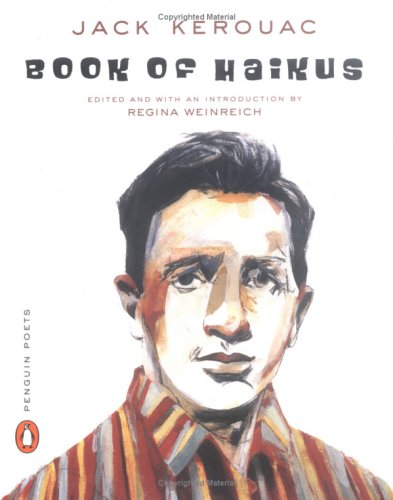
22. Book of Haikus
$4.80
23. Dr. Sax (Kerouac, Jack)
$8.36
24. The Portable Jack Kerouac (Penguin
$11.65
25. Why Kerouac Matters: The Lessons
$39.91
26. Poets on the Peaks: Gary Snyder,
$7.05
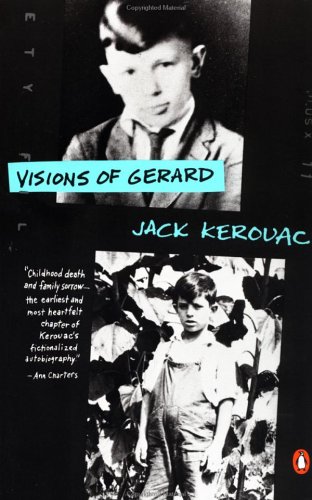
27. Visions of Gerard: A Novel
$7.49
28. Book of Sketches (Poets, Penguin)
 
29. Jack Kerouac on the Road
$6.47
30. On The Road CD
$2.45
31. Jack's Book: An Oral Biography
$9.99
32. Kerouac: Selected Letters: Volume
$7.50
33. Visions of Cody
 
34. Disembodied Poetics: Annals of
$15.12
35. On the Road (Essential Edition):
$26.50
36. Jack Kerouac, Prophet of the New
 
$13.82
37. Los Subterraneos
38. Memory Babe: A Critical Biography
$6.13
39. Desolate Angel: Jack Kerouac,
 
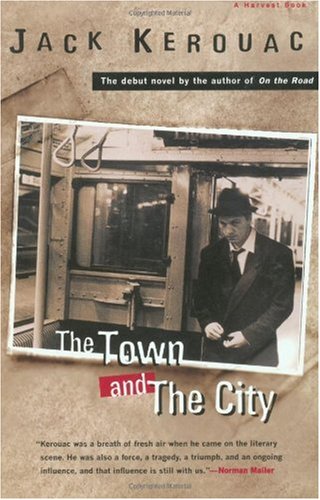
40. The Town and the City

21. Jack Kerouac and the Literary Imagination
by Nancy M. Grace
Hardcover: 272 Pages (2007-01-09)
list price: US$69.95 -- used & new: US$73.63
(price subject to change: see help)
Asin: 1403968500
Canada | United Kingdom | Germany | France | Japan
Editorial Review

Book Description
Jack Kerouac and the Literary Imagination explores Kerouac's fiction, poetry, religious writing, private journals, and correspondence as literary texts revealing his aesthetic vision for American belle letters--one embracing the confessional, rhapsodic, sermonic, and comic. ... Read more


22. Book of Haikus
by Jack Kerouac
Paperback: 240 Pages (2003-04-01)
list price: US$13.00 -- used & new: US$7.05
(price subject to change: see help)
Asin: 014200264X
Average Customer Review: 4.0 out of 5 stars
Canada | United Kingdom | Germany | France | Japan
Editorial Review

Book Description
Highlighting a lesser-known aspect of one of America's most influential authors, this new collection displays Jack Kerouac's interest in and mastery of haiku. Experimenting with this compact poetic genre throughout his career, Kerouac often included haiku in novels, correspondence, notebooks, journals, sketchbooks, and recordings. In this collection, Kerouac scholar Regina Weinreich supplements an incomplete draft of a haiku manuscript found in Kerouac's archives with a generous selection of Kerouac's other haiku, from both published and unpublished sources. With more than 500 poems, this is a must-have volume for Kerouac enthusiasts everywhere. ... Read more

Customer Reviews (8)

5-0 out of 5 stars American haikus
The haiku poem is a Japanese genre where each poem consists of 17 syllables in a 5-7-5 pattern. Kerouac uses this short form in his own personal way - he also calls these short poems "American Pops". These haikus are simple and often funny and they deal with existential matters, nature and Buddhism (often in a blend). Kerouac at his best. A jazz & poetry reading of some of these poems is included on the CD box-set entitled "The Jack Kerouac Collection".

3-0 out of 5 stars It's Just Not Haiku (Is It?)

Who am I to judge another human being's writings objectively? Who am I to declare definitively that what one calls a haiku is in actuality not a haiku at all?

Am I the expert? I don't think I am an expert because I am still learning about the artform -- but perhaps I 'do' have a degree of objectivity about it?

The reason I think I may have some degree of objectivity about it is simply because I have been reading haiku; studying and investigating haiku (especially the original early great Japanese masters); and creating with great flexibility of experimentation my own haiku pretty obsessively for a few years now. I don't think it can be argued that there must be some kind of a genuine "aha" moment (a hidden insight) within the tiny poem; or that there must be at least one "not necessarily quite so obvious on the surface" intuited connection demonstrated existing between the animate and inanimate things in nature. It is in the absence of these things that one runs the risk of ending up with a tiny bit of reporting of what one perceived with his or her five senses and nothing more than that.

Again, I don't know just how much objective discernment I have developed for making determinations of other people's good and bad haiku -- however, I can't imagine that it can be argued that at the very least a so called haiku that possesses an intuited set of connections or relationships between things found in nature will indeed seemingly qualify it as being a "true" and valid haiku.

I believe that we here in the west (even after all this time) are yet to grasp what the true essence of the haiku artform actually is. So many of us here in the western world have not yet gotten beyond composing what are nothing more than these little filler material moments that are mostly just empty reporting of what one sees or hears. Much of the so-called haiku that so many of us create are so "gimmicky" (so "clever" or "contrived") and full of "affectation".

I think that most of Kerouac's so called haiku quite simply are not haiku at all, but are seemingly just reporting what he saw and heard at any given moment; they're images without substance. I am overwhelmed by the sense that he never practiced looking below the surface of these images he reported to see if there was any extra depth therein.

Now, having pretty much condemned most of Mr. Kerouac's tiny creations as being invalid (and I feel bad in my gut having done so) let me just try to prove my point by listing examples.

These are seemingly objectively good to brilliant:

In my medicine cabinet
the winter fly
has died of old age

(It is brilliant; it has substance and the image is rendered perfectly.)

Chief Crazy Horse
looks tearfully north
The first snow flurries

(This is very good; the image is direct and has a substance to it. You notice that there are some almost "inexpressible" connections existing between the elements of the Chief's tears (regret over something, perhaps -- or a ruefulness?) and the snow flurries (Indicating perhaps a feeling that "it's getting late now" or even that "it is already too late"). There could also be a connection to notice contrasting his presumed "warrior's strength" with his tears. This one is very rich in the things that make for a objectively good or great haiku or senryu.)

Missing a kick
at the icebox door
it closed anyway

(This is a good one and seemingly is closer to being a "senryu" than a haiku. Do you see that it has that little "aha" moment in the last line? The setup is in the first line and the payoff is in the last.)

For me those three I just listed represent the best of what he composed in the collections represented in this book. The rest seem anywhere from mediocre to just plain awful. (I get no joy in saying such a thing.)

***
It is unfortunate that the vast majority of his creations are along the lines of the following examples (which for me lack any real substances in their images):

Tuesday -- one more
drop of rain
From my roof

(This one is just some kind of empty reporting of an image isn't it? What does it being Tuesday have anything to do with one more drop of rain falling from my roof? It is confusing if nothing else.)

Seven birds in a tree,
looking
In every direction

(This is just an empty image with no substance. "Seven" draws attention to itself -- but it does so seemingly for no discernable purpose whatsoever. It seems to me that "Birds in a tree" is preferable to "Seven birds in a tree" because in this instance "seven" is serving only to uselessly distract the reader. Seven birds in a tree looking in every direction simply isn't anything but an unremarkable image.)

When the moon sinks
down to the power line,
I'll go in

(What does the moon sinking down to the power line have to do with deciding to go in at that point? If there was a reason for it he didn't say so. Again no substance to it. Is there supposed to be a connection between the moon and power line? If so, I just don't see it. Just random elements put together seemingly for no reason. Confusing to me.)

***
I do not mean to come off as sounding like some kind of high-handed authority on the matter but I think that most of Mr. Kerouac's so-called haiku quite simply aren't -- but I will give him all the credit in the world for trying as best as he knew how to do it.

Maybe I am unduly punishing Mr. Kerouac for composing really bad haiku when I really ought to be making the point that the vast majority of the material in this book is not worthy of publication because of the objectively inferior quality of the content overall.

It occurs to me that any number of others may disagree with my judgments and may "take me to task" over it -- I respect that.

I hope I have been more helpful than irritating with this review.

5-0 out of 5 stars A little book of gems
I wanted to say that I disagree with the comment about the poor production values of this book. Even though the paper could certainly have been of higher quality, the book itself is beautifully designed and printed. I fell in love with it, and already gave a copy to a friend who loves Beat poetry but doesn't know much about Kerouac's verse.

4-0 out of 5 stars Haiku finds American form - Beat!
The other Beat poets generally looked to him as a master, but Jack Kerouac's general reputation will probably always be that of a novelist, albeit a mad one who did little prosaic and much prosodic. Even though he created significant swaths of poetry - within his famous prose and elsewhere, it is a small circle that considers him a poet.

Anyone in that group would like this book.

It shows how far his poems would roam yet stay with a form, the haiku form. This is known to readers of Scattered Poems and Poems All Sizes, and buffs familiar with his recordings with Al Cohn and Zoot Sims - but a better view of the amount of haiku Kerouac had within him is at hand.

A new collectipon of about 700 haikus now appears. Book of Haikus, includes works from several stages in Kerouac's career, and stands well with his other books of poems.

His approach to haiku form, like his approach to blues form, was creative. His first big step was to throw out the syllabic conventions. The classic syllable count of the Japanese form, he reasoned, worked for haiku poems in the Japanese language, but not for English maybe.

For Kerouac, description was key. Encounter with object or experience was key. It is here in Book of Haikus. In haiku bulk.

5-0 out of 5 stars Must have
A great little book with a collection of haikus. Visual presentation is not the very best, but to me it is the contents that counts. IMHO there hardly is a better way to reflect the feelings of a moment than in a haiku, so one can get an intimate impression about the authors feelings comparable to a collection of snapshots.This haiku book certainly is a must have for every Jack Kerouac fan. ... Read more


23. Dr. Sax (Kerouac, Jack)
by Jack Kerouac
Paperback: 245 Pages (1994-01-13)
list price: US$13.00 -- used & new: US$4.80
(price subject to change: see help)
Asin: 0802130496
Average Customer Review: 4.5 out of 5 stars
Canada | United Kingdom | Germany | France | Japan
Editorial Review

Book Description

In this haunting novel of intensely felt adolescence, Jack Kerouac tells the story of Jack Duluoz, a French-Canadian boy growing up, as Kerouac himself did, in the dingy factory town of Lowell, Massachusetts. Dr. Sax, with his flowing cape, slouch hat, and insinuating leer, is chief among the many ghosts and demons that populate Jack's fantasy world. Deftly mingling memory and dream, Kerouac captures the accents and texture of his boyhood in Lowell as he relates Jack's adventures with this cryptic, apocalyptic hipster phantom. "Kerouac dreams of America in the authentic rolling rhythms of a Whitman or a Thomas Wolfe, drunk with eagerness for life." - John K. Hutchens; "Kerouac's peculiar genius infects every page." - The New York Times.
... Read more

Customer Reviews (12)

4-0 out of 5 stars Kumquats and oranges.
There has always been much of the child in Kerouac.Whether creating a baseball game from a deck of cards in Desolation Angels, or just displaying a child-like fascination and exuberance at the prospect for a hiking trip in the Dharma Bums, he comes across as a naive man-child, the reluctant herald of a new social and literary order.After publication of On the Road, he became fascinated with the idea of a Balzacian type of literary work that would encompass the life of the writer, but would be autobiographical only in a peripheral way.It would be a sprawling collection of novels, vignettes and poems with a re-occurring cast of characters that would allow the reader to view the author in a series of vaguely related situations.This grand epic was to be know as the Duluoz Legend.True, his first novel, The Town and the City, dealt with much of the same material contained in Dr. Sax, but that book was written before Kerouac found his true voice, the one that was displayed in On the Road.So, armed with a new style he was to revisit his youth once more and add to the legend.

What makes this novel distinct from The Town and the City, other than its style, is Kerouac's emphasis on the fantasy world of his youthful protagonist.Ti Jean does what most other adolescent boys do: play sports, hang out with his friends, discover masturbation, and lose himself in the fantasy world of comics, radio and movies.Chief among these are the Street and Smith westerns and the mysterious hero of the weekly radio program, The Shadow - "who knows what evil lurks in the hearts of men."Ti Jean, has his own phantom fighter of evil: Dr. Sax, who hangs out down by the banks of the Merrimack, has a greenish complextion, wears a slouch hat in which he stores his secret weapons and potions, and is seen "flowing in the back darks with his wild and hincty cape."Unbeknown to Ti Jean's family and friends trouble has come to Lowell, Mass.In the abondoned mansion on top of Snake Hill the apocalyptic battle between good and evil is to be fought between Dr. Sax and the satanic Serpent, slowly worming its way up from Hell.Although Lowell is saved from the destructive forces of the Serpent, Dr. Sax plays little part in this salvation - he is exposed as quite the inept evil fighter - but by a giant bird that picks up the Serpent and carries it away.All that the ineffectual Dr. Sax can say is, "I'll be damned ... The Universe disposes of its own evil."

I know that I am comparing kumquats to oranges here, but in this novel Kerouac did for Lowell what Joyce did for Dublin.With almost almanac-like precision he describes that mill city of the mid and late 1930s (even providing a sketch map of his Pawtucketville neighborhood) so that armed with a copy of the novel, the present-day reader can follow in Kerouac's footsteps.The Lowell that is described in the novel is essentially an immigrant community, one principally occupied by French Canadians who came south to work in the mills.This community is described with love and attention to detail and Kerouac captures the rhythm of the speech and the social interactions so important to that community.Another high point of the novel is the vivid description of the great flood of 1936, when much of the city was unundated, forcing hundreds to flee their homes.

5-0 out of 5 stars Dr. Sax
This year marks the 50th anniversary of the publication of Jack Kerouac's(1922-- 1969) "On the Road." The Library of America, among others publishers, has marked the occasion with the publication of a new volume including five Kerouac "Road Novels".I wanted to reread other works by Kerouac besides the "road novels" that are in danger of being overlooked, and I turned to "Dr. Sax".Kerouac wrote "Dr. Sax" in 1952 while living with William Burroughs in Mexico City. It was a difficult time for both writers.Kerouac had already written "On the Road" but could not get it published.Burroughs had just accidentally killed his lover, Joan Vollmer, during a drunken game of "William Tell"."Dr. Sax" proved even more difficult to publish than "On the Road" and did not appear in print until 1959.

"Dr. Sax" differs from "On the Road" and the other books in the LOA collection in that it is set in Lowell, Massachusetts, the town where Kerouac grew up.Lowell is a small mill town on the banks of the Merrimack River. During Kerouac's boyhood, it was home to a substantial French-Canadian immigrant population, to a community of Greek Americans and to several other diverse ethnic groups.Kerouac's parents were both immigrants from French Canada.They spoke a dialect of French in their home and Kerouac did not learn English until he was about seven years old. A fascinating part of "Dr. Sax" is the French dialogue among Kerouac and his family -- with Kerouac immediately providing an English rendition in addition to the French.

The book is written from the perspective of an adult -- Kerouac in 1952 in Mexico City -- looking back and reflecting upon his childhood and early adolescence from the standpoint of his ongoing difficult life as awriter struggling for publication and combating his own inner demons of drugs and alcohol.It opens with a dream, and Kerouac tells the reader that "memory and dream are intermixed in this mad universe."The book features a strange character the young Kerouac invented named Dr. Sax, a sinister figure in a cape and slouch hat.Dr. Sax is accompanied by other bizzare characters including Count Cordu the Vampire, the Great Snake, the Wizard, and others who live in a large weed-grown abandoned house on a snake-infested hill just outside of Lowell.Kerouac conceived the idea of Dr. Sax from various comic books that were popular when he was a child.

"Dr. Sax" is memorable largely for the picture it draws of Kerouac's childhood and of Lowell. (Kerouac is named Jack Duluoz or "Ti Jean" in the book.) It gives good portraits of Kerouac's mother and father and of the family's many moves among the poorer neighborhoods of the town and of Kerouac's older sister and ill-fated brother Gerard who died when he was ten. Kerouac, Ti Jean is portrayed as a sensitive, imaginative and athletic child.The book offers portraints of Kerouac playing baseball and marbles, going to church, engaging in pranks and fights with his childhood friends and enemies, watching movies and reading books, experiencing the first flush of sexuality and learning to masturbate, and learning of death, in the person of Gerard and several others.The book also shows a great deal of Lowell and its environs, especially of a large flood that destroyed much of the city's downtown in 1936.

The story of young Ti Jean and of Lowell is punctuated by comic-book like tales of Dr. Sax.Dr. Sax also appears as a shadowy figure commenting upon and observing the life of young Kerouac and his family and friends.There is something sinister about Sax throughout most of the book.He is partly drawn from William Burroughs, as he is shown travelling through South and Central America for various "powders". In the lengthy final chapter of the book, Ti Jean accompanies Dr. Sax in a bizzare chapter in which Sax purports to ward off the forces of evil that threaten Lowell.The story gets a sharp wizard-of-Oz-like twist at the end.

With the comic characters and the surprise ending, there is a great deal of mad humor in Dr. Sax, but the tone still is predominantly one of melancholy and reflection.In one particularly good scene, Kerouac's dying uncle prophetically tells him: "my child poor Ti Jean, do you know my dear that you are destined to be a man of big sadness and talent-- it'll never to live or die, you'll suffer like others -- more"The Dr. Sax figure, similarly, seems to show the price Kerouac paid for becoming a writer.The book suggests -- with its subtitle "Faust Part Three" that Kerouac's writing was part of a Faustian bargain with Dr. Sax in which Kerouac paid for his literary imagination with a sad and tormented life.

Dr. Sax was Kerouac's favorite among his own novels, and many readers would among his work regard it as his best or second-best after "On the Road." (Other works have their own partisans as well.)This book will interest readers who want to see a lesser-known side of Kerouac. The book is written in a variety of styles.It is erratic and not easy reading. Those who are interested in Kerouac's portrayals of his life in Lowell might also enjoy "Maggie Cassidy" and Kerouac's first and underappreciated book, "The Town and the City".

Robin Friedman

5-0 out of 5 stars Amazing talesfrompulp sources
Who is Doctor Sax?At first glance, he appears as a shadowy, even frightening figure from pulp comics.He dons a cape and a slouch hat; he changes colors depending on the time of day.Is he a demonic figure, lurking in the darkness intent on catastrophic destruction or is he simply a regular guy in an atypical superhero type costume?

_Doctor Sax_ is basically a series of interconnected tales of the bizarre, as seen primarily through the eyes of its young protagonist, Jean Duluoz.Lowell, Mass. in the 1930s is the backdrop, and the realistic part of the novel includes Jean's interactions with his parents and his boyhood friends.Jean and his buddies engage in all the compulsory games of childhood, including baseball and shooting marbles.The book also contains a large section concerning the flooding of the Merrimac River during a spring thaw.As seen from some of the boys' point of view, the anticipated floods provide sheer excitement, while their adult counterparts react with fear and horror.

The fantasy part of the book, concerning haunted castles, demons, huge coiling snakes and an ultra-colossal sized bird, contains some of the best and most imaginative science fiction/fantasy writing ever._Doctor Sax_ is not just merely a very superior pulp tale of good vs. evil, it is also a work of genius and wit.Mr. Kerouac, having written in an entirely different genre for him, has clearly outdone himself.

5-0 out of 5 stars Kerouac the mystic.
This book gets you past the historical significance of his work and gives you direct contact with his deeper nature.You don't have to have any interest in "The Beat Generation" to enjoy this book or to appreciate its immense spiritual value.

5-0 out of 5 stars Lowell superheroes
These are stories from Kerouac's childhood.The writing resembles that of the later Henry Roth.Among other things, each man wrote of boys swimming in the river and the magic highlighted style gives the reader the sense of swimming, too, a not alltogether positive experience in the built-up industrial areas described.Kerouac's writing is vigorous and interesting.Dr. Sax is a mythic, half real, half unreal character, something, someone, looming up, derelict.Dicky Hampshire wrote on a fence that Jack is a big punk, and so on and so forth.The community described is comprised of many French-Canadians and French terms and phrases are used.As to the swimming in the Merrimac River, it was polluted in those days prior to World War II in the area near Lowell.Kerouac writes of a silent Boott Mills, horse racing, marble playing, and ghosts.There is bowling at the social club.Movies and funnies get the attention of the children, boys, friends of Ti-Jean.Family names mentioned include Duluoz.Dr. Sax in a shroud stands on the shore.The castle is a heap of stones.The Shadow Magazine is of significance in the book.Flooding in the area sometime in the thirties is described.The boys go to Paul's porch in a rowboat. ... Read more


24. The Portable Jack Kerouac (Penguin Classics)
by Jack Kerouac
Paperback: 656 Pages (2007-08-28)
list price: US$18.00 -- used & new: US$8.36
(price subject to change: see help)
Asin: 014310506X
Average Customer Review: 4.0 out of 5 stars
Canada | United Kingdom | Germany | France | Japan
Editorial Review

Amazon.com
Jack Kerouac produced a substantial body of writings in his mercurial career. His drug- and alcohol-inspired furious bursts on the typewriter created energetic and exciting prose, chronicling his experiences and impressions of the untapped restlessness of America in the 1950s. On the Road is certainly his most recognized and influential work, but among his other efforts are books and stories that range from inspired beauty and to sad desperation. Ann Charters, who wrote the first Kerouac biography in 1973 and worked with him in preparing his first bibliography, has assembled here a first-rate sample of some of his better work. The collection is a perfect way to sample Kerouac and necessary for those looking past On the Road.Book Description
The definitive Kerouac collection—now in Penguin Classics

To coincide with the 50th anniversary celebration of On the Road, Penguin Classics republishes this landmark collection. The Portable Jack Kerouac made clear the ambition and accomplishment of Kerouac’s “Legend of Duluoz”—the story of his life told in his many “true story” novels. Featuring selections from Kerouac’s autobiographical fiction, as well as from his poetry, criticism, Buddhist writings, and letters, The Portable Jack Kerouac offers a total immersion in an American master. ... Read more

Customer Reviews (3)

5-0 out of 5 stars WILD, WEIRD, WONDERFUL--- AND WOOLLY AND WOOZY,
GRANTED that the selections are a mishmash of Kerouac styles, and at times misuse words with a kind of tender haughtiness and screw you if you don't like it but this is what I bruit. Bruit? But at his best Kerouac time and again tells us of that railroad earth and trains rolling under October skies and rushes up our noses with piney phrases that would raise gooseflesh on Thomas Wolfe. What's more, Ann Charters serves Jack nobly by inventively selecting along a timeline that captures the hero's age throughout, a superb bit of editing much like Malcolm Cowley's for The Portable Faulkner in which he patched together a groundbreaking picture of Yoknapatawpha County from Faulkner's many works. A Must-Have Kerouac volume that should break ground for new readers and give old admirers a bath in that old spontaneous prose he dreamed up nightly with candlelight on the kitchen table, booze, and weed. Some of it's mush, some visionary, and much of it just what writing should be: straight from the heart.

3-0 out of 5 stars Well edited, but it has continuity issues
This collection is wonderfully edited.There are no major breaks in the plot and Ann Charters commentary provides a good context to understand the book (e.g. she provides a table that matches character names to actualpeople).However, since the books were written out of order, the immenselydifferent writing styles of Kerouac's different novels do not mesh well attimes.It is fine for somebody who has had previous exposure to Kerouac'swriting and now wants a survey of all his different styles, but I wouldgenerally recommend buying the individual books.

4-0 out of 5 stars almost confusing
For a true kerouac reader, i think it's worth it to work through this book.It's long, but a good part of it is the editor talking, a woman who has a true love of Kerouac.It's a little bit of everything, from hisletters, to his ideas on buddhism(my personal fave)It's a good, but long,read ... Read more


25. Why Kerouac Matters: The Lessons of On the Road (They're Not What You Think)
by John Leland
Hardcover: 224 Pages (2007-08-16)
list price: US$23.95 -- used & new: US$11.65
(price subject to change: see help)
Asin: 0670063258
Average Customer Review: 4.0 out of 5 stars
Canada | United Kingdom | Germany | France | Japan
Editorial Review

Book Description
The author of Hip: The History reveals the lessons of the original hipster bible, On the Road

Legions of youthful Americans have taken On the Road as a manifesto for rebellion and an inspiration to hit the road. But there is much more to the novel than that.

In Why Kerouac Matters, John Leland embarks on a wry, insightful, and playful discussion of the novel, arguing that it still matters because at its core it is a book that is full of lessons about how to grow up. Leland's focus is on Sal Paradise, the Kerouac alter ego, who has always been overshadowed by his fictional running buddy Dean Moriarty. Leland examines the lessons that Paradise absorbs and dispenses on his novelistic journey to manhood, and how those lessons— about work and money, love and sex, art and holiness—still reverberate today. He shows how On the Road is a primer for male friendship and the cultivation of traditional family values, and contends that the stereotype of the two wild and crazy guys obscures the novel's core themes of the search for atonement, redemption, and divine revelation. Why Kerouac Matters offers a new take on Kerouac's famous novel, overturning many misconceptions about it and making clear the themes Kerouac was trying to impart.

Celebrating 50 Years of On the Road
In three weeks in a Manhattan apartment in April 1951, Jack Kerouac wrote his first satisfactory draft of On the Road as a single, 120-foot scroll. On the Road: The Original Scroll prints the text of this remarkable literary artifact in book form.
A 50th anniversary edition of Kerouac's classic novel that defined a generation. On the Road is the quintessential American vision of freedom and hope, a book that changed American literature and changed anyone who has ever picked it up.

Questions for John Leland

Amazon.com: There is a great legend around the composition of On the Road. What parts are true and what parts aren't?

Leland: The legend is that Kerouac wrote the book in three frenzied weeks on a scroll of tracing paper. In truth he had already written a couple drafts, and had written and re-written many of the scenes in his notebooks and letters to friends, which he kept in scrupulous order. I liken the three-week spree to a jazz musician improvising a solo using riffs and phrases he has worked out in the woodshed: it's part spontaneous composition, but building on mountains of practice and planning.

Amazon.com: In Why Kerouac Matters you make the against-the-grain argument that On the Road is not an ode to permanent adolescent transience and rebellion but rather a guide in moving toward adult responsibility. Could you explain?

Leland: Like any good book, On the Road sustains at least two threads. The one that gets the most attention is the book of Dean Moriarty (Neal Cassady), the wild, yea-saying overburst of American joy who sounds an irresistible call to adventure. Dean is the circus that every boy dreams of joining. Dean's road is pure carnal excitement, all speed and jazz and sex. But there's also the book of Sal Paradise, the narrator, who follows Dean out onto the road but then ultimately outgrows him, finishing the book off the road. Sal comes to recognize Dean's road as destructive and limiting--as long as Dean keeps going through the same motions, leaving a new baby and a new ex-wife in every town, he isn't really on the road, he's stuck in a rut. Sal, by contrast, is learning to be a man and a writer, searching for meaning and a home. For all its frantic adventures, the book ends with Sal nesting with his new love, Laura (Joan Haverty, Kerouac's second wife) and ready to write the book we're still reading.

Amazon.com: Do you think its enduring popularity comes from the appeal of Dean's endless summer or from Sal's development? (In other words, do you think people like it for the wrong reasons or the right ones?)

Leland: Dean is one of the most compelling characters in American literature; we'll always be drawn to him. The speed of the prose encourages us not to ask to questions, just be cool and enjoy the ride. Sal is a much more recessive character, shambling behind his friends "as I've been doing all my life after people who interest me." Kerouac regretted that so many readers saw only Dean's wild ride. But I think much of the book's power comes from the tension between these two ideas of manhood.

Amazon.com: You quote a line from David Gates, "A 21-year-old applying to a writing program is as ill-advised to cite Jack Kerouac as an influence as O. Henry or H.P. Lovecraft." Has On the Road been a novel more for readers than for writers?

Leland: Writers who try to write like Kerouac are bound for trouble. More bad prose has been committed in his name than good. His famous dicta, "No revisions" and "You're a genius all the time," obscure the discipline and erudition behind his work. But there's another way to read On the Road, as a tale of a writer in search of his voice. On Sal's first journey, he arrives in Denver and imagines himself in his friends' eyes, "strange and ragged like the Prophet who has walked across the land to bring the dark Word, and the only Word I had was 'Wow!'" He's not ready to tell his story. But by the end, after Dean abandons him with dysentery in Mexico, Sal receives his writerly mission, from a character Kerouac called the Great Walking Saint, who tells him, "Go moan for man." Now he's ready to write, and compelled to do so. Writers who take Kerouac's work as a license to develop their own voices have greatly benefited, even if they don't sound anything like Kerouac. For the others, there's always bongos and reruns of The Many Loves of Dobie Gillis.

Amazon.com: To what extent do you think On the Road is a different book to readers 50 years later?

Leland: We're now longer shocked by the sex and drugs. The slang is passé and at times corny. Some of the racial sentimentality is appalling, and we're revolted--in ways the characters aren't--when Dean busts his thumb on Marylou's head. There's a line in the book when the guys are driving into New York that now takes my breath away: "Dean had a sweater wrapped around his ears to keep warm. He said we were a band of Arabs coming to blow up New York." But the tale of passionate friendship and the search for revelation are timeless. These are as elusive and precious in our time as in Sal's, and will be when our grandchildren celebrate the book's hundredth anniversary. And the music still kicks.

Book Description
The author of Hip: The History reveals the lessons of the original hipster bible, On the Road

Legions of youthful Americans have taken On the Road as a manifesto for rebellion and an inspiration to hit the road. But there is much more to the novel than that.

In Why Kerouac Matters, John Leland embarks on a wry, insightful, and playful discussion of the novel, arguing that it still matters because at its core it is a book that is full of lessons about how to grow up. Leland’s focus is on Sal Paradise, the Kerouac alter ego, who has always been overshadowed by his fictional running buddy Dean Moriarty. Leland examines the lessons that Paradise absorbs and dispenses on his novelistic journey to manhood, and how those lessons— about work and money, love and sex, art and holiness—still reverberate today. He shows how On the Road is a primer for male friendship and the cultivation of traditional family values, and contends that the stereotype of the two wild and crazy guys obscures the novel’s core themes of the search for atonement, redemption, and divine revelation. Why Kerouac Matters offers a new take on Kerouac’s famous novel, overturning many misconceptions about it and making clear the themes Kerouac was trying to impart. ... Read more

Customer Reviews (3)

3-0 out of 5 stars Less Controversial than Expected
Leland's book (published by Kerouac's Viking) is very well grounded in fact and is quite scholarly.Leland's credentials as the NY Times neo-Beatnik/Hippie reporter gave him the edge on this and unfortunatley his conclusions -- that Kerouac really was a conservative square -- longing for conservative "family values" -- are controversial.His sub rosa inspiration he freely admits is of all things the evangelical tome "The Purpose Driven Life".Leland is quite accurate in his recounting facts and events of Kerouac's writing of "On The Road."Most of his conclusions, however, are looney tunes, but admittedly, are good debate material.The title of the book, however, is an insult to all Kerouac readers -- "Why Kerouac Matters: The Lessons of "On the Road" (They're Not What You Think.)"While it MATTERS very little what I think of Leland and his arrogance, his premise that nobody but him knows the "real" Kerouac is disgusting and vain and egocentric.Why choose such an ornery title?Are we all idiots, Mr. Leland?Are you the crusader to bring the holy grail to us? I think I know what "On The Road" is about.Please don't tell me or millions of others that they do not.And why was the "Original Scroll" version not mentioned in the copyright acknowlegments although you freely quoted from it and other books?Somethinng to do with Sampas, the "estate" and the coming arrival of Douglas Brinkley as the "definitive" biographer?

4-0 out of 5 stars In Search of Lost Identity
Jack Kerouac's novel, "On the Road" is not any where near the literary standards of say, "The Great Gatsby" or "Sister Carrie", yet it is a very interesting work. This reviewer has read and reread it over the fifty years since it was published and always found it enlightening.

To its credit, John Leland's book about this novel actually makes reading the novel more enjoyable. The virtue of Leland's critical essay is not so much that it breaks new ground, but that it ties the observations made by many critics and scholars over the years about the novel into coherent themes that underlie the action (or inaction) described in the novel. One of Leland's most interesting points is that Kerouac internalized the middle class values of the thirties and forties and was really out of touch with the post-WWII U.S. and especially the materialism and conformity that characterized the fifties. At the same time, he could not relate to the so-called "beat generation", that claimed him as its founder. (Allen Ginsberg, by contrast, was flexible enough to wade wholeheartedly into both the "beat" and latter Hippie movements.) In the end Kerouac was very much a man out of time and place most of his life. He tried to accept and reject the values that were part of him and his so called road novels on one level represent his search for what he really was.

Some of Leland's other observations are somewhat more dubious and a few are down right loopy. Also Leland notes in passing, but does not build on the sexual ambiguity that was part of Kerouac's life and certainly at odds with his middle class value system. Indeed all the models for leading characters in "On the Road" were sexually ambivalent whose behaviors ran counter to middle class standards and norms. And yet even Neil Cassady (Dean Moriarty), as social critic Paul Goodman observed, tried to conform to middle class standards by marrying and divorcing the women he was continually seducing.

Leland has provided a good think piece on what can best be described as semi-autobiographical novel whose main subjects (Kerouac/Cassady) had only a shaky hold on their real identities.

5-0 out of 5 stars Why LelandMatters
Like his previous book "Hip: The History" journalist John Leland grapples with elusive concepts.In "Hip" he tries to define that nebulous term and makes a lively engaging argument.

In "Why Kerouac Matters" he tries to define the reasons that Jack Kerouac's work held and still holds a strong place in the canon of significant 20th Century literature.He points out that similarly successful work by some of Kerouac's contemporaries are now mere curiousities and not really widely read anymore.And he ventures to do some really creative literary analysis.

Leland does not have the depth and rigor of a thorough academic study but he does not purport to be definitive and his arguments are lively, thought provoking, well researched and well reasoned.He seems to like to tackle somewhat nebulous ideas and I think he is very successful.

As an introduction to Kerouac and for the seasoned Kerouac devotee there is a great deal to be said for this slim but succint and fascinating volume.

Kudos Mr. Leland. ... Read more


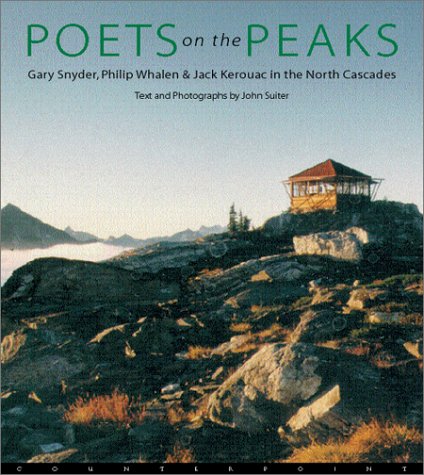
26. Poets on the Peaks: Gary Snyder, Philip Whalen & Jack Kerouac in the Cascades
by John Suiter
Hardcover: 352 Pages (2002-04)
list price: US$40.00 -- used & new: US$39.91
(price subject to change: see help)
Asin: 1582431485
Average Customer Review: 5.0 out of 5 stars
Canada | United Kingdom | Germany | France | Japan
Editorial Review

Book Description
A beautifully illustrated portrait of Beat icons Jack Kerouac, Gary Snyder, and Philip Whalen and the years in the Cascades high country that shaped their lives and work.

This is John Suiter's first book, and it evolved from a magazine assignment that took him to Jack Kerouac's remote fire lookout on Desolation Peak on the fortieth anniversary of the publication of The Dharma Bums. For two weeks in the summer of 1995, Suiter-an East Coast city-dweller all his life-lived in Kerouac's still-standing fire lookout, making photographs for his magazine project. Meanwhile, the awesome beauty and profound solitude of the surrounding North Cascades worked their magic-as it had for Kerouac and countless others since.

In 1996, Suiter met the poets Gary Snyder and Philip Whalen, who had also worked as fire lookouts on peaks in the North Cascades in the 1950s. It had been Snyder-the real-life model for Kerouac's fictive "Japhy Ryder"-who had first come into the Upper Skagit country as a fire lookout in 1952 and blazed the way for Whalen and Kerouac to follow. Suiter returned to the North Cascades during the next few summers for further shooting-hikes on Crater, Sourdough, and Sauk mountains. Illustrated with thirty-five beautiful photographs, Poets on the Peaks tells how the solitary mountain adventures of three young men helped to form the literary, spiritual, and environmental values of a generation.

Based on scores of previously unpublished letters and journals, plus recent interviews with Snyder and Whalen and several others, Poets on the Peaks creates a group portrait of Kerouac, Snyder, and Whalen that transcends the tired urban clichés of the "Beat" life. Poets on the Peaks is about the development of a community of poets, including the famous Six Gallery reading of October 1955, and contains unexpected cameos by fellow poets and mountain-climbers Allen Ginsberg, Kenneth Rexroth, Philip Lamantia, and Michael McClure. Poets on the Peaks is also a book about Dharma and the years of Dharma Bums--from the 1951 roadside revelation in the Nevada desert that led Gary Snyder to drop out of academia and head for Japan, to Kerouac's lonely vigil with The Diamond Sutra on Desolation Peak, to Philip Whalen's ordination as a Zen priest. Finally, Poets on the Peaks is the story of the birth of a wilderness ethic, as well as a photographic homage to the Cascades landscape, a landscape virtually unchanged since these men journeyed there thanks to the environmental protections they helped inspire. ... Read more

Customer Reviews (6)

5-0 out of 5 stars The sources of "The Dharma Bums" & more
This is the perfect companion to Jack Kerouac's classic novel, offering a wealth of information, fascinating stories, and gorgeous photographs about the world chronicled in that novel's pages. But it offers so much more -- a richer understanding of Gary Snyder & Philip Whalen, as well as their poetic work, and an in-depth look at the times & experiences that shaped all three writers. There are countless books about the Beats, many of them quite good indeed ... but this is surely one of the best. The author truly knows & loves his subjects, without being blinded by any need for glossy hagiography. It's as honest a book as you'll find about these three remarkable men & their times. A very enthusiastic recommendation!

5-0 out of 5 stars Beat Beginnings:The right place at the right time...
John Suiter's work on the founding fathers of Beat poetry and prose is a marvelous read. Suiter takes us along the trail through post war America and ties together the Beat poets, Jack Kerouac, McCarthyism, San Francisco and the North Cascades Forest Service Fire Lookout system of the 1950's. Imagine the poet/Zen Buddhist Gary Snyder being blacklisted from working for the Forest Service! Do you want to know how Jack Kerouac got the idea for his Dharma Bums work? What was it like spending a month and a half completely alone on top of a mountain in the Pacific Northwest, looking for the telltale smoke of a developing forest fire? Do you know what a "lightning stool" is, what you do with it and would you like to see a photograph of one? What was it like being at the famous Six Gallery poetry reading in 1955 when Allen Ginsberg first read "Howl"? If these questions interest you, or if you want to know about the origins of Beat writings-this is the book to get. Author Suiter launches the reader awaythrough Old Mexico to visit with young Robert Mitchum as Christ in a glass coffin and William "Junky" Burroughs, up through Yosemite to camp with Kerouac and Snyder, a stop in San Francisco at City Lights Bookstore and Lawrence Ferlinghetti and finally Japan and Hozomeen, and the Void from Desolation. A delightful Masterpiece of fact and photographs!

5-0 out of 5 stars Covers beautiful Cascade Mountain scenes and peaks
Writer-photographer Suiter provides a literary portrait of Beat era poets Gary Snyder, Philip Whalen, and Jack Kerouac in Poets On The Peaks, which centers around their early experiences as fire lookouts in the 1950s. As such, Poets On The Peaks provides a hard book to easily categorize: it covers beautiful Cascade Mountain scenes and peaks, fire lookouts, and literature and biography alike. The writings of these three juxtapose nicely with the photos and images, making this a recommended gift choice for the holiday season.

5-0 out of 5 stars Significant contribution to literature on early Beats
In his first book, John Suiter has produced a work that contributes significantly to the literature on early development of the Beat literary movement and to understanding the disparate characters of Snyder, Whalen, and Kerouac.Using the common experience of all three men serving as fire lookouts in the Northern Cascades in the early to mid 1950's, the author evokes portraits of how each writer was influenced by wilderness and the isolation of a fire lookout, and how each used the experience in his work.Drawing from recent interviews with Snyder and Whalen and others who knew them during the early 1950's, from previously unpublished letters and journals, and from extensive close readings of all three writers, the author crafts a portrait of the evolution of a literary movement, of a wilderness ethic, and perhaps unintentionally, the devolution of Kerouac contrasted against the focus and dedication of Snyder and Whalen.The book is illustrated with photographs of the fire lookouts and their locales.

5-0 out of 5 stars Gifted Photographer/Story Teller Explores Poets/Peaks
"Poets on the Peaks" by John Suiter is a beautiful and insightful book. The text and pictures hold your hand through wonderful reminiscing with and about some of the greatest poets of our time. The landscapes that inspired the poetry that Gary Snyder, Philip Whalen and Jack Kerouac are famous for is staged perfectly throughout the book. It gives you a sense of time and place that makes you feel as if you were in those look out towers and you experienced that electric and quiet time. Learn, escape, and love with this book. It is well worth it! ... Read more


27. Visions of Gerard: A Novel
by Jack Kerouac
Paperback: 144 Pages (1991-06-01)
list price: US$13.00 -- used & new: US$7.05
(price subject to change: see help)
Asin: 0140144528
Average Customer Review: 4.5 out of 5 stars
Canada | United Kingdom | Germany | France | Japan

Customer Reviews (16)

4-0 out of 5 stars A hit
Kerouac is often hit or miss. This book is a double bull.Its sad, beautiful... The affect that his older brother's young death had on Jack is moving.If you've been discouraged by Kerouac in the past, or if you think he's overated (I tend to agree) try this book out.

5-0 out of 5 stars This gentle, weary flesh
Surely the most tender of Kerouac's many books, this reads more like an extended meditation than a novel as such, and draws the reader into its elegaic world of bittersweet memories & lost joys. Written at the height of Kerouac's immersion in Buddhism, it fuses both his Buddhist studies & his own Catholic upbringing to create a personal faith of both suffering & a sort of resigned wonder, contemplating the ephemeral, cloud-like events of Time from the perspective of a pained & puzzled Eternity. While a lovely memorial to his brother, it's just as much a revealing portrait of his own sensitive soul, battered by the needless cruelties of life, yet still astonished by its beauties. An essential book, not just for the Beat canon, but for all who ponder the contradictory nature of life on Earth. Most highly recommended!

5-0 out of 5 stars Diamond Literature
I haven't read ALL of this book yet, but what I have read has proved to be, so far, one of the most beautiful, melancholy stories my eyes have ever graced. I have been moved to tears, and after diving into Kerouacs huge library, I would be the first to say that On The Road has definite rivals within his legacy......This is an essential, don't believe the hype about it being "for completists only". This book should be made standard fare among literature courses along with all his books, screw it!! mabye that's taking it to far, but still, this book is grade A and the other reviews can tell ya all about it.

5-0 out of 5 stars an offbeat gem
This is a little off 'Beat' gem (for Kerouac) of the author's canon. It is the most Catholic of his books, and perhaps the closest to his origins as a writer. It is a narrative poem, filled with Kerouac's eidetic imagery, much of it of a Catholic, French Canadian character, and crumpled language. It is intensely personal, yet never falls into pathos over the tale of the death of his brother from illness. There are lovely passages of innocence and anger, love and grief. One wonders if such a tragic event, when the author was age 4, was formative to his later history of wandering, restlessness, neurosis and alcoholism. It's a book that regular Kerouac readers might find a bit eccentric, sentimental. It doesn't have the frenzy of 'On the Road', or the bitter ends of 'Big Sur', but it is among his finest, most truthful and most hopeful works.

5-0 out of 5 stars Touching and sad.
I first discovered Jack Kerouac when a friend of mine was going on and on about this book "On the Road" that he had read, only this past November. I picked up the book and read it, I was floored, and I've read eight more of his novels since that time.

'Visions of Gerard' is a touching story of Jack's older brother Gerard who dies a sad death at 9 years old but seems to live a more beautiful life than most of us can claim to have in twice as much time in my case, and of course, in others seven or eight times.

Gerard's optimism, appreciation of everything, and just pure kindness in the book makes it for a beautiful, touching novel that everyone should read. There's no excuse not to, it's very short, but it pulls you in so quickly! It's hard not to be sad, but it's hard not to be happy, a beautiful book. ... Read more


28. Book of Sketches (Poets, Penguin)
by Jack Kerouac
Paperback: 496 Pages (2006-04-04)
list price: US$18.00 -- used & new: US$7.49
(price subject to change: see help)
Asin: 0142002151
Average Customer Review: 5.0 out of 5 stars
Canada | United Kingdom | Germany | France | Japan
Editorial Review

Book Description
A never-before-published book of poems by Jack Kerouac—in a deluxe package

In 1952 and 1953 as he wandered around America, Jack Kerouac jotted down spontaneous prose poems, or “sketches” as he called them, on small notebooks that he kept in his shirt pockets. The poems recount his travels—New York, North Carolina, Lowell (Massachusetts, Kerouac’s birthplace), San Francisco, Denver, Kansas, Mexico—observations, and meditations on art and life. The poems are often strung together so that over the course of several of them, a little story—or travelogue—appears, complete in itself. Published for the first time, Book of Sketches offers a luminous, intimate, and transcendental glimpse of one of the most original voices of the twentieth century at a key time in his literary and spiritual development. ... Read more

Customer Reviews (4)

5-0 out of 5 stars The Great American Poem
I know this was an accumulation of Kerouac's observations from the early 1950's until 1957 written in little notebooks...writings that capture the detail of the world (mostly America) as he mentally photographed it and transcribed it ( as a writer's exercise or batting practice)...and I know that he took all these observations and typed them up as a manuscript titled book of sketches...But upon reading this...this stands as the greatest poem ever written about America...

5-0 out of 5 stars Most important new Kerouac release in decades
After completing his scroll version of On the Road in April 1951, Kerouac was still unsatisfied and wanted to break away from its "conventional narrative survey of road trips etc." In October his architect student friend Ed White suggested to Jack: "Why don't you just sketch in the streets like a painter but with words?" Kerouac tried it, and was gripped by the power of the new technique which lent a new form of spontaneity to his writing. He began straight away, enthusiastically rewriting his Road book in this new fashion. The first 36 pages of Visions of Cody are pure sketches, recorded in the streets, subways and diners of New York in the fall of 1951. This new publication, Book of Sketches, contains over 400 more pages of sketches, typed up by Jack in 1959 from the original small breast-pocket notebooks in which they were recorded. They begin with sketches of life at his sister's home in Rocky Mount, North Carolina in August 1952, just after Jack had returned there from Mexico City where he had completed work on Doctor Sax. Jack describes his work on the North Carolina railroad just before taking off on the road once more on a mammoth hitch-hike to California, via Denver, and the new Cassady home in San Jose. Then follow sketches of Mexico from December 1952, and one on an airplane flying from St Louis to New York, a previously unknown trip taking Jack back home in time for Christmas.

In the following year Jack sketched while on a visit to Montreal in March 1953, and during his railroad work at San Luis Obispo, California that April, before taking off by sea for New York and a meeting with "Mardou" during the summer of the Subterraneans. Sketches of Jack's work on the Long Island railroad in October are also included , as well as more descriptions of the streets of Manhattan and Long Island that fall. The book comes to a close with a glimpse of life in San Francisco in early 1954, and tagged onto the end are a few sketches recorded during Jack's big overseas trip of Spring 1957, to Tangiers, France, and England.

The writing is superb throughout, and particularly the description of what must have been Kerouac's longest ever hitch-hike, 3000 miles from North Carolina to California in late August 1952, via Tennessee, Arkansas, Oklahoma, Kansas, Colorado, Utah, and Nevada, a trip not previously mentioned in his other writings. Jack lists each town he passed through and describes practically every lift he obtained on the way. Reaching Denver, Jack spent a whole day sketching Neal's old haunts, including Zaza's barbershop, the Glenarm poolhall, and Pederson's. But as well as sketching the scenes before him, Kerouac also explored philosophical topics, such as his Spengler-inspired sympathy with the Fellaheen, in his "Notes on the Millennium of the Hip Fellaheen, Oct. 1952, California" and planned his future with them -- "Go among the People, the Fellaheen not the American Bourgeois Middle-class World of neurosis nor the Catholic French Canadian European World -- the People -- Indians, Arabs, the Fellaheen in country, village, of City slums -- an essential World Dostoevsky."

This has to be one of the most important pieces of Kerouac's writing to have been released in several decades. As well as providing further examples of Kerouac's innovative sketch-writing, it also fills some gaps in the Duluoz Legend. It will become an essential part of the Kerouac canon. The marketing of the book raises some queries, however, since it is described on the back cover as a collection of "poems" and is published in the Penguin Poets series. Kerouac always seemed quite clear that his sketches were not poems but prose. In his definition of a sketch (in Some of the Dharma) he notes that "A sketch is a prose description of a scene before the eyes," and on the title page of his typescript wrote: "Book of Sketches -- Proving that sketches ain't verse." It is clear, though, that sketching led to Kerouac's development of the spontaneous poems he called Blues, which he began in 1954 with San Francisco Blues, continuing with his classic Mexico City Blues the following year. Whatever, it's the content of the book that matters, and this is quite simply outstanding, and essential for any Kerouac enthusiast.

5-0 out of 5 stars One of Jack's Greatest Books!
>
Sketches of `Sketches'

Jack Kerouac's 'Book of Sketches' is beautifully
descriptive - I want to keep quoting passages
for you.... Kerouac sees & then meditates on
what he sees but all in an instant while watching
it.

Incredibly perceptive, Jack puts into words
what you suspected yourself but hadn't noted.
He invents words & re-spells words all the time
when he sees the limitations of language.If
somebody says something to him in a local
accent he spells it the same as the person says
it, not original among writers it's true, but a
a mark of Kerouac's accurate honesty to the
subject.And this conveys the full feeling of
the moment to us without it being distorted by
convention.

Most women wouldn't like this book (as generally
women don't like Kerouac's writing).Women
like plot and a dialog, you'll find neither of
those here.

Kerouac, more than any other writer I know, is
a pleasure to read.Someone once said he had
a hypnotic quality and true enough reading Book
of Sketches in bed - it's one book I don't want
to leave my bed for, for the bathroom.

Jack has learned the immediacy of writing "on the
job" - actually describing the scene as you see it -
so that descriptions of everyday street life appear
vivid.
But Kerouac goes further his thoughts melt with
what he see's so that as the great Scottish Beat
James Morton say's it becomes a journey of the
mind.

Physically a chunky little book, printed on that
sort of imitation old parchment with ragged
edges.Jack types out the lines short like American
poetry, which reads like prose, (unlike Jack's prose
which reads like poetry) - so it can be assimilated
in bite-sized chunks.A deceptively small book
though, Kerouac fans will be delighted to know
that there's a lot of text in there - I found it a long
read that went right to the back of the mind.
So, a far longer book than it's appearance would
suggest.I would say it will take two days solid
reading to get through it (that's if you're going
to take it all in).

Jack's thought is so natural you can often read the
last line of a passage and `know' the theme of the
previous lines.

The truth is we see nothing without feeling an
attendant emotion.Kerouac's genius is in noting
the emotion with the observation, but his economy
with language is such that where with most
writers this would slow the passage down with
Kerouac it's just a glimpse and the text rolls on
un-interrupted.
But I think I've said that already, so I'd better
wrap this small review up...

The piece that sticks in my mind is the description
of the sunken boat with the seagulls sheltering in it
(about 2/3 of the way through), probably because I
come from the seaside.

The nearest comparison I can think of to Kerouac
when he's in this descriptive mood is the writing
of Katherine Mansfield.Jack may be the last
great writer because in this day of television, and
instant visual art through computers and eight
screen cinemas, no one these days is immersed in
books for their fantasies the way they were pre-
the nineteen sixties.Therefore nobody develops
the ability to write the way they did back when.

I should think Kerouac kept a diary back in 1953
at the height of his writing powers - and this is it.

Hail, Oh genius!

In the Kerouac canon Book of Sketches is as
important and artistic a book as Dr.Sax.

5-0 out of 5 stars Achieves Greatness
At first you may not take this book seriously...ANOTHER "new" book by Jack Kerouac...released so that Kerouac lovers (like me) HAVE to buy it no matter how useless it might be; but then you start reading it...and it starts to get interesting...more and more interesting...Kerouac revealing incredible thoughts, brutally honest about himself, women and their body parts, America itself... the whole book is over 400 pages...and by the time you get to page 172 or so...you begin to realize...THIS BOOK IS GREAT...and then after that it doesn't let you down...it continues to be GREAT.FYI, the majority of "Sketches" was written between The Town And The City and On The Road.I absolutely give this book my highest recommendation. ... Read more


29. Jack Kerouac on the Road
by Jack Kerouac
 Paperback: Pages (1957)

Asin: B000JIQS3G
Canada | United Kingdom | Germany | France | Japan

30. On The Road CD
by Jack Kerouac
Audio CD: Pages (2004-05-01)
list price: US$19.95 -- used & new: US$6.47
(price subject to change: see help)
Asin: 0060755334
Average Customer Review: 4.5 out of 5 stars
Canada | United Kingdom | Germany | France | Japan
Editorial Review

Book Description

On the Road chronicles Jack Kerouac's years traveling the North American continent with his friend Neal Cassady, "a sideburned hero of the snowy West." As "Sal Paradise" and "Dean Moriarty", the two roam the country in a quest for self-knowledge and experience. Kerouac's love of America, his compassion for humanity, and his sense of language as jazz combine to make On the Road an inspirational work of lasting importance.

... Read more

Customer Reviews (13)

4-0 out of 5 stars An excellent performance of a childish novel
I dislike the prose Beats; I *hate* Burroughs, while I only dislike Kerouac,but nonetheless I agree with John Updike's very funny parody of the genre called "On The Sidewalk" (from his 1965 book Assorted Prose), in which the narrator is a faux-rebellious child who takes off burning through the afternoon on his tricycle, but is too scared to cross the street alone.

But Matt Dillon's performance of this audiobook version is really excellent. He does absorbing but not overdone voices for the different characters, reads the rest of the time with a suitable world-weary tone, and (my favorite aspect of his performance) picks up on the fact that Kerouac sometimes goes on a tear of short, Hemingway-esque sentences, which Dillon reads as if they were liturgy or poetry, with a steady, incantatory beat.

There seems to be a trend of recruiting name actors to do high-profile audiobooks; Maggie Gyllenhall's The Bell Jar is even better.

4-0 out of 5 stars A new audio book lover is born...
On the Road is my very first audio book ever. I've tried audio books in the past, but they always seemed to be narrated by some suave fella with a buttery English accent, and I would inevitably end up face-down on my bed, snoring away within 5-7 minutes of beginning. When I began to commute for a total of 80 minutes a day (round trip), I quickly tired of listening to the same music time and again. Although I have an 8gb iPod nano, you can only cram so much music on the thing. After I gave up finding a decent radio station, I was left with one simple option. Give audio books another try.

On the Road seemed an obvious choice for two reasons. 1) I was turning to audio books because I was "on the road" so much (har har) 2) I haven't been able to read it. That is, its rambling style tends to put me to sleep almost as quickly as a British man reading at me. Yet, I've always wanted to complete it despite my doomed attempts, and the recent publication of Kerouac's original scroll sort of bewitched me. I was completely ignorant of the great Kerouac myth before I decided to listen to this book. I had no idea the length of time that Kerouac and his cronies spent traveling the country. I hadn't the foggiest idea that he wrote the book on one long, uninterrupted scroll of paper (120 feet). Or that Kerouac composed the novel in a three-week rush of writing fueled by endless cups of coffee and--though Kerouac adamantly denied it--probably Benzedrine.

But enough of the back story...let's get to the book! I listened to an unabridged audio version narrated by Matt Dillon, and for that aspect alone, I expected to have problems with it. Matt Dillon is generally considered, by me, a boil on the butt of humanity. His teeth bother me, his face bothers me, his voice bothers me. But, somehow, he was able to make On the Road come alive. Given, he has his readerly flaws--his syllables sometimes smashing in on one another, his characters' voices eventually crapping out and evening into something that sounds very much like "every other character." However, he has some rough wildness to his voice that did justice to Kerouac's musical, rambling, stream-of-consciousness classic.

This is one of those books, like Wuthering Heights, that offers few likable characters. They're ruffians and deadbeats and swindlers, but they're also thinkers and adventurers. I suppose the story, as I knew it would, plays into my romantic fantasies of dropping everything and just taking off. I would love to travel the country with no particular place to be for seven years. Drink with friends, intellectualize, philosophize and write, write, write. Alas, Kerouac lived, in many ways, in a dramatically different America than the one we live in today. A man could hitchhike from coast to coast, sleep around and drive his car into a muddy ditch in middle America without worrying too much about being arrested or getting knifed to death and hacked into little pieces.

I read somewhere that Kerouac's novel is a "love letter to America," and I think that's a fair assessment. He became intimately acquainted with corners of this country that most people will never see, and never care to see. His manic scribblings are interspersed with poetic, literary digressions that boggle the mind. The whole thing is one big jazz solo twittering, banging and hooting all night long.

Now, all these praises don't actually mean that I liked the book that much. That's news, eh? This is one of those tomes that I appreciate even if it bored me at times. I appreciate Kerouac's intentions far more than his prose, and when all is said and done, I really like the mythical proportions that this story and its author have grown into.

5-0 out of 5 stars Perfect presentation!!!
Matt Dillon's presentation was superb -- he brought the characters to life.Especially, Dean, with his slow, distant, unique way of talking ... it was like Dean was really there.

I would very much recommend this audio CD to anyone who likes On the Road.Very, very well done.

5-0 out of 5 stars Excellent. Dean Moriarty would probably say: Yes, Yes, Yes, this man has got IT!
I think most of the reading is excellent, just some short parts are less inspired, and maybe- but this is very personal - only the very first pages are not read in the mood I feel them in my soul. But the more you listen, the more you are caught in the reading and you realize the great work of actor Dillon has made and in a very spontaneous way.
Dillon's voice is full of colours and tones, the reading is rich in changes of speed, subtle shifting in mood. He succeeds in carving the characters from within in such a deep and honest way that they keep on living haunting you also when the reading is over. All the dialogues are performed in an outstanding way.
If English readers disagree, let me add that I am Italian and I had bought On the road long time ago but in English it was difficult for me and I didn't like the Italian translation. Though not English, I had felt the jazz wave of the writing and loved it. I felt a lot went lost in translation as if you cannot read Cesare Pavese in Italian, I guess.
So On the road had remained there on the shelf together with other not-yet-read books that are like friends I keep loving simply because I trust them.
What a surprise then when a lot of years later, while living in a country with a mysterious language, where English appears the only chance to subtitle reality and fiction, I found out that a reading of the whole book was available and the narrator was Matt Dillon, who has the perfect voice to embody On the road.
So thanks to Matt Dillon for driving me till the end of this journey of Kerouac's word in such an intense way, performing this jazz session of Kerouac right with the voice I had always imagined these lines would sound.
I don't know of any movie of On the Road. This is the kind of book that may frighten a director. However, listening to this reading I imagined it would be challenging with a director as Gus Van Sant or maybe Coppola or Scorsese, having Matt Dillon performing Sal or Dean, or even both, the last idea only if an enough visionary director/writer can somehow tell through the movie art how much Dean is part of Sal himself.

3-0 out of 5 stars A glimpse of history
"On the Road" does not tell a particularly compelling story, but it offers an interesting and entertaining view into the lifestyle of a generation of post-World War II era beatniks.Matt Dillon is sometimes great with his narrative and sometimes awful, running on in a dull tone and ignoring punctuation in what feels like an effort to plow through the material. ... Read more


31. Jack's Book: An Oral Biography of Jack Kerouac
by Barry Gifford, Lawrence Lee
Paperback: 304 Pages (2005-09-15)
list price: US$15.95 -- used & new: US$2.45
(price subject to change: see help)
Asin: 1560257393
Canada | United Kingdom | Germany | France | Japan
Editorial Review

Book Description

Here, in what has become a classic of its kind since its publication in 1978, is the fascinating story of Jack Kerouac, "King of the Beats" and American literary legend, recorded through the voices of his friends and lovers. Authors Barry Gifford and Lawrence Lee retraced Kerouac's life at home and on the road and talked with the prophets, musicians, poets, socialites, and working people who knew Jack Kerouac. Some are famous like Allen Ginsberg, Gore Vidal, William Burroughs, Gary Snyder, among others; and some are not like Jack's boyhood buddies, his lovers, and his barroom companions. All, however, have contributed to a remarkably vibrant, riveting portrait of a life. We see Jack at Columbia University and on the scene of Greenwich Village; speeding across the tarmac of America with Neal Cassidy ("Dan Moriarty" in Kerouac's classic novel, On the Road); at home with his possessive mother; in California, drinking wine and talking Buddhism; and finally, in Florida, where his life ends tragically at forty-seven years old. Jack's Book, like Kerouac's novels, makes a unique contribution to our understanding of a man and a generation that shaped the dreams and visions of those who followed.
... Read more

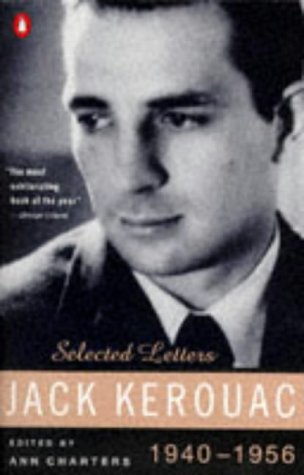
32. Kerouac: Selected Letters: Volume 1 1940-1956
by Jack Kerouac
Paperback: 656 Pages (1996-03-01)
list price: US$18.00 -- used & new: US$9.99
(price subject to change: see help)
Asin: 0140234446
Average Customer Review: 5.0 out of 5 stars
Canada | United Kingdom | Germany | France | Japan
Editorial Review

Amazon.com
Jack Kerouac is one of America's most influential literary figures. On the Road begot the Beat Generation, which ushered in the hippie movement, then free love, then drugs and so on and so on. Yet the real Kerouac bore little resemblance to this enduring image as an open-road rebel and spokesman of the Beats. He was a lover of women and wine, all right, but also a sad, confused romantic who longed for acceptance and often viewed life with a child's perspective. By capturing his emotions in his personal writings, Selected Letters helps shed light on a figure who was as troubled as he was rebellious. ... Read more

Customer Reviews (4)

5-0 out of 5 stars Kerouac Rocks
A fantastic gorp into Kerouac and his 'real' life and the many spontaneous voices that make his dreams.As you read these letters listen to the different tones he gives to those most important in his life ... Sabastian Sampas (boyhood best friend), Gabriella Kerouac (anchor Mom), Allen Ginsberg (understanding friend), William S. Burroughs (adventure friend), Neil Cassady (challenging boyfriend), Stella Sampas (wife subsequently), Carolyn Cassady (complicated :).It is all here!Jack's words bring up the truth about questions that still are not answered today as we go to the 'world of tomorrow'.Buy this to hear it direct from Jack.

4-0 out of 5 stars An essential read to understanding the genesis of his work.
Much has been made about Kerouac's philosophy of spontaneous prose. The immediacy of it's impact. It's flawed honesty. The sheer weight of his all-too-real emotion as it flowed out of him and stained the page. Like VanGogh, Kerouac was an artist who did not concern himself with"sentimental melancholy" but looked to express the true sorrowand joy of his life in his works. These letters are a vital piece of theKerouac puzzle, fore they show us the genesis of the man's method andstyle. From his early emulation of novelist Thomas Wolfe, through hismeeting of first Allan Ginsburg, who was really more of an intellectualinfluence than a literary one, and subequently, William Burroughs, and NealCassady. It was Cassady's influence that was paramount to Kerouac'screation of his style, and in his letters to Neal, we are shown first handhow Jack sought to withold nothing, to seek out the details of living.These letters are startling in their honesty and emotion. They reveal a manwho sought not only a vision of and for himself, but for the rest of usliving, dead, and unborn. Maybe he was uncomfortable in his own skin, maybehe couldn't cut the apron strings that bound and stunted him emotionally tohis mother, but these letters prove the essentialness of the artist in thisworld. Those souls like Kerouac who sought to express the unknown, that thereasons for why we all go on living in this world where "all life issuffering," outweigh the reasons why we should just give up and notlive at all. Jack may have suffered too much, smoked too much, and drankhimself to an early, lonesome grave, but he left behind works of beauty andsadness that changed the landscape of modern literature, whosedirectionless direction sought the innocent, lost heart in many of us. LikeJack said, one must "live, travel, adventure, bless and don't besorry."

5-0 out of 5 stars The screen-plays of Kerouac's life
Having read most all of Kerouac's published work, reading this book is like finding the keys to the locks.Jack's and other letters provide deep insights into his life, his feelings and all that followed into Jack's novels, poems and stories. Much more than a diary, this book serves almost asreference material for reading his other works. The letters pre-On The Road and post-Big Sur, opens up your eyes to the life he was leading, itis here that you see the fluid motion of his lifefalling into his work. A must have for any JKbookshelve.

5-0 out of 5 stars I dig this book
If one wants to dig deep into kerouac then this is how.Everything begins to form from reading this.You find Jack inside yourself screaming to come out.You hear his voice and feel his every tear, smile, and high that he has felt.I recommend this to anyone who wants to take a risk in believing in someone with different views then we have today. ... Read more


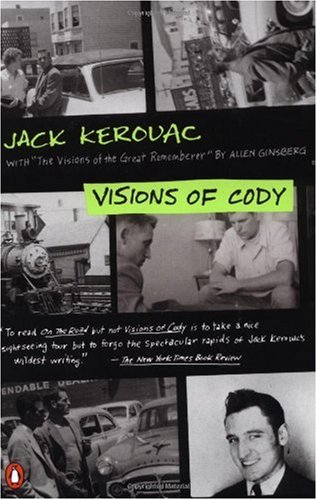
33. Visions of Cody
by Jack Kerouac
Paperback: 448 Pages (1993-08-01)
list price: US$15.00 -- used & new: US$7.50
(price subject to change: see help)
Asin: 0140179070
Average Customer Review: 4.0 out of 5 stars
Canada | United Kingdom | Germany | France | Japan

Customer Reviews (22)

5-0 out of 5 stars How To Read The Tape Transcripts...
Yes, at first I thought the tape transcripts were just a lot of useless padding to fill out Jack's book. Boy, was I wrong! Here's how to read them:

1. Get a couple of Charley Parker albums (Bird and Diz will do nicely.)

2. Procure a jug of red wine and a joint.

3. Put on Bird, pour a glass of wine, and just relax with the music for a while.

4. Take a few tokes. Drink more wine. Get a nice mellow buzz.

5. NOW, begin reading the tape transcripts, and voila! You are invited to the party!

You will be sitting there with Cassidy and Kerouac, digging the flow of music and conversation and experiencing a new comprehension of their friends, wives and lovers. The gossip, the stories, the subtle oneupmanship between them is a delicious fly-on-the wall experience. By recreating the set and setting of these long ago conversations, you will experience an intimacy that is uncanny. I've done this a few times and was amazed at the greater understanding I had of these two complicated men. I read and re-read the transcripts with delight and was sorry there wasn't more of them.

This is surely what Kerouac intended. It's like the modern day extras and behind the scenes specials you get on movie DVDs. I mourn their passing more than ever and the fact that there doesn't appear to be anyone out there to take their place.

Ever wonder why Hollywood depictions of the Beats are laughable failures? HERE'S why.

Go now...

2-0 out of 5 stars From the old Remington Rand direct to you...
I don't even know what to say about this book other than anyone who pretends to like this nonsense deserves to read it. Truman Capote's quote about Kerouac's writing, "That it's not writing, it's typing," probably sums up the matter better than anything I can say.What disappoints me I suppose is that I really want to like Kerouac - I love the idea of him, though I can't say I care much for his typing.

2-0 out of 5 stars Spontaneous Autonomy Or Muddled Proustian?
Allan Ginsberg wrote in August 1972: "Some of Kerouac's writings of '52, particularly his Visions of Cody, are some of the most brilliant texts written about the psychedelic experience, especially the description of him and Neal Cassidy on Peyote." AND From October 26, 1974, Ginsberg writes of himself, which he learned from Kerouac: What I mean by "polish the mind," in that you actually do get an increasing awareness either through meditative or poetry which is another yoga, of the actual stuff, cita. And then it becomes a matter of being a very faithful secretary. You can't get everything, so you get as much as you can so you have something solid to work with. In other words, you're not doing something arbitrary, romantic, babble, bullsh*t, you're actually dealing with your mind stuff just like a painter's working with an actual landscape. Solid in the sense that it's real, it's objective, it isn't even your subjectivity any more, you're just objectively watching something move. So there's no long any question of egotism or self-expression or personal expression. All those theoretical things are like nonpracticing questions. But if you're actually practicing there's a real thing to work with, which is your thought-forms."

"Chogyam Trungpa's principle of "First thought, best thought." That was kerouac's basic principle for his spontaneous writing, for the same Buddhist reasons of practical inquiry into the operation of the mind. Both Kerouac and Trungpa realized, and teach, a very simple thing, which is that the first way that you flash on a thing is the unselfconscious, naked, real first-mind way, which is totally private and odd, eccentric to you, but is so direct that anybody can understand it."

At first, this book was way too muddled to be of much use for myself, not receiving much out of the book and feeling that I have invested way too much time for the read, but I think that's because I've been reading it as a novel like "On The Road," and this is more poetry or jazz style spontaneous prose. Actually, this book is from flashing mental thoughts that are suddenly inspired within the self. This book is not some preplanned novel and storyline and not at all the robotic, mechanical mindset of the propogandized America and therefore represents a breakthrough in American thinking, thinking for the autonomous self.

I think if this book were given the publisher to publish before "On The Road" they would have agreed here on such being garbled and overly Proustian in attempt of remembrance. However, to the person looking for poetry or verbal prose over a story, and in this we have a jazz type expression of bebop in words and that makes this book a major change from the herd mentality of the masses. Hey, this is the beat rhythmic language, not Melville or Dostoevsky, but Proust and Celine.

Now to be fair, there are some good descriptions and well written feelings through out the book, but not in volume. Now don't get me wrong, I'm a Beat Hipster I would like to think, a Nietzschian, a mystical, philosophical seeker into spiritual, psychedelic and karmic realms, but maybe not the existential, Benzedine type. This book is largely garbled ramblings?? Or is just too poetic for me? I can appreciate the long "bird" Parker-like jazz of the spontaneous sentence styles, the overly descriptive emphasis on observable flashes of insight, but this story has no story line, ok-it's poetry or electic prose. So it's verbal dynamics in avant garde, not a novel then, and I guess I'm failing to fully appreciate it.

When Kerouac gets Celine-ian he works very well, but when he enters his Proustian attempt at daily observations, he becomes cloudy in tangent ramblings of private memories, non-relating to his current observations that are over detailed and nonsensical in the first place. His dope-riddled conversations and past remembrances enter back doorways in winding pathways of the red neon lights.

Now Ginsberg's introduction to the book, that I found both enjoyable and very understandable. Allen Ginsberg in a November 26th 1968 interview, from the book, Spontaneous Mind, page 132, writes on Robert Creeley and Kerouac's style of writing:

"Creeley was talking about how his writing was determined by the typewriter, neurasthenias of his habit; mine is determined by the physical circumstances of writing, i.e., literally that. And I got that actually from Kerouac, who was that simple and straight about it. If he had a short notebook he wrote little ditties and if he had a long . . . a big typewriter page, he wrote big long sentences like Proust."

I think this agrees with Visions of Cody, in consisting of either short "ditties" or "long sentences like Proust," all depending on the writing pad Kerouac was using at the time of writing. To me this makes a whole lot of sense in the arbitrary, elusive and haphazard style of this book.

What appears to me as the Kero