e99 Online Shopping Mall

Geometry.Net - the online learning center Help  
Home  - Authors - Macleod Ken (Books)

  1-20 of 42 | Next 20
A  B  C  D  E  F  G  H  I  J  K  L  M  N  O  P  Q  R  S  T  U  V  W  X  Y  Z  

click price to see details     click image to enlarge     click link to go to the store

$4.00
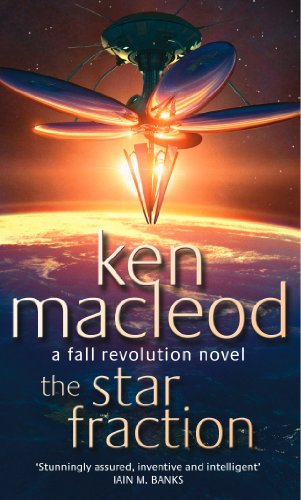
1. The Star Fraction (Fall Revolution)
 
$3.99
2. Learning the World: a Scientific
$2.68
3. Cosmonaut Keep (The Engines of
$66.69
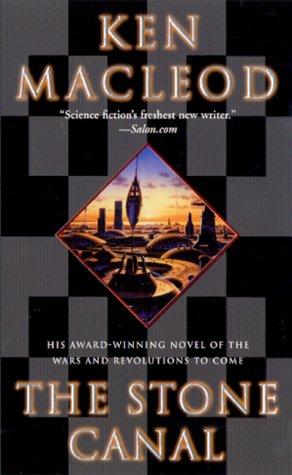
4. The Stone Canal: A Novel (Fall
 
$1.94
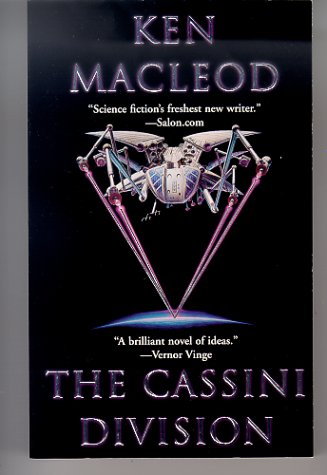
5. The Cassini Division (Fall Revolution)
$21.18
6. The Sky Road
$23.95
7. Giant Lizards from Another Star
$6.99
8. Dark Light
$10.54
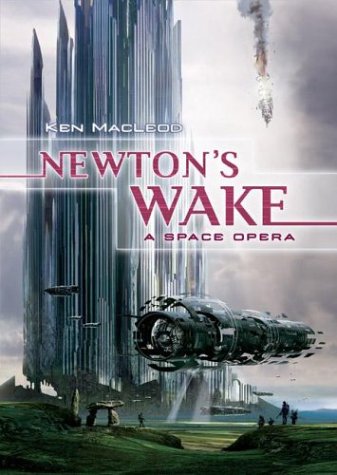
9. Newton's Wake : A Space Opera
$3.26
10. Engine City (The Engines of Light,
$12.00
11. The Execution Channel
$10.43
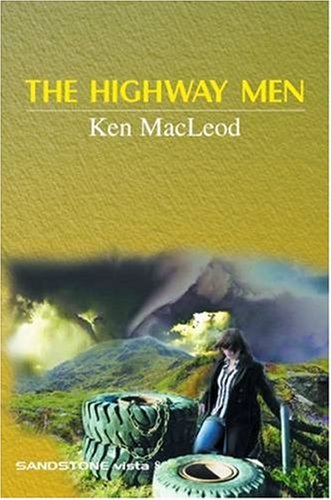
12. The Highway Men (Sandstone Vista)
 
$49.00
13. The True Knowledge of Ken MacLeod
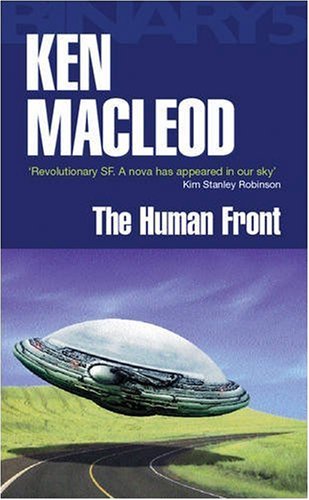
$25.00
14. The Human Front (Gollancz)
$9.95
15. Biography - MacLeod, Ken (1954-):
 
$5.95
16. Andrew Butler and Farah Mendlesohn,
 
$5.95
17. The True Knowledge of Ken MacLeod.(Book
 
$29.95
18. The fall revolution
19. Das Sternenprogramm.
 
20. Dark Light

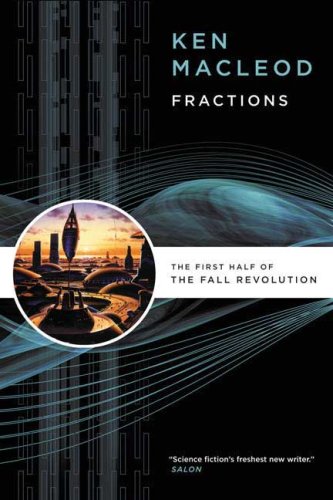
1. The Star Fraction (Fall Revolution)
by Ken MacLeod
Paperback: 320 Pages (2002-07-05)
list price: US$14.95 -- used & new: US$4.00
(price subject to change: see help)
Asin: 0765301563
Average Customer Review: 4.0 out of 5 stars
Canada | United Kingdom | Germany | France | Japan
Editorial Review

Amazon.com
A Ken MacLeod book is like a crowded college coffeehouse:noisy, bustling, a little rowdy, and packed with enough wild ideas and competing ideologies to leave you reeling. Star Fraction, MacLeod's 1995 debut, is no exception. As the first installment in the Fall Revolution sequence (followed by The Stone Canal and The Cassini Division), Star Fraction established this Scottish author's formidable talent for mixing complex politics and cyberpunk action into smart, funny stories.

MacLeod avoids heady political theorizing by always personifying his ideas in believable, often articulately passionate characters. (Or as one character puts it, "In my experience politics is guys with guns ripping me off at roadblocks.") Star Fraction's putative protagonists--a Trotskyite mercenary, a fugitive universityresearcher, and a fundamentalist-turned-atheist programmer--are on the run after a chance combination of marijuana, experimental memory drugs, and a self-aware firearm threatens to awaken a powerful AI on the nets, much to the dismay of the Men In Black and the orbital-laser-wielding U.S./UN. (As with all MacLeod plots, don't bother asking--it's a long story.)

With its ultrabalkanized UK and convoluted cast of neo-Stalinists, AI-Abolitionists, Christianarchists, femininists, et al., Star Fraction is MacLeod at his best--even at his first. --Paul Hughes Book Description
The award-winning novel that launched Ken MacLeods SF career, in softcover with a new introduction written especially for the American readerBritain in the 21st century is a Balkanized mess with an absentee-landlord Hanoverian royal family, neighborhoods that pursue their own independent foreign policies, and US/UN technology cops with everyone in their sights. Moh Kohn is a security mercenar unaware that he holds the key to information which could change the world. Janis Taine is a scientist who needs Mohs help hiding from the US/UN. Jordan Brown is a teenaged refugee from an enclave of religious fundamentalists. And a rogue computer program is guiding events to a breathtaking conclusion, with strange and wonderful implications for the human future. ... Read more

Customer Reviews (10)

4-0 out of 5 stars Not Free SF Reader
In this fragmented and fractured world artificial intelligence research is no-no, at least mostly, as far as the everyday people go.

A mercenary and a couple of others from one of these micro-organisations get involved in a plot involvingsome fancy financial software and other problems, not least of which is their own gear.

MacLeod's element of taking the piss is certainly in evidence here.


4-0 out of 5 stars Very imaginative and thought-provoking
First of all, I do recommend this book to everybody that enjoys some near-future what-if books that mixes politics, artificial intelligence possibilities, and loads of technology.

The good things about it would first be the ability to really shape a very interesting reality, very well built characters, many thought-provoking discussions, in the political, social and technological fields. In a way the story is very believable (maybe not in 40 years), and very fast paced.

Now the reason why I didn't rate it a 5 stars is that sometimes it becomes too "thick". Too many things happen without much explanation, and the author seems to be looking for that. I remember finishing the first chapter of the book and just thinking to myself "What? What is going on here?". Little by little you start to get used to the acronyms, the political system, and the pace of the book and then it becomes really interesting. Just be ready for this "shock" if you plan on reading it.

For now I'll move into a new book and then go back and read another of his Fall Revolution series books. Now that I know what he is talking about maybe it will be easier to finish the next one.

4-0 out of 5 stars The Star Fraction - A somewhat lackluster beginning!
I believe that I originally found Ken MaCleod's "Cosmonaut Keep" on the bookshelf at a store and found the description for it to be extraordinarily interesting.That being said, I decided to research and find out what the authors first book was.Upon discovering the Fall Revolution Sequence did not have to be read in any particular order, I decided to order and read the Star Fraction before the others, just to put my own sense of order to it.

Upon beginning this book, I found that a sense of order to the book itself was to some extent difficult to discern.Bear in mind that in several sequences I found the author's style to actually be very exciting and captivating, which lends to the idea that his later books will be very exciting.For a huge portion of the book though, I found his writing style to be somewhat cryptic, plodding and convoluted in the set up of the action sequences.This book is replete with varying political and social views that at times will leave your head spinning as to which direction the book is taking you.

Overall, this novel for me was a worthwhile read, just not overly compelling.At some point in time, after some further reflection, I will pick up the next book, "The Stone Canal" and read it.The conclusion to this one just doesn't compel me to do so at this time.

The premise:MINOR SPOILERS

This tome is about a dismal future of the early 2040's after a brief third world war, the US/UN has taken hegemony over a balkanized world.The Fall Revolution Sequence itself is an attempt to put an end to this new world order and reunify fragmented nations.

A key player in the Fall Revolution is an extremely interesting character by the name of Moh Kohn.His father Josh Kohn was the one who wrote many of the revolutionary programs that runs the computers of this society, which play a key part in the society.Moh Kohn himself is a security mercenary, living in a commune who believes in many of the communist ideas.Through chance, he meets with Janis Taine, who is a scientist working on memory enhancing drugs.This meeting is what basically begins the Fall Revolution.{ssintrepid}

4-0 out of 5 stars Pretty good cyberpunk
Fast-paced and a fun read.All of the usual cyberpunk elements are there, with the addition of some complicated socialist politics.Long on action, short on characterization.Several different cultures that aren't explored in depth.Major historic events, any one of which would probably be a book in itself, that seem more like backdrop than real things happening to large numbers of people.(A major change in America happens just like that.)Like a lot of cyberpunk, the treatment of computers and AI is a bit too magical for my taste.But certainly good enough for an action movie - err, book.

3-0 out of 5 stars Average at best
I bought this book partly on the strength of the reviews on this site and the UK sister site (hmmmmmm), and the fact it kept appearing on my recommended list. However it did not live up to my (generally easily satisfied) expectations.
Let's be fair about this, some of the ideas and thought that evidently went into the creation of Star Fraction were impressive. It's the implementation that I've a problem with, and that made this book just another "also-ran".

The plot and character development felt rushed and erratic at times. At a few points I found myself wondering what was going to happen next, and asking myself if I really cared or not. It all felt a bit thin and two dimensional. Perhaps it was me, but I made an assumption that the length and detail at which the politics were explored would have some impact in the end-game. They didn't, unless I missed something blindingly obvious. Or perhaps that was the point - that the politics were irrelevant to the outcome (in which case, why bother with them at all).
I also thought that he failed to capture the 'feel' of north London, even allowing for the fact that it had become something of a splintered entity.

There were parts which reminded me of William Gibson, and a lot of the style was more than a little reminiscent of the great Iain M. Banks. I think that Ken would be better trying to concentrate on a style of his own and attempt to leave behind the large influence of other (and IMO, better) sci-fi authors.
I honestly believe this guy does have some talent, and this will flourish with a little more focus, but then ... what do I know.

So Mr. MacLeod, for your end of book report you get an average grade C, and a "Kenneth is capable of better". ... Read more


2. Learning the World: a Scientific Romance
by Ken MacLeod
 Hardcover: 303 Pages (2005-11-01)
list price: US$24.95 -- used & new: US$3.99
(price subject to change: see help)
Asin: B00127UJBA
Average Customer Review: 4.0 out of 5 stars
Canada | United Kingdom | Germany | France | Japan
Editorial Review

Book Description
Humanity has spread to every star within five hundred light-years of its half-forgotten origin, greening the light with a haze of habitats. Societies rise and fall. Incautious experiments burn fast and fade. On the fringes, less modified humans get on with the job of settling a universe that has, so far, been empty of intelligent life. The ancient starship But the Sky, My Lady! The Sky! is entering orbit around a promising new system after a four-hundred year journey. For its inhabitants, the centuries have been busy. Now a younger generation is eager to settle the system. The ship is a seed-pod ready to burst. Then they detect curious electromagnetic emissions from the new systems Earth-like world Meanwhile, on Ground, second world from the sun, a young astronomer searches for his systems outermost planet. A moving point of light thrills, then disappoints him. Its only a comet. But something is very odd about that comets path Humans are not the only ones for whom the world has changed. ... Read more

Customer Reviews (15)

5-0 out of 5 stars Really interesting read
I really enjoy the perspective MacLeod displays in his writing.I found this novel in particular to be one of his best, andmost enjoyable to read.The novel starts slow but for a tale of this scope I'd say it's necessary.One aspect of the novel was especially surprising to me.I kept having a sense of impending doom about the political situation on the Ground and the aliens interaction with their less developed brethren.But in the end I was merely projecting our thoughts and fears onto a people who'd always been free of the yoke, and noble, and not too terrible at all.MacLeod got me on that one.Well done.

I read science fiction for the ideas and MacLeod has a few great ones in here.

5-0 out of 5 stars Extremely Enjoyable
This is the 2nd Ken Macleod novel I've read.The first was NEWTON'S WAKE (3/2005), which was a bit of a "space parody", and which I found enjoyable.LEARNING THE WORLD (10/2005) is a more serious book, which I found extremely enjoyable.

LEARNING THE WORLD follows the travels of an interstellar ship, which takes hundreds of years to cross the voids between the stars; and, as such, doesn't rely on the FTL "tricks" of most modern SciFi books.This situation makes the story seem much more realistic... and, I'm beginning to view much of the FTL-based books out there as a branch of SciFi that approaches "fantasy".

Our interstellar travellers become the first humans to encounter intelligent life on another planet... and there the fun begins...

4-0 out of 5 stars Learning the world
This book was a little differnt than the usual scifi first contact story. The story focus on the instellar starship But the sky,my lady! The sky! and its inhabiants and what happens when they fnally run into other intelligent life after 4000 years of travel. There are some interesting ideas in the book about what would happen if a generation of people used to always being plugged in suddenly had that taken away, along with suddenly losing their purpose in life due to running into a planet they couldn't colonize.

The book is a little out there with the techno babble and dealing with stuff that doesnt exist. But it does look at some interesting ideas a little differntly.
This book does remind me of another called Ship of Fools by Richard Paul Russo. Not as dark but dealing with some of the same ideas. All in all a good read.

3-0 out of 5 stars 3.5 rounded up
MacLeod has received a lot of flack lately for the "quality" of his writing. My take is that he is such a hot commodity right now that he is churning them out as fast as possible without that once-high regard for quality.Once again, all the components are present - technological future, new worlds, first meeting, generational and moral issues.Yet, despite all the promise the result remains unsatisfying.

Let's start with the most important aspect of any book, characterization. In this case there were two groups with the humans carrying such absurd names as Synergy Fusion Smith.At first I thought the young girl whose diary we follow throughout the book was going to dominate but then someone else comes along and after that....you get the drift.Folks fade in, fade out, show up, disappear, frustrating. Not a single character was one I remembered when I finished and that is a shame.

Then there is the enormous "ship" (another "world" thus the title) whole description was confusing in the extreme, lots of meandering, various perspectives, the place did not seem "real".Another problem - the levels of advancement were uneven - they could live forever but their nanotech seemed stillborn.

The aliens were anthrpomorphized as is only natural - bat people with 1940technology.Their social system uses a similar race as beasts of burdens thus preventing the development of work machines. The tale descends into a moral one with question about intervention, colonization, authority, imposing our values. Predictable ending...oh well, better luck next time.

4-0 out of 5 stars Diversity Training
Here's a well written, short science fiction, first-contact, novel with a nice little twist at the end.

The story shifts between the points of view of the humans and the aliens.The humans are on a multi-generational voyage to discover a new planet.While examining how culture, with a small "c", evolves in this self-contained environment, there is even a look at economics, with everyone, including children, engaged in a lively trade in what financiers call derivative instruments and futures. The aliens (who naturally don't think of themselves as aliens) are a bat-like people who keep large herds of creatures who seem very similar to themselves.Some creatures are used as workers while others are used as food.The winged aliens, who can fly, are at the stage of developing machines to fly in.Although presented in a sympathetic way, in absolute human terms, they seem a bit disgusting in their habits.The alien side of the story focuses on an astronomer and academic who first discovers the approaching human ship.

What makes the writing special is that the back story is revealed not through dry exposition, but through the gradual revelation in the lives of the characters.We start out not quite grasping either of the two cultures involved, but the author manages to reveal just enough about them as he tells his tale to satisfy us, saving his most thought-provoking revelations for the finale.

Although I was entranced by the tale, I was not always certain why the author choose to focus on one character or another when they did not always seem to be essential to the events occurring.And yet, while not always essential players, they gave a flavor to the cultural implications of what was happening.

I also felt that the alien society was too under-developed, in human terms, for the societal actions that were being taken.And yet I suppose that is exactly the point of the author, who seems to be telling us that we should not judge other cultures by our own, and indeed, that what appears to us as somehow inferior may actually be superior.If one is not happy with a message of diversity and tolerance, this may not be a book to read.

If this sounds like a book with a heavy dose of sociology it is, but like much good science fiction, it helps to illuminate our own society.
... Read more


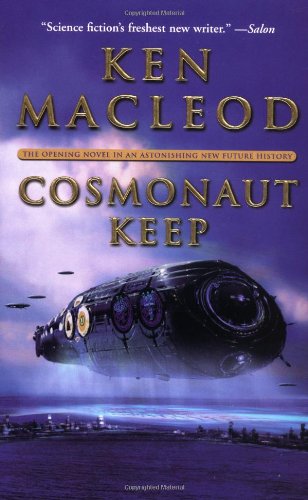
3. Cosmonaut Keep (The Engines of Light, Book 1)
by Ken MacLeod
Mass Market Paperback: 352 Pages (2002-01-07)
list price: US$7.99 -- used & new: US$2.68
(price subject to change: see help)
Asin: 0765340739
Average Customer Review: 3.5 out of 5 stars
Canada | United Kingdom | Germany | France | Japan
Editorial Review

Amazon.com's Best of 2001
Like a British--specifically, Scottish--counterpart of BruceSterling, Ken MacLeod is an SF author who has thought hard about politics and delights in making unlikely alternatives plausible, grippingly readable, and often downright funny.

Cosmonaut Keep swaps between two timelines whose characters share the ultimate goal of interstellar travel. In an uncertain future on the far world of Mingulay, human colonists live in the title's ancient, alien-built Keep--coexisting with reptilian "saurs," trading with visiting ships piloted by krakens, and hiding their laborious "Great Work" of developing human-guided navigation between the stars.

Meanwhile, alternate chapters present a mid-21st-century Earth whose EU is (to America's horror) Russian-dominated with a big red star in the middle of its flag. Rumors of alien contact abound, and computer whiz kid Matt Cairns finds himself carrying a data disk of unknown origin that offersantigravity and a space drive.

Clearly, the later storyline's Gregor Cairns is Matt's descendant. There are ingenious connections and surprises, with witty resonances between their wild careers, their travels, and their bumpy love lives. The foreground action adventure points to a bigger picture and a master plan known only to the godlike hive-minds who built the "Second Sphere" of interstellar culture, and who regard traditional SF dreams of unlimited human expansion through space as precisely equivalent to floods of e-mail spam polluting the tranquil galactic net.

Cosmonaut Keep opens MacLeod's new SF sequence, Engines of Light. It's highly entertaining and intelligent, promising more good things to come. --David Langford Book Description
Matt Cairns is a 21st-century outlaw Programmer who takes on the shady jobs no one else will touch. Against his better judgment, he accepts an assignment to crack the Marshall Titov, a top-secret orbital station operated by the European Space Agency. But what Matt will discover there will propel him on an extraordinary and quite unexpected journey.Gregor Cairns is an exobiology student and descendant of one of Terra Nova's first families. Hopelessly infatuated with a lovely young trader's daughter, he is unaware that his research partner, Elizabeth, has fallen in love with him. Together, Gregor and Elizabeth confront the great work his family began three centuries earlier-to rediscover the secret of interstellar travel.Ranging from a gritty near-future Earth to a distant alien world, Cosmonaut Keep is contemporary science fiction at its highest level, a visionary epic filled with daring individuals seeking a place for themselves in a vast, complex, and enigmatic universe. ... Read more

Customer Reviews (27)

4-0 out of 5 stars Not Free SF Reader
This novel has two threads.The first a near future thriller revolving around secret spaceflight technology and contact with aliens, and the dangers inherent in this activity.The politics of who should control such tech and information also make up an important part.

The other stream is set in the reasonably distant future on a planet that actually has humans coexisting with aliens.One particular wealthy family is looking into technological research on a long term scale, trying to improve their situation.


4-0 out of 5 stars Good series, but something's always missing.
I think it's called an end. Each book of both series tends to fade away at the end and the last book of both series don't seem to pull it together any better.

That said, the topics are all great reading, the characters all work well, the talent is clearly there. I think it's just a stylistic decision not to wrap the stories up (I didn't say neatly) that leaves me wondering a week or month later if I had actually finished reading them.

Odd. I will still read everything this author puts out there anyway. Maybe I'll develop a taste for the case of the quiet denoument in time. Or out of it.

2-0 out of 5 stars Never judge a book by its cover
This paperback edition of "Cosmonaut Keep" has a beautiful cover.The depiction of a hovering city-sized spaceship is rendered in cool blues and accented with brilliant light shining between dark clouds.In fact, looking back it was the beauty of this cover that first caught my eye in the bookstore, and lent weight to the generic description blurb on the back.

Alas, as they say, you should never judge a book by its cover."Cosmonaut Keep" is a truly mediocre book.About the best thing I can say about it is that it never crossed the line into being actually bad.I had the strange experience of starting to wish, halfway through, that it would get just a little bit worse so I could conclude it wasn't worth finishing, but it managed to hang in there.

The book is split into two plots separated in time and converging at the end.But neither plot is very interesting.I'm not sure exactly where to lay the blame for this, since I've read books in the past with very simillar plots that managed to be entertaining, and it's undeniable that Macleod is a competent writer.In the end, I think he simply failed to create characters that I felt were real, much less could be sympathetic to.It is almost as if his main emotional attachment was to the neat plot and background story he had created, and not to the people he was showing us.

I also have a quibble with the universe that Macleod has created.It was perfectly acceptable in years past for sci-fi authors to create near-future scenarios where the world was divided between Soviet and American spheres of influence, or where one had conquered the other, and so on.It was a perogative of the Cold War, the same way that spy thrillers were always permitted to summon up a KGB agent at any point where it would help the plot.But those days are long gone, and this book was published in the year 2000.What could possibly excuse an author who pretends that events from 1991 on simply never took place, and that in the future the EU will be under Soviet domination?For me it was unnecesary and annoying, and made it more difficult to do the traditional work of a sci-fi reader; suspending my disbelief.

4-0 out of 5 stars Skillfully interweaves the personal and the political in a tapestry of transcendental posthumanity
Cosmonaut Keep is the first in a new series by Ken MacLeod, who wrote The Stone Canal and The Cassini Division. As in those earlier works, this novel skillfully interweaves the personal and the political in a tapestry of transcendental posthumanity.

MacLeod again uses two narratives spanning an unknown amount of time to tell his story, and this conceit (while a bit confusing at first, at least in this novel) works. The "present" narrative takes place in the near-future, albeit in an alternate world where the EU is part of a larger Communist bloc and where alien technology, specifically a starship and drive, are being discovered. It follows one Matt Cairns as he makes his way from Edinburgh, Scotland to Area 51 in New Mexico to a space station and the future. The "future" narrative takes place on a world called Mingulay, which is inhabited by humans and saurs, intelligent descendents of the terrestrial dinosaurs. (Other forms of intelligent life in the novel include the kraken, superintelligent spacefaring squid, and god-like colonies of microorganisms that inhabit millions of asteroids in the solar system. There we follow one Gregor Cairns in his quest to solve the Great Game---to discover the secrets of interplanetary navigation believed to be possessed by his ancestor, Matt.

If the rest of the series is as fascinating as this volume, then reading it will be a real joy. Once again, MacLeod shows himself asone of the smarter writers in contemporary SF and speculative fiction.

5-0 out of 5 stars Those whom the gods would destroy...
This is not an easy book to get into, there is an initally confusing split storyline and seemingly bizarre shifts in narrative and time (without the usual chapter markers to ease the readers transitions), but these are all clues to an unfolding and complex drama well worth a few chapters of disorientation.
In the vein of William Gibson's Neuromancer, we are shown a cyberpunk distopia on the verge of a transformative shift or it's own destruction, but peopled by characters both interesting and familier enough to be our guides (rather like Larry Niven's Ring World series); as well as a front row seat to Humanity's awareness of the true nature of the Universe and our relationship to it... and it's not a comfortable revelation either.
As the pieces begin to fall into place, the book becomes a real treat to read and the shifts in place and time fuel the sense of urgency and tension as events lead you to an all too sudden but satisfying ending... thankfully, this is only the first book in what promisies to be a fantastic and challenging trilogy, a must have for my library, to be sure. ... Read more


4. The Stone Canal: A Novel (Fall Revolution)
by Ken MacLeod
Mass Market Paperback: 352 Pages (2001-03-15)
list price: US$6.99 -- used & new: US$66.69
(price subject to change: see help)
Asin: 0812568648
Average Customer Review: 4.0 out of 5 stars
Canada | United Kingdom | Germany | France | Japan
Editorial Review

Amazon.com
"So it's true what they say: information wants to be free!" But the information in question, in this case, is Dee Model, a sexy, butt-kicking, love-slave android who's just mysteriously become self-aware, eluded her owner, and filed for her own autonomy. And the person making the remark (ironic given that it's a centuries-old reference) is Ax Terminal, a "freelance professional eunuch and part-time catamite," a resident of New Mars, the wormhole-away-from-Jupiter free-market anarchy set up thanks to the fast-folk, an uploaded race of überhumans experiencing reality and evolving at ultrahigh speeds. Android Dee, as it turns out, may have been nudged toward freedom by Jon Wilde, her cloned body's former husband (they met at Glasgow University back in the '70s), who just recently came back from the dead (revived by himself, in robot form) to join in the struggle between robot abolitionists and the malicious boss man of New Mars, David Reid (Wilde's former rival and owner of the sex slave that happens to be a cloned copy of Wilde's former wife). Now this is what great science fiction is all about.

Action-packed, inventive, and satisfyingly weird, Ken MacLeod's Stone Canal (the retroactively U.S.-released prequel to The Cassini Division) lets loose with a steady stream of challenging ideas and novel technology, taking on questions of free will, identity, and the nature of consciousness, all the while telling a bang-up story. Reminiscent of K.W. Jeter's best work, The Stone Canal certainly deserves a look. --Paul HughesBook Description
Life on New Mars is tough for humans, but death is only a minor inconvenience. The machines know their place, the free market rules all, and only the Abolitionists object.Then a stranger arrives on New Mars, a clone who remember his life on Earth as Jonathan Wilde, the anarchist with a nuclear capability who was accused of losing World War III. This stranger also remembers one David Reid, who now serves as New Mars's leader. Long ago, it turns out, Wilde and Reid had shared ideals and fought over the same women.Moving from 20th-century Scotland through a tumultuous 21st century and outward to humanity's settlement on a planet circling another star, The Stone Canal is idea-driven sci-fi at its best., making real and believable a future where long lives, strange deaths, and unexpected knowledge await those who survive the wars and revolutions to come. ... Read more

Customer Reviews (17)

2-0 out of 5 stars A would-be Heinlein copycat?
Almost to the end, this novel reminded me of Robert Heinlein's writings (the best of them, I mean). Then it crashed in the last few pages, so I am a little dissatisfied with it.
The plot is heavy with Comunist, Socialist and Anarchist messages, presented by either cynics or idealists. As I grew up in a Comunist dictatorship, none of them impressed me, nor ever would... so I had to put them aside and try to enjoy the action. And I did, most of the time.
Jon Wilde is ressurected by a sentient machine he'll soon learn is an earlier imbodiment of himself. Then he discovers his late wife's body walking around with a robot intelligence inside, a world where his name is revered, an old friend and rival hunting him and a plot for the destruction of all sentient machines... for starters.
The interesting part was a bit about "fast people", minds so far evolved that they live an accelerated existence in nanite bodies... but they never had a major part to play, so the thrill went away pretty fast.
An almost Heinlein-type of story. Not Heilein-like enough, though. Too bad...

4-0 out of 5 stars Entertaining, action-packed, though-provoking, but...
This was really a very interesting book to read! Lots of interesting ideas, mixing hard sci-fi with political aspects in a way that is very rare to find around. It may get sometimes I little boring with all the discussions about politics and the life of an anarchist, but there are some parts that you really can't leave the book aside without feeling guilty for not knowing what is coming next.

The only reason I gave it 4 stars instead of 5 is that sometimes the abilities of the characters seem a little too "supernatural". Sometimes when you get a book where characters are portrayed as human being and then suddenly they are just too good to be a human being, it does feel strange. Some people like it, I just didn't feel confortable with it. Personal opinion.

4-0 out of 5 stars Love never dies
Picking up this book mainly as a fluke, I was not expecting the story that awaited me.The most fascinating thing is the reality of thought and dialogue, mixed together in a intricate web of fiction, both of the historical brand (a large chunk is set in 1970's Scotland) and the all too alarmingly realistic future brand.The story revolves around two men, David Reid and Jon Wilde whose political views and ideals have set the course of the world, and have built a centuries long rivaly between them.
The text reads remarkably well, and even when lost in the mire of politcal thought (it is recommended that the reader have at least a basic knowledge of communism, socialism and capitalism) the text is rich enough and REAL enough to carry through.Switching from one point of view to the next is not just jumping from character to character, but shooting from first person to third to the camera man if this were a movie.
The only drawback about this book is the breakneck speed at which it ends.But the ending is not diminished by it.
I recommend this story to anyone looking for Science Fiction that is believable, no matter how unbelievable it really is.

4-0 out of 5 stars intelligent, deep, imaginative, well written
Out of the first five books Ken Macleoud has had published only the last one 'Cosmonauts Keep' I will never reread. All of the first four are well worth rereading, the mark of a good book.
'The Stone Canal' has the great structure Macleoud does so well, of alternating chapters telling the story from centuries past of the character's. While the next chapter carrys on in the present and so on.
It was KM who advised Bank's of this for his great 'Use of Weapons' novel. Back to the Stone Canal. It's packed with ideas, intensity and thriller like page turning. It could easily fall back into a revenge and killing book. Let's face it the main character has many good reasons to kill Reid. It's about myths, love and reality. It's fun and smart. Macleoud doesn't have the same strength and depth in description as say Banks or Dan Simmon's at their best but he writes very good books, compressed, full of twists, ideas and smart characters.

4-0 out of 5 stars Good Hard Science Fiction
This is one of those uncommon books that immediately caught my interest from page one and kept it, the characters and their relationships and development done on the 'fly' as the pages flowed, superior writing indeed. The plot switches back and forth from the year 1975 and the following years, up to the late 21st century, and later on another planet. Two friends, one a socialist and the other an anarchist (quite opposite world views actually which is thought provoking) later become rivals and later both find themselves on a planet called New Mars many decades later, and the outcome of their rivalry is decided there, the story of how they got to New Mars is quite interesting, involving some speculative science which will someday likely take place, including topics such as biostasis, mind uploading and downloading with computers, cloning, nanotechnology,etc....

I gave this novel four instead of five stars due to the fact that Ken Macleod included here way too much of a dose of English politics for my taste (he lives in Scotland) and as most people know, English politics are nearly incomprehensible to outsiders!!! But overall, this is cutting-edge science fiction well worth reading. Macleod's later novel THE CASSINI DIVISION extends from this novel. ... Read more


5. The Cassini Division (Fall Revolution) (Fall Revolution)
by Ken MacLeod
 Hardcover: 256 Pages (1999-07-16)
list price: US$22.95 -- used & new: US$1.94
(price subject to change: see help)
Asin: 0312870442
Average Customer Review: 3.5 out of 5 stars
Canada | United Kingdom | Germany | France | Japan
Editorial Review

Amazon.com
With his third novel, Ken MacLeod elaborates on the future timeline from his first two works, The Star Fraction (1995) and The Stone Canal (1996). Most relevant is book two, which established a colony on the remote world of New Mars via a spatial wormhole created by superhumans--transcendent machine-hosted intelligences called the "fast-folk." The original fast-folk crashed from too much contemplation of their metaphorical navels, but their descendants on Jupiter still harass Earth with virus transmissions that have killed off computers and the Internet. Enter heroine Ellen May Ngwethu of the Cassini Division, an elite space-going force created to defend against the fast-folk. Her wild doings in the 24th century's anarcho-socialist utopia make for fun reading--everyone will covet her smart-matter clothing that can become a spacesuit, combat outfit, evening gown, or satellite dish at will. But the Division's political philosophy is brutally tough, with alarming plans to use a planet-wrecking doomsday weapon against "enemies," who may not be hostile at all. In a climax of slam-bang space battle, MacLeod crashes the ongoing ethical debate into a brick wall and leaves you gasping. Witty, skillful, provocative, but just a trifle too glibly resolved. --David Langford, Amazon.co.ukBook Description
Ken MacLeod is a science-fiction sensation in his native Britain, widely compared to Vernor Vinge, Bruce Sterling, and Iain Banks, but with a storytelling energy all his own. The Cassini Division, his first novel to appear in America, displays his astonishing power and range.

Ellen May Ngewthu is a young woman with centuries of experience, a soldier and leader of the Cassini Division, the elite defense force of the utopian Solar Union. Here in the twenty-fourth century, the forts of the Division, in orbit around a mysteriously transformed Jupiter, are the front line in humanity's long standoff with the unknowable posthumans--godlike and remote beings descended from the people who transformed themselves with high technology centuries ago.

The posthumans' capacities are unknown . . . but we know they disintegrated Ganymede, we know they punched a wormhole into Jovian space, and we know that the very surface of the solar system's largest planet has been altered by their incomprehensible artifacts. Worst of all, we know that they have been bombarding the solar system with powerful data viruses for generations.

Now Ellen has a plan to rid humanity of this threat once and for all. But she needs to recruit the right people to her cause--and convince them to mistrust the posthumans as much as she does.

Her quest will take her to the mid-Atlantic towers of Solar Union Earth, to the green ruins of London, and, in the farthest reaches of human space, to the long-separated libertarian colony of New Mars. In the process, much will be revealed--about history, about power, and about what it is to be human. ... Read more

Customer Reviews (41)

4-0 out of 5 stars Not Free SF Reader
Defend the solar system, brothers.


The Cassini Division is an organisation that is ready to 'kick posthuman arse', as they put it.A key strategic asset is a wormhole, and the Division realises that anything evolving quickly could appear.It gets a lot less simple than this as societies on Mars and in the Jupiter area come into conflict, as well as Divisions within the division and your garden variety humans

One woman and the crew of a ship have to decide what sort of carnage they are willing to inflict on others for preservation, along with some strange consequences of their actions.

1-0 out of 5 stars If you've never put a sci-fi book down, no matter how bad; try this one...


For some odd reason, I felt compelled to do a search for reviews on this book I picked at random in the library. In all my 35+ years of reading sci-fi and fantasy, I can't recall more than a couple of books I'd put done incomplete.

I am about 2/3's the way through this one, and may or may not complete it.While diametrically opposed to Macleaod's politics, I felt I should give it a read nonetheless so as to be somewhat 'liberal' in giving it a chance.

That said, I have to agree with SouthFried's review on the whole. This book, even if part of an ongoing series gives the reader very little incentive to go back or forward to the se/pre-quel.The story meanders between plot and borderline propoganda, with nary a thought for continuity.Maybe some of his other books are tighter and on-beam, but if this is the caliber, I'd say many a college writerwould surpass.

I've heard mention of one of MacLeaod's contemporaries who's written something called the "Lazy Gun", hopefully it will be less of a propoganda exercise in wishful 'what ifs' than this.

I think I'll have to go back to the remaining Terry Pratchet or Aaron Elkinson's I've yet too read.Idealism has its place, unfortunately it just doesn't cut it with sci-fi.

3-0 out of 5 stars Whoops...

MacLeod has named his hero Ellen May Ngwethu because he thinks "ngwethu" is a Zulu word that means freedom. We know this because he tells us so. Not once but twice. Except that ngwethu doesn't mean "freedom": it is actually the Zulu for "it is ours".

How embarrassing - instead of being named after "freedom", poor Ellen May has been named after an Zulu instrumental prefix plus possessive stem.

4-0 out of 5 stars Great story, dumb ideas
I am very surprised by the hostile reviews to this engaging novel.I suppose many could be put off by the socialist orientation of the author and the story.I agree that at times the book reads like a propoganda piece for the Socialist International.I am certainly no socialist, very much the opposite as some of my other book reviews will attest.To describe this as a novel of ideas is correct.Many of them are dumb, unrealistic, and totally discredited ideas.So what, the story was great and in spite of my hostility to these ideas I loved it.It just requires a little suspension of disbelief.It also helps to know where Macleod is coming from upfront.The socialism bothers less if it is expected.

I agree with several of the other reviewers, do not start this series with this book.If you do start here you may be confused at times.

If you are easily annoyed by politics and political ideas you disagree with, this book and this author, are not for you.If you can enjoy a good story and can look past some pretty loopy ideas you will enjoy this series.

3-0 out of 5 stars Clash of Civilizations
Compared to Ken MacLeod's later work, "Cassini Division" (1998) is a little underwhelming. The main ideas involve the clash of civilizations: the anarchic-socialists (from whose perspective the book is narrated), the uploaded post-Singularity consciousnesses of Jupiter, a capitalist anarchy on the far-flung planet New Mars (accessible only via tricky wormhole travel) and the non-cooperators left on Earth, who haven't joined in any of the parties.

That's most of the problem, really. The plot seems like more of an excuse to examine all these societies than an interesting story in its own right. The author doesn't quite seem to pay enough attention to the main plot threads. Generally speaking, I found it a bit hard to read and a bit too easy to put down.

There are some interesting narrative tricks here: the entire story is told from a first person POV, and only one person's, to boot. However, the "present tense" parts of the story are told in past-tense voice, and the flashbacks (sometimes inserted in such a ways as to kill narrative momentum instead of helping it) are told in present-tense voice. An odd choice that doesn't seem to make much difference.

The parts where he's actually examining the societies are admirable: fairly balanced, showing the upsides and downsides of all of them. However, it sometimes seems unsubtle, more like a sledgehammer than you'd like. Also, the narrator is not the most sympathetic person you've ever met. So if you're interested in Ken MacLeod, I might recommend skipping this one and heading for his later works: the Engine of Light series or (the much more enjoyable) "Newton's Wake." ... Read more


6. The Sky Road
by Ken MacLeod
Hardcover: 291 Pages (2000-08-01)
list price: US$24.95 -- used & new: US$21.18
(price subject to change: see help)
Asin: B0009WE1HM
Average Customer Review: 3.0 out of 5 stars
Canada | United Kingdom | Germany | France | Japan
Editorial Review

Amazon.com
In the series that started with The Star Fraction, Ken MacLeodhas created a future history whose genesis was an argument about anarchismbetween a group of left-wing students in the '70s. The destruction andrenaissance of civilization, here and elsewhere in the human galaxy, turns onthis argument. In the fourth book, MacLeod productively fills in some of thegaps. This is the story of Myra, Trot-turned-entrepreneur, whose nucleardeterrence-for-hire is central to the event known by some as the Fall and othersas the Deliverance. It is also the story of young Clovis, part-time worker inthe yard where the first space-ship in centuries is being built, part-timescholar trying to find out what Myra the Deliverer was really like.

MacLeod's readers are used to his quirky and intelligent take on the world ofpower politics and his charmingly cynical gift for engaging and engagedprotagonists. What this book also has is a profound sense of the beauty of asimpler and stiller world; MacLeod's real gift is his capacity to see all sidesof a question, even when he is sure of the answer. --Roz Kaveney,Amazon.co.ukBook Description

Centuries after the catastrophic Deliverance, humanity is again reaching into space. And Clovis, a young scholar working in the spaceship-construction yard, could make the difference between success and failure. For his mysterious new lover, Merrial, has seduced him into the idea of extrapolating the ship's future from the dark archives of the past.

A past in which, centuries before, Myra Godwin faced the end of a different space age--her rockets redundant, her people rebellious, and her borders defenseless against the Sino-Soviet Union. As Myra appealed to the crumbling West for help, she found history turning on her own strange past--and on the terrible decisions she faces now.

The Sky Road is a fireworks display, a bravura performance, and the most amazing novel yet by one of the powerful new voices in science fiction.
... Read more

Customer Reviews (15)

4-0 out of 5 stars Not Free SF Reader
This is a solid book, but a pretty quick read.One nice highlight is that one of the two main threads is centered around Kazakhstan.That certainly doesn't happen very often.Some funny computer jokes at the expense of the characters in the other section, and something that we, of course see coming, but the protagonist, does not.
Then he throws in one sneaky, very political AI, and it is not a bad story, along with being hopeful, even with a bit of the good old nuclear destruction.


5-0 out of 5 stars This is my favorite novel, and i read a *&!%-load.
This is the most mind-opening book I've ever read. I frequently impose MacLeods questions on other people because the book poses questions of philosophy on such a level that forming an opinion on some sends the reader into the most interesting paths of cognition.

For instance: (the responses to this always very) Let's say I can plug my head into this computer, and download every memory, every single feeling and second UP UNTIL this very second. Let's say I do that, and then I open the window of my 7th story apartment and take a running leap onto a taxi below. When I die, and the computer brings the three-minuite-old me back, is it really still me? More importantly, When I'm flying to my death, am I thinking "Well, I'm sure glad I made that backup". Personally, I think i'd just be thinking "AHHHHHHHHHHHHHHHHH!!!!", but then what's the point of making a backup?

I mean, exploring principles of high-technology and how it can completely smash political barriers in ways that we're so used to not thinking of that we completely don't see them; this is what the book does. It's a study of political-techno-biological relations in different stages of a world. Ironically, the 'past' section of the story less resembles the present than the 'centuries-in-the-future' sections.

Truly, the characters are merely vessels for carrying a greater message and simply acting out the functions of the story, they don't seem to have personal depth - but that isn't a fault of macleod; failing to delve into expressing a character's personality traits through action and dialogues. There's fair amounts of that, although the reader fails to connect at times because the fact is simply this: Macleod's characters are representations of external circumstance. The book's main message is that we really are products of our circumstance, and we do and think what's in front of us.

That's why it ends like it does, and clovis never does understand maya's story. It's outside of his societally-conformant way of thinking: history only makes sense in it's own context BECAUSE we only understand ourselves in our own history's context. The entrancement of the book comes from truly questioning how much we really can understand as we're stuck in the frame of mind that we've grown into. The true genius of the book is the mind-popping questions of new political-technological systems that are actually believable when considering the possibilities of the futures that the book presents. What effect would immortality have on a society? What effects would nano-technology instant fabrication have on a capatalist society? If the cost of production was zero, would anarcho-communism come into effect? Would the very greed principle guiding humanity dissolve if we were immortal? If we truly had all the time we needed to live out whichever life we choosed 800 times, The world changes inevitably.

Ultimately, it is usually those who ask such questions whom see a bigger picture in every aspect of any situation. As legs will grow musclar if forced to run, a mind will be more receptive and open to unfamiliar ideas if a mind is used to fathoming the completely unfamiliar.

I read the cassini division too, and found it equally (maybe a bit less) thought-provoking and generally 'neat'. I haven't read any others in the series, and i tried to read 'Dark Light' from the 'Engines of Light' series but couldn't dig it..

4-0 out of 5 stars Reading Fiction, Lesson One: Start at the begging of the series.
I couldn't help but to leave this small piece of advice for those complaining about obscure references and an overwhelmed feeling due to plot points they failed to grasp (or indeed, viewed as inconsequential rambling on Mr Mcleods part).

If the fourth book in a series is the first you read, then OF COURSE you're not going to have a clue with regards to obscure references and knowing-winks-and-nods to past events and characters.

For the love of god, read the series and put the book into some form of context before slapping a 2 star rating on it. You're putting off more patient prospective-readers who may well take the time and effort to become properly versed in the back story before leaping in for the final lap and then moaning that they don't know what's going on...

An excellent book and a wonderful series, the more positive elements of the other reviews here are all spot on... Not to be missed if you are a fan of Hamilton or Reynolds... Or like myself, have strong leftist/socialist tendencies and a love of sci-fi.

2-0 out of 5 stars Would Have Been Better off as a Fantasy
www.angelfire.com/zine2/fictiononline/myworks.html

The story is set in a far future - so far in fact that it could be a story about another planet and another culture or it could even be a fantasy. The story has two parts. The protagonists of the first part are Clovis colha Gree (male) and Merrial (female).

The story starts with the meeting of the two protagonists at a festival. Merrial seems to be out to get Clovis. It may not all be love or even sexual attraction. She may have a hidden agenda.

The society depicted is quite confusing. Way, way back in the past, humankind, led by Myra Godwin, had reached for stars. It had ended in a catastrophic destruction at the hands of the Sino-Soviet Union. In spite of this catastrophic end, the western world remembers Myra as the Deliverer. If this is not confusing enough, get a bite into this: the world is once again reaching out for the stars. Space ships are being built, but computer programmers are called tinkers and are shunned by the society.

Clovis colha Gree is also a student of history and his topic is the life of the Deliverer. Merrial coaxes him into finding the secret files of Myra Godwin and looking into them, hoping that the new space age would benefit from her experiences.

Clovis delves into these secret files, and the story jumps from the present (of the narrative) to the past -- to the time of Myra Godwin. And then Myra Godwin's story starts to unfold.

It is a story within story. The story of Clovis and Merrial is told in first person, Clovis being the narrator. The story of Myra Godwin is in third person. The times are not very well realized. The characters are not very interesting. The story has overtones of myths when talking about the Deliverer, and this is well handled. This and the fact that computers and computer technology is referred in magical terms like "demons" and "invoking", prompted me to the earlier comment that the setting could as well be a fantasy.

3-0 out of 5 stars Just OK
This book was ok.It was interesting to read, but there was nothing particularly special about it.

I never really felt much concern over what was going to happen with the characters or the story.I wanted to find out what happened, but I didn't have any strong feelings about the characters or what I thought should happen.

I've seen other reviews here that seem to indicate that this is part of a series. If that is the case, then perhaps I missed something in an earlier book that would have made this more enjoyable.I will probably investigate this and try to read any earlier books because I do think MacLeod writes well.Hopefully, in one of his other books I will find the spark that I think was lacking in this one. ... Read more


7. Giant Lizards from Another Star (Boskone Book) (Boskone Book)
by Ken MacLeod
Hardcover: 352 Pages (2006-02-28)
list price: US$25.00 -- used & new: US$23.95
(price subject to change: see help)
Asin: 1886778620
Average Customer Review: 5.0 out of 5 stars
Canada | United Kingdom | Germany | France | Japan
Editorial Review

Product Description
Giant Lizards from Another Star is an anthology containing poems, short stories, convention reports, and essays, as well as the novellas "The Human Front" and "Cydonia". ... Read more

Customer Reviews (1)

5-0 out of 5 stars A 'must' for any MacLeod fan or hard science fiction fan
Ken MacLeod's a powerful hard science fiction writer who applied the techniques of Hal Clement to cyperpunk ideas: GIANT LIZARDS FROM ANOTHER STAR gathers his well known novellas 'Cyndonia' and 'The Human Front' under one cover and adds four short stories, poems convention reports, essays and more shorter pieces to round out the presentation. While many of these have been published in smaller magazines, most will be new even to MacLeod fans, and provide a comprehensive representation of his many talented works under one cover. A 'must' for any MacLeod fan or hard science fiction fan.

Diane C. Donovan
California Bookwatch
... Read more


8. Dark Light
by Ken MacLeod
Kindle Edition: 272 Pages (2002-05-20)
list price: US$18.95 -- used & new: US$6.99
(price subject to change: see help)
Asin: B000FA5Q9A
Average Customer Review: 3.5 out of 5 stars
Canada | United Kingdom | Germany | France | Japan
Editorial Review

Amazon.com
With his sharp, fast-paced, challenging novel Dark Light (sequel to the Prometheus Award-nominated Cosmonaut Keep in the Engines of Light series), Ken MacLeod reaffirms why he is science fiction's hottest new writer at the turn of the millennium.

From the days of the dinosaurs, mysterious aliens have been transporting earthly life forms across the galaxy to the worlds of the Second Sphere. Here, the descendants of humans abducted from the Stone Age and from colonial America coexist with dinosaurs--and with the saurs, their intelligent descendants, who are technologically superior to the humans. This arrangement is disturbed by the arrival of nearly immortal (but far from indestructible) humans from 21st-century Earth--men like Matt Cairns, who have no desire to let the secret of interstellar flight remain in the hands of the inscrutable, almost godlike aliens.

In addition to the Engines of Light series, MacLeod has written the Fall Revolution quartet: The Cassini Division (a Nebula Award and Arthur C. Clarke Award finalist); The Star Fraction (a Prometheus Award winner); The Stone Canal (also a Prometheus Award winner); and The Sky Road (a Hugo Award finalist and recipient of the British SF Association Award). --Cynthia Ward Book Description
With Cosmonaut Keep, Ken MacLeod launched a new interstellar epic with all the engaging characters and ingenious SF inventiveness of his earlier "Fall Revolution" novels. Now, with Dark Light, MacLeod delves further into a human future crammed with innumerable varieties of intelligent alien life. For intelligence, it turns out, is rare--on planetary surfaces. It is ubiquitous everywhere else, from the Oort-cloud fringes of star systems to the magma furnaces beneath planetary crusts. Among the powerful intelligences that pervade the universe, there are profound differences of opinion about how to deal with surface life-forms such as human beings. Now, as humans have finally achieved space travel, they find themselves involved in the politics of the gods ... and in their wars. ... Read more

Customer Reviews (13)

3-0 out of 5 stars Not Free SF Reader
Dark Light is the second of a trilogy, and this book is where you see more of the point of having the two different threads in the first book.

The characters in the first novel have a type of immortality treatment, so a few of them are hanging out on a planet that Matt takes the Bright Star ship to, and their destinies becomed intertwined.

Along with the local political manipulation that said long lived guys have been up to in the meantime.

Not as interesting as the first novel.


3-0 out of 5 stars Somewhat disappointing.
Sequels are always difficult to write: you want to be fresh yet keep your fans satisfied.MacLeod seems to pull a George Lucas, writing the second book of the "Engines of Light" series only to fill the gap from the better "Cosmonaut's Keep" and the finishing "Engine City".I found "Dark Light" a bit of a let down; the plot and meat of the story could have been told in half the space, that other half filled with stoddy, dated political explorations...it took me twice as long to read this book than I would have normally, finding myself putting the book down mid-chapter as I lost interest.
Another complaint: two of the main characters (and most interesting) also disappear inexplicably from the first quarter of the book, just reappear in the denouement.There is only a throwaway line of where they were and their inactivity through this period was completely out of character.
Here's hoping the third and final installment is more of a page-turner.

2-0 out of 5 stars Significantly weaker than Cosmonaut Keep
Matt and Gregor Cairns, with Elizabeth in tow, use their new light drive to travel to the planet Croatan (as in "gone to...") where they get embroiled in the local political scene, along with fellow Cosmonaut Grigor Volkov. They manage to communicate with two "gods," the alien intelligences that live in asteroids and comet nuclei, and discover that all the sentient species (i.e., saurs, krakens, and hominidae) are involved in some Great Game being played between the gods. Upon learning this, Volkov and Cairns return to Croatan to play a Great Game of their own by trying to influence the political future of the various peoples there, ostensibly in preparation for a coming alien war.

All in all, Dark Light makes a pretty disappointing follow-up to Cosmonaut Keep. MacLeod tells the story as a straight-forward narrative, instead of by interweaving multiple plot/timelines. While I appreciate his desire to try something different here, this story simply lacks juice. The new characters, including Stone and Slow-Leg from Croatan's prehistoric ("heathen") sky people and some "Christians" from Rawliston, are nowhere near as compelling as those sketched in Cosmonaut Keep (or in other works by MacLeod). Finally, the plot is simply not that interesting; instead of being a stand-alone work, it seems that Dark Light is merely a transitional novel between books 1 and 3 of the trilogy.

The book is not completely without merit, though. MacLeod's prose is still finely crafted, with many puns and double-entendres scattered throughout. As well, the machinations of Volkov and Matt Cairns are absolutely fascinating to those interested in libertarian, anarchist, socialist, and/or communist politics.

On its own, this is a so-so novel, but after reading the first few pages of its sequel, Engine City, I think that sticking with the trilogy as a whole will be worth it.

4-0 out of 5 stars "Like a ripple in a stream"
Charming, well-written, and often funny, this followup to "Cosmonaut Keep" is, umm, lightyears better than its clunky predecessor.

Well plotted, with memorable characters and interesting issues, especially about gender (prepare to be challenged), you'll probably get so wrapped up in the multiple POV tale that maybe you'll even forgive the author's goofball politics.

So flip a Greatful Dead CD onto the old player, turn on your reading light, open the book, and enjoy!

5-0 out of 5 stars Motivation is the key...
Matt Cairns, Gregor Cairns and the rest of the crew of the Bright Star have left Mingulay and visited their nearest star system, right next door.But they all have different reasons for going.Not everybody is doing it for the trade.
This second book in a the series is about motivation.What IS Matt after?What are Volkov's plans?What do the saur's want?What are the motivations of the krakens and, more importantly, what do the gods want?
And what happens when Matt decides to go and ask the gods themselves? ... Read more


9. Newton's Wake : A Space Opera
by Ken MacLeod
Hardcover: 320 Pages (2004-06-01)
list price: US$24.95 -- used & new: US$10.54
(price subject to change: see help)
Asin: B000C4SFRE
Average Customer Review: 3.5 out of 5 stars
Canada | United Kingdom | Germany | France | Japan
Editorial Review

Book Description
ith visionary epics like The Stone Canal, The Cassini Division, and Cosmonaut Keep, award-winning Scottish author Ken MacLeod has led a revolution in contemporary science fiction, blending cutting edge science and razor-sharp political insights with pure, over-the-top interstellar adventure. Now MacLeod takes this heady mix to a new level with a stunning new SF masterwork-Newton's Wake. In the aftermath of the Hard Rapture-a cataclysmic war sparked by the explosive evolution of Earth's artificial intelligences into godlike beings-a few remnants of humanity managed to survive. Some even prospered. Lucinda Carlyle, head of an ambitious clan of galactic entrepreneurs, had carved out a profitable niche for herself and her kin by taking control of the Skein, a chain of interplanetary star-gates left behind by the posthumans. But on a world called Eurydice, a remote planet at the farthest rim of the galaxy, Lucinda stumbles upon a forgotten relic of the past that could threaten her way of life ... Read more

Customer Reviews (24)

4-0 out of 5 stars New world meets old problems
Like the subtitle indicates - this novel carries grand ambitions of bringing you into a wast and incredible setting, with driven characters and fantastic sets making up the back drop.

A few memorable bit pieces, some over the top political swipes - and a well put togheter setting for musing on the trancendence of time, space and life.The book is well enough written to just skim like an airport novel, but still has some of the touchstones of great SF: current concepts taken to their logical extreme, wast new worlds only hinted at in their complexity, and concepts that can keep you up at night pondering their implications - and how you would react, should they come to pass.

4-0 out of 5 stars Not Free SF Reader
Humanity made artificial intelligence, and it decided it didn't want to hang around, going through its own Singularities.

As a result, lots of reall cool and weird tech is left behind, including FTL travel, and a bunch of wormhole type gates for travelling around to different places.

Humanity, after a war as a result of all this has split into various different factions.One of these controls the gates, economically, and one of their missions stumbles across a human remnant that has been cut off for some time.

This sparks off another conflict.


3-0 out of 5 stars Still not sure what to make of it
It's hard to even come up with a synopsis of the story.A woman and her team investigate an old artifact and consequences ensue?

The first problem was the dialect in the dialog.The author didn't make it clear in the beginning that it was Scottish. (I don't always read the author's biography before selecting a book to read.)The reference alluding to it being English made it difficult for me to get into the flow of it.After I finally got the hang of it, it was OK.The back and forth usage of dialect didn't really help move the plot.The plot seemed to move better when the dialect was dropped.It might be just my preference, but I prefer dialect be kept to minimum.It can help with an emotional outburst.Prolonged usage though just gets in the way of the story.I think once the reader knows someone speaks with a Scottish accent they can fill in the inflections in their own head.

The other problem I had with this book is the ending.The middle had some drama.A sense of moving towards a resolution of conflict.The ending though seemed to just dribble out.I ended up thinking what was the point of it all?I guess in summary I could say parts are good, but don't expect a big finish.

2-0 out of 5 stars Mishmashing your way thru the Singularity
This is yet another great idea that got screwed up along the way. Although subitled "A Space Opera" it does not approach the spectacular novels by such authors as Alastair Reynolds or Morgan.It IS like a soap opera with their long-lost twins, amnesia and absurd twists. The outstanding feature of the novel is its uneveness.A plot begins, gets intersting, then disappears until halfway through the book.The story swings wildly between interesting subplots, fluff, crazy politics (North Koreans are the good guys / Americans the bad guys - I guess we all have our priorites), virtual and real worlds and history.In the end it's a mishmash, an overload of characters with conflicting motives and not enough detail on only particular one to hold the reader's attention in the long run.

The Singularity has come and it is known as the Hard Rapture.Machines declared war on manking and took over the Earth a la Terminator style (again the Evil Americans led the way).Humans were either subsumed or perished with only a small number escaping.Lucinda Carlyle, the Scottish speaking (God, that got to be so annoying) swashbuckler bombshell, is allegedly our heroine but she becomes lost in the avalanche of endless characters that pop in and out at the pace of a machine gun.

A final problem is the inability to describe fantastic structures and complex machinery - it remains a mystery even after the telling. The ability to back up ourselves and create virtual universes and worlds opens new questions (that were touched upon) about the nature of reality and authenticity.In the end, the real question is, does it rally matter if we are living in a virtual world?As long as its the only one we know and we can make sense of it, that's all that matters.

3-0 out of 5 stars Well-imagined, nicely written, but kind of disappointing
(or maybe 3.5 stars -- a book I had trouble rating.)

Newton's Wake is is Ken MacLeod's first standalone novel, after seven books that fit into two separate series. It is subtitled A Space Opera, and so it is -- though MacLeod repeats a joke also turned by Jack Vance, in having an actual opera be part of the action. (As with Vance's novel Space Opera.) MacLeod has promised this will be a standalone, and indeed the ending leaves little room for any sequel.

The novel is told through several viewpoints -- as standard with MacLeod. Oddly enough, though, the timeline is basically linear (with arguably a wiggle or two at the end). It seems that several hundred years in the future, after the Hard Rapture, when the Earth's computers achieved consciousness and many of its inhabitants joined the computers in a Singularity event, the remaining humans have spread across the Galaxy, partly by FTL ship, but mostly through a skein of wormholes called Carlyle's Drift. There are four main factions. The Knights of Enlightenment (KE) believe that everyone will be reincarnated at the Omega Point, or something, and they have proof. Thus they eschew backups and reincarnation. The Demokratische Kommunistebund are dedicated Communists, revering for example Kim Jong Il of all people, and they are expert terraformers. America Offline are "farmers", who occupy DK-terraformed worlds and live fairly low-tech lives, as I understand it. And the Carlyles are former Glasgow gangsters who control the wormhole skein. The main character, pretty much, is a young Carlyle named Lucinda. She is leading a team that has found a new planet in the wormhole skein. Surprisingly, this planet is inhabited by humans, people who fled the Hard Rapture but had no idea anyone else had survived. This planet, called Eurydice, has spent centuries believing they are the only surviving humans. They, like the Carlyles, aggressively pursue backups of mind and reincarnation. They also have some surprisingly high tech. And their planet seems to have been formerly occupied by intelligent aliens who underwent their own Singularity, leaving some enigmatic structures behind.

Lucinda gets entangled with some of the political factions on Eurydice. Eventually, the KE show up and are ready to fight for control of this promising new planet. At the same time the main artifact left by the original aliens has become activated, and it has sent out viruses to take over, among other things, an asteroid mining ship from Eurydice. Lucinda manages to escape and return to the Carlyle's base, but she is in disgrace. Her only hope is to recruit some "lightning chasers" -- people fascinated by dangerous tech that may be on the cusp of another Rapture -- and try to recover a teleportation machine from the planet of a pulsar. And back on Eurydice, an impresario decides to resurrect a couple of uploaded singers from the time of the Hard Rapture, and use them as the centerpiece of a provocative opera about the political divide at the heart of Eurydicean history.

MacLeod keeps upping the ante. The issues presented at the outset are all but forgotten at the end of the book. He does provide answers, sometimes surprising, to the questions he raises and the mysteries he poses. The book ends up in a rather surprising place. It's well-imagined, and nicely written in MacLeod's very clever, punny, historically knowing style. But ... though it's worth reading, it's kind of a disappointment. In part, the characters don't really engage the attention. They are clever but don't seem to have much depth, nor to, well, have souls. (One could argue that that could dovetail with some themes of the book, but I don't think that's the intent.) Gobs of people are killed, only some of whom have backups, and the lack of apparent concern by anyone about most of this is distressing. The tech is interesting but after a while I got weary of too many wonders. The action and plot are logical but the way the endpoint keeps moving, though not unreasonable, ends up deflating the reader's (or this reader's) interest. ... Read more


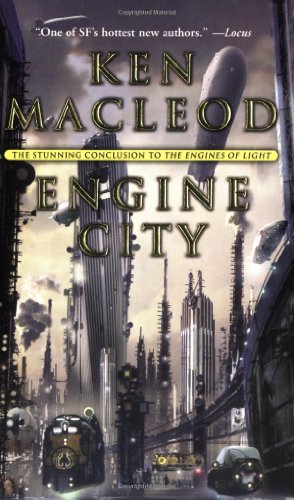
10. Engine City (The Engines of Light, Book 3)
by Ken MacLeod
Mass Market Paperback: 304 Pages (2004-01-05)
list price: US$6.99 -- used & new: US$3.26
(price subject to change: see help)
Asin: 0765344211
Average Customer Review: 3.0 out of 5 stars
Canada | United Kingdom | Germany | France | Japan
Editorial Review

Book Description
WHO OWNS THE STARS?For ten thousand years Nova Babylonia has been the greatest city of the Second Sphere, an interstellar civilization of human and other beings who have been secretly removed, throughout history, from Earth. Now humans from the far reaches of the Sphere have come, to offer immortality-and to urge them to build defenses against the alien invasion they know is coming.As humans and aliens compete and conspire, the wheels of history will lathe all the players into shapes new and surprising. The alien invasion will reach New Babylon at last-led by the most alien figure of all.Download Description
The concluding volume of the acclaimed Engines of Light sequence, from one of the hottest new authors in modern SF. ... Read more

Customer Reviews (10)

4-0 out of 5 stars Not Free SF Reader
The story picks up again, and steps up a notch.It is not only the locals and known beings they have to worry about.It seems there is a large conflict elsewhere, and new recruits are always needed for the fighting.

Other branches of this conflict just like to make stuff, and change people.Given that a lot of people don't like change, serious and deadly problems abound for a lot of the characters.


4-0 out of 5 stars Original, Fresh Writing
In this futuristic story, Gods are real, and sometimes they are a real pain--so much so, that eventually some of their charges might commit theicide.This--and much more--happens in the course of a book that does a pretty good job of presenting various kinds of alien beings.The fear of being invaded and "taken over" plays a part in this story, as does the wanderlust of starfaring races and the old-fashioned desire for power.

Technology does not rule the storyline in this novel, though there's enough of it; to the author's credit, characters--human and otherwise--are sufficiently developed that they successfully carry the day and the plot. We get to know them well enough to care about their fate, and this provides the emotional power in the ultimate part of the book, almost lyrical in its suggestion of continuity beyond death.

4-0 out of 5 stars A Satisfying Ending
This is one book I thoroughly enjoyed. Each chapter was packed with new ideas and unexpected plot lines that drived the story forward; and despite the rich content, the pacing was executed just right. I have to admit I was afraid that the series might end badly, especially after reading the second book in the trilogy (Dark Light). Alas, my fears were unfounded, and Ken Macleod delivered briliantly!

The series had made a lot of use of, and reference to, popular alien culture - from "grays" to flying saucers. However, it was thankfully *not* about that particular popular culture, despite the superficial resemblance. It is about human potential, about inner drives - both human and extraterrestrial, about change, about history repeating itself, and about the wide unknown universe.

All in all, it was an interesting and fun journey through a universe filled with conscious asteroids, saurs (alien grays), kraken starships, utopian societies, future-historic events, and the down-to-earth familiar characters that shaped this future history.

The Engines of Light is the first work I've read from Mr. Macleod, and I should say it makes me look forward to reading his other novels.

3-0 out of 5 stars Disappointing conclusion to a flawed trilogy
Reading the preface to this, the third volume in The Engines of Light trilogy, buoyed me after I completed the lackluster second volume, Dark Light. This novel seemed like the redemption of the trilogy (in the same fashion as Star Wars III). Alas, my optimistic assessment of the novel began to unravel as I was a quarter of the way in.

The "octopod" aliens whose future invasion was central to developments in Dark Light have arrived. These octopods, called Multis, Multipliers, or Spiders, are fractal in nature; a roughly human-sized representative of the species comprises smaller, self-similar individuals. These smaller Spiders can break off and grow into adults themselves or even be introduced into the system of a human in order to work nanoscale improvements (such as instant healing and immortality).

The reception that awaits the Multis is mixed, as should be expected by anyone who read Dark Light. Matt Cairns and his people adapt to the Multis and vice-versa, while the people of Nova Babylonia (who have undergone a revolution and fragmented into separate nation-states) responded to the alien arrival with nuclear weapons in space. The aliens make it through the defenses anyway, with the help of the Bright Star Cultures (the descendants of Cairns and other cosmonauts), the krakens and saurs panic and disappear, someone nukes New Babylon (Volkov? The gods?), and the ultimate crime, theicide, is committed.

If that all sounds confusing, that is because this novel, and the trilogy as a whole, WAS confusing. Reading it was like watching a firework launching into a beautiful trajectory only to come apart into thousands of different shards, and thinking to oneself, "I have to pick up those pieces."

In truth, the novel was fun to read (more fun than Dark Light) but the entire arc of the story, such as it was, became far too convoluted to resolve adequately. The ending was less a disappointment and more a head-scratcher; I did not understand what MacLeod had been trying to say with the trilogy.

That said, I must give kudos to MacLeod for creating in the Multis some of the more, well, alien aliens that I have encountered in SF. Perhaps MacLeod could do something in future works to explore the culture and history of the Multis. That would be fascinating.

2-0 out of 5 stars Not a strong finish....
Ken MacLoeds books are usually a complex but ultimately satisfying read. The first two books of this trilogy fitted into that description but this third book, Engine City, missed the mark. I found myself skipping through pages which is something I usually never do. It seemed like this was a very disjointed finish to a story that had started out really well in books one and two.

I look forward to his next work...although may not a trilogy. ... Read more


11. The Execution Channel
by Ken MacLeod
Hardcover: 288 Pages (2007-06-12)
list price: US$24.95 -- used & new: US$12.00
(price subject to change: see help)
Asin: 0765313324
Average Customer Review: 3.0 out of 5 stars
Canada | United Kingdom | Germany | France | Japan
Editorial Review

Book Description

It's after 9/11. After the bombing. After the Iraq war. After 7/7. After the Iran war. After the nukes. After the flu. After the Straits. After Rosyth. In a world just down the road from our own, on-line bloggers vie with old-line political operatives and new-style police to determine just where reality lies.

James Travis is a British patriot and a French spy. On the day the Big One hits, Travis and his daughter must strive to make sense of the nuclear bombing of Scotland and the political repercussions of a series of terrorist attacks. With the information war in full swing, the only truth they have is what they're able to see with their own eyes. They know that everything else is--or may be--a lie.
... Read more

Customer Reviews (11)

3-0 out of 5 stars Like MacLeod's other stuff, hoped for better
I agree with the reviewer who stated the Execution Channel itself is just a throwaway plot device.Specifically, it reveals to the public that the British government has just tortured to death a serving member of its own armed forces under suspicion of being involved in a nuclear explosion on British soil.The novel extrapolates the current "War on Terror" ("Terror Won") into the near future, and the torture is an obvious extrapolation of both Gitmo/CIA secret prison procedures and Britain's own legal response to 9/11. The author unfortunately spends only about one paragraph on one character's thoughts about the transition from 20th Cent. trial by jury to 21 Cent. secret torture chambers in the US & UK, and it is a well written section on a chilling and scary notion.Very topical, don't you think, considering how Gitmo, waterboarding, & US citizen Jose Pedilla's treatment all seem at odds with the Bill of Rights?The author could have written the entire damn novel about how the British and US governments regress to barbarism in the face of terrorism in his scenario, and it would have been relevant.The author could also have spent more time explaining to a US audience _why_ his characters are protesting full-time the US Air Force presence on British soil.Maybe it goes without saying to a Brit, but over here you gotta explain it a bit. Instead, we get alt.conspiracy "false-flag" talk and Communist spindizzies.Communists?J. Edgar Hoover wouldn't give a damn about Commies during our current Arab adventure.Why does the author?

4-0 out of 5 stars Has some good aspects, but mostly uninspiring
The style of this book is better than that of the other books I've read by MacLeod, but not good enough for the style alone to be sufficient reason to read it.
I was disappointed that the substance was not very thought provoking. Unlike the typical MacLeod novel, it is set in a society too similar to ours to stretch our imaginations much, and sufficiently less pleasant to be somewhat depressing.
Much of the book is commentary on the current "war on terror". I agree with a lot of that commentary, but only a few aspects of the commentary have much value.
The most important way in which this novel stands out is that it portrays most characters as people who expect to be the kind of leaders that conspiracy theorists imagine the world to be run by, but regularly end up as more realistic people whose battle plans don't survive contact with the apparent enemy. And there's a good deal of realistic "fog of war" type uncertainty over who the enemy is.
MacLeod deserves a good deal of credit for avoiding a number of biases that make typical novels popular but unrealistic, such as making the protagonists better than human. Unfortunately, the results confirm that this kind of realism interferes with the enjoyability of novels.

1-0 out of 5 stars Don't bother
I got through the first 100 pages of this book, and decided not to waste any more of my time with it.By the time a reader is one-third of the way through the book, he should be able to at least have an idea of what is going on and know who some of the characters are.But you won't get that here.I have moved on to better things, and you probably should, too.

1-0 out of 5 stars What a Mess
Plot line almost impossible to follow. Unbelieveable coincidences. Heroic (I think) bloggers. Technology so hokey as to be laughable. The whole novel seems to be a vehicle for blaming the USA for any and all future disaster that may befall mankind. Why read the book? We can get that from the liberal Left.

2-0 out of 5 stars I'd block this channel from further viewing...
Normally, a near-future sci-fi novel with government propaganda and disinformation is a recipe for success with me.But in The Execution Channel by Ken Macleod, someone must have left out a critical item to make it all come together.The two major questions I kept asking were "what's going on" and "why do I care"...

I'm not even sure I can do a decent plot recap.What seems to be a nuclear explosion occurs at an air force base in England.This is followed by a number of other terrorist acts which are being spun as a full-fledged attack on the country.A group that was watching the base for signs of illegal activity is being blamed for the explosion.But no one is quite sure *who* is to blame, as all the governments are involved in actively feeding "leaks" to bloggers in order to cover up the truth and fuel UFO and conspiracy theories.Members of the observation group are trying to cut through the media spin and confirm the truth.

That's a weak recap, but it's the best I can do.The characters seem to be a continuation of some other story, and I was never quite sure who was who in terms of plot and allegiances.The whole "Execution Channel" just dies on the vine in the story.For something that is the title of the book, it ultimately never comes into play (as best I can tell).And the ending is just plain weird...The term "cop-out" comes to mind.

This could have been a great setting.The concept of governments driving public opinion using media and internet sites isn't hard to imagine.The color and settings also seemed to work well.But unfortunately, the plot was either too sophisticated for me to understand, or it was just plain muddled...
... Read more


12. The Highway Men (Sandstone Vista)
by Ken MacLeod
Paperback: 80 Pages (2006-03-13)
list price: US$11.82 -- used & new: US$10.43
(price subject to change: see help)
Asin: 1905207069
Canada | United Kingdom | Germany | France | Japan

13. The True Knowledge of Ken MacLeod (Foundation Studies in Science Fiction)
 Hardcover: 136 Pages (2005-03)
list price: US$30.00 -- used & new: US$49.00
(price subject to change: see help)
Asin: 0903007029
Canada | United Kingdom | Germany | France | Japan

14. The Human Front (Gollancz)
by Ken MacLeod
Paperback: 208 Pages (2003-02-13)
list price: US$12.40 -- used & new: US$25.00
(price subject to change: see help)
Asin: 0575075058
Average Customer Review: 4.0 out of 5 stars
Canada | United Kingdom | Germany | France | Japan
Editorial Review

Book Description
THE HUMAN FRONT is a sparkling SF alternate history story set in world that has been fighting WWIII since 1949. Leading a guerilla campaign against the Western Forces is the heroic, myhtic figure of Joe Stalin. And above the battlefields flying saucers fill the skies. ... Read more

Customer Reviews (2)

3-0 out of 5 stars When Does Right Go Wrong?
MacLeod has shown a fine sense of how to blend political philosophy with storytelling in his prior works. No less so here, with this tale of an alternate history where WWIII began in 1949, where Joe Stalin is the peopleýs revolutionary hero, atomic weapons have been used in many more places than Hiroshima, and the Americans are flying some very strange bombers with even stranger pilots.

The book follows John Matheson from a young boy through early manhood, tracing his awakening to the political facts of life. And like many young people, the inequalities and suffering that much of world must live with are open sores that he feels he can and should do something about. This is the entry point for MacLeod's exposition of political/revolutionary solutions, along with some rather sharp satire of figures that are almost deified in our world ("Hey, hey, JFK, how many kids did you kill today?"). These answers will disturb your sense of the correctness of the status quo, perhaps make you realize that there is merit in other political philosophies than your own. Very little of this is presented directly, but is rather shown as an normal outgrowth of Matheson's development and learning, from his days in school and college and later as a member of the revolutionary group The Human Front. MacLeod's envisioned world is believable, and its contrasts with our own highlight just how much the world's and your personal condition depends upon chance happenstances and events beyond any one individual's control.

All of this, about the first fifty pages, is excellent writing, but at the end of the book MacLeod turns away from what should be the logical conclusion to the story and instead chooses what felt to me like a dues-ex-machina resolution, (even though MacLeod has carefully planted clues to this early in the book), and a far too happy one at that. For me, this ending greatly lessened the strength of his earlier points. Those familiar with the various science-fictional treatments of alternate time-line scenarios will recognize in this ending an attempt to rationalize the paradoxes inherent in disturbing the past and will see parallels with books like Asimov's The End of Eternity and Dick's The Man in the High Castle, but what is missing from this ending is a proper resolution to the political questions raised in the earlier portion of the book.

Perhaps this novella should have been given a longer treatment, expanded to full novel length, and with this extra room there would have been space to fill in what I feel was missing to this ending.As it is, I feel that MacLeod has presented a sharply realized different world that can illuminate many of the problems of our world, but hasnýt really finished his story within that world.

--- Reviewed by Patrick Shepherd (hyperpat)

5-0 out of 5 stars Fascinating blend of genres and ideas
First off, this isn't a typical Amazon title, rather it is the product of PS Publishing, which puts out limited, signed editions by various science fiction and fantasy authors. Specifically, "The Human Front" was limited to 400 hardcover and another 500 paperback copies, all of which have long since sold out from the publisher. That said, there are copies available on the internet, and fans of alternate history will definitely want to track this one down.

As I alluded to above, "The Human Front" is Ken MacLeod's take on alternate history, but anyone who knows MacLeod knows it will be anything but conventional. Actually, it does start off conventionally enough: it's the early 1960's and World War III has been raging with varying degrees of ferocity since 1949. Joe Stalin is a romanticized guerrilla fighter in the model of Che, and the Soviet Union has been beaten down to the point where the allies have installed a government in Petrograd.

Macleod rather cleverly juxtaposes roles in this world; in addition to Stalin, JFK is reviled as a butcher ("Hey, Hey, JFK, how many kids have you killed today?"). By so doing, he obliterates the myths of the past, and rather shrewdly, points out that historical interpretation is largely a function of the circumstances in which one lives, or more simply, a result of how the past turned out. While he is no apologist for Stalin (by any stretch) he creates a plausible reality where he is revered as a pragmatic, dedicated revolutionary, rather than reviled as a butcher. Thus removed from our known context he can create an absurd inversion that nonetheless sheds light on how we view our own heroes.

However, instead of following this believable alternate reality to a logical conclusion, MacLeod throws a curveball in the main character, John Matheson's, enigmatic encounter with one of the U.S.'s strange disc shaped bombers. Although the next twenty pages of narrative are fairly conventional, MacLeod has set the stage, and everything thereafter is tainted by this puzzling mystery.

To go any further would spoil the plot, but suffice it to say that the novel takes numerous bizarre twists before arriving at a fascinating ending. Specifically, unlike most Alternate History, which revels in an outcome discrete from reality, MacLeod attempts to reconcile his world to our own in a manner reminiscent of Philip K. Dick's "The Man in the High Castle". The mechanism of this reconciliation is completely original without being outlandish, and the statement made is simple but profound. In essence, MacLeod is arguing that we are all victims of circumstance, that, generally speaking, shaping the world's destiny is beyond the individual. Thus, it is left to each of us to live as best we can, in the hopes that the cumulative result is something better than where we started. At the same time, unlike much Alternate History, (and particularly what one would expect from such a politically conscious writer) MacLeod isn't entirely displeased with the path history has taken, and actually seems to find it better than many of the alternatives.

MacLeod packs more into the seventy-five pages of "The Human Front" than most authors do in novels four times as long. He has blended so many genres, I've lost count, and it's almost unfair to categorize it as Alternate History, in spite of the fact that it won the Sidewise Award for best Short Form Alternate History in 2001. Rather, MacLeod created a true SF hybrid, that evokes the best of many different themes. At the same time, he has written a character driven novel that explores some interesting themes around meaning and purpose. Ultimately, this is a work of literature in which the content far surpasses what one might expect from the length.

Jake Mohlman ... Read more


15. Biography - MacLeod, Ken (1954-): An article from: Contemporary Authors Online
by Gale Reference Team
Digital: 3 Pages (2006-01-01)
list price: US$9.95 -- used & new: US$9.95
(price subject to change: see help)
Asin: B0007SIP0C
Canada | United Kingdom | Germany | France | Japan
Editorial Review

Book Description
Word count: 781. ... Read more


16. Andrew Butler and Farah Mendlesohn, ed. The True Knowledge of Ken MacLeod.(Book Review): An article from: Utopian Studies
by Michael Jackson
 Digital: 2 Pages (2005-01-01)
list price: US$5.95 -- used & new: US$5.95
(price subject to change: see help)
Asin: B000ALT5ZK
Canada | United Kingdom | Germany | France | Japan
Editorial Review

Book Description
This digital document is an article from Utopian Studies, published by Society for Utopian Studies on January 1, 2005. The length of the article is 439 words. The page length shown above is based on a typical 300-word page. The article is delivered in HTML format and is available in your Amazon.com Digital Locker immediately after purchase. You can view it with any web browser.

Citation Details
Title: Andrew Butler and Farah Mendlesohn, ed. The True Knowledge of Ken MacLeod.(Book Review)
Author: Michael Jackson
Publication: Utopian Studies (Refereed)
Date: January 1, 2005
Publisher: Society for Utopian Studies
Volume: 16Issue: 1Page: 117(2)

Article Type: Book Review

Distributed by Thomson Gale ... Read more


17. The True Knowledge of Ken MacLeod.(Book Review): An article from: Extrapolation
by Michael Levy
 Digital: 13 Pages (2003-12-22)
list price: US$5.95 -- used & new: US$5.95
(price subject to change: see help)
Asin: B0008278GO
Canada | United Kingdom | Germany | France | Japan
Editorial Review

Book Description
This digital document is an article from Extrapolation, published by Extrapolation on December 22, 2003. The length of the article is 3747 words. The page length shown above is based on a typical 300-word page. The article is delivered in HTML format and is available in your Amazon.com Digital Locker immediately after purchase. You can view it with any web browser.

Citation Details
Title: The True Knowledge of Ken MacLeod.(Book Review)
Author: Michael Levy
Publication: Extrapolation (Refereed)
Date: December 22, 2003
Publisher: Extrapolation
Volume: 44Issue: 4Page: 468(8)

Article Type: Book Review

Distributed by Thomson Gale ... Read more


18. The fall revolution
by Ken MacLeod
 Unknown Binding: 710 Pages (2001)
-- used & new: US$29.95
(price subject to change: see help)
Asin: 0739421220
Canada | United Kingdom | Germany | France | Japan

19. Das Sternenprogramm.
by Ken MacLeod
Paperback: Pages (2001-10-01)

Isbn: 3453187881
Canada | United Kingdom | Germany | France | Japan

20. Dark Light
by Ken MacLeod
 Mass Market Paperback: Pages (2003)

Asin: B000OCG70G
Canada | United Kingdom | Germany | France | Japan

  1-20 of 42 | Next 20
A  B  C  D  E  F  G  H  I  J  K  L  M  N  O  P  Q  R  S  T  U  V  W  X  Y  Z  

Prices listed on this site are subject to change without notice.
Questions on ordering or shipping? click here for help.

site stats