e99 Online Shopping Mall

Geometry.Net - the online learning center Help  
Home  - Authors - Nin Anais (Books)

  1-20 of 100 | Next 20
A  B  C  D  E  F  G  H  I  J  K  L  M  N  O  P  Q  R  S  T  U  V  W  X  Y  Z  

click price to see details     click image to enlarge     click link to go to the store

$87.99
1. Delta of Venus
$8.10
2. Little Birds
$13.15
3. The Diary Of Anais Nin, Volume
 
4. The Diary of Anais Nin, 1931-1934
$4.36
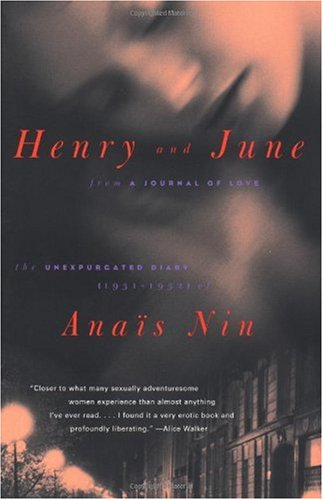
5. Henry and June: From "A Journal
$4.00
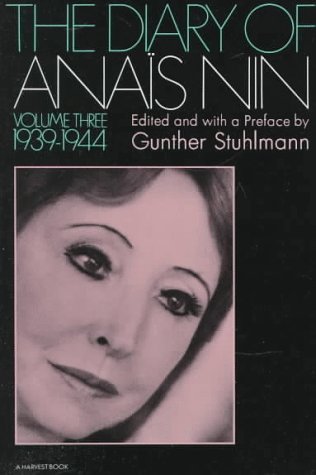
6. The Diary Of Anais Nin, Volume
$6.95
7. The Diary Of Anais Nin, Volume
$3.49
8. In Favor of the Sensitive Man,
$5.00
9. Anais Nin: A Biography
$9.98
10. Cities of the Interior
$9.21
11. The Diary Of Anais Nin, Volume
$16.95
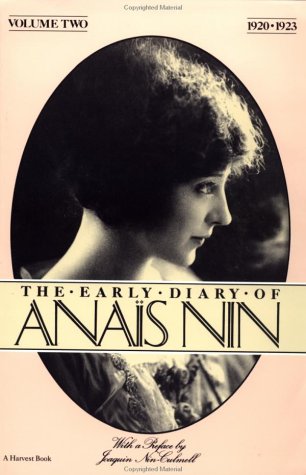
12. The Early Diary of Anais Nin,
$3.93
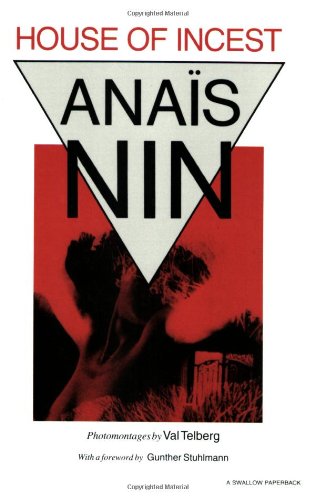
13. House Of Incest
$5.94
14. Fire: From "A Journal of Love"
$9.50
15. Anais: The Erotic Life of Anais
$8.99
16. The Early Diary of Anais Nin,
$15.35
17. The Diary Of Anais Nin, Volume
$19.03
18. The Early Diary of Anais Nin,
$13.86
19. A Spy in the House of Love (Penguin
 
$45.00
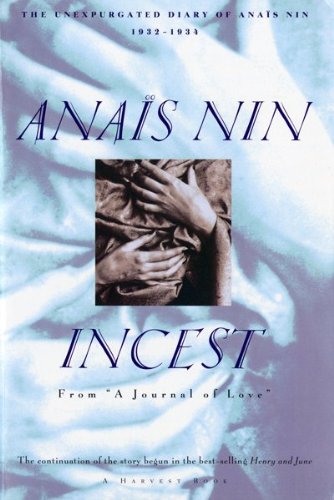
20. Incest: From a Journal of Love

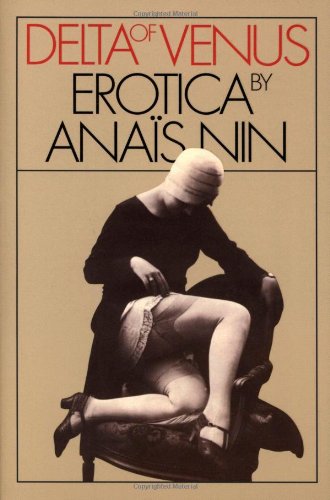
1. Delta of Venus
by Anais Nin
Hardcover: 271 Pages (2006-05)
list price: US$9.98 -- used & new: US$87.99
(price subject to change: see help)
Asin: 1579125743
Average Customer Review: 4.0 out of 5 stars
Canada | United Kingdom | Germany | France | Japan
Editorial Review

Book Description

In Delta of Venus Anaïs Nin penned a lush, magical world where the characters of her imagination possess the most universal of desires and exceptional of talents. Among these provocative stories, a Hungarian adventurer seduces wealthy women then vanishes with their money; a veiled woman selects strangers from a chic restaurant for private trysts; and a Parisian hatmaker named Mathilde leaves her husband for the opium dens of Peru. Delta of Venus is an extraordinarily rich and exotic collection from the master of erotic writing.


... Read more

Customer Reviews (69)

3-0 out of 5 stars Keep this book away from kids
I read this book when I was 10, and it absolutely horrified and disgusted me. I had nightmares for years about being sexually molested and was often afraid of boys and men. Now in my early twenties, I realize that the detached style of narration does not mean that the author condones these acts or implies that they are normal and healthy (I refer especially to the rape and pedophilia), and that is a unique, even ground-breaking book due to Nin's style and breadth of imagination.

However, I still think no review of this book is complete without this caveat: Some of what is protrayed is not erotic--it is violent and abusive.

Please, keep this book out of the reach of kids and yes, I would say even teenagers who may not be mature enough to comprehend that difference. Leave something lying around that portrays healthy, loving relationships.

3-0 out of 5 stars interesting but not necessarily erotic
there is a lot of interesting prose in this book but it's not the erotica I was expecting. she's got interesting things to say and discuss but if you're looking for something to turn you on, this might not be it.

4-0 out of 5 stars Nin in fine form...sort of
The great work of Anais Nin's life was her diary, and everything else she wrote, no matter how much energy and passion she invested in it, seemed distracted and a bit colorless. This erotica is no exception, and it also has the distinction of being composed to the tune of a tightrope act; Nin was required to deliver hardcore sex, but she could not help adding her own poetry to it. The conditions of composition are here important to whether or not you'll enjoy this semi-hardcore, semi-erotica writing.

If you're a Nin fan, however, this is a must-have.

4-0 out of 5 stars One of the classics
This is one of the classics of sex and eroticism. As a teen, I stole my mother's copy and it inspired many a fantasy. The writing is wonderful and the sex is, well, just hot. I've ready many similar books since then, like right now I am reading Abby Lee's Diary of a Sex Fiend: Girl with a One Track Mind. Reading about sex is always "stimulating" but this classic has lasted generations.

2-0 out of 5 stars I expected something deeper
I guess I was expecting better writing from Nin. I have heard so many good things about her writing and I have read a few books by one of her "good friends", Henry Miller, that I decided to pick up Delta of Venus and was a bit disappointed. In the introduction Anais Nin describes the conditions under which she wrote much of what is contained in this book. Some wealthy "collector" had commissioned erotica at the rate of $1/page and he was not interested in anything but the physical act of sex. Well, Nin delivered. Much of the content is the description of various sexual situations and lacks what I would consider art. Reading Delta of Venus I felt like I was reading at more tasteful version of Letters to Penthouse. I must admit, this is my first exposure to Nin so I am not saying she is not a gifted author. I understand she was commissioned to write stories of this nature, I'm just saying I expected something more. ... Read more


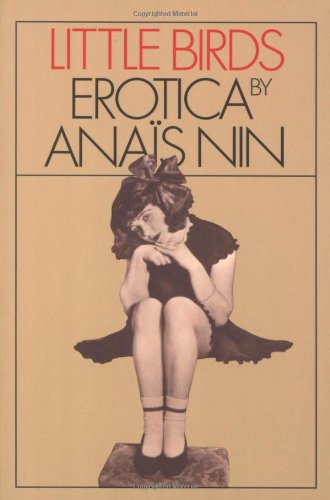
2. Little Birds
by Anais Nin
Paperback: 168 Pages (2004-02-02)
list price: US$14.00 -- used & new: US$8.10
(price subject to change: see help)
Asin: 0156029049
Average Customer Review: 4.5 out of 5 stars
Canada | United Kingdom | Germany | France | Japan
Editorial Review

Book Description

Evocative and superbly erotic, Little Birds is a powerful journey into the mysterious world of sex and sensuality. From the beach towns of Normandy to the streets of New Orleans, these thirteen vignettes introduce us to a covetous French painter, a sleepless wanderer of the night, a guitar-playing gypsy, and a host of others who yearn for and dive into the turbulent depths of romantic experience.


... Read more

Customer Reviews (29)

3-0 out of 5 stars a little twisted but not erotically
definitely not the erotica I was expecting. there's some interesting twisted stuff but if you're looking for a turn on in a traditional erotic fashion, this might not do it. interesting read tho.

4-0 out of 5 stars Classic erotica
Beautifully written erotic short stories exploring a range of sexual and sensual indulgences, some explicit and some sublime.

5-0 out of 5 stars Pure genius
I cannot praise Anais enough. Her writing captures you emotionally and then sets you afire with her raw sexuality. The book is mesmerizing. Pure passion.

5-0 out of 5 stars Wonderful!
This is a wonderful collection of erotic writing from a true master of the genre.I have my grave doubts though if men can truely appreciate this work.

3-0 out of 5 stars Little Birds
Not as good as The Delta of Venus. If you are interested in classic erotica I would try Delta of Venus instead. ... Read more


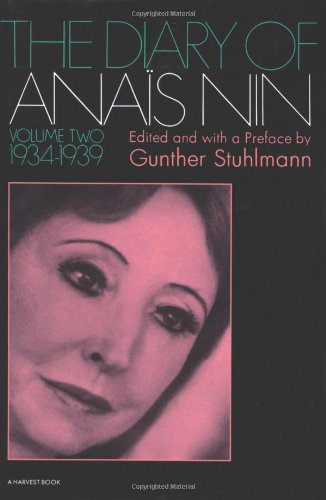
3. The Diary Of Anais Nin, Volume 2 (1934-1939)
by Anais Nin
Paperback: 372 Pages (1970-06)
list price: US$20.00 -- used & new: US$13.15
(price subject to change: see help)
Asin: 0156260263
Average Customer Review: 4.5 out of 5 stars
Canada | United Kingdom | Germany | France | Japan
Editorial Review

Book Description
Beginning with Nin's arrival in New York, this volume is filled with the stories of her analytical patients. There is a shift in emphasis also as Nin becomes aware of the inevitable choice facing the artist in the modern world. "Sensitive and frank...[Nin's] diary is a dialogue between flesh and spirit" (Newsweek). Edited and with a Preface by Gunther Stuhlmann; Index.
... Read more

Customer Reviews (2)

5-0 out of 5 stars A coherent extension of the first volume
Anais Nin began a letter to her father, on the ship that carried her, her mother and brothers, away from him, away from Europe and to New York City. She was 11 at the time. The letter was never sent (her mother did not think it appropriate), but instead developed into a diary that would become legendary by the time she reached her late 20s. Henry Miller helped feed the legend by stating that, once published, Anais Nin's diary would take its place beside the great literary revelations of the century. Upon publication in the 1960s, many critics, and audiences alike, felt that the acclaim was justified. Though original plans called for the publication of only one volume, demand was so great that seven volumes in all would be eventually be published; then, of course, the "unexpurgated" versions would be published in the late 1980s and early 1990s.

In the first volume of the diary, we meet Anais Nin living outside of Paris with her husband, banker Hugh Guiler. She has just published her study of DH Lawrence and is about to meet Henry Miller and his fascinating and dramatic wife, June. All characters from the previous volume factor into this second installment, but many new people are introduced. Gonzalo, a Peruvian Marxist, and his wife Helba, are the most interesting new characters. Famous Freudian analyst Otto Rank is also depicted. Anais works with Rank in New York; she struggles to understand whether she is meant to be an analyst or a writer. Yes, in what strikes me as an odd occurence, Anais Nin - with no formal training - is allowed to take on patients.

Of the first two volumes, I'd have to say that this is my favorite. There is more movement, and with World War II as a backdrop, there is more social conscience on display. "Politics, all of them," Anais writes in an astute observation that, sadly, is still true 70 years later, "seemed rotten to the core and all based on economics, not humanitarianism." Indeed, in this volume Anais seems more aware of the world around her and less preoccupied with herself, well, a little less so. But, as with all other volumes in this series of diaries, and just about all of Anais Nin's literature, the reader is wise to look more for poetic truth than literal reality. What I mean is, the diaries of Anais Nin are most likely not verbatim transcriptions of the manuscript versions (the difference between this original series and the unexpurgated versions pretty much proves this point). They are something closer to being stylized, masterfully edited "memory books" and persona self-creation. But it's an entertaining, romantic, and often beautiful persona.

Andrew Parodi

4-0 out of 5 stars Anais is always searching
This book has so much wisdom. I find myself reading it very slowly to stop and really think about what she has to say. This volume of her diary is more disconnected than the one prior, but the insight is much more profound. ... Read more


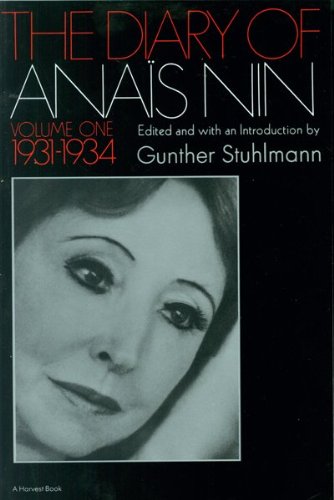
4. The Diary of Anais Nin, 1931-1934
 Paperback: Pages (1969-06)

Isbn: 0151255881
Average Customer Review: 5.0 out of 5 stars
Canada | United Kingdom | Germany | France | Japan
Editorial Review

Book Description

This celebrated volume begins when Nin is about to publish her first book and ends when she leaves Paris for New York. Edited and with a Preface by Gunther tuhlmann; Index.
... Read more

Customer Reviews (13)

5-0 out of 5 stars Should be read simultaneously...
...with "Tropic of Cancer."For newbies, read the synopsis of Anais Nin and Henry Miller at "wikipedia."Then start reading Volume 1 of Anais Nin's diaries (1931 - 1934).After a while, maybe 30 - 40 pages you will want to take a break.So, pick up "Tropic of Cancer" and read the first couple of chapters.Anais had Henry read her journals; Anais and Henry helped each other with each others works.The preface to "Tropic of Cancer" was written by Anais Nin (at least it was signed by her; legend has it that Henry actually wrote it)."Tropic of Cancer" was published (and immediately banned in the United States) in 1934.(By the way, off topic, Henry Miller reminds me a lot of Hunter S. Thompson, at least "Tropic of Cancer" and "Fear and Loathing in Las Vegas.")

5-0 out of 5 stars A womans heart ...laid out boldly in words for all to see.
ANAIS has been someone who has carried me through some tough times in the past...I read her at twenty...and twenty-three and twenty-six. Her troubles were my own and we were kin. She is meant to be read by anyone who loves life...in it's full fleshy sometimes heart rending reality. She writes with the open-heart of a poet, and leaves the reader feeling more than fed. READ ANAIS NIN!

4-0 out of 5 stars A great read
I recomend reading Anais Nin's diary. The book is such poetic prose. Some sentences really took my breath away, the way she can captivate something so beautiful and human in simple words. Since it is a diary, its main focus is her life, but its not selfish, infact she mentions herself very little. The main focus is Henry (Miller) and June, his wife. When Ananis Nin falls inlove with someone, so does the reader. Her descriptive skills gave me goosebumps, you really can see it in your minds eye, hear the music or feel the softness of skin. I highly recomend this to anyone thinking about reading this book, you will come away with a slice of life from 1930's France.

5-0 out of 5 stars Wonderfully delicate and erotic
This is one of the most profound works of literature I have ever read.Nin leads you directly into her life, the nature of the people around her, her feelings and internal conflicts.She writes delicately and powerfully and womanly.Everyone should have a chance to read this.

4-0 out of 5 stars Worth reading
A bit long and occasionally dense, but overall, a worthwhile and insightful glimpse into the life of a remarkable, thoughtful writer in 1930s France. ... Read more


5. Henry and June: From "A Journal of Love" -The Unexpurgated Diary of Anais Nin (1931-1932)
by Anais Nin
Paperback: 288 Pages (1990-10-29)
list price: US$14.00 -- used & new: US$4.36
(price subject to change: see help)
Asin: 015640057X
Average Customer Review: 4.0 out of 5 stars
Canada | United Kingdom | Germany | France | Japan
Editorial Review

Book Description

This bestseller covers a single momentous year during Nin’s life in Paris, when she met Henry Miller and his wife, June. “Closer to what many sexually adventuresome women experience than almost anything I’ve ever read....I found it a very erotic book and profoundly liberating” (Alice Walker). The source of a major motion picture from Universal. Preface by Rupert Pole; Index.
... Read more

Customer Reviews (29)

1-0 out of 5 stars Froid et faux
Anais Nin and Henry Miller are minor writers, the former considerably more minor than the latter.However, I daresay Anais Nin is more widely read nowadays than is Henry Miller.The interest in them is gosspiy - that whole Americans in Paris in the thirties schlock - and nicely seasoned by the erotic.This book is actually a rather revolting self-portrait of a self-obsessed woman with too much time on her hands.Her writing is Lawrence without the passion for truth, and her living is all words. Everything is affect.There seems not an ounce of tenderness in her.She (and this book) is cold and false.

5-0 out of 5 stars Wow!
From the very first few pages you know that you have entered a fascinating world -- if you are reading these reviews and haven't yet purchased the book, don't wait any longer.It's an easy read -- you should be able to read it in one setting -- maybe one weekend, and you may be totally transformed in the way you think about human relationships.

I would recommend starting with Nin's edited diaries (Vol I: 1931 - 1934) and Henry Miller's "Tropic of Cancer" before reading "Henry and June."

"Henry and June" covers only one year, perhaps the most important year in her life, and is clearly her "coming-of-age" year.

For those who are troubled by Nin's infidelities and lies, one turns to the answer Marcel Proust gave on a questionnaire during his adolescence:"For what fault have you the most toleration?""For the private life of geniuses."

5-0 out of 5 stars Brutally and beautifully honest!
A very honest account of a very dishonest period in Nin's life. Highly entertaining, at times liberating (at least for women) and often times very scary (mostly for men). Psychologically fascinating! Interesting peak into Henry Miller's life.

3-0 out of 5 stars If D.H. Lawrence were a barracuda. . .you'd have anais nin.
Read this interspaced with Tropic of Cancer. You find a more accurate image of Henry Miller's second wife/muse June this way.

I love Nin's work, especially the vast prose of House of Incest. However, at this point in her writing, I just see her clutching copies of D.H. Lawrence's works and using her sexuality to figure out the rest.

I empathize more with the June who inspired the myths, rather than the sanquinary authors lusting after her degredation and ruin. . .and lastly, her love.

Nin was a rebirth to water in terms of literature and her timeframe on earth, but she was flawed. However she was never destroyed by her flaws. A psychic vampire way beyond Warhol proportions, I still adore her.

This is just my vision of the artist. Don't be lazy. Read for yourself. Research in spite of what you read.

2-0 out of 5 stars It's alright
The main thing to remember about this book is that it is a journal.So if you are looking for a beginning, middle and end you won't find it here.I kind of felt like "what is the point?" after I read it.It was also hard for me to understand how Anais Nin could write all these words of love about Henry Miller.I tried to read Miller's TROPIC OF CAPRICORN but I had to stop because he is such a misogynistic jerk. I couldn't believe the feelings of hate he had towards his poor first wife, and the way that he saw all women as trash.I had a hard time not thinking that Anais Nin was crazy to risk her marriage to a wonderful man for a horrible man like Miller.This is not a great book, but the one good thing about it is that it is very sensual and erotic. ... Read more


6. The Diary Of Anais Nin, Volume 3 (1939-1944)
by Anais Nin
Paperback: 344 Pages (1971-08)
list price: US$20.00 -- used & new: US$4.00
(price subject to change: see help)
Asin: 0156260271
Average Customer Review: 5.0 out of 5 stars
Canada | United Kingdom | Germany | France | Japan

Customer Reviews (4)

5-0 out of 5 stars Anais Nin confronts New York City
Anais Nin began a letter to her father, on the ship that carried her, her mother and brothers, away from him, away from Europe and to New York City. She was 11. The letter was never sent, but instead developed into a diary that would become legendary by the time she reached her late 20s. Henry Miller helped feed the legend by stating that, once published, Anais Nin's diary would take its place beside the great literary revelations of the 20th Century. Upon publication in the 1960s, many felt that the acclaim was justified. Though original plans called for the publication of only one volume, demand was so great that seven volumes in all would be eventually be published.

In this present volume (1939-1944), Anais has taken refuge once again in the United States, escaping the war that has engulfed most of Europe and destroyed her much beloved literary community back home in Paris. This is the second time she has had to immigrate to the US, and its culture seems just as alien and unwelcoming as it did the first time. Nin finds the transition particularly difficult because her "European" writing style is not warmly received; American audiences are more interested in realism than sur-realism. Her work is deemed obscure and un-publishable. But Anais Nin does not cave to pressure. She forges a community with other artists in the Manhattan literary world, creating something close to what she had in Paris with Henry Miller and Lawrence Durrell.

I enjoyed this volume because, well, I'm fascinated with Anais Nin's work, persona, and overall career. I enjoy its panoramic quality, and that it gives me insight into a world of which I would otherwise be totally ignorant, as I was merely two-years-old when Anais Nin died in 1977. But I think it would be true to say that general readership would probably stop at volume two of this series. In other words, unless you are heavily interested in Anais Nin, this volume and all future installments probably will not grab you. If you are like me, then you have four more volumes in this "expurgated" series to look forward to, then four volumes of the "unexpurgated" series, and yet four more volumes of "early diaries." See you then! :)

Andrew Parodi

5-0 out of 5 stars Anais Nin confronts New York City
Anais Nin began a letter to her father, on the ship that carried her, her mother and brothers, away from him, away from Europe and to New York City. She was 11. The letter was never sent, but instead developed into a diary that would become legendary by the time she reached her late 20s. Henry Miller helped feed the legend by stating that, once published, Anais Nin's diary would take its place beside the great literary revelations of the 20th Century. Upon publication in the 1960s, many felt that the acclaim was justified. Though original plans called for the publication of only one volume, demand was so great that seven volumes in all would be eventually be published.

In this present volume (1939-1944), Anais has taken refuge once again in the United States, escaping the war that has engulfed most of Europe and destroyed her much beloved literary community back home in Paris. This is the second time she has had to immigrate to the US, and its culture seems just as alien and unwelcoming as it did the first time. Nin finds the transition particularly difficult because her "European" writing style is not warmly received; American audiences are more interested in realism than sur-realism. Her work is deemed obscure and un-publishable. But Anais Nin does not cave to pressure. She forges a community with other artists in the Manhattan literary world, creating something close to what she had in Paris with Henry Miller and Lawrence Durrell.

I enjoyed this volume because, well, I'm fascinated with Anais Nin's work, persona, and overall career. I enjoy its panoramic quality, and that it gives me insight into a world of which I would otherwise be totally ignorant, as I was merely two-years-old when Anais Nin died in 1977. But I think it would be true to say that general readership would probably stop at volume two of this series. In other words, unless you are heavily interested in Anais Nin, this volume and all future installments probably will not grab you. If you are like me, then you have four more volumes in this "expurgated" series to look forward to, then four volumes of the "unexpurgated" series, and yet four more volumes of "early diaries." See you then! :)

Andrew Parodi

4-0 out of 5 stars all female writers/readers should read about
anais was so frank & true to her feelings& what she wrote was warm& sweet,though her erotic story was still a bit leg-behind than henrymiller's, she's still a very good female writer.

5-0 out of 5 stars Descoveryof an excellent diarist!!!
I found out some volumes of A.Nin's series of Journals some months ago and I was really amazed : how precise and how many literary encounters! Being a student in American Literature and an apprentice diarist myself, I think Nin's skill for autobiography and her sense of time are optimal points to last longer in diaries! ... Read more


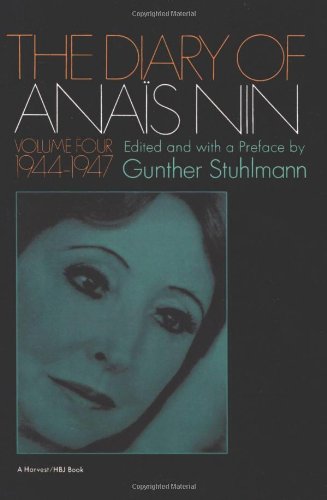
7. The Diary Of Anais Nin, Volume 4 (1944-1947)
by Anaïs Nin
Paperback: 256 Pages (1980-04)
list price: US$16.00 -- used & new: US$6.95
(price subject to change: see help)
Asin: 015626028X
Average Customer Review: 3.0 out of 5 stars
Canada | United Kingdom | Germany | France | Japan
Editorial Review

Book Description
The author's experiences in Greenwich Village, where she defends young writers against the Establishment, and her trip across the country in an old Ford to California and Mexico. "[Nin is] one of the most extraordinary and unconventional writers of this century" (New York Times Book Review). Edited and with a Preface by Gunther Stuhlmann; Index.
... Read more

Customer Reviews (1)

3-0 out of 5 stars Offers No Sense of Artistic Evolution
This volume was the fourth in the published series of expurgated diaries beginning with the 1931 manuscript diaries of the prolific Anais Nin.

Unfortunately, although this volume begins with diary entries written some thirteen years after those in the first published volume, the reader has no sense that Nin's craft of diary-keeping as an art form evolved or matured in those thirteen years. It is impossible to tell whether this stems from Nin's habit of editing and reworking her material over the years, thus possibly refining early entries until they were on a par with her later work, or whether Nin was simply never able to improve on her first work inspired by her meeting Henry Miller.

Deidre Bair's biography of Nin reveals the interesting tidbit that Nin stopped keeping diaries in volume form some time during 1946, partway through this volume. After 1946 (particularly since Nin soon found herself living with two men, one on each coast), she jotted down notes on whatever papers were handy and tossed the notes into manila folders. The decrease in quality associated with this apparent lack of care shows, I think, as this volume progresses.

The life she was then leading, although distracting her from the diary, hardly constituted a work of art in and of itself. Nin spends much of this volume "ensorcelling" teenage boys as a woman in her forties. She declares frequently that she identifies with the young, and surrounds herself with them in preference to the rigid folks her own age. A more jaded view of Nin's behavior at this time is that men her own age were able to see through her games in a way that boys did not have the life experience to do. Although she frequently claims tremendous insight and understanding of psychoanalysis, she is ultimately blind to the uglier aspects of the larger patterns of her life at this time.

Because this is the expurgated version of the diary, this volume omits a critical event: Anais's meeting Rupert Pole, whom she would later marry, in 1947.

Verdict: only for hardcore Anais Nin fans. ... Read more


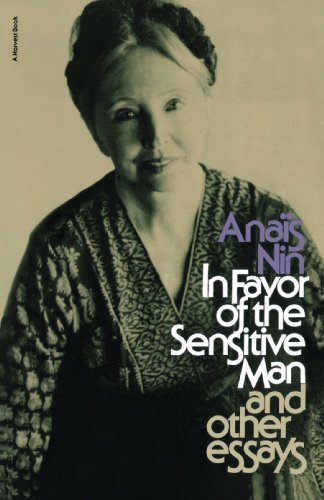
8. In Favor of the Sensitive Man, and Other Essays
by Anais Nin
Paperback: 180 Pages (1976-04-01)
list price: US$14.00 -- used & new: US$3.49
(price subject to change: see help)
Asin: 0156444453
Average Customer Review: 5.0 out of 5 stars
Canada | United Kingdom | Germany | France | Japan
Editorial Review

Book Description

Here, in more than twenty essays, Nin shares her unique perceptions of people, places, and the arts. Includes several lectures and two interviews.
... Read more

Customer Reviews (2)

5-0 out of 5 stars Some books sink into our consciouness
There is no simple way to explain the meaning of human relationships. Anyone who believes that our socialization as human beings can be easily understood should read 'In Favor of the Sensitive Man'.

The twenty seven pieces included cover Nin's main interest: feminine sexuality, human relationships, and eroticism. The book is divided into 3 sections: Women and Men, "Writing, Music, and Films", Enchanted Places. A book as intelligent as this about human interaction had to written by a someone with a background in psychology and a keen inner awareness.

Anais Nin (1903-1977) was born in France. She began to keep a journal of her life in 1914, when her father, composer Joaquin Nin abandon the family. These journals were published in 1966 and lifted Nin from obscurity into the celebrity. Nin studied psychoanalysis under Otto Rank and practiced as a therapist in New York. At some point, she was even a patient of Carl Jung.

As Nin writes, there are books which we read early in life, which sink into our consciouness. I read the famous Nin "dairies" in my teens. I am convinced that Anais' is a brilliant woman and a gifted writer. This book is a confirmation of those beliefs.


5-0 out of 5 stars Exquisite discussion of Nin's own feminism from the self
The book is divided into essay on 3 topics: Women and Men; Writing, Musicand Films; and Enchanted Places. This is a very developed sense of Anais -open, radiant, and sincere as always. There are several distinct themesthroughout the collection. One of these themes, and to her, the mostimportant, is that women (and men) must first come to know themselvesintimately and erotically before they can successfully contribute to anyother person, group, society, or otherwise. "In denying the need ofintimacy with ourselves, our extroverted culture destroys the possibilityof intimacy with others." Nin openly discusses her knowledge offeminism and the roles women have traditionally held in dealing withthemselves. Shealso voices in several essays, her opposition to women's"listing of griefs against men." She emphasizes the rebuilding ofthe self through poetry and eroticism. "Eroticism is one of the basicmeans of self-knowledge, as indispensible as poetry."

The book isfull of discussion of feminism, eroticism, psychology of the self, ourroles in relationships, art, and society. There are 2 fascinatinginterviews with Nin, several of Nin's essays on other writiers andfilmmakers, and her magical recreations of enchanted places. It is a mustread for Anais Nin fans. It's short, it's sweet (I couldn't put it down),and intellectually, but most importantly, emotionally fulfilling. ... Read more


9. Anais Nin: A Biography
by Deirdre Bair
Paperback: 672 Pages (1996-07-01)
list price: US$16.95 -- used & new: US$5.00
(price subject to change: see help)
Asin: 0140255257
Average Customer Review: 3.0 out of 5 stars
Canada | United Kingdom | Germany | France | Japan

Customer Reviews (22)

4-0 out of 5 stars Useful perspective to be gained here
Bair's hardcore feminism only occasionally gets the best of her here, I believe. She does spend a good deal of this book making her subject out to be a deluded, dishonest, self-centered person, but I have little doubt that's what Anais Nin was. She was also talented, intelligent, generous, and had lots of other good qualities. No person is a saint, and that's what Bair exposes. Her research is solid (in my view) and her view of Nin is clear-eyed. There isn't much more you can ask from a biography, except for good writing, and that exists here as well. After I read this I reread a lot of Nin's diary, and I was impressed by the multi-angled perspective the biography had helped me to acquire. None of the pleasure I take in Nin's writing was dulled by Bair's analysis. The question of Nin as feminist is one that I think Bair has an OK handle on, as well, far more so than most modern feminists (but still not wholly correct).

If you are too dreamy about Nin, you won't like this, but if you want to delve into her as a real person, a human being, beyond the self-centered perspective intrinsically inherent in her diary, this is a terrific place to start.

4-0 out of 5 stars Truly Fascinating
Well, it's very hard to decide what exactly to say about this extraordinarily comprehensive book. I do agree that the sarcasm towards the subject was a bit intense sometimes. Generally, biographers should be a bit more objective. However, since I have read Bair's biography on Simone de Beauvoir (which was indeed an exercise in objectivity) I can only conclude that what Bair found out in her research about Anais was so distasteful that she could simply not hide her contempt.

I personally have not read the diaries (I will begin tomorrow) so this is my first and only glimpse into the intensely complicated, tragicomic life that is Anais Nin. While she is, to be sure, a literary genius of sorts, she is also a maddeningly self centered, immature, spoiled, manipulative sometimes downright evil woman with a hefty does of a victim complex. It is truly difficult to come away from this book with any sort of sympathy for the Anais altogether. It is true that the biography (hence the 4 stars) does not delve any deeper into her myriad of neuroses, or even begin to expunge on why in gods name she would continue to fund all those idiotic mens lives and then bitch about it constantly. She not only constantly took advantage of others (Hugo), but also let herself be taken advantage of, only to try and pass herself off as some sort of saint, when all she really was, was downright stupid and gullible.

In any case, before I make any real and final judgements, I will read the Diaries, however, I dont expect my opinion to change much. What really troubles me is that Anais (she does have beautiful, elegant, inspiring prose I will admit) is held up as some sort of feminist icon, when in reality, she could not be farther from anyone I would want myself or any woman to hold in high esteem.

one thing i would have also have liked to see Bair delve deeper into would be the struggle Anais endured, recognized and articulated when it came to being a woman writer in a mans world. I would say it is somewhat a study in irony, the fact that Anais led anything but a feminist life, yet realized the unfairness when it came to woman artists and how they were demeaned and put down but the literary world in general.

In conclusion I will say that Anais literary contributions -which are vast- should in no way be judged or lessed by any aspect concerning her less than savory personal life, because god knows men are not held by by those standards. henry miller being a perfect example.

4-0 out of 5 stars A Good Competent Biography
Like many young adults I was fascinated and inspired by Nin's Diaries when I read them in the seventies. Lately I've been rereading them along with Bair's biography.I was aware that Nin's life was more complex and checkered than what she described, so I came to Bair's book for a more objective account.I think Bair succeeds and without the venom some reviewers here ascribe to this work.

As to the deeper understandings of what really made Nin tick, Bair speculates at times, but the mystery largely remains.However, I find this typical of biographies.

3-0 out of 5 stars Interesting
I can understand why people find this biography alienating. Deidre Bair certainly sheds no tears for Anais Nin; her tone is cool and detached at best. There is nothing inherently wrong with this detachment; in fact, coolness is infinitely preferable to heroine-worship and gushing, and I think Bair must have wanted her book to work as a sane, clear-eyed counterpoint to the self-mythology and pop phenomenon of Anais Nin, as well as counterpoint to the rhapsodic narcissism and half-truths that permeate her diaries.
Nonetheless, Bair's detachment occasionally spills over into open dislike of Nin; sentences prickle with moral judgment, ironic rebuke. It is always starkly noticeable when this happens because of Bair's otherwise crisp, self-effacing restraint. The Nin that emerges here is at best a spoilt, manipulative, vain and egocentric little child in need of a good slap across the face; at worst, she's a monster capable of inhuman callousness and indifference. This image is derived partly from fact, true; but there is no objective organization of facts, and these facts are largely unmitigated by humour or any attempt to probe Nin's deeper psychology. All Nin's acts are attributed to base motives - she's a narcissist, she's selfish, she's a manipulator. I've no doubt Nin WAS guilty of all these charges; but in writing the story of a woman like Anais Nin, so fascinated withhuman psychology and with the possibilites of life beyond moral demarcations, it is the duty of her biographer to probe deeper, to look beyond, even if they do not absolve Nin of her crimes.
As a result, Nin does not really emerge in this pages; it seems like an shopping list of her follies and cruelties rather than a exploration. Bair seems to have little affinity with Nin, and you begin to wonder why she's writing the book at all; obviously, it's not essential a biographer adores their subject (it's probably better they possess a healthy skepticism); but Bair does not even esteem Nin as much of an artist.
So you begin to feel guilty about reading this book. It seems hypocritical, to condemn Nin while enjoying a salacious tour of her very colourful life. It makes Bair seem simultaneously judgmental and scurrilous, an untenable position. Nevertheless, Bair does possess one great virtue as a biographer: she's self-effacing. Her writing and personality does not intrude excessively, except in occasional moments of moral censure; and Nin's life was so full of incident and glamour that you're propelled from page to page regardless. It's great to have the biographical facts of Nin's life as a means of decoding her diaries to some extent, which are so full of self-myth and hyperbole that it can feel like wading through the raptures of a schoolgirl's mind. I think Bair was afraid to engage fully with Nin, believing critical distance was the way of giving this inevitably salacious biography (anything about Nin is inevitably salacious) a sense of validity and rectitude. She shouldn't have bothered with this pretence of scholarly dignity; she should've just admitted that her - and our - interest in Nin is voyeurism and titillation, love of her extremes and her glamour and her erotic knowledge, and that she's our heroine, not our object of revulsion. Anyone who picks up this biography wants to identify with Nin to some extent - this does not mean unqualified endorsement of everything she did.
Bair should let her imagination roam a bit - or else she should stick to subjects like de Beauvoir and Beckett, whose stature and gravity no one is going to dispute.

2-0 out of 5 stars Instead of Mittens...
This biography is a thorough catalogue of facts about the life of a complicated woman, but you can warm your hands off the hatred that emanates from its pages.Why write a book about a subject you do not like?I am also offended by Bair's announcement that Nin is a "minor" writer.Who decides these things?(Let it be known that for decades F. Scott Fitzgerald was also considered a "minor" writer by the critics of the day.A few decades later, they'd changed their minds.)

Anais Nin is not for everyone.If you don't like Anais Nin and need more facts to back your views, check out this book.If you like Nin, or are interested in learning about her, there are other, more discerning, means. ... Read more


10. Cities of the Interior
by Anais Nin
Paperback: 609 Pages (1975-01-01)
list price: US$22.95 -- used & new: US$9.98
(price subject to change: see help)
Asin: 0804006660
Average Customer Review: 4.5 out of 5 stars
Canada | United Kingdom | Germany | France | Japan

Customer Reviews (2)

4-0 out of 5 stars What a Grand Description of People and their Motivations
This book differs greatly from her better known Little Birds and Delta of Venus.The characters Are The Story.It is rich in description, and the quirks and strivings of each persona is so minutely described, that it rings true these many decades later.I am sure a person in the book will remind you of someone you know.

5-0 out of 5 stars Look into your lovers' hearts...
Though any of the five mini masterpieces that constitute this cyclical novel ("Ladders to Fire", "Children of the Albatross", "The Four-Chambered Heart", "A Spy in the House of Love", and "Seduction of the Minotaur") stand on their own as seperate and equally moving novels, I'm finding it difficult to describe the importance "Cities of the Interior" has held in my (and countless others') heart since my first reading of it.

The narcisism of which Anais Nin has been continually accused could be found here in "Cities of the Interior" during the most cursory of surface-readings (I suppose the same could be said of any writer who has been published to a mass market?) but, it is precisely her singular ability to delve into the depths of her most secret heart that allows her to reveal the core motivations for even the smallest of sensual gestures of her literary characterisations.

These revelations, couched in some of the most memorable and intimate prose you're ever likely to read, are the keys that can unlock the restrictive bonds we all place on our relationships with those closest to us, and perhaps more importanly, the restrictions that keep those with whom we SHOULD be close at arms-length.

This universal gift of empathy and understanding of the geography of the heart is the reason I come back to Ms. Nin's work again and again. What an appropriate title for a timeless epic that has the ability to polish your inner life to a bright glow. ... Read more


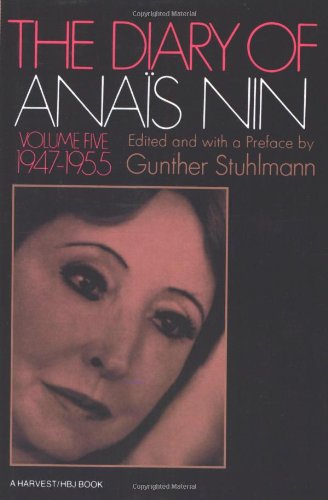
11. The Diary Of Anais Nin, Volume 5 (1947-1955)
by Anaïs Nin
Paperback: 288 Pages (1975-03)
list price: US$17.00 -- used & new: US$9.21
(price subject to change: see help)
Asin: 0156260301
Average Customer Review: 4.0 out of 5 stars
Canada | United Kingdom | Germany | France | Japan
Editorial Review

Book Description
The author's experiences in Mexico, California, New York, and Paris, her psychoanalysis, and her experiment with LSD. "Through her own struggling and dazzling courage [Nin has] shown women groping with and growing with the world" (Minneapolis Tribune). Edited and with a Preface by Gunther Stuhlmann; Index.
... Read more

Customer Reviews (3)

4-0 out of 5 stars The Rich and Continuing Saga
I just finished a book I didn't want to read, The Journals of Anaïs Nin: Volume Five (1947-1955). I had planned to read it, and its time came, but I just didn't feel like it. Happily, it took me about two pages to change my mind and enjoy this book in a little less than a week.

Anaïs Nin was born Angela Anais Juana Antolina Rosa Edelmira Nin y Culmell in France in 1903 to composer Joaquin Nin, who was of Cuban and Spanish background, and his wife, Rosa, who was Cuban, French and Danish. After Joaquin abandoned the family, the family moved to the United States in 1914. With the disapproval of her mother, Nin began work as an artist's model to help pay the family bills, and then returned to Europe in 1923. She studied psychoanalysis under Otto Rank, practiced as a lay analyst and underwent therapy with Carl Jung for a time. Nin is also well known her for lovers, Henry Miller, Otto Rank, Gore Vidal and Edmund Wilson. She was married, I believe, twice, once to Hugh Guiler, who looked the other way regarding her affairs, and once, bigamously, to Rupert Cole.

Nin's fame these days is primarily as a diarist, and there seem to be two veins of her diaries, those she published in an expurgated form in ten volumes, which remain popular, and another five-volume series of unexpurgated journals that focus on a shorter window of time around the decade of the 1930s. This book is from the former series, and is copyrighted in 1974. I have no idea where I got it.

Nin also wrote fiction, and I've read two of her fictional works, Spy in the House of Love and Delta of Venus. I also have read a biography, Anaïs: The Erotic Life of Anaïs Nin by Noel Riley Fitch. She was a peripheral literary figure during most of her lifetime and she died in 1977.

The main focus of her work seems to be psychological realism, and as she grew older, she seemed to see her diaries as the primary outlet of that stream of thought. As she writes in a letter to Max Geismar, copied into her journal in the winter of 1954-1955, "I only need to continue my personal life, so beautiful and in full bloom, and to do my major work, which is the diary. I merely forgot for a few years what I had set out to do."

This diary focuses on various themes of her life during this time, her struggle to get Spy published (she ends up self-publishing it), her travels and time spent living in Mexico, her friendships with Geismars and Jim Herlihy, her psychoanalysis with a Dr. Inge Bogner, and a return to the focus of her work as a diarist. She includes wonderful interludes about her life in Acapulco; a return trip to Paris, which is deliciously recounted with her nostalgic expectations sometimes being born out and sometimes failing; letters to and from Henry Miller; the fruit of her work with Bogner; and the story of her last days with her mother before Rosa's death from a heart attack.

This last is touchingly told, and she follows her feelings about both her parents to see how she reclaimed their characteristics with pride once they were lost to her, the same characteristics she sought to reject in herself while her parents were living.

Nin's writing is rich, like a filling meal, so the episodic and brief passages of the expurgated journals are suitable, somewhat "bite-sized," so to speak. In many ways she is very likable, and her descriptions of her life, travels, lectures and parties (she attends a costume party for which attendees were to dress as their own madness. She went bare-breasted with a bird-cage on her head...!) are fascinating, a look at her social circle and those who influenced her.

And sometimes, I thought, "Wow! I really would not like her!" especially when she wrote about meeting a very bizarre woman in New York, Nina Gitana de la Primavera, whom Nin admired for living even less in reality than Nin herself did. From Nin's diary description, I thought, "This woman is just crazy!" but Nin and Herlihy had a brief friendship with her, even though they had at first a deep visceral negative reaction to her. Herlihy attributed this reaction to his fear that Primavera was living as he would have liked, but was too afraid to do, so they forced themselves to spend time with her.

The book ends with Nin recounting an LSD trip she experienced at the behest of a psychologist who was trying to study its effects. He wanted her to participate because as a writer, she could better articulate the experience, which is clearly drawn in the journal. She seems to come to the conclusion that the drugs merely heightened what was in her own mind, as symbols appeared real to her that she had previously used in her work.

While the book is an enjoyable interlude, there is an underlying loneliness to it, as Nin fights the sadness of being rejected for her work and her dedication to creating a reality that links intellect and emotion in a fiction that she finds truer than literary realism. " I have raged at the wall growing denser between myself and others. I do not want to be exiled, alone, cut off. I wept at being isolated, at the blockade of the publishers." I found the book very interesting and readable. I recommend it.

5-0 out of 5 stars Beautiful writing that I use as meditations
THE DIARY OF ANAIS NIN: VOLUME FIVE 1947-1955 contains beautiful writing. Anais (pronounced "anna - EESE" ["EESE" as in "lease"]) has a very unique writing style, a result of her Spanish and French background, her fondest for extremes, and frequent disregard for correct grammar and punctuation.

The downside to her beautiful prose is that often it is hard to follow what she is talking about. Though I am a huge fan of Anais Nin, I always struggle with her writing, particularly these "expurgated" diaries; because they were so heavily edited they seem very choppy at times. Anais also was not in the habit of sticking to one topic per paragraph. And it is common for one paragraph to be completely unrelated to the previous. I often become so bewildered that I have to put the book down. (It also doesn't help that I was only two when Anais died in 1977, meaning I am often completely unfamiliar with the topics she discusses.)

I now use her diaries as meditations, and am content to read a passage or even paragraph at a time. It no longer bothers me that I often get lost. One paragraph, or even one sentence, often contains enough beauty to make it unimportant that I have no idea what she's talking about (many things I have understood have not been nearly as beautiful). She just had an awesome command of language! My favorite passage in Volume Five is on the very first page where she describes her time in Acapulco. It's stunning poetry! I've never seen anyone else write like this.

I would certainly agree that previous knowledge of Anais's life is helpful in appreciating her diaries and all other works. I am currently reading ANAIS NIN: A BIOGRAPHY by Deirdre Bair. Ms. Bair's book has been incredibly helpful in understanding Nin's work. I recommend Bair's biography of Nin in addition to THE DAIRY OF ANAIS NIN: VOLUME FIVE 1947-1955.

3-0 out of 5 stars Anais's Excellent Adventure
This volume is number five in the original series of Nin's published expurgated diaries. (As the major players in Nin's life have passed away, and libel suits have become a lessening concern, her literary executor has begun releasing additional volumes from the same time periods as the expurgated works containing previously suppressed material, which makes talking about a "series" confusing at times.) Volume Five finds Nin in America after World War II, during the era of the Feminine Mystique, living what has to have been a fairly expensive lifestyle on both coasts, plus Mexico, with no visible means of support. Knowing more of Nin's actual biography than she is willing to divulge in this volume helps in understanding this puzzle--she was married to two men at the time, one in New York, one on the West Coast.

This volume appears to have been written with more care than the 1944-47 volume, perhaps because with Nin's second marriage she was no longer spending as much time compulsively "ensorcelling" younger men. Nin dates her entries by the month or season of the year, and they appear to be written with reflection, rather than in the heat of the moment. This suggests also that the entries may have been more heavily edited, either before they were ever incorporated into the diary or later, for publication. This raises an interesting question for which there is no answer:If a diary is edited by the alteration of text, as opposed to the deletion of uninteresting or controversial matter, should it still be considered a diary? How much editing can be done before a work becomes no longer a diary but a series of essays? It depends on what the definition of "diary" is, of course, but I think there is a good argument that this volume is no longer a bad diary, as volume four was, but a fairly good series of essays.

A number of interesting events happen in Nin's outer life in this volume that are engagingly described. She goes to Mexico and describes her exotic life there quite beautifully. She copes with the death of her mother. She has an interesting literary friendship with James Leo Herlihy more than a decade before his great success as the author of the book _Midnight Cowboy_. She drops acid under laboratory conditions (in 1955!).

Nin doesn't seem as whiny about her inner life as she did in volume four of this series. Her ongoing struggles with lack of literary recognition are thus easier for at least this reader to take in stride than in volume four. Nin also appears to achieve some sort of psychological breakthough with her therapist of that period, Dr. Inge Bogner, and, as Nin describes it, achieves objectivity. Whatever it was, she seems less frantic at this juncture in her life.

Because Nin has a track record of being somewhat slippery, it is always a great temptation to read her diary volumes in tandem with her letters, biographies...and fiction. Therein lies the rub with her constant complaints about her lack of literary recognition. Although I respect her ambition to show psychoanalytic process in her characters, I just find that she mastered the diary genre much more than the fiction forms she attempted. Read Amy Bloom's and Peter Kramer's fiction, not Nin's, if you want intense psychological fiction, but do read Nin's diary.

Verdict: pretty good, but hard to appreciate fully unless you know a lot about Nin and her work. ... Read more


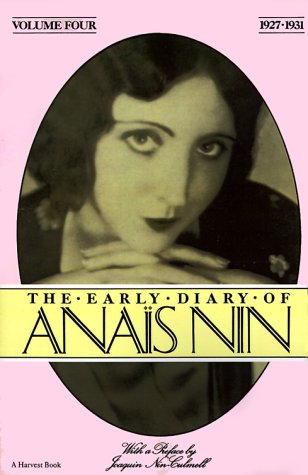
12. The Early Diary of Anais Nin, Vol. 4 (1927-1931)
by Anais Nin
Paperback: 528 Pages (1986-04-25)
list price: US$26.00 -- used & new: US$16.95
(price subject to change: see help)
Asin: 0156272512
Average Customer Review: 4.5 out of 5 stars
Canada | United Kingdom | Germany | France | Japan
Editorial Review

Book Description

A bridge between the early life of Nin and the first volume of her Diary. In pages more candid than in the preceding diaries, Nin tells how she exorcised the obsession that threatened her marriage and nearly drove her to suicide. Editor's Note by Rupert Pole; Preface by Joaquin Nin-Culmell; Index; photographs.
... Read more

Customer Reviews (6)

5-0 out of 5 stars The Beginning of a Great Advenure
I had the distinct advantage when reading this chronologically first Nin diary of knowing little about her, and having never read any of her diaries or books.About half way through I ordered the other 3 early diaries, all 7 later diaries and the 4 volumes of unexpurgated material that represented diary materials left out of the ones she published during her lifetime.I am so looking forward to reading all of these in chronological order.In all of literature is there a more extensive, detailed look into another person's private life and thoughts?What an adventure this will be.

This first volume covers Nin's entries from ages 11 to 17.The level of writing, description, and psychological insight contained here is astounding for a girl of pre-teen and teenage years.So amazing that I finally came to the conclusion that there is no way a 15 year old could come up with some of the subtle observations about human nature and behavior contained herein.No way.Apparently, Nin read her older diaries numerous times over the years.My guess is that when she went back to these diaries in her adulthood, at times she added comments and details not written originally.There is nothing wrong or disingenuous about that, especially since the apparent adult added material is so educational and perceptive.I do wish however, that the editor if possible, could have indicated what was the original material and what was added later on.Perhaps, it was not possible to ascertain when portions and additions were written.As a case in point, there is no way a 12 year old wrote this, "I forget the earth, I forget everything, and I soar into an infinite without misery and without end.When my free spirit escapes from the powerful claws of that mortal enemy, the World, it seems to me I find what I wanted."World-weary cynicism at age 12?

This diary picks up speed being especially poignant as Anais experiences first innocent love.Surprisingly the story of her evolution never lags.The writing itself is miraculous, for any age.What an irony that this young girl often wondered how she might eventually write poems and novels to become a famous writer, and didn't have the slightest clue that that fame was being realized in the words she was writing at that momentin these diaries.She was to become the most famous, and infamous, diarist of the 20th century.Little did she see that, until decades later.The lesson seems to be to follow your instinctive creative impulses and desires, and if you do have any genius in you, it will show itself where your spirit leads your path.Instinct and interest are God's hands gently showing you the way.

5-0 out of 5 stars Amazingly different!
I've never read one of Anais Nin's early diaries and I can tell from the very beginning that this volume is way different from her latest diaries. This volume acts like a transition between her young, unspoiled perspective upon life and her mature, sensual way of living.
I enjoyed reading Anais Nin at the age of 24 - because she seemed rather naive and seeking answers, yet beginning to develop into the amazing woman she later became.

4-0 out of 5 stars Good background, but not for the casual reader
This book is pretty interesting if you've already read a good deal of Anais Nin's diary. Her early years are somewhat nondescript as European children go, however, so there isn't much here for the historian or for those who like their memoirs spicy and strange (cf Running With Scissors). If you are a serious Nin fan, you'll probably want to read this, but you aren't missing much if you don't. If you're not really a fan, you won't find much of interest here.

5-0 out of 5 stars Prelude to the Storm
For fans of Anais Nin, this unedited early diary is a must.Written in the years immediately preceding the events revealed in her books HENRY AND JUNE and INCEST, this diary is the connecting link that reveals how a virtuous, loving wife became a wild adventurous.The writing is simply gorgeous;you'll be amazed at how polished and vivid her discriptions of life in Paris of the 1920s were (and yes, this book was printed AS IS from the original journals).Ironically, she describes her initial disgust with Parisian "sensuality," as well as her growing acceptance and eventual delight with the city.She describes her homes, friends, and her interest in Spanish dance.But perhaps most importantly, she describes her marriage to Hugh Guiler, a man she loves but who does not satisfy her physically.Read this book so as to understand how Anais was eventually driven into the arms of Henry Miller.

3-0 out of 5 stars Modest Beginnings
This volume of writing offers the careful reader glimpses of Anais Nin before she reinvented herself. Or does it? One can never be sure with Nin.

The girl who became Anais Nin, scandalous diarist, was clearly highly articulate, and determined to live a life of Art and Passion, even when her mother was making her do housework as a teenager in their modest rental house in Queens. It provides agentle introduction to her life and times, and a fascinating contrast to searing works such as _Incest_, taken from diary material written some twenty or so years later. One also gets some interesting views of early-twentieth century New York City.

The book, taken in the context of Nin's later work, offers evidence that we become what we most want to be. Dreamer, beware! ... Read more


13. House Of Incest
by Anais Nin
Paperback: 72 Pages (1958-01-01)
list price: US$7.95 -- used & new: US$3.93
(price subject to change: see help)
Asin: 0804001480
Average Customer Review: 4.0 out of 5 stars
Canada | United Kingdom | Germany | France | Japan

Customer Reviews (11)

5-0 out of 5 stars Background research may be necessary
HOUSE OF INCEST is a very slim volume of 72 pages. Naturally, I expected to be done with this oddly titled book in one sitting. After reading the brief introductions, with references to the author spitting out her heart and an Indian making a flute out of the bones of his dead wife, I realized this was a book unlike any other I'd seen. I struggled to relate and to understand, but after about 10 minutes on one page, I had a headache. I put the book down, but was determined to figure out what the heck Anais Nin was talking about.

I turned to many other sources for clarification. ANAIS NIN: A BIOGRAPHY by Deirdre Bair was the first outside source. Bair explains that the main supporting character of "Sabina" is none other than June Miller, the notorious second wife of Henry Miller (who appears as "Mona" in Miller's TROPIC OF CANCER). Then I turned to ANAIS NIN READER, which contains introductory essays explaining that the incest referred to in the title is not literal but symbolic. But far, far above the rest, the most helpful was ANAIS NIN: AN INTRODUCTION by Benjamin Franklin V and Duane Schneider; I learned here that HOUSE OF INCEST is not a conventional story by any means. Rather, HOUSE OF INCEST is an exploration of the narrator's subconscious state (very few passages in this book, the two introductory pages for example, reveal the narrator's conscious state). The main theme of HOUSE OF INCEST is the relationship between the narrator and Sabina; but the narrator eventually realizes that her fascination with Sabina is merely a fascination with an aspect of herself, hence the metaphorical incest for which this volume is named. Finally, I understood this book! Finally, I enjoyed it! Now, I love it and think it's brilliant and am glad it was not so easy to get through at first.

If labyrinths, puzzles, and psychology interest you, then you may find HOUSE OF INCEST has something to offer. But a word of caution: even though the over-riding theme is not of literal incest, there is one instance where it is: "... there sat Lot with his hand upon his daughter's breast," Anais writes on page 52, "while the city burned behind them." HOUSE OF INCEST was Anais Nin's first work of fiction, published in 1936 - nearly 40 years before the publication of the famous diaries. Deirdre Bair explains that Nin was already publishing aspects of her diary as fiction, though attempting to disguise the more painful details. Bair writes that in this instance Nin was not successful.

5-0 out of 5 stars A Wonderful Dream
This book was a captivating dream.I've read it over and over again and enjoy it each time.

1-0 out of 5 stars I would give this a 0if I could
This is a nothing book, I mean literally, this book contains NOTHING.No story. No plot. No ending.INCEST?.....there is none, there are not even any people in it.

5-0 out of 5 stars Nin's powerful language
Anais has such a command of the language found in the undercurrents of our existence.I found each page to move me more, and more deeply.Agreed, this book is not for everyone.It will at best, confuse the simple-minded. It can intoxicate, inspire, and evoke extrodinary compassion for the restof us.

5-0 out of 5 stars PERFECT!
The most nearly perfect book I have ever read in my entire lifetime.It's like reading a drug: hypnotic, mesmerizing, dream-like.A prose-poem from heaven. . . ... Read more


14. Fire: From "A Journal of Love" The Unexpurgated Diary of Anaïs Nin, 1934-1937
by Anaïs Nin
Paperback: 448 Pages (1996-06)
list price: US$16.00 -- used & new: US$5.94
(price subject to change: see help)
Asin: 0156003902
Average Customer Review: 5.0 out of 5 stars
Canada | United Kingdom | Germany | France | Japan
Editorial Review

Book Description
In this “erotically charged”(Publishers Weekly) diary that picks up where Incest left off, Nin chronicles a restless search for fulfillment that leads her to New York City-”that brilliant giant toy” -then back to Paris and Henry, and eventually into the arms of a passionate new lover. ... Read more

Customer Reviews (4)

4-0 out of 5 stars Still poetry in human form
This book is not as compelling as "Incest", but it's still Anais: still burning, still feeling, still wholly human, with all flaws and wishy-washiness included. But again, I warn away people who may not be down with heavily sexual content. If you are, though...

5-0 out of 5 stars Interior decorating of the heart
"This is not a lie. I was starting to tell lies and struck a truth! Very often I tell lies that are deeply true."
-Anais Nin, January 17, 1937

Diary opening with a visit to New York accompanying Dr Otto Rank. Searches for release from Rank. Back to Paris, Henry, Hugh, and to find Gonzalo More. Desriptions of interior worlds built for Hugh, Gonzalo, and Henry. Beautiful. Houseboat on the Seine, "Nanankepichu", Villa Seurat, Louveciennes.

5-0 out of 5 stars Exploring the Inner Bad Girl
Anais Nin was raised a devout Catholic and to earn her family's love she was expected to be demure, self-sacrificing, hard-working, and chaste.When her father abandoned the family she assumed, as children sometimes do, that he had left because she wasn't "good" enough.She played the role of "good girl" for twenty years in response.Then all hell broke loose.

What I believe is different about FIRE is that it reveals Anais's explorations and experiementation with her inner "bad girl" in a way that she had only just begun in HENRY AND JUNE and INCEST.In it she is still married to Hugh and involved with Henry Miller, but in FIRE she has a relationship with the famous analyst Otto Rank that takes some treacherous twists and turns.Her writing is as wonderful as ever.For the Nin fan, this diary is yet another must-read.

5-0 out of 5 stars ANAIS NINBRAVERY SHE FREELY WROTE ABOUT EROTICISM
As follower of Anais'Diaries (expurgated or not) and her novels I would like to express my admiration and my curiosity for her amazing literature and her rare personality, motivatedagain by "Fire". I believethat Anais was able to enjoy sex simultaneously withseveral men, each oneof them however,playing an appropriate , no transferable,role: Hugh(husband),Joaquin Nin (father-lover),Eduardo Sanchez (cousin-brother),Henry Miller (friend-lover), Gonzalo More (lover-friend) and others.Occidental society usually attributethispromiscuous behavior only tomen.As Anais shows, this may happen also amongladies, perhaps moreoften than accepted . Indeed, these "faults" may be heavilydamned andpunishedby society whenperpetrated by ladies. Probably Anaiswas thefirst woman ,brave and courageous enough , to describeher ownexperiences and feelings about eroticism andsensuality writtenfrom afemale point of view. Actually, looking at her inner mirror she describesherselfwith delicacy , ever avoidingdisgusting pornography. I believethat Anais spenther life searching aBig One Love . As a result shefound many"Love" and many Lovers . The sum of them neverreachedtotality. HerLove washerfantasy and her invention, hence endless andinaccessible. On the other hand, in this and other books Anais masterly presentunknown, almost domesticfeatures and characteristic ofthepersonality of several men and ladies who were outstanding representatives in art, literature, theatre, politicsas Neruda,Alberti, Dali, Allendy, Rank, Gore and others. ... Read more


15. Anais: The Erotic Life of Anais Nin
by Noel Riley Fitch
Paperback: 536 Pages (1994-11-01)
list price: US$22.00 -- used & new: US$9.50
(price subject to change: see help)
Asin: 0316284319
Average Customer Review: 3.5 out of 5 stars
Canada | United Kingdom | Germany | France | Japan
Editorial Review

Book Description
Anais Nin was the ultimate femme fatale, a passionate and mysterious woman, world famous for her extravagant sexual exploits, most notably her simultaneous affairs with Henry and June Miller and her bicoastal bigamous marriages. In the mid-1920s, eager to break the confines of American Victorianism both as an artist and as a woman, Nin traveled to Paris, where she fell in with the legendary artistic and literary circles of the Left Bank."Nin's Diary", published over the years in numerous volumes, has been hailed as a breakthrough document by literary critics and feminists alike. Yet in the published diary, Nin did not lay bare her true self. She instead constructed a carefully stylized image of the woman the world knew as "Anais" while keeping her inner self hidden. In "Anais", biographer Noel Riley Fitch presents an honest portrait of Nin's passionate, tumultuous, and sometimes bitterly painful life. Fitch reveals, among other things, that behind Nin's coquetry was the desperate yearning of an abused and abandoned child. This, the first biography of Nin, complements, corrects, and demystifies the image that Nin so artfully crafted in her diary. ... Read more

Customer Reviews (10)

5-0 out of 5 stars The history behind the diaries.
I have to agree with some of the other reviews here that Fitch's work can be cumbersome at times. It is a little confusing in spots, mostly due to the tricky present-tense and Fitch's tendency to make giant, intuitive leaps from one reference to another. I do not, however, feel that this detracts one bit from the subject matter.

I can't imagine another biography addressing Nin's complicated life and neurosis with the same unflinching honesty and compassion. Nin was an extremely complex woman who spent most of her time and energy trying to compartmentalize her life, then painfully pushing against the boundries of those compartments with her life and work. Fitch pulls from multiple sources to draw a more cohesive picture of Nin's life than Anais herself ever did. Though that's rather the point, isn't it? The original published diaries are now understood to be a construct of Nin's talented metaphorical writing: true in a sense, but bearing little resemblence to hard facts. One doesn't read Nin's rich, feminine, lyrical prose for an accurate histoical record. And although it's difficult to be accurate about history under the best of circumstances, Fitch does a fine job piecing together the available clues not only for an accurate timeline, but for some kind of insight into Anais Nin's motivations.

Overall, Fitch portrayed Nin without prejudice, balancing the horrors of childhood abuse and neglect against the adult Nin's conscious betrayals of lovers and friends. Ultimately, she shows Nin to be a very flawed, very passionate artist without excuses. She neither condemns Nin, nor places her on a pedastal. I prefer this way... it's like seeing Nin through the eyes of a true friend;one that loves her for who she was, with no excuses.

1-0 out of 5 stars The Biographer Dislikes her Subject; the reader suffers almost as much as Nin's reputation
I've read several biographies of 20th century female writers, and this was the worst.

This was a frustrating read because the biographer seemed to dislike Nin, and I felt that Fitch somehow blamed her poor biographical work on Nin's so-called "double life." Fitch reacts to Nin's life as if it were far more pathological and complicated than any other artist a biographer ever had to deal with.

Fitch's telling of events is confusing. The story goes back and forth between decades, enemies, versions of what may or may not be truth- it's a mess. It goes on for pages mentioning this lover and that lover, and then there's little more than a tiny paragraph about a major career step Nin achieves, but little, if any credit, is given to Nin for her work and effort. Fitch never misses an opportunity to explain why Nin was not talented, not a true artist, not a good wife, not a true Parisian, not a true American, not a good daughter, and just does not deserve to be known, appreciated, published or even remotely liked.

The only redeeming point that Fitch can be proud of is sort of investigating a possibly incestuous relationship Nin experienced with her father. Even this uncovering is a half-baked attempt at taking a feminist point of view about sexual abuse and female artists and popularizing it into something salacious and one dimensional. Fitch's inclusion of this relatively new information about Nin is a transparent attempt at making this biography seem scholarly. Biographers who have delved into the lives of Anne Sexton, and other writers who may have been sexually abused should be offended by Fitch's treatment of this information.

Despite the fact that Nin helped and nurtured many artists, this book is full of catty swipes from several of those people. Robert de Niro's mother (a student who typed for Nin), for example, may well have meant her comments to be neutral, but hers and several others comments read as a mid-20th century, Greenwich Village, literary scene "Mean Girls." Gore Vidal is often quoted, without any mention to the fact that Nin helped his early career or even the slightest admission by the biographer that Vidal himself is one of the tallest tale-tellers and self-aggrandizers in American literature. Vidal's agenda was never noted. Fitch does not seem to try to balance them out with a different point of view or interpretation for the reader to try and understand why or what would make some so hateful of Nin. If you read this book, it seems you must blindly accept that Nin had overwhelmingly bad traits, and few, if any, good, or even neutral ones.

I learned nothing about Nin's true philosophy and ideas. Nin's explanations are even filtered through comments and actions by those who clearly dislike her.

What Fitch cannot account for is why Nin became so popular and beloved, yet the biographer does admit Nin had a following. There is no social context, no cultural context, nor objectivity to this biography.

This badly researched and poorly written bio left me with one thought: I must try to find a good, objective biography about Anais Nin.

5-0 out of 5 stars The best biography I've ever read
If you are fascinated by Anais Nin's diaries, you will find this biography even jucier!Fitch uncovers all in a way that further illuminates what was behind the woman who once said, "Erotica is like a veil."
After reading this book, I felt I'd witnessed Nin in a way no one could have by just knowing her.To me, this is what biographies are all about.It made me see Nin in a new way, and allowed me to finally see what drove her mysterious behavior, talent, obsessions, and extreme privacy. In fact, this book made me more interested in biographies than reading diaries.
If you like this, you might also try the biography of Clara Bow, "Runnin' Wild," as well as the biography of Katherine Ann Porter.

4-0 out of 5 stars Thoroughly Delicious
This book is a thoroughly delicious read for the Nin fan.Noel Riley Fitch's fine scholarship, deft analysis, and solid writing make vivid what is surely one of the most fascinating lives of the 20th century.As the title indicates, this books focuses on Nin's love/sex life, but it uses all available diaries and fictional works to piece together what can sometimes be a real puzzle.And, unlike the biography by Deirdre Bair, Ms. Fitch has an obvious affection, admiration, and appreciation for Nin which does not compromise the objectivity of her analysis.

The one possible problem in Fitch's analysis is that she makes the presumption that Nin was physically violated by her father.There is no doubt whatsoever that Nin was emotionally abused by the man, but Fitch is the first to suggest actual sexual molestation.Though she makes an excellent case for this possibility, her daring thesis caused a bit of an uproar amongst Nin's family and close friends who believe Fitch played fast and loose with the facts.I can understand their concern;it is a serious thing to accuse someone of such a crime.Still, Fitch's argument is socompelling that I don't believe it can be easily overlooked.

For anyone interested in understanding Anais Nin, this book posits a provocative theory while also pulling together the facts of her life.

1-0 out of 5 stars a difficult biography of a difficult writer
Granted, Anais Nin, having spent her life veiling and concealing truths, is a most difficult individual to research.This fact, however, offers no excuse for the writing style of this book.The use of the present tense serves to obscure the meaning of references to the present day. In the text, does "today," mean the year being discussed, or the year of writing?In additon, Fitch mercilessly peppers a paragraph with names, only to use an imprecise pronoun in attributing a quotation.Who was it that said that again?Random comparasions to other writers, (i.e. anne Sexton) spring up in one sentence, neither led up to nor substantiated.Bare facts are laid down side by side with purple prose and phrasal flights of fantasy.
In short, the self-consciousness, name-dropping, and obscuring of facts makes this book only slightly less obsfucating than the writing of Nin herself. ... Read more


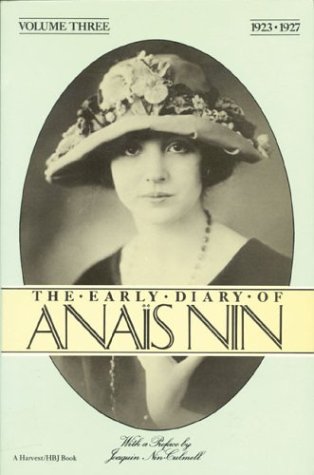
16. The Early Diary of Anais Nin, Vol. 3 (1923-1927)
by Anais Nin
Paperback: 332 Pages (1985-03-22)
list price: US$17.00 -- used & new: US$8.99
(price subject to change: see help)
Asin: 0156272504
Canada | United Kingdom | Germany | France | Japan
Editorial Review

Book Description

A bridge between the early life of Nin and the first volume of her Diary. In pages more candid than in the preceding diaries, Nin tells how she exorcised the obsession that threatened her marriage and nearly drove her to suicide. Editor's Note by Rupert Pole; Preface by Joaquin Nin-Culmell; Index; photographs.
... Read more

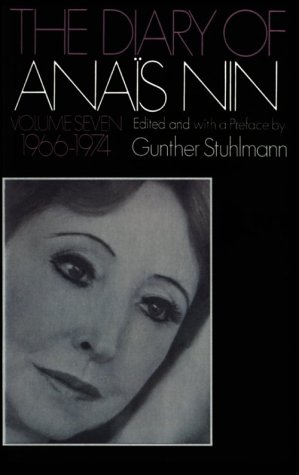
17. The Diary Of Anais Nin, Volume 7 (1966-1974)
by Anais Nin
Paperback: 384 Pages (1981-10)
list price: US$20.00 -- used & new: US$15.35
(price subject to change: see help)
Asin: 0156260352
Average Customer Review: 4.0 out of 5 stars
Canada | United Kingdom | Germany | France | Japan
Editorial Review

Book Description
The final volume ends as the author wished-not with her last two years of pain but at a joyous