e99 Online Shopping Mall

Geometry.Net - the online learning center Help  
Home  - Authors - Niven Larry (Books)

  1-20 of 100 | Next 20
A  B  C  D  E  F  G  H  I  J  K  L  M  N  O  P  Q  R  S  T  U  V  W  X  Y  Z  

click price to see details     click image to enlarge     click link to go to the store

$2.95
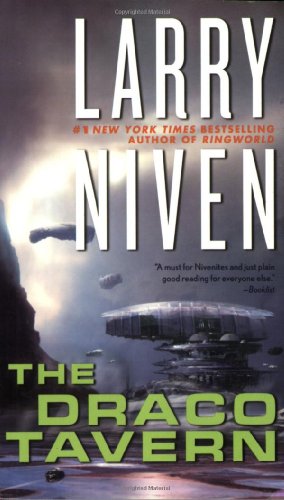
1. The Draco Tavern
$14.38
2. Fleet of Worlds
$9.94
3. Three Books of Known Space
$3.26
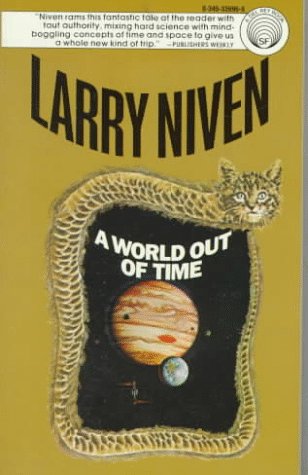
4. A World Out of Time
$2.88
5. Crashlander
$8.98
6. The Flying Sorcerers
$2.59
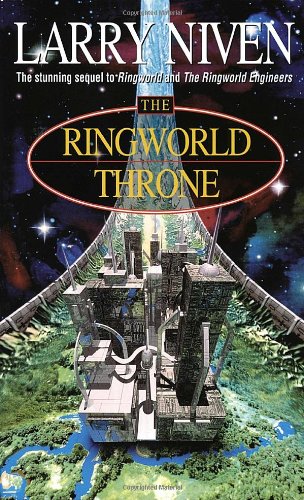
7. Ringworld Throne
$16.47
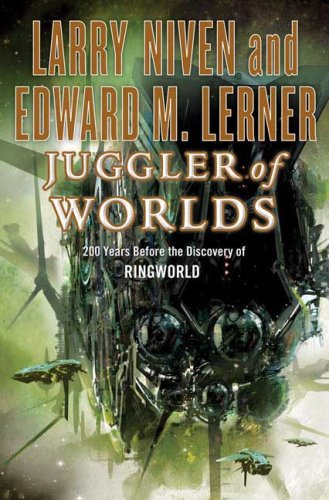
8. Juggler of Worlds
$3.26
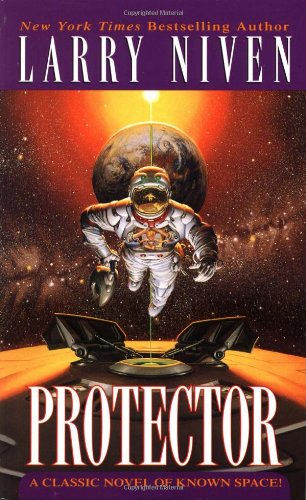
9. Protector
$57.54
10. Legacy of Heorot: Legacy of Heorot
$7.50
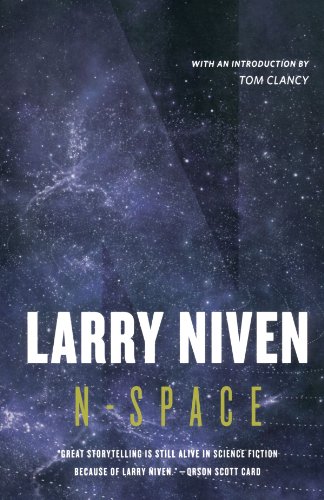
11. N-Space
$3.35
12. The Ringworld Engineers (Ringworld)
$0.90
13. Saturn's Race
$18.51
14. Footfall
$33.50
15. Man Kzin Wars V
$4.07
16. Man-Kzin Wars X: The Wunder War
$4.26
17. Destiny's Forge: A Man-Kzin Wars
$3.95
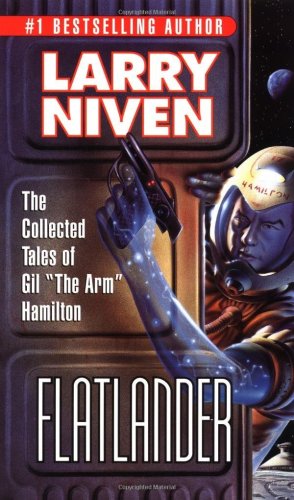
18. Flatlander
$3.96
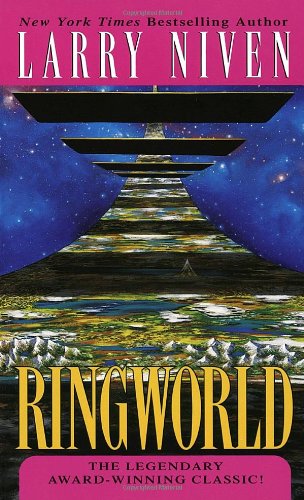
19. Ringworld
$3.45
20. Burning Tower

1. The Draco Tavern
by Larry Niven
Mass Market Paperback: 336 Pages (2006-11-28)
list price: US$6.99 -- used & new: US$2.95
(price subject to change: see help)
Asin: 0765347717
Average Customer Review: 4.5 out of 5 stars
Canada | United Kingdom | Germany | France | Japan
Editorial Review

Book Description

When a tremendous spacecraft took orbit around the Earth’s moon and began sending smaller landers down toward the North Pole, the newly arrived visitors quickly set up a permanent spaceport in Siberia. Their presence attracted many, and a few people grew conspicuously rich from secrets they learned from talking to the aliens. One of these men, Rick Schumann, established a tavern catering to all of the various species of visiting aliens, a place he named the Draco Tavern.
From the mind of #1 New York Times bestselling author Larry Niven come twenty-six tales and vignettes from this interplanetary gathering place, collected for the first time in one volume, including:

“The Subject Is Closed”: A priest visits the tavern and goes one-on-one with a chirpsithra alien on the subject of God and life after death.

“Table Mannners: A Folk Tale”: Rick Schumann is invited to hunt with five folk aliens, but he’s not quite sure what their hunt entails, or if he will be the hunted.

“Losing Mars”: In this previously unpublished tale, a group of aliens who call Mars and its moon home arrive at the tavern only to find that humans have mostly forgotten about their neighboring planet.
... Read more

Customer Reviews (25)

3-0 out of 5 stars Contains some pretty good short stories
These are short stories set in the near future, mostly consisting of stories told in "The Draco Tavern" which is a bar on Earth built to serve alien races.Similar to the one in "Star Wars" or the one Spider Robinson used to write about.The basic premise is that modern-day Earth is discovered and then periodically visited by interstellar space liners run by a powerful but non-aggressive race, and also containing all manner of other races as passengers.Kind of interesting, and not entirely implausible if you think about it.

Some of these stories are Niven at his best, because the stories are so short that they do not at all require much in the way of character development.Instead, some of these stories center around one or more quite imaginative ideas and for that reason are often startling and entertaining.Once the stories started to be about the Draco Tavern and its bartender, and not the aliens themselves and their interaction with humans, I thought that the stories went downhill.I did not at all care for about the last third or so of the collection.

Still, this is a decent collection of short stories representing Larry Niven at or near his best.Niven afficianados will like this collection.

4-0 out of 5 stars Not Free SF Reader
A pretty entertaining group of connected stories based around the one man that has a bar catering to aliens, after contact is made with a highly advanced alien race, and all the problems that entails.

It is more serious in general than your 'pub jokes' type collections.


Draco Tavern : The Subject is Closed - Larry Niven
Draco Tavern : Grammar Lesson - Larry Niven
Draco Tavern : Assimilating Our Culture that's What They're Doing - Larry Niven
Draco Tavern : The Schumann Computer - Larry Niven
Draco Tavern : The Green Marauder - Larry Niven
Draco Tavern : The Real Thing - Larry Niven
Draco Tavern : War Movie - Larry Niven
Draco Tavern : Limits - Larry Niven
Draco Tavern : Table Manners - Larry Niven
Draco Tavern : One Night at the Draco Tavern - Larry Niven
Draco Tavern : The Heights - Larry Niven
Draco Tavern : The Wisdom of Dreams - Larry Niven
Draco Tavern : Smut Talk - Larry Niven
Draco Tavern : Ssoroghods People - Larry Niven
Draco Tavern : The Missing Mass - Larry Niven
Draco Tavern : The Convergence of the Old Mind - Larry Niven
Draco Tavern : Chrysalis - Larry Niven
Draco Tavern : The Death Addict - Larry Niven
Draco Tavern : Storm Front - Larry Niven
Draco Tavern : The Slow Ones - Larry Niven
Draco Tavern : Cruel and Unusual - Larry Niven
Draco Tavern : The Ones Who Stay Home - Larry Niven
Draco Tavern : Breeding Maze - Larry Niven
Draco Tavern : Playhouse - Larry Niven
Draco Tavern : Lost - Larry Niven
Draco Tavern : Losing Mars - Larry Niven
Draco Tavern : Playground Earth - Larry Niven


God talk.

3.5 out of 5


Two-faced possessiveness.

3.5 out of 5


If you don't sell the scientific recipe for long pig, it will be pirated anyway. Pretty relevant, really.

3.5 out of 5


Bored Baby.

3.5 out of 5


Old tourist fancies a drink.

3 out of 5


Imported booze.

3 out of 5


Pacificism ain't entertainment.

3.5 out of 5


Casual immortality cutoff.

3.5 out of 5


Hunting games.

2.5 out of 5


Kid hunt amusement.

3.5 out of 5


Symbiotic upgrade.

3 out of 5


Bacterial reproduction.

3 out of 5


Breeding experiment problems.

3.5 out of 5


Cosmological puzzle.

3.5 out of 5


Big computing.

3.5 out of 5


S3x then death.

3.5 out of 5


Cosmological fear.

3.5 out of 5


Sunshiny happy people, not so much.

3.5 out of 5


Geological time fun.

3 out of 5


Execution slowdown.

3 out of 5


Vandal Savages solution.

3 out of 5


The Joker gets hunted.

3.5 out of 5


Childminding chaos.

4 out of 5


Exploration complaint.

2 out of 5


Use it or ancient aliens will give it away immediately.

3.5 out of 5


Elvis sighting very fishy.

2.5 out of 5


3.5 out of 5

5-0 out of 5 stars Just fantastic
Niven is a really smart man and this book is a series of short stories about a multi-species bar that gives him a venue to explore some of the great questions of human kind, like life after death, the nature of man, where we came from, and many others. I loved the book. Full disclosure, I am a great Niven fan and love hard Science Fiction.

5-0 out of 5 stars The Mos Eisley cantina done right
_The Draco Tavern_ by Larry Niven is a fun collection of short stories that the author had written and published from the 1970s until 2006. Though easily read as stand alone tales, they are arranged in chronological order, as some of the short stories briefly reference events in previous tales.

The premise is pretty basic but full of potential. The setting is nearly always the Draco Tavern, the time the 2030s. The tavern is thirty-something years old, established when aliens first arrived on Earth. At a near future date, as the author put it in the introduction, "say two years from whenever you are reading any given story," an enormous alien spacecraft took up orbit around the Moon. The vessel sent down a lander that came down along the lines of Earth's magnetic field not far from the North Pole. After talks with Siberia (which is an independent nation in this setting) and the U.N., a permanent spaceport was established at Mount Forel in Siberia, with restricted access for humans and facilities set up to cater to alien visitors.

Some people became wealthy from working with technologies derived from the aliens, while others came just to be around the extraterrestrials. One of them was Rick Schumann, the only recurring character in the various short stories. With the help of aliens, he set up a multi-species tavern, able to cater to a diverse clientele of species, including aliens who weren't organically based and unable to breathe oxygen. It is in this tavern that the vast majority of the stories take place, as Rick and his staff try to accommodate the needs and desires of both alien and human clients, including accommodating unusual requests and acting as brokers between different alien races or aliens and humans.

A great many species, some quite bizarre, come through though there are several regulars. The most important are the Chirpsithra (sometimes called Chirps), the crew and builders of the interstellar craft that occasionally call upon Earth. They look identical to human eyes, salmon-red exoskeletal vaguely lobster-like creatures, standing eleven feet in height and thus far only female. Though some consider them braggarts, many believe their claims to be virtually immortal, to possess a civilization billions of years old, and to "own the galaxy" (in reality, they claim every habitable planet - like their own - that orbits red dwarves, generally cooler, tidally locked planets similar but by no means identical to Earth).

The ships that visit are actually interstellar luxury liners of a sort, visiting various ports of call throughout the galaxy, run by the Chirpsithra. Other notable races that make repeat appearances are the Glighstith(click)optok (or simply Gligs), gray, smallish beings that have had a huge impact on human medicine and biology, the Folk, which look very wolf-like (and can even go on all fours) but have a rather different cranial anatomy (their eyes are located below their mouth), predators with some odd ideas of justice, and the Bebebebeque, a hive-mind species that takes the form of numbers of six-inch high golden beetle-like organisms.

It was an enjoyable book and a fast read, Niven used many of the alien's differing anatomies, physiologies, and customs to explore a variety of topics relating to humans, including greed, love, and friendship.

5-0 out of 5 stars Great vingettes.
The Draco Tavern stories have always been a favorite of mine among Nivin's short works.I love the way he can create a story and characters that are thought provoking, entertaining, and real in so few pages.

Most of my contact with the Tavern Tales have been in other collections, but this collects all of them, including one never before published, in one place.I found that I had previously missed half of the stories, but finding them here put me over the moon.

I loved this collection.It's not the heaviest of Niven's works, but there's plenty to think about in these stories.For the serious Niven fan, or just for a quick read while waiting in the car, this is a must have. ... Read more


2. Fleet of Worlds
by Larry Niven, Edward M. Lerner
Hardcover: 304 Pages (2007-10-16)
list price: US$24.95 -- used & new: US$14.38
(price subject to change: see help)
Asin: 0765318253
Average Customer Review: 3.5 out of 5 stars
Canada | United Kingdom | Germany | France | Japan
Editorial Review

Book Description
Fleet of Worlds marks Larry Niven's first full novel-length collaboration within his Known Space universe, the playground he created for his bestselling Ringworld series. Teaming up with fellow SF writer Edward M. Lerner, Fleet of Worlds takes a closer look at the Human-Puppeteer (Citizens) relations and the events leading up to Niven's first Ringworld novel. Kirsten Quinn-Kovacs is among the best and brightest of her people. She gratefully serves the gentle race that rescued her ancestors from a dying starship, gave them a world, and nurtures them still. If only the Citizens knew where Kirsten's people came from....A chain reaction of supernovae at the galaxy's core has unleashed a wave of lethal radiation that will sterilize the galaxy. The Citizens flee, taking their planets, the Fleet of Worlds, with them.Someone must scout ahead, and Kirsten and her crew eagerly volunteer. Under the guiding eye of Nessus, their Citizen mentor, they explore for any possible dangers in the Fleet's path-and uncover long-hidden truths that will shake the foundations of worlds. ... Read more

Customer Reviews (19)

4-0 out of 5 stars Previous unknown space
I liked this most recent installment of the Known Space Series.Perhaps because of Lerner's influence, Niven's usual "let's play tourist" theme has been replaced by a situation in which two cultures are trapped in a deadly embrace, seen from the inside and both sides.The conflict between the two cultures is muted by a reluctance to use violence and the irony that each culture has copied features of the other, making in more interesting than a usual "interstellar war" story.Meanwhile we still find familiar concepts from Known Space: stepping disks, the ARM, Julian Forward's hyperspace trap, and the start of the Teela Brown experiment.Well done.

5-0 out of 5 stars Nessus revealed
Having read all of Niven's Known Space novels, I found this one quite refreshing. Although a four hand effort, it feels like an original. Niven does partnerships very well and Edward Lerner seems to be a good match. We get to know more about the Pierson Puppeteers and they are a fascinating bunch of aliens. Nessus, a sketchy character in some of the previous books is now a complex one. The plot is beautifully developed and like all good science fiction, makes one wish it could happen.

4-0 out of 5 stars Known Space from the Puppeteers' Side
Larry Niven, this time in collaboration with Ed Lerner, returns to Known Space, this time with a story told largely from the point of view of the Puppeteers, the three-legged, two-headed race who have featured in many of Niven's Known Space stories. About 500 years before the events of the story, the Puppeteers captured a human colony ship. The descendants of the passengers on that boat have been made slaves, called "Colonists," held in ignorance of human culture. It's a benign slavery, but slavery none the less.

Three of the Colonists are being trained as scouts by Nessus, by no coincidence the Puppeteer who has had the most contact with humans. Puppeteers aren't cowards, exactly. They are, however, extremely risk averse. As the Puppeteers' Fleet of Worlds flees an impending galactic catastrophe - the subject of earlier Known Space stories - it would be handy to have scouts, so the risk of scouting ahead for danger isn't taken by Puppeteers. Human scouts. That starts a chain of events that reveal the Puppeteers' version of Colonist history to be a tissue of lies.

Along the way we get to see Nessus manipulate Earth culture and create, almost in passing, the Birthright Lotteries, which led to Teela Brown and the events of "Ringworld." We get a bit of the truth about Dr. Julian Forward and the events leading up to "The Borderland of Sol," one of Niven's best novellas. But the most interesting bits are seeing the society and politics of Puppeteers and the Fleet of Worlds developed and revealed. In an odd way, there's even a Puppeteer love story.

Perhaps it's Lerner's influence, but plotting and characterization are far better than most ofNiven's recent work. Neither is terrific, but the characters aren't cardboard cutouts, either. Nessus and Nike, the leader of the radical faction in Puppeteer politics, in particular, are nicely done. There are some nice subtle touches, too, including the influences of Puppeteer society on Colonist society.

We've never read Niven for characterization. We've read Niven for his terrific ideas and his plotting. Both are on display here. Especially if you are a fan of Known Space, this book is a lot of fund and a cut above anything Niven has written in the last 15 years. Recommended.

3-0 out of 5 stars Didn't quite do it for me
I well remember haunting the book shops in the seventies and eighties for the latest known space epic from Larry Niven so when I saw a new book about known space I eagerly snapped it up.

I guess that your tastes change over the years but, sadly, I didn't think that this book rates up there with previous books in the known space universe.The main problem is with the characters, the humans in particular - they just aren't very interesting.It's a reasonable story in terms of known space technology but quite slow moving and very little of the vitality in the original known space series is present.Basically it's about a group of human servants to the puppeteers who discover that the puppeteers have lied to them about their origins. Separately the puppeteers themselves, who are desperately frightened about the "wild humans" from earth, attempt to conceal the location of the planets making up the fleet of worlds.The main puppeteer character is Nessus who was introduced in the original books.

It's a reasonably competent book in some ways but I didn't find it a real page turner and I doubt whether I will go back and read it again.Not one of Niven's best but I still think it just makes it into the three stars category.

3-0 out of 5 stars So-so Niven is Still Better Than Most People's Best
** Caution -- Here There Be Spoilers **

Two things I've always enjoyed about Larry Niven stories:

First, his characters are uniformly smart people, who notice things merely-average folks would not and draw useful inferences from their observations.I feel smarter for a few days afterwards just for having been inside heads like theirs.

Second (and related), Niven is a master of what I call "the telling detail" -- some word or little action that tells you more about that character than said character would want you to know.

Sadly, those features are mostly missing from "Fleet of Worlds," co-written with Edward M. Lerner.

"Fleet" slots neatly into Niven's "Known Space" series.(Really, the reader will probably have a hard time fully appreciating the action unless he is already familiar with the alien Puppeteers, the explosion of the galaxy's core, and the Puppeteers' startling plan for escaping the resulting wave of radiation.)Here's the setup: Hundreds of years ago, the human slower-than-light starship "Long Pass" blundered onto a Puppeteer engineering project.Panicked, the aliens attacked the ship, took the crew prisoner and domesticated the next generation -- grown from frozen embryos -- as agricultural workers.The humans were kept ignorant of their true history and fed a cock-and-bull story about how the Puppeteers had found them drifting in space and saved them.

The book follows three humans who have been trained to take over the dangerous and (for a Puppeteer) terrifying job of scouting ahead of the Fleet of Worlds as it flees the galaxy.As you might expect, the aliens' centuries-long coverup shreds in short order.

Alas, the human characters are bland and nearly indistinguishable.The book's saving grace is the far more interesting story of love, intrigue and betrayal between "Fleet's" two main alien characters: Nessus (a brave -- and therefore insane -- Puppeteer from Niven's original stories) and Nike (an up and coming Puppeteer politician).We also learn a bit more about Puppeteer reproduction than Niven was ever willing to tell us.(Don't ask.You don't want to know.)

Not overly long (a blessing itself in today's tetralogy-choked SF market), the action moves along briskly and wraps up neatly (if a bit implausibly).A sequel is possible, but not mandatory.Not sure I'll read this one again, but I'm glad I read it once.

... Read more


3. Three Books of Known Space
by Larry Niven
Paperback: 592 Pages (1996-09-03)
list price: US$16.95 -- used & new: US$9.94
(price subject to change: see help)
Asin: 0345404483
Average Customer Review: 4.5 out of 5 stars
Canada | United Kingdom | Germany | France | Japan
Editorial Review

Book Description
Let three complete books in one take you on a dazzling journey into science fiction's most famous future history: Known Space!
WORLD OF PTAVVS
Kzanol was a thrint from a distant galaxy. He had been trapped on Earth in a time-stasis field for two billion years. Now he was on the loose, and telepath Larry Greenberg knew everything he was thinking. Thrints lived to plunder and enslave lesser planets . . . and the planet Kzanol had in mind was Earth!
A GIFT FROM EARTH
Shrouded in lethal mists, the world named Mount Lookitthat was never meant for humans. Life existed only on one plateau, unreachable except from space. But still the planet had been colonized, and the settlers struggled to survive under a ruthless dictatorship on a rebellion-proof world . . . until fate dealt them a wild card named Matthew Keller, whose secret talent might just be their only hope!
TALES OF KNOWN SPACE
A classic collection of stories that traces humankind's expansion and colonization throughout the galaxy from the twentieth century to the thirty-first . . .
AND MORE: Larry Niven's latest thoughts on the evolution--both creative and "historical"--of known space, as well as an updated Timeline of Known Space and a complete Niven bibliography! ... Read more

Customer Reviews (11)

3-0 out of 5 stars Not Free SF Reader
Am omnibus collection that contains World of Ptavvs, A Gift From Earth and Tales of Known Space.

Also included at the start is a comprehensive timeline of Niven's Known Space Future History, as well as introduction, afterword, and a pretty decent looking bibliography of Niven work up to that time, something he is quite good at compared to other authors.

Stasis end control conflict.


An alien that basically wants to do the Overmind thing ends up on Earth, but things don't go as plan, to the tune of him being frozen in stasis for rather a long time.

Lone enough to wake up and get involved with a search for his global domination gear with an Earth scientist, a specialist in interspecies communication.

Light, short and entertaining book.

3 out of 5


Invisible man wild card.

This book is set in the part of Niven's future history where organlegging as such, is very common. Set on a colony world the wealthy want access to body parts, so any crime gets you executed and recycled for their use.

Throw in a wild card superpowered outsider with basically the power to cloud men's minds and things get interesting.

3 out of 5

A collection of stories from Niven's multi-era Future History, which some introduction to each part. The stories themselves only average 3.23, but do show the interesting structure of this universe, from early solar system exploration, to interstellar conflict.

Tales of Known Space : The Coldest Place - Larry Niven
Tales of Known Space : Becalmed in Hell - Larry Niven
Tales of Known Space : Wait It Out - Larry Niven
Tales of Known Space : Eye of an Octopus - Larry Niven
Tales of Known Space : How the Heroes Die - Larry Niven
Tales of Known Space : The Jigsaw Man - Larry Niven
Tales of Known Space : At the Bottom of a Hole - Larry Niven
Tales of Known Space : Intent to Deceive [The Deceivers] - Larry Niven
Tales of Known Space : Cloak of Anarchy - Larry Niven
Tales of Known Space : The Warriors - Larry Niven
Tales of Known Space : Madness Has Its Place - Larry Niven
Tales of Known Space : There Is a Tide - Larry Niven
Tales of Known Space : Safe at Any Speed - Larry Niven


Ship brain Mercury trip.

3 out of 5


Ship brain Venus trip.

2.5 out of 5


Corpsicle decision.

3 out of 5


Martian mummy is da bomb.

3.5 out of 5


Martian indeceny.

1.5 out of 5


Organlegging escape.

4 out of 5


Martian mistake.

3.5 out of 5


Luncheon loop.

3.5 out of 5


Free Park experiment not bright.

4 out of 5


Cat ship fry.

3 out of 5


ARM to schizo arm.

3.5 out of 5


Wu Pak Big lure.

4 out of 5


Living in your car.

3 out of 5


3 out of 5

5-0 out of 5 stars Great book
This book really deserves 4 stars, but I accidentally rated it five and can't change it.This book is a compilation of three other books, one of which is a collection of short stories itself.If you've read other Niven books such as "Ringworld", you'll feel at home in Known Space, though this takes place long before that one.

"World of Ptavvs" is an excellent book, one of the best SCI-FI books I've read.A telepathic alien that can make humans do his bidding is found after being trapped in statis on earth for billions of years.If he can find his equipment which is also in stasis, humanity may be doomed to be a slave race.

"A Gift From Earth" is a good book as well, but it didn't keep my attention like Ptavvs.The colony world described is interesting and there are some nifty surprises thrown in though.

The other stories, which are interspersed with the two full-length books and told in chronological order, are a mixed blessing.Many are quite good, others are just so-so.I wonder why Niven was so fascinated with the "Organ Banks".That is a fine theme for a story or two, but they seem to be the base for much of his writing, including "A Gift From Earth".

4-0 out of 5 stars Essential Larry Niven
I'm sure I'm not alone in "cutting my teeth" on Niven's work by reading Ringworld, and then discovering that it actually assumed prior knowledge of the Kzinti, indestructible General Products hulls, stasis fields, and other weird stuff. Three Books of Known Space fills in some of the gaps in that knowledge.

This volume is an omnibus collection of three previous books, World of Ptavvs, A Gift from Earth, and the short story collection Tales of Known Space. Niven has rearranged all the stories in chronological order according to his future history.

World of Ptavvs is a decent novel - Niven's first - about an alien Slaver who attempts to escape from Earth after being trapped there for 2 billion years in a stasis field. Human experiments with stasis technology allow him to escape - but not only in his own body. When telepath Larry Greenberg attempts to communicate with whatever is in the stasis field, he comes away with a copy of the Slaver's consciousness in his own brain. A chase across the solar system ensues as the authorities attempt to capture the Slaver and the schizophrenic Greenberg.

Niven's sophomore novel, A Gift From Earth, is slightly better. The planet We Made It has a single habitable feature: a plateau at the top of 40-mile-high Mount Lookitthat. The colony there is governed by a hereditary aristocracy, the descendants of the crew that piloted the two colony ships. The colonists, who arrived on We Made It in hibernation, are their serfs. "Justice" is swift and draconian, and colonists on the wrong side of the law wind up as spare parts in the crew's organ bank. Naturally, there is resentment, and A Gift From Earth recounts a rebellion by a faction of colonists after a robot spaceship arrives from Earth with a technological gift that could strengthen the crew's hold on power. The rebellion is led, reluctantly, by Matt Keller, who has begun to manifest some sort of psychic ability. The story is decent hard science, but would actually be improved if Niven hadn't resorted to giving the protagonist mysterious powers, which always strike me as a bit of a cheat.

But the real treasure of this volume are the short stories. Niven's future timeline begins with the early colonization of space; the first stories are about the exploration of the extremities of the solar system. (The first story, "The Coldest Place," relies on an [admitted] major scientific gaffe by Niven: at the time he thought one side of Mercury always faced the sun, though it was already known this was not the case.) The three best stories are "Eye of an Octopus," "How the Heroes Die," and "At the Bottom of a Hole," about the colonization of Mars and the discovery of the Martians. On the other hand, "The Warriors," about first contact with the Kzinti, lacks plot and seems pointless. "There is a Tide" will be a pleasant surprise for Ringworld fans: it's an earlier story starring Louis Wu as a treasure hunter who gambles with an alien Trinoc for possession of a Slaver stasis field and its contents.

Three Books of Known Space also includes a Known Space timeline, a helpful complete Niven bibliography, and numerous annotations. A lot of the stories are starting to show its age, but nonetheless this book is essential reading for anyone who wants to appreciate Larry Niven's fictional universe.

5-0 out of 5 stars Worth every penny.
Larry Niven's Known Space universe is probably one of the most developed in all of science fiction. It mixes hard science fiction with space opera so seamlessly that it's easy to just slip in a wave reality bye-bye.

This book represents the largest concentration of known space stories anywhere, with many of the ones included now impossible to find elsewhere. The novels are both excellent stuff, but the short stories are where the book really shines. They cover over a thousand years of future history (and even a little of the past), and their topics are just as varied. You can expect to read about your favorite characters, plus a few new ones. The timeline is also indispensible to know how the stories relate to each other.

All in all, you should own this book if you consider yourself a science fiction fan. It's that good.

5-0 out of 5 stars A great Known Space Collection
Collected here are three novels previously published.Tales of Known Space(itself a collection of short stories), World of Ptavvs, and A Gift from Earth.

If you are just getting into Larry Niven's Known Space series, then this would be a fantastic place to start.It contains some very short stories, some medium sized stories and two novels along with a Known Space timeline.This timeline is not completely up to date.A search on the web should turn out some more recent ones.

All-in-all this is hard science fiction at its best.Larry weaves a fabric whose strands from the very beginning are encountered far into his alternate future.This gives the reader that feeling of breadth that only comes from years-long sagas.

The only ding I would give this work is the novel "A Gift From Earth".Honestly, I disliked this book.It just seemed to unrealistic to me.It deals with a world in rebellion and the whole situation and subsequent developments just seemed a bit on the improbable side of things.Because of this, I would have given it 4 1/2 instead of 5

Despite that, the rest of the book makes it worth the buy.Highly recommended. ... Read more


4. A World Out of Time
by Larry Niven
Mass Market Paperback: 256 Pages (1986-03-12)
list price: US$6.99 -- used & new: US$3.26
(price subject to change: see help)
Asin: 0345336968
Average Customer Review: 4.5 out of 5 stars
Canada | United Kingdom | Germany | France | Japan
Editorial Review

Book Description
Jaybee Corbell awoke after more than 200 years as a corpsicle -- in someone else's body, and under sentence of instant annihilation if he made a wrong move while they were training him for a one-way mission to the stars.

But Corbell picked his time and made his own move. Once he was outbound, where the Society that ruled Earth could not reach him, he headed his starship toward the galactic core, where the unimaginable energies of the Universe wrenched the fabric of time and space and promised final escape from his captors.

Then he returned to an Earth eons older than the one he'd left...a planet that had had 3,000,000 years to develop perils he had never dreamed of -- perils that became nightmares that he had to escape...somehow! ... Read more

Customer Reviews (34)

3-0 out of 5 stars A world out of focus
I find this book hard to evaluate because its two main focuses are out of proportion. Niven creates a fascinating future history where one mistake leads to another and eventually dooms the human race to barbarism -- then he pushes it in the background and expects us to get concerned about Corbell bumbling through boring adventures while piecing the history together. (Niven even borrowed the hero's name from another of his stories -- that's how uninterested he was in the character)

5-0 out of 5 stars Incredible vision and a fun ride!
When do you ever get to read a genuinely fun book and in the tradition of classic science fiction, with characters that are memorable and visceral and a story line that is not only well wrought but one that is unique and timeless?

The chilling visionary of Larry Niven's future centers around mid-40s Jerome Corbell, a man dying of cancer from 1970 who pins all his hopes and dreams on a future cure. But when he wakes up from the dead in the 22nd century, and his life force has been injected into a empty body of a criminal, he opens his eyes to a alarmingly different world where nothing is familiar. And his new life is repaying his debt to society. Everything is dead: his language, his loved ones, even his own body. But does Corbell fret? Hell no! He decides quite cheekily that a life-time of slavery for crimes that his stolen body had committed, just doesn't apply to him. A theft of a rammer spacecraft meant to seed earth-like planets with an injected but quirky personality Peersa, and a journey to the center of the galaxy and over a black hole--and a mere 3 million years gone by--Corbell returns, with deep yearning, once again to return to Earth. And yet again, opens his eyes to a radically different world.

This is an Earth taken from its normal orbit in a universe dramatically altered with a red sun, dried lands with patches of civilization and a race not only highly intelligent through genetics and disconcerting by their adolescent appearance but who are also intensely obsessed with youth and immortality. This is a world once ruled by the sky-controlling Girls, long dead, and the Boys who now control everything and the Dikta (the Dictator Class who created them), a herd of humanoid adults who once ruled the children and are now enslaved to breed new and better Boys. Corbell, as usual, gets himself in amusing positions, forever enslaved, in some way, either by the fear of the Boys, or fear of another human like himself, Mirelly-Lyra who will do anything to be young, but who also crossed over a black hole and found herself back on a vastly different earth.

Throughout his entire ordeal, Corbell always maintains a level self-deprecation that is hilarious and fun to read. His interactions with other life forms, his encounters with unusual future creations and constant state of on the run all come together to form a highly entertaining, interesting and truly alien world for the audience to read.

While some of the theoretical science can be hard to grasp at first, it's manageable and his descriptions are coherently told and incredible to imagine. The philosophy--about youth, genetics, perfection and rise and fall of man--is light and done with a touch of irony which adds to the humor of this book. Crobell'sconstant state of new discoveries is fascinating and riveting with lots of surprises and interesting developments that you experience with Corbell.

In the tradition of Sagan, Asimov, Herbert, Bradbury, Miller, Heinlein, Wells and Clark, this is a book that sucks you in and one not to miss!

5-0 out of 5 stars excellent time travelling story
Kept looking forward to my brief opportunities to read so I could get back to this story. Excellent time travelling story (forward only, so it's plausible). Don't let the cover fool you. It's not a romance or fantasy story. Lives up to Niven's reputation for hard science. Timely discussion of climate change as well.

4-0 out of 5 stars A good novel and this is actually "Larry's" favorite universe.
World-out-of-Time grew out of a short story written by Niven for the science fiction magazine, Analog, in the mid-1970s.

This reviewer had met Larry Niven (Lawrence Van Colt) back in 1983 at a science fiction convention in Midland, Michigan.Larry was alway perplexed by the much more successful "Known Space" books.Why? Larry views "Known Space" as pure science fantasy and the "World" time line as much more possible.Indeed, at least three other books were spun out of this time line.There are "Intregal Trees" and its successor.At least two other books use the "World" timeline and science.Bluntly, "WOOT" spaceships are possible with our science.

Personally, this review is a big Niven fan and wishes he would keep on writing at the brisk pace he set for himself in the '70s to the mid-1990s period.But Larry really only produces a book year and he is slowly retiring from writing.Still, this particular book is an old friend and I like it.

The main character - Corbell - has terminal cancer in the early '70s and is frozen to keep from the grave.His DNA and RNA is combined to introduce a new personality in a criminal that has had his mind erased.It's the mind of Corbell in a new body.

The first chapters of this book keeps much in common with the original analog story of the mid-1970s.Peersa, the main computer, runs the starship under Corbell's command.Corbell says that all empires die from barbarians; the analog is given of Rome.Niven could use a little more help with history because Rome fell from lots of reasons and not just barbarians.Anyway, you've got to wonder about Peersa at that point because he (it) has no memory or data tapes of Earth's history.

Anyway, Peersa keeps the Starship from Earth until long after the state's fall:about 3 million years.Corbell is quite old but because of the ship's close to speed of light velocity he is only a very elderly man when returning to earth.

When Corbell arives at the red giant that is the Sol system the story gets really good and is one of the best that Niven has ever wrote.First, because of various wars the earth is hardly habitable.The reasons for that is covered later on in the book.Second, Corbell discovers the last human on earth and she is both quite insane and well armed.Third, human beings have mutated drastically in three million years to a breeder type of human and the ruling children that are divided up into boys and girls.However, the boys and girls are fantastically old due to a DNA treatment that gives them near immortaltiy.

The boys are the rulers of earth and Corbell spends a good part of the novel either under their control or trying to escape from the boys.These parts of the reads are fast and fun.The typical reader will enjoy this part.

The sex, bluntly, is a little contrived.It's Niven's world and he may do with it as he wishes.However, this part of the book was written for the market of teenage boys of the '70s.It's a little distracting for adults of the 2000s.

But this book is fun and fast paced.The science is quite good and Larry has a great command of the science needed for near-fast-as-light driven space ships.

The real gem of this book is how Larry moves worlds.Few can do it so good.Larry gives us this feel of moving worlds in "Ringworld Engineers", in many of his known space books, and in this book.Basically, if you build an rocket engine as big as a small moon and use Uranus as a "fuel tank" then it's amazing what a person can move in space.

Larry can never go wrong in one of his old novels.This is a solid 4 star book and the typical reader will have it done in just a night.

I will miss Niven's writing quantity of the '70s to the '90s.However, he will have the novel "Fleet of Worlds" coming out in Fall of 2007; it's the 5th Ringworld novel.Perhaps I'll have the chance to talk with Larry again like in 1983.In 2007 I'll look forward to buying another Niven novel and donating it to my favorite High School.

Yes, I like his writings and you should be able to enjoy this novel.

4-0 out of 5 stars The State Commands the Universe!
Larry Niven (1938) is a multi-awarded Hugo winner and best known by his "Ring World" series.

He is a "hard sci-fi" writer, that is to say he emphasizes scientific aspects of the narration over more humanistic facets. He is more concerned on the "how" rather than on the "who". His style is nearer to sci-fi writers of the '50s & early '60s than to more recent generations.

Niven has developed the Known Space Universe as a common background to many of his novels. "A World Out of Time" does not use this backdrop.

The story starts when Corbell's persona is revived on a new body. Corbell was frozen before dying in the `70s and awaited to be "awakened" when a cure to his cancer is available.
But... surprise, surprise, 200 years after he started his hibernation the State has become omnipotent and use ancient cryobodies to extract their personality and install it on criminal's bodies devoid of their personality.
Corbell realizes that he is absolutely helpless and must follow State's instructions. In his case consist in being trained as a starship pilot and sent into an interstellar "plowing" mission.

Once in deep spaces Corbell manages to cut loose and explores the galactic core. Then he tries to return to Solar System. Due to relativistic time-debt three million year has elapsed and he is not sure that the planet into which he is descending is ancient Earth.
From here on the story catch up momentum and really interesting situations are described: strange civilizations, animals and sentient interacting in complex relations.

This book is a good starting point to appreciate the author's writing style.
Reviewed by Max Yofre.
... Read more


5. Crashlander
by Larry Niven
Mass Market Paperback: 288 Pages (1994-03-02)
list price: US$6.99 -- used & new: US$2.88
(price subject to change: see help)
Asin: 0345381688
Average Customer Review: 3.5 out of 5 stars
Canada | United Kingdom | Germany | France | Japan
Editorial Review

Book Description
Crashlander Beowulf Shaeffer has long been one of the most popular characters in Known Space. Now, for the first time ever, Larry Niven brings together all the Beowulf Shaeffer stories--including a brand-new one--in one long tale of exploration and adventure! PLUS--an all-new framing story that pulls together all of Beowulf Shaeffer's adventures and allows Shaeffer and his family to make a clean start at life once and for all! ... Read more

Customer Reviews (11)

4-0 out of 5 stars Hard sci-fi at its best - puts the science in science fiction
This is a collection of all of the Niven's short stories involving Beowulf Schaeffer.Most of the stories were written in the late 60s and early 70s, and Niven added an additional story to this collection (published in 1994) as well as a bridge to connect all the Beowulf stories.This is among the best hard sci-fi available, and I must admit that I'm a bit puzzled by some of the negative reviews.The best stories in this collection were written almost forty years ago now, and they are available in other (now out of print) books such as Neutron Star.The additional story and bridge, while not outstanding, are not as bad as some of the negative reviewers have portrayed.In the hard sci-fi genre, this is as good as it gets.If you are currently collecting the Known Space stories (novels and short stories) and haven't been reading/collecting Niven since the '70s, this is an absolute must have.If you are a longtime reader/collector of Niven, this is probably not worth the one story plus bridge unless you want to complete your collection.If you are new to Niven, the Beowulf stories are terrific hard sci-fi, and I would highly recommend this collection as a starting point into Known Space.For those in the latter category, Niven combines the hard boiled detective genre (ala Dashiell Hammett and Raymond Chandler) with creative and/or speculative astrophysical ideas that were at the cutting edge of astrophysical research at the time they were written.I give this four stars instead of five for three reasons.First, many of the astrophysical ideas are now hopelessly out of date.The stories were quite imaginative in the late 60s and early 70s, but Niven's speculations about neutron stars, the Galactic core, and supernovas have now been shown to be incorrect.This isn't Niven's fault of course, but it definitely gives the series of stories a dated feel.Second, there are some gross errors of physics (e.g. he grossly underestimates the effect of tides around neutron stars, and he makes some incorrect assertions about shock waves) that would have been well understood even at the time of writing.Third, Niven includes a few `supernatural' plot elements (e.g. the space ships are navigated psychically) that don't really belong in hard sci-fi.These are minor criticisms though, Niven has lots of great ideas, and with a few problems, he creatively blends science fact with speculative fiction.The stories are imaginative, and the planets, the people, and the aliens that populate Known Space are well developed and believable.I think this is a great collection and would recommend it to anyone interested in the hard sci-fi genre.

3-0 out of 5 stars A book that starts good and declines steadily.
Known Space. It's cool. Beowulf Shaeffer. Cool guy. Mostly.

The first few stories, especially the Nebula award winning "Neutron Star," are of extremely high quality. It's something of a shock, then, that the later stories decline so rapidly. Niven's writing style changes quite noticably in the real-life years between the stories, from a more traditional space opera to something...not. I couldn't even finish "Procrustes," it was so bizarre and un-Niven that I had trouble following it.

If you are lucky enough to find the book Neutron Star, which contains the first few stories of this book (in addition to a few others), go for it. It's a better buy overall. If not (this will be most of you, unfortunately), it's up to you whether the first half of the book is worth the price of admission, since the second half arguably isn't.

1-0 out of 5 stars The early material is great, but Niven's latest is awful
In 1966 Larry Niven created the ultimate tourist with his short story "Neutron Star." It was the tale of Beowulf Shaeffer, a laid-off pilot heavily in debt and easy to blackmail, and how the alien race the puppeteers convinced him to make a dangerous flyby of a neutron star. Throughout the late sixties followed several other Beowulf Shaeffer stories, which were previously to be found only in the out-of-print collection NEUTRON STAR. In 1994 Del Rey released CRASHLANDER, which brought back into print the Beowulf Shaeffer stories of the late 60's, together with "The Borderland of Sol" (1975), a new story "Procrustes," and interim material that Niven had just penned to bind the stories together into one novel, as it were (there's no table of contents and the title of each story isn't listed at the head of the page). CRASHLANDER has some good material, but the latest writing shows that Niven's treatment of his Known Space universe has become very poor indeed.

The late-60's Beowulf Shaeffer stories were classics of science fiction, mixing hard science with colourful alien races and futuristic fashion. In "Neutron Star" the reader travels with Shaeffer as he visits what was then a revolutionary concept in astronomy. In "At the Core", the puppeteers convince Shaeffer to take an experimental hyperdrive all the way to the galactic core, where he makes a discovery that spurs the puppeteers into fleeing Known Space. "Flatlander" begins with Shaeffer as a tourist on Earth, and takes him on a journey with a millionaire to a very unusual planet. "Grendel", the last of the golden age of the Shaeffer stories, has Shaeffer foil a kidnapping on a newly-colonized world. These stories are all excellent and are recommended reading for any fan of science fiction.

The last two stories, however, are incredibly disappointing, nearly enough so to taint the eariler works. "The Borderland of Sol" was written after the decline of Niven's writing in the mid-1970's. It nearly repeats the theme of "Grendel" (with Shaeffer becoming something of a detective), but with unbelievable characters, B-movie shoot-outs, and uninspired futurisms. The last story, "Procrustes" dates from the 1990's and is nearly as bad as Niven's novel from the same time THE RINGWORLD THRONE. "Procrustes" has a plot that is convoluted to say the least, and none of the characters act like they have in previous stories. Most disturbing is the Robert Heinlein-esque turn into sexuality explicit scenes that Niven made in the early 90's, as "Procrustes" begins with an orgy. The frame stories were written at the same time as "Procrustes" are are just as bad. They contradict previous Niven stories (such as mentioning the Trinocs when they won't be met for another 200 years, the Puppeteer Fleet of Worlds, etc.) and end in an inexplicable murder that is nothing but a deus-ex-machina.

My recommendation: skip CRASHLANDER and find the out-of-print collection NEUTRON STAR, which brings together all the golden age Shaeffer stories as well as several other fascinating Known Space short stories.

2-0 out of 5 stars Beowulf's Progress
Beowulf Shaeffer started out as this cool space pilot who swoops down on a neutron star, journies to the galactic core, and visits the weirdest planet in Known Space.

Later on, though, his adventures involve stopping criminal activities, as if he's become an interstellar cop.

In the end, he's this amoral dude on the lam from the Earth government in the most convoluted plot this side of interpreted BASIC spaghetti code.

The early classics are in other collections, and will endure.This effort, thankfully, will be forgotten.If you can figure what it was about in the first place.

4-0 out of 5 stars A strange hybrid, but the stories are great
Crashlander contains the collected stories of Beowulf Shaeffer, the man who, in Niven's Known Space, discovered the core explosion and, as it turnsout, did a number of other things as well.Beowulf is an interestingcharacter, and although not every story is great, most are very good andquite worth reading.

The stories were written over a range of time,which is obvious from the internal differences - the social and moralaspects of Beowulf's world change quite a bit from first to last.And the"binder" material - the stuff Niven interpolated between thestories to bring them together, make them more cohesive - is onlymoderately successful.Frankly, Beowulf's past is just more interestingthan his present.But the stories themselves are truly gripping, and as ashort story collection, this book really works.

One tiny caveat: the bookas a whole implies certain things about the origins of Louis Wu (ofRingworld fame) that contradict the beginning of the Ringworld seriesitself.Doesn't matter, of course, unless you're a real stickler fordetail.

Over all, a book well worth reading for those into Niven or hisKnown Space. ... Read more


6. The Flying Sorcerers
by David Gerrold, Larry Niven
Paperback: 312 Pages (2004-04-01)
list price: US$14.95 -- used & new: US$8.98
(price subject to change: see help)
Asin: 1932100237
Average Customer Review: 4.0 out of 5 stars
Canada | United Kingdom | Germany | France | Japan
Editorial Review

Book Description

This funny and insightful science fiction classic introduces Shoogar, the greatest wizard ever known in his village. His spells can strike terror in the hearts of even his most powerful enemies. But the enemy he faces now is like none he has ever seen before. The stranger has come from nowhere and is ignorant of even the most basic principles of magic. But the stranger has an incredibly powerful magic of his own. There is no room in Shoogar’s world for an intruder whose powers match his own, let alone one whose powers might exceed his. So before the blue sun can cross the face of the red sun once more, Shoogar will show this stranger just who is boss.
... Read more

Customer Reviews (11)

2-0 out of 5 stars Perplexingly bad
Gerrold and Niven are both excellent SF writers.I usually enjoy their books, and both have built up large and high-quality bodies of work.That's why the badness of "Flying Sorcerers" is so baffling.It's like they banged this out in a weekend on a bet.

Much is made of the alleged humor of this novel.Fannish jokes and puns belong at Worldcon, not in a book put out for sale to the general public.Their humor value fails to rise over the level of Granpa's thighslappers.For example, two young alien boys who build a flying machine are called "Wilville" and "Orbur."Ho, ho.My sides!And the gags go downhill from there.

So why 2 stars instead of one?Despite all of its flaws, this is still an amiable book."Ringworld Throne" aside, both Niven and Gerrold have enough talent to make this book at least somewhat interesting, and to keep the thin plot moving.

If you're interested in these authors, and you should be, pick out almost anything from their extensive catalogs before you purchase this.

5-0 out of 5 stars Fine work
This book is really a great work if you realize what it is, comical sci-fi. And it is not a Niven story but a Gerrold one, if you liked The Trouble With Tribbles episode of Star Trek then this for you.

To dananbethany> It's a pun, As a mauve. Asimov.

5-0 out of 5 stars An overlooked treasure
This is one of the funniest SF books out there.I've got an old tattered copy, and I will order the new edition when it comes out.The book is full of cultural, SF and fandom references.Some might be a little dated (for example, the symbol of the sheep, the horned box, is a reference to a TV with antenna, and how many people have seen one of THOSE lately?), but overall, this book holds up very well.

To answer another reviewer's question would be a spoiler, but anyone who wishes to know who Purple was based on can email me at my nickname at hotmail.

5-0 out of 5 stars Enjoyable and Fun
I love this book - it is funny.I have had the book for at least 10 years but I have yet to figure out - what is Purple's real name?It has something to do with "as a color, shade of purple-gray" and "mauve" but I cannot piece it together.Any help would be appreciated!

5-0 out of 5 stars A wonderful romp
I picked this up (or it was loaned to me) because I was tickled by the title. It's a very entertaining story about a technologically advanced traveller's visit to a fairly primitive world, narrated by one of theprimitives. It's an hilarious treatment of Clarke's Law in action, and acolossal pun near the end will delight long-time SF readers enormously.

This is definitely a'G'-rated title in my book. ... Read more


7. Ringworld Throne
by Larry Niven
Mass Market Paperback: 368 Pages (1997-03-30)
list price: US$7.99 -- used & new: US$2.59
(price subject to change: see help)
Asin: 0345412966
Average Customer Review: 2.5 out of 5 stars
Canada | United Kingdom | Germany | France | Japan
Editorial Review

Amazon.com
In Ringworld and Ringworld Engineers Larry Niven created Known Space, a universe in the distant future with a distinctive and complicated history. The center of this universe is Ringworld, an expansive hoop-shaped relic 1 million miles across and 600 million miles in circumference that is home to some 30 trillion diverse inhabitants. As in his past novels, Niven's characters in The Ringworld Throne spend their time unraveling the complex problems posed by their society.Book Description
Come back to the Ringworld . . . the most astonishing feat of engineering ever encountered.  A place of untold technological wonders, home to a myriad humanoid races, and world of some of the most beloved science fiction stories ever written!

The human, Louis Wu; the puppeteer known as the Hindmost; Acolyte, son of the Kzin called Chmeee . . . legendary beings brought together once again in the defense of the Ringworld. Something is going on with the Protectors. Incoming spacecraft are being destroyed before they can reach the Ringworld.  Vampires are massing. And the Ghouls have their own agenda--if anyone dares approach them to learn.

Each race on the Ringworld has always had its own Protector. Now it looks as if the Ringworld itself needs a Protector. But who will sit on the Ringworld Throne?

"Niven's work has been an intriguing and consistent universe, and this book is the keystone of the arch. . . . [His] technique is wonderfully polished, his characters and their situations are nicely drawn . . . wraps up (maybe) a corner of a very interesting universe."
--San Diego Union-Tribune ... Read more

Customer Reviews (102)

4-0 out of 5 stars If you read the others, you have to read this one
That is the ONLY reason to read it, too. His plot is thin and his characters are stale. Still, if you made it through the first two, you will find some closure in this one. (At the very least, you can say you read them all.) The science behind his fiction is so close to scientific possibility that something always brings readers back to see what he has dreamed up next.

Pity Niven lacks punch when her writes on his own. His book with Pournelle are stellar.

3-0 out of 5 stars Worth a read for die-hard fans.
I read Ringworld Throne when it was first published in 1996, again in 2004 following the publication of Ringworld's Children, and have now read it a third time. It does improve somewhat on a second and third read, but overall I agree with the many 2-star reviews already on the amazon website.

On the other hand, I think there is a saving grace that reviewers have missed, and which I would like to point out.

**spoiler alert**

The book follows two story arcs, neither of which involves Louis Wu or his alien companions in a substantial way. In the first, a large team of ringworld natives goes on a quest to destroy a vampire nest that has grown up in the shadow of the boiling ocean (as described in Ringworld Engineers). This quest seems provincial, and holds little interest for readers attracted to the world-spanning narratives that made Niven famous. In the second story arc, Louis Wu witnesses several protectors battle for domination of the ringworld. Unfortunately, most of the action takes place in a series of brief battles that are incompletely described. Louis Wu's chief involvement here is that he gets to see it all unfold on TV.

**even more spoilers**

These two story arcs are not clearly related, and Niven never explains how they might be connected. However, Niven implies that ringworld has descended into anarchy precisely because the current protectors were vampires before their transformation. Ringworld vampires are not sentient, and they lack complex social organization. This lack of psychological sophistication as breeders makes them short-sighted, dictatorial, and occasionally bloodthirsty, once transformed into protectors. They don't mind that ringworld has fallen into a pre-industrial state, as this has presumably allowed the vampire population to increase significantly.

Thus, the two story arcs are not unrelated. They are two halves of the battle against vampires. This unity would have been more evident if Niven had included the word "vampire" somewhere in the title.

3-0 out of 5 stars Not Free SF Reader
A return to the Ringworld after a long writing delay.At the start, the Ringworld denizens have to deal with vampires of a sort.Yep, whacky.Later on, Louis Wu and our puppeteer friend have some of the same work to do, as he and Speaker To Animals' son are taken captive by a vampire Pak Protector.

They end up involved in a Protector conflict, vamps vs the others.In general though, the usual suspects aren't really the main focus of the book, it is the Pak struggle that occupies this position.


3-0 out of 5 stars Ringworld Throne
A fairly good read, multiple story lines, a little slow moving with all these different story lines going on, not as engrossing as the previous Ringworld Novels but still worth reading.

1-0 out of 5 stars dull and pointless disconnected plot
I really enjoyed the first Ringworld book, and although the second (Ringworld Engineers) was a bit so-so, I was still willing to give this one a shot. Unfortunately, it was terrible. The plot is very disjointed and thrown together. There are at minimum two unconnected stories. The first concerns a group of vampire hunters. Louis Wu is largely absent for that part of the story. Most of the first half is spent with the reader wondering why any of this is important. The second half of the novel concerns Louis Wu and some protectors. I won't spoil the plot for you, but suffice it to say there is almost nothing new in either of these plots. You simply don't care what happens to the characters. Good grief, I don't want to ever read about another protector again. ... Read more


8. Juggler of Worlds
by Larry Niven, Edward M. Lerner
Hardcover: 352 Pages (2008-08-19)
list price: US$24.95 -- used & new: US$16.47
(price subject to change: see help)
Asin: 0765318261
Canada | United Kingdom | Germany | France | Japan
Editorial Review

Book Description

For too long, the Puppeteers have controlled the fate of worlds.Now Sigmund is pulling the strings...
Covert agent Sigmund Ausfaller is Earth's secret weapon, humanity's best defense against all conspiracies, real and potential - and imaginary - of foes both human and alien.Who better than a brilliant paranoid to expose the devious plots of others?
He may finally have met his match in Nessus, representative of the secretive Puppeteers, the elder race who wield vastly superior technologies.Nessus schemes in the shadows with Earth's traitors and adversaries, even after the race he represents abruptly vanishes from Known Space.
As a paranoid, Sigmund had always known things would end horribly for him.Only the when, where, how, why, and by whom of it all had eluded him.That fog has begun to lift...
But even Sigmund has never imagined how far his investigations will take him - or that his destiny is entwined with the fates of worlds.
... Read more

9. Protector
by Larry Niven
Mass Market Paperback: 224 Pages (1987-09-12)
list price: US$6.99 -- used & new: US$3.26
(price subject to change: see help)
Asin: 0345353129
Average Customer Review: 4.5 out of 5 stars
Canada | United Kingdom | Germany | France | Japan
Editorial Review

Book Description
Phssthpok the Pak had been traveling for most of his thirty-two thousand years. His mission: save, develop, and protect the group of Pak breeders sent out into space some two and a half million years before...

Brennan was a Belter, the product of a fiercely independent, somewhat anarchic society living in, on, and around an outer asteroid belt. The Belters were rebels, one and all, and Brennan was a smuggler. The Belt worlds had been tracking the Pak ship for days -- Brennan figured to meet that ship first...

He was never seen again -- at least not by those alive at the time. ... Read more

Customer Reviews (47)

4-0 out of 5 stars Decent fiction... great nonfiction
It's a decent SF potboiler, but I personally found it the best book about parenting I've ever read.Undergo a magical transformation that gives you amazing powers you never knew you had... but you can only use them in the service of the offspring. Yep, pretty much sums it up for me.

Too bad the "practically immortal" part is just fiction. Ah well.

3-0 out of 5 stars Good Sci-Fi with an anthropological twist that is entertaining.
Protector


I went into this book thinking that it would be the story of a really old alien who came to earth and found something in us worth saving.Boy, was I in for a surprise.The biggest was that very little time was spent with the original alien at all; in all the story was passed through three different narrators before its completion - not a challenge to the story but interesting when I had expected the main voice to stick with grandpa-ET the whole time.

What did I like about this book?I liked the fact that it recognized that people were missing something.Even though we've evolved into this form and this way of life - we are missing something; and although the author didn't put this much into words he did address it indirectly by providing the solution: we weren't always like this.

In fact, at one time we were very different from who we are now as a species, and something happened that made us lose a part of ourselves, a part that we've been missing ever since - and that msising has been gnawing away at us for some time.

I liked the book.I read it in a single sitting, so it wasn't hard to go with.It turned out well; a little lackluster as far as endings go and maybe the plot didn't move as fast as it could.The problems that characters faced were all solved without much effort or ingenuity involved on their parts, seemingly - and I didn't find myself engaged by that much.Sure there was some killing and explosions - but those aren't why I read books and they aren't that good in books anyway.

I would read it again, it was worth the $4 I paid for it buying it from Powell's in Portland, but Amazon has some great copies too I'm sure, I just didn't want to wait for them to arrive.

Good luck, and enjoy discerning if there's a little Pak in you too.

Dr. Dominic Ebacher
ebacherdom.blogspot.com
071108.0221

3-0 out of 5 stars Juvenile, but good
If you like epic SciFi with positive endings and colorful characters, which I do, this is a good book.It does suffer from "simple" logic though, but sometimes things do work out like that.I do reserve more stars for better writing though.

4-0 out of 5 stars Not Free SF Reader
The Pak protectors have both a strange physiology and psychology.They mature from the breeder stage to the very intelligent protector stage, and develop a serious protective parental impulse to go with it.

When a protector has nothing to look after, he goes on a quest for purpose, as without one, he will literally die.Enter humans and their little solar system.


5-0 out of 5 stars Good things DO come in small packages...
"Protector" by Larry Niven is a very short book of around 215 pages, but it is jam packed full of intriguing futuristic technologies, plenty of space-operatic drama and a very thought provoking idea of the origin of the human species...all wonderfully self-contained and fabricated in a few pages!The story starts to take off immediately within the first few pages, of which we learn of Phssthpok, the protector, and his long journey across the galaxy in his spaceship using a Bussard ramjet fusion drive.Phssthpok has survived a thousand year long interstellar journey solely off of the "nourishment" of a tree-of-life root and his resolve of finding those of his Pak species that he must protect.Those of the Pak species left their homeworld thousands upon thousands of years ago, and Phssthpok, with his enhanced intelligence, believes to have triangulated them to a blue orb somewhere in the spiral arms of the Milky Way...

The main features of this book that I thoroughly enjoyed were the adherence to basic scientific principles, which I believe is entirely lost on most Sci-fi authors.Niven's handling of time dilation and relativistic corrections due to interstellar space travel are extremely well done; there are no instantaneous hyper-accelerations to the other side of universe, because the farthest the reader travels is Alpha Centauri (quite the believable destination for Niven's technology).His grasp of plasma physics and similar concepts are well envisioned in discussions of ramjet fusion drives spaceships, as well as the "singleships" used in cruising through the asteroid belt and outer Trojan points, i.e. space travel in Niven's universe seems completely plausible and not a contrived fantasy.Plus, the idea of a populated asteroid belt at places like Ceres, Vesta, etc. was great to imagine with an entirely new "Belter" society complete with their trademark haircuts and low gravity quirks.But the coup de grace, was Niven's playful approach he took towards gravity, and especially his concept of the "gravity polarizer".A lot of awesome ideas, from a gravity lens telescope, to stasis field contained Neutronium spheres and Moebius toroid ecosystems abound, plus lots of other interesting off the wall ideas.For being such a short book this is definitely worth your time, as there is enough science fiction in this one volume to fill up Brin's entire catalogue of Uplift rubbish.A word to all the Robert Jordan's out there...you don't need a millions pages for an awesome story!!!!Quality not quantity!!!
... Read more


10. Legacy of Heorot: Legacy of Heorot
by Larry Niven, Steven Barnes, Jerry Pournelle
Mass Market Paperback: Pages (1989-08-01)
list price: US$6.99 -- used & new: US$57.54
(price subject to change: see help)
Asin: 0671695320
Average Customer Review: 4.5 out of 5 stars
Canada | United Kingdom | Germany | France | Japan

Customer Reviews (51)

4-0 out of 5 stars No Materpiece, But A Whacking Great Read
This is an extremely fun read - someone with no expectations other than to be amused and thrilled for several hours could do a lot worse than to read this book. The pacing is fast, the suspense knife-edge, and the xenobiology fascinating. I surprised myself with a second reading of the book, many years after my first reading which left me with an ambivalent reaction.

A reviewer has posted that they are not sure what Steven Barnes had to do with the writing - I would venture that the book's more disciplined structure and social interations probably are mostly his work. This can be deduced by a read of other Niven/Barnes collaborations, such as "The Descent ofAnansi" or "The Locusts." In the latter, a group of interplanetary colonists face the tragic realization that mankind's entire intellectual evolution is solely a mechanism for seeding other worlds, as their babies are all born as throwbacks to Homo Erectus - a Niven story idea if there ever was one. Given to Barnes to complete, this novella has a clean, clear structure quite different from Niven's natural momentum/shaggy dog story-type of narrative. The relationships within the colony are also more utilitarian and down-to-earth than in some Niven's more recent works which display aggressively libertarian societal presumptions (as in "The Smoke Ring" or "The Ringworld Engineers").

Of course, the concept of heroism and military tactics point straight at Pournelle in the character of Cadman. It's very believable that in a seemingly harmless world, a career officer might find themselves sidelined, and struggle to win the colony's respect. That is pure Pournelle, master of that sort of self-defining warrior character. And just as likely, the eerie uncertainties and jolting peril are trademark Niven, who could just as easily been one of the great crime or horror writers of today.

So while it's a fun read, it is certainly not a masterpiece. There are definitely moments when the pet quirks of the authors conspire to overwhelm the suspension of disbelief in the reader - such as the reactions of the characters in the conclusion of the story. Niven's strange notion that sexual freedom somehow results in the lifting of personal standards and emotional bonding kicks in as the tattered community somehow bypasses the process of grieving and gets down to negotiating coupling rights. And the resolution of the conflict with the monsters is simply unbelievable - after carefully constructing and amplifying the logic of an insurmountable biological threat, the solution is tossed off in a couple of careless sentences followed up by no explanation of any depth. Without giving any of the story away, an isolated group of human defenders somehow get their mindless monster attackers to acknowledge their supremacy as predators. How this translates to all the other mindless monsters all over the rest of the world I'll never guess, because three authors never get around to telling me. I'd assume that the minute the defenders ran into a new group, we'd be back at page 225.

All this aside, it's a very enjoyable way to spend an afternoon. Its sins of inconsistency or faulty characterization are certainly no greater than, say, Dracula or Around the World in 80 Days. Except for the lurking presumption that between the three of them, the authors might have come up with a classic like those two books rather than just a page-turner.

1-0 out of 5 stars Stultifyingly Boring ... and Unlikely To Boot In At Least One Area
As numerous other viewers have already stated, this is one of the worst efforts to ever spring from the minds of Niven and Pournelle. A guaranteed insomnia cure.

Even the name of the hero is hokey - Cadmann??? Why not Dirk or Apollo? what's wrong with a hero, for once, named Orville? But where I find it unlikely - given that we, as science fiction fans, readily accept the premise of a human colony on the fourth planet in the Tau Ceti system - is when one of the characters is careful to "blow his smoke away from her face...."

Now, come on! This is who knows how far into the future, they've just traveled for 100 years in an induced coma, and where every ounce of weight is presumably measured in terms of fuel, and they've brought along cigarettes?? Or the seeds to grow tobacco plants maybe?

Even the fact that some idiot would still be smoking at that distant future date is hard to fathom. Then again, maybe THAT is the ultimate science fiction.

Read it only if you've run out of Sominex.

3-0 out of 5 stars Not Free SF Reader
A group of settlers on a planet include a lot of your smart scientific types.There is, however, one of your hard nosed, pragmatic security and military experts.He is not happy with how everything is set up.

Cue horror movie plot.Animals are eaten/disappear and Beowulfesque monsters roam, although they are just the local lifeforms, with their rather odd breeding cycles.Reminiscent of Heinlein's Stobor of course.

This is really pretty ordinary.


5-0 out of 5 stars Yamabushi's mini reviews XVI
one the best books I've ever read, absolutely perfect in every regard

5-0 out of 5 stars SF adventure at its' best.
Why Hollywood has not made a movie from this book is a mystery to me. It has a creature that would eat the "Alien" for a snack and come back for the "Predator" as the main course. Adrenalin-pumping, fast-paced thriller set on an Earth-like planet being colonized by humans. Everything goes well, until they tangle with the 'Grendel', than all hell breaks loose. One of those stories that can be read and re-read, (I usually read it about once a year.) Very good SF which requires literally no suspension-of-disbelief.Has lots of lessons on ecology intertwined with the plot. I love it! ... Read more


11. N-Space
by Larry Niven
Paperback: 544 Pages (2007-08-21)
list price: US$15.95 -- used & new: US$7.50
(price subject to change: see help)
Asin: 0765318245
Average Customer Review: 5.0 out of 5 stars
Canada | United Kingdom | Germany | France | Japan
Editorial Review

Book Description
Arthur C. Clarke was once asked to name his favorite writer. His answer was "Larry Niven." Countless others agree. The Baltimore Sun and Kirkus Reviews have both dubbed Niven "the premier writer of hard SF," and Gregory Benford has hailed him as "the paradigm of SF personality of the last several decades."Now Larry Niven presents us with his undisputed masterwork. N-Space contains, very simply, the best SF of his career--marvelous fiction, a wealth of anecdotes and gossip, plus Niven's own special brand of wit and excitement. N-Space includes: *Excerpts from some of Niven's most loved novels, including The World of Ptavvs, a Gift from Earth, Ringworld, and The Mote in God's Eye *His bets short fiction, including "Bordered in Black," "The Fourth Profession," "Madness Has Its Place," and many others*Quips like the ever growing list of "Niven's Laws" *Notes from Niven describing his inspirations and building blocks for his writing. *And an introduction by Tom Clancy, one of Niven's biggest fans. ... Read more

Customer Reviews (15)

5-0 out of 5 stars A feast for the mind
This book is at the top of my "If I were stranded on a desert island..." list. I don't love everything Niven's ever written, but this sampler has something for everyone. This isn't just the best of Niven, it's some of the best SF written in the last 40 years. What's also nice is the inclusion of hard-to-find stories like "For A Foggy Night" and the non-fiction slice of life stuff. NSpace, Playgrounds of the Mind, and the later Scatterbrain provide an unparalleled look at the career of one of SFs greats. If you read no other science fiction this decade, read these books.

5-0 out of 5 stars A collection as unique as the author
At one time the term "science fiction" caused eyebrows to raise."Isn't that reading for losers who can't relate to others well?"Larry Niven is one of the authors who forever changed the way SF is perceived, one whose fiction emphasizes science without cutting short on any of the tools of your typical brilliant writer of fiction.This gives us well-sculpted characters, even in the shortest of stories, with eye-opening and theoretically sound scientific concepts, plot twists, and remarkable endings.Satisfying story after satisfying story.

What's unique about this collection isn't that it includes a foreward with comments by other authors and fans, or that the author comments on each piece within the collection.Those are commonplace.But in Niven's world, he likes to let you into his world in a special way, perhaps by dishing some dirt on an SF mag who rejected a story that turned out to win a Hugo, etc.He openly questions his finished product, saying that "Today I'd write this story differently," etc.As if we could lift the lid on his cranium and step inside for a moment, seeing how the stories are crafted.Very interesting.

Not as interesting as the work, however, another unique thing about this collection:Not only short stories are collected here, many of which only appeared in one issue of some now-defunct SF mag or other, dating back to the mid 1960s upward to 1990 when this book was first published.He also includes essays, such as an unforgettable commentary on the problems Superman would have if he tried to mate with Lois Lane, as well as excerpts from his published novels at the time.A terrific sampler of a terrific author, whose early-70s work "Ringworld" stands as one of the most brilliant works of speculative fiction of all time.Intelligentsia still debates the validity of its scientific assumptions, and while even Niven admits that most of these have been disproven, how many SF works do you know that sparked so much debate while still being so widely admired?

Niven is far, far beyond any alien shoot-em-up author.This ain't "Star Trek."This is real scientific fiction told by a natural storyteller who loves what he does.We readers love him for it.

5-0 out of 5 stars The book that brought me back into the Niven fold
I am a lapsed Niven fan having discovered him in the late '70s as a kid. Something spurred me to buy N-Space as a way to rediscover what I cherished about his unique mix of hard sci-fi and realistic human emotion.
Thank goodness! When I was done I had to immediately start picking up where I left off with "The Mote in God's Eye" and I look forward to re-reading treasures like "Footfall." Perhaps I'll just start at the beginning and work my way up? :)

5-0 out of 5 stars Dizzying collage of hard SF from a master SF writer
I purchased "N-Space" and its sequel "Playgrounds Of The Mind" in summer of 1992, totally unaware of who Larry Niven was, or that he already had such a lengthy history in the science fiction community.At that point (my first year in college) I had not read a lot of SF beyond the confines of Star Trek novels; save the space opera of W. Michael Gear and the military SF of Chris Bunch & Allan Cole.I didn't even really know what 'hard' science fiction was, and picked up "N-Space" and "Playgrounds Of The Mind" because I was pining for something different--perhaps more challenging?

Oh boy, did I ever get my wish!I soon discovered that "N-Space" is not a straightforward science fiction novel, but rather a mega-compilation of short stories, novellas, and outtakes from novels, spanning Niven's (apparently) decades-spanning SF career.I spent the fall and winter of 1992 totally falling in love with Niven's various universes, and the characters that inhabit them.Moreover, I fell in love with the 'hard' aspect of Niven's work, which compared to the space opera I had been previously reading, was rigorously rooted in the realities of physics and science.I was enchanted by the idea that you could stick to real science (mostly) and still tell amazing and adventurous science fiction stories.In fact, much of Niven's hard SF ranks superior to a great deal of softer material precisely because of its 'realistic' flavor.The generic, and often rubbery gadgets and technology of softer fare is religiously replaced in Niven's work by concrete extrapolations, based on what we understand about the universe in the present time.

Now, with that in mind, I would caution younger or less experienced readers, where "N-Space" is concerned.Especially since the book is not a novel unto itself, it's easy to get lost or distracted in this book.So many different ideas, concepts, times, places, and characters, are all hurled at you at once.If you're not ready to hang on for the ride, you're liable to get thrown off!Thus, if you're brand new to science fiction, or if you were like I was, and only familiar with media SF or military/opera, you need to understand that "N-Space" is a very different kind of book that gives a very different kind of read.

Still, Niven has enormous talent, not just for telling hard SF stories, but for telling them with wit, insight into character, and not just a little humour.His imagination when it comes to world-creation is dazzling, and his alien races and places are some of the most memorable I have ever read.Like a smorgasbord, "N-Space" gives us a healthy portion from virtually all of Larry's playgrounds, both well known and obscure.By the time I was done with "N-Space" I launched voraciously into "Playgrounds Of The Mind", which is essentially the second half of "N-Space"; the two books serving as the first and second parts of one, giant collection.

I've since gone on to explore the majority of the works that "N-Space" touches upon, and after a decade of consuming Niven I consider him to be, perhaps, my all-time favorite SF writer."N-Space" is not his best single work, it is the best from his best, and as such, makes an outstanding primer for anyone who has never read Niven, but wants to becoming broadly and deliciously acquainted with his work.

5-0 out of 5 stars Excellent introduction
A Larry Niven novel, especially lately, can be a hit or miss affair but it's clear the man still knows what he's doing and there's no better way to prove that to pick up this hefty book.Not so much a collection of short stories as a retrospective and an introduction just about every piece here has something to recommend it to new and old readers.Niven has some of the best hard science ideas ever put down on paper but sometimes he forgets about the plot when writing his longer works, in short story form all the brilliance shines right through and you can see why millions revere the man as a writer of ideas.By and large the short stories are all excellent, ranging from the really good ("Cloak of Anarchy" "The Fourth Profession") to the merely okay (the story set in the Smoke Ring).For new readers there are even excerpts from his more famous novels, though only a couple highlight the best portions of the book (especially "The Mote in God's Eye" bit, which reminds those of us who have read it why we loved the book so much in the first place), all are interesting.But even better than the stories are the series of essays interspersed throughout the book.Some are Niven just goofing and having a good time (the bit about Superman's attempt at mating is one of the funniest things I've ever read and is worth the price of the book alone) and others are serious pieces on science fiction and writing in general.Rarely do readers get such a peek inside the mind of one of their favorite writers and it's a welcome look.Overall if you have even a passing interest in Niven you can't go wrong, since it focuses on what he's really good at and with so many stories and essays, the chance of a reader getting bored is very slim indeed. ... Read more


12. The Ringworld Engineers (Ringworld)
by Larry Niven
Mass Market Paperback: 368 Pages (1985-11-12)
list price: US$7.99 -- used & new: US$3.35
(price subject to change: see help)
Asin: 0345334302
Average Customer Review: 4.0 out of 5 stars
Canada | United Kingdom | Germany | France | Japan
Editorial Review

Book Description
"This rousing sequel to the classic Ringworld continues the adventures of Louis Wu and Speaker-to-Animals on that fantastic planet."--School Library Journal An ALA Best Book for Young Adults ... Read more

Customer Reviews (36)

2-0 out of 5 stars lecherous let down
When Larry Niven said he never meant to make sequel to Ringworld, he should have stuck to his word and spared us the agony of reading this weak, weak sequel. The idea of a sequel to Ringworld is 1) kinda silly since the original was neatly tied up and 2) exploring any part of the Ringworld allows an absurd amount of possibilities to write about... so why did he choose this storyline presented in Engineers? I dunno.

From reading Ringworld, I already knew that Louis Wu was a bad character. He's lame, thoroughly uninteresting and also a bit promiscuous. After reading Engineers, my original feelings about Louis Wu (Luweewoo) still stick, but now instead of being loose, he's a full fledged lecher. I don't know why Louis Wu had to scour the Ringworld to shag every human sub-species. I read the book for the ENGINEERING aspect and to learn more about who build the Ringworld and why. Mmm, nope, none of this is revealed. Instead, the book is about Louis Wu and his sexual romps `round the Ring. I expect this kind of smuttiness from Robert Silverberg or Gentry Lee, but not Larry Niven!

Pathetic attempt at a sequel!

3-0 out of 5 stars Not Free SF Reader
This sequel to Ringworld, basically back by popular demand, takes a more in depth look at what it is like to actually live there, and at the beings that actually do.

More of the construction and engineering issues are also looked at, unsurprisingly.

Louis and Speaker To Animals return.


4-0 out of 5 stars scifi classic
The original and informal trilogy that began with Protector ends here. There's a fair bit more character development here than in Ringworld. I remember not liking this book as much as Ringworld, and now the tables are turned, which does I guess reflect that change in reading tastes. The whole trilogy is worth reading for scifi fans, as some pretty interesting ideas are present (evolution, life cycles, stellar engineering, superconductivity...just to name a few), and it is easy reading as well.

5-0 out of 5 stars Great sequel from a great author
Larry Niven did a good job of creating a sequel to one of his most famous works. 'Ringworld Engineers' has several of the characters from the original 'Ringworld' returning and some new ones. Combine this with Niven's interesting technologies and you've got a book thats a great read and well worth its price.

2-0 out of 5 stars A disappointment
The original was recommended to me by a friend, and I enjoyed it enough to pick up the sequel, but after reading it I can see why she didn't bother to recommend this one too.

From the title you would guess that this is about the engineers of Ringworld, but in actuality the entire thing is about alien sex. Okay, maybe that's an exaggeration, but only a slight one. There is a plot, but it's strung together and ultimately overshadowed by Louis running from place to place in order to have sex with aliens.

Disappointing and somewhat sad to see an author run his most well-known creation into the ground like this, presumably just to make a few extra bucks. This is one of those cases where it would have been better to just leave the original to stand alone.
... Read more


13. Saturn's Race
by Larry Niven, Steven Barnes
Mass Market Paperback: 384 Pages (2001-06-18)
list price: US$7.99 -- used & new: US$0.90
(price subject to change: see help)
Asin: 0812580109
Average Customer Review: 3.0 out of 5 stars
Canada | United Kingdom | Germany | France | Japan
Editorial Review

Amazon.com
Girl meets boy. Girl falls in love with boy. Boy turns out to be an oldman impersonating his own grandson. Girl discovers diabolical plot to sterilizethe Third World. Boy erases girl's memory. Intrigue upon intrigue unfolds,involving an army of ninjas, talking sharks with arms, the peculiarities oftelegraphy, and a virtual Rex Stout detective who lives in an old Macintosh.

And that's just the setup for this well-developed, whip-smartmystery-thriller-love story from duo Larry Niven and Steven Barnes. But it'shard to imagine going wrong when you team up Niven's technology-loving optimismand legendary chops with Barnes's eclectic résumé (the guy's beeneverything from a karate columnist for Black Belt magazine to ascriptwriter for The Twilight Zone). Probably their best collaborationyet, Saturn's Race matches the pacing and unpredictability of KenMacLeod's The Stone Canalwhile evoking the anything's-possible, shiny sleaziness of a Snow Crash near future.

Our protagonist--the boy-cum-grandfather--works on Xanadu, an OTEC-poweredisland-city floating just off Sri Lanka, part of a supranational corporatesuperelite. He's teamed up in a love triangle balanced by the girl who's mind hewiped and his ex-wife, a feisty security officer straight out of Stone Age Java.The population-control plot succeeds ("We can fight their grandchildren for airand water in thirty years, or we can reduce their numbers now"), but who knowswhat the puppet master behind Xanadu's all-powerful Council is really up to?--Paul HughesBook Description
The future is a strange and dangerous place. Chaz Kato can testify to that. He is a citizen of Xanudu, a city-sized artificial island populated by some of the wealthiest men and women on future Earth. A place filled with hidden wonders and dark secrets of technology gone awry. Lenore Myles is a student when she travels to Xanadu and becomes involved with Chaz Kato. She is shocked when she uses Kato's access codes to uncover the grizzly truth behind Xandu's glittering facade.Not knowing who to trust, Lenore finds herself on the run. Saturn, a mysterious entity, moves aggressively to break the security breach. With interests of the world's wealthiest people at stake, and powerful technology at it's fingertips, Saturn, puts Lenore racing for her life, against a truly formidable foe. ... Read more

Customer Reviews (27)

2-0 out of 5 stars Very disappointing
Don't waste any time reading this one.It started out OK and then fell apart in the middle.It is not worth my time to write more than this.

1-0 out of 5 stars Not Niven as I know him
Okay, I'll admit up front that perhaps I should not write a review of this book, because I never finished it. I got as far as Page 73 and simply could not stand it any more. Stopping in the middle of any book is rare for me, but the boredome was unbearable. In fact, I only got that far because I am a great fan of Niven, which gave me hope. His "Mote in God's Eye" with Pournelle may be my all-time favorite novel. Maybe it's just because he has a different writing partner in this book, or maybe it was just an off time for him. But the spark is not there. The plot and character development were slow, tedious, and completely unrewarding.A painful read, at least the first 73 pages.

1-0 out of 5 stars Boring
This seems to have been written for money only, i.e. without inspiration. The characters stay flat. The story is boring. The technology described sounds like it could have turned into something interesting, but even that stays flat. The big conspiracy introduced is only marginally interesting. The computer-science is bogus, like in bad cyberpunk.

My advice: Spend your money and more important time on something else.

1-0 out of 5 stars Not For Niven Fans
Perhaps this is a decent cyber-punk SF novel.I wouldn't know because these reviews mark the first time I've ever heard the term cyber-punk.But I do know that as a long-time Larry Niven fan, this is the worst book by him that I've ever read.

5-0 out of 5 stars Gripping
This is some of the best fiction I have read from Niven and Barnes.It is a long novel, but went by so quickly. ... Read more


14. Footfall
by Larry Niven
Paperback: 524 Pages (1997-06-23)
list price: US$25.00 -- used & new: US$18.51
(price subject to change: see help)
Asin: 0345418425
Average Customer Review: 3.5 out of 5 stars
Canada | United Kingdom | Germany | France | Japan
Editorial Review

Book Description
"NOBODY DOES IT BETTER THAN NIVEN AND POURNELLE.

I LOVED IT!"
--Tom Clancy

They first appear as a series of dots on astronomical plates, heading from Saturn directly toward Earth. Since the ringed planet carries no life, scientists deduce the mysterious ship to be a visitor from another star.

The world's frantic efforts to signal the aliens go unanswered. The first contact is hostile: the invaders blast a Soviet space station, seize the survivors, and then destroy every dam and installation on Earth with a hail of asteriods.

Now the conquerors are descending on the American heartland, demanding servile surrender--or death for all humans.

"ROUSING . . . THE BEST OF THE GENRE."
--The New York Times Book Review


From the Paperback edition. ... Read more

Customer Reviews (92)

3-0 out of 5 stars What in the ...???
I fully understand reading should be about escapism. But elephants attackingKansas??? Aircraft carriers in space??? The President calling on SF writers to devise a plan to battle the invaders. Ugghhh!!! You've got to be kidding me. Sad to say, I read Footfall after having just finished Lucifer's Hammer and The Mote in God's Eye, two excellent classics (sci-fi or not)that should be at the top of anyone's "must read" list. But for you LN/JP newbies just starting out... start with the aforementioned books first.

And if I could say something to LN/JP: you guys owe us another 50 pages to this story. I can't believe I suffered through 400+ pages for THAT ending??? Give me a break.

5-0 out of 5 stars Not just among the best...
Not just among the best invasion books ever written, but possibly THE best.Not only a great genre book, but good literature besides.These two are good authors by themselves, but when they work together, they approach Heinleinian levels of greatness.Fantastic.

2-0 out of 5 stars IT FELL A LITTLE FLAT
Footfall is another ambitious attempt by the team of Niven and Pournelle. The formula, previously used in Lucifer's Hammer, is an apocalyptic event with a huge cast of characters drawn on a relatively limited canvas. While Lucifer's Hammer mostly succeeded, Footfall mostly fails. While I admire the conceptions of this novel, the execution left too much to be desired. Only a handful of the dozens of characters are even somewhat compelling. The invaders mindset is brilliant, but the communication of the aliens motivations and goals is tedious and difficult to understand. Harry Red is fun up to a point but he turns into Uncle Joe from Petticoat Junction showing up in the cast of Alien. Everything in this book is either too much or not enough. Too many characters, not enough information revealed. Too much action, not enough payoff. There were several chapters where I just felt lost.

In fact, after a while, I just didn't give a Fithp!

3-0 out of 5 stars It's okay, but.....
Footfall is an ambitious novel that succeeds in some areas but falls flat in as many others.There are probably 7 or 8 character threads, and 3 of them are interesting.By halfway through the book you learn which characters are worth reading about and which you can safely skim over.There's nothing wrong with the story, but I kept finding myself putting it down and picking up something else to read.
One conceit of Niven and Pournelle I found amusing was the importance of Science Fiction writers.Something's gone wrong?Ask the sci fi writers.President needs advice?Ask the sci fi writers.It doesn't hurt the story, but it did make me smile at the prominence of writers as portrayed in the book.

2-0 out of 5 stars airport reading..maybe..
Well, I have to agree with many of the critiques about the use (or misuse) of the cast of characters. Overall I really wasnt very impressed. One amusing bit is that the book is also a not so subtle anti-liberal screed.Characters mutter about the liberals every 50 pages or so and then of the two characters described as liberal: One ends badly (cowardice apparently) and the last we see of the other he's lamenting his opposition to industry and nuclear power as that might have saved everyone from the aliens (midway through, not giving anything away here).

I was curious about the right-wing slant so I did some googling and found that Jerry Pournelle is apparently well known for this kind of material. Liberals and eco-terrorists figure prominently as villains in his work.Its just an amusing, if slightly nutty, undercurrent. My real problems with the book were the jumble of characters and the somewhat abrupt ending. ... Read more


15. Man Kzin Wars V
by Larry Niven
Mass Market Paperback: 336 Pages (1992-10-01)
list price: US$5.99 -- used & new: US$33.50
(price subject to change: see help)
Asin: 0671721372
Average Customer Review: 4.5 out of 5 stars
Canada | United Kingdom | Germany | France | Japan

Customer Reviews (3)

5-0 out of 5 stars This is a good one...
I just read the first story, "In the Hall of the Mountain King". It's an excellent homage to the old Humphrey Bogart movie,"Treasure of the Sierra Madre". It has enough Known Space detail that I didn't realize it until Jonah and two Kzin were in the mountains with an old man and some mules, panning for gold. I especially liked how the authors avoided Goldhat and his now infamous "Badges...We don't need no stinking badges" line - instead replacing him with Ed "Ti Kwan Leep/Boot to the Head" Gruedermann (by the Fanatics as heard on Doctor Demento).
5 Stars just for this story.

4-0 out of 5 stars Second best of the series so far.
Like volume IV, (and unlike I-III) this book contains only two stories, rather than three. Unlike volume IV, the stories are a bit more even in length, 202 and 129 pages respectively. The first story, by Jerry Pournelle and S.M. Stirling, is a continuation of their story in volume III of the series, and is quite good, more interesting than I've found any of their previous stories set in the Wunderland system. The second story, by Thomas T. Thomas, is a little bit of a comedown from the quality of the first story, but only a little bit; it's much better than the second story in volume IV of the series.

For those of you unfamiliar with the series, I wouldn't really advise starting with this book, although it wouldn't be as disastrous a mistake as starting with book five of SOME series. All you REALLY need to know going in is that Kzinti are a sentient, spacefaring race evolved from carnivorous hunting cats, seven feet tall and 500 pounds of mighty warrior who consider it marginally dishonorable to plan an attack against so trivial an opponent as an omnivorous monkey, and whose general "strategy" amounts to "first you scream and then you leap". For this reason, and this reason alone, humanity always wins in the long run. The short run, however, can get quite unpleasant for the unwary monkeyboys.

The entire series is excellent, and highly recommended.

4-0 out of 5 stars Cool.
A lot of the later Man-Kzin Wars stories take place on or in the vicinity of Wunderland, which I just find utterly cool considering the ways the authors use this locale.I WANNA FIGHT IN A MAN-KZIN WAR!!! ... Read more


16. Man-Kzin Wars X: The Wunder War (Man-Kzin Wars)
by Hal Colebatch
Mass Market Paperback: 480 Pages (2005-03-01)
list price: US$7.99 -- used & new: US$4.07
(price subject to change: see help)
Asin: 0743498941
Average Customer Review: 4.5 out of 5 stars
Canada | United Kingdom | Germany | France | Japan
Editorial Review

Book Description
The first colonists from Earth named the planet Wunderland. Generations later, the felinoid alien invaders called Kzin came and turned it into a hell for humans. Touched on in other accounts of the Man-Kzin wars, here for the first time is the decades-long saga of Wunderland: how the Wunderlanders first learned of the Kzin attacks on Earth by slower-than-light communications, barely in time to prepare to fight back. How the valiant human defenders turned to guerilla warfare in the Wunderland jungles and caves after the feline warrior race had destroyed or seized the cities. How, after the war ended in an ignominous defeat for the Kzin, some humans and Kzin worked for good will between the two species-their work complicated by humans wanting revenge and Kzin who still saw humans as a somewhat annoying food source. And how a human-Kzin team was sent to investigate a mysterious asteroid and found a threat not only to both species, but to the entire galaxy. The humans wanted to destroy it, but the Kzin wanted to exploit it, and the only hope was a Kzin telepath raised by humans from a cub. Which side would he choose, monkey or warcat?

... Read more

Customer Reviews (10)

4-0 out of 5 stars Pretty good filling-in of the history
I would have given this book 3 stars (it is interesting but the stories in it are longer and more confusingly detailed than they need to be), except that the last story "Peter Robinson" is extremely impressive. This is the only realistic story I have ever seen in which it can be plausibly maintained that a single character "saves" the entire galaxy.

5-0 out of 5 stars Tales of known space series
Another one to add to my collection of Tales of known space

5-0 out of 5 stars Loved it
I loved this book and believe me I am not easy to impress.The thing that really hit home for me was the possiblities, the amazing future we can never fully imagine.A land of no war could it be possible and then we get attacked.What bitter irony, that we the makers of destruction can get attacked by a foe almost as vicious as we are.

But overall it was the humanity of the stories that I loved.The characters so well developed seemed almost real to me, and the world of wunderland a warm place to let the imagination run wild.

The Corporal in the Caves was my favourite followed closely by Music Box.

The honesty and the realities all created a world of truth and possiblities.I love that about these stories, that nothing is impossible.That man can be better than he is and,though it may take a formidable foe to learn the lessons, that we are capable of so much more.Music box spoke to that, to the fact that we are capabe of inflicting such horrible pain.But we are also capable of so much compassion.Like a strange virus we somehow keep surviving no matter the odds.

5-0 out of 5 stars No errors-Just good stories
Having read the two reviews claiming errors of syntax, grammar and spellinbg, and being demanding in this area I re-read my own copy. I canonly suppose that other reviewers sopke Californian, not English. I could find none in a fairly swift re-reading.

What I did find was:

1. Maintance of dramatic tension, particularlarly through,
2. Development and interaction of characters, as against
3. a background of the history of Wunderland which itself develops through the interaction of social groups remaining after war.

I was reminded of some of Kilpling's short stories which display these attributes to the full. By this I do not mean to suggest that Colebatch's work is imitative: it is original. But it does touch on the same universal themes that makes Kipling's great. One does not expect to see this in science fiction, but no doubt, science fiction afficionados would say thast the genre has developed well beyond the crude stuff of the 1950's.

5-0 out of 5 stars A few corrections
I've reviewed these stories before, and everyone interested knows what I think of them - very good indeed. So I'll just correct a few things about the previous review.

The reason the climax of "Peter Robinson" is not mentioned in any other story, as anyone with the wit to look at the dateline at the top should be able to work out is that it occurs AFTER them. It even occurs after "Ringworld". AFTER, Geddit? Explorations of Ringworld are mentioned as having happened in the past. Further, Man-Kzin relations have progressed to the point there is some grudging co-operation between them. All this is set out quite plainly.

Our genius goes on to say:

"Colebatch grants two major new abilities to the Kzin. He tells us that all Kzinti have an empathic sense, and the ability to see in almost total darkness. Unless my memory is failing, these are new abilities. On Earth, species rarely have more than two sharp senses, let alone four. What's worse, having bestowed empathic abilities on the Kzin, he makes no use of them.

"In the fourth story, there is a cameo by some Thrintun. Why? Having live Thrint in the story for 30 seconds makes no difference to anything. Why is the finale of the story never mentioned in any other Known Space tale? It certainly would have had a huge impact on everyone."

"Colebatch also introduces a new sentient species native to Wunderland. Did everyone else overlook them before? The species is in a niche that makes their evolution highly improbable too."

It was established in Larry Niven's first story, The Warriors, and in many since, by Larry and other writers, that some of the Kzin are telepaths. This makes it plausible that all Kzin have some ruidmentary abilities for the telepath drug to enhance - it could not enhance nothing.

As for Kzin being able to see in almost total dark, they are felinoids, and are referred to many times as being cat-like. Ordinary terrestrial cats can see in almost total dark - they have a sight-collecting mechanism, called the tappetum, at the back of the eye.

There would be nothing wrong with introducing a new sentient species to Wunderland, which is an imaginary world and changes and develops under the hands of different authors, except that the statement is entirely false. There is no new sentient species introduced. There are some semi-sentient creatures living in caves: "Did everyone overlook them before?" There have not been any stories set in the Caves of Wunderland before, and previous writers were under no compulsion to mention them.

There is no "cameo by some Thintun", another example of this reviewer posting a total falsehood.

Why is it implausible that a species like the Kzin which lives by hunting should not have highly-developed senses?

I can only think the motives for posting the previous review were irresponsible and malicious ignorance. These are great stories!
... Read more


17. Destiny's Forge: A Man-Kzin Wars Novel (Man-Kzin Wars)
by Paul Chafe
Mass Market Paperback: 976 Pages (2007-09-25)
list price: US$7.99 -- used & new: US$4.26
(price subject to change: see help)
Asin: 1416555072
Average Customer Review: 4.5 out of 5 stars
Canada | United Kingdom | Germany | France | Japan
Editorial Review

Book Description
For fifty thousand years the Kzinti Patriarchy thrived on battle fought for conquest. Against all odds the humans stopped them, and for five wars kept on stopping them. With its violent expansion checked internal strains have built up within the Patriarchy, and now they threaten to tear it apart. When the ambitious Kchula-Tzaatz makes a bid for ultimate power the established order comes tumbling down, and the flames of war burn hot in Destiny's Forge. Hammered on that Forge are; Major Quacy Tskombe, battle hardened warrior turned diplomat. His life is duty, his mission takes him to the Citadel of the Patriarch in a last ditch effort to avert war. When it all falls apart he's forced to choose between love and loyalty, with the fate of humanity hanging in the balance. Captain Ayla Cherenkova, starship commander. As talented as she is beautiful, her hatred of the Kzinti has driven her to the top. Her space combat genius is unmatched, but when she's trapped alone in the jungles of Kzinhome her survival will depend on a whole new skillset. Pouncer, First-Son-of-Meerz-Rritt, heir apparent to the galaxy's most powerful empire, now a nameless fugitive with the collapse of his father's dynasty. Survival demands escape, but honor demands vengeance, and the price of his Name will be paid in the blood of worlds.

Paul Chafe presents a masterpiece in the grand tradition of epic science fiction. No fan of Larry Niven's best-selling Known Space series can miss Destiny's Forge.

... Read more

Customer Reviews (13)

4-0 out of 5 stars Kzinti Dune
It's a good book, but the review title says it all.There were times that I laughed out loud at the similarities.You have been warned.

5-0 out of 5 stars This Book is Great!
I wouldn't normally spend time writing a review unless a book was either great or awful."Destiny's Forge" is terrific.

When I first read Larry Niven's "Ringworld" I kept thinking, "How does he think this stuff up?"Niven has a gift for telling a story that weaves the consequences of technology or alien contact with imaginative plots and BIG ideas.

One of the spin offs of the Known Space universe is a series of books with stories about the wars between Man and the Kzin.I've read them all.Some of the stories are great and others have been OK.In the past year I had pretty much concluded the series was starting to run out of steam.I was wrong.

Reading this story has been really fun.The authors take nearly 1,000 pages to tell a story with epic scope.Many questions are answered and themes found in previous stories are expanded and explained. If you don't like to read long books, or keeping up with plot twists, or imagining everything from huge sentient tigers who have mastered space travel to the Grand Master Chess Champion of earth being a Porpoise you should avoid this book...otherwise I recommend it without

2-0 out of 5 stars Overlong, but interesting in parts
"Destiny's Forge" is about a civil war among the Kzinti during the late stages of the Man-Kzin Wars.For those unfamiliar with this "franchise," the basic premise is fairly straightforward.Human society has put war behind it by means of worldwide psychological conditioning.Earth is slowly colonizing planets of nearby stars, when it runs into the Kzinti, a rabidly warlike species.The humans are thus forced to relearn the art of war in a hurry.The original premise for the novels and short stories that feature this background was written by Larry Niven, in his Known Space series of stories, which remains Niven's best work.

This one is about five times as long as it needed to be--it is almost a thousand pages in length.I found myself skimming much of it, and normally I am not much given to that kind of reading.The novel does feature some interesting speculations about both Earth's society and that of the Kzin, where most of the novel is set, and this did get me through the novel, but only barely.Much of it was implausible, which detracted from the story.I simply do not buy the idea of dolphins that act like humans and have an intelligence similar to that of humans (if they did, we would know it by now.)Nor does practical, working telepathy seem very likely.To be fair, these are prognostications of Niven in his "Known Space" stories, but here the author takes them to extremes.These devices do not seem plausible to me.

The overall story is very tedious.There is a civil war in Kzinti society, and the heir of the Patriarch (more or less the Kzinti "king") is trying to win back his throne.It takes him a thousand pages to do it, and that is pretty much what this novel is about.A pretty hard slog for both the Kzinti prince, and the reader.

This one may be worth a try, but I contemplated giving it only one star.

5-0 out of 5 stars Pouncer rules!
OK, so I like the ratcats. Sure, we humans are mostly considered a prey species, but in the grand scheme of things, I think this is actually good for us. In this excellent novel, a few Kzinti and a few humans work - both independently and together - to control the suicidally destructive urges of their respective species, who are both armed with the ultimate WMDs. Along the way, the reader comes to like one particular kzintosh very much. We also see significant blows struck for kzinretti rights, gain an understanding of how so many kzinretti became senseless sex kittens, and develop heretofore unknown insights into the history, biology, and religion of the Kzinti. I could not put it down. I very much hope that Chafe writes a sequel.

3-0 out of 5 stars Not terrible, but over-long and kind of disapointing.
The Man-Kzin Wars series has been running for about 20 years now, but I've generally avoided them. I read volume 1 when it came out, and though there was nothing wrong with it, it had the feeling of product rather than passion to me. While I enjoyed the idea of other writers "Playing in Mr. Niven's Garden" so to speak, it just felt wrong to me in actual practice. For me, personally, Niven's "Known Space" universe is inseparable from Niven's own jaunty writing style and everpresent neat ideas. Niven has more random off-the-cuff brilliant ideas in any given short story than most writers have had in their entire careers. Still, it was a couple decades ago when I last read this series, and decided it was time to give it another try. "Destiny's Forge" was the first full-length novel in the series, so that seemed like a logical place to start.

Perhaps I simply misunderstood the pre-release propaganda surrounding this book. As I understood it, it implied it was co-written by Niven himself (It isn't), and that it's a fullchronicle of the sixth-and-final war (It isn't). Again, that mistake may have been my own, but caveat emptor just the same. For those interested, this book takes place during the 3rd Man-Kzin war.

This is not a bad book, mind you: it held my interest and I don't feel
cheated by reading it. It is on occasion, quite clever and the protagonist - a Kzin named "pouncer" - is quite likeable. It is not by any means a brilliant book, however, and I'm at a loss as to why it takes 963 pages to tell a story that could easily have been told in 1/3rd that space. Frequently, it feels padded out, as when characters spend an entire chapter discussing game theory or the statistical probabilities of being able to effectively test for Psi powers.

Despite this, Mister Chafe makes some pretty interesting stylistic decisions inthe book. It's mostly told from the Kzin point of view. Humans (Generally referred derisively to by the Kzinti as their word for "Monkey") don't even get a mention in the book until more than twenty pages in. Humans don'tactually show up in the book until more than sixty pages in, and when they do they're more-or-less background characters for the first two hundred pages thereafter. This is kind of refreshing, actually. Dolphins - Sentient,but generally overlooked in Known Space - eventually show up and play a logically prominent role later on in the book, and it's always nice when they show up. We get a very good look at the organization and workings ofthe somewhat feudalistic Kzin society as well, and some interesting insights that, unfortunately, were more interesting than the story itself. For instance, the Patriarch tells us in no uncertain terms that the existence of
Faster-Than-Light travel is just as big a threat to the survival of the
Empire as "The Monkeys" are, because of the sociological changes this
innovation has caused. That's neat stuff, commonly overlooked in mass-market skiffy.

That said, Chafe makes some rather unfortunate decisions, too: the book
starts out with a pretentious reprinting of Blakes' "The Tyger" (Ok, we get it: they're cats) followed by a dry, boring, 11-page sociological essayexplaining Kzin society that fundamentally breaks the "Show, don't tell" rule of storytelling. This is followed by a spectacularly ill-advised 10-page hunting scene when we're introduced to Pouncer in a poorly-written sequence where every other phrase is full ofKzin nonsense words that utterly kills any interest in the story. Imagine an immersion-lesson in learing Klingonese while playing poker, and you'll get the idea of how annoying this is. There's also a pretty nasty torture scene late in the book that probably will prevent my being able to enjoy fondue again for a long time.

The human sections of the story seem to contradict a lot of what we know of earth in Known Space: While never a Utopia, it is consistently a pretty nice place to live, and it's certainly not a dystopia. In this novel, however, there's a large grey-market economy that simply isn't present or implied in Niven's own stories, and a larger black market beneath it. The United Nations Government in Niven's stories is portrayed as rather invasive and somewhat uncaring, but not at all evil. Granted, there's little-or-no privacy, but it's not Orwellian, it's just the price you pay for living in ahypertechnological society with 18 billion people on earth, if you want to make sure the guy in the next apartment isn't a terrorist building bombs. In Destiny's Forge, however, Chafe chooses to portray this in the Orwellianmold where everyone is being spied on more or less constantly, which nearly costs one of the human characters his life. This just doesn't fit, stylistically, with what we've seen of Earth in Niven's stories.

Once Earth is introduced, The novel kind of sprawls at this point, where we meet a whole bunch of ancilliary characters, including - I kid you not - a jailbait hooker with a heart of gold who unfortunately will kill most of the drama in the secondhalf of the book. Once she shows up, you kind of know which way the story is gonna' play out, because she has an early version of a preternatural ability that Niven introduces in his later Ringworld stories. Is that vague enoughfor you? I'm not trying to give out spoilers here.

Though I enjoyed the book, I couldn't shake the feeling that it was rather derivative of Dune, but to tell more would be to give spoilers about both this book *and* Dune, and I don't want to do that. Granted, really none of the themes in Dune are original or unique to that book, and the basic 'one man overthrows the empire single handedly' plot was a staple as far back as the Byzantine Empire, but still, it grew distracting after a time. Despite the fact that we're centuries in the future, most of the action is swords-and-shields stuff, which is, well, very dune-like, though to his credit the author manages to come up with a pretty good reason why aliens with starships insist on fighting with mideval weapons.

My only really huge beef with the book is its length. This thing is an almost-thousand-page doorstop. In 963 pages, you could tell the entire
rise and fall of the Roman Empire, you can tell four pretty damn good pulpSF novels, you could write a compelling and pretty complete history of the American Civil War (Winston Churchill does a damn good job of this in just 145 pages, counting an index), you can tell the entire New Testament, andhave plenty of room left over for tons of apocrypha, you can tell two or three good Nabokov novels in that amount of space, or one-and-a-half bad ones. 963 pages is an ENORMOUS amount of space, and a lot of the time Mister Chafe seems to just be filling space. Why is it so damn long? It's like they decided they wanted a 1000-page book before they found a writer. Even still, the ending seems rather abrupt (Also like Dune, now that I think on it). Despite all this - and again, I have to point outthat this isn't a bad book, it's entertaining enough but hardly a treasured heirloom of the Known Space universe.

Chafe isn't by any means a bad writer, and the story, while a bit derivative, is entertaining enough, though way too long, and definitely not the kind of thing one hauls out and reads over-and-over again. I suspect if you're already a fan of the Man-Kzin Wars series, you'll probably enjoy this book, but if you're not a fan, it might be best to hold out for Niven's own "Fleet of Worlds" novel coming out next year. ... Read more


18. Flatlander
by Larry Niven
Mass Market Paperback: 368 Pages (1995-05-01)
list price: US$7.99 -- used & new: US$3.95
(price subject to change: see help)
Asin: 0345394801
Average Customer Review: 4.5 out of 5 stars
Canada | United Kingdom | Germany | France | Japan
Editorial Review

Book Description
Gil "The Arm" Hamilton was one of the top operatives of ARM, the elite UN police force. His intuition was unfailingly accurate, his detective skills second to none, and his psychic powers -- esper sense and telekinesis -- were awesome. Now you can read all the classic stories of the legendary ARM operative, collected in one volume for the first time -- plus, an all-new, never-before-published Gil Hamilton adventure! ... Read more

Customer Reviews (8)

3-0 out of 5 stars So-So Stories
I've always been interested in sci-fi/mystery hybrids, so I picked up this collection of three "Gil the Arm" stories Niven wrote between 1969-75 and two written in the early '90s. Set in Niven's 22nd-century "Known World", the global population has been booming along out of control, and a world government strictly regulates who can have children. Meanwhile, "Belter" communities live off-world and mine asteroid belts for the raw resources the Earthling "Flatlanders" need to survive. Ex-Belter and minor telekinetic Gil Hamilton is an agent for the UN police, and spends most of his time chasing "organleggers", criminals who kidnap and kill people in order to harvest organs and sell them on a black market. As in many science-fiction stories, medical technology has advanced to the point where life can be prolonged indefinitely via transplants.

The first story, "Death by Ecstasy", is essentially a classic locked-room mystery. Another advancement in technology is the ability to implant a jack directly into the brain, allowing one to send electrical current which directly stimulates the pleasure center. Gil is brought in to look into the death of his old mining partner, who spent a month locked in a one-room apartment while plugged into such a device, apparently committing suicide. Gil is certain his old friend wouldn't have killed himself, and has to unravel who killed him and how it was done in what is essentially a locked room. The answer brings him into conflict with a notorious West Coast organlegging gang, and a heart-stopping ending. (Note: This story has been adapted into a graphic novel.)

The second story, "The Defenseless Dead", involves the harvesting of organs from cryogenically frozen people. Years ago, legislation allowed those who had no means of support should they be "woken", to be carved up. Now, a new scheme aims to allow harvesting from even those who do have estates to support them. This threatens not only to undercut the illicit organlegging trade, but also to make a number of people very wealthy, as their ancestors' legal lives are ended. The story involves organleggers, the discovery of two bodies on a moving sidewalk, and a mysterious attempt on Gil's life, but the focus is really medical ethics theme.

The third story is "ARM", and is another locked-room murder, this time involving a famous genius inventor and what appears to be some kind of time-accelerator. While the puzzle is pretty interesting, two locked-room stories out of three is a little much. By the end of it, I had had pretty much my fill of Gil the Arm, and having heard bad buzz about them, I didn't read "Patchwork Girl" or "The Woman in Del Rey Crater." In a certain sense, the stories almost read like something some conspiracy-theory libertarian nut might come up: how the world government is going to come along and dictate everything and then outlaw everything and institute the death penalty for even minor offenses. And yet, some elements (state enforced birth control, organ harvesting from executed prisoners) can be found in modern China, there is a worldwide illicit trade in organs, and advancements in medicine are certainly making some of the questions Niven raises uncomfortably real.

5-0 out of 5 stars The true spirit of Larry
This book is in Niven's truest tradition. Excellent!

3-0 out of 5 stars Three excellent SF short stories, two lackluster duds
FLATLANDER is a collection of the five "Gil the Arm" short stories that Larry Niven has written between the late sixties and today. Set in the 2120s, these stories chronicle the adventures of Gil Hamilton, an agent with the UN police force, who fights against "organleggers," criminals who commit murder to sell the organs for transplant. Gil spent seven years mining in the asteroid belt before an accident resulted in the loss of his arm. He found out, however, that he had developed the psychic power of telekinesis, which he calls his "invisible arm." These stories are part of Niven's "Known Space" universe and revolve around the themes Niven thought important in that series, such as organ transplanting, psychic powers, and the ramifications of fusion power. These are also the only mysteries that Niven has written.

The first three short stories are decent reading, and highly entertaining. In "Death By Ecstay," the reader is introduced to Gil as he investigates the murder of an old friend while working to bring down a major West Coast organlegging ring. In "The Defenseless Dead," the UN decides to liquidate people placed into cold storage decades before to harvest their organs; the plentiful supply of legal organs drives organlegging temporarily unprofitable, and Gil tracks down a retired organlegger, with a surprising ending. In "ARM," Gil investigates the murder of a famous inventor, and tries to unravel how a new time-accelerating invention was used in the crime.

The final two stories are highly disappointing. "Patchwork Girl" and "The Woman in Del Rey Crater" date from after Larry Niven's decline in the mid-70's. Both set on the moon, they suffer from goofy, lackluster writing and don't have the gritty edge and emphasis on novel ideas that made Niven's late-60's works so revolutionary.

The book has an afterword by Niven in which he explains how organ transplanting will inevitably lead to a future in which even petty crimes are punished by death. Written in 1995, this afterword is already out-of-date with the advances in cloning and alloplasty.

If you enjoy Niven's writing, especially the Known Space series, I'd recommend FLATLANDER. The first three stories are really gripping reading. The last two stories, however, will probably disappoint.

5-0 out of 5 stars SF/Mystery at its best
SF/Mystery is one of the hardest subgenres to write convincingly - as Niven points out in his introduction to this book, SF/Mystery, to work,must follow the rules of both genres, which makes for quite the writingchallenge.But in Flatlander, the collected stories about Gil "TheArm" Hamilton, Niven does a masterful job of meshing science,technology, and mystery.

These stories were written over quite a range oftime, and that's obvious, in both the social and moral overtones and thewriting itself.However, the quality is fairly consistent, and it ranks upthere with the very best Niven work.Most important, the puzzle aspect -the mystery component - is very well done, in every case; the mysteries arefair (the reader could solve them with the information given) and good (thereader has to work fairly hard to solve them before the main characterdoes).

It's a pity there aren't more Gil Hamilton stories; I'd love tosee another book of these.Whether you're a fan of mystery, or SF, andespecially if you're a fan of both, you'll love Flatlander.

4-0 out of 5 stars Larry Niven's always keeping it real.
Flatlander encompasses the stories in The Long Arm of Gil Hamilton, but adds two new stories that focus more on Gil Hamilton's personal life, though there's still plenty of murder mystery and futuristic intrigueinvolved.I like this book. ... Read more


19. Ringworld
by Larry Niven
Mass Market Paperback: 352 Pages (1985-09-12)
list price: US$7.99 -- used & new: US$3.96
(price subject to change: see help)
Asin: 0345333926
Average Customer Review: 4.0 out of 5 stars
Canada | United Kingdom | Germany | France | Japan
Editorial Review

Book Description
A new place is being built, a world of huge dimensions, encompassing millions of miles, stronger than any planet before it. There is gravity, and with high walls and its proximity to the sun, a livable new planet that is three million times the area of the Earth can be formed. We can start again! ... Read more

Customer Reviews (164)

4-0 out of 5 stars 4 gold rings
This is one of the masterpieces of hard-science fiction novels, though that is one of its problems.Its power lies in working out the dazzling scientific premise -- what would an artificial world built on an immense scale be like?The novel has two big flaws, however. Once the characters double back on their path and Niven has no more novelties to present, he seems to lose interest in the story.More importantly, the novel exhibits dated 60s attitudes about condescending to and exploiting "natives".(By the time he started writing the sequels Niven was clearly aware of this, and had his hero treat the Ringworlders as equals and with respect from then on.But the original novel couldn't be rewritten).

5-0 out of 5 stars Larry Niven is a master
I read this book in about a day and a half -- that's how much of a page-turner it is. Niven has some awesome sci-fi ideas, but he doesn't let them get in the way of telling a good story.

4-0 out of 5 stars Quite bizzare
This is a very strange book. But it is one of the most inetersting and outlandish stories I have ever read.I remember reading this book in middle school and I lost my copy.About 6 years later I played the infamous game Halo (Xbox platform) and was instantly reminded of it.I hope alot of kids discover this book because of the Halo series. It should be an instant classic to any sci-fi fan's book collection...

3-0 out of 5 stars Great concepts
The concepts that Niven uses in this novel are very interesting - I suspect that is the main reason most people have read it. The physics and nature of the Ringworld itself are unique in the sci-fi genre and highly worth being familiar with if you are a sci-fi 'geek.' The vastness and the scope of the artificial world known as Ringworld are endless fodder for discussion and imagination.

But one of the other major concepts in the book is more rational than physical, namely the nature and use of 'luck.' Not a topic that is visited very often by any writers, I really liked Niven's idea of it for this storyline. It is an interesting idea that luck plays such a large role for the characters (one was genetically bred for their luck!?!).

The characters are likable and very unique. Their uniqueness is also consistent throughout the novel, which was nice, and their cooperation (or not) is important for the adventure they are on. The neat little tools and gadgets in the novel are also cool to imagine.

Admittedly, the writing is a bit stilted and choppy. Regardless of this, readers of the Foundation series as well as those who enjoy McDevitt's work will appreciate this book.

4-0 out of 5 stars Not Free SF Reader
A Puppeteer recruits a group to travel to the Ringworld, a large, artificial construct that is a very large band around a sun.

This group includes Louis Wu, a 200 year old bored junkie, your average warrior Kzin type, but for his people, he is remarkable tolerant, and a woman named Teela Brown.She is included for her presumable genetic dispensation towards luck being the result of so many winning birth lotteries.

What the Puppeteer really wants they have yet to find out.


... Read more


20. Burning Tower
by Larry Niven, Jerry Pournelle
Mass Market Paperback: 672 Pages (2006-09-26)
list price: US$7.99 -- used & new: US$3.45
(price subject to change: see help)
Asin: 0743416929
Average Customer Review: 4.0 out of 5 stars
Canada | United Kingdom | Germany | France | Japan
Editorial Review

Book Description
Return to the "vivid and unusual" (Kirkus Reviews) world of Larry Niven and Jerry Pournelle's The Burning City, where the fire god has retreated into myth, leaving the residents of Tep's Town unprotected for the first time in their history.

Unfortunately, a fiery fate isn't the only danger the town is facing. From out of the desert come monsters -- great birds with blades instead of wings, driven by some unknown force. Although they can be killed, the threat these terror birds pose is worse than death. Danger on the roads means no trade. No trade means that Tep's Town will be no more.

Sent by the Lords of Lordshills to discover the source of the terror birds, Lord Sandry and his beloved, Burning Tower, must travel into a world where magic is still strong -- and where

someone or something waits to destroy them!

Filled with the sweeping adventure, memorable characters, and imaginative world-building that have defined the novels of Larry Niven and Jerry Pournelle, Burning Tower is another triumph.

... Read more

Customer Reviews (8)

4-0 out of 5 stars Not Just Another Unicorns and Magic Yarn - "Real" Legend

This "Unicorns and Magic" book is in realty a clever telling of folk legends from the days long before the coming of white people to Southern California and Western Mexico.My only quibble is this is disclosed in the after-words (Notes),and I would wish it a preface. Start there.

I want to read it again, but first I'll take in "The Burning City" the first book in this series.Events in the prior book in this series, are refrenced constantly in "Burning Tower." However modern movies and books jump timelines regularly. Modern storytelling references events never written all the time.It really doesn't matter which book brings you to this saga.

I had not previously read "The Burning City" when I picked up "Burning Tower." I was at Orycon and felt like buying something to read (imagine that!). Knowing nothing about this or the prior book, I knew that I trusted Pournelle and Niven to tell a tale worthy of my time. I trusted them as authors and editors, both alone and especially together. "On the gripping hand" is their words, and you hear that all the time outside of fandom.

I had misgivings about these authors doing a "Unicorns and Magic" book. Not my normal genre, nor I thought, theirs. Or so I thought.The first half of the book didn't pull me in, but didn't push me away either. The characters and situations were rich and textured, and I kept turning pages.The evil that the protagonists fight seemed a stretch but that was before I read the after-words in the "Notes" section.

How did Jerry and Larry handle this genre? Just fine. You will love the ending.

Legends are told and retold, heard and re-heard. That's what makes 'em legend.The wonderful discovery that these tales are based on real legends is significant. It is not necessary that you believe these stories. It is however vital that you understand: a hundred generations have.

4-0 out of 5 stars Delivering Fire
As Prometheus gifted us with fire Messrs. Niven and Pournelle, ever the consumate collaborators, bring us into a world where magic refuses to die and the gods themselves can be held to answer for their acts. Perhaps Science Fiction's most creative team and certainly ranked amongst the greatest for their individual contributions, the Larry and Jerry act again bring us novelty and continuity in their "Lordshills" series.

4-0 out of 5 stars The magic continues
A reviewer above said these books [Burning City and Burning Tower]appeal only to hardcore Pournelle & Niven readers, and added that even they should only buy the books at discount.
I heartily disagree.

It's not Shakespeare, it's not Conrad, but it's not silly or poorly written. While the plots are not as tight as some English & writing teachers would strive for in a writing class, I would not call them haphazard at all.And while some characterization is weak, I'm willing to accept that given the relatively large cast of characters in this book (Burning Tower)and its prequal. I found the characterization for the major characters and the descriptive writing to be pretty good. For something really bad, try reading "1865".Or rather....don't read '1865' or, '1910' for that matter.

If the one or two poor reviews posted here have not dissuaded you from reading Burning Tower or Burning City, youmight be interested in knowing that the background world is taken from a collection of stories titled "The Magic Goes Away". That book inspired a sequal "The Magic May Return".

As reviews here have mentioned, magic was once common, but went away because it was made possible only with the presence of "manna".So people literally used up the manna and the magic went away.

The first book (Burning City) tells the story of a young man who leaves a city that seems to be magic-poor, yet is still dominated by a fire-god and magic.He leaves the city has adventures and later returns. On one level it is a simple adventure/coming of age story. On another level it is about
how a city/society is changed when it is exposed to the greater world.

The second book (Burning Tower) is on one level a quest:Find out why the terror birds are attacking the caravans.On another level it is a love story about two people from different worlds.He is a Lord.She is a semi-nomadic trader.On an even higher level, it is about how people react when they realize a precious resource is going away.After you read this book, substitute the word "oil" for "manna" and then use your imagination.

I found both books interesting and fun to read. Note: while Burning Tower stands on it's own, it obviously helps the reader to have first read Burning City.

3-0 out of 5 stars California dreamin'
"You don't know about me without you've read a book called" . . . Huck Finn's opening to his autobiography is particularly appropriate here.This book can't be enjoyed, almost not read, unless you have completed "The Burning City", its predecessor.For starters, your first question will be "what time period does this take place in?"A little research reveals you'll be many thousands of years off - in the wrong direction!Appearing at first like one of the standard post-nuclear holocaust fantasies, it turns out to be many millennia in the past.Niven and Pournelle have violated a guideline of trilogy writing.If you pick up this book assuming it's a "stand-alone" novel, you will be sadly disappointed.If you start it as a fantasy adventure story, you will find much excitement, adventure and, of course, travel.What's a fantasy story for if not to go on quests in distant lands?Well, that's not quite the case here.

Location questions are dispelled by the maps provided.The story takes place in Southern California.In what's now called the Los Angeles Basin, there exists a multi-layered society.There are Lords and Ladies, Lordkin, who seem to be minor aristocrats, and the kinless - the bottom of society.As with today, bushfires are a matter of concern in this arid environment.A fire sets off this story in revealing the rivalry within the aristocrat clans and threats from other clan groups.Ameliorating this rather medieval scene are the merchants' wagon trains.To keep commerce flowing, wagon trains are pretty much left in peace, except by bandits - and "terror birds".

The terror birds, which almost elude physical description, become the core of the story.They seem to be an archaeopteryx with an attitude.Having attacked the merchants' wagons, they've also destroyed whole villages and besieged a town.Having upgraded from solitary attacker to group assault, the birds are clearly becoming a serious threat.Are they being guided using magic?Lord Sandry joins the Feathersnake caravan to find out.He encounters the gypsy beauty queen Burning Tower [you never learn the source of the name] and romance flares.Oh, yes.As a virgin, Tower is allowed a "bonehead" - a unicorn - for a mount.It's all quite genre stuff.Sandry, the Hero of this tale, doesn't have a quest.He's just riding shotgun for the commercial travellers.Still, he's allowed some heroic activity with a bit of help from his [girl]friends.

The framework of this fantasy fable is that "there's gold in them thar hills".Gold is one of the sources of "manna" [magic] that makes things happen in this rather disjointed tale.So is petrified wood.The problem with magic is that once introduced by an author[s], there are no limits to its use.Magic is available to certain types who use others as pawns in power struggles.In this bizarre Southern California environment, it is gods who wield that power most significantly.Unless they are turned into myths, which depletes their prowess.Magic, like gold in a later age, is being depleted.Dire predictions for the future permeate this story, and the result will surely be depicted in the next volume.However, i will not be learning the accuracy of the predictions.I haven't yet worked out how Atlantis found it's way to the Pacific Ocean before sinking, as this novel implies.[stephen a. haines - Ottawa, Canada]

4-0 out of 5 stars Enjoyable 'end of magic' fantasy
Thousands of years ago, the magic is running out. Although the firegod Yangin-Atep has 'gone mythical,' and manna is slowly seeping back into Tep's Town, throughout the world, manna is being used and once used, it cannot be replenished. But a few sources remain--and trade in manna-enabled objects remains central to the economies of the cities of what is now California. When huge birds begin attacking caravans and cutting off this trade, the leaders of Tep's Town send Sandry, a young lord, along with Burning Tower (the woman he loves), her half-sister and coyote-sired Clever Squirrel, as well as some mercenaries and a couple of 'Lordkin' to determine the source of the problem and to re-open the vital trade in magic.

Terror birds had been known to caravaneers for ages, but never before had they organized. Clever Squirrel determines the only possible solution--they are being controlled by a god. But what god would want to destroy the profitable trade in manna-enriched items? And what can their trading party do against the power of a god? Their journey takes them across California and what is now the southwest U.S. to the mythical city of Aztlan--from whence Aztec culture descended. There's plenty of action and some clever plot twists along the way.

Authors Larry Niven and Jerry Pournelle continue the saga begun in THE BURNING CITY. The 'end of magic' motif adds poignancy to the story--and creates a bit of moral ambiguity as Sandry and Burning Tower learn the motives behind the terror bird attacks.

BURNING TOWER is a solid and enjoyable adventure. I did think that the relationship stuff felt a bit like an add-on, designed to make the book appeal to the teenaged girl audience. It was easy enough to tune out, though, and didn't detract from the story.

Three Stars ... Read more


  1-20 of 100 | Next 20
A  B  C  D  E  F  G  H  I  J  K  L  M  N  O  P  Q  R  S  T  U  V  W  X  Y  Z  

Prices listed on this site are subject to change without notice.
Questions on ordering or shipping? click here for help.

site stats