e99 Online Shopping Mall

Geometry.Net - the online learning center Help  
Home  - Authors - Olson Charles (Books)

  1-20 of 100 | Next 20
A  B  C  D  E  F  G  H  I  J  K  L  M  N  O  P  Q  R  S  T  U  V  W  X  Y  Z  

click price to see details     click image to enlarge     click link to go to the store

 
$4.15
1. Selected Poems (Centennial Books)
$24.43
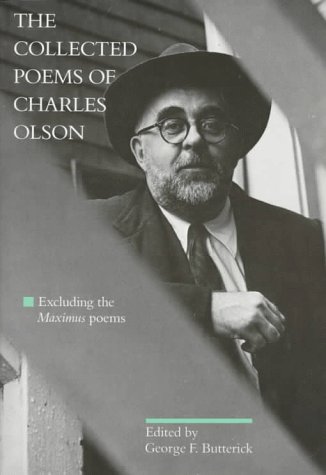
2. The Collected Poems of Charles
$25.73
3. The Maximus Poems
$19.95
4. Call Me Ishmael
 
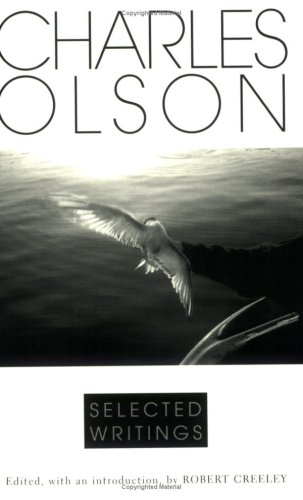
5. Charles Olson Selected Writings
 
$33.63
6. Charles Olson in Connecticut
$9.49
7. Selected Writings
 
8. HUMAN UNIVERSE and other essays
 
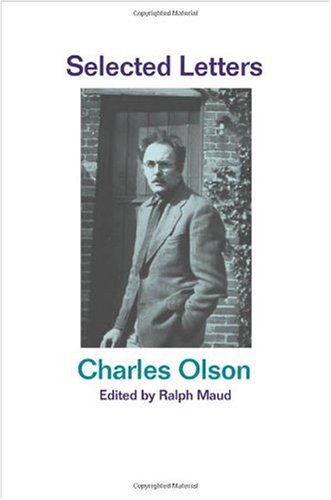
9. Charles Olson Letters for Origin
 
$15.00
10. Charles Olson Reading at Berkeley
$19.99
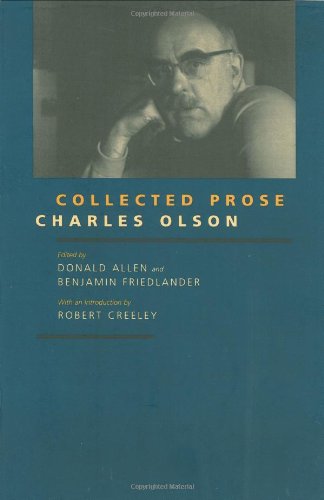
11. Collected Prose
$13.57
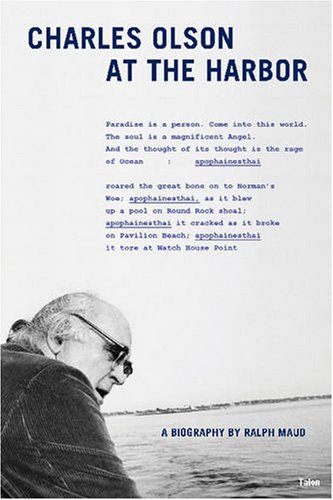
12. Charles Olson at the Harbor
$14.95
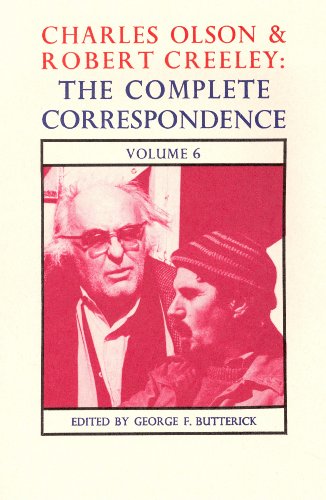
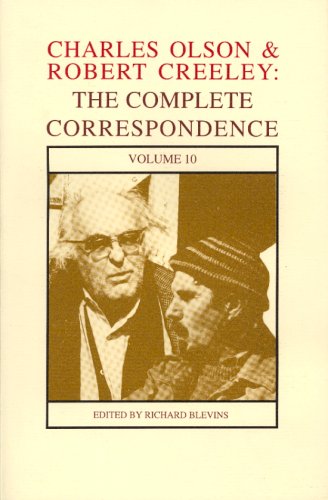
13. Charles Olson & Robert Creeley:
$11.53
14. Charles Olson: The Allegory of
 
15. Charles Olson in Connecticut :
 
16. The Distances Poems By Charles
 
17. Pleistocene Man: Letters from
$2.18
18. Charles Olson and Frances Boldereff:
$32.83
19. What Does Not Change: The Significance
20. A Guide to <i>The Maximus

1. Selected Poems (Centennial Books)
by Charles Olson
 Paperback: 224 Pages (1997-12-01)
list price: US$21.95 -- used & new: US$4.15
(price subject to change: see help)
Asin: 0520212320
Average Customer Review: 5.0 out of 5 stars
Canada | United Kingdom | Germany | France | Japan
Editorial Review

Book Description
"I have assumed a great deal in the selection of the poems from such a large and various number, making them a discourse unavoidably my own as well as any Olson himself might have chosen to offer. I had finally no advice but the long held habit of our using one another, during his life, to act as a measure, a bearing, an unabashed response to what either might write or say."--Robert Creeley
A seminal figure in post-World War II literature, Charles Olson has helped define the postmodern sensibility. His poetry embraces themes of empowering love, political responsibility, the wisdom of dreams, the intellect as a unit of energy, the restoration of the archaic, and the transformation of consciousness--all carried in a voice both intimate and grand, American and timeless, impassioned and coolly demanding.
In this selection of some 70 poems, Robert Creeley has sought to present a personal reading of Charles Olson's decisive and inimitable work--"unequivocal instances of his genius"--over the many years of their friendship. ... Read more

Customer Reviews (2)

5-0 out of 5 stars Charles Olson: "finding out for himself"
"History was "'istorin," which Olson took from Herodotus and used not as a noun or concept, but, rather, as a verb, "to find out for yourself." ---Robert Creeley, from his preface.

Charles Olson is a poet of poignant searching.Throughout this volume, confidently compiled by Olson's longtime friend and correspondent, Robert Creeley, Olson seems to be finding out for himself what it is to be human.In the soliloquy poem, "Maximus, to himself" (taken from Olson's magnum opus, The Maximus Poems), Olson shows that this process involves the discussion of feelings of inadequacy.He describes the frustration of "[standing] estranged / from that which was most familiar," when "the sharpness (the achiote) / I note in others, / makes more sense / than my own distances."Here, Olson seems to want to attain a certain quickness of mind which he sees as an essential human characteristic.The qualities he admires in others are mixed, though, as when he says of Sappho (in "For Sappho, Back"): "with a bold / she looked on any man, / with a shy eye."Her power seems to come in her duality, her ability to appear both "bold" and "shy."This discussion of Sappho shows that Olson is concerned with the classical world, but he can also be an achingly banal poet as when, in "As the Dead Pray Upon Us," he remembers his dead mother, saying, "And if she sits in happiness the souls / who trouble her and me / will also rest.The automobile // has been hauled away."A truly great poet, Olson realized that the real history is that of the self, in all its foibles, contradictions, and blisses.

5-0 out of 5 stars Essential, a quick look at a true genius
Charles Olson (1910-1970) was one of the most important American poets ofthe 20th Century. In this volume, Olson friend Robert Creeley has chosenmost of the poems that I would have chosen for such a volume. He hasincluded such works as "An Ode on Nativity" and "TheTwist" which help celebrate the city of his birth and youth, WorcesterMA. Creeley fairly evenly divides the book between choosing from TheCollected Poems and The Maximus Poems. The only poem that is not in thisexcellent volume that I would have included is "Ferrini 1,"Olson's tribute to his brilliant friend, Vincent Ferrini. Buy this book! ... Read more


2. The Collected Poems of Charles Olson: Excluding the <i>Maximus</i> Poems
by Charles Olson
Paperback: 609 Pages (1997-11-30)
list price: US$45.00 -- used & new: US$24.43
(price subject to change: see help)
Asin: 0520212312
Average Customer Review: 4.0 out of 5 stars
Canada | United Kingdom | Germany | France | Japan
Editorial Review

Book Description
A seminal figure in post-World War II literature, Charles Olson (1910-1970) has helped define the postmodern sensibility. His poetry is marked by an almost limitless range of interest and extraordinary depth of feeling. Olson's themes are among the largest conceivable: empowering love, political responsibility, historical discovery and cultural reckoning, the wisdom of dreams and the transformation of consciousness--all carried in a voice both intimate and grand, American and timeless, impassioned and coolly demanding. Until recently, Olson's reputation as a major figure in American literature has rested primarily on his theoretical writings and his epic work, the Maximus Poems. With The Collected Poems an even more impressive Olson emerges. This volume brings together all of Olson's work and extends the poetic accomplishment that influenced a generation.
Charles Olson was praised by his contemporaries and emulated by his successors. He was declared by William Carlos Williams to be "a major poet with a sweep of understanding of the world, a feeling for other men that staggers me." His indispensable essays, "Projective Verse" and "Human Universe," and his study of Melville, Call Me Ishmael, remain as fresh today as when they were written. ... Read more

Customer Reviews (1)

4-0 out of 5 stars Bigmans' Big Book
This is one of the most unusual poetry books I've read.The poems Olson published in his lifetime were a fraction of what he wrote.In this volume, editor George Butterick interleafs nearly all the surviving typescripts with the poems from Olson's previously published collections, creating a giant single edition that runs to over 600 pages.On the plus side, you get the chance to discover a new Olson through reading his poems, most published here for the first time, in the order he wrote them.The downside is that the 'historical' Olson, who along with Allen Ginsberg electrified American outsider poetry in the '50s and '60s, tends to get choked off in all the false starts, toss-offs and unfinished fragments that few of his contemporaries ever saw. Since the notes at the end don't give the page numbers of the poems they refer to, it's a hassle to sort out which poems appeared in which collections, if any.Butterick's thirty-year care and feeding of Olson's work has to be one of the greatest editorial romances of all time, and his openness in letting you decide which poems are good or not is democratic.But it also demands a lot of unnecessary work (why not a separate section of unpublished poems?) that might leave you wondering if Olson's worth the effort.Robert Creeley's shorter "Selected Poems" are a better bet if you want a quicker overview, and Butterick's edition of the Maximus poems probably catches Olson at his best.But his risk in presenting Olson like this is true to the spirit of the poetry.An outsized book for an outsized man. ... Read more


3. The Maximus Poems
by Charles Olson
Paperback: 664 Pages (1985-07-25)
list price: US$39.95 -- used & new: US$25.73
(price subject to change: see help)
Asin: 0520055950
Average Customer Review: 4.0 out of 5 stars
Canada | United Kingdom | Germany | France | Japan
Editorial Review

Book Description
Praised by his contemporaries and emulated by his successors, Charles Olson (1910-1970) was declared by William Carlos Williams to be "a major poet with a sweep of understanding of the world, a feeling for other men that staggers me." This complete edition brings together the three volumes of Olson's long poem (originally published in 1960, 1968, and 1975) in an authoritative version. ... Read more

Customer Reviews (7)

5-0 out of 5 stars Charles Olson
if i told you where if first saw this poetry volume you won't believe me :-)

usually my attention to new or other authors comes from books or authors i've previously read or on occasion on a friend's recommendation. however, watching the movie "Bob Dylan: No Direction Home" on DVD i saw this book among a stack of papers on Izzy Young's desk during him being interviewed.

pageing through it at first glance one detects a couple of blank pages and one thinks 'whatta cheat?'. on scrutinizing the contents further one finds that Charles Olson not only wrote the poetry, but was also being very particular about the publication of his writings, and the setting up of the same.

i personal seem to prefer his later poetry writings. as an author he's completely new to me and finds his marked place among my modern american poets and writers.

JohPWilbrand

5-0 out of 5 stars The masterpiece of a new poetic
This is mid twentieth century American EPIC poetry. It is not a collection of pretty little lyrics. If you want that, you came to the wrong place. It does have some lyric poetry embedded within, however. But for those who think all poetry should be lyrical, turn back now.

What is an epic? Pound said it was a poem with history. Olson disagrees. Olson visited Pound, argued with him, and Pound said Olson saved his life. But Olson disagreed with Pound on many issues. Pound was a Fascist, Olson was a Democrat. Pound sought to establish a sort of neo-Confucianism, while Olson's philosophy comes straight from Alfred North Whitehead (as well as Jung's psychology and other "new sciences of man"). Pound wanted to establish a cultural elite, while Olson seeks to establish the workers (in this case the fishermen) as the indomitable spirit of forward directed hard-boiled Yankee go-get-it-ism, if there really is such a thing, is spite of any doings by the self-styled elite, or mistaken directives from ship owners. As such, his epic is barbaric, and certainly dirty. Olson's epic has a main character. Aristotle suggested that definition about 2500 years ago.

Olson accepts the techniques of Pound, and he accepts the techniques of Williams in Paterson. Another reviewer mentions Zukofsky, but there really seems to be no such influence at work here. If the techniques of Pound are interesting to you, but you find his opinions repugnant, try this book. It is, in my opinion, the final success of all that modernistic attempt at redefining the epic we get from the above men.

Some reviewers here have shied away, citing naughty words or even difficulty. Can you imagine anyone writing a review to whine that something is difficult? What is that about? Some sort of glorification of ignorance? And the naughty words are by no means prevalent. PG-13 at best.

OK. I said this was a new poetic. I must explain. It begins with Whitman, of course, just writing what he darn well pleased. And it grew with William Carlos Williams who was in France as a teen and was exposed to the French poetry of the late 19th century. So Williams, like most people his age, had to react to Whitman, in light of that exposure to the French. The result was "Spring and All" in which Williams seeks new forms in the American language and tries to find poetry in the common barnyard objects, for instance. Meanwhile in Europe several friends of Williams come up with some silly rules (Imagism) to make lyrics seem new, and Pound writes them down and gets them published. Well, that didn't work because the minute one person states a rule, someone is inclined to break it. But Williams in Spring and All is not making rules. He's thinking out loud. This is where many discussions that include the two most important words (form and content) begin: in "Spring and All" in 1921. Twenty years later, Olson and Robert Creeley are young writers and, of course, they are discussing form and content and how they relate. The result, after several letters back and forth, is that form is an extension of content (Creeley) with Olson caveat, that (this may not be the exact wording) the best form is the most natural extension of content. And Olson wrote about this in an essay called Projective Verse, itself a poem from my point of view. Projective Verse then touches off several responses, as Olson had the minds of many young writers in his care during the existence of Black Mountain College. Over the next 20 years or so, many poets are affected by these theories, which are by them being labeled "postmodernism". Until finally it all came to a head in Vancouver, BC in 1962 when many of these poets gathered at a poetry conference and read their works. As one can see from the works read there, projective verse was in full swing. Again, it was not a set of rules. It was a discussion of where things come from and how to get them where they are going. The different writers who embraced these new ideas all wrote in totally different ways. If nobody ever said that Creeley, Blackburn, Duncan, Olson, etc. were all operating from the same idea of form and content, one might never be able to tell. If that isn't proof that an idea about form is solid, I don't know what is!

Olson actually began working on an epic in the 40s, but for some reason was unsatisfied. The remnants can be found in his first book of poems, "In Cold Hell, In Thicket" which was published around the same time as the first ten Maximus poems.

If, like me, you are an American Humanist, a student of Whitman, you wonder what's the great American poetry of the 20th century, and you really have no stomach for fascists and other elitists, this book is the end of your searching.

Don't sweat the fragmentary sentences. They make sense if you read it aloud. There are plenty of free audio recordings of Olson reading these Maximus poems on the net, so you can easily get his voice going in your ear. It is all very sensible, unless you were looking for some excuse to be thought better than other people. There's plenty of that out there, but not to be found in here. Here is where you get your hands dirty digging around in old cellar holes or boning fish on the line with old men listening to their stories, or listening to an old postman who has it from the widows up the hill that such-and-such happened. They don't speak grammatically correct English. They use, as Dante put it, de vulgaris loquentia, the common speech.

p.s. I realize that speech was Aristotle's defining characteristic of drama, but Olson makes it work in the epic.

5-0 out of 5 stars Dear Dellaphon
A masterpiece (and an ample illustration of Gertrude Stein's answer to "why there are so few of them"). One wonders how Jacob Dellaphon (reviewer from RI) could manage to come away from his reading having allowed himself to LEARN absolutely nothing. Don't let any initial impressions of Olson's difficulty (or his pretention, or the pretention of some of his more zealous readers) steer you away from what he has WITNESSED. "Polis is eyes."

5-0 out of 5 stars olson's maximus
"In the land of plenty, have
nothing to do with it"

olson was a large man & the maximus poems is some of what he got down on paper.

"he and I seeming
the only ones who know
what we are doing, where
we are going"

it is a big book that requires time and care of attention

it's also a reference, something that can be "dug up" to serve as signs or points.the lyric passages are often very low to the ground

"the forests,
behind, transparent
from the light snow showing
lost rocks and hills
which one doesn't, ordinarily,
know"

1-0 out of 5 stars Relief for Insomniacs - The "Poetry" of Charles Olson
I was forced to read this dreck for an architecture(?) class.Although I love to read, and so usually approach unknown materials with an open mind, I quickly lost any illusion of interest once the first few pages were read.This "poem" is hard to follow, impossible to translate, boring to read.

Now if I could only find someone to take this book off of my hands. ... Read more


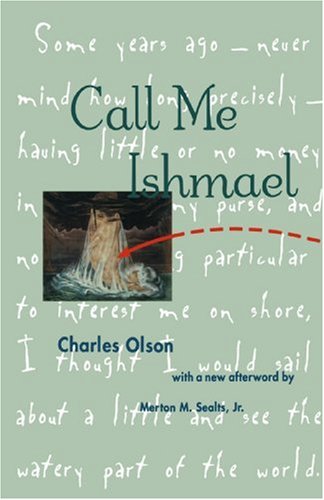
4. Call Me Ishmael
by Charles Olson
Paperback: 164 Pages (1997-10-30)
list price: US$25.00 -- used & new: US$19.95
(price subject to change: see help)
Asin: 0801857317
Average Customer Review: 5.0 out of 5 stars
Canada | United Kingdom | Germany | France | Japan
Editorial Review

Book Description
First published in 1947, this acknowledged classic of American literary criticism explores the influences--especially Shakespearean ones--on Herman Melville's writing of "Moby-Dick". Olson examines the influence of "King Lear" on Melville's work. ... Read more

Customer Reviews (3)

5-0 out of 5 stars Fans of Ahab will love this one
Or, if you have read and re-read the current bestseller Ahab's Wife, and you are looking for another classic treatment of the Moby Dick story not featured on Oprah Winfrey's daily chat show, you might pick up Olson's famous theoretical exposition of Melville.In 1947, Charles Olson hadn't written much poetry and he was just coming off a failed political career as a minor functionary in Roosevelt's New Deal, but somehow he got his act together with CALL ME ISHMAEL.Nowadays, everyone is in on the Melville revival but in the immediate postwar years Melville had only really been in the canon for twenty years or so, so Olson was working out something new and undone in American literature.His book didn't sell particularly well, it's challenging and high-toned, but it has remained in print continuously for almost 60 years.Let's see if AHAB'S WIFE can say the same!

5-0 out of 5 stars Literary criticism becomes art
It should come as no surprise that the world's greatest novel would inspire the world's greatest essay of literary criticism. Sadly, Olson's ideas did not appeal to members of the elite Melville Society, and to this day they still consider him a "crank." A real pity, because Olson will be remembered long after they are forgotten.

5-0 out of 5 stars You will seek the White Whale as Ahab did.
In brief, "Call Me Ishmael" is the most interesting piece of literary criticism I've ever read.Foreshadowing his future leanings as a poet, Olson writes "Ishmael" more like a prose poem than stodgydissertation.Yet, however unique the form, it seems strangelypredetermined.For it is only through a poetic nature that it coulddistill such huge, multilayered concepts into an accessible and short (119pg.) essay.This reissue--it was first published in 1947--takes the readerthrough Shakespearean influence on "Moby Dick," Melville'sstruggle with faith, and the importance of place--to name only threeexamples.The future rector of the short-lived, yet highly influential,Black Mountain College in North Carolina, creates an energy out of wordsbested only by "The Whale" itself.As Olson stated to hiscolleague, Merton Sealts, Jr., who wrote the new afterword to the essay: "I see that The White Death has descended upon You too."And itwill upon you as well.After reading this incisive, lyrical, and engagingpiece, you will want to return to "Moby Dick" before you'veclosed its pages. ... Read more


5. Charles Olson Selected Writings
by Charles / Creeley, Robert, editor and introduction Olson
 Paperback: Pages (1966)

Asin: B000J0YTX0
Canada | United Kingdom | Germany | France | Japan

6. Charles Olson in Connecticut
by Charles Boer
 Paperback: 144 Pages (1991-10)
list price: US$12.95 -- used & new: US$33.63
(price subject to change: see help)
Asin: 0933598289
Canada | United Kingdom | Germany | France | Japan
Editorial Review

Book Description
memoir of Olson's last months while teaching in CT ... Read more


7. Selected Writings
by Charles Olson
Paperback: 280 Pages (1971-06)
list price: US$15.95 -- used & new: US$9.49
(price subject to change: see help)
Asin: 0811203352
Canada | United Kingdom | Germany | France | Japan

8. HUMAN UNIVERSE and other essays [First Edition] 1st
by Charles OLSON
 Paperback: 160 Pages (1967)

Asin: B000N9B5TS
Canada | United Kingdom | Germany | France | Japan

9. Charles Olson Letters for Origin 1950-1955
by Charles] Glover, Albert, editor [Olson
 Paperback: Pages (1970)

Asin: B000J0YVV0
Canada | United Kingdom | Germany | France | Japan

10. Charles Olson Reading at Berkeley
by Charles Olson
 Paperback: Pages (1966-06)
list price: US$5.00 -- used & new: US$15.00
(price subject to change: see help)
Asin: 0685803724
Canada | United Kingdom | Germany | France | Japan

11. Collected Prose
by Charles Olson
Paperback: 382 Pages (1997-12-19)
list price: US$27.50 -- used & new: US$19.99
(price subject to change: see help)
Asin: 0520208730
Average Customer Review: 5.0 out of 5 stars
Canada | United Kingdom | Germany | France | Japan
Editorial Review

Book Description
The prose writings of Charles Olson (1910-1970) have had a far-reaching and continuing impact on post-World War II American poetics. Olson's theories, which made explicit the principles of his own poetics and those of the Black Mountain poets, were instrumental in defining the sense of the postmodern in poetry and form the basis of most postwar free verse.
The Collected Prose brings together in one volume the works published for the most part between 1946 and 1969, many of which are now out of print. A valuable companion to editions of Olson's poetry, the book backgrounds the poetics, preoccupations, and fascinations that underpin his great poems. Included are Call Me Ishmael, a classic of American literary criticism; the influential essays "Projective Verse" and "Human Universe"; and essays, book reviews, and Olson's notes on his studies. In these pieces one can trace the development of his new science of man, called "muthologos," a radical mix of myth and phenomenology that Olson offered in opposition to the mechanistic discourse and rationalizing policy he associated with America's recent wars in Europe and Asia.
Editors Donald Allen and Benjamin Friedlander offer helpful annotations throughout, and poet Robert Creeley, who enjoyed a long and mutually influential relationship with Olson, provides the book's introduction. ... Read more

Customer Reviews (1)

5-0 out of 5 stars Despite a bad design still a MARVEL of a book
Charles Olson is THE giant of post-war American poetry. Massive in every way - 6 foot 7 & a half inches tall, enormously influential as writer & teacher, a voracious reader, intense visionary, a mind second to none & a heart as big as the planet, his poetry & prose should be on every curriculum & syllabus in every school & university on the planet. What is so exciting about his work is that it proposes not just a new way of looking at things, but a new & vital way of engaging with life & destiny (ENERGY & INSTANT is how he put it) - "the poet is the only pedagogue left, to be trusted" - he teaches "man, that participant thing, to take up, straight, nature's, live nature's force". As you can see his prose is difficult & takes time to get used to - best to read it aloud & let its energy transform you as much as its meaning: energy transferral is how Olson saw communication & to receive energy you must first give it, & to bring energy from the page you must first bring it into the air in the act of speech: language for Olson was as much physical as mental - "I believe in God as fully physical" - & when you read Olson you feel yourself in the grip of energy - what he called the WILL TO COHERE - THE PROJECTIVE ACT - the very grip of LIFE, which flowed thru him with such intensity. His style is crucial to his message - FORM IS NEVER MORE THAN AN EXTENSION OF CONTENT - which brings me to my only quibble with this book (& it's a major one) - its design. Olson was a real stickler for design - layout & typefaces were crucially important to him because they all contributed to the impact of the page on the reader, which is why I cannot understand the reason for the cool (the last word you'd ever call Olson - he was too hot even to get close to), sans serif, bland layout of the pages in this book. Olson often capitalises phrases - like he's shouting them at you - here they're barely a whisper. Is all I can think is that the book was designed by someone more familiar with fashion than with the contents - a big mistake I'm afraid because a lot of the power is lost. Anyway, that said, it is all here - Call Me Ishmael, Human Universe, Additional Prose & other snippets, & the photo on the cover is wonderful. As I see it, Olson's big mistake was not living a long enough life - not completing his work - not actually having the intelligence to see & feel his life as a complete entity - not actually having the heart (as Spinoza had) to realise that ENERGY & INSTANT are in fact, in essence, the same, & that if one lives a responsible life & looks after ones health because certain things can only be learnt at a certain age & one must live that long at least, then time is consumed & one comes to something real & godly which Olson never managed, despite the promise of the final poems. The archaeologist of morning died TOO young & I miss him. ... Read more


12. Charles Olson at the Harbor
by Ralph Maud
Paperback: 224 Pages (2008-05-30)
list price: US$19.95 -- used & new: US$13.57
(price subject to change: see help)
Asin: 0889225761
Canada | United Kingdom | Germany | France | Japan

13. Charles Olson & Robert Creeley: The Complete Correspondence (Charles Olson and Robert Creeley)
by Charles Olson, Robert Creeley
Paperback: 325 Pages (1996-09)
list price: US$18.95 -- used & new: US$14.95
(price subject to change: see help)
Asin: 1574230042
Average Customer Review: 5.0 out of 5 stars
Canada | United Kingdom | Germany | France | Japan
Editorial Review

Amazon.com
Whenever I become intrigued by a writer, I tend to read everything I can get my hands on that he or she has written -- including their letters.Correspondence presents the unique opportunity to become closer to your writer. The guard is down, the language is conversational, the ideas fly by fresh and uncrafted by months of revisions. This collection of letters between two of the famous Black Mountain poets bares their souls in everything from writer's block to religions to saving each other's lives through the near-forgotten art of written correspondence. ... Read more

Customer Reviews (1)

5-0 out of 5 stars astounding
Only Butterick and Creely could have demonstrated the significance that Charles Olson imparted upon the world of post-modern poetry.For those familiar and unfamiliar with the works of this poet, this collection,although only a mere smattering of the magnitude of Olson, provides animposing insight to the depth and mastery of modern poetry. ... Read more


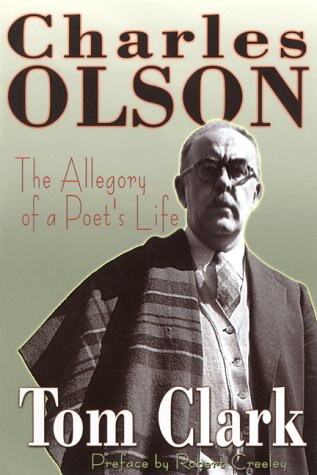
14. Charles Olson: The Allegory of a Poet's Life
by Tom Clark
Paperback: 352 Pages (2000-05-31)
list price: US$18.95 -- used & new: US$11.53
(price subject to change: see help)
Asin: B000I0RTR4
Average Customer Review: 3.5 out of 5 stars
Canada | United Kingdom | Germany | France | Japan
Editorial Review

Book Description
An incandescent biography of the inventor of "projective" verse, this comprehensive portrait distinguishes the convivial, bluff public figure from the tormented inner man. A lapsed Catholic, Olson (1910-1970) turned to Sumerian myths, Mayan legends and Islamic mysticism for cosmic insights that would inform poems of cyclic sweep. Torn by contradictory feelings toward his proud, stern father--a Swedish immigrant postman in Worcester, Mass.--the poet found a father-figure in mentor Edward Dahlberg and later in Ezra Pound. Reclusive self-absorption sapped his two common law marriages; he harbored enormous guilt over his neglect of his two children and over second wife Betty Kaiser's death (in a car accident), which may have been self-inflicted during a severe depression. Clark, author of books on Kerouac, Celine and Ted Berrigan, reveals that Olson grappled with homosexual impulses, took hallucinogens and dominated those around him, seeking periodic release from inner demons in frenzied floods of images. ... Read more

Customer Reviews (3)

5-0 out of 5 stars thoroughly readable portrait of an iconoclast
and by iconoclast its not possible to sugarcoat the very real personal destruction that olson wrought on everyone around him, though he was one of the most brilliant exponents of some of the very best strains of modernist poetry. as someone who has studied, admired, and been engaged with olson over the last two years, and his prophetic calls for "an earth of value", and "proprieception", among many other ideas that went way beyond theinventions and drug induced nihilism of the beats, clark's biography gave an insight in to the man's extremely complex relationship with everyone around him, and i mean everyone.yes olson was exploding off the page with ideas, but his attempts to live the ideas fell far short of his high flown naturalistic bent, and some of his behavior, both pre and post amphetamines, was frankly incredible; particularly his 5 years at black mountain, which although may have been doomed from the start, (an experimental college in mccarthyist america) it was still a testing ground for olson's "polis has eyes" that may have changed a lot in the postsecondary educ. system.a great insight in to a man that was brilliant, a visionary, and an inventor, but also apetty, misogynistic, brute of a man that sacrificed many people to the great altar of ideas. i've never read anything else by clark, but he seems to have a pretty thorough approach to biography that tells a story in a straightforward narrative with plenty of documentary evidence; also, having picked up the first edition in a used book store, the comments of robert duncan, haas, creely, and edward dorn on the back flap give credence the portrait that clark paints.highly recommended to anyone wanting to understand the man who "invented" postmodernism.

4-0 out of 5 stars Choppy Life
Found the book to lead me on great imaginings.Certainly not a prettyportrait of the artist, but within a tight 352 pages a sound introductionto his work and psychic torment which shaped it.The book led me intodeeper investigations and further imaginings which is part of what a decentbiography should do.

1-0 out of 5 stars A tour de force which has little to do with Olson or his art
The author belies a hostility towards his subject early on in the book by referring to him as "Charlie" as though he was the cop on "Bad Boys" who had caught the guy in the video who had obviouslydone something which gave him the right to speak condescendingly to him. In Clark's own mind Olson has become an unworthy father who he has to beatdown.Wierd !Totally misses the point of Olson's art which is that eachpage is different and a unique attempt at truth. Shows too how theThruway West (oh Gunslinger) has obliterated belief in an actual earth ofvalue. Which Olson's actual text does manage to keep alive. ... Read more


15. Charles Olson in Connecticut : Last Lectures, as Heard By John Cech, Oliver Ford [and] Peter Rittner
by Charles Olson
 Hardcover: Pages (1974)

Asin: B000KW8FV4
Canada | United Kingdom | Germany | France | Japan

16. The Distances Poems By Charles Olson
by Charles Olson
 Paperback: Pages (1960)

Asin: B000GWFEAS
Average Customer Review: 1.0 out of 5 stars
Canada | United Kingdom | Germany | France | Japan

Customer Reviews (1)

1-0 out of 5 stars hmmm
This book arrived almost completely destroyed, looking like it had been smashed by a truck.
It was sent unprotected in a small manila envelope, and should have been incinerated, save that it is so rare.Shame on whoever mailed it. ... Read more


17. Pleistocene Man: Letters from Charles Olson to John Clarke during October 1965.
by Charles. OLSON
 Pamphlet: Pages (1968)

Asin: B000UBKM7A
Canada | United Kingdom | Germany | France | Japan

18. Charles Olson and Frances Boldereff: A Modern Correspondence
by Charles Olson, Frances Boldereff
Paperback: 564 Pages (1999-06-01)
list price: US$29.95 -- used & new: US$2.18
(price subject to change: see help)
Asin: 0819563641
Canada | United Kingdom | Germany | France | Japan
Editorial Review

Book Description
A remarkable series of letters between Black Mountain poet Charles Olson and his most ardent reader. ... Read more


19. What Does Not Change: The Significance of Charles Olson's "the Kingfishers"
by Ralph Maud
Hardcover: 176 Pages (1997-12)
list price: US$33.50 -- used & new: US$32.83
(price subject to change: see help)
Asin: 0838637310
Canada | United Kingdom | Germany | France | Japan

20. A Guide to <i>The Maximus Poems</i> of Charles Olson
by George F. Butterick
Paperback: 881 Pages (1981-02-17)
list price: US$35.00
Isbn: 0520042700
Canada | United Kingdom | Germany | France | Japan
Editorial Review

Book Description
Praised by his contemporaries and emulated by his successors, Charles Olson (1910-1970) was declared by William Carlos Williams to be "a major poet with a sweep of understanding of the world, a feeling for other men that staggers me." This complete edition brings together the three volumes of Olson's long poem (originally published in 1960, 1968, and 1975) in an authoritative version. ... Read more


  1-20 of 100 | Next 20
A  B  C  D  E  F  G  H  I  J  K  L  M  N  O  P  Q  R  S  T  U  V  W  X  Y  Z  

Prices listed on this site are subject to change without notice.
Questions on ordering or shipping? click here for help.

site stats