
|
Help |
| Home - Authors - Paz Octavio (Books) | |
e99 Online Shopping Mall
|
|
Help |
| Home - Authors - Paz Octavio (Books) | |
| 1-20 of 99 | Next 20 |
click price to see details click image to enlarge click link to go to the store
| 1. The Collected Poems of Octavio Paz, 1957-1987: Bilingual Edition by Octavio Paz, Eliot Weinberger | |
 | Paperback: 688
Pages
(1991-04)
list price: US$26.95 -- used & new: US$15.95 (price subject to change: see help) Asin: 0811211738 Average Customer Review: 
Canada | United Kingdom | Germany | France | Japan |
|
Editorial Review Product Description Customer Reviews (10)
| |
| 2. The Labyrinth of Solitude: The Other Mexico, Return to the Labyrinth of Solitude, Mexico and the United States, the Philanthropic Ogre by Octavio Paz | |
 | Paperback: 398
Pages
(1994-01-12)
list price: US$14.50 -- used & new: US$6.97 (price subject to change: see help) Asin: 080215042X Average Customer Review: 
Canada | United Kingdom | Germany | France | Japan |
|
Editorial Review Product Description Customer Reviews (17)
| |
| 3. Sor Juana Inés de la Cruz o las trampas de la fe by Octavio Paz | |
 | Paperback: 658
Pages
(1995-01-01)
list price: US$19.95 -- used & new: US$10.00 (price subject to change: see help) Asin: 9681612116 Average Customer Review:
Canada | United Kingdom | Germany | France | Japan |
|
Editorial Review Product Description Customer Reviews (5)
| |
| 4. Convergences: Essays on Art and Literature by Octavio Paz | |
 | Paperback: 320
Pages
(1991-06-01)
list price: US$20.00 -- used & new: US$15.00 (price subject to change: see help) Asin: 0156225867 Average Customer Review:
Canada | United Kingdom | Germany | France | Japan |
|
Editorial Review Product Description Customer Reviews (1)
| |
| 5. Sunstone/Piedra De Sol by Octavio Paz | |
 | Paperback: 60
Pages
(1991-10-17)
list price: US$9.95 -- used & new: US$5.70 (price subject to change: see help) Asin: 0811211959 Average Customer Review:
Canada | United Kingdom | Germany | France | Japan |
|
Editorial Review Product Description Customer Reviews (2)
| |
| 6. Octavio Paz Selected Poems by Octavio Paz | |
| Paperback: 147
Pages
(1984-05)
list price: US$12.95 -- used & new: US$4.82 (price subject to change: see help) Asin: 0811208990 Average Customer Review: 
Canada | United Kingdom | Germany | France | Japan | |
Customer Reviews (1)
| |
| 7. The Double Flame: Love and Eroticism by Octavio Paz | |
 | Paperback: 288
Pages
(1996-06-01)
list price: US$16.95 -- used & new: US$7.23 (price subject to change: see help) Asin: 0156003651 Average Customer Review:
Canada | United Kingdom | Germany | France | Japan |
|
Editorial Review Product Description Customer Reviews (12)
| |
| 8. Mexican Poetry: An Anthology | |
 | Paperback: 224
Pages
(1994-03-29)
list price: US$14.95 -- used & new: US$6.98 (price subject to change: see help) Asin: 0802151868 Average Customer Review: 
Canada | United Kingdom | Germany | France | Japan |
|
Editorial Review Product Description Customer Reviews (1)
| |
| 9. A Tree Within (A New Directions Paperbook) by Octavio Paz, Eliot Weinberger | |
 | Paperback: 164
Pages
(1988-11)
list price: US$12.95 -- used & new: US$2.99 (price subject to change: see help) Asin: 0811210715 Average Customer Review:
Canada | United Kingdom | Germany | France | Japan |
Customer Reviews (2)
The book is richly studded with multicultural references and allusions--to Epictetus, Buddha, Gilgamesh, Jack the Ripper, the Aztecs, Don Quixote, and many, many, more. But Paz is not merely trying to dazzle us with his knowledge. He is also introspective and revealing. He struggles with deep questions about language, love, and other concerns. Paz seems to be searching both for an ideal poetic language, and for a form of connectedness that transcends language--a paradoxical quest, yet pure Paz. When he writes "Man's word / is the daughter of death" (in the poem "To Talk"), it strikes me as both a tragically naked confession of inadequacy and a moment of serene liberation. At other times, Paz seems, like Walt Whitman and Emily Dickinson, to be groping towards the creation of a sort of "secular scripture" for the (post)modern age. In the poem "I Speak of the City," Paz writes, "I speak of our public history, and of our secret history, yours and mine." The histories recorded by this visionary genius are certainly some of the most important literary creations of the 20th century. ... Read more | |
| 10. Persona Non Grata: A Memoir of Disenchantment with the Cuban Revolution (Nation Books) by Jorge Edwards | |
 | Paperback: 304
Pages
(2004-04-20)
list price: US$13.95 -- used & new: US$1.06 (price subject to change: see help) Asin: 1560256079 Average Customer Review: 
Canada | United Kingdom | Germany | France | Japan |
|
Editorial Review Product Description Customer Reviews (2)
| |
| 11. Alternating Current by Octavio Paz | |
 | Paperback: 226
Pages
(1991-01-18)
list price: US$13.95 -- used & new: US$1.99 (price subject to change: see help) Asin: 1559701366 Canada | United Kingdom | Germany | France | Japan |
| 12. El Laberinto De La Soledad (Popular) (Spanish Edition) by Octavio Paz | |
 | Paperback: 351
Pages
(1993-02-01)
list price: US$9.95 -- used & new: US$5.65 (price subject to change: see help) Asin: 9681659708 Average Customer Review:
Canada | United Kingdom | Germany | France | Japan |
|
Editorial Review Product Description Customer Reviews (12)
| |
| 13. Early Poems, 1935-1955 (New Directions Paperbook, Ndp354) by Octavio Paz, Muriel Rukeyser | |
 | Paperback: 145
Pages
(1973-06)
list price: US$12.95 -- used & new: US$7.49 (price subject to change: see help) Asin: 0811204782 Average Customer Review:
Canada | United Kingdom | Germany | France | Japan |
Customer Reviews (2)
The poems in this book represent a mix of short, haiku-like verses; prose poems; and longer poems. Although Paz is a distinctive and original talent, some of his work seems to echo the spirit of such earlier poets as William Blake, Walt Whitman, and Stephen Crane. Paz often writes about writing and language, often with a metaphysical, reality-warping perspective. His poems include a multicultural mix of interesting references: Polyphemus, Buddha, Tlaloc, the Tower of Babel, etc. He uses much striking imagery, and frequently his writing has a prophetic tone. There are many fine poems in this collection, but I was particularly impressed by "The prisoner," his stunning homage to the Marquis de Sade: "The letters of your name are still a scar that will not heal, / the tattoo of disgrace on certain faces." If you are interested in Latin American literature or 20th century poetry, I recommend this book. ... Read more | |
| 14. Figures & Figurations (New Directions Paperbook) by Marie José Paz, Octavio Paz | |
 | Paperback: 64
Pages
(2008-08-17)
list price: US$17.95 -- used & new: US$5.39 (price subject to change: see help) Asin: 0811217590 Canada | United Kingdom | Germany | France | Japan |
|
Editorial Review Product Description | |
| 15. El Arco y la Lira by Octavio Paz | |
| Unknown Binding:
Pages
(1967-01-01)
Asin: B003XJZ0M8 Canada | United Kingdom | Germany | France | Japan | |
| 16. The Bow and the Lyre (Texas Pan American Series) by Octavio Paz | |
 | Paperback: 294
Pages
(2009-12-01)
list price: US$25.00 -- used & new: US$21.37 (price subject to change: see help) Asin: 0292707649 Canada | United Kingdom | Germany | France | Japan |
| 17. Tiempo nublado by Octavio Paz | |
 | Paperback: 206
Pages
(1995-09)
list price: US$19.95 -- used & new: US$28.78 (price subject to change: see help) Asin: 8432207586 Average Customer Review:
Canada | United Kingdom | Germany | France | Japan |
Customer Reviews (2)
| |
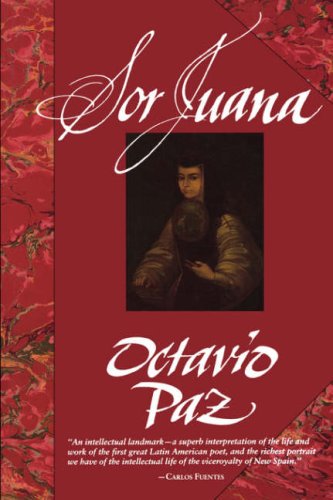
| 18. Sor Juana: Or, the Traps of Faith by Octavio Paz | |
 | Paperback: 564
Pages
(1990-01-02)
list price: US$28.00 -- used & new: US$23.16 (price subject to change: see help) Asin: 0674821068 Average Customer Review:
Canada | United Kingdom | Germany | France | Japan |
|
Editorial Review Product Description Mexico's leading poet, essayist, and cultural critic writes of a Mexican poet of another time and another world, the world of seventeenth-century New Spain. His subject is Sor Juana Inés de la Cruz, the most striking figure in all of Spanish-American colonial literature and one of the great poets of her age. Her life reads like a novel. A spirited and precocious girl, one of six illegitimate children, is sent to live with relatives in the capital city. She becomes known for her beauty, wit, and amazing erudition, and is taken into the court as the Vicereine's protégée. For five years she enjoys the pleasures of life at court--then abruptly, at twenty, enters a convent for life. Yet, no recluse, she transforms the convent locutory into a literary and intellectual salon; she amasses an impressive library and collects scientific instruments, reads insatiably, composes poems, and corresponds with literati in Spain. To the consternation of the prelates of the Church, she persists in circulating her poems, redolent more of the court than the cloister. Her plays are performed, volumes of her poetry are published abroad, and her genius begins to be recognized throughout the Hispanic world. Suddenly she surrenders her books, forswears all literary pursuits, and signs in blood a renunciation of secular learning. The rest is silence. She dies two years later, at forty-six. Octavio Paz has long been intrigued by the enigmas of Sor Juana's personality and career. Why did she become a nun? How could she renounce her lifelong passion for writing and learning? Such questions can be answered only in the context of the world in which she lived. Paz gives a masterly portrayal of the life and culture of New Spain and the political and ideological forces at work in that autocratic, theocratic, male-dominated society, in which the subjugation of women was absolute. Just as Paz illuminates Sor Juana's life by placing it in its historical setting, so he situates her work in relation to the traditions that nurtured it. With critical authority he singles out the qualities that distinguish her work and mark her uniqueness as a poet. To Paz her writings, like her life, epitomize the struggle of the individual, and in particular the individual woman, for creative fulfillment and self-expression. Customer Reviews (5)
| |
| 19. La Otra Voz: Poesia y fin de siglo by Octavio Paz | |
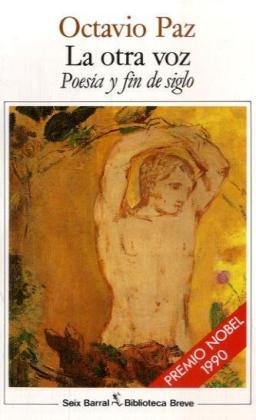 | Paperback: 141
Pages
(1990-06)
list price: US$14.95 -- used & new: US$18.79 (price subject to change: see help) Asin: 843220630X Average Customer Review:
Canada | United Kingdom | Germany | France | Japan |
Customer Reviews (1)
| |
| 20. In Search of the Present: 1990 Nobel Lecture by Octavio Paz | |
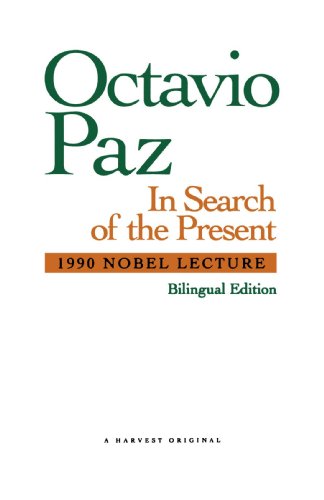 | Paperback: 72
Pages
(1991-06-01)
list price: US$21.00 -- used & new: US$0.99 (price subject to change: see help) Asin: 0156445565 Average Customer Review:
Canada | United Kingdom | Germany | France | Japan |
|
Editorial Review Product Description Customer Reviews (1)
Paz begins by reflecting on the unique aspects of the literatures of the Americas. Then, after a brief autobiographical transition, he discusses his life-long pursuit of that elusive phenomenon known as "modernity." Although Paz has great insights, his words do tend to oversimplify issues at times. In his reflection on the literature of the Americas, for example, he acknowledges only the great national literatures written in Spanish, English, Portuguese, and French. Reading it made me want to exclaim, "What about the rich tradition of oral literatures in Native American languages? Or the creole literatures of this hemisphere? What about those American writers who have composed their works in Yiddish and other "marginal" languages?" (This criticism is ironic in light of the fact that Paz mentions Nahuatl, a native Mexican language, in passing towards the end of the address). This complaint aside, Paz remains provocative and compelling. And his address yields a wealth of memorable, epigram-like insights. Consider this one: "Poetry, in love with the instant, seeks to relive it in the poem, thus separating it from sequential time and turning it into a fixed present" (p. 16). All things considered, this is a significant text from one of the indispensable figures in the literatures of the Americas. ... Read more | |
| 1-20 of 99 | Next 20 |
 Sor Juana: a sparking biography