e99 Online Shopping Mall

Geometry.Net - the online learning center Help  
Home  - Authors - Pessoa Fernando (Books)

  1-20 of 100 | Next 20
A  B  C  D  E  F  G  H  I  J  K  L  M  N  O  P  Q  R  S  T  U  V  W  X  Y  Z  

click price to see details     click image to enlarge     click link to go to the store

$9.07
1. A Little Larger Than the Entire
$9.72
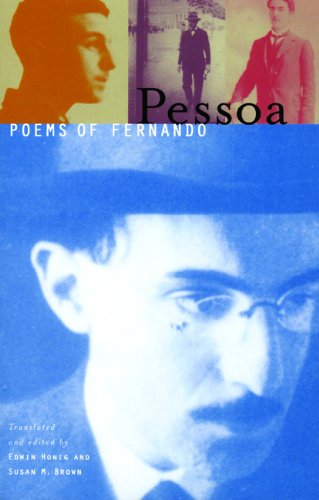
2. Poems of Fernando Pessoa
$9.18
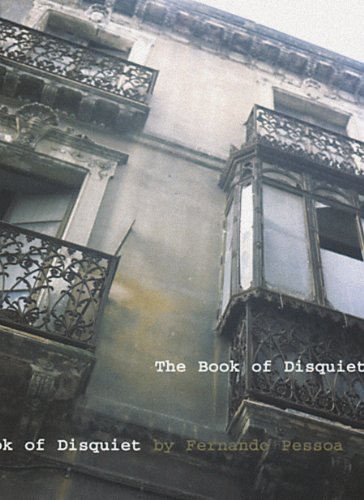
3. The Book of Disquiet (Penguin
 
$8.00
4. Fernando Pessoa and Co.: Selected
$9.93
5. Book Of Disquiet, The
$8.06
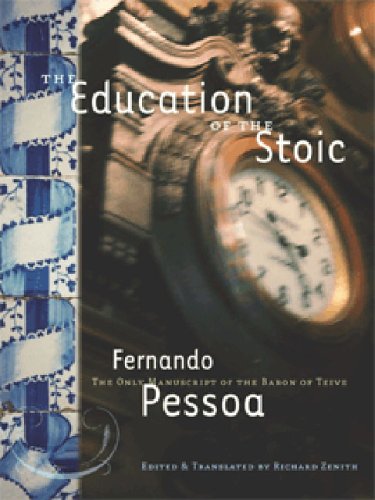
6. Education Of The Stoic, The
$22.95
7. A Centenary Pessoa
8. Fernando Pessoa (Pocket Archives
$8.00
9. The Selected Prose of Fernando
 
10. The Book of Disquiet
$6.75
11. Dreams of Dreams and the Last
$13.97
12. Selected Poems (Penguin Modern
$20.50
13. Poemas - Fernando Pessoa
$10.82
14. Sheep's Vigil by a Fervent Person:
$13.70
15. Message
$18.28
16. The Collected Poems of Alberto
 
17. Man Who Never Was: Essays on Fernando
 
18. Melhores Poemas de Fernando Pessoa,
 
$22.57
19. El caso clínico de Fernando Pessoa
 
$9.95
20. Oscar Wilde, Fernando Pessoa,

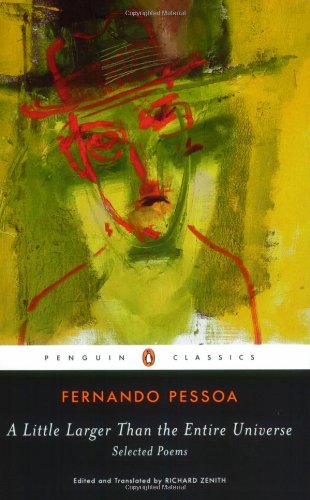
1. A Little Larger Than the Entire Universe: Selected Poems (Penguin Classics)
by Fernando Pessoa
Paperback: 400 Pages (2006-04-04)
list price: US$16.00 -- used & new: US$9.07
(price subject to change: see help)
Asin: 0143039555
Average Customer Review: 4.0 out of 5 stars
Canada | United Kingdom | Germany | France | Japan
Editorial Review

Book Description
The poetry of “the greatest twentieth century writer you have never heard of ” (Los Angeles Times)

Writing obsessively in French, English, and Portuguese, Fernando Pessoa left a prodigious body of work, much of it under “heteronyms”—fully fleshed alter egos with startlingly different styles and points of view. Offering a unique sampling of all his most famous voices, this collection features poems that have never before been translated alongside many originally composed in English. In addition to such major works as “Maritime Ode of Campos” and his Goethe-inspired Faust, written in blank verse, there are several stunning poems that have only come to light in the last five years. Selected and translated by leading Pessoa scholar Richard Zenith, this is the finest introduction available to the breadth of Pessoa’s genius. ... Read more

Customer Reviews (1)

4-0 out of 5 stars sometimes sad, sometimes scary, but always stunning...
The verses in this selection are hideously delicious and entertainingly sad. Pessoa is great. As W. S. Merwin put it, there's nobody like him - well, on earth.

Some may complain that Richard Zenith's translation is too colloquial, but who knows, probably this is the way the original is.

Buy this book and read The Book of Disquiet (Penguin Classics). It's a life-changing expereince. ... Read more


2. Poems of Fernando Pessoa
by Fernando Pessoa
Paperback: 240 Pages (1998-06)
list price: US$15.95 -- used & new: US$9.72
(price subject to change: see help)
Asin: 0872863425
Average Customer Review: 5.0 out of 5 stars
Canada | United Kingdom | Germany | France | Japan
Editorial Review

Book Description

Fernando Pessoa is Portugal's most important contemporary poet. He wrote under several identities, which he called heteronyms: Albet Caeiro, Alvaro de Campos, Ricardo Reis, and Bernardo Soares. He wrote fine poetry under his own name as well, and each of his "voices" is completely different in subject, temperament, and style. This volume brings back into print the comprehensive collection of his work published by Ecco Press in 1986.

... Read more

Customer Reviews (4)

5-0 out of 5 stars Fernando Pessoa
Fernando Pessoa is surely the most important 20th century Portuguese poet. The critic Harold Bloom considers Fernando Pessoa (along with Pablo Neruda) the "most representative" poet of the 20th century. This is a considerable feat if one considers other 20th century poets like: T.S. Eliot, Rilke, Valery, Yeats, Lorca etc.

Gabriel Garcia Marquez considers Neruda the "best poet of the 20th century, in any language." I highly admire Neruda, but Pessoa has done more for me, has influenced me much more than has Neruda. Pessoa's invention of several "selves" is a feat of originality without precedent.

Perhaps what most characterizes Pessoa is his strangeness. His strangeness is partly explained by his own life: Pessoa has been called "the man who never was." This is accurate: he is one of the most solitary literary geniuses of modern times. This sense of estrangement is all-pervasive in most of his poems.

The Noble Laureate Gao Xinjiang recently called Pessoa "the most profound poet of the 20th century." I concur with him. ---

Concerning this selection: I suggest the reader buy both the Zenith and Hong translations. It would be best ofcourse if one read his poetry in the original Portuguese. P.S: (Pessoa's complete poems can be found online, in both English, Spanish & Portuguese...)

5-0 out of 5 stars Genius and Madness from the Portuguese
It's telling of the miserable state and status of the Portuguese -- "a brilliance lacking luster" -- that only an enlightened few are privileged to know (posthumously) that Pessoa ranks among the greatest writers of recent centuries.(Yes.)Become one of the privileged few to enter Pessoa's universe, and make sure it's initially through the translations of Honig and Brown.

4-0 out of 5 stars Moving
Accessable modern poetry; depressing, surreal, with alot of sach-religious overtones.

5-0 out of 5 stars fabulous
Do yourselves a favour and read the unforgettable poems of the century's least acknowledged, but greatest, poet. ... Read more


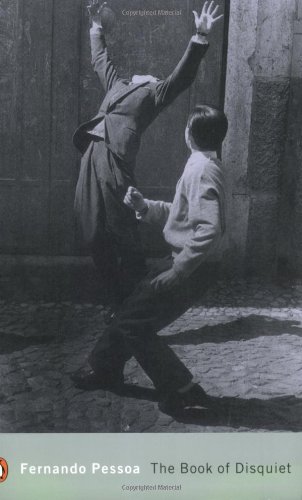
3. The Book of Disquiet (Penguin Classics)
by Fernando Pessoa
Paperback: 544 Pages (2002-12-31)
list price: US$17.00 -- used & new: US$9.18
(price subject to change: see help)
Asin: 0141183047
Average Customer Review: 4.5 out of 5 stars
Canada | United Kingdom | Germany | France | Japan
Editorial Review

Book Description
Fernando Pessoa was many writers in one. The Portuguese author attributed his work to literary alter egos that he called "heteronyms," each of which had a fully developed identity. When Pessoa died, he left behind a trunk filled with disorderly scraps of unpublished poems and unfinished works, among which was The Book of Disquiet. Published for the first time some fifty years after his death, this unique collection of short, aphoristic paragraphs comprises the "autobiography" of Bernardo Soares, one of Pessoa's alternate selves. Part intimate diary, part prose poetry, part descriptive narrative, captivatingly translated by Richard Zenith, The Book of Disquiet is one of the greatest works of the twentieth century.

Edited and Translated with an Introduction by Richard Zenith ... Read more

Customer Reviews (11)

3-0 out of 5 stars Tedium of Tediums, saith Pessoa
"Tedium", the most recurrent theme in these collections, by Pessoa's (or, excuse me, one of his "heteronym's") definition is the "serious disease of feeling there's nothing worth doing." Another one of these heteronyms remarks at an earlier point that "...the very idea of reading vanishes as soon as I pick up a book from the table."This, at any rate, was the effect this book had on me.Normally, I knock off a book of this length in a couple days.It's taken me a month now to complete.Every time I picked up this particular book, I said to myself, time and again, "What's the point?It's just going to be more tedious description of tedium."And I was quite correct.I think most readers would do well to heed another remark made in this book, to wit, that all this has been said before in the book of Ecclesiastes.He might have added that Ecclesiastes is much shorter, more moving and less redundant as well.

What saves The Book of Disquiet from being an utter wash is the conflict essential in it.Pessoa and his heteronyms, despite their sense of life's futility, love literature and words with such utter devotion that living life as if in a book seems the only hope of salvation from the torpor of existence:

"To see all things that happen to us as accidents or incidents from a novel, which we read not with our eyes but with life.Only with this attitude can we overcome the mischief of each day and the fickleness of events." P.211

This, and Pessoa's beautiful use of language, as translated by Robert Zenith in any event, save the day:

"We don't know if what ends with daylight terminates in us as useless grief, or if we are just an illusion among shadows, and reality just this vast silence without wild ducks that falls over the lakes where straight and stiff reeds swoon.We know nothing.Gone is the memory of the stories we heard as children, now so much seaweed; still to come is the tenderness of future skies, a breeze in which imprecision slowly opens into stars.The votive lamp flickers uncertainly in the abandoned temple, the ponds of deserted villas stagnate in the sun, the name once carved into the tree now means nothing, and the privileges of the unknown have been blown over the road like torn-up paper, stopping only when some object blocked their way.Others will lean out the same window as the rest; those who have forgotten the evil shadow will keep sleeping, longing for the sun they never had; and I, venturing without acting, will end without regret amid soggy reeds, covered with mud from the nearby river and from my sluggish weariness, under vast autumn evenings in some impossible distance.And through it all, behind my daydream, I'll feel my soul like a whistle of stark anxiety, a pure and shrill howl, useless in the world's darkness." P.179

Perhaps a bit on the belaboured side anent reeds and rivers and wild ducks---Still, never was meaningless death by sluggishness so gloriously apotheosized.Passages like this make the book worth reading, perhaps.But, caveat lector, don't expect to close the cover with any sense of enchantment.The book, cover to cover, is full of emptiness.


5-0 out of 5 stars All is here...
I am making the journey through The Book of Disquiet with much care and fear, and I think all that you can expect from literature is delivered here with unflinching honesty and heart-breaking tenderness.

Penetrating insight into social affairs, acute awareness of the chaotic absurdity behind the facade of human orderliness, sophist interrogations about universal truths, sadistic playing with one's own feelings, descriptive analysis of the tragic futility of all beings, unfathomable sadness in all human souls. All that was, all that is and all that will be are presented here in the lamenting prose from one of the greatest writers of the twentieth century.

1-0 out of 5 stars The Book of Pretentiousness
Nothing can prepare you for this work. No one in the history of literature has written with more pretentiousness and self-indulgence. How Pessoa can present himself as both pathetic and heroic at the same time is a miracle of narcissism. In contemporary terms this is like an adolescent blog. He dismally attempts to disguise his platitudes as lyrical profundity.

5-0 out of 5 stars What I said when it first came out in Britain!
IN THE popular literary imagination, Lisbon is famous for only earthquakes and fires. Quartet has transformed this reputation forever with the first British publication of Portugal's greatest 20th century writer. Reading it in 1991, one gets an exaggerated sense of what it was for Camus and Sartre to discover Kafka.

Devoid of a narrative line, this is really only half of the actual book. Most of Pessoa's writing was published posthumously: this is merely a selection of writings grouped by themes. Pessoa paints a picture of an existence blighted by boredom, decadence and despair.

5-0 out of 5 stars Don't die before read this book
I have read it at least 5 years ago and I can tell you for sure that you will never be free of this book's concepts, they will influence your thoughts for the rest of your life.

... Read more


4. Fernando Pessoa and Co.: Selected Poems
by Fernando Pessoa
 Paperback: 304 Pages (1999-04-01)
list price: US$14.00 -- used & new: US$8.00
(price subject to change: see help)
Asin: 0802136273
Average Customer Review: 4.5 out of 5 stars
Canada | United Kingdom | Germany | France | Japan
Editorial Review

Book Description

Fernando Pessoa (1888-1935) - a poet who lived most his life in Lisbon, Portugal, and who died in obscurity there - has in recent years gained international recognition as one of the greatest writers of the twentieth century. Now Richard Zenith has collected in a single volume all the major poetry of "one of the most extraordinary poetic talents the century has produced" (Microsoft Network's Reading Forum). Fernando Pessoa was as much a creator of personas as he was of poetry, prose, and criticism. He wrote under numerous "heteronyms," literary alter egos with fully fleshed identities and writing styles, who supported and criticized each other's work in the margins of his drafts and in the literary journals of the time. From spare minimalism to a revolutionary exuberance that recalls Leaves of Grass, Pessoa's oeuvre was radically new and anticipated contemporary literary concerns to an unnerving degree. The first comprehensive edition of Pessoa's poetry in the English language, Fernando Pessoa & Co. is a work of extraordinary depth and poetic precision. "Zenith's selection of Pessoa is a beautiful one-volume course in the soul of the twentieth century." -- Booklist
... Read more

Customer Reviews (12)

5-0 out of 5 stars VISIONAIRE
" The poet is a faker
Who's so good at his act
He even fakes the pain
Of pain he feels in fact "

As a Portuguese native I am, I must say that Fernando Pessoa was not only a writer, but is to this day a myth, be it in Portugal or abroad. One that thinks that Pessoa "has more name than merit" (as someone said some reviews before) isn't to blame, since he's not Portuguese and so he cannot even imagine what is to read and UNDERSTAND Pessoa's thoughts and poems in Portuguese. To read Pessoa in English or other non-portuguese language would be something like reading Walt Whitman in Portuguese (which would be, in fact, MUCH SIMPLER TO TRANSLATE, since there's no english word that cannot be translated into any other language, unlike Portuguese who has several): the essential (that is : THE SPIRIT AND MANERISM OF THE ORIGINAL LANGUAGE) would be lost.
I strongly advise anyone into poetry and visionarism or out of time characters to check out Pessoa. It will be a life long discovery, that's for sure.

5-0 out of 5 stars Alberto Caeiro.....
Note: This is part of a critical essay I wrote, which is to be found online at: idol.2ya.com

I have no ambitions and no desires.
To be a poet is not my ambition,
It's my way of being alone.


--Alberto Caeiro: 'The Keeper of Sheep'

Alberto Caeiro is Pessoa's first great heteronym. Caeiro is perhaps my favorite heteronym of the three; although, it is true, I recognize Alvaro de Campos poetic achievement as superior-- Caeiro is nonetheless the most endearing.

The best summarization of Caeiro is given by Pessoa himself: "He sees things with the eyes only, not with the mind. He does not let any thoughts arise when he looks at a flower...the only thing a stone tells him is that it has nothing at all to tell him...this way of looking at a stone may be described as the totally unpoetic way of looking at it. The stupendous fact about Caeiro is that out of this sentiment, or rather, absense of sentiment, he makes poetry."

In a letter written to his friend Adolfo Casais Monteiro, Pessoa described the birth of this heteronym: "[It] was March 8th 1914--I approached a high chest of drawers, and, taking a sheet of paper, I began to write, standing up, as I always write whenever I can. And I wrote thirty or so poems at a stroke in a kind of ecstatic trance, the nature of which I will not be able to define to you. It was the day of triumph in my life and I shall never succeed in living another like that. I opened with the title 'The Keeper of the Flock' ('O Guardador de Rebanhos'); and what followed was that someone emerged from within me, and whom I christened that very moment Alberto Caeiro. Forgive me for the absurdity of the following sentence: my master emerged from within me."


What makes Caeiro such an original poet is the manner he apprehends reality. He does not question anything whatsoever; he calmly accepts the world as it is. Caeiro is indeed a child of sorts: the recurrent themes, as a critic notes, to be found in nearly all Caeiro's poems are wide-eyed child-like wonder at the infinite variety of nature. He is free of metaphysical entanglements (as Campos and Pessoa himself are). Central to his world-view is the idea that in the world around us, all is surface: things are precisely what they seem, there is no hidden meaning anywhere.

He manages thus to free himself from the anxieties that batter his peers; for Caeiro ''things simply exist and we have no right to credit them with more than that.'' Our unhappiness, he tells us, springs from our unwillingness to limit our horizons. Caeiro in this sense is wise: he attains happiness by not questioning, and by thus avoiding doubts and uncertainties.

For Caeiro apprehended reality solely through his eyes, through his senses. What he teaches us is that if we want to be happy we ought to do the same. Octavio Paz called him 'the innocent poet'; true, he is innocent by our standards, and yet: does not his wisdom--experience-- consist precisely in his 'innocence'? Paz made a shrewd remark on the heteronyms: "In each are particles of negation or unreality. Reis believes in form, Campos in sensation, Pessoa in symbols. Caeiro doesn't believe in anything. He exists."

Caeiro is a wonderful invention; is there a poet before him who thinks, or rather, sees as he does? Poetry before Caeiro was essentially interpretative; what poets did was to offer us an interpretation of their perceived surroundings; Caeiro does not do this: instead, he attempts to communicate his senses, his feelings to us, without any interpretation whatsoever.

Caeiro teaches us to apprehend Nature differently; he asks of us, simply, to see what is before us. Poets before him would have made use of intricate metaphors to describe what was before them; not so Caeiro: his self-appointed task is to bring these objects to the reader's attention, as directly and simply as possible. Caeiro sought a direct experience of the objects before him.

It does not surprise us that Caeiro has been called an anti-intellectual, anti-Romantic, anti-subjectivist, anti-metaphysical...an anti-poet, by critics; Caeiro simply--is. He is in this sense very unlike his creator Fernando Pessoa: Pessoa was besieged by metaphysical uncertainties; these were, to a large extent, the cause of his unhappiness; not so Caeiro: his attitude is decidedly anti-metaphysical; he avoided uncertainties precisely by clinging single-mindedly to a certainty: his belief that there is no meaning behind things. Things simply--are.

Caeiro represents a primal vision of reality, of things. He is the pagan incarnate. Indeed Caeiro, Richard Zenith tells us, was not simply a pagan but 'paganism itself'.

The critic Jane M. Sheets, sees the insurgence of Caeiro--who was Pessoa's first heteronym-- as essential in founding the later poetic personas: "By means of this artless yet affirmative anti-poet, Caeiro, a short-lived but vital member of his coterie, Pessoa acquired the base of an experienced and universal poetic vision. After Caeiro's tenets had been established, the avowedly poetic voices of Campos, Reis and Pessoa himself spoke with greater assurance."

5-0 out of 5 stars From a Portuguease reader
I've read many of Pessoa's works and studied him at school. I remenber that after studying some very weel-know poets we reached Pessoa. I also remenber and i'll possibly never forget that after reading some of his poems i just exclaimed out loud "Ei, este gajo e um genio"-"ohh, this guy's a genious".
I write poetry for some years now and i'm always very critic about it. But Pessoa just seems to be ahead of our own critic, sometimes wondering in our own mind, How does he do that !?
Someone hear in Amazon was surprised by the reviews posted here and asked "Is he really that good, or is the translation not so good" Then he just asked if some portuguease reader could clarify it. Well i am portuguease and i tell you he is really that good or even better.
I try the best i can to be objective in my reviews but when we talk about Pessoa we talk about emotions and feelings. After all who can be indifferent to the work that some call the most beatifull writing in the world (Jean-Pierre Thibaudat) and others remember it as the most inspiring author of our time! If i have to be objective i shall say his poems gives me a shiver in my spine...his prose: a moment of silence with my innerself.
About coloquial language, at least the portuguese original texts are not, mostly if you compare them with other famous portuguese poets like Camoes or Bocage.
As to Caeiro`s poetry and other others heteronyms, it is simply his need to see things in a different perpective.
This is a man that recognized himself to have sacrificed his live, his soul, his hapinnes and his mental health to be remenbered, just so that someone, even if only a single person, would remember him. And here he is now...and here we are with him.
Pessoa is that kind of author that doesn?t carries his heart at his mouth and his cause at his pen, this is a very mental experience, a reflexion on basic feelings and senses, such a deep vision on subjectivism that just a man that baunces between the thin line of genious and madness would achieve.
It astonishes...

1-0 out of 5 stars Shoddy translation
I don't speak Portuguese, but I've read Pessoa in Italian translation, and I consider his poetry remarkably powerful.I would think that, based on linguistic similarities, Italian translations in general would be more faithful to the original Portuguese than English would be.
I bought this edition of Pessoa, translated by Richard Zenith, and was so terribly disappointed by the shoddiness of the translation that I was forced to write this review to defend Pessoa.Zenith fails miserably in conveying the sheer haunting power of Pessoa.Zenith's English is too colloquial for the task.Portuguese is not like Russian or Arabic:one would have to work fairly hard to make a translation this bad; or be awfully enamored of one's own poetical abilities, instead of being a faithful conduit of the original language.
You ought to read Pessoa, but find a better translation.

5-0 out of 5 stars Four heads are better than one
Just being himself wasn't good enough for Fernando Pessoa, so he divided himself into four distinct, invented personalities ("heteronyms") and wrote poetry from the perspective and in the style of each of them. This in itself is a remarkable feat of literary imagination.

The poetry itself (well, this translation of it) is startling. It's direct and plain-spoken for the most part, even allowing for the personality differences. It may look un-poetic, or even awkward, at first reading. But it sticks. Days after reading, you may find lines and phrases of Pessoa & Co. springing up spontaneously in your head, just because they're so sharp and to the point. Getting to know this multitudinous poet is an invigorating experience. Try it yourself. ... Read more


5. Book Of Disquiet, The
by Fernando Pessoa
Paperback: 304 Pages (2004-02-02)
list price: US$15.95 -- used & new: US$9.93
(price subject to change: see help)
Asin: 1878972278
Average Customer Review: 5.0 out of 5 stars
Canada | United Kingdom | Germany | France | Japan
Editorial Review

Book Description
The rediscovery in the 1990s of the Portuguese writer Fernando Pessoa (1888-1935) is reminiscent of the rediscovery of Kafka in the 1950s. Like Kafka, Pessoa left his work in disarray, much of it to be published posthumously. And Pessoa is fast becoming an icon of postmodernism, as Kafka was of modernism. Pessoa's mystique comes largely from his practice of writing under "heteronyms," each supplied with distinct biographies, life spans, even horoscopes. In The Book of Disquiet, Pessoa came as close as he would to autobiography. But this book is, like so much about Pessoa, an object of mystery. Left on disordered scraps of paper in a trunk, the fragments that make up The Book of Disquiet have no fixed sequence, and therefore each reader must make out of them a different text. This translation, published in hardcover by Pantheon in 1991, has been widely reviewed as the best available. ... Read more

Customer Reviews (13)

5-0 out of 5 stars Kierkegaard, Pessoa- how many of them are us?
The life - project of Pessoa in his making of multiple poetic alter egos, reminds of the life - project of Kierkegaard who explored various aspects of the religious life through use of alter egos often representing different faculties, approaches and moods of life. But if Kierkegaard's aim is to bring the reader to realization of what it might be to be in true connection with God, Pessoa's seems to be more to dissipate the notion of unique identity completely out of existence. Thus the fragments he shores around his own ruin and attributes to alter ego , heteronym Bernard Soares have within them a strong nihilistic self- and - world denying element.
Yet and here is the contradiction and the deeper truth they also reveal a kind of beauty both in perception and in the varied motion of the mental life itself. Lonely solitary lost fragmented Pessoa knows no human sacrifice like that of Kierkegaard with Regina, knows no dedication to his father's task of doing God's duty in the most ultimate way. He instead seems to reveal hidden realities as he conceals that beyond them all may well lie an eternal nothing. Kierkegaard is the many- selved servant of God, and Pessoa the many - selved servant of nothing more holy than human poetry.

5-0 out of 5 stars Pesoa's Kaleidoscope
Fernando Pesoa's genius lies within who Pesoa was as nil and not.He wasn't anyone. Only somene who continually writes in "disquiet" his persona's variable exegesis.The writing is in the book but the author who wrote it, Fernando Pesoa does not "feel himself" as actually being who he is. So, maybe he's actually a different author, with a different name who begins to write a different book. There's all of the writing there, its genius evident in the mystery of the writing itself. All the writing invested with absolute revelation ofnuminous absence. The absence is that of the author's presence.Magic?Truly.The author is not there.But he must be "there" because he has no choice but to write.What's the answer for the author who is finds himself as absent?He must undertake the creation of the abent author's presence.How?By literally creating a utterly unique form of literature. A literature whose grammar is of being literal by making it possible to write of the absence of an author to himself into a presence to be known as the once absent identity.Writing through a textual hermeticism capable of transmutation through written words of the emanation of an author as "logos," or the Word. "In the beginning there was the Word." Through the Word as logos, all identity is created in the appearance, ex nilho, of the writer mediated solely through himself in this the new logos of writing itself.Pesoa is not himself. He's a man who achieves glimpses of a unmanifest self-referential identity only through his books. In the work of writing these books, this identity is made manifest as the author's anamnesis.Seemingly he finds out (remembers) he is, and always was, a certain author he now "remembers" as himself as a manifested presence. An absolute genius manifested as the author himself being (repeatedly) annihilated through radical self-doubt.Only later remembering who he was as absolute presence never to be lost again. Until this is accomplished all of the laborious, literal negotiations must of necessity begin anew, and are written as literature whose search arises from absence's discontent becomes the new discourse as the art and improvisation of real identity forged in the alchemy of narrative.This peculiar narative reaveals itself as a lived experience of self-discovery.One man of many parts dismembered in his own identity become self-inflicted and religious. Pesoa's own holy inquisition seeking and finding the indentity he is spurious, a phantasm of derealized personality perpetually guilty of having a persona found lacking,Wriiten out in texts as being found guilty of the "heresy" of having an identity.Never before Pesoa has an identity crisis of infinite magnitude been witnessed in Pesoa absence made real presence in some of the 2OTH century's finest writing and poetry. of the 20TH century in The writing of a man named Fernando Pesoa. A man lost to himself, in search of the "person" underneath the name. Personality and identity as reality grounded in a mystery only to be known by itself: self found through words that are the artifacts of the self discovered. A genius lost to himself and calling his absent identity into gradual existence by a person's absence fading into a personality that's presented in multiple, shifting Heteronyms, or cases of terminal identity lost and regained.

5-0 out of 5 stars The beauty of this novel
Poetry often speaks to us; we see something in it, something recognizable, and it's like we are shown a piece of ourselves that had been hidden for a lifetime before. Finding Pessoa's *Book of Disquiet* was like finding a piece of myself. In the pages of this poetic novel you will find honesty, often self-disparaging, and you will find beauty in the smallest observation. However, be forewarned, this is not a book that should be picked up with the idea of light reading in mind. In fact, you may find that you have to put it down, repeatedly, to get away from it, to think, but you will always, always come back to it. Keep it close to hand.

5-0 out of 5 stars Thinking is absurd
"If i think, it all seems absurd to me; if i feel, it all seems strange; if i desire, he who desires is something inside of me."
Sums up the book perfectly. Pessoa explores one of his many personalities. "The Book of Disquiet" explains, in complete depth and faith, the beauty of a lonely, existential, moment by moment life. He explains the beauty that people forget. He explains the world, his perception, as if every moment were the last.
"The book of disquiet" is one of the most insightful books a person can read, but only if one has imagination and an ability to let go. Bernardo Soars, Pessoa's personality who wrote the book, is extreme and eccentric. It isn't easy reading, and it won't affect you if you can't overlook the fact that life doesn't go on like Soars'; that there is more in thinking, dreaming, and desiring than Soars admits. What makes the book so special is how Soars can forget everything but the thought and the moment, and how he can analyze and critique and put into words something that most of us forget to remember. "The book of disquiet" reminds me, at least, of how to appreciate my own mind. It is the only philosophy-like book that i enjoy (as yet) because it is the real thing and encompasses a forgotten part of real life.

5-0 out of 5 stars a master-priece from a tortured mind
there are few poets able to assume so many diferent personalites as Fernando Pessoa. But Bernardo Soares is not a diferent personality, is just the other side of his personnal mirror, an escape to his tortured soul. Probably that is why The Book of Disquiet is so universal, a portait of the human fears, an example of a lonely man,travelling across his own mind, looking at the world through the most ironic eyes. Fernando Pessoa was able to understand dissapointment and regreat in a intemporal way, as a natural part of human nature. So, this book has the ability to make you look inside yourself, guide by one of the best poets of all times! ... Read more


6. Education Of The Stoic, The
by Fernando Pessoa
Paperback: 128 Pages (2003-07)
list price: US$13.95 -- used & new: US$8.06
(price subject to change: see help)
Asin: 1878972405
Canada | United Kingdom | Germany | France | Japan
Editorial Review

Book Description
Description: "I transferred to Teive my speculations on certainty, which lunatics have in greater abundance than anyone." Portuguese author Fernando Pessoa (1888-1935) was a multitude of writers: his works were composed by "heteronyms," alter egos with distinct biographies, ideologies, influences, even horoscopes. The Education of the Stoic is the only work left by the Baron of Teive, who, having destroyed all his previous attempts at literary creation, and about to destroy himself, explains "the impossibility of producing superior art." The baron's manuscript is found in a hotel-room drawer - not unlike editor and translator Richard Zenith's own discovery, while conducting research in the Pessoa archives, of a small black notebook whose contents had never been transcribed. In it he found the missing pieces of this short but trenchant complement to Pessoa's major prose work, The Book of Disquiet. Pessoa himself noted that despite their dialectical differences, the middle-class author of The Book of Disquiet (assistant bookkeeper Bernardo Soares) and the aristocrat Teive, "are two instances of the very same phenomenon -- an inability to adapt to real life." "There are in Pessoa echoes of Beckett's exquisite boredom; the dark imaginings of Baudelaire (whom he loved); Melville's evasive confidence man; the dreamscapes of Borges" - Voice Literary Supplement "The humorist who never smiles and makes our blood run cold, the inventor of other poets and self-destroyer, the author of paradoxes clear as water, and like water, dizzying, the mysterious one who doesn't cultivate mystery, mysterious as the moon at noon, the taciturn ghost of the Portuguese midday - who is Pessoa?" - Octavio Paz ... Read more


7. A Centenary Pessoa
by Fernando Pessoa
Paperback: 336 Pages (2006-06-30)
list price: US$22.95 -- used & new: US$22.95
(price subject to change: see help)
Asin: 1857547241
Canada | United Kingdom | Germany | France | Japan
Editorial Review

Book Description

This collection of the work of Portuguese author Fernando Pessoa (1888–1935) is an essential introduction to the work of one of the most original European poets of the twentieth century. It includes translations of a broad selection of his poems and his extraordinary prose, as well as some of his original English writings. A major introductory essay by Octavio Paz, a critical anthology, two posthumous "interviews," and archived illustrations are also included, revealing the world of Pessoa in all its richness.
... Read more

8. Fernando Pessoa (Pocket Archives Series)
Paperback: 200 Pages (1997-05)
list price: US$12.95
Isbn: 2850255386
Average Customer Review: 5.0 out of 5 stars
Canada | United Kingdom | Germany | France | Japan

Customer Reviews (1)

5-0 out of 5 stars Creative Idea
This small little book is a clever idea.The book is a wonderful photographic biography of the great Portuguese poet from the 20th century - Fernando Pessoa.Even if one does not know anything about Pessoa, thisbook provides a wonderful pictorial view of what his life was.Here, onewill find pictures on almost every aspect of the poet's life, from hisbirth certificate, to family pictures, including pictures of letters, histypewriter, and terrific pictures of Lisbon in the early part of the 20thcentury.

Antonio Tabucchi introduction gives us a clear and well writtenexplanation of Fernando Pessoa's importance for the literature of the 20thcentury.I highly recommend this book.This is an excellent introductionto Pessoa. ... Read more


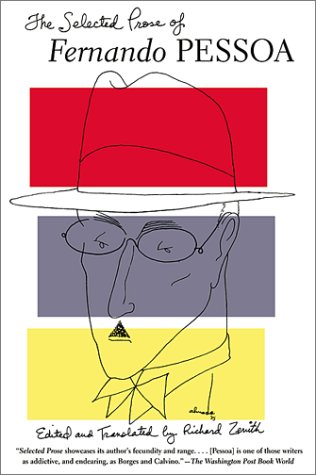
9. The Selected Prose of Fernando Pessoa
by Fernando Pessoa
Paperback: 368 Pages (2002-07-19)
list price: US$14.00 -- used & new: US$8.00
(price subject to change: see help)
Asin: 0802139140
Average Customer Review: 5.0 out of 5 stars
Canada | United Kingdom | Germany | France | Japan
Editorial Review

Book Description

The Washington Post Book World has written that Fernando Pessoa was "Portugal's greatest writer of the twentieth century [though] some critics would even leave off that last qualifying phrase" and "one of the most appealing European modernists, equal in command and range to his contemporaries Rilke and Mandelstam." The Selected Prose of Fernando Pessoa, a Los Angeles Times Best Book of 2001, spans playful philosophical inquiry, Platonic dialogue, and bitter intellectual scrapping between Pessoa and his many literary alter egos ("heteronyms"). The heteronyms launch movements and write manifestos, and one of them attempts to break up Pessoa's only known romantic relationship. Also included is a generous selection from Pessoa's masterpiece, The Book of Disquiet, freshly translated by Richard Zenith from newly discovered materials. The Selected Prose of Fernando Pessoa is an important record of a crucial part of the literary canon. "Zenith's selection is beautifully translated, compact while appropriately diverse." -- Benjamin Kunkel, Los Angeles Times "[Pessoa] is one of those writers as addictive, and endearing, as Borges and Calvino." -- Michael Dirda, The Washington Post Book World
... Read more

Customer Reviews (2)

5-0 out of 5 stars Notesof a genius
This book is full of genius and madness, which are nearly indistinguishable from one another.Like Kafka, Pessoa stands above his peers for his profound sense of humanity.He is also as singular as Kafka.Pessoa is a mystery, and his notes and letters further illustrate this.I am sorry that he died before the world would honor him as one of the Twentieth Century's greatest writers.However, Pessoa was well aware of his genius and the admiration of the world would have done nothing to convince him of his worth.He was already convinced!
Pessoa published little during his lifetime, but it was because he never submitted much of his work for publication.Apparetnly, the Portugese publishers still haven't published all of his works, either, and that is a shame.
One thing that stands out about this book is that Pessoa does not engage in any of the posturing that one might find in the works of other writers convinced of their genius.One senses that Pessoa considers his genius not in boast, but as if it were as unavoidable as his own face.It is fact to him; he cannot change it.His is a sad genius, not a violent genius.But do not pity him; he knew what he was doing.Pessoa was a man who knew what it meant to be a writer (that is, a perpetual other, an individual who can describe the world because he stands apart from it).
Pessoa is a wonder.Buy this book.I only wish it were the "Collected Prose" of Pessoa rather than the "Selected Prose."

One more note, if you are interested in Portugese literature you must read Anotnio Lobo Antunes, also published by Grove Press.A few of his works have been also translated by Richard Zenith (to whom I am grateful for his translations).If you like madness, madness in the Faulknerian sense, then you will love Lobo Antunes.

5-0 out of 5 stars An indispensable addition to the Pessoa oeuvre in English
Richard Zenith is my favourite translator of Pessoa; in this collection, he brings the insight and perspective he brought to his transcendant "Pessoa & Co." and "Book of Disquietude." The puckish nature of Pessoa's heteronym project is put into sharp relief: those who know only Pessoa/Soares may have thought the subsumption into heteronymology a sad affaire.

This collection complicates and deepens that perspective, with selections ranging from the whole of Pessoa's life, from the childhood Alexander Search to the elderly and Stoic Baron of Tieve, yet remains (as Pessoa remains) wholly delightful and charming. A Maria José even appears, in a letter "From A Hunchbacked Girl To A Metalworker" (a heartbreaking letter, I may add). Pessoa's possibly affected eccentricities is in full evidence here: witness the "Riddle Of The Stars," a kind of proto-"Changing Light At Sandover," wherein Pessoa receives otherworldly communiqués via automatic writing and the spirits exhort him repeatedly to lose his virginity. Other kicks: his "static drama" "O Marinhero" and Alvaro de Campos' "Ultimatum," where he personally attacks everyone responsible for World War I (and I mean, _everyone_).

Zenith's notes are indispensable (though he peculiarly abandons his "Disquietude" for "Disquiet," and chooses American English as his idiom). All in all, a welcome addition to the Pessoan archive in English, and a breathtaking array of further complications. ... Read more


10. The Book of Disquiet
by Fernando Pessoa
 Paperback: Pages (1998)

Asin: B000UW2LN2
Canada | United Kingdom | Germany | France | Japan

11. Dreams of Dreams and the Last Three Days of Fernando Pessoa
by Antonio Tabucchi, Nancy J. Peters
Paperback: 128 Pages (2000-05)
list price: US$10.95 -- used & new: US$6.75
(price subject to change: see help)
Asin: 0872863689
Average Customer Review: 2.5 out of 5 stars
Canada | United Kingdom | Germany | France | Japan
Editorial Review

Book Description

A City Lights / Italian Voices Book

"Elaborately imagined...mini-catalog of great artists' dreams and the author's interpretation of the last three days in the life of Portuguese poet Fernando Pessoa. Tabucchi's rich language and his magical-realist charm tinge the volume with a visionary glow."-Publishers Weekly

" A lovely little book that keeps ringing in your head long after you've finished it."-Kirkus

Chapter One

DREAM OF DAEDALUS,
ARCHITECT AND AVIATOR

One night, thousands of years ago, at a time impossible to calculate exactly, Daedalus, architect and aviator, had a dream.

He dreamed that he was deep inside an immense palace and he was going through a corridor. The corridor opened into another corridor and Daedalus, tired and confused, walked along it, leaning on the walls. When he had come to the end, the corridor opened into a small octagonal room, from which eight corridors branched out. Daedalus began to feel short of breath and a need for fresh air. He entered one corridor, but it ended against a wall. He went into another, but it too ended against a wall. Seven times Daedalus made an attempt until, on the eighth attempt, he entered a very long corridor that, after a series of curves and corners, led out into another corridor. Daedalus then sat down on a marble step and began to reflect. On the corridor walls were flaming torches that illuminated frescoes blue with birds and flowers.

I'm the only one who could know how to get out of here, Daedalus said to himself, and I don't remember. He took off his sandals and began to walk barefoot on the green marble floor.

To console himself, he began to sing an ancient dirge he had learned from an old servant who had rocked his infant cradle. The arcades of the long corridor carried his voice back to him ten times over.

I'm the only one who could know how to get out of here, said Daedalus, and I don't remember.

At that moment, he came out into a wide, circular room frescoed with absurd landscapes. He remembered that room but he couldn't remember why he remembered it. There were seats covered with luxurious fabrics and, in the middle of the room, a large bed. On the edge of the bed was seated ... Read more

Customer Reviews (2)

1-0 out of 5 stars Name-dropping is no substitute for creativity
I was very disappointed by the Tabucchi's Dreams.The author attempts to recreate the dreams of twenty or so canonical figures from Western civilization.I felt that author made no effort to penetrate the psyche of these great human beings.The dreams were recreated by an obviously shallow reading of bio-sketches.If you want to know what I mean, select one of the characters you know very well and read his dream.I am familiar with Debussy's music and have no qualms about suggesting that Debussy's dream is a mediocre parody of his "Prelude to the Afternoon of a Faun".

The same problems persist in the Last Three Days of Fernando Pessoa.This short work offended me more than the Dreams.I adore Pessoa and his poetry.It was heartbreaking to see all his heteronyms turn into colorless characters that stroll through this story.I consider Ricardo Reis to be the heteronym closest to Pessoa's personality.Unfortunately Reis comes back to the dying Pessoa to tell him that he didn't leave Portugal.Am I missing something here?? In short, any average reader of Pessoa can write a better book on the confrontations of the heteronyms with their creator.

4-0 out of 5 stars Another masterpiece from Antonio Tabucchi
This book is a collection of short stories of dreams of various major artists or influences on the arts - from Daedalus to Freud.It is a book that makes me wish to be more broadly educated in European literature - forwhen I was familiar with the biography and works of the individual, thematching of the imagined dream to the individual was more clear.Forexample, the dream of Federico Garcia Lorca picks up on his work regardingdeepsong.Lorca is on stage singing a Gypsy song "a song about duelsand orange groses, passion and death" ...A small black dog leads himtowards his death as a traitor ... The dream is a wonderful mix of clarityand chaotic jumps, as are real dreams.

Tabucchi writes in his normal tautprose - with wonderful lines to mull over: "Life is indecipherable,answered Pessoa.Never ask and never believe.Everything ishidden."

But this book, unlike his other works requires significantknowledge of his reader.If you've never read Tabucchi, I would suggestthat you begin with any of his other books.If you are a Tabucchi fan,this new book will not disappoint you. ... Read more


12. Selected Poems (Penguin Modern Classics)
by Fernando Pessoa
Paperback: 160 Pages (2000-11-30)
list price: US$21.35 -- used & new: US$13.97
(price subject to change: see help)
Asin: 0141184337
Average Customer Review: 5.0 out of 5 stars
Canada | United Kingdom | Germany | France | Japan

Customer Reviews (1)

5-0 out of 5 stars Four poets as one
Pesssoa is unique as a poet in that he generously scatters himself into the identities of three other people. The four heteronyms dominate his character.He searches for objective truth.
Here is an excerpt.
have no ambitions and no desires.
To be a poet is not my ambition,
It's my way of being alone.
... Read more


13. Poemas - Fernando Pessoa
by PESSOA FERNANDO
Paperback: Pages (2007)
-- used & new: US$20.50
(price subject to change: see help)
Asin: 9500307375
Canada | United Kingdom | Germany | France | Japan
Editorial Review

Product Description
En Pessoa todo combate con algo. todo choca con su opuesto. y a veces se agita. o se supera. o se apaga. no sin antes haberse fortalecido. Después vuelve a ponerse en duda.Pessoa es la alternativa: otro universo posible . dice Marcelo Cohen en el prólogo donde se aproxima a la escritura y a la acaso torturada existencia del formidable poeta portugués. Acechado por la locura. alcohólico. marcado por la temprana muerte de su padre. Pessoa (1888-1935) escribió con distintos nombres para escapar. quizá. de su propia voluntad. No soy nada. nunca seré nada . dijo de sí mismo. descreído del valor de su obra.Por el hecho de haber sido escritos. de ser tan nítidos como para conmovernos de distintas maneras en cada lectura -y de conmovernos integralmente-. los poemas de Pessoa demuestran que no estamos condenados a ser siempre los mismos; tampoco él fue siempre el mismo. sino una verdadera asamblea de poetas. cada uno con una obra completa que no terminará de leerse nunca. ... Read more


14. Sheep's Vigil by a Fervent Person: A Translation of Alberto Caeiro/Fernando Pessoa's O Guardador de Rebanhos
by Eirin Moure
Paperback: 144 Pages (2001-04-01)
list price: US$14.95 -- used & new: US$10.82
(price subject to change: see help)
Asin: 0887846602
Canada | United Kingdom | Germany | France | Japan
Editorial Review

Book Description
A temporary move to Toronto in the winter of 2000, a twisted ankle, an empty house-all inspired Mouré as she read Alberto Caeiro and Fernando Pessoa's classic long poem O Guardador de Rebanhos. For fun, she started to translate, altering tones and vocabularies. From the Portuguese countryside and roaming sheep of 1914, a 21st century Toronto emerged, its neighborhoods still echoing the 1950s, their dips and hollows, hordes of wild cats, paved creeks. Her poem became a translation, the jubilant and irrepressible vigil of a fervent person. "Suddenly," says Mouré impishly, "I had found my master." Caeiro's sheep were his thoughts and his thoughts, he claimed, were all sensations. Mouré's sheep are stray cats and from her place in Caeiro's poetry, she creates a woman alive in an urban world where the rural has not vanished, where the archaic suffuses us even when we do not beckon it, and yet the present tense floods us fully. In this ecstatic long poem of hope and creeks and cats and rain, Sheep's Vigil by a Fervent Person catches Governor General's Award-winner Erin Mouré at her most playful and ingenuous-and wearing her Galician name. ... Read more


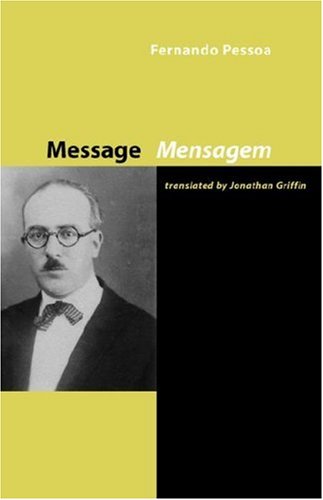
15. Message
by Fernando Pessoa
Paperback: 112 Pages (2007-09-15)
list price: US$15.00 -- used & new: US$13.70
(price subject to change: see help)
Asin: 190570027X
Average Customer Review: 5.0 out of 5 stars
Canada | United Kingdom | Germany | France | Japan
Editorial Review

Book Description
Message ("Mensagem") was the only book of verse in his own language that Pessoa saw through the press in his lifetime. On the face of it, a patriotic sequence steeped in 'Sebastianismo', the poems offer much more than this, the Kings and navigators of the Portugal's history standing as avatars of the poet's self, their explorations and heroic deeds projections of the poet's inner creative life. Although Pessoa is famous for the many heteronyms under which he composed verse in wildly different styles, this volume was published under his own name - the 'orthonym', as he defined it - and it remains one of his great masterpieces. This edition brings Jonathn Griffin's fine translation (originally published by the Menard Press in 1992) back into print, as part of Shearsman's Pessoa edition. ... Read more

Customer Reviews (4)

5-0 out of 5 stars The portrait of a nation
If you are wondering how the portuguese are like, Pessoa's book will give you a hint. Unfortunately things haven't changed much since the author's time. Once a great nation of sailors and of a great world wide empire, nothing remains but a dull far away memory of what we were. We tend to live to much from the glories of the past without ever thinking of the possible glories of the future. We live in the shadow of Camões's epic poem "Os Lusíadas" still thinking it was the greatest portuguese literary work ever written. On the 25th of April 1974 a new generation raised from the fall of a dictatorship of almost 30 years. But those who gave birth to the revolution are now those who perpetuate the social differences between rich and poor, good and bad, high and low. Ironic isn't it? As Pessoa, I still have hope. This people is made of hope although lacking some iniciative to actually make a difference... If something goes wrong, blame it on the government. If something goes right, thank God for it. The Fifth Empire hasn't arrived yet, and I hardly think it ever will.
Pessoa is one of the greatest portuguese writers of all time but he's not the only one. I also reccomend (if a translated version is available)Mário de Sá-Carneiro, José Saramago, Virgílio Ferreira, Eça de Queiroz, Antero de Quental. These are the so-called classics, just to get you started in the discovery of portuguese literature.

4-0 out of 5 stars For those with knowledge
The poetry is cunningly crafted, but I am not sure how well the translation really stands up, as I read it in the native Portuguese.

Those who have never studied Portuguese history will probably rate this only a 2 or three statrs, but those who have studied Portuguese history in depth and have developed a sense for the sentiment of the nation will be amazed at how Pessoa has managed to capture the flavour and emotion of centuries of a nation's past into his clever verses.

I give it four stars as it is a translation. The portuguese version gets five and then some.

5-0 out of 5 stars Indispensável - Essencial
Indispensável, não apenas para os portugueses, mas também para os brasileiros e falantes do Português em geral.

Essencial to all portuguese speakers.

5-0 out of 5 stars A Alma Portuguesa
Indispensável para quem seja português ... Read more


16. The Collected Poems of Alberto Caeiro
by Fernando Pessoa
Paperback: 200 Pages (2007-10-01)
list price: US$20.00 -- used & new: US$18.28
(price subject to change: see help)
Asin: 1905700245
Canada | United Kingdom | Germany | France | Japan
Editorial Review

Book Description
This is the only integral collection of Pessoa's Caeiro heteronym in English, and the poems are accompanied by theintroductions of Ricardo Reis and a memoir by Álvaro de Campos, two of Pessoa's other major poetic heteronyms, as well as a poem dedicated to Caeiro by Coelho Pacheco, believed by many commentators to be another one-off heteronym.Ricardo Reis says: "Alberto Caeiro da Silva was born in Lisbon on April 16, 1889, and died of tuberculosis in the same city on (. . .), 1915. He spent nearly all his life in a village in Ribatejo, and only returned to the city of his birth in his final months. In Ribatejo he wrote nearly all his poems . . ."Fernando Pessoa was educated in English in Durban, as the stepson of a Portuguese diplomat, and was completely bilingual. During his lifetime he was to publish only one collection of his poems in Portuguese, although many appeared in literary journals, under a number of alter egos, or heteronyms, chief amongst them Alberto Caeiro, Alvaro de Campos and Ricardo Reis. At his death in 1935, Pessoa left more than 20,000 manuscripts - poetry and prose - in a large trunk, the contents of which are still being transcribed and deciphered to this day. He is the greatest modern poet in the Portuguese language, but always considered himself a poet in the English tradition. ... Read more


17. Man Who Never Was: Essays on Fernando Pessoa
 Hardcover: Pages (1982-09)
list price: US$17.50
Isbn: 0943722071
Canada | United Kingdom | Germany | France | Japan

18. Melhores Poemas de Fernando Pessoa, Os
 Paperback: Pages (2001)

Isbn: 8526000535
Canada | United Kingdom | Germany | France | Japan

19. El caso clínico de Fernando Pessoa
by Ramón] Tr.; [Ebeshardt, Carmen A.; Saraiva, Mario Atienza
 Paperback: Pages (1996-04-30)
-- used & new: US$22.57
(price subject to change: see help)
Asin: 8487198317
Canada | United Kingdom | Germany | France | Japan

20. Oscar Wilde, Fernando Pessoa, and the art of lying.(Critical essay): An article from: Portuguese Studies
by Mariana de Castro
 Digital: 53 Pages (2006-09-22)
list price: US$9.95 -- used & new: US$9.95
(price subject to change: see help)
Asin: B000WE299E
Canada | United Kingdom | Germany | France | Japan
Editorial Review

Book Description
This digital document is an article from Portuguese Studies, published by Thomson Gale on September 22, 2006. The length of the article is 15851 words. The page length shown above is based on a typical 300-word page. The article is delivered in HTML format and is available in your Amazon.com Digital Locker immediately after purchase. You can view it with any web browser.

Citation Details
Title: Oscar Wilde, Fernando Pessoa, and the art of lying.(Critical essay)
Author: Mariana de Castro
Publication: Portuguese Studies (Magazine/Journal)
Date: September 22, 2006
Publisher: Thomson Gale
Volume: 22Issue: 2Page: 219(33)

Article Type: Critical essay

Distributed by Thomson Gale ... Read more


  1-20 of 100 | Next 20
A  B  C  D  E  F  G  H  I  J  K  L  M  N  O  P  Q  R  S  T  U  V  W  X  Y  Z  

Prices listed on this site are subject to change without notice.
Questions on ordering or shipping? click here for help.

site stats