
|
Help |
| Home - Authors - Queneau Raymond (Books) | |
e99 Online Shopping Mall
|
|
Help |
| Home - Authors - Queneau Raymond (Books) | |
| 1-20 of 100 | Next 20 |
click price to see details click image to enlarge click link to go to the store
| 1. Exercises in Style by Raymond Queneau | |
 | Paperback: 204
Pages
(1981-02-17)
list price: US$12.95 -- used & new: US$7.25 (price subject to change: see help) Asin: 0811207897 Average Customer Review: 
Canada | United Kingdom | Germany | France | Japan |
|
Editorial Review Product Description Customer Reviews (25)
| |
| 2. The Last Days: A Novel (French Literature) by Raymond Queneau | |
 | Paperback: 237
Pages
(1996-09)
list price: US$11.95 -- used & new: US$1.48 (price subject to change: see help) Asin: 1564781402 Average Customer Review: 
Canada | United Kingdom | Germany | France | Japan |
|
Editorial Review Product Description Customer Reviews (2)
| |
| 3. Heartsnatcher by Boris Vian | |
 | Paperback: 245
Pages
(2003-10-03)
list price: US$14.95 -- used & new: US$8.67 (price subject to change: see help) Asin: 1564782999 Average Customer Review:
Canada | United Kingdom | Germany | France | Japan |
Customer Reviews (8)
| |
| 4. The Sunday of Life by Raymond Queneau | |
 | Paperback: 180
Pages
(1977-01-01)
list price: US$18.95 -- used & new: US$13.67 (price subject to change: see help) Asin: 0811206467 Average Customer Review:
Canada | United Kingdom | Germany | France | Japan |
Customer Reviews (3)
Valentin Bru is a retiring private soldier in Bordeaux, a veteran of colonial warfare singled out for marriage by a middle-aged merceress whom he has never met.Bru's sole desire is to be a street sweeper, but soon inherits a frame-selling shop in Paris.An earlier visit to the city on a honeymoon he had to take on his own because of his wife's concern for business, saw him engaged in farcical adventures ending up coincidentally at the funeral of his mother-in-law's younger lover.Now in his shop, he becomes a kind of confessional for the local traders, passing on the information to his wife who, unknown to him, has become a clairvoyant. So far, so funny.The novel proceeds with Queneau's usual gorgeous style, that decaptively loose mix of vernacular and circumlocution that creates comedy by over-verbalising the banal, or pitting his hero's innocence and good faith against the cynical, or customs he simply doesn't understand. Soon, however, time intrudes, as Valentin acts on a desire to 'trap' time, to follow the long hand of a clock without losing himself in reveries or distractions.The title derives from Hegel, whose spirit haunts the book, and refers, apparently, to a point where history ends and everyday is like Sunday, a timeless realm of pure consciousness.Or something.I don't know anything about Hegel, you'd have to look it up.Certainly, there are at least two strands of time in the novel, the world of the late 30s, Nazism, the impending Fall of France, and the seemingly detached present tense Valentin seems to float through.this is reinforced by a plot withfortune tellers and a hero who predicts a coming war in a 1952 novel that knows he's right. Philosophers will probably enjoy all this - the rest of us can relish the simpler pleasures: linguistic play; deadpan funny characters; deadpan silly, almost irrelevant comic situations; deadpan dialogue; a sunny love of Paris.
| |
| 5. The Blue Flowers (New Directions Paperbook) by Raymond Queneau | |
 | Paperback: 232
Pages
(1985-04)
list price: US$16.95 -- used & new: US$8.50 (price subject to change: see help) Asin: 0811209458 Average Customer Review:
Canada | United Kingdom | Germany | France | Japan |
Customer Reviews (6)
Is one dreaming the other? That is the basic conceit of this lavishly surreal and philosophically-rich novel. I espeially recommend this title to readers who enjoy books by Italo Calvino, Umberto Eco & Georges Perec. Did I mention the talking horses?
| |
| 6. Chiendent by Raymond Queneau | |
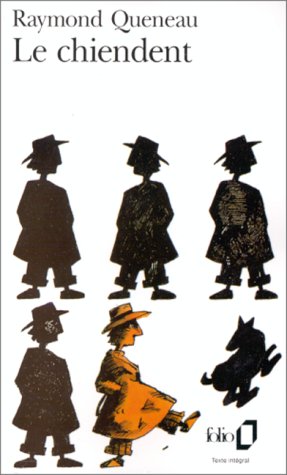 | Mass Market Paperback: 431
Pages
(1933-12)
list price: US$22.95 -- used & new: US$5.00 (price subject to change: see help) Asin: 2070365883 Canada | United Kingdom | Germany | France | Japan |
| 7. Naming and Unnaming: On Raymond Queneau (Stages) by Jordan Stump | |
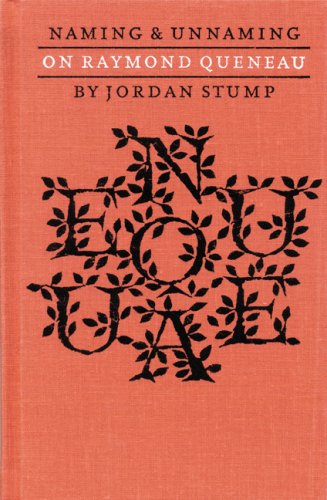 | Hardcover: 193
Pages
(1998-10-01)
list price: US$45.00 -- used & new: US$14.50 (price subject to change: see help) Asin: 0803242689 Canada | United Kingdom | Germany | France | Japan |
|
Editorial Review Product Description From the idea that the names of characters offer a more immediate and perhaps even a more intimate understanding of their souls than we might glean from their words and deeds has grown the broad field of inquiry known as literary onomastics. Stump argues that there is another approach to the literary proper name, one that concentrates not on the meaning of names but on the meaning of the use of those namesthe ways in which the characters and narrator of a novel address or refer to others. Naming and Unnaming considers the literary and philosophical implications of names and naming. Stump examines four issues in Queneau’s novelsthe nature of writing and of creation in general, the possibility or impossibility of knowledge, the relationship between the individual and the group, and the uses of power and controlin relation to which naming emerges as a force both powerful and utterly impotent. By exploring these forces and their evocation, Stump reveals the complexity of both the act of naming and the novels of Queneau. | |
| 8. Zazie in the Metro by Raymond Queneau | |
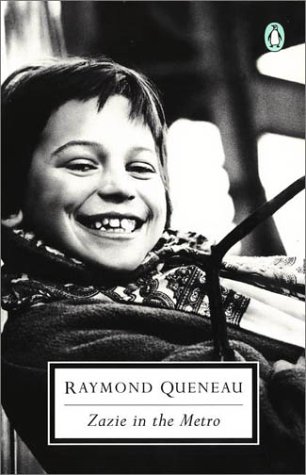 | Paperback: 176
Pages
(2001)
-- used & new: US$6.65 (price subject to change: see help) Asin: 0142180041 Average Customer Review:
Canada | United Kingdom | Germany | France | Japan |
Customer Reviews (10)
I pity poor translator Barbara Wright -- author Raymond Queneau's preferred translator, from what I understand -- for what must have been buckets of perspiration shed in what could have only worked as a labor of love. After all, this is a book is more about language and dialogue than it is about anything that could be mistaken for a plot. The other main source of Zazie in the Metro's charm comes from its unusual roll call of characters. Aside from the always-interesting Zazie, the book offers the quixotic and curious "Unkoo" Gabriel, his dour sometimes foil Gridoux, and even a parrot called Laverdure, whose solitary line -- "Talk, talk, that's all you can do" -- seems to get blurted out only with exceptional timing. It's easy to understand how this colorful tale inspired a generation of French readers and writers. It is even said to have had a hold on Jean-Pierre Jeunet, the director of the wonderful and similarly playful film, Amelie. Compared to all this, the plot of this story hardly seems worth mentioning: young Zazie comes to Paris to visit her uncle, but what she really wants to do is ride on the metro for the first time. Because of a strike, she can't, and she compensates with a string of other adventures. Up until this point, I know, this does not sound like a three-star review (or three and a half, if that had been possible). I have given Zazie in the Metro what amounts to a so-so rating for reasons I am not too sure how to describe. The best explanation I can come up with is that despite all of the positive points made here, the book just failed to capture me; I never felt like I was part of the story. Somehow, its 157 pages seemed quite a bit longer, and sometimes the action became confused or obscured because of the clever word play. It was like a meal based on ingredients I adore, but which don't quite seem to work well together.
(Note: Queneau is, I think, an underappreciated genius. You can find out more about him by looking up the book "The OULIPO COMPENDIUM" here at Amazon, which contains his extraordinary "One-hundred-trillion sonnets." "Oulipans: rats who build the labyrinth from which they plan to escape" -- Raymond Queneau). Zazie is less of a labyrinth and more of a amusement park, a good introduction to this imaginative writer. Probably not for those easily offended (nor is "Zazie" herself), but a little treasure worth looking for ... Read more | |
| 9. Saint Glinglin by Raymond Queneau, James Sallis | |
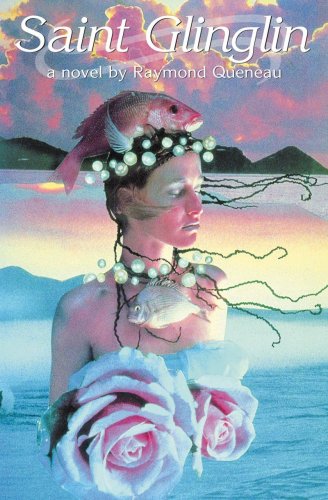 | Paperback: 169
Pages
(2000-05)
list price: US$11.95 -- used & new: US$7.22 (price subject to change: see help) Asin: 1564782301 Canada | United Kingdom | Germany | France | Japan |
|
Editorial Review Product Description | |
| 10. Pierrot Mon Ami (French Literature) by Raymond Queneau | |
 | Paperback: 159
Pages
(2005-03-30)
list price: US$11.95 -- used & new: US$6.94 (price subject to change: see help) Asin: 1564783979 Average Customer Review:
Canada | United Kingdom | Germany | France | Japan |
|
Editorial Review Product Description Customer Reviews (3)
'Pierrot' has slightly more reference to the Occupation than Queneau's other novels in the period - a fire razing a giant amusement arcade is said to have been started by one of the attractions, burning chairoplanes; an uproarious journey with a boar and a chimp is arguably a figure for anti-Semitism; a bottle of Vichy water is pronounced disgusting. Another point of reference might be Sartre's famous short story 'The Wall'.Pierrot's imprisonment may be more metaphorical than actual - he is condemned to walk the same streets every day; on the one occasion he leaves, the rest of the book's cast go with him, while the strangers he meet used to work in the area - but it provokes the same Nietzchean laughter. I point this out to show how much 'Pierrot' is of its time - Queneau is often dismissed for refusing to 'engage'.In any case, 'Pierrot' is a supremely anti-Nazi book, with its shifting perspectives, its formal games, its narrativeand semantic gaps, its instability of character, refusing the reader the reassurance of fixity or authority. But if 'Pierrot' is of its time, it's also ahead of it.Together with Nabokov's 'The Real life of Sebastian Knight' and Borges' Ficciones, Queneau was at this moment pioneering anti-detective fiction, that genre later populated by Pynchon, Calvino, Eco, Sciascia et al, where the conventional rules of the detective story are invoked (a mystery, investigation), but its ideological function is displaced (resolution, restoration of social order). 'Pierrot' is full of mysteries - who was the woman Jojo Mouilliminche died for?Who was the Paldovian prince whose tomb Mouzzenergues faithfully curates?Who burned the Uni-Park where philosophers pay and brawl to see brief glimpses of female flesh, the hero is sporadically employed, and where he meets the boss's daughter who will sleep with everyone but him (well, he is a pierrot)?Are these things connected?There is a proliferation of clues, coincidences and patterns, but, perhaps because of the Occupation, there is less faith in the restorative powers of the genre. Instead of fixing things in their proper place, 'Pierrot' is a book that celebrates play - every character is in some way connected to performance, and their every appearance is like a 'bit' or 'act' on the novel's stage.
| |
| 11. Witch Grass by Raymond Queneau | |
 | Paperback: 328
Pages
(2003-01-31)
list price: US$14.95 -- used & new: US$7.18 (price subject to change: see help) Asin: 1590170318 Average Customer Review:
Canada | United Kingdom | Germany | France | Japan |
|
Editorial Review Product Description Customer Reviews (2)
| |
| 12. We Always Treat Women Too Well (New York Review Books Classics) by Raymond Queneau | |
 | Paperback: 200
Pages
(2003-01-31)
list price: US$14.00 -- used & new: US$7.92 (price subject to change: see help) Asin: 159017030X Average Customer Review:
Canada | United Kingdom | Germany | France | Japan |
|
Editorial Review Product Description Customer Reviews (3)
For more information this book isa part of another which title is "the private diary of SallyMara" which is really worthwhile to read. ... Read more | |
| 13. The Flight of Icarus (New Directions Books) by Raymond Queneau | |
 | Paperback: 191
Pages
(1973-11)
list price: US$12.95 -- used & new: US$7.00 (price subject to change: see help) Asin: 0811204839 Average Customer Review:
Canada | United Kingdom | Germany | France | Japan |
Customer Reviews (2)
| |
| 14. Exercices De Style (French Edition) by Raymond Queneau | |
 | Mass Market Paperback: 158
Pages
(1995-06)
-- used & new: US$6.60 (price subject to change: see help) Asin: 2070373630 Canada | United Kingdom | Germany | France | Japan |
| 15. The Lyric Encyclopedia of Raymond Queneau by Jane Alison Hale | |
 | Hardcover: 190
Pages
(1990-03-15)
list price: US$39.50 -- used & new: US$150.35 (price subject to change: see help) Asin: 0472101277 Canada | United Kingdom | Germany | France | Japan |
| 16. Raymond Queneau, un poète by Raymond Queneau | |
 | Mass Market Paperback: 135
Pages
(2001-03-14)
-- used & new: US$15.72 (price subject to change: see help) Asin: 2070546306 Canada | United Kingdom | Germany | France | Japan |
| 17. Raymond Queneau: Poems (Unicorn French Series, V. 11) (English and French Edition) by Raymond Queneau, Teo Savory | |
| Paperback: 55
Pages
(1971-12)
list price: US$9.95 Isbn: 0877750041 Canada | United Kingdom | Germany | France | Japan | |
| 18. Stories and Remarks (French Modernist Library) by Raymond Queneau | |
 | Paperback: 159
Pages
(2000-08-01)
list price: US$15.00 -- used & new: US$5.00 (price subject to change: see help) Asin: 0803288522 Average Customer Review: 
Canada | United Kingdom | Germany | France | Japan |
|
Editorial Review Product Description Raymond Queneau—polyglot, novelist, philosopher, poet, mathematician, screenwriter, and translator—was one of the most significant figures in twentieth-century French letters. His work touches on many of the major literary movements of his lifetime, from surrealism to the experimental school of the nouveau roman. He also founded the Oulipo, a collection of writers and mathematicians dedicated to the search for artificial inspiration via the application of constraint. Customer Reviews (1)
"Dino" is the story of an invisible dog accompanying its master on long walks in Portugal.The dog reappears in "At the Forest's Edge" - a story of a nearly deserted hotel with no cook and a sexually agressive daughter. "In Passing", a personal favorite among these texts, tells the story of a couple, a beggar and a passerby twice - changing the gender of the roles between the two tellings. "The Cafe de La France" is a bleak view of Le Havre as decimated by the war - a very effective piece mulling over writing and childhood in the context of the ruined city. "The Trojan Horse" occurs in a bar where a horse from Troyes insists on purchasing drinks for a couple drinking only water and planning to "hit up" an aunt for financial assistance. "Green With Fright" combines wordplay and dream in the story of a man unable to leave the bathroom because of his fear of the nothingness lurking in the hallway. "Conversations in Greater Paris" is "found poetry" i.e. an assemblage of bits and pieces of conversations captured in the author's notebooks. "Texticles" is a collection of short pieces based in some sense on word play, rhetoric, semantics - they are an excellent example of playing with words as a media rather than as a tool of communication. "A Story of Your Own" is an early example of a tree-structure story in which after each piece of the tale, you are offered options as to what should come next. "Some Brief Remarks Relative to the Aerodynamic Properties of Addition" is a piece that considers the movement of numbers and arithemetic symbols due to the force of the wind ... an absolute delight. "Dream Accounts Aplenty" is a series of short dream accounts told as an example of the shortcomings of dreams as the "stuff" of writing. The other pieces are as diverse as the ones I have mentioned.Don't read this as a relaxing narrative - it isn't; do read this as an exploration of the use of language and narrative. ... Read more | |
| 19. Les\Fleurs Bleues by Raymond Queneau | |
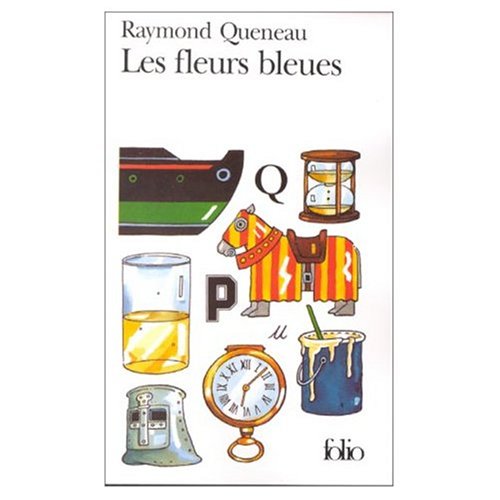 | Paperback:
Pages
(1978-10-01)
list price: US$24.95 -- used & new: US$24.95 (price subject to change: see help) Asin: 0828837716 Canada | United Kingdom | Germany | France | Japan |
| 20. Odile by Raymond Queneau | |
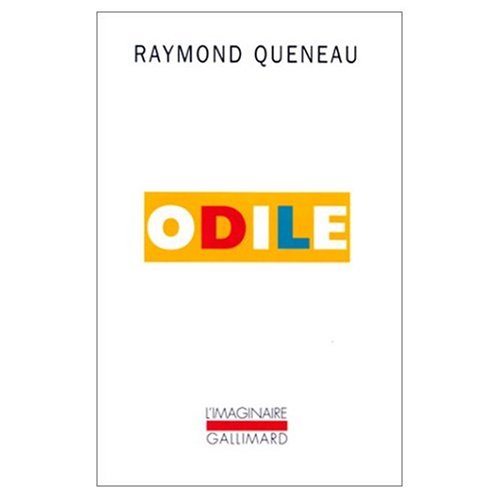 | Paperback: 196
Pages
(1992-10-01)
list price: US$24.95 -- used & new: US$24.95 (price subject to change: see help) Asin: 0686546792 Average Customer Review: 
Canada | United Kingdom | Germany | France | Japan |
|
Editorial Review Product Description Customer Reviews (4)
Queneau does a brillant job of showing the absurdity and humor in everything that happens in Odile. From the beginning there's a laugh when Roland states that his fellow soldiers "are really good guys and all capable no doubt of making really good butchers". The bohemians are seen as ineffectual idiots more interested in preaching to their own circle of disciples than improving the common people. They're the same posers you see nowadays in cafes preaching to each other about the sad state of humanity but having no effect upon their fate. Roland sees all this but goes along with the different movements, at least superficially. At one point he visits a seance where the spirit of Lenin is summoned and as he walks out he comments how pathetic the spectacle was. Even Roland is guilty, spending 8-12 hours a day in his apartment working with mathematical problems. He has spent years in the belief that he is a latter day Isacc Newton or an Einstein who will discover the true nature of reality through mathematics and physics. He's also too proud to admit he's in love with Odile. It wouldn't be in keeping with his image if anyone knew he was in love. At the end of the book he has a vision of what he truly is and he snaps out of the childish games of his adulthood. This novel is funny, and I mean that in the humorous sense. The characters are a little weak except for Roland but that's to be expected in an autobiographical work. The beginning and the end of the novel pack more punch than the middle. The crisis of identity is equal to The Stranger in some passages but here we have a happy ending. A realization of meaning. Or IS it a happy ending? Roland decides to live a "normal" life and dismisses any rebellion against society as a childish act of defiance and a losing battle. You have to be assimilated sooner or later.
Travy, returned from two years military service in a mostly clerical position, subsists in Paris on an allowance from a gay, ex-colonial uncle, conducting obscure mathematical research, lost in a fug of solipsism, passivity and a lack of self-esteem.He drifts in with a group of petty criminals, where he meets another bourgeois abscondee, Odile, and, with equal passivity, gets involved with the Infrapsychics, an eccentric group of intellectuals who hope to provoke revolution through liberating the unconscious and the irrational. For such a small book, 'Odile' is many things: a damning account of French colonialism in North Africa - the opening scenes depicting the crushing of a local rebellion in Morocco are frightening precisely because of their un-Tolstoyan vagueness; a satire/critique/fond evocation of political and cultural life in 1920s Paris, all the groups, -isms, infighting, experiments, flirting with Communism - in particular the Surrealists, to whom Queneau was briefly affiliated (he married Andre Breton's sister), relentlessly lampooning their arbitrary games and theories, while admitting the creative debt he owes them; a love story, postponed by a hero who 'despises' bourgeois notions like 'love' and 'marriage'; and the bildungsroman of an artist who goes along with whatevercomes his way, be it the army, the Infrapsychics, criminals, Communists etc., always unhappy, but never taking the active step thta might transform his, or reconcile him to, life. Fans of Queneau's more linguistically playful works like 'Zazie' and 'Exercises of Style' might find 'Odile' disappointing.As a love story, the figure of Odile is too idealised and symbolic to be affecting; the satire on Surrealism and its cultural milieu is too laboured and obvious to be laugh-out-loud (although this might be a problem with the flat translation: Queneau needs someone as recklessly inventive as Barbara Wright to survive in English) - there is fun to be had in recognising the fictionalised Breton, Aragon, Eluard etc., and there is an Alice-like court hearing, in which the magistrate starts interrogating Travy about Fermat's last theorem and the 'excluded middle'; the narrative of maturity is blunted by the narrator's rather unsympathetic personality, even if his aesthetics of mathematics is frequently, to this ignoramous, enrapturing, and his struggle to record his memories, imperfectly exploring the landscape of his mind with as many black holes as open spaces, is very poignant. 'Odile' has been called 'gentle', but what is most immediately apparent is the sadness and emptiness behind the logorrheic comedy.Where 'Odile' succeeds is formally and philosophically.It lacks the set-pieces of 'Zazie', but there is the same dizzying, elliptical style, what Gilbert Adair calls Queneau's 'jump cuts', the same telescoping and contracting of narrative time and space, that can be disorienting and liberating. The novel opens with a beautiful paragraph about the narrator's (re?)birth, at 21, walking down a muddy road skirting a North African town, the rain just stopped, the last clouds caught fleeing in a puddle.Straight ahead of him stands an Arab, possibly a nobleman, a philosopher or a poet, staring at something.What that something might be, for the narrator, the reader, the novelist, the book, is what 'Odile' movingly explores. ... Read more | |
| 1-20 of 100 | Next 20 |
 A highwayscribery "Book Report"