e99 Online Shopping Mall

Geometry.Net - the online learning center Help  
Home  - Authors - Sallust (Books)

  1-20 of 100 | Next 20
A  B  C  D  E  F  G  H  I  J  K  L  M  N  O  P  Q  R  S  T  U  V  W  X  Y  Z  

click price to see details     click image to enlarge     click link to go to the store

$7.90
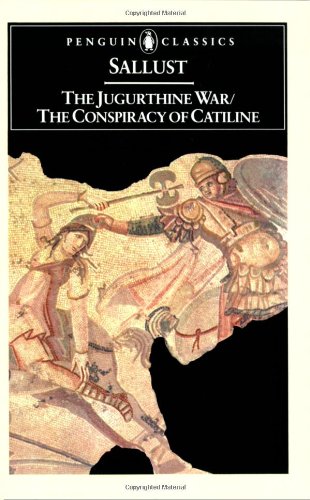
1. The Jugurthine War / The Conspiracy
$19.46
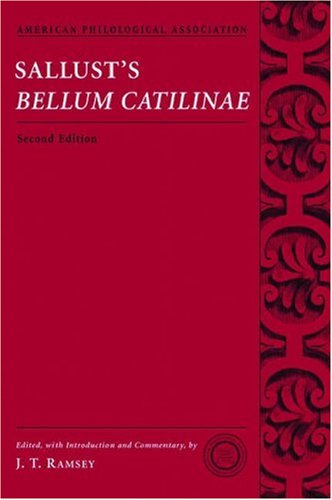
2. Sallust's Bellum Catilinae (American
$17.82
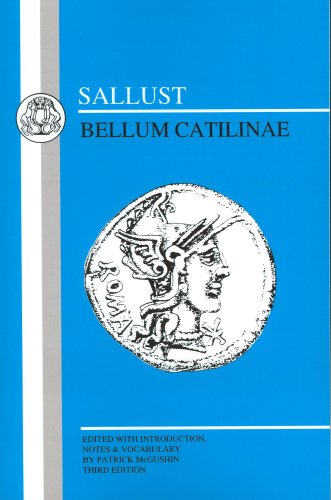
3. Sallust: Bellum Catilinae (Latin
$28.49
4. Sallust
$9.50
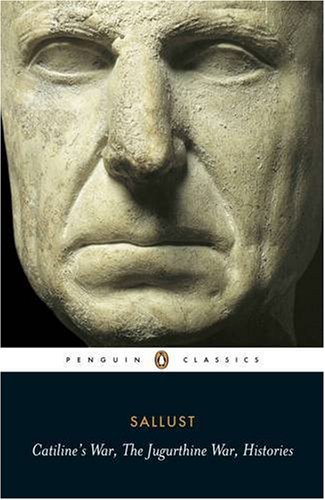
5. Catiline's War, The Jugurthine
$22.67
6. Two Centuries of Roman Prose:
$18.00
7. Selections from Five Roman Authors:
 
$6.18
8. Lingua Latina: Sallust & Cicero,
$23.27
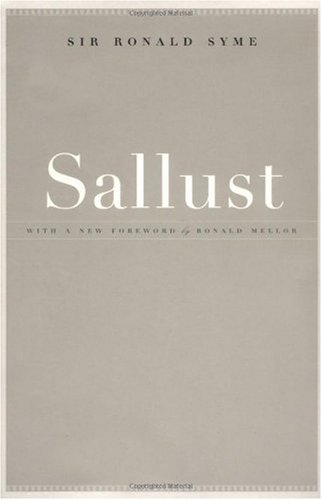
9. Sallust (Sather Classical Lectures)
 
$21.50
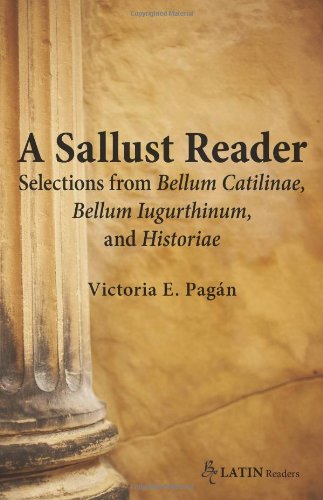
10. Cicero and Sallust (Latin Readers)
$20.00
11. Sallust: Catiline (BCP Latin Texts)
$31.11
12. Sallust's History Of The War Against
 
13. The Political Thought of Sallust
$57.92
14. The Histories: Volume I: Books
 
15. Plato's Republic in the Monographs
 
16. Sallust's History of the war against
$25.40
17. Sallust's history of the war against
 
18. Sallust's Jugurthine War and Conspitracy
 
19. Sallust's Catline
 
20. The Catilinarian conspiracy from

1. The Jugurthine War / The Conspiracy of Catiline (Penguin Classics)
by Sallust
Paperback: 240 Pages (1964-02-28)
list price: US$15.00 -- used & new: US$7.90
(price subject to change: see help)
Asin: 0140441328
Average Customer Review: 4.5 out of 5 stars
Canada | United Kingdom | Germany | France | Japan

Customer Reviews (8)

5-0 out of 5 stars Great tract on Roman morals just before the fall of the Republic
The two tales in this were hugely influential historical essays more or less up to the early 20C; they served as models of moralistic writing as well as clear exposition in Latin. I remember studying both the content and writing style while (inexplicably) attempting to master Latin in college.

In the Jugurthine War, you get wonderful details on the rise of the great generals, Marius and Sulla, who were friends and then deadly rivals in a struggle that essentially sowed the seeds of the end of the Roman Republic in the next generation.While the plot covers a war in Northern Africa on a ruthless rebel King, Jugurtha, the most important aspects of the work are on the transformation of the Roman army from amateur soldier-farmer landowners to a professional corps that admitted anyone. While a necessary measure to maintain the expansion of the Roman empire as the population of traditional army recruits dwindled, this led directly to rise of powerful generals, who could rely on the personal loyalty of their troops if they wished to grab power in civil war, which had been avoided for centuries. First, there was Sulla's dictatorship, then Julius Caesar crossed the Rubicon. But the story takes place before that, when the military genius Marius was transforming the army and mentoring the ambitious Sulla. The reader can study the organization of the army as well as the changing mores of Roman society that this reflected. It is a great masterpiece and fun read, with wonderfully quirky details. In many ways, it is about the end of the oligarchy that ruled the Republic for so long, as exemplified by the failure of Metellus and how despised enemy, Marius (who was not a aristocrat and knew no Greek) took over from him and triumphed.

The story on Cataline's conspiracy is more about Rome's civil society and governance. It is a far more openly moralistic tale of an attempted coup by a disgraced aristocrat, who was opposed by Cicero; in the background Julius Caesar and Pompey are also present, as are a number of lesser known Senators such as Scaurus. While this adds crucial detail to the historical picture, its preachiness and one-sided portrait - and many sloppy chronological mistakes - make it a fairly boring read, i.e. for scholars. It is a tale of decadence and ruffians who are tempted by power in the promises of a fool, Cataline.

The introductory essays are also splendidly detailed regarding historical controversies and background currents as well as beautifully written.I learned a great deal about the context in which Sallust's essays were conceived, e.g. his reasons for moralizing, his hypocracies, and career.

So, while rather recondite, this is a truly great volume of one of antiquity's most influential writers. Recommended.

4-0 out of 5 stars Sallust's works
Sallust was adept in the writing of history as these works attest.A reason not to read this work is if you are able to read it in the original Latin.A good primary source for those interested in this period of the Republic.

His two works, The Jugurthine War & The Conspiracy of Catiline cover the events whereby the Romans were forced to hunt a North African ruler through the desert from hideout to hideout for years & where Cicero, acting in his capacity as Consul faced an insurrection led by a Roman.

4-0 out of 5 stars The more things change.........
The more things change, the more they stay the same.With Enron,
Worldcom, and other companies going down in flames all around us-
with the little guys getting the shaft, while the CEO's get gold-
en parachutes-when you read this, you realize nothing has changed
in 2,000 years!!!!!!!!!!!!

Allowing for some Roman idioms, Sallust is as relevant today as he was 2,000 years ago.

Pretty sad commentary on human nature, huh?!

4-0 out of 5 stars Moral retelling of exciting episodes
I am giving this book four stars instead of five because I don't think Sallust's extrinsic moralism has worn well with time.He is right to note that rich, powerful governments are often corrupt, but the men and women who make up these governments do not change thir ways because someone preaches at them.

As with other histories written in ancient times, the two stories contained in this book are partly historical data, partly historical narratives, and partly dramatic dialogue.Whenever Sallust wants to make a general point, like "Rome is the city where everything is for sale", he adapts the language of this assertion to the circumstances of a point of specific action, and then puts it into the mouth of one of his characters.Keep in mind that the dramatic dialogue may be fiction, but the underlying points may very well have been valid.Rome really was a city where almost everything was for sale, and reading narratives like these gives us a vivid look at this reality.

This work is flawed, but we should be very happy that we have it because it gives us an alternate (pagan) look at power relationships within the late Roman Republic - a society that would soon become an Empire and produce written works (both Christian and secular) that are today read all over the world.

5-0 out of 5 stars Enemies of the State
It is suggested by historians that Sallust was a hypocrite. In his writings he always claims to be writing from the highest motives and says such things as:
"Wealth and Beauty can only give us a fleeting and perishable fame, but intellectual excellence is a glorious and everlasting possession." This stance sits nicely alongside the fact that he was expelled from the Senate for alleged immorality in 50 B.C.! The solution to this problem seems to be that human nature is a complex phenomenon, and that man is capable of both brute carnality and intellectual honesty, depending on the chemical swings of the moment without totally compromising his integrity.

Only a part of Sallust's work has survived, most notably his history of the war against Jugurthine, an able North African monarch, and the Conspiracy of Catiline, a debauched but charismatic member of the aristocracy who aimed at a populist coup. This volume is composed of these two histories.

The war against the ruthless but talented Jugurthine was more about politics than tactics. Jugurthine took advantage of the growing material greed of senators and tribunes in the late Roman Republic to bribe them to connive at his usurpation of the Numidian Kingdom. This policy was only successful in the short term, however, as the aggravated greed of the Romans led to a war of conquest, plunder, and annexation of his kingdom.

Sallust's account is particularly effective at showing the rise of Marius, a common soldier from a plebian family, who succeeded in overcoming prejudice to rise to the top of the Roman State as Consul. Although he later became a bloodthirsty revolutionary, his toughness, honesty, and energy contrast with the corruption and decadence that was already infecting Rome's higher orders.

The second part of this history focuses on one of these corrupt aristocrats, the much vilified Catiline, who tried to seize supreme power. Connected to many of the great men of his day, like the young Julius Caesar and the extremely wealthy Crassus, he hatched a plot to cause fires, assassinations, and riots in Rome while his private army conscripted from veterans with bad debts marched on the city. Catiline as a profligate nobleman had vast debts of his own and this was perhaps one of the main motives behind the plot.

Ably opposed by the Consul Cicero, the plot fell apart until Catiline's private army was forced to retreat and then annihilated by the Roman legions in North Italy. Although Catiline was depicted by Cicero as a depraved monster who had even sacrificed and eaten human flesh, Sallust seems more objective. He records Caesar's fine speech calling for clemency for some of the conspirators, and he also records the bravery of Catiline's little army, every man of which fell facing the enemy in a stubborn battle. This leaves the reader feeling that Catiline was perhaps more than just a power-crazed thug.

Dealing honestly with two of the most unpopular 'villains' from the late Republic, Sallust's history successfully aspires to the writer's own notion of intellectual excellence. It is for this reason that his name is still with us today. ... Read more


2. Sallust's Bellum Catilinae (American Philological Association Classical Texts With Commentary Series)
Paperback: 280 Pages (2007-01-27)
list price: US$24.95 -- used & new: US$19.46
(price subject to change: see help)
Asin: 0195320859
Average Customer Review: 5.0 out of 5 stars
Canada | United Kingdom | Germany | France | Japan
Editorial Review

Book Description
In his Bellum Catilinae, C. Sallustius Crispus or Sallust (86-35/34 B.C.) recounts the dramatic events of 63 B.C., when a disgruntled and impoverished nobleman, L. Sergius Catilina, turned to armed revolution after two electoral defeats. Among his followers were a group of heavily indebted young aristocrats, the Roman poor, and a military force in the north of Italy. With his trademark archaizing style, Sallust skillfully captures the drama of the times, including an early morning attempt to assassinate the consul Cicero and two emotionally charged speeches, by Julius Caesar and Cato the Younger, in a senatorial debate over the fate of the arrested conspirators. Sallust wrote while the Roman Republic was being transformed into an empire during the turbulent first century B.C. The Bellum Catilinae is well-suited for second-year or advanced Latin study and provides a fitting introduction to the richness of Latin literature, while also pointing the way to a critical investigation of late-Republican government and historiography. Ramsey's introduction and commentary bring the text to life for Latin students. This new edition includes two maps and two city plans, an updated and now annotated bibliography, a list of divergences from the 1991 Oxford Classical Text of Sallust, and revisions in the introduction and commentary. ... Read more

Customer Reviews (1)

5-0 out of 5 stars A helpful commentary
Sallust's Bellum Catilinae contains the Latin text of Sallust's work on the conspiracy of Catiline along with a concise introduction and commentary by J.T. Ramsey.

The introduction begins with a brief overview of the life and works of Sallust, discusses Sallust's contribution to Roman historiography, introduces his general style of writing and has a few words on the textual tradition of the Bellum Catilinae. Ramsey then gives a short account of the conspiracy of Catiline, followed by a timeline of events. Finally, the introduction concludes with an analysis Sallust's narrative.

The Latin text is based on the text in Ernout's 1958 Bude edition with a few modifications.

The commentary mostly has notes on the grammar and syntax of the text, but also on style and sometimes even discusses questions of textual criticism, it often explains important concepts and, where needed, gives the reader further information on historical matters. The commentary, however, is not at all historical or philological in nature, but rather designed to be of aid to readers who's main concern is to be able to read and understand the Latin text. In my opinion, Ramseys notes do a fine job of this and are generally very helpful.

I recommend this book to those who wish to experience the pleasure of reading Sallust in Latin. Ramseys commentary will almost certainly make it an easier task as well as enrich the experience. ... Read more


3. Sallust: Bellum Catilinae (Latin Texts)
by P. McGushin
Paperback: 208 Pages (2002-11-14)
list price: US$18.00 -- used & new: US$17.82
(price subject to change: see help)
Asin: 090651519X
Canada | United Kingdom | Germany | France | Japan
Editorial Review

Book Description
This is Sallust's text, "Bellum Catilinae", in Latin with English introduction and notes. ... Read more


4. Sallust
by Sallust
Hardcover: 256 Pages (2007-07-25)
list price: US$42.95 -- used & new: US$28.49
(price subject to change: see help)
Asin: 0548117721
Average Customer Review: 5.0 out of 5 stars
Canada | United Kingdom | Germany | France | Japan

Customer Reviews (1)

5-0 out of 5 stars A Great Recital of the Late Roman Republic's Turbulent Years
Crispus Sallustius (86-34 B.C.) was a plebeian who became a follower of Julius Caesar.He himself admits to having had a turbulent and mischievous youth in which he was expelled from the Senate at one point.This Loeb edition is probably the best purchase as it contains all of Sallust's works in one volume. Loeb is also one of the few publications that offers the reader the work in both its original Latin as well as in English.

Although the letters and speeches are interesting in their own right, the best works by Sallust are regarding the wars against Jurguthra and Catiline.Both seek to show how immorality and corruption, almost in the style of Dostoyevsky, prevails among those who hold or seek to hold the reigns of power.Juguthra was a Numidian/Moorish Prince who sought to take the throne from his brother by cajoling the Roman Senate who honored him for having served in Spain.Jugurthra's thirst for power was his own demise as Rome soon went to war against him for his daring efforts.Sallust approaches Catiline as the symptom of a social malaise resulting from a corrupt aristocracy.Despite this framework to his monogram, Sallust is far less biased of Catiline than Cicero's account in his Catilinarian speeches. Catiline was a patrician whose family had not reached any high office for over two hundred years.He served under Sulla and hoped to attain the consulship after his service with the dictator. As with many aristocrats, Catiline was in heavy debt and failed to win the consulship of 63 which he lost to Cicero and his patrician co-candidate.He hated Cicero for having won the consulship without being anything more than a new man with no ancestral distinction. Feeling that Rome was lost to new men such as Cicero or other lowly plebeians, Catiline organized an intricate conspiracy to carry out a coup with other nobles and even Gauls to set Rome on fire and slaughter the nobility along with Cicero.Cicero foiled his plot and Catiline chose to leave Rome to join his army of disenfranchized Marians, Sullan veterans, and whoever believed in his cause against the wealthy.He engaged in a battle against Roman forces in the north and fought to the death along with most of his followers.

The other works are rhetorical speeches or letters attributed to Lepidus, Phillipus, Cotta, Pompey, Macer and Mithridates.Although these are interesting to read, they are not as detailed or encompassing as his 'Wars.'As with the invectives, they are probably to a great extent fabrications of the author's imagination as to what the persons would have said: a style seen as perfectly normal in antiquity.The invectives are also pseudo-speeches but historians tend to think that they were not written by Sallust but merely attributed to him.

In any case, Sallustius is an important author as he is one of the few authors whose works we have who were involved with the politics of the Late Roman Republic and therefore were either first hand witnesses of the events or knew many who were.This Loeb edition is again the best deal one can get for $21 as it has all of Sallust's works in one volume offering the reader the work in both its original Latin as well as in English.Enjoy!
... Read more


5. Catiline's War, The Jugurthine War, Histories (Penguin Classics)
by Sallust
Paperback: 256 Pages (2008-02-26)
list price: US$16.00 -- used & new: US$9.50
(price subject to change: see help)
Asin: 0140449485
Average Customer Review: 5.0 out of 5 stars
Canada | United Kingdom | Germany | France | Japan
Editorial Review

Book Description
The only surviving works from one of the world’s earliest historians, in important new translations

Sallust’s first published work, Catiline’s War, contains the memorable history of the year 63, including his thoughts on Catiline, a Roman politician who made an ill-fated attempt to overthrow the Roman Republic. In The Jugurthine War, Sallust dwells upon the feebleness of the Senate and aristocracy, having collected materials and compiled notes for this work during his governorship of Numidia. ... Read more

Customer Reviews (1)

5-0 out of 5 stars essential reading on Roman morals
Here I am, re-reading books I still have from college, with faint hope that anyone would ever read a review of it, but here goes:

The two tales in this were hugely influential historical essays more or less up to the early 20C; they served as models of moralistic writing as well as clear exposition in Latin.In the Jugurthine War, you get wonderful details on the rise of the great generals, Marius and Sulla, who were friends and then deadly rivals in a struggle that essentially sowed the seeds of the end of the Roman Republic in the next generation.

While the plot covers a war in Northern Africa on a ruthless rebel King, Jugurtha, the most important aspects of the work are on the transformation of the Roman army from amateur farmer landowners to a professional corps that admitted anyone.While a necessity to maintain the expansion of the Roman empire as the population of traditional army recruits dwindled, this led directly to rise of powerful generals, who could rely on the personal loyalty of their troops to grab power in civil war, which had been avoided for centuries.First, there was Sulla's dictatorship, then Julius Caesar.But the story takes place before that, when the military genius Marius was transforming the army and mentoring the ambitious Sulla.The reader can study the organization of the army as well as the changing mores of Roman society that this reflected. It is a great masterpiece and fun read, with wonderfully quirky details.In many ways, it is about the end of the aristocratic oligarchy that ruled the Republic for so long, as exemplified by the failure of Metellus and how Marius, who was not a aristocrat and knew no Greek, took over from him and triumphed.

The story on Cataline's conspiracy is more about Rome's civil society and governance.It is a far more openly moralistic tale of an attempted coup by a disgraced aristocrat, who was opposed by Cicero; in the background Julius Caesar and Pompey are also present, as are a number of lesser known Senators such as Scaurus.While this adds crucial detail to the historical picture, its preachiness and one-sided portrait - and many sloppy mistakes - make it a fairly boring read, i.e. for scholars.It is a tale of decadence and ruffians who are tempted by power in the promises of a fool, Cataline.

So, while rather recondite, this is a truly great volume of one of antiquity's most influential writers.Recommended. ... Read more


6. Two Centuries of Roman Prose: Extracts from Cicero, Nepos, Sallust, Livy, Petronius, Seneca, Pliny and Tacitus
by Eberhard Christoper Kennedy
Paperback: 281 Pages (2002-01-28)
list price: US$23.50 -- used & new: US$22.67
(price subject to change: see help)
Asin: 1853994952
Canada | United Kingdom | Germany | France | Japan
Editorial Review

Product Description
Extracts from Cicero, Nepos, Sallust, Livy, Petronius, Seneca, Pliny and TacitusIn Latin with notes and introductory material in English. ... Read more


7. Selections from Five Roman Authors: Nepos, Caesar, Sallust, Livy and Cicero
by H.E. Gould
Paperback: 142 Pages (2007-08-15)
list price: US$18.00 -- used & new: US$18.00
(price subject to change: see help)
Asin: 1853995312
Average Customer Review: 5.0 out of 5 stars
Canada | United Kingdom | Germany | France | Japan
Editorial Review

Book Description
This volume has served several generations of Latinists making their first acquaintance with the main Roman prose authors of the first acquaintance with the main Roman prose authors of the first century BC.It includes part of Cornelius Nepos' Miltiades, sections of Caesar's De Bello Civili Book II, Sallust's De Bello Jugurthino, Livy Books II and V, and three short extracts from Cicero -- Pro Milone, De Amicitia and a letter to Atticus.All are chosen for the intrinsic interest of their content and ease of narrative. ... Read more

Customer Reviews (1)

5-0 out of 5 stars nice sample, kinda small
Good selection of authors at a low price, only thing is the book is kinda small. Be sure to have a look at the dimensions. ... Read more


8. Lingua Latina: Sallust & Cicero, Catilina
by Hans Orberg
 Paperback: Pages (2006-06)
list price: US$10.95 -- used & new: US$6.18
(price subject to change: see help)
Asin: 8790696115
Canada | United Kingdom | Germany | France | Japan

9. Sallust (Sather Classical Lectures)
by Ronald Syme
Paperback: 433 Pages (2002-06-05)
list price: US$25.95 -- used & new: US$23.27
(price subject to change: see help)
Asin: 0520234790
Average Customer Review: 5.0 out of 5 stars
Canada | United Kingdom | Germany | France | Japan
Editorial Review

Book Description
With this classic book, Sir Ronald Syme became the first historian of the twentieth century to place Sallust--whom Tacitus called the most brilliant Roman historian--in his social, political, and literary context. Scholars had considered Sallust to be a mere political hack or pamphleteer, but Syme's text makes important connections between the politics of the Republic and the literary achievement of the author to show Sallust as a historian unbiased by partisanship. In a new foreword, Ronald Mellor delivers one of the most thorough biographical essays of Sir Ronald Syme in English. He both places the book in the context of Syme's other works and details the progression of Sallustian studies since and as a result of Syme's work.
... Read more

Customer Reviews (1)

5-0 out of 5 stars Definitive Primary Source On the History OfRepublican Roman
I read this book for a graduate course in Roman history.
When most people think of the men responsible for causing the revolutionary changes in Roman politics and military prowess they think of leaders such as: Julius Caesar 110-44 BCE, Pompey 106-48 BCE, Mark Antony 83-30 BCE, and Octavian 63 BCE-14 CE, whom the Senate named Augustus in 27 BCE.However, all four of these men learned how to use the army, and especially its veterans, to further their political aims from one of Rome's earlier ambitious generals, Gaius Marius 157-86 BCE.Marius made sweeping reforms in army recruitment in 107 BCE so that he would have enough men to fight in the Numidian War.Most of what is known about Marius comes from Sallust, a historian who spent a good part of his life as a politician.He served as a senator, tribune of the plebians, and as a provincial governor.All of these experiences gave him a unique insight into Roman history.One of the twentieth century's most eminent historians of Roman history, Sir Ronald Syme, resurrected Sallust's reputation as a balanced historian.It was Syme's work on Sallust, published in 1964, that made historians take a fresh look at Sallust's scholarship.Syme found that Sallust had a negative view of Marius and believed him to be too politically ambitious.Marius broke with Roman tradition and recruited troops from the ranks of the poor, who owned no land.Marius felt forced to do this because of a manpower shortage due to Rome's involvement in many years of warfare.Marius' action at the time caused him to be hailed as a hero of the people, standing up against the Roman nobility.Sallust saw this as a great deviation from Roman tradition."Indeed, to a man grasping at power, the most needy are the most serviceable, persons to whom their property (as they have none) is not an object of care, and to whom every thing lucrative appears honorable."Marius' military reforms were put into proper context for understanding how the consequences of his recruiting from the ranks of the poor had on the political future of Rome."Often these men found a new home in the legions, adding to the increasing element of `professionals', and infusing a spirit of callousness and indifference, which was to have serious consequences later."

Sallust's scholarship on party politics leading up to and during Rome's Civil War 49-45 BCE, highlighted the consequences of Marius' military reforms."It was Marius who introduced the personal army as a decisive factor in Roman politics.Marius established the role of the general in politics, exemplified by the subsequent careers of Sulla and Pompey, a role that led through Caesar to monarchy."He understood how generals needed to maintain their political standing in Rome's burgeoning empire.With their new landless recruits, generals had to promise them the bonus of land for their service, which bought their recruit's loyalty, not to Rome but to their generals."When the senate was not compliant, they took to appealing to the people through the tribunes who proposed laws rewarding the soldiers.To win victory at the polls the generals began to send their soldiers to Rome to vote or, if necessary, to use violence."Historians used the example of Marius to show how Pompey and Caesar, both great Roman generals vying for power a generation after Marius, emulated his political tactics with the people and the military to further their ambitions.Between 70-54 BCE, Pompey and Caesar bribed senators and sent their soldiers to Rome "ostensibly to vote."When Pompey stood for election of the consulship in 55 BCE, it marked the first time in Roman history that the violence and bloodshed caused anarchy at the polls.

Recommended reading for those interested in Roman history, military history.

... Read more


10. Cicero and Sallust (Latin Readers)
by E. J. Barnes, John T. Ramsey
 Paperback: 96 Pages (1988-06)
list price: US$29.10 -- used & new: US$21.50
(price subject to change: see help)
Asin: 0582367522
Canada | United Kingdom | Germany | France | Japan

11. Sallust: Catiline (BCP Latin Texts)
by A. Davis
Paperback: 128 Pages (2005-11-15)
list price: US$20.00 -- used & new: US$20.00
(price subject to change: see help)
Asin: 0862922585
Average Customer Review: 2.0 out of 5 stars
Canada | United Kingdom | Germany | France | Japan

Customer Reviews (1)

2-0 out of 5 stars Caveat Emptor
I ordered this item with express shipping for a class on Sallust.Little did I know that this edition contains SELECTIONS rather than the complete text.Moreover, there is no commentary, just selections and vocab. ... Read more


12. Sallust's History Of The War Against Jugurtha And Of The Conspiracy Of Catiline: With Dictionary And Notes
Hardcover: 342 Pages (2007-07-25)
list price: US$46.95 -- used & new: US$31.11
(price subject to change: see help)
Asin: 0548206635
Canada | United Kingdom | Germany | France | Japan

13. The Political Thought of Sallust
by Earl. D.C.
 Hardcover: Pages (1961)

Asin: B000XKQQS2
Canada | United Kingdom | Germany | France | Japan

14. The Histories: Volume I: Books i-ii (Clarendon Ancient History Series)
by Sallust
Paperback: 288 Pages (1992-08-20)
list price: US$103.00 -- used & new: US$57.92
(price subject to change: see help)
Asin: 0198721404
Canada | United Kingdom | Germany | France | Japan
Editorial Review

Book Description
Sallust (86-35 BC) was a historian of major importance, writing at the time of the late Roman Republic. This is the first ever full-length commentary and English translation of one of his major works, the Histories, covering the years 78-67 BC, one of the least well-documented periods of the era. The translation is based on a text freshly examined for the first time since the original edition of 1891-3, and also includes newly discovered material. ... Read more


15. Plato's Republic in the Monographs of Sallust
by Bruce D. MacQueen
 Paperback: Pages (1984-04)
list price: US$12.95
Isbn: 0865160120
Canada | United Kingdom | Germany | France | Japan

16. Sallust's History of the war against Jugurtha and of the Conspiracy of Cataline: With a dictionary and notes
by Sallust
 Unknown Binding: 336 Pages (1841)

Asin: B00088CX5O
Canada | United Kingdom | Germany | France | Japan

17. Sallust's history of the war against Jugurtha, & of the conspiracy of Catiline: with a dictionary & notes. By Prof. E. A. Andrews.
by Michigan Historical Reprint Series
Paperback: 356 Pages (2005-12-20)
list price: US$26.99 -- used & new: US$25.40
(price subject to change: see help)
Asin: 1425536352
Canada | United Kingdom | Germany | France | Japan
Editorial Review

Product Description
This volume is produced from digital images created through the University of Michigan University Library's preservation reformatting program. ... Read more


18. Sallust's Jugurthine War and Conspitracy of Catiline with an English Commentrary....
by Charles Anthon
 Hardcover: Pages (1837)

Asin: B000RWB55K
Canada | United Kingdom | Germany | France | Japan

19. Sallust's Catline
by Jared W. Scudder
 Hardcover: Pages (1900)

Asin: B000HCQZO6
Canada | United Kingdom | Germany | France | Japan

20. The Catilinarian conspiracy from Sallust & Cicero: Partly in the original and partly in translation (The Clarendon series of Latin and Greek authors)
by Sallust
 Unknown Binding: 127 Pages (1923)

Asin: B0008A8T82
Canada | United Kingdom | Germany | France | Japan

  1-20 of 100 | Next 20
A  B  C  D  E  F  G  H  I  J  K  L  M  N  O  P  Q  R  S  T  U  V  W  X  Y  Z  

Prices listed on this site are subject to change without notice.
Questions on ordering or shipping? click here for help.

site stats