e99 Online Shopping Mall

Geometry.Net - the online learning center Help  
Home  - Authors - Sappho (Books)

  Back | 21-40 of 100 | Next 20
A  B  C  D  E  F  G  H  I  J  K  L  M  N  O  P  Q  R  S  T  U  V  W  X  Y  Z  

click price to see details     click image to enlarge     click link to go to the store

$7.50
21. Biographical Dictionary of Ancient
 
$21.00
22. Sappho's Immortal Daughters
$4.00
23. To a Nightingale: Sonnets and
$9.38
24. Sappho Through English Poetry
$19.95
25. Sappho in the Making: The Early
 
$5.99
26. Wild Girls: Paris, Sappho, and
$6.13
27. Notes on Thought and Vision &
 
28. Sappho by the sea: An illustrated
$24.94
29. Sappho's Gymnasium
$12.88
30. Sappho in Early Modern England:
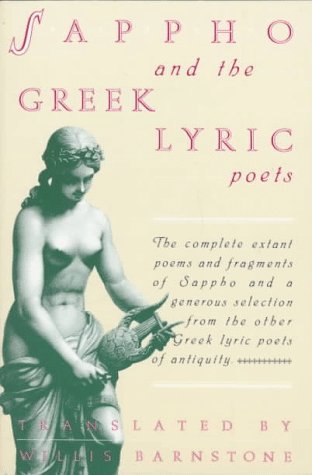
31. Sappho and the Greek Lyric Poets
$7.43
32. The Sewing Circle: Sappho's Leading
$14.72
33. Sappho: Poems and Fragments
$25.00
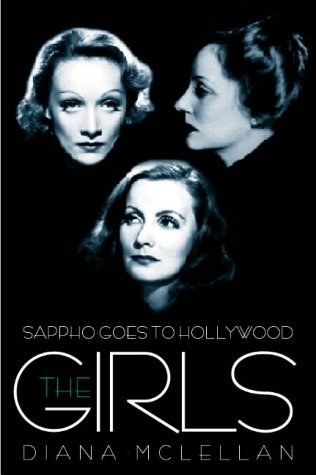
34. Sappho Goes to Hollywood : The
 
$75.00
35. Sappho: The Art of Loving Women
 
$14.49
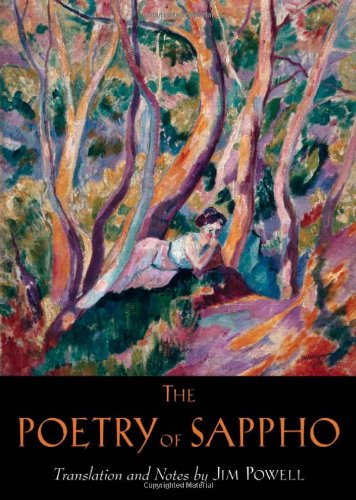
36. Sappho: A Garland : The Poems
$9.44
37. Poems By Sappho
38. Sappho of lesbos (Paperback Library)
$3.80
39. Erotica: Women's Writing from
$17.66
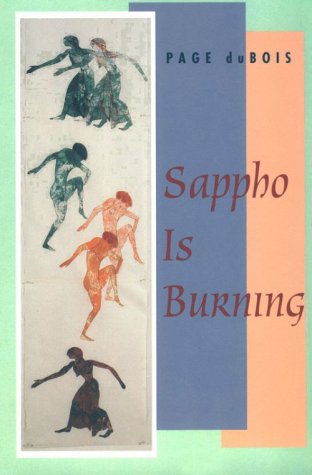
40. Sappho Is Burning

21. Biographical Dictionary of Ancient Greek and Roman Women: Notable Women from Sappho to Helena
by Marjorie Lightman, Benjamin Lightman
Paperback: 298 Pages (2000-11)
list price: US$18.95 -- used & new: US$7.50
(price subject to change: see help)
Asin: 0816044368
Average Customer Review: 3.0 out of 5 stars
Canada | United Kingdom | Germany | France | Japan

Customer Reviews (1)

3-0 out of 5 stars Good information but....
This book provides some really good information about women who lived in ancient times and does not confine itself to Greek and Roman woman some famous and/or infamous Hebrew ladies are included such as Alexandra and Bernice.
However, the plethora of typos detract from the enjoyment of this book. ... Read more


22. Sappho's Immortal Daughters
by Margaret Williamson
 Paperback: 196 Pages (1998-01-21)
list price: US$21.00 -- used & new: US$21.00
(price subject to change: see help)
Asin: 067478913X
Average Customer Review: 5.0 out of 5 stars
Canada | United Kingdom | Germany | France | Japan
Editorial Review

Book Description

She lived on the island of Lesbos around 600 B.C.E. She composed lyric poetry, only fragments of which survive. And she was--and is--the most highly regarded woman poet of Greek and Roman antiquity.

Little more than this can be said with certainty about Sappho, and yet a great deal more is said. Her life, so little known, is the stuff of legends; her poetry, the source of endless speculation. This book is a search for Sappho through the poetry she wrote, the culture she inhabited, and the myths that have risen around her. It is an expert and thoroughly engaging introduction to one of the most enduring and enigmatic figures of antiquity. Margaret Williamson conducts us through ancient representations of Sappho, from vase paintings to appearances in Ovid, and traces the route by which her work has reached us, shaped along the way by excavators, editors, and interpreters. She goes back to the poet's world and time to explore perennial questions about Sappho: How could a woman have access to the public medium of song? What was the place of female sexuality in the public and religious symbolism of Greek culture? What is the sexual meaning of her poems? Williamson follows with a close look at the poems themselves, Sappho's "immortal daughters." Her book offers the clearest picture yet of a woman whose place in the history of Western culture has been at once assured and mysterious.

... Read more

Customer Reviews (1)

5-0 out of 5 stars Most Comprehensive I've Read
Just fininshing up a history term paper here for my major, and I thought I'd drop off a good word for the best secondary source on Sappho's life and work that I've ever seen.Ms. Williamson leaves no rock unturned, noaspect of Sappho's work or life unaddressed, and manages to do it in anentertaining and comprehensive way without runninginto 500 pages!If youare interested in Sappho at all beyond the text of her extant poetry, thisis the book to buy! ... Read more


23. To a Nightingale: Sonnets and Poems from Sappho to Borges
Hardcover: 104 Pages (2007-09-17)
list price: US$20.00 -- used & new: US$4.00
(price subject to change: see help)
Asin: 0807615870
Average Customer Review: 5.0 out of 5 stars
Canada | United Kingdom | Germany | France | Japan
Editorial Review

Book Description
Uniting the voices of thirty master poets, To a Nightingale traces the presence of literature's most celebrated bird from Sappho's fragments to the verse of Borges.

The collection reveals a time-honored, poetic discussion of grief, solitude, beauty, song, and artistic expression—a discussion that moved history's greatest literary minds to create their greatest works.

As Keats writes in his famous ode: "Thou wast not born for death, immortal Bird...The voice I hear this passing night was heard in ancient days." His sentiment resounds throughout this book, echoing through the words of Milton, Shakespeare, Virgil, and other luminaries whose work directed the course of world literature. Bound by a common reverence for the nightingale's unchanging music, each author seems to speak intimately to the other, their sentiments resonating beautifully despite the passage of centuries.

To a Nightingale is a powerful homage that inspires appreciation not only for the nightingale herself, but also for the poets who collectively made her song sacred to us. This book will appeal to anyone seeking a glimpse into the world of celebrated poetry. ... Read more

Customer Reviews (1)

5-0 out of 5 stars An image both verbal and visually is enduringly impressive
Kameda Bosai is a Japanese poet and master of the 'ehon' (art-book) literary and artistic tradition of his country. The poetry and paintings of Kameda Bosai as compiled in the pages of this superbly presented edition of "Mountains of The Heart" elegantly portray the relationship between human beings and their environment. This poet/artist depicts homes lost in the mists of immense foothills, small figures wandering through rolling valleys, the transience of roads and buildings with the permanence of their natural surroundings. This is a book to be browsed through with an inevitable appreciation for a master storyteller and keen observer whose ability to inspire through a brush stroke and inform through an image both verbal and visually is enduringly impressive. "Mountains Of The Heart" is strongly recommended for personal, academic, and community library Japanese Culture & Art collections and supplemental reading lists. ... Read more


24. Sappho Through English Poetry
Paperback: 144 Pages (1996-01-01)
list price: US$11.95 -- used & new: US$9.38
(price subject to change: see help)
Asin: 085646273X
Canada | United Kingdom | Germany | France | Japan

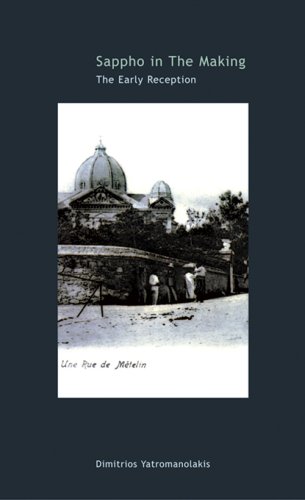
25. Sappho in the Making: The Early Reception (Hellenic Studies)
by Dimitrios Yatromanolakis
Paperback: 442 Pages (2008-03-15)
list price: US$19.95 -- used & new: US$19.95
(price subject to change: see help)
Asin: 0674026861
Canada | United Kingdom | Germany | France | Japan
Editorial Review

Book Description

This book offers the first interdisciplinary and in-depth study of the cultural practices and ideological paradigms that conditioned the politics of the "reading" of Sappho's songs in the early and most pivotal stages of herreception. In this wide-ranging synthesis, Dimitrios Yatromanolakis investigates visual representations and ancient texts in their synchronic and diachronic multilayeredness to trace the discursive nexuses that defined the making of "Sappho" in the late archaic, classical, and early Hellenistic periods. Offering a systematic analysis of the contextual cues provided by vase paintings and focusing on the sociocultural institution of the symposion, this book explores the intricate modes of the assimilation of Sappho's poetry into diverse social, aesthetic, and performative contexts. Drawing on a number of disciplines, including archaeology, papyrology, and anthropology, Sappho in the Making articulates a new methodological Problematik on the reception of archaic Greek socioaesthetic cultures.

... Read more

26. Wild Girls: Paris, Sappho, and Art: The Lives and Loves of Natalie Barney and Romaine Brooks
by Diana Souhami
 Hardcover: 240 Pages (2005-11-05)
list price: US$29.95 -- used & new: US$5.99
(price subject to change: see help)
Asin: B000VYQEOG
Average Customer Review: 2.5 out of 5 stars
Canada | United Kingdom | Germany | France | Japan
Editorial Review

Book Description
Natalie and Romaine met in London during World War I and their partnership lasted until Natalie died 52 years later.They were both American expatriates; unconventional, energetic, flamboyant and rich.Natalie was known as 'the wild girl of Cincinnatti'.She had numerous affairs with other women: Renee Vivien who nailed shut the windows of her apartment, wrote about the loveliness of death, drank eau de cologne and died of anorexia aged 30; and Dolly Wilde niece of Oscar, who ran up terrible phone bills and died of a drugs overdose.She wrote books of aphorism, memoirs and poems and her Friday afternoon salons in the cobbled garden of her Parisian house were for 'introductions and culture'. They were frequented by Gertrude Stein, Colette, Radclyffe Hall and Edith Sitwell.Romaine achieved fame in her own lifetime and after as an artist. She painted her lovers including Gabriele d'Annunzio with whom she had a terrible and tortured relationship, and the ballerina Ida Rubinstein. However her relationship with Natalie was constant and in their eventful years together they threw up a liberating spirit of culture, style and candour.Diana Souhami has written a moving portrait of these two enigmatic figures, as well as a fascinating recreation of a forgotten time. ... Read more

Customer Reviews (2)

3-0 out of 5 stars Fascinating, But...
A fascinating story of two extraordinary lives soaked in the demi-monde at the fin-de-siecle with the world of the rich and artistic as its background. Unfortunately, this telling comes with some irritating costs. The book is studded with bizarrely extraneous footnotes: does any reader of this story really need to be told who Dante, Proust, Cocteau, Sappho, Gertrude Stein, Sarah Bernhardt (among many others) were? Also, the author interpolates little autobiographical asides that have nothing to do with the dual biography at hand and merely comes across as an egotistical affectation.

When Souhami actually gets to the story at hand (which in fairness is most of the time), historical errors aside, she tells a wonderful tale of the sapphic world in turn-of-the-century Europe.

Very well written when not marred by the author's idiosyncrasies.

2-0 out of 5 stars A life still left in shadow
Gray is a difficult colour to master. It is enigmatic, aloof. It can be warm, with tints of peach and pink, or cold, with tints of sapphire and indigo. But no one could ever doubt that American artist Romaine Brooks was a master of gray. From her mysterious, icy portraits of members of the belle époque and the jazz age, to her preference for colorless fashions and décor, to the melancholy of her own day to day existence, Brooks was almost the personification of the colour gray itself. It would take great skill to write a biography of such a woman. Therefore I was ecstatic to discover that Diana Souhami had taken on the task of writing a book on the entwined lives of Romaine Brooks and her long-time companion, Paris saloneuse Natalie Clifford Barney. Both American, both wealthy, both artistic, Barney and Brooks still made an odd pair. Barney was the ever-social butterfly, flitting from flower to flower, beautiful and flamboyant. Brooks was her exact opposite, a withdrawn, flighty creature from a background of insanity, who preferred to live in the shadows, alone. This sounds like perfect material for the talents of Souhami, who has already tackled the lives of such challenging individuals as Radclyffe Hall, Gertrude Stein and Greta Garbo. Souhami also wrote the award-winning "Selkirk's Island", untangling the threads of the life of Alexander Selkirk, the inspiration for Defoe's classic, "Robinson Crusoe". Yes, Brooks and Barney seemed in good hands.
I cannot express, then, the disappointment that this anticipated book brought. Distressingly short not only for a biography of two distinct souls, but also an examination of the times in which they lived, the book is riddled with factual errors and blunders. Souhami begins her race by stumbling. In her Foreword she states plainly, one would say almost flippantly, of her use of the Internet as a main source of research-and it shows. The author appears to think that everything you find on the Web is factual, not realizing that the information to be found there is only as accurate as the knowledge of those posting it. This is a fatal error. Souhami seems almost dismissive of her own research, telling us about how much she enjoyed reading the pop-up advertisements she encountered while on the Net for such things as sexy chat, and even giving us a footnote detailing a pill that can help men lengthen the size of their endowment.Souhami further mars the book with the constant insertion of bits and pieces of her own past that, although well written, are disturbingly incongruous and intrusive and give the impression that she would much rather be talking about herself.
Next, Souhami falters in her facts, tripping too many times to enumerate, but here are a few major potholes: Lady Mary "Minnie" Anglesey is said on page 40 to be "about to divorce her transvestite husband." Souhami then footnotes that Mary was married to Henry Cyril Paget, the 4th Marquess of Anglesey. This is a gross mistake. Mary Anglesey was indeed married to the 4th Marquess of Anglesey, but she was married to Henry Paget, not Henry Cyril Paget, the 5th Marquess of Anglesey, who was not only infamous for his flashy dressing-up and obsession for jewelry, but was also Mary's own son (and, for the record, Henry Cyril Paget's wife's name was Lilian). Next we are told that the Italian poet Gabriele D'Annunzio's nickname for Brooks was "Cinerana". This is incorrect; his nickname for her was "Cinerina", meaning, "little gray one". Also, the Baroness Madeleine Deslandes was known as "Elsie", not "Ilsie". On page 141 we are told that Brooks described in a letter the "house" on Capri of the eccentric Marchesa Casati as "simply beautiful", but the author fails to point out that Casati's "house" was, in fact, the famous Villa San Michele, rented from Dr. Axel Munthe.
Beguiling anecdotes also slip through the fingers of an author so proud of her diligent international research. No mention is made of the mystery revolving around Brooks' painting "The White Bird" and how some historians believe it is a portrait of Barney's lover, the renowned grand horizontal, Liane de Pougy. Nor are we told that the face of the cat in Brooks' portrait of Baroness Catherine D'Erlanger was deliberately painted to resemble that of her husband's. Nor do we hear of the intriguing story that, after becoming a virtual hermit in Nice, living in a room devoid of everything but a bed and table, and having given away all of her paintings, drawings and writings, beneath Romaine Brooks' death bed was found the only canvas she kept, her portrait of Luisa Casati. Also, there is no mention of the small book, written by Elizabeth de Gramont, another of Barney's paramours, on Brooks' work that was published in 1952. Nor that the normally pathologically reclusive Brooks granted a long interview with French writer Michel Desbrueres that appeared in the Parisian periodical "Bizarre" in 1968, just two years before her death. Souhami also claims that Brooks painted a portrait of artist Elizabeth Eyre de Lanux, but, oddly, there is no reference to this painting in any prior biography of Brooks or in any catalogue of her oeuvre. Has Souhami discovered a hitherto unknown painting? We are given no clue. Perhaps another fifteen minutes of research on the Internet would have cleared up all of this-or better yet some good old-fashioned investigatory legwork and elbow grease that Souhami's research sorely lacks.
Next is the matter of Souhami's innumerable and annoying footnotes. She footnotes everyone and sundry with what she must have felt were charming and witty caricatures-Noel Coward is summed up as being "friendly with the lesbian haut monde", composer Prince Edmond de Polignac's only reference says "he died after eight years of marriage" and Luisa Casati is dubbed "the patron saint of exhibitionists". Such sketches are neither charming nor witty, and consistently get in the way of reading the text. As a reader, I also do not need to know such minutiae as how many seats there are in the Theatre du Chatelet in Paris, that Gluck's "Orfeo ed Euridice" was first performed in 1762, or the lyrics to "Auld Lang Syne". It is most interesting to note that even though the author strives to introduce us to every person in the book that some celebrated individuals such as Madame Eugenia Errazuris, a bright grand dame of the beau monde, are left floundering and unannotated, while poet Anna de Noailles, writer Paul Morand, and interior designer, Elsie de Wolfe, each a distinguished sitter for Brooks, are not mentioned at all (nor is the fact that Brooks' portrait of de Wolfe was often sarcastically called "The White Goat", because of the small ceramic goat that sits beside the designer and mimics her simpering expression perfectly). And worst of all, these intrusive footnotes shine a glaring light on the fact that Souhami never footnotes any of her relevant and/or fascinating facts. How do we know that Liane de Pougy's asparagus soup congealed and her risotto went cold while she, at lunch, waited for writer Max Jacob to arrive, or that after being pelted by preserved cherries by boys at the Long Beach Hotel in New York, a young Natalie Barney ran into the arms of Oscar Wilde for comfort. Where does this information come from? Such charming tidbits require references for future researchers.
And here is where Souhami's book fails the most-as a research tool and reference book for the future. Subsequent authors and students cannot use a book rife with easily correctable errors without perpetuating those same mistakes ad infinitum. As a highly respected writer, shame on you, Ms. Souhami. You should have known better.

... Read more


27. Notes on Thought and Vision & the Wise Sappho
by H. D. (Hilda Doolittle)
Paperback: 88 Pages (1982-10)
list price: US$9.95 -- used & new: US$6.13
(price subject to change: see help)
Asin: 0872861414
Average Customer Review: 4.0 out of 5 stars
Canada | United Kingdom | Germany | France | Japan
Editorial Review

Book Description

Notes on Thought and Vision by Imagist poet H.D. (Hilda Doolittle) is an aphoristic meditation on how one works toward an ideal body-mind synthesis; a contemplation of the sources of imagination and the creative process; and a study of gender differences H.D. believed to be inherent in women's and men's consciousness. Here, too, is The Wise Sappho, a lyrical tribute to the great poet of Lesbos, for whom H.D. felt deep personal kinship.

... Read more

Customer Reviews (2)

4-0 out of 5 stars H.D. being H.D.
I have a love/hate relationship with H.D. - I lack her enthusiasm forGreek and Egyptian mythology (I'd rather move a bit further to theSoutheast) but I appreciate what she does with the mythology.Thus I amnever quite sure to what audience I can recommend her.

The second piecein this book, "The Wise Sappho" is a meditation on the poetry ofSappho - a poetic meditation.If you have read Sappho, this is a must readpiece as both Sappho and H.D. are talismen of the feminist strand ofpoets.

The first piece "Notes on Thought and Vision" needs tobe placed in time.H.D. speaks of her discovery of a higher level ofconsciousness, a level she refers to as jelly-fish mind as she imagines itas a jelly-fish above us (for brain consciousness) or beside us (for wombconsciousness) with tenacles into our body.Her examples come primarilyfrom art, Greek mythology or "the Galilean" (Jesus).Shespecifically includes scientists among those dependent upon this jelly-fishconsciousness.However, she cautions that body and mind are not to beneglected.Her description of her experience serves as an importantinsight into her poetry and prose and as one ray into understanding theliterary circle in which she roamed e.g. Ezra Pound.

4-0 out of 5 stars Delicate, Not Brittle by Padma J. Thornlyre
At her best, H.D. (Hilda Doolittle) is a poet. Her novels all display a poet's sense of immediacy, but are sometimes confusing for their interior "scapes" which are frequently all too fluid. Her poetry, however, directs the "flow" deliberately and masterfully. "Notes on Thought and Vision" is a rare example (like Nikos Kazantzakis's "The Saviors of God") wherein the distinction between poetry and prose evaporates. These "Notes" are intimate and compelling, watery and feminine, mystical and yet (strangely) earthy--composed of octopus, seaweed, and salt. Her language is delicate, but not brittle, her point of view keenly sensitive but never timid. "Notes" is an intelligent reflection on the sub- or un-conscious, and on the source(s) of poetic inspiration, from the only person, male or female, who ever wrote openly of her experience as Sigmund Freud's patient (see H.D.'s "Tribute to Freud"). "Notes on Thought and Vision" is a short book (and a small one), which contains a very large message that celebrates the feminine and the divine as one and the same. A must-read for any woman who seeks to explore her creativity and for any man who seeks his own "anima". ... Read more


28. Sappho by the sea: An illustrated guide to the Hamptons
by J. Frederick Smith
 Unknown Binding: 95 Pages (1976)

Isbn: 0877540438
Canada | United Kingdom | Germany | France | Japan

29. Sappho's Gymnasium
by Olga Broumas, T. Begley
Paperback: 185 Pages (1994-11)
list price: US$12.00 -- used & new: US$24.94
(price subject to change: see help)
Asin: 1556590717
Average Customer Review: 3.0 out of 5 stars
Canada | United Kingdom | Germany | France | Japan
Editorial Review

Book Description
collaborative poems in Sapphic idiom ... Read more

Customer Reviews (1)

3-0 out of 5 stars Ambiguity makes these poems difficult but more beauitful.
I bought Sappho's Gymnasium by Olga Broumas and T Begley on the basis of the first-lines listed on Amazon.com. The easy-going spirituality I saw in them appealed to me-I thought, "This looks just right."These poems arenot the poems I've been waiting for my whole life, but I'm glad I've readthem.

I was writing a letter to my friend about these poems and describedthem as "kinda crazy, out-there."There's no punctuation, which doesn'tsit well with me, but it fits with Broumas and Begley's style.These shortpoems are mostly strings of images with some reflection too.Connectionsbetween the images aren't made-the reader needs to make the connections forherself.But in most places it's impossible to make these connections in away that's wholly satisfying.Sometimes it feels pleasant to let theimages play themselves in my mind-it feels like my unconscious is makingsense of them in a way that's vague and beautiful.Sometimes the imagesinteract, resonate with one another, in a way that I could never describe. But other times I get frustrated, as if the writers are playing a game withmeaning, and it's a game I've played before, and I don't want to play withthem.

This ambiguity is obviously what the poets wanted.Everything isviewed as if through a screen or in a very hazy, bright light.There aremoments of clarity that I enjoy very much.For the most part, the poemsdon't seem whole-they're heavily dependant on one another-but there areoccasional poems that stand alone as complete.I particularly like theseones; they seem more successful.

Because of the ambiguity, this book isgenerally frustrating to me, but also because of the ambiguity, it's alsogenerally a pleasure.The easy-going spirituality that attracted me tothis book initially is not explored as much as I wanted, but it is anundercurrent throughout the poems, a part of that bright, hazy light. ... Read more


30. Sappho in Early Modern England: Female Same-Sex Literary Erotics, 1550-1714 (The Chicago Series on Sexuality, History, and Society)
by Harriette Andreadis
Paperback: 240 Pages (2001-07-15)
list price: US$20.00 -- used & new: US$12.88
(price subject to change: see help)
Asin: 0226020096
Canada | United Kingdom | Germany | France | Japan
Editorial Review

Book Description

In Sappho in Early Modern England, Harriette Andreadis examines public and private expressions of female same-sex sexuality in sixteenth- and seventeenth-century England. Before the language of modern sexual identities developed, a variety of discourses in both literary and extraliterary texts began to form a lexicon of female intimacy. Looking at accounts of non-normative female sexualities in travel narratives, anatomies, and even marital advice books, Andreadis outlines the vernacular through which a female same-sex erotics first entered verbal consciousness. She finds that "respectable" women of the middle classes and aristocracy who did not wish to identify themselves as sexually transgressive developed new vocabularies to describe their desires; women that we might call bisexual or lesbian, referred to in their day as tribades, fricatrices, or "rubsters," emerged in erotic discourses that allowed them to acknowledge their sexuality and still evade disapproval.
... Read more

31. Sappho and the Greek Lyric Poets
by Willis Barnstone
Paperback: 368 Pages (1988-11-23)
list price: US$18.15
Isbn: 0805208313
Average Customer Review: 5.0 out of 5 stars
Canada | United Kingdom | Germany | France | Japan
Editorial Review

Book Description
Willis Barnstone has augmented his widely used anthology of the Greek lyric poets with eleven newly attributed Sappho poems, making this the most complete offering of Sappho in English. Two new sections -- "Sources and Notes" and "Sappho: Her Life and Poems" -- provide the student with the classical sources and an appraisal of this greatest of Western women poets.

Barnstone's lucid, elegant translations include a representative sampling of all the significant Greek lyric poets, from Archilochus, in the seventh century B.C., through Pindar ("prince of choral poets") and the other great singers of the classical age, down to the Hellenistic, Roman, and Byzantine periods. William McCulloh's introduction illuminates the forms and development of the Greek lyric. Barnstone introduces each poet with a brief biographical and literary sketch. The critical apparatus includes a glossary, index, bibliography, and concordance.

Willis Barnstone is professor of Spanish and comparative literature at Indiana University. He is co-editor of A Book of Women Poets from Antiquity to Now, and has translated poetry of Mao Zedong, Antonio Machado, and St. John of the Cross. ... Read more

Customer Reviews (1)

5-0 out of 5 stars The Best Manual Of the Greek Lyric
As a student of Greek Lyric poetry, I have spent many an hour in the library pouring over varying translations of many greek lyric poets.This book is by far the most complete, true-to-original book around; it hasnearly all earth's remaining greek lyric from the Lyric Age, and, fankly,Barnstone's poems outstrip others in naked beauty.Those who are lookingfor Sappho--Each translator has thier strong poems and their weak ones,Barnstone, however, is strongest overall.His version of "ToAnaktoria" is my favorite of all Sappho in translation. ... Read more


32. The Sewing Circle: Sappho's Leading Ladies
by Axel Madsen
Paperback: 250 Pages (2002-02-02)
list price: US$15.00 -- used & new: US$7.43
(price subject to change: see help)
Asin: 075820101X
Average Customer Review: 3.0 out of 5 stars
Canada | United Kingdom | Germany | France | Japan

Customer Reviews (5)

1-0 out of 5 stars In Hollywood, once you're dead, you're GAY
Oh, God. Let's just get it over with and say that EVERYONE ON EARTH IS SECRETLY GAY. EVERYONE. This is one of the stupidest books I've ever glanced through - yes, GLANCED through, since I couldn't stomach slowing down to allow the words to stick in my head. Madsen, who I believe is secretly gay himself, is hellbent on making as many dead people gay as possible. And he can't write. I take particular offense at his chapter on Barbara Stanwyck. She was a brilliant actress and a very private person. Her life was relatively scandal-free. Mr. Madsen, you would be hurting right now if she were alive to crucify you in court. If only I could see that!!!

4-0 out of 5 stars a review of the sewing circle.
This book is very good and well worth a look at. The sociogists theorys are dicey at times, but apart from that its great.

3-0 out of 5 stars Entertaining But Sloppy and Occasionally Unsubstantiated
Axel Madsen's THE SEWING CIRCLE purports to reveal the truth about Hollywood's lesbian social set--and if read in the same way one would read a gossip column it is an entertaining book, ripsnorting through the lives of as many stars as the author dares.

Portions of the book are clearly better researched than others, and consequently some exposes are easier to buy into others.Most of THE SEWING CIRCLE concerns the rumors that swirled around Greta Garbo, Marlene Dietrich, and the various women who moved in their circle; in writing of this group Madsen has done his homework and the result is quite interesting.On the other hand, Madsen makes little effort to explore the lives of such figures as Agnes Moorehead--and then, completely out of the blue, attempts to posit Judy Garland as a lesbian, which is such a leap that it makes you begin to question his portraits of everyone else as well.

That aside, although Madsen's actual style is good enough, his structure is not, and THE SEWING CIRCLE jumps here, there, and everywhere in an effort to catch the reader by surprise.Still, the book is entertainingly written.Recommended for a rainy day read, but keep your grains of salt ready.

5-0 out of 5 stars Interesting and Fascinating
I have a funny feeling that the one other review of this book is based on someone's being angry and disappointed that Mr. Madsen has "outed" some of his/her cherished movie stars.The truth is the truth and being gay doesn't make these stars any less nice, human or worthwhile.The book is well-written and interesting.What else can you ask of a book?I think it's so good I've bought several copies for friends.

1-0 out of 5 stars The worst book ever
How the author managed to make the infinitely interesting subject matter as dry as burnt toast, is beyond me. His style is rambling, incoherent and goes off on insignificant tangents and never quite returns to the original thought. It's as if he took all of his notes, tossed them into the air, and wrote out the book from there. His editor should be tarred and feathered for having let this mess ever get into print. I LOVE books and treat them with great respect, but this is one I got so frustrated with, I flung it across the room. Often and with great force. If you have infinite patience and a lot of time to waste, by all means wade through these ramblings, as there are a few gems, but I found it hardly worth the frustration. (I read the first edition... one would hope a decent editor took this book in hand and FIXED it for the subsequent editions).
P.S. For the other reviewer who thought I hated this book because I was supposedly "angry and disappointed that Mr. Madsen has "outed" some of his/her cherished movie stars", you've gotten the very wrong end of the stick. As a lesbian, I crave books with material like this. The book is just, sadly, very, very bad. ... Read more


33. Sappho: Poems and Fragments
by Sappho
Paperback: 96 Pages (1992-11)
list price: US$21.95 -- used & new: US$14.72
(price subject to change: see help)
Asin: 1852242019
Canada | United Kingdom | Germany | France | Japan

34. Sappho Goes to Hollywood : The Girls
by Diana McLellan
Hardcover: 432 Pages (2001)
-- used & new: US$25.00
(price subject to change: see help)
Asin: 1861053819
Canada | United Kingdom | Germany | France | Japan

35. Sappho: The Art of Loving Women
by Sappho, J. Frederick Smith
 Hardcover: 160 Pages (1975)
-- used & new: US$75.00
(price subject to change: see help)
Asin: 0877540314
Canada | United Kingdom | Germany | France | Japan

36. Sappho: A Garland : The Poems and Fragments of Sappho
by Sappho
 Hardcover: 65 Pages (1993-10)
list price: US$15.00 -- used & new: US$14.49
(price subject to change: see help)
Asin: 0374253935
Average Customer Review: 4.5 out of 5 stars
Canada | United Kingdom | Germany | France | Japan

Customer Reviews (3)

4-0 out of 5 stars Totally accessible despite the centuries.
Powell's translations of Sappho's poems and fragments of poems is well done. Beside the 30 pages of poems he includes much biographical material on her life; a glossary of terms, places, people;and her contribution to the field of poetry with an analysis of her meter.

The full poems are magnificent and the fragments are almost like a projective psychological exam, mysterious and evocative.Of course there is the poem here "Raise high the roofbeam, carpenters" on which J. D. Salinger named his famous novella.

Also included is the wonderful "Some say" poem in which she says that some will say an army or navy is beautiful but she says beauty resides in that which we love. Scholars have pointed out that Sappho's poetry explores the action of gods upon our emotions and compulsions, the nature of love in its many forms, and hymns of fertility and matrimony. This is in contradiction to the rise of the Greek city states and their masculine Imperialistic power reference.

There were also included my favorite four Sappho poems:

The moon has set
and the Pleiades; it is the middle
of the night and the hours go by
and I lie here alone.

Also the wonderful brief but penetrating poem about loss of the lover and loss of love:

For me
neither the honey
nor the bee.

I have always loved the poem about attaining the utmost apple;

As a sweet apple reddens
on a high branch

at the tip of the topmost bough;
The apple-pickers missed it.

No, the didn't miss it;
They could not reach it.

The poems begin with the magnificent "Artfully adorned Aphrodite" full of wit, sarcasm and humor about the repetitive nature of love and obsession, loss and grief, recovery and new obsessions.

Sappho is so frequently identified as Lesbian yet the poems are full of eroticism around both beautiful young men and women. Granted the verses about women are more sexually intimate and the verses around young men are celebratory of the handsome and virile young male, marriage and fertility.

I have read the poems repeatedly over the last 10 years, always finding that they evoke new images from my unconscious with each new reading. Let me end with one of these fragments for which the full poem is lost:

Golden chickpeas grow along the shore.


4-0 out of 5 stars Brief and mysterious
Much of Sappho's original poetry seems to have been lost; classic writers refer to many of her works that are no longer extant. The few works that survive are in fragmentary condition, often just a few words from the middle of a line.

As short as this book is (65 pages), the translation is only half. End matter starts with a brief, helpful biographical note. The rest is a detailed analysis of poetic form - possibly of interest to the specialist, but a specialist I haven't met.

The translation is quite clear about the points at which text is missing, and makes no attempt to interpolate. Instead of whole poems, we see individual lines or fragments that evoke Sappho's tone. Since I knew Sappho only by reputation, I wasn't ready for its romantic appeal, or for its praise of male loves ("In my eyes, he matches the gods...") as well as female. I should have known better - every classic I've read has been very different than its reputation. I strongly recommend this to any well-rounded reader.

//wiredweird

5-0 out of 5 stars The most readable, accurate, and complete Sappho in English
Of the several translations of Sappho's work into English during the past two decades, Powell's ranks highest in three regards:

His translations bring the immediacy and nuance of Sappho more clearly to the fore.

While not encumbering the text, there is more scholarly supporting material(written so as to be accessible to the lay person as well as useful to thescholar) available in this volume than in any other.

Finally, while thepoems that have reached us nearly in-tact are presented in most volumes ofSappho, Powell's book makes available many smaller fragments that have beenlost to English-speakers for years in anything but the most inaccessiblevolumes.

-Nathan ... Read more


37. Poems By Sappho
by Sappho
Paperback: 48 Pages (2004-06-30)
list price: US$15.95 -- used & new: US$9.44
(price subject to change: see help)
Asin: 1419142097
Canada | United Kingdom | Germany | France | Japan
Editorial Review

Book Description
It was you, Atthis, who said "Sappho, if you will not get up and let us look at you I shall never love you again!Download Description
It was you, Atthis, who said "Sappho, if you will not get up and let us look at you I shall never love you again! ... Read more


38. Sappho of lesbos (Paperback Library)
by Jefferson Cooper
Unknown Binding: 158 Pages (1964)

Asin: B0007HZMEA
Canada | United Kingdom | Germany | France | Japan

39. Erotica: Women's Writing from Sappho to Margaret Atwood
by Margaret Reynolds
Paperback: 396 Pages (1998-02-03)
list price: US$19.00 -- used & new: US$3.80
(price subject to change: see help)
Asin: 044990752X
Average Customer Review: 4.0 out of 5 stars
Canada | United Kingdom | Germany | France | Japan
Editorial Review

Book Description
"This collection shows that women have seen themselves as aggressive and receptive lovers, as well as philosophically sexual and loving partners, since the beginning of recorded history."
SAN FRANCISCO CHRONICLE
Here is the first collection of female erotic writing through the ages, and the first to reveal the form's amazing scope--as multifaceted as the sexuality of women themselves. EROTICA reveals the history of women's erotic writing and reexamines the literary expression of female sexuality. Included in this unique anthology are: Kathy Acker, Jane Austen, Anne Boleyn, Kate Copin, H.D., Radclyffe Hall, Edna O'Brien, Vita Sackville-West, Stevie Smith, Marina Tsvetayeva, Virginia Woolf, and many others. ... Read more

Customer Reviews (1)

4-0 out of 5 stars Multi-faceted erotica by women for... women?
As a heterosexual but experimental woman, I hoped to find in "Erotica" sexual writing for a variety of tastes.However, what I actually found was an overwhelming tendency toward lesbian eroticism. Regardless, the writing was interesting, erotic, and broad-based, thoughthe modern writers emphasized more homosexuality than heterosexuality. Overall, the book is a great introduction to feminine erotica, andempowering to those women who feel timid about their sexuality. ... Read more


40. Sappho Is Burning
by Page duBois
Paperback: 213 Pages (1997-04-15)
list price: US$20.00 -- used & new: US$17.66
(price subject to change: see help)
Asin: 0226167569
Average Customer Review: 4.0 out of 5 stars
Canada | United Kingdom | Germany | France | Japan
Editorial Review

Book Description

To know all we know about Sappho is to know little. Her poetry, dating from the seventh century B.C.E., comes to us in fragments, her biography as speculation. How is it then, Page duBois asks, that this poet has come to signify so much? Sappho Is Burning offers a new reading of this archaic lesbian poet that acknowledges the poet's distance and difference from us and stresses Sappho's inassimilability into our narratives about the Greeks, literary history, philosophy, the history of sexuality, the psychoanalytic subject.

In Sappho is Burning, duBois reads Sappho as a disruptive figure at the very origin of our story of Western civilization. Sappho is beyond contemporary categories, inhabiting a space outside of reductively linear accounts of our common history. She is a woman, but also an aristocrat, a Greek, but one turned toward Asia, a poet who writes as a philosopher before philosophy, a writer who speaks of sexuality that can be identified neither with Michel Foucault's account of Greek sexuality, nor with many versions of contemporary lesbian sexuality. She is named as the tenth muse, yet the nine books of her poetry survive only in fragments. She disorients, troubles, undoes many certitudes in the history of poetry, the history of philosophy, the history of sexuality. DuBois argues that we need to read Sappho again.
... Read more

Customer Reviews (2)

4-0 out of 5 stars A Powerful, Disruptive Challenge to Classicism
Sappho of Lesbos, appropriated in modern times as a classical literary progenitor of sexual transgression, lived and wrote in the 7th century B.C.E. Apart from that fact, however, little is known of her life or the circumstances in which she wrote and performed her poetry. Indeed, the poetry itself exists only in fragments. In the words of Page duBois, the author of this thought-provoking collection of essays, "[s]he is not a person, not even a character in a drama or a fiction, but a set of texts gathered in her name."

"Sappho is Burning" presents a series of close, subtle readings of Sappho's poetry, readings which present a powerful, disruptive challenge to the traditional Classicist's view of Greek antiquity. Writing in the period between Homer and the so-called "Golden Age of Greece," Sappho's "lyrical, sensual, emotionally laden textuality" undermines the austerity of Plato and other writers of the ancient Greek canon, disrupting prevailing views of cultural wholeness and opening a space for difference at the origins of Western civilization.

While "Sappho is Burning" is undermined by the author's own propensity for self-characterization ("I am a psychoanalytic female subject, an academic, a Marxist historicist feminist classicist, split, gender-troubled") and occasionally lapses into the thickets of Lacanian jargon, these shortcomings are overcome by the brilliant insights of four of the essays: "Sappho's Body-in-Pieces," "Sappho in the Text of Plato," "Helen," and "Sappho in the History of Sexuality." In each of these essays, duBois, through close readings of the texts of Sappho and others, persuasively establishes a number of counter-readings to Classicist orthodoxy and, perhaps more significantly, inscribes Sappho in the history of ancient Greece, the history of Western sexuality, and the psychoanalytic history of the development of subjective identity. The ultimate effect is to cause the careful reader to re-examine received notions of the origins of Western thought and to recognize that "[t]o begin the history of the West with classical Greece and with the philosophers is a polemical choice."

4-0 out of 5 stars A Powerful, Disruptive Challenge to Classicism
Sappho of Lesbos, appropriated in modern times as a classical literary progenitor of sexual transgression, lived and wrote in the 7th century B.C.E. Apart from that fact, however, little is known of her life or thecircumstances in which she wrote and performed her poetry.Indeed, thepoetry itself exists only in fragments.In the words of Page duBois, theauthor of this thought-provoking collection of essays, "[s]he is not aperson, not even a character in a drama or a fiction, but a set of textsgathered in her name."

"Sappho is Burning" presents aseries of close, subtle readings of Sappho's poetry, readings which presenta powerful, disruptive challenge to the traditional Classicist's view ofGreek antiquity. Writing in the period between Homer and the so-called"Golden Age of Greece", Sappho's "lyrical, sensual,emotionally laden textuality" undermines the austerity of Plato andother writers of the ancient Greek canon, disruptingprevailing views ofcultural wholeness and opening a space for difference at the origins ofWestern civilization.

While "Sappho is Burning" is underminedby the author's own propensity for self-characterization ("I am apsychoanalytic female subject, an academic, a Marxist historicist feministclassicist, split, gender-troubled") and occasionally lapses into thethickets of Lacanian jargon, these shortcomings are overcome by thebrilliant insights of four of the essays: "Sappho'sBody-in-Pieces", "Sappho in the Text of Plato","Helen", and "Sappho in the History of Sexuality".Ineach of these essays, duBois, through close readings of the texts of Sapphoand others, persuasively establishes a number of counter-readings toClassicist orthodoxy and, perhaps more significantly, inscribes Sappho inthe history of ancient Greece, the history of Western sexuality, and thepsychoanalytic history of the development of subjective identity.Theultimate effect is to cause the careful reader to re-examine receivednotions of the origins of Western thought and to recognize that "[t]obegin the history of the West with classical Greece and with thephilosophers is a polemical choice." ... Read more


  Back | 21-40 of 100 | Next 20
A  B  C  D  E  F  G  H  I  J  K  L  M  N  O  P  Q  R  S  T  U  V  W  X  Y  Z  

Prices listed on this site are subject to change without notice.
Questions on ordering or shipping? click here for help.

site stats