e99 Online Shopping Mall

Geometry.Net - the online learning center Help  
Home  - Authors - Sawyer Robert J (Books)

  1-20 of 100 | Next 20
A  B  C  D  E  F  G  H  I  J  K  L  M  N  O  P  Q  R  S  T  U  V  W  X  Y  Z  

click price to see details     click image to enlarge     click link to go to the store

$3.59
1. Foreigner: Book Three of the Quintaglio
$19.88
2. Illegal Alien
$19.99
3. The Terminal Experiment
$17.39
4. Humans (Neanderthal Parallax)
$3.27
5. Rollback
$28.95
6. Identity Theft: And Other Stories
$3.50
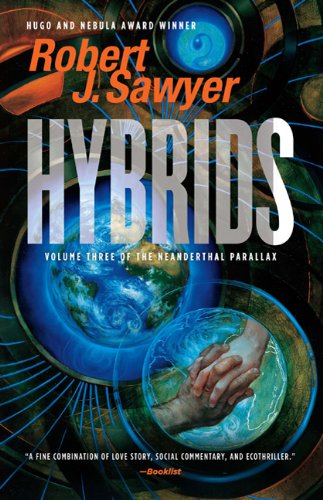
7. Hybrids (Neanderthal Parallax)
$34.39
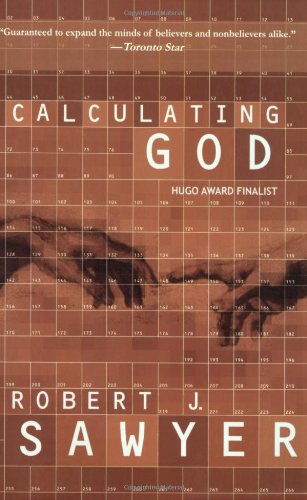
8. Calculating God
$605.18
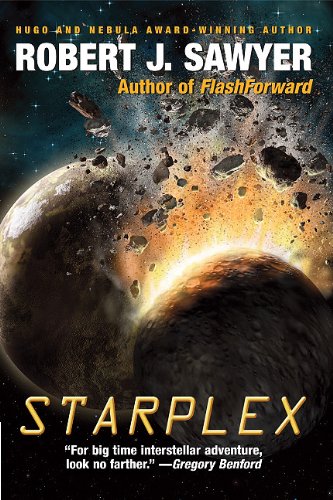
9. Starplex
$3.47
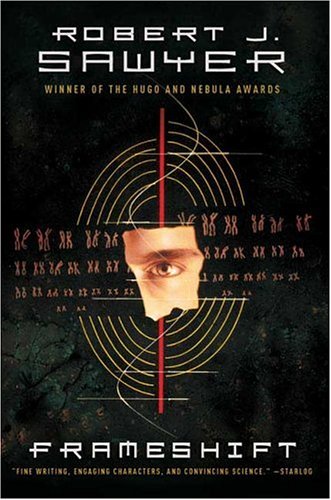
10. Frameshift
$3.99
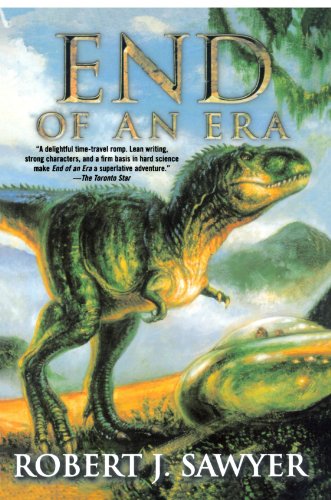
11. End of An Era
$16.49
12. Relativity
$13.78
13. Factoring Humanity
$3.15
14. Flashforward
$4.79
15. Hominids
$4.85
16. Golden Fleece
$15.69
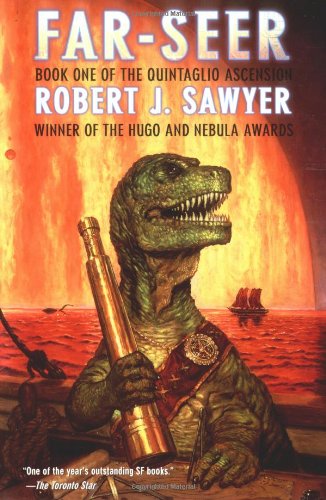
17. Far-Seer: Book One of the Quintaglio
 
$0.55
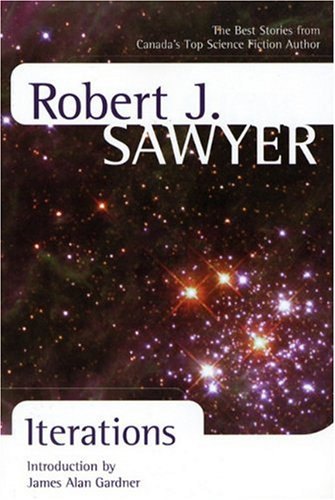
18. Iterations
$4.43
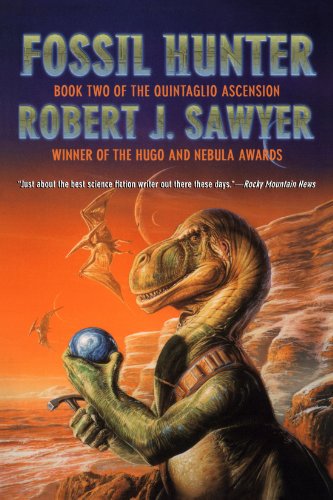
19. Fossil Hunter: Book Two of The
 
$0.75
20. The Shoulders of Giants

1. Foreigner: Book Three of the Quintaglio Ascension (The Quintaglio Trilogy)
by Robert J. Sawyer
Paperback: 320 Pages (2005-08-01)
list price: US$14.95 -- used & new: US$3.59
(price subject to change: see help)
Asin: 0765309726
Average Customer Review: 5.0 out of 5 stars
Canada | United Kingdom | Germany | France | Japan
Editorial Review

Book Description
A tale of aliens in the tradition of James White-but these aliens are dinosaurs! I nFar-Seer and Fossil Hunter, we met the Quintaglios, a race of intelligent dinosaurs from Earth, and learned of the threat to their very existence. Now they must quickly advance from a culture equivalent to our Renaissance to the point where they can leave their planet. ... Read more

Customer Reviews (8)

5-0 out of 5 stars What is that Blue Stuff,Anyhow?
Foreigner


Foreigner (1994) is the third and final book of Sawyer's Quitaglio Ascension trilogy.

In Foreigner Sawyer borrows elements from real Human History to add bits and pieces to his characterizations.In this one he borrows bits and pieces from Guy de Chaulia, Sigismund Schlomo Freud Also; there is a little Japanese Kamikazes. There that's enough clues.Go out and get this book!

If you enjoyed The Fossil-Hunter and the Far-Seer as much as I did, you'll want to read this concluding book.


Next comes... nothing. Oh, well, I'll check out his short stories in Iterations, maybe read Calculating God, again. Or possibly the Neanderthal series ,hmm.


Sawyer does let his Liberal leanings peek out at you in this book, but not terribly so.The nose of the camel does get snuck under the tent.

All in all this is a delightful ending to a very pleasant trilogy.

5-0 out of 5 stars Justice must beblind
Foreigner is a satisfying conclusion to the Quintaglio series. How to get off the moon before certain destruction? How to deal with a newly discovered dinosaur species? Why do the gest Quintaglios have such rage and then contrition when seening those new dinosaurs? It's not just dinosaurs, it's pyschology and family and thinking outside the egg. Loads of fun and lots of thought in this terrific read.

4-0 out of 5 stars Agreeable conclusion to the trilogy
An exciting and interesting conclusion to Robert Sawyer's trilogy about intelligent descendants of the dinosaurs.Naturally in the way that fiction often does, it wraps up the loose ends almost too well.I was interested to discover that this is some of Sawyer's earliest published work.It has been a while since I read any of his more recent work but I think there is a contrast - the protagonists in the Hominids series are not nearly as certain or guaranteed of success.

What actually happens in the book?It would be difficult to say much without giving away a lot of the plot, but from the blurb you can doubtless gather that the Quintaglios discover they are not the only intelligent species on their moon.What they find out about their neighbours leads to very difficult times indeed, and threatens the goal of escape from their doomed home.

5-0 out of 5 stars A quest for understanding
As the concluding work in the Quintaglio series of planetary destruction, this book draws together many elements introduced earlier.Although ostensibly a dinosaur, Afsan's character grows more human with each volume.As a reflection of current Euro-North American society, Foreigner is hard to beat.That reflection may be too vivid for some.Sawyer has a fine talent for portraying reality, whether on an imaginary planet or right next door.This series remains a challenging read.

A trilogy of sub-plots keeps your interest alive through the main theme.The saurians are learning about their own world while striving for the means to escape it.Sawyer depicts the violent mental disruptions of racism with talent.Although dinosaurs mate for reproductive ends, he manages to introduce a new feature of their lives, jealousy versus loyalty.While the accounts of Novato, Afsan's mate and his son Toroca are compelling, it's the relationship of Afsan, the continuing primary character in this series, that renders this book worthy of note.His association with the practitioner of the new therapy of psychology makes hilarious reading.Mokleb, the 'therapist,' is a marvelous rendition of the money-grubbing cockroaches that infest Earth's cities today.She's a Freudian, of course, with all the fanciful ideas of conscious and subconscious ['high' and 'low' mind] and dream interpretation that has bled many a bank account dry during the past century.Her negotiation with Afsan over payment for the therapy sessions is too vividly real to be missed.

If you are new to Sawyer, by all means start the trilogy at the beginning and follow it through this volume.You will learn much about your own world as Sawyer reflects it in Afsan's.The series is a good addition to any library of speculative fiction.The only truly speculative part of Sawyer's works is the 'people' portrayed and their location in the cosmos.[stephen a. haines - Ottawa, Canada]

5-0 out of 5 stars Finally, the conclusion!
I've waited years for this, and it was worth the wait. Some people perhaps didn't read Sawyer's Quintaglio series when it first came out, because all they saw were the dinosaurs on the covers. But the fact that his characters are intelligent saurians is almost incidental. This whole series is really a discussion of science and faith, and an examination of what breakthroughs in science would be like if they were really crucially important (what if it was a matter of life and death how the solar system was arranged -- not just for Galileo, but for EVERYONE [the plot of FAR-SEER]; what if the truth of evolution over creationism was the key to a species' survial [that's FOSSIL HUNTER]; and what if a breakthrough along the lines of psychoanalysis was the only thing that would stop a genocide [the current volume, FOREIGNER].)All three are wonderfully told, but FOREIGNER holds the most surprises and twists, not to mention packing the biggest emotional whallop. Bonus: a comprehensive "Quintaglio Concordance," drawn from all three books, at the end. As the cover quote from a Canadian newspaper says, "A fine end to a brilliant series." ... Read more


2. Illegal Alien
by Robert J. Sawyer
Mass Market Paperback: 304 Pages (1999-01)
list price: US$5.99 -- used & new: US$19.88
(price subject to change: see help)
Asin: 0441005926
Average Customer Review: 3.5 out of 5 stars
Canada | United Kingdom | Germany | France | Japan
Editorial Review

Amazon.com
Aliens, Tosoks, have finally made contact with Earth, but there are only seven of them, and they've arrived in a disabled spaceship. The Tosoks are intelligent and surprisingly easy to communicate with, and are happy to tour Earth and see what humans have to offer. But during a stop in Los Angeles, one of the human scientists traveling with the Tosoks is gruesomely murdered, and all evidence points to the alien Hask. The Los Angeles Police Department is determined to indict Hask for the crime, even though the aliens have little concept of laws or crime as we understand them. The only thing the U.S. government can do is secretly procure the services of Dale Rice, a leading civil rights lawyer, and hope he can clear Hask of the charges. But as the trial progresses, evidence indicates a cover-up by one or more of the aliens.Humanity's survival--not just Hask's fate--might hinge on the jury's verdict.Book Description
The highly-praised author of Starplex, End of an Era, and Foreigner presents a thrilling new story, a skillful blend of the great wonders of the universe and the harsh realities of life on earth.When a disabled starship enters our atmosphere, fear is quickly replaced with awe-and the incredibly intelligent members of the Tosok race are welcomed with open arms.But the growing spirit of trust and cooperation is shattered when a popular human scientist is found dead.The U.S. government provides a leading civil rights lawyer to defend the accused alien.And an unprecedented trial centers around not only one lost life, but the very essence of justice itself. ... Read more

Customer Reviews (26)

3-0 out of 5 stars Pretty good read
I tend to be a "big picture" reader, meaning that I do not pay significant attention to details... a story, for me, either flows or it doesn't.

In that context, this book is quite wonderful... as it is a great page turner. I read it in one sitting. However, when compared with numerous readings over the years, Illegal Alien has not struck me as one of the more memorable stories, nor particularly well written. The book is a great blend of mystery, court drama, and sc-fi... would make a fantastic movie with the right screen writer.

Worth a read if you are looking for interesting blend of genera, or if you are stuck at an airport.

1-0 out of 5 stars Uninspiring/Unbelievable Tale with a Catchy Title
I found ILLEGAL ALIEN(1997) to be unfinishable - mainly due to the fact that it is a contemporary SciFi story that was written ten years ago - so it simply doesn't hold up to time, and there are far too many anachronisms and idosynchrocies to wade thru... the straw that broke the camel's back for me was the part where F-14 fighters are escorting the Alien Craft - it is impossible for me to "suspend disbelief" in this case, as the last F-14 was decommissioned this year..., and since no aliens have shown up yet, this situation couldn't have ever happened, and never will happen.

After encountering a similar fiasco (but for different reasons - way too liberal politics and science) with MINDSCAN (2005), I'm definately steering away from any more books by Robert J. Sawyer.

5-0 out of 5 stars Excellent Science Fiction!
This just happens to be the first Sawyer book I read; and I can say without a doubt it will not be the last. _Illegal Alien_ moves along at a tightly written pace that keeps you turning the pages and guessing where the plot will turn next. I'm not a crime or mystery reader per se, I tend to stick with straight SF; but I love a good mystery and this certainly was one. The utlimately satisfying ending left me smiling. I must admit I had a little trouble getting past some of the gruesome details portrayed, but I'm glad I stuck with it. Without giving anything away it all makes sense in the end. Keep at it Mr. Sawyer, you can definitely write!

4-0 out of 5 stars OK, but not Great
I am a big fan of Robert J. Sawyer and consider him the best scifi writer available right now.This book fall in his middle of the road efforts (I give it 3 1/2 stars).Having read such excellent works such as the Neanderthal series, Calculating G-d, Mindscan and Factoring Humanity, I was a little bit disappointed by this one which is more a like a scifi version of a John Grisham courtroom novel.

A group of aliens lands on Earth and their ship needs repairs for them to leave.Little is known about them or their actual intentions.In the meantime a popular TV personality is murdered apparently by one of the aliens.The LA District Attorney decides to prosecute the accussed alien calling for the death penalty.An aide to the President tries to help the alien and hires one of the top criminal lawyers who had experience working on the OJ Simpson trial.

The book then turns into a courtroom drama with many pages devoted to boring court procedures (note: it worked real well in Mindscan but this approach falls short in this novel).You expect the other aliens to revolt but they all seem ambivilent to the whole situation.

Not to give away the ending but the case is somewhat solved similar to an episode of the original Star Trek series (no doubt, Sawyer got his idea from it since he constantly reference Star Trek throughout the book).

I definately would not recommend starting with this book if you are new to Sawyer but if, like me, you want to read all his works then you should definately read this.

2-0 out of 5 stars Mediocre at best
This book is social commentary thinly disguised as science-fiction/mystery. There's nothing wrong with that per se; combining sci-fi with social-political views goes back at least to H.G. Wells, to a lesser extent to Jules Verne, and for all I know even before that. There's a catch, though: the sci-fi story must be good enough to stand on its own, without the political trappings. Such was the case with "War of the Worlds", "The Time Machine", etc. Such is not the case with "Illegal Alien". The reader is subjected to a steady stream of the author's liberal political and social views, along with a wearying succession of pop culture references. In short, if you're a left-wing kind of person -- to the extent that you'll put up with a mediocre sci-fi yarn just to get your dose of liberal politics -- then this may be the book for you. All others, steer clear. And maybe re-acquaint yourself with a real writer like Wells. ... Read more


3. The Terminal Experiment
by Robert J. Sawyer
Mass Market Paperback: 352 Pages (1995-05-01)
list price: US$6.99 -- used & new: US$19.99
(price subject to change: see help)
Asin: 0061053104
Average Customer Review: 3.5 out of 5 stars
Canada | United Kingdom | Germany | France | Japan
Editorial Review

Amazon.com
The Terminal Experiment has propelled Robert J. Sawyer into the limelight as one of science fiction's hot new writers, earning him the prestigious Nebula Award in the process. In this fast-paced thriller, Dr. Peter Hobson's investigations into death and afterlife lead him to create three separate electronic versions of himself: one has no memory of physical existence and represents life after death; one has no knowledge of death or aging and represents immortality; and the third is left unaltered as a control. But all three have escaped into the worldwide matrix...and one of them is a killer. ... Read more

Customer Reviews (66)

4-0 out of 5 stars It's all in the brain...
Going back through time, I just finished Terminal Experiment, winner of the prestigious science fiction Nebula Award in 1995, after having read all of Robert Sawyer's book since his "Calculating God" (2000) in sequence. The subject matter, how technological advances can extend life beyond the usual lifespan has been a major topic in his most recent books, "Mindscan" and "Rollback".Terminal Experiment, Sawyer stated at the time, was "an exercise in determining what a human mind might be like if it were aware either that it would live forever or that it was already dead."

"Hobson's Choice", named with a touch of irony after the primary protagonist, Dr. Peter Hobson, and the title of the novel's serialization in Analog magazine, "is the choice between immortality or a scientifically verified life after death." Hobson's fascination with AI reaches new levels when he discovers an electromagnetic pulse that can be monitored as it escapes from the brain at time of death. He calls it a "soul-wave". Does that mean that a "soul" can be scientifically identified? Where does it lead and how long does it survive outside the body? Does it apply to everybody or was it a fluke? What about animals? Sawyer explores these topics with his usual sharp, investigative mind both from the technological angle as well as the spiritual.

Hobson's friend and partner in AI experiments is Sakar Muhammed. Together, they dream up a scheme that should provide new insights into brain functions after death.They do this by developing sophisticated computer models of Peter's complete brain map. The three models are not identical so that they can monitor the different behaviour patterns in the virtual environment. But then the virtual and the actual realities collide with consequences the two scientists have not foreseen... Are they in the end faced with a real "Hobson's Choice"?

As in the recent novels, brilliant to my mind, this novel combines the human aspects of what artificial intelligence (AI) can provide through advanced technology. He embeds pertinent questions of life after death and the morality resulting from the application of the technological advances into a full-fledged detective and mystery story. At times the story moves a bit slowly and there are unnecessary repetitions. His protagonists' characters are well drawn, their personal lives complicated by events and strong emotions. Other players, in particular, Sandra, Peter's wife are less convincing and rather shallow despite her role in the personal drama. While the reader may have more insights in what is going on than the protagonists, the unravelling of events is as creative as it is unique. Sawyer's knowledge of the latest science is, as usual, spot on and the realization of some of his fictional developments are within reach just a few years later. It makes the reading or rereading of Terminal Experiment years after publication particularly interesting and stimulating. [Friederike Knabe]

3-0 out of 5 stars Interesting read, thought provoking....
I am usually not a sci-fi reader, but picked this up at the library.I have heard a little about AI but dont understand it very well. I found this book to have an interesting story about what could happen with AI.It definatley held my interest.Coming from a biblical background, the life/death issues went way south of what I believe.I gave it 3stars because even if you dont like sci-fi its worth reading.The story was good, the characters were good, and the idea plausible.

4-0 out of 5 stars A murder mystery that deals with the very definition of life and death!
Robert J Sawyer has never been an author to think small and he certainly didn't start in "The Terminal Experiment"! Soul-searching (literally) provocative discussions on the nature and the very definition of death, immortality, spirituality, morality, love, compassion, hatred, infidelity and more are what elevates Sawyer's novel from the realm of a mere hard sci-fi murder mystery into the class of a Nebula Award winner! He even goes so far as to touch upon the existence of a soul and its effect upon religious beliefs and global events.

Dr Peter Hobson, a successful businessman and bio-technology engineer, has created an EEG orders of magnitude more sensitive than all of the machines currently available. When he uses his scanner to detect an electrical field leaving the body after death, which he calls the "soul wave", he then collaborates with his best friend, an AI specialist, to create three computer simulations of his own brain - one modified to represent the spirit, or life after death; a second, modified to have no concept of death or aging, representing immortality; and the third left untouched as a scientific control. The self-determining simulations escape from the confines of the AI lab's computers into the world wide net and the murders begin. One of them is a murderer but the question, of course, is which one, why and how to stop it?

Sawyer's clever literary device of using snippets from newscasts and magazine or newspaper articles is not only entertaining but it places the issues he has chosen to address in his novel into a global context and hypothesizes on the effects that these types of discoveries would have on a worldwide scale ... at once thought provoking, amusing, sobering and educational!

On a complete aside, I was also grateful to Sawyer for using his story as an example of what Charles Dickens was trying to convey in his famous opening paragraph in "The Tale of Two Cities" - you know the one, "It was the best of times. It was the worst of times ...".Until Sawyer illustrated the idea using his own story, I was always foggy about this ambiguous juxtaposition of complete opposites. But Sawyer switched on the light bulb for me.

Highly recommended!

Paul Weiss

4-0 out of 5 stars Another solid work
This here's another solid work by a really good SciFi writer. Tho, 12 years after publication it could use an revised edition. Seems funny to be reading about VCRs still being used in the year 2011 and Donahue and Geraldo as leading TV newscasters. Solid SciFi thriller that's thought provoking; abortion, AI, nanotech figuring in the nifty plot.

4-0 out of 5 stars A decent story from one of the best SF writers
Robert J. Sawyer is a great science fiction writer, having won every major award in the US, UK, Canada, Japan, and would have won one in Antartica if they had a contest. This novel won the Nebula and was a Finalist for the Hugo.

Frankly, I do not see why.

The story is based on two scientific premises: detection of the soul leaving the body and computer based artificial intelligence. Detection of the soul leads to experiments in AI to determine what life after death might be like. Dr. Peter Hobson, the inventor of the "soulwave" detection, uses AI and nueral net scanning to create three versions of himself: a life after death sim, an immortality sim and a control sim that is just like him. Hobson has some issues to deal with in his personal life (I won't play spoiler here), and those issues are duplicated into the three sims. One of them goes bad, and starts using the net to kill people.

Sawyer's claim to fame is that he will take premises like this and wrap very real characters around them. The concept of science fiction is in making both the science and the fiction work for the reader. Many writers tend to forget this, either throwing out unbelievable science or getting the science right but forsaking the characters or the plot. Sawyer is normally magic in this.

The Terminal Experiment is a good read, with nice pacing. It bogs down at times in the explanations of the science, and some of the philisophical discussions of the AI's. But the concept of killer AI computers has been hashed and re-hashed (remember HAL!), as has the concept of detecting something that proved life after death. And unlike other Sawyer novels, I had difficulty caring about the characters, esp. Cathy, Peter's wife.

I'm glad I read it, but I'm gonna go now and read Hominids, Humans and Hybrids, his classic Neaderthal Parallax series.

... Read more


4. Humans (Neanderthal Parallax)
by Robert J. Sawyer
Hardcover: 384 Pages (2003-02-22)
list price: US$24.95 -- used & new: US$17.39
(price subject to change: see help)
Asin: B000C4SK2E
Average Customer Review: 4.0 out of 5 stars
Canada | United Kingdom | Germany | France | Japan
Editorial Review

Book Description
Robert J. Sawyer, the award-winning and bestselling writer, hits the peak of his powers in Humans, the second book of The Neanderthal Parallax, his trilogy about our world and parallel one in which it was the Homo sapiens who died out and the Neanderthals who became the dominant intelligent species. This powerful idea allows Sawyer to examine some of the deeply rooted assumptions of contemporary human civilization dramatically, by confronting us with another civilization, just as morally valid, that has made other choices. In Humans, Neanderthal physicist Ponter Boddit, a character you will never forget, returns to our world and to his relationship with geneticist Mary Vaughan, as cultural exchanges between the two Earths begin.As we see daily life in another present-day world, radically different from ours, in the course of Sawyer's fast-moving story, we experience the bursts of wonder and enlightenment that are the finest pleasures of science fiction. Humans is one of the best SF novels of the year, and The Neanderthal Parallax is an SF classic in the making. ... Read more

Customer Reviews (49)

3-0 out of 5 stars good writer, good plot, characters need work
I like the books, but the main male Neanderthal comes across as just to much of a character from a woman's romance novel.He's just a bit to manly.Even his feminine side is manly.The author does this by cutting down on the men from our universe.Especially American men.The series is good but if you are an American white male, expect to feel insulted.You just can't compete with Neanderthals.

5-0 out of 5 stars Justice triumphant
Humans

In Humans, the second book of the Neanderthal ParallaxSawyer has Ponter Bodditt spend most of his time in the world that we know along with a dozen or so of the Neanderthal best scientist.In the first book,Hominids (Neanderthal Parallax)Sawyer spends most of the time in the Neanderthal world.

Sawyer does introduce a novel method for dealing with crime.Treating it as a genetic disorder.Sounds interesting to me.Be sure to tune in for the third book in this seriesHybrids (Neanderthal Parallax)

GunnerJuly 2007

4-0 out of 5 stars Not as good as the first one
Humans is not as good as the first book in this trilogy, Hominids.However, much of the book still takes place in the intelligent and imaginative alternate universe populated with neanderthals created by Sawyer.This book focuses on the developing relationship between Ponter and Mary and the obstacles of their separate worlds and cultures, as well as Mary's past sexual assault.The ending alone makes this book worth reading.

3-0 out of 5 stars Candide gets on his soapbox
After the excellent Hominids, Humans is somewhat of a let down. The series remains above the average SF fare, both in terms of contents and execution. But Humans wouldn't win any awards on its own though (PC award excepted).

Rather than exploring new ground, Mr. Sawyer has Ponter (the main Neanderthal character) repeatedly asking questions that highlight how we humans are so unpleasant to each other. This is not a bad thing in itself, but it is not a substitute for a plot either. By the time Ponter asks his 4th or 5th such question, with Mary providing an uninspired pro forma defense, the trick is as stale as my hiking socks. I especially "liked" the cocktail discussion with Mary's colleagues, with verbatim quotes from Jared Diamond's excellent Guns, Germs and Steel.

The Neanderthals' policy of castrating criminals and their immediate relatives smacks of eugenics, despite recent statistical research on the hereditary component of criminality. How did they avoid judicial errors, before the oh-so-convenient alibi machines? Is that policy ever defended? Nope, no need to, they are perfect after all.

Like others, I wonder how the Neanderthals can have such advanced technology, without our population base, our manufacturing base, or indeed our wars. I see several possibilities, and I would have welcomed more insight from the book.

a) Not having civilization collapses is more efficient in the long term (tortoise vs. hare).

b) The Neanderthals are smarter as they have bigger brains. What is Ponter doing with Mary then?

c) Technological research has been long been driven by the military, though nowadays, consumer/business oriented research seems to be more important. But pure science may be less influenced by military spending.

d) Having one language/civilization might speed up the transfer of ideas.More likely, it would introduce serious groupthink.

e) The Neanderthals' socialism implies universal access to education which could maximize the potential of gifted individuals.

All in all, the author rests on his laurels and Humans doesn't add anything fresh to Hominids' storyline. Instead, he falls back into his usual habit of throwing "subtle" barbs at our southern neighbours. Gee, Mr. Sawyer, you live in Canada and prefer it to the US. Living in Canada, I sympathize, to an extent. But, need we be reminded, at length, in _all_ your books??? Hominids was much the better for being unusually subtle on that matter.

5-0 out of 5 stars Good continuation of Volume One
I love this series, it's got just enough science fiction mixed in with reality to make it a very quick and enjoyable read. I recommend this series to anyone from 12 to 112. ... Read more


5. Rollback
by Robert J. Sawyer
Mass Market Paperback: 320 Pages (2008-02-05)
list price: US$6.99 -- used & new: US$3.27
(price subject to change: see help)
Asin: 0765349744
Average Customer Review: 4.5 out of 5 stars
Canada | United Kingdom | Germany | France | Japan
Editorial Review

Book Description

Dr. Sarah Halifax decoded the first-ever radio transmission received from aliens. Thirty-eight years later, a second message is received and Sarah, now 87, may hold the key to deciphering this one, too . . . if she lives long enough.
A wealthy industrialist offers to pay for Sarah to have a rollback—a hugely expensive experimental rejuvenation procedure. She accepts on condition that Don, her husband of sixty years, gets a rollback, too. The process works for Don, making him physically twenty-five again. But in a tragic twist, the rollback fails for Sarah, leaving her in her eighties.
While Don tries to deal with his newfound youth and the suddenly vast age gap between him and his wife, Sarah struggles to do again what she’d done once before: figure out what a signal from the stars contains.
... Read more

Customer Reviews (20)

4-0 out of 5 stars Very Good overall.
I just finished reading this and can recommend it without hesitation.

There are two main concepts that run through this book.The first is the discovery of a complex signal from a nearby star, Sigma Draconis.The second is the concept of "rolling back" the aging process.Both of these themes run through this book.

The few characters are well-developed and the book is a fast read.Although this wasn't a five-star book IMO, it is well worth reading.

5-0 out of 5 stars Excellent Sawyer material
Sawyer is always creative and makes you think - this is easily one of his best. Enjoy!

3-0 out of 5 stars Somewhat disappointed
Let it be known that I am a big Sawyer fan, I've read many of his books, including my favorite Neanderthal Parallax trilogy. His social commentary is among my favorites along with his scientific backup and plausible scenarios. I was debating on whether or not to post a review since the last thing i'd like to do is discredit this amazing author. Ultimately i decided that maybe criticism is best introduced when coming from a devote fan such as myself.
Now on to the review.

Don Halifax is content with his long life and finds that dying is the next logical and appropriatestep he must take. With that, his life is turned upside down when received a rollback that reverts his physiology back to the age 25. As customary with Sawyer many political subjects are touched upon. Sadly the issues weren't of much consequence to the plot. Additionally the big issue of loyalty to a spouse was handled with far too little care. Hormones vs faithfulness seemed to be the prominent factor in the book. Aside all the issues, the heart of the story(that of the alien's messages) were fairly interesting but once again not delved into enough. Throughout the book, i was quite bored and was anticipating a big ending that would rattle me as i've come to expect of Sawyer. Regretfully it was VERY anti-climatic.
Now don't get me wrong, the book was well-written and enjoyable. It's just that Sawyer seemed to lose some of his pizazz. Having said all that, I will continue to read Sawyer albeit somewhat weary of his further approaches at entertaining us.
Lucas.

3-0 out of 5 stars eh.its okay.
While I am an avid Sawyer reader, this book while interesting pulled too much from ethical literature without fully exploring any of its ramifications.An interesting and quick read, but not nearly as satisfying as his other works.

5-0 out of 5 stars Good characters, good concept, and an easy read
Robert J. Sawyer's novels are always a treat for me.I have read them all. His characters are believeable and likeable.His ideas are unique and based on science that is not that far-fetched at all.Rollback is another one of those books that fits right into those categories.Sawyer is a master at developing ethical or moral issues for his characters in the way they respond to their environment, circumstances, etc.

Here we have Don Halifax, an Octogenarian who receives an expensive, highly sought after rollback that fixes all his innards to be that of a man in his 20's.His wife, also an Octogenarian, gets the same treatment but it fails.Don and his wife are still in love after 60 years of marriage but things get frustrating and confusing for Don as he sees his elderly wife fading away while he gets this other chance at life that he never actually asked for. All the while, Don's wife Sarah is trying to use her twilight years to assist an alien species that responded to a SETI message she sent years earlier during the prime of her career.

This book didn't have a real enemy per se just a lot of thought provoking ideas.I suppose the antogonist was Don's own psyche as he reacted to friends and family dying around him, guilt, frustrations, raging hormones, and looking younger than his own kids

The book is over 300 pages but you will get through it in no time, even with all the scientific research discussions thrown into the mix.It is also going to be his last book with TOR as his next book will have a new publisher.

By the way, I loved Gunther, the Robot and I wished there was more of him in the book. ... Read more


6. Identity Theft: And Other Stories
by Robert J. Sawyer
Hardcover: 386 Pages (2008-03-15)
list price: US$28.95 -- used & new: US$28.95
(price subject to change: see help)
Asin: 0889954119
Canada | United Kingdom | Germany | France | Japan
Editorial Review

Book Description

"A sense of wonder that hasn't prevailed in American SF since the days of Heinlein."-Books in Canada

This new collection by the man Anne McCaffrey calls "an absolutely marvelous writer" includes Hugo Award nominee "Shed Skin," Nebula Award nominee "Identity Theft," and Aurora Award winner "Ineluctable." In these pages, you'll discover the dark secret of the only priest on Mars, revisit H.G. Wells's Morlocks, and learn what really happens when aliens beam us the Encyclopedia Galactica.


"Sawyer's fans will be gratified to find many of his favorite themes amply represented here, from evolution gone awry to sentient dinosaurs to the perilous loopholes created by quantum physics. He has a gift for casting jarringly original ideas in lucid, sharp-edged prose that mainstream-fiction as well as SF readers should appreciate."-Booklist

"Sawyer has a way of taking familiar ideas, looking at them from new angles and in greater depth than almost anybody before him, and tying them together to create extraordinarily fresh and thought-provoking stories."-Analog

"Sawyer writes my favorite kind of science fiction: interesting characters, fast-paced plotting, science threaded elegantly into the prose - he does it all with grace and style. I am constantly amazed by the depth of Sawyer's characters - their humanity, their failings and their instincts."
-Rodger Turner on SF Site

... Read more


7. Hybrids (Neanderthal Parallax)
by Robert J. Sawyer
Mass Market Paperback: 400 Pages (2004-11-01)
list price: US$7.99 -- used & new: US$3.50
(price subject to change: see help)
Asin: 076534906X
Average Customer Review: 3.0 out of 5 stars
Canada | United Kingdom | Germany | France | Japan
Editorial Review

Book Description
In the Hugo-Award winning Hominids, Robert J. Sawyer introduced a character readers will never forget: Ponter Boddit, a Neanderthal physicist from a parallel Earth who was whisked from his reality into ours by a quantum-computing experiment gone awry - making him the ultimate stranger in a strange land.In that book and in its sequel, Humans, Sawyer showed us the Neanderthal version of Earth in loving detail - a tour de force of world-building; a masterpiece of alternate history.Now, in Hybrids, Ponter Boddit and his Homo sapiens lover, geneticist Mary Vaughan, are torn between two worlds, struggling to find a way to make their star-crossed relationship work. Aided by banned Neanderthal technology, they plan to conceive the first hybrid child, a symbol of hope for the joining of their two versions of reality. But after an experiment shows that Mary's religious faith - something completely absent in Neanderthals - is a quirk of the neurological wiring of Homo sapiens brains, Ponter and Mary must decide whether their child should be predisposed to atheism or belief. Meanwhile, as Mary's Earth is dealing with a collapse of its planetary magnetic field, her boss, the enigmatic Jock Krieger, has turned envious eyes on the unspoiled Eden that is the Neanderthal world . . . Hybrids is filled to bursting with Sawyer's signature speculations about alternative ways of being human, exploding our preconceptions of morality and gender, of faith and love. His Neanderthal Parallax trilogy is a classic in the making, and here he brings it to a stunning, thought-provoking conclusion that's sure to make Hybrids one of the most controversial books of the year. ... Read more

Customer Reviews (40)

2-0 out of 5 stars Disappointing
Very disappointing - I waited a long time for all three of these to be in paperback so I could read them all together.They weren't anywhere close to as good as the rest of his work and I'm a big Robert Sawyer fan as well as a feminist.Mary, the primary female character, was not a very sympathetic person although I'm sure she was meant to be. Lots of potential that just never quite got there.

4-0 out of 5 stars The Camel is in the tent
Hybrids

Hybrids is the book Sawyer has been leading up to all along.You should definitely read all three books in this trilogy.Hominids (Neanderthal Parallax)], ][[ASIN:0765346753 Humans (Volume Two of The Neanderthal Parallax),and now Hybrids (Neanderthal Parallax).

I mentioned in an earlier review that with respect to Sawyer's Liberalism" he let the nose of the camel come peeking under the tent.Well, in Hybrids the camel is all the way inside the tent and it has taken a dump in the middle.I'm going to have to hold my nose if I read any more of his stories.In fact I'm going to go read[[ASIN:0743499204 A State of Disobedience]] just to balance out Sawyer.

Points include the old Military Industrial Complex as the boogieman.

Universal homosexuality being apparently espoused.

Anyhow it is a good story ,but...

I noticed that it didn't win any awards like the other two.Now I know why.

Gunner August,2007

2-0 out of 5 stars More a romance novel than science fiction
I thought long and hard over how many stars to give this book and eventually opted for two because it's just not quite good enough for three but it is a fairly strong two.The first books in the trilogy are better however and I would rate them each three stars.

Without going into too much detail about the story, the three books cover what happens when a link to an alternate universe where Neanderthals supplanted humanity as the dominant hominid race opens up.Ponter Boddit, a Neanderthal physicist, is transported to our universe and Mary Vaughan, a genetic expert, is appointed to study him and over time they fall in love.As humanity learns more about the Neanderthals, dark forces plot to take their universe over for the human race.Of course everything turns out okay in the end.

Sawyer paints an interesting picture of how different the science and culture in the Neanderthal universe is compared to ours but spends too much time on religion.Apparently the Neanderthal brain is structured in such a way that religious experience is beyond their understanding.What irritated me the most though was the concentration on the love story.At times I thought I was reading a Mills and Boon romantic novel and some of the romantic interaction later in the book came over as just plain silly.

I think that the Neanderthal Parallax could just as well have been fitted into two books.This book has its occasional moments but isn't a real winner as far as I'm concerned.

4-0 out of 5 stars All right, having read the previous ones...
Reviews of this book seem to belong to two categories:
A. very negative ones, usually written by ultra-religious folks and
B. very positive ones,written by non-religious folks who had read the other two instalments.
It is my belief one should be somehow more considerate in reviewing this book.
Obviously, it has not got the inventiveness and the fast pace of the first, or of the second.
It does, nonetheless, ask uncomfortable questions and provides also some food for thoughts.
It therefore should not be dragged down.
You need to read the two other volumes first, but once you do, if you are not from a ultra-strict religious upbringing, you are most likely to enjoy this book, which is, inter alia, about tolerance, something in very short supply these days...
After reading all the negative reviews, I first hesitated about buying it and then I expected it to bomb.
I was actually wrong. I quite liked it for the reasons I mentioned above.
Thank you, Mr Sawyer.

5-0 out of 5 stars Excellent continuation, have to read if you've read the others in this series.
If you read one of this series, you have to read them all. They're very well writte, flow smoothly and provide such a relaxing, quick, and upbeat read (for the most part)at the end of the day. ... Read more


8. Calculating God
by Robert J. Sawyer
Hardcover: 320 Pages (2000-06-03)
list price: US$23.95 -- used & new: US$34.39
(price subject to change: see help)
Asin: B00008RUN0
Average Customer Review: 4.0 out of 5 stars
Canada | United Kingdom | Germany | France | Japan
Editorial Review

Amazon.com
Creationists rarely find sympathy in the ranks of science fictionauthors--or fans, for that matter. And while Robert J. Sawyer doesn't exactlymake peace with evangelicals on the issue, Calculating God has to be oneof the more thoughtful and sympathetic SF portrayals you'll find of religion andintelligent design. But that should come as no surprise from this craftyCanadian: in the Nebula Award-winning Terminal Experiment, Sawyerspeculated on what would happen if hard evidence were ever found for the humansoul; in Calculating God, he turns science on its head again when earthis invaded by theists from outer space.

The book starts out like the setup for some punny science fiction joke: An alienwalks into a museum and asks if he can see a paleontologist. But the arachnid EThasn't come aboard a rowboat with the Pope and Stephen Hawking (although HisHoliness does request an audience later). Landing at the Royal Ontario Museum inToronto, the spacefarer (named Hollus) asks to compare notes on mass extinctionswith resident dino-scientist Thomas Jericho. A shocked Jericho finds that notonly does life exist on other planets, but that every civilization in the galaxyhas experienced extinction events at precisely the same time. Armed with thatdisconcerting information (and a little help from a grand unifying theory), thealien informs Jericho, almost dismissively, that "the primary goal of modernscience is to discover why God has behaved as he has and to determine hismethods."

Inventive, fast-paced, and alternately funny and touching, CalculatingGod sneaks in a well-researched survey of evolution science, exobiology, andphilosophy amidst the banter between Hollus and Jericho. But the book alsoproves to be very moving and character-driven SF, as Jericho--in the face ofHollus's convincing arguments--grapples with his own bitter reasons for notbelieving in God. --Paul HughesBook Description
Calculating God is the new near-future SF thriller from the popular and award-winning Robert J. Sawyer. An alien shuttle craft lands outside the Royal Ontario Museum in Toronto. A six-legged, two-armed alien emerges, who says, in perfect English, "Take me to a paleontologist."It seems that Earth, and the alien's home planet, and the home planet of another alien species traveling on the alien mother ship, all experienced the same five cataclysmic events at about the same time (one example of these "cataclysmic events" would be the meteor that wiped out the dinosaurs). Both alien races believe this proves the existence of God: i.e. he's obviously been playing with the evolution of life on each of these planets.From this provocative launch point, Sawyer tells a fast-paced, and morally and intellectually challenging, SF story that just grows larger and larger in scope. The evidence of God's universal existence is not universally well received on Earth, nor even immediately believed. And it reveals nothing of God's nature. In fact. it poses more questions than it answers.When a supernova explodes out in the galaxy but close enough to wipe out life on all three home-worlds, the big question is, Will God intervene or is this the sixth cataclysm:?Calculating God is SF on the grand scale. ... Read more

Customer Reviews (151)

4-0 out of 5 stars Science as leap of faith, faith as solid science
Usually, if I sense an alien coming, I run. In movies or books, anyway. Beasties with six legs and eyes on wands, flying saucers and such... not my thing. But good writing, in any genre, is always my thing. There is so much to learn and understand in solid reality that I wish no escapism, the latter wasting precious real time for matters of value and substance ... but when science fiction keeps enough of its six legs firmly planted in issues we face in substantiated reality, even as it waves its eye wands into the unknown ... then my interest is won.

Robert J. Sawyer is a familiar name to me, even without being a sci fi fan. The title, "Calculating God," locked into my lifelong fascination with the spiritual realm. I was intrigued to know how a sci fi writer of acclaim would approach the concept of God, that is, faith, grounded in a world of science, however speculative: he does it well and convincingly.

Hollus, aforementioned six-legged alien with waving eye wands, comes to Earth to research, well, life itself. And all that the concept of life and living encompasses. She enters a museum to find a paleontologist, thus meeting Tom Jericho, scientist who is facing the afterlife, like it or not, as a newly diagnosed cancer patient. The two have an ongoing dialogue about God and faith, which pretty much sums up the entire premise of this story, with few sidelines. Surprise! For it is the alien who believes in God, the human being who so mightily resists, even as he contemplates his fast approaching mortality.

I could complain that various scenes and plot twists in this book leave me unconvinced. I have a hard time buying the idea that people would accept so quickly and easily, almost to the point of being oblivious, an alien moving so casually among them, even if mostly in hologram form. The vandalism in the museum by religious fundamentalists is on shaky ground, potentially unnecessary, but with more solid plotting, might have been developed into a fascinating tangent of exploring religious fervor when it goes too far. Sawyer missed his mark here for what might have added a fine nuance to the story.

Yet, regardless, I found myself recommending this book to others even before I had finished it. Several times, the author brings out points in this dialogue on faith that made me "a-ha!" aloud in my reading, wondering, why had I never thought of that? He makes arguments, via Hollus, favoring the idea of intelligent design, that for all the proven evolution of one species over time in a myriad of ways and forms, never has science shown one species evolving into another species. A dog can, over time, become a great many other breeds of dog, but he will never become a bird. And this, after all, is the premise on which the idea of evolution is, must be, built. Cell becomes fish becomes reptile becomes primate becomes man... you know the lineage. Science has gaps in this area, requiring faith.

What Sawyer so masterfully brings to light in this story is that it is science that requires many leaps of faith ... *not* believing in God. Perhaps, in fact, much more so. With his alien voice, in various examinations of one scientific premise after another, he argues that God is rooted in science, that is, well substantiated in many forms of solidevidence, while the [godless] science we accept in the contemporary world is actually standing on the clay feet of irrational faith.

Fascinating.

The literary value of this book, in terms of style and form, for me, is on the weak side. Its value as invitation for lively discussion, its courageous groundbreaking of the usual storylines of more typical sci fi fare, deserves high praise. Science fiction fan or not -- recommended reading.


3-0 out of 5 stars Excellent premise...mediocre execution.
Robert J. Sawyer is the master of coming up with some of the most unique and clever premises in all of science fiction...and then stumbling in the execution.

As is typical for Sawyer, he can't quite resist the temptation to get up on his soapbox and skewer one or more straw men characters he's created for the sole purpose of serving as boogeymen to the left wing protagonist.With the understanding that science fiction authors tend to be politically left of center in general, Sawyer takes it to an extreme.In this book, the straw men are a couple of "creationists" whom Sawyer portrays as murderous buck-toothed morons (of course).Defying all logic (perhaps intentionally), the "creationists" believe that fossils 1) were "created by God to test the faith of the weak" AND 2) are "the work of the devil."Apparently, Sawyer thinks creationists believe that God and the devil are in cahoots to trick people into not believing in God.Huh???Anyway, this entire subplot seems to exist only in order to assure Sawyer's readers that he is most definitely NOT a creationist.(Oddly, some of the other reviewers criticize this novel as being a defense of creationism.Ummm...you might want to read it again...a little more carefully this time.)

The other flaws in this book are also Sawyer mainstays, namely one-dimensional characters in general (yes, even the good guy characters that Sawyer is fond of) and a rushed/anticlimactic ending.

Minus one star each for the one-dimensional characters, left wing soapbox, and rushed ending; plus one star because this is actually one of Sawyer's more interesting novels; final verdict, three stars.

2-0 out of 5 stars Last search for the thing that is not
Calculating God, published in 2000, seems to be Robert Sawyer's last desperate attempt to cling to the delusion that the universe was intelligently designed by an entity that, for want of a better term, might as well be called "God." The first volume, published in 2001, of his Neanderthal Parallax trilogy, leaves little doubt that he no longer lives in Cloud Cuckoo Land. Somewhere between those publication dates he either had an "Aha!" revelation and suddenly recognized that metaphysics is a denigration of rational human thought, or he eventually accepted the inevitable conclusion that the reason he could find no legitimate evidence for a god's existence is that gods in fact do not exist, and further searching was not going to change that reality.
But even Calculating God, written when he was still basically a believer, presents a Designer quite unlike the deities of organized religion. It has no interest whatsoever in individuals, and could not answer prayers even if it cared to do so, since it has no common language in which spoken words could reach its awareness. In fact it turns out to be a galaxy-sized sentient black hole that evolved in the last Big-Bang, Big-Crunch eon, and was able to survive the following Big Bang. Nonetheless, Sawyer portrays it as sufficiently partial to sapient life to interpose itself between a supernova and three intelligent species that would otherwise have been destroyed by the supernova's radiation.
If I had not previously read the Neanderthal Parallax, and consequently was confident that the author's pro-hogwash perspective would eventually be corrected, I would have been unable to get past the first five pages. As it happens, I am glad I finished it, for what it reveals about an author struggling to come to terms with a belief he recognizes as indefensible but nonetheless comforting. That is why security beliefs exist. But while I can unequivocally recommend the Neanderthal trilogy as worthy of Asimov or Heinlein, this book's status as suspension-of-disbelief fiction falls abysmally short of its target.

2-0 out of 5 stars Resolution not impressive
I was not impressed with the resolution. While some have considered it thoughtful and clever, I found it disappointing. The Author is articulate and certainly does not suffer from the lack imagination. Nevertheless, like many other books that entertain youwith their language, this is a good read for that reason along.

5-0 out of 5 stars Don't make the mistake of thinking Sawyer is a creationist
Before posting any review I always like to read what the one-star reviewers have to say. It doesn't usually change my position, and this time is no different. One thing I will mention is that some people completely misinterpreted what Sawyer was trying to accomplish with this book.

Some reviewers see Sawyer as a preacher of faith espousing creationism as a fact through this book. Nothing could be further from the truth. Sawyer is an atheist. He wrote this book as a "what if" scenario. "What if there really was such a thing as a god who created the universe." He also creates the character of Tom Jericho (given the name based on the mythological doubting Thomas) to show a strong, unmoving atheist who refuses to believe in a god even after shown overwhelming evidence.

Remember that this is a work of fiction. Sawyer no more believes it than John Varley believes that people from 50,000 years in the future travel back in time to snatch people from doomed aircraft.

There are atheists who say that absolutely nothing will convince them of the existence of a god. They have absolute faith that a god does not exist. Jericho is such a man. Rob Sawyer created a situation where a man has his strong atheist beliefs challenged, and he did in a unique and thought provoking way.

Like Sawyer, I am an atheist, but not a strong one. We do not have the scientific knowledge, at present, to confirm that a god does not exist. I think it is quite likely that there is no god. The evidence that we can gather points us in that direction, but it is far from conclusive. Therefore, if some scientific proof came about, like this book's scenario, then I'd change my thinking.

Sawyer is highly adept at exploring real life issues that affect the human species. This is another example of that. You may not agree with his point of view, but he does take a firm social stand in his books and it makes for great stories.

Not only that, but he is a very nice guy.
... Read more


9. Starplex
by Robert J. Sawyer
Paperback: 304 Pages (1996-10)
list price: US$6.50 -- used & new: US$605.18
(price subject to change: see help)
Asin: 0441003729
Average Customer Review: 3.5 out of 5 stars
Canada | United Kingdom | Germany | France | Japan

Customer Reviews (29)

3-0 out of 5 stars Not on Sawyer's "A" list!
I have nothing but praise for Sawyer and I find him one of the best Science Fiction writers ever!However, this book was a major letdown, lacking the interesting characters and intriguing plots of some of his other books. Also, in other books, Sawyer does a far superior job explaining complex science.In this book he makes the scientific explanations difficult to follow unless you happen to be Stephen Hawking.

The plot itself reminds me of a long episode of Star Trek TNG.You have the starship searching the galaxy with both human and alien crewmen united by a planet Commonwealth (did you say Federation?).They ultimately must save the galaxy by the book's end.

5-0 out of 5 stars Award-caliber / first-rate / great book
Robert J. Sawyer won the 2003 Hugo Award for Best Novel of the Year for HOMINIDS.That win was well-deserved but I got to wondering how far back in his career he was writing award-caliber books before he snared the "Big One."The answer is:at least THIS far back.STARPLEX was the only 1996 novel to be both a best-novel Hugo Award finalsit and best-novel Nebula Award finalist (and it won Canada's Aurora Award and the Compuserve HOmer Award).Sawyer's aliens are every bit as good as those of James White, Larry Niven, Hal Clement and Robert Forward, and his people are infinitely more complex and believable than any written by those writers.This book tackles just about every problem in astrophysics ... and solves them all.No wonder its on numerous university astronomy reading lists, and endorsed by the Astronomical Society of the Pacific.A terrific book well worth tracking down.

4-0 out of 5 stars Good mix
This the second book by Sawyer I have read and I enjoyed both. The first was 'Calculating God'. Starplex was mostly hard SF but with some interesting philosophical ideas. Although Starplex seems like basic hard SF, even leaning towards space opera on the surface, it's also develops some big ideas about the universe and origin of life.

4-0 out of 5 stars Good mix
This the second book by Sawyer I have read and I enjoyed both.The first was 'Calculating God'.Starplex was mostly hard SF but with some interesting philosophical ideas.Although Starplex seems like basic hard SF, even leaning towards space opera on the surface, it's also develops some big ideas about the universe and origin of life.

3-0 out of 5 stars An Enjoyable but Uneven Space Opera
Sawyer's foray into space opera and space adventure is a fun book to read, but lacks the depth of (human) characterization and philosophical thought that are the strengths of his later works.The book's strengths include
1. the Ib Race -- a brilliant construct
2. the dark matter entities
3. the enigmatic glass man
4. the tightly woven plot threads
5. an interesting twist on the gateway concept

The book's weaknesses include
1. a weak protagonist
2. too many "Star Trek"-like devices (tractor beams, force fields)
3. uneven treatment of the human-Walhal (the pig creatures) dynamics.

Unlike many of the (harsh) negative critics below, I found the book quite enjoyable, even if there is some hand-waving here and there.It's not like that hasn't been done before in SF.And just to set the matter straight, Sawyer does NOT imply that laser beams are visible (he clearly states that the computer animated the laser fire in a holographic display) and he does not say that a spaceship swerves to avoid direct laser fire; what he does say is that a spaceship maneuvers to avoid another, spinning spaceship which happens to be firing a laser.

The book is enjoyable science fiction.The key word in this phrase is fiction. ... Read more


10. Frameshift
by Robert J. Sawyer
Paperback: 352 Pages (2005-11-01)
list price: US$14.95 -- used & new: US$3.47
(price subject to change: see help)
Asin: 0765313162
Average Customer Review: 3.5 out of 5 stars
Canada | United Kingdom | Germany | France | Japan
Editorial Review

Amazon.com
There is a 50 percent chance that geneticist Pierre Tardivel is carrying the gene for Huntington's Disease, a fatal disorder. That knowledge drives Pierre in his work on the Human Genome Project, an attempt by scientists to map human genes. But a strange set of circumstances--including a knife attack, the in vitro fertilization of his wife, and an insurance company plot to use DNA samples to weed out clients predisposed to early deaths--draw Tardivel into a story that will ultimately involve the hunt for a Nazi death camp doctor. Frameshift shows why the New York Times calls Robert J. Sawyer "a writer of boundless confidence."Book Description
Geneticist Pierre Tardivel may not have long to live-he's got a fifty-fifty chance of having the gene for Huntington's disease. But if his DNA is tragic, his girlfriend's is astonishing: Molly Bond has a mutation that gives her telepathy. Both of them have attracted the interest of Pierre's boss, Dr. Burian Klimus, a senior researcher in the Human Genome Project who just might be hiding a horrific past. Avi Meyer, a dogged Nazi hunter, thinks Klimus was the monstrous 'Ivan the Terrible' of the Treblinka Death Camp. As Pierre races against the ticking clock of his own DNA to make a world-changing scientific breakthrough, Avi also races against time to bring Klimus to justice before the last survivors of Treblinka pass away.Winner of the Seiun Award-Japan's top honor in science fiction-and a finalist for the Hugo Award, Frameshift is classic Robert J. Sawyer, combining a heart-wrenching human story and cutting-edge science into a pulse-pounding thriller that 'delivers the real thing with subtlety and great skill' (Toronto Star). ... Read more

Customer Reviews (34)

1-0 out of 5 stars Read It In Two Days - Wondering Why I Bothered.
I was excited to read Frameshift at first. A small-scale adventure, confined to one planet, to one species - humans. I didn't see how Sawyer could pull his usual trick of cramming too much subject matter into a book for its own good here, and thankfully, Sawyer manages to focus pretty well on his subject - an unusual achievement for him.

Unfortunately, though, the book suffers from a flawed structure, and the conclusion is undramatic and abrupt. I don't like it when an author has trouble exploiting the dramatic potential latent in his concepts, and Sawyer might as well just not write at all if he can't cure this problem.

If a Nazi is on the loose, shouldn't most of the book center around him? It sort of does, better than most of Sawyer's work, but I was irritated by the insurance company angle taking up so much time in the book, and the science seemed irrelevant and pointless.

By the end of the novel, I still didn't understand what any of the science meant, and I was worried this would stop me from understanding the climax. But this didn't turn out to be a problem, since the villain just gets blown up. This opens the question of why Sawyer bothered wasting time including the science at all. Things that don't drive the plot of a novel or contribute in some signifigant way should be left out.

Robert J. Sawyer seems to have trouble just picking one extraordinary thing and sticking to it. Most of his books are irritating, having such a mish-mash of different subjects all piled together that it's hard to know which one to concentrate on. Frameshift is one of his best, but it still amounts up to a dull, unfullfilling conclusion.

4-0 out of 5 stars How does Sawyer cram so much into one book?
This is the second novel I have read by Canadian author Robert J. Sawyer and after this I will definitely be reading a lot more.I am in amazement about some of the reviews listed here. It appears that if an author has a comment or idea that makes some of these reviewers uncomfortable or the plot does not go the way they want it to then the author must be at fault. Now personally I enjoyed being challenged by a writer to keep my mind open and let new thoughts slip in, and in Sawyer's books the ideas are exploding like hot popcorn kernels.

This novel runs the gamut of ideas, plots and sub-plots.Sawyer covers everything from Huntington's disease, telepathy, evil nazis, neanderthals, crooked insurance companies, and genetics in less than 350 pages and makes it all work smoothly. With a strong narrative style, believable characters, and an ability to explain complex scientific principles in a manner that is easy to comprehend Sawyer keeps the reader turning the pages. Several of the reviewers have criticized this book saying that having an evil or corrupt insurance company as the villain is too unrealistic. If I am not mistaken insurance companies are interested in one thing and one thing only-profit. If they could find a way (and in this book they do) to increase the odds in their favor, they would.

If you want a science-fiction book that actually has science in it, some controversial and original viewpoints and is bursting at the seems with ideas and is well-written as well, then you should enjoy Robert J. Sawyer's FRAMESHIFT.

1-0 out of 5 stars Badly Handled Story.
I bought Frameshift because of the Nazi war criminal angle. I always enjoy a good Nazi courtroom prosecution scene, and I thought this book was going to be another one of those. Sadly, it was not. Robert J. Sawyer even mentions one of my favorite movies in the novel, Judgment at Nuremburg, which may very well be the ultimate Nazi trial movie; but the novel completely fails to live up to the greatness of that incredible film.

I didn't get any of the drama or courtroom intrigue I was expecting in Frameshift. The book reads quickly enough, and the writing is pleasant, but the payoff at the end is a colossal letdown. I love watching defiant Nazis led to the stand, unrepentant and demonic, demanding their freedom and resisting all efforts to establish their guilt. Robert J. Sawyer gives us none of that, and I felt cheated by the quick death of the villain. (Oops.)

"Ivan the Terrible," as he is called, may not always be visible throughout the book, but his presence drives the action in almost every scene. His existence and his vile deeds torment the good guys, and I wanted to see him suffer. After a whole book of him making ME suffer, why not? I wanted to see him go to trial. I wanted to see him confronted with his crimes and the people he hurt. But that never happens.

The survivors of the Nazi death camp Treblinka are eventually called to testify against their tormentor, but this material appears to be tacked onto the book for no apparent reason, since the bad guy never appears in court. And the entire reference to Judgement at Nuremburg, though skillfully handled, gives completely the wrong courtroom vibe to a book in which a courtroom utterly fails to materialize.

Why, Robert J.? Why did you cheat us? You set the scene beautifully but failed to carry through.

I have noticed that a lot of Robert J. Sawyer's books seem to have structural and dramatic problems in them. I tried to read the first book in his Neanderthal Parallax series, but I gave up when I realized it was dreadfully paced, the characters being handled in abrupt, heavy-handed ways. These character problems are not evident in Framshift, but this book is also very badly structured, promising untold courtroom delights, but conking out at the crucial moment.

None of Sawyer's books have ever been turned into big sucessful movies the way Micheal Crichton's books have, and I can see exactly why. Sawyer has zero cinematic sense. The action is practically non-existant, and we are presented with oodles and oodles of thinking and character work, not always very good. And when the action finally does come, it is the wrong kind. This book promised to be a tensely plotted courtroom thriller. All the elements were there. And none of it came to pass.

The science, in Sawyer's books, is often quite dull and unoriginal, and it gets on my nerves. Micheal Crichton, at least, understands how to weave some beautifully original research into a finely balanced action-adventure storyline, but Sawyer's science seems boring and pedestrian by comparison. It just isn't exciting. I could easily have skipped most of the genetic science bits in the story without losing any of the actual plot (which is, in fact, what I did.) Shame on you, Robert. Shame.

To be fair, though, Sawyer does have some talent. It's just that he keeps using his talent to create distasteful, unfullfilling novels. He keeps his characters fairly consistent (at least in this book) and he sticks to his theme without too many deviations. But what he does with his story just doesn't work, and it is disappointing on almost every level.

Looking back, I can see that Sawyer was carefully setting up his plot so that the bad guy (disappointingly) gets blown up at the end. All the steps were there, but I just couldn't see them until I'd actually finished the book. All the villain's wicked deeds are gradually unmasked as the story progresses, and so naturally enough, a highly-charged trial doesn't make any sense by the end. There is really nothing new to do with the character, and Sawyer really has no choice but to blow him up. A perfectly logical, perfectly rational way of creating a really pointless story. A total failure.

4-0 out of 5 stars MIND-EXPANDING IDEAS - GREAT STORY
I thoroughly enjoyed this book which examines some important moral and scientific issues. I liked Pierre and Molly and found the information on DNA fascinating. But I think the author went off in too many directions, with the Nazi stuff (incorporating true events involving the false accusations against John Demjanjuk), the crazy old guy studying Neanderthal DNA, the findings on DNA frameshifting, and the greedy insurance company with its murderous founder and rapacious stockholders.

Unlike some of the other reviewers here, I found Sawyer's implied criticism of the US health care system to be fully justified, but this Canadian author did not get it all right. In some ways, the situation in the US is even worse than he portrayed. Someone like Pierre, trying to get health insurance on his own, would find that even if he was perfectly healthy all he could get was very poor coverage at very high rates. The only people in the US who have great coverage for health care expenses are people who work for large companies and have employer-provided insurance or are public employees. But Pierre would probably not have been left to get his own insurance because, as Molly's husband, he could probably have been added to her insurance and, since she was a public employee, she would have had very good coverage. The profit-driven US health care system (not really a "system" at all - more like a lottery) arbitrarily provides great health care to a lucky group, mediocre care to most, and no care at all to millions of unlucky Americans.

Surely someone in Pierre's situation - having Huntington's Disease - would go back to Canada where he would never have to worry about getting the care he needed or going broke trying to pay for it. Yes, I totally envy the Canadians for their fair and humane health care system. In the US, we have created a "health care system" that tries to avoid anyone who actually needs health care! (and could theoretically lead to schemes to eliminate people whose health care will be very expensive).

Okay, some of the plot elements were a little far out, but the drama moved along nicely and I identified with Molly's desire to be a mother and found myself really wondering what I would do in her situation (not to give away the plot here, but I mean what she found out about her in-vitro conceived daughter). When I got to that part of the book, I almost had to stop reading because for me the sheer horror of what was done was just too much. But Molly so loves her little girl that nothing matters, and her gift of reading thoughts turns out to have a purpose. A bit cornball, but still touching. I give the book high marks for making readers think, even those who disagreed with the author on some issues.

1-0 out of 5 stars I only read it to the end for the comedy value
I'd call this book unintentionally hilarious. The science parts are not as awful as in other books of the genre, but the writing is wooden, the characters are flat and the abrupt insertion of long quotes from other books and works of political oratory is annoying. But that's not why I call it unintentionally hilarious. No, that's because the bad guy is ... (drumroll) an evil insurance company! An evil insurance company that engages in a secret plot so that it can keep its actuarial tables up to date, no less! Plus you just can't beat lines like this: "What better work for an out-of-work Nazi than being an actuary?" ... Read more


11. End of An Era
by Robert J. Sawyer
Paperback: 252 Pages (2001-10-19)
list price: US$14.95 -- used & new: US$3.99
(price subject to change: see help)
Asin: 0312876939
Average Customer Review: 4.0 out of 5 stars
Canada | United Kingdom | Germany | France | Japan
Editorial Review

Book Description
Archaeologist Brandon Thackery and his rival Miles Klicks Jordan fulfill a dinosaur lovers dream with historys first time-travel jaunt to the late Mesozoic. Hoping to solve the extinction mystery, they find Earths gravity is only half of its 21st century value and encounter dinosaurs that are behaving very strangely. Could the slimy blue creatures from Mars have something to do with both? ... Read more

Customer Reviews (28)

1-0 out of 5 stars Distracting and Unfocused. Silly Ideas. Avoid!
End of An Era is disgraceful. Absolute junk.

Robert J. Sawyer combines aliens and dinosaurs. Right away, you see the problem. Dinosaurs are fascinating in their own right. Why do we need to drag aliens into the picture? Now we can't concentrate on the dinosaurs.

Aliens, by themselves, are also fascinating. Why, then, bother including the dinosaurs?

It's distracting. It's irritating. It's not focused literature. What is this book even really about? Aliens, dinosaurs, AND time travel, apparently. A strange, very uncomfortable combination.

As I read this book, I found myself going through a lot of pain. Those interested in dinosaurs will find themselves irritated by all these aliens getting in the way. Those fascinated by aliens will be annoyed by all the dinosaurs cluttering up the place. AND throw in the time travel angle, and you have one scatterbrained, hare-brained story.

The best I can figure, this story is about aliens. Not dinosaurs. Not really time travel, either, although that does contribute a little bit.
Just aliens. One wonders why Sawyer bothered including dinosaurs at all. If something doesn't contribute, you should leave it out.

Probably dinosaurs were used for the market value. When this story was published, Jurassic Park was a big thing. Everyone was into dinosaurs. Nobody wanted another alien story, although that seems to be what Sawyer wanted to write. In order to sell it, no doubt he felt he had to include dinosaurs, and it doesn't work. If you're going to write about aliens, write about aliens. Leave the dinosaurs alone.

I have a hard time comprehending the state of mind someone has to be in to write something as uninteresting as this. A lot of Sawyer's books follow this pattern - his Quintaglio Ascension series is about literate, talking dinosaurs interested in space travel (gag) - in Illegal Alien, he drags aliens to Earth just to take a different look at our courtroom system (ugh) - and in his Neanderthal Parallax, he uses some very lumpy, unconvincing culture clashes to make Neanderthals cross paths with present-day humans (which would be interesting, if handled with more charm and better pacing, gag, hack.)

Again and again, Sawyer violates one of the cardinal rules of science fiction, laid down by the great H.G. Wells. Pick just one extraordinary thing and concentrate on how humans react to it.

Anyone can create cities on clouds or worlds inside of fishbowls.

It takes real style to show the natural reactions of people to just ONE incredible thing.

Where ANYTHING can happen at any time, things just aren't interesting anymore. So cut us a break, will you, Robert J.?

1-0 out of 5 stars Martians? Why did I buy this???
I was looking for a time-travel book & I love dino movies, but this book, my first read by Sawyer, was worse than disappointing. It was like reading an old '50's short story when flying saucers, Martian slime, and the idea that dino's are cold-blooded was popular. Well, those days are over.

For $15, save your money for something that can draw you into a story that is halfway believable.

Btw, it's more about the relationship between 2 guy-buddies than dinos, and that relationship wasn't much to speak of either.

A totally unbelievable story that I forced myself to finish since I paid so much for the over-sized thing.

4-0 out of 5 stars A Review Of "End Of An Era" By Robert J. Sawyer
Dinosaurs are fantastical creatures that once existed. How cool is that?! Stories about dinosaurs are cool too, if told well. End Of An Era is a fun, quick read about scientists travelling to the Mesozoic, hoping to figure out why dinosaurs became extinct, when they discover that aliens had something to do with it. The story has elements of Robert Heinlein's classic The Puppet Masters, along with interesting facts about dinosaurs, and a compelling story.

All of Sawyer's books are interesting to read, and I've read most of them. My main complaint is his writing style: it's simple; he seems to intentionally write with little imagery or style, using colloquialisms and cultural references too much. Yet, his ideas are fascinating, and he knows how to get his point across. I've read most of his books more than once; they are fun to read.

4-0 out of 5 stars Beginning of an era
In my recent trip to the beach, I took along my old copy of Robert Sawyer's End of An Era, a science ficton novel set in both the near future and the distant past. Ten years ago, when I read it for the first time, I was impressed enough by the work that I've been on a Robert Sawyer kick ever since.

A little about the story... In the not-so-distant future, a team of two scientists are sent back on a first, experimental mission into the past, to study and resolve questions regarding the fall of the dinosaurs at the end of the Jurassic. Old friends these two are, but there are recent, and large, strains on their relationship: a divorce, an affair, family illness, to name a few. So, perhaps sending them into the past together is not the best idea, but they have to make do with each other--and what they find.

Sawyer clearly and concisely reviews the theories regarding the extinction of the dinosaurs, and introduces his own...I grant you, with no real evidence, but it makes for an entertaining spin. Along the way, time travel paradox issues are also touched upon, as well as current issues such as public science funding, the economy, and AIDS. The story makes for an entertaining and quick read, and the main character is portrayed as flawed, yet likeable, and intelligent. Hard science fiction, this is not...but that's OK, as the introduction of new concepts and spins on classic problems make this a keeper.

Sawyer containues to be one of the authors I try to keep up with these days, and I do recommend this book to science fiction fans.

3-0 out of 5 stars Jurassic Sparks?
Robert J. Sawyer sure has a thing for cancer, Canada and craters.All three figure prominently in both his Calculating God, the first of his books that I read and this one, the second, as do dinosaurs, mass extinction, paleontology and the Royal Museum of Natural History.I have seen him compared to some of the greats of hard science fiction but that is I think a big miscasting. There is precious little hard science in his fiction, but there are interesting premises.This one mixes up time travel, first contact, alternate histories and various theories about the cause of the Tertiary-Cretaceous mass extinction to a pleasant if not overly deep result.Like Calculating God, It was fun, it was short, it was not overly ambitious, and it was short on the kind of science that I usually like in my hard SF.But like the last book, I still liked it OK, and I will try one or two more looking for that big story that I have a feeling might be inside him somewhere. ... Read more


12. Relativity
by Robert J. Sawyer
Hardcover: 308 Pages (2004-11-12)
list price: US$25.00 -- used & new: US$16.49
(price subject to change: see help)
Asin: 0975915606
Average Customer Review: 5.0 out of 5 stars
Canada | United Kingdom | Germany | France | Japan

Customer Reviews (2)

5-0 out of 5 stars Across the Mind
'Relativity' collects up 8 short stories, and a lot of Sawyer's non-fiction.Some of the stories are minor, but most of them are important stories proving Sawyer is among the field's top authors at any length.

But the non-fiction is also a treat.It is occasionally a little repetitive due to the nature of having been collected over many sources, and over some years.But all of it is thoughtful, interesting, and full of ideas.

In fact, the book is so full of ideas, it's best read over a few weeks rather than in one sitting.It's one to be savored.

5-0 out of 5 stars Good Insight into a Great Writer and Interesting Guy
Given his sales, I'm sure a lot of people have read Robert J. Sawyer's novels, but unless you spend time surfing his website at www.sfwriter.com or listening to him at one of the many scifi cons he attends, you don't really get the full picture.Rather than pushing an agenda or scare-mongering, Rob is, I think, most interested in getting people to think intelligently about serious issues concerning science, humanity, and the future.This collection of stories, speeches, and articles illustrates his creativity, his impact on science fiction, his dedication to the craft of writing, and his willingness to help aspiring authors (including me:Rob provided a quote for my first scifi novel, Forced Conversion).Relativity is a worthy addition to the collection of any Sawyer fan and any aspiring scifi writer.As the first offering of ISFiC Press, there is even more reason to get your copy now. ... Read more


13. Factoring Humanity
by Robert J. Sawyer
Paperback: 336 Pages (2003-11-21)
list price: US$14.95 -- used & new: US$13.78
(price subject to change: see help)
Asin: B000GG4JOQ
Average Customer Review: 4.0 out of 5 stars
Canada | United Kingdom | Germany | France | Japan
Editorial Review