
|
Help |
| Home - Authors - Sayers Dorothy L (Books) | |
e99 Online Shopping Mall
|
|
Help |
| Home - Authors - Sayers Dorothy L (Books) | |
| 1-20 of 106 | Next 20 |
click price to see details click image to enlarge click link to go to the store
| 1. Busman's Honeymoon: A Lord Peter Wimsey Mystery with Harriet Vane by Dorothy L. Sayers | |
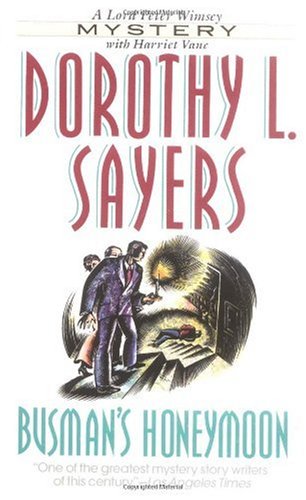 | Mass Market Paperback: 416
Pages
(1995-04-01)
list price: US$7.99 -- used & new: US$3.80 (price subject to change: see help) Asin: 0061043516 Average Customer Review: 
Canada | United Kingdom | Germany | France | Japan |
|
Editorial Review Product Description Customer Reviews (32)
| |
| 2. Dorothy L. Sayers: The Complete Stories by Dorothy L. Sayers | |
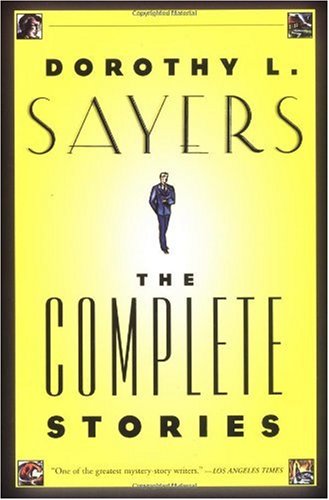 | Paperback: 816
Pages
(2002-08-01)
list price: US$17.99 -- used & new: US$8.73 (price subject to change: see help) Asin: 0060084618 Average Customer Review: 
Canada | United Kingdom | Germany | France | Japan |
|
Editorial Review Product Description Customer Reviews (6)
This volume also doesn't contain THE WIMSEY FAMILY, highlights from the Wimsey family history written by C. W. Scott-Giles. Granted, it wasn't written by Sayers. However, it was published by Harper & Row and this "complete" edition was also published by Harper. Including THE WIMSEY FAMILY, which is OP and VHTF, would have made this edition a "must have" for LPW fans. ... Read more | |
| 3. The Nine Tailors by Dorothy L. Sayers | |
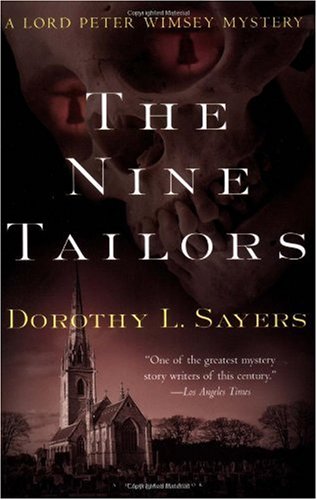 | Paperback: 420
Pages
(1966-09-28)
list price: US$14.00 -- used & new: US$4.00 (price subject to change: see help) Asin: 0156658992 Average Customer Review:
Canada | United Kingdom | Germany | France | Japan |
|
Editorial Review Product Description Customer Reviews (49)
| |
| 4. In the Teeth of the Evidence (Lord Peter Wimsey Mysteries) by Dorothy L. Sayers | |
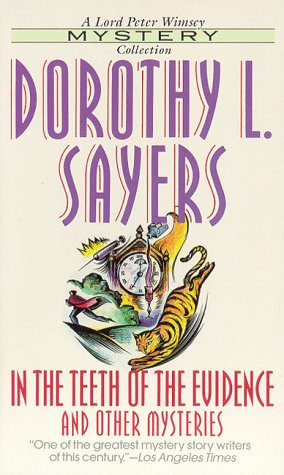 | Mass Market Paperback: 272
Pages
(1995-06-01)
list price: US$5.99 -- used & new: US$62.99 (price subject to change: see help) Asin: 0061043567 Average Customer Review: 
Canada | United Kingdom | Germany | France | Japan |
|
Editorial Review Product Description In each case, the murder baffles the local authorities.For his Lordship and the spirited salesman-sleuth Montague Egg, a corpse is an intriguing invitation to unravel the postmortem puzzles of fascinating falsehoods, mysterious motives and diabolical demises. Customer Reviews (5)
The Wimsey stories in this volume are not Sayers' best, but if you give the other stories herein a chance, the book pulls its weight. No one has to date assembled a collection featuring only Montague Egg, partly because there are so few stories featuring him (5 appear in this volume). Monty is a traveling salesman for Plummett & Rose (fine wines and spirits). Sayers had definite opinions about making sure that amateur sleuths had legitimate reasons to travel, meet the necessary people (what better person to visit the local pub?), and so on. The remaining 10 stories feature neither major character. Sayers liked to have fun with the conventional formula of a detective story; sometimes a death isn't murder, or a mystery doesn't involve a death. Sometimes nobody's guilty of anything, or (treason!) they actually get away with it. "In the Teeth of the Evidence" - Wimsey's dentist has been called upon to identify one of his predecessor's patients from dental work - a fellow dentist found dead in the charred remains of his car. Wimsey comes along, never having had a corpse-in-blazing-garage case before. "Absolutely Elsewhere" - Wimsey and Parker are up against what appears to be a cast-iron alibi. "A Shot at Goal" - The head of the local soccer committee (a big man at the local factory) is found with his head beaten in after being called away from the pub where Monty had been trying out his sales pitch. One is spoilt for choice for motive here. "Dirt Cheap" - Monty and his fellow traveling salesman are stuck at the Griffin, since their usual hotel has had a fire; it's no surprise that Pringle (after his heavy meal of bad food) should be making noises in the night, enough to wake Monty next door. But the next morning he finds Pringle dead and robbed of his jewelry sample-case - the man he spoke to through the door in the night must have been the killer. "Bitter Almonds" - Upon hearing that an eccentric old customer has died suddenly in a nearby town, Monty attends the inquest - partly beccause the deceased was drinking one of Monty's products when he died. "False Weight" - Monty is called on to identify the corpse of Wagstaffe, a traveling salesman for a jeweller's firm who had a wife in every other town on his route. The trick here isn't to find someone with a motive, but to find a solution that fits all the physical evidence in the bar where he died. "The Professor's Manuscript" - A colleague, upon failing to sell soft drinks to the professor who just moved in, passes him along to Monty as a prospect. Monty makes the sale, but notices several incongruities about the elderly professor and his home. See if you can spot them before they're pointed out to you. "The Milk-Bottles" - Hector Puncheon (a young reporter from the Lord Peter stories) thinks he's onto a hot story when a young couple disappears from their apartment and the milk-bottles begin piling up outside. "Dilemma" - Everyone's heard the question: if you could have a million dollars by pushing a button and killing a stranger a thousand miles away, would you do it? In this case, a doctor had to choose between saving 1) a dead man's research on sleeping sickness or 2) a drunken butler on the night of a fire. "An Arrow O'er the House" - Failed author Mr. Podd begins wracking his brain for flamboyant schemes to draw publishers' attention to his work (other than dismal rejection notices). "Scrawns" - Susan took the job of house-parlourmaid at Scrawns without an interview, not expecting such a gloomy, run-down, deserted country house... "Nebuchadnezzar" - This game is charades raised to about the 3rd power- act a word, whose initial letter, in turn, forms part of the final word. Markham, whose wife Jane died of gastroenteritis about 6 months ago, begins to brood while watching her old friends act out Jezebel (J), Adam (A), ... "The Inspiration of Mr. Budd" - Mr. Budd, a skilled barber who is losing his struggle against the flashy establishment across the street, yearned for a chance at the evening paper's reward posted for help in catching a murderer. But how could he earn it against such a strong and brutal man, anyway? "Blood Sacrifice" - The playwright hated what actor-manager Garrick Drury had done to his first professional sale, although it played to packed houses. His generous compensation merely meant that he had no leverage to protest the mutation of the script into an almost unrecognizable form, which was ruining his reputation among the Bloomsbury types he moved among. (If the playwright's character interests you, try Sayers' _Strong Poison_, whose artistic crowd produced similar unsaleable work, or _Gaudy Night_, where professional ethics have a major role in the story.) "Suspicion" - Mr. Mummery has been very careful to stick to a health-food diet lately, since his stomach began playing him up. He and his wife had accepted their new and experienced cook as a gift from heaven, without checking up her references, but now he's feeling uneasy. "The Leopard Lady" - As a Smith & Smith (Removals) story, the reader should come into this story aware that, unless a client turns nasty, nobody will be charged, let alone convicted, for the removal. In this instance, Tressidier stands as guardian and residuary legatee for his small nephew, but Mr. Smith knows just how much of Tressidier's own money was lost in the Megatherium crash and at the track. (They never approach anyone unless they're sure of him.) "The Cyprian Cat" - The narrator is speaking to his defense counsel: "It's funny that one should be hanged for shooting at a cat." (A Cyprian cat is actually a tabby.) This story breaks the rules about not throwing in magical overtones. If you like it, you might consider Lovecraft's "The Rats in the Walls" or Howard's "The Hyena".
| |
| 5. Thrones, Dominations (A Lord Peter Wimsey Mystery) by Dorothy L. Sayers, Jill Paton Walsh | |
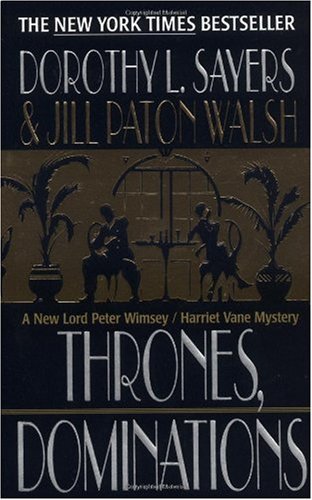 | Mass Market Paperback: 322
Pages
(1999-03-15)
list price: US$6.99 -- used & new: US$36.54 (price subject to change: see help) Asin: 0312968302 Average Customer Review:
Canada | United Kingdom | Germany | France | Japan |
|
Editorial Review Product Description Customer Reviews (80)
| |
| 6. Gaudy Night (Lord Peter Wimsey Mysteries) by Dorothy L. Sayers | |
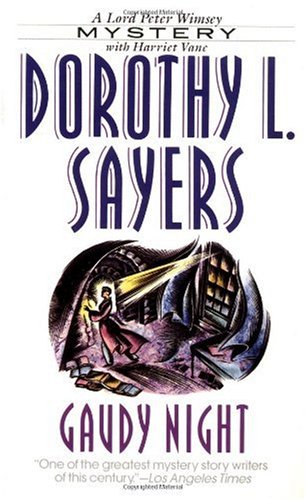 | Mass Market Paperback: 512
Pages
(1995-04-01)
list price: US$7.99 -- used & new: US$7.15 (price subject to change: see help) Asin: 0061043494 Average Customer Review:
Canada | United Kingdom | Germany | France | Japan |
|
Editorial Review Product Description Customer Reviews (56)
| |
| 7. Unnatural Death (Lord Peter Wimsey Mystery) by Dorothy L. Sayers | |
| Paperback: 285
Pages
(1993-07)
list price: US$8.00 -- used & new: US$5.40 (price subject to change: see help) Asin: 0060923865 Average Customer Review: 
Canada | United Kingdom | Germany | France | Japan | |
Customer Reviews (1)
Wimsey is an old Etonian, Balliol Oxford (of course), served with distinction in His Majesty's forces during the War (this book having been written in 1927, I shall leave it to your good services to deduce which War), who resides both town and country somewhat fashionably, and takes great pride in the ancient family history (by the time one gets to be the fifteenth Duke of anything, the family can be easily considered ancient). Wimsey has a vocation as criminologist, not out of necessity, surely, and not by training either (for such training did not formally exist, but, as an Oxford Arts man, he was trained for most anything intellectual, or at least, that is what an Oxford Arts man would tell you). An interesting addition to the beginning of the book is a short biographical sketch of the fictional Wimsey by his equally-fictional uncle. All of this, of course, is but preamble to the latest mystery to come calling upon Lord Wimsey. There are the requisite features: a dead woman, Agatha Dawson, wealthy and having left a will that might not be a will, but rather a sham (a delirious woman whose nurse insists that there was no possible way of having made a will during the last month, yet oddly there is a document, complete with a witness who claims that dear old Agatha Dawson wanted nothing to do with the signing -- ah, the plot thickens here). Of course, to most of the world, Wimsey is, well, following a whimsey of his own. The woman was after all elderly and in poor health; surely his investigations are misplaced. The doctor (not the one who tended Miss Dawson's death, to be sure, but an earlier doctor, suspicious of Dawson's sole heir, her niece) was accused of having blackened the name of Miss Whittaker, the niece, unnecessarily, particularly as no evidence of mischief had been uncovered. Wimsey with the assistance of Inspector Parker are able to rectify the situation vis-a-vis the doctor, but there is still the mystery. Then, more death. This time the maid. To lose one woman may be regarded as a misfortune; to lose two women... (well, you can fill in the rest yourself). Of course I won't spoil it for you; perhaps my tag-team reviewers will do that for you, but I sincerely hope not. Suffice it to say, Wimsey proves himself a consummate actor in which the truth comes out (in London, and in style!). One of the glories of Sayers work is the intricacies of her plots. She tends to get a huge number of people involved (the number of people who seemed to have trouped through the ill woman's bedchamber is in itself surprising, given the era) each with subplots and agenda that nonetheless get neatly resolved in the end. Sayers' development of character (even of the already dead ones!) is done with style and subtlety; while Wimsey is developed over several novels, one doesn't feel him a stranger by reading this one alone. The other characters fit their parts admirably (had Sayers not been a writer, she may well have made a good career as a casting director in Hollywood), in physical and personality attributes. Her descriptions of the milieu, both in town (London) and in the country (the village and surroundings, in this case, of Hampshire, are interesting reading. Sayers is very much the cosmopolitan, and somewhat condescending toward the countryfolk. However, that is not a heavy element, and perhaps can be written off to her attempt to make Wimsey even more the worldly character he turns out to be over the course of her novels. In all, an excellent read, a great diversion, and well worth musing over while sipping tea on a Regency-style sofa in one's dressing gown. ... Read more | |
| 8. Whose Body? (Lord Peter Wimsey Mysteries) by Dorothy L. Sayers | |
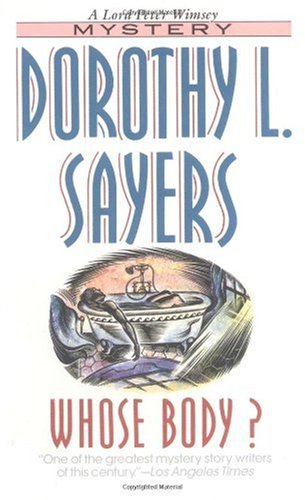 | Mass Market Paperback: 224
Pages
(1995-08-01)
list price: US$7.99 -- used & new: US$3.80 (price subject to change: see help) Asin: 0061043575 Average Customer Review:
Canada | United Kingdom | Germany | France | Japan |
|
Editorial Review Product Description Customer Reviews (35)
| |
| 9. Lord Peter : The Complete Lord Peter Wimsey Stories by Dorothy L. Sayers | |
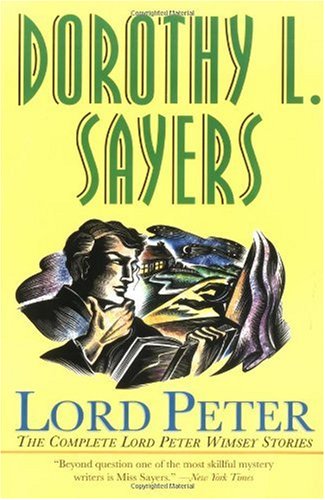 | Paperback: 496
Pages
(1986-12-03)
list price: US$16.00 -- used & new: US$9.32 (price subject to change: see help) Asin: 0060913800 Average Customer Review:
Canada | United Kingdom | Germany | France | Japan |
|
Editorial Review Product Description One of the founding mothers of mystery, Dorothy Sayers first introduced the popular character Lord Peter Wimsey in 1923 with the publication of Whose Body? Over the next twenty years, more novels and short stories about the aristocratic amateur sleuth appeared, each one as cunningly written as the next.Now in single volume, here are all the Lord Peter Wimsey stories, a treasure for any mystery lover.From "The Fantastic Horror of the Cat in the Bag" to "The Image in the Mirror" and "Talboys," this collection is Lord Peter at his best -- and a true testament to the art of detective fiction. Customer Reviews (18)
| |
| 10. Clouds of Witness by Dorothy L. Sayers | |
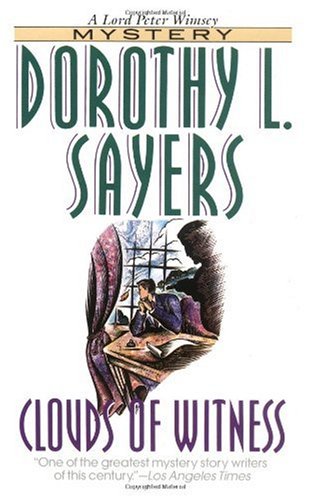 | Mass Market Paperback: 288
Pages
(1995-06-01)
list price: US$7.99 -- used & new: US$3.99 (price subject to change: see help) Asin: 0061043532 Average Customer Review:
Canada | United Kingdom | Germany | France | Japan |
|
Editorial Review Product Description Customer Reviews (33)
| |
| 11. Strong Poison by Dorothy L. Sayers | |
| Hardcover:
Pages
(1987-01)
list price: US$23.95 -- used & new: US$23.95 (price subject to change: see help) Asin: 0848811542 Average Customer Review:
Canada | United Kingdom | Germany | France | Japan | |
|
Editorial Review Product Description Mystery novelist Harriet Vane knew all about poisons, and when her fiancÉ died in the manner prescribed in one of her books, a jury of her peers had a hangman's noose in mind. But Lord Peter Wimsey was determined to find her innocent--as determined as he was to make her his wife. Customer Reviews (32)
| |
| 12. Murder Must Advertise (Lord Peter Wimsey Mysteries) by Dorothy L. Sayers | |
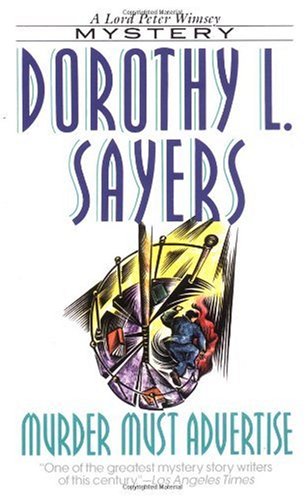 | Mass Market Paperback: 368
Pages
(1995-06-01)
list price: US$7.99 -- used & new: US$3.88 (price subject to change: see help) Asin: 0061043559 Average Customer Review:
Canada | United Kingdom | Germany | France | Japan |
|
Editorial Review Product Description Customer Reviews (32)
| |
| 13. Clouds of Witness by Dorothy L. Sayers (Halcyon Classics) by Dorothy L. Sayers | |
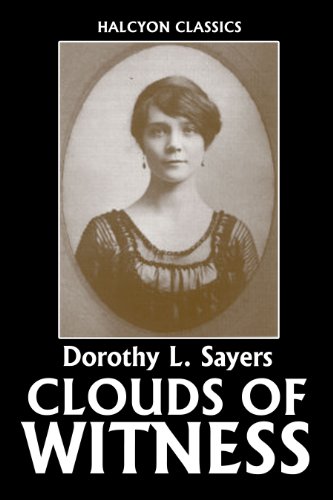 | Kindle Edition:
Pages
(2010-08-16)
list price: US$0.99 Asin: B003ZUYPZS Average Customer Review:
Canada | United Kingdom | Germany | France | Japan |
|
Editorial Review Product Description Customer Reviews (1)
| |
| 14. Mind of the Maker by Dorothy L. Sayers | |
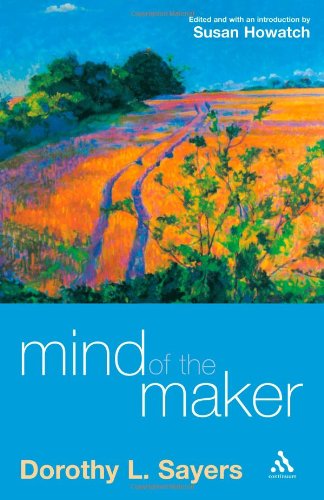 | Paperback: 206
Pages
(2005-01-17)
list price: US$32.95 -- used & new: US$24.05 (price subject to change: see help) Asin: 0826476783 Average Customer Review:
Canada | United Kingdom | Germany | France | Japan |
|
Editorial Review Product Description In a plain, matter-of-fact style that readers will recognize from hermysteries, she reflects on the question of free will and miracle, evil,and, ultimately, "the worth of the work." It is especially here, I think,in this final chapter that the book remains both timeless and profoundlytimely. The artist stands for the true worker, she writes, who, whilerequiring payment for his work, as an artist "retains so much of the imageof God that he is in love with his creation for its own sake." So too,ultimately, should it be for all human work: "That the eyes of all workersshould behold the integrity of the work is the sole means to make that workgood in itself and so good for mankind. This is only another way of sayingthat the work must be measured by the standard of eternity." --DougThorpe Customer Reviews (12)
| |
| 15. Strong Poison (A Lord Peter Wimsey Mystery) by Dorothy L. Sayers | |
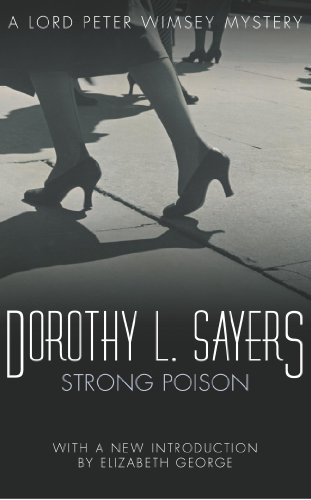 | Paperback: 304
Pages
(1968-10-31)
list price: US$14.45 -- used & new: US$6.53 (price subject to change: see help) Asin: 0450013928 Average Customer Review:
Canada | United Kingdom | Germany | France | Japan |
|
Editorial Review Product Description Customer Reviews (2)
| |
| 16. Are Women Human? by Dorothy L. Sayers | |
 | Paperback: 69
Pages
(2005-11-15)
list price: US$9.00 -- used & new: US$4.44 (price subject to change: see help) Asin: 0802829961 Average Customer Review:
Canada | United Kingdom | Germany | France | Japan |
|
Editorial Review Product Description While Sayers did not devote a great deal of time to talking or writing about feminism, she did explicitly address the issue of women's role in society in the two penetrating essays collected here. Though she wrote several decades ago, she still offers in her piquant style a sensible and conciliatory approach to ongoing gender issues. Customer Reviews (13)
| |
| 17. Whose Body? (Lord Peter Wimsey) by Dorothy L. Sayers | |
 | Kindle Edition:
Pages
(2010-01-19)
list price: US$0.99 Asin: B00359FEU4 Average Customer Review:
Canada | United Kingdom | Germany | France | Japan |
|
Editorial Review Product Description Customer Reviews (3)
| |
| 18. Have His Carcase by Dorothy L. Sayers | |
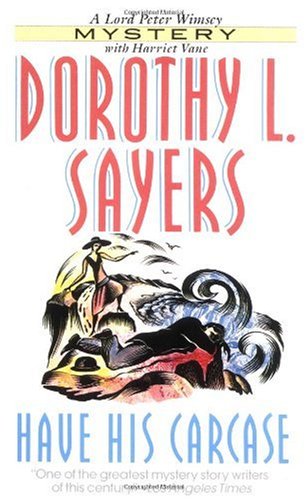 | Mass Market Paperback: 448
Pages
(1995-04-01)
list price: US$7.99 -- used & new: US$3.56 (price subject to change: see help) Asin: 0061043524 Average Customer Review:
Canada | United Kingdom | Germany | France | Japan |
|
Editorial Review Product Description Customer Reviews (21)
| |
| 19. A Presumption of Death: A New Lord Peter Wimsey/Harriet Vane Mystery by Jill Paton Walsh, Dorothy L. Sayers | |
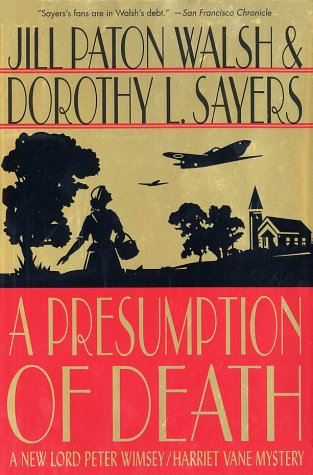 | Hardcover: 384
Pages
(2003-03-27)
list price: US$24.95 -- used & new: US$19.76 (price subject to change: see help) Asin: B0009XG390 Average Customer Review:
Canada | United Kingdom | Germany | France | Japan |
|
Editorial Review Product Description Customer Reviews (47)
| |
| 20. Two Lord Peter Whimsey Mysteries by Dorothy L. Sayers (Halcyon Classics) by Dorothy L. Sayers | |
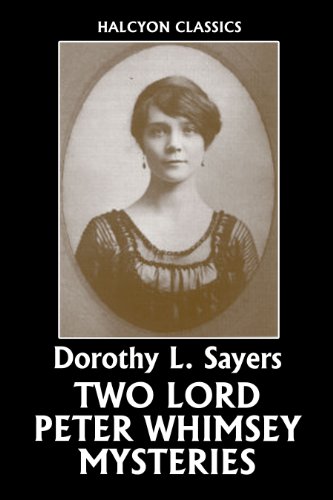 | Kindle Edition:
Pages
(2010-08-16)
list price: US$1.99 Asin: B00400MQ9O Average Customer Review: 
Canada | United Kingdom | Germany | France | Japan |
|
Editorial Review Product Description Customer Reviews (1)
| |
| 1-20 of 106 | Next 20 |
 Very dated
 no, it's just not the same