e99 Online Shopping Mall

Geometry.Net - the online learning center Help  
Home  - Authors - Tacitus (Books)

  1-20 of 100 | Next 20
A  B  C  D  E  F  G  H  I  J  K  L  M  N  O  P  Q  R  S  T  U  V  W  X  Y  Z  

click price to see details     click image to enlarge     click link to go to the store

$13.35
1. Complete Works of Tacitus
$7.00
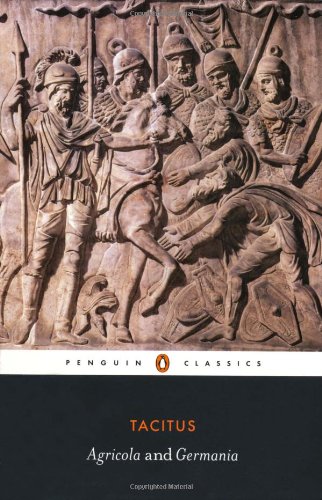
2. The Agricola and The Germania
$8.81
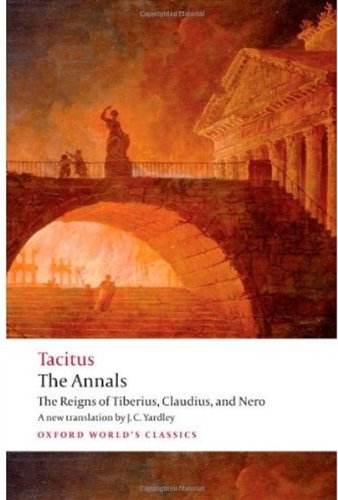
3. The Annals of Imperial Rome
4. The Histories (Oxford World's
$23.90
5. Tacitus: The Annals, Books IV-VI,
$23.90
6. Tacitus: Histories, Books IV-V,
$15.89
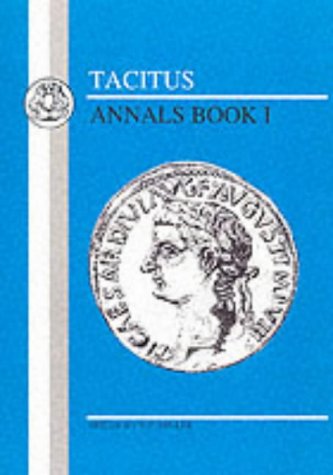
7. The Annals
$23.90
8. Tacitus, I, Agricola. Germania.
$27.41
9. Tacitus: Dialogus de oratoribus
$58.05
10. Tacitus: Histories Book II (Cambridge
$9.49
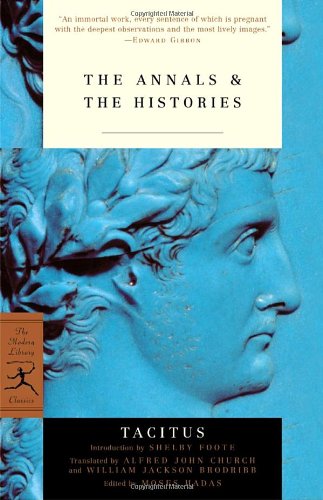
11. The Annals & The Histories
 
$7.73
12. The Annals and The Histories (Tacitus)
$31.67
13. Irony and Misreading in the Annals
 
$15.00
14. The Annals of Tacitus (The Franklin
$24.00
15. Tacitus: Annals 13-16 (Loeb Classical
 
16. Agricola, Germania, Dialogus,
$26.93
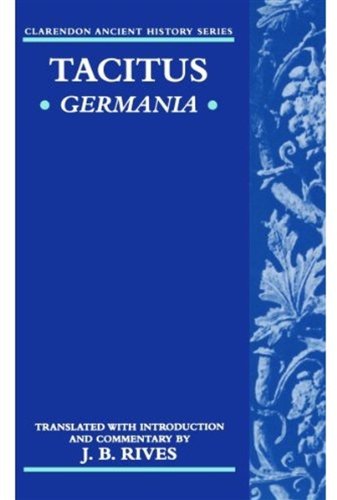
17. Tacitus: Germania
 
$18.95
18. Tacitus: The Annals and the Histories
$26.64
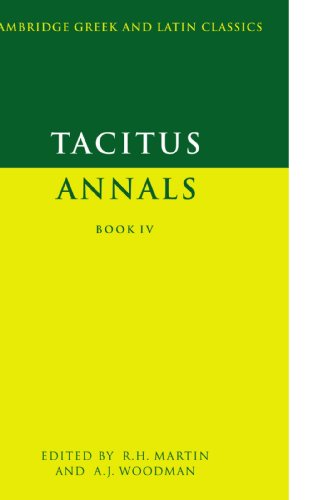
19. Tacitus: Annals Book IV (Cambridge
 
$81.99
20. Tacitus: The Histories, Volumes

1. Complete Works of Tacitus
by Tacitus
Paperback: 773 Pages (1964-09-01)
list price: US$13.75 -- used & new: US$13.35
(price subject to change: see help)
Asin: 0075536390
Average Customer Review: 3.5 out of 5 stars
Canada | United Kingdom | Germany | France | Japan
Editorial Review

Book Description
Translated by Alfred John Church and William Jackson Brodribb, Edited, with an Introduction, Moses Hadas ... Read more

Customer Reviews (5)

5-0 out of 5 stars Definitive Primary Source On the History OfImperial Roman
I read this book for a graduate course in Roman history.It is an indispensable primary source for students of Roman history.

On the first page of his Annals of Imperial Rome, Tacitus wrote that Octavian "seduced the army with bonuses, and his cheap food policy was successful bait for civilians."Tacitus' description of Augustus' transformation of Rome from a republic into an empire is most illuminating as well."Upper-class survivors found that slavish obedience was the way to succeed, both politically and financially.They had profited from the revolution, and so now they liked the security of the existing arrangement better than the dangerous uncertainties of the old regime."

Sir Ronald Syme relied heavily on the work of Tacitus for his cogent narrative of Octavian's rise to power as Augustus.Syme's in-depth study of Tacitus' life and work was published in 1958.Tacitus' historical accuracy was doubted for centuries and Syme made a project of re-evaluating the accuracy of his historical writings.Syme believed that Tacitus was in a unique position to write about the birth and early political history of the Imperial period in Rome due to his very active political life.Tacitus had served as a senator, consul, and proconsul of Asia.In addition, he was known to be an excellent orator in his day.In his writings, Syme believed that Tacitus provided excellent accounts of Augustus' rise to power and his career as Rome's first Emperor.

Tacitus delved into the machinery of the new government, including Augustus' use of patronage as well as his many thwarted attempts at planning for his own succession.What Syme found was a man that grew very adept politically and whose political maturity rapidly developed at an early age.At eighteen, he was named as heir to Julius Caesar.He grew into the greatest Roman princeps spanning fifty-six years until his death.Augustus knew that to retain power he had to maintain the general consent of the governed.He astutely maintained order not by following the constitution or past precedent, but by using the tremendous resources at his disposal.Augustus kept the plebeians in check making sure they were fed, kept them amused with games, and constantly reminded them that he was protecting them from the oppression of the nobiles.

Augustus became the "leader of a large and well organized political party as the source and fount of patronage and advancement."

Recommended reading for those interested in Roman history, military history.

2-0 out of 5 stars A Decent Translation, but a Poor Edition
My experience with Tacitus in the original was brief and without professorial guidance, so I can't vouch for the accuracy of the translators; however, Church and Bodribb's English is certainly readable if a bit outdated (A trait I like in translations of ancient authors). The lack of footnotes or maps is what dooms this edition, though it probably is directly related to the excellent price. I would only advise purchasing this book if money is that much of a problem for you or if you're only buying as an aid for translation, you dirty cheat you.

5-0 out of 5 stars The hurt long arm of history
You simply cannot beat these collected works for witticisms.And all of those sorts of phrases like what the kids mock, in Proust, at the beachhouse- "they ridiculed his Greek attendants" for example, describing the relations between the natives of some blah-stonia and their Roman legate sent to rule over them from a reclined couch strewn with sausages and succulent roast meats - you get the idea.It really is a hoot.The best part though, is that Tacitus is mindful, when writing the history of the emperors, of the moments when the old freedoms of the republic were gladly handed over by their owners to the flattery of the emperor's representatives, He appeals to their vanity and self-righteousness; chest-thumping, etc.It's all so very analogous to the changes the U.S. is undergoing today.Worth a read for anyone interested in politics.There's some stuff about Jesus in it too sort of indirectly, so if you're into all that evangelistianity, it's a new text you can cite predicting the apocalypse.

1-0 out of 5 stars Paperback not Hardback.
This book is advertised as being in a hardback edition.However, as the back cover says, it is "paperbound".

5-0 out of 5 stars "Impressive and Pristine Translation...The Best Out There"
While Tacitus remains the most brilliant, eloquent, and important of all the Roman historians, his translators Alfred John Church and William Jackson Brodribb have purged the excessive verbosity and superfluity of style common in other translations to form a complete and precise representation of Tacitus' original.An amazing anthology at an affordable price...there's no better deal or collective genius of works available. ... Read more


2. The Agricola and The Germania (Penguin Classics)
by Tacitus
Paperback: 176 Pages (1971-02-28)
list price: US$14.00 -- used & new: US$7.00
(price subject to change: see help)
Asin: 0140442413
Average Customer Review: 4.5 out of 5 stars
Canada | United Kingdom | Germany | France | Japan

Customer Reviews (15)

5-0 out of 5 stars Excellent
Tacitus was truly a master historian, and both of these books breathe colorful, exciting life into a by-gone era. "The Agricola" is an entertaining (often gripping) biography of a great Roman general, one that is in turns powerful, exciting, inspiring (read Calgacus's speech to those troops making a last stand against the Roman army), and finally heartbreaking (the conclusion when Tacitus pays tribute to the father-in-law he so clearly loved). "The Germania", on the other hand, is more of an anthropological survey cum social commentary; even while Tacitus provides contemporary readers with a fascinating look into the cultures of ancient Germanic tribes, he simultaneously levies some of the most poignant criticisms ever penned about a civilization in decline. A truly great book.

4-0 out of 5 stars A look into an ancient world...
This book includes the writings of the ancient Roman writer, Tacitus, as he follows the campaigns of Agricola into Anglesey and northern Scotland. He also follows closely the campaigns into Germania, a country as untamed as Scotland.

The reader is given a vivid look into an ancient world, but through the eyes of the conqueror and not the conquered. Still, this is a masterpiece of information about a lost time. The translation was done very well by Harold Mattingly and his introduction sheds light on Tacitus' life and literary career, the governorship of Agricola and Rome's political backgroud in an everchanging empire. The two maps of Roman Britain and Germania were an added surprise.

I was a little disappointed that Tacitus did not give more descriptions on the native tribes of Scotland in The Agricola. For this reason, I felt that The Germania stood out much more. His vivid descriptions of the German tribes and their religious beliefs was wonderful to read.

I highly recommend this book to anyone who is interested in Roman history and/or the native tribes of Scotland and Germania.

5-0 out of 5 stars Two classics of one of the greatest Roman historians
This edition brings Tacitus' biography of Agricola (his father-in-law) who consolidated Roman rule in Britain. It also contains his geographical, historical and anthropological survey of the ancient Germanic tribes.

An introduction by revered British archaeologist Harold Mattingly provides an useful overview of Roman history and a balanced evaluation of the relevance of these works.

Agricola is interesting for its description of battle strategies used to consolidate Britain, especially the final one, although it is sketchy, eulogistic and a little simplistic.

Germania is more interesting than Agricola and provides rich insights into the customs of various Germanic tribes during first century AD. It particularly brings out the strengths and weaknesses of these tribes from military point of view very well and is prophetic in its anxiety about the power of these ancient people (Rome was repeatedly sacked by German tribes after Tacitus' death).

The best part is that these works are so small (running into 40/50 pages each) and yet give such a good overview of history that they make effortless reading (which is further eased by a plain writing style - free of jargon).

4-0 out of 5 stars Rewarding Even For The Non-Classicist
A rewarding surprise.Sheer chance dropped this book into my hands.Found it lying in mint condition (with a fair number of other volumes) in the alley behind my building, abandoned and unread by some student who will never recognize his loss.A bit obscure, not being a classicist or an historian, even by my somewhat obscure tastes, but I picked it up, started the introduction, and soon found myself spending an evening intriguingly engaged in a world very different from my own.Whether it be the excellence of the translation or Tacitus' own abilities as a writer, the prose is pleasantly crisp and renders reading the straightforward observations presented here into something not unlike receiving a letter sent a long, long, time ago which has only just finally managed to arrive.While I certainly wouldn't take any of Tacitus' observations of Roman era Britain and Germany for fact; it is the fact ofhis very attempt to try to describe these foreign peoples and what he sees in them and how they make him reflect on his own people that comes through as honest and true.A great portrait of virtue in the midst of a bankrupt society -- it is hard not to make contemporary parallels, or to try and take away lessons.Technocrats v. tyrants, assimilation v. tribalism, decadent civilization v. noble barbarism, terrorism v. occupation: Tacitus faces all these issues and can still be surprising after 1900 years.

The late Harold Mattingly's introduction is excellent in its own right, providing a clear picture of the Roman Empire of Tacitus' time, and one of the best short overviews of Rome's imperial management and military that I have ever read.After reading it, I had a better understanding of Rome's First Century Legions than I do of the United States' current forces in Iraq.If his monographs on Roman coinage are as good as this, I'd want to read them.

4-0 out of 5 stars An engaging look at Roman Britain
Cornelius Tacitus was born ca. A.D. 56 and died around 115. He had a senatorial career and became consul in 97 and governor of Asia from 112-113. In 77, Tacitus married the daughter of Agricola, governor of Roman Britain. Tacitus wrote The Agricola as a sort of eulogy for his father-in-law, and in it he recounts Agricola's career. Tacitus also wrote The Germania, in which he provides a colorful description of the indigenous tribes of Germany during the time of the Roman Empire.There is something to be said of the style with which Tacitus writes, and that is to say that his accounts of Agricola and Germania are full of wit. However, there are some problems when analyzing Tacitus as a factual source. For one, he is constantly making social commentaries about the declining role of the Senate in the affairs of the Roman Empire. In addition, Tacitus makes claims about territories that it is difficult to determine if he would actually have been able to visit and study. Therefore, one must think of his analysis of these areas as being hearsay. For instance, in The Germania, he discusses tribes of northern Germany where there was not much communication or contact. However, one cannot look past the value of this work, for although biased, it does offer insight into the way the Romans viewed the frontier and the frontier peoples. Up until archaeological discoveries, the works of Tacitus and toehr Roman historians was all the world knew of the indigenous "barbaric" peoples of Europe. However, as excavations reveal more flourishing pre-Roman cultures in Europe, Tacitus' claims may be validated or viewed as being culturally biased, uninformed and imaginative. However, as a primary source, his view of Roman Britain remains an essential part of the study of Classical Rome. ... Read more


3. The Annals of Imperial Rome
by Cornelius Tacitus
Paperback: 240 Pages (2005-01-01)
list price: US$9.99 -- used & new: US$8.81
(price subject to change: see help)
Asin: 1420926683
Average Customer Review: 4.0 out of 5 stars
Canada | United Kingdom | Germany | France | Japan
Editorial Review

Book Description
One of the most important historical records from classical antiquity, "The Annals of Imperial Rome" chronicles the history of the Roman Empire from the reign of Tiberius beginning in 14 A.D. to the reign of Nero ending in 66 A.D. Written by Cornelius Tacitus, Roman Senator during the second century A.D., "The Annals of Imperial Rome" is a detailed first-hand account of the early Roman Empire. Presented in this volume is the classic translation of Alfred John Church and William Jackson Brodribb. ... Read more

Customer Reviews (29)

4-0 out of 5 stars Tactius Part of the Whole
An excellent piece of work on it's own. However, because it's by an "ancient historian" we should always remember that it needs supplementation by other writers of the time.

5-0 out of 5 stars Definitive Primary Source On the History OfImperial Roman
I read this book for a graduate course in Roman history.It is an indispensable primary source for students of Roman history.

On the first page of his Annals of Imperial Rome, Tacitus wrote that Octavian "seduced the army with bonuses, and his cheap food policy was successful bait for civilians."Tacitus' description of Augustus' transformation of Rome from a republic into an empire is most illuminating as well."Upper-class survivors found that slavish obedience was the way to succeed, both politically and financially.They had profited from the revolution, and so now they liked the security of the existing arrangement better than the dangerous uncertainties of the old regime."

Sir Ronald Syme relied heavily on the work of Tacitus for his cogent narrative of Octavian's rise to power as Augustus.Syme's in-depth study of Tacitus' life and work was published in 1958.Tacitus' historical accuracy was doubted for centuries and Syme made a project of re-evaluating the accuracy of his historical writings.Syme believed that Tacitus was in a unique position to write about the birth and early political history of the Imperial period in Rome due to his very active political life.Tacitus had served as a senator, consul, and proconsul of Asia.In addition, he was known to be an excellent orator in his day.In his writings, Syme believed that Tacitus provided excellent accounts of Augustus' rise to power and his career as Rome's first Emperor.

Tacitus delved into the machinery of the new government, including Augustus' use of patronage as well as his many thwarted attempts at planning for his own succession.What Syme found was a man that grew very adept politically and whose political maturity rapidly developed at an early age.At eighteen, he was named as heir to Julius Caesar.He grew into the greatest Roman princeps spanning fifty-six years until his death.Augustus knew that to retain power he had to maintain the general consent of the governed.He astutely maintained order not by following the constitution or past precedent, but by using the tremendous resources at his disposal.Augustus kept the plebeians in check making sure they were fed, kept them amused with games, and constantly reminded them that he was protecting them from the oppression of the nobiles.

Augustus became the "leader of a large and well organized political party as the source and fount of patronage and advancement."

Recommended reading for those interested in Roman history, military history.

3-0 out of 5 stars Not the best Roman history
In his introduction, Michael Grant tells us Tacitus ranks among Livy and Caesar as one of the best stylists of Roman histories.Either his translation loses this style or Grant is mistaken.I found the 'Annals' to lack many of the features I have come to love about Roman histories.There is little moral instruction.Reading Livy or Plutarch, you can't help but to marvel at the lives of great men and learn either from their virtues or vices.Tacitus does not dwell on such issues.Instead, his history reads more as a catalog of events.First this conspirator died, then this one, then this one, etc.Tacitus defends himself by saying each person deserves to have his name mentioned -- "let each receive his separate, permanent record."But reading the long list of people killed is like visiting a graveyard, the endless gravestones emitting a feeble sense of transience.

Part of the problem may be Tacitus's choice of time period.The bloody and mismanaged era begins with Augustus's death in A.D. 14 and concludes with Nero's 54 years later.This is a time marked by indecency and blood.The emperors, including Tiberius, Caligula, and Claudius, are as wasteful as they are licentious.The most complete figure to emerge is Tiberius, who though he avoids Rome because of his debauchery with Roman children comes across as well-spoken and involved in state affairs.Subsequent emperors go no further than stick-figures, their reins filled with internal divisiveness and forced suicides.

I would recommend this book to readers who already have some knowledge of Roman history.There are some parts, such as the only mention in pagan Latin of Christ's killer, Pontius Pilate, that will interest readers.But for new readers I would recommend Livy and Plutarch.They are the true stylists of ancient Rome.

5-0 out of 5 stars The Beautiful Sarcasm
I read Tacitus for a college humanities course, and although I had to read the entirety of the Annales over two days, it was quite an enjoyable, if daunting, task. The other reviews discuss his historical importance, so I'll limit myself to commenting that his sarcasm and turns of phrase (particularly in this translation) are biting and funny (at least for those of us for whom Nero and the corrupt emperors are not a reality). Plenty of interesting happenings for someone who is not a classics scholar.

1-0 out of 5 stars Find a Different Publication of this Book!
This is a monumentally bad translation and Penguin should be ashamed of themselves for having kept publishing it for forty odd years. While Grant's style is quite good, his awful, clashing, illogical translations of familiar Roman terms renders it unreadable. Everyone who has any interest in Roman History (and let's face it, who else would be reading this book?) knows what a legion is. But how many people know what a division is, or a brigade? The same goes for company commanders instead of centurions. This is not only confusing and anachronistic, its simply innaccurate. As far as i'm aware a modern company numbers about 120 men (please let me know if i'm wrong!) whereas a century had only 80. Also to call a Roman legion either a division or a brigade is also innaccurate. A division is made up of several brigades but a full legion is not made up of two or three smaller legions. Grant is just being difficult. Also the index infuriatingly insists on listing people by their correct family names instead of the names by which they are commonly called. Hence, you look up references to Corbulo and find "See Domitius" so you look up Domitius, go to one of the pages mentioned and there you find "Corbulo", repeatedly called Corbulo on every page by Tacitus. Finally, the maps. Penguin Classics maps are generaly bad and these are no different. A one page map of all of Northern Europe with all the various placenames and features squeezed awkwardly in through lack of space, and with no outstanding line to dilineate the roman frontier, then on another page a whole page map of africa with a grand total of SEVEN places mentioned on it. This may all seem picky, but it spoils the whole reading experience. I'm afraid it's symptomatic of Penguin Classics who have been resting on their laurels for far too long. They've been very good at constantly changing the covers and folio size of their books but seem to have no real interest in the CONTENT. ( I have binned my copy and bought a very nice secondhand Dent and Sons edition, with "legions" in it! ) ... Read more


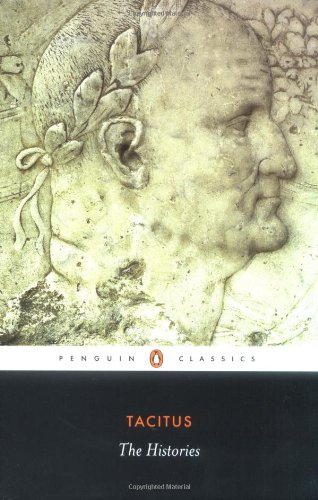
4. The Histories (Oxford World's Classics)
by Cornelius Tacitus, W.H. Fyfe
Paperback: 368 Pages (2008-05-08)

Isbn: 0199540705
Average Customer Review: 5.0 out of 5 stars
Canada | United Kingdom | Germany | France | Japan
Editorial Review

Book Description
In The Histories Cornelius Tacitus, widely regarded as the greatest of all Roman historians, describes with cynical power the murderous `year of the Four Emperors'--AD 69--when in just a few months the whole of the Roman Empire was torn apart by civil war. W.H. Fyfe's classic translation has
been substantially revised and supplied with extensive historical and literary notes. The Introduction examines the subtleties of Tacitus's writing and gives the necessary political and social background.Download Description
Covers Rome from 69 to 70 AD. ... Read more

Customer Reviews (10)

5-0 out of 5 stars There is nothing to be gained by lying
Cornelius Tacitus knows perfectly what the cardinal human characteristic is: `From time immemorial, man has had an instinctive love of power.' And, `the reward for virtue was inevitable death.'
His book is a mighty illustration of the ruthless fight for the top spot: emperor. The ambitious and the wealthy fight one another without mercy. `The truth is that revolution and strife put tremendous power into the hands of evil men.' The vanquished are brutally slain.
For Tacitus, the most important factors in the power struggle are money (`money was the sinews of civil war') and control of the military (`the lesson that an army can create an emperor'). If you could `reward` your soldiers, you could win. However, the legions were not interested in war itself only in looting, plundering, raping and enslaving. `The men wanted campaign and set battles, as the prizes here were more attractive than their normal pay.' The victims were innocent peasants, women and children.
Overall, `Italy found it hard to put up with such hordes of infantry and cavalry, and with violence, financial loss and acts of lawlessness.'

While the `Annals' contain more human touch, the `Histories' are nearly completely centered on military, diplomatic and tactical manoeuvres, followed by terrifying and merciless violence after the battles (`the fury of the soldiers').

This for mankind severe and pessimistic book is a must read for all those interested in the lessons of history and for lovers of great classical literature.

5-0 out of 5 stars Still a benchmark
Every now and then a pivotal moment in history is witnessed and recorded by a master communicator. The mid-first century of Rome was such a time and Tacitus was such a communicator.The Histories will forever be a benchmark of good history with its observations on human nature and behaviour along with their impact on history. The historian will do well to read Tacitus not just for the historical lessons but for his approach to history as a record of human activity. While observing and commenting on the human element in history, Tacitus avoids making moral judgements and remains as objective as possible in the midst of turmoil, wars, and rumors of wars.His beloved nation and people were suffering under the barbarity of fratricidal war yet he remains above the madness and records the events with passion tempered with objectivity.His example is one that has remained difficult for others to follow.

A word on this translation in particular - I found Mr. Wellesley's translation very readable and poetic.He seems to have captured the literature value of the text as well as the content.Well done.

5-0 out of 5 stars corrupting effects of power
Reading Tacitus' Annals I oft remembered Thucydides' account of the Peleponnesian wars. An important theme of the latter work was the corrupting effects of prolongedwar on the morals and intellect of the Athenian people, who were ultimately degraded so much that they voted the destruction of the people of a small island just because they had chosen to remain neutral. Tacitus, on the other hand, seems to have dedicated himself in this work to examining the corrupting effects of absolutism on the Roman people after the fall of the Republic. He shows how absolute power brought out the worst traits in the character of rulers like Tiberius and Nero, who grew more and more tyrannical with every year on the throne, and how members of the illustruous Roman senate and other sections of the Roman political society turned into a horde of spineless sycophants, informers and debauches. There were still a few honourable individuals, but as Tacitus shows in an endless series of judicial and non-judicial murders, most of these paid the price of sticking to the ancient traditions of liberty and honour with their lives. Tacitus also deals at length with the relations of the Romans with the subject peo-ples. I may be wrong here, but it seems to me that in such passages Tacitus draws a parallels between the fate of these enslaved peoples and that of the enslaved Roman people -the first a slave to the Romans, the second a slave to the emperor and his bureaucracy made up of ex-slaves. Many subject peoples rebelled and some like the Cherusci under Arminius (towards whom he does not seem averse at all) could successfully preserve their liberty against the in-trusion of the Romans. Those Romans who dared defy the tyrant on the other hand, and especially those who could wisely remain independent and yet stay alive, were far fewer, Tacitus seems to imply. Insofar as it demonstrates how closely liberty (including liberty of thought) and morals are intertwined, this work is still relevant today as a central work of liberal humanism.

5-0 out of 5 stars fascinating reading
Tacitus Histories deals with the turbulent year 69AD the year of four emperors. Tacitus eye for detail which allows us to understand the personalities of Galba, Otho, Vitellius and Vespatian and their motivations and ambitions in this trully chaotic time in Rome's history. The sinister role of the Praetorians in these events is faithfully accounted. I found I could not put it down! Very readable compared to the Annals. The translation is first rate. The work is also supported by numerous foot notes and maps. Anyone interested in this period of Roman history must read this book.

5-0 out of 5 stars May You Live in Interesting Times
The year 69 CE, called The Year of the Four Emperors, was awfully busy in the Roman Empire. The Emperor Nero had committed suicide in the previous year, the last ruler to have a family connection to Julius Caesar. His place was taken by Servius Sulpicius Galba, who was murdered early in 69 as part of a revolt by the next emperor, Marcus Salvius Otho. Otho himself committed suicide after being militarily bested by the next emperor, Lucius Vitellius. But by December of 69, Vitellius had been assassinated, and his place taken by Titus Flavius Sabinus Vespasianus, the general who had brutally suppressed the Bar Kochba rebellion in Judea. All this in less than 365 days.

Tacitus was a Roman conservative and, if his spirit could be summoned back from the dead, I would love to see him coming "From the Right" on "Crossfire."He was a tremendous writer, and "The Histories" are full of examples of this. There are his epigrams, such as his observation that Galba would have universally been thought of as worthy to rule had he never, in fact, ruled. There are interesting characters, like the great opportunist Antonius Primus, whose nickname translates roughly as "Beaky" because, well, he had a huge nose. There are a great many people mentioned in this work and therefore it needs to be read carefully, as it's hard to keep track of the Romans without a scorecard.

After the year 69, the Presidential election of 2000 seems pretty tame, doesn't it? ... Read more


5. Tacitus: The Annals, Books IV-VI, XI-XII (Loeb Classical Library No. 312)
by Tacitus
Hardcover: 432 Pages (1937-01-01)
list price: US$24.00 -- used & new: US$23.90
(price subject to change: see help)
Asin: 0674993454
Average Customer Review: 4.5 out of 5 stars
Canada | United Kingdom | Germany | France | Japan
Editorial Review

Book Description

Tacitus (Cornelius), famous Roman historian, was born in 55, 56 or 57 CE and lived to about 120. He became an orator, married in 77 a daughter of Julius Agricola before Agricola went to Britain, was quaestor in 81 or 82, a senator under the Flavian emperors, and a praetor in 88. After four years' absence he experienced the terrors of Emperor Domitian's last years and turned to historical writing. He was a consul in 97. Close friend of the younger Pliny, with him he successfully prosecuted Marius Priscus.

Works: (i) Life and Character of Agricola, written in 97-98, specially interesting because of Agricola's career in Britain. (ii) Germania (98-99), an equally important description of the geography, anthropology, products, institutions, and social life and the tribes of the Germans as known to the Romans. (iii) Dialogue on Oratory (Dialogus), of unknown date; a lively conversation about the decline of oratory and education. (iv) Histories (probably issued in parts from 105 onwards), a great work originally consisting of at least twelve books covering the period 69-96 CE, but only Books I-IV and part of Book V survive, dealing in detail with the dramatic years 69-70. (v) Annals, Tacitus's other great work, originally covering the period 14-68 CE (Emperors Tiberius, Gaius, Claudius, Nero) and published between 115 and about 120. Of sixteen books at least, there survive Books I-IV (covering the years 14-28); a bit of Book V and all Book VI (31-37); part of Book XI (from 47); Books XII-XV and part of Book XVI (to 66).

Tacitus is renowned for his development of a pregnant concise style, character study, and psychological analysis, and for the often terrible story which he brilliantly tells. As a historian of the early Roman empire he is paramount.

The Loeb Classical Library edition of Tacitus is in five volumes.

... Read more

Customer Reviews (3)

5-0 out of 5 stars Definitive Primary Source On the History OfImperial Roman
I read this book for a graduate course in Roman history.It is an indispensable primary source for students of Roman history.

On the first page of his Annals of Imperial Rome, Tacitus wrote that Octavian "seduced the army with bonuses, and his cheap food policy was successful bait for civilians."Tacitus' description of Augustus' transformation of Rome from a republic into an empire is most illuminating as well."Upper-class survivors found that slavish obedience was the way to succeed, both politically and financially.They had profited from the revolution, and so now they liked the security of the existing arrangement better than the dangerous uncertainties of the old regime."

Sir Ronald Syme relied heavily on the work of Tacitus for his cogent narrative of Octavian's rise to power as Augustus.Syme's in-depth study of Tacitus' life and work was published in 1958.Tacitus' historical accuracy was doubted for centuries and Syme made a project of re-evaluating the accuracy of his historical writings.Syme believed that Tacitus was in a unique position to write about the birth and early political history of the Imperial period in Rome due to his very active political life.Tacitus had served as a senator, consul, and proconsul of Asia.In addition, he was known to be an excellent orator in his day.In his writings, Syme believed that Tacitus provided excellent accounts of Augustus' rise to power and his career as Rome's first Emperor.

Tacitus delved into the machinery of the new government, including Augustus' use of patronage as well as his many thwarted attempts at planning for his own succession.What Syme found was a man that grew very adept politically and whose political maturity rapidly developed at an early age.At eighteen, he was named as heir to Julius Caesar.He grew into the greatest Roman princeps spanning fifty-six years until his death.Augustus knew that to retain power he had to maintain the general consent of the governed.He astutely maintained order not by following the constitution or past precedent, but by using the tremendous resources at his disposal.Augustus kept the plebeians in check making sure they were fed, kept them amused with games, and constantly reminded them that he was protecting them from the oppression of the nobiles.

Augustus became the "leader of a large and well organized political party as the source and fount of patronage and advancement."

Recommended reading for those interested in Roman history, military history.

5-0 out of 5 stars The First Modern Historian
Publius/Gaius Cornelius Tacitus was born c. 55 A.D. under Nero's reign and his family seems to have had at least an equestrian rank. The date of his death is uncertain but placed at the close of Trajans reign in c. 117 A.D. Tacitus is considered by many to be the first modern Roman historian due to his avoidance of the praiseful oratory so common with other historiographers such as Livy. Tacitus tended to explain the events and persons as they existed and then delve into empirical speculation as to motives or causes.

This volume covers the close of Nero's reign in 68 A.D. and of the Julio-Claudian dynasty that Caesar had started.The lack of succession created a power vacuum in Rome filled by Galba, Otho, Vitellius, and eventually Vespasian in 69 A.D.The book offers a good insight as to what was really nothing more than a continuation of the power struggles between military commanders that were so pervasive in the Republic: mainly, who will be the new dictator/emperor? In addition to providing information about the aristocracy in Imperial Rome, Tacitus gives valuabe information on the workings of the Principate, the Imperial Roman army, and the notorious Praetorian Guard.

The Loeb library is reknown for its publications of classical texts in English and either Latin or Ancient Greek depending on the author. If you're a student or teacher of classics you can't go without this publication. This translation is a pleasant work to read. All of Tacitus' volumes by Loeb are presently availble. This is a very good investment for anyone who wants to be illuminated as to what humanity achieved over 2000 years before we even existed: it's priceless!

4-0 out of 5 stars Initium mihi operis Servius Galba iterum . . .
The Histories (Books I-III) by Tacitus must be one of the best historical writings of the ancient world.A chronicle of the turbulent events taking place in the years 69 A.D. and 70 A.D., these books capture what it must have been like to be where the action was taking place. It (the account)begins almost immediately with the brutal murder of the emperor Galba.Itcontinues with most brief reign of Otho, an essentially defensive waragainst his most fearsome rival, Vitellius.Vitellius then captures Rome,kills Otho, and then himself is emersed in a war against Vespasian, whoeventually defeats Vitellius. This history is wonderful firstly forits relative lack of biassed opinion.Almost all actions of the historicalfigures in the books are represented with the utmost objectivity.OnlySuetonius, author of The Twelve Caesars surpasses him in this way. The books are filled with the most captivating descriptions of people andplaces.As one reads, one senses the terror of civil war and of battle. The reader is "put into the shoes" of thoses present at thoseawesome events.The descriptions of the second battle at Cremona, thedocumentation of the atrocities, are enough to make one's stomach turn.Tacitus was lucky to have had access to eyewitnesses and the imperialarchives while writing these histories.The only thing to be truly awareof are the speaches quoted on the books.For anyone who is no familiarwith ancient writings: it was not uncommon practice to "fill thegaps" with artificial speaches.You will, however get a good sense ofwhat was on in the supposed orator's mind. Recommendations to anyoneutterly obsessed with the history of imperial Rome seen through the eyes ofpeople who were there.I'm in the process of reading books IV-V of thehistories and they have just the same flavour!I hope you'll enjoy thesehistories as much as I have. ... Read more


6. Tacitus: Histories, Books IV-V, Annals Books I-III (Loeb Classical Library No. 249)
by Tacitus
Hardcover: 656 Pages (1931-01-01)
list price: US$24.00 -- used & new: US$23.90
(price subject to change: see help)
Asin: 0674992741
Average Customer Review: 5.0 out of 5 stars
Canada | United Kingdom | Germany | France | Japan
Editorial Review

Book Description

Tacitus (Cornelius), famous Roman historian, was born in 55, 56 or 57 CE and lived to about 120. He became an orator, married in 77 a daughter of Julius Agricola before Agricola went to Britain, was quaestor in 81 or 82, a senator under the Flavian emperors, and a praetor in 88. After four years' absence he experienced the terrors of Emperor Domitian's last years and turned to historical writing. He was a consul in 97. Close friend of the younger Pliny, with him he successfully prosecuted Marius Priscus.

Works: (i) Life and Character of Agricola, written in 97-98, specially interesting because of Agricola's career in Britain. (ii) Germania (98-99), an equally important description of the geography, anthropology, products, institutions, and social life and the tribes of the Germans as known to the Romans. (iii) Dialogue on Oratory (Dialogus), of unknown date; a lively conversation about the decline of oratory and education. (iv) Histories (probably issued in parts from 105 onwards), a great work originally consisting of at least twelve books covering the period 69-96 CE, but only Books I-IV and part of Book V survive, dealing in detail with the dramatic years 69-70. (v) Annals, Tacitus's other great work, originally covering the period 14-68 CE (Emperors Tiberius, Gaius, Claudius, Nero) and published between 115 and about 120. Of sixteen books at least, there survive Books I-IV (covering the years 14-28); a bit of Book V and all Book VI (31-37); part of Book XI (from 47); Books XII-XV and part of Book XVI (to 66).

Tacitus is renowned for his development of a pregnant concise style, character study, and psychological analysis, and for the often terrible story which he brilliantly tells. As a historian of the early Roman empire he is paramount.

The Loeb Classical Library edition of Tacitus is in five volumes.

... Read more

Customer Reviews (2)

5-0 out of 5 stars Definitive Primary Source On the History OfImperial Roman
I read this book for a graduate course in Roman history.It is an indispensable primary source for students of Roman history.

On the first page of his Annals of Imperial Rome, Tacitus wrote that Octavian "seduced the army with bonuses, and his cheap food policy was successful bait for civilians."Tacitus' description of Augustus' transformation of Rome from a republic into an empire is most illuminating as well."Upper-class survivors found that slavish obedience was the way to succeed, both politically and financially.They had profited from the revolution, and so now they liked the security of the existing arrangement better than the dangerous uncertainties of the old regime."

Sir Ronald Syme relied heavily on the work of Tacitus for his cogent narrative of Octavian's rise to power as Augustus.Syme's in-depth study of Tacitus' life and work was published in 1958.Tacitus' historical accuracy was doubted for centuries and Syme made a project of re-evaluating the accuracy of his historical writings.Syme believed that Tacitus was in a unique position to write about the birth and early political history of the Imperial period in Rome due to his very active political life.Tacitus had served as a senator, consul, and proconsul of Asia.In addition, he was known to be an excellent orator in his day.In his writings, Syme believed that Tacitus provided excellent accounts of Augustus' rise to power and his career as Rome's first Emperor.

Tacitus delved into the machinery of the new government, including Augustus' use of patronage as well as his many thwarted attempts at planning for his own succession.What Syme found was a man that grew very adept politically and whose political maturity rapidly developed at an early age.At eighteen, he was named as heir to Julius Caesar.He grew into the greatest Roman princeps spanning fifty-six years until his death.Augustus knew that to retain power he had to maintain the general consent of the governed.He astutely maintained order not by following the constitution or past precedent, but by using the tremendous resources at his disposal.Augustus kept the plebeians in check making sure they were fed, kept them amused with games, and constantly reminded them that he was protecting them from the oppression of the nobiles.

Augustus became the "leader of a large and well organized political party as the source and fount of patronage and advancement."

Recommended reading for those interested in Roman history, military history.

5-0 out of 5 stars Rome's First Modern Historian
Publius/Gaius Cornelius Tacitus was born c. 55 A.D. under Nero's reign and his family seems to have had at least an equestrian rank. The date of his death is uncertain but placed at the close of Trajans reign in c. 117 A.D. Tacitus is considered by many to be the first modern Roman historian due to his avoidance of the praiseful oratory so common with other historiographers such as Livy. Tacitus tended to explain the events and persons as they existed and then delve into empirical speculation as to motives or causes.

This volume covers the close of Nero's reign in 68 A.D. and of the Julio-Claudian dynasty that Caesar had started. The lack of succession created a power vacuum in Rome filled by Galba, Otho, Vitellius, and eventually Vespasian in 69 A.D. The books also recites Augustus' reign and Tiberius' early reign from 14 A.D. to 22 A.D. The book offers a good insight as to the power struggles in the Principate as well as information about the aristocracy in Imperial Rome. In addition to the events of that period, Tacitus also gives valuabe information on the workings of the Principate, the Imperial Roman army, and the notorious Praetorian Guard.

The Loeb library is reknown for its publications of classical texts in English and either Latin or Ancient Greek depending on the author. If you're a student or teacher of classics you can't go without this publication. This translation is a pleasant work to read. All of Tacitus' volumes by Loeb are presently availble. This is a very good investment for anyone who wants to be illuminated as to what humanity achieved over 2000 years before we even existed: it's priceless! ... Read more


7. The Annals
by Tacitus
Paperback: 464 Pages (2004-09)
list price: US$16.95 -- used & new: US$15.89
(price subject to change: see help)
Asin: 0872205584
Average Customer Review: 4.0 out of 5 stars
Canada | United Kingdom | Germany | France | Japan
Editorial Review

Book Description
A.J. Woodman's translation combines accuracy and Tacitean invention, masterfully conveying Tacitus' distinctive and powerful manner of expression, and reflecting the best of current scholarship. An introductory essay discusses Tacitus' career, the period about which he wrote, the nature of historical writing in the Roman world, and the principles of translation which have shaped this rendering. No other translation captures more successfully the flavor, nuance, and power of Tacitus' greatest work.

This edition includes extensive notes; suggestions for further reading; appendices explaining political and military terms, and geographical and topographical names; imperial family trees; maps; and an index. ... Read more

Customer Reviews (1)

4-0 out of 5 stars a tacitean translation of tacitus
although tacitus has never been a favorite latin author of mine, he is the most valuable literary source we have for the reign of the emperor nero (AD 54-68). his latin, however, is not easy to read, and thus, a student new to ancient history may be discouraged to continue exploring the roman empire. this translation provides the student with both the tale hidden in tacitus' difficult latin, and with the insight into the mind of the historiographer. the english translation is almost tacitean in its density, but never so complex that it the reader gets lost. it is close enough to the latin original for a reader who is already acquainted with tacitus' latin to be able to appreciate it, and yet it is not overwhelming (which tacitus tends to be in latin). it is by far the best translation of tacitus I have come across, and I recommend it wholeheartedly. the commentary is useful, and the translator has done a great deal of research on his topic. well done indeed. ... Read more


8. Tacitus, I, Agricola. Germania. Dialogue on Oratory (Loeb Classical Library)
by Tacitus
Hardcover: 384 Pages (1914-01-01)
list price: US$24.00 -- used & new: US$23.90
(price subject to change: see help)
Asin: 0674990390
Average Customer Review: 5.0 out of 5 stars
Canada | United Kingdom | Germany | France | Japan
Editorial Review

Book Description

Tacitus (Cornelius), famous Roman historian, was born in 55, 56 or 57 CE and lived to about 120. He became an orator, married in 77 a daughter of Julius Agricola before Agricola went to Britain, was quaestor in 81 or 82, a senator under the Flavian emperors, and a praetor in 88. After four years' absence he experienced the terrors of Emperor Domitian's last years and turned to historical writing. He was a consul in 97. Close friend of the younger Pliny, with him he successfully prosecuted Marius Priscus.

Works: (i) Life and Character of Agricola, written in 97-98, specially interesting because of Agricola's career in Britain. (ii) Germania (98-99), an equally important description of the geography, anthropology, products, institutions, and social life and the tribes of the Germans as known to the Romans. (iii) Dialogue on Oratory (Dialogus), of unknown date; a lively conversation about the decline of oratory and education. (iv) Histories (probably issued in parts from 105 onwards), a great work originally consisting of at least twelve books covering the period 69-96 CE, but only Books I-IV and part of Book V survive, dealing in detail with the dramatic years 69-70. (v) Annals, Tacitus's other great work, originally covering the period 14-68 CE (Emperors Tiberius, Gaius, Claudius, Nero) and published between 115 and about 120. Of sixteen books at least, there survive Books I-IV (covering the years 14-28); a bit of Book V and all Book VI (31-37); part of Book XI (from 47); Books XII-XV and part of Book XVI (to 66).

Tacitus is renowned for his development of a pregnant concise style, character study, and psychological analysis, and for the often terrible story which he brilliantly tells. As a historian of the early Roman empire he is paramount.

The Loeb Classical Library edition of Tacitus is in five volumes.

... Read more

Customer Reviews (1)

5-0 out of 5 stars A Roman Eulogy
Publius/Gaius Cornelius Tacitus was born c. 55 A.D. under Nero's reign and his family seems to have had at least an equestrian rank.The date of his death is uncertain but placed at the close of Trajans reign in 117 A.D.Tacitus is considered by many to be the first modern Roman historian due to his avoidance of the praiseful oratory so common with other historiographers such as Livy.Tacitus tended to explain the events and persons as they existed and then delve into empirical speculation as to motives or causes.

In addition to his 'Histories', 'Annals', and a work on oratory, Tacitus wrote this eulogy to his father-in-law, Cnaeus Julius Agricola, which he finished in 98 B.C.This panergyc recital is of his father-in-law who had served as governor of Britain and who was killed by a displeased Emperor Domitian: probably poisoned. The work goes over Agricola's illustrious origins and then his loyal service to the Empire in Britain.In addition to providing information about the aristocracy in Imperial Rome, Tacitus gives valuabe information on Britain as a Roman colony under Domitian and the political developments of that period.

The Loeb library is reknown for its publications of classical texts in English and either Latin or Ancient Greek depending on the author. If you're a student or teacher of classics you can't go without this publication. This translation is a pleasant work to read. All of Tacitus volumes by Loeb are presently availble. This is a very good investment for anyone who wants to be illuminated as to what humanity achieved over 2000 years before we even existed: it's priceless!
... Read more


9. Tacitus: Dialogus de oratoribus (Cambridge Greek and Latin Classics)
by Tacitus
Paperback: 238 Pages (2001-05-28)
list price: US$31.99 -- used & new: US$27.41
(price subject to change: see help)
Asin: 0521469961
Canada | United Kingdom | Germany | France | Japan
Editorial Review

Book Description
This is an edition of Tacitus' work on oratory, with a substantial introduction and commentary. It is the first commentary in English in over 100 years and the only one at this level. It is designed to elucidate problems of language and reference in the text and to put the reader in the picture as regards late first-century AD society and literature, particularly oratory, still the most important activity within the Roman élite. ... Read more


10. Tacitus: Histories Book II (Cambridge Greek and Latin Classics)
by Tacitus
Hardcover: 430 Pages (2007-12-10)
list price: US$99.00 -- used & new: US$58.05
(price subject to change: see help)
Asin: 0521814464
Canada | United Kingdom | Germany | France | Japan
Editorial Review

Book Description
The Histories is the first historical work by Rome's most accomplished and challenging historian, Tacitus. It narrates the brutal civil wars which broke out in AD 68-9 across the Roman Empire after the suicide of the last Julio-Claudian emperor, Nero. Book II covers the bloody finale of the war between two of those emperors, Otho and Vitellius, and the emerging challenge from the eventual victor, Vespasian. The progression of events, kaleidoscopic and gripping, unfolds over a broad geographical sweep and is presented by Tacitus with consummate artistry. This commentary on Histories Book II, the first in English for twenty-five years, elucidates historical questions, clarifies Tacitus' historiographical techniques and explains grammatical difficulties of the Latin for students. It also includes a Latin text, relevant maps, and a comprehensive introduction discussing historical, literary and stylistic questions. ... Read more


11. The Annals & The Histories (Modern Library Classics)
by Tacitus
Paperback: 640 Pages (2003-04-08)
list price: US$15.95 -- used & new: US$9.49
(price subject to change: see help)
Asin: 0812966996
Average Customer Review: 3.5 out of 5 stars
Canada | United Kingdom | Germany | France | Japan
Editorial Review

Book Description
Cornelius Tacitus brilliantly chronicles the moral decline and rampant civil unrest in the Roman Empire in a period when the earliest foundations of modern Europe were being laid. The Annals commence in a.d. 14, at the death of Augustus, recounting the reigns of Tiberius, Gaius (Caligula), Claudius, and Nero, and conclude in a.d. 68, the year of Nero’s suicide. The Histories document the tumultuous year a.d. 69, when Emperors Galba, Otho, and Vitellius all perished in quick succession, ushering in Vespasian’s ten-year reign. According to historian Will Durant, “[We must] rank Tacitus among the greatest. . . . The portraits he draws stand out more clearly, stride the stage more livingly than any others in historical literature.” This Modern Library Paperback Classic includes newly commissioned endnotes. ... Read more

Customer Reviews (2)

5-0 out of 5 stars Definitive Primary Source On the History OfImperial Roman
I read this book for a graduate course in Roman history.It is an indispensable primary source for students of Roman history.

On the first page of his Annals of Imperial Rome, Tacitus wrote that Octavian "seduced the army with bonuses, and his cheap food policy was successful bait for civilians."Tacitus' description of Augustus' transformation of Rome from a republic into an empire is most illuminating as well."Upper-class survivors found that slavish obedience was the way to succeed, both politically and financially.They had profited from the revolution, and so now they liked the security of the existing arrangement better than the dangerous uncertainties of the old regime."

Sir Ronald Syme relied heavily on the work of Tacitus for his cogent narrative of Octavian's rise to power as Augustus.Syme's in-depth study of Tacitus' life and work was published in 1958.Tacitus' historical accuracy was doubted for centuries and Syme made a project of re-evaluating the accuracy of his historical writings.Syme believed that Tacitus was in a unique position to write about the birth and early political history of the Imperial period in Rome due to his very active political life.Tacitus had served as a senator, consul, and proconsul of Asia.In addition, he was known to be an excellent orator in his day.In his writings, Syme believed that Tacitus provided excellent accounts of Augustus' rise to power and his career as Rome's first Emperor.

Tacitus delved into the machinery of the new government, including Augustus' use of patronage as well as his many thwarted attempts at planning for his own succession.What Syme found was a man that grew very adept politically and whose political maturity rapidly developed at an early age.At eighteen, he was named as heir to Julius Caesar.He grew into the greatest Roman princeps spanning fifty-six years until his death.Augustus knew that to retain power he had to maintain the general consent of the governed.He astutely maintained order not by following the constitution or past precedent, but by using the tremendous resources at his disposal.Augustus kept the plebeians in check making sure they were fed, kept them amused with games, and constantly reminded them that he was protecting them from the oppression of the nobiles.

Augustus became the "leader of a large and well organized political party as the source and fount of patronage and advancement."

Recommended reading for those interested in Roman history, military history.

2-0 out of 5 stars Wonderful Tacitus ill-served by this translation
Lest there be some confusion about the 2 stars I've given this book: Tacitus is fantastic and fascinating. So don't reproach me for SEEMING to criticize Tacitus, when my target here is the translation. (On the subject of reproach, Tacitus himself wrote: "To show resentment at a reproach is to acknowledge that one may have had it coming.") In fact, I think very highly of the incomparable Roman historian. Gibbon, among many others, loves him and so do I. However, this superficially handsome volume from The Modern Library (containing both The Histories and The Annals), does not do justice to Tacitus at all. These translations cannot be recommended, in spite of the praise lavished on them by the general editor. The Annals is barely acceptable but no more than that, and The Histories is inferior. No, the interested reader would be better off to consult the scintillating translation by W. H. Fyfe (revised by his editor, D. S. Levene) of The Histories, published by Oxford as a paperback in 1997. Tacitus' renown -- looking at his style rather than his content -- comes from his acerbic wit, pithy remarks and lucid analytical sentences. To get a truer sense of his abilities, look to another translation. ... Read more


12. The Annals and The Histories (Tacitus)
 Paperback: Pages (2005)
-- used & new: US$7.73
(price subject to change: see help)
Asin: 0760770220
Canada | United Kingdom | Germany | France | Japan

13. Irony and Misreading in the Annals of Tacitus
by Ellen O'Gorman
Paperback: 208 Pages (2006-12-14)
list price: US$39.99 -- used & new: US$31.67
(price subject to change: see help)
Asin: 0521034957
Canada | United Kingdom | Germany | France | Japan
Editorial Review

Book Description
This book is a literary analysis of the language and style of Tacitus' Annals. The political context of first-second century AD Rome is also taken into consideration. In analysis of particular passages close attention is given to the structure of the Latin, which is fully translated. Issues relating to the study of narrative, Roman politics and theories of history are addressed in the course of the discussion.Download Description
This book examines Tacitus' Annals as an ironic portrayal of Julio-Claudian Rome, through close analysis of passages in which characters engage in interpretation and misreading. By representing the misreading of signifying systems - such as speech, gesture, writing, social structures and natural phenomena - Tacitus obliquely comments upon the perversion of Rome's republican structure in the new principate. Furthermore, this study argues that the distinctively obscure style of the Annals is used by Tacitus to draw his reader into the ambiguities and compromises of the political regime it represents. The strain on language and meaning both portrayed and enacted by the Annals in this way gives voice to a form of political protest to which the reader must respond in the course of interpreting the narrative. ... Read more


14. The Annals of Tacitus (The Franklin Library)
 Leather Bound: Pages (1982)
-- used & new: US$15.00
(price subject to change: see help)
Asin: B000CC7GIA
Canada | United Kingdom | Germany | France | Japan
Editorial Review

Product Description
A part of a 100 vol. set produced by the Franklin leather, finely bound with raised rings on spine and extensive 22kt gold Gilding to spine, cover and page ends. ... Read more


15. Tacitus: Annals 13-16 (Loeb Classical Library No. 322)
by Tacitus
Hardcover: 432 Pages (1937-01-01)
list price: US$24.00 -- used & new: US$24.00
(price subject to change: see help)
Asin: 0674993551
Average Customer Review: 5.0 out of 5 stars
Canada | United Kingdom | Germany | France | Japan
Editorial Review

Book Description

Tacitus (Cornelius), famous Roman historian, was born in 55, 56 or 57 CE and lived to about 120. He became an orator, married in 77 a daughter of Julius Agricola before Agricola went to Britain, was quaestor in 81 or 82, a senator under the Flavian emperors, and a praetor in 88. After four years' absence he experienced the terrors of Emperor Domitian's last years and turned to historical writing. He was a consul in 97. Close friend of the younger Pliny, with him he successfully prosecuted Marius Priscus.

Works: (i) Life and Character of Agricola, written in 97-98, specially interesting because of Agricola's career in Britain. (ii) Germania (98-99), an equally important description of the geography, anthropology, products, institutions, and social life and the tribes of the Germans as known to the Romans. (iii) Dialogue on Oratory (Dialogus), of unknown date; a lively conversation about the decline of oratory and education. (iv) Histories (probably issued in parts from 105 onwards), a great work originally consisting of at least twelve books covering the period 69-96 CE, but only Books I-IV and part of Book V survive, dealing in detail with the dramatic years 69-70. (v) Annals, Tacitus's other great work, originally covering the period 14-68 CE (Emperors Tiberius, Gaius, Claudius, Nero) and published between 115 and about 120. Of sixteen books at least, there survive Books I-IV (covering the years 14-28); a bit of Book V and all Book VI (31-37); part of Book XI (from 47); Books XII-XV and part of Book XVI (to 66).

Tacitus is renowned for his development of a pregnant concise style, character study, and psychological analysis, and for the often terrible story which he brilliantly tells. As a historian of the early Roman empire he is paramount.

The Loeb Classical Library edition of Tacitus is in five volumes.

... Read more

Customer Reviews (2)

5-0 out of 5 stars Definitive Primary Source On the History OfImperial Roman
I read this book for a graduate course in Roman history.It is an indispensable primary source for students of Roman history.

On the first page of his Annals of Imperial Rome, Tacitus wrote that Octavian "seduced the army with bonuses, and his cheap food policy was successful bait for civilians."Tacitus' description of Augustus' transformation of Rome from a republic into an empire is most illuminating as well."Upper-class survivors found that slavish obedience was the way to succeed, both politically and financially.They had profited from the revolution, and so now they liked the security of the existing arrangement better than the dangerous uncertainties of the old regime."

Sir Ronald Syme relied heavily on the work of Tacitus for his cogent narrative of Octavian's rise to power as Augustus.Syme's in-depth study of Tacitus' life and work was published in 1958.Tacitus' historical accuracy was doubted for centuries and Syme made a project of re-evaluating the accuracy of his historical writings.Syme believed that Tacitus was in a unique position to write about the birth and early political history of the Imperial period in Rome due to his very active political life.Tacitus had served as a senator, consul, and proconsul of Asia.In addition, he was known to be an excellent orator in his day.In his writings, Syme believed that Tacitus provided excellent accounts of Augustus' rise to power and his career as Rome's first Emperor.

Tacitus delved into the machinery of the new government, including Augustus' use of patronage as well as his many thwarted attempts at planning for his own succession.What Syme found was a man that grew very adept politically and whose political maturity rapidly developed at an early age.At eighteen, he was named as heir to Julius Caesar.He grew into the greatest Roman princeps spanning fifty-six years until his death.Augustus knew that to retain power he had to maintain the general consent of the governed.He astutely maintained order not by following the constitution or past precedent, but by using the tremendous resources at his disposal.Augustus kept the plebeians in check making sure they were fed, kept them amused with games, and constantly reminded them that he was protecting them from the oppression of the nobiles.

Augustus became the "leader of a large and well organized political party as the source and fount of patronage and advancement."

Recommended reading for those interested in Roman history, military history.

5-0 out of 5 stars Rome's First Modern Historian
Publius/Gaius Cornelius Tacitus was born c. 55 A.D. under Nero's reign and his family seems to have had at least an equestrian rank. The date of his death is uncertain but placed at the close of Trajans reign in c. 117 A.D. Tacitus is considered by many to be the first modern Roman historian due to his avoidance of the praiseful oratory so common with other historiographers such as Livy. Tacitus tended to explain the events and persons as they existed and then delve into empirical speculation as to motives or causes: many of conclusions however, particularly towards Livia and Nero, are severly biased. Despite his personal biases and errors, in contrast to previous writers like Livy who wanted to praise the Emperor with an illustrious past of heroes decorated by poetics, Tacitus wrote these Annals more to compare how much worse previous emperors were than the present one: his writing is therefore more cynical and skeptical.

This volume covers Nero's reign from 54 A.D. to 66 A.D. and the debaucheries of his reign.Tacitus is paticulary harsh with Nero even though his extended reign of 12 years indicates that he certainly wasn't as bad or mad as Caligula.For more anectodal and comical stories as to his reign, I would recommend Suetonius' 'Twelve Caesars' as a companion text. In addition to providing information about the aristocracy in Imperial Rome, Tacitus gives valuabe information on the workings of the Principate, the Imperial Roman army, and the notorious Praetorian Guard.

The Loeb library is reknown for its publications of classical texts in English and either Latin or Ancient Greek depending on the author. If you're a student or teacher of classics you can't go without this publication. This translation is a pleasant work to read. All of Tacitus' volumes by Loeb are presently availble. This is a very good investment for anyone who wants to be illuminated as to what humanity achieved over 2000 years before we even existed: it's priceless!
... Read more


16. Agricola, Germania, Dialogus, (The Loeb classical library. Latin authors)
by Cornelius Tacitus
 Unknown Binding: Pages (1925)

Asin: B00085BOVG
Canada | United Kingdom | Germany | France | Japan

17. Tacitus: Germania
by J.G.C. Anderson
Paperback: 296 Pages (2007-02-17)
list price: US$31.00 -- used & new: US$26.93
(price subject to change: see help)
Asin: 1853995037
Average Customer Review: 4.0 out of 5 stars
Canada | United Kingdom | Germany | France | Japan
Editorial Review

Book Description
Updated to include the findings of archaeological investigation over the century, it serves to lift the veil that shrouded the pre-history of the Germanic peoples and the process of their expansion over central Europe. ... Read more

Customer Reviews (1)

4-0 out of 5 stars Invaluable to the Modern Historian
In the Germania, one of Tacitus' most valuable works, the author gives a First and Second Century look at the various Germanic tribes that hovered outside the eastern border of Roman Gaul. Beginning with a general geographic introduction, he reviews the culture all the various tribes shared, their religion, their war cries, their marriage and funeral rites, and the German way of war.In the remaining chapters, Tacitus describes the various tribes of the Germans and their location to one another and to major rivers and mountains; this is invaluable to the modern historian and is the most complete study of the Germany of late Rome.

Tacitus' writing is clear and thorough, giving us a consistent and accurate picture of the Germany of his day, a swirling cauldron of tribes filled with young men who fight bravely, though often just for the fun of it.We get a clear glimpse of the German character, his rites and his habits, his strengths and his weaknesses.There is no other book quite like it, and in its four dozen short chapters we come to know not only who waited outside Rome's borders, but why Tacitus thought they were a reason for concern.

While there's not much to not like about Germania, I do think Tacitus overplays the innocent virtue of the Germans, drawing too many parallels between their character that of the old Roman Republic. While his political purpose was important to him, it is less important to us, if only because we can see in hindsight that the Germans were not so different from the Romans in the end. That they didn't have wealth and splendor does not mean they didn't desire it; it only means that they had not yet acquired it.It will turn out, however, that they are as willing to take it from the Romans as the Romans were from everyone else. ... Read more


18. Tacitus: The Annals and the Histories (Great Books of the Western World #15)
by Cornelius Tacitus
 Hardcover: 313 Pages (1990)
-- used & new: US$18.95
(price subject to change: see help)
Asin: B0006EW9HC
Canada | United Kingdom | Germany | France | Japan

19. Tacitus: Annals Book IV (Cambridge Greek and Latin Classics)
by Tacitus
Paperback: 289 Pages (1990-01-26)
list price: US$31.99 -- used & new: US$26.64
(price subject to change: see help)
Asin: 0521315433
Average Customer Review: 5.0 out of 5 stars
Canada | United Kingdom | Germany | France | Japan
Editorial Review

Book Description
The fourth book of Tacitus'Annals has been described as "the best that Tacitus ever wrote."It covers the years AD 23-28, starting when Tacitus noted a significant deterioration in the principate of the emperor Tiberius, and the increasingly malign influence of his "evil genius" Sejanus.R.H. Martin and A.J. Woodman present an improved text of Annals IV, explain in detail the difficulties and unusual features of Tacitus' Latin, and discuss the dramatic, structural and literary qualities of the narrative.They also discuss the political, moral and stylistic dimensions of the Roman historiographical tradition.Though intended primarily as a textbook for undergraduates and high school students, this edition will interest scholars of Latin literature and Roman history as well. ... Read more

Customer Reviews (1)

5-0 out of 5 stars Definitive Primary Source On the History OfImperial Roman
I read this book for a graduate course in Roman history.It is an indispensable primary source for students of Roman history.

On the first page of his Annals of Imperial Rome, Tacitus wrote that Octavian "seduced the army with bonuses, and his cheap food policy was successful bait for civilians."Tacitus' description of Augustus' transformation of Rome from a republic into an empire is most illuminating as well."Upper-class survivors found that slavish obedience was the way to succeed, both politically and financially.They had profited from the revolution, and so now they liked the security of the existing arrangement better than the dangerous uncertainties of the old regime."

Sir Ronald Syme relied heavily on the work of Tacitus for his cogent narrative of Octavian's rise to power as Augustus.Syme's in-depth study of Tacitus' life and work was published in 1958.Tacitus' historical accuracy was doubted for centuries and Syme made a project of re-evaluating the accuracy of his historical writings.Syme believed that Tacitus was in a unique position to write about the birth and early political history of the Imperial period in Rome due to his very active political life.Tacitus had served as a senator, consul, and proconsul of Asia.In addition, he was known to be an excellent orator in his day.In his writings, Syme believed that Tacitus provided excellent accounts of Augustus' rise to power and his career as Rome's first Emperor.

Tacitus delved into the machinery of the new government, including Augustus' use of patronage as well as his many thwarted attempts at planning for his own succession.What Syme found was a man that grew very adept politically and whose political maturity rapidly developed at an early age.At eighteen, he was named as heir to Julius Caesar.He grew into the greatest Roman princeps spanning fifty-six years until his death.Augustus knew that to retain power he had to maintain the general consent of the governed.He astutely maintained order not by following the constitution or past precedent, but by using the tremendous resources at his disposal.Augustus kept the plebeians in check making sure they were fed, kept them amused with games, and constantly reminded them that he was protecting them from the oppression of the nobiles.

Augustus became the "leader of a large and well organized political party as the source and fount of patronage and advancement."

Recommended reading for those interested in Roman history, military history.
... Read more


20. Tacitus: The Histories, Volumes I and II
by Cornelius Caius Tacitus
 Hardcover: 340 Pages (2007-04-12)
list price: US$81.99 -- used & new: US$81.99
(price subject to change: see help)
Asin: 1428070060
Canada | United Kingdom | Germany | France | Japan

  1-20 of 100 | Next 20
A  B  C  D  E  F  G  H  I  J  K  L  M  N  O  P  Q  R  S  T  U  V  W  X  Y  Z  

Prices listed on this site are subject to change without notice.
Questions on ordering or shipping? click here for help.

site stats