
|
Help |
| Home - Authors - Tagore Rabindranath (Books) | |
e99 Online Shopping Mall
|
|
Help |
| Home - Authors - Tagore Rabindranath (Books) | |
| 1-20 of 100 | Next 20 |
click price to see details click image to enlarge click link to go to the store
| 1. Gitanjali by Rabindranath Tagore | |
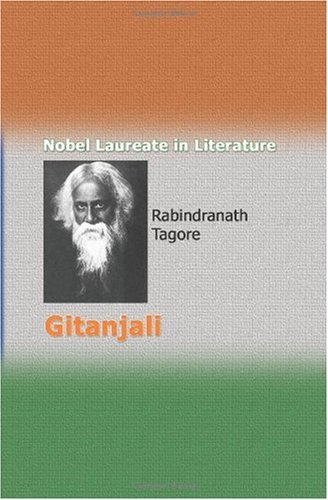 | Paperback: 72
Pages
(2009-05-01)
list price: US$10.99 -- used & new: US$10.99 (price subject to change: see help) Asin: 1594568049 Average Customer Review: 
Canada | United Kingdom | Germany | France | Japan |
|
Editorial Review Product Description Customer Reviews (30)
| |
| 2. The Gardener by Rabindranath Tagore | |
 | Paperback: 42
Pages
(2010-07-24)
list price: US$14.14 -- used & new: US$14.13 (price subject to change: see help) Asin: 1153703440 Average Customer Review: 
Canada | United Kingdom | Germany | France | Japan |
|
Editorial Review Product Description Customer Reviews (2)
And what he wants for his reward? He asks to be allowed to hold her little fists like tender lotus-buds and slip flower chains over her wrists; to tinge the soles of her feet with the red juice of flower petals and kiss away the speck of dust that may chance to linger there. This is the way Rabindranath Tagore, the greatest Indian poet of all times, introduce us to this enchanted collection of poems, poems that touch the most profound strings of our hearts. His poems tell us about love and life - and they are rich with the description of nature and beauty. Anybody that loves or has loved cannot remain indifferent to his poems. Some readers "have smiles, sweet and simple, and some a sly twinkle in their eyes. Some have tears that well up in the daylight, and others tears that are hidden in the gloom." But we all have need for him, the poet, who is "ever as young or as old as the youngest and the oldest of the village". His poems tell us of impossible love - like the love of the free bird and the cage bird: "Their love is intense with longing, but they never can fly wing to wing. Through the bars of the cage they look, and vain is their wish to know each other. They flutter their wings in yearning, and sing, 'Come closer, my love!' The free bird cries, 'It cannot be, I fear the closed doors of the cage.' The cage bird whispers, 'Alas, my wings are powerless and dead.' " His poems tell us of secret love: "The young traveler came along the road in the rosy mist of the morning. He stopped before my door and asked me with an eager cry, 'Where is she?' For very shame I could not say, 'She is I, young traveler, she is I.' " His poems tell us of lovers' emotion: "When my love comes and sits by my side, when my body trembles and my eyelids droop, the night darkens, the wind blows out the lamp, and the clouds draw veils over the stars. It is the jewel at my own breast that shines and gives light. I do not know how to hide it." His poems tell us of the need for love confidence: "Do not keep to yourself the secret of your heart, my friend! Say it to me, only to me, in secret. You who smile so gently, softly whisper, my heart will hear it, not my ears." His poems tell us of a love story: "Hands cling to hands and eyes linger on eyes: thus begins the record of our hearts. It is the moonlit night of March; the sweet smell of henna is in the air; my flute lies on the earth neglected and your garland of flowers is unfinished. This love between you and me is simple as a song." His poems tell us of lovers departing: "An unbelieving smile flits on your eyes when I come to you to take my leave. I have done it so often that you think I will soon return. To tell you the truth I have the same doubt in my mind. For the spring days come again time after time; the full moon takes leave and comes on another visit, the flowers come again and blush upon their branches year after year, and it is likely that I take my leave only to come to you again. But keep the illusion awhile; do not send it away with ungentle haste.When I say I leave you for all time, accept it as true, and let a mist of tears for one moment deepen the dark rim of your eyes. Then smile as archly as you like when I come again." Reading those poems I felt like visiting a flower garden full of scents and beauty in a magic ancient kingdom. ... Read more | |
| 3. The Heart of God: Prayers of Rabindranath Tagore by Rabindranath Tagore, Herbert F. Vetter | |
 | Paperback: 112
Pages
(2004-07-15)
list price: US$8.95 -- used & new: US$4.62 (price subject to change: see help) Asin: 0804835764 Average Customer Review:
Canada | United Kingdom | Germany | France | Japan |
Customer Reviews (6)
Obviously a spiritual master, he speaks for each of our hearts with a depth of compassion and honesty that embraces universal and timeless themes.Human struggle, delight, quest, hope, trust, joy, despair, and peace are expressed in a compelling commitment to Love which draws him only into deeper intimacy with the Beloved. I liked this book because it draws me also into the heart of God. ... Read more | |
| 4. Rabindranath Tagore: An Anthology by Rabindranath Tagore | |
 | Paperback: 432
Pages
(1998-12-15)
list price: US$22.99 -- used & new: US$16.08 (price subject to change: see help) Asin: 031220079X Average Customer Review:
Canada | United Kingdom | Germany | France | Japan |
|
Editorial Review Product Description Customer Reviews (8)
Tagore's five short stories in this anthology are folkloric, sometimes sad or humorous, somewhat other worldly, and always entertaining.They expose the hues of Bengal better than paintings with their brilliant characterizations and finite details of place and time.Here's a sampling from The Raj Seal: "An old story came to his mind.An ass was pulling a temple car along the sacred way, and the passers-by, prostrating themselves in the dust before it were offering their pranams. 'They are all worshipping me,' the foolish ass thought. 'There's only one small difference between that ass and me,'the elder brother told himself.'I have at last realized that it is not my person the British sahibs respect, but the jacket weighing on my shoulders.'" Tagore's play The Post Office is included in its entirety.It's very childlike and simplistic in structure, yet it is poignantly profound with its message that death is serene; "...that great ocean of truth to which all life returns". The Nobel Prize for literature was awarded to him in 1913.Part of the tribute was for Tagore's poetry, particularly Gitanjali; however, there is too small of a sample (four stanzas) to truly appreciate it.My favorite from the anthology was Flute Music, an autobiographical poem. Tagore the philosopher is evident in his essays and letters.In his letters he takes on the persona to whom the letter is addressed.The debate with Einstein "On the Nature of Reality" leaves the reader uncertain as to who was more convincing.A rebuke to Gandhi reads like the good counsel of a loving older brother.(It was Tagore who gave Gandhi the honorific title, Mahatma.) The three excerpts from his novel The Home and the World have induced me to order the book, which is still in print.When Hermann Hesse reviewed the German translation, he praised it for its "purity and grandeur". Now, I could only hope for more of his writings to become translated and accessible.
| |
| 5. Rabindranath Tagore: The Myriad-Minded Man by Krishna Dutta, Andrew Robinson | |
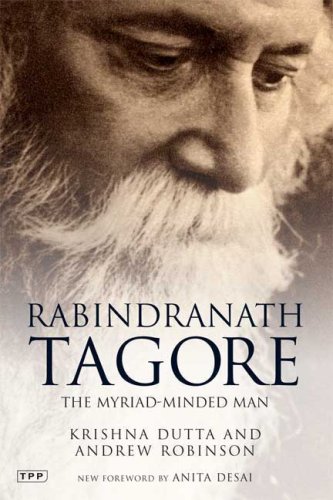 | Paperback: 520
Pages
(2009-02-15)
list price: US$19.95 -- used & new: US$11.35 (price subject to change: see help) Asin: 1845118049 Average Customer Review:
Canada | United Kingdom | Germany | France | Japan |
|
Editorial Review Product Description Rabindranath Tagore (1861-1941)--poet, philosopher, painter, novelist, playwright, composer, traveller, political commentator and Asia’s first Nobel Laureate--was one of his era’s cultural icons. Proclaimed as the greatest poet India has ever produced, Tagore left an astonishing legacy undimmed nearly 70 years after his death. But he was also an enigmatic, complex and contradictory figure, torn between India’s spiritual values and the spirit of the West. In this definitive biography, Krishna Dutta and Andrew Robinson explore the man behind the myth, presenting the power of his person, the power of his name and the power of his work. The result is an enlightening and exquisitely rendered portrayal--not of the legend but, to quote Tagore, of "the figure that once moved." Customer Reviews (2)
| |
| 6. The Home and the World (Penguin Classics) by Rabindranath Tagore | |
 | Paperback: 240
Pages
(2005-04-26)
list price: US$15.00 -- used & new: US$7.51 (price subject to change: see help) Asin: 0140449868 Average Customer Review: 
Canada | United Kingdom | Germany | France | Japan |
|
Editorial Review Product Description Customer Reviews (6)
| |
| 7. Fruit-Gathering by Rabindranath Tagore | |
 | Paperback: 28
Pages
(2010-07-24)
list price: US$14.14 -- used & new: US$14.13 (price subject to change: see help) Asin: 1153623757 Canada | United Kingdom | Germany | France | Japan |
|
Editorial Review Product Description | |
| 8. Selected Short Stories (Penguin Classics) by Rabindranath Tagore | |
 | Paperback: 336
Pages
(2005-08-23)
list price: US$14.00 -- used & new: US$7.98 (price subject to change: see help) Asin: 0140449833 Average Customer Review:
Canada | United Kingdom | Germany | France | Japan |
|
Editorial Review Product Description Customer Reviews (7)
| |
| 9. Poems of Rabindranath Tagore by Humayun Kabir | |
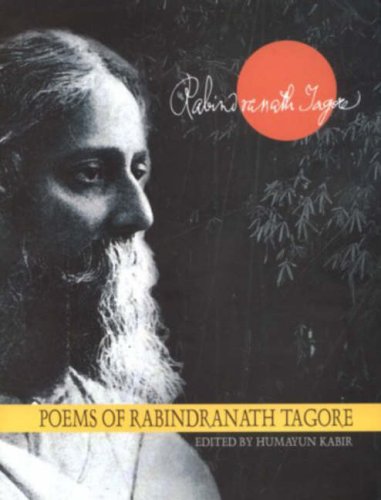 | Hardcover: 252
Pages
(2005-01-01)
list price: US$40.00 -- used & new: US$17.11 (price subject to change: see help) Asin: 8174765476 Canada | United Kingdom | Germany | France | Japan |
|
Editorial Review Product Description | |
| 10. SADHANA: THE REALIZATION OF LIFE by Rabindranath Tagore | |
 | Paperback: 80
Pages
(2009-03-26)
list price: US$8.99 -- used & new: US$8.74 (price subject to change: see help) Asin: 1604594659 Average Customer Review:
Canada | United Kingdom | Germany | France | Japan |
|
Editorial Review Product Description Customer Reviews (6)
I fell in love with physics and mathematics because of my liking for their perfectness, exactness, and trimness; perfect form.(No large claims; a physics major and math minor, no graduate work.) For the same reasons, vague or inconsistent pictures of the universe are difficult for me to take in--I often take a statement, rework it, rework myself, think carefully, stay honest, and in the end sometimes come up with an expanded understanding of things; almost always the statement and I both must be reworked; there is no problem with that, it is just the natural metabolism of thinking. But Sadhana is so honest and well thought through that my first reading of it was smooth, beginning to end.And it was expanding.And it was perfect.And it was beautiful because it was true; it was perfectly beautiful; however you want to put it, I was taken. The book presents a perception of things which goes to their root; fortunately and unfortunately, I find no other words for this than "spiritual;" I must be careful to point out that this spirituality is grounded in the world; it is not pained to explain ugliness; it is honest about things--this honesty does not make it less beautiful; but a rather awe-filled more.The integrity of perception of things is wonderful, and makes it a joy to read;any inch of slack can be overlooked in loo of the expansiveness, truth, and depth of insight provided. It is the only presentation of a cosmology I have found which seems (to me!) 1. entirely consistent with a physicist's beliefs of the nature of things, and 2. which even encompasses the physicists's awarenesses, without at all attempting to (at least not by the same route).And yet with all this, it is more a work of poetry of the heart than a work of philosophy or analysis.It successfully remains part of the *lived* world. I would like to continue about how I came to *Sadhana* in the first place, but it is best read in quiet, absent commentary by others.Get to the book.Make it "yours" first, perhaps, and then talk with others (just a thought). Perhaps I can say this final bit (it only clues you in to the table of contents): I came to this book a few months after finishing Plato's *Republic*, and I know that Plato's work helped me develop the ideas and questions which led me to find Sadhana. I felt--coming from my reading and response to *The Republic*--that there was something worthy to pursue related to such notions as beauty, self, soul, and consciousness.Unfortunately, keyword searches on these called up not much helpful; mainly, they were works arrived at with too much fear and desire pushing for a crystallization of philosophy, or which lacked depth of heart. The best writings I didn't find under these searches, but instead under searches related to poetry, music, or art--nothing directly speaking of "soul," "self," and so forth.Yet I finally queried the library computer for any books which contained all four above words (the initial four).The fact that anything came up at all, with such 'different' notions, was unusual--I approached it warily, yet with subdued and slightly hopeful stride.My wariness soon evaporated away; dissolving.I read.It was Tagore's Sadhana, you assuredly have guessed.
Perched as he wasat the cusp of the Twentieth Century, Tagore saw with penetrating insightthe fallacies of the age of science when he wrote, " The man ofscience knows, in one aspect, that the world is not merely what it appearsto be to our senses; he knows that earth and water are really the play offorces that manifest themselves to us as earth and water -how, we can butpartially comprehend. Likewise the man who has his spiritual eyes openknows that the ultimate truth about earth and water lies in theapprehension of the eternal will which works in time and takes shape in theforces we realize under those aspects. This is not mere knowedge, asscience is, but it is a perception of the the soul by the soul. This doesnot lead us to power, as knowledge does, but it gives us joy, which is theproduct of kindred things. The man whose acquaintance with the world doesnot lead deeper than science leads him, will never understand what it isthat the man with the spiritual vision finds in these natural phenomena.The water does not merely cleanse his limbs, but it purifies his heart; forit touches his soul. The earth does not merely hold his body, but itgladdens his mind; for its contact is more than a physical contact, -it isa living prsesence." When I first read these words over twenty yearsago, they took my breath away.I have read and re-read Sadhana many timesince then. Each reading or re-visting of favorite passages is as fresh asthe first.He says much more that is worth reading in this 164 pagegem. Sadhana is also an excellent primer on classical Hinduism, as Tagorebeautifully quotes the Vedas and Upanishads with Sanskrit transliterationto convey the lovliness of the vocal cadences of that ancienttongue. Sadhana ranks with Psalms, the Tao De Ching, the Dhammapada, ZenMind Begginers Mind and other enduring classics of world spiritualliterature for its directness, simplicity and beauty of expression. My copyis beginning to fall apart so I am delighted to find it is again inprint. Finally, I thank Dr. Purshotam Lal of Calcutta for havingintroduced me to Tagore as Visiting Professor at Hofstra University in the1960's. Lal, a Tagore Scholar, also produced a lovely translation (or as hepreferred, a "transcreation") of the Dhammapada then published byFarrar Straus in New York. Thanks again, Lal. Joel Freiser Hoboken, NewJersey ... Read more | |
| 11. Selected Poems (Tagore, Rabindranath) (Penguin Classics) by Rabindranath Tagore | |
 | Paperback: 208
Pages
(2005-09-27)
list price: US$14.00 -- used & new: US$7.56 (price subject to change: see help) Asin: 0140449884 Average Customer Review:
Canada | United Kingdom | Germany | France | Japan |
|
Editorial Review Product Description Customer Reviews (2)
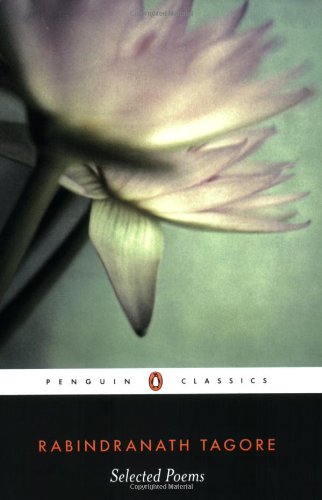
This is where Radice fails miserably. Let me simply cite the opening two lines of his translation of "Golden Boat" (Shonar Tari) along with the original. In Bengali, unlike in English, it is the consonant count (note that joint consonants are counted as one) and not the syllable count that defines a given meter. Here, we have a truncated fourteen-beat meter with a caesura after the eigth beat. The "ga" sounds are onomatopoeic, after the roaring of the clouds. Subsequently, the use of softer consonants indicates a draining of tension and reflects the loss of hope on the part of the narrator. Radice's version lacks any discernible meter and most importantly, the cohesion of sound and sense. The only device he uses is a slant rhyme and this, by itself, falls short of conveying the music of Tagore's verse. Other weaknesses include the unhappy gerund and the prosaic modifiers. Although the loss of formalism remains the primary failing of Radice's translations, there are other drawbacks. Reading Tagore aloud is always a pleasure because language in his hands is not only expression but can be read for sound alone. Those long polysyllabic compounds,the internal rhymes, the effortless alliteration are always a delight, no matter what the content, be it some his later abstruse works (of which I am not particularly fond) or his purely narrative poems. Radice's translations lack this linguistic richness and are bland for the most part. Worse, he has a penchant for cliches ("bright as a million suns", "sea of joy surges through his heart" etc.).One might as well ask, "What is the point?" Submitted incognito, these poems would be rejected by even middling journals. I can only guess what impressions critics unfamiliar with Bengali might form of Tagore's work, particularly in relation to his contemporaries, Yeats, Pounds and Stevens. I would refer them to selected translations by Radice's wife, Ketaki Kushari Dyson. "I won't let you go" (Jete nahi dibo), in particular, is well rendered.
| |
| 12. Songs of Kabir by 15th cent Kabir, Rabindranath Tagore, Evelyn Underhill | |
| Paperback: 164
Pages
(2010-09-08)
list price: US$21.75 -- used & new: US$16.07 (price subject to change: see help) Asin: 1171741375 Average Customer Review:
Canada | United Kingdom | Germany | France | Japan | |
|
Editorial Review Product Description Customer Reviews (7)
| |
| 13. Collected Poems and Plays of Rabindranath Tagore by Rabindranath Tagore | |
 | Paperback: 578
Pages
(2002-01-01)
list price: US$14.95 -- used & new: US$12.96 (price subject to change: see help) Asin: 8171677029 Average Customer Review:
Canada | United Kingdom | Germany | France | Japan |
|
Editorial Review Product Description Customer Reviews (1)
| |
| 14. Stray Birds by Rabindranath Tagore | |
 | Kindle Edition:
Pages
(2010-10-03)
list price: US$3.99 Asin: B0045U9SOU Average Customer Review:
Canada | United Kingdom | Germany | France | Japan |
|
Editorial Review Product Description Customer Reviews (3)
| |
| 15. Sadhana: The Realisation of Life by Rabindranath Tagore | |
 | Paperback: 84
Pages
(2005-01-31)
list price: US$7.95 -- used & new: US$5.80 (price subject to change: see help) Asin: 1420926543 Average Customer Review: 
Canada | United Kingdom | Germany | France | Japan |
|
Editorial Review Product Description Customer Reviews (2)
| |
| 16. The Fugitive by Rabindranath Tagore | |
 | Kindle Edition:
Pages
(2009-10-04)
list price: US$1.99 Asin: B002RKQYZ6 Canada | United Kingdom | Germany | France | Japan |
|
Editorial Review Product Description | |
| 17. The Hungry Stones and Other Stories by Rabindranath Tagore | |
 | Kindle Edition:
Pages
(2009-10-04)
list price: US$1.99 Asin: B002RKRV2G Canada | United Kingdom | Germany | France | Japan |
|
Editorial Review Product Description | |
| 18. The gardener by Rabindranath Tagore | |
 | Paperback: 172
Pages
(1916-01-01)
list price: US$13.99 -- used & new: US$13.99 (price subject to change: see help) Asin: B003Z4L4E4 Average Customer Review:
Canada | United Kingdom | Germany | France | Japan |
|
Editorial Review Product Description Customer Reviews (2)
And what he wants for his reward? He asks to be allowed to hold her little fists like tender lotus-buds and slip flower chains over her wrists; to tinge the soles of her feet with the red juice of flower petals and kiss away the speck of dust that may chance to linger there. This is the way Rabindranath Tagore, the greatest Indian poet of all times, introduce us to this enchanted collection of poems, poems that touch the most profound strings of our hearts. His poems tell us about love and life - and they are rich with the description of nature and beauty. Anybody that loves or has loved cannot remain indifferent to his poems. Some readers "have smiles, sweet and simple, and some a sly twinkle in their eyes. Some have tears that well up in the daylight, and others tears that are hidden in the gloom." But we all have need for him, the poet, who is "ever as young or as old as the youngest and the oldest of the village". His poems tell us of impossible love - like the love of the free bird and the cage bird: "Their love is intense with longing, but they never can fly wing to wing. Through the bars of the cage they look, and vain is their wish to know each other. They flutter their wings in yearning, and sing, 'Come closer, my love!' The free bird cries, 'It cannot be, I fear the closed doors of the cage.' The cage bird whispers, 'Alas, my wings are powerless and dead.' " His poems tell us of secret love: "The young traveler came along the road in the rosy mist of the morning. He stopped before my door and asked me with an eager cry, 'Where is she?' For very shame I could not say, 'She is I, young traveler, she is I.' " His poems tell us of lovers' emotion: "When my love comes and sits by my side, when my body trembles and my eyelids droop, the night darkens, the wind blows out the lamp, and the clouds draw veils over the stars. It is the jewel at my own breast that shines and gives light. I do not know how to hide it." His poems tell us of the need for love confidence: "Do not keep to yourself the secret of your heart, my friend! Say it to me, only to me, in secret. You who smile so gently, softly whisper, my heart will hear it, not my ears." His poems tell us of a love story: "Hands cling to hands and eyes linger on eyes: thus begins the record of our hearts. It is the moonlit night of March; the sweet smell of henna is in the air; my flute lies on the earth neglected and your garland of flowers is unfinished. This love between you and me is simple as a song." His poems tell us of lovers departing: "An unbelieving smile flits on your eyes when I come to you to take my leave. I have done it so often that you think I will soon return. To tell you the truth I have the same doubt in my mind. For the spring days come again time after time; the full moon takes leave and comes on another visit, the flowers come again and blush upon their branches year after year, and it is likely that I take my leave only to come to you again. But keep the illusion awhile; do not send it away with ungentle haste.When I say I leave you for all time, accept it as true, and let a mist of tears for one moment deepen the dark rim of your eyes. Then smile as archly as you like when I come again." Reading those poems I felt like visiting a flower garden full of scents and beauty in a magic ancient kingdom. ... Read more | |
| 19. Sacrifice: and other plays by Rabindranath Tagore | |
 | Paperback: 228
Pages
(1917-01-01)
list price: US$16.99 -- used & new: US$16.99 (price subject to change: see help) Asin: B00427ZE9O Canada | United Kingdom | Germany | France | Japan |
|
Editorial Review Product Description | |
| 20. Glimpses of Bengal Selected from the Letters of Sir Rabindranath Tagore by Rabindranath Tagore | |
 | Paperback: 90
Pages
(2006-11-03)
list price: US$9.95 -- used & new: US$9.95 (price subject to change: see help) Asin: 1406936774 Canada | United Kingdom | Germany | France | Japan |
|
Editorial Review Product Description | |
| 1-20 of 100 | Next 20 |
 Please dont buy this copy as it is poorl y formatted and I am sure there may be a copyright violation
 the classic triangle in orient style
 the Home and the world