e99 Online Shopping Mall

Geometry.Net - the online learning center Help  
Home  - Authors - Thoreau Henry David (Books)

  Back | 21-40 of 100 | Next 20
A  B  C  D  E  F  G  H  I  J  K  L  M  N  O  P  Q  R  S  T  U  V  W  X  Y  Z  

click price to see details     click image to enlarge     click link to go to the store

$5.75
21. Walden
$5.89
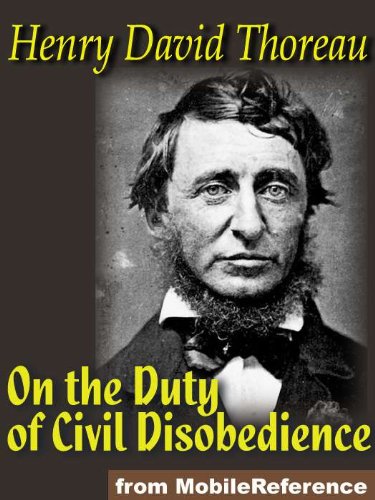
22. On the Duty of Civil Disobedience
 
23. The Portable Thoreau
$65.95
24. Journal, Volume 5
 
25. Journal of Henry David Thoreau
 
$100.00
26. The Illustrated a Week on the
 
27. The Journal of Henry D. Thoreau
$7.14
28. Walden : An Annotated Edition
$10.00
29. Walking With Henry: Based on the
$16.00
30. Cape Cod
$64.09
31. The Writings of Henry David Thoreau:
$16.39
32. Walden (Naxos Audio)
$2.22
33. New Suns Will Arise : From the
$17.42
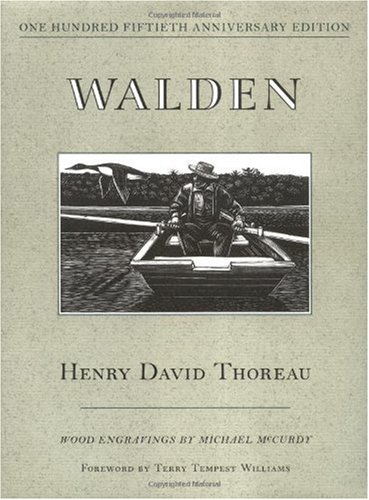
34. Walden: 150th Anniversary Illustrated
$8.95
35. H. D. Thoreau: A Writer's Journal
$89.89
36. Henry David Thoreau / Walden
$4.70
37. Walden and Civil Disobedience
$0.99
38. Walden and On the Duty of Civil
$26.14
39. Familiar Letters Of Henry David
 
$65.00
40. Thoreau Journal

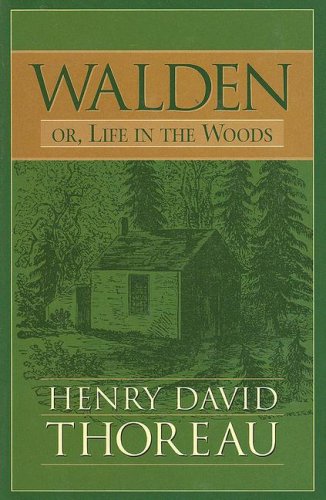
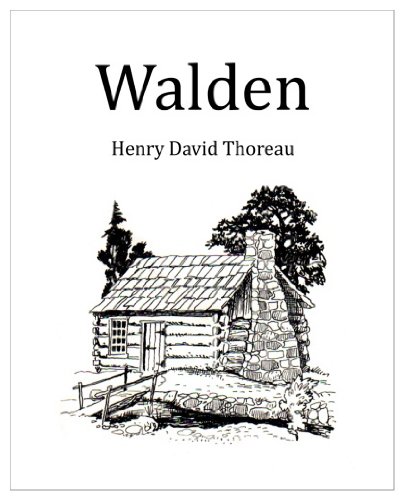
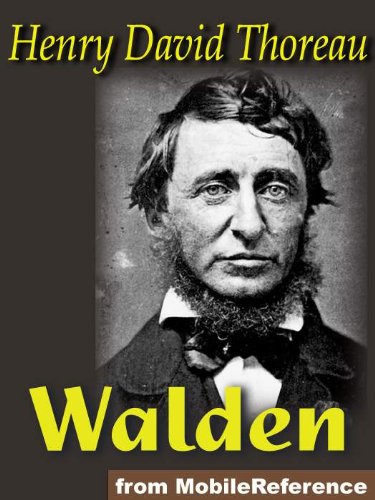
21. Walden
by Henry, David Thoreau
Paperback: 156 Pages (2005-01-01)
list price: US$6.95 -- used & new: US$5.75
(price subject to change: see help)
Asin: 1420922610
Average Customer Review: 5.0 out of 5 stars
Canada | United Kingdom | Germany | France | Japan
Editorial Review

Book Description
"Walden" is the classic account of two years spent by Henry David Thoreau living at Walden Pond near Concord, Massachusetts. The story is detailed in its accounts of Thoreau's day-to-day activities, observations, and undertakings to survive out in the wilderness for two years. Thoreau's journal is an exquisite account of a man seeking a more simple life by living in harmony with nature. In today's fast-paced consumer-driven society the austere life style endorsed by Thoreau is as relevant and refreshing as ever. ... Read more

Customer Reviews (2)

5-0 out of 5 stars Loved it!
The service was prompt, the book was brand new, and cheaper than the list price!!!

5-0 out of 5 stars Walden, by Henry David Thoreau
This book should be required reading for every high school and college student in every school in the country.Our narcissistic, throwaway, gadget-intoxicated society needs to hear Thoreau's message about the satisfaction gained through living simply, and about the difference between want and need.Not to mention his pronouncement that we do not own our possessions but are rather owned and enslaved by them. ... Read more


22. On the Duty of Civil Disobedience - Thoreau's Classic Essay
by Henry David Thoreau
Paperback: 48 Pages (2007-12-10)
list price: US$5.99 -- used & new: US$5.89
(price subject to change: see help)
Asin: 1604500417
Canada | United Kingdom | Germany | France | Japan
Editorial Review

Book Description
On the Duty of Civil Disobedience is one of Thoreau's most famous essays. This edition includes a special section for the reader to take notes at the end of the book. ... Read more


23. The Portable Thoreau
by Henry David Thoreau
 Hardcover: Pages (1957-08-29)
list price: US$4.95
Isbn: 0670010316
Average Customer Review: 4.5 out of 5 stars
Canada | United Kingdom | Germany | France | Japan

Customer Reviews (7)

5-0 out of 5 stars Nice Size
This is a nice size copy. I'm glad it's larger than a normal paper back.

'makes reading Thoreau a more beautiful experience.

3-0 out of 5 stars Just a taste
This book is a collection of essays, poems, and chapters of books written by Thoreau.It includes:

Essays:
--Natural History of Massachusetts
--A Winter Walk
--Civil Disobedience
--Walking
--Life Without Principle
--The Last Days of John Brown

Book excerpts:
--The Wilds of Penobscot (from The Maine Woods)
--Life in the Wilderness (from The Main Woods)
--Concord to Montreal (A Yankee in Canada, Excursions)
--Selections from 1858 (Journal)
--The Wellfleet Oysterman (Cape Cod)

A sampling of 18 poems is also included, as well as the full text of Walden.Supplementing this material by Thoreau are an introduction and epilogue by the editor, a short chronology of the main events of Thoreau's life, and a short bibliography.There is no index.

For a book that tries to capture the essence and variety of Thoreau's work in one volume, the choice of essays is quite decent."Civil Disobedience" and "The Last Days of John Brown" represent some of the best and most well known of Thoreau's political works."Life Without Principle" is perhaps the most well-known essay describing Thoreau's economic philosophy. The remaining essays are classics of his naturalist writing.If there were more space, it would have been great to include "Autumnal Tints," "Wild Apples," or "The Succession of Forest Trees," as well.The book excerpts also present a decent selection of highlights.Certainly, Walden is Thoreau's most well-known book, and it contains material on many of his characteristic topics, so it makes sense to print the entire text.Due to space constraints, material from the other books can only be excerpted, so only the most outstanding or popular sections of the other books appear in this volume.

Carl Bode, the editor, includes a short biographical sketch of Thoreau in the introduction, and provides brief notes that describe the context for each of the items included in the book.In the biographical sketch, Bode follows the biographer Canby for the most part, and doesn't seem very impressed by Thoreau's writing on nature, terming him "merely an amateur botanizer."In the epilogue, Bode summarizes a 1957 unpublished doctoral dissertation by Raymond Gozzi, in which Gozzi does an extended Freudian psycho-analysis of Thoreau, based on his writings and known biographical details.Gozzi's findings, at least as reported by Bode, are bizarre, as for instance, when it is claimed Thoreau's affinity for swamps as being sexual in nature, or when it is proposed that Thoreau had an Oedipus complex and his relationship with John Brown was colored by his identification with Brown as a father-figure. In sum, this book provides a decent taste of many of Thoreau's more famous works.The biographical sketch can also be useful for students of Thoreau, but the epilogue is more useful as an example of the oddities of Freudian analysis than a serious account of Thoreau and his work.

4-0 out of 5 stars greatvalue
Very nice collection of Thoreau's work.Perfect for anyone wanting to get better acquainted with Thoreau.

5-0 out of 5 stars 'My life has been the poem I would have writ'
This anthology contains Thoreau's major writings. First and above all 'Walden'. And then far far back the travelogue reflective work ' A Week on the Concord and Merrimack Rivers', the famous essay on ' Civil Disobedience' which would be important for Gandhi and Martin Luther King, a scattering of his poems , 'The Maine Woods', ' AWinter Walk' ' A Yankee in Connecticut' and ' The Last Days of John Brown'
As Carl Bode makes clear in his excellent introduction surveying the work and life of Thoreau , Thoreau was always one who heard the sound of a different drummer. His aim was to be a poet , a poet who was true to the facts of life and to its deepest transcendal reflection.Bode tells the story of Thoreau seeking a way to make a living, and able to find only a vocation. And that vocation found in the two years and two months at Walden Pond gave the world a literary masterpiece and Thoreau his time of realization. Bode makes it clear that all that came before and all would come after in Thoreau's life would be anti- climax. Bode also tells the story of Thoreau's complicated relation with Emerson, and of Thoreau's learning the heart of his own doctrine from Emerson' 'Nature'. The emphasis on Nature, and on the transcendent world of the Spirit , and on a kind of life apart from the ordinary commercial business of mankind would become essential parts of Thoreau's message. And this Thoreau always closer to the facts of life than Emerson. Thoreau's two disappointed attempts at love are also seen as critical steps in re- enforcing his natural tendency to walk and dream alone. Thoreau towards the end of his life subdued a bit his radical individuality in his effort to serve the anti- slavery cause. But he is the quintessential American individualist, the man who goes his own way to see something no one else has seen before. Bode concludes his introduction with Thoreau's short poem , a summary judgment on his life' My life has been the poem I would have writ/ But I could not both live and utter it./
It is clear despite this negative judgment that in another sense the life he did come to confront and live most deeply was the one he shaped with his words. And the testament he left behind has been for many an enhancement not only of their sense of literature and poetry but of their feeling of the possibilities of life.

5-0 out of 5 stars Must Read
This volume represents a collected works of Thoreau's writings, which a previous reviewer has done well to catalog. Every couple of years I find myself returning to this book to walk with Thoreau and attempt to rediscover my core values and love for pure writing and critical thinking. Thoreau invites his readers to shed the encumbrances of their lives, willingly brought upon themselves in the form of mortgages and jobs they cannot afford to abandon. In short, we become tools to our tools-that is, slaves to materialism.

In "Nature," Thoreau states: "The mass of men lead lives of quiet desperation." Referring, in my opinion, to the eternal quest for material items at the cost of intellectual enlightenment. According to Thoreau, a man will spend his entire life working to obtain a nicer house and to surround himself with the trappings of wealth, all the while forgetting that nature, and the pursuit of simplicity and knowledge are true wealth.

This book should be a part of your home library. ... Read more


24. Journal, Volume 5
by Henry David Thoreau
Hardcover: 616 Pages (1997-07-07)
list price: US$99.50 -- used & new: US$65.95
(price subject to change: see help)
Asin: 0691065365
Average Customer Review: 5.0 out of 5 stars
Canada | United Kingdom | Germany | France | Japan
Editorial Review

Book Description

From 1837 to 1861 Thoreau kept a journal that began as a conventional record of ideas, grew into a writer's notebook, and eventually became the principal imaginative work of his career. The source of much of his published writing, the Journal is also a record of both his interior life and his monumental studies of the natural history of his native Concord, Massachusetts. In contrast to earlier editions, the Princeton Edition reproduces the Journal in its original and complete form, in a reading text that is free of editorial interpolations but keyed to a comprehensive scholarly apparatus.

Covering an annual cycle from spring 1852 to late winter 1853, Journal 5 finds Thoreau intensely concentrating on detailed observations of natural phenomena and on "the mysterious relation between myself & these things" that he always strove to understand. Increasingly, the Journal attempts to balance a new found scientific professionalism and the accurate recording of phenological data with a firmly rooted belief in the spiritual correspondences that Nature reveals. Fittingly, the year of observation ends with Thoreau pondering an invitation to join the Association for the Advancement of Science, an invitation he ultimately declined in order to pursue his own life studies.

... Read more

Customer Reviews (1)

5-0 out of 5 stars A day by day look at Thoreau
"Oct. 22nd, 1837. 'What are you doing now?' he asked, 'Do you keep a journal?'-- So I make my first entry today." Thus begins Thoreau's Journal, made up of more then two million words and covering about twenty-five years of his life.No other work of Thoreau's better exhibits his discipline as a writer and his devotion to the natural world.In the Journal can be found the fragmented foundations ofmasterpieces such as Walden, A Week on the Concord and Merrimack Rivers, The Maine Woods, and Cape Cod.But what is perhaps more interesting to a reader of Thoreau's Journal are his thoughts and insights on topics such as friendship, love, religion, nature, bravery, heroism, war, slavery, the art of writing, and, most important to Thoreau, the art of living.Anyone with any interest in Thoreau will find his Journal to be an invaluable aid in understanding and following the life of one of America's most profound prose writers ... Read more


25. Journal of Henry David Thoreau 1837-1861
by Henry David Thoreau
 Paperback: 14 Pages (1984-11)
list price: US$49.98
Isbn: 0879051736
Canada | United Kingdom | Germany | France | Japan

26. The Illustrated a Week on the Concord and Merrimack Rivers
by Henry David Thoreau, Herbert W. Gleason, Carl Hovde, William L. Howarth, Elizabeth Hall Witherell
 Hardcover: 415 Pages (1984-01)
list price: US$34.50 -- used & new: US$100.00
(price subject to change: see help)
Asin: 069106573X
Canada | United Kingdom | Germany | France | Japan

27. The Journal of Henry D. Thoreau (In Fourteen Volumes, Bound as Two) (Henry David Thoreau, Vols. VIII - XIV (1855 - 1861))
 Hardcover: Pages (1962)

Asin: B000FU3DRM
Canada | United Kingdom | Germany | France | Japan

28. Walden : An Annotated Edition
by Henry David Thoreau
Hardcover: 352 Pages (1995-09-19)
list price: US$35.00 -- used & new: US$7.14
(price subject to change: see help)
Asin: 0395720427
Average Customer Review: 4.5 out of 5 stars
Canada | United Kingdom | Germany | France | Japan
Editorial Review

Book Description
On July 4, 1845, Henry David Thoreau moved into the cabin he had built on the shore of Walden Pond. Now, on the 150th anniversary of that event, Houghton Mifflin is proud to publish an exceptional new edition of what is perhaps the most important book in our history as a publisher. Walden: An Annotated Edition features the definitive text of the book with extensive notes on Thoreau's life and times by the distinguished biographer and critic Walter Harding. In the third chapter, Thoreau writes, "How many a man has dated a new era in his life from the reading of a book?" For many readers, Walden is that book. Written a century and a half ago, it grows more meaningful every day, and whether you are reading it for the first time or the hundredth, Walter Harding's insightful comments will open your eyes to the true depths of this masterpiece. ... Read more

Customer Reviews (18)

2-0 out of 5 stars Like panning for gold...
...you have to sift through a lot.

Thoreau has some really great, original ideas and approaches to life.He has whole sections that seem incredibly tangential but after you reread them, you realize they were perhaps the greatest parts of the book.

That being said, he also has sections that are just incredibly tangential, and when you finish you miss things like narratives, a centered topic, main points, etc.These are just stream of consciousness it seems.

5-0 out of 5 stars Rich and Profound
To a citydweller who enjoys the modern conveniences, the idea of building a primitive shed in the woods and observing Nature for days on end was entirely unappealing. I felt I would have no sympathy with the Thoreauvian worldview.

I was pleasantly surprised. Thoreau has a distinct sense of humor. While a lot of the book is descriptions of Nature, the writing was lovely enough to make up for my disinterest in the subject. In fact, Thoreau's enthusiasm communicated itself to me, and I found myself becoming more interested as I read on.

Thoreau has a reputation for being unworldly, but interestingly the longest chapter in the book, "Economy," lays out in great detail the cost-effectiveness of his experiment in simple living. Although living in an isolated shed, he is no misanthrope but displays much affection and compassion for his fellow man. He is a keen observer of human nature and his descriptions of his friends and visitors were some of the best parts of the book. He is a man of sensibility, sincerely concerned about the direction he sees society taking.

The annotations were useful, as was the map of Concord.

1-0 out of 5 stars An Entirely New Level
Henry David Thoreau did something truly magical in Walden. He brought boredom to an entirely new level I never knew existed. The amount of pointless and extraneous details that overflowed the pages of the book never ceased to amaze me.
I was forced to read the book for an english class. My life has never been the same since. Thoreau's brilliant writing technique has allowed me to realize the full potential of other "books." I often find myself engrossed in the phone book or the dictionary, which have become suspenseful thrillers in comparison to Walden.

4-0 out of 5 stars Tied for second place among the annotated Waldens
WALDEN has rarely been out-of-print since its first publication in 1854. Copies come in all sizes, shapes and price ranges.Today's Thoreauvians have three ANNOTATED versions of WALDEN to choose from.Each one provides same-page explanatory notes that help the reader interpret the sometimes esoteric references in Henry David Thoreau's original text.The three books are "The Annotated Walden" (edited by Philip Van Doren Stern, 1970), "Walden: An Annotated Edition" (edited by Walter Harding, 1995), and "Walden: A Fully Annotated Edition" (edited by Jeffrey S. Cramer, 2004).Each one has at least one map of Concord and/or Walden Pond.Each one has its strengths and weaknesses. Each one has appeal for a devoted audience.

"Walden: An Annotated Edition" by Walter Harding was released in 1995, a year before the editor's death.Harding was a founding member of the Thoreau Society and devoted his entire life to the man and his writings. He is still regarded as *the* HDT expert of the 20th century.In addition to the text of WALDEN, this volume includes a few "extras":a four-page forward that contains a biographical summary; a bibliography; journal entries and original HDT sketches scattered throughout the book's margins (a favorite Harding technique); and a special appendix regarding the story about "a hound, a bay horse, and a turtle-dove."The explanatory notes -- the essence of an annotated edition -- define a number of references both in word and phrase.Harding didn't copy anything from Van Doren Stern's previous work, and he also didn't include as many stylistic comments as his predecessor.He offered more frequent explanations and backed them up with a variety of source materials.He also throws in his own opinion every once in a while.The occasional ink doodlings from the journals serve well to break up the text.But lack of an index is a major failing. This is a handsome volume that improves upon Van Doren Stern's previous WALDEN analysis.

Lining up the three versions side by side is an interesting experiment, best conducted on a rainy summer day when no other work has appeal.Let's use two well-known and oft-debated passages for an initial sample interpretive comparison.

"I long ago lost a hound, a bay horse, and a turtle-dove, and am still on their trail."("Economy") Do those three animals stand for actual individuals in Thoreau's life?Or does this passage simply refer to Life's losses? Philip Van Doren Stern devotes a page-length note to this paragraph.He mentions a few of the major interpretations and refers readers to the bibliography for more. His conclusion is: "Since there is no clear explanation, each reader will have to supply his own." Walter Harding offers three pages in a special appendix that covers all the major theories.At the end, he too suggests that "each reader is free to interpret them as he wishes." Jeffrey Cramer's paragraph cites two similiar excerpts found in other Thoreau pieces, and his explanation states that "no analysis has been generally accepted as valid."So the three men agree: we have to decide for ourselves what we think of the story.

"There was an artist in the city of Kouroo who was disposed to strive after perfection."("Conclusion")Is the parable that follows that opening sentence based on some of the Eastern texts that Thoreau was fond of reading at the time?Or is it a thinly-disguised depiction of his own struggle to perfect the final WALDEN manuscript?Philip Van Doren Stern simply says that "no one has been able to find a source for the legend" and agrees with Arthur Christy that it is an allegory about Thoreau's own life.Walter Harding offers several possible origins of the legend but eventually cites and agrees with Christy's allegory statement.Jeffrey Cramer devotes just a two-sentence annotation, concluding with "It is generally agreed that the following fable is by Thoreau."In this instance, Cramer has the benefit of time over his colleagues. Most Thoreauvians have come to the same realization during the past decade after much gnashing of teeth.

Explanatory differences are more pronounced at other various junctures in the text.Each man obviously was intrigued by certain references more than others.I can say that overall, I found Jeffrey Cramer's annotations to be the most helpful of the three.Maybe someday someone will have the courage to tell all the makers of posters, bumper stickers, and t-shirts that "Time is but the stream I go a-fishing in" is NOT about fishing at
all.

Every school and public library should own at least one of these annotated editions.Academic libraries will want at least two of the three versions.If you want a book that has a lot more HDT than just WALDEN, find a used copy of the Philip Van Doren Stern book.If you want to hear from expert Walter Harding, choose his.Individuals who want the most comprehensive interpretation should go with the newest volume by Jeffrey
Cramer.It's a worthy addition to the Thoreau legacy.

1-0 out of 5 stars INSOMNIA'S CURE
I first read Solitude in high school(over 10 years ago), not as part of the regular curriculum but for US Academic Decathlon.To think about it even now still bores me.Reading Solitude may have been the most boring part of USAD, & that ain't a little bit of boredom.Thoreau, Emerson, those other guys I can barely differentiate, especially the 'fire & brimstone' types were some of the reasons I took British lit instead of American lit in college.I also took British lit rather than American because it is 800+ years vs. 200+.(Thanks Mr. M, my h.s. English lit teacher).But back to Walden.

Think of it.You decide to live in solitude for a couple of years, in the 19th century!The very idea is boring.Let's not get into no t.v., et.c.But not even the daily news?Didn't they have newspapers back then?Before some make the mistake of thinking I don't understand, I (yawn) say I can appreciate one's desire to engage himself by the near total exclusion of others.I just don't believe its something you need to read about some guy doing over 150 years ago.On the other hand, if you wanted to avoid those very interesting times, you'd do what Thoreau did if you could so afford.If not you'd read about it, to quiet the debate going on outside one person's journey of self-discovery.Specifically, if I wanted to learn more about those times I'd check up on abolitionist writings, women's suffrage, and other things from the period that were more topical.

Nevertheless, I could use a copy though, for those troublesome nights when I can't get to sleep.

P.S. Thoreau is one of those authors you list that maintains your "with it-ism" in our increasingly 'my country, right or wrong' times. ... Read more


29. Walking With Henry: Based on the Life and Works of Henry David Thoreau
by Thomas Locker
Hardcover: 32 Pages (2002-06)
list price: US$17.95 -- used & new: US$10.00
(price subject to change: see help)
Asin: 1555913555
Average Customer Review: 5.0 out of 5 stars
Canada | United Kingdom | Germany | France | Japan
Editorial Review

Book Description
In a series of richly painted landscapes, Walking with Henry offers readers of all ages a glimpse into the grandeur of nature through Thoreau's eyes, showing how one can discover, when walking in the natural world, Truth, Beauty, and Goodness. Henry David Thoreau was a serious field biologist who studied nature and all its intricacies, and who showed us that nature was something more than facts to be assembled, arranged, and measured. He was also a poet, and in his hands, closely observed facts blossomed into wonder-filled metaphors of lasting value.

Footstep by footstep, we follow Thoreau on his solitary journey through wilderness, gaining insight into his quiet and reflective world. With this wondrous introduction to the poet-philosopher, Walking with Henry helps readers understand Thoreau's belief that wilderness can be found in every blade of grass, every tree, and every aspect of the natural world. Wildness wasn't a resource for Thoreau; it was the ultimate source of creativity, essential for survival in an ever-evolving, fast-paced world.

Walking with Henry carries a healing message for our time by sharing a love of the wild so natural to the young. Selections of Thoreau's writing will inspire teachers and parents to a renewed appreciation of the importance of Thoreau's thoughts in today's world. ... Read more

Customer Reviews (2)

5-0 out of 5 stars An in depth persspective on the time line of ecology.
As Tom was forming the images for this book he fell extremely ill. While in a deep and long coma he met Henry and based upon that meeting several of the images in this book were changed. These beautiful images of the Hudson River and in particular Storm King Mountain will haunt and excite you as you consider how this area was formed and has survived man's interference. The essence of this area will be finally synthesized in his next book, The Story of a River. When completed this will give you a private insight into time and ecology not found anywhere else.

5-0 out of 5 stars A warm and resplendently beautiful picture book
Written and illustrated by Thomas Locker, Walking With Henry is a warm and resplendently beautiful picture book based on the life and works of Henry David Thoreau. Majestic painted landscapes showcase simple descriptions drawn from and inspired by the man who loved to walk in the wilderness. Walking With Henry is a highly recommended and heartwarming tribute suitable for young readers of all ages, and aptly serve to introduce the life and work of America's most famous and enduringly popular naturalists. ... Read more


30. Cape Cod
by Henry David Thoreau
Hardcover: 256 Pages (2002-06)
list price: US$16.00 -- used & new: US$16.00
(price subject to change: see help)
Asin: 1883684277
Average Customer Review: 5.0 out of 5 stars
Canada | United Kingdom | Germany | France | Japan
Editorial Review

Book Description
Fortunately for those who love the Cape, as well as for those who love to read, Henry David Thoreau left no stone unturned as he ambled through backyards, strolled along beaches, and traipsed through the scrub of this peninsula with the eye of an observer who was fully enthralled with the obvious. The result of his excursions was not just Cape Cod, but also this unique edition. While Thoreau's journals from the first three visits provided the basis for his text, his entries from the final visit are also included as an appendix. And following those, our newly re-designed volume retains the only complete index to this classic work.Download Description
Our way to the high sand-bank, which I have described as extending all along the coast, led, as usual, through patches of Bayberry bushes, which straggled into the sand. This, next to the Shrub-oak, was perhaps the most common shrub thereabouts. I was much attracted by its odoriferous leaves and small gray berries which are clustered about the short twigs, just below the last year's growth. I know of but two bushes in Concord, and they, being staminate plants, do not bear fruit. ... Read more

Customer Reviews (6)

5-0 out of 5 stars Travel to the cape with Thoreau
(My review is on Thoreau's Cape Cod rather than this specific edition).

While some literary critics seem to slight this work by Thoreau, saying that it is not as "powerful" as his other works, etc., I personally find this one very enjoyable. Sure, it does not have as much "philosophizing" as other books by him, but it is full of humor and very fun to read. The part where he describes the old man spitting into the hearth is particularly hilarious. The part about him sleeping in a lighthouse is also very funny. It lets us experience the more jovial side of Thoreau. This is probably one of the easiest to read among Thoreau's books.

Published posthumously, this volume is surprisingly consistent and complete (unlike "The Maine Woods" which is chopped into three different parts), it gives one the feel of walking along the entire cape, although the materials are quarried from several different trips. One only wish Thoreau had lived longer and had seen the West, imagine him taking a trip in the Sierra! Oh, well, meanwhile, we still have this one to enjoy.

5-0 out of 5 stars BEST EDITION AVAILABLE, BY FAR
This hardcover edition from Peninsula Press is unquestionably the best available edition of Thoreau's Cape Cod, for these reasons:

1) While all other editions are based on Thoreau's journal entries from only his first three visits to the Cape, this edition includes an epilogue compiling Thoreau's notes from his fourth and final visit, in which he traveled south to Chatham and Monomoy.

2) This is the only edition to translate the many, many Greek and Latin phrases Thoreau includes throughout the work, and it is also the only edition to provide illustrations, maps, and sidenotes in-text.

3) This is the only indexed edition ever created.

HIGHLY RECOMMENDED for fans of both Cape literature and Thoreau in general.

5-0 out of 5 stars A Cape Cod Walk with Thoreau
Thoreau visited Cape Cod in 1849, 1850, and 1853.These trips formed the basis for a series of essays, several of which Thoreau published in magazines. After Thoreau's death, the essays were gathered together and published as "Cape Cod" in 1865.

Thoreau's "Cape Cod" is different in tone in theme from his earlier books.The tone is leisurely and light.Instead of solitude or the wild woods, the picture that remains with me from this book is that of a long walk, or, as Thoreau puts it, a "ramble" through the sand and dunes of Cape Cod. The book is picturesque, full of humor and wry observation. Thoreau unforgettably describes the ocean, in its storms, vicissitudes, and moments of peace, the fish and the fishermen, the sands, birds, plants and lighthouses of Cape Cod, and the people.I have visited portions of the Masachusetts coast, but I have never been to Cape Cod.Thoreau took me there in his book.

The book is arranged into ten chapters.It opens with a description of the shipwreck of the St John on a rock off the Cape. Thoreau then describes a ride by coach across the Cape.But the heart of the book lies in the following chapters in which Thoreau with a companion walks the 30 mile beach from Nauset Harbor to Provincetown with many stops and diversions along the way. I felt the salt air and saw the fishermen and the sandy beach as I walked with Thoreau.

The most vivid characterization in the book is in the chapter "The Wellfleet Oysterman", as Thoreau describes a grizzled, taciturn, and ancient native of Cape Cod and his family who offer him hospitality for the night.Another memorable chapter involves the description of the Highland Lighthouse, no longer standing, and its keeper.The stops with the Oysterman and the Lighthouse punctuate Thoreau's long walks through the day over the beach and his meditiations about and descriptions of what he finds there.

Thoreaus walk ended at Provincetown, on the northernmost portion of Cape Cod, with its wood walkway, shanty houses, and ever-present scenes of fishermen, boats, and drying fish. Thoreau offers what I found an affectionate portrait of these hardy fishermen and their families.Following a description of what he found at Provincetown, Thoreau offers a great deal of historical background on the exploration of the Cape, from the Pilgrims reaching back to earlier French, Icelandic, and English explorers.

Thoreau's "Cape Cod" is a worthy companion to his books describing his experiences inland, on Walden Pond and on the rivers and woods of New England and Maine.It is beautifuly written with unforgettable descriptive passages.It made me want to get up and go from my life in the city, and over 150 years after Thoreau wrote, wander and walk for myself along the dunes and sands of Cape Cod.

5-0 out of 5 stars Great Humor
This book details the flora, fauna and people that Thoreau found in Cape Cod in the 1850s.Thoreau organizes the book around a single trip to Provincetown, although much of the material that he uses in the book came from various visits to the Cape, and to the ocean in general.He starts with a description of a shipwreck at Cohasset, then a stagecoach ride from Plymouth, then a walking trip with a companion along the outer shore to Provincetown.Along the way, he describes not only the plants and animals he encountered, but also the people who he met.The book finishes with a lengthy academic historical account of the discovery and mapping of the Cape.

I found this to be the most humorous of all Thoreau's work.The character sketches he provides in this book, sharpened with his trained eye for observation of natural phenomena, are legendary.The cultural description of the Cape and its environment is quite fascinating for those interested in the history of daily life in 19th century Massachusetts.As Thoreau describes the desolate, treeless desert that made up the far reaches of the Cape, one begins to comprehend what it meant for an economy to be based on wood and whale oil for fuels.Thoreau stresses how valued driftwood was for residents of the Cape, as one of their main sources of heating and cooking fuel.Doubtless, he would not recognize the Cape today with its lush new forests.Or its Wal-Marts--switching to an oil economy has brought mixed blessings for the Cape.For those who think Thoreau to be a humorless didactic philosopher, this book shows a very different aspect of Thoreau as a writer.

5-0 out of 5 stars Leave your brain at the door.
You will forget about the outside world when you read this; nothing but sand, wind, and water. Plus some natural history, local folklore, a few shipwreck tales. Typical Thoreau; he finds beauty, interest, detail in the wilderness. The desolate landscape will help to clear your mind. Highlyrecommended. ... Read more


31. The Writings of Henry David Thoreau: Journal, Volume 8: 1854. (Writings of Henry D. Thoreau)
by Henry David Thoreau
Hardcover: 507 Pages (2002-05-06)
list price: US$80.00 -- used & new: US$64.09
(price subject to change: see help)
Asin: 0691065411
Canada | United Kingdom | Germany | France | Japan
Editorial Review

Book Description

From 1837 to 1861, Thoreau kept a Journal that began as a conventional record of ideas, grew into a writer's notebook, and eventually became the principal imaginative work of his career. The source of much of his published writing, the Journal is also a record of his interior life and of his monumental studies of the natural history of his native Concord, Massachusetts. Unlike earlier editions, the Princeton edition reproduces the Journal in its original and complete form, in a reading text free of editorial interpolations but keyed to a comprehensive scholarly apparatus.

Journal 8: 1854 is edited from the 467-page notebook that Thoreau kept February 13-September 3, 1854. It reveals him as an increasingly confident taxonomist creating lists that distill his observations about plant leafing and seasonal birds. Two particularly significant public events took place in his life in the summer of 1854. On July 4, at an antislavery rally at Framingham, Massachusetts, Thoreau appeared for the first time in the company of prominent abolitionists, delivering as heated a statement against slavery as he had yet made. And on August 9, Ticknor and Fields published Walden, the book Thoreau had been working on since 1846. In Journal 8 Thoreau indicates that these public accomplishments, though satisfying, took a toll on his creative life and did not fully compensate him for the hours spent away from the woods.

... Read more

32. Walden (Naxos Audio)
by Henry David Thoreau
Audio CD: Pages (2001-08)
list price: US$28.98 -- used & new: US$16.39
(price subject to change: see help)
Asin: 9626342323
Average Customer Review: 2.0 out of 5 stars
Canada | United Kingdom | Germany | France | Japan

Customer Reviews (1)

2-0 out of 5 stars Read the Book!
I have to disagree with the positive reviews above, but I'll admit I don't generally enjoy audio books and I couldn't get through much of this one.

The first problem for me is that it is Walden Lite. In the parts I listened to while following along in the text, all Thoreau's references and comments on mythology, history, etc. were eliminated. No doubt that makes it simpler to read and listen to, but it's not Walden. If you're not up to dealing with the whole book, just get a book of Thoreau quotes...don't listen to this and think you've heard Walden.

The biggest issue I had was that I simply didn't like the voice of the actor reading. It's hard to say why exactly, but I think I found it too high-pitched and affected. Never had the pleasure of hearing HDT's own voice of course, but I like to imagine it a lot more down to earth than this one. ... Read more


33. New Suns Will Arise : From the Journals of Henry David Thoreau
by Henry David Thoreau, Frank Crocitto
Hardcover: 80 Pages (2000-12-01)
list price: US$24.99 -- used & new: US$2.22
(price subject to change: see help)
Asin: 0786805390
Average Customer Review: 5.0 out of 5 stars
Canada | United Kingdom | Germany | France | Japan
Editorial Review

Book Description
One of America's best-loved writers is paired with photography of a wholly unique artist.

Nothing must be postponed. Take time by the forelock. Now or never! You must live in the present, launch yourself on every wave, find your eternity in each moment...

The essays of Henry David Thoreau resonate with a love for life, nature, and simplicity. But his concern for the natural world and passion for living life to its fullest are perhaps best illustrated in his rarely read journals. Encompassing the whole of his writing career, these journals convey a startling insight, zest for life, and admiration for the power of the individual.

This breathtaking book combines selected journal entries -many never before published - with the poignant, ethereal photography of internationally renowned photographer John Dugdale. Developed using an early photographic process, these unique cyanotypes echo the beauty of a time forgotten and the strength and spirit of one of America's best-loved writers. ... Read more

Customer Reviews (2)

5-0 out of 5 stars Great quotes and pictures
I would recommend this for some one looking to explore some of Thoreau without tripping over some of his verboeness.He has great pearls of wisdom for which you must hunt in his full works.Mind you that is worth it.However, this books has many all in one to view quickly.Also a great book to get the meditative juices flowing.

5-0 out of 5 stars SIGHT BEYOND THE PHYSICAL
It is obvious that the present day photographer, John Dugdale, has been greatly influenced by the 19th century Transcendentalist writer, Henry David Thoreau.In this superb book of Dugdale's photographs and selections from Thoreau's journals, it is as if the writings were done specifically for the images, not over 100 years previously.

Dugdale has, for many years, been one of my favorite photographers.He uses a process for printing his photographs called cyanotype which was invented during the time that Thoreau lived and worked.The wonderful elegance and simplicity of his subjects and images fits perfectly with Thoreau's philosophies of life.Dugdale, because of HIV, is 80% blind, but, somehow, uses what sight he has combined with a pure spirituality and sight beyond the physical to create images of rare beauty.

So, we see a single rose alongside these words of Thoreau:"Love is the burden of all Nature's odes..."A still-life of flowers, two birds, which may be made of milk glass, and a human hand are viewed with Thoreau's "Perhaps what most moves us in winter is some reminiscence of far-off summer...;" a solitary man with one hand against an old, tall tree by a pond and a field are perfect for Thoreau's "Live in each season as it passes; breathe the air, drink the drink, taste the fruit, and resign yourself to the influences of each..."And perhaps most moving of all, part of the back of a nude man is used with Thoreau's "My life was ecstasy.In youth, before I lost any of my senses, I can remember that I was all alive, and inhabited my body with inexpressible satisfaction..."

The book begins with two short, wonderfully written appreciations of the artists by Frank Crocitto.

This collection is magnificent beyond any contemporary words.HIGHLY RECOMMENDED. ... Read more


34. Walden: 150th Anniversary Illustrated Edition of the American Classic
by Henry David Thoreau, Scot Miller
Hardcover: 288 Pages (2004-08-11)
list price: US$28.12 -- used & new: US$17.42
(price subject to change: see help)
Asin: 0618457178
Average Customer Review: 5.0 out of 5 stars
Canada | United Kingdom | Germany | France | Japan
Editorial Review

Book Description
Henry David Thoreau was just a few days short of his twenty-eighth birthday when he built a cabin on the shore of Walden Pond and began one of the most famous experiments in living in American history. Originally he was not, apparently, intending to write a book about his life at the pond, but nine years later, in August of 1854, Houghton Mifflin's predecessor, Ticknor and Fields, published Walden; or, a Life in the Woods. At the time the book was largely ignored, and it took five years to sell out the first printing of two thousand copies. It was not until 1862, the year of Thoreau's death, that the book was brought back into print. Since then It has never been out of print. Published in hundreds of editions and translated into virtually every modern language, it has become one of the most widely read and influential books ever written, not only in this country but throughout the world. On the one hundred and fiftieth anniversary of the original publication of Walden, Houghton Mifflin is proud to present the most beautiful edition ever published of Thoreau's masterpiece. The price -- $28.12 -- is half a cent less than Thoreau himself spent to build his cabin in Walden Woods. This new edition features spectacular color photographs by Scot Miller that capture Walden as vividly as Thoreau's words do. The book is being published in association with the Walden Woods Project, which is dedicated to preserving the lands Thoreau wrote about. For each copy sold, Houghton Mifflin and Scot Miller are making a donation to the Walden Woods Project. ... Read more

Customer Reviews (8)

5-0 out of 5 stars Lovely
Bought this as a gift for my husband and he really loved the photo illustrations.They are beautiful.Makes a nice "coffee table book".

3-0 out of 5 stars Ironic edition
I'll not dwell on the author's content but on the publisher's choice of binding. Thoreau calls for a complete abandonment of possessions and to always choose the simpler, less expensive if something is needful. This beautiful coffee table book uses expensive glossy enamel paper with gorgeous photographs going way beyond necessity. Every time I picked it up to read, it's irony struck me first and weighed upon me until I set it down. It's a shame really, because with other content it would be luxurious.

5-0 out of 5 stars SUMPTUOUS SIGHTS & TIMELESS TRANSCENDENTAL TEXT

* "I would rather sit on a pumpkin and have it all to myself than be crowded on a velvet cushion . . . I have thus a tight shingled and plastered house, ten feet wide by fifteen long . . . A lady once offered me a mat, but as I had no room to spare within the house, nor time to spare within or without to shake it, I declined it, preferring to wipe my feet on the sod before my door.It is best to avoid the beginnings of evil."
~ Henry David Thoreau; "Walden"

* "Walden has become as much a state of mind as it is a place."
~ Scot Miller; "Walden - 150th Anniversary Illustrated Edition"

For my birthday in 1984, my dear friend, Marty ("rhymes with party"), gave me the 1981 Avenel books hardcover edition of WORKS OF HENRY DAVID THOREAU.This compilation contained all of the famous transcendentalist's most significant writings and the thirty intriguing Herbert Wendall Gleason, black and white photographs that graced the 1906 publication of Thoreau's complete works.

My dear friend died in an auto accident five years later, but part of his legacy is the passion for Thoreau's philosophy that his gift awakened in me, and that book which occupies a prestigious place in one of my bookcases right between my Holy Bible and my 1st edition copy of Mark Twain's 1872, Roughing It.And my book, though yellowed now, looks pretty good for a volume 23 years without a dust jacket (I nearly always trash the things immediately), and for having been completely read twice, and thumbed through hundreds of times!

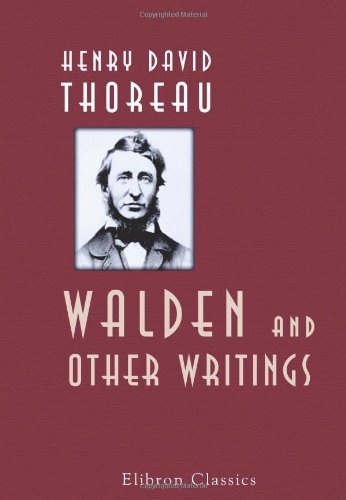
A couple of years ago, GFM (Good Friend Melanie) gave me a softcover copy of WALDEN AND OTHER WRITINGS, and I was glad to have it as it contained a couple of essays and excerpts I'd not previously read, and it provided me with a copy of Thoreau's best that I could loan out to others.

Therefore, when my friend, Pooh, and I flew into Philadelphia in late August 2005, to visit the birthplace of our nation, and then to drive north to visit Walden Pond and environs, I did not consider purchasing a copy of this 150th ANNIVERSARY ILLUSTRATED EDITION of WALDEN for myself while in Thoreau's hometown.I already had two copies of this true classic and couldn't see buying a third despite the stunning pictures included in this publication.I did, however, bring home a copy as a gift for GFM.(The woman in the bookstore in downtown Concord, Massachusetts, pointed out to me that the original publishing price - printed on the inside flap of the dust jacket - was $28.12, half a cent less than Thoreau tells us it cost him to build his little house at Walden's shore in 1845.(He officially moved into his homemade home on the appropriate date of July 4th, and an American classic was born!)

One day, shortly after returning from my memorable trip, I borrowed from GFM the copy I had given her, so I could gaze upon the nearly 100 SCOT MILLER photographs once again.And I was so awed by the indescribably gorgeous and practically breathtaking pictures of the Walden area and its flora and fauna, that I realized I needed to own this book like Thoreau needed solitude.And that's how I came by Thoreau's WALDEN for a THIRD time!While Marty's gift reigns for sentimental reasons, the 150th Anniversary Illustrated Edition is tops in exquisite beauty - a lovelier and more profound coffee table book is simply unimaginable; a richer gift for a valued friend couldn't be purchased at ANY price!This edition is simply a divine marriage of Thoreau's insight into the nature of Man and his place in nature, and Scot Miller's illustrations of the natural world wherein Thoreau made those treasured observations over a century and a half ago.Hey, I even left the dust jacket on this book despite the fact that the jacket's photograph is also reprinted on page 2, and it barely even hints at the wonders inside.

In Thoreau's WALDEN, the naturalist makes the following observation in the chapter titled, "Sounds":"I had this advantage, at least, in my mode of life, over those who were obliged to look abroad for amusement, to society and the theatre, that my life itself was become my amusement and never ceased to be novel.It was a drama of many scenes and without an end."And Scot Miller has brilliantly captured with his camera the splendor of that "drama of many scenes" at Thoreau's old stamping ground.

I'm not knowledgeable in the techniques of photography, so I can't explain to you HOW Miller was able to make photographs like these (it seems obvious to me, however, that he must employ an array of various filters and such).All that I CAN tell you is that words can't describe the virtual explosion of colors (like nature vibrantly celebrating that 1845 4th of July within Herself) and the uncommon degree of visible detail (staring at those rocks and leaves in "Still Life Under Ice", I can almost feel the bone-numbing cold that any one of those stones would penetrate my hand with)."Magical Fairyland Pond" is the perfect caption for that dreamlike picture of Walden's sister pond.I can almost hear a lonely dog barking from across the glittering snow while hidden deep in the distant, wooded shore, when I'm lost in the "Sunrise On Frozen Walden Pond."I'm not even going to attempt to describe the "Nature's Palette, Heywood's Meadow" photograph on page 32.Suffice to say that God is "The" Master Painter.Incredible!(And Scot Miller, you're a wonder, too!)

This five-star beauty of a book represents the pinnacle of the publisher's art, and it includes a shot of the exact site of Thoreau's 1845 cabin (previously obscured by a cairn), and Henry's simple tombstone, which I visited at the Author's Ridge section of the Concord cemetary where our hero's physical body gradually became a part of the nature that his spirit loved so much.

5-0 out of 5 stars Revisiting Walden
On a family vacation many years ago, I visited Walden Pond and walked all around it. In celebration of the 150th anniversary of the publication of Thoreau's Walden, the Walden Woods Project published, in 2004, this illustrated edition of the work with stunning color photographs by Scott Miller of Walden Pond and its environs.The Walden Woods Project is a nonprofit organization dedicated to the preservation of Walden Pond and to the legacy of Thoreau. I found this book a fitting memorial of my walk around Walden Pond and of my earlier readings of Walden.The lovely edition, photographs, and memories inspired me to turn again to Thoreau's book.

Henry David Thoreau (1817 -- 1862) lived at Walden Pond, Masachusetts from July, 1845 -- September, 1847, in a cabin he built himself on a tract of land owned by his friend, Ralph Waldo Emerson. He was two miles from Concord, Massachusetts and one mile from his nearest neighbor.A railroad passed near the pond, and it was frequented regularly by farmers, hunters, picnickers, and others.During the two years, Thoreau left Walden Pond at times to visit friends in Concord, to lecture, and to visit other ponds and sites in the area.He made no pretense of being entirely isolated.In his book, Walden, published in 1854, Thoreau described the first year ofhis life at Walden Pond (he tells us that the second year was much the same) and his reasons for living there.Much of the book was written at Walden Pond, and Throreau also wrote other works there.

The book is short but it is written in a dense, difficult and condensed style with many long, complex sentences. It is also highly allusive and shows Thoreau's learning in classical literature and his interest in Eastern thought and religion.It is filled with many short, pithy, and provocative comments which have become proverbial in American literature.

In the opening and closing chapters of the book, Thoreau describes his motivations for living at Walden Pond and abandoning the life of commerce.For Thoreau, most people are owned by their possessions.He saw a need to live with little encubrance in order to understand himself and find inner peace. "Simplify, simplify, simplify" was his goal. In one of my favorite sentences of the book, he states (p. 67) "I went to the woods because I wished to live deliberately, to front only the essential facts of life, and see if I could not learn what it had to teach, and not, when I came to die, discover that I had not lived."Then, towards the end of the book, Thoreau recounts some of the lessons he had learned in the following passage:

"We should be blessed if we lived in the present always, and took advantage of every accident that befell us, like the grass which confesses the influence of the slightest dew that falls on it, and did not spend our time in atoning for the neglect of past opportunities, which we call doing our duty.We loiter in winter while it is already spring."(p/253)

In the middle sections of the book, Throreau describes his life in the woods, again with recognition of his substantial interactions with other people during the time.(He was not a hermit.) He describes the books he read, his activites at his cabin, Walden Pond and woods, the changes of the seasons, and the plants and animals.The pond and its creatures are described with great detail, but Thoreau gives even more attention to internalizing his experiences and explaining their significance to his readers.

Scott Miller's beatiful photographs of Walden Pond add a great deal to this edition.They are well-placed to correspond with the discussion in the text, and they illuminate Thoreau's descriptive passages.The photographs, and the book itself, brought back reading and visiting memories and made me want to see Walden Pond again.

But much as Walden is revered for its descriptions of nature, the book remains for me primarily internalized and intropsective. Thoreau has many polemical things to say which will not, and should not, appeal to all readers.But the book documents the effort of an individual to try to understand his life, to reflect, and to understand change. As I have suggested, it is not an anti-social book as Thoreau was never far removed from friends and company.But it is a book about understanding one's life and learning not to be afraid of solitude or of being with oneself.

Robin Friedman

5-0 out of 5 stars Walden: 150th Anniversary Illustrated Edition of the American Classic
I recently sent this to my daughter because during a phone converstation, I thought she sounded depressed, so I didn't actually see the book myself, but she called me to tell my how much she loved it. I could hear it in her voice as she decribed it to me. She said a friend was at the house when it was delivered and while looking at one picture, in a quiet voice, her friend said "I want to go there". ... Read more


35. H. D. Thoreau: A Writer's Journal
by Henry David Thoreau
Paperback: 234 Pages (1960-06)
list price: US$8.95 -- used & new: US$8.95
(price subject to change: see help)
Asin: 0486206785
Average Customer Review: 5.0 out of 5 stars
Canada | United Kingdom | Germany | France | Japan

Customer Reviews (1)

5-0 out of 5 stars The best of Thoreau's journal
Because Henry David Thoreau's work is in the public domain, it's easy to run across any number of compilations of his most profound or most quotable words.Perhaps these mini-anthologies are simpler to digest than, say, every single page of _Walden_, or every one of the 14 volumes of his _Journal_. Let's face it:most people don't get or take the chance to read either one.So it's nice that Laurence Stapleton took the time to read the _Journal_ and select crucial parts for us to study.Here Thoreau is at his best in describing his neighbors or his walks around Concord and his art of observing Nature.His recordings are mostly made under what most people would consider adverse conditions:in fog, in rain, in snow, or at night.He notices phenomena reflected only in the water of a pond or the ice-covering of a wintry field.He is a practiced "seer," and his writing inspires the reader to see as well.

His writing.Of course!This book is subtitled _A Writer's Journal_ for good reason.Stapleton specifically picked out many entries where Thoreau ruminates about his own writing and the creative process.To this end, this book reads like a 19th-century _Chicken Soul for the Writer's Soul_.Anyone who writes can identify with considerations like these:

"The best you can write will be the best you are.Every sentence is the result of a long probation.The author's character is read from title-page to end.Of this he never corrects the proofs."(Feb. 28, 1841)

"We cannot write well or truly but what we write with gusto.The body, the senses, must conspire with the mind.Expression is the act of the whole man, that our speech may be vascular.The intellect is powerless to express thought without the aid of the heart and the liver and of every member."(Sept. 2, 1851)

"Write often, write upon a thousand themes, rather than long at a time, not trying to turn too many feeble somersaults in the air,--and so come down upon your head at last." (Nov. 12, 1851)

"I wish that I could buy at the shops some kind of india-rubber that would rub out at once all that in my writing which it now costs me so many perusals, so many months if not years, and so much reluctance, to erase."(Dec. 27, 1853)

"Time never passes so quickly and unaccountably as when I am engaged in composition, i.e. in writing down my thoughts.Clocks seem to have been put forward."(Jan. 27, 1858)

"The more you have thought and written on a given theme, the more you can still write.Thought breeds thought.It grows under your hands."(Feb. 13, 1860)

(Is he speaking to *us* or to *himself*?) We also see publication notes of the two books released during Thoreau's lifetime, _A Week on the Concord and Merrimack Rivers_ and _Walden_.We read discourses and ramblings that will later become essays like "Slavery in Massachusetts" and "A Plea for Captain John Brown."The latter are served without any intrusion from the editor, so the savvy reader might need to brush up on pre-Civil War history to put the words into context.Thoreau's discussions about putting pen to paper make the audience feel almost guilty for spending time reading, not writing.A volume that can be appreciated by nature-lovers, contemporary transcendentalists and writers alike. ... Read more


36. Henry David Thoreau / Walden
by Henry David Thoreau
Hardcover: Pages (1966)
-- used & new: US$89.89
(price subject to change: see help)
Asin: B000TPK3ZI
Canada | United Kingdom | Germany | France | Japan
Editorial Review

Product Description
This abridged edition of WALDEN contains the essence of Thoreau's individualistic philosophy: his firm belief in the divine unity of Nature and in the perfectibility of man. The selected passages capture Nature's bewitching moods throughout the four seasons of the year. ... Read more


37. Walden and Civil Disobedience (Barnes & Noble Classics Series) (B&N Classics)
by Henry David Thoreau
Mass Market Paperback: 400 Pages (2003-12-01)
list price: US$4.95 -- used & new: US$4.70
(price subject to change: see help)
Asin: 1593080263
Average Customer Review: 4.5 out of 5 stars
Canada | United Kingdom | Germany | France | Japan
Editorial Review

Book Description

Walden and Civil Disobedience, by Henry David Thoreau, is part of the Barnes & Noble Classics series, which offers quality editions at affordable prices to the student and the general reader, including new scholarship, thoughtful design, and pages of carefully crafted extras. Here are some of the remarkable features of Barnes & Noble Classics:
New introductions commissioned from today's top writers and scholars Biographies of the authors Chronologies of contemporary historical, biographical, and cultural events Footnotes and endnotes Selective discussions of imitations, parodies, poems, books, plays, paintings, operas, statuary, and films inspired by the work Comments by other famous authors Study questions to challenge the reader's viewpoints and expectations Bibliographies for further reading Indices & Glossaries, when appropriateAll editions are beautifully designed and are printed to superior specifications; some include illustrations of historical interest. Barnes & Noble Classics pulls together a constellation of influences—biographical, historical, and literary—to enrich each reader's understanding of these enduring works.
Henry David Thoreau was a sturdy individualist and a lover of nature. In March, 1845, he built himself a wooden hut on the edge of Walden Pond, near Concord, Massachusetts, where he lived until September 1847. Walden is Thoreaus autobiograophical account of his Robinson Crusoe existence, bare of creature comforts but rich in contemplation of the wonders of nature and the ways of man. On The Duty Of Civil Disobedience is the classic protest against government's interference with individual liberty, and is considered one of the most famous essays ever written. This newly repackaged edition also includes a selection of Thoreau's poetry.
Jonathan Levin is Dean of the School of Humanities and Professor of Literature and Culture at SUNY-Purchase. His research interests include nineteenth- and twentieth-century American literature and culture, modernism and modernity, and environmental studies. He is the author of The Poetics of Transition: Emerson, Pragmatism, and American Literary Modernism, as well as numerous essays and reviews.

... Read more

Customer Reviews (9)

5-0 out of 5 stars Book cover commercialization?
A previous reviewer asked what Thoreau might think of how society has developed commercially since he wrote this book. I have to also wonder what he would think of the ridiculous (in my opinion) and jingoistic cover of this current edition? The person who chose the cover design should have read the book. The cover is offensive, given the ideas the book contains. Penguin should be ashamed.

5-0 out of 5 stars Amazon Purchases August 9, 2007
This is a classic novel.It's value as literature speaks for itself.
I received the product in the condition advertised, in two days.
I am completely satisfied with the purchase and service.

5-0 out of 5 stars He heard a different drummer- The sun is but a morning star
Thoreau is more than simply a writer who produced a great American classic. He exemplified the idea which perhaps as much as any other has come to be at the heart of the American creed. "If a man does not keep pace to his companion, perhaps it is because he hears a different drummer.Let him step to the music which he hears, however measured or far away."

Throreau when he went into the woods of Walden Pond on July 4, 1845 , a journey in solitude which would last just two years and two months, was the archetypal American individualist. He was the man 'doing his own thing' living in accordance with what only he could know was right for himself. This idea of 'radical individualism' has become part of the American common faith. Its abuses are legion and may be disastrous, but it also has brought about not simply 'better mousetraps' but awhole vast world of innovations and innovators, the like of which Mankind has never known before.

Thoreau as he writes in his introduction went to the woods to explore not simply the natural world, the outdoors he so much loved. He went to the woods to truly go more deeply into and know himself. As he says in his introduction:

" I should not talk so much about myself if there were anybody else whom I knew as well. Unfortunately, I am confined to this theme by the narrowness of my experience. Moreover, I, on my side, require of every writer, first or last, a simple and sincere account of his own life, and not merely what he has heard of other men's lives; some such account as he would send to his kindred from a distant land; for if he has lived sincerely, it must have been in a distant land to me."

Thoreau in that enigmatic, epigrammatic aphoristic style, he shared with his great mentor and fellow pioneering poet- philosopher, Emerson connects the world within with the world without , connects the Concord woods with the Cosmos . He creates a work in 'Walden' of singular beauty and of its own special economy and principles in thought.

Thoreau was too an abolitionist, an opponent of the Mexican war, a civil disobedient who refused to pay the poll tax-, a pioneer
whose followers would include Gandhi and Martin Luther King Jr.

But in his close looking at the world of nature and the world of himself he was first a great explorer of life and reality going out alone in his own way- however geographically close he may have been to home.

His words and his wisdom waken us even today to the hope of new and better worlds i.e. he also embodied the spirit of a great American optimism.

The great individual teaches us even in dark hours to find new worlds in ourselves outside our own darknesses. " There are new worlds yet to be born" he writes, " The sun is but a morning star"

5-0 out of 5 stars Isolate, Nonconformist
Thoreau lived for two years and two months at Walden Pond.He said the mass of men live lives of quiet desperation.Henry Thoreau asked hard questions.

He related that when the Masschusetts Bay Colony was founded, earthen houses were built.They were convenient and suitable and they had the advantage of putting everyone in a position of equality and not making the poorer inhabitants feel discouraged.It distressed Thoreau that a good deal of the money spent for shelter and dress was for show, uneconomical.

He farmed organically because he was only a squatter.He found that by working for about six weeks he could meet all of the annual expenses of living.He claimed that memorable events transpired in the morning.

Thoreau went to the woods because he wished to live deliberately.The sounds of the railroad penetrated the woods.Visitors were frequent during three seasons.In the wintertimebasically he had only himself for company and some of the animals.

In any season, the woods were surprisingly dark at night.Because he had no helpers or animals to assist him in cultivating the fields he felt that he ws more intimate with the beans in his beanfield.Songs have suggested that husbandry is a sacred art.

The scenery of Walden was on a humble scale.The first ice was especially interesting.He reported seeing fox, jays, chickadees, and red squirrels in the the winter.

In CIVIL DISOBEDIENCEhe asserts that in a government that imprisons unjustly, the place of a just man is in prison.Thoreau underwent an overnight jail stay when he failed to pay a poll tax.

3-0 out of 5 stars Ho hum
Isn't it a little bit incongruous to desire to detach yourself from society, seeking self-reliance, and then write a book about it?Just an observation...

While Thoreau is a curious individual - sort of a poor-man's G.K. Chesterton - he always seems to come up short.The Virtue of Civil Disobedience reads more like self-satire than a serious attempt at political philosophy.And while Walden is rich and fulfilling, it is ultimately just a vehicle for Thoreau to make baseless claims predicated upon his treasury of tidbits and odd knowledge.

Had Thoreau been blessed with living in the modern world, he could have just written "Living by a Pond on Your Own For Dummies" and saved himself (and us) a lot of trouble.

Instead of "Civil Disobedience," I recommend anything by Lysander Spooner (particularly "No Treason")

Instead of "Walden" I recommend "Two Years Before the Mast."It's both more relevant than Walden, and a heck of a lot Closer To Nature. ... Read more


38. Walden and On the Duty of Civil Disobedience
by Henry David Thoreau
Kindle Edition: Pages (2007-12-28)
list price: US$0.99 -- used & new: US$0.99
(price subject to change: see help)
Asin: B001216BX6
Canada | United Kingdom | Germany | France | Japan
Editorial Review

Book Description
The classic essays. ... Read more


39. Familiar Letters Of Henry David Thoreau (1895)
by Henry David Thoreau
Paperback: 496 Pages (2007-11-03)
list price: US$38.95 -- used & new: US$26.14
(price subject to change: see help)
Asin: 0548702772
Canada | United Kingdom | Germany | France | Japan

40. Thoreau Journal
by Henry David Thoreau
 Hardcover: Pages (2008-09-30)
list price: US$65.00 -- used & new: US$65.00
(price subject to change: see help)
Asin: 0691065403
Canada | United Kingdom | Germany | France | Japan

  Back | 21-40 of 100 | Next 20
A  B  C  D  E  F  G  H  I  J  K  L  M  N  O  P  Q  R  S  T  U  V  W  X  Y  Z  

Prices listed on this site are subject to change without notice.
Questions on ordering or shipping? click here for help.

site stats