e99 Online Shopping Mall

Geometry.Net - the online learning center Help  
Home  - Authors - Unamuno Miguel De (Books)

  1-20 of 100 | Next 20
A  B  C  D  E  F  G  H  I  J  K  L  M  N  O  P  Q  R  S  T  U  V  W  X  Y  Z  

click price to see details     click image to enlarge     click link to go to the store

$6.50
1. Aunt Tula/La Tia Tula: A Dual-Language
$8.95
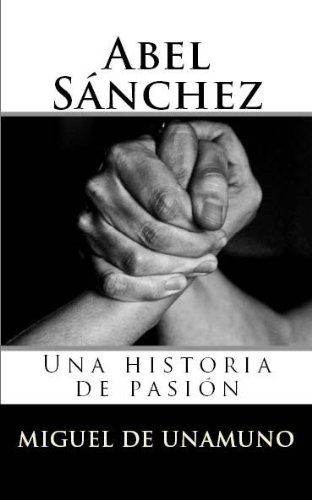
2. Abel Sanchez (Clasicos Castalia)
$48.99
3. Niebla (Coleccion Austral (1987),
 
$4.00
4. Vida de Don Quijote y Sancho
$9.52
5. Niebla (Coleccion Austral)
$7.29
6. Unamuno: San Manuel Bueno, Martir
$9.95
7. A Spanish Reader, Miguel De Unamuno
$12.00
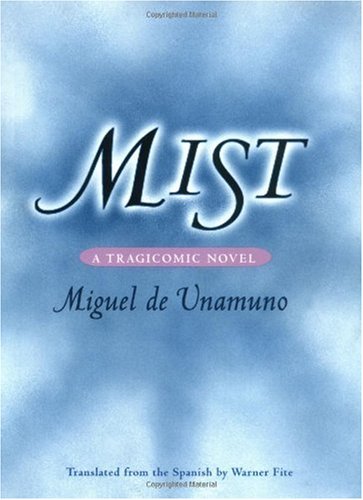
8. Mist: A TRAGICOMIC NOVEL
 
$8.10
9. Educacion y Sociologia en Espana:
 
10. Novela/Nivola (Bollingen Series)
 
11. Three Exemplary Novels
$7.72
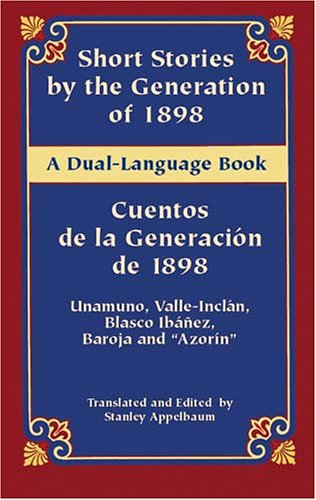
12. Short Stories by the Generation
 
$4.50
13. Libros y Autores Espa~noles Contemporaneos
$12.36
14. Tragic Sense of Life (Dodo Press)
 
$5.95
15. Criatura y creador en Niebla de
$8.94
16. Tres Novelas Ejemplares Y UN Prologo
 
$4.95
17. Del Sentimiento Tragico De La
$22.45
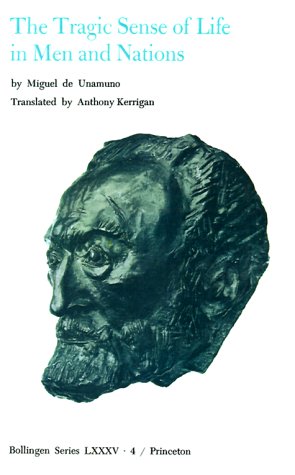
18. The Tragic Sense of Life in Men
$9.64
19. La Tia Tula/ Aunt Tula (Coleccion
 
$5.95
20. Niebla/ Fog

1. Aunt Tula/La Tia Tula: A Dual-Language Book
by Miguel de Unamuno
Paperback: 192 Pages (2005-11-04)
list price: US$10.95 -- used & new: US$6.50
(price subject to change: see help)
Asin: 0486445062
Canada | United Kingdom | Germany | France | Japan
Editorial Review

Book Description

A provocative nonconformist, Unamuno (1864-1936) excelled in the creation of essays, fiction, poetry, and plays. In La tía Tula, he paints a memorable portrait of the indomitable Aunt Tula, who fulfills her maternal desires on her own terms. This dual-language edition features an informative introduction and ample footnotes.
... Read more

2. Abel Sanchez (Clasicos Castalia)
by Miguel De Unamuno
Paperback: 167 Pages (2001-05)
list price: US$13.95 -- used & new: US$8.95
(price subject to change: see help)
Asin: 8470394584
Average Customer Review: 4.5 out of 5 stars
Canada | United Kingdom | Germany | France | Japan
Editorial Review

Book Description
Quixotic madmen are the protagonists of these imaginative stories, which probe the horror of a nothingness beyond death. ... Read more

Customer Reviews (8)

4-0 out of 5 stars Reflective and unsettling
One of the great thinkers of the 20th century, this Spanish poet, philosopher, novelist and playwrite is, unfortunately, too often over shadowed by the work of later existentialists. Unamuno's short stories are reflective and unsettling. This book contains one of his most popular stories, "San Manuel Bueno, Matyr," about a priest who doesn't believe in God. Though the idea my seem cliche to a contemporary audience, don't underestimate the power of Unamuno's passionate and moving verse.

To read more reviews check out Void Magazine's website.

4-0 out of 5 stars In the land of the blind, the 1-eyed man is....compassionate
Some thirty years ago, I read, in Spanish, the novella "San Manuel Bueno, martyr", included in this collection.This week I read it again.
As a young man, to me it seemed that San Manuel had dishonestly misled the devout peasants of his isolated village.At nearly age 60, I now accept my own foibles and those of others, so I can see that San Manuel had found perhaps the only compassionate solution to the dilemma of his own clear vision surrounded by the benighted -- and sacrificed himself to it.
As I write this review, in 2004, we are spectators to a world torn by conflict between devout fanatics.Does Unamuno's solution hold in a world where such devout believers burst forth from their villages to inflame the world in the name of their narrow beliefs?

5-0 out of 5 stars moving reflections on art and faith
These three stories, in addition to being a great read, really moved me.Yet I can't fully pin point why I enjoyed this collection so much.Maybe it was Miguel de Unamuno's unique background as a Christian existentialist writing in the early twentieth century.Maybe it was the influence of cubism on his approach to these three stories. Perhaps it was just the stories themselves; I really grew attached to these characters and the subject matter.Abel Sanchez and The Madness of Doctor Mantarco are great reflections on art (and these stories are adequately discussed in other reviews) but my personal favorite was San Manuel Bueno, Martyr.The story about a well respected priest who no longer believes in God sounds cliche, Miguel de Unamuno writes it in a way that is heartbreakingly tragic.Because the story moved me on a decidedly personal level, it's hard for me to recommend this book with certainty:how am I to know whether it's true art, or whether it's a novel I happened to just particularly like?Still, I can speak for myself:Abel Sanchez and Other Stories is an impeccable piece of literature.

5-0 out of 5 stars Christian existentialism
..and other themes are treated in this volume.Abel Sanchez, the title narrative, is an incredible reterlling of the Biblical story of Cain and Abel.Unamuno is able to interweave christian faith and spanish culturalism in order to create a morally compelling story.This collection has had a profound influence on me.I highly recommend it if you are interested in Christianity, Spanish literature, or even good literature.

5-0 out of 5 stars Masterpiece of Latin American Literature
Miguel De Unamuno uses his two lead characters Abel Sanchez and Joaquin Monegro along with more than enough biblical metaphors to tell this wonderful story. This is possibly one of the best books I have ever read and if you are an avid Latin American Literature aficionado as I am, I highly recommend this gem of a book. ... Read more


3. Niebla (Coleccion Austral (1987), 115.)
by Miguel De Unamuno, German Gullon
Paperback: 259 Pages (1996-12)
list price: US$9.50 -- used & new: US$48.99
(price subject to change: see help)
Asin: 8423919153
Average Customer Review: 5.0 out of 5 stars
Canada | United Kingdom | Germany | France | Japan

Customer Reviews (1)

5-0 out of 5 stars Referente de la literatura contemporanea existencialista
Niebla,escrita en 1914, es para mí la novela más vanguardista que he leído. Al momento ninguna otra obra narrativa ha logrado involucrarme de un modo tan inquietante y perturbador como la Nivela de Miguel de Unamuno (España, 1864 - 1936) -narrador, poeta, dramaturgo y filósofo ¡Válgame!-. Nada más contemporáneo, , no como género sino en el sentido literal del aquí y el ahora. Este texto que arremete contra la realidad con la ficción, el Everest de un buen escritor, el Frankenstein escrito, la confrontación existencial del fenómeno dialéctico creador-creación-creador-creado.

Si Unamuno escribe su nivela para escapar de los cánones estéticos y estilísticos convencionales de su tiempo, hoy en día su género inventado es el terreno de rigor en el que los escritores tienen la posibilidad de dejar que su creación se cree a sí misma y adquiera esa autonomía que hace que algunas narraciones parecNiebla (Coleccion Austral (1987), 115.)ieran tener vida propia.

Unamuno es referente y referencia, está presente de algún modo en la novela de Bret Easton Ellis Lunar Park y en la película Más extraño que la ficción del guionista Zach Helm.

...estamos incompletos sin la ficción y cuando la ficción nos complementa reclama su cuota de existencia. ... Read more


4. Vida de Don Quijote y Sancho
by Miguel De Unamuno
 Paperback: 317 Pages (1987)
list price: US$21.95 -- used & new: US$4.00
(price subject to change: see help)
Asin: 8420636142
Canada | United Kingdom | Germany | France | Japan

5. Niebla (Coleccion Austral)
by Miguel De Unamuno
Paperback: 274 Pages (2007-12-30)
list price: US$14.95 -- used & new: US$9.52
(price subject to change: see help)
Asin: 8467021942
Canada | United Kingdom | Germany | France | Japan

6. Unamuno: San Manuel Bueno, Martir
by Miguel de Unamuno
Paperback: 52 Pages (2005-02)
list price: US$12.95 -- used & new: US$7.29
(price subject to change: see help)
Asin: 1585101443
Canada | United Kingdom | Germany | France | Japan
Editorial Review

Book Description
San Manuel Bueno, mártir is a standard novella appropriate as an introductory text for Spanish language courses in literature and culture. This edition has been prepared with non-native Spanish speakers in mind. It includes an introduction (in Spanish) to the author and the work, the complete novella with notes and vocabulary (Spanish-Spanish), a current bibliography and questions in the AP format to facilitate study. ... Read more


7. A Spanish Reader, Miguel De Unamuno (Spanish Reader)
Hardcover: 224 Pages (2001-05)
list price: US$16.68 -- used & new: US$9.95
(price subject to change: see help)
Asin: 0618048278
Canada | United Kingdom | Germany | France | Japan

8. Mist: A TRAGICOMIC NOVEL
by Miguel de Unamuno, Warner Fite
Paperback: 352 Pages (2000-03-27)
list price: US$16.00 -- used & new: US$12.00
(price subject to change: see help)
Asin: 0252068947
Average Customer Review: 5.0 out of 5 stars
Canada | United Kingdom | Germany | France | Japan

Customer Reviews (8)

5-0 out of 5 stars how much fun!
With the exception of Nietzsche, never has been philosophy been so much fun! Mist comes across to me as a romping Borges - by this I mean it is full of ideas and creative, as is Borges, but Miguel De Unamuno seems to have the almost girlish exuberance of the Spanish while the Argentinan stays more alof and academic.
Contemporary philosophy normally involves a trained vocabulary and historical understanding, but De Unamuno manages to make this an interesting story and throwing in bones for us to ponder. I often found myself pausing and chewing on my lip, lost in thought. Oh, and how I laughed! At one point the absent minded main character has fallen is asleep and is called to dinner by his servant. Wondering whether the voice was in his head or not he exclaims: "Psychological mysteries!"
It is a shame De Unamuno is not better known.

5-0 out of 5 stars A Spanish Classic, DO NOT MISS IT!!!
This is the typical novel that when in schooldays, the Teacher order the pupils to read it. And obviously, you do (or you pretend that you do) without paying very much attention on what you read. Sometimes this novel do not appear in the Compulsory Lecture Program, and you escape from it. This is what happened to me...
Later, a friend of yours (in my case it was my partner) recommends you to go over it again, and you discover a Gem.
There are very little things than can be said about the plot, the characters, the language... because I risk to spoil the whole experience of reading it. But I would not avoid saying that Unamuno was one of the most clever writers that ever existed in my country (everyone has heard of him here), and that in "Mist", mostly all things that worries the Human being, such as love, relationships between men and women, marriage, the Meaning of life, the aim of Literature itself... is within its pages, and that is exposed in a very surprising and entertaining way.
As every Masterpiece, it admits many different lectures and points of view, and it might be a very good piece of literature to be discussed in one of those Book Clubs that are so popular in the States.
Trust me: Read it and you won't be disappointed.

5-0 out of 5 stars existential masterpiece
This is one of my favorite books of all time.It's about everything and nothing at the same time.It's a tragic love story, a philosophical quest, and a literary experiment all in one.An existential novel about how to write an existential novel!Unamuno's writing is both very funny and deeply insightful, and at the end, he has you questioning whether or not you yourself are alive.A mind-bending work, and one I have read again and again.

5-0 out of 5 stars ....Mist....Niebla...Fog....
" Ni los recuerdos ni los suenos son tan efimeros como la NIEBLA"

This book deals with human emotions, thoughts and fears in a deep, meaningful and funny way. It has a little bit of everything, private conversations with God, the search for the true meaning of life, the quest to find an everlasting love, the fear of facing death, and the hardships that every single human faces during a lifetime.

I read it in Spanish, and I have to say it is one of the best written books I have read so far. Every single word is where it should be, and the story flows magnificently. Im sure that with a good translation this book won't lose its magic in English.

Although it deals with very serious topics, the story is simple, well written, funny, easy to read and with a very unexpected twist at the end...

It simply belongs to a class of its own.

5-0 out of 5 stars COOL!
Miguel de Unamuno was definitely ahead of his time. This is a wonderful book, full of great lines you'll be quoting (e.g., "The best mnemonic device is a notebook in your pocket."). The structure of this book is really unique, and the story is so unusual! The main character in the book wants to kill himself and the author won't let him, so the character argues with the author. Very twisted, very mind-bending, very wonderful. The writing is clever, the characters are familiar but I've never met them before, and the style is engaging. I'm off to read more Unamuno! ... Read more


9. Educacion y Sociologia en Espana: Seleccion de Textos (Serie Educacion)
by Miguel de Unamuno
 Paperback: 624 Pages (1997-07)
list price: US$8.10 -- used & new: US$8.10
(price subject to change: see help)
Asin: 8476001584
Canada | United Kingdom | Germany | France | Japan

10. Novela/Nivola (Bollingen Series)
by Miguel De Unamuno
 Paperback: 552 Pages (1987-06)
list price: US$14.95
Isbn: 0691018758
Canada | United Kingdom | Germany | France | Japan

11. Three Exemplary Novels
by Miguel De Unamuno
 Paperback: Pages

Isbn: 0394172035
Average Customer Review: 4.5 out of 5 stars
Canada | United Kingdom | Germany | France | Japan

Customer Reviews (3)

3-0 out of 5 stars OUCH!That Hurt!
Ugly stories about ugly people.That about sums it up.Perhaps that was the author's intent?Beats me.So much ugliness in such a small space is hard to endure, which is why I give less than five stars.Now Unamuno was bright and could write, andthat is why I give more that one star.

5-0 out of 5 stars Unamuno's philosophy in novel form
Unamuno was a genius who is underrated as a thinker, philosopher, author, and political critic. His use of the novella as a vehicle for his philosophy and existential thought should put him in every discussion aboutthe likes of Albert Camus, Jean-Paul Sarte, Martin Heidigger, and SorenKierkegaard. These three novellas give us a view, not only of the Spanishmind, but also of what a serious, learned man (who was incidentally Basque)could see as flaws and existential dilemmas in Spanish as well as Europeanculture. Each of the three novellas give insight into the gender roles ofmen and women in turn of the century Spanish society as well as very realissues of what a man or women should be in a world where title, pride andwealth seem to be more important than acting in an ethical manner.

5-0 out of 5 stars Egad!
In the prologue to this trio of novellas, Unamuno declares that the work might be more aptly dubbed "four exemplary novels." "For this prologue is also a novel... the novel of my novels," he adds.And, indeed, I believe him. The prologue itself is wildly entertaining and,by far, the most striking segment of the piece. In some fifteen pages,Unamuno presents hilarious, yet profound (as is his custom -- I love thatabout him) commentary on the novel as artform and ontological playground.The three stories that follow are all gripping in their own ways. DosMadres is an Unamunian version of the tale of King Solomon and thebickering mothers. El Marques de Lumbria presents the story of an isolatedhousehold that is somewhat reminiscent of Lorca's The House of BernardaAlba. Nada Menos que Todo Un Hombre stars Alejandro, a tough guy, a regularAlexander the Great, who isn't really as strong as he appears. All of thenovels are tied together by a common thread of power play and self-doubtamong their characters.And the result is a cohesive bundle of words thatis truly exemplary. ... Read more


12. Short Stories by the Generation of 1898/Cuentos de la Generacion de 1898: A Dual-Language Book (Dual-Language Books)
by Miguel de Unamuno, Ramon del Valle-Inclan, Pio Baroja, Vicente Blasco Ibanez, "Azorin"
Paperback: 240 Pages (2004-09-23)
list price: US$12.95 -- used & new: US$7.72
(price subject to change: see help)
Asin: 0486436829
Average Customer Review: 5.0 out of 5 stars
Canada | United Kingdom | Germany | France | Japan
Editorial Review

Book Description

These 13 short stories by 5 authors of the era include 4 tales by Miguel de Unamuno — famed as a novelist, essayist, and poet, and one of the few internationally known and acclaimed Spanish writers of the 20th century — along with the works of Valle-Inclán, Blasco Ibánez, Baroja, and "Azorín" (José Martínez Ruiz).
... Read more

Customer Reviews (1)

5-0 out of 5 stars Generation of 1898
Valuable introduction to a key period of Spanish literatur. Blasco's regional stories were amongst his best work. Basque, Pio Baroja, is much neglected in England, as is Unamuno.The other authors are not to be found easily in English.
Dual-language presentation has a direct simplicity for students. Good introduction and translation in this volume. Dover Publications are always well-produced.
I must add my appreciation of the management of Amazon. ... Read more


13. Libros y Autores Espa~noles Contemporaneos (Coleccion austral, no. 1513)
by Miguel de Unamuno
 Paperback: 232 Pages (1972-01)
list price: US$4.50 -- used & new: US$4.50
(price subject to change: see help)
Asin: 8423915131
Canada | United Kingdom | Germany | France | Japan

14. Tragic Sense of Life (Dodo Press)
by Miguel de Unamuno
Paperback: 288 Pages (2007-08-31)
list price: US$16.99 -- used & new: US$12.36
(price subject to change: see help)
Asin: 1406550442
Average Customer Review: 4.5 out of 5 stars
Canada | United Kingdom | Germany | France | Japan
Editorial Review

Book Description
Miguel de Unamuno y Jugo (1864-1936) was an essayist, novelist, poet, playwright and philosopher from Spain. He served as rector of the University of Salamanca for two periods: from 1900 to 1924 and 1930 to 1936, during a time of great social and political upheaval. His philosophy was not systematic, but rather a negation of all systems and an affirmation of faith "in itself. " He developed intellectually under the influence of rationalism and positivism, but during his youth he wrote articles that clearly show his sympathy for socialism and his great concern for the situation in which he found Spain at the time. The title of Unamuno's most famous work, Del Sentimiento Trágico de la Vida (Tragic Sense of Life), refers to the human condition of the desire above all else for immortality when faced with the certainty of death. ... Read more

Customer Reviews (10)

5-0 out of 5 stars The Tragic Sense of Life.
_Tragic Sense of Life_ is a translation of _Del Sentimiento Tragico de la Vida_, originally published in 1913, by the Spanish (Basque) existentialist philosopher Miguel de Unamuno, translated by J. E. Crawford Flitch.This work is an important one in Spanish literature and offers an attempt to expound upon a uniquely Spanish philosophy (influenced in particular by for example Cervantes and his _Don Quixote).This is also an important existentialist work, which considers the interplay and contrast between faith and reason.Miguel de Unamuno (1864-1936) was a Roman Catholic Spanish intellectual who participated to some extent in the Basque nationalist movement (though he remained skeptical of Basque separatism) and was witness to the Carlist wars.Unamuno also lived through the fascist revolution in Spain and eventually came to oppose the Franco regime because of its brutality.Unamuno's life was one of profound religious crisis (perhaps brought on by the early deaths of his father and his son), and he attempted to resolve this crisis in his writings.However, despite the fact that Unamuno was and remained a Roman Catholic, he was heavily influenced by the Protestant Kierkegaard, and thus his work may be described as having a particularly "Lutheran" aspect to it.In particular, in his understanding of the relationship between faith and reason and in the place of individual autonomy within his philosophy, Unamuno's philosophy may be understood as "Lutheran".It is for this reason that his work was rejected by Catholics and eventually placed on the Index of Prohibited Books.Nevertheless, Unamuno was to remain a Catholic and to argue that the Spanish understanding was a profoundly Catholic one.

Unamuno begins this work by noting that he writes for all Christian men and not just for Spanish Christians.Unamuno also reflects some on the Great War, and the sense of crisis which existed at the time and which underlay all the subsequent existentialist philosophies.The first chapter is entitled "The Man of Flesh and Bone", and it is here that Unamuno contrasts man in the abstract (man considered as humanity, man as the "reasoning animal", man as "homo economicus" and "homo sapiens") with the "man of flesh and bone".Indeed, in contrast to the idea of man as the "reasoning animal", Unamuno maintains that instead man is the feeling animal.Unamuno wittily observes, "More often I have seen a cat reason than laugh or weep.Perhaps it weeps or laughs inwardly - but then perhaps, and also inwardly, the crab resolves equations of the second degree."Unamuno considers the "Protestant" philosophy and God of Kant and contrasts this with the Aristotelian God of Catholicism.Unamuno also mentions Joseph Butler, the Anglican divine, and Cardinal Newman.Unamuno contrasts this with the philosophy of the Jewish Spinoza, a man suffering from "God-ache" for his refusal to believe in immortality.Indeed, the issue of immortality becomes Unamuno's central question; one which he will try to rescue from various objections (such as that it is selfish to wish for immortality).The second chapter is entitled "The Starting-Point".Unamuno comments on the apparent "morbidity" of his reflections.He considers both biblical and Darwinian accounts of man's origin, and then goes on to expound upon the nature of philosophy.The third chapter is entitled "The Hunger of Immortality".Here, Unamuno regards immortality as the central question and the central yearning of man.He considers objections to the belief in immortality (such as that it is selfish to believe in one's immortality or that belief in immortality constitutes a form of materialism), but shows how these objections are ill-founded.Unamuno also brings out again the contrast between the Protestant (Kantian) understanding of God and the Catholic (Aristotelian) one.The fourth chapter is entitled "The Essence of Catholicism".Here, Unamuno shows how Christianity arose from both Hellenism and Judaism.He comments on the letters of Saint Paul.Then, he discusses the rise of the Catholic Church and the Catholic mystics, contrasting the Catholic understanding with the Protestant (Kantian).He also discusses the modernist crisis and mentions such ardent defenders of Catholic orthodoxy as Donoso Cortes and Count Joseph de Maistre.The fifth chapter of this book is entitled "The Rationalist Dissolution".Here, he shows how Catholicism faces a crisis brought on by rationalism, mentioning such philosophers as Hume and Kant.He also mentions the conflict between idealism and materialism and notes the work of William James.Unamuno also presents the writings of George Berkeley and Joseph Butler as examples of philosophers who sought to preserve belief in the immortality of the soul.Unamuno also discusses an interesting book by Frederic W. H. Myers, _Human Personality and its Survival of Bodily Death_, which held him in thrall for a time for what it promised regarding immortality.Unamuno brings out the conflict between faith and reason, mentioning both Pascal and Spinoza in this regard.He also mentions Nietzsche, whose writings he rejects.The sixth chapter of this book is entitled "In the Depths of the Abyss".Here, Unamuno expounds upon both Descartes and Kierkegaard, as well as various further comments on the opposition between faith and reason.The seventh chapter of this book is entitled "Love, Suffering, Pity, and Personality".Unamuno reflects upon these notions and the nature of God.The eighth chapter of this book is entitled "From God to God".Here, Unamuno considers man's understanding of God, contrasting the rationalist God of Aristotle with the more Protestant understanding of God (of for example Kant).The ninth chapter of this book is entitled "Faith, Hope, and Charity".Unamuno reflects upon both faith and hope, but he also calls attention to the possibility of charity.The tenth chapter of this book is entitled "Religion, the Mythology of the Beyond and the Apocatastasis".Unamuno writes upon God, heaven, and hell (mentioning Dante), and he notes his difficulties with the doctrine of hell (claiming that nothingness is worse than eternal torture) which he believes will be resolved in the apocatastasis.The eleventh chapter of this book is entitled "The Practical Problem".Here, Unamuno makes some comments on the nature of work, socialism, and the issue of war and the state (noting its origin in the fratricide of Cain and Abel).The twelvth chapter of this book is entitled "Don Quixote in the Contemporary European Tragi-Comedy".Unamuno notes the role of Don Quixote in Spanish literature and his importance in forming a Spanish philosophy.Unamuno comments on the role of comedy and tragedy, maintaining that life is a comedy for those who think and a tragedy for those who feel.Unaumuno notes that while Don Quixote may be a "reactionary" that he is an heroic one.Unamuno then concludes his book on the "tragic sense of life in men and in peoples", noting the fact that he is a man and that he writes for his people.

Unamuno's writings are certainly beautiful and they play an important part in both Spanish and existentialist literature in the twentieth century.While Unamuno never quite reconciled himself to the Catholic understanding of both faith and reason, he provides a unique philosophy which speaks both to the heart and head.

3-0 out of 5 stars Intimations of Irrationality
The forward to my copy of this book makes a great to do in comparing Unanumo with Wordsworth.Upon finishing the book, I can see why.The gist of this book is that the way to a sort of knowledge of God or immortality is a completely irrational (or perhaps a-rational conveys more the sense in English) struggle with God (rather than the idea of God)and the notion of immortality and thereby achieve the knowledge and FEELING attained by the great mystics.---This is indeed very much in the tradition of Wordsworth's famous Ode.

But Wordsworth's ode was not concerned with a particular religion.Unanumo's book is. This leads to a number of curiosities that are rather hard to swallow.First, of course, is that only Roman Catholics can experience such feelings.Second is his denunciation of Nietsche, whom he very much resembles, particularly when he expatiates on suffering as a good. Methinks he is a bit more influenced by Nietzsche than he likes to admit.In fact,I was reminded of that tragic German philosopher on every page.But, of course, no Roman Catholic can admit that he has been influenced by Nietzsche.

It is encouraging to read someone who dumps the metaphysical muck of the Scholastics etc in the rubbish bin, and also confirms Hume against Kant and others who have supposedly "refuted" him. They have done nothing of the sort, but only spun more meaningless metaphysical webs.

So, all in all, a bit of a mixed bag.But recommended reading, if only because there's nothing else quite like it.

5-0 out of 5 stars The Eternal struggle between Faith and Reason
This is the Masterpiece of the greatest fideist of the 20th century. The conflict between faith and reason is the greatest conflict of the human psyche in my opinion and this book is a testament to that assertion

5-0 out of 5 stars A great book...
One of my favorite books in the field of philosophy. Unamuno seems to effortlessly cut through so much of the time-wasting academic drollery and nonsense that often clutters up this vital area of study. This isn't a philosopher getting lost in his own inane definitions and absurd mind games, this is the work of a man who lives to think, and thinks because he is in awe of life. Highly recommended to those who philosophize because they need to, not because they are trying to make other people think they are intelligent...

5-0 out of 5 stars men of flesh and bone
Other reviewers have called this book "philosophy for real men."Unamuno begins with this assertion.He rejects the Socratic "Man" as a creature of thought and not of substance."Soy un hombre de carne y hueso!" he says: "I am a man of flesh and bone."

He works to provide the basis for a belief based on on reason, which he calls anti-vital, but on necessity.It is necessary for us, as men of flesh and bone, to believe that we can exist indefinitely.Reason tells us that we cannot.It is the confluence of these two beliefs that creates the tragic sense of life.

This is one of the best and most important books I've read, and I'd recommend it to anyone capable of sitting down and reading it. ... Read more


15. Criatura y creador en Niebla de Unamuno.(Miguel de Unamuno, autor ): An article from: Explicación de Textos Literarios
by Eva Nunez
 Digital: 18 Pages (1999-12-22)
list price: US$5.95 -- used & new: US$5.95
(price subject to change: see help)
Asin: B00099PPMA
Canada | United Kingdom | Germany | France | Japan
Editorial Review

Book Description
This digital document is an article from Explicación de Textos Literarios, published by California State University, Sacramento on December 22, 1999. The length of the article is 5260 words. The page length shown above is based on a typical 300-word page. The article is delivered in HTML format and is available in your Amazon.com Digital Locker immediately after purchase. You can view it with any web browser.

Citation Details
Title: Criatura y creador en Niebla de Unamuno.(Miguel de Unamuno, autor )
Author: Eva Nunez
Publication: Explicación de Textos Literarios (Refereed)
Date: December 22, 1999
Publisher: California State University, Sacramento
Page: 133(12)

Distributed by Thomson Gale ... Read more


16. Tres Novelas Ejemplares Y UN Prologo (Coleccion Austral)
by Miguel De Unamuno
Paperback: Pages (2000-01-01)
list price: US$9.95 -- used & new: US$8.94
(price subject to change: see help)
Asin: 8423919412
Canada | United Kingdom | Germany | France | Japan

17. Del Sentimiento Tragico De La Vida / The Tragic Sense of Life (Grandes Filosofos / Great Philosophers)
by Miguel De Unamuno
 Paperback: 320 Pages (2004-10-30)
list price: US$4.95 -- used & new: US$4.95
(price subject to change: see help)
Asin: 9875505145
Canada | United Kingdom | Germany | France | Japan

18. The Tragic Sense of Life in Men and Nations
by Miguel de Unamuno
Paperback: 576 Pages (1978-06-01)
list price: US$35.00 -- used & new: US$22.45
(price subject to change: see help)
Asin: 0691018200
Average Customer Review: 5.0 out of 5 stars
Canada | United Kingdom | Germany | France | Japan
Editorial Review

Book Description
Unamuno expressed the anguish of modern man in his passionate concept of the Tragic Sense of life, the continual struggle within the 'man of flesh and blood' between the dictates of reason and the demands of his own heart. This book is his acknowledged masterpiece. ... Read more

Customer Reviews (1)

5-0 out of 5 stars Modern ethics---Felix Culpa!!
As a disclaimer, I must say this is probably my favorite book of all time, so once I start explaining it, I frequently tend to effusion.In the simplest terms, it is a book written by a man who wants to understand why he lives and why he dies.Miguel de Unamuno was a spanish philosopher and novelist, a part of the "generation of 1898," along with Ortega y Gasset and Pio Baroja among others.They are part of the Spanish Romantic movement and their main quest in their writings is for a sense of the individual as a representative of the universal.
Unamuno in particular and in this book attempts to reconcile Christianity with Classicism, and does so through the characters of Don Quixote and Sancho Panza(of course).These two for Unamuno are symbols of human striving both for noble purpose, outside of one's own self (christianity) yet also for an almost pagan "immortality" through heroic reputation (classicism). Unamuno wants to live nobly and never wants to die.He loves the concept of suffering and redemption, both in the model of a Christ who redeems, and by our own actions in this world, by which we redeem ourselves.
Unamuno is all about striving, in the most ethical way possible, to create yourself.In a way, he is a more humanistic Nietzsche.His will-to-power is tempered by his mediterranean/Spanish anarchical democratic sentiment. Whew. He's like a Spanish Walt Whitman.A Spanish William Blake.But really so much better than them.Nada menos que todo un hombre.
You will like this book if you like:
a) Shakespeare for his "philosophy"
b) Don Quixote and Sancho Panza
c) Nietzsche but are turned off by his German-ness
d) philosophy that helps you exist but doesnt turn you into a whimpering sap
e) southern Spain; Cante Jondo; the deep mediterranean vibe
PS- He has a great "spiritual biography" of Quixote and Sancho Panza too but I dont think its translated into English.Its called "Vida de Don Quixote y Sancho" and is almost as good as this book. ... Read more


19. La Tia Tula/ Aunt Tula (Coleccion Austral)
by Miguel De Unamuno
Paperback: 174 Pages (2007-12-30)
list price: US$14.95 -- used & new: US$9.64
(price subject to change: see help)
Asin: 8467024461
Average Customer Review: 4.5 out of 5 stars
Canada | United Kingdom | Germany | France | Japan

Customer Reviews (2)

4-0 out of 5 stars Why does she deny herself?
Tula and Rosa are two orphans raised by their priest uncle. Ramiro is a young man who falls for Tula, but she is a tough young woman who refuses him and prompts Ramiro to marry Rosa instead. Rosa is a feeble woman who gives birth to three children before dying. Tula steps in to take care of the children, and then Ramiro asks her again to marry him. Tula refuses one more time, and becomes Aunt Tula. She is the real head of the family, a firm but loving woman. One of the kids, Manuela, adores her and starts becoming a new Aunt Tula. Ramiro, very sad at her refusals, marries the maid and has two more kids. The the maid dies and Ramiro follows. Before he dies, Tula confesses her love for him. Why the hell then didn't she marry him? We are left without a clue: maybe it's because of the stern and restrictive Catholicism of Spain in those times, maybe she's frigid, maybe whatever. But the novel is good and the character is interesting.

5-0 out of 5 stars History of a woman's self-repression
Tula and Rosa, two orphans, grow together educated by their uncle, a priest. Ramiro, a young admirer of both, cannot choose between them. Tula denies her own desires and pushes Rosa to marry him. When Rosa dies, Ramirodeclares his love for his sister-in-law, but Tula keeps on denying herselfher sexual and emotional needs and becomes the aunt-mother of Rosa'schildren. Only when Ramiro is dying she is able to declare her love. ... Read more


20. Niebla/ Fog
by Miguel De Unamuno
 Paperback: 224 Pages (2008-01-28)
list price: US$5.95 -- used & new: US$5.95
(price subject to change: see help)
Asin: 9706667180
Canada | United Kingdom | Germany | France | Japan

  1-20 of 100 | Next 20
A  B  C  D  E  F  G  H  I  J  K  L  M  N  O  P  Q  R  S  T  U  V  W  X  Y  Z  

Prices listed on this site are subject to change without notice.
Questions on ordering or shipping? click here for help.

site stats