e99 Online Shopping Mall

Geometry.Net - the online learning center Help  
Home  - Authors - Van Vogt A E (Books)

  1-20 of 100 | Next 20
A  B  C  D  E  F  G  H  I  J  K  L  M  N  O  P  Q  R  S  T  U  V  W  X  Y  Z  

click price to see details     click image to enlarge     click link to go to the store

$3.59
1. The World of Null-A
$4.99
2. Slan Hunter
$8.88
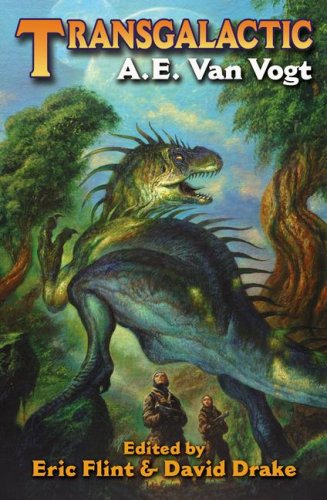
3. Transgalactic
$12.00
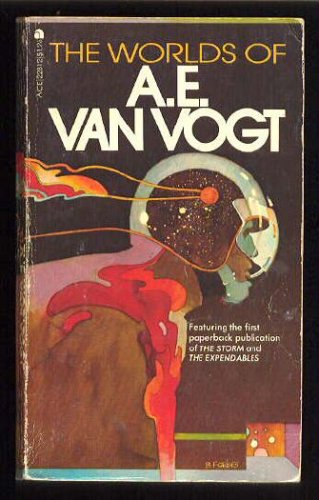
4. The worlds of A.E. Van Vogt
$29.00
5. Transfinite: The Essential A.
$18.99
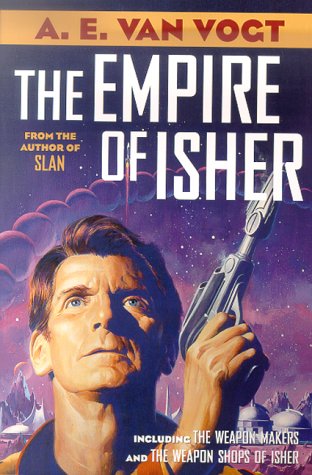
6. The Empire of Isher: The Weapon
$30.00
7. The Silkie
 
8. Triad, Three Complete Science
 
9. The Universe Maker (G-660)
10. Futures Past: The Best Short Fiction
11. The Far out Worlds of A. E. Van
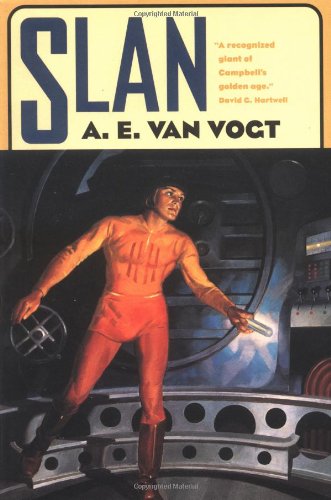
12. Slan
$10.99
13. Slan
$33.60
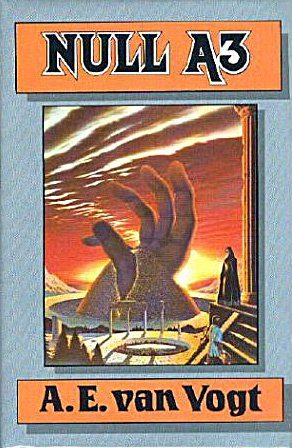
14. Null a Three
$10.17
15. The Voyage of the Space Beagle
 
16. SLAN
 
17. Slan
 
18. The World of A
 
19. The Far-Out Worlds of a.E. Van
$5.50
20. The Battle of Forever

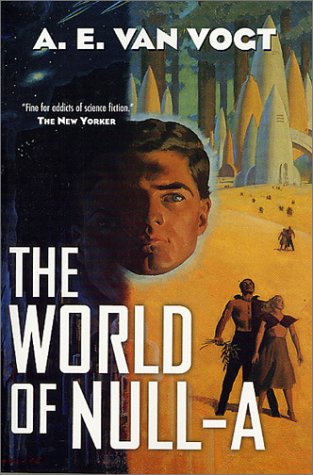
1. The World of Null-A
by A. E. van Vogt
Paperback: 272 Pages (2002-10-25)
list price: US$14.95 -- used & new: US$3.59
(price subject to change: see help)
Asin: 0765300974
Average Customer Review: 4.5 out of 5 stars
Canada | United Kingdom | Germany | France | Japan
Editorial Review

Book Description
The classic novel of non-Aristotelian logic and the coming race of supermenGrandmaster A. E. van Vogt was one of the giants of the 1940s, the Golden Age of classic SF.Of his masterpieces, The World of Null-A is his most famous and most influential. It was the first major trade SF hardcover ever, in 1949, and has been in print in various editions ever since. The entire careers of Philip K. Dick, Keith Laumer, Alfred Bester, Charles Harness, and Philip Jose Farmer were created or influenced by The World of Null-A, and so it is required reading for anyone who wishes to know the canon of SF classics.It is the year 2650 and Earth has become a world of non-Aristotelianism, or Null-A. This is the story of Gilbert Gosseyn, who lives in that future world where the Games Machine, made up of twenty-five thousand electronic brains, sets the course of people's lives. Gosseyn isn't even sure of his own identity, but realizes he has some remarkable abilities and sets out to use them to discover who has made him a pawn in an interstellar plot. ... Read more

Customer Reviews (15)

5-0 out of 5 stars A Man Who Doesn't Exist
The World of Null-A (1948) is the first SF novel in the Null-A series. The Earth has been gradually influenced by the principles of General Semantics over several centuries under the direction of the Semantic Institute and the Games Machine.Those who show the greatest comprehension of these principles are transported to Venus to live in a Non-Aristotelian society.Those who don't score high enough to be allowed on Venus are awarded with high offices on Earth.

In this novel, Gilbert Gosseyn has traveled to the city of the Machine to participate in the annual Games.Joining the local self-protection group, his identity is challenged by a resident of his home town.A lie detector confirms that he is not Gilbert Gosseyn, but states that his true identity is not known within his mind.

Ejected by the hotel staff into the crime filled night, Gilbert is bewildered by these events.Without any warning, a young woman runs into him and almost knocks them both off their feet.The woman claims to be pursued by two men, but Gilbert doesn't see them.

Teresa Clark tells him that she has been evicted from her boarding house and lacks a place to spend the night.Gilbert finds them a vacant lot and they settle down amidst the bushes.During their discussion, various things she says and does contradict her story.The next day, he learns that she is actually Patricia Hardie, the woman that he had believed to be his dead wife.

In this story, Gilbert meets various members of a group that has taken over the government of Earth and Venus.Patricia's father is the President of Earth.Thorson is the personal representative of the leader of the Greatest Empire.Elred Crang is the commander of the local Greatest Empire forces and John Prescott is his vice-commander.Dr. 'X' is a gravely injured Earth scientist whose personality has been distorted toward megalomania.

They all seem to be interested in his brain.After his interrogation and examination, Gilbert is carried down, still bound to his chair, into a dungeon and locked up.Later, Patricia releases him and they escape to her room.Then guards come searching for him and he slips out the window.As he is approaching the Games Machine, cars come out of the trees and attack him.He is shot by projectile weapons and burned by energy guns, quickly passing out from the blood loss.

Later, Gilbert wakes up on Venus.He doesn't have any scars or other signs of the wounds and burns, but he still has all his memories, including those of extreme pain.He visits the house of Prescott and Crang, but is then captured and returned to Earth.There he is shown the corpse of Gosseyn I.Apparently he is Gosseyn II, alive and well after the death of his previous body.

This story has several themes, one of which is the practice of General Semantics.This approach to mental discipline, based upon the theories of Alfred Korzybski, is claimed to provide greatly stability and adaptation to change.An introduction to this approach can be found within Science and Sanity, first published in 1933.

Another theme is the transportation of objects by causing them to become similar to within twenty decimal places.Supposedly, such similarity will cause the greater to bridge space to the lesser.Although such transits take finite time, the bridging occurs at speeds much greater than lightspeed.Thus, this principle provides a practical way to travel among the stars.

This novel is first of three in the series.The next volume is The Pawns of Null-A (also entitled The Players of Null-A).Enjoy.

Highly recommended for van Vogt fans and for anyone else who enjoys tales of high adventure, political intrigue, and strange talents.

-Arthur W. Jordin

5-0 out of 5 stars One from SF's Golden Age ... hooboy!
This is one of the best bad books I know.

It was first published as a three-part serial in the pulpy pages of Astounding Science Fiction Magazine during the second half of 1945, just after what was then regarded as the science fictional end of World War II.Considering the economics of scratching out a living as a pulp writer and the physical necessities of magazine publication in the heyday of the great Street and Smith pulps, it was probably written in the spring of that year.A couple of references to atomic power were, I think, hastily edited in just before the presses turned.(I have always rather fancied the atomic-powered flashlight that the hero totes for a couple of pages before it is forgotten entirely.)

Van Vogt's hero is a man whose name may or may not be Gilbert Gosseyn.At the beginning of the book, the poor schnook just wants to take a test to qualify for a job.Then things begin to go wrong, really wrong.First he gets killed, shot to pieces by machineguns, then he....

Years later, Alfred (a name he loathed) van Vogt said that he had stumbled on the name "Gosseyn" as the chief of some obscure Central Asian tribe.He had liked the sound of it: pronounceable, a bit exotic and vaguely Indo-European.He was absolutely astonished when the fans knowingly informed each other that he had meant the name to be taken as "Go-Sane."

This "Go-Sane" business arose from Van Vogt's placement of puzzling quotes at the beginning of each chapter.The quotes come from several sources, including his own editor at the magazine, but the ones everyone remembered were hacked out of "Science and Sanity: an Introduction to Non-Aristotelian Systems and General Semantics" published in 1933 by Alfred (that name again) Korzybski.

Korzybski has his legion of followers even today.(They tend to use such terms as "unrecognized genius" when referring to him.)Whether Korzybski was reconstituting human consciousness or selling intellectual snake oil, it must be admitted that the man had a memorable prose style.Here is a passage that Van Vogt did not happen to quote:

"What we know positively about `space' is that it is not `emptiness', but `fulness' or a `plenum'.Now `fulness' or `plenum', first of all, is a term of entirely different non-el structure.When we have a plenum or fulness, it must be a plenum of `something', `somewhere' at `sometime', and so the term implies, at least, all three of our former elementalistic terms.Furthermore, fulness, by some psycho-logical process, does not require `outside walls'."[Page 229 of the International Non-Aristotelian Library edition; italics omitted in deference to Amazon's software limitations.]

Now that may mean simply "the universe is neither empty nor bounded."On the other hand, it might also--or even instead (or both, of course)--mean "the Gostaak distims the doshes."It's hard to say which.Van Vogt quoted a lot of this stuff.The fans ate it up!

The serial was hugely successful.Before long, there was a sequel, "The Players of Null-A," that was almost equally popular.In 1948, "The World of Null-A" was the first pulp SF novel to achieve the dignity of book publication and, if the blurb on the back of this edition is to be believed, it hasn't been out of print since.I gather that years later Van Vogt wrote a third Null-A book, one I have never run across.

A. E. van Vogt was one of the leading luminaries of the Golden Age of Science Fiction. (Of course, the golden age of anything is about eleven.)He wrote stirring and memorable stuff.While the war was still being waged in the Pacific, he wrote a series of novelettes for Astounding about a far-ranging space vessel called the Beagle, commanded by a sympathetically portrayed Japanese captain.(In those days, that was a brave act.)The stories were gathered together in a book called "The Voyage of the Space Beagle."Read it today and you will never again regard either the movie "Alien" or the first series of "Star Trek" as having the slightest shred of originality about them.

Van Vogt's specialty, and the thing the fans most wanted from him, was the plot of almost maniacal complexity, of enigmas wrapped in hidden agendas, of wheels within wheels within hidden wheels, of characters wearing whole wardrobes of masks for the purpose of discarding one after another.Take this passage as a typical example.The speaker is Patricia Hardy, daughter of the President of Earth, to whom Gosseyn (apparently) falsely believed he was married before her death, which took place before the novel starts--of course.She had helped him leave the presidential palace in the botched escape attempt that had resulted in him being killed ... the first time.This is their second meeting and, the thing is, he's a bit confused:

"The truth is that your lack of personal knowledge has puzzled all groups.Thorson, the personal representative of Enro, has postponed the invasion of Venus.There!I thought that would interest you.But wait!Don't interrupt.I'm giving you information I intended to give you a month ago.You'll want to know about `X.'So do the rest of us.The man has a will of iron, but no one knows what his purpose is.He seems to be primarily interested in his own aggrandizement, and he has expressed the hope that some use can be made of you.The Galactic League people are bewildered.They can't decide whether the cosmic chess player who has moved you into the game is an ally or not.Everybody is groping in the dark, wondering what to do next." [Page 110-111]

Oh, yeah!

And let it not be thought that Van Vogt had to depend on Korzybski for puzzling statements.He was pretty good at it himself:

"The problem," Prescott [Deputy Commander of the "Greatest Empire" invasion force] continued, frowning, "is greatly complicated by a law of nature, of which you have probably never heard.The law is this: if two energies can be attuned in a twenty-decimal approximation of similarity, the greater will bridge the gap of space between them just as if there were no gap, although the juncture is accomplished at finite speeds." [Page 173]

Pay attention!You WILL be tested on this.

Finally, Van Vogt finishes the book with a five word sentence that is one of the great pulp endings, comparable to his own "Poor superman!" in "Masters of Time" or to his friend L. Ron Hubbard's, "God?In a dirty bathrobe?"

3-0 out of 5 stars Good, But Not His Best
"The World Of Null-A" is a tremendously influential work in the SF genre.It was first published in August - October of 1945 in "Astounding Science Fiction", however that version is quite a bit different from the version which was published in book form in 1948.A final revision was published in 1970, which was very close to the 1948 version.

The core of the story is set in the year 2650, and is told from the point of view of Gilbert Gosseyn, who discovers very early on that all his memories are not real.He is being used as a pawn in a struggle for power.

The story of Gosseyn is interesting and the reader does want to find out what happens to him, but there are problems with the story as well.Key to the plot is the philosophy of Null-A (non-Aristotelianism), which is never clearly defined and thus can easily leave the reader confused.This is the first of three books in this series, so perhaps this problem will be resolved in the other books.

For my tastes, "Slan" was a better example of van Vogt's work.In addition, his Isher series is easier to follow as well.The other two books in the Null-A series are: "The Players of Null-A" and "Null-A Three".

4-0 out of 5 stars Dated, but still fun
As a classic Sci-Fi novel it reads pretty good.Much of the futuristic speculative science is not yet either obsolete nor proven impossible 60 years later.Some of the high-tech foreseen by Vogt includes a society run by a mega-computer which selects leader based on a mental discipline and philosophy called "Null-A."Our hero enrolls in the annual selection by the computer after some years of study.Selected winners are sent to an imaginative colony on Venus. Everything in perfect order, until he finds out that his brain has been tampered with, he isn't who he thinks he is, and nothing is as it seems.The Earth is a pawn in a galaxy wide political plot wherein one evil dictator is planning to destroy Earth and Mars as and use it as justification to start a huge interstellar war.Our hero finds out that his brain has been genetically augmented to give him extra abilities, and his body is being cloned and the clones receiving his mental patterns so that when he is killed the clone takes over without loss, a sort of immortality.Typical of early sci-fi the characters are mostly cardboard cutouts.There is a woman in the plot, and he almost but not quite manages a relationship.In Vogt style it ends when he gets tired of writing without the reader finding out what ever became of the space war.Still, it's an entertaining read on a lazy afternoon.

5-0 out of 5 stars Classic in its time
If this book was released today I don't think it would be as critically praised as it has been and regarded as an outright classic of Golden Age SF.It's not that standards were lower back then, but the audience was different and looking for a different type of story, one that audiences today probably aren't as interested in.Of course, keeping in mind that, all nostalgia aside, most of the Golden Age SF, except for a handful of notable authors was mostly derivative crap, this book looks pretty good indeed.It's original, for the most part it's readable and often times fairly exciting.What we have here is a hero who has no idea who he really is fighting against an enemy and being manipulated every time he turns around.Like most novels of the period, Van Vogt wasn't about to let something as simple as plot get in the way of a good story and it shows.The book is supposed to be based around the concept of General Semantics which I admittedly know nothing about and didn't learn much from the book itself . . . the concept is never really fully explained except for general asides and most of the stuff "fully null-A people" would do strikes me as mostly common sense (attack an army at night? it takes a logical system of thought to figure that out) so I suspect there's more to it than Van Vogt shows us.The best way to read this book is as quickly as possible, preferably in one sitting . . . plots shift gears and scenes change so quickly and ideas are tossed out with such uncaring glee that when you're immersed in the story, it's great fun.But when you take a step back to think about it, you're not so pleased.But the ideas and the feelings are what make this story work and explains why people still read it fifty some odd years after its publication . . . it's certainly not for the sophisticated writing or the depth of charactization but simply because it's a fun book that at best will get you interested in General Semantics and at worst will simply entertain you. ... Read more


2. Slan Hunter
by Kevin J. Anderson, A. E. van Vogt
Hardcover: 272 Pages (2007-07-10)
list price: US$24.95 -- used & new: US$4.99
(price subject to change: see help)
Asin: 0765316757
Average Customer Review: 2.5 out of 5 stars
Canada | United Kingdom | Germany | France | Japan
Editorial Review

Book Description

This startling SF adventure novel is a collaboration between the classic SF Grand Master, A. E. van Vogt, and contemporary master Kevin J. Anderson. At the time of his death in 2000, van Vogt left a partial draft and an outline for the sequel to his most famous novel, Slan. van Vogt's jam-packed, one-damn-thing-after-another story technique makes his active plots compulsively readable. Now the story is completed by Anderson, and is sure to be one of the most popular SF novels of the year.
Slans are a race of superior mutants in the far future, smarter and stronger than Homo sapiens and able to read minds. Yet they are a persecuted minority, survivors of terrible genocidal wars, who live in hiding from the mass of humanity. Slan Hunter tells of this towering conflict in the far future, when a new war among the races of mankind bursts out, and humanity -- all types of humanity -- struggles to survive, and of course of the heroic Jommy Cross, mutant hero of Slan.
... Read more

Customer Reviews (11)

4-0 out of 5 stars As good as the original. No more.
Read through both novels in one stride and, like others reported, Anderson's sequel is a cleaner and clearer read.

The themes explored, the plot, the motivations, the repsect of the overhaul way the characters were acting in Slan and now act in Slan Hunter, are all there and intact.
I did not find the harsh discrepancies other reviewers have remarked upon. Thus, in my opinion, such remarks must stem from something else...perhaps in a sacred cow feeling on the reviewer's part.

The only problem I could find were the last two paragraphs, about 6 lines of text, in which a character physically does some ridiculous thing (and here I use the term apporpriately) instead of thinking it. Anderson prefers to _show_ us, through that phsycial act, what happens in that scene instead of having another slan read it off the character's mind and say it outloud for us the readers.
Still, those last few lines don't mare the story, albeit they're definitely clumsy. The idea they convey is sound and matches well with the story, but is badly delivered to the reader.

4-0 out of 5 stars Campy, but adequate for what it is
Firstly, let us clarify one point: the original Slan was not a classic of the genre. It was, admittedly, a great adventure, but the technique tended overwhelmingly towards the amateur. Now, is Kevin J. Anderson's sequel, Slan Hunter, a great work of literature? No - and it never pretends to be. Yet Slan Hunter is in many regards manifestly superior to its predecessor. It's clear that the first half of the book was culled from A.E. van Vogt's notes: the prose jounces awkwardly from one paragraph to the next, an inconsistency probably indicative of heavy cropping by an editor with a completely different style from the original writer. All for the best, since Anderson's stylistic minimalism is a refreshing alternative to van Vogt's typical floridity. Also, the early dialogue retains a certain pulpy grandiosity easily identifiable with a writer who peaked during the 1950s. I'm sure the uncompleted van Vogt manuscript was very elegantly refurbished, but the result is a rather uneven, static quality - too many cooks spoil the broth, don't you know. Slan Hunter only hits its stride in the middle third, the portion obviously written entirely by Anderson. The prose suddenly becomes quick and fluid, fraught with sharp sensory details. Admittedly, this writing is more effusive than Anderson's normal polished standard. (One must feel sorry for the poor man: his most publicly visible works - Dune, Star Wars, etc. - are distinctly inferior to his more obscure classics, like Blindfold and Captain Nemo.) But the dialogue, typically an Achilles' heel to Anderson, is actually quite snappy; the comic-book repartee between Granny and John Petty is worthy of genuine chuckles. Although Anderson is frequently derided for thin characters (an accusation which I find invalid, by the way), his renderings of established players are orders of magnitude better than the two-dimensional stereotypes of the original novel. In Slan, the entire dramatis personae consisted of forthright, emotionless do-gooders pitted against monotonously sadistic villains. The schmaltzy romantic subplot practically demanded a swooning violin soundtrack. I readily confess that Anderson hasn't lent the characters tremendous depth, but their easy humanity is so much more palatable than that former pomposity. The villains are not spectacularly threatening (both of them could use a refresher course in the Evil Overlord List: "When I have my gun on the hero and he tells me to put it down and fight him like a man, I will not. Instead, I will shoot him."), but they at least possess some reasonable motivation. Unfortunately, Chief Petty is portrayed as totally incompetent, which, while amusing as fantasy vindication, robs him of whatever small antagonistic depth he had in the original. Lack of depth is an issue throughout the book: it's not bad, but it clearly doesn't take itself seriously. In fact, as a parody of pulp writing, it's quite intelligent (numerous sly offhand references are made to the fact that the ostensibly far-future universe of Slan operates on technology equivalent to that of mid-Twentieth Century America), but one can't help but long for a more intellectually engaging work. Of course, such longings beg the question: after sixty years, is it possible to write a serious-minded sequel to Slan? I understand Anderson's dilemma, because it afflicts all latter-day adapters of old camp. The problem is quite simply that pulp novels don't age well, and any attempts to resurrect them as modern dramas look pretentious and, frankly, goofy. I tell you, contract Greg Bear to write a follow-up to Battlefield Earth, and even he wouldn't keep a straight face all the way through. On the flip side, Anderson can't very well toss out the entire Slan universe and turn his sequel into a comedy! And so Slan Hunter languishes in the sort of half-serious tonal indecision that plagued Alan Moore's League of Extraordinary Gentlemen and Gabrial Mesta's The Martian War. (Before you tell me, yes, I am aware that Gabriel Mesta is a pseudonym for Kevin J. Anderson.) That state of limbo exposes the novel to criticism from both ends of its self-contradictory stylistic spectrum: if it is a "real" novel, it lacks substance; if, by contrast, it is a parody, it lacks humor. I'll give Anderson this: he treats the world of Slan as a real universe. Yes, he fiddles with Slan continuity - but very the term "Slan continuity" is misleading and somewhat oxymoronic. Slan was originally serialized in a science fiction magazine, and van Vogt basically developed the plot on the fly. You want a study in self-contradiction? Read the first five chapters of Slan, skip the middle, and then read the last five chapters. Uh, yeah. There is no practicable way for Anderson to remain faithful to a novel that isn't faithful to itself, but given his pick of continuity, he seems to have chosen the more logical threads - viz., the threads which make the most sense juxtaposed against the whole. Slan Hunter is at its best when it bounces along on crackerjack adventures, unconcerned about its own absurdity. Alas, the fun cannot last; the narrative crumbles towards the tail end. That was no doubt the point at which Anderson was forced to return to the specifications of van Vogt's outline. Note, in particular, the eye-rolling deus ex machina by which the plot is resolved. The text feels uncomfortable, almost apologetic, as though to say, "I hate to foist this trash on you guys, but it's in the contract." The final chapter, too, is improbably tidy and quick. On the whole, Slan Hunter leaves an aftertaste of disappointment, of unrealized potential. Still, Slan Hunter is adequate for what it is; indeed, in some literary respects, it is more technically adept than its predecessor. But given the source material from which it was derived, the book was doomed to mediocrity. Modern science fiction has simply lost the naïveté that allowed the existence of Slan.

4-0 out of 5 stars An Enjoyable SCi FI Read
These bad reviews must have been written by biased old Slan fanatics who have a problem with Kevin finishing the second book. I just finished it and found it to be an enjoyable read. If you like Kevin Anderson's other books you'll enjoy this one.

3-0 out of 5 stars Super Reader
Secret police clueless about what is really going on.


When the head of the human secret police discovers that the President is actually a slan, arresting him and Jommy Cross gives the tendrilless slan group freedom to act unopposed. When the somewhat incompetent spook is told the real story they have to try and work together without getting blown up. Luckily the other two and friends have some plans in place.


"Mutants are cropping up everywhere--it's a veritable plague!"

The tendrilless have control of Earth, and Jommy and company turn to his shotgun packing granny for help, hoping to find some allies.

Slans to the rescue.


It isn't good for the older generation in this book, as the hunt for Jommy and the tendrilless realisation that further true slans are being born, no matter what they do. A surprise waits in space for everybody concerned.

4-0 out of 5 stars I have different, more positive take...
The long awaited sequel to A.E. Vogt's "Slan" is wonderfully nostalgic; unfurling a far away world glowing with the relentless enthusiasm of Science Fiction's Golden Age (1930s - `50s). "Slan Hunter" boasts "Flash Gordon" high-adventure alongside thought-provoking themes in a tale that's intriguing, epic, and just good fun.

No one knows how the Slans - mutated humans with psychic head tendrils, inhuman strength and uncanny intelligence - came to be, but regular humans know this: they're to be destroyed, at all costs. Certain the Slans are bent on worldwide domination, humans hunt them mercilessly, sparking the Slan Wars. Though humans eventually wipe out all but a few stragglers, the victory is costly: the war's devastation sets Earth back hundreds of years, and much technological progress is lost.

Peace of a sort descends. Humans dominate, refugee Slans hide, and all is well. However, a hidden threat lurks - the Tendriless, a new breed of Slans that appear human. They hate both humans and Slans, and want nothing more than to destroy both races and rule supreme.

Kevin J. Anderson has long proven himself skilled at carrying on literary traditions - as he has with the "Dune" series - and he does so with "Slan Hunter", which captures perfectly the feel of Science Fiction's Golden Age. This is fun, escapist reading at its best, with serious matters at the core, an ageless question: how do we treat those who are different from us? With a surprise cliffhanger conclusion, "Slan Hunter" leaves the reader expecting more science fiction fun to come. ... Read more


3. Transgalactic
by A.E. Van Vogt
Paperback: 448 Pages (2006-09-26)
list price: US$15.00 -- used & new: US$8.88
(price subject to change: see help)
Asin: 1416520899
Average Customer Review: 4.5 out of 5 stars
Canada | United Kingdom | Germany | France | Japan
Editorial Review

Book Description
Empire of the Atom and The Wizard of Linn: Global war smashed civilizationgends told¿but not all of its machines. A caste of ¿scientists¿ arose who knew how to repair and operate the ancient machines¿but not how they worked¿and worshipped at the altars of the atomic gods who were said to make the machines run. Society was a strange mix of the modern and the medieval, with armies riding on horseback into huge spaceships, then flying to human colonies on other planets to wage war with swords and arrows. Then came the mutant Clane, who would have been put to death for his deformities had he not been born into the ruling family. Though his body was twisted, his mind was brilliant, and he not only recovered the lost science behind the ancient machines, but found the truth behind the legends of civilizationAlien invaders, not human war, had reduced humanity to barbarism as a prelude for a later return in force to colonize the Solar System. And that return would happen soon, unless Clane could find a way to stop it. . . . For the first time, the entire Clane saga, told in the two novels Empire of the Atom and The Wizard of Linn, is complete in one volume.

Mission to the Stars, Van Vogtovel of interstellar adventure, is also included, along with the two short novels in the ¿Ezwal¿ series, chronicling the struggle of one man to convince a feral but intelligent species to join with humanity in the battle against a mutual enemy¿but first he must convince the lone Ezwal who is trapped with him in a deadly jungle to co-operate, or neither will survive.

... Read more

Customer Reviews (2)

4-0 out of 5 stars Great Classic, small women
To own Transgalactic by A. E. Van Vogt is to own a classic from the "classical age" of Science Fiction.A compendium of novels and short stories written around a common theme of aliens from outer space, this thick book is a page burner and it was only when I was well into the second novel that I realized that van Vogt could only write about scheming women and even then avoided women characters like a plague.But the volume was fun to read.

5-0 out of 5 stars The aftermath of a global war which has ended civilization
A.E. Van Vogt's TRANSGALACTIC tells of the aftermath of a global war which has ended civilization, leaving 'scientists' to repair and operate their old machines. A brilliant mutant recovers the lost science behind these machines, uncovering in the process the truth about humanity's decline. ... Read more


4. The worlds of A.E. Van Vogt
by A. E. Van Vogt
Paperback: Pages (1974-01-01)
-- used & new: US$12.00
(price subject to change: see help)
Asin: B00005XZW0
Canada | United Kingdom | Germany | France | Japan

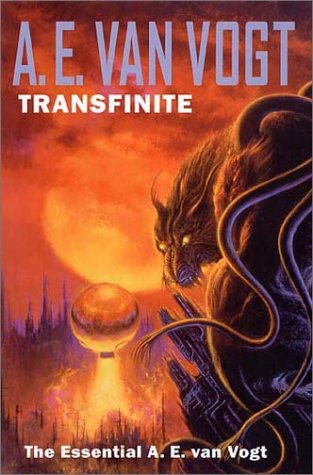
5. Transfinite: The Essential A. E. Van Vogt
by A. E. Van Vogt
Hardcover: 576 Pages (2003-02)
list price: US$29.00 -- used & new: US$29.00
(price subject to change: see help)
Asin: 1886778345
Average Customer Review: 5.0 out of 5 stars
Canada | United Kingdom | Germany | France | Japan
Editorial Review

Book Description
Contains the most popular and important stories from van Vogt's wide and varied career. ... Read more

Customer Reviews (1)

5-0 out of 5 stars Timeless classics of science fiction
Most of these classic stories are from the years 1939-1950, an era where A.E. van Vogt was, along with Robert Heinlein, the most popular science fiction author in America.And although much science fiction written so many years ago has become dated, van Vogt's stories, for the most part, are still fresh and exciting.

If you have never read van Vogt, be prepared to be swept away from the very first sentence.His stories are not always logical, nor are all loose ends always tidied up, but they move along at breakneck speed, are filled with ideas, and will containmoments that you will remember forever.

From a historic perspective, you will see some of the first science fiction stories dealing with human-alien warfare (The Sound, The Rull), humans that can travel back through time (The Search), encounters with energy vampires (Asylum), humans of varied nationalities populating a spaceship that explores the galaxy, and beyond (Black Destroyer, War of Nerves), and so much more.

A few of van Vogt's classic novels have recently been reprinted, but sadly most of his work is out of print.Here is probably your last chance to own a large collection of his best short stories - stories that are timeless classics of science fiction. ... Read more


6. The Empire of Isher: The Weapon Makers / The Weapon Shops of Isher
by A. E. van Vogt
Paperback: 288 Pages (2000-05)
list price: US$14.95 -- used & new: US$18.99
(price subject to change: see help)
Asin: 0312875002
Average Customer Review: 4.0 out of 5 stars
Canada | United Kingdom | Germany | France | Japan
Editorial Review

Amazon.com
Having more stories from A.E. van Vogt repackaged andreprinted can only be good news: along with Heinlein and Asimov, this prolific, wild-eyed author deserves much of the credit for pioneering science fiction's golden age back in the '40s and '50s. As a sort of crazy old uncle of modern sci-fi, though, van Vogt doesn't always get his due: his writing wasn't always spectacular, his plot and pacing fell somewhere between harum-scarum and willy-nilly, and his ideas were delivered in relentless salvos, each more outlandish than the last. But an embarrassment or not, the visionary van Vogt is indisputably part of the family, an entertaining and daring author whose influence can be seen in the work of countless other writers.

This 288-page paperback binds together two of van Vogt's better stories, "The Weapon Makers of Isher" and "The Weapons Shops of Isher," published in sequel-prequel order back in 1946 and 1951. These time-hopping, politically convoluted tales follow the struggle between the oppressive (but beautiful) Empress Innelda and the superadvanced libertarian Weapon Shops ("The right to buy weapons is the right to be free," reads the storefront sign). Much of the melodramatic plot revolves around the Shops' immortal, ultragenius founder Robert Hedrock, his conflict with the Empress, and their differing visions for the future of humanity, but don't fret too much over the details: van Vogt keeps your head comfortably a-swim in a steady stream of whiz-bang gadgetry, plot twists, and breakneck action. --Paul Hughes Book Description
Two classic Van Vogt works, The Weapon Makers and The Weapon Shops of Isher form the complete story of Robert Hedrock and the Empire of Isher. They are about revolution through time travel, the right to bear arms, the end of the universe and the beginning of the next. ... Read more

Customer Reviews (4)

5-0 out of 5 stars Van's best series in one big book
"The Weapon Shops of Isher" is an interestingly mosaic novel based on a few short stories published in the '40s, and the plot strands understandably hardly touch, but the overall effect is one of a nice cross-section of this society.

"The Weapon Makers," a 1943 novel that was written as a finale to the stories that made up "The Weapon Shops of Isher" is even better than the first, and is perhaps Van's finest novel.The plot is very straight-forward but nonetheless full of surprises and interesting turns.The writing style is far better than most of his output, which when combined with the excellent plot and characters makes an outstanding masterpiece.

3-0 out of 5 stars Confusion about two different books
Another reviewer has reviewed a different book. "Reviewer: Trevor J Hall (see more about me) from PERRY,, ME USAAt last the two books of the life of the mutant prince of the House of Lin have been combined in onecover...."

This is actually a review of _Empire of the Atom_, anSFnal re-telling of Robert Graves's _I Claudius_, and a quite differentbook, also by Van Vogt.

As to the books at hand, they are some of vV'sbest, but suffer from all his characteristic faults -- the too frequentplot changes, the endless consipiricies (often where the leaders of twoopposed sides are secretly the same person) a society whose economic basisis dubious at best.But it is a page-turner, and one that keeps thisreader returning from time to time. A classic that any SF fan should readsometime or other.

5-0 out of 5 stars a classic by a giant in the field
At last the two books of the life of the mutant prince of the House of Lin have been combined in one cover. A E van Vogt is a master wordsmith, 'thus died a whole legion of men', and this is one of his masterpeices. Somehowboth dated and yet timeless this is the career of a mutant princeovercoming his handicaps and ultimately triumphing against his politicalfoes, inspiring loyalty in his companions and gaining the cooperation andadmiration of his piratical foes.The tale is told in a somewhat ironicvein which is unforgettable. I have spent many years wishing for afurther sequel.

3-0 out of 5 stars Justly reprinted
I have not seen this edition, but both the component novels, "The weapon makers" and "The weapon shops of Isher" are old friends. These are among the better of van Vogt's works, perhaps not theabsolute best, but close. For books written some fifty years ago stillremarkably readable. Justly reprinted.

Note that "The weaponmakers" was written first but that "The weapon shops ofIsher", added later, is a prequel. The stories are also different intone: "The makers" is highly dynamic (almost dynamite), while the"The shops" is much quieter. ... Read more


7. The Silkie
by A. E. Van Vogt
Mass Market Paperback: Pages (1969)
-- used & new: US$30.00
(price subject to change: see help)
Asin: B000GRKL6U
Canada | United Kingdom | Germany | France | Japan

8. Triad, Three Complete Science Fiction Novels by A.E. Van Vogt (The World of A, The Voyage of the Space Beagle, and Slan)
by A.E. Van Vogt
 Hardcover: Pages (1951)

Asin: B000PFN5RK
Canada | United Kingdom | Germany | France | Japan

9. The Universe Maker (G-660)
by A.E. Van Vogt
 Paperback: Pages (1953)

Asin: B000NXCMZU
Canada | United Kingdom | Germany | France | Japan

10. Futures Past: The Best Short Fiction of A.E. van Vogt
by A. E. Van Vogt
Paperback: 203 Pages (1999-10-31)
list price: US$17.00
Isbn: 1892391058
Average Customer Review: 5.0 out of 5 stars
Canada | United Kingdom | Germany | France | Japan

Customer Reviews (1)

5-0 out of 5 stars Excellent collection by a Master
This is a group of lesser-known science fiction stories, first published between the 1940s and 1960s, by one of the all-time masters of the field. When writers like Asimov and Heinlein were hitting their stride, van Vogtwas the pinnacle to which they aspired. When the first specialty bookpublishers were looking for material to republish after World War II, vanVogt was their first stop. In this book, the last survivor of aspaceship that crash landed on Mars finds a deserted Martian village.Natives of the Andes Mountains are able to survive in the thin atmosphereof Mars, without pressure suits, to the great resentment of those born atsea level. A human and an ezwal, a large, blue, three-eyed being with thepower of telepathic communication, crash land on a jungle planet and areforced to cooperate with each other to survive. This is despite the factthat the ezwal hates humans and would just as soon tear the human intolittle pieces. These may not be classic, well-known stories, but theystill run rings around most of what was, and is, in the science fictionsection of the local chain bookstore. ... Read more


11. The Far out Worlds of A. E. Van Vogt
by A E Van Vogt
Hardcover: Pages (1973)

Asin: B000KK5FDM
Canada | United Kingdom | Germany | France | Japan

12. Slan
by A. E. Van Vogt
Mass Market Paperback: Pages (1961)

Isbn: 0345511107
Canada | United Kingdom | Germany | France | Japan

13. Slan
by A. E. Van Vogt
Audio Cassette: Pages (1995-04)
list price: US$15.95 -- used & new: US$10.99
(price subject to change: see help)
Asin: 1884214002
Average Customer Review: 4.0 out of 5 stars
Canada | United Kingdom | Germany | France | Japan
Editorial Review

Amazon.com
Slan is legendary science fiction author A. E. Van Vogt's first and best-known novel, back in print from Tor Books's Orb imprint.The story is classic golden age science fiction: Jommy Cross is a slan, a genetically bred superhuman whose race was created to aid humanity but is now despised by "normal" humans. Slans are usually shot on sight, but that doesn't stop Jommy's mother from bringing him to see the world capital of Centropolis, the seat of power for Earth's dictator, Kier Gray.But on their latest trip to Centropolis, the two slans are discovered, and Jommy's mother is killed.Jommy, only 9 years old, unwittingly becomes caught up in a plot to undermine Gray, who may be more sympathetic to slans than the public suspects. The nonstop action and root-for-the-underdog plot has made Slan a science fiction favorite.Book Description
In the 1940s, the Golden Age of science fiction flowered in the magazine Astounding. Editor John W. Campbell, Jr., discovered and promoted great new writers such as Isaac Asimov in New York, Robert A. Heinlein in California, and A.E. van Vogt in Canada, whose novel Slan was one of the basic works of the era. Throughout the forties and into the fifties Slan was considered the single most important SF novel, the one great book that everyone had to read. Many SF fans rallied to the cry, "Fans are slans."Today it remains a monument to pulp SF adventure, filled with constant action and a cornucopia of ideas. And maybe fans really are slans. Read it and see for yourself.Download Description
The Slans, a superior race of telepaths, are isolated and persecuted by the "normal" humans.The young Jommy Cross's mother dies in a pogrom and he struggles to survive.With its obvious evocation of the Holocaust, this novel, first published in 1941, made an enormous impression.Van Vogt (1912-2000) was an SFFWA Grand Master. ... Read more

Customer Reviews (29)

2-0 out of 5 stars A weak story from the Golden Age of science fiction
This book comes to us from the very start of the Golden Age of science fiction.First copyrighted in 1940, it has most probably been reissued now to support the release of a new sequel (Slan Hunter) rather than in response to any great fan demand, despite the assertion on the back cover that in the 40's and 50's SF readers rallied to the cry "Fans are slans."

However, I don't feel that this story stands up well even against other Golden Age stories.Unlike some of the books from this time, including Van Vogt's own Weapons Shops of Isher, the outdatedness of the technology is a distraction to the reader.This is typically a sign of a book where the plot is driven by a good concept rather than character interactions, as indeed "Slan" is.But in this case even the concept is not executed as well as it could have been.A Slan is an uber-mensch, a Nietzschian hero whose intellect (and telepathy, natch) allow them to survive and prosper in the middle of a violent campaign to eradicate them.Granted, today this is standard action hero stuff, but coming out of this time period it feels a little creepy, maybe a little Nazi-ish.

Our hero Jommy is a Slan whose parents are murdered by the authorities, and who must make his own way in the world.He is constantly trying to find the other Slans, who he know must exist but whom he can never locate.I won't give away the (deeply flawed) twist ending, but by allowing Jommy to succeed in his quest Van Vogt missed an opportunity to create an allegory about totalitarianism and instead simply capped a rambling narrative with the expected solution.

That's not to say there's nothing to enjoy here.The action is sometimes good, and despite myself I got a vicarious thrill at watching Jommy use his extraordinary abilities to build up a small private empire.But while it might have been an average book sixty years ago, by today's standards it's simply not worth reading.

5-0 out of 5 stars The Wave of the Future
Slan (1951) is a standalone SF novel.Slans are a mutation of humanity that have high intelligence and telepathic capabilities.Their popular name came from Samuel Lann, the man who discovered their abilities.The most distinctive difference from humanity is the golden tendrils growing from their scalp, but they also have internal dissimilarities, including a modified heart.

In this novel, Jommy Cross is the son of Peter and Patricia Cross.His father had been killed by a mob of humans about four years before.Since Jommy is charged with retrieving his father's papers from the catacombs when he reaches fifteen, his mother is taking him into Centropolis to show Jommy a secret entrance into the tunnels.

Unluckily, the humans have noticed the pair and suspect that they are slans.The secret police are closing in, although Jommy is not mature enough to detect their presence until they are quite close.His mother shoves him between two other people and tells him to run.

Jommy climbs onto the rear bumper of a car that is soon moving swiftly down the street.Jommy tunes in to the thoughts of the men within the car.He has no difficulty reading the thoughts of the driver, but the passenger only shows the upper level of his thoughts.

Soon Jommy realizes that the passenger is John Petty, chief of the secret police.Moreover, the radio is announcing his flight from the area where his mother has just been killed.John Petty is realizing that his car is probably the one mentioned in the radio report.

The car is traveling too fast for Jommy to jump off and survive.Yet Petty is having the driver slow down and stop to check the rear bumper.As soon as the car has slowed enough to jump, Jommy is off the bumper and fleeing down a poorly lit alleyway.But the driver gets one good shot at him and doesn't miss.

Jommy wonders at the lassitude of his body, which is usually not tired by any effort.He is feeling woozy, but he pulls himself over a pile of boxes and inside a hole in the wall.He finds that the irritating objects under him are shards from the wall and replaces them, using mud as mortar to hold them in place.

While he is preparing his bolthole, he discovers that an evil mind is also thinking of the hiding place.Later, after the pursuers have left the area, he crawls out and is snatched by the owner of the evil thoughts.She puts him into her wagon under a smelly cover and smuggles him out of the neighborhood.

In this story, Granny is a former show girl who uses her good looks and sex to advance in show business.Yet she is eventually betrayed and tossed out onto the street.Since then she has become an alcoholic rag lady.But she is still capable of finding a way to use Jommy to gain money.

Granny takes Jommy to a department store to swipe valuable trinkets.He brushes against a man heading out of the store and scans his mind.He is quite startled to find that the man is a slan.Yet the man lacks tendrils and is unable to read minds.

He follows the man to his destination and then naively shows his tendrils to two men within the building.He barely escapes their attempts to capture and then kill him.He climbs up the building to the roof and sees a spaceship launched into space.

Puzzled, he returns to the department store and steals a few trinkets for Granny.On his way out, he accidentally learns the combination to the store safe, which contains hundreds of thousands of dollars.After returning to Granny's shack, he tells her that the safe contains four thousand dollars and suggests that they bypass the trinkets.

Jommy stays with Granny for six years.When he reaches fifteen, he goes into the catacombs and retrieves his father's papers and an artifact that is a powerful weapon.When three guards discover him, he unthinkingly destroys them with an atomic blast from the weapon.

This story tells of Jommy's experiences with the tendrilless slans and his theft of a spaceship.He also learns their side of the conflict against true slans.Their statements don't agree with his experiences with his parents and he resolves to discover the truth of the matter.

This tale also relates the experiences of Kathleen Layton, a slan female who is a couple of years older than Jommy.Kathleen is living in the palace designed and built by true slans before humans drove them into hiding.She is the ward of Kier Gray, leader of all humans on Earth.

This novel is one of the early works by the author.It was also one of the first novels published after the wartime constraints.It is considered a classic Science Fiction novel.

Highly recommended for van Vogt fans and for anyone else who enjoys tales of high adventure, mutational advances, and political intrigues.

-Arthur W. Jordin

4-0 out of 5 stars Inventive, but dated story
I first read 'Slan' when I was about 15.I thought it was a fantastic story and kept borrowing it from my brother and re-reading it.I bought it recently to see if it stood up to my memory of it.Ok, it is a bit dated, the conversations are more lengthy than we are used to in today's faster paced novels, but I found it very exciting all the same.It's about a boy who has the ability to read minds and knows that if the normal humans find out that he can, they will try to kill him.Obviously he has to use all his abilities to stay one move ahead of the game.Part of the fun in this book is recognising where Star Wars etc. got their ideas from!Now I want to read the sequel (Slan Hunter) to see if I think the next book carries on in the spirit of the first as it has a different writer.

5-0 out of 5 stars reprint of a WW II classic
Jommy Cross's mom Patricia knew the danger to both of them if they were discovered as Slans whenever she brought her son to the world capital of Centropolis, home to Earth dictator Kier Gray.The "normals" hate the super human genetically engineered Slans whose telepathic powers and other skills make them a superior race.Still this does not prevent the single mom from taking her Jommy periodically to the city.

Their latest trip turns tragic.Sensing the others were coming for them, Patricia informs her beloved son to find the catacombs of his late father if they catch up to her.She knows her time on earth is over as the law allows instant killing of Slans.While his mom is legally murdered nine year old Jommy escapes by leaping on to the bumper of a moving vehicle, but overhears an odd conversation that makes no sense to him as the killing of Slan female Kathleen Lawton could not undermine the Great Dictator, or could it somehow?.Jommy knows he must find this woman, but is not sure why or how she will receive a visit from an orphaned nine year old Slan.

This is a reprint of a WW II classic that many insist changed science fiction from pure action to pure action with a social message that in the 1970s remained required reading in college level Sci Fi literary classes.The story line has obvious links to the Holocaust, but also holds true today with genocides in Darfur, Rwanda, Cambodia, etc as the late great A.E. Vogt condemns racism in any form and not just the extreme final solution, but does so inside a great youth on the run thriller.The story line is fast-paced and will excite a horde of new fans to this landmark thriller that easily passes the test of time.Readers will also rejoice that Kevin J. Anderson, who wrote the Introduction to this edition, shortly will finish a Mr. Vogt's manuscript, SLAN HUNTER.

Harriet Klausner

4-0 out of 5 stars Important Work that Falls Victim to the Conventions of the Period
Centuries in the future, a new mutation has appeared in the human species.Known as the slans, this mutant group is physically stronger, smarter, and telekinetic via the tendrils that grow out of their hair.They are also hunted down and killed on sight by the dictatorship of Keir Gray.It seems, in the deep murky past, that the slans attempted to conquer the human race, and war began.But slans still live among humans, hiding in plain sight.One such slan is John Thomas "Jommy" Cross, who, after watching his parents' murder as a boy, is taken in by a greedy old woman, as he bides his time until he such time when he claim the inherited knowledge left by his father.Another slan is Kathleen Layton, a ostensible science project in the custody of Keir Gray himself, but in fact a pawn in the chess game of the Gray dictatorship.

A.E. Van Vogt's "Slan" is a historical piece of science fiction.It's easy to trace numerous concepts back to "Slan" (e.g. Marvel Comics "X-Men").It is also an interesting allegory on human nature and the theme of "Man's inhumanity to man."It's probably no coincidence that this book was published in 1946, when WW II was over, and the genocide that it entailed was known.However, much like its contemporaries, "Slan" frequently falls victim to the conventions of science fiction of the time, and so a reader will almost certainly feel star-crossed.

Initially, Van Vogt starts his novel on a thrill, as Jommy is on the run from the humans.Images of a boy of nine running for his life, surrounded by hatred and greed and fear are chilling and gripping.Alternatively, Kathleen's observations of an attempted coup against Gray, and Gray's violent response, while perhaps not so frenzied as a chase, are however just as engrossing.

However, after initial rush, the pace slackens considerably, as Jommy lives a life as a thief, biding his time.While Van Vogt piques our curiosity with the revelation of slans who are not telekinetic, he spends a good deal of time with a contemplative Jommy, spectacularly loquacious secondary characters, and progressively neglected and underdeveloped Kathleen.

It certainly doesn't help that Van Vogt injects several dozen mysteries into his book without ever satisfactorily dealing with any of them.Are the slans really evil?How did the come to be, and how did that cause the war?What's the deal with the non-telekinetic slans?Why does Keir Gray seem so intent on holding on to Kathleen?What will Jommy do about any of it?With so many plot lines to juggle, Van Vogt never seems to give any one of them satisfactory time to develop.The end result is something of a disappointment.

While there is plenty to like about this book, I never felt completely satisfied with it.It tantalizes, but only rarely gratifies.It's historical value in the science-fiction is inarguable, and it's allegorical aspect is always important.Unfortunately, it's aesthetic is never quite able to live up to its potential.However, that doesn't diminish its value.It's absolutely worth reading. ... Read more


14. Null a Three
by A. E. Van Vogt
Paperback: 254 Pages (1985-07-02)
list price: US$3.50 -- used & new: US$33.60
(price subject to change: see help)
Asin: 0886770564
Average Customer Review: 2.0 out of 5 stars
Canada | United Kingdom | Germany | France | Japan

Customer Reviews (1)

2-0 out of 5 stars Null-A disaster
Van Vogt's earlier Null-A novels explore a philosophic, educational and analytical system advanced by Alfred Korzybski called General Semantics.The stories are interesting if more than a little off the GS mark.The third Null-A novel is a disaster.I won't go into details of plot but each of the Null-A books explores a theme.The first addressed a question of identity that remains both fresh and current.The second, well, it seems to continue that exploration, more or less, after a fashion, sort of; and it tosses in a direct contradiction to Null-A philosophy as key plot device.It still hangs interesting GS quotes at the chapter headings, but, well van Vogt tried too hard.And 3?Well in 3 it doesn't seem as if he tried at all.If anything, 3 seems to be about child rearing and education, with an attractive widow.Stick to Null-A 1 and if you must, Null-A 2.
... Read more


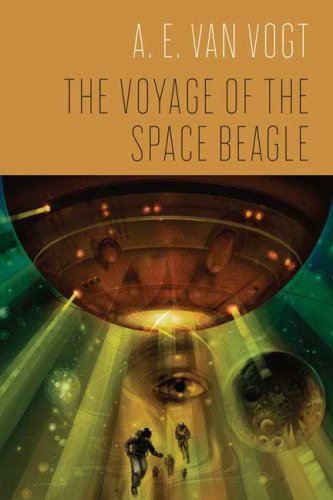
15. The Voyage of the Space Beagle
by A. E. van Vogt
Paperback: 224 Pages (2008-07-08)
list price: US$14.95 -- used & new: US$10.17
(price subject to change: see help)
Asin: 0765320770
Average Customer Review: 4.5 out of 5 stars
Canada | United Kingdom | Germany | France | Japan
Editorial Review

Book Description
The first third of this novel, BLACK DESTROYER, appeared in the 7/39 ASTOUNDING as Van Vogt's first science fiction story.It was the basis of the Sigourney Weaver Film, Alien.Van Vogt (1912-2000), named an SFFWA Grandmaster in 1995, was the most influential science fiction writer of his time.Download Description
The first third of this novel, BLACK DESTROYER, appeared in the 7/39 ASTOUNDING as Van Vogt's first science fiction story.It was the basis of the Sigourney Weaver Film, Alien.Van Vogt (1912-2000), named an SFFWA Grandmaster in 1995, was the most influential science fiction writer of his time. ... Read more

Customer Reviews (20)

5-0 out of 5 stars Nexialism vs. far-flung complex aliens
Written in 1959 - wiseguy, hard SF space novel readers don't knock it yet! A.E. van Vogt presents, carries and completes a beautiful presentation about a roaming scientific spaceship visiting worlds strewn acorss the glaxay. His vision of aliens don't have the normal Golden Age hokiness than many books at the time have. The Space Beagle meets four species which are so different from the normal "two-arm, two-leg, slimy" alien. These aliens can control wavelengths or exist as pure energy or can project hallucinations, etc. The way these aliens interact or deceive humans is an excellent read.

The crew of the Space Beagle are always on the brink of destruction, if it wasn't for Grosvenor and his mysterious science of Nexialism. Whole none of the crew understand his science, they view him as eccentric and unreliable. It's Grosvenor's struggle to have the others see that his science can work wonders between the other scientists sciences.

5-0 out of 5 stars Into the Unknown
The Voyage of the Space Beagle (1950) is a standalone SF novel.The Space Beagle is a roving laboratory ship that is outward bound to another galaxy.Almost every human science is represented onboard the great ship, including one Nexialist.These scientists are searching for new and unusual data that they can use to evaluate and revise existing scientific theories.

In this novel, Ellott Grosvenor -- the Nexialist -- observes as the other scientists encounter a huge black cat-like animal on a previously unexplored planet.The creature is obviously intelligent, as is shown by its straight-forward, yet cautious, approach to the scientists.It even has manipulative tentacles around its neck.

Coeurl is hungry, but knows that it cannot directly attack the small strangers and survive.It acts friendly and later ambushes a lone individual among the ruins of the Builders.For the first time in weeks, it absorbs life sustaining id from the body.But its feeding is interrupted by the approach of a small flyer.

The strangers are suspicious of Coeurl after the body is found.Gregory Kent -- head of the chemistry department -- is very angry at the death of his friend Jarvey.He wants to terminate the creature immediately, but is overruled by Hal Morton, the expedition director.

The chemistry department analyses the remains and discovers a shortage of potassium.They prepare a soup of potassium suspended in an organic compound similar to its state within the human body and Kent presents a bowl filled with the substance to the alien creature.Before most of the department heads, Coeurl angrily dumps the contents of the bowl into Kent's face.

After being thrown off his feet by the forcefully thrown substance, Kent responds by drawing his vibrator gun and shooting the creature.He is quickly disarmed, but the whole incident results in a loud argument.Eventually one of the participants notes that Kent's shot struck Coeurl without harming the creature.

In this story, Grosvenor leads the creature into a specimen cage and the doors are locked from the outside.Grosvenor submits a report to the director about the incident and points out that, with the creature's known and suspected abilities, the current confinement has certain flaws.Later that night period, Coeurl manipulates the electrical lock with its control of electromagnetic energy and starts killing off the humans.

At first, the creature kills humans in individual bedrooms and returns to the cage in sufficient time to fool the roving guards.When it reaches a dormitory, however,Coeurl goes into a killing frenzy and returns late to the cage.As it is killing the guards, one cries out and sets off alarms throughout the ship.It throws the bodies far down the corridor and slips into the cage, locking the door behind it.

This story tells of the battle between Coeurl and the humans.It also relates the experiences of the ship's crew and passengers when they encounter the bird-like Riim espers, the almost unkillable space-living Ixtl, and the galaxy-spanning dispersed intelligence of the Anabis.As the ship's captain says, "scientists can find trouble where it never existed before."

This is one of the earliest novels by the author and is based on his first published short story -- "Black Destroyer" -- from the July 1939 issue of Astounding.It contains most of the elements that earned him a lofty reputation:high adventure, exotic science, and extraordinary individuals.While the book publication was almost sixty years ago, this story still seems to be as futuristic as the latest tales in SF magazines.The science of Nexialism could be announced anytime in the next year or so.

Obviously, the title and plot of this story refer to the voyages of the HMS Beagle.This nineteenth century brig was used for three voyages of exploration, but is remembered mostly for the second voyage.In 1831, the Beagle sailed from Plymouth with the naturalist Charles Darwin onboard.While visiting the Galapagos Islands, Darwin collected the data that eventually led to his theory of evolution.

This story, however, expands upon the voyages of the Beagle.Rather than a small vessel, the space version is a huge starship capable of tremendous velocities through intergalactic space.Moreover, the ship carries over eight hundred scientists and hundreds of tons of tools and instruments.The author doesn't think small.

Highly recommended for van Vogt fans and for anyone else who enjoys tales of high adventure, advanced mental training, and unknown worlds.

-Arthur W. Jordin

5-0 out of 5 stars A classic...
You hear that a lot.This is a classic, that is a classic.But this IS a classic.
The Voyage of the Space Beagle is one of those books that have inspirited many later authors and movies.A. E. Van Vogt is one of the Fathers of modern Sci-Fi.While the Black Destroyer may, or may not, have inspirited the makers of the movie Alien I do know that two of the aliens in the book also show up in Barlowe's Guide to Extraterrestrials along side such great aliens as the Puppeteers, The Thing, the Overlords, the Guild Steersmen and the Old Ones.
The book is four short stories put together.Or a novel that has been cut up into four short stories for other collections.But in the end this is the story of a huge spaceship on a deep space mission to explore and understand.The science is kind of soft, more of a space opera but also reminds me a tad of Star Trek.But remember this was first printed decades before Star Trek.

4-0 out of 5 stars Classic Sci-Fi and the Basis for Alien
The Voyage of the Space Beagle by A. E. van Vogt is a book that could best be described as Classic Sci-Fi.Science Fiction in general is a genre that is very new to me, and I have never read any van Vogt. So I decided to go on a voyage!

This book was originally 4 short stories that were put together in a "fixup" by van Vogt. The stories are all about the crew of the Space Beagle (a Darwin reference) and its intergalactic expedition. The crew is made up of military personnel and scientists that are on board to study alien life in other galaxies. Eliot Grosvenor, is the books protagonist. He is the lone Nexialist aboard the ship. Nexialism is a relatively new science. It is one that encompasses ALL the other sciences and relates them together. It is more generalized than specific, but it also adds an element of hypnotism and mind control. At first, Grosvenor isn't given much thought. He is left to himself until trouble comes aboard and his skills are called into play.

Each story, or section, in the book describes contact with an alien race. In the first story, the crew members explore what they think is a seemingly deserted planet. The stumble across Coeurl, a cat-like creature that has tentacles and an incredible hunger. He pretends to be just another dumb animal, and the crew members "capture" him and take him aboard the ship to study. But Coeurl is hungry and he has an agenda. He quickly escapes and terrorizes the ship.

They also encounter the Riim, a bird-like creature that has great hypnotic power; the Ixtl, a devil-like alien that is keen on breeding, by implanting his eggs in the stomach of the crew members; and Anabis, who is galaxy-wide and is waiting to take over planets.

While the aliens are the main part of the storyline, what appealed to me even more was the relationships of the crew members. If the creatures outside don't get you, the people inside just might! There is a political undertone that reflects the climate on the ship. The military and the scientists always seem to be at odds with each other and underlies the harmony on the ship. It seems to be a pretty accurate assessment of ventures even today that involve the same types of people. While a lot of the "scientific" stuff is really dated, I was intrigued by the politicking going on inside the walls of the Beagle. This was a short, fun read. I can see a lot of present day science fiction that was influenced by this writer. Overall, I highly enjoyed it!!

3-0 out of 5 stars Interesting and imaginative but dated!
With all the benefit of hindsight, it's easy to read Van Vogt's "Voyage of the Space Beagle" with the same clarity and futuristic vision that perhaps inspired Gene Roddenberry to spin off Star Trek vesting the Enterprise with the five year mission to go where no man has gone before. In a style that will remind readers of Bradbury's "The Martian Chronicles" or Asimov's "I, Robot", this quintessential example of early pulp science-fiction and space opera - at once fun-loving, thought-provoking, intense, frightening and entertaining - is actually a series of four short stories joined together by the common theme of inter-stellar exploration and alien first contact.

Each of the four stories is brim full of the stock in trade and requisite hard sci-fi toys and elements of the typical stories of the day - blasters, stun guns, force fields, teleportation, bizarre aliens, hostile landscapes, communicators, travel at near light speeds, and the like. But assessing it from the hard side of the sci-fi spectrum, "Voyage of the Space Beagle" is certainly not unique, has little beyond short-term entertainment value to recommend it and I think most readers would be unlikely to accord it the status of "classic".

But look more closely at the softer side of the sci-fi field of play! Ah, now there's where "Voyage of the Space Beagle" comes into its own with some compelling and imaginative ideas, insights and questions - Elliot Grosvenor as the expert in the newly founded science of Nexialism which purports to be the nexus or bridge between hitherto unrelated fields of scientific endeavour such as physics, chemistry, metallurgy, geography or sociology for example (a means of looking at the "big" scientific picture from a new meta-level, as it were - do you think we're talking about a 1950s version of Science Officer Spock here?); the social difficulties of a population living in the confined quarters of an exploratory vessel for extended periods; the political, command and management clashes between scientific, technical and military personnel with their varying motives, agendas and decision making styles on such a mission; the completely ineffectual nature of democracy as part of a command structure in the context of such an operation; and the unbridgeable philosophical differences and overwhelming communication difficulties that might be encountered in an alien first contact situation.

Clearly Van Vogt was appreciative of our ultimate smallness in the universe. Like Clifford D Simak, he was also openly critical of man's history of violence and the arrogant impression of his own power and importance:

"You assume far too readily that man is a paragon of justice, forgetting, apparently, that he has a long and savage history. He has killed other animals not only for meat but for pleasure; he has enslaved his neighbors, murdered his opponents, and obtained the most unholy sadistical joy from the agony of others. It is not impossible that we shall, in the course of our travels, meet other intelligent creatures far more worthy than man to rule the universe."

I wonder if Van Vogt appreciated the irony in his own writing. Despite the obvious criticism of the human condition inherent in his character's words, Van Vogt persisted in writing stories in which every alien encounter failed to transcend that hostility and savagery and either began or ended with violent confrontation or battle. For the most part, the inhabitants of the Space Beagle barely even tried. Sigh!

"The Voyage of the Space Beagle" is fun to read, entertaining andimaginative to be sure but not truly visionary and capable of lasting other than as a memento of what good space opera was like in the 50s! Recommended for lovers of classic science fiction.

Paul Weiss
... Read more


16. SLAN
by A. E. van Vogt
 Paperback: Pages (1962)

Asin: B000ICDPK2
Canada | United Kingdom | Germany | France | Japan

17. Slan
by A.E. Van Vogt
 Mass Market Paperback: Pages (1977)

Asin: B000PLTH1M
Canada | United Kingdom | Germany | France | Japan

18. The World of A
by A. E. Van Vogt
 Leather Bound: Pages (1988)

Asin: B0011VWCKS
Canada | United Kingdom | Germany | France | Japan

19. The Far-Out Worlds of a.E. Van Vogt
by A.E. Van Vogt
 Paperback: 222 Pages (1974)

Isbn: 0450017354
Canada | United Kingdom | Germany | France | Japan

20. The Battle of Forever
by A. E. Van Vogt
Mass Market Paperback: 176 Pages (1982-08-02)
list price: US$2.25 -- used & new: US$5.50
(price subject to change: see help)
Asin: 0879977582
Average Customer Review: 4.0 out of 5 stars
Canada | United Kingdom | Germany | France | Japan

Customer Reviews (1)

4-0 out of 5 stars Almost deserves 5 stars , but...
First of all - It's one of Van-Vogt's most ideas-filled books. If you've read Van-Vogt before you know that a comment like that is not to be taken lightly.

Writen in 1970 and being rather "new" in Vogtianstandarts , I was afraid that Van has gotten old , lost his zest , and boy, how wrong was I !

From the first word I was captivated in the story ofModyun - a far future human man that has a 30cm body and a 15inch diameterhead. Modyun , who's a telepath and a genius using 100% of his brain'spotential like all other humans ( who numbers a mere 1000 )decides toenlarge his body to the original size of the ancient humans , and take atour around the world , to see how the animal-men are doing.

Theanimal-men , ofcourse , were created by Man by mixing every animal's DNAwith human's inorder to give them intelligence. When that was achived , Manhas built the animal-men cities and food-commisary's and factories tofulfill every need , and that done - reduced his number to a representative1000 and began passing time in emotion-free , stimulant-free , totalypeacfull philosophic existance.

When Modyun encounters the world outsidethe human valley , he has many enlightment's on the way "ancientman" use to think and feel , and the way the body , not the brain ,was mostly responsible for those feelings because of the number andintensity of the stimulations over-flowing into the mind and interfere withrational thought. Besides fighting his own bodily sensations , Modyun isnoticing a diference in the way the world is run ! He begins hisinvestigations and does have some success but the thing that holds him backis really his own attitude - after hundread's of years of peacfullexistance , Modyun is almost uncapable of identifying a violent situation ,not to mention a suspicion of scheming !

I won't tell you what Modyunfinds out and how he deal's with it , but I'll tell you that though : thisbook is a wonderfull exemple of the mind-expanding works Van-Vogt give usevery once in a while. It might have been his greatest , if the endwould'nt have been a bit rushed - hence the four stars. But anyway , It'san excellent book , and you should read it if you're an early sci-fi lover, an A.E Van-Vogt fan , or a person interested in having a wonderfullreading experience.

Very recommended. ... Read more


  1-20 of 100 | Next 20
A  B  C  D  E  F  G  H  I  J  K  L  M  N  O  P  Q  R  S  T  U  V  W  X  Y  Z  

Prices listed on this site are subject to change without notice.
Questions on ordering or shipping? click here for help.

site stats