e99 Online Shopping Mall

Geometry.Net - the online learning center Help  
Home  - Authors - Vidal Gore (Books)

  1-20 of 100 | Next 20
A  B  C  D  E  F  G  H  I  J  K  L  M  N  O  P  Q  R  S  T  U  V  W  X  Y  Z  

click price to see details     click image to enlarge     click link to go to the store

$9.58
1. United States
$8.49
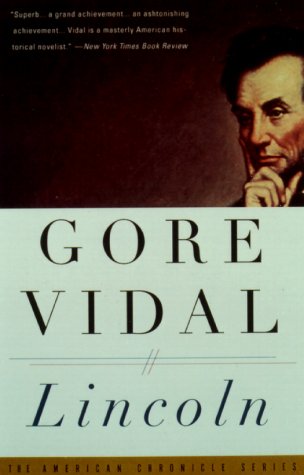
2. Lincoln: A Novel
$6.00
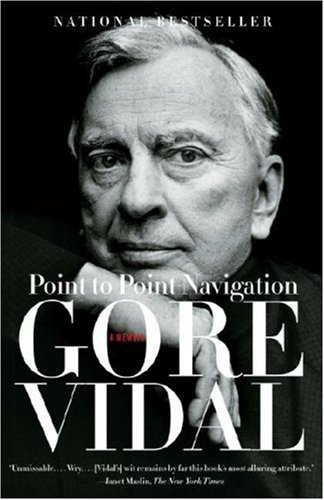
3. Point to Point Navigation: A Memoir
$9.03
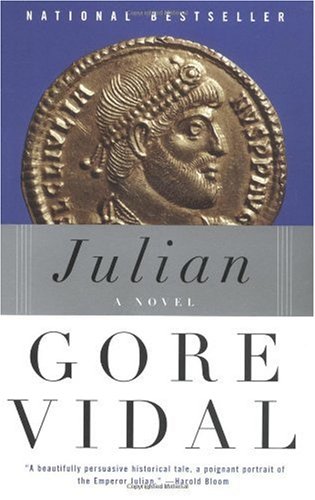
4. Julian: A Novel
$9.58
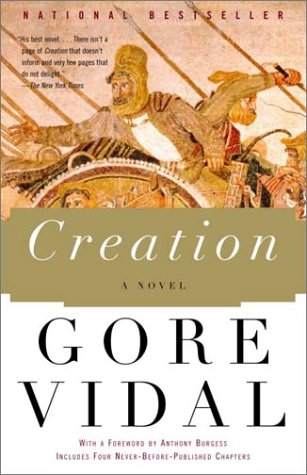
5. Creation: A Novel
$9.63
6. Imperial America: Reflections
$5.35
7. Dreaming War: Blood for Oil and
$10.98
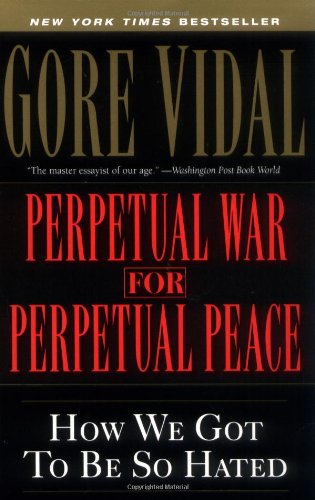
8. Perpetual War for Perpetual Peace
$3.96
9. Decline and Fall of the American
$6.90
10. Empire: A Novel
$7.95
11. Washington, D.C.: A Novel
$6.97
12. Palimpsest: A Memoir
$6.06
13. The Best Man.
$6.73
14. The Golden Age
$8.70
15. The Last Empire: Essays 1992-2000
$1.71
16. The Judgment of Paris
$10.68
17. Gore Vidal's America (Polity celebrities
 
18. Lincoln (Signed, First Edition,
 
19. Washington, D.C. : a novel / by
 
20. THE BEST MAN A PLAY ABOUT POLITICS

1. United States
by Gore Vidal
Paperback: 1312 Pages (2001-05-15)
list price: US$27.95 -- used & new: US$9.58
(price subject to change: see help)
Asin: 0767908066
Average Customer Review: 4.5 out of 5 stars
Canada | United Kingdom | Germany | France | Japan
Editorial Review

Book Description
From the age of Eisenhower to the dawning of the Clinton era, Gore Vidal’s United States offers an incomparably rich tapestry of American intellectual and political life in a tumultuous period.It also provides the best, most sustained exposure possible to the most wide-ranging, acute, and original literary intelligence of the post—World War II years.United States is an essential book in the canon of twentieth-century American literature and an endlessly fascinating work. ... Read more

Customer Reviews (19)

5-0 out of 5 stars Great reading guaranteed in perpetuity
This book is so vast and so full of wisdom, prescience (read Vidal's 1970s attack on religion and compare its conciseness and brilliance with the just released polemics of Hitchins and Dawkins, and his 1950s biting comments on the culture of celebrity are so far ahead of their time that they're breathtaking), wit and humour that you can pick it up at any time and find what seems to be a new gem within.After 5 years of owning this book, I'm still finding pieces I either haven't read or now read with a different outlook, owing to Vidal's amazing ability to be so pertinent to all ages.
Highly recommended.

5-0 out of 5 stars Outstanding, relevant and necessary
These particular selections of essays by the prolific and most caustic critics of the American Republic, has sat on my bookshelf since the early months of 1999. Included in this overwhelming collection are 114 essays, in some cases, randomly categorized into three chapters - State of Art, State of the Union and State of Being. Vidal is an intensely knowledgeable fellow, and therefore has an opinion on just about everything having to do with art, history, politics, the state of literature and his beloved Republic To attempt to read this entire tome (1271 pages) from start to finish over a few weeks (my original intention) proved to be impossible. Although informative and extremely entertaining, there was just too much to digest, too important to scan through, thus I would mark the essays read with a tick on the contents page, place the book back on the shelf, only to return when the time felt right to take them up again.

Vidal is not only a great historian, he is also one of America's great literary radicals. He was experimenting with the literary form, attempting to apply critical theory to the Novel very early in the piece with such works as Duluth, Mira Breckinridge and the post modern religious satire, Live from Golgotha. These were indeed "radical" departures from the standard fare of American novels coming out at the time. In mainstream circles, however, these novels were not well received, but were critically acclaimed, calling them subversive, iconoclastic, original and extremely funny.

As an essayist, Vidal really has no match in American letters. These essays reveal a master at the top of their form. What is interesting as well as admirable, Vidal was criticising literary theory which had infiltrated academia in the late 60's and early 70's, al la, post structuralism and deconstructionism, but unlike the so-called "experts" in the university's across the western world, (he calls them "Hacks of Academia") Vidal attempted to put these theories to the test in the form of a popular novel, (Duluth) and succeeded. In his essay, "French Letters -Theories of the Modern Novel", Vidal attacks these modern theorists, who state that language and literature as an art form is dead, in elegant prose and biting gusto, revealing their empty (headed) arguments,

"In any case, rather like priests who have forgotten the meaning of the prayer they chant, we shall go on for quite as long time talking of books and writing books, pretending all the while not to notice that the church is empty and the parishioners have gone elsewhere to attend other gods, perhaps with silence or with new words." (1967, p.110)

In "The State of the Union" essays, Vidal expounds upon American politics and his views on the National Security Council, the CIA and America's on-going imperialistic intentions, which interestingly, have not dated in the least. Most of these essays are as relevant as ever despite the passing of over thirty years.

There is no doubt in my mind that reading Vidal is an education, showing us a way through the miasma of received wisdom, relentlessly thrown in our direction. In many respects Vidal is a beacon of light during dark times, a writer that has never pulled any punches when it came to the things he believed in, namely writing, politics and his beloved Republic. This book should be standard issue for anyone interested in literature, politics, art, and American history.


5-0 out of 5 stars Gore Vidal, United States
First, for those readers solely interested in the quality of this essay collection, my advice is simple.If you enjoy the essay form, buy this collection!There is no better essayist alive.In the USA, Vidal stands beside Emerson, White and Trilling in exemplifying the power of the essay; and like them, his greatest quality is the intense, lasting relevancy of his argument, even when he deals with people or events long past.His vilification of Truman, for example, concentrates on the latter's founding the American security state, certainly a germane issue.

As for all this talk of Vidal's political affiliation, anyone who claims he is a conservative or a liberal in any normal sense of these words is simply wrong, and is unfortunately missing the purpose of Vidal's writing.Vidal firmly believes in the people and the ideals by which our nation was founded; but he is alone, as far as I know, in keeping himself free of worship.Jefferson, Adams, etc. were not perfect; and neither is democracy or republicanism.In our intensely polarized time, in which unthinking loyalty is a virtue, Vidal is exactly that type which he has often cheered throughout history, the brave heretic.Gore Vidal is our Orwell; his opinions may only occasionally be right, but anyone who ignores him is jeopardizing our relationship with the truth.

In addition to this collection, I also highly recommend *the last empire*, Vidal's collection of essays from 1992 to 2000.It is much shorted, and is actually a better introduction to the author.

5-0 out of 5 stars Master Essayist At Work
United States, the 1993 Winner of the National Book Award, it covers the years from 1952 until 1992. This book shows that Vidal is an authority/reliable source in many areas. He served in WWII and wrote his first novel while doing so. He comes form a political background; his grandfather, blind Senator T.P. Gore, brought him up. He is related to Eleanor Roosevelt and was friendly with JFK. He ran for Congress in New York in 1960 and came in second in the California democratic primary in 1982. Furthermore, his father served as director of the Bureau of Air Commerce under FDR, which gave him insight into the forming of airlines and access to Charles Lindberg. He wrote his first novel at the age of 20 and has subsequently written 23 other novels, most of them historical novels in which he did significant research to get the details just right. He has numerous interesting insights into the lives of other writers as well as being capable of writing compelling book chat. He has also written for TV and the movies, as a result knows a lot of famous Hollywood movers and shakers. His heroes (John Quincy Adams, FDR, Abraham Lincoln, Paul Bowles, Edmund Wilson, Charles Lindberg) and villains (Teddy Roosevelt, Harry Truman, Richard Nixon, the CIA) are vividly drawn and expertly judged throughout.

I am hesitant to recommend this tome that weighs in at 1295 pages and is the size of a reference book, but does seem all but indispensable, because it has many excellent and interesting essays. It is divided into three sections: state of the art (literature), state of the union (politics), and state of being (personal responses to people and events, not to mention movies and children's books). Not a light book to take on the train, this tome took me the better part of a year to finish, but was well worth it.

5-0 out of 5 stars Gleefully malicious
Gore Vidal possesses an immense erudition and a willingness to inflict it on anyone and everyone who doesn't measure up to his standards, with tremendously entertaining results.He is a pedant and a nitpicker who will not let be even the smallest things, and I would hate to be subjected to his merciless eye, but it's great to read about the people who have been.

I bought the book for its first section, which consists of essays on literary matters (quite a few of them concerning people of whom I had never heard before -- some of whom I have now started reading just because of the essays), figuring that I could at worst skip the politics (the idea of which bored me) and still have quite a collection of essays in my hands.As it turned out, though, once I had made my way through that section I was so hooked on Vidal's drily contemptuous writing that I couldn't help continuing.I'm glad I read on, because his views (many of them bolstered by first-hand experience with the issues about which he's writing) and ability clearly and convincingly to expound them are amazing.He has really changed my ideas about a few issues.(There are also a few issues on which I think he can say nothing but educated nonsense, but I didn't read the book to have my own opinions parroted back at me.)The essays are fascinating, educating and entertaining, and the collection is superb -- trumping (in quantity and quality) just about any other book of his essays available.The ``sequel'' to this collection, Last Empire, can be a bit repetitive and shrilly alarmist, but this one is fresh and insightful throughout (perhaps because he's talking about events from which I feel sufficiently detached to be open-minded?).

The only slight complaint I have is that Vidal, in the middle of his complaints about the style and spelling problems of others, has some stingers of his own.(One of the most glaring is that he likes to set off parenthetical notes for example this one, with only a final comma.)I'd try to ignore this in an ordinary writer (should I say mere mortal?), but with someone who so clearly values pedantry and precision it is extremely jarring. ... Read more


2. Lincoln: A Novel
by Gore Vidal
Paperback: 672 Pages (2000-02-15)
list price: US$16.95 -- used & new: US$8.49
(price subject to change: see help)
Asin: 0375708766
Average Customer Review: 4.5 out of 5 stars
Canada | United Kingdom | Germany | France | Japan
Editorial Review

Amazon.com
Lincoln is a masterwork of historical fiction, in which Gore Vidal combines a comprehensive knowledge of Civil War America with 20th-century literary technique, probing the minds and motives of the men surrounding Abraham Lincoln, including personal secretary John Hay and scheming cabinet members William Seward and Salmon P. Chase, as well as his wife, Mary Todd. It is a book monumental in scope that never loses sight of the intimate and personal in its depiction of the power struggles that accompanied Lincoln's efforts to preserve the Union at all costs--efforts in which the eradication of slavery was far from the president's main objective.As usual, there's plenty of room for Vidal's wickedly humorous deflation of American icons, including a comic interlude in a Washington bordello in which Lincoln's former law partner informs Hay that Lincoln had contracted syphilis as a young man and had, just before marrying Mary Todd, suffered what can only be described as a nervous breakdown. (Protestors should note that Vidal is only passing along what that former partner had written inhis own biography of Lincoln.)Don't be intimidated by the size of Lincoln; if you like historical fiction, you should read this book at the first opportunity.--Ron HoganBook Description
Gore Vidal's Narratives of Empire series spans the history of the United States from the Revolution to the post-World War II years. With their broad canvas and large cast of fictional and historical characters, the novels in this series present a panorama of the American political and imperial experience as interpreted by one of its most worldly, knowing, and ironic observers.

To most Americans, Abraham Lincoln is a monolithic figure, the Great Emancipator and Savior of the Union, beloved by all. In Gore Vidal's Lincoln we meet Lincoln the man and Lincoln the political animal, the president who entered a besieged capital where most of the population supported the South and where even those favoring the Union had serious doubts that the man from Illinois could save it. Far from steadfast in his abhorrence of slavery, Lincoln agonizes over the best course of action and comes to his great decision only when all else seems to fail. As the Civil War ravages his nation, Lincoln must face deep personal turmoil, the loss of his dearest son, and the harangues of a wife seen as a traitor for her Southern connections. Brilliantly conceived, masterfully executed, Gore Vidal's Lincoln allows the man to breathe again. ... Read more

Customer Reviews (57)

4-0 out of 5 stars Ambitious
I'd like to give this book 5 stars for the extraordinary undertaking of thought and research that it represents, but the book, while very good, is weakened by its ambition and its reliance on dialog.

I think Vidal developed insight into many of the players (Lincoln, Mary, Salmon Chase, Kate Chase, Sprague, Stanton, Seward, David, Hay...) and wanted to sketch a portrait of each one of them.This detracted from his most interesting portrait, that of Lincoln.

The characters are developed primarliy through conversation, so much that it reads more like a script than a novel.Even as a script, it's in need of an edit. Some of the conversation has tremendous impact, such as Lincoln at cabinet meetings, exchanges with Mary, meeting with free Blacks, Lincoln on his own political situation, Mary talking with relatives, David and Booth, and Hay in Paris.At other times, the dialog seems to be there because it's just too clever to leave out.

I recently read and thoroughly enjoyed Vidal's Burr: A Novel. The novel was enriched by my having recently read Alexander Hamilton and Fallen Founder: The Life of Aaron Burr.While I enjoyed and appreciated this book, perhaps it would have been more so had I prepared by reading something like Team of Rivals: The Political Genius of Abraham Lincoln in advance.

5-0 out of 5 stars Historical Fiction at Its Finest
Gore Vidal's 'Lincoln' immerses the reader in Civil War Washington with rich detail. Vidal introduces few fictional characters and hews close to the known historical record in brilliantly recreating actions and conversations. Lincoln emerges as a master political strategist who invites his chief adversaries into his Administration and then lulls them into thinking they and not he are the real powers. By the time Lincoln acheives near complete power, Chase and Seward are unsure just how it happened.

By the end, this reader more pitied than despised Mary Todd Lincoln, but felt both emotions in full towards Lincoln's vicious and insane wife. Salmon Chase comes in for a richly deserved measure of disrepute with his incessant political ambitions. Lesser known characters such William Sprague and 'Chevalier' Henry Wikoff add color and dishonor. The examination of Lincoln's second secretary, John Hay, is fascinating and enlightening.

Vidal inserts several rebels into the story, including a glory-hound named David Herold. These characters are real, but little is known about them and it shows. A reduced role for these characters would have mercifully shortened the extraordinary length of the book.

Vidal controversially has Lincoln continuing to advocate the colonization of freed slaves right up until the day of his assassination. My understanding of the generally accepted view is that Lincoln had long since abadnoned colonization as a viable policy.

Vidal's 'Lincoln' is historical fiction at its finest - entertaining and elucidating. Highly recommended.

5-0 out of 5 stars bravo!
Mr. Vidal has written an elegant story about one of the most troubling times in our nations history. As seen through the eyes of our greatest president, his cabinet and the people around him this book pulls you in and grabs you by the coattails. What is actual fact and what comes from Mr Vidals imagination? Every action, every word seems authentic and keeping in line with what we expect from the characters. A beautiful book, you feel as if you are right there seeing for yourself firsthand, the birth of a nation from grandiose ideas about democracy and union to a reality.

5-0 out of 5 stars 4 score and 5 stars ago...
It is a book about Lincoln; the book was delivered on time and it was clean and just what we needed!

5-0 out of 5 stars A Novel of Abraham Lincoln
In his 1984 historical novel "Lincoln", Gore Vidal has written with great insight about our sixteenth president, his cabinet, his family, his enemies, and the Civil War Era. Lengthy though the book is, the writing is crisp and eloquent. It held my attention throughout. The book is part of a series of novels by Vidal exploring the history of the United States.

In writing historical novels, it is difficult to tell where fact ends and fiction begins. This is particularly the case in dealing with a complex figure such as Lincoln whose life and political legacy remain controversial and subject to many interpretations. Controversial mattersthat Vidal addresses in his novel include Lincoln's attitude towards African-Americans and the Reconstruction policy that Lincoln might have pursued if he had lived.Vidal's book shows careful study of Lincoln's life and the Civil War era.He uses the resources uniquely available to the novelist to good advantage by probing the thought processes and feelings of his characters where historical evidence is lacking.I found the portrait of Lincoln compelling, but it is important to remember that Vidal is writing a novel.

Vidal's book begins as the President-elect arrives secretly in Washington, D.C. a few days before his inaugaration to thwart a feared assassination attempt in Baltimore.In the course of the novel, passages of recollection by various characters, reliable and unreliable, cast some light on Lincoln's earlier life.The book moves carefully and slowly, with a great deal of attention given, and properly so, to the earlier period of Lincoln's presidency.Much attention is given to Washington, D.C. at the outset of Lincoln's administration, to attempts to avert the war, to Lincoln's formation of his cabinet, and to preparing the nation for what proved to be a long bloody struggle.The pace of the book picks up as it proceeds through Lincoln's first term and reelection, the end of the Civil War, and the assassination.

The picture of Abraham Lincoln that emerges from Vidal is of a man of great intellect, ambition and will, determined to save the Union at all costs.Vidal portrays Lincoln's overriding dedication to the Union. In order to preserve the Union, Lincoln uses extraordinary and even ruthless political skills. Thus, Vidal's novel considers extensively Lincoln's relationship with his cabinet.Vidal shows Lincoln choosing a cabinet from among his political rivals for the presidency, as well as from loyalist democrats, in order to be all-inclusive in the war effort.Lincoln deals with uncanny skill with potential rivals for the presidency, especially Secretary of State Seward and Secretary of the Treasury Chase. (Arecent historical study, "Team of Rivals" by Doris Goodwin also treats Lincoln's relationship to his cabinet at length.)The book also shows Lincoln dealing with similar finesse and force with the Radical Republicans in Congress, with Chief Justice Taney on the Supreme Court, and with his military leaders.

Vidal tells his story through a variety of perspectives.Most of the time, the viewpoint is that of John Hay, one of Lincoln's two secretaries, who had detailed and close access to Lincoln throughout the presidency.Hay and Lincoln's other secretary, Nicholay, together wrote one of the earliest biographies of Lincoln.Vidal also gives the reader a large portrait of the many southern conspirators against Lincoln.In particular Vidal develops the character of a young man named David Herrold, with uncertain purpose in life, who ultimately becomes part of the Booth conspiracy to assassinate Lincoln.Secretary of the Treasury Salmon Chase and his ambitious daughter Kate also receive a large share of attention in Vidal's novel.

For all the attention lavished on him, Lincoln as a man remains an enigma. Lincoln largely kept his own counsel and was not demonstrative in showing his feelings. Thus fleshing-out Lincoln's character offers the novelist a great deal of latitude, and Vidal makes the most of it.His novel focuses on Lincoln's difficult relationship with his wife, Mary Todd Lincoln, as she spends lavishly, engages herself in political intrigue, and descends to near-madness.The Lincolns endured the death of their young son Willie during the presidency. Vidal properly gives substantial attention to Lincoln's religious views, which became increasing theistic with the prolongation of the Civil War, but never Christian.

Although Gore clearly admires Lincoln and his fortitude in saving the Union, he emphasizes that Lincoln's success came at a high price over and above the loss of blood and treasure in a long bitter war. With his suspension of habeas corpus and supression of dissent, Lincoln expanded forever the power of the Presidency. The war effort changed the character of the United States from an agrarian republic to a centralized, industrial nation.At the end of the book, Vidal puts his own misgivings into the words of John Hay, stationed in France after the assassination..Hay remarks that "Lincoln, in some mysterious fashion, had willed his own murder as a form of atonement for the great and terrible thing that he had done by giving so bloody and absolute a rebirth to his nation." (p. 657)

"Lincoln" is a thoughtful and moving book for those readers wanting to think about the ideals and political processes of the United States and about Lincoln's role in their continuing development.

Robin Friedman ... Read more


3. Point to Point Navigation: A Memoir (Vintage)
by Gore Vidal
Paperback: 288 Pages (2007-10-09)
list price: US$14.95 -- used & new: US$6.00
(price subject to change: see help)
Asin: 0307275019
Average Customer Review: 4.0 out of 5 stars
Canada | United Kingdom | Germany | France | Japan
Editorial Review

Book Description
In a witty and elegant autobiography that takes up where his bestelling Palimpsest left off, the celebrated novelist, essayist, critic, and controversialist Gore Vidal reflects on his remarkable life.

Writing from his desks in Ravello and the Hollywood Hills, Vidal travels in memory through the arenas of literature, television, film, theatre, politics, and international society where he has cut a wide swath, recounting achievements and defeats, friends and enemies made (and sometimes lost). From encounters with, amongst others, Jack and Jacqueline Kennedy, Tennessee Williams, Eleanor Roosevelt, Orson Welles, Johnny Carson, Francis Ford Coppola to the mournful passing of his longtime partner, Howard Auster, Vidal always steers his narrative with grace and flair. Entertaining, provocative, and often moving, Point to Point Navigation wonderfully captures the life of one of twentieth-century America’s most important writers. ... Read more

Customer Reviews (27)

5-0 out of 5 stars Patriotic Gore
It sounds funny to say this about a writer who has had as long and successful a career as Gore Vidal, but there are times I suspect that he is the most under/rated of our writers: He is quite simply a master novelist and the finest writer of essays of the last half century. Point To Point Navigation is a lovely, understated summing up of a long and varied life. If one cares about effortless prose- and a clear-eyed overview of the last few deacdes, you owe it to yourself to read P To P Navigation.

3-0 out of 5 stars not palimpsest
Yes there's the charm, the wit, the astonishing offhand stories about his friendships with a diverse crowd of 20th century legends, but in a nutshell: read Palimpsest instead! He actually repeats a couple stories from that book here. A few good new stories, but not many. If you have already read Palimpsest, this is something of an addendum.

4-0 out of 5 stars Wide Ranging Thoughts and Experiences Recalled

Vidal starts with his views on the future of the novel which got me wondering about the future of memoirs.Since books like this are not usually converted to film, sadly, it may be the memoir that publishers drop from their lists.

Later in the book Vidal writes of Paul Bowles who's agent needs celebrity names and corresponding anecdotes in order to shop a memoir, which Bowles will reluctantly write.Celebrity anecdotes are not problem for Vidal, who has plenty of names (of both US and European royalty) to drop.From lunch in Thailand with Barbara Cartland to dinner with Princess Margaret to being airbrushed out of his proximity to JFK and being cryptically greeted by his widow in an elevator, this book meets any agent's celebrity anecdote quota.

The book's totality is more than any of its name-dropping parts. Vidal's interesting life, view of the world, and literary style make it a worthwhile read.

5-0 out of 5 stars When Character Was King
My grandfather had it; nowadays those without it talk about it--and have no idea what it is, and wouldn't know it if they encountered it.But Gore Vidal has it.And in a stream of consciousness memoir that interweaves the public and the private; the political and the aesthetic; the psychological and sociological, Gore Vidal demonstrates that he is one of the few Americans who not only has it, but demonstrates its value. And that is CHARACTER.Gore Vidal is not afraid to opine on a number of sacred cows--and providing his version of the truth which may discomfort some but he has the merit, I believe, to not give a damn.Heis a man of letters who is serious about politics, and is frank in his assessment of politics and politicians is extremely rare and more rare because he speaks in a voice of eloquence.Perhaps he can afford to be frank because he is a man of talent, who, so long as he has been able to earn a comfortable living from his opinions, does not have to fear being voted out of office.His observations are mixed with a blend of historicity and reason and with an emotional intution: isn't that how most people form their political traits?Gore Vidal's self-discipline allows him to call upon his reading and his experience to make reasonable assertions that might seem radical to some.For example, he notes how 'motherhood' as a sanctified position in American society is a recent value, and no one made much of George Washington's unkind view of his own mother.However, Americans, for whom history is a high school subject, rarely understand the historical perspective, favoring, unfortunately, the hysterical perspective.Gore Vidal may be wry and jaded, but any idealist would who has studied the history of a nation founded by intellectuals who were required to--in order to graduate from college-- translate Greek into Latin and vice-versa. Imagine if they were to see our government now with bureaucrats incapable of running a decent lemonade stand.

5-0 out of 5 stars Squeak, Memory
That would be my memory, not Vidal's.His memory speaks - both precisely and compassionately in this book, as in "Palimpsest."
It took me years to appreciate Vidal's work - it was the "American Empire" series that turned that corner for this disciple of the great American historian William Appleman Williams.Since then, I've read most of his essays and a number of his novels. "Point to Point" is a fitting closure to a great and honourable body of work.
Back in the 90's, I had the (never-realised)idea of writing a book on William Blake and the American poet, Joel Barlow. Part of the theme was to relate "serious" and "mock" epic poetry.I couldn't imagine whom else better to write for insight than Gore Vidal.During a very short-lasting, hand-written correspondence, he did, indeed, share an excellent insight or two, in a tone both respectful and witty ("I memorized yards of Pope when I was young").He also offered encouragement and respect. More to the point of "Point," he also offered personal memory.He wrote that, on his blind Grandfather Gore's return to the Senate, it was a Senator Kilgore who guided him to his seat.That was a piece of my own (very-extended) family's history I'd not known, and a moving piece at that.
So it was not news to me, as it has seemed to be to some, that Vidal is a flesh-and-blood person as well as a sharp tongue and penetrating intellect. I once wrote a thesis on a nineteenth-century figure, Parson Brownlow of Tennessee (about whom Vidal knew, of course).I called him "a public bastard and a private saint."Vidal would no doubt more-easily accept the first characterisation than the second.But I offer both.Read his two memoirs and see for yourself. ... Read more


4. Julian: A Novel
by Gore Vidal
Paperback: 528 Pages (2003-08-12)
list price: US$16.00 -- used & new: US$9.03
(price subject to change: see help)
Asin: 037572706X
Average Customer Review: 5.0 out of 5 stars
Canada | United Kingdom | Germany | France | Japan
Editorial Review

Book Description
The remarkable bestseller about the fourth-century Roman emperor who famously tried to halt the spread of Christianity, Julian is widely regarded as one of Gore Vidal’s finest historical novels.

Julian the Apostate, nephew of Constantine the Great, was one of the brightest yet briefest lights in the history of the Roman Empire. A military genius on the level of Julius Caesar and Alexander the Great, a graceful and persuasive essayist, and a philosopher devoted to worshipping the gods of Hellenism, he became embroiled in a fierce intellectual war with Christianity that provoked his murder at the age of thirty-two, only four years into his brilliantly humane and compassionate reign. A marvelously imaginative and insightful novel of classical antiquity, Julian captures the religious and political ferment of a desperate age and restores with blazing wit and vigor the legacy of an impassioned ruler. ... Read more

Customer Reviews (56)

5-0 out of 5 stars 6 Stars
Last year I read Vidal's Burr: A Novel and didn't think it could be topped, but this earlier novel of Vidal's is even more extraordinary.

Vidal creates a memoir by the Emperor Julian and presents it with the commentary of two friends.This novelization gives the reader a good understanding of the social and political dynamics of this often neglected period of history.

I take it on faith that the scholarship is as accurate as the critics contend which makes this book not just fiction, but literature, and a major achievement for its author.

The book begins with Julian's sheltered childhood as the nephew of the Emperor, who is always in fear that the males in his bloodline would rise up against him.The uncle, claiming to be a Christian (the new religion that has taken root), has killed Julian's father and later his brother along with many more.Seeds of doubt of this new religion were planted in Julian's mind early on.

Many reviewers have commented that the book is hard on Christianity. It shows how much the religion spead in the early days not just through missionary work, but also through politics and violence. It gives an equal number of swipes at the old religion.Julian's sacrifices are almost comedies (i.e. one bull had a damaged liver - an ominous sign, Julian spoke at the end of the ceremony negating its meaning so a healthy bull was brought in) as are Julian's looking for signs before battle.

For anyone interested in historical fiction this is an engrossing read.

5-0 out of 5 stars Flawlessly executed historical novel
This book is a novelization of the history of Roman emporer Julian Augustus. Raised a Christian, he turned his fascination with Hellenism into policy when he became emporer. This novel is presented as Julian's own memoir with commentary by his teacher and frequent companion Priscus and compiled by influential teacher Libanius. The final chapters are Julian's private notes with explanations by Priscus.

The biggest fear I had going in was that a historical novel would end up being like fan fiction where stories created from whole cloth are set with the main figures as the characters. It was almost a shock to find that Vidal stayed as close to the historical record as possible except for a couple very clearly explained points (mostly about Priscus being with Julian in Persia when he was in fact not). Rather than fiction, it was history come to life.

So much better is this style of presentation of history than the dry droning of Scullard that I am impelled to find other historical novels to compare. Is Vidal's success with Julian due to his genius, or is the format conducive to gripping narrative? I want to find that out for myself.

The interplay between the two haughty teachers is hilarious, with Libanius the compiler always getting the last word on the grumpy Priscus. Libanius is asking Priscus to provide Julian's memoir manuscript and Priscus is injecting his notes and comments throughout the text. Libanius reacts to both the text and Priscus' notes with interjections of his own. The interchange where Priscus mocks Mithraism and Libanius condemns him is one of the funniest points in the story. They never hold back when attacking each other in the text, but in their personal correspondence they are as polite as can be. This dichotomy is well used by Vidal to squeeze all sorts of humor out of these two old men.

For anyone unfamiliar with the history of Julian, the story is also somewhat of a whodunit with Julian's murder explained early on but the perpetrator only revealed in the last couple pages. The underlying current driving the story towards the treachery provides a solid base upon which the various subplots and story arcs are placed.

I am again turned on to ancient Roman history. This book was a breath of fresh air compared to the stifling dreariness of Scullard's history texts. Though not "pure" history, Vidal's Julian is a remarkable work of history that compares well with McCullough's chatty histories. I recommend this book to anyone. It's one of the best books I've read this year.

4-0 out of 5 stars Nonbelieving Literati
As I was reading the book I became interested in the characters and endeavored to find more about them, and though I could find a great deal about Libanius, Priscus was more difficult. And now reading John's explanation for Priscus, the pieces click into place.

I enjoyed the exchange between Libanius and Priscus a great deal. Julian's words I found frustrating. There was so much he could have done, but in the end he only substituted one religion for another. I think Priscus expressed it best in his commentary:

"Julian speaks continually of his love of Hellenism. He honestly believed he loved Plato and reasonable discourse. Actually, what he craved was what so many desire in this falling time: assurance of personal immortality. He chose to reject the Christian way for reasons which I find obscure, while settling on an equal absurdity. Of course I am sympathetic to him. He dealt the Christians some good blows and that delighted me. But I cannot sympathize with his fear of extinction. Why is it so important to continue after death? We never question the demonstrable fact that before birth we did not exist, so why should we fear becoming once more what we were to begin with? I am in no hurry to depart. But I look on nothing as just that: no thing. How can one fear no thing?" p.90-91

Of course not existing before birth is more of a Western religious tradition, and his argument largely does not apply to Eastern religions, but I still find a lot of meaning in his words. I don't want to die, but I accept it. I accept that I won't go on as anything else after my physical death. One day I'll be forgotten as if I never existed and it doesn't bother me.

But Julian had his spots of brilliance where he expressed philosophy and religion in terms that I think many liberal Christians embrace today, as he argued with Christian priests:

"After all, as educated men, we should realize that myths always stand for other things. They are toys for children teething. The man knows that the toy horse is not a true horse but merely suggests the idea of a horse to a baby's mind. When we pray before the statue of Zeus, though the statue contains him as everything must, the statue is not the god himself but only a suggestion of him. Surely, as fellow priests, we can be frank with one another about these grown-up matters." p.338

Why is it difficult to accept ancient religious writings as myths written by men who were trying to explain the world around them and how humans fit into that world? Surely in 3000 years our own writings on science will look just as much like myths as our understanding grows. That doesn't mean that these men weren't wise or didn't hold that kernel of truth, but that they didn't have the knowledge we have now or the knowledge we'll have in the future, if our species continues.

We build on knowledge. That's our evolutionary advantage. When knowledge is lost it's a tragedy. When knowledge is rejected it's a sin. I know that's going to be taken out of context. I don't mean there aren't things we shouldn't do, that there aren't things that are wrong. What I mean is that's it's wrong to reject knowledge because it questions our preconceived ideas about the world.

We use metaphor today when teaching. Why is it any different in ancient texts? We make mistakes, follow incorrect leads, and sometimes completely misunderstand what we're studying. Was it so different with men in the past? I cling tightly to preconceived ideas sometimes. But I hope that I'll continue to learn and question and grow despite my prejudices.

And mostly I hope I'm never to stubborn to hold onto something that I want to believe, simply because I want to believe it as Julian did. As Priscus said:

"Incidentally, in his description of that seance with the Etruscans he omits my remark to him, "What is the point of listening to soothsayers, if you won't believe what they tell you" But Julian was very like the Christians who are able to make their holy book endorse anything they want it to." p.422

4-0 out of 5 stars Another winner by Gore Vidal
I'd read this book many years ago and enjoyed it tremendously.I still believe it's one of the best autobiographical novels I've ever read, but found this time around that it was too heavily loaded with paragraph after paragraph of ancient philosophy.Other than that, a very enjoyable read.
Vidal describes a young Julian, whose father died at the hands of the Emperor Constantius, and follows him through the remainder of his life.The youth was fearful of his life for being a possible threat to Constantius from the time he was six years old until he grew to manhood.As a result, he hoped to make himself invisible by turning to the study of philosophy.Finally, with no other heir to the throne, Constantius appointed the student Julian to be Cesaer of Gaul, where his first task was to lead the army against German tribes moving in on the Roman Empire.He proves to be a natural leader and his success is phenomenal.When Constantius demands that Julian's army march off to Antioch to fight the Persians, leaving Julian behind, his soldiers demand that he take over the throne--and of course he does.
Julian is skeptical of the new religion Christianity that has pretty much overwhelmed the older gods of the Greeks and Romans.He seeks to reinstate the old gods and rebuild their temples destroyed by zealous Christians.As one of his friends tell him, he's three centuries too late.

4-0 out of 5 stars A great read...A man's book!
This is my second helping of Gore Vidal. I read "Creation" some years ago. This is a great novel. Gore Vidal has a tremendous way with words. He maintains tension in dialogue and drama so easily. This work concerns the emperor, Julian, who was unlike the post-Constantine emperors in that he favored a return to old-time religion, not the religion of the Galileans, which had become "official" after Constantine. The story traces his life based on a shared manuscript between two philosophy teachers. The plot thickens throughout the novel with conspiracy and political shenanigans. I only offer four stars because it is unreal that the Church has NO redeeming value, and comes across way too evil. Obviously, the ending is a tad predictable.

Pick it up! A great choice for Men's Book study groups! What a way to get boys to read. It is quite a fantastic way to begin a study of the Roman Empire in its last days. ... Read more


5. Creation: A Novel
by Gore Vidal
Paperback: 592 Pages (2002-08-27)
list price: US$17.00 -- used & new: US$9.58
(price subject to change: see help)
Asin: 0375727051
Average Customer Review: 4.5 out of 5 stars
Canada | United Kingdom | Germany | France | Japan
Editorial Review

Amazon.com
In 445 B.C., Cyrus Spitama, the grandson of the prophet Zoroaster, is the Persian ambassador to the city of Athens. He has a rather caustic appreciation of his situation: "I am blind. But I am not deaf. Because of the incompleteness of my misfortune, I was obliged yesterday to listen for nearly six hours to a self-styled historian whose account of what the Athenians like to call 'the Persian Wars' was nonsense of a sort that were I less old and more privileged, I would have risen to my seat at the Odeon and scandalized all Athens by answering him." Having thus dismissed Herodotus, Cyrus then dictates his life story to his nephew, Democritus, with similar disdain for the Greeks--whom we in the modern world have come to view as the progenitors of civilization, but whom Cyrus considers to be bad-smelling rabble.

Of course, Cyrus Spitama speaks with a very modern, ironic voice supplied to him by Gore Vidal--and the political intrigues in which Cyrus finds himself immersed are likewise familiar territory for fans of Vidal's historical fiction. But the narrator's delightfully wicked observations are the icing on a narrative of truly epic scope--out of his desire to understand the origins of the world, Cyrus undertakes journeys to India, where he encounters disciples of the Buddha, and China, where he engages Confucius in philosophical conversation while the great sage fishes by the riverside. Creation offers insights into classical history laced with scintillating wit and narrative brio.Book Description
A sweeping novel of politics, war, philosophy, and adventure–in a restored edition, featuring never-before-published material from Gore Vidal’s original manuscript–Creation offers a captivating grand tour of the ancient world.
Cyrus Spitama, grandson of the prophet Zoroaster and lifelong friend of Xerxes, spent most of his life as Persian ambassador for the great king Darius. He traveled to India, where he discussed nirvana with Buddha, and to the warring states of Cathay, where he learned of Tao from Master Li and fished on the riverbank with Confucius. Now blind and aged in Athens–the Athens of Pericles, Sophocles, Thucydides, Herodotus, and Socrates–Cyrus recounts his days as he strives to resolve the fundamental questions that have guided his life’s journeys: how the universe was created, and why evil was created with good. In revisiting the fifth century b.c.–one of the most spectacular periods in history–Gore Vidal illuminates the ideas that have shaped civilizations for millennia.
... Read more

Customer Reviews (38)

2-0 out of 5 stars Doesn't deliver what it promises
You don't like a novel written by a legend and immediately, you feel guilty, even stupid. It's like standing in front of a very expensive painting of what looks like vomit marks on a canvas, and the "art critic" next to you lectures you on the deep meaning behind such a fantastic artwork.
Not that this book is a literal comparison here, but I found it a labor to read. Worse, the promise of the book was a fantasy "as if" look at what would happen if all the ideas of the axial age had somehow merged, or at least crossed paths. For years I've thought this an excellent concept for a book, and was delighted when I discovered that somebody had written one. This book is a waste of a fantastic concept. Totally undeveloped. The hero simply meets folks like Confucius and Buddha and basically says hello and goodbye. Not to say the book isn't interesting, just too long. By half.

3-0 out of 5 stars "Magnum Opus"?
While reading "Creation" by Gore Vidal, I kept imagining that the main character, Cyrus Spitama, was a representation of Vidal himself.There are several parallels that lead me to this conclusion.First, Cyrus is from an important family, and so is Vidal.Second, Cyrus is closely connected to political events around him; so is Vidal.In any case, in my opinion, I feel Cyrus Spitama is Vidal.I enjoyed this novel, probably because ancient history and philisophy are two of my main interests, and a novel, well-written and interesting on top of it, combining these two interests would surely rank high on my charts, and it does.The protagonist in the story, this Cyrus Spitama, the grandson of the religious leader Zoroaster, gets involved with different political assignments throughout the ancient world, including Greece, Persia, India, and ancient China.While on these assignments, Cyrus gets in touch in various ways with the land's resident philisophers, be it Buddha or Confucius and so forth.Cyrus is on a quest to find the meaning of "Creation", or the meaning of it all.It's unclear whether or not he finds such meaning, but by the end of the novel I feel that Vidal wants to strike a balance between endless philisophical searching and involvement in the world around us; for example, politics.This idea has it's voice in the character of Confucius, who, in the novel, is portrayed both as a philisopher and a political tinkerer.I believe that Vidal has more sympathy for the ideas and behavior of Confucius than, for example, the Buddha, who is seen in the book as a lazy bum who doesn't want to do anything productive with his time.Some of the events of ancient Greek history are seen from a "behind the scenes" viewpoint, and this is important because Vidal is known for criticizing "official" views of history.Admirers of Vidal's work will find the standard wit and cynicism laced throughout the text.Overall, this is an interesting novel and well worth the time to read it.

5-0 out of 5 stars Simply the Best
This is the best historical fiction novel written by one of the best historical novelists ever.

4-0 out of 5 stars Fantastic tale!
Incredibly, it took me three tries to finish the book. The first two times I put it down because it talked at length about Greek politics and it was a bit boring. However, I am glad I got to finish it. The story portrayed in Vidals' book is Cyrus Spitama's and his travels during what Jaspers called the Axial Age. Spitama, the grandson of the prophet Zoroaster, is imagined to travel to India and to China, where he met with the most prominent religious figures of his day, namely:
Makkhali Gosala (p. 204-07). This thinker parted company with Mahavira. He believed that everyone begins as an atom and has to go through 84,000 rebirths. Only then is the monad finally blown out. Everybody must endure the entire cycle from beginning to end. There is no way out. Nobody can help one escape the cycle.
Mahavira (p. 219-23). He achieved "kevala". He was the 24th Tirtankara ("Crossing-maker"), founder of the Jains. He upheld an atomistic view of life. He believed in the need to extinguish karma by refraining from actions (including good ones).
King Bimbisara
Buddha (p. 330-36) and his disciples Sariputta and Ananda. See Buddha's rebuttal of God's existence in pp. 624-25. Spitama says: "The absence of deity, of origin and of terminus, of good in conflict with evil...the absence of purpose, finally, makes the Buddha's truths too strange for me to accept." And again: "It is astonishing to think that millions of people actually think that at a given moment in history, two human beings [Buddha and Mahavira] had evolved to a higher state than that of all the gods that ever were or ever will be. This is titanism. This is madness." (p. 300)
Lieh-Tzu (p. 489-96)
Confucius(p. 549- 57)Spitama cites his views in detail (p. 672-73)
Democritus' views (p.701)

5-0 out of 5 stars Unseemly Questions
If X Created Us, Then Who Created X? And other Unseemly Questions.

About 2,500 years ago, a blind old man remembers his adventurous life. He is half Persian, half Greek, and traveled all over the world known to his people. He's met every major thinker of his time and posed to them the same question--in effect the same question. In India, he sat with Buddha. In China, he fished and chatted with Confucius. He listened to their explanation for how we came to be and asked the next question: Who created that set up? His grandfather Zoroaster taught him about the Wise Lord, but as he comes to realize, not where the Wise Lord came from. Confucius is the only one with a coherent answer: there's no point in inquiring what we can't know, so let's instead focus on the here and now.

At one level, this is a philosophical treatise. But like all great books, it works on more than one level. So this is also a picaresque adventure story, told delightfully by the weary yet ever so witty old man, Cyrus Spitama. From the ghastly enamel makeup on a Persian great queen's face to the exotic foods sold in a Chinese market place, the details are marvelous. Several historical characters come to life, Persian emperor Xerxes among them. By the end, Xerxes no longer cares about Greece or China or India or even his own empire. He just wants to stay in his harem and drink. That's one response to the complexity of existence.

Fortunately, Spitama has a very different response. He explores and learns and then transmits his learning to his young nephew, Democritus--another historical character, the philosopher who originated the view that the world consists of atoms in constant motion. What would the fictional Spitama have thought of atoms? One suspects he would have been most curious. The book, a wonder of engaging narrative, raises tantalizing issues and really makes one think.
... Read more


6. Imperial America: Reflections on the United States of Amnesia
by Gore Vidal
Hardcover: 208 Pages (2004-05-10)
list price: US$18.00 -- used & new: US$9.63
(price subject to change: see help)
Asin: B000HT2OJY
Average Customer Review: 4.0 out of 5 stars
Canada | United Kingdom | Germany | France | Japan
Editorial Review

Book Description

Following the publication of Perpetual War for Perpetual Peace and Dreaming War comes award-winning Gore Vidal's long-awaited conclusion to his landmark, best-selling trilogy. Now, Vidal has written his most devastating exploration of Imperial America to date. "Not since the 1846 attack on Mexico in order to seize California" Vidal writes, "has an American government been so nakedly predatory." Bush's apparent invincibility, and what he might or might not know—especially about those new "black box" voting machines being installed all over the country—is one of the central themes of "State of the Union 2004," a magnificent and witty Olympian survey of American Empire, where the war on terror is judged as nonsensical as the "war on dandruff," where America is an "Enron-Pentagon prison," a land of ballooning budget deficits thanks to the growth of a garrison state, tax cuts for the privileged, and the creeping totalitarianism of the Ashcroft justice department. Collected in this volume are Vidal's earlier State of the Union addresses, a tradition inaugurated on the David Susskind show in the early seventies as a counterpoint to "whoever happened to be president."
... Read more

Customer Reviews (30)

5-0 out of 5 stars Bottom Line:'...a MUST READ for patriotic Americans...'
This is an outstanding book from an insightful and wise author.It should be required reading for all Americans.Recommend also:'Perpetual War for Perpetual Peace' and 'Decline and Fall of the American Empire (The Real Story Series)' ...both by Gore Vidal.Also, see the documentary film 'Why We Fight'.

5-0 out of 5 stars A Real Patriot
Mr. Gore has an in depth and uncanny view of American Politics and he is right on.Would that we could have leaders such as Mr. Gore running the Country.I can only dream of what could have been while I suffer the ineptitude and greed of modern day politicians.We need more like Mr. Gore who can stir the masses and demand change.

5-0 out of 5 stars I'm a Believer
I'm over 55 and I thought I knew about our government and about Gore Vidal.40 years ago, I dismissed him as a "queer", as he was called by William F. Buckley.Big mistake.

I don't believe everything I read and I'm not easily impressed.But after reading "Imperial America", now I'm a believer in what Gore Vidal has been saying for a very long time- that America is no longer a Republic, but an Empire and that the interests of "The People" do not drive our elected officials.

This book will make you feel like the wool the government has been pulling over your eyes for the past 50 years is 50% dacron!

Required reading for every concerned American- I wonder how many are out there.

4-0 out of 5 stars Thought provoking
It seems almost inevitable that associated with every fact is a level of fiction.So rather than argue "the facts" or regurgitate them, let us instead argue their relevancy to the state of American society today.In that vein, this book was personally very relevant.Although I fail to agree with every problem cited and/or proposals for their solution, I wholeheartedly agree with its overall assessment for our malaise.

This book expresses an intelligent and insightful perspective of our state of American governance.To ignore this message because we do not agree with all it says or how it says it does us a disservice.Even though three quarters of the book is composed of articles published during the eighties, I feel collectively that they are no less relevant today then they were then.Reading this book has broadened my perspective and I encourage everyone to read it.

4-0 out of 5 stars In a word...Brilliant !!
Gore Vidal does a brilliant job at pointing out how our "Republic" has turned into an Empire as expansive and militaristic as Rome in the first century and Britain in the nineteenth. He has a keen eye and is a wonderful observer. It is amazing that more Americans will not wake up and smell the coffee. Face it, America is an Empire! America is the 21st century Rome! And Mr. Vidal does a fantastic job at describing and detailing how we have arrived at as the Empire that we are.
However, there is one discrepancy that I have with Mr. Vidal's thesis. Mr. Vidal, who is very patriotic, does his best to try and explain ways in which the American Empire can return to a Republic. In other words, he does a good job at explaining that the world is round (that America is an Empire)but still has the attitude that it is flat (that is still Republic in spirit and will become a Republic once again). I believe that the American Empire will fall very soon - within a matter of five years - as the Prophet Joseph Smith predicted in Nauvoo. I believe that the only stable institution that can and will survive the coming anarchy (see Robert D. Kaplan's book) is the theocratic Kingdom of God (see my personal portfolio). As Francois-Marie Arouet, Voltaire, said it best, "I disagree with what comes out of you pen, but I would defend to the death your right to write it."
As I said before, I believe that Mr. Vidal does a great job at defining that America is an Empire, but that is it. I think that it is too late for the American Empire. It will crash and burn HARD! Mind you, I did not say the people. I believe completely that the people living in the American Empire, and the people in the rest of the world for that matter, can easily repent and return to Jesus Christ the Lord.
So all in all, a great observation on the American Empire. Four out of five stars. ... Read more


7. Dreaming War: Blood for Oil and the Cheney-Bush Junta (Nation Books)
by Gore Vidal
Paperback: 176 Pages (2002-12-16)
list price: US$11.95 -- used & new: US$5.35
(price subject to change: see help)
Asin: B0013LRB8E
Average Customer Review: 4.0 out of 5 stars
Canada | United Kingdom | Germany | France | Japan
Editorial Review

Book Description

When Gore Vidal's recent New York Times bestseller Perpetual War for Perpetual Peace was published, the Los Angeles Times described Vidal as the last defender of the American republic. In Dreaming War, Vidal continues this defense by confronting the Cheney-Bush junta head on in a series of devastating essays that demolish the lies American Empire lives by, unveiling a counter-history that traces the origins of America's current imperial ambitions to the experience of World War Two and the post-war Truman doctrine. And now, with the Cheney-Bush leading us into permanent war, Vidal asks whose interests are served by this doctrine of pre-emptive war? Was Afghanistan turned to rubble to avenge the 3,000 slaughtered on September 11? Or was "the unlovely Osama chosen on aesthetic grounds to be the frightening logo for our long contemplated invasion and conquest of Afghanistan?" After all he was abruptly replaced with Saddam Hussein once the Taliban were overthrown. And while "evidence" is now being invented to connect Saddam with 9/11, the current administration are not helped by "stories in the U.S. press about the vast oil wealth of Iraq which must- for the sake of the free world- be reassigned to U.S. consortiums."
... Read more

Customer Reviews (77)

4-0 out of 5 stars The Hobo Philosopher
I wouldn't have said everything exactly the same way but on the whole Mr. Vidal has it pretty much as I see it also. He hit the Military Industrial Complex right on the head and even mentions the fact that we do live in a socialist state - it is just that it is only for corporate America and the super rich and needlessly wealthy. This is good "liberal" political science. Conservatives won't be reading this book no matter what it has to say, I'm sure. this is an easy book to read. Mr. Vidal doesn't mince any words. He says it as he see it. Sometimes he see it a little exaggerated for me but yet his conclusions are right in line, I would say.

2-0 out of 5 stars eh...
Boilerplate rhetoric about how the US is the global policeman and no longer a republic but an empire.We've heard it all before...yawn...

And I even agree!

5-0 out of 5 stars Thought provoking......
I thought this latest collection of Mr. Vidal's work was timely and well worth the read. I applaud his bluntness and 'tell it like it is' attitude concerning the U.S. and it's push for world domination. This book will be interesting to anyone who is searching for an alternative view as to what is going on in our crazy, sordid post 9/11 world. Highly recommended.


5-0 out of 5 stars The United Oil Oligarchy of Amnesia and Entropy
...with free enterprise for the poor and socialism for the rich.


The label "conspiracy theorist" holds a powerful stigma.For the most part, the conspiracy theorists themselves are to blame for that.For the most part the people I've run across who propagate and perpetuate these wild schemes are not the most critical thinkers out there.The evidence of this is the way conspiracies run in packs.Once they're talking about secret societies, secret connections and plots, more and more unfold, running off in tangents.It might start with the Kennedy assassination but soon area 51 and Roswell are evoked, the moon landing is a hoax, the Loch Ness monster and the inner Earth people.Not to mention the Catholics, the Masons, and the Jewish-communists.

But that shouldn't dissuade us from investigating anything.The fact that conspiracy theorists are nuts doesn't mean conspiracies never happen.People who believe everything that's slightly exciting to believe are no less critical thinkers than those who dismiss outright anything that threatens the veneer of civility and order.

In reality, a conspiracy doesn't have to be an intricate web of deception, some brilliant design everyone but you is in on.A conspiracy can be lots of powerful people acting in a similar way, through sneaky means and propaganda, for the sake of strengthening and securing their own power.Hillary Clinton was lambasted for speaking of a vast right-wing conspiracy, but as the story unfolds, we see a small handful of very powerful, rich people using their influence to try and drag down a President and his administration by any means necessary.She was right.

This book is a collection of essays unified by the assertion Gore Vidal is making that American is an empire, and that American military action and behavior, since before world war 2, has been an imperial attempt to control as much of the world as possible.If one looks at the whole of human history, none of this should come as a surprise.But in the modern debate, where Neo-con imperialism is compared to Nazism, Mr. Vidal is telling us that a better analogy would be the ancient Roman Empire, and that this has been going on a whole lot longer than since the neo-cons have been in power.The primary difference today is near-transparency of the current administrations goals, and the deplorable depths of depravity to which they'll sink to accomplish it.The unprovoked, unilateral invasion of Iraq was just one of hundreds of unprovoked, unilateral military actions the American empire has engaged in post-WW2.But in the past, America had the self-awareness, pride and patience to do things in a deceptive manner, exercising domination economically (the Marshall plan), or through low-key military presences (like NATO in Western Europe) and by meddling around the world with an alphabet soup of secret police (CIA, FBI, DEA, DIA...).So, there's nothing new going on in the Bush-Cheney Junta.It is a matter of degrees, but previous presidents and previous administrations don't get off the hook unscathed.

And the media, owned by powerful, rich, well-connected corporations, don't get off unscathed.Vidal discusses the role of the media, paid off to keep two major characteristics of the America off the radar off the people, the first being the existence- not to mention the pervasiveness- of a class system, and the second being the nature of the U.S. Empire.Outside of the United States, these are not secrets.When the twin towers fell, Americans turned to each other and asked in genuine bewilderment how anyone could hate us.When the answer was supplied for us, "they hate us because they hate freedom," enough people could actually get themselves to believe this to accomplish there-election of the worst, most venal bunch of ganefs in American history.American people could accept the premise that people around the world want to attack us with suicidal acts simply because they envy our goodness.That's not just us being stupid, that's us being uneducated and misinformed.(And distracted!Was that really a partial breast seen during a football half-time show?Heaven forfend!Let's have congressional hearings about it.)

Drawbacks?Because this is a collection of essays written for different sources at different times, you get a lot of redundancy if you read this book cover to cover.Also, while I'm not a knee-jerk pro-Israel kind of guy (I have plenty of criticism for the way Israel has acted and I see a lot more complexity in the situation than people on either side ever acknowledge), I do cringe a little bit when Mr. Vidal gets on the subject of Israel's role in today's geopolitical scene.He hints at Israel's mistakes, but then, in his wonderfully droll, mischievous style, declares that one can't criticize Israel without being accused of anti-Semitism, complete with a sarcastic tone that says `gosh, what could be worse than being an anti-Semite?'I know he's making an important point but, as someone who grew up being taught that they will eventually get around to blaming everything on the Jews again, I can't help but feel a touch queasy.

All that being said, this is an important book, it offers an alternate take on the modern situation that needs to be heard.And Gore Vidal, as opposed to someone like Noam Chomsky, reports in his inimitable sassy style, which turns a painful topic into pleasurable reading.That takes some talent.Thumbs up.

5-0 out of 5 stars Gore Vidal Has Done His Homework and Relates Unpleasant Truths
Gore Vidal wrote DREAMING WAR:BLOOD FOR OIL and the CHENEY-BUSH JUNTA shortly after he wrote PERPETUAL WAR FOR PERPETUAL PEACE.The second book is just as good and as well written as the first. Vidal states obvious truths which anger some because they are so obvious and true.

Vidal's collection of essays deal with the American Empire which is a term that the Establishment does not like because the word empire is an accurate term in describing U.S. Government meddling.Such a term might give Americans an uncomfortable view of the reality of U.S. diplomacy.

Some of these essays confront the unconfortable truths regarding the Japanese attack on Pearl Harbor on December 7, 1941.Vidal gives a brief but clear account of the FDR lads goading the Japanese to attack this naval base in response to U.S. pressure that would have reduced the Japanese to famine had they adhered to U.S. policy.One should note that U.S. foreign policy against Japanese presence in China was due to some vague nonsense about the Open Door Policy in China.One should note when the Chinese Communists came to power in 1949, the Open Door was slammed shut in everyone's face.By eliminating the Japanese as a power in China, the road was wide open for Mao tse-Tung and the Chinese Communists to take power after a prolonged civil war that lasted from 1927 to 1949.

Vidal is also very clear that the use of nuclear weapons against the Japanese in 1945 was unnecessary.Vidal cites a letter dated July 18, 1945 written by the Japanese Emperor begging to surrender and ending the war.This is a matter of public record now, and few if any "mainstream" historians have mentioned this.Vidal makes effective use of Alperovitz's book THE DECISION TO USE THE ATOMIC BOMB: THE ARCHITECTURE OF A MYTH.Vidal notes that many well known military men including Admiral Nimetz, the General Eisenhower, etc., were very much opposed to the use atomic bomb.Or course, none of this is very well publisized as it undermines the political myths upon which the American Empire is built.

Vidal also deals with more recent events such as the Korean War, the Vietnam War, the Cold War, U.S. destructiveness in Latin America,etc.These interventions fit the classcial definition of empire which is largely unknown to Americans. Vidal destroys the myths that have been presented as truth regarding these events, and he undermines the official truths of these events.

Vidal has some interesting remarks re "Official Truth."He well knows thatLord Acton's dictum that, "Official truth is never actual truth" is an accurate statement.When Vidal made a production for The History Channel, some Establishment hacks formed a panal to smear Vidal.Vidal notes that he was not invited to defend himself, and Vidal further conclusively refutes the hacks on this panal.One should note his remarks re this attempt to smear him.

Vidal has some interesting remarks about U.S. domestic policies. He mentions that government authorities have made a war on alleged domestic policies to divert attention from foreign interventions.Americans have had a war on illteracy, a war on poverty, and a war on drugs.If anyone is interested, illiteracy, poverty, and drugs have won.

Vidal has some interesting suggestions for solving or reducing problems.He suggests, to use the expression, "Smaller is better."Vidal cites Thomas Jefferson's remarks re making Washington, D.C. about the centralization of power in that city and the destructive consequences of such a concentration of power.Vidal suggests that Americans should live in confederated sections which, while not eliminating corrpution and economic ruin, would significantly reduce such problems and give Americans more direct control.

Vidal has some interesting comments on American "education."Vidal comments on the ignorance of Americans re their own history or any history.Vidal also condemns the ignorance of geography whereby Americans do not even know where interventions take place.One should note that the "experts" in Congress do not where these areas are either.They have shown their ignorance when some un-American has asked them to locate any of these places on globe, and these "experts" did not know the difference between South American and Antarctic or anywhere else for that matter.

Vidal has been accused of hating America.Vidal does not hate America.Alleged proof is that Vidal lives part of the year in Italy.So do many other Americans.Vidal does not hate America.He hates what thecorporate CEOs and government authorities have done to America and Americans.He is very clear about this.Vidal has been accused of being a Bush Basher and opposed to Republicans.These remarks betray these critics who obviously have been watching too much TV and have not read Vidal's books.Vidal is an ardent supporter of limited government, the Bill of Rights, etc.If supporting lawful restraints on federal power and support of the United States Constitution is un-American, we are in bad shape.

Vidal uses public sources and comments to support his views.He does not refer to arcane nonsense, and readers can read Vidal's books and decide for themselves.Again, readers should note that Vidal displays knowledge, reason, and an exceptional ability to write.

... Read more


8. Perpetual War for Perpetual Peace
by Gore Vidal
Paperback: 176 Pages (2003-03-11)
list price: US$18.50 -- used & new: US$10.98
(price subject to change: see help)
Asin: 1902636384
Average Customer Review: 4.0 out of 5 stars
Canada | United Kingdom | Germany | France | Japan
Editorial Review

Book Description

The United States has been engaged in what the great historian Charles A. Beard called "perpetual war for perpetual peace." The Federation of American Scientists has cataloged nearly 200 military incursions since 1945 in which the United States has been the aggressor. In a series of penetrating and alarming essays, whose centerpiece is a commentary on the events of September 11, 2001 (deemed too controversial to publish in this country until now) Gore Vidal challenges the comforting consensus following September 11th and goes back and draws connections to Timothy McVeigh's bombing of the federal building in Oklahoma City. He asks were these simply the acts of "evil-doers?" “Gore Vidal is the master essayist of our age.” — Washington Post ”Our greatest living man of letters.”—Boston Globe “Vidal’s imagination of American politics is so powerful as to compel awe.”—Harold Bloom, The New York Review of Books
... Read more

Customer Reviews (87)

4-0 out of 5 stars Perpetual War for Perpetual Peace - Well Named
I feel remiss that I didn't read this book when it came out six years ago, but I'm glad I finally read it. Mr. Vidal brings some emotional life into what is normally a lifeless policy-wonk issue and I can't stress how important it is to absorb his message - that we've completely given ourselves to a foreign dictated by military industrial interests.He emphasizes that our dealings around the world and at home are with people, and dehumanizing them serves no one's interests.

In a particularly long study, the author introduces us to Timothy McVeigh the Oklahoma Murrah Building bomber.I was in downtown Oklahoma that day and lost people to that tragedy, so it was hard for me to understand that Vidal wasn't condoning his actions or justifying them, but instead showing the reader that McVeigh had human motivations to do that horrible thing. Understanding, on their own terms, if you will.It shows that we can sit down and learn from people when it comes down to a one on one because humans can relate at some level with every other human. Randy Weaver, David Koresh, and even Osama bin Laden have motivations that can be understood and when those motivations are understood, it's possible to reach those people before it escalates into violence, murder, or tragedy.

Vidal takes us back to 1947 when Dean Acheson advocated scaring the hell out of the American people in order to justify a wartime military budget and in turn pumps corporate money from those interests into the political system, essentially buying elections.He tells the story of a foreign policy out of control and nonsensical where money trumps humanity every time.He tells the story of an empire driven by it's privatized industrial military without controlling it.

What is America "doing" in the name of its citizens, under the cover of democracy?Vidal publishes pages of aggressive military intervention around the globe and posits the question - have we made things better, or worse?

Finally what Vidal does is ring a clarion call to Americans to stand up and ask questions - hard, probing questions.Don't let the media run interference and don't let accountability be shirked.It used to be our government and it's time to take it back.

- CV Rick, February 2008

5-0 out of 5 stars A fantastic read, highly recommended!
Enlightening, scary, provocative, opinionated, funny - what more do you want from a book?

What a breath of fresh air he is!

5-0 out of 5 stars Bottom Line:'...a MUST READ for patriotic Americans...'
This is an outstanding book from an insightful and wise author. It should be required reading for all Americans. Recommend also: 'Imperial America: Reflections on the United States of Amnesia' and 'Decline and Fall of the American Empire (The Real Story Series)' ...both by Gore Vidal. Also, see the documentary film 'Why We Fight'.

4-0 out of 5 stars lawless government invites citizen anarchy
Is there a connection between Timothy McVeigh's 1995 bombing of the Murrah Federal Building in Oklahoma City, which killed 168 people and is still the deadliest terrorist act in America except for 9/11; the FBI's ambush of the Branch Davidian compound in Waco, Texas, that killed eighty-two people (1993); and the Iraq war? Well, maybe. In this slender volume of occasional essays the controversial writer Gore Vidal tries to connect the dots.

Vidal borrows the phrase "perpetual war for perpetual peace" from the American historian Charles Beard (1874-1948), famous for his outspoken criticisms of American interventionism abroad. To punctuate his point Vidal includes a list from the Federation of American Scientists that identifies 201 instances of American military intervention between Pearl Harbor and September 11, 2001 (pp. 22-41). In fact, this grossly underestimates American military incursions if Cullen Murphy of Vanity Fair is right that in any given year American forces conduct 170 "operations" abroad (Are We Rome?). At any rate, the Iraq war that began in March 2003 was, sadly, only one more instance of pre-emptive and unilateral state violence by America, some of it against its own citizens.

Whereas the press demonized McVeigh, Vidal tries to understand him. Based upon his three-year correspondence with McVeigh, who invited him to be one of the five witnesses of his execution (Vidal couldn't attend), Vidal concludes that Oklahoma City was McVeigh's revenge for Waco. Without the latter the former never would have happened. McVeigh clearly explained his motives in a letter to Vidal in which he quoted Justice Louis Brandeis in the Olmstead case of 1928, where the Supreme Court upheld the right of the federal government to wiretap private telephone conversations and use them as evidence: "Our government," wrote Brandeis in the dissenting opinion, "is the potent, the omnipotent teacher. For good or ill, it teaches the whole people by its example." Thus did McVeigh "declare war on a government [at Oklahoma City] that he felt had declared war on its own people" at Waco. Later Vidal continues the Brandeis quote where McVeigh had left off: "Crime is contagious. If the government becomes the law breaker, it breeds contempt for laws; it invites every man to become a law unto himself." Lawless government invites anarchy; it will reap what it sows.

In Vidal's scenario, pre-emptive war in Iraq is of the same piece as the FBI slaughtering Branch Davidian cultists. "Now, with the revolt of the Praetorian Guard at the Pentagon, we are entering a new and dangerous phase," he writes. "Although we regularly stigmatize other societies as rogue states, we ourselves have become the largest rogue of all. We honor no treaties. We spurn international courts. We strike unilaterally wherever we choose. We give orders to the United Nations but do not pay our dues. We complain of terrorism, yet our empire is now the greatest terrorist of all. We bomb, invade, subvert other states. Although We the People of the United States are the sole source of legitimate authority in this land, we are no longer represented in Congress Assembled" (158-159). And so private citizens like McVeigh follow the example of government atrocities in Waco and Baghdad.

4-0 out of 5 stars Wake up, America!
Vidal's job has always been to act as a Cassandra during the final days of the American republic: like her, he always speaks the truth but no-one believes it. This book is really just a collection of magazine articles and it's a shame that at 82 he probably doesn't have the stamina for a comprehensive analysis. Having said that, it's still worth reading if only for the essay on Timothy McVeigh.
And if you think I'm exaggerating about the American collapse, consider the obvious parallels between the fall of Rome and the present American decline - the destruction of the currency; defeat in war; and the invasion of the homeland by foreigners.
... Read more


9. Decline and Fall of the American Empire (The Real Story Series)
by Gore Vidal
Paperback: 95 Pages (1992-10)
list price: US$8.00 -- used & new: US$3.96
(price subject to change: see help)
Asin: 1878825003
Average Customer Review: 4.5 out of 5 stars
Canada | United Kingdom | Germany | France | Japan
Editorial Review

Book Description

Six essays on the theme of empire and republic, with particular focus on the national security state and the failure of the U.S. economic system./P> ... Read more

Customer Reviews (19)

5-0 out of 5 stars Bottom Line:'...a MUST READ for patriotic Americans...'
This is another outstanding book from an insightful and wise author. It should be required reading for all Americans. Recommend also: 'Perpetual War for Perpetual Peace' and 'Imperial America: Reflections on the United States of Amnesia' ...both by Gore Vidal.Also, see the documentary film 'Why We Fight'

5-0 out of 5 stars Pouty, you pouting little Eugene Gore-obsessed prick!
You stupid, imbecilic moron. Other than that you seem, yourself, OBSESSED with Eugene Gore (his birth name), his egotism is legendary, and has often been the subject of HIS OWN jokes! He used to appear on Laugh-In, and introduced HIMSELF as "Gore Vidal, a legend in his own mind!" How's that for self-mocking and laughing at one's self? You ought to try it, you fallaciously-arguing, Abusive-ad-Hominem, intellectual wannabe. Grow up. Argue with the man's viewpoints, as I should do with yours, except you present none, other than your personal prejudices, disguised as tell-all revelations. Child.Also, I guess you know that the essays reprinted here first appear in a hard-cover collection, published in 1992, right? Oh...

5-0 out of 5 stars Another home run for Vidal
This book, or pamphlet I should say, was just as good as "Imperial America" which was written by the same author, Gore Vidal. I especially like Vidal's essays titled "The Day the American Empire ran out of Gas" and "Monotheism and it's Discontents". I would recommend this book to anyone who is a fan of Vidal or who likes some good home controversial but provocative writing.

4-0 out of 5 stars Setting it Straight
I love reading the reviews on authors with whom I have a more than passing familiarity. After catching Vidal several times on C-SPAN, I've become a fan. Up until that time, I had read only a novel or two, completely unaware of his opinions. I was pleased to learn that he is completely irreverent in approaching the marbleized icons of our history. People educated beyond the fifth-grader's rote-instilled hagiographies of our Founding Fathers (registered trademark) understand that most of our education is more an indoctrination, a demand for worship, than an accurate history with the intention of informing us. Only the truly naive believe that our leaders have been benevolent servants representing WE THE PEOPLE. Such a stifling approach precludes progress, since everything is considered perfect, in a perfect country established by perfect, selfless servants pursuing the highest ideals for the brotherhood of humanity. Anyone interested in progress and who challenges this facile indoctrination are labeled as a subversive, and that being the case, Gore Vidal is definitely a subversive. And an incredibly entertaining one at that. His detractors incensed by his perceptions are likely to betray their own ignorance, such as the one reviewer below called "Pouty." My goodness! How benighted he's betrayed himself to be! I honestly can't say if Gore Vidal's first name is "Eugene," but I know for a fact that he didn't just take up the name "Gore" for the salability of it. "Gore" was originally his LAST name, and he is in fact cousin to Al Gore (for whom, despite his consanguinity, he has little use). This I learned from his other essays, along with the fact that the Gore family has hobnobbed with the social, entertainment, and -- most importantly -- POLITICAL elite for at least a hundred and fifty years. Gore Vidal can share with you some inside stories. That's what makes his essays and speeches so important. He's a man who while born into, and currently comfortably ensconced in, the elite class disdains the values normally associated with it. His essays nearly always suggest that revolution should be in a vigorous republic an ongoing enterprise. He exemplifies the premise that INTELLECT is the necessary ingredient to true participation in the democratic process. I highly recommend not only this collection, but an even better collection, THE LAST EMPIRE. He'll give you something to think about, if you're so inclined.

4-0 out of 5 stars A Good Briefing on Vidal's Views
I have read several great books by Vidal over the past few months. This book is more or less a summary of several others that he has written. If you are new to Vidal, this is a great place to start. I have read collections of his essays, The Last Empire was great. It gets into more detail on many of the topics covered in this book. ... Read more


10. Empire: A Novel
by Gore Vidal
Paperback: 496 Pages (2000-08-01)
list price: US$16.00 -- used & new: US$6.90
(price subject to change: see help)
Asin: 037570874X
Average Customer Review: 4.0 out of 5 stars
Canada | United Kingdom | Germany | France | Japan
Editorial Review

Amazon.com
There are two epic struggles in Empire, the fourth of Gore Vidal's fictional meditations on the history of the United States. First, there is the historical conflict between Theodore Roosevelt--the war hero vaulted by circumstances into the Oval Office at a time when America is about to become a global power--and newspaper mogul William Randolph Hearst. Then there's the battle between the fictional Caroline Sanford (the great-granddaughter of Aaron Burr) and her half-brother Blaise over their late father's estate. Caroline, cut off from the money until her 27th birthday, is furious that Blaise plans to invest (and probably lose) most of it in Hearst's journalistic empire, and initiates a counterstrike by putting together the money to buy her own newspaper in the nation's capital.

As always, the scenes are populated by the powerful men and women who dominated American government and society. John Hay and Henry Adams are particularly prominent here, along with Hearst and Roosevelt. But there are also appearances by even more diverse figures, such as novelist Henry James and populist leader William Jennings Bryan.Book Description
"Mr. Vidal demonstrates a political imagination and insider's sagacity equaled by no other practicing fiction writer I can think of. And like the earlier novels in his historical cycle, Empire is a wonderfully vivid documentary drama." —The New York Times Book Review

In this extraordinarily powerful epic Gore Vidal recreates America's Gilded Age—a period of promise and possibility, of empire-building and fierce political rivalries. In a vivid and beathtaking work of fiction, where the fortunes of a sister and brother intertwine with the fates of the generation, their country, and some of the greatest names of their day, including President McKinley, Theodore Roosevelt, William Jennings Bryan, William and Henry James, the Astors, the Vanderbilts, and the Whitneys, Gore Vidal sweeps us from the nineteenth century into the twentieth, from the salvaged republic of Lincoln to a nation boldly reaching for the world.


From the Paperback edition. ... Read more

Customer Reviews (9)

5-0 out of 5 stars An exceptional novel
This historical novel takes place roughly between the years 1898 and 1906. The novel is seen through the eyes of three characters: one who actually existed, William McKinnley's and Theodore Roosevelt's Secretary of State John Hay; and the other two are purely fictious, the aristocratic half-siblings Caroline and Blaise Sanford. Vidal uses his immense knowledge of the intricacies of all the political controversies, large and small of the period, and personal conflicts among the elite Americans described here.

Those elite Americans who make frequent appearances in this book include Henry Adams, Theodore Roosevelt, and William Randolph Hearst. However, many of the other prominent characters of the period also make appearances: Mark Hanna, Henry James, William Jennings Bryan, William