e99 Online Shopping Mall

Geometry.Net - the online learning center Help  
Home  - Authors - Wallace David Foster (Books)

  1-20 of 83 | Next 20
A  B  C  D  E  F  G  H  I  J  K  L  M  N  O  P  Q  R  S  T  U  V  W  X  Y  Z  

click price to see details     click image to enlarge     click link to go to the store

$3.66
1. Oblivion: Stories
$7.44
2. A Supposedly Fun Thing I'll Never
$7.99
3. Consider the Lobster: And Other
 
$5.94
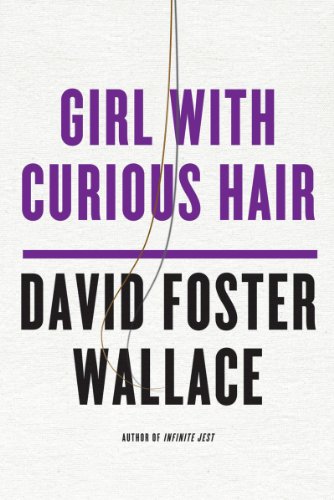
4. Girl With Curious Hair (Norton
$3.94
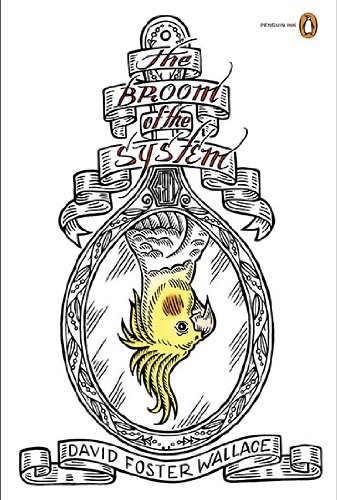
5. The Broom of the System
$25.75
6. Everything and More: A Compact
$23.01
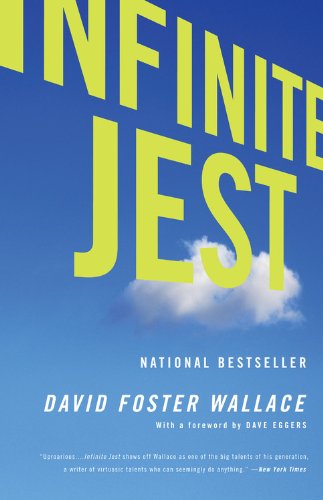
7. Infinite Jest: A Novel
$3.98
8. Brief Interviews with Hideous
$10.26
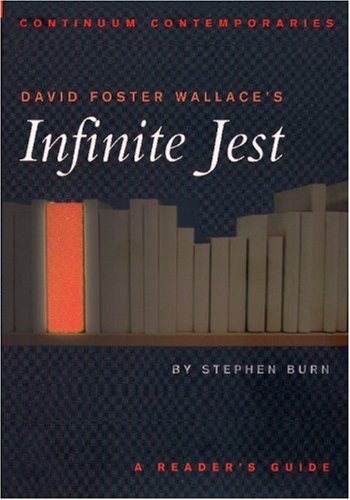
9. David Foster Wallace's Infinite
$7.50
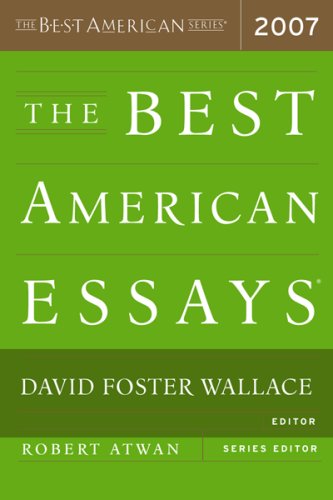
10. The Best American Essays 2007
$34.95
11. Understanding David Foster Wallace
$46.71
12. La Nia del Pelo Raro
$18.50
13. Extincion
$221.99
14. Open City Number Five : Change
$3.99
15. Up, Simba!
 
$8.00
16. REVIEW OF CONTEMPORARY FICTION
17. Georg Cantor
$9.95
18. Biography - Wallace, David Foster
 
19. The Broom Of The System (First
20. Review of Contemporary Fiction

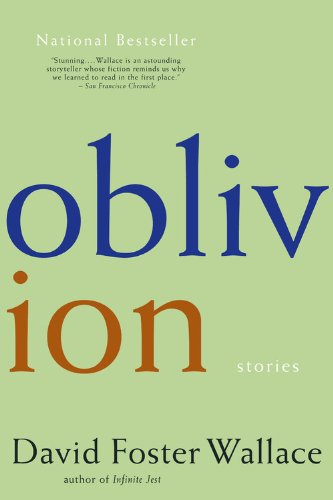
1. Oblivion: Stories
by David Foster Wallace
Paperback: 336 Pages (2005-08-30)
list price: US$14.95 -- used & new: US$3.66
(price subject to change: see help)
Asin: 0316010766
Average Customer Review: 3.5 out of 5 stars
Canada | United Kingdom | Germany | France | Japan
Editorial Review

Book Description
'Stunning......Wallace is an astonishing storyteller whose fiction reminds us why we learned how to read in the first place.' -San Francisco Chronicle OBLIVION is an arresting, hilarious new creation from a writer universally regarded as one of the most prodigious and original talents in contemporary letters. In the stories that make up this exuberantly praised collection, David Foster Wallace joins the rawest, most naked humanity with the infinite involutions of self-consciousness-a combination that is dazzlingly, uniquely his.Download Description
In the stories that make up Oblivion, David Foster Wallace joins the rawest, most naked humanity with the infinite involutions of self-consciousness—a combination that ilis dazzlingly, uniquely his. These are worlds undreamt-of by any other mind. Only David Foster Wallace could convey a father's desperate loneliness by way of his son's daydreaming through a teacher's homicidal breakdown ("The Soul Is Not a Smithy"). Or explore the deepest and most hilarious aspects of creativity by delineating the office politics surrounding a magazine profile of an artist who produces miniature sculptures in an anatomically inconceivable way ("The Suffering Channel"). Or capture the ache of love's breakdown in the painfully polite apologies of a man who believes his wife is hallucinating the sound of his snoring ("Oblivion").

Each of these stories is a complete world, as fully imagined as most entire novels, at once preposterously surreal and painfully immediate. Oblivion is an arresting and hilarious new creation from a writer "whose best work challenges and reinvents the art of fiction"(Atlanta Journal-Constitution). ... Read more

Customer Reviews (32)

2-0 out of 5 stars Read this to study for the GRE, but not to be entertained
This is fiction of a style I would label A.D.D. prose: there is very little action yet we spend pages reading about dribbly insignificant details. It is easy to lose focus while reading this book. Wallace writes sublimely detailed sketches of the characters, but it is only a still life; there is no action, no dimension. The one redeeming quality is the English of this book; extremely erudite, it is like reading a dictionary.

3-0 out of 5 stars Please enter a title for your review
*contains spoilers?*
where the vast majority of "literary fiction" writers say to themselves "i need some detail to add color to this scene, what's a generic characteristic that would be apparent and what's the best way to allude to it possessing overlooked significance?", Wallace finds and focusses on the details that are actually interesting and thus only needs to describe them in an objective rather than poetic way demonstrating the irrelevance of poetic descriptions when you have enough of a sense of reality to find the facts that define the nature of a situation and let them speak for themselves.
i felt like most of the writing in the first half of this book consistently paid off with a new idea that built on the previous ones every second or third sentence. i was too engaged by the minor immediate payoffs to even be anticpating an ultimate ending crescendo. i struggled to find any ideas that could hook me in the second half though, which is the same experience i had with Infinite Jest. all the faults of that previous novel are equally apparent here, the progressively increasing reliance on suspense to hold reader attention and excluding or vaguely implying the most relevant information.
the title story Oblivion is a non-linear minefield of half-ideas with a conclusion seemingly consisting (although i could be completely wrong) of the "...and it was all a dream" twilight zone ending. the cryptic style is perhaps designed to represent a dream, but since all his writing has included an element of surrealism it isn't different enough from his other stories for the intention to be apparent even retrospectively.
The Suffering Channel is alternating boring and frustrasting, spending all of it's 90 pages raising question after question that are never answered and dragging out the suspense with the kind of banal detail that can only be called padding, something DFW clearly knows better than to use. the minor philisophical ideas never go beyond surface level kneejerk reactions, something that, again, DFW clearly knows better than to use.
just like Infinite Jest half of it blew me away but i couldn't see how the same writer could take any pride in the lesser half.

3-0 out of 5 stars Best collection since Girl with Curious Hair
One of the most dense yet intriguing short story collection since Girl With Curious Hair. Here the caveat lector is of course the sterile (at times incredibly boring) build-up constructed purposively to cathart the denouement, and make as if the dialectic probing of the human condition, was somehow merit, or enlightening. This is distinctly Wallace. Distinctly wealthy, manipulative, and white.

The inclusion of clinical, statistical terminology, though sticks out like sore thumbs, even to medical professionals like myself.

5-0 out of 5 stars Brilliant
The best collection of short fiction from the best living writer in the English language.It demands patience and attention, but the rewards for the effort are incredible.The best story in the collection is Good Old Neon, which is bifercated (by use of footnotes), such that there are two distinct endings, both of which would qualify the story as probably the best I have read this year.
These stories coil and bend, and the sentences are often labyrinthine; casual reading really won't suffice. If you do put forth the effort, I think you'll find that they engage the mind and that other thing, whatever it may be, that makes us what we call "human."Truly an outstanding collection.

4-0 out of 5 stars I go back to it fairly frequently
Pissed off at the mindnumbing aspects of television, I found this collection of stories to be a breath of fresh air showing me the power and scope of what fiction writing can be when someone courageous enough will put in the work.You can trust Wallace to know what the heck he's writing about, just don't think too hard about it - like television - enjoy it and the words and ideas in each story will, in the end, make you glad you did, unlike television.I especially enjoy 'Good Old Neon' and 'Another Pioneer'. ... Read more


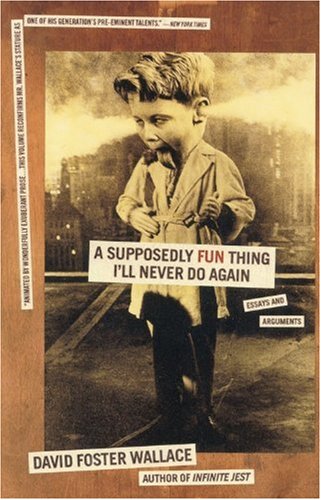
2. A Supposedly Fun Thing I'll Never Do Again: Essays and Arguments
by David Foster Wallace
Paperback: 368 Pages (1998-02-02)
list price: US$14.99 -- used & new: US$7.44
(price subject to change: see help)
Asin: 0316925284
Average Customer Review: 4.0 out of 5 stars
Canada | United Kingdom | Germany | France | Japan
Editorial Review

Amazon.com
David Foster Wallace made quite a splash in 1996 with his massive novel, Infinite Jest. Now he's back with a collection of essays entitled A Supposedly Fun Thing I'll Never Do Again. In addition to a razor-sharp writing style, Wallace has a mercurial mind that lights on many subjects. His seven essays travel from a state fair in Illinois to a cruise ship in the Caribbean, explore how television affects literature and what makes film auteur David Lynch tick, and deconstruct deconstructionism and find the intersection between tornadoes and tennis.

These eclectic interests are enhanced by an eye (and nose) for detail: "I have seen sucrose beaches and water a very bright blue.I have seen an all-red leisure suit with flared lapels. I have smelled what suntan lotion smells like spread over 21,000 pounds of hot flesh . . ." It's evident that Wallace revels in both the life of the mind and the peculiarities of his fellows; in A Supposedly Fun Thing I'll Never Do Again he celebrates both.Book Description
David Foster Wallace made quite a splash in 1996 with his massive novel, Infinite Jest. Now he's back with a collection of essays entitled A Supposedly Fun Thing I'll Never Do Again. In addition to a razor-sharp writing style, Wallace has a mercurial mind that lights on many subjects. His seven essays travel from a state fair in Illinois to a cruise ship in the Caribbean, explore how television affects literature and what makes film auteur David Lynch tick, and deconstruct deconstructionism and find the intersection between tornadoes and tennis. These eclectic interests are enhanced by an eye (and nose) for detail: "I have seen sucrose beaches and water a very bright blue.I have seen an all-red leisure suit with flared lapels. I have smelled what suntan lotion smells like spread over 21,000 pounds of hot flesh . . ." It's evident that Wallace revels in both the life of the mind and the peculiarities of his fellows; in A Supposedly Fun Thing I'll Never Do Again he celebrates both. ... Read more

Customer Reviews (85)

5-0 out of 5 stars Sheer genius.
David Foster Wallace is one awesomely smart guy. This is both his greatest strength and his potential Achilles heel as a writer. Personally, I will read anything this man writes, because I think he is a true genius with a rare sense of compassion, and a hilarious sense of humor. Even when his writing falls victim to its own cleverness, I still find it worthwhile - perhaps because one senses that the writer is a true mensch (not something I feel when being dazzled by the cleverness of a Dave Eggers, for instance).

Oh hell, I want to be seated next to DFW on a long transpacific flight subject to major delays, OK? I have an enormous intellectual crush on this man. And when I cavil, it is done out of love, pure and simple.

But when discussing this book, caviling would simply be out of place. It contains two of the funniest essays I have ever read in my life (the descriptions of his experiences on a cruise liner and at the state fair, respectively). Do yourself a favor. Read this book.

4-0 out of 5 stars Detailing certain paradigms w/r/t what can loosely be considered the contemporary pomo condition
I came to this book of essays via 'Brief Interviews with Hideous' men, a recent DFW short story collection (which I found one of those books I wanted to enjoy but couldn't). This essay collection I found I wanted to enjoy, and I certainly did.

Some pieces contain long stretches of genius. The title piece and 'Getting Away from Already Being Pretty Much Away from It All' are both superb dissections of a luxury Caribbean cruise and a Midwestern country fair respectively. DFW, by merely turning up and observing, picks out with his genius power rays of observation, in hillarious and telling detail, the social rhythms and pulses of these occasions. The Caribbean cruise piece must rank as one of the great modern essays as the detail slowly accumulates to reveal a nauseous portrait of overprivileged wealthy American tourists going through their bovine (with DFW's accompanying 'bovinecophobia) activities, waited on to a ludicrous degree by servants and lackeys, with the express purpose of making sure their every whim is catered for. The Illinois fair piece similarly illuminates the Midwestern condition (peoplego on holiday to meet people, as opposed to the East Coast where they go on holiday to escape from people) and their dietary habits, their activities (horrendous sounding carnival rides, which the author finds terrifying) and their livestock and rural baking traditions. Credit too for whichever editor of Harpers had the foresight to send DFW on these trips. He certainly taps into a vibe that fairly rips off the page when he writes up such events.

DFW is truly a massively reconstructed Midwesterner. His influences and nostalgia all points Illinois way (as evidenced by a cool piece on the physics of tennis, and his junior ranking years), but his sensibility is all hip and modern - he is well up their with the savviest and smartest of New York writers, in fact he is well above the vast majority of them.

You get the sense that there is no modern feeling that DFW doesn't understand, or try to grapple with. Reading these pieces is to engage with a creative and comic mind of the highest caliber. Unlike many writers, DFW is a true polymath, equally at home in the figures and thought processes of science as he is with pure art. Whether it be the subliminal commercialism that infects so much of contemporary US life, the disturbing suspense (rather than the 'pleasant' commercial suspense) of David Lynch movies, or the unique difficulty modern writers have in grappling with the immense televisual culture, DFW casts illuminating, if at times abtruse, analysis on the situation.

I do feel his style is a little loose limbed at times - my, admittedly probably more hidebound British ear, found the liberal smatterings of 'sort of' 'kind of' and the ubiquitous 'like', though thankfully not ',like', which no one pronounces. And some sentences are clearly only for the super intellectual academic studier of pomo texts. The worst piece, 'Greatly Exaggerated' which trips around various French post modern type deconstruction of the author style theories, is full of sentences like the following: 'What Hix offers as a resolution to the debate is a combination of a Derridean metaphysics that rejects assumptions of unified causal presence and a Wittgensteinian analytic method of treating actual habits of discourse as a touchstone for figuring out what certain terms really mean and do'. Erm, quite.

Still, DFW is known as a super smart intellectual, and he can be forgiven the odd slightly pretentious indulging in his higher planes of thinking. For the majority of this book is accessible, and original, and sheds great light on a whole sweep of contemporary US life, and most importantly is often very very funny in a genuinely warm and human way, which is a trait I find lacking in certain youngish hipster authors.

DFW is virtually unknown in the UK. Unlike some of his contemporaries (particularly Franzen and Safran Froer), he has failed to gain much of a readership over here. His books are only stocked on the shelves of the largest or most enlightened stores. I hope this changes and more non US readers discover his unique voice. As for me, I am limbering up with his most recent essay collection 'Consider the Lobster' as a final wind up before tackling the immense 'Infinite Jest' - any views on how a British reader might find that book from people who have tackled that magnum opus?

4-0 out of 5 stars 4.5 stars
As many have said, the title essay in this volume by Wallace is worth the price alone. I've been on a cruise before as well, and holy hell are Wallace's thoughts in this essay spot on. Every sentence drips with truth.

Of course, as with anything by Wallace, you've got to meet him half-way or you will not like/understand him. This collection, because most of these essays were written for magazines or as argumentative essays, is actually very conservative writing-wise for Wallace: there are no grammatical and syntactical acrobatics and page-long insanities that inform his book-length long works, or his more aggressive short stories (like the wonderful but taxing Oblivion).

Of particular relevance in this collection is a nearly 15 year old essay E Unibus Pluram, about the corrosive effects of irony as a literary tactic aimed at television. While some reviewers have suggested this essay is outdated (and in terms of its more topical references/subjects, it is), I think it probably holds more relevance than ever, with the kind of unfathomably corrosive effects that reality TV and MTV and etc. have had on youth culture and the English language. And this is coming from a ripe old aged-22-years fogie.

There are some portions of essays that drag, but I acknowledge that may be due to my own lack of interest (say, in tennis, for the second to last essay). This collection is full of some very funny and informative essays (including one on David Lynch) that are moderately readable even with little knowledge/experience of the subject. If you are just getting into reading Wallace, this is a great way to introduce yourselves before picking up his MUCH more experimental fiction.

4-0 out of 5 stars A Supposedly Good Book I'll Never Read Again
I picked up this collection of Wallace's essays largely based on his reputation as one of America's young, "genius" writers, in the line of Franzen and Powers and while he amply demonstrates his exhaustive vocabulary and keen sense of observation, his selected subject matter is often mundane. The title essay, ultimate in the collection, recounting his 7-day Caribbean cruise, is by far the best work in the collection, but even it wonders off in the weeds with long passages of minutia that seem pointless except to demonstrate the author's verbal pyrotechnics. I find Wallace's signature stylistic trait, the liberal use of long digressive footnotes, to be distracting. Reading him is like browsing a Web page with numerous URL links to other far-flung pages, clicking on each link in sequence just to check out the reference and then navigating back to the original. By the time you get back, you've lost context and the author's original point -- rereading previous paragraphs often ensues. Suffice it to say, this 'two steps forward, one step back' reading experience is frustrating.

I'll rate this book a ***+ or ****- (since we don't get half stars) primarily based on the occasional nugget of wisdom or spot-on description Wallace sprinkles through his essays. It's certainly worth picking up, particularly a cheap remaindered copy, for the two or three decent essays in this set, since it's easy to skip the clunkers (like his visit to the state fair) and move onto the next piece.

4-0 out of 5 stars Like an amusing dinner guest
You know those people who have everyone at your table laughing so hard they can hardly eat?Reading Wallace's essays is just like listening to one of them, complete with hysterically funny asides (long footnotes that will crack you up).Just don't try to read his stuff while eating.Oh, and check out his amazing piece on Roger Federer from last summer's New York Times magazine.You can find it on the Times website.It's worth a search. ... Read more


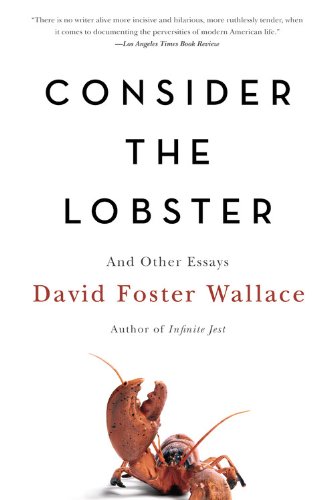
3. Consider the Lobster: And Other Essays
by David Foster Wallace
Paperback: 352 Pages (2007-07-02)
list price: US$14.99 -- used & new: US$7.99
(price subject to change: see help)
Asin: 0316013323
Average Customer Review: 4.0 out of 5 stars
Canada | United Kingdom | Germany | France | Japan
Editorial Review

Book Description
Do lobsters feel pain? Did Franz Kafka have a funny bone? What is John Updike's deal, anyway? And what happens when adult video starlets meet their fans in person? David Foster Wallace answers these questions and more in essays that are also enthralling narrative adventures. Whether covering the three-ring circus of a vicious presidential race, plunging into the wars between dictionary writers, or confronting the World's Largest Lobster Cooker at the annual Maine Lobster Festival, Wallace projects a quality of thought that is uniquely his and a voice as powerful and distinct as any in American letters. ... Read more

Customer Reviews (45)

4-0 out of 5 stars for DFW disciples
I would suggest, dear reader, that when considering Consider the Lobster, that you consider it in the same light as David Foster Wallace's collection A Supposedly Fun Thing I'll Never Do Again. Use that book as your frame of reference for style and content and you can place this collection firmly into the category of "typical" DFW. That being said, if you thoroughly enjoyed A Supposedly Fun Thing... then you'll likely thoroughly enjoy this one as well; by that same coin, if you're on the fence, you're unlikely to be won over; and if you dislike DFW (If you truly and I mean honestly and passionately dislike DFW, well then I suggest some rigorous therapeutic interventions) then this collection will probably do you no favors.

So in this reviewer's opinion: Consider the Lobster is more of the same. But that's a good thing.More...

One thing that CtL has over ASFTINDA is that it reads like an essayist's equivalent to a DJ's mixtape. While the essays individually are more than capable of standing on their own (e.g., apart from each other; i.e., in their original printings) they are arranged in such a creative way here that they build upon each other. The essays are vaguely self-referential, perhaps purposefully so; "jokes" from a given essay may rely heavily on you properly "getting" and then retaining the thesis of a preceding essay. I submit as an example: "Authority and American Usage" contains several sections that are slightly humorous in their own respect but can only be truly appreciated as bracingly so when you recall Wallace's thesis on Franz Kafka's humor from the prior article and the accompanying explication of said humor and why it is thoroughly pointless to try and explain any joke anywhere, let alone Kafka's absurdly dark and probably pathological comedy (which is totally drained of its humor when you try to offer any kind of explanation. I offer as further evidence for this that (after a protracted bout of laughing) I read aloud (to A.) a passage from "Authority and American Usage" and how it's humor is underscored by the thesis of the Kafka essay to which A. offered scarcely an acknowledging chortle). In this way, CtL may be Wallace's finest collection to date; the interleaving of the essays, their strength when taken as a whole, an obscurely surreal recursion. It's really all quite expertly done.

Perhaps the highlight of this collection is the maturity that Wallace is showing. Previous collections have his tone and style coming off as a bit of an effete intellectual, a nerdy-but-hip smartest-kid-in-class tone that is simultaneously masterfully humorous and maddening. Like maybe he's just trying to make you feel dumb but then again maybe it's thesaurial sleight-of-hand to play into some particular joke. Which is not at all to suggest that he has discarded this completely. But maybe like he's toned it down a bit (maybe?)? His signature style is definitely still there but he seems to have grown into it, it's a better fit. Whereas before it may have felt borderline confrontational (see above), it comes across now as disarming. For example, in the midst of "Authority and American Usage", Wallace comes across (on the one hand) vaguely condescending of SNOOTs (just read the essay...) and then on the other hand admits to being one; and then he takes a deeper dig on SNOOTs by eviscerating their essays and articles and other writings (e.g., the heavy-handed and jargon-laden "worst ever" publications of Comparative Lit profs) by using the very same over-the-top vocabulary to get to that point (I mean seriously: do you know anyone to drop "solecistic" in casual conversation?). The whole routine can be a little jaw-clenched maddening but is for those same reasons endearing and worthwhile.

It is also seems worth mentioning that Wallace masterfully frames pretty grand subject matter in all kinds of tangential and frankly genius-like-a-mad-scientist ways that it's formidable and a bit frightening. Example: Wallace uses "Authority and American Usage" as a vehicle to discuss linguistic politics and the critical role of socialization, language learning, and regional dialects on individual growth and development (Compare/contrast with similar arguments posited in Freakonomics). Example: Wallace uses his coverage of McCain2000 in "Up, Simba!" to discuss the political brokerage through media outlets and the bizarre power dynamics at work between journalists, politicians, and their handlers (let it also be known that this becomes painfully apparent when the essay's title appears in the text; it's a real head-slapping moment with a kind of chilling aftershock). Example: how Wallace goes to work on the ethics of food in "Consider the Lobster", working through the logic rather elegantly and then stupefyingly relinquishing it all with the atavistic admission that that simply isn't enough to tear you away from the desire to enjoy something delicious. In light of all this, it's no wonder an aspiring author Such As continues to find himself enthralled and intimidated by this literary Cronus.

Parting shots? I have two: the first regarding my "four of five" rating and the second a mere sidebar.

First: though the tone in CtL shows a refreshing maturity and welcome evolution, and though every essay is engaging and timely and brilliant, there also seem to be moments of tedium. Perhaps this is expected and unavoidable. But an essay on a book on the life and times of Dostoevsky (e.g.) can disappoint. Abandoning the F.N. format for a House of Leaves-esque series of drawn boxes is more distracting than textually informing (even if the essay's content is exhilarating and terrifying). And maybe it's just me but "How Tracy Austin Broke My Heart" seemed (via the text) a parody of itself as much as it was a parody and/or review of the book in question.

Second: while I don't believe that these kinds of things, should matter, I'm also of the opinion that Wallace should have fired the photographer. Or perhaps chosen a better photo from that particular shoot. I realize that folks may want their book jacket photos to be relatively current, and I realize that our bodies change over time, and all of that is fine; but I also wonder if his publisher could have perhaps insisted that they find a photo that did NOT make him look like a squinty-eyed and slightly slumped Jeffrey Lebowski. Seriously sir, that's your credibility at stake here.

5-0 out of 5 stars Smart, eclectic, and hilariously funny.
Full disclosure: I have a major intellectual crush on David Foster Wallace. Yes, yes, I know about his weaknesses - the digressions, the rampant footnote abuse, the flaunting of his amazing erudition, the mess that is 'Infinite Jest'. I know all this, and I don't care. Because when he is in top form, there's nobody else I would rather read. The man is hilarious; I think he's a mensch, and I don't believe he parades his erudition just to prove how smart he is. I think he can't help himself - it's a consequence of his wide-ranging curiosity. At heart he's a geek, but a charming, hyper-articulate geek. Who is almost frighteningly intelligent.

The pieces in "Consider the Lobster" have appeared previously in Rolling Stone, The Atlantic Monthly, the New York Observer, the Philadelphia Enquirer, Harper's, Gourmet, and Premiere magazines. Among them are short meditations on Updike's `Toward the end of Time', on Dostoyevsky, on Kafka's humor, and on the `breathtakingly insipid autobiography' of tennis player Tracy Austin. An intermediate length piece describes Foster Wallace's (eminently sane) reaction to the attacks of September 11th. Each of these shorter essays is interesting, but the meat and potatoes of the book is in the remaining five, considerably longer, pieces. They are:

Big Red Son: a report on the 1998 Adult Video News awards (the Oscars of porn) in Las Vegas.
Consider the Lobster: a report on a visit to the annual Maine Lobster Festival (for Gourmet magazine).
Host: a report on conservative talk radio, based on extensive interviews conducted with John Ziegler, host of "Live and Local" on Southern California's KFI.
Up Simba: an account of seven days on the campaign trail with John McCain in his 2000 presidential bid (for Rolling Stone).
Authority and American Usage: a review of Bryan Garner's"A Dictionary of Modern American Usage" , which serves as a springboard for a terrific exegesis of usage questions and controversies.

Here's what I like about David Foster Wallace's writing: I know of nobody else who writes as thoughtfully and intelligently. That he manages to write so informatively, with humor and genuine wit, on almost any subject under the sun is mind-blowing - it's also why I am willing to forgive his occasional stylistic excesses. (Can you spell `footnote'?) You may not have a strong interest in lobsters or pornography, but the essays in question are terrific. The reporting on Ziegler and McCain is amazingly good, heartbreakingly so, because it makes the relative shallowness of most reporting painfully evident. Finally, the article on usage is a tour de force - when it first appeared in Harper's, upon finishing it, I was immediately moved to go online and order a copy of Garner's book (which is just as good as DFW promised).

How can you not enjoy an essay that begins as follows?

"Did you know that probing the seamy underbelly of US lexicography reveals ideological strife and controversy and intrigue and nastiness and fervor on a near Lewinskian scale?

....... (several other rhetorical questions) ......

Did you know that US lexicography even*had*a seamy underbelly?"

And which later contains sentences such as:
"Teachers who do this are dumb."
"This argument is not quite the barrel of drugged trout that Methodological Descriptivism was, but it's still vulnerable to objections."
and - my personal favorite -
"This is so stupid it practically drools."

Not everyone will give this collection 5 stars, but I do.

4-0 out of 5 stars Brillian and Funny but Ultimately Pandering
Coming back to Wallace after having not read him in a (personally very consequential) few years allowed me to see him better:the dude is a square. Over and over (and I've read and reread virtually everything DFW's written, the math book aside) Wallace presents the following as a, if the not the, central idea of his work:cliches and the homespun advice you spurned to become cooly cynical are where truth really resides.In three different books Wallace puts forth the following bromide:being cynical and naive are not mutually exclusive.In this book's essays we learn Wallace thinks that the popularity of filmed exotica (apologies for the euphemism) will lead to snuff films.Snuff films!(It's been at least 10 years and so far no one's moved from pigs' masks to snuff, at least no one I associate with).Later Wallace asserts that John McCain's torture makes him a better candidate with the power to inspire masses of young people to Get Involved.Wallace also talks about 911 patriotism without really touching on xenophobia and naked, violent fear.In other words, the authorial (though probably not the actual) Wallace believes in his heart of hearts the same things as the (imagined?) midwestern viewer Fox news is always trying to stir to a froth.But would the succubus and Grammar Nazi* on which April Incandenza was modeled be likely to spawn this hick? Wallace frequently argues for the greatness of Flannery O'Connor's work but it's not hard to guess how the very literal religious beliefs of Ms. O'Connor would go down at an Incandenza/Wallace family dinner.It may be that Wallace is reacting against that stiflingly academic environment, but he always presents this Central Idea like a dog who expects a treat after a well-performed trick:he wants to be applauded for (he thinks) going against the grain but hedges by telling his audience that their most comforting and dearly held sentiments, no matter how unrealistic, are not only true but rebellious.It's fitting that Wallace frequently writes about TV because he usually shares its trite emotional conclusions.

The TV references date the book unfortunately and indicate, like Wallace's basic dishonesty as a writer, that he just doesn't know how good he is.I realize this is a harsh review (though it's a loveletter compared to the bile Wallace spews on poor John Updike (whose place in the canon seems much more assured)), but it's honest and arrived at after closely examining Wallace's uncommon and almost unparalleled virtues.Wallace has the potential to be remembered in centuries, and he probably will as a stylist and humorist. Wallace's Byzantine sentences recreate the fun of the first Escher poster you saw and if you don't laugh or at least smile at his description of Scotty Schwartz's self-serving anecdotes you're either evil or stupid. But if Wallace wants greatness like that of Flaubert--whose revelations are often not reassuring--he's gotta stop pandering.Like Charles Tavis, whose constant confessions are at least as misleading and coercive as blunt deception, Wallace packs many and deep layers of truth around his core lie.

*Honestly, if Wallace were to read this, don't you think my shifting POV (first-, third- and even second-person) and other grammar mistakes would annoy him a lot more than my essentially calling him a phony?

4-0 out of 5 stars Consider the Reader
Consider the Lobster: And Other Essays

David Foster Wallace wields a mighty literary voice. Although not easily accessible, this book's collection of essays is not to be missed. From an insider's view of McCain's campaign trail, to an eldritch perspective of the Boston Lobster Festival, Wallace presents the modern essay as high art.

I say it's not easily accessible because his range and precision with the English language is nearly unmatched in modern literature. You might as well purchase a pack of index cards when you buy this one because you'll either have to pause every other page to look up a word, or use the cards to write them down to look up later.

If you want to experience the highest tier of modern wordsmithing and essay crafting buy this one today.

4-0 out of 5 stars Porn Stars, Lobsters and Politicians
The collection of essays features David Foster Wallace's insights into worlds as disparate as the porn industry and the Maine Lobster Festival.His erudition is filtered through a popular and provocative voice whose sardonic humor reflects a general acceptance of modern life.

Wallace's shorter essays are where he's at his best, sometimes playing the role of the critic, as in "How Tracy Austin Broke My Heart," and sometimes packaging tremendous poignancy in with surface humor ("The View From Mrs. Thompson's" is one of the best essays on 9/11). While his longer essays capture intriguing topics (life on the campaign trail with John McCain, the inner psychological workings of a radio disc jockey, etc.), they start to become a bit tiresome in their organization (or lack thereof).Wallace includes footnotes or sidebars as written subtexts, and while they are witty and often important, they do constantly yank the reader away from the essay itself in a manner that might infuriate some readers.

The author's real gift is to capture vignettes of the mundane and turn them into opportunities for social critique.Even though he does this with varying success, he is able to combine intellectual conversation with absurdity in a way few authors can.Peter Grier, of the Christian Science Monitor, described him best when he called him a "snowboarder with a PhD." ... Read more


4. Girl With Curious Hair (Norton Paperback Fiction)
by David Foster Wallace
 Paperback: 373 Pages (1996-03)
list price: US$14.95 -- used & new: US$5.94
(price subject to change: see help)
Asin: 0393313964
Average Customer Review: 4.0 out of 5 stars
Canada | United Kingdom | Germany | France | Japan

Customer Reviews (25)

5-0 out of 5 stars Brilliant, funny, disturbing
This collection of short stories is, sadly, much stronger than the more recent batch released in Oblivion.D.F. Wallace still seems stymied by the mammoth success he generated with Infinite Jest; it's been 12 years and still no new novel.If Oblivion is any indication, maybe he used up most of his brilliance with I.J.

The good news is that this book contains some real gems of short fiction.The title story is one of the most frightening, deeply disturbing pieces I've ever read.Nothing supernatural happens, but its depiction of dementia spawned by the horrific child abuse in the narrator's past really gets under your skin.Other strong entries are "Little Expressionless Animals" and "My Appearance."The final story, though cited as a precursor of sorts to Infinite Jest, didn't do much for me.

All in all, this is a stunning piece of work that goes far beyond the boundaries often associated with the short story format.

5-0 out of 5 stars DFW, Fiction and DFW and Fiction
Okay, so here's the deal w/ DFW: the guy is extremely intelligent. he is also overtly aware of his intelligence and displays it all over the place. this bothers people. some things to remember and know about DFW: he was a philo. major as an undergrad; his first book was an investigation of the theories of ludwig wittgenstein, also an overly intelligent fellow and very hard to follow. Something else: in this collection of short-stories, the one titled "the girl w/ curious hair," DFW displays that he also knows one thing or another about fiction and that he has read a lot of it and doesn't like most of it. the title story, "girl w cur..." is a cool story is you think you like punks and nihilists and sado-masochism and other stuff, but it helps to know something about bret easton ellis's stuff, and to know that DFW hates (HATES!) BEE w/ some serious passion. Then there's the two stories about real-world characters, "little expressionless animals"--the opening piece, and i think it's pretty damn cool--and "lyndon" are investigations/explorations of using "real-world characters" (which for legal reasons has to be roundly denied) that was pioneered by the exceedingly weird and totally fun robert coover who wrote "the public burning" whose main character was richard milhouse nixon and was the first book to use a "RWC" as a protagonist. so there's that. then there's the piece of cathartic/psyhological diaglogue, in which DFW dips his fingers, there's "john billy" which is kind of a stab at faulkner but is also pretty cool and a really great read near the end (which i find is pretty true of most of DFW's stuff, it takes a while to build up and the guy is a straight-up bonafide (a word he hates) genius at bringing it all together and making you feel good when you finish a story). there's some other stuff in there (like "everything's green" which is only two pages but still isn't his shortest piece which was only like five lines, and both of those are cool). finally, there's the final fiction, a novella of about like 150 pages or something and it's all-over john barth (author of "the floating opera," "giles goat-boy" (which is way weird), "the sot-weed factor" and others) principally his exlposive collection of shorts, "lost in the funhouse." ytou should read that entire book (it's short) in order to really get what DFW is after in "westward the course of empire makes its way," and he's really after "metafiction," look it up. so this is all to say that DFW is writing fiction, and it's way cool fiction, well written and crafted, with interesting characters and solid "stories," but it is way helpful to know his sources. this kind of fiction--intertexual and in some ways needing a well-literary-read reader--is not for all. it's some damn fun stuff on it's own though. i recommend DFW to those w/ an interest in where "serious literary fiction" might be making it's way; to those who also enjoy and appreciate vollmann, powers, pynchon (seriously pynchon), gaddis, barth, maybe updike a little but not totally, and some other guys, yeah, mostly white males, but also cynthia ozick, whose fiction is slamming, especially her shorts which are hard to come by. so there's that, which is nice.

2-0 out of 5 stars Foster: a craftsman of the human language
Unfortunately, there is a very real difference between those with a gift for manipulating the human language and good 'writers'. Continents of difference.

Wallace will often spend pages of deft and cynical description, and it takes the heaviness of the reader's eyelids to alert him to the fact that *nothing is happening*. Now, thinking something needs to be happening in fiction may be out of style among the Midwest creative writing programs this year, but all Foster seems to be communicating is "Look at me! I'm clever as you please!" Some of these stories almost feel like they began as one of his overly-written essays (once he spent twenty pages describing a tennis court, apparently in the belief all of his readers were Haitian refugees who only knew sugarcane fields) and then he added a few lines of dialogue.

The language is very pretty, but I have hand-carved pretty crystal things which aren't even decent paperweights. If only his fiction were about something besides poking fun at the writing of fiction!

It's something like literary self-gratification. It takes skill and effort, and it probably felt very good while he was doing it, but in the end he's left all alone, the only person who really knows the 'what' and 'why' of any of it.

4-0 out of 5 stars An EntertainingMixed Bag
I read Girl With Curious Hair after Infinite Jest, so I thought I had some idea of what to expect.The stories in this book are so different from one another, and from Jest, that I shall now review them separately.
Little Expressionless Animals-This story blended the absurd business of game shows perfectly with the absurd story of a savant lesbian and her autistic brother.This was probably my favorite story.
Luckily the Account Representative Knew CPR- This story was the very crisp.It is short, and it is still detailed, but it is not an extravaganza like the others.It is a good story, though, and very clever.
Girl With Curious Hair- This story is hilarious and very perverse.My brother says it is pro-Republicanism, but I do not believe him.It may be too perverted for many people.
Lyndon- This is a good example of DFW's ability to recreate actual famous people.It is also a comment on the different kinds of love people have.I don't think that I understood it.
John Billy- John Billy is an excellent example of DFW's style.It is a simple story about the hometown hero Chuck Nunn Jr, told in a complicatedly Kansan dialect and with a bizzarre twist at the end.
Here and There- This is a story that I enjoyed very much.It is a dialectic account of the failure of a genius to love.It has an anti-ending similar to Infinite Jest, though, which many find troublesome.
My Appearance- This may be the best story in the collection.It explores the conflicting themes of sincerity/naivite and irony/cynicism.It also stars David Letterman.
Say Never- This story was about a man who cheats on his wife and then with his brother's girlfriend, and then confesses.It is told from his p.o.v., the brother's, and their mother's friend Labov.I didn't like this one that much, but the style is, as usual, amazing.
Everything is Green- This one is only two pages long and doesnt make any sense as far as I can tell.If it were more than two pages long, I might advise skipping it.But then, if it were more than two pages long, it might be good.
Westward the Course of Empire Takes Its Way- This novella made me think alot, about stories and postmodernism and commercialism.I liked it alot.However, like Barth's Lost in the Funhouse that inspired it, at the end I did not understand it.
On the whole, this is an excellent collection and there is something to like about each piece, except maybe Everything is Green. I recommend it and Infinte Jest to pretty much anybody.

3-0 out of 5 stars Worth My Appearance alone...
Why do so many reviews warn readers of the complexity of Infinte Jest? I found Infinite Jest to be a hundred times more readable than most of the stories in Girl with Curious Hair. The last story is ridicliously difficult to read and the ending makes no sense at all. Why would an author who deftly satirizes meta-fiction even in his first book (which some reviewers compared to the great metafictionists) purposefully try to be so difficult? Like the main character in Broom of the System tells Rick Vigorous: why don't you tell a real story instead of a story about a story? As a huge David Foster Wallace fan, I have to admit that I positively abhor Broom of the System and most of Girl With Curious Hair. They seem to be like cold, heartless exercises in how-avant-garde-can-I-be? and not at all pieces of writing that seemed like they were written by the author of Infinite Jest. But as my title eludes to, I am postively enamored with My Appearance. As an indictment of postmodern irony and its inability to truly accomplish anything, the story is flawless (well maybe the didactic dialogue can be a little off putting). More than any other living author, David Foster Wallace tackles the most important issues of the day to his generation and mine: drug abuse, depression, loneliness, irony, sex, and television. And, unlike other authors, he doesn't do it in a cute or ironic way. In an anthology of literary criticism from the 1950s, I read an article in which a critic expressed her feeling that writers of her decade had lost the ability to write about their culture and instead chose to focus on subjective explorations of individuals outside the bounds of society. I find current writers to be having the same difficulties, though instead of decadent novels about sex, drugs, and depression, todays writers write novels about mysterious byzantine paintings or soulless "satires" of the media in which the same sort of heartless humor and everyone's-a-whore philosophy found on late night TV is used to supposedly "skewer" that very phemenona. Those who are unafraid to face real, scary human realities like Wallace are the real heroes. ... Read more


5. The Broom of the System
by David Foster Wallace
Paperback: 480 Pages (2004-05-25)
list price: US$15.00 -- used & new: US$3.94
(price subject to change: see help)
Asin: 0142002429
Average Customer Review: 3.5 out of 5 stars
Canada | United Kingdom | Germany | France | Japan
Editorial Review

Book Description
Published when Wallace was just twenty-four years old, The Broom of the System stunned critics and marked the emergence of an extraordinary new talent. At the center of this outlandishly funny, fiercely intelligent novel is the bewitching heroine, Lenore Stonecipher Beadsman. The year is 1990 and the place is a slightly altered Cleveland, Ohio. Lenore’s great-grandmother has disappeared with twenty-five other inmates of the Shaker Heights Nursing Home. Her beau, and boss, Rick Vigorous, is insanely jealous, and her cockatiel, Vlad the Impaler, has suddenly started spouting a mixture of psycho- babble, Auden, and the King James Bible. Ingenious and entertaining, this debut from one of the most innovative writers of his generation brilliantly explores the paradoxes of language, storytelling, and reality. ... Read more

Customer Reviews (42)

4-0 out of 5 stars If you're just reading it now---
you must remember, that the first edition arrived on the scene in 1987. I read it back then, when I was much younger and there was not a plethora of new ideas out there. I appreciated how different it was from the mainstream novels.It was definitely bright, original and hilariously funny, in many scenes.Would I feel the same about it, if I were just reading it for the first time, with all the competition out there churning out literary jewels?Well, I think not!But I'm glad I read it when I did and still think many would get a kick out of it today. BTW, I still own my copy, so it made some kind of imprint that prevented me from recycling it at 1/2 Price Books, where most of my novels eventually come to rest :-).

2-0 out of 5 stars Disappointing
As a raving fanatic of DFW, I was surprisingly and to all contrary expectations let down quite thoroughly by his first novel. People say it's a mini Infinite Jest, but that's really not true at all. I mean there are budding and teasing similarities, but they are, in my opinion, very different novels concerned with different issues. First, The Broom of the System is mostly in dialogue without the sharp wit and rolling-on-the-floor-funny humor and the trademark myriad lengthy footnotes you see in his later works. Second, it is a hell of a lot less pretentious; i.e. I didn't have to consult the OED, not even once, which is unthinkable in his later works, fiction or essays. In this sense, the book is much easier to read, but then for a seasoned DFW fan/reader, it felt lightweight, paltry, and very unsatisfying indeed. In other words, I felt cheated.

Indulge me with a little rant. The quintessential DFW experience is a menagerie of pretentiousness, sophistication, and killer humor blended together with the right amount of direction or plot. And here I say pretentiousness in its most possible sense. People tend to say, "Oh that's pretentious!" in the spirit of angry and dismissive criticism, but if you look at it more carefully, what's wrong with being pretentious? You know a lot of stuff, and you show off what you know. And what's wrong with that? Does it make you feel stupid? Ignorant? Inadequate? Well then, big guy, maybe you should sit, look up those words, learn them, and delve in further. Be a little more patient when reading books. It's literature, not popular fiction. It offers you an opportunity to be more educated, more knowledgeable, and perhaps - God forbid - more pretentious. Anyway, DFW's pretentiousness is by no means a malicious or harmful kind where he's trying to put you down or show he's a hundred times smarter than you. On the contrary, it seems to be informed by a desire to just play around with words (e.g. Hey, this word sounds cool, why not use it?).

But I digress. The point is that The Broom of the System didn't offer the full range and depth of DFW experience. It wasn't pretentious (which can be a good thing for some readers), it wasn't that sophisticated (no footnotes? Come on. And any cool plot? Like a film that makes people watch until they die and is being hunted by a Canadian wheelchair terrorist group to give the big terrorizing finger to the US?), and it wasn't that funny (I can recall only three, at most four, instances when I laughed out loud). The plot, too, was pretty bland and wasn't exciting. It also kept going off on tremendous tangents that weren't 1) funny or 2)relevant to the main story.

So all in all, it was such a let down that it almost hurt when the book ended as it did. Read his essays and his magnum opus, but this one isn't that worth it.

2-0 out of 5 stars I tried really hard to like this book
This book looked promising and I loved the first line.However, that was all I loved.There was very little actual "story" to this book and without compelling characters, settings, or philosophies it became incredibly dull.

2-0 out of 5 stars Maybe don't bother.
I agree with the reviews that consider this book a pretentious, self-indulgent, ego-fest. Wallace is obviously highly intelligent, and every minute of this book seems designed to remind us of that.

It all starts off well enough. The characters are quirky and interesting. At first. And Wallace does a good enough job of setting up a curious chain of events to keep the reader reading and wondering what's going to happen. But nothing ever really happens. And at some point I just grew sick of the characters and their weird little lives.

Ultimately, this just felt like what happens when a really smart person decides to write something as a way to experiment with and exhibit his own intellect. And while that exercise may have been rewarding for Wallace, it wasn't so terribly rewarding for the reader.

5-0 out of 5 stars Savagely intelligent and uproariously hilarious
After literally stumbling across Wallace's "Brief Interviews With Hideous Men," I immediately purchased "Broom Of The System."

Through a series of lough-out-loud dialouge and absurdly detailed passages, the story of young Lenore Beadsmen unfolds before the reader's enchanted eyes. Among the funnier characters, there are Lenore's violently jealous boss who is coincedently her lover; Wang-dang-lang, a friend from college; and Norman Bombardini, an obscenely obese lone-wolf with an unhealthy obsession for Lenore.

Although there are really no key plots, the story is never dull and a lot of the short stories within the book (critiqued by none other then Lenore's boss who runs a publishing company) are reason enough alone to buy this paperback edition.

Although I think the ending was overly abrupt, it fits in well with the context of the character, especially considering his apparent fixation on "words" (the word itself is the word that should appear as the last word in the book, if this made any sense to you whatsoever).

Nonetheless, this book is a definite must have for any Wallace fan, and an excellent introduction to him which will not give you a workout every time you pick it up to read like the hefty "Infinite Jest" undoubtedly will.

blog.myspace.com/mattyp242 ... Read more


6. Everything and More: A Compact History of Infinity (Great Discoveries)
by David Foster Wallace
Hardcover: 320 Pages (2003-09-30)
list price: US$23.95 -- used & new: US$25.75
(price subject to change: see help)
Asin: B000FUO0G0
Average Customer Review: 3.0 out of 5 stars
Canada | United Kingdom | Germany | France | Japan
Editorial Review

Amazon.com
Before discussing the merits of David Foster Wallace's Everything and More: A Compact History of Infinity, it is essential to define what the book is not. This volume in the "Great Discoveries" series is not a history of the personalities and social conditions that led to the "discovery" of infinity. Nor is it a narrative fixated on the cultish fear of--and obsession with--the infinite that has seemingly driven mathematicians insane over the centuries. Rather, Everything and More is a surprisingly rigorous march through the 2000 plus years of mathematical research that began with Aristotle; continued through Galileo, Isaac Newton, G.W. Leibniz, Karl Weierstrass, and J.W.R. Dedekind; and culminated in Georg Cantor and his Set Theory.The task Wallace (author of the bestseller Infinite Jest and other fiction) has set himself is enormously challenging: without radically compromising the complexity of the philosophy, metaphysics, or mathematics that underlies the evolving concept of infinity, present the material to a lay audience in a manner that is entertaining. To propel his narrative, Wallace even develops a style that mirrors the mathematical language he probes. One difficulty in his focus on concepts and not a strict human chronology, though, is that his structure is dependent on frequent digressions (especially early on). Patience is required. Wallace demands that his reader walk through the equations, study the graphs and charts, and relearn college-level concepts to follow along on the exploration. Indeed, after one wrenching dip into Zeno's paradoxes, Wallace spouts at his imagined complaining audience: "Deal." But the book should be deemed a success. If one grants him the attention he requires, Wallace has made the trip richly rewarding.--Patrick O'KelleyBook Description
The best-selling author of Infinite Jest on the two-thousand-year-old quest to understand infinity.

One of the outstanding voices of his generation, David Foster Wallace has won a large and devoted following for the intellectual ambition and bravura style of his fiction and essays. Now he brings his considerable talents to the history of one of math's most enduring puzzles: the seemingly paradoxical nature of infinity.

Is infinity a valid mathematical property or a meaningless abstraction? The nineteenth-century mathematical genius Georg Cantor's answer to this question not only surprised him but also shook the very foundations upon which math had been built. Cantor's counterintuitive discovery of a progression of larger and larger infinities created controversy in his time and may have hastened his mental breakdown, but it also helped lead to the development of set theory, analytic philosophy, and even computer technology.

Smart, challenging, and thoroughly rewarding, Wallace's tour de force brings immediate and high-profile recognition to the bizarre and fascinating world of higher mathematics.

About the series:Great Discoveries brings together renowned writers from diverse backgrounds to tell the stories of crucial scientific breakthroughs—the great discoveries that have gone on to transform our view of the world. ... Read more

Customer Reviews (44)

2-0 out of 5 stars Please enter a title for your review
this book offers no recommendation for what mathematical principles a reader should be familiar with before starting it but any claim of it being accessable to an average reader would be misleading.
if seems not only like no attempt was made to relate most of what is being described to any commonsense foundation, but that it was academically overwritten into a code that even someone who already knew all the information contained in the book would have trouble following. in my ironic experience the "emergency glossary" definitions themselves contain more undefined or ambiguous terms than any other part of the text.

2-0 out of 5 stars How not to write a book on math
It was Isaac Asimov who once pointed out that to be a great science fiction writer, you must first be a great writer, but the converse doesn't necessarily hold true:you can be a great writer but a poor science fiction writer.The same is true for other genres as well as David Foster Wallace's Everything and More illustrates:he may be a great novelist (though I can't even be positive of that, as I've never read any of his books prior to this one), but he is a mediocre science/math writer.

What is Everything and More about?It is a history of the mathematic concept "infinity".From ancient times, the concept of infinity was troublesome and often worked around.Paradoxes such as Achilles and the Tortoise demonstrated the seeming contradictions of the infinite; for example, this ancient paradox pointed out that to go from point A to point B, you must first go to the halfway point, but to get to that point C, you need to first go to the halfway point between A and C, and so on, ad infinitum.Since there is always another midpoint standing between you and your destination, you can never reach it, but, as anyone who has walked from A to B knows, this seeming impossibility is really possible.

Infinity would be a concept more or less ignored or danced around until the development of calculus made it essential.Even then, for a while, infinity (and the related concept, the infinitesimal) was a shaky idea.Yes, calculus worked, but the foundation it was built on was of uncertain strength.It would take the work of Cantor to finally give infinity its strong theoretical basis; indeed, Cantor is the hero of Everything and More, though he really only appears in the end to clean things up.

Wallace is something of a literary writer, which is not a quality that really fits a math history.He is an occasionally witty and generally wordy writer who is often clever but more often too clever.His constant asides and footnotes are distracting and diminish the clarity that this subject requires.He enjoys abbreviations to the point of annoyance.In addition, a book of this type demands a table of contents or at least an index, but neither are provided.

Reading Everything and More is like going diamond mining.You know there is a gem somewhere, but you need to a lot of work to get to it.In the end, I don't think it is worth the effort.Wallace may be a good writer in other contexts, and certainly this is an interesting concept, but he is not the right man for the job.If you want to see what good math or science writing is like, read Martin Gardener, Isaac Asimov, Carl Sagan, Brian Greene or a dozen others; if you want to see how not to write on such subjects, Everything and More is an ideal example.

1-0 out of 5 stars Unreadable
I could not read more than 50 pages of this self-indulgent, illiterate, incompetent mess before going into "browse mode".How did this get past the editors at Norton??

5-0 out of 5 stars Infinity Explained
A brilliant book on the big questions about infinity.Wallace can seemingly make any subject a page turner.His explanations of complex mathematics are clear and simple.I loved it.

5-0 out of 5 stars Math for Smarties (Both Informed and Un)
I originally picked this book up for my math grad student roommate, but on his recommendation I read it after, and I loved it.I don't have an extensive math background, while he (clearly) does, but I think we both liked it equally.

The book is both theory and history and, through the use of footnotes allows you to tailor the information you're receiving to make it either more elite, more basic, or just more specific.As long as the reader is interested in intellectual history he or she should enjoy the book. ... Read more


7. Infinite Jest: A Novel
by David Foster Wallace
Paperback: 1088 Pages (1997-01-31)
list price: US$18.95 -- used & new: US$23.01
(price subject to change: see help)
Asin: B00008RWB3
Average Customer Review: 4.0 out of 5 stars
Canada | United Kingdom | Germany | France | Japan
Editorial Review

Amazon.com
In a sprawling, wild, super-hyped magnum opus, David Foster Wallace fulfills the promise of his precocious novelThe Broom of the System.Equal parts philosophical quest and screwball comedy, Infinite Jest bends every rule of fiction, features a huge cast and multilevel narrative, and questions essential elements of American culture - our entertainments, our addictions, our relationships, our pleasures, our abilities to define ourselves. ... Read more

Customer Reviews (333)

5-0 out of 5 stars A great and difficult book(as it should be)
I am determined to write a short review of a very long book. And quickly. I started reading "IJ" the year it first came out and finished it 5 years later. That's OK. It's like reading Melville's "Moby Dick," Joyce's "Ulysses" or Pychon's Gravity's Rainbow."If you are a serious contemporary/postmodern/whatever reader or writer you must read it. Whatever time it takes. Homework. Don't skip the footnotes. You will not regret it. You'll laugh/cry/it will become you/etc. Infinite Jest is the book I recommend when I am talking to people who REALLY READ BOOKS.
Working backwards, I now turn to "Don Quixote." Bon voyage!

5-0 out of 5 stars recommended for human beings
Imagine (if you will) an attempt to capture the whole of human experience in a semi-plausible all-too-near future North America.Now imagine that the attempt works.And it does a pretty good job of getting a good cross-section and eviscerating it (it is a cross-section, after all) in all of its banal humanity.

The physical weight of this novel can be a bit intimidating.Most folks don't feel this ambitious when it comes to their pleasure reading.Which is too bad, really.Because if you just take your time, you'll find yourself well-rewarded.

But yeah, you've got to be prepared to take a joke.

3-0 out of 5 stars Please enter a title for your review
i'm amazed by the diverse range of topics and situations that David Foster Wallace can go into realistic descriptive detail on, it's like he has a hidden camera and microphone on every person in the world and he can just pull a random file from his database every time he needs a new character or situation for a story, but I wonder how much of it comes from instinctive insight and how much from research, and whether any average writer couldn't essentially achieve the same result if they were willing to invest enough time and effort.
i went back and forth between loving Infinite Jest and hating it, probably eventually spending more time, if not hating it, at least annoyed by it.
after the first 200 pages i thought this was going to be a book i could generalize about but it isn't. like every novel I've ever found any value in this one can be evenly divided into worthwhile parts and throwaways. pages 435-503 (and at least a third of the chapters thereafter) are nothing more than generic functional writing and a drag to get through, warranting skimming. there are also a few depraved horror-scenarios, as well as plenty of racism/sexism/homophobia that i'm surprised gets no mention as an issue against the book while the endnotes constantly do. the author enjoys racial slurs so much he even invents one for canadians.
the further you get through the book the less new ideas there are, the plottier it gets, and the more typically novelish it gets, baiting you with constant cliffhangers and just generally being vague and cryptic. regressing to the kind of writing that implies everything and specifies nothing, to the point that you inevitably start drawing the wrong implications from things, and when you realise that's what you've done you just stop trying to focus, accept that 25% of the text will be lost on you, being unable to work out how one sentence (or part thereof) correpsonds to another regardless of how many times you re-read it in a row, and race to the end to get it over with trusting that whatever's significant will stick.
If you have an impulse to put the book down at the halfway mark because it feels like it's winding down i say go with it, you won't miss much. When DFW is on he's untouchable, but the other half of this book seems thoughtlessly tossed off.

1-0 out of 5 stars Too smart for your own good.
There was a time when picking up a book made you feel that you would be whisked away to a fantasy world, entertained, moved, and satisfied.With this guy picking up a book means getting a hernia.If it is not 400k words, it must not be analyzed enough!I could not take it.It was written fine, the thing was long and boring enough to get the kudos of people that have spent their lives loving all the words of the world so much that every single one of them must be put in their book.Sure, he was making good points, for the 1990s!Argh, not my cup of tea.But remember, this guy won a freeking McAuthor genius grant.

still like this story better, it is just more zany, funny, and dumb
Life Begins...

5-0 out of 5 stars The Ending (or lack thereof)
So I started looking through the one star and five star reviews just for fun.The issue of the lack of closure to Infinite Jest has come up repeatedly in both camps of criticism.Here's what went through my head when I finished the book for the first time (I'm a little more than half-way through my second and somehow even more gratifying read of it presently, obviously I loved it the first time as well):

"That's it?No way! [staring awestruck at the final page, flipping over to the "Notes and Errata" then back again with an irrational hope to find more in between]I want MORE!How unresolved![etc, etc, etc]Wait a second, this FEELING that I have, this unsatisfied desire, this craving for more stimulus and entertainment...haven't I been reading a book about this very basic phenomenon?About addiction, entertainment, consumerism, and so forth?Ah, yes, I get it now.Brilliant move David, you've turned the mirror of the Ennet House around to capture my reflection and MAKE ME THINK beyond the book.Make me "Identify"."

Do people really think someone as intelligent as Wallace would just sloppily, lazily, without purpose and meaning, end the novel he put so much effort into?Look for the possible reasons, the intentions.To me it's obvious why the novel ends the way that it does. ... Read more


8. Brief Interviews with Hideous Men
by David Foster Wallace
Paperback: 336 Pages (2000-04-01)
list price: US$14.99 -- used & new: US$3.98
(price subject to change: see help)
Asin: 0316925195
Average Customer Review: 3.5 out of 5 stars
Canada | United Kingdom | Germany | France | Japan
Editorial Review

Amazon.com
Amid the screams of adulation for bandanna-clad wunderkind David Foster Wallace, you might hear a small peep. It is the cry for some restraint. On occasion the reader is left in the dust wondering where the story went, as the author, literary turbochargers on full-blast, suddenly accelerates into the wild-blue-footnoted yonder in pursuit of some obscure metafictional fancy. Brief Interviews with Hideous Men, Wallace's latest collection, is at least in part a response to the distress signal put out by the many readers who want to ride along with him, if he'd only slow down for a second.

The intellectual gymnastics and ceaseless rumination endure (if you don't have a tolerance for that kind of thing, your nose doesn't belong in this book), but they are for the most part couched in simpler, less frenzied narratives. The book's four-piece namesake takes the form of interview transcripts, in which the conniving horror that is the male gender is revealed in all of its licentious glory. In the short, two-part "The Devil Is a Busy Man," Wallace strolls through the Hall of Mirrors that is human motivation. (Is it possible to completely rid an act of generosity of any self-serving benefits? And why is it easier to sell a couch for five dollars than it is to give it away for free?) The even shorter glimpse into modern-day social ritual, "A Radically Condensed History of Postindustrial Life," stretches the seams of its total of seven lines with scathing economy: "She laughed extremely hard, hoping to be liked. Then each drove home alone, staring straight ahead, with the very same twist to their faces." Wallace also imbues his extreme observational skills with a haunting poetic sensibility. Witness what he does to a diving board and the two darkened patches at the end of it in "Forever Overhead":

It's going to send you someplace which its own length keeps you from seeing, which seems wrong to submit to without even thinking.... They are skin abraded from feet by the violence of the disappearance of people with real weight.
Of course, not every piece is an absolute winner. "The Depressed Person" slips from purposefully clinical to unintentionally boring. "Tri-Stan: I Sold Sissee Nar to Ecko" reimagines an Arthurian tale in MTV terms and holds your attention for about as long as you'd imagine from such a description. Ultimately, however, even these failed experiments are a testament to Mr. Wallace's endless if unbridled talent. Once he gets the reins completely around that sucker, it's going to be quite a ride. --Bob MichaelsAmazon.com Audiobook Review
David Foster Wallace is one of those either-love-him-or-hate-him kind of writers, but most of the subjects in his collection are--as the title suggests--worthy of contempt. On this audiocassette, DFW, as he's known to his fans, reads a selection of his works from the book of the same name. The fictional "interviews" are brief forays into the minds of men via questions that are signaled with a verbal "Q," but never actually asked. While he reads those pieces in the voices of the interviewees, Wallace reads the rest of the collection--a handful of short stories--with the self-conscious lack of emotion commonly used by poets. Don't look for plot or action here; it's strictly character sketches with a good dose of verbal gymnastics. And don't expect to like most of the characters; it's clear the author doesn't either. (Running time: 3 hours, 2 cassettes) --Kimberly HeinrichsBook Description
Amid the screams of adulation for bandanna-clad wunderkind David Foster Wallace, you might hear a small peep. It is the cry for some restraint. On occasion the reader is left in the dust wondering where the story went, as the author, literary turbochargers on full-blast, suddenly accelerates into the wild-blue-footnoted yonder in pursuit of some obscure metafictional fancy. Brief Interviews with Hideous Men, Wallace's latest collection, is at least in part a response to the distress signal put out by the many readers who want to ride along with him, if he'd only slow down for a second.The intellectual gymnastics and ceaseless rumination endure (if you don't have a tolerance for that kind of thing, your nose doesn't belong in this book), but they are for the most part couched in simpler, less frenzied narratives. The book's four-piece namesake takes the form of interview transcripts, in which the conniving horror that is the male gender is revealed in all of its licentious glory. In the short, two-part "The Devil Is a Busy Man," Wallace strolls through the Hall of Mirrors that is human motivation. (Is it possible to completely rid an act of generosity of any self-serving benefits? And why is it easier to sell a couch for five dollars than it is to give it away for free?) The even shorter glimpse into modern-day social ritual, "A Radically Condensed History of Postindustrial Life," stretches the seams of its total of seven lines with scathing economy: "She laughed extremely hard, hoping to be liked. Then each drove home alone, staring straight ahead, with the very same twist to their faces." Wallace also imbues his extreme observational skills with a haunting poetic sensibility. Witness what he does to a diving board and the two darkened patches at the end of it in "Forever Overhead":It's going to send you someplace which its own length keeps you from seeing, which seems wrong to submit to without even thinking.... They are skin abraded from feet by the violence of the disappearance of people with real weight.Of course, not every piece is an absolute winner. "The Depressed Person" slips from purposefully clinical to unintentionally boring. "Tri-Stan: I Sold Sissee Nar to Ecko" reimagines an Arthurian tale in MTV terms and holds your attention for about as long as you'd imagine from such a description. Ultimately, however, even these failed experiments are a testament to Mr. Wallace's endless if unbridled talent. Once he gets the reins completely around that sucker, it's going to be quite a ride. --Bob Michaels ... Read more

Customer Reviews (65)

4-0 out of 5 stars recommended for hideous men
This collection is about two short stories shy of a perfect "10".That said, for anyone that wants to cut their teeth on some DFW before taking the Infinite Jest plunge, I would gladly recommend this compilation.There are numerous gems in here that tease you in every which way.Here are the great (short) examples of DFW's work: format bending, expectation jerking, emotion shredding -- all of it.

3-0 out of 5 stars victory for the forces of democratic freedom
as with all DFW's work, if you ripped almost exactly 50% of the pages out you could find yourself with a 5 star book.
the first 84 pages are mostly a waste. what wrong with it? two words: slow paced. the ideas are there but they're repeated over and over when you just want to get to the next one. the bit about the kid at the swimming pool would have to be the least rewarding ten pages he's ever published and makes me wish i could read the stuff he discarded instead.
i can't tell whether his breaking the fourth wall part was really written in his own genuine voice or in the character of an author who's trying to manipulate you into liking him, in keeping with a previous theme of the book.
is it really possible he can be apprehensive about using the word "limn" or some analogy involving "A + L = E equation of modern accounting" because only 1 person out of 1000 would care, but have no qualms about publishing his 3 page jargon-riddled futuristic dictionary definition of "date"? is this possible? the basis on which he deducts what is a good or bad idea/piece is his absolute failing. the basis on which he differentiates between what is worth publishing and what isn't is somehow based on attributes completely aside from those that make him my favorite writer. so i guess what i love about his writing is incidental or peripheral to what he's really focussed on. so weird.

2-0 out of 5 stars Clever but Reader-Friendly?
As a writer, I found the craft utilized by David Foster Wallace intriguing. He really breaks out of what a standard "story" can be and is quite successful in a few of the pieces. I, however, did not enjoy much of what I read.

There is something to be said for being clever and being inventive but to put so many stories together in one collection limits the ability to take them all in and truly enjoy them. I think if this book had been cut in half I would have given it a better review, but the sheer number of non traditional stories was too overwhelming. In other words, I wanted more story and less creation.

5-0 out of 5 stars RIVETING PATTER OF CONSCIOUSNESS; NOT BRIEF, AND NOT ALWAYS HIDEOUS
I am intrigued by reviewers who picked up a David Foster Wallace novel and expected to beat a crystal clear-cut confession out of it. Lamenting the lack of "a point" in just about any creation of this eccentric author is a bit lacking in ingenuity; it's like walking into a pub on the east end of London and griping about the lack of homely milkshakes.

The literature of Foster Wallace--and yes, it certainly is literature-- is not for everyone. Not in a lofty, philistine, I'm-So-Uppity sort of a way. Just in the sheer breadth and depth of its imagination. Just read the "Key Phrases" bit below the book title on this Amazon.com page here and you'll get a good sense of the Left-of-Center stuff to expect from these adroit little vignettes of the human mind, all 23 of them. There are four essays titled Brief Interviews with Hideous Men--which should dispel any misconceptions you may have about the book from its title--and all of them are sensational in their departure from the norm, from creative formatting to the effervescent use of language.

The first essay, A Radically Condensed History of the Postindustrial Life, is exactly 79 words. Guess you can even find it online if you try hard enough. But that's all the brevity you're going to get for the remainder of the book. Mind you, Wallace may write in long, really long, sentences, and his profuse footnotes would take Nicholson Baker to task. But "boring" is not an accusation he merits by any stretch of criticism (e.g., "More pu$$y than the toilet seat man. I shit you not").

For those who doubt his literary imagination, I only need to point to his essay "Datum Centurio" which is an at-first-confusing sliver of a specific dictionary, but when your tube light comes on, it comes on with mad respect for the author. Or the brilliant set of pop quizzes in "Octet" that describe interesting social situations from around the world and then pose tangential questions such as "Which one of them lived?" -- the question in and of itself forces a totally new dimension to the paragraph you had just finished reading and felt that you had understood. Then there's the throbbing spirit of "Adult World" where a young wife worries if her love-making with her new husband is stressful for his "thingie" -- an atavistic fear that is so beautifully drawn out, you almost feel like having a word with this woman.

Ultimately, the novel's misfits, losers, dreamers, and just plain good paranoid folk, get an affectionate if pensive frisking from the author's hands. It's provocative, witty, and very, very engaging. Don't like his stream of consciousness style of writing? Skip this one. But please don't ignorantly castigate something that is not in line with your own personal tastes.

5-0 out of 5 stars Hats off to an innovator
The writer in me says: thank you.

The reader in me says: you sonofa****. ... Read more


9. David Foster Wallace's Infinite Jest: A Reader's Guide (Continuum Contemporaries)
by Stephen Burn
Paperback: 96 Pages (2003-04)
list price: US$12.95 -- used & new: US$10.26
(price subject to change: see help)
Asin: 082641477X
Average Customer Review: 5.0 out of 5 stars
Canada | United Kingdom | Germany | France | Japan
Editorial Review

Book Description
This is part of a new series of guides to contemporary novels. The aim of the series is to give readers accessible and informative introductions to some of the most popular, most acclaimed and most influential novels of recent years - from `The Remains of the Day' to `White Teeth'. A team of contemporary fiction scholars from both sides of the Atlantic has been assembled to provide a thorough and readable analysis of each of the novels in question. ... Read more

Customer Reviews (5)

5-0 out of 5 stars Read this after Infinite Jest
This book is excellent for reviewing the overall meaning of infinite jest.It lays out a comprehensive chronology of every event, delves into several topics concerning David Foster Wallace and Infinite Jest, and, most importantly, is a good read.If you've made it through the 1000-some pages of Infinite Jest, add these 96 pages to the top and get a much-needed recap of this great book.

4-0 out of 5 stars mostly [...]
As a great fan of Infinite Jest, I picked up this book over a year ago. It is disappointing. Burn spends a lot of time picking on one or two hobbyhorses; more insightful interpretations have appeared elsewhere, in particular on the web in communities like wallace-l, and prior to Burn's (very slim) volume.

Burn also feels the need to rack up the wordometer with a very academicish approach to the subject that won't endear him to the readers who presumably come in already familiar with many of the issues that Burn rehashes at the level of a freshman seminar.

If you are curious and have the cash, by all means pick up a copy; I do, and I don't regret the purchase. But there are far more valuable sources of information and intepretation of Wallace's book out there online, and they are not hard to find.

5-0 out of 5 stars An Illuminating Guide
If Infinite Jest has become the Ulysses of the late twentieth century, then this excellent guide is the equivalent of Stuart Gilbert's companion to Joyce's masterpiece: Burn offers a lucid unravelling of some of the more mysterious aspects of Wallace's book (what exactly is up with Hal, where the mastercopy of the film is at a given time), but he also demonstrates fascinating parallels with books like The Golden Bough that I'd never thought of. It's also mercifully free of the kind of esoteric literary theory that spoils so many literary studies - refreshingly Burn prefers to situate the novel alongside the work of writers like Jonathan Franzen, and William Gaddis.

The book is short (you sometimes get the feeling that Burns wants to say more but doesn't have space) but within those limitations this is a fine study of a terrific novel - highly recommended.

5-0 out of 5 stars Brilliant, humble analysis
I've been a fan of IJ since reading it in the summer of '96, but I've never read such a lucid and thoughtful analysis as this book provides.Burns has put enormous effort into analyzing Wallace's writing style, and avoids the simple analysis that Wallace is concsiously trying to undermine.Even though there are many subjects in the book that I would love Burns' opinion on, he is forthcoming about the limitations of the 'readers' guide' format, and has chosen his few topics for detailed analysis with care and skill.

I especially liked his understanding and analysis of IJ's literary context: rather than simplistically comparing Wallace's work to Pynchon or DeLillo, as many have done, he explores the richer tradition of myth materials and 20th-century literature that informs Wallace's brilliant novel.

My only criticism is Burns' failure to comment on Wallace's sense of humor, which was one of the reasons I loved IJ so much, and why I find it worth re-reading from time to time.I've enjoyed other writers endorsed by Wallace, like Irvine Welsh and Dave Eggers, but some literary analysis of Wallace's effective use of different varieties of humor would have been helpful.Still, given the lucid and concise analysis Burns provides, this criticism should be understood as part of my wishlist, not any negative take on Burns' sense of humor.

5-0 out of 5 stars Exceptional
A remarkable book - and a fitting tribute to DFW's wonderful novel. Quite how Stephen Burn has managed to cram so much lucid opinion and information into a book of this brevity is beyond me, but he should be warmly applauded for doing so. One quibble only, for the publishers: labelling this book a 'readers guide' is doing it a disservice. Burn's book is much, much more than that. ... Read more


10. The Best American Essays 2007 (The Best American Series)
Paperback: 336 Pages (2007-10-10)
list price: US$14.00 -- used & new: US$7.50
(price subject to change: see help)
Asin: 0618709274
Average Customer Review: 4.5 out of 5 stars
Canada | United Kingdom | Germany | France | Japan
Editorial Review

Book Description
"The Best American Essays 2007" offers up the best pieces of the year selected and introduced by David Foster Wallace. ... Read more

Customer Reviews (6)

4-0 out of 5 stars Some unconventional choices
I didn't really know what to expect from a Best American Essays edited by David Foster Wallace.This man is one of the biggest personalities in American literature today and is known for his stylistic inventiveness and originality.He's published a couple of esoteric collections of his own essays and this is similar in some ways.

There are some very short essays (Name That Tone, a two-page reflection on youth and aging) and a couple lengthy ones (Iraq: The War of the Imagination, which stretches on for thirty-five pages).There are some conventional "essay" essays, and there are essays, that, as other reviewers noted, are basically short stories.

I would say this collection has a bit of a political cast to it compared to others in the series.Two long pieces on the war in Iraq, one on torture, one on freedom of speech,and two on Christianity.I prefer essays in the tradition of Montaigne to pieces such as these and feel that they don't quite fit here.

But of course, nothing gets into this series if it isn't good, and anyone willing to keep an open mind about what an essay should be, should enjoy this book, and learn a couple things along the way.

3-0 out of 5 stars Like all anthologies, a mixed bag.
A typical anthology in this series has about two dozen essays and merits a 3-star rating. This book is no exception. With essays by Ian Buruma, Malcolm Gladwell, Cynthia Ozick, Marilynne Robinson, Richard Rodriguez, Elaine Scarry, Louis Menand, John Lahr, Peter Singer, Edward O. Wilson, and an introduction by David Foster Wallace, there is no shortage of big-name contributors. Unfortunately, name recognition doesn't always guarantee quality and, for me, the gems in this collection came from authors I was unfamiliar with until now.

In addition to a terrific introduction by DFW, there were four essays among the 22 in this collection that I found exceptional:

"Werner" by Jo Ann Beard
"Shakers" by Daniel Orozco
"Dragon Slayers" by Jerald Walker
"Fathead's Hard Times" by W.S. DiPiero

Several essays covered political topics: Mark Danner on Iraq, George Gessert on torture, Garret Keizer on gun control, Phillip Robertson on Iraq, Elaine Scarry on America's compliance with the Geneva Convention, Roger Scruton's "A Carnivore's Credo", Ian Buruma on multiculturalism, Edward O. Wilson on responsible environmental stewardship, Peter Singer's "What should a millionaire give - and what should you?" It might be just a testament to my shallowness, but the only two of these essays that didn't feel like homework were those by Elaine Scarry and Peter Singer.

Gladwell's profile of Cesar Millan (The Dog Whisperer) is interesting, but only moderately so. Personal reminiscences are provided by John Lahr, Molly Peacock, Cynthia Ozick, and Marione Ingram. Of these, only that by Lahr rises above the average; Ingram's account of her family's experience during WWII during air raids on Hamburg, wh