e99 Online Shopping Mall

Geometry.Net - the online learning center Help  
Home  - Authors - Xenophon (Books)

  1-20 of 100 | Next 20
A  B  C  D  E  F  G  H  I  J  K  L  M  N  O  P  Q  R  S  T  U  V  W  X  Y  Z  

click price to see details     click image to enlarge     click link to go to the store

$6.12
1. The Art of Horsemanship
$7.25
2. The Persian Expedition (Penguin
$8.46
3. A History of My Times (Penguin
$29.85
4. Xenophon's Anabasis: Book 1-4
$21.95
5. Xenophon, III, Anabasis (Loeb
$10.35
6. Xenophon's Socrates
$19.85
7. The Education of Cyrus (Agora
$24.00
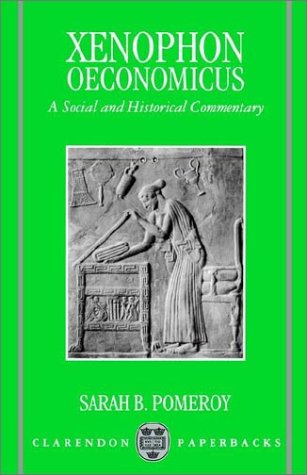
8. Xenophon: Memorabilia. Oeconomicus.
$16.01
9. The Memorabilia
$7.85
10. Conversations of Socrates (Penguin
$14.99
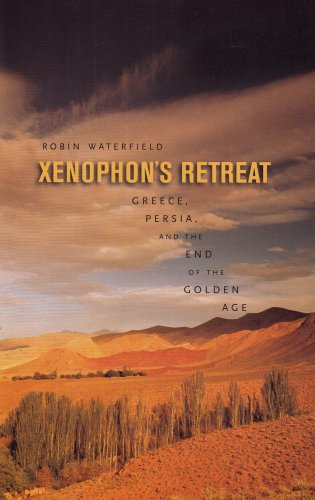
11. Xenophon's Retreat: Greece, Persia,
$18.85
12. The Shorter Socratic Writings:
$15.82
13. Xenophon: The Persian Expedition
$4.42
14. The Expedition of Cyrus (Oxford
$16.95
15. The March Up Country: A Translation
$32.00
16. The Long March: Xenophon and the
$12.10
17. The Anabasis of Cyrus (Agora)
 
18. The Exploits of Xenophon
$14.89
19. Hellenica: Hellenica
$16.28
20. Hellenica (Dodo Press)

1. The Art of Horsemanship
by Xenophon
Paperback: 208 Pages (2006-03-31)
list price: US$9.95 -- used & new: US$6.12
(price subject to change: see help)
Asin: 0486447537
Average Customer Review: 5.0 out of 5 stars
Canada | United Kingdom | Germany | France | Japan
Editorial Review

Book Description

Among the earliest known works on choosing, caring for, and riding horses, this book is still hailed — 2,300 years after it was written — as one of the most complete, thoughtful, and accessible guides of its type. Morris H. Morgan's fluid translation features 38 illustrations of this classic's practical tips and enlightened observations.
... Read more

Customer Reviews (11)

5-0 out of 5 stars A fascinating study
The material in this book is thousands of years old but amazing in how modern the approach is to horsemanship.Most of Xenophon's advice is timely even today.It shows how little has changed over the centuries.

5-0 out of 5 stars Xenophon - The Art of Horsemanship
This is a must if you are passionate about horses. It is so clear and to the essential point that it is a pleasure to read.

5-0 out of 5 stars A very interesting read
Xenophon covers several aspects of horsemanship, from grooming, leading, and choosing a horse, to mounting, riding, and training a war mount. Very, very interesting to see what is still applicable today. While this isn't a "training" or even a "horse care book," its a great historical reference from those interested in how horses we cared for and trained 2000 years ago. However, for those looking for a story or a book to teach riding skills, I suggest you look elsewhere. Those interested in dressage will find this worth-while, as it is considered the oldest text on the subject.

5-0 out of 5 stars Evidence of Ancient Humanism
Xenophon's philosophy and many techniques, though tailored for the development of a war-horse, demonstrate the ageless capacity for human empathy toward the horse. The horse centered work makes the goal of a harmonious partnership attainable. The book interweaves aspects of barn management, riding technique, and early human psychological insights. The translation keeps this work relevant and vibrant. The overriding theme is one of responsibility for the education and wellbeing of the horse. It is, if nothing else, a comfort to read that some horses in the ancient world were treated humanely in the training process...even if under the unfortunate auspices of a warrior culture. Kurt Hartle, Reydon,Suffolk. UK

5-0 out of 5 stars A "Must" For The Serious Horse Owner's/ Trainer's Library
The first ever book of it's kind on selecting, training and riding horses, eloquently written by an articulate ancient Greek horseman. A quick read but entertaining and enlightening. This English translation is very fluid and easy to understand. Xenophon covers all the basics of horse husbandry that are still followed 2500 years later. If you are thinking of owning or training a horse, this work is a good place to start. ... Read more


2. The Persian Expedition (Penguin Classics)
by Xenophon
Paperback: 384 Pages (1950-06-30)
list price: US$17.00 -- used & new: US$7.25
(price subject to change: see help)
Asin: 0140440070
Average Customer Review: 4.5 out of 5 stars
Canada | United Kingdom | Germany | France | Japan

Customer Reviews (16)

5-0 out of 5 stars A guide to AncientNear East
Xenophon accompanied the Ten Thousand, a large army of Greek mercenaries hired by Cyrus the Younger, who intended to seize the throne of Persia from his brother, Artaxerxes II. Though Cyrus' army was victorious at Cunaxa in Babylon (401 BCE), Cyrus himself was killed in the battle, rendering the victory irrelevant and the expedition a failure. Stranded deep in enemy territory, the Spartan general Clearchus and most of the other Greek generals were subsequently killed or captured by treachery on the part of the Persian satrap (or warlord) Tissaphernes. Xenophon played an instrumental role in encouraging the Greek army of 10,000 to march north to the Black Sea. Now abandoned in the middle of the hostile Anatolian plateau, without communications and supplies other than what they could obtain by force as they went, the 10,000 had to fight their way northward, making ad hoc decisions as to their destiny. Ultimately this "marching republic" managed to reach the shores of the Black Sea, which meant home for most of the soldiers.

I sometimes find reading ancient literature somewhat difficult, but Xenophon (as translated by Rex Warner) was fairly straight forward and easy to understand.The political infighting doesn't seem to have changed much in 2400 years, and I think that a few executions for disciplines' sake may not be out of order now-a-days.It is also a grand adventure and very interesting travelogue of Ancient Near East, with descriptions of some of the tribes from the former Hittite empire.A definite classic that those with an interest needs to read.

5-0 out of 5 stars fascinating narrative
A very interesting story about the expedition of ten thousands Greek mercenary soldiers who were motivated by financial rewards by Cyrus the younger for war against his brother,Atraxerexes II.
Cyrus was killed in Cunaxa battle and Greek army negotiated with the Persian satrap Tissaphernesaboutreturning back to Greece but the satrap hadthe intension to destroy the invading army and made it very hard for them to return from the same root and they had to divert towards Armenia first and then to southern coast of Black Sea.
They faced great difficulties on their march through hostile territories and were attacked several times by natives.
What is most interesting about this edition of "the Persian Expedition" is its first 48 pages of introduction by George Cawkwell and he is specialized in Greek history from sixth to fourth century and in his fantastic introduction and foot notes heexplains about Xenophon'sPan-Hellenic motives and disputed narratives about victory of ten thousands Greek army against 1.2 millions Persian army!! And how villages were plundered on their root to Persia and people were taken as hostages and were sold as slaves later.
Persian history is indebted to some Great scholars for their research and for exposing the true about the history.

4-0 out of 5 stars ROMP AND STOMP
This is the book that inspired all the swash-buckler adventures. A true escape coutresy good old boy XENOPHON...LOTS OF FUN

4-0 out of 5 stars Naration a matter of taste but timeless material
The narator is not one of my favorite Blackstone narators but that seems more a matter of personal taste.The content/translation of the material is where the value lies in this recording. Xenophon's tact and humor in telling this legendary tale makes it poetry as much as history and the narator gives it a good rendition.

5-0 out of 5 stars History, Culture and Leadership
The Persian Expedition or the "Anabasis" is a history of the expedition of a Greek Mercenary Army into the heart of the Persian empire to install Prince Cyrus upon the Persian throne. After success in battle against the Persian Emperor Artaxerxes, Cyrus is killed in battle and subsequently the Greek commanders are treacherously killed during truce negotiations.Despite being trapped in enemy territory, a thousand miles from assistance, the Greeks rally and retreat through Turkey to Byzantium via Armenia and the Black sea's coast despite determined opposition from Persian forces and tribal groups and natural dangers such as the mountains and rivers which threatened to halt the Greek retreat.

Xenophon was an Athenian who joined the expedition without rank, but following the Persian execution of the officers, was elected to the rank of General based upon his arguments that the Persian could no longer be trusted and that the Greeks only hope for survival and freedom was extricate themselves from there predicament. By the end of the march Xenophon has become one of the most respected of the Greek leaders and after successfully returning to Europe, he leads the survivors in the service of Seuthes IIto secure the Thracian throne.

The Persian Expedition at its most simple a rip roaring tale of survival in the face of seemingly overwhelming odds. But it also provides a is a fascinating picture of the Greek city state culture and religion and how both of these factors impacted on the Greek military forces and endeavours constantly creating frictions within the various factions which made up the Greek force. Also the Persian Expedition provides an interesting analysis of the Persian empires strengths and weakness, an analysis which would later form the basis of the Alexander's campaigns "Indeed an intelligent observer of the Kings empire would form the following estimate "It is strong in respect to the extent of its territory and number of inhabitants ; but it is weak in respect of its lengthened communications and the dispersal of its forces"

However on a more universal basis the Persian Expedition is worth reading for Xenophon's insights on leadership, with much detailed analysis of the personality and styles of the various leaders of the expeditions and how the soldiers reacted to these personalities. ... Read more


3. A History of My Times (Penguin Classics)
by Xenophon
Paperback: 432 Pages (1979-05-31)
list price: US$15.00 -- used & new: US$8.46
(price subject to change: see help)
Asin: 0140441751
Average Customer Review: 4.0 out of 5 stars
Canada | United Kingdom | Germany | France | Japan

Customer Reviews (7)

5-0 out of 5 stars Independence
This is by all means a heavily underrated book.
Xenophon lays bare the essential characteristics of his (and our) time and its crucial kernel, independence.

Inside the Greek cities, independence meant democracy, which was the political regime in Athens. The latter's arch-rival, Sparta, had an oligarchic rule, a government controlled by a king and the aristocracy.
When Sparta defeated Athens, it put immediately a lackey oligarchic government (the Thirty) in place. The oligarchs could `do exactly what they liked with the state.' They went on a killing spree, murdering all democratic opponents, in casu, `more Athenians than all the Peloponnesians did in ten years of war.' They confiscated illegally the property of resident aliens and when people could vote, it was in full view.
Xenophon knows perfectly the importance of education: `For I know that in Persia everybody except one man is educated to be a slave rather than stand up for himself.'

Inside the Peloponnesus, independence meant freedom for every city: `the cities must be independent, which means not to set up your own government ... what you aim at is not that they should govern in accordance with the laws, but that they should be strong enough to hold down the city by force. This makes it look like as though what gives you pleasure is dictatorship and not constitutional government.'
The Greek cities fought against each other to become `like the king of Persia ... the richest man on earth ... he gets his revenue from a continent.' The reward for control was solid tribute, but also the goldmines of Mount Pangaeum.
This continuous infighting and the relentless changes of alliances were a catastrophe for the populations. The inhabitants of the conquered cities were enslaved and sold or slaughtered, the crops and towns burned, cattle and precious metals stolen. The city was completely annihilated.
The war ended with the peace of Antalcidas in 387 B.C. on very favorable terms for Sparta.

Xenophon's book could also serve as a manual for vicious (bribery, infiltration, spying, informants) or clever diplomacy: `guard against the emergence of any single strong Greek state by seeing that they were all kept weak by constantly fighting among themselves.'
It is also an encyclopedia for military tactics: where, when and how to fight and how to keep the morale of the troops high.
He is also a fine psychologist: `people call a man `good' merely because he has been good to them.'

To the contrary of his joke, `even the golden plane tree was not big enough to give shade to a grasshopper', Xenophon's book puts many authors in the shadow.

A must read for all historians and lovers of classical literature.

4-0 out of 5 stars Read First
As a continuation of thuchides its a little soft. but if you read THE PERSIAN EXPIDITIONSby XENOPHON first you'll feel me comfotable with his
lighter reading style...

5-0 out of 5 stars The Vagaries of History
The title refers to the complete randomness of the document survival process.We know that only a small fraction of the works of Aristophanes, Euripides, Plato, Livy (the historian), Aristotle and other "greats" survived the ages.The Gospel of Mark, which both Luke and Matthew tries to supplant, survived only because the splinter group that used it was located in the desert and the dryness increased longevity.

Thucydides recorded the first part of the Peloponnesian War and Xenophon presents witness to the last few years.Remarkably, both men were participants and their history is based on first-hand knowledge of the events and people.The city-states of Thebes, Athens and Sparta vied for supremacy with shifting allegiances and no clear winner.The writing is good, very good when one considers the various replications and translations that have brought the work to this point.

Xenophon introduces speeches and comments of participants and instead of just recording battles and events, he begins the process of writing a moral history - assigning blame, making choices on good and bad, presenting justifications and the reasons why certain people acted as they did.THe author was one of the first of the new breed - those who sought to present human action that was not directed by the caprice of gods or nature.As such he succeeded admirably.

4-0 out of 5 stars The sequel to Thucydides
For people who have read Thucydides, this is an exemplary companion to his PELOPONNESIAN WAR. There are likely to be many readers out there who were dismayed at the conclusion of this text as it is incomplete.Of course, this is not the great historian's fault;he died while writing his epic historical treatise.

Enter Xenophon.He picks up almost right where Thucydides leaves off and traces the murky Grecian politics over the next 40 years or so, after which time Thebes would assert herself as the foremost power in the Greek world.

Along the way, Xenophon painfully recounts the demise of his beloved Spartans. His distaste for the Thebans is readily evident, and one must weigh the veracity of some of his descriptions ofbattles against his inherent Laconian prejudice.Rex Warner, the translator, does an excellent job of point out specific places where modern scholars have called into question Xenophon's honesty as well as his aptitude as an historian.

Nevertheless, for all the Xenophon-bashing that the 20th century has accrued, I still firmly believe he is well worth reading. He is one of the very few primary sources that we have for the demise of Alcibiades, the disastrous 30 Tyrants of Athens, the campaigns of King Agesilaus, the decisive battle of Leuctra and so much more.Hence, the present text is a MUST for the modern classical historian.

3-0 out of 5 stars A Fine Translation of Xenophon's "Hellenica"
Rex Warner's translation of Xenophon's "Hellenica" is quite enjoyable. However, the problem lies with Xenophon's writing. Allegedly a continuation of Thucydides' history of the Peloponnesian War, it is really more of a memoir recounting Spartan triumphs and failures during the period of 400 to 365 BC.Indeed, it should be regarded mainly as Xenophon's apologia on behalf of his Spartan patron, the king Agesilaus. As such it is often plodding reading. It is certainly not as riveting as Xenophon's "Anabasis". Yet those interested in Greek history during this time may find it rewarding. ... Read more


4. Xenophon's Anabasis: Book 1-4
by Maurice W. Mather, Joseph William Hewitt
Paperback: 516 Pages (1979-06)
list price: US$29.95 -- used & new: US$29.85
(price subject to change: see help)
Asin: 0806113472
Average Customer Review: 5.0 out of 5 stars
Canada | United Kingdom | Germany | France | Japan

Customer Reviews (3)

5-0 out of 5 stars Anabasis
Excellent edition of the Anabasis.I recommend it to anyone interested in Greek history and literature.The commentaries are informative and really add to the experience.

5-0 out of 5 stars Ultimate Student Edition
Mather and Hewitt's edition of the Anabasis is self-contained in a way that very few Greek texts currently in print are: not only does it have a very detailed line-by-line commentary, map and complete vocabulary, it also has a fulsome introduction to Xenophon and the Anabasis, including what the ancients thought of Xenophon, Xenophon's personality and subsequent literary career, and the organization and equipment of the Persian and Greek armies.The introduction and commentary are both pre-multiculturalist and therefore unabashedly discuss such things as the moral lessons to be drawn from the Anabasis, and the Anabasis as a model of democracy.Throughout, the text is furthermore illustrated with delightful little reproductions of Greek and Persian art, technology, monuments, coins, weapons, etc.

And of course, if you're looking to brush up on your Greek without the aid of a classroom and instructor, this edition is a great choice.Not only does it have the advantages enumerated above, but the Anabasis itself is relatively easy and clear Greek with a historical rather than philosophical vocabulary.

5-0 out of 5 stars An Excellent Book for Self Study
This is an excellent edition for those who are studying Greek on their own. The Anabasis is a fine second year book because its Greek is easierthan the "Apology of Socrates" by Plato. This edition also hasgrammatical notes and a Greek-English dictionaryof all the words you willneed for translation. You do not have to spend hours looking them up in theLiddell-Scott lexicon. Also, it lists interesting cognates and borrowingsfor most words. I strongly recommend this edition for those working onGreek as a hobby or outside of an academic environment. ... Read more


5. Xenophon, III, Anabasis (Loeb Classical Library)
by Xenophon
Hardcover: 672 Pages (1998-12-30)
list price: US$24.00 -- used & new: US$21.95
(price subject to change: see help)
Asin: 067499101X
Average Customer Review: 4.5 out of 5 stars
Canada | United Kingdom | Germany | France | Japan
Editorial Review

Book Description

Xenophon (ca. 430 to ca. 354 BCE) was a wealthy Athenian and friend of Socrates. He left Athens in 401 and joined an expedition including ten thousand Greeks led by the Persian governor Cyrus against the Persian king. After the defeat of Cyrus, it fell to Xenophon to lead the Greeks from the gates of Babylon back to the coast through inhospitable lands. Later he wrote the famous vivid account of this 'March Up-Country' (Anabasis); but meanwhile he entered service under the Spartans against the Persian king, married happily, and joined the staff of the Spartan king, Agesilaus. But Athens was at war with Sparta in 394 and so exiled Xenophon. The Spartans gave him an estate near Elis where he lived for years writing and hunting and educating his sons. Reconciled to Sparta, Athens restored Xenophon to honour but he preferred to retire to Corinth.

Xenophon's Anabasis is a true story of remarkable adventures. Hellenica, a history of Greek affairs from 411 to 362, begins as a continuation of Thucydides' account. There are four works on Socrates (collected in Volume IV of the Loeb Xenophon edition). In Memorabilia Xenophon adds to Plato's picture of Socrates from a different viewpoint. The Apology is an interesting complement to Plato's account of Socrates' defense at his trial. Xenophon's Symposium portrays a dinner party at which Socrates speaks of love; and Oeconomicus has him giving advice on household management and married life. Cyropaedia, a historical romance on the education of Cyrus (the Elder), reflects Xenophon's ideas about rulers and government; the Loeb edition is in two volumes.

We also have his Hiero, a dialogue on government; Agesilaus, in praise of that king; Constitution of Lacedaemon (on the Spartan system); Ways and Means (on the finances of Athens); Manual for a Cavalry Commander; a good manual of Horsemanship; and a lively Hunting with Hounds. The Constitution of the Athenians, though clearly not by Xenophon, is an interesting document on politics at Athens. These eight books are collected in the last of the seven volumes of the Loeb Classical Library edition of Xenophon.

... Read more

Customer Reviews (22)

5-0 out of 5 stars Anabaisis: Great lessons in life and military history
I read Xenophon's Anabasis to give me some insight to how Alexander the III of Macedon was thinking in terms of logistics and geography when he was conquering Persia.Historians of antiquity have said that Alexander had read and carried Anabasis on his campaign against Darius and that he possibly used information from the book to avoid making the same mistakes Cyrus the Young made at the battle of Cunaxa. Regardless, the book stands on its own and will open up a whole new course of study for those interested in ancient Greek military history.On the less academic side, the book entails a great story of a struggle of a brotherhood of men against a Persian Army, mother nature, their own hubris, and against the very Greek gods themselves. I agree with another reviewer when he/she said that Anabasis would make a great movie.It would. "March of the Ten Thousand,".....I can see it now....

4-0 out of 5 stars An Ancient Quest
This exciting battle story also is a meditation on leadership as the Greeks first attack and then retreat from the Persians across Tigris and Euphrates geography all too familiar at the present time.

4-0 out of 5 stars The Real Deal!
I confess that I have heard of this classic for years and never made an attempt to read it until recently. It is a classic because it has stood the test of time. It is an outstanding account of the Greek Mercinaries who fought with Cyris in the 5th century BC. Although it reads much differently than a novel it is much more fascinating when you know that the words are written by the man who really participated in this epic adventure and survived to tell his story. I highly reccomend it to anyone who is interested in classsical warfare of just likes a good adventure story of men enduring extremehardship and winning the battle in the end. You will not be disappointed.

4-0 out of 5 stars brilliant story
It's a brilliant story, an epic hard to be found in other forms of literature throughout the world. Enjoyable, readable.

On a secondary note, I noticed the references to the absence of a movie. I'm writing a screenplay for this book, I'm an amateur writer in my free time and apart from poetry, fiction and short stories I'm interested in making screenplays from a few famous Classical stories. One of these is the battle of Marathon and the Anabasis itself. If you're interested my email is keltic_chi@yahoo.fr

Back to the story itself, I believe it's one of the few classical books that can be read by anyone, even if you're not particularly interested in the ancient world.

Jan

5-0 out of 5 stars Greatest Story Ever Told?
Arguably the greatest military memoir ever written as well as the one of the greatest adventure stories ever told.Xenophon shows himself to be both a strong, fair leader and a humble person as he recounts the retreat from enemy territory. I understand there was a time when this was part of a mandatory curriculum in schools. How far we have fallen. Anabasis is a great story for all ages and would be a wise choice as a gift for young readers ( even if the younger ones need some help from their parents). ... Read more


6. Xenophon's Socrates
by Leo Strauss
Paperback: 181 Pages (2004-08-20)
list price: US$17.00 -- used & new: US$10.35
(price subject to change: see help)
Asin: 1587319659
Canada | United Kingdom | Germany | France | Japan
Editorial Review

Book Description
Relying exclusively on the texts, Professor Strauss analyzes and compares every seemingly casual utterance as well as the more formal statements to recover the true Socrates and to determine the character of political philosophy. He investigates its origins, possibilities, and intention against the nonphilosophical background from which it emerged. ... Read more


7. The Education of Cyrus (Agora Editions)
by Xenophon
Paperback: 304 Pages (2001-08)
list price: US$19.95 -- used & new: US$19.85
(price subject to change: see help)
Asin: 0801487501
Average Customer Review: 5.0 out of 5 stars
Canada | United Kingdom | Germany | France | Japan
Editorial Review

Book Description
Xenophon's masterpiece The Education of Cyrus--a work admiredby Machiavelli for its lessons on leadership--is at last available in a newEnglish translation for a new century. Also known as the Cyropaedia, thisphilosophical novel is loosely based on the accomplishments of Cyrus theGreat, founder of the vast Persian Empire that later became the archrivalof the Greeks in the classical age. It offers an extraordinary portrait ofpolitical ambition, talent, and their ultimate limits.

The writings of Xenophon are increasingly recognized as important works ofpolitical philosophy. In The Education of Cyrus, Xenophon confronts thevexing problem of political instability by exploring the character andbehavior of the ruler. Impressive though his successes are, however, Cyrusis also examined in the larger human context, in which love, honor, greed,revenge, folly, piety, and the search for wisdom all have important partsto play.

Wayne Ambler's prose captures the charm and drama of the work while alsoachieving great accuracy. His introduction, annotations, and glossary helpthe reader to appreciate both the engaging story itself and the volume'scontributions to philosophy. ... Read more

Customer Reviews (5)

5-0 out of 5 stars In the name of Iran
This book was indepth research of King of kings Cyrus the Great with respect how did He became the King of Persia/Iran.

Interestingly, Cyrus the Great became the King of Iran not by having large army but by hard work, and relying on His good allies and friends to establish His empire.

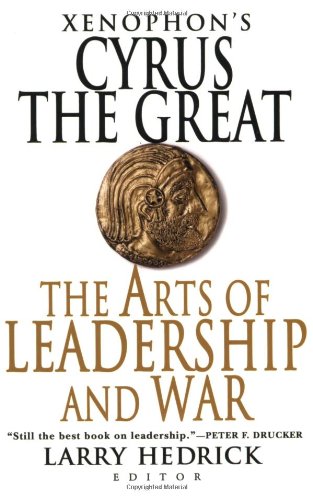
If English is your second language or if you are first time reader of Cyrus the Great you may wish to read this book "Xenophon's Cyrus The Great" by Larry HEDRICK in order to grasp King of kings Cyrus the Great very well.

Ahura Mazda be with you.

5-0 out of 5 stars Xenofreak
This truly is one of the most remarkable books I've ever read and I would encourage anyone with an interest in military science, government or leadership to take the time to read it.This book requires commitment and a quiet place to read and savor its thought-provoking passages.The investment of time and effort is dwarfed by the magnitude of the lessons this book has to offer.Make the commitment and you'll see why this book was a favorite of men like Alexander the Great, Scipio Africanus, Caesar and Machiavelli.

4-0 out of 5 stars What exactly are you buying here?
This book is not in the style of a Platonic dialogue, or a play (whether a tragedy or comedy), a Homeric epic (but if you're careful, you'll note parallels),or a history (like Herodotus).

No, Xenophon - a contemporary of Plato's, a student of Socrates - was considered a philosopher way back when. He tells a story and you might think it is a history that is meant to be accurate. There is nothing accurate about Xenophon's use of history in this book; however, the story is well-told and funny, and the prose moves fast in this edition. (Which was your primary concern, of course: that this was a good read.)

He does teach philosophy - ancient philosophy concerned with ethics and politics - in an interesting way. The plot of the book is as follows: Cyrus of Persia receives an education unlike any of his peers. With that education, and a considerable bit of ruthlessness, he attempts to take over the world.

It's difficult to write a story where different philosophical viewpoints define characters and events. Somehow, Xenophon pulls this off, and manages to entertain his reader with tales of battles, lots of humorous exchanges between characters, and even some love stories strewn throughout.

(If you do Classics, you probably want to get acquainted with Xenophon, fast.)

5-0 out of 5 stars A Brilliant Read
Herodotus' Histories is often considered the gold standard of knowledge pertaining to the Persian empire.Little is made of the fact that this Ionian had certain political grudges against his political masters and had never visited Persia or had entry into Persian society.Xenophone however was a nobleman who lived amongst the Persians and the Medes and was acquaianted with their ways and histories.Xenophone's observations on Persian society and religion are far closer to modern scholarship than Herodotus. Furthermore even the chronological inaccuracies of Cyropaedia are in the Persian tradition.As evidenced by Sassanian histories, the Persians had the habit of attributing the conquests of dynasties to their founders.However the most fascinating and thrilling aspect of reading this book is that the educational stories attributed to Cyrus are identical to the stories found in Adab or the Persian courtly literature of Islamic era. Given that Xenophone was not translated into Persian or Arabic, this confirms the authenticity of the materials used by Xenophone.I love this book and have read it twice already.I recommend it to anyone who wants to have a closer look at the realities of Persia.

5-0 out of 5 stars The opposite of xenophobia
Xenophobia is the fear of foreigners. Yet Xenophon's greatest book was a biography of the most hated foe of the greeks, Cyrus.

Cyrus was the greatest emperor of the Persian empire, and the antecedent (see what a great scholar I am? I can't remember all the exact facts like a real student should; I read this stuff for fun) of the Persian emperor who Alexander defeated right before Alexander went crazy and decided to conquer the rest of the world while he was on a streak.

In today's Jingoistic anti-Iran & Iraq climate, it's illuminating to get the Persian perspective on world history, and since I haven't found any Persian histories written from the ancient Persian viewpoint, this book is the best I've read. ... Read more


8. Xenophon: Memorabilia. Oeconomicus. Symposium. Apologia. (Loeb Classical Library No. 168)
by Xenophon
Hardcover: 704 Pages (1923-01-01)
list price: US$24.00 -- used & new: US$24.00
(price subject to change: see help)
Asin: 0674991869
Canada | United Kingdom | Germany | France | Japan
Editorial Review

Book Description
In Memorabilia or Memoirs of Socrates and in Oeconomicus, a dialogue about household management, we see the philosopher through Xenophon's eyes. Here, and in the accompanying Symposium we also obtain insight on life in Athens. The volume concludes with Xenophon's Apology, an interesting complement to Plato's account of Socrates' defense at his trial. Ostensibly an account of a dinner party in the summer of 421 BCE, Xenophon's Symposium is a vibrant picture of an Athenian evening of quiet entertainment and conversation. Among the guests Socrates is the central figure, and--as in Plato's Symposium--love is the main subject of debate. But the style here is more relaxed and less artful than in Plato's philosophical dialogue, yielding an engaging portrait of Socrates and of Athenian social life. ... Read more


9. The Memorabilia
by Xenophon
Paperback: 208 Pages (2004-06-30)
list price: US$24.95 -- used & new: US$16.01
(price subject to change: see help)
Asin: 141917259X
Canada | United Kingdom | Germany | France | Japan
Editorial Review

Book Description
But his mode of dealing with his intimates has another aspect. As regards the ordinary necessities of life,[6] his advice was, "Act as you believe[7] these things may best be done." But in the case of those darker problems, the issues of which are incalculable, he directed his friends to consult the oracle, whether the business should be undertaken or not.Download Description
But his mode of dealing with his intimates has another aspect. As regards the ordinary necessities of life,[6] his advice was, "Act as you believe[7] these things may best be done." But in the case of those darker problems, the issues of which are incalculable, he directed his friends to consult the oracle, whether the business should be undertaken or not. ... Read more


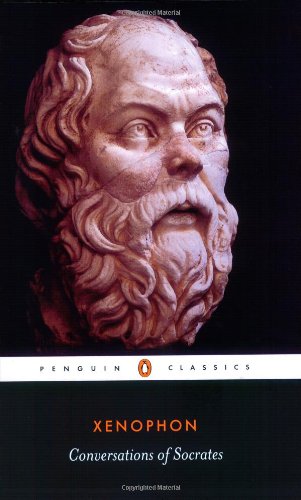
10. Conversations of Socrates (Penguin Classics)
by Xenophon
Paperback: 384 Pages (1990-07-03)
list price: US$14.00 -- used & new: US$7.85
(price subject to change: see help)
Asin: 014044517X
Average Customer Review: 5.0 out of 5 stars
Canada | United Kingdom | Germany | France | Japan

Customer Reviews (9)

5-0 out of 5 stars Oligarch
Nearly all those who studied Greek in high school were given a much distorted image of the Athenian (and certainly of the pedophilic Spartan) society. Who told us that the wealth of Athens was based on silver mines (the university city of Ioanina is still one of the world's biggest centers of the silver industry)? And who told us why Socrates was forced to commit suicide?
One can find the answers on many questions about Greek society in Xenophon's works, the clever writer of `Hellenika' (`All Persians are educated to become a slave, except one').
In his works about Socrates, Xenophon brushes a lively picture of the `real' Socrates and explains clearly his political views: 'Where offices were filled by men who satisfied the legal requirements, he considered the constitution to be an aristocracy; where they were filled in accordance with a property qualification, a plutocracy; where they were filled by anybody, a democracy.'
Socrates was an anti-democrat and defended oligarchy is his teachings.
What oligarchy really meant for the majority of the Athenians, one can also read in `Hellenika'. Describing the reign of the Thirty (comprising two uncles of Plato), Xenophon states: `The oligarchs went on a killing spree murdering all democratic opponents, more Athenians than all the Peloponnesians did in ten years of war ... when people could vote, it was in full view.'
Xenophon explains one of the main reasons for oligarchic rule in his rhetoric question: `if people uses its superior power to enact measures against the propertied classes, will that be violence rather than law?'
Socrates was a moderate anti-democrat, not as his pupil Plato who fulminated relentlessly against the democratic beast (Gerard Koolschijn). He respected the law: `He disobeyed the illegal orders of the Thirty on the ground that what he was ordered to do was illegal.'
He also was a moderate in his personal life (`to need nothing is divine').

Xenophon's works are key texts for understanding the ancient Greek society (daily life, morals, social issues, drink-parties, sex, politics). They are a must read for all those interested in human history and for all lovers of classical texts.

5-0 out of 5 stars Against the government-clique of President Perikles ...
Perikles pushed Athens into risky power politics, those led into the Peloponnesi war (431-404 before Chr.). The second woman of Perikles, Aspasia, participated in the philosophical discussions of Socrates and became highly estimated by him. She was accused like Sokrates of being not as religious as they should be. Of course the boring-questioner Socrates became a feedback not only ironically (e.g. by the comedy poet Aristophanes) but also others with heavy rage: started by the government clique around President Perikles. To awaken the people from their sleep of propaganda-smeared opinions, - this had to provoke counter actions. In his defense speech at court Socrates didn't own much time. The limit was set by a pot of water, having a whole. The moment, all the water had run out, that was the very moment he had to stop his speech. The jury of 500 Athenians didn't like to listen at all - and they were happy, to bring that thing quickly to an end. The three prosecutors of Socrates by the way had been lynched a few weeks later. Probably the thoughts become accepted to which Socrates had wanted to inflame: "... perhaps you might possibly be offended, like the sleeping who are awakened, striking me, you might easily kill, then the rest of your lives you might continue sleeping..." - Socrates maintained his integrity as hero until the end. His radical critique of the Athenians fundamental values is the starting point of western philosophy, of the modern debate over civil disobedience (compare Henry David Thoreau, Martin Luther King Jr., Jane Fonda and so on...). Today it's still amusing to follow the way, how the master shredded the weaknesses in faulty arguments. Socrates had tried to make publicly, what later should be named as "try-and-error procedures of thinking". And he didn't allow the mighty ones to intimidate him. There are cultural fluctuations with regard to the allowance to think opposite. Jesus or Spartacus (or the American Socrates-scientist Vlastos, notified by the FBI and threatened with deportation to Canada because he didn't agree to the VietNam-war), Angela Davis, Sinead o'Connor or Michael Moore - they had their special versions of trouble. Today we don't need a death-sentence, there are smaller and more effective tricks, to produce a YES to nearly everything. So we still need such a hero of dissidence like Socrates - or should we stop thinking self-confidently? Nearly 500 years before Christ this Socrates gave an unforgettable sign of a solid character. He didn't beg the judge committee, to stop the death penalty, he didn't agree to accept exile - in the contrary he made a request for the highest honor in Athens at that time: the daily free meal-supply in the city hall. He was an ironic man and he knew, this request had been a little too much for the nervous jury ...

5-0 out of 5 stars Against the government-clique of President Perikles ...
Perikles pushed Athens into risky power politics, those led into the Peloponnesi war (431-404 before Chr.). The second woman of Perikles, Aspasia, participated in the philosophical discussions of Socrates and became highly estimated by him. She was accused like Sokrates of being not as religious as they should be. Of course the boring-questioner Socrates became a feedback not only ironically (e.g. by the comedy poet Aristophanes) but also others with heavy rage: started by the government clique around President Perikles. To awaken the people from their sleep of propaganda-smeared opinions, - this had to provoke counter actions. In his defense speech at court Socrates didn't own much time. The limit was set by a pot of water, having a whole. The moment, all the water had run out, that was the very moment he had to stop his speech. The jury of 500 Athenians didn't like to listen at all - and they were happy, to bring that thing quickly to an end. The three prosecutors of Socrates by the way had been lynched a few weeks later. Probably the thoughts become accepted to which Socrates had wanted to inflame: "... perhaps you might possibly be offended, like the sleeping who are awakened, striking me, you might easily kill, then the rest of your lives you might continue sleeping..." - Socrates maintained his integrity as hero until the end. His radical critique of the Athenians fundamental values is the starting point of western philosophy, of the modern debate over civil disobedience (compare Henry David Thoreau, Martin Luther King Jr., Jane Fonda and so on...). Today it's still amusing to follow the way, how the master shredded the weaknesses in faulty arguments. Socrates had tried to make publicly, what later should be named as "try-and-error procedures of thinking". And he didn't allow the mighty ones to intimidate him. There are cultural fluctuations with regard to the allowance to think opposite. Jesus or Spartacus (or the American Socrates-scientist Vlastos, notified by the FBI and threatened with deportation to Canada because he didn't agree to the VietNam-war), Angela Davis, Sinead o'Connor or Michael Moore - they had their special versions of trouble. Today we don't need a death-sentence, there are smaller and more effective tricks, to produce a YES to nearly everything. So we still need such a hero of dissidence like Socrates - or should we stop thinking self-confidently? Nearly 500 years before Christ this Socrates gave an unforgettable sign of a solid character. He didn't beg the judge committee, to stop the death penalty, he didn't agree to accept exile - in the contrary he made a request for the highest honor in Athens at that time: the daily free meal-supply in the city hall. He was an ironic man and he knew, this request had been a little too much for the nervous jury ...

5-0 out of 5 stars A Revelation
Very few extant works remain on the life of Socrates: mainly the works of Xenophon and Plato. In "Conversations of Socrates" Xenophon writes extensively on the philosophical thought of the master in a forthright and simple manner. Xenophon has not always been praised for his writing style but he covers the Socratic principles thoroughly. The subjects aren't organized particularly well with examples of Socrates' views on certain virtues scattered throughout the text. Nevertheless, since Socrates didn't write his own thoughts we are very fortunate that we have these works.

Xenophon divided his works into four books: Socrates' Defense; Memoirs of Socrates; the Dinner-Party; and the Estate-Manager. Xenophon writes in the second and third person so that we "hear" the Socratic Method throughout the text. We see how Socrates used questions of his followers to teach them to think. His method thoroughly flushed out the truth and often revealed the flaws in the arguments his opponents and followers made.

I thoroughly enjoyed reading Xenophon. One could almost imagine being right there with the master as he shredded the weaknesses in faulty arguments and uncovered hidden truths. His opinions on virtues may be dated to Twentieth Century people but one must remember that it was largely his teachings that had such a great influence on Western thought and ideas.

5-0 out of 5 stars Underrated
While not as competent a writer as Plato, Xenophon's 'Socrates' is the historically more accurate (I refer to the chapter of Memoirs in this book.)The Dinner-Party was my favorite dialogue, there are also several brilliant vignettes throughout the memoir chapter. This is not to say that it doesn't 'drag' in parts, it does. The Estate-Manager, which is the last dialogue, terribly weighs down this volume; there Socrates is more a bystander than participant.

But I give this 5 stars, as its an indespensible volume for the Socratic enthusiast. ... Read more


11. Xenophon's Retreat: Greece, Persia, and the End of the Golden Age
by Robin Waterfield
Hardcover: 272 Pages (2006-11-30)
list price: US$27.95 -- used & new: US$14.99
(price subject to change: see help)
Asin: 0674023560
Average Customer Review: 4.5 out of 5 stars
Canada | United Kingdom | Germany | France | Japan
Editorial Review

Book Description

In The Expedition of Cyrus, the Western world's first eyewitness account of a military campaign, Xenophon told how, in 401 B.C., a band of unruly Greek mercenaries traveled east to fight for the Persian prince Cyrus the Younger in his attempt to wrest the throne of the mighty Persian empire from his brother.

With this first masterpiece of Western military history forming the backbone of his book, Robin Waterfield explores what remains unsaid and assumed in Xenophon's account--much about the gruesome nature of ancient battle and logistics, the lives of Greek and Persian soldiers, and questions of historical, political, and personal context, motivation, and conflicting agendas. The result is a rounded version of the story of Cyrus's ill-fated march and the Greeks' perilous retreat--a nuanced and dramatic perspective on a critical moment in history that may tell us as much about our present-day adventures in the Middle East, site of Cyrus's debacle and the last act of the Golden Age, as it does about the great powers of antiquity in a volatile period of transition.

Just as Xenophon brought the thrilling, appalling expedition to life, Waterfield evokes Xenophon himself as a man of his times--reflecting for all time invaluable truths about warfare, overweaning ambition, the pitfalls of power, and the march of history.

... Read more

Customer Reviews (2)

5-0 out of 5 stars Way more than just a translation...
Though, at its heart, "Xenophon's Retreat" is a summary of "The Expedition of Cyrus" (the first, and one of the most important, military campaign accounts of the ancient world), this book is surprisingly more than just a translation.

Written with a fantastically dry wit by an author who actually retraced the life, and travels, of "The Expedition's" Greek creator, it not only tells the story of Cyrus' ill-fated uprising, but also takes a very reasonable, and enlightening, approach to the ancient Greeks as a people...providing critical background on not only Xenophon (something that was desperately lacking until now), but also the social, economic, and political forces of the world he lived in.

As someone who's read more than my share of military history, I loved the balance it strikes between the technical, the philosophical, and the practical.In particular, I was impressed with the religious and cultural perspectives it provides on history that is so often left to relatively dry statistics.Turns out it's absolutely remarkable how much more sense the military aspects of the ancient world makes once you get a glimpse at the rest of the picture.

All in all, "Xenophon's Retreat" is unlike anything else I've ever read in the field, and I thoroughly enjoyed it.

4-0 out of 5 stars Interesting Overview of Xenophon's Life and Times
This book is more than a summary of Xenophon's `The Expedition of Cyrus'. It gives an outline of Xenophon's life in the backdrop of the places and times in which he lived. I found the account of the Cyreans' march to and from Cunaxa, as well as the battle itself, to be particularly gripping. The political shenanigans that are described both before and after the march, to me, seemed less interesting in comparison; however, these descriptions do allow the reader to form a more complete picture of what life was like and the way people reasoned things out in those turbulent times. The writing style is clear and engaging; several black and white photographs complement the text. This book should of particular interest to ancient history buffs. ... Read more


12. The Shorter Socratic Writings: "Apology of Socrates to the Jury," "Oeconomicus," and "Symposium"
by Xenophon
Paperback: 216 Pages (2006-02-09)
list price: US$18.95 -- used & new: US$18.85
(price subject to change: see help)
Asin: 0801472989
Canada | United Kingdom | Germany | France | Japan
Editorial Review

Book Description
This book presents translations of three dialogues Xenophondevoted to the life and thought of his teacher, Socrates. Each isaccompanied by notes and an interpretative essay that will introduce newreaders to Xenophon and foster further reflection in those familiar withhis writing.

"Apology of Socrates to the Jury" shows how Socrates conducted himselfwhen he was tried on the capital charge of not believing in the city's godsand corrupting the young. Although Socrates did not secure his ownacquittal, he profoundly impressed some listeners who then helped to shapethe public perception of philosophy as a noble, if highly idiosyncratic,way of life.

In "Oeconomicus," Xenophon relates the conversation Socrates had on theday he turned from the study of natural philosophy to that of moral andpolitical matters. "Oeconomicus" is concerned most directly with thecharacter and purpose of Socrates' political philosophy.

Xenophon provides entertaining portraits of Socrates' circle of friendsin the "Symposium." In the process, he conveys the source of everyindividual's pride in himself, thus defining for each a conception of humanexcellence or virtue. The dialogue concludes with Socrates' beautifulspeech on love (eros) and its proper place in the good or happy life. ... Read more


13. Xenophon: The Persian Expedition (BCP Greek Texts)
by Stephen Usher, J Antrich
Paperback: 200 Pages (2002-06-18)
list price: US$18.00 -- used & new: US$15.82
(price subject to change: see help)
Asin: 0906515114
Canada | United Kingdom | Germany | France | Japan
Editorial Review

Book Description
This volume, originally published in 1978, offers some 800-850 lines of the 'Anabasis' in Greek with English summaries of the intervening passages to give an idea of the whole of Xenophon's exciting adventure. Notes at the foot of each page assist with content and language; they asssume only basic grammatical knowledge. There is a consolidated vocabulary.

The book was specifically designed to offer a number of reasonably self-contained prescriptions for GCSE and this to replace the old 'blue Macmillan' editions of individual books. ... Read more


14. The Expedition of Cyrus (Oxford World's Classics)
by Xenophon
Paperback: 288 Pages (2005-10-20)
list price: US$16.95 -- used & new: US$4.42
(price subject to change: see help)
Asin: 0192824309
Canada | United Kingdom | Germany | France | Japan
Editorial Review

Book Description
'Men, the enemy troops you can see are all that stands between us and the place we have for so long been determined to reach.We must find a way to eat them alive!'TheExpedition of Cyrustells the story of the march of the Ten Thousand.The exploits of this famous army of Greek mercenaries in modern-day Turkey, Syria, and Iraq were described by one of their leaders, the Athenian historian and philosopher Xenophon.They were recruited at the end of the fifth century BC by a young Persian prince, Cyrus, who rose in revolt against his brother, the king of Persia.After Cyrus' death, the army was left stranded in the desert of Mesopotamia, a thousand miles from home.Their long march, across mountains and plateaux to the sight of 'The sea! The sea!', and back to the fringes of the Greek world, is the most exciting adventure story to survive from the ancient world.Xenophon's gripping narrative offers a unique insight into the character of a Greek army struggling to survive in an alien world.It is also the most sustained eyewitness account of the landscape of the vast and wealthy Persian empire. ... Read more


15. The March Up Country: A Translation of Xenophon's Anabasis (Ann Arbor Paperbacks)
by Xenophon
Paperback: 224 Pages (1958-03-01)
list price: US$16.95 -- used & new: US$16.95
(price subject to change: see help)
Asin: 0472060953
Average Customer Review: 5.0 out of 5 stars
Canada | United Kingdom | Germany | France | Japan
Editorial Review

Book Description

The famous chronicle of the wealthy Athenian leader Xenophon, brought to life for the modern reader
... Read more

Customer Reviews (1)

5-0 out of 5 stars An exciting literary expedition
This is one of those books you have on your list of "books-I-am-going-to-read-someday." Okay, someday arrived. I should have read it decades ago. This is a fairly good translation and the story is written, as was the custom at that time, from the third person point of view. The story begins with a bang and immediately carries us into the expedition itself. When a Greek mercenary army attempts to help Cyrus overthrow his relative, (his brother, Artaxerxes, was the Persian King), it marches all the way to Babylon to give battle...and wins! But Cyrus is killed in the battle and the Greeks find themselves stranded. After the Greek generals are killed in a treacherous parley, the army does not disintegrate, as Artaxerxes and the Persians expect. Instead, they elect new officers, Xenophon among them, and proceed to march out of the Persian Empire across 1,500 miles of hostile terrain teeming with savage adversaries. Xenophon employs a straightforward, soldierly style as he describes people, places and events. It is a wonderful narrative and the action keeps you turning pages until the end. By a happy coincidence, history has preserved this enchanting adventure story. If you prefer to hear a recorded version of it, I recorded it for Audio Connoisseur and you can find it here at Amazon. ... Read more


16. The Long March: Xenophon and the Ten Thousand
Hardcover: 376 Pages (2004-11-10)
list price: US$48.00 -- used & new: US$32.00
(price subject to change: see help)
Asin: 0300104030
Average Customer Review: 3.0 out of 5 stars
Canada | United Kingdom | Germany | France | Japan
Editorial Review

Book Description

The March of the Ten Thousand is one of the most famous military adventures in the ancient world. Its fearless army of Greek mercenaries marched through western Asia (modern Turkey and Iraq) in 401–399 B.C., their hopes and hardships recounted by Xenophon, the Athenian, an admiring pupil of Socrates. Xenophon’s history of the Long March, or Anabasis, is a classic of Greek literature.
In this book, twelve leading scholars explore the Anabasis, a deceptively simple and profoundly rich source of social and cultural history and the mentality of the ancient Greek participants. The contributors explore a wide range of topics, from Xenophon’s values, motives, and manner as a writer to the outlook of his companions as mercenary soldiers, from his descriptions of religion in soldiers’ lives to their relations with women, boys, and the many foreign peoples encountered during the march.


... Read more

Customer Reviews (1)

3-0 out of 5 stars An Artifact in Itself.
A dozen specialists assemble to discuss their speciality. They write papers and read them to one another. The papers repeat what they know and a few things that are new. These are published in a book.

They remind each other that a parasang was a unit of time, not space; that Xenophon was often self-serving; and that motives of Greeks on the march were mixed. These are worth being reminded of, but not new. Recent discoveries in Persian studies are mentioned, but not examined. None realizes that the Cyropaedea is as much a treatise on an ideal curriculum, an issue that was on Plato's mind, as it is an encomium for Cyrus. Many, based on their own attention spans, are certain that Xenophon could not possibly have reported long speeches verbatim, decades after the fact, without contemporaneous notes. None speculates that Xenophon's name, "foreign voice," might have significance.

The book covers important issues and reports current directions of scholarship for specialists in other fields as well as laity. But its most interesting aspect may be the character of examiners themselves. Their intellectual style, strategies, and speculations reveal the pathology of those who dedicate themselves to knowing more and more about less and less. This makes it diverting, as well as improving, for the careful reader. ... Read more


17. The Anabasis of Cyrus (Agora)
by Xenophon
Paperback: 281 Pages (2007-12)
list price: US$16.95 -- used & new: US$12.10
(price subject to change: see help)
Asin: 0801489997
Canada | United Kingdom | Germany | France | Japan
Editorial Review

Book Description
One of the foundational works of military and politicalhistory, and an inspiration for Alexander the Great, the Anabasis ofCyrus recounts the epic story of the Ten Thousand, a band of Greekmercenaries hired by Cyrus the Younger to overthrow his brother,Artaxerxes, king of Persia and the most powerful man on earth. It shows howCyrus' army was assembled covertly and led from the coast of Asia Minor allthe way to Babylon; how the Greeks held the field against a superiorPersian force; how Cyrus was killed, leaving the Greeks stranded deepwithin enemy territory; and how many of them overcame countless dangers andfound their way back to Greece. Their remarkable success was due especiallyto the wily and decisive leadership of Xenophon himself, a student ofSocrates who had joined the Ten Thousand and, after most of the Greekgenerals had been murdered, rallied the despondent Greeks, won a positionof leadership, and guided them wisely through myriad obstacles.

In this new translation of the Anabasis of Cyrus, Wayne Amblerachieves a masterful combination of liveliness and a fidelity to theoriginal uncommon in other versions. Accompanying Ambler's translation is apenetrating interpretive essay by Eric Buzzetti, one that shows Xenophon tobe an author who wove a philosophic narrative into his dramatic tale. Thetranslation and interpretive essay encourage renewed study of theAnabasis of Cyrus as a work of political philosophy. They alsocelebrate its high adventure and its hero's adroit decision-making underthe most pressing circumstances. ... Read more


18. The Exploits of Xenophon
 Hardcover: Pages (1955)

Asin: B000E13OLC
Canada | United Kingdom | Germany | France | Japan

19. Hellenica: Hellenica
by Xenophon
Paperback: 338 Pages (2007-05-23)
list price: US$14.99 -- used & new: US$14.89
(price subject to change: see help)
Asin: 1434614565
Canada | United Kingdom | Germany | France | Japan
Editorial Review

Product Description
Translation by H. G. Dakyns ... Read more


20. Hellenica (Dodo Press)
by Xenophon
Paperback: 320 Pages (2007-09-24)
list price: US$21.99 -- used & new: US$16.28
(price subject to change: see help)
Asin: 1406555673
Canada | United Kingdom | Germany | France | Japan
Editorial Review

Book Description
Xenophon (431-355 BC), son of Gryllus, of the deme Erchia of Athens, was a soldier, mercenary and an admirer of Socrates. He is known for his writings on the history of his own times, the sayings of Socrates, and the life of Greece. He participated in the expedition led by Cyrus the Younger against his older brother, the emperor Artaxerxes II of Persia, in 401 BC. His record of the entire expedition against the Persians and the journey home was titled Anabasis (The Expedition or The March Up Country). He was later exiled from Athens, most likely because he fought under the Spartan king Agesilaus against Athens at Coronea. The Spartans gave him property at Scillus, near Olympia in Elis, where he composed the Anabasis. His writings are often read by beginning students of the Greek language. His Hellenica is a major primary source for events in Greece from 411 to 362 BC, and his Socratic writings, preserved complete, are the only surviving representatives of the genre of Sokratikoi logoi other than the dialogues of Plato.Download Description
After this the new admiral Hierax arrived from Lacedaemon. The naval force was transferred into his successor's hands, and under the happiest auspices Teleutias set sail for home. As he descended to the seashore to start on his homeward voyage there was not one among his soldiers who had not a warm shake of the hand for their old admiral. Here one presented him with a crown, and there another with a victor's wreath. ... Read more


  1-20 of 100 | Next 20
A  B  C  D  E  F  G  H  I  J  K  L  M  N  O  P  Q  R  S  T  U  V  W  X  Y  Z  

Prices listed on this site are subject to change without notice.
Questions on ordering or shipping? click here for help.

site stats