e99 Online Shopping Mall

Geometry.Net - the online learning center Help  
Home  - Basic A - Asian-american History (Books)

  1-20 of 100 | Next 20
A  B  C  D  E  F  G  H  I  J  K  L  M  N  O  P  Q  R  S  T  U  V  W  X  Y  Z  

click price to see details     click image to enlarge     click link to go to the store

 
$28.00
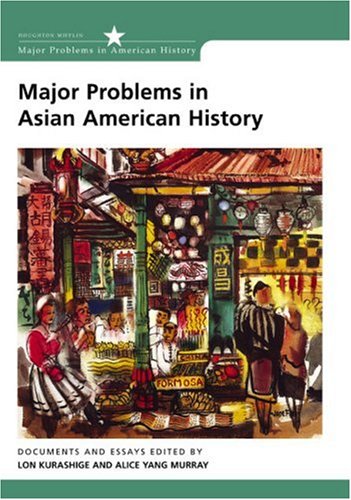
1. Major Problems In Asian American
$5.99
2. Everything You Need to Know About
$23.56
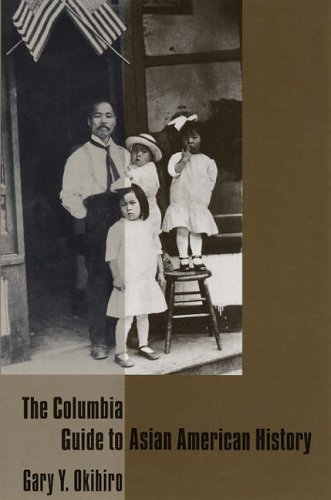
3. The Columbia Guide to Asian American
$139.95
4. Dictionary of Asian American History
$9.43
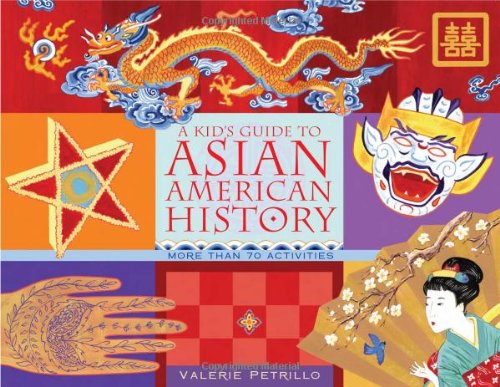
5. A Kid's Guide to Asian American
$16.13
6. Asian Americans: An Interpretive
$28.85
7. Contemporary Asian American Communities:
$15.00
8. Mobilizing an Asian American Community
$29.85
9. Countervisions: Asian American
$8.53
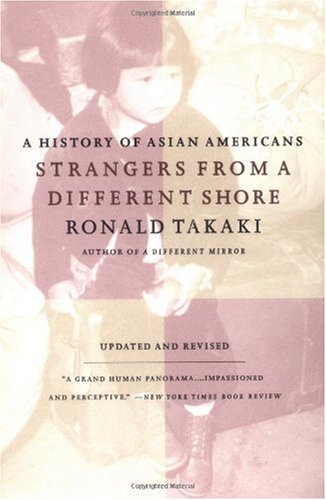
10. Strangers from a Different Shore:
$14.89
11. The Asian American Movement (Asian
$23.00
12. The Sum of Our Parts: Mixed-Heritage
$26.31
13. Making Ethnic Choices: California's
$25.71
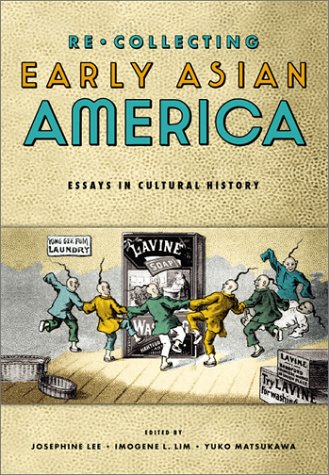
14. Re/collecting Early Asian America:
$20.97
15. Hmong Means Free Pb (Asian American
 
$10.00
16. Reading the Literatures of Asian
$24.26
17. The First Suburban Chinatown:
$23.95
18. Smuggled Chinese: Clandestine
$21.61
19. The Racial Logic of Politics:
$21.43
20. Asian American Panethnicity (Asian

1. Major Problems In Asian American History: Documents and Essays (Major Problems in American History Series)
by Lon Kurashige, Alice Yang Murray, Thomas Paterson
 Paperback: 522 Pages (2002-10-08)
list price: US$61.56 -- used & new: US$28.00
(price subject to change: see help)
Asin: 0618077340
Canada | United Kingdom | Germany | France | Japan
Editorial Review

Book Description

This collection, designed to be the primary anthology or textbook for courses in Asian American history, covers the subject's entire chronological span. The volume presents a carefully selected group of readings that requires students to evaluate primary sources, test the interpretations of distinguished historians, and draw their own conclusions.

... Read more

2. Everything You Need to Know About Asian American History (Revised Edition)
by Himilce Novas, Lan Cao
Paperback: 432 Pages (2004-07-27)
list price: US$15.00 -- used & new: US$5.99
(price subject to change: see help)
Asin: 0452284759
Average Customer Review: 4.0 out of 5 stars
Canada | United Kingdom | Germany | France | Japan
Editorial Review

Book Description
One can hardly understand American history without knowing the crucial role people of Asian ancestry have played in shaping our past, politics, and culture. Exploding myths and stereotypes, with more than fifty pages of new material, this absorbing and accessible reference answers such questions as:

• Where and when did the history of Chinese America begin?
• What is Zen?
• Why do Filipinos have Spanish names?
• How did the U.S. get involved in Vietnam?
• What is the difference between Hindu and Hindi?
• And much, much more.

In a lively question-and-answer format, Everything You Need to Know About Asian-American History provides a complete understanding of the traditions and ideas that people of Chinese, Japanese, Vietnamese, Korean, Indian, and Pacific Island descent have contributed to American life. ... Read more

Customer Reviews (10)

5-0 out of 5 stars Excellent and Readable and Fun History book!
This books covers the whole range of Asian American history in a quick and fun way while being extremely well researched and deceptively scholarly. If a book can be both popular and easy read and yet a perfect academic resource, this is it. I learned more in one hour of reading it than in whole semesters in school. I strongly recommed this book as well as other fiction and non-fiction work by Himilce Novas.

4-0 out of 5 stars Filipino American section much improved over previous edition
I am a scholar who wrote a dissertation on Filipino American culture and contributes articles on the topic to academic publications. Though I had suspended my usual critical standards upon approaching the earlier edition of EVERYTHING YOU NEED TO KNOW..., by most reasonable measures the chapter on Filipino Americans was underdeveloped; it revealed more about the authors' myopic perception of Asian Americans than it communicated about the second largest Asian American group and could not be recommended to its juvenile literature audience. This criticism was taken to heart by the authors, and as a result the 2004 edition features a substantially expanded and conceptually renovated Filipino American section. Important historical and social features, such as the impact of the Philippines' colonization by Spain and the United States on Filipino Americans and their experience of racism from both whites and other Asian Americans, is emphasized through an informed selection of questions ("Why do Filipinos have Spanish last names?"), answers written in a clear & simple language, and appropriate examples. In addition, issues that distinguish Filipino Americans from other Asian Americans and continue to vex scholars - namely, social invisibility, or if there are so many of us in the U.S., why is it that only U.S. Navy and Peace Corps personnel are capable of recognizing us? - are introduced. (There's even a highlighted block-quote on social invisibility from E. San Juan, Jr.'s FROM EXILE TO DIASPORA, which isn't exactly trade paperback non-fiction.) Some of the biographical selections are questionable: Jocelyn Enriquez is divine, a glorious Pinay diva, but she has not influenced popular music as much as "turntablists" like the Invisibl Skratch Piklz and the World Famous Beat Junkies or the larger networks of mobile DJ crews. But, overall, such thorough and successful revisions of older editions are so infrequent that when they are achieved, its authors deserve recognition. In summary, were my younger cousins to approach me with questions about Filipino Americans, before crossing their eyes with lectures on heteroglossic subjectivities and the exclusion of neocolonial subjects from hegemonic racial discourse, I'd point my relatives towards this book.

5-0 out of 5 stars Great Read! Very informative and full of fun stuff!
Wow! I love this book. The question and answer format is really user friendly. It covers all the Asian American groups and gives their history and all sorts of cultural information without feeling heavy. And yet, is IS heavy in the sense that it gave me a very good handle on the struggles and the contribution of the various Asian American groups, as well as all their celebrations, important holidays, legal landmarks, etc. I am half Japanese and it made me very proud of my mother. I am giving the book to all my relatives on my father's side. This one's a definite for any home library. They should teach it in schools. Maybe they do.It should be required reading for all non-Asians as well.

4-0 out of 5 stars It's Not Brain Surgery, But. . .
This book is in a readable format consisting of questions that middle and senior high school students might ask about Asian Americans. For the most part, the explanations are clear and short.I do not agree with the reviewers who hated this book.The titles they recommended are scholarly works more suitable for the college level.This book is a useful introduction, not "Everthing you need to know," as the title suggests. This book has sparked interest in Asian American history and many of my middle school students have gone further to read Sucheng Chan and Ron Takaki's Asian Pacific Islander series, but I haven't had much luck using the more scholarlyAsian American histories as a starting point.

5-0 out of 5 stars EXCELLENT HISTORY BOOK! FAST AND FUNNY AN DEEP!
this book was an unexpected bonus. not only did i totally enjoy it, it was a breeze to read cause it's in funny Q & As, and when i finished it (i read it here and there, cafeteria style), i really felt like a whole door had been opened to me about asian american history and asian american life--this is an incredible and great and excellent culture. i was also able to use this book to help me with my college history courses, and even with my asian american friends when i visited with their families. two thumbs up! ... Read more


3. The Columbia Guide to Asian American History (Columbia Guides to American History and Cultures)
by Gary Y. Okihiro
Paperback: 352 Pages (2005-03-09)
list price: US$27.00 -- used & new: US$23.56
(price subject to change: see help)
Asin: 0231115113
Average Customer Review: 5.0 out of 5 stars
Canada | United Kingdom | Germany | France | Japan
Editorial Review

Book Description

Offering a rich and insightful road map of Asian American history as it has evolved over more than 200 years, this book marks the first systematic attempt to take stock of this field of study. It examines, comments, and questions the changing assumptions and contexts underlying the experiences and contributions of an incredibly diverse population of Americans. Arriving and settling in this nation as early as the 1790s, with American-born generations stretching back more than a century, Asian Americans have become an integral part of the American experience; this cleverly organized book marks the trajectory of that journey, offering researchers invaluable information and interpretation.

• Part 1 offers a synoptic narrative history, a chronology, and a set of periodizations that reflect different ways of constructing the Asian American past.

• Part 2 presents lucid discussions of historical debates -- such as interpreting the anti-Chinese movement of the late 1800s and the underlying causes of Japanese American internment during World War II -- and such emerging themes as transnationalism and women and gender issues.

• Part 3 contains a historiographical essay and a wide-ranging compilation of book, film, and electronic resources for further study of core themes and groups, including Chinese, Japanese, Filipino, Hmong, Indian, Korean, Vietnamese, and others.

... Read more

Customer Reviews (1)

5-0 out of 5 stars A choice, concise guide to Asian American experiences
A choice, concise guide to Asian American experiences is offered by Gary Okihiro, the recipient of the American Studies Association Lifetime Achievement Award and past president of the Association for Asian American Studies. The experiences of Chinese, Japanese, Filipino, Hmong, Indians and more are contrasted in chapters exploring migration patterns, racism issues, gender issues and much more. Columbia Guide To Asian American History is a recommended pick for any high school or college collection focusing on Asian-American immigrant, multicultural, or ethnic group experiences.
... Read more


4. Dictionary of Asian American History
Hardcover: 642 Pages (1986-12-01)
list price: US$139.95 -- used & new: US$139.95
(price subject to change: see help)
Asin: 0313237603
Canada | United Kingdom | Germany | France | Japan
Editorial Review

Book Description
Filling an important gap in scholarship, this unique historical dictionary recounts the experience of immigrants from more than ten countries in East and Southeast Asia and assesses the cultural, social, economic, and political impact of these groups on United States history. A wealth of specific information on people, places, and events is contained in over one thousand entries, each including its own bibliography. Fourteen historical and sociological essays, written by outstanding Asian specialists, provide analyses of particular groups and issues and clarify the ethnohistorical concepts that are essential to an understanding of majority/minority relations in America. An extensive general bibliography on Asian-American history and a comprehensive chronology of events are additional features. ... Read more


5. A Kid's Guide to Asian American History: More than 70 Activities (Kid's Guide series, A)
by Valerie Petrillo
Paperback: 256 Pages (2007-05-28)
list price: US$14.95 -- used & new: US$9.43
(price subject to change: see help)
Asin: 1556526342
Canada | United Kingdom | Germany | France | Japan
Editorial Review

Book Description

Hands-on activities, games, and crafts introduce children to the diversity of Asian American cultures and teach them about the people, experiences, and events that have shaped Asian American history. This book is broken down into sections covering American descendents from various Asian countries, including China, Japan, Korea, Philippines, India, Vietnam, Laos, and Cambodia. Topics include the history of immigration from Asian countries, important events in U.S. history, sidebars on famous Asian Americans, language lessons, and activities that highlight arts, games, food, clothing, unique celebrations, and folklore. Kids can paint a calligraphy banner, practice Tai Chi, fold an origami dog or cat, build a Japanese rock garden, construct a Korean kite, cook bibingka, and create a chalk rangoli. A time line, glossary, and recommendations for Web sites, books, movies, and museums round out this multicultural guide.
... Read more

6. Asian Americans: An Interpretive History (Immigrant Heritage of America Series)
by Sucheng Chan
Paperback: 240 Pages (1991-01-01)
list price: US$23.00 -- used & new: US$16.13
(price subject to change: see help)
Asin: 0805784373
Average Customer Review: 4.5 out of 5 stars
Canada | United Kingdom | Germany | France | Japan
Editorial Review

Book Description
Series Editor: Thomas Archdeacon, University of Wisconsin-Madison

This series presents concise histories of individual ethnic groups and their impact on American life and culture. With comprehensive examinations of the immigrant experience, it serves as a resource for both young students and experienced researchers. Each book in the series is written by a qualified scholar and includes notes, references, a selected bibliography and a complete index. ... Read more

Customer Reviews (3)

4-0 out of 5 stars difficult experiences for over a century
Not a casual read. Chan describes well over a hundred years of Asians emigrating to and growing up in the United States. Many of the pages describe years of backbreaking toil, especially in the California goldfields, and in the building of the transcontinental railroads. Exacerbated by periodic bouts of discrimination by the European settlers and immigrants.

In a relatively short book, the account cannot be comprehensive. Complexity is added, due to the different nationalities of Asians that came over. Chinese. Japanese. Filipinos. Koreans. There never was one unitary Asian bloc in the US. Thus descriptions of various benevolent social and cultural organisations that arose are often split by ethnicity or nationality.

The text also shows that the civil rights movement of the 1950-1970s, while primarily for Negroes, also benefited Asians. Something not necessarily widely known or appreciated today.

5-0 out of 5 stars Excellent Reference
This book give a little overview of a multitude of topics, nothing indepth, but rather a 'light read'.

5-0 out of 5 stars Excellent general resource
Sucheng Chan offers a statistic-rich, informative history ofAsian-Americans, from their first immigration to current issues of As-Amsas "model minorities". I definitely prefer Chan's style toTakaki's quote-heavy, anecdotal approach; she is both thorough and concise. ... Read more


7. Contemporary Asian American Communities: Intersections and Divergences (Asian American History and Culture)
Paperback: 254 Pages (2002-04)
list price: US$28.95 -- used & new: US$28.85
(price subject to change: see help)
Asin: 1566399386
Canada | United Kingdom | Germany | France | Japan
Editorial Review

Book Description
Once thought of in terms of geographically bounded spaces, Asian America has undergone profound changes as a result of post-1965 immigration as well as the growth and reshaping of established communities. This collection of original essays demonstrates that conventional notions of community, of ethnic enclaves determined by exclusion and ghettoization, now have limited use in explaining the dynamic processes of contemporary community formation.

Writing from a variety of perspectives, these contributors expand the concept of community to include sites not necessarily bounded by space; formations around gender, class, sexuality, and generation reveal new processes as well as the demographic diversity of today's Asian American population. The case studies gathered here speak to the fluidity of these communities and to the need for new analytic approaches to account for the similarities and differences between them. Taken together, these essays forcefully argue that it is time to replace the outworn concept of a monolithic Asian America. ... Read more


8. Mobilizing an Asian American Community (Asian American History and Culture)
by Linda Trinh Vo
Paperback: 287 Pages (2004-06)
list price: US$23.95 -- used & new: US$15.00
(price subject to change: see help)
Asin: 1592132626
Canada | United Kingdom | Germany | France | Japan
Editorial Review

Book Description
Focusing on San Diego in the post-Civil Rights era, Linda Trinh Võ examines the ways Asian Americans drew together—despite many differences within the group—to construct a community that supports a variety of social, economic, political, and cultural organizations.

Using historical materials, ethnographic fieldwork, and interviews, Võ traces the political strategies that enable Asian Americans to bridge ethnicity, generation, gender, language, and class differences, among others. She demonstrates that mobilization is not a smooth, linear process and shows how the struggle over ideologies, political strategies, and resources affects the development of community organizations. Võ also analyzes how Asian Americans construct their relationship with Asia and how they forge relationships with other racialized communities of color. Võ argues that the situation in San Diego illuminates other localities across the country where Asians face challenges trying to organize, find sufficient resources, create leaders, and define strategies. ... Read more


9. Countervisions: Asian American Film Criticism (Asian American History and Culture)
by Darrell Hamamoto
Paperback: 317 Pages (2000-09-28)
list price: US$29.95 -- used & new: US$29.85
(price subject to change: see help)
Asin: 1566397766
Canada | United Kingdom | Germany | France | Japan
Editorial Review

Book Description
Spotlighting Asian Americans on both sides of the motion picture camera, Countervisions examines the aesthetics, material circumstances, and politics of a broad spectrum of films released in the last thirty years.One of the anthology's key contributions is to trace the evolution of Asian American independent film practice with essays on the Japanese American internment and historical memory, essays on films by women and queer artists, and the reflections of individual film makers as they discuss independent productions as subverting or opposing the conventions of commercial cinema. ... Read more


10. Strangers from a Different Shore: A History of Asian Americans Au of...
by Ronald Takaki
Paperback: 640 Pages (1998-09-23)
list price: US$16.99 -- used & new: US$8.53
(price subject to change: see help)
Asin: 0316831301
Average Customer Review: 4.5 out of 5 stars
Canada | United Kingdom | Germany | France | Japan

Customer Reviews (14)

5-0 out of 5 stars A Book Every American Should Read
This was my textbook for my Asian-American History class in college and this was one I did not sell back. This is a very interesting read about the various groups of Asian immigrants to America and their struggles. This is history you never hear about and thus makes it even more captivating. Takaki's style of writing is easy to follow and never dull. I recommend this for anyone who is seriously interested in race studies or American history.

4-0 out of 5 stars Asian American History Up Close
Ronald Takaki opens the gate to Asian American history.When one reads STRANGERS FROM A DIFFERENT SHORE:A HISTORY OF ASIAN AMERICANS, there is no doubt that this area of study still needs further examination beyond what has already been written.While reading this book, two critical areas come to mind when studying the intricacies and complexities of American history and all its participants -- Asian American history about social intolerance and injustice that was imposed on many Asian immigrants during the nineteenth and twentieth centuries?This as well as other interpretations of the presence of Asians within American history is the main premise of Takaki's study, which centers on the "stranger" or the "other," and how their story was no different from their European counterparts - seeking the romanticized and majestic "American dream," but happened to encounter social indifferences along the way.

Takaki roughly covers the broad spectrum of Asian immigration from the 1830s to the late 1980s.He specifically examines the Chinese, Filipinos, Japanese, and briefly the latter, Korean, Asian-Indians, Vietnamese, Cambodian, Laotian immigrants.The book contains immense information pertaining to Chinese and Japanese immigration, and Takaki concentrates on the Pacific Rim -- Hawaii, California, and the Pacific Northwest where Asian presence has had a significant social, political, and economical effect on the particular region.Although Takaki provides a vast amount of detail, one thing lacking in his study is the mention of the arrival of Filipinos in New Orleans during the late eighteenth century.It may have been helpful if he also spoke a little bit more about the East coast of the United States.

Nonetheless, STRANGERS FROM A DIFFERENT SHORE magnifies Asian American history and shows the misconceptions, stereotypes, myths, and the never-ending reference to "other".Indeed, Asian American history shows the undesirable side to history, and hopefully, more scholarship will be written where Takaki has left off in order to provide a balanced representation that shows the good and bad in a way that other events in American history have already done.This is a great introduction for anyone who wants to have a better understanding of Asian American history as well as Asian American culture.

5-0 out of 5 stars Great book
This book, Strangers From a Different Shore by Ronald Takaki, is a great book to read. Ron Takaki tells stories about how Asian Americans travel to America, to find a better job. They leave behind their families not knowing if they are going to come back. This book covers many Asian races like the Chinese, Japanese, Koreans, Filipinos, Indians, Vietnamese and other Asian races that journeyed to America in search of prosperity. As an Asian American myself, this book has taught me more about my ancestors than our history books. If you are interested in Asian Americans, I suggest reading this book because it will make things more clear about Asian American history as well as their hardships of landing into a unknown world where Caucasians are jealous, angry and ready to kill because of so many people taking their jobs. Ronald Takaki describes in detail how Asian Americans had to overcome all their hardships. Like getting false papers, traveling by boat to America, imprisonment on Angel Island, how they searched for gold, etc. Ronald Takaki writes an ideal "textbook" about Asian Americans, but this "textbook" does not seem to feel like one. It is fun to read, enjoyable, and informative. This is one of the best books that I have read in a long time.

5-0 out of 5 stars Take Two - The Asian American Experience Revisited
What was useful to me as a new scholar in the area of migration studies is that in Strangers from a Different Shore, Takaki's makes extensive use of numbers - mixed in with a plethora of anecdote. Once again, we are beset with the notion that there are statistics and such. What was really missing, at least for me, was the framing of the Asian American experience (of which Takaki is somewhat self-reflective but contradictory here - since there really is no homogenous `Asian American' experience per se) within the framework of world migration. As much as the anecdotes and references to numbers are concerned they do have explanatory powers but then both are not really examined against hard core migration theory - so in some places the book fails as history.Nonetheless, Takaki's narrative of first generation immigrants is compelling and very accessible and prompts us to ask some fairly fundamental questions.

Takaki does move us to ask the very fundamental questions about what it is to be American. He uses a variety of sources - much of which, as indicated above - are problematically anecdotal.Nonetheless, Takaki paints a picture that is in many places lucid. Takaki also provide an explanation for the landscape of modern day demographics and gives the reader a broad base to work with to understand the modern day ethnic dynamic in America. Takaki is far-reaching use of the immigrants own voice.However, the question we are faced with is this `really' reflective of the Asian American voice or does Takaki's examination have an agenda - not that that is bad or wrong per se, it just has to be recognized.

I was somewhat disenchanted that Takaki did not provide more detail on the Thai and Hmong Americans.Takaki's examination of the Thai examination was noted only relation to that of the Vietnamese experience and it was certainly not very flattering either way. Also, if Takaki is completely accurate about the Asian Indian experience does this mean that most Asian Indian immigrants to the US are from the Punjab - or at least at the time that Takaki is focusing on? On the other hand, examining anything from a regional studies perspective is always tricky as there are criteria for inclusion and exclusion. What is it really to be Asian American? Where does Asia `really' start and end? Is Takaki `really' focusing on East Asia when he writes extensively about the American Chinese and American Japanese experience? How is the rest of Asia `really' treated? Who defines `Southeast Asia'? Where Takaki sometimes falls short, at least for me, is how he defines what.It is not entirely crucial, per se - just that it would be more helpful to see where and how he came up with some of his categories. Although Takaki does provide extensive detail in relation to particular `Asian American' groups, in a way I still have mixed feelings about how he divided the book into sections then focused on those particular `Asian American' groupings.You would not think by reading this but I do recommend the book highly if only for its extensive scope.

Miguel Llora

5-0 out of 5 stars From a Different Shore
We're all pretty familiar with the immigration patterns that came to our east cost through time in such places as Ellis Island. However, pacific immigration and immigration to Hawaii have received less attention. He deals with Angel Island, the Ellis Island of the west coast and the life off immigrant emplyed in Hawaii agriculture. Takaki looks at this pattern of immigration from the arrival of the first Chinese in California in the 1840s. He covers a lot of asain ethnic groups like the Chinese, Japanese, Asian Indians, and Korean. He looks at immigration through the present and different legislation like the Chinese Exclusion Act, immigration act of 1924 that basically cut of Asian immmigration and the immigration act of 1965 that reopened Asian immigration. Takaki looks at the hearships and racism that affected these immigrant. In addition, Takaki focuses on the adjustments, how they lived and how their children born in this country were treated. Present Asian-Americans concerns are presented like anti-Asian violence like the murder of Vincent Chin and the Dotbusters. ... Read more


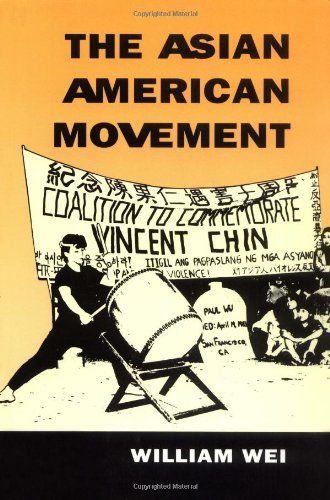
11. The Asian American Movement (Asian American History and Culture Series)
by William Wei
Paperback: 376 Pages (1994-01)
list price: US$27.95 -- used & new: US$14.89
(price subject to change: see help)
Asin: 1566391830
Average Customer Review: 2.0 out of 5 stars
Canada | United Kingdom | Germany | France | Japan
Editorial Review

Book Description
Active for more than two decades, the Asian American movement began a middle-class reform effort to achieve racial equality, social justice, and political empowerment. In this first history and in-depth analysis of the Movement, William Wei traces to the late 1960s, the genesis of an Asian American identity, culture, and activism.

Wei analyzes the Asian American women's movement, the alternative press, Asian American involvement in electoral politics. Interviews with many key participants in the Movement and photographs of Asian American demonstrations and events enliven this portrayal of the Movement's development, breadth, and conflicts. ... Read more

Customer Reviews (2)

1-0 out of 5 stars Don't waste your time
This book was notable in being the first mass-market book on the Asian American Movement.As far as I'm concerned, that was its only selling point. I was struck by his hostility towards the movement [and all things radical, it seems], and I would have let that slide if only he could even get the facts right.

As a former board member of one of the organizations mentioned in his book, the Committee Against Anti-Asian Violence, I know for a fact that it was not related to the Asian American movements on the west coast.CAAAV was founded in the 1980's in New York City and its founders had nothing to do with the "Serve the People" programs.So, wrong time and place.Also, I was invoved with the flag-burning issue and am certain that the Revolutionary Communist Party never claimed that flag-burning would or could lead to revolution.The RCP does support revolution and flag-burning so it might be easy for the casual observer to conflate the two, but for a piece of research, it's unacceptable.I am not in a position to refute the other historical claims he makes, but I believe more than a little skepticism is in order.

Don't get me wrong, I don't insist that authors be "unbiased", which is impossible, only that they be open about their biases and try to utilize facts to support their arguments.Wei doesn't do the first and doesn't do a great job of the second..

For a better reading, try the State of Asian America edited by Karen Aguilar-San Juan and Legacy to Liberation edited by Fred Ho.

3-0 out of 5 stars Good for its historical insight
Years ago, I took a class called "Producing Asian-American Sexuality" at Brown University in which we read this book.I may be a little sketchy on the details.But I think it contributes nicely to Asian-American studies with its focus on the history of activism.The articles talk about Asian Americans, particularly on the West Coast, who were influenced by Black Power, feminism, and the antiwar movement, and decided to start their own political groups.Its focus is on the 1960s and 1970s.I would add it to any Asian American studies collection.Further, I am sure that this book is required reading in a number of ethnic studies courses around the nation.So I'm a little shaky on the facts, but I recall this being a decent book. ... Read more


12. The Sum of Our Parts: Mixed-Heritage Asian Americans (Asian American History and Culture)
by Cynthia L. Nakashima, Michael Omi
Paperback: 279 Pages (2001-11)
list price: US$26.95 -- used & new: US$23.00
(price subject to change: see help)
Asin: 1566398479
Average Customer Review: 4.0 out of 5 stars
Canada | United Kingdom | Germany | France | Japan
Editorial Review

Book Description
Largely as a result of multiracial activism, the US Census for 2000 offers people the unprecedented opportunity to officially identify themselves with more than one racial group. Among Asian-heritage people in this country and elsewhere, racial and ethnic mixing has a long but unacknowledged history. According to the last US Census, nearly one-third of all interracial marriages included an Asian-descent spouse, and intermarriage rates are accelerating. This unique collection of essays focuses on the construction of identity among people of Asian descent who claim multiple heritages.

In the U.S., discussions of race generally center on matters of black and white; mixed heritage Asian Americans usually figure in conversations about race as an undifferentiated ethnic group or as exotic Eurasians. The contributors to this book disrupt the standard discussions by considering people of mixed Asian ethnicities. They also pay particular attention to non-white multiracial identities to decenter whiteness and reflect the experience of individuals or communities who are considered a minority within a minority. With an entire section devoted to the Asian diaspora, The Sum of Our Parts suggests that questions of multiracial and multiethnic identity are surfacing around the globe. This timely and provocative collection articulates them for social scientists and students. ... Read more

Customer Reviews (8)

3-0 out of 5 stars imperfect in trying to fill in the gaps
I commend this book for a lot of reasons.First, there are already enough anthologies of personal essays from mixed people.This anthology both shows and proves that mixed people can be subject to rigorous academic study.Second, most books on mixed people, focus on black-white.This book focuses on part-Asian, and not just Asian-white and not just biracial in the USA.Still, I have to agree with other reviewers that this book is a little dry.So many of the articles are just academics commenting on OTHER people's studies.The chapters read quickly, but while some are rich, others have little to say.For instance, the chapter comparing white-Asians to black-Asians said less about black-Asians than many of the other articles in the book.Further, this book is broken into four sections and the best section is the one where people speak more personally and avoid sociological studies.The best essay is about lesbigay mixed Asians.I applaud the editor for her piece.I'm glad this book was made, but lots of it left me unimpressed.As a whole, this was decent enough, just some things were problematic.

5-0 out of 5 stars A Lot of Great Stuff
This book isn't for the simple minded or someone who just wants an easy answer -- skip this one and read People or something.But if you're really interested in hapa issues (and I'm hapa so yes) it's a great, articulate, intelligent group of essays covering many different aspeacts of hapahood.Some of the writing takes some mental acuity to comprehend but I found it really worth the effort.

1-0 out of 5 stars Disappointed, too academic
Academics are presumptuous. This is not for the everyday reader.Too bad.The topic is interesting (being mixed heritage Asian Americans).The book is boring --too academic.This is not for the average reader who wants to read something for fun. I would prefer What Are You? by Pearl Gaskins and the book, Half and Half (by biracial and bicultural writers) before I'd recommend this academic mumbo-jumbo. The book's title is misleading.It should be titled, "Academics Gotta Make a Project Out of Everyting, including hapas"The writings are presumptuous.

5-0 out of 5 stars A Great Contribution
I've been searching for a book like this. I bought some other personal testimonials, but this one combines personal stories and accounts and interviews with deeper analysis.I myself am mixed Asian-Spanish-Portugues-African born in Brazil, moved to Mexico at a young age and then, my family immigrated to the U.S. fiften yeers ago so this topic is close to my heart.I especially liked how the book deals with class issues, gender issues, and other issues that a lot of mixed-race and biracial research doesn't deal with.Especially worthy of mentioning is breaking the perspective that mixed-race issues and race matters in general are about black versus white conflicts. The last section of the book looks at mixed Asian communities in other parts of the world not just the Amerasians in the Philippines or Korea or Japan,but in SOuth America (Suriname), Europe (England), etc.Mr. Omi's Foreward adds a special sociological and cultural studies touch to the work.For these reasons, I think this book will be regarded as an important contribution.

4-0 out of 5 stars AssumingMixed Experience w/o Intermarriage Lacks
I'm reading this book for a class.It's pretty interesting. It goes into detail about how race is a big part of how people who are mixed identify.This is something my friends and I talk about a lot.I like the subject matter and am glad that a book on this is here. I think the book should also include a discussion on interracial dating and marriage.Without interracial dating and then marriage, there would be no discussion on mixed heritage people.I would like to see more written on Asian males dating and marrying non-Asian women and why Asian women are dating and marrying non-Asian men.What are the patterns?What are the reasons for these patterns?How does having an Asian father versus having an Asian mother influence how mixed heritage people identify.The book touches this subject a little bit (like in the Valverde chapter and the Root chapter), but overall, the book assumes that there is a category of people called "Mixed Heritage."I think this assumption is still premature because we haven't even dealt with interracial dating & marriage issues of Asian Ameirans adequately.Once we do, then, I think we can proceed into looking at mixed heritage issues. I still think this book is a good one.I would suggest this book to people who are dating interracially aor married interracially.If you want children, this book gives information on what it will be like for those children as they go through their various life stages. The good thing about this book is that it doesn't perpetuate the idea of mixed heritage people as mixed up.That's very positive.And most importantly, this book tells us that Asian Americans are no exempt from issues of race, power, and inequality.Interracial marriage does not mean the absence of racial inequality.This book comes close to hitting the mark. ... Read more


13. Making Ethnic Choices: California's Punjabi Mexican Americans (Asian American History & Culture)
by Karen Isaksen Leonard
Paperback: 352 Pages (1994-02)
list price: US$27.95 -- used & new: US$26.31
(price subject to change: see help)
Asin: 1566392020
Average Customer Review: 4.5 out of 5 stars
Canada | United Kingdom | Germany | France | Japan
Editorial Review

Book Description
This is a study of the flexibility of ethnic identity. In the early twentieth century, men from India's Punjab province came to California to work on the land. The new immigrants had few chances to marry. There were very few marriageable Indian women, and miscegenation laws and racial prejudice limited their ability to find white Americans. Discovering an unexpected compatibility, Punjabis married women of Mexican descent and these alliances inspired others as the men introduced their bachelor friends to the sisters and friends of their wives. These biethnic families developed an identity as "Hindus" but also as Americans. Karen Leonard has related theories linking state policies and ethnicity to those applied at the level of marriage and family life. Using written sources and numerous interviews, she invokes gender, generation, class, religion, language, and the dramatic political changes of the 1940s in South Asia and the United States to show how individual and group perceptions of ethnic identity have changed among Punjabi Mexican Americans in rural California. ... Read more

Customer Reviews (2)

5-0 out of 5 stars A scholarly book with a powerful story
Professor Karen Leonard's study of one of California's more interesting multi-ethnic communities, founded at the turn of the 20th century by Hindu, Moslem and Sikh men from India's Punjab region and their Mexican-American wives, is a well-researched look into how different immigrant cultures meld to become American, while retaining some ethnic traditions.Leonard also examines the effects of discriminatory U.S. and California laws on the community.As it happens, anti-miscegenation laws were influential in forming many of the original marriages, as those with like racial classifications married like.

An earlier reviewer of Leonard's book claims that the author was unaware of the difference between Hindus, Moslems, and Sikhs--and this reviewer thereby questions her scholarship.The claim is simply not true.Leonard makes clear that the lumping of all three Indian groups under the category "Hindu" was accomplished by the prevailing "Anglo" community in California.The term became so widely used that the Indian men finally acquiesed and referred to themselves in that way, whatever their religion.But they were not confused, and neither is Dr. Leonard.All this is explained clearly in her study.

For a unique and eye-opening view of Americanization under the most trying of circumstances, buy and read this book.

4-0 out of 5 stars Both Insightful and Irritating
Karen Leonard had done research on Hindus in Hyderabad during the 1970s (see her "Social History of an Indian Caste: the Kayasths of Hyderabad, 1978).It is important to know a little about the Kayasth caste of Hindus because Leonard's impression of them most certainly affected her ability to do research later on Punjabi Sikhs and Muslims in California.The Kayasths were devoted to the acquistion of knowledge rather than practicing the Hindu religion. They transformed themselves under Mughal rule in India and later transformed themselves again after the British took over. Kayasths switched allegiance faster than any invader could expect. Their neutrality made them into Indian chameleons, which allowed them to not only survive but prosper. Under British rule in India, they rose to the highest positions accessible to Indians. They dressed and talkedBritish and were the first Indians to drop their cultural identities.

After she presented a talk on "Women in Indian Culture" at Yuba Community College in 1979, she discovered that Punjabi males of the Sikh religion and a small number of Punjabi Muslims had immigrated to California (many via Canada) before the British partitioned Punjab into the Pakistani West and the Indian East, and that most of the Sikhs and Muslims in California had married Mexican-American Catholic or Mexican Catholic wives. Further their half-caste American-born offspring were marrying Sikhs and Muslims back home from India through arranged marriages rather than mixing with the opposite sex in California and stumbling into lust relationships.Leonard said in her preface that she "had been totally unaware of the recent large Punjabi immigration to rural northern California and of the operation of this marriage network linking Marysville and Yuba City with peasant villages back in Punjab" (p ix). Without any previous knowledge of Sikhism or Islaam, Leonard "decided to trace the handful of Mexican-Hindu [sic] families to see how these pioneer Punjabi men had transmitted Indian beliefs and behaviors to their descendants. That was my initial, simple preconception of the research project" (p x).

Leonard's methodology was historical social science rather than ethnography and participant observation.Not knowing the difference between a Sikh and a Hindu, or a Muslim and a Hindu, Leonard unknowingly charted an oral history course for herself involving a steep learning curve that she had difficulty ascending. By lumping Sikhs and Muslims together under the misnomer of "Hindu", she displays ignorance of the cultural and even linguistic differences between the three groups. Her background was equally ignorant of Mejicana Catholic culture. In addition, Leonard'sr unfamiliarity with Sikh and Muslim cultures and her inability to distinguish Sikhs and Muslims from Hindus raises questions about her previous study on Hindus in Hyderabad, India and the extent to which she truly understood Hindu culture.

The result, alternatingly insightful and irritatingly wrong to the initiated reader is this book - "Making Ethnic Choices", which contains 13 chapters grouped into three parts.The three parts are 1. Introduction,2. The World of the Pioneers, and 3. The Construction of Ethnic Identity.The 13 chapters are 1. Exploring Ethnicity, 2. Contexts: California and Punjab, 3. Early Days in the Imperial Valley, 4. Marriages and Children, 5. Male and Female networks, 6. Conflict and Love in the Marriages, 7. Childhood in Rural California, 8. The Second Generation Comes of Age, 9. Political Change and Ethnic Identity, 10. Encounters with the Other, and 11. Contending Voices.These interesting and pleasantly readable chapters are followed by appendixes, over 60 pages of notes, a bibliography, and an index.

Chapter 7 -11 under Section Three examines the English-speaking American-born offspring of the Sikh and Muslim Punjabis with their Mejicana wives (or "Hispanic" wives according to Leonard) and is where the author's understanding of cultural theory begins to show.She shows how the second generation of Punjabis saw themselves as Indian rather than Mexican, yet often went on to marry Mejicana spouses that shared ethnicity with their mothers.Most of the second generation was assimilated after that and the third generation was not to be.

Leonard's empathy and ability to interpret and analyze the data from her research clearly lies with the second generation who most resembled Leonard.When Leonard otherized the Indian-born Sikhs and Muslims, worse - when she lumped them under the misnomer of "Hindu", she displayed her difficulty in remaining objective. Leonard's attempts at interviews and interpretation were related to sociological issues of "self and other".Her research was biased in seeing cultural differences from the standpoint of her own here and now and judging those differences according to the degree they deviated as cultural backwardness.Worse, Leonard may not even be aware of her bias. Aristotle said it succinctly - "we like those who resemble ourselves".If Leonard could live and teach in Jullinder or Lahore long enough to speak and understand Punjabi, then live in Mexicali or Hermosillo long enough to speak and understand Spanish, then rewrite this book under her newly acquired culturally-informed awareness, the result would probably bring more validity by relating to all participants rather than those who most resemble Leonard.
... Read more


14. Re/collecting Early Asian America: Essays in Cultural History (Asian American History and Culture)
Paperback: 368 Pages (2002-08)
list price: US$27.95 -- used & new: US$25.71
(price subject to change: see help)
Asin: 1566399645
Average Customer Review: 4.0 out of 5 stars
Canada | United Kingdom | Germany | France | Japan
Editorial Review

Book Description
As a book about cultural memory and retrieval, this collection of essays asks readers to reconsider who represents Asian America and what constitutes its history. Defining the early period as spanning the nineteenth century and the 1960s, the original essays here speak to the difficulty of recovering a past that was largely unrecorded as well as understanding the varied experiences of peoples of Asian descent. Interdisciplinary in approach, the essays address the Asian American individuals and communities that have been omitted from "official" histories; trace the roots of persistent racial stereotypes and myths; and retrieve artistic production that raises vexed questions of what counts as "art" or as Asian American. By reconsidering the political, cultural, and material history written in the last three decades, this volume contributes to a new understanding of Asian America's past and relationship to the present. ... Read more

Customer Reviews (1)

4-0 out of 5 stars Asian American Studies
This book was quite interesting though the class at the university was more about theories and politics than I had liked. The stories and experiences that the people share in this book were truly touching and intriguing. ... Read more


15. Hmong Means Free Pb (Asian American History & Cultu)
by Sucheng Chan
Paperback: 267 Pages (1994-04-27)
list price: US$24.95 -- used & new: US$20.97
(price subject to change: see help)
Asin: 1566391636
Average Customer Review: 3.5 out of 5 stars
Canada | United Kingdom | Germany | France | Japan
Editorial Review

Book Description
This collection of evocative personal testimonies by three generations of Hmong refugees is the first to describe their lives in Laos as slash-and-burn farmers, as refugees after a Communist government came to power in 1975, and as immigrants in the United States. Reflecting on the homes left behind, their narratives chronicle the difficulties of forging a new identity. ... Read more

Customer Reviews (13)

5-0 out of 5 stars My thoughts
I thought the chineses' called Hmongs "Miao" and the Tais' called Hmongs "Meo." Don't quote me on that, I could be wrong.

Hmong peoples' stories are a bit different than most immigrants that came to the US. They are here because they assisted the US CIA with a "Secret War" against Indochina Communist and fled to the US to escape from death and imprisonment.

I agree that other races faced equal or more horrific conflicts, as well, but to bicker with PMS is a bit over the top. All of the reviews have brought much joy to me. At least there are people thinking deeply about the idea of Hmong and "reading" this cool book.

5-0 out of 5 stars To the not so cool dude.Get a life!
I have not read this book personally, but the reviews I have read seemed like some of you are a little ticked off. It doesn't matter what "Hmong" really means to you, it's what it means to the author. But all of a sudden, some of you have become experts in the Hmong culture and language.Well send me your email address and I will personally send you a diploma, a B.S. in Hmong culture and language.

Now for the jerk that wrote the last review- The Hmong have put up with all kinds of stereotyping, but to say that they are inferior by looking at the way they live is really a slap in the face. I could say the same thing about the Vietnamese, Laotians, Cambodians, Chinese, or any other Asian groups in this country but I don't.What a person becomes is really up to that individual, so for you to pass judgement on others, especially a group of people, based on your narrow minded pea brain, I nominate you for the "Jerk of the Year" award.

Go get a life and stop ruining mine!

4-0 out of 5 stars Cried and laughed all at once.
The author's intro was informative but lacks passion (some day, a Hmong author may be able to do a more passionate job on our plight).

The narratives were honest and sincere. There was no "sugar-coating"--I know! The narratives had a single common denominator: the sufferings of the human condition. Throughout the narration, I cried and laughed all at once. I cried: all the sufferings. I laughed: when one of the narratives failed the drivers' written test (in California) the first time because after she took the test, she didn't even realized it was in Spanish until her husband told her--she did not know Spanish.

The book gave me a sense of my history in a personal and down-to-earth way. The book is an excellent reference.

5-0 out of 5 stars Helping young Hmong Americans find and identity...
I work in the healthcare field and have seen quite a few young (teenage +) Hmong Americans struggling with their sense of value.In particular, a young girl who had been "Americanized" AKA taken from her family when she was young because of supposed abuse - a common practice not that long ago.She was depressed, living with a loving but very white family in which she felt inferior.Asian gang activities in our area made her feel embarrassed.This book put a spark back in her eyes.I found it wonderful and would highly recommend it.

1-0 out of 5 stars Hmong means free
I just want to say something about the two words Hmong and Meo because many people seem to misunderstand.

"Hmong" is what the Hmong called themselves long ago during Fishing & Gathering, agrarian, and horticulture civilization. On the other hand, "Meo" is what the Chinese named the Hmong due to prejudice and discrimination result from war: Chinese battled with the Hmong during pre-industrial society in the late 1700s.

Tou B. YAng ... Read more


16. Reading the Literatures of Asian America (Asian American History and Culture)
by Shirley Geok-Lin Lim, Amy Ling
 Paperback: 376 Pages (1992-09)
list price: US$28.95 -- used & new: US$10.00
(price subject to change: see help)
Asin: 0877229368
Canada | United Kingdom | Germany | France | Japan
Editorial Review

Book Description
With the recent proliferation of critically acclaimed literature by Asian American writers, this groundbreaking collection of essays provides a unique resource for students, scholars, and the general reading public. The homogeneity implied by the term "Asian American" is replaced in this volume with the rich diversity of highly disparate peoples. Languages, religions, races and cultural and national backgrounds. Examining a century of Asian American literature from the late 19th century up through the contemporary experimental drama of Ping Chong, the contributors address the work of writers with Chinese, Japanese, Korean, Vietnamese, Filipino, East Indian, and Pacific Island ancestry. Asian Canadian and Hawaiian literature are also considered. ... Read more


17. The First Suburban Chinatown: The Remaking of Monterey Park, California (Asian American History and Culture Series)
by Timothy P. Fong
Paperback: 240 Pages (1994-09)
list price: US$26.95 -- used & new: US$24.26
(price subject to change: see help)
Asin: 1566392624
Canada | United Kingdom | Germany | France | Japan
Editorial Review

Book Description
Monterey Park, California, only eight miles east of downtown Los Angeles, was dubbed by the media as the "First Suburban Chinatown." The city was a predominantly white middle-class bedroom community in the 1970s when large numbers of Chinese immigrants transformed it into a bustling international boomtown. It is now the only city in the United States with a majority Asian American population. Timothy P. Fong examines the demographic, economic, social, and cultural changes taking place there, and the political reactions to the change.

Fong, a former journalist, reports on how pervasive anti-Asian sentiment fueled a series of initiatives intended to strengthen "community control," including a movement to make English the official language. Recounting the internal strife and the beginnings of recovery, Fong explores how race and ethnicity issues are used as political organizing tools and weapons. ... Read more


18. Smuggled Chinese: Clandestine Immigration to the United States (Asian American History and Culture)
by Ko-Lin Chin, Douglas S. Massey
Paperback: 221 Pages (2000-01-15)
list price: US$23.95 -- used & new: US$23.95
(price subject to change: see help)
Asin: 1566397332
Average Customer Review: 3.0 out of 5 stars
Canada | United Kingdom | Germany | France | Japan
Editorial Review

Book Description
No one knows how many Chinese are being smuggled into the United States, but credible estimates put the number at 50,000 arrivals each year. Astonishing as this figure is, it represents only a portion of the Chinese illegally residing in the United States. Smuggled Chinese presents a detailed account of how this traffic is conducted and what happens to the people who risk their lives to reach Gold Mountain.

When the Golden Venture ran aground off New York's coast in 1993 and ten of the 260 Chinese on board drowned, the public outcry about human smuggling became front-page news. Probing into the causes and consequences of this clandestine traffic, Ko-lin Chin has interviewed more than 300 people--smugglers, immigrants, government officials, and business owners--in the United States, China, and Taiwan. Their poignant and chilling testimony describes a flourishing industry in which smugglers--big and little snakeheads--command fees as high as $30,000 to move desperate but hopeful men and women around the world. For many who survive the hunger, filthy and crowded conditions, physical and sexual abuse, and other perils of the arduous journey, life in the United States, specifically in New York's Chinatown, is a disappointment if not a curse. Few will return to China, though, because their families depend on the money and status gained by having a relative in the States.

In Smuggled Chinese, Ko-lin Chin puts a human face on this intractable international problem, showing how flaws in national policies and lax law enforcement perpetuate the cycle of desperation and suffering. He strongly believes, however, that the problem of human smuggling will continue as long as China's citizens are deprived of fundamental human rights and economic security.

Smuggled Chinese will engage readers interested in human rights, Asian and Asian American studies, urban studies, and sociology. ... Read more

Customer Reviews (1)

3-0 out of 5 stars Smuggled Chinese
This is an interesting book, an obvious result of extensive research. It best serves as a historical reference tool for anyone interested in the crisis of Chinese being smuggled to the U.S. in the 80's and early 90's. That is also its shortcoming, since it lacks any reference to more recentevents related to the smuggling of Chinese into the U.S.This was a majordisappointment to me for a book published in 2000.The book would bewell-served to be updated with reference to new routes being used bysmugglers; the INS Global Reach program, new offices in China, and effortsto disrupt the smuggling trade; the Chih Yung interdiction and other boatsstopped off Mexico and Central America; the Spring 1999 influx ofsmuggler's ships in Guam and Tinian; and the impact on the smuggling ofChinese as a result of the 1996 immigration reform law. ... Read more


19. The Racial Logic of Politics: Asian Americans and Party Competition (Asian American History and Culture)
by Thomas P. Kim
Paperback: 208 Pages (2006-12-28)
list price: US$22.95 -- used & new: US$21.61
(price subject to change: see help)
Asin: 1592135498
Canada | United Kingdom | Germany | France | Japan

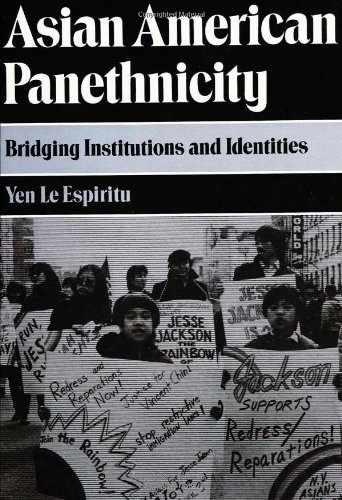
20. Asian American Panethnicity (Asian American History & Cultu)
by Yen Le Espiritu
Paperback: 139 Pages (1993-02-11)
list price: US$24.95 -- used & new: US$21.43
(price subject to change: see help)
Asin: 1566390966
Average Customer Review: 4.0 out of 5 stars
Canada | United Kingdom | Germany | France | Japan
Editorial Review

Book Description
With different histories, cultures, languages, and identities, most Americans of Chinese, Japanese, Filipino, Korean, and Vietnamese origin are lumped together and viewed by other Americans simply as Asian Americans. Since the mid 1960s, however, these different Asian American groups have come together to promote and protect both their individual and their united interests. The first book to examine this particular subject, Asian American Panethnicity is a highly detailed case study of how, and with what success, diverse national-origin groups can come together as a new, enlarged panethnic group.

Yen Le Espiritu explores the construction of large-scale affiliations, in which previously unrelated groups submerge their differences and assume a common identity. Making use of extensive interviews and statistical data, she examines how Asian panethnicity protects the rights and interests of all Asian American groups, including those, like the Vietnamese and Cambodians, which are less powerful and prominent than the Chinese and Japanese. By citing specific examples—educational discrimination, legal redress, anti-Asian violence, the development of Asian American Studies programs, social services, and affirmative action—the author demonstrates how Asian Americans came to understand that only by cooperating with each other would they succeed in fighting the racism they all faced. ... Read more

Customer Reviews (1)

4-0 out of 5 stars Major source of Asian American panethnic information
Yen Le Espiritu's book is probably the major source of research and theory dealing with Asian American panethnicity.While there are a few other researchers doing panethnicity work with other ethnic groups, this bookremains the main source for those studying Asian Americans.

Her summariesof theories of ethnicity are very short and perhaps leave out a little toomuch.But, the book does a good job of giving the reader an introductionto some major theories in preparation for her ideas.Her main areas arepolitics, funding, census classifications and anti-Asian violence.

Iappreciate this book a great deal in that it brings together some disparatepieces of information and puts it all in the context of panethnicity. ... Read more


  1-20 of 100 | Next 20
A  B  C  D  E  F  G  H  I  J  K  L  M  N  O  P  Q  R  S  T  U  V  W  X  Y  Z  

Prices listed on this site are subject to change without notice.
Questions on ordering or shipping? click here for help.

site stats