e99 Online Shopping Mall

Geometry.Net - the online learning center Help  
Home  - Basic A - Astronomy General (Books)

  1-20 of 100 | Next 20
A  B  C  D  E  F  G  H  I  J  K  L  M  N  O  P  Q  R  S  T  U  V  W  X  Y  Z  

click price to see details     click image to enlarge     click link to go to the store

$88.80
1. General History of Astronomy:
$6.50
2. Astronomy Made Simple
$29.00
3. Euclid's Phanomena:A Translation
 
$59.45
4. Explorations: An Introduction
$120.02
5. Foundations of Astronomy
$74.27
6. Tools of Radio Astronomy (Astronomy
$7.00
7. Astronomy: A Self-Teaching Guide,
$25.31
8. Creating and Enhancing Digital
$24.53
9. Astronomy: 365 Days
$175.00
10. The Cambridge Illustrated History
$8.53
11. Astronomy for All Ages, 2nd: Discovering
$6.25
12. State of the Universe 2007: New
$22.10
13. Astronomy: A Physical Perspective
$12.61
14. Aristarchus of Samos: The Ancient
$4.89
15. Astronomy and the Bible,: Questions
$15.00
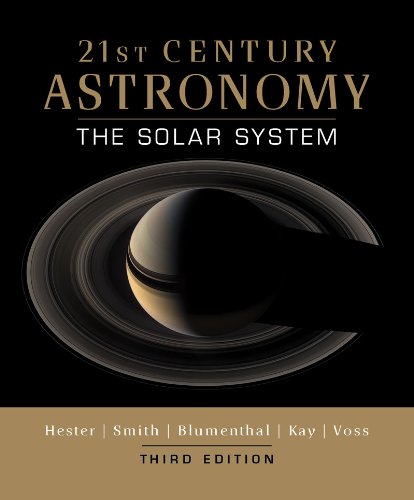
16. Astronomy Today: Solar System,
$66.54
17. Special and General Relativity:
$30.29
18. Great Ideas for Teaching Astronomy
$111.58
19. Astronomy: Journey to the Cosmic
$52.99
20. Astronomy: From the Earth to the

1. General History of Astronomy: Volume 2, Planetary Astronomy from the Renaissance to the Rise of Astrophysics (General History of Astronomy)
Hardcover: 295 Pages (1995-08-25)
list price: US$120.00 -- used & new: US$88.80
(price subject to change: see help)
Asin: 0521351685
Canada | United Kingdom | Germany | France | Japan
Editorial Review

Book Description
Part B of Planetary Astronomy from the Renaissance to the Rise of Astrophysics continues the history of celestial mechanics and observational discovery through the eighteenth and nineteenth centuries. It provides a synoptic view of the main developments and furnishes details about the lives, ideas, and interactions of the various astronomers involved.Twelve different authors have contributed their expertise to this book that begins with the reception of Newton's inverse-square law. In the remainder, a large place is given to the development of the mathematical theory of celestial mechanics from Clairaut and Euler to LeVerrier, Newcomb, Hill, andPoincaré. This emphasis is balanced by other chapters on observational discoveries and the rapprochement of observation and theory (for instance, the discovery of Uranus and the asteroids, use of Venus transits to refine solar parallax, introduction of the method of least squares, and the development of planetary and satellite ephemerides). Lists of "Further Reading" provide entrée to the literature of the several topics. This book will be of great interest to historians of science and astronomers. ... Read more


2. Astronomy Made Simple
by Kevin B. Phd Marvel
Paperback: 240 Pages (2005-01-11)
list price: US$12.95 -- used & new: US$6.50
(price subject to change: see help)
Asin: 0767917049
Canada | United Kingdom | Germany | France | Japan
Editorial Review

Book Description

See the skies in a whole new light.


Take a tour of the universe, from our local solar system to the far reaches of deepest space.ASTRONOMY MADE SIMPLE offers a complete introduction to this science, from its birth in ancient times to the different types of super-powerful telescopes scientists use today. It also includes detailed instructions on how to map the stars and understand the coordinate system, as well as fun sidebars, ideas for projects for further learning, and resources for the student or the amateur astronomer.

Topics covered include:
*the properties of light and how it gets to Earth
*the tools of astronomy
*the basics of astrophysics
*the planets
*the Sun
*distant stars and their origins
*our galaxy and beyond
*cosmology
*the existence of life in the universe


Look for these Made Simple titles


Accounting Made Simple

Arithmetic Made Simple
Biology Made Simple
Bookkeeping Made Simple
Business Letters Made Simple
Chemistry Made Simple
English Made Simple
Earth Science Made Simple
French Made Simple
German Made Simple
Ingles Hecho Facil
Investing Made Simple
Italian Made Simple
Latin Made Simple
Learning English Made Simple
Mathematics Made Simple
The Perfect Business Plan Made Simple
Philosophy Made Simple
Physics Made Simple
Psychology Made Simple
Sign Language Made Simple
Spelling Made Simple
Statistics Made Simple
Your Small Business Made Simple


www.broadwaybooks.com

... Read more

3. Euclid's Phanomena:A Translation and Study of a Hellenistic Treatise in Spherical Astronomy (History of Mathematics)
by J. L. Berggren, Robert S. D. Thomas
Paperback: 132 Pages (2006-06-01)
list price: US$29.00 -- used & new: US$29.00
(price subject to change: see help)
Asin: 082184072X
Canada | United Kingdom | Germany | France | Japan
Editorial Review

Product Description
The book contains a translation and study of Euclid's Phaenomena, a work which once formed part of the mathematical training of astronomers from Central Asia to Western Europe. Included is an introduction that sets Euclid's geometry of the celestial sphere, and its application to the astronomy of his day, into its historical context for readers not already familiar with it. So no knowledge of astronomy or advanced mathematics is necessary for an understanding of the work. The book shows mathematical astronomy shortly before the invention of trigonometry, which allowed the calculation of exact results and the subsequent composition of Ptolemy's Almagest.The Phaenomena itself begins with an introduction (possibly not by Euclid) followed by eighteen propositions set out in geometrical style about how arcs of the zodiacal circle move across the sky. The astronomical application is to the small arc of that circle occupied by the Sun, but the Sun is not mentioned. This work and the (roughly) contemporaneous treatises of Autolycus and Aristarchos form a corpus of the oldest extant works on mathematical astronomy. Together with Euclid's Optics one has the beginnings of the history of science as an application of mathematics.Copublished with the London Mathematical Society beginning with Volume 4. ... Read more


4. Explorations: An Introduction to Astronomy, Volume 1 (Solar System) with Starry Night Pro DVD, version 5.0 (Explorations)
by Thomas T Arny
 Paperback: 594 Pages (2008-01-04)
list price: US$62.50 -- used & new: US$59.45
(price subject to change: see help)
Asin: 0077234073
Average Customer Review: 5.0 out of 5 stars
Canada | United Kingdom | Germany | France | Japan
Editorial Review

Book Description
Arny: Explorations-An Introduction to Astronomy, 5th edition, is built on the foundation of its well-known writing style, accuracy, and emphasis on current information. This new edition continues to offer the most complete technology/new media support package available. That technology/new media package includes: 23 Interactives (located on the text ARIS Presentation center); ARIS website (that allows instructors to take their course to the web if they choose); and Starry Night Planetarium Software (packaged free with each new text). Available in Volumes: Volume 1 contains the Solar System (ISBN: 0077234073) / Volume 2 contains the Stars & Galaxies (ISBN: 0077234065). ... Read more

Customer Reviews (1)

5-0 out of 5 stars Excellent
This is the best Astronomy text that I have ever seen. It is filled with colorful photos and diagrams, and delves into the more interesting aspects of astronomy. A must for any Astronomy teacher, student, or amateurastronomer. It's also included with a great CD that has planetariumsoftware on it. ... Read more


5. Foundations of Astronomy
by Michael A. Seeds
Hardcover: 736 Pages (2007-11-27)
list price: US$132.95 -- used & new: US$120.02
(price subject to change: see help)
Asin: 049538724X
Canada | United Kingdom | Germany | France | Japan
Editorial Review

Book Description
With this newly revised tenth edition of FOUNDATIONS OF ASTRONOMY, author Mike Seeds' goal is to help you use astronomy to understand science--and use science to understand what we are. Fascinating and engaging, this text will help you answer two fundamental questions: What are we? How do we know? This edition addresses the newest developments and latest discoveries in the exciting study of astronomy, including new data on Jupiter's ring system; new observations of the shapes of stars; new evidence of dark energy, quasars, and galaxy collisions; and a look inside supernova explosions. And for students looking for an interactive alternative to the print text, the FOUNDATIONS OF ASTRONOMY Online Version is the ideal solution. The Online Version gives you Web-based access to a digital version of Michael A. Seeds' best-selling astronomy textbook. If your instructor is using the Enhanced WebAssign® online homework management system, the Online Version includes access to your homework assignments as well, allowing you to quickly navigate between your homework and the text. Visit www.webassign.net/seeds to learn more. ... Read more


6. Tools of Radio Astronomy (Astronomy and Astrophysics Library)
by K. Rohlfs, T.L. Wilson
Hardcover: 461 Pages (2006-04-11)
list price: US$99.00 -- used & new: US$74.27
(price subject to change: see help)
Asin: 3540403876
Average Customer Review: 5.0 out of 5 stars
Canada | United Kingdom | Germany | France | Japan
Editorial Review

Book Description

This substantially rewritten and expanded fourth edition outlines the most up-to-date methods and tools of radio astronomy. Tools of Radio Astronomy gives a unified treatment of the entire field of radio astronomy, from centimeter to sub-millimeter wavelengths and using single telescopes as well as interferometers. The basic physical principles are described and a complete outline of the instrumentation, observational techniques, and methods of measurement and analysis are given. The goal of this standard reference and text is to prepare readers to carry out observations and relate the data to physical processes in interstellar space. In this fourth edition, the chapter on interferometry and aperture synthesis has been thoroughly revised in the light of most recent developments, as has been the chapter on molecules in interstellar space, and material on receiver technology.

... Read more

Customer Reviews (1)

5-0 out of 5 stars One of the best introductions to the field
Although Rohlfs and Wilson have only made perfunctory changesbetween this and the previous edition of the book, it still stands asone of the best introductions to the field of radio astronomy.It still doesn't cover some topics (such as calibration techniques) as well as I would have liked, and Kraus' _Radio Astronomy_ (2e) does a better job (IMHO) on the mathematical details as well as specific applications.Because of its length, the topics of millimeter and submillimeter astronomy are not covered in as much as centimeter wavelengths.However despite all this, the book is highly readable for a student in the field, and is invaluable to have on one's bookshelf, or even to take observing (for those who only dabble in radio astronomy). ... Read more


7. Astronomy: A Self-Teaching Guide, Sixth Edition
by Dinah L. Moche
Paperback: 368 Pages (2004-02-19)
list price: US$19.95 -- used & new: US$7.00
(price subject to change: see help)
Asin: 0471265187
Average Customer Review: 3.5 out of 5 stars
Canada | United Kingdom | Germany | France | Japan
Editorial Review

Book Description
"A lively, up-to-date account of the basic principles of astronomy and exciting current field of research."-Science Digest
For a quarter of a century, Astronomy: A Self-Teaching Guide has been making students and amateur stargazers alike feel at home among the stars. From stars, planets and galaxies, to black holes, the Big Bang and life in space, this title has been making it easy for beginners to quickly grasp the basic concepts of astronomy for over 25 years. Updated with the latest discoveries in astronomy and astrophysics, this newest edition of Dinah Moché's classic guide now includes many Web site addresses for spectacular images and news. And like all previous editions, it is packed with valuable tables, charts, star and moon maps and features simple activities that reinforce readers' grasp of basic concepts at their own pace, as well as objectives, reviews, and self-tests to monitor their progress.
Dinah L. Moché, PhD (Rye, NY), is an award-winning author, educator, and lecturer. Her books have sold over nine million copies in seven languages. ... Read more

Customer Reviews (9)

3-0 out of 5 stars Astronomy: A self teaching guide
I have always been fascinated with astronomy but the language/references have been a bit over my head sometimes.I am looking forward to becoming a more savvy "star gazer".The book seems to be what I have been looking for.

2-0 out of 5 stars good introduction, but....
This book is a good introduction to astronomy, but, they put the answers for all the tests right next to (and often directly underneath) the questions. That makes it very hard to take the tests sincerely because it's so easy to accidentally glance at the answers.

5-0 out of 5 stars a nice little book for intro to astronomy
Obviously there are no people who are completely clueless about astronomy since we all were taught as children (at least I was) about the planets in our solar system and about other galaxies.Beyond that most people would not know much about astronomy;which is where this nice little book comes in handy.It has enough information on astronomy subjects without mathematics and without being textbook-like. I think the value of this book is the combination of illustrations and text thatstimulate an interest to explore the topics(in another, more extensive book)if this is so desired. And if not, then it is still a good overview of astronomy.Good book for the price!

1-0 out of 5 stars Yet another deceptive book...
Wanting to teach myself a little astronomy, I purchased this book, since it somehow had acquired a noble status among similar literature. Upon receiving the book and looking through it, I simply wondered "how?". It seems that most books of this type suffer from similar defects. The design seems to be based off a children's activity book. Wide margins, plentiful empty, white space, and text that is big and ugly. Is it possible to publish a book of this purpose with a crisp, small font, several paragraphs per page, and clean, sharp diagrams/illustrations? Apparently not. Perhaps I'm alone in desiring an efficient, textbook-like layout. It seems possible that the complete text of this book could have been printed on 50 pages. Anyway, there's more. The book has been reprinted several times due to its popularity. Again, I'm at a loss for why. Though the cover, perhaps, has changed, the photos that litter its pages, seem to have not. Imagine for a moment taking a photo of Jupiter through a sheet of black tracing paper. Now imagine the resultant sharpness and resolution. Breathtaking, no? The overall quality of diagrams, illustrations, and photos is woeful. Lastly, this book, in sharing the rudiments of astronomical science felt compelled to discuss the wonderful world of SETI!!! SETI is a money-sucking escapade in speculative failure.This book, as most others do, discussess the pseudo-scientific merits of the SETI program, complete with reproductions of the diagrams we've sent along into outer space of a generic ( though peaceful looking), naked man and woman.Hmmm...You will find some science in this book, but if you hope to master the basics of astronomy and take part in an honest discussion regarding the limited understanding we still have of many things universal, I recommend looking elsewhere.

4-0 out of 5 stars An armchair guide to the cosmos
I'm an armchair astronomer.While I save up to buy that telescope, I read books like this, attend star parties (dark sky gatherings where amateur astronomers let wannabes like me peek through their scopes) and daydream about the day when my future telescope sees first light.
This is a great book for people like me.It's the equivalent of a very thorough undergraduate "Introduction to Astronomy" class. The author makes good use of illustrations throughout the book to explain difficult concepts like stellar spectra, distances to astronomical objects, and how astronomers determine the temperature, mass, and composition of stars.
New discoveries are being made every day in astronomy,and of course it's impossible for a book to be as current as today's newspaper.Readers of this book will want to update themselves on certain topics, such as extrasolar planets, human spaceflight, SETI, the explosion of CCD photography in amateur astronomy, among others. A list of resources to do just that is provided in the back of the book. I highly recommend this book for anyone who wants to be entertained and enlightened at the same time.If you're like me, preparing to morph from armchair to amateur status, this book provides an excellent foundation. ... Read more


8. Creating and Enhancing Digital Astro Images (Patrick Moore's Practical Astronomy Series)
by Grant Privett
Paperback: 142 Pages (2007-03-19)
list price: US$39.95 -- used & new: US$25.31
(price subject to change: see help)
Asin: 1846285801
Average Customer Review: 3.5 out of 5 stars
Canada | United Kingdom | Germany | France | Japan
Editorial Review

Book Description

The book will, in jargon-free blow-by-blow terms, describe how to create the best astronomical images you can with the digital camera equipment at your disposal. It will explain the steps we go through to extract results from the raw-and-dirty original imagery, and then transform them into high quality pictures that you could hang on your wall.

The advent of CCDs, and more recently inexpensive webcams, has led to a much greater proportion of amateur astronomers becoming involved in digital imaging. The low price of the new Meade Deep Sky Imager - $299 (2005)suggests that within a few years a simple digital camera will become a standard accessory for any telescope.

There are as yet few books available on this aspect of amateur astronomy. This situation is likely to change in the next few years and there are going to be lots of people out there asking questions like "Flat field? What does that mean?", and trying to work out how to get the best out of their webcam, CCD or Digital SLR. They will also be wondering what is the best software to use.

To summarise; this is a book that tells practical astronomers (and that includes some but not all professionals) what is needed to get from standing in the dark with a telescope and a camera, to showing your spouse, local society friends or even supervisor the astonishing images that can be obtained with simple equipment but the right software and knowledge of how to use it.

(Grant Privett works for the Ministry of Defence in the UK, heading up the Advanced Image Processing Team.)

... Read more

Customer Reviews (2)

5-0 out of 5 stars Excellent Practical Source of Information
I have been a serious photographer for several years, and an intermediate astronomer for the last couple years.I have recently decided to try and marry these two interests together in the form of astrophotography.This book has been an outstanding source of practical, usable information that has made the transition to using a telescope in conjunction with my cameras much easier and more enjoyable.I especially benefited from Privett's section on Image Reduction; I found several mistakes in my technique that I was not even aware I was making.Privett has a very readable writing style, and he also uses a subtle sense of humor to make the reading enjoyable, and not just a dry technical treatise.I also own one of Privett's other books, The Deep-Sky Observer's Year, and these two books go together very well for planning what to shoot, and knowing how to shoot.I heartily recommend this book for anyone who wants practical advice on how to improve their digital astrophotography results.

2-0 out of 5 stars Not worth the money
To start, this book is not 244 pages, it is 142 pages including indexes and appendices. I had hoped for a tutorial that would take you through the process of taking, processing and displaying astro photos. Given the advertised 244 pages (and the relatively high price) it seemed a reasonable expectation. It's not that there is something wrong, it's just that it's not anything special and for the price it should be. Bottom line, it's not worth the money ... Read more


9. Astronomy: 365 Days
by Jerry T. Bonnell, Robert J. Nemiroff
Hardcover: 744 Pages (2006-10-01)
list price: US$29.95 -- used & new: US$24.53
(price subject to change: see help)
Asin: B000W0DFU0
Average Customer Review: 4.0 out of 5 stars
Canada | United Kingdom | Germany | France | Japan

Customer Reviews (6)

1-0 out of 5 stars Astronomical catastrophe
Astronomy: 365 DaysBeware of BordeeBook seller. I paid $38.60 to BordeeBook for a new copy and received in the mail a used book $13.99 Sort Floor Books. I don't know why my order was fouled up beyond all recognition, but BordeeBook denies receiving the book I returned for the promised refund and my credit card company will not pursue the case without a return tracking number.Also, forget about Amazon...they didn't even try...just passed me on to the seller.

5-0 out of 5 stars Stunning
This book lives up to the others that preceed it.The collection of photographs are powerful, and there are 365 days of these images along with desciptions.The book is informative as well as stunning to look at.This is one for the coffee table and not the shelf.

5-0 out of 5 stars Fascinating Fotos
I purchased the book as a gift and was lucky enough to have the recipient show me what was inside.The photos are breathtaking and really amazing.I recommend this book for anyone with an interest in the stars.

5-0 out of 5 stars Glorious Images
Astronomy: 365 is a wonderfully simple concept: one picture for each of the 365 nights of the year. This allows for a great variety of images, taken by all sorts of instruments from ordinary cameras to the Hubble Space Telescope, spanning broad panoramas of the night or evening sky to extreme close-ups of the Moon, galaxies and other heavenly bodies. Each image comes with a page of explanation of what can be seen and how the image was obtained.

A fascinating collection: the only criticism possible being that the book is rather small in both senses: it leaves you hungry for more pictures, which could be done more justice on larger format pages...

3-0 out of 5 stars an atlas, not a text
nice photographs. a book to look at photos, not to learn about astronomy ... Read more


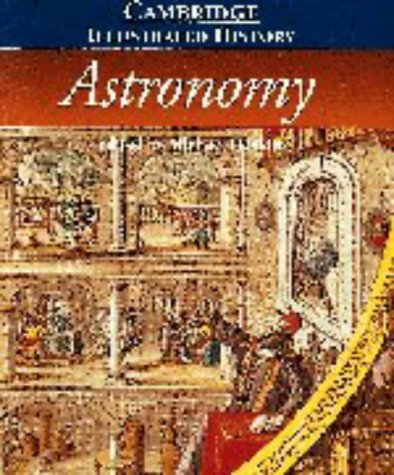
10. The Cambridge Illustrated History of Astronomy (Cambridge Illustrated Histories)
Hardcover: 400 Pages (1997-01-13)
list price: US$40.00 -- used & new: US$175.00
(price subject to change: see help)
Asin: 0521411580
Average Customer Review: 5.0 out of 5 stars
Canada | United Kingdom | Germany | France | Japan
Editorial Review

Book Description
Expertly written and lavishly illustrated, The Cambridge Illustrated History of Astronomy offers a unique account of astronomical theory and practice from antiquity to the present day. How did Moslems of the Middle Ages use astronomy to calculate the direction of Mecca from far-flung corners of the Islamic world? Who was the only ancient Greek to suspect that the earth might revolve around the sun? How did Christopher Columbus abuse his knowledge of a lunar eclipse predicted by an astronomical almanac? Packed with anecdotes and intriguing detail, this book describes how we observed the sky and interpreted what we saw at different periods of history; how this influenced our beliefs and mythology; and how great astronomers contributed to what we now know. The result is a lively and highly visual history of astronomy - a compelling read for specialists and non-specialists alike. ... Read more

Customer Reviews (4)

5-0 out of 5 stars Not a Finer History of Astronomy Available
Like other works in this series, the Cambridge 'Illustrated History of Astronomy' is both a useful reference work and a visually entertaining table-top book. Combined, those two elements make for an excellent history of the science of astronomy.

The scholarship is top-notch: Michael Hoskin is the editor and a contributor, and other contributors include J.A. Bennett, Owen Gingerich, Clive Ruggles, Christopher Cullen and David Dewhirst--superb scholars all. They cover the history of astronomy from prehistory, through the invention of the telescope and the scientific revolution, to the rise of astrophysics and beyond. Astronomy in non-western cultures (China, India, Islam) is also covered, and makes a welcome addition to the traditional Euro-centric story.

But the illustrations (many in color) really make the book: pictures, graphs, sidebars, frontispieces, manuscript pages, newspaper clippings, paintings, etc. enhance the written portion and make it that much more informative.

In sum, this may be the most useful and enjoyable book on the history of astronomy in print.

5-0 out of 5 stars Masterpice!
When you see a "coffee table" book like this, you sometimes wonder about whether the writing is going to match the pictures, but with people like Michael Hoskin, Christopher Cullen and Owen Gingerich writing the text, you know that this one is going to be a winner even before you open it. Let me just say that the pictures and the desing in fantastic, and that the writing is at a level suitable for the general public without being "dumbed down". Trust me, you're going to enjoy this one!

5-0 out of 5 stars Beautifully written and illustrated
This is the single best history of astronomy I've ever encountered. Not only is the narrative interesting, the pictures--from William Herschel's journal pages describing his discovery of Uranus to full-page illuminations of the Cartesian cosmology--enhance the experience even more than one mightexpect. At less than ( ), this book is a must for any astronomy buff.

5-0 out of 5 stars Comprehensive coverage of the history of astronomy
An excellent survey with both breadth and depth, covering non-European astronomy (for example the Dresden Codex - a Mayan calendar), the difficulties of the Geo-centric model, the development of the telescope,modern astrophysics, up to the Hubble Space Telescope. Includes a greatmany sidebars with much peripheral information (I did not know thatHerschel was an organist by trade). ... Read more


11. Astronomy for All Ages, 2nd: Discovering the Universe through Activities for Children and Adults
by Philip Harrington, Edward Pascuzzi
Paperback: 224 Pages (2000-09-01)
list price: US$19.95 -- used & new: US$8.53
(price subject to change: see help)
Asin: 0762708093
Canada | United Kingdom | Germany | France | Japan
Editorial Review

Book Description

This collection of fifty-one fascinating and engaging activities opens up the gateway to outer space for stargazers young and old.
... Read more

12. State of the Universe 2007: New Images, Discoveries, and Events (Springer Praxis Books / Popular Astronomy)
by Martin Ratcliffe
Hardcover: 194 Pages (2006-12-08)
list price: US$29.95 -- used & new: US$6.25
(price subject to change: see help)
Asin: 0387341781
Average Customer Review: 5.0 out of 5 stars
Canada | United Kingdom | Germany | France | Japan
Editorial Review

Book Description

The aim of State of the Universe 2007 (and subsequent volumes issued annually) is to provide an annual astronomy review suitable for the popular science level reader to be published every year in September in a format that will be suitable for an appeal to the Christmas market. The book will cover all major astronomical news on topics beyond the Solar System and place them in the context of the longer term goals that astronomers and astrophysicists around the world are aiming for. The target is to capture the excitement and vibrancy of modern astronomical research. The book will present a complete list of the major announcements, discoveries and news items from each year, with the major ones being explained in detail through selected chapters being written by invited contributors who are at the forefront in those fields. The January meeting of the American Astronomical Society each year will be the major source of astronomical news for the following years volume, giving access to potential authors and contacts with public information officers of major observatories, space centers, etc.

The regular set features, which will appear every year, will include an annual chronological list of the latest discoveries announced during the previous twelve months; a review of the major news stories of the year with the main characters; a list of launches of major astronomical observatories/satellites during the past year; a list of planned future astronomical satellites; basic data on all astronomical observatories currently in operation with web links for the reader to dig deeper; list of anniversaries and landmarks; the latest from the BadAstronomy website by Dr Phil Plait, and the cartoon feature.

... Read more

Customer Reviews (2)

5-0 out of 5 stars A must have!
When I read about the book I was quite excited and when I received the book, a few days ago, I was not disappointed. The book has a part dedicated to brief news and other with in-depth articles about very interesting topics (gravitational waves and LIGO, supernova 1987A remnants, gamma ray bursts...) and appendixes with data about current and future telescopes and extrasolar planets. I have still not finished it, but it won't take me long to.

Only slight cons is that I expected it to cover 2006 news and, because editorial schedule, it covers march 2005 - march 2006. Then maybe State of the Universe 2007 was not the most proper or accurate title. Other con was that I expected glossy paper, and it's not, Mate astronomical pictures are not so spectacular, but I guess this way it's cheaper (and more ecologic?).

I hope next year will bring a new State of The Universe, and I sure will buy it,

5-0 out of 5 stars Excelent Information
I read the Martin Radcliffe's book "State of the Universe 2007" and I think it was a good idea to write a book like this. It is informative, well documented, comprehensive and provides you a good vision of what is going on in the different areas of the Universe whicha are under investigation. I think he should publish it every year, to keep un up-to-date with the latest discoveries. We could collect them and follow up different researches and their results and novelties. Superb. ... Read more


13. Astronomy: A Physical Perspective
by Marc L. Kutner
Paperback: 600 Pages (2003-08-04)
list price: US$79.00 -- used & new: US$22.10
(price subject to change: see help)
Asin: 0521529271
Average Customer Review: 3.5 out of 5 stars
Canada | United Kingdom | Germany | France | Japan
Editorial Review

Book Description
This revised and updated comprehensive introduction to astronomical objects and phenomena applies basic physical principles to a variety of situations. Students learn how to relate everyday physics to the astronomical world with the help of useful equations, chapter summaries, worked examples and end-of-chapter problem sets. It will be suitable for undergraduate students taking a first course in astronomy, and assumes a basic knowledge of physics with calculus.Download Description
This fully revised and updated text is a comprehensive introduction to astronomical objects and phenomena. By applying some basic physical principles to a variety of situations, students will learn how to relate everyday physics to the astronomical world. Starting with the simplest objects, the text contains explanations of how and why astronomical phenomena occur, and how astronomers collect and interpret information about stars, galaxies and the solar system. The text looks at the properties of stars, star formation and evolution; neutron stars and black holes; the nature of galaxies; and the structure of the universe. It examines the past, present and future states of the universe; and final chapters use the concepts that have been developed to study the solar system, its formation; the possibility of finding other planetary systems; and the search for extraterrestrial life. This comprehensive text contains useful equations, chapter summaries, worked examples and end-of-chapter problem sets. ... Read more

Customer Reviews (3)

2-0 out of 5 stars A very poor textbook
This text was assigned for my second year astronomy course. While I'm told that it is rather difficult to find a suitable text for the course, this one sure doesn't fit the bill.

First of all, after being raised on MKS (meters, kilograms, seconds) units since the sixth grade, it would be nice to stay consistent with that; this book uses CGS (centimeters, grams, seconds) units. Although this didn't seem like a big deal initially, it becomes bothersome when converting constants and generally known scientific values to suit the more awkward CGS system.

Second, the number of errors contained therein are absolutely astonishing; there are mistakes in the formulas given in the instructive portions of the book, in the practice problems, and even in the constants listed (very inconveniently) in the appendix.For example, the gravitational constant, G, was given units of "dyne cm^2 g^2", when it should have been "(dyne cm^2)/g^2". Speaking from a student's perspective, it is extremely frustrating and defeating to spend hours attempting to solve a problem, only to find that the formula you are supposed to prove is missing a key component or is outright misleading (i.e., a formula missing an "R," refers to the "mass of a proton" when it is supposed to read "mass of a neutron," and declares that pi must be approximated to exactly three (!). That's a sum total of three errors in one just one question.)

Instructors, I would advise you to look for a more user-friendly textbook with a more intuitive layout, clearer diagrams, and and fewer errors.

Students who are unfortunate enough to be assigned this text, my heart goes out to you.

4-0 out of 5 stars Generally good book with a few big flaws
This book offers a good introduction to astronomy, with chapters devoted to everything from telescope technology to general relativity and cosmology.Its explanations are generally clear and instructive, although the sections on subjects like nuclear and particle physics could be a little overwhelming to the uninitiated - it's simply a lot of information to present in a relatively small amount of space, but the author does a decent job.The book gives a good understanding of the science aspect of astronomy, but rushes through some of the technicalities, with, for example, a surprisingly brief and uninformative section (3 pages!) on astronomical coordinates and timekeeping.

My big complaint about this book is that it is chock full of errors!Some entire diagrams need to be replaced, and more importantly, there are way too many errors in the equations and exercises.As a student with weekly problem sets to get through, I found this quite frustrating.In one case, an entire exercise was an error and had to be replaced with a different question.If you're thinking of using this book for a course, make sure you find the list of after press corrections, and hand it out on the first day of class.

5-0 out of 5 stars An excellent introductory astronomy textbook
I like this up-to-date textbook.I like the explanations, the diagrams, the marvellous photographs, the exercises.It covers pretty much everything I'd want as a teacher or student, and in well under 600 pages.Maybe the parts I liked best were the sections on relativity and cosmology.But it was all just great, as it sailed through telescopes, stars, spectra, binaries,the Sun, stellar evolution, the Milky Way, star formation, the interstellar medium, normal galaxies, active galaxies, clusters of galaxies, and the Sun's planetary system.The treatment of the solar planetary system included planetary atmospheres, surfaces, and interiors.It even talked about planetary resonances.

One weakness, to my way of thinking, was the overly brief appendix on astronomical coordinates and timekeeping.And there were a couple of minor topics I would have wanted to see mentioned.One was Gamma Ray Bursters.Another was Blue Stragglers.

... Read more


14. Aristarchus of Samos: The Ancient Copernicus (Dover Books on Astronomy)
by Sir Thomas Heath
Paperback: 448 Pages (2004-12-09)
list price: US$22.95 -- used & new: US$12.61
(price subject to change: see help)
Asin: 0486438864
Average Customer Review: 5.0 out of 5 stars
Canada | United Kingdom | Germany | France | Japan
Editorial Review

Book Description

This classic work traces Aristarchus of Samos's anticipation by two millennia of Copernicus's revolutionary theory of the orbital motion of the earth. Heath's history of astronomy ranges from Homer and Hesiod to Aristarchus and includes quotes from numerous thinkers, compilers, and scholasticists from Thales and Anaximander through Pythagoras, Plato, Aristotle, and Heraclides. 34 figures.
... Read more

Customer Reviews (1)

5-0 out of 5 stars best history of Greek astronomy
This old (early twentieth century) book is not just about Aristarchus, the "Greek Copernicus" -- that comes in the final chapters.Rather, it is the best survey I know of ancient Greek astronomy, starting from the very beginning.I kept coming across references to this book by Sir Thomas Heath in books on the Copernican revolution, e.g. those by Angus Armitage and Thomas Kuhn, and finally decided to read it -- after having bought his smaller volume on Greek astronomy, also reprinted by Dover.

Heath really goes into detail on each of the ancient schools of astronomy in Greece.There were in fact a good many points of view -- the earth-centered view, the view that the earth rotates daily about its axis, the view of everything going around a fiery center, the "concentric spheres" variant of Eudoxus of the earth centered view, the Aristotelian variant of that, the eventual Ptolemaic view of epicycles and all that ... and finally the view of Aristarchus, which was essentially the Copernican sun-centered view (but without Copernicus' marvelous insights into how such a view simplified everything).

Heath not only goes into detail about each of these schools of thought -- it can be pretty rough going trying to follow all of this, especially because of the esoteric modes of speaking they often employed -- he also gives pithy summaries of what each school was saying, and a critical evaluation of their worth and influence.

If you really want to gain an appreciation of the variety of the ancient Greek schools of thought, of their struggle and progress over seven centuries in describing the motions in the heavens, of the reasonableness of much of their thinking, of the magnificence of their achievement -- I heartily recommend this book, then I recommend, either before or after, exploring the Copernican revolution and the rest of the scientific revolution, in the books by Armitage, Kuhn, Hall, and others. ... Read more


15. Astronomy and the Bible,: Questions and Answers
by Donald B. DeYoung
Paperback: 176 Pages (2000-04-01)
list price: US$12.99 -- used & new: US$4.89
(price subject to change: see help)
Asin: 080106225X
Average Customer Review: 4.0 out of 5 stars
Canada | United Kingdom | Germany | France | Japan
Editorial Review

Book Description
Answers to 110 questions on astronomy and the universe from a Christian perspective that is informed by Scripture. A useful resource for classroom and home. ... Read more

Customer Reviews (7)

5-0 out of 5 stars Astronomy and the Bible:Disclosing the Glory of God in Creation
We are often exposed to "scientific" articles, books and television programs that ignore and even mock the Bible's clear teaching concerning the Creator. Because of this, Christians are sometimes intimidated, especially in a culture which insists that science is the sole propriety of secular humanism; but if the study of Physics, Biology and Astronomy should do anything to the Christian, it should inccrease our own sense of wonder and awe for the One who simply spoke the vast cosmos into existence by His powerful Word (Hebrews 11:3, Psalm 33:6). Instead of avoiding these subjects, Christians must understand that genuine science is the propriety of God, and is therefore to be enjoyed by His children, both for personal edification, as well as for outreach and evangelism to the lost. With this in mind, there is a great need for scientific works that can be used by brethren in order to increase their understanding of the sciences in an age of scholastic misinformation.

One such book is Astronomy and the Bible, Questions & Answers, by Dr. Donald B. DeYoung.

Dr. DeYoung is Chairman of the Department of Physical Science at Grace College, Winona Lake, Indiana. He holds a B.S., M.S. and Ph.D. in Physics, as well as an M. Div. from Grace Seminary. DeYoung's approach to the subject of Astronomy is clearly Biblical. Refreshingly, he deals with many of the sticky questions that normally surround modern cosmology, but with the priority of Biblical authority. Within the brief span of just 176 pages, DeYoung manages to raise and answer one hundred popular questions dealing with Cosmology and Physics. In particular, he addresses the most common questions dealing with:

* Geocentricity (Is the earth at the center of the universe?).
* The Anthropic Principle (a term which speaks of the uniqueness of earth's habitable environment).
* What is the big bang?
* What is the age of the universe?
* Should man be in space?
* What is background radiation?
* What's wrong with studying astrology?

This small sample of his one hundred questions provides a preview of DeYoung's very helpful review of Cosmology and Physics. Many of the questions that he raises are designed to bust certain modern myths. Others are designed to clarify matters that are often misunderstood in the popular culture. I find that his simple answers are thorough enough, and yet simple enough, to equip believers for personal edification as well as for sharing the Gospel with others. You don't need a Physics degree in order to read and understand this book! At the same time, this work will certainly challenge your thinking about many discussions that have fallen prey to secular humanism. I offer it to you with my highest recommendation.

3-0 out of 5 stars Astronomy from a Perspective of Creation
ASTRONOMY AND THE BIBLE is a book that attempts to answer various questions about astronomy, but from the perspective of a creationist scientist.Basic astronomical issues such as eclipses, solar systems, stars, auroras, satelittes, etc. are covered as well as more in-depth issues such as what powers the sun.There are also a variety of issues the book discusses that aren't directly related to astronomy, but that are addressed, such as the origin of the Jewish Star of David and what Bioshpere II is.

ASTRONOMY AND THE BIBLE is written in a fairly easy-to-read style that the average person can understand.It isn't very detailed and the book is written from a creationist perspective, so the majority of the scientific community would disagree with many of the explanations offered (God and science don't mix in the secular world).This book would, however, be a great read for anyone with a Biblical worldview who is trying to figure out how the celestial bodies of the universe fit into their worldview.

5-0 out of 5 stars I've used this book
Other reviews of this book--the ones that are highly critical--are critical for one reason--they don't agree with the author's stance on a relatively young earth.I've stuidied this subject quite a bit and honestly I'm not sure what to believe about "young" or "old".But then, I wasn't there.
I love DeYoung's book however because it answers so many questions in readable fashion. The non-scientist can easily grasp the basic concepts and terms we so commonly hear.It is not overly religious (that's an opinion!) but does assume that there is a God (that's not an opinion!) and that he is the God of the Bible.All books on astronomy espouse philosphical viewpoints--either the viewpoint of athiesm or that "God did it" or something else. I happen to believe the Bible, so although I'm not altogether convinced that God created the earth in 6 days that were precisely 24 hours in length, I am PLEASED by the author's God-centered conception of creation. He writes as one who knows his subject and understands the kind of questions students are asking.The book is well organized and indexed so you can find what you're looking for quickly.I would recommend it as a beginning point for Christians.
I wouldn't recommend it for the athiest.The athiest should read anything written by Phillip Johnson on the subject of inteligent design.

2-0 out of 5 stars Contaminated Astronomy
In a mailing-list flame war on creationism at MIT (of all places!) about eight years ago, I wrote (something like), "Anyone who knows anything about astronomy and has half a brain can figure out that creationism is false." Now why would I write such a thing? I was refering, of course, to young-universe creationism, the idea that the universe was created about 6000 years ago. Now, here we have an astronomy book which tries to argue that creationism is at least respectible, and *assumes* that the Bible is accurate.

This book does contain quite a bit of information on astronomy. As such, it could be a good introductory book. Unfortunately, the science is contaminated with creationist propaganda and superfluous Bible references. Only someone already knowledgeable in the field would be able to separate these tares from the wheat of science. I strongly recommend some other book on astronomy, preferably secular. "The Physical Universe" by Frank Shu, for example.

This book is better than "Starlight and Time" and "Tornado in a Junkyard," which I've already reviewed on Amazon.com. In "Starlight and Time," Russell Humphreys completely disregards all physical consequences of his white-hole theory. In "Tornado in a Junkyard," James Perloff distorts or disregards pretty much everything known in modern science. Here, Professor DeYoung gives plenty of accurate information, but also some distortions.

DeYoung does tell us about the immense distances involved in the universe. Our galaxy is about 100,000 light years across. The Andromeda galaxy, he says, is about 2.9 million light-years away. The large Magellanic Cloud, where Supernova 1987A occured, is about 180,000 light-years away. There are many many galaxies much farther away. The most distant objects, the quasars, are billions of light-years away.

The speed of light is one light-year per year. Since we can see things billions of light-years away, the universe must be billions of years old. So what's the problem?

The problem is that creationists come up with all sorts of crackpot theories to explain how we can see distant objects even with a young universe. DeYoung presents five such theories on pp. 89-90, including one detailed in "Starlight and Time." Four of them predict enormous physical phenomena that are absent in nature. The fifth theory is that God created the light while in transit when it created the universe 6000 years ago. That theory is a variant on "Last Thursdayism," the idea that we were created last Thursday with our memories completely intact and everything around us matching.

The two problems with the "Last Thursdayism" theory are that it's completely unverifiable and unfalsifiable, and it means that God committed an enormous fraud on us by creating massive evidence of a history that didn't occur. DeYoung tries to answer whether Supernova 1987A actually occured, under "Last Thursdayism." The obvious answer is no, because it would have occured long before the creation of the universe. God would have had to make the explosive light, the matching neutrinos, the light from the prior star that exploded (a blue supergiant), the light from the remains of the supernova, etc. in flight.But DeYoung makes a convoluted attempt to argue that the supernova actually did occur -- something to the effect that it happened in God's imagination, and God is truth, so it happened.

DeYoung tells us that many different estimations of the age of the universe give widely varying results, from thousands of years to billions of years. The problem is that the young-universe estimations have been thoroughly debunked. (See any typical anticreationist book, or www.talkorigins.org.) Those estimations have used absurd assumptions and have disregarded well-established basic science.

DeYoung believes that a "vapor canopy" of water existed above the atmosphere before the flood (p. 88). Genesis 1 states that God created a "firmament" in the sky, separating the waters above from the waters below. However, in the fourth day, when God created the sun, moon, and stars, God set them in the firmament. That means that the "vapor canopy" existed not only above the atmosphere, but beyond all the stars as well.

In fact, the world-view of Genesis 1 is either geocentric or flat-earth -- most likely flat-earth, because nothing in Genesis 1 portrays anything more than a "heaven above" and an "earth beneath." (Exodus 20:4) The sun and moon are small balls of light, and the stars are tiny points of light, which can fall to earth (Revelation 6:13). I've not seen anything in the Bible that unambiguously identifies a round earth. That includes Job 26:7, which DeYoung cites as indicating a round earth (p. 17). On the other hand, there are a few indications that the earth is flat: Isaiah 40: 22, Matthew 4: 8.

I agree with DeYoung, that the six days of Genesis 1 are literal days, contrary to the claims of Hugh Ross and others that days refer to ages or eons. Genesis 1 has day and night created before the sun, moon, and stars; and vegetation created before the sun. What this means is that the author of Genesis 1 didn't connect daylight with sunlight, and that Genesis 1 is simply wrong.

Contrary to DeYoung's claim on p. 17, "When the Bible touches on scientific subjects, it is entirely accurate," the Bible is frequently wrong. There is NO science in the Bible.

2-0 out of 5 stars Almost garbage - useless, unscientific, not good theology
I write this as a person both trained scientifically (I'm an electrical engineer) and trained theologically (also have M.Div.). This book is but one from a group of so-called creation-scientists. As a minister/scientist, I have to say this book, and others like it, are unhelpful. I believe that science and theology must go together - and have preached that they must, and that they very well do go together in a beautiful and meaningful way. But to do that, one has to have a mature enough faith to realize that the Bible is not a record of scientific fact.

As far as creation-science books go, I give this one two stars becuase the author clearly understands science, and uses some good scientific data and honesty, much more so than others of his ilk. However, whenever he makes a very valid scientific point, he then careens off into a bizarre creationist perspective that makes no sense. As any good scientist knows, one collects data, and then draws conclusions. One does not, as the creation-scientists do, make a hypothersis and then find the data to prove it (in their case, they are always proving that everything in the Bible is literally true, no matter how obviuosly it isn't, and so comletely ignore any discoveries that are in disagreement no matter how often that data has been reproduced, and instead focus on data that was gathered through questionable proceeses, or interpreted in questionable ways, usually having been done a fair distance in the past with imprecise tools). These are scientific shennanigans that any junior high science student would be able to pick up on as just plain wrong. I am saddened that Christians are out there who are so literally married to the idea that the Bible is a scientific textbook. The Bible is TRUTH, but it is not always FACT, and there's a big difference. The author re-arranges and re-numbers scientifically valid data to "prove" his point. There is absolutely nothing theologically wrong with admitting that the stars are billions of years old, billions of years away, and that the universe is even older than that. Please stop trying to force science to fit some misinterpreted Biblical claim (a claim which the Bible doesn't even make, which a close reading of the Bible will show you). There is some truly valid and well-thought scientific theology being done, especially from the Center for Theology and Natural Science at the Pacific School of Religion. If you want theological science, go there - their scientists are able to see and interpret scientific data in a scientific way, and are not clouded by forcing data to fit a Biblical model which doesn't even exist to begin with.

Read this book if you are interested in what the creation-scientists are doing. But don't read it because you are looking for scientific method and process. It ain't that at all. This book serves only to further make Christians look silly in the eyes of their non-Christian peers. ... Read more


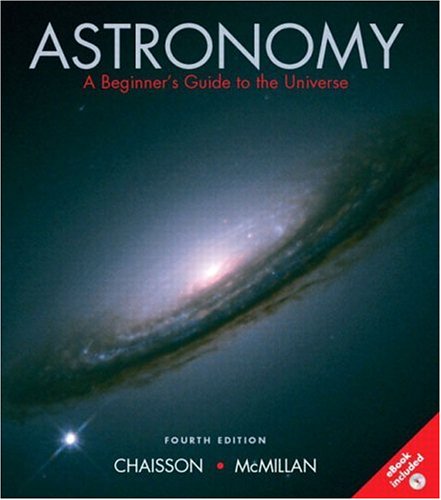
16. Astronomy Today: Solar System, Vol. I (4th Edition)
by Eric Chaisson, Steve McMillan
Paperback: 528 Pages (2002-01-15)
list price: US$58.00 -- used & new: US$15.00
(price subject to change: see help)
Asin: 0130935603
Canada | United Kingdom | Germany | France | Japan
Editorial Review

Book Description
Chaisson/McMillan's writing style and pedagogically driven art program are recognized as being scientifically accurate yet accessible to non-science majors. The integrated media program contains the market's only E-book. It provides readers with innovative and interactive tools to learn and test their understanding of astronomy concepts.Topics covered include Astronomy and the Universe, Our Planetay System, and more.For one or two-semester introductory astronomy course. ... Read more


17. Special and General Relativity: With Applications to White Dwarfs, Neutron Stars and Black Holes (Astronomy and Astrophysics Library)
by Norman K. Glendenning
Hardcover: 228 Pages (2007-04-20)
list price: US$89.95 -- used & new: US$66.54
(price subject to change: see help)
Asin: 0387471065
Canada | United Kingdom | Germany | France | Japan
Editorial Review

Book Description

Special and General Relativity are concisely developed together with essential aspects of nuclear and particle physics. Problem sets are provided for many chapters, making the book ideal for a course on the physics of white dwarf and neutron star interiors.

... Read more

18. Great Ideas for Teaching Astronomy
by Stephen Pompea
Paperback: 256 Pages (2000-07-12)
list price: US$33.95 -- used & new: US$30.29
(price subject to change: see help)
Asin: 0534373011
Average Customer Review: 5.0 out of 5 stars
Canada | United Kingdom | Germany | France | Japan
Editorial Review

Book Description
Written and revised in response to requests from teachers for ideas that can be used to improve astronomy teaching, this new expanded edition offers dozens of ideas, demonstrations, and analogies gathered from over 40 teachers around the world. ... Read more

Customer Reviews (1)

5-0 out of 5 stars Astronomy Teachers Look No Further!
This resource, Great Ideas for Teaching Astronomy, is absolutely amazing.Dr. Pompea has collected hundreds of short descriptions of teaching strategies and resources in one easy to access book.For example, regarding light and the electromagnetic spectrum, there are more than 20 demonstrations and analogies that could be used to help students.There is also information on creating successful public outreach programs.There is even an annotated bibliography of research articles in astronomy misconceptions with nearly 40 references.Every astronomy teacher should have a copy of this whether they are a novice or an experienced teacher of many years.In short, this book serves as the central foundation of my astronomy teaching tool kit and I use it all of the time. ... Read more


19. Astronomy: Journey to the Cosmic Frontier Fourth Edition with Starry Nights Pro CD-ROM (v.3.1)
by John D Fix
Hardcover: 658 Pages (2005-01-12)
list price: US$116.88 -- used & new: US$111.58
(price subject to change: see help)
Asin: 0073040789
Average Customer Review: 4.5 out of 5 stars
Canada | United Kingdom | Germany | France | Japan
Editorial Review

Book Description
This is a text for an introductory astronomy course. One of the main goals is to provide a broad enough and deep enough background in astronomy so the student will be able to follow current developments in astronomy years after they complete the course. This book presumes that most of its readers are not science majors and that they probably have not had a college-level science or mathematics course. The book provides a complete description of current astronomical knowledge, neither at an extreme technical level nor at a level that fails to communicate the quantitative nature of physical science. Finally, the historical development of astronomy is emphasized to show that astronomy, like other sciences, advances through the efforts of many scientists, and to show how present ideas have been developed. ... Read more

Customer Reviews (3)

4-0 out of 5 stars Gets the job done
I had to buy this book for a class, but given textbooks in general, this one is perfectly adequate.

5-0 out of 5 stars Astronomy: Journey to the Cosmic Frontier
The book was in mint condition.I received it promptly.I am confused though as to the record of it's purchase date.I bought this book in early September and the notification I just received says I purchased it yesterday.Other than that, no complaints.

4-0 out of 5 stars Good read lost of water
Its a good read, clear definitions, emphasis on getting sence of things, and simple relationships (say lifetimes scales as inverse of mass squared) but rather poor problems if one intends to use as a textbook... a 100lvl classes only :) ... Read more


20. Astronomy: From the Earth to the Universe, Media Edition (with InfoTrac®)
by Jay M. Pasachoff
Paperback: 912 Pages (2002-10-11)
list price: US$136.95 -- used & new: US$52.99
(price subject to change: see help)
Asin: 0534421970
Average Customer Review: 5.0 out of 5 stars
Canada | United Kingdom | Germany | France | Japan
Editorial Review

Book Description
ASTRONOMY: FROM THE EARTH TO THE UNIVERSE describes the current state of astronomy, both the fundamentals of astronomical knowledge that have been built up over decades and the exciting advances that are now taking place. The writing style is friendly and carefully detailed. It serves as a valuable reference for both beginners and astronomy enthusiasts.This book is organized as a number of stories. Individual chapters often tell what used to be known, how space and other modern observations have transformed our understanding, and then what is scheduled for the future. This is done with each planet. Consequently, an instructor can easily add photos (available as slides, overheads, CD-ROMs, and on the World Wide Web) and movies and keep a student's interest for a whole lecture on each planet, if desired. Students learn about astronomy through concrete examples, rather than merely being given overarching concepts without enough underpinning. ... Read more

Customer Reviews (1)

5-0 out of 5 stars Astronomy
I ordered this book for a Cosmology class. It was pretty good. Check out the NASA site for additional pictures. ... Read more


  1-20 of 100 | Next 20
A  B  C  D  E  F  G  H  I  J  K  L  M  N  O  P  Q  R  S  T  U  V  W  X  Y  Z  

Prices listed on this site are subject to change without notice.
Questions on ordering or shipping? click here for help.

site stats