e99 Online Shopping Mall

Geometry.Net - the online learning center Help  
Home  - Basic C - Calculus & Trigonometry General (Books)

  1-20 of 64 | Next 20
A  B  C  D  E  F  G  H  I  J  K  L  M  N  O  P  Q  R  S  T  U  V  W  X  Y  Z  

click price to see details     click image to enlarge     click link to go to the store

$58.99
1. Geometry and Trigonometry for
$82.79
2. Algebra and Trigonometry
 
$58.85
3. Pre-calculus With Trigonometry:
$14.94
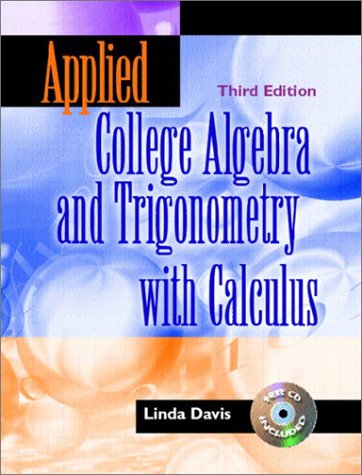
4. Applied College Algebra and Trigonometry
$12.95
5. SMP 16-19 Pure 2: Co-ordinate
$35.98
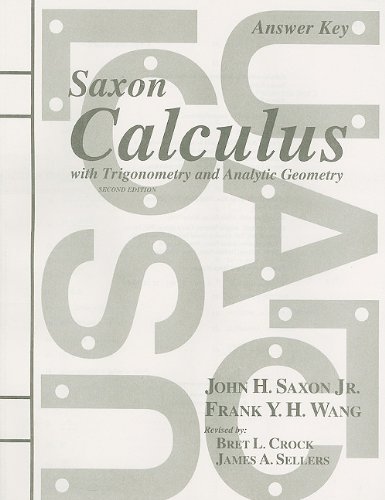
6. Calculus with Trigonometry and
$15.75
7. Just-In-Time Algebra and Trigonometry
$10.00
8. Just-In-Time Algebra and Trigonometry
9. Algebra and Trigonometry Refresher
 
$8.58
10. Algebra and trigonometry: A pre-calculus
 
11. Algebra & Trigonometry Solving
 
$4.98
12. Graphing Technology Guide For
$13.74
13. Mandatory Package College Algebra
 
$86.67
14. Technical Mathematics With Calculus
 
$16.84
15. Algebra and Trigonometry with
$19.95
16. College Algebra with Trigonometry:
 
$40.10
17. Study Guide for Algebra And Trigonometry,
$156.02
18. Fundamentals of Algebra and Trigonometry
 
$56.75
19. Calculus (Saxon Calculus)
 
$8.00
20. Bob Miller's Precalc Helper

1. Geometry and Trigonometry for Calculus (Wiley Self-Teaching Guides)
by Peter H. Selby
Paperback: 432 Pages (1975-04-18)
list price: US$19.95 -- used & new: US$58.99
(price subject to change: see help)
Asin: 0471775584
Average Customer Review: 4.0 out of 5 stars
Canada | United Kingdom | Germany | France | Japan
Editorial Review

Book Description
Geometry & Trigonometry for Calculus By Peter H. Selby If you need geometry and trigonometry as a tool for technical work … as a refresher course … or as a prerequisite for calculus, here's a quick, efficient way for you to learn it! With this book, you can teach yourself the fundamentals of plane geometry, trigonometry, and analytic geometry … and learn how these topics relate to what you already know about algebra and what you'd like to know about calculus. You'll work your way through geometry, numerical trigonometry, methods of trigonometric analysis, analytics, and limits—all the way up to the "front door" of calculus. Geometry and Trigonometry for Calculus is one of the Wiley Self-Teaching Guides. It's been tested, rewritten, and retested until we're sure you can teach yourself the concepts of geometry and trigonometry. And it's programmed—so you work at your own pace. No prerequisites are needed. Objectives and self-tests tell you how you're doing and allow you to skip ahead or find extra help if you need it. Frequent reviews and practice exercises reinforce what you learn. Wiley Self-Teaching Guides Astronomy, Moche Basic Physics, Kuhn Chemistry: Concepts and Problems, Houk How to Succeed in Organic Chemistry, Gordon Basic Electricity, Ryan Electronics, Kybett Ecology, Sutton Energy for Life, Allamong Plant Anatomy, Stevenson Quick Medical Terminology, Smith Human Anatomy, Ashley Dental Anatomy and Terminology, Ashley Math Skills for the Sciences, Pearson Thinking Metric, 2nd ed., Gilbert Using Graphs and Tables, Selby Geometry and Trigonometry for Calculus, Selby Quick Calculus, Kleppner BASIC, 2nd ed., Albrecht BASIC for Home Computers, Albrecht ANS COBOL, 2nd ed., Ashley Structured COBOL, Ashley Fortran IV, Friedmann, Greenberg & Hoffberg ATARI BASIC, Albrecht TRS-80 BASIC, Albrecht Job Control Language, Ashley Flowcharting, Stern Introduction to Data Processing, 2nd ed., Harris Background Math for a Computer World, Ashley Probability, Koosis Statistics, 2nd ed., Koosis Finite Mathematics, Rothenberg Practical Algebra, Selby Quick Arithmetic, Carman Math Shortcuts, Locke Study Skills: A Student's Guide for Survival, Carman Psychological Research: How to Do It, Quirk Psychology of Learning, Royer Choosing Success: TA on the Job, Jongeward Successful Time Management, Ferner Communication for Problem Solving, Curtis Skills for Effective Communication, Becvar Clear Writing, Gilbert Punctuation, Markgraf Vocabulary for Adults, Romine Spelling for Adults, Ryan Reading Skills, Adams Art: As You See It, Bell Your Library —What's in It for You? Lolley Quickhand, Grossman Quick Typing, Grossman Consumer Math, Locke ... Read more

Customer Reviews (12)

5-0 out of 5 stars READ HERE FOR DETAILS
This book is excellent. I don't believe that I can find anything wrong with this book.

Some readers are saying that this book has too small of a font, or that the binding is loose, or that the book offers little in explanations to the awnsers for the practice problems. These are simply false. The font is a size twelve by most computer's standard font, if you can't see that small get glasses. If some books are falling apart stop throwing them or bending the spine. The explanation part is true in that the book doesn'tsay things like "the reason this is the awnser is..." However, I feel that the explanation of how geometry works and what it's rules are, is sufficient for the reader to analyse why the awnser is what it is. If you cannot do this it may be adviseable to bring the problem in question to a friend or teacher knowledgeable in geometry (I mean this in the kindest of manners).

Over all the book is clear and quick to the point. Some people may find it a bit dry in that there is no humor really or any stories, strictly instructional. Some may find it difficult to remember things this way or to read a book written in such a manner.

This book is written so that a reader who has no knowledge about geometry can understand it.

Overall a five star book and worth the price and then some.

(Please forgive anything mispelled I didn't have time to check this review.)

1-0 out of 5 stars good as a companion only
If you want to test your knowledge of geometry and trig after reading another text book, this is good.However, this is not a standalone book.It offers problems and answers, but very little in examples and explanations of why.

Unless you want a refresher, I'd go somwhere else, maybe a dummies or idiots guide instead.

2-0 out of 5 stars There aren't enough exercises..
The best and most enjoyable way to learn math is through practice, and although Peter H. Selby articulately explains the concepts presented in this book, there just aren't enough exercises for you to "teach yourself" the subject.A given section on plane geometry will give you about 15 abstract principles followed by 5 easy practice exercises.I have learned from this book, but in order to do so, I've had to make flashcards and do lots and lots of rereading to help me memorize the vocabulary and rules.This book would be okay for someone who just needs a quick refresher, but if you really want to learn the material, I would suggest buying separate 350-400 page books for each subject.

4-0 out of 5 stars The Pleasure of Finding Things Out
Like many people, I didn't learn anything in any meaningful way in high school, so later in life I realized I lacked the necessary mathematical skills to pursue my interests in science.

Looking to fill that void I got this book and its companion introductory volume, "Peter Selby and Steve Slavin - Practical Algebra: A Self-Teaching Guide", and was extremely relieved to verify that mathematical illiteracy can be remedied with the right tools.

These books not only taught me the basics of algebra and geometry, but more importantly, gave me a glimpse of how mathematical ideas are developed. Concepts that before had appeared to me to be mystical elaborations now seem full of reason and purpose, thanks to the self-contained nature of these two books and the step by step construction of ever more complex themes, an approach that enables the reader to sense the necessity and reason behind mathematics. The authors focus not on mechanical repetition but on understanding, on making sense to the student, so everything fits in in a meaningful way, instead of appearing as a loose aggregation of disjointed bits. I really got a lot of enjoyment out of learning all the material, and finding out what a wonderful world of ideas this knowledge opens up.

Of course, being a great book doesn't mean being a flawless book, and this one indeed has its shortcomings. First, these two volumes do not cover logarithms at all, so you'll have to look for that subject elsewhere. Also, the plain geometry, analytic geometry, and conic sections chapters have insufficient exercises, so you'll probably want to get an additional text to get some more practice in those areas. Finally, even though the books are a very good and well-rounded introduction, they do not go into much depth in any area. On the other hand, the discussion of the concept of limits is truly great.

If your knowledge of mathematics has ever held you back personally or professionally, this is a great place to start changing that!!

After you're finished with these two I recommend you move on to "James Stewart - Calculus", a true gem of a book... but that's another review ;-)

1-0 out of 5 stars too much info, in way too small a typeface
The type size is too small for my eyes to read. The circles, and triangles are everyware. I'm drowning, Save me! ... Read more


2. Algebra and Trigonometry
by Michael Sullivan
Hardcover: 1176 Pages (2007-01-07)
list price: US$144.00 -- used & new: US$82.79
(price subject to change: see help)
Asin: 0132329034
Average Customer Review: 4.0 out of 5 stars
Canada | United Kingdom | Germany | France | Japan
Editorial Review

Book Description

The Eighth Edition of this highly dependable book retains its best features–accuracy, precision, depth, and abundant exercise sets–while substantially updating its content and pedagogy. Striving to teach mathematics as a way of life, Sullivan provides understandable, realistic applications that are consistent with the abilities of most readers. Chapter topics include Graphs; Trigonometric Functions; Exponential and Logarithmic Functions; Analytic Geometry; Analytic Trigonometry; Counting and Probability; and more. For individuals with an interest in learning algebra and trigonometry as it applies to their everyday lives.

... Read more

Customer Reviews (9)

5-0 out of 5 stars This is an excellent book - period
I am 55 years old and promised myself that when I became financially able I would relearn Algebra, Trigonometry, Geometry, Calculus I, II,III & IV and ODE skills from start to finish. I am now finished with Sullivan's book I have found the book easy to read and understand. The presenation of the material is well thought out and the abundance of practice problems invaluable. If you are serious about math then this is a great book.

A retired hedge fund manager.

4-0 out of 5 stars Helpful
This book has the solutions for the material presented in the book.The book has helped me alot. The only think I don't like about it, is that the book has to many practice exercises and too many pages.

1-0 out of 5 stars Buyer Beware
The information listed in the "Product Details" section for this book is very misleading.As noted in the other comments, this book is the paperback Student Solutions Manual.It is NOT a hardcover book and the ISBN number is not ISBN: 0130914657 (as listed in the product detail section).This book may prove to be helpful but it was not the book I thought I ordered.

4-0 out of 5 stars Very Good Precalculus Reference
With the sixth edition of this textbook, Sullivan has made significant strides since the fifth edition of the College Algebra portion. The interval notations used to indicate the regions where the value of a function is increasing or decreasing is so much more clear and concise. In contrast to the former use of frequently displaying number lines with pluses and minuses underneath, in which the readings of them were perhaps more of an exercise for the eyes than for the mind, Sullivan revised this mess using parentheses and brackets to indicate test intervals.

As a teacher, I say that this is not the most user-friendly book for an instructor who teaches one hour college algebra classes three times a week. Oftentimes, for me to quickly get the fundamentals across, I have to paraphrase what Sullivan lays out in many of the sections. The language is often too theoretical for several of my students (Many are in non-technical majors but have to complete college algebra as a last mathematics course requirement), and I have to put the symbolic logic sequences into terms that can cross over to applied mathematics. This is not meant to be a criticism, however.

Perhaps the main weaknesses lie in the shortcomings of applied problems, particularly in the sections concerning maxima and minima, and especially in the inequality segments. On a very positive note, however, I will grant that the sixth chapter, which involves logarithms and exponents is quite fascinating. For instance, you have applied problems involving the amount of interest that can be gained after so many years if, say, [money amount]is deposited into an account and accumulates interest at 6% compounded quarterly. Physics problems are also well presented. One interesting tidbit: if you wondered how long it would take for a 300-degree dish to cool down to 100 degrees in an environment that is at room temperature, the formula that can be used, namely Newton's Law of Cooling, is provided. As another example: suppose that a dead animal was discovered in a barn at midnight and its temperature was 80°F° ; the temperature of the barn is kept constant at 60°F; two hours later the temperature of the corpse dropped to 75°F; find the time of death. The formula for this type of problem is also shown.

As added kudos, I especially like the intermittent TI-83 calculator tips. The use of technology in mathematics classes is notably increasing in the community colleges. All in all, this is a finer, more updated version, and it is especially recommended for those who want to go beyond the call of duty and discover new ways of applying mathematics to their daily lives.

5-0 out of 5 stars Please read this review!!!!
1)Michael Sullivan (Sr.) is one of the four or five best writers
of math textbooks on today's scene. If you can find a textbook written by him that fits whatever current math course you are in
buy the book sight unseen. You will be more than happy that you
did.
2)As far as this book is concerned, I used it from chapter 1 to the end (every section of every chapter) and did every problem in
the book. I did not have an instructor and I was not enrolled in a course. I used the book to brush up for calculus after being out of school for 20 years.
3)This book is great for a course in college algebra, trigonometry, or precalculus. It serves all three purposes. I know this because after I finished the text and began studying
calculus, on my own, I was really able to appreciate how well
Sullivan's book prepared me for calculus.
4)The explanations of each concept are clear, not more rigorous
than is appropriate for a student at the level of the textbook,
but certainly not dumbed down.
5)The problems and questions are well written, comprehensive, and
most importantly, instructive. I found that the best question I
could ask myself about every problem in the book was "now what is
Sullivan trying to get me to see by doing this problem or answering this question". I mention this because this is what Sullivan is really good at; he doesn't spoon feed you.
6)Look, we all want essentially the same things from a textbook.
We want clearly written, well illustrated worked out problems
that allow us to grasp the concept in question so that we can use
it to solve problems and answer conceptual questions. With Sullivan, you get this in great measure.
This is a wonderful textbook for both sudents and teachers. It is
a great book to learn from and a great book to learn to teach from. ... Read more


3. Pre-calculus With Trigonometry: Concepts And Applications
by Paul A. Foerster
 Hardcover: Pages (2006-03-31)
list price: US$72.95 -- used & new: US$58.85
(price subject to change: see help)
Asin: 1559537884
Canada | United Kingdom | Germany | France | Japan

4. Applied College Algebra and Trigonometry with Calculus (3rd Edition)
by Linda P. Davis
Hardcover: 1184 Pages (2002-07-08)
list price: US$147.00 -- used & new: US$14.94
(price subject to change: see help)
Asin: 0130939056
Canada | United Kingdom | Germany | France | Japan
Editorial Review

Book Description
This book's objective is to make learning mathematics easier. Its easy-to-follow writing style and its balanced approach between mathematical theory and real-world applications allow the user to progress step-by-step; concepts are presented and then built upon, strengthening understanding and providing solid support for learning new concepts.Using color graphics, illustrations, examples, and application problems, topics covered in this easy-to-follow book are linear equations and inequalities; factors and fractions; exponents and radicals; functions and graphs; quadratic equations; systems of equations; higher degree equations; exponential and logarithmic functions; right angle trigonometry; vectors and oblique triangles; graphs; complex numbers; analytic geometry; introduction to statistics and empirical curve fitting; sequences, series, and the binomial theorem; differentiation with applications; integration with applications; derivations of transcendental functions; and differential equations.For workers in technical fields needing to brush up on their mathematic skills. ... Read more


5. SMP 16-19 Pure 2: Co-ordinate Geometry, Trigonometry and Further Calculus (School Mathematics Project 16-19)
by School Mathematics Project
Paperback: 172 Pages (2002-02-21)
list price: US$19.00 -- used & new: US$12.95
(price subject to change: see help)
Asin: 052178798X
Canada | United Kingdom | Germany | France | Japan
Editorial Review

Book Description
SMP 16-19 Pure 2 matches the Pure 2 module of the new AQA Advanced Subsidiary and Advanced Level Mathematics specification A. Adapted from the SMP's successful 16-19 Mathematics course, it uses a highly motivating approach which develops ability and confidence in mathematics and its applications. It continues the SMP tradition of accessibility, attractive presentation and motivating activities, all of which ease the transition from GCSE to A level mathematics. Each section of every chapter is followed by an exercise; answers are given at the back of the book. ... Read more


6. Calculus with Trigonometry and Analytic Geometry (Solutions Manual)
by John H., Jr. Saxon, Frank Y. H. Wang, Bret L. Crock, James A. Sellers
Paperback: 398 Pages (2002-06)
list price: US$74.00 -- used & new: US$35.98
(price subject to change: see help)
Asin: 1565771486
Average Customer Review: 3.0 out of 5 stars
Canada | United Kingdom | Germany | France | Japan

Customer Reviews (4)

5-0 out of 5 stars Use only if you want an "unfair" advantage for your students
The bottom line: if you want an "unfair" advantage over other math students, or if you are a teacher who wants your math students to have an "unfair" advantage, use the Saxon advanced math texts.

In essence, Saxon texts teach advanced math as a language. At present, all other serious texts teach advanced math as a formalism, a grammar. Analogously, other advanced math books present examples of the present tense the first week, then examples of nouns the second, etc. By contrast, Saxon texts make you speak sentences using the present tense every day, throughout the year.

The newer Saxon-style "language" instructional paradigm is far more consistent with consensus empirical cognitive research than is the traditional math formalism/grammar model, as well as probably being more consistent with your own intuition and past experience: grammar books may be very good at describing a language, but they are inherently not very good at training you to speak it.

The Saxon calculus text is tough, accurate, and makes profuse use of "classic" problems to teach. It just doesn't look like a grammar book, or even aspire to be one. That is apparently sufficient to bewilder, even repulse, some math educators.

Saxon detractors suspicious of its basic pedagogy are welcome to perform the mountains of painstaking basic research that would be necessary to overturn fundamental tenets in cognitive science, such as the general superiority of "distributed" (Saxon-style) practice over "massed" (traditional-style) practice. The Nobel prizes critics would garner would of course be mere icing on the cake.

But it's actually easy to demolish the fundamental argument of Saxon critics. Once people understand that other serious advanced math texts are really grammar books, Saxon critics have lost, since the average person already knows that grammar books inherently suck.

In a perfect world, all advanced math texts would simply accept the Saxon-style "language" model as obviously the superior pedagogy, and we consumers would benefit as publishers competed to produce the best possible realizations of that inherently superior model. At present, however, especially at the advanced level, the Saxon texts are the only game in town, and fine ones, at that. This gives students and teachers willing to use the Saxon texts an "unfair" advantage over their peers.

Excellent printed introductions on how to teach and learn advanced math in Saxon are available for download from the Saxon website. The most important point can be noted here: in Saxon, you are learning to "speak" math. Every single Saxon problem, in every problem set, exists solely to force you to be as fluent in as many aspects of math as possible at that time. Therefore, you can't skip any problems, or skip around in the book. If you did, you'd either be cheating yourself of opportunities to "speak" at your current highest level, or stretching yourself too thin.

A Saxon year is devoted exclusively to grammar-in-use, to "speaking" math. A point or two of math "grammar" is introduced briefly and quickly each lesson, and understanding is built up not through more explanation but through repeated and gradually more sophisticated use of the concept in problems over the following days, weeks, or even months. Introductory calculus teachers are definitely not accustomed to that way of teaching, and college-level teachers who dared to use a "language"-paradigm introductory calculus text like Saxon might be at special risk for merciless ridicule from colleagues, but something much less philosophical could also be a factor in teacher resistance to the Saxon-style approach.

Grammar books are not pedagogies, so a teacher who uses a grammar book still has to decide how to teach the grammar. Accordingly, many American math teachers are accustomed to a lot of pedagogical control. On a given day, they will pick and choose the specific problems students will do, or skip around in the text, omit or expand the development of topics, drop the textbook completely or use it merely as a "resource," and/or give elaborate lectures and demonstrations. Saxon texts, being an actual pedagogy and not a grammar of "topics," don't allow any of that.

A Saxon teacher's goal is to help every single student "speak" math each day by doing every single problem in the problem set for that day. Period. Since a Saxon text asks teachers, even more than students, to behave very differently in the classroom, a Saxon text should always be adopted voluntarily, never imposed. The unknowing, and especially, the unwilling, would wreak havoc. Learning a "language"-paradigm math text using traditional methods would be like having the football coach teach you violin. You would not enjoy the results.

Of course, there will always be a place for grammar-style math texts -- as reference manuals, once students have solidly learned the grammar-in-use.

I have no connection to the Saxon people, but I have used the Saxon texts with my own children and therefore know them intimately. As I've implied, while the Saxon books are very good, it's improbable that they represent the ultimate realization of the inherently superior "language" model, and I wish there were lots of worthy competitors. However, especially at the advanced level, the Saxon texts currently have no competition. At present, they're the only "language"-paradigm texts available.

It's a free country. If, despite considerable basic science to the contrary, you think that grammar books are swell at teaching languages; or if you believe that a language paradigm is irrelevant to mathematics instruction, since math is a beautiful formalism that only second-rate engineering students would ever deploy as a grammar-in-use; or if you simply enjoy the pedagogical autonomy that traditional introductory calculus texts allow you to exercise, then there are a plethora of math grammars to choose from. For the rest of us, there's Saxon.

1-0 out of 5 stars Worst Calculus Text I've Ever Seen
I've taught from and worked with a variety of calculus texts over the years, ranging from one-semester "calculus for business majors" to courses for science and math majors. In the course of this, it became clear that there's a fairly standard progression of topics in introductory calculus texts that's been developed and polished over the last century or so. It developed that way because, peadagogically, it's what works best for most students.

One brilliant exception is Tom Apostol's classic two volume set, but it's really designed for people who had calculus in high school already, or otherwise have sufficient mathematical maturity to handle a rigorous theoretical exposition.

Another exception is Saxon/Wang/Harvey. They've certainly come up with a different approach to teaching calculus, but unfortunately they're not Tom Apostol.

What they seem to have done is take the standard approach, slice it up like a loaf of bread, and shuffle it like a deck of cards. The result is a largely unintelligible mishmash of concepts.

For instance, in the standard approach, early on you are introduced to the idea of simple limits. Then you are taught epsilon-delta proofs as a way to handle more complicated limits. Finally, you are given a definition of the derivative as a limit that can be calculated with the epsilon-delta technique. This is both theoretically sound and pedagogically useful.

But Saxon et. al. have a different idea. Instead of presenting these topics in order, one after the other, they jumble the order and spread them out all through the book. So by the time you get to epsilon-delta proofs at the end of the book (instead of early-on like most calculus texts), you're wondering, "Why are we bothering with this?"

Similarly, other concepts that work best when taught one after the other and learned in a short period of time, in Saxon are spread out and interleaved with unrelated material. As another reviewer pointed out, Saxon has lots of review problems, and you'd certainly need them to get anything out of the text, because when you get to a concept and the immediate prerequisite information was last encountered forty or fifty pages before, you better have been doing review problems on it because otherwise you'll be lost.

It might be possible for someone who is an experienced calculus teacher to teach from this book successfully by skipping around and cherry-picking it. But I don't know why they'd bother when there are so many better texts out there.

However, for someone being home-schooled or teaching themselves, who may be making their way through this book on their own or with the guidance of a parent whose calculus may be rusty or nonexistent... this book is a disaster.

1-0 out of 5 stars An inadequate text, at best
I reviewed this text for a friend who has been struggling through it with her son. I spent several hours reading it and studying the organization and pedagogical technique.

The book breaks up important concepts, like limits, that are best left together and studied in sequential order. Its treatment of other concepts, like the definition of the derivative, does not include enough explanatory text. Some key theorems, like the mean value theorem, don't appear soon enough. The book leave epsilon delta proofs until the last lesson.

It is possible, I suppose, for a student to learn to perform Calculus in a mechanical way with this book. But I find it hard to believe that Saxon aids any student to a deeper understanding of the important concepts in Calculus. This kind of understanding is necessary for any student who intends to pursue a career in math, science, or engineering.

My friend is bright and motivated. Her son is bright and talented in mathematics. And they found this book very confusing. I think anyone unfamiliar with calculus should not use this book to homeschool their child.

My advice is to get a good AP or college calculus book, instead.

5-0 out of 5 stars Book wonderful and easy to understand; Saxon does it again!
This book teaches the advanced topics of calculus in a manner that one does no learn one day and forget in a month.The Saxon series learning premise is that of an 'incremental development', which means once a skillis acquired and it is practiced, another fascet is added, and then anotheruntil you have a full understanding of the material.This book is greatfor anyone at all who wants to learn Calculus; not just students.It isrecommended that the book "Advanced Mathematics" should preceedthis because the first part "Calculus" quickly reviews all thetopics in that book.So, I say get the book and try it; it is the best wayto learn Calculus! ... Read more


7. Just-In-Time Algebra and Trigonometry for Early Transcendentals Calculus (3rd Edition)
by Guntram Mueller, Ronald I. Brent
Paperback: 224 Pages (2005-05-13)
list price: US$30.00 -- used & new: US$15.75
(price subject to change: see help)
Asin: 0321320506
Average Customer Review: 5.0 out of 5 stars
Canada | United Kingdom | Germany | France | Japan

Customer Reviews (1)

5-0 out of 5 stars Excellent for a review, of little value for learning.
If you have previously studied and largely understood algebra and trigonometry and just need a quick review, then this book is right for you. However, if you haven't studied these topics or didn't understand them the first time, then it will be of little value. The coverage is thorough in breadth, starting with the basics of adding and subtracting all types of numbers through logarithms, exponential functions and trigonometry. Only a few pages are devoted to each topic with exercises at the end of each section. Solutions to some of the exercises are given at the end, although in my opinion there should have been more.
While the explanations are short, to the extent that it is possible in a small number of pages, they are through in depth. In a section that I found interesting, the dy/dx notation for a derivative is used. However, knowledge of calculus is not required, the reader is simply being asked to algebraically solve for dy/dx rather than use any knowledge of what it represents. Used in the manner for which it was intended this book is an effective tool in the study of precalculus material. Note: This book is nearly identical to the companion book, "Just-In-Time: Algebra & Trigonometry for Calculus." It would be a waste of money to buy both.
... Read more


8. Just-In-Time Algebra and Trigonometry for Students of Calculus (3rd Edition)
by Guntram Mueller, Ronald I. Brent
Paperback: 224 Pages (2004-10-03)
list price: US$30.00 -- used & new: US$10.00
(price subject to change: see help)
Asin: 0321269438
Average Customer Review: 5.0 out of 5 stars
Canada | United Kingdom | Germany | France | Japan

Customer Reviews (4)

5-0 out of 5 stars Solid if you need a refresher, unsuited if you need to learn it
If you have previously studied and largely understood algebra and trigonometry and just need a quick review, then this book is right for you. However, if you haven't studied these topics or didn't understand them the first time, then it will be of little value. The coverage is thorough in breadth, starting with the basics of adding and subtracting all types of numbers through logarithms, exponential functions and trigonometry. Only a few pages are devoted to each topic with exercises at the end of each section. Solutions to some of the exercises are given at the end, although in my opinion there should have been more.
While the explanations are short, to the extent that it is possible in a small number of pages, they are through in depth. In a section that I found interesting, the dy/dx notation for a derivative is used. However, knowledge of calculus is not required, the reader is simply being asked to algebraically solve for dy/dx rather than use any knowledge of what it represents. Used in the manner for which it was intended this book is an effective tool in the study of precalculus material.
Note: This book is nearly identical to the companion book, "Just-In-Time: Algebra & Trigonometry for Early Transcendental Calculus." It would be a waste of money to buy both.

5-0 out of 5 stars Wow ... great book!!
This book is totally great. I've seen very few books that explain mathematical concepts as well as this. The authors actually made math look easy by providing a lot of examples and writing in a more conversational, informal style (like the style in the Idiot's Guides series). It's a lot clearer than Barron's and Cliffs. Often there is a lot of humor added in.

As the title of this book indicates, this book is intended for calculus students in college who are struggling in their courses. However, for high school students who are using this book to teach themselves new concepts or using this as a tutorial, review, etc. I would recommend this as a supplement to another text. The book is somewhat brief and does not go through the advanced and nitty-gritry areas of algebra and trigonometry. This is intended to be a remedial "catch-up" book and is not targeted specifically towards the hig school student. But high school students, teachers, and curious readers will all find this book very helpful for making hard math look simple.

5-0 out of 5 stars Cheap, highly-focused and useful review for calculus
I'd taken Calculus ten years ago and needed to retake it. After working through 'Forgotten Algebra', this book was a godsend. It's B.S.-free and highly focused on what you need BEFORECalculus. If you buy the first edition used (as I did), then it's cheap.

5-0 out of 5 stars Best book for review
These guys are geniuses for presetnting complex information in a digestable, direct, witty, and accurate manner.Great for remembering forgotten trig and algebra.Awesome calc primer.

I salute a rare erudite math professor who can actually teach.Where can we find more?My school is full of passive aggressive math professors who know their stuff but cant teach.

thank you for the help ... Read more


9. Algebra and Trigonometry Refresher for Calculus Students (Series of Books in the Mathematical Sciences)
by Loren C. Larson
Paperback: 192 Pages (1979-09)
list price: US$33.25
Isbn: 0716711109
Average Customer Review: 5.0 out of 5 stars
Canada | United Kingdom | Germany | France | Japan

Customer Reviews (3)

5-0 out of 5 stars Perfect refresher to prepare for Calculus
I had taken Calculus in high school, but ten years later found myself having to take it again.I showed up for the first class as a confident 28 year-old, secure in the knowledge that my 'A' in high school would ensure another 'A' as an adult.What I failed to consider is the amount of intermediate Algebra and Trig that had escaped me over the years, so I left the first class feeling overwhelmed, defeated, and immediately dropped the course.Rather than signing up for Pre-Calculus instead, I spent the next two months working through every lesson and practice problem in this book.There aren't any lame cartoons to illustrate concepts, and the lessons aren't drawn out.Rather, each chapter quickly summarizes its lesson, provides a few clear examples, then gives the reader about 20 problems to work through at the end of each lesson.It's a welcome, bare-bones approach right down to the font (Courier).By the time Calculus was offered the next quarter, I was completely prepared.In fact, I got an 'A+' in the course, and this book *definitely* helped put me over the edge.

5-0 out of 5 stars Excellent aid to the first-course calculus student!
I never learned certain mathematical prerequisites of calculus in high school.Going to college I found my self struggling in calculus I... until I studied this book.It contains all of the basics for the beginning calculus student (as far as the trigonometry and algebra one needs).I quickly read the text and worked out the problems because I was in desperate need of an understanding of those basic concepts.I was able to do relatively well in calculus I, thanks to studying this book.I highly recommend it to anyone in a similar situation as the one I was in.

5-0 out of 5 stars Outstanding aide for serious student needing help!
This is an excellent text for any calculus student who has gaps in her/his algebraic preparation.The outstanding [and unusual] table of contents is a self-contained test and easily directs the user to parts of the book that will provide needed help.

Another particularly strong area of this little book are the sections on logarithmic and exponential functions. These pages contain a sound mix of graphs, explanations, and sample problems that can clarify gaps for any even semi-serious student.

This book will not spoon-feed the unprepared student, the student who never learned the necessary algebra and/or trigonometry that one needs for the calculus. However, it is an excellent resource for the student who has forgotten or never learned some topics. I have used the book as a reference since 1982 and very much appreciate it. ... Read more


10. Algebra and trigonometry: A pre-calculus approach
by Max A Sobel
 Hardcover: 524 Pages (1983)
list price: US$25.95 -- used & new: US$8.58
(price subject to change: see help)
Asin: 0130216348
Canada | United Kingdom | Germany | France | Japan

11. Algebra & Trigonometry Solving Problems in Calculus
by Grossman
 Paperback: Pages (1997-11)
list price: US$17.50
Isbn: 0030531683
Canada | United Kingdom | Germany | France | Japan

12. Graphing Technology Guide For Calculus And Precalculus
by Benjamin N. Levy
 Paperback: Pages (2000-08-01)
list price: US$23.56 -- used & new: US$4.98
(price subject to change: see help)
Asin: 061807287X
Canada | United Kingdom | Germany | France | Japan
Editorial Review

Book Description

This resource provides detailed keystroke information for current models of graphing calculators, along with step-by-step examples and technology tips.

... Read more

13. Mandatory Package College Algebra with Trigonometry with Smart CD (Windows)
by Raymond A. Barnett, Michael R. Ziegler, Karl E. Byleen
Hardcover: 1024 Pages (2000-07-06)
list price: US$142.50 -- used & new: US$13.74
(price subject to change: see help)
Asin: 0072412186
Average Customer Review: 3.5 out of 5 stars
Canada | United Kingdom | Germany | France | Japan
Editorial Review

Book Description
The Barnett, Ziegler, Byleen College Algebra/Precalculus series is designed to be user friendly and to maximize student comprehension.The goal of this series is to emphasize computational skills, ideas, and problem solving rather than mathematical theory.College Algebra with Trigonometry, 7/e, introduces a right triangle approach to trigonometry and can be used in one or two semester college algebra with trigonometry or precalculus courses.The large number of pedagogical devices employed in this text will guide a student through the course.Integrated throughout the text, the students and instructors will find Explore-Discuss boxes which encourage students to think critically about mathematical concepts.In each section, the worked examples are followed by matched problems that reinforce the concept that is being taught.In addition, the text contains an abundance of exercises and applications that will convince students that math is useful.A Smart CD is packaged with the seventh edition of the book.This CD tutorial reinforces important concepts, and provides students with extra practice problems. ... Read more

Customer Reviews (2)

2-0 out of 5 stars Mandatory Package College Algebra with Trigonometry with Smart CD (Windows)
This book was confusing. I found descrepancies. It really frustrated me. If you are an online student, good luck with this book. You will definately need tutoring.

5-0 out of 5 stars A college student from MCPV
This book may be expensive but is really helpful, not only in class but also as a reference or as a study guide. The language used in this book issimple and the graphics and images easy to understand. For me trigonometrywas always a pain and I got an A in the class, so I decided to write areview for future students. ... Read more


14. Technical Mathematics With Calculus
by Paul Calter, Michael A. Calter
 Hardcover: 1328 Pages (1999-11)
list price: US$86.67 -- used & new: US$86.67
(price subject to change: see help)
Asin: 0130960977
Average Customer Review: 4.0 out of 5 stars
Canada | United Kingdom | Germany | France | Japan
Editorial Review

Book Description
A non-theoretical book packed with applications in technology! This invaluable book is renowned for its many, fully-worked examples and numerous applications. Throughout, effective illustrations make the material clear and easy to understand. ... Read more

Customer Reviews (1)

4-0 out of 5 stars Good starting point to refresh your math skills...
This is a general mathematics text specifically written at the junior college level.The book begins with the number system and surveys the whole gamut from Algebra to Trig to Matrices to Calculus.I use this text to refresh my skills AFTER reading a standard college textbook (ex. Stewart's Calculus).There are numerous worked problems.A great feature are the boxed segments that show formulae and special rules. The layout of the text is very good with wide margins and a good font size.I highly recommend this text as a good review tool and to brush up on your math skills. ... Read more


15. Algebra and Trigonometry with Analytic Geometry (with CD-ROM, Make the Grade, and InfoTrac)
by Earl W. Swokowski, Jeffery A. Cole
 Hardcover: 960 Pages (2001-11-15)
list price: US$117.95 -- used & new: US$16.84
(price subject to change: see help)
Asin: 0534435297
Average Customer Review: 4.0 out of 5 stars
Canada | United Kingdom | Germany | France | Japan
Editorial Review

Book Description
The classic in the series of highly respected Swokowski/Cole mathematics texts retains the elements that have made it so popular with instructors and students alike: its exposition is clear, the time-tested exercise sets feature a variety of applications, its uncluttered layout is appealing, and the difficulty level of problems is appropriate and consistent.The goal of this text is to prepare students for further courses in mathematics.This book is set apart from the competition in a number of ways: it is mathematically sound, it focuses on preparing students for further courses in mathematics, and it has excellent problem sets.This edition has been improved in many respects.All of the chapters include numerous technology inserts with specific keystrokes for the TI-83 Plus and the TI-86, ideal for students who are working with a calculator for the first time.The new design of the text makes the technology inserts easily identifiable, so if a professor prefers to skip these sections it is simple to do so. ... Read more

Customer Reviews (1)

4-0 out of 5 stars Hard, but good
I use this book for my tenth grade algerbra 2 honours class. It has very good examples and is very thourough with the information. However, we never go beyond halfway through the practice problems because after the first ten or so sets, the problems are so challenging and difficult, it becomes a time waster to spend all our time going over such hard equations. It is a very good textbook, and the CD is handy. ... Read more


16. College Algebra with Trigonometry: Graphs and Models
by Raymond A. Barnett, Michael R. Ziegler, Karl E. Byleen
Hardcover: 930 Pages (2005-01-01)
list price: US$134.06 -- used & new: US$19.95
(price subject to change: see help)
Asin: 0072916990
Canada | United Kingdom | Germany | France | Japan

17. Study Guide for Algebra And Trigonometry, Second Edition
by James Stewart, Lothar Redlin, Saleem Watson
 Paperback: 352 Pages (2006-01-12)
list price: US$44.95 -- used & new: US$40.10
(price subject to change: see help)
Asin: 0495013587
Average Customer Review: 4.0 out of 5 stars
Canada | United Kingdom | Germany | France | Japan
Editorial Review

Book Description
This carefully crafted learning resource helps students develop their problem-solving skills while reinforcing their understanding with detailed explanations, worked-out examples, and practice problems. Students will also find listings of key ideas to master. Each section of the main text has a corresponding section in the Study Guide. ... Read more

Customer Reviews (2)

5-0 out of 5 stars Great book
This math book helped me get into calculus without much of a mathematical background. I messed around in high school too much :p. For three months I intensely studied this book - I nearly answered all the question. I bought the answer guide to help me see what I was doing wrong. The book is easy to read and understand; all the steps are explained in an orderly manner. If you get stuck, try reading the chapter again, you might have missed a critical part of the puzzle.

Many wonderful long night hours with this book. It's hard enough to keep your attention and make you want to strive to improve.

3-0 out of 5 stars Made math fun!!!
This book helps when you miss a class session.I was able to keep up when I read the text on days missed. ... Read more


18. Fundamentals of Algebra and Trigonometry
by Earl Swokowski, Cole
Paperback: 928 Pages (1997-01-11)
list price: US$173.95 -- used & new: US$156.02
(price subject to change: see help)
Asin: 0534954146
Average Customer Review: 5.0 out of 5 stars
Canada | United Kingdom | Germany | France | Japan
Editorial Review

Book Description
This classic in the series of highly respected Swokowski/Cole mathematics texts retains the elements that have made it so popular with instructors and students alike: it is clearly written, the time-tested exercise sets feature a variety of applications, its exposition is clear, its uncluttered layout is appealing, and the difficulty level of problems is appropriate and consistent.Now this Ninth Edition of Fundamentals of Algebra and Trigonometry has been improved in three important ways.First, discussions have been rewritten to enable students to more easily understand the mathematical concepts presented.Second, exercises have been added that require students to estimate, approximate, interpret a result, write a summary, create a model, explore, or find a generalization.Third, graphing calculators have been incorporated to a greater extent through the addition of examples and exercises as well as the inclusion of a cross-referenced appendix on the use of the TI-82/83.All of this has been accomplished without compromising the mathematical integrity that is the hallmark of this text. ... Read more

Customer Reviews (1)

5-0 out of 5 stars Everyone has to start some where.
I do not know about you. But I can study math a lot better if the book has a hard cover. This first chapter assumes you are coming from ground zero and is good to read just to brush up or see if there is anything new, that you missed originally. There is a smooth transition and a gradual complexity as you go from the fundamentals through the subject. Now some people will complain that it is not all practical or applied. This was not designed as a course for practical or applied. However it sure helps when reading other books tat can only explain tings in at least rudimentary math. Even the fundamentals of trig are needed to follow The Ascent of Man by Jacob Bronowski ISBN: 0316109339. Now I call that practical. ... Read more


19. Calculus (Saxon Calculus)
by John Saxon, Yuan Wang
 Hardcover: 756 Pages (2002-06)
list price: US$87.14 -- used & new: US$56.75
(price subject to change: see help)
Asin: 156577146X
Average Customer Review: 4.5 out of 5 stars
Canada | United Kingdom | Germany | France | Japan
Editorial Review

Book Description
Aimed at first and second year undergraduate students in mathematics, the physical sciences, and engineering, and written by two authorities in the field, this book will be required reading for courses that follow a 'problem-solving' approach to teaching calculus. The main philosophy of calculus is presented through many examples and applications to explain its abstract notions and concepts. A solutions manual demonstrating the workings of each example accompanies the book. ... Read more

Customer Reviews (3)

5-0 out of 5 stars Great Book
From the standpoint of a 15 y/o homeschooled student: I enjoyed taking this book very much, I was able to understand the whole book without having to look elseware for any instruction from anybody. The only thing I would reccomend for it would be more examples in the explinations.

5-0 out of 5 stars Best for Technical mathematicians and Engineers, physicists
This book is, no doubt, unusual all the way that it presents the subject. But it is an interesting approach that ultimately would prove useful for engineers but probably not pure mathematicians. In fact, we probably don't remember much after we finish the subject, but with this book, due to its unusual structure, content,..., the subject matter would remain longer in your mind after you study it...

3-0 out of 5 stars Unusual in structure, content and order of presentation.
This is a very unusual calculus textbook, in structure, content and order of presentation. In terms of structure, the sections are very short with a large number of problems at the ends of the sections. What is unusual about the problem sets is that explicit review problems over previous sections are included. For example, at the end of section 69 there are problems from sections 47, 26, 68, 50 12 and 18. Since the subject of section 69 is integration by parts and the problem from section 26 deals with interest computation, there does not need to be a logical connection between the two. This is most unusual and I am not convinced that it is of value, in fact I consider it detrimental.
The content is also weak, most of the explanations do not extend beyond the basics. Instructors attempting to provide a rigorous explanation of the principles of calculus will most likely need to find some supplemental material.
Finally, the order of presentation is unusual. For example, lesson 70, which starts on page 361, covers the properties of limits. Rules such as "The limit of the (sum, difference, product, quotient) of two functions is the (sum, difference, product, quotient) of the limits of the functions", are mentioned in this lesson. Since this lesson comes after derivatives and integrals, which are based on limits, have been used for some time, I found the order very odd.
In conclusion, you can teach non-rigorous calculus classes using this book, but the unusual features mean that I would not consider using it as a textbook. ... Read more


20. Bob Miller's Precalc Helper
by Robert Miller
 Paperback: 106 Pages (1991-01)
list price: US$9.95 -- used & new: US$8.00
(price subject to change: see help)
Asin: 0070422567
Canada | United Kingdom | Germany | France | Japan
Editorial Review

Book Description
The "math helper" brings a unique approach to the teaching of mathematics. Although it contains serious mathematics, it is written in a style to relieve math anxiety. It takes students by the hand and leads them through the subject. The most important topics are selected and presented in such a way as to help the student better understand the textbook and the instructor succeed in the course. This book and its companions are intended to clarify the explanation presented in traditional math texts, not for completeness. ... Read more


  1-20 of 64 | Next 20
A  B  C  D  E  F  G  H  I  J  K  L  M  N  O  P  Q  R  S  T  U  V  W  X  Y  Z  

Prices listed on this site are subject to change without notice.
Questions on ordering or shipping? click here for help.

site stats