e99 Online Shopping Mall

Geometry.Net - the online learning center Help  
Home  - Basic C - Computer Ethics (Books)

  1-20 of 100 | Next 20
A  B  C  D  E  F  G  H  I  J  K  L  M  N  O  P  Q  R  S  T  U  V  W  X  Y  Z  

click price to see details     click image to enlarge     click link to go to the store

 
$32.00
1. Computer Ethics
$14.26
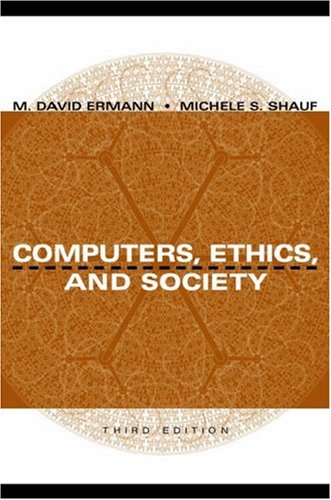
2. Computers, Ethics, and Society
$7.74
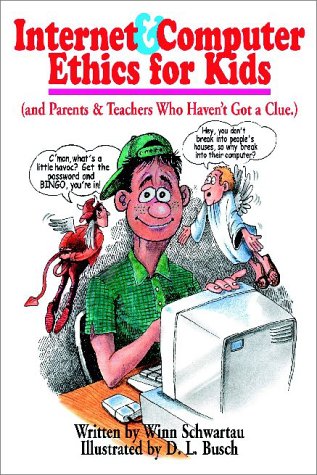
3. Internet & Computer Ethics
$9.95
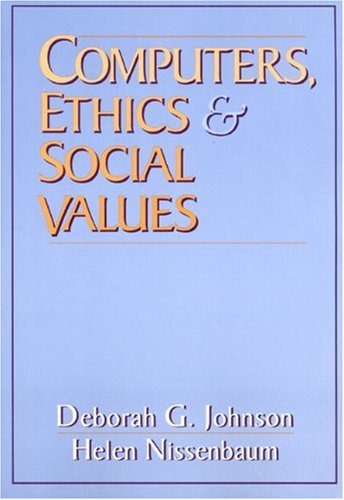
4. Computers, Ethics and Social Values
$36.50
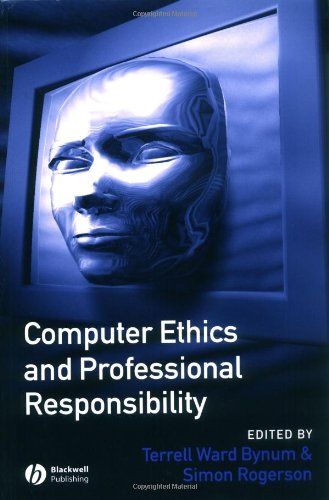
5. Computer Ethics and Professional
$19.00
6. Computer and Information Ethics
 
$2.47
7. Case Studies in Information and
$3.78
8. Computer Ethics, Second Edition:
$18.75
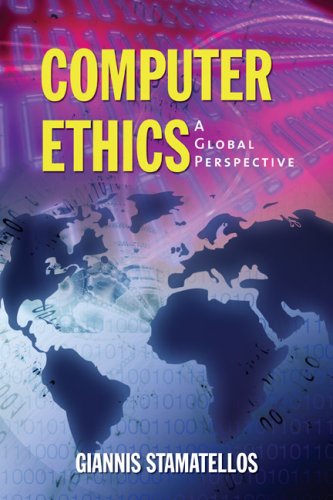
9. Computer Ethics: A Global Perspective
$59.99
10. Ethics for the Information Age
$50.74
11. Morality and Machines, Second
$34.90
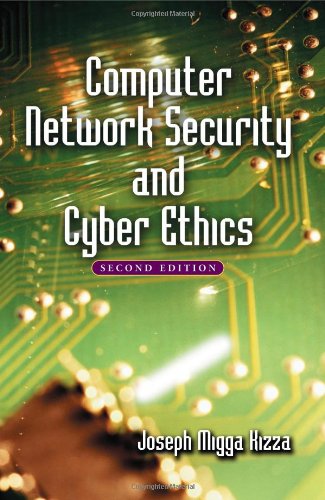
12. Computer Network Security and
$160.09
13. E-mail and Ethics: Style and Ethical
$5.97
14. Ethics and Technology: Ethical
$26.37
15. Ethical and Social Issues in the
$0.29
16. IT Ethics Handbook: Right and
$9.49
17. Ethics, Computing, and Genomics
 
$5.95
18. Ethics and computers: Bowling
 
19. Computers and Ethics (Metaphilosophy
20. USMLE Step 3 Board Certification

1. Computer Ethics
by Deborah G. Johnson
 Paperback: 224 Pages (2008-02)
list price: US$32.00 -- used & new: US$32.00
(price subject to change: see help)
Asin: 0131112414
Average Customer Review: 3.5 out of 5 stars
Canada | United Kingdom | Germany | France | Japan

Customer Reviews (12)

3-0 out of 5 stars It's OK, but boring...
I have to read this book for a college class. I've only read the first two chapters, but I agree with the other reviews. The content is easy to understand, the author makes some good points. This book can be thought provoking, but overall, it's pretty boring and repetitive.

5-0 out of 5 stars Very good
The book arrived quickly and in the condition speficied. No issues, would use this seller again.

3-0 out of 5 stars Computer Ethics Review
This book was required for my Computers & Philosophy class. It's a decently informative book, but the author doesn't write it in a way that's easy to understand. Most philosophy books are similar, but others that I've read have provided small indecies or at least some way of defining terms. By the time you finish reading a paragraph you've already forgotten what she was trying to say in the first place. If you're familiar with reading philosophy books, its great and informative, but if it's your first I would not recomend it.

3-0 out of 5 stars Painfully boring
I'm double majoring in Philosophy and Communication, so I thought that this was going to be a great book for my Computer Ethics class.Our assignments consisted of writing responses to each chapter.I was so bored only a few pages in that my responses focused on those pages and completely left out the rest of the chapter.

Having said that, if you don't read any other chapter, read "Chapter 5: Privacy".This chapter is great for debate and is VERY thought provoking.I actually read all of this one.There are so many services that people can go to, where they can access info about you.Is that ethical?

The good and bad thing about ethics in general, is that there usually isn't a right or wrong answer.This can also be a problem in that some people feel very strongly about an issue and refuse to even view it from another's perspective.

1-0 out of 5 stars .
This book is painful to read.The writing is clear, but it is so boring and repetitive that I can barely bring myself to pick it up.It seems like a majority of the time she rambles on about issues that aren't even specific to technology, and are, as another reader suggested, common sense.Unfortunately I have to read this book, since I am yet another CS major taking a required course in ethics related to technology.The subject isn't bad, the book is. ... Read more


2. Computers, Ethics, and Society
Paperback: 256 Pages (2002-11-14)
list price: US$37.95 -- used & new: US$14.26
(price subject to change: see help)
Asin: 0195143027
Average Customer Review: 5.0 out of 5 stars
Canada | United Kingdom | Germany | France | Japan
Editorial Review

Book Description
In today's world, computers can have complex and contradictory effects on human life. They can enhance our quality of life by creating access to previously unimagined worlds. On the other hand, as computers become increasingly important in our everyday lives, their potential to strip away our privacy and autonomy increases exponentially. Computers, Ethics, and Society, now in its third edition, offers a comprehensive, interdisciplinary set of readings on the ethical and social implications of computer technology. Taking into account technological, social, and philosophical issues, the contributors consider topics such as the work-related ramifications of automation, the ethical obligations of computer specialists, and the threats to privacy that come with increased computerization. Thoroughly up-to-date in its coverage, this collection includes articles on specific ethical dilemmas related to contemporary issues and events. Essays new to the third edition cover such topics as cyber-terrorism, the ethics of downloading music from Internet sites, and the question of whether human beings may someday be "replaced" by artificial intelligence and computer technology. An ideal text for sociology, philosophy, and computer science courses, Computers, Ethics, and Society, 3/e, reminds students that although technology has the potential to improve or undermine our quality of life, societal forces ultimately have the power to decide how computers will affect our lives. ... Read more

Customer Reviews (2)

5-0 out of 5 stars Excellent articles all computer professionals should read.
This book has many of the classic articles about computers and our society.The GNU Manifesto is included.There is an excellent article about whistle-blowing. I read this text many years ago in my Computer Ethics course.I really enjoyed the class and this book.

5-0 out of 5 stars Information technology in a global society
As a teacher of a course entitled "Information technology in a global society" i have found this book an excellent resource for both myself and my students alike. It's simple enough for an entry level reader (I have had kids as young as 11 discussing the ethical considerations presented inthe book). While on the other hand it contains enough specifics and casestudies to make it a suitable source for high school students preparingpapers on a variety of topical issues.

What I love is that you can pickup the book and find the relavant information your looking for withouthaving to read the whole book. ... Read more


3. Internet & Computer Ethics for Kids: (and Parents & Teachers Who Haven't Got a Clue.)
by Winn Schwartau
Paperback: 200 Pages (2001-04-01)
list price: US$15.95 -- used & new: US$7.74
(price subject to change: see help)
Asin: 0962870056
Average Customer Review: 4.5 out of 5 stars
Canada | United Kingdom | Germany | France | Japan
Editorial Review

Book Description
Internet and Computer Ethics for Kids (and Parents and Teachers Who Haven't Got a Clue) The Book of cyber-ethical Questions for the Information Age

The Title says it all.

Internet and Computer Ethics for Kids (and Parents and Teachers Without a Clue) is going to be one of the most significant books of 2001.

It discusses, in a non-technical language that everyone can understand, one of the most serious issues facing us today:

Hackers, Hacking and Cyber-Ethics.

1. How should kids behave on the Internet?
2. How can parents help their technically fluent children?
3. What can the schools and teachers do to assist?

Cyber Ethics is an important mission that you will want to be a part of, and this book is only the first of a series of books that will be appearing in the coming three years on the subject, all talking to a wide variety of issues.

CyberEthics for Kids and Families!

Internet and Computer Ethics for Kids is the first book to actively promote family and youth values and cyberethics in an entertaining, colorful way.

All About Internet and Computer Ethics for Kids!

Internet and Computer Ethics for Kids is a colorful, extensively illustrated book written in an easy to understand, non-technical format. No other book has been specifically targeted at non-technical parents, teachers and kids who are in the greatest need of ethical education on issues they don't understand.

This lack of cyber ethical knowledge:
-Hampers a parent's ability to raise their children with the appropriate amount of teaching and ethical foundation.
-Creates a greater schism in families
-Ultimately raises children with no cyber ethical guidance, which as we all know, if bad for business and society as a whole.

Unlike the small handful of older books which preach ethics and tell people how to behave, Internet and Computer Ethics for Kids does not preach or suggest what is right or wrong behavior. Instead, it provides situational conundra for the reader, the parent and the educator to discuss, evaluate and form the basis for personal ethics.

Internet and Computer Ethics for Kids is written so everyone, from all walks of life and education can read it - and understand it.
Parents
Kids
Families
Teachers
School Districts
Information Age Workers
Government Employees
Corporations to Teach Staff Ethics
Technical Conferences ... Read more

Customer Reviews (3)

5-0 out of 5 stars Even teens will like it...
We have to use this book in our Information Technology course, and we were all a little hesitant at first, but from the first page this book had us laughing...and thinking. It provides you with great resources and plenty of opportunities to flex your mind muscles with hypothetical situations and challenging questions. I actually enjoy using THIS text book! Everyone who has a computer should get it, if for no other reason that to laugh and think!

4-0 out of 5 stars For Parents and their Kids together
This book is well written.It uses language kids can understand, and also points parents and teachers to additional resources.A great book for parents to read WITH their kids, with lots of discussion suggestions at the end of every chapter.It can really help parents guide their children in the Internet age.

4-0 out of 5 stars A Great Book
After I saw this book on Tech tv i had to have it and its well worth it.. ... Read more


4. Computers, Ethics and Social Values
by Deborah G. Johnson, Helen Nissenbaum
Paperback: 656 Pages (1995-02-03)
list price: US$101.60 -- used & new: US$9.95
(price subject to change: see help)
Asin: 0131031104
Average Customer Review: 5.0 out of 5 stars
Canada | United Kingdom | Germany | France | Japan
Editorial Review

Book Description
A comprehensive anthology of readings on computers andethical issues surrounding their use. Can be used as a corebook or supplemental readings in Computer Ethics or Computersand Society subjects. ... Read more

Customer Reviews (1)

5-0 out of 5 stars Very good
The book arrived quickly and in the condition specified. No issues, would use this seller again. ... Read more


5. Computer Ethics and Professional Responsibility
Paperback: 376 Pages (2003-09-19)
list price: US$51.95 -- used & new: US$36.50
(price subject to change: see help)
Asin: 1855548453
Canada | United Kingdom | Germany | France | Japan
Editorial Review

Book Description
This clear and accessible textbookand its associated website offer a state of the art introduction to the burgeoning field of computer ethics and professional responsibility.


  • Includes discussion of hot topics such as the history of computing; the social context of computing; methods of ethical analysis; professional responsibility and codes of ethics; computer security, risks and liabilities; computer crime, viruses and hacking; data protection and privacy; intellectual property and the “open source” movement; global ethics and the internet.
  • Introduces key issues and concepts at the start of each section, and features classroom-tested study questions, and lists of useful websites and further reading.
  • Provides a wealth of relevant case studies, and an easy-to learn case-analysis technique.
  • Is accompanied by a website, offering sample student answers, additional study questions, example case analyses, and discussion forums.
  • Visit the website at www.southernct.edu/organizations/RCCS/Textbook
... Read more

6. Computer and Information Ethics
by Marsha Woodbury
Paperback: 360 Pages (2003-01)
list price: US$19.95 -- used & new: US$19.00
(price subject to change: see help)
Asin: 1588741559
Canada | United Kingdom | Germany | France | Japan

7. Case Studies in Information and Computer Ethics
by Richard A. Spinello
 Paperback: 285 Pages (1996-06-26)
list price: US$44.00 -- used & new: US$2.47
(price subject to change: see help)
Asin: 013533845X
Average Customer Review: 5.0 out of 5 stars
Canada | United Kingdom | Germany | France | Japan

Customer Reviews (1)

5-0 out of 5 stars An interesting look at computer ethics
I am using this book for an information systems management course that I am taking over the internet. It gives a fantastic look at how ethics are involved and applied to computer usage. The case studies presented dealwith very current ethical issues that are relevant to the computer industrytoday. ... Read more


8. Computer Ethics, Second Edition: Cautionary Tales and Ethical Dilemmas in Computing
by Tom Forester, Perry Morrison
Paperback: 359 Pages (1993-12-16)
list price: US$34.00 -- used & new: US$3.78
(price subject to change: see help)
Asin: 0262560739
Average Customer Review: 4.0 out of 5 stars
Canada | United Kingdom | Germany | France | Japan
Editorial Review

Book Description
For anyone interested in the issues arising from computer malfunctions and, more perniciously, from misuse, this new edition of Computer Ethics is right on the mark. Widely acclaimed for its readability and its balanced and authoritative coverage, Computer Ethics has been thoroughly revised and updated with new anecdotes, new revelations, and lively discussion of the ethical, social, and professional issues arising from the computer revolution, such as computer crime, software theft, hacking, viruses, and the invasion of privacy.

An entirely rewritten first chapter is followed by expanded chapters that contain compelling new case studies and analyses. A new final section contains 10 hypothetical scenarios for group discussion. Copies of the ACM Code of Ethics and the ACM-IEEE Computing Curricula are included in the appendixes.

Tom Forester is Senior Lecturer in the School of Computing and Information Technology at Griffith University, Queensland, Australia, and is editor or author of seven books on the social aspects of computers. Perry Morrison lectures in psychology at the National University of Singapore. ... Read more

Customer Reviews (1)

4-0 out of 5 stars A good introduction
This book serves as a good introduction to the main seven areas of information technology reguiring ethical considerations. It is suitable for anyone who is new to computing with a social concience. ... Read more


9. Computer Ethics: A Global Perspective
by Giannis Stamatellos
Paperback: 160 Pages (2007-01-09)
list price: US$37.95 -- used & new: US$18.75
(price subject to change: see help)
Asin: 0763740845
Canada | United Kingdom | Germany | France | Japan
Editorial Review

Product Description
The rapid advancement of information technology in modern societies affects the way we live, communicate, work, and entertain. Computers and computer networks formulate an information age in which traditional ethical questions are reexamined and new questions arise concerning moral standards for human behavior.Computer Ethics: A Global Perspective presents a clear and concise introduction to the ethical and social issues sparked by our ever-growing information society at the local and global level. Designed for use as a main text in undergraduate and graduate courses that focus on computer, business, and applied ethics, the text is also ideal for the Information Technology in a Global Society course for the International Baccalaureate diploma. The text considers the impact of digitized information on individuals and societies and includes discussions on privacy, reliability, security, intellectual property, control, equality of access, and authenticity, with insights from the scientists and philosophers who have attempted to evaluate, explain, and resolve these issues. The text also discusses the social impact of information technology in different areas of human life such as business, health, education, entertainment and politics. ... Read more


10. Ethics for the Information Age (3rd Edition)
by Mike Quinn
Paperback: 528 Pages (2008-02-14)
list price: US$69.13 -- used & new: US$59.99
(price subject to change: see help)
Asin: 0321536851
Average Customer Review: 3.5 out of 5 stars
Canada | United Kingdom | Germany | France | Japan
Editorial Review

Book Description
KEY MESSAGE: In an era where information technology changesconstantly, a thoughtful response to these rapid changes requires abasic understanding of IT history, an awareness of current issues, anda familiarity with ethics. Ethics for the Information Age provides an overview of ethical theories and problems encountered by computer professionals in today’s environment.

Catalysts for Change; Introduction to Ethics; Networking; IntellectualProperty; Privacy; Computer and Network Security; Computer Reliability;Professional Ethics; Work and Wealth; Plagiarism.

For all readers interested in computers and society or computer ethics. ... Read more

Customer Reviews (3)

4-0 out of 5 stars Very good; not perfect
Quinn's textbook comes off "very good" in a crowded field of competitors.It is broad in its scope, and very up to date in the issues that it raises.

The book is not without its flaws: as a philosophy professor, I would have hoped for a clearer discussion of ethical theory and a less mechanical application of those theories to the issues, but these parts of the book are small and can easily be supplemented by outside readings.I also deal with the subjects in a very different order from the book, beginning with the issues of reliability and security that will most concern our CS majors.(Spam is nasty, but it doesn't seem like the best place to start.I doubt that many of our majors will be headed in that direction as professionals.)

Of course even a perfect book could not guarantee that students will learn from it-- Learning is also the responsibility of the student.Students of science or engineering who treat this as if it were a science or math text may well come to the conclusion of one reviewer below that its conclusions often seem "obvious"-- but it is a method that is being taught, and not just the answers.Who knows what the big questions will be ten years from now in such a rapidly changing field?That is one reason why the author's first, historical chapter is such a valuable inclusion and should not be overlooked.Students too often take the status quo for granted, and do not realize how much has changed to get us here, and how quickly it has happened.Few such texts deal with this important material, and Quinn does a good job with it.

As to alleged bias in the text, that is just nonsense.If you are convinced that J. Edgar Hoover never authorized an illegal wiretap, or that the Patriot Act is uncontroversial, then some of the questions Quinn raises may make you feel uncomfortable.But that is exactly what a good ethics text should do: provoke thought and discussion.

I recommend this book as a course text that touches on all of the (currently) key areas of social concern in the CS curriculum in an engaging way.I also hope for an improved second edition that will do the job even better.

1-0 out of 5 stars What are the Ethics of Slanted Writing in an Ethics Book?
This book is one of the two texts in FSU's COP 3502: "Introduction to Computer Science" course (a required course in their Computer Science degree).It's mostly a waste of time.The first two chapters are of some use because they provide a brief history of computers and a quick introduction to the ethical theories one can use to resolve ethical dilemmas. Unfortunately, chapters 3 through 6 (inclusive) are worthless.They consist of about 190 pages of figuring out why certain obviously wrong activities are wrong (things like sending spam, producing pornography, stealing intellectual property, violating privacy, stealing identities, producing viruses, etc.).The last three chapters might have some merit, though.They cover some of the more general ethical consideration of working in the computer science field.Unfortunately, I stopped reading when the author started bringing up false POLITICAL references.

In general, most of the examples of ethical situations in these chapters are non-computer-related.Since the author specifically talks about this book being an ethics course as adhering to the IEEE's and ACM's "Computing Curricula 2001" standard, its examples ought to be drawn from the Information Systems world.My biggest gripe with these chapters is the obvious political slant of the author.He's constantly slipping his world-view based assumptions into the text as absolute-truth.I wonder what the ethics is of implying to students that certain things are true when, at best, they're controversial, and at worst, false?

I truthfully feel sorry for the poor students in FSU's Computer Science degree program who are stuck going through a course with this book and a (most probably) similarly slanted professor.

I give it 1 Star out of 5.

5-0 out of 5 stars It covers the IEEE, ACM recommendations for an ethics course
In 2001, a joint committee of the IEEE computer society and the Association for Computing Machinery recommended that every undergraduate computer science degree incorporate 40 hours in the social issues of computing. The report also contains a model syllabus for "CS280, Social and Professional Issues." This book is designed to cover all of the major topics in that outline, and that goal has been achieved. There is also enough additional material and chapter independence so that all adopters will have the flexibility to do it their own way.
The book is split into nine chapters:

*) Catalysts for change.
*) Introduction to ethics.
*) Networking.
*) Intellectual property.
*) Privacy.
*) Computer and network security.
*) Computer reliability.
*) Work and wealth.
*) Professional ethics.

While the coverage is fairly complete, the technical level never rises beyond that which one would expect the experienced computer science student to be able to handle. In my opinion, most computer science students, and quite likely instructors as well, will find the second chapter to be the most difficult to understand. The topics are:

*) Subjective relativism.
*) Cultural relativism.
*) Divine command theory.
*) Kantianism.
*) Act utilitarianism.
*) Rule utilitarianism.
*) Social contract theory.

The author delves fairly deeply into these areas, but since they are the necessary preconditions to understand ethical dilemmas, I do not object to it. However, it is a point that needs to be made in this review. I took two courses in philosophy/ethics as an undergraduate and I found myself going slowly through the chapter. A large number of questions and in-class exercises are given at the end of each chapter.
However, there is one area where the author really fumbled the ball, demonstrating a lack of historical knowledge. On page 335 in the Work and Wealth chapter, there is the statement:

" It also appears modern Americans work harder than the ancient Greeks, Romans or Western Europeans of the Middle Ages. `The lives of ordinary people in the Middle Ages or Ancient Greece and Rome may not have been easy, or even pleasant, but they certainly were leisurely. [9]' In the mid-fourth century the Roman Empire had 175 public festival days. In medieval England holidays added up to four months a year; in Spain, five months; in France, six months.[9]"

A reference is given to justify these statements, but it is most certainly wrong. While I don't dispute that there were many public holidays in ancient Greece and Rome, they were for citizens only, which was a small percentage of the population. The majority of people were slaves, who did the bulk of the labor in those societies and their labor is what made the circuses possible. Nothing really changed in the Middle Ages, the only difference was that the laboring population were called serfs.
Anyone who tries to make the point that people work harder now than in the past should reread the history of the industrial revolution. At that time, most industrial workers put in ten to fourteen hours a day seven days a week, with almost no days off. The managers of industry also readily admitted that the work environment was structured so that the workers were required to move as fast as possible. Working conditions were so difficult and physically demanding that many people were permanently disfigured after a few years on the job.
Despite this reservation, I recommend the book and plan on using it as a text if my proposal for a course in computer ethics is approved. ... Read more


11. Morality and Machines, Second Edition: Perspectives on Computer Ethics
by Stacey L. Edgar
Paperback: 448 Pages (2002-09-25)
list price: US$72.95 -- used & new: US$50.74
(price subject to change: see help)
Asin: 0763717673
Average Customer Review: 4.0 out of 5 stars
Canada | United Kingdom | Germany | France | Japan
Editorial Review

Book Description
Intended for science and technology students, philosophy students interested in applied ethics, and others who must deal with computers and the impact they have on our society. ... Read more

Customer Reviews (1)

4-0 out of 5 stars Comprehensive and fun.
Dr. Edgar's text provides a thurough and engaging look into contemporary issues involving computers and ethical decision making.Designed for a course in Computer Ethics, this text not only provides applied ethics but also gives the non-Philosophy student a good introduction to ethics itself.As a past student in the course, I felt as though the book worked well and provided professors and students alike with much to work from. ... Read more


12. Computer Network Security and Cyber Ethics, 2d edition
by Joseph Migga Kizza
Paperback: 223 Pages (2006-07-26)
list price: US$35.00 -- used & new: US$34.90
(price subject to change: see help)
Asin: 0786425954
Average Customer Review: 5.0 out of 5 stars
Canada | United Kingdom | Germany | France | Japan
Editorial Review

Product Description
This fully updated edition of the 2002 Choice Outstanding Academic Title opens with three chapters new to this edition introducing morality, ethics, and technology and value. The author demonstrates the central role of morality and ethics in the deliberations and decisions of people handling information technology. Also discussed in depth is the value technology adds and the role it plays in the decision-making process. Like the first edition, this book focuses on security issues with the intent of increasing the public’s awareness of the magnitude of cyber vandalism, the weaknesses and loopholes inherent in the cyberspace infrastructure, and the ways to protect ourselves and our societies. The goal is public understanding of the nature and motives of cyber acts, how such acts are committed, and the efforts being undertaken to prevent future occurrences. ... Read more

Customer Reviews (1)

5-0 out of 5 stars A down-to-earth, serious guide
Computer Network Security And Cyber Ethics by Joseph Kizza (professor of computer science at the University of Tennessee, Chattanooga, Tennessee) studies the very real and expanding frontier of cybercrime. From the motives for cyber attacks to their costs to society as a whole, crime prevention efforts and the future of cybercrime are all covered in this down-to-earth, serious guide. A thoughtful, informed, and informative look at electronic malice and its consequences, Computer Network Security And Cyber Ethics is highly recommended reading. Also strongly recommended is Joseph Kizza's earlier work, Civilizing The Internet: Global Concerns And Efforts Toward Regulation ... ... Read more


13. E-mail and Ethics: Style and Ethical Relations in Computer-Mediated Communications (Routledge Studies in Contemporary Philosophy)
by Emma Rooksby
Hardcover: 256 Pages (2002-10-18)
list price: US$170.00 -- used & new: US$160.09
(price subject to change: see help)
Asin: 0415282810
Canada | United Kingdom | Germany | France | Japan
Editorial Review

Book Description
In E-mail and Ethics, Emma Rooksby explores the ways in which interpersonal relations are affected by being conducted via computer-mediated communication.

For over a decade, computer-mediated communication has been available as institutional and personal communication technology, and it has been becoming more widely available ever since its inception. It is often considered to be an efficient, productive and cost-effective form of communication, and it is claimed to bring many social and personal benefits in fields ranging from political action and formation of friendships, to therapeutic discussion and education access.

The advent of this channel of communication has prompted a renewed investigation into the nature and value of forms of human association. Rooksby addresses these concerns in her rigorous investigation of the benefits, limitations and implications of computer-mediated communication.

With its depth of research and clarity of style, this book will be of essential interest to philosophers, scholars of communication, cultural and media studies, and those interested in the importance and implications of computer-mediated communication. ... Read more


14. Ethics and Technology: Ethical Issues in an Age of Information and Communication Technology
by Herman T. Tavani, Herman Tavani
Paperback: 400 Pages (2003-06-03)
list price: US$64.95 -- used & new: US$5.97
(price subject to change: see help)
Asin: 0471249661
Average Customer Review: 4.5 out of 5 stars
Canada | United Kingdom | Germany | France | Japan
Editorial Review

Book Description
"Herman Tavani has written an excellent introduction to the field of cyberethics. . . . We need a good book in cyberethics to deal with the present and prepare us for an uncertain future. Tavani's Ethics and Technology is such a book."
--from the foreword by James Moor, Dartmouth College

Is there privacy in a world of camera phones and wireless networking?
Does technology threaten your civil liberties?
How will bioinformatics and nanotechnology affect us?
Should you worry about equity and access in a globalized economy?

From privacy and security to free speech and intellectual property to globalization and outsourcing, the issues and controversies of the information age are serious, complex, and pervasive.

In this new edition of his groundbreaking book, Herman Tavani introduces computer professionals to the emerging field of Cyberethics, the interdisciplinary field of study that addresses these new ethical issues from all perspectives: technical, social, and philosophical. Using fascinating real-world examples--including the latest court decisions in such cases as Verizon v. RIAA, MGM v. Grokster, Google versus the Bush Administration, and the Children's Online Pornography Act (CIPA) --as well as hypothetical scenarios, he shows you how to understand and analyze the practical, moral, and legal issues that impact your work and your life. Tavani discusses such cutting-edge areas as:
* Globalization and outsourcing
* Property rights and open source software
* HIPAA (privacy laws) and surveillance
* The Patriot Act and civil liberties
* Bioinformatics and genomics research
* Converging technologies--pervasive computing and nanocomputing
* Children's online pornography laws

Updating and expanding upon the previous edition, Ethics and Technology, Second Edition provides a much-needed ethical compass to help computer and non-computer professionals alike navigate the challenging waters of cyberspace.

About the Author

Herman T. Tavani is Professor of Philosophy at Rivier College and Co-Director of the International Society for Ethics and Information Technology (INSEIT). He is the author, editor, or co-editor of five books on ethical aspects of information technology.

www.wiley.com/college/tavani ... Read more

Customer Reviews (3)

4-0 out of 5 stars Repectable, updated text
While this book would not normally be one that I would purchase to read on its own, it was the textbook for a course on computer ethics that I took and I was pleasantly surprised to find the textbook written in a very approachable matter.

The text starts off with an overview in general ethical theory before starting in to the focus of the text - various issues and how they apply to the growing use of computer technology in the modern world. Some of the topics covered include surveillance, privacy, and file sharing among others. Included with the various issues are up to date examples for recent cases and point/counterpoint perspectives on the topics.

The text does lose some points due to the fact that the last few chapters run a bit thin and could stand to be expanded a bit, but as a whole the text is quite detailed and provides plenty of citations to allow the reader to find attentional information.

4-0 out of 5 stars More academic than I'm used to, but solid information...
It seems that every time you turn around, there's some news story in the industry press about the ethics or legality of some aspect of technology.To help myself understand some of the underlying issues a bit better, I decided to read and review Ethics & Technology: Ethical Issues in an Age of Information and Communication Technology (2nd Edition) by Herman T. Tavani.While not the easiest or most riveting read, I did come away with a better appreciation for the field of ethics.

Contents: Introduction To Cyberethics - Concepts, Perspectives, and Methodological Frameworks; Ethical Concepts and Ethical Theories - Establishing and Justifying a Moral System; Critical Thinking Skills and Logical Arguments - Tools for Evaluating Cyberethics Issues; Professional Ethics, Codes of Conducts, and Moral Responsibility; Privacy and Cyberspace; Security in Cyberspace; Cybercrime and Cyberrelated Crimes; Intellectual Property Disputes in Cyberspace; Regulating Commerce and Speech in Cyberspace; Social Inclusion, The Digital Divide, and the Transformation of Work - The Impact for Class, Race, and Gender; Community and Identity in Cyberspace - Ethical Aspects of Virtual-Reality and Artificial-Intelligence Technologies; Pervasive Computing and Converging Technologies - Ethical Aspects of Ambient Intelligence, Bioinformatics, and Nanocomputing; Glossary; Index

Having never taken a class on ethics or critical thinking, I found the first three chapters interesting.Tavani builds the foundation of how to define and describe cyberethics, as well as how to determine and argue the case of what is "moral".These chapters are a concise course on how to build an argument and support it properly.After those three chapters are done, the concepts that were built are used to examine many different facets of computers and life, and how ethics come into play and shape how we think.There are the subjects you'd expect, like digital rights and security.But he also covers issues that I don't normally think of when dwelling on computers and ethics...gender, socioeconomic classes, race.First you have to determine if indeed those things are ethical issues, and if so, what responsibility do you have in those areas.

On one hand, the book is thorough and detailed.It's meant to be a textbook on the subject, and as such it delivers.These are the types of academic discussions and debates that you'd expect in a formal setting.I was somewhat disappointed, however, when it came to conclusions.Both sides of each issue were debated (even when I didn't even think there *was* another side), but resolution was elusive.I suppose I'm supposed to take this information and draw my own conclusions, but instead I came away with "so everything's right *and* wrong".Since I tend to want to get down to practical issues rather than deal with abstracts, I found it hard to come to any resolution at the end of each chapter.

Definitely good material, and worth reading.But it will make you work and think.

5-0 out of 5 stars A really interesting little-ish book
This book was on the prescribed text list for the masters I am doing (Master of Informaiton Technology) and I must say I was pleasantly surprised to read it. Being a technical (engineer) person, it's a generalized opinion that this group (enclave?) we like mathematics, science and engineering books, but not so called 'arty farty' stuff like philosophy. Speaking for me personally, isn't far from the truth...So I thought...groan, not another one of these idealistic, pointless, ultimately altruistic and futile failures to read. Indeed not! I actually enjoyed reading it! (shock-horror). Tavani uses the ploy of relating hisideas to real-life situations (stalking, cracking, etc). This lends the book a serious air of legitimacy. The ivory tower is nowehere in sight. He doesn't lecture at you like you're a poor, misguided computer geek who could never possibly understand human morals and ethics in a digital world (the point is to help you do that...which Tavani does).

Back to the point: the book builds form the point of view that you have never been exposed to ethics. You get a grounding in ethical theories and then move on to learning how to evaluate ethical issues (kind like logic in mathematics without the symbols). He talks about codes of practice and your moral responsibility as a somebody who works, creates or manages a little corner of cyberspace. It is at this point that the book leaps forward into relevant (if somewhat shallow treatment) of the major issues ike privacy, piracy, crime, security,freedom of speech and equity. These are also posited through scenarios and then the ethics involved are developed through direct discussion of these scenarios. And as I alluded to previously, these give the book an excellent 'hook'. They make the theory real and relevant and rather interesting (and sometimes tragic: you'll see what I mean when you read the first scenario involving a teenage girl stalked thorugh the net and ultimately murdered in realty).

This is a provocative book, but in a subdued, subtle way. The author doesn't speed feed you heaped spoonsfuls of moral outrage with lashings of indignant pontification, just ideas (and these are ever so valuable) in a considered manner. I think the author has really succeeded here. If he can make a totally 'technical' person like me actually enthusiastic about reading it, then that's truly indicative of the book's quality.

The price may be a little high for what is a pretty thin book in a physical sense. Ideaswise it is quite rich, so that's the price you pay (it this ethical? ideas are only available to those who can affort it!) That aside, I got a lot from this little book and so consider it money well spent.

All in all a good 'starting' book for cyberethics! Thumbs up! However consider you may find yourself supplementing it with other braoder, deeper works as you progress because it is a rich field to learn in. Tavani will open this vista up for you if you approch this book with a willingness to put aside your prejudices and listen to what he has to say. ... Read more


15. Ethical and Social Issues in the Information Age (Texts in Computer Science)
by Joseph M. Kizza
Kindle Edition: 374 Pages (2002-12-06)
list price: US$54.95 -- used & new: US$26.37
(price subject to change: see help)
Asin: B000PY3OAO
Average Customer Review: 3.0 out of 5 stars
Canada | United Kingdom | Germany | France | Japan
Editorial Review

Book Description
Rapid advances in computing and information science often outpace society's ability to adapt its moral and legal codes.Different computing paradigms applied to the same ethical issues can often lead to conflicting confusions.This second edition examines ethical, social, and policy challenges stemming from the emergence of cyberspace, the convergence of telecommunications, and other information handling products.The book broadly surveys thought-provoking questions about the impact of these new technologies, with particular emphasis on the growth of the Internet, artificial intelligence, cyberspace, and virtual reality.Topics and features:* Describes how changes in information technology influence morality and the law.* Surveys the history of computing and the recent evolution of computer crimes* Incorporates recent requirements for computer science curricula* Assess workplace concerns related to privacy, surveillance, and virtual offices* Contains numerous discussion and research projects on all presented material* Considers what should be covered in a professional code of conduct of IT professionals* Offers a pertinent discussion on civil liberties, harassment, and discrimination.. ... Read more

Customer Reviews (1)

3-0 out of 5 stars A myriad of topics each discussed briefly
Excellent chapters covering morality, law, ethics, professional codes, and intellectual property rights. Provides a basic introduction to many topics that stimulate further study, research, and discussion. Discussion ofsocial issues is limited. The weaker chapters are the modern areas of theinformation age such as cyberspace, the internet, email, privacy, security,artificial intelligence, and virtual reality. ... Read more


16. IT Ethics Handbook: Right and Wrong for IT Professionals
by Stephen Northcutt, Cynthia Madden
Paperback: 648 Pages (2004-06-08)
list price: US$49.95 -- used & new: US$0.29
(price subject to change: see help)
Asin: 1931836140
Average Customer Review: 2.5 out of 5 stars
Canada | United Kingdom | Germany | France | Japan
Editorial Review

Book Description
The target audience for this book is any IT professional responsible for designing, configuring, deploying or managing information systems. This audience understands that the purpose of ethics in information security is not just morally important; it equals the survival of their business. A perfect example of this is Enron. Enron's ultimate failure due to a glitch in the ethics systems of the business created the most infamous example of an ethics corporate breakdown resulting in disaster. Ethics is no longer a matter of morals anymore when it comes to information security; it is also a matter of success or failure for big business.

*This groundbreaking book takes on the difficult ethical issues that IT professional confront every day.

*The book provides clear guidelines that can be readily translated into policies and procedures.

*This is not a text book. Rather, it provides specific guidelines to System Administrators, Security Consultants and Programmers on how to apply ethical standards to day-to-day operations. ... Read more

Customer Reviews (7)

1-0 out of 5 stars Walk the walk...
It would be good if the author were capable of following his own advice; his personal examples contradict themselves on many important points, and when the moral questions get tough, he (or she) dashes away like a frightened rabbit, metaphorically speaking. A quick Google search turns up several lawsuits and evidence that this author is definitely not someone who should be writing about IT ethics under any circumstances.

2-0 out of 5 stars This could have been better
I really wanted to like this book.There are a lot of good things in it, but the negatives outway them.

Problems:
* No bibliography, refrences or pointers to further reading/research.There have been other books on it/computer ethics, this is not the first.
* The slant seems too much toward ethics as it relates to security and security-related matters.There's more to it/computer ethics then that.
* No mention of the several professional organizations of IT/ITSEC people!!!Slight mention is made of ACM & IEEE, but no mention of SAGE (the System Administrators Guide at www.sage.org) which is THE professional association of sysadmins, who have spent YEARS developing a professional code of ethics.This code should have been included in the book.And what about the several professional groups of ITSEC people, like ISSA (Information Systems Security Association at www.issa.org) which also has a code of ethics, Computer Security Insitute (www.gocsi.com), and so forth??They should have been mentioned.(and since SANS, the authors group, did stuff with SAGE, ignoring them is pretty bad).

1-0 out of 5 stars Don't know right from wrong? This book isn't going to help.
Have you ever wondered if you are doing the right thing?Is is okay to steal from work?How about downloading pirated music using the company network? Do the rules apply to everyone? Can I do whatever I want if I'm a system administrator?

These are real topics covered in "IT Ethics Handbook". Sadly, each answer comes in two varieties: Conservative and liberal (each of which get their own font!).If you don't like one answer, you can just choose the other.The (long) list of contributors put their heads together to come up with rationalizations for both sides.

I tend to think that if you have to ask the question, you already know the answer, and if you truly don't, asking your friends, boss, or co-workers will clear it right up.Heck, the employee handbook might even answer them.The book doesn't really lay a foundation for ethics, but sticks to specifics questions.Indeed, it seems to ignore the idea that ethics isn't an absolute, and may vary between different groups and cultures.They merely mention all that stuff in the introduction, but then quickly discard it.

Some other paraphrased questions, in case you still think you need this book.You can quickly find a rationalization for the right and wrong of each and apply the answer that you like best.


  • Can I write malicious virus code for profit?
  • Should I use somebody else's login and password?
  • Can I use company resources for personal gain?
  • Can I videotape my co-workers having sex in the hallways? (real question)
  • Do I have to obey the law?
  • Can I be lazy?
  • Can I spy on employees?
  • Can I take revenge on a co-worker?


Perhaps this book is for the guy who wears the expensive suit and takes off fridays to play golf.

3-0 out of 5 stars Clear cookbook for common ethical dilemmas
I'm glad that we are finally starting to see books like this. This is a good one but I would like to see more emphasis on this area with even better books.

The book is organized into chapters based on various roles and functions within and organization. Then within each chapter there are various ethical dilemmas which are discussed. The dilemmas is defined, then both liberal and conservative takes on the matter are described and the item is closed with an explicit stance on the issue.

This issues discussed are wide ranging, from storing personal files on work machines, to whether a workplace affair can be tolerated. This wide ranging discussion is one of the problems I have with the book. If the issues had been more focused on IT concerns then each item could have been covered in more depth.

Another problem with the book is it's layout. I found that the layout of the text and the material distracted from the contents. There was too much formatting.

I liked the book because I found the material compelling. If not the discussions themselves, which were too brief. It stretched my mind to think about these issues and to take input from different sides of the fence. I hope this book will be revised so that it is even more readable and valuable. In the meantime it is still worth the look for those in the IT field with ethics concerns.

3-0 out of 5 stars How Do You Truly Define Ethical Right and Wrong in IT?
When do we as information technology professionals cross the line ethically? Who us to say what is right or wrong? Are there absolutes? Or is everything just relative. These are some of the questions posed by Stephen Northcutt in IT Ethics Handbook - Right and Wrong for IT Professionals ( 648 pages ; Syngress, 2004). The only problem is that for this reader, the book left me with more questions than it answered, though I found the many examples and "case studies" included would provide good references for discussion purposes.

The first thing that caught my attention was the author's identification of "moral relativism" as one of the dominant "religious thoughts" in the world today. The author also boldly states that in many cases "moral relativism" will "rapidly get you fired in the workplace". This latter statement may or may not be true, but itstruck me more as an ethical goal in a perfect world than as statement of fact. And there is no way in the world that this reader would consider "moral relativism" a stream of religious thought because it has no grounding in religion at all. It is a by-product of the drive for a secular society in today's world. It seems that the author does acknowledge to some degree that moral relativism is a culprit in the ethical quandaries of today, it serves as the framework for the discussion of each ethical issue raised, casting answers in a "conservative" and "liberal" point of view to show the extremes of the answers to different scenarios.

It is here that the readers of this book would need to be very careful, as is the challenge in looking at any case study, since nothing is always cut and dry since a scenario does not always include all the factors that can drive it. The author does acknowledge this and states that every case study and answer set offered may or may not be applicable to given organizational circumstances.

All of this being said, I would not recommend this book for anyone expecting to find cut and dry answers that they can apply to their organization. I would recommend it as a desk reference to use for ethics training session or to find information for the starting point of discussions for ethics issues that may arise at any given time in the workplace. The price is not that expensive that you would not get at least some value out of the book, even if it just challenges your thinking about what issues really fall under the realm if "IT Ethics" or how you would approach a given situation.

The Business Controls Caddy Scorecard: Even on a Par 4 ... Read more


17. Ethics, Computing, and Genomics
Paperback: 356 Pages (2005-07)
list price: US$67.95 -- used & new: US$9.49
(price subject to change: see help)
Asin: 0763736201
Average Customer Review: 4.0 out of 5 stars
Canada | United Kingdom | Germany | France | Japan
Editorial Review

Book Description
Comprised of eighteen chapters contributed by experts in the fields of biology, computer science, information technology, law, and philosophy, Ethics, Computing, and Genomics provides instructors with a flexible resource for undergraduate and graduate courses in an exciting new field of applied ethics: computational genomics.The chapters are organized in a way that takes the reader from a discussion of conceptual frameworks and methodological perspectives, including ethical theory, to an in-depth analysis of controversial issues involving privacy and confidentiality, information consent, and intellectual property.The volume concludes with some predictions about the future of computational genomics, including the role that nanotechnology will likely play as biotechnologies and information technologies continue to converge. ... Read more

Customer Reviews (2)

4-0 out of 5 stars Essential information for developing an informed opinion
Since the essence of being that is commonly described as the purview of the soul is still unknown, our genetic material is considered the main component of who we are. It is the blueprint by which our bodies and minds are constructed. Therefore, it is natural that most people would consider their personal genetic code to be their property, to be guarded and controlled.
However, there are also valid reasons why a person's genetic data should be extracted and kept on file. It can reveal propensities for the onset of disease and point the way to curing illness. It is clear that in the future, many fatal diseases will be recognized in the DNA before the onset of symptoms and the disease will be cured when it is only a potential.
These two opposing forces are heavily debated in this book, with no clear resolution as to what the appropriate position is. I was impressed with the quality of the arguments, in other books I have read about human cloning; some of the reasons against were too shrill and emotional. These arguments are based on sound social, economic, biological and ethical considerations.
Identity theft is a growing problem in modern society; millions of dollars of fraud is committed every year. Unfortunately, while the application of genetic information has the potential to do great good, if it is misused, it could be enormously destructive. It is no exaggeration to claim that the improper use of genetic information could alter the human species. For these reasons, every citizen has a stake in the direction of genetic research and how a person's genetic data is used. Using the articles in this book, it is possible to understand the debate and get the information so that you can form your own opinion based on the facts.

4-0 out of 5 stars raises early questions in this field
Undoubtedly, many other books will follow in the field, in the years ahead. Currently, computational genomics is in its infancy. The amount that is known is surely orders of magnitude less than what will follow, as biologists investigate further the development process at higher levels than the DNA.

So in a sense, Tavani hopes to raise awareness now. He discusses various problems with the use or abuse of information about people.As computational genomics can find out more about a given person, what social ill effects might result if the information got out to unauthorised parties? Who has a right to the data?

Plus, what if advances in understanding are made as a consequence of a person's data. Does she or should she benefit, beyond receiving any possible therapies? Bluntly, can she collect royalties from something derived from her body? ... Read more


18. Ethics and computers: Bowling Green's computer policy. (Kentucky): An article from: Government Finance Review
by Melissa Wilson
 Digital: 9 Pages (1995-12-01)
list price: US$5.95 -- used & new: US$5.95
(price subject to change: see help)
Asin: B00093SYBK
Canada | United Kingdom | Germany | France | Japan
Editorial Review

Book Description
This digital document is an article from Government Finance Review, published by Government Finance Officers Association on December 1, 1995. The length of the article is 2438 words. The page length shown above is based on a typical 300-word page. The article is delivered in HTML format and is available in your Amazon.com Digital Locker immediately after purchase. You can view it with any web browser.

From the supplier: The city of Bowling Green, KY, has come up with a employee computer ethics and procedures handbook for all computer users in government agencies. Users must read the policies and affix their signatures on the agreement sheets before gaining access to the city's computer system. It ensures that computer equipment and software are used for the benefit of the city of Bowling Green.

Citation Details
Title: Ethics and computers: Bowling Green's computer policy. (Kentucky)
Author: Melissa Wilson
Publication: Government Finance Review (Magazine/Journal)
Date: December 1, 1995
Publisher: Government Finance Officers Association
Volume: v11Issue: n6Page: p40(3)

Distributed by Thomson Gale ... Read more


19. Computers and Ethics (Metaphilosophy 16(4) 1985.)
 Paperback: Pages (1985)

Asin: B0012BT8HM
Canada | United Kingdom | Germany | France | Japan

20. USMLE Step 3 Board Certification Review: Pediatrics and Medical Ethics (Adult and Pediatric) With Computer-Based Case Simulations and Some Important Adult Topics
by D., M.D. Kanjilal
Paperback: 616 Pages (2001-10-15)
list price: US$99.00
Isbn: 1581410638
Canada | United Kingdom | Germany | France | Japan

  1-20 of 100 | Next 20
A  B  C  D  E  F  G  H  I  J  K  L  M  N  O  P  Q  R  S  T  U  V  W  X  Y  Z  

Prices listed on this site are subject to change without notice.
Questions on ordering or shipping? click here for help.

site stats