
|
Help |
| Home - Basic E - Economic History (Books) | |
e99 Online Shopping Mall
|
|
Help |
| Home - Basic E - Economic History (Books) | |
| 1-20 of 97 | Next 20 |
click price to see details click image to enlarge click link to go to the store
| 1. A New Economic View of American History: From Colonial Times to 1940 (Second Edition) by Jeremy Atack, Peter Passell | |
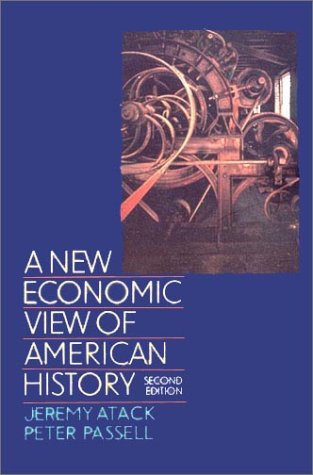 | Paperback: 714
Pages
(1994-05-17)
-- used & new: US$35.97 (price subject to change: see help) Asin: 0393963152 Average Customer Review: 
Canada | United Kingdom | Germany | France | Japan |
|
Editorial Review Product Description Customer Reviews (6)
I remember it in terms of so many wonderful anecdotes. There are the farm girls from Vermont who staffed the mills in Massachusetts until the great Irish immigration drove them back to the farm. There are the restless young men from the prairies who rode the rafts down river to New Orleans, and then set off to see the world. There are the canals that lost all their capital value with the coming of the railroads - but then kept operating anyway, because it was more worthwhile to use them than to tear them up. This is not, of course, precisely a law book. But it is a book about issues for the law: about slavery, about public land policy, about the structure of industry and finance. The chapters on the Great Depression alone would make a sufficient background for any course in constitutional or administrative law.For the authors, only two words: new edition. ... Read more | |
| 2. History of Economic Analysis: With a New Introduction by Joseph A. Schumpeter | |
 | Paperback: 1320
Pages
(1996-03-07)
list price: US$95.00 -- used & new: US$89.92 (price subject to change: see help) Asin: 0195105591 Average Customer Review: 
Canada | United Kingdom | Germany | France | Japan |
|
Editorial Review Product Description Customer Reviews (5)
He is sometimes difficult to follow, not helped by the many and extensive footnotes he appends the book with, and by the many quotations he does in foreign languages, which he usually do not translate, be it in ancient Greek, Latin , French or German. Also , the book was unfinished in his lifetime and had to be edited by his wife, who was also deceased before the full completion of the giantic task. Even so, the book has some 1.300 pages and covers the full range of all the relevant economic thougth until the time of its publication. A warning sign of caution must be addressed to the non-professional readers not not fully interested in the magnitude of such a scope, that is, of addressing the formative ideas of each and every important concept in economic analisys in a so complete way. This can be an overkill for you. But if you are interested in Medieval thought, the concepts exposed by , for instance, Saint Thomas and many others, this is a very good reading. Enjoy it
For a reader well-grounded in economic theory and history, I am sure that this is a bible; but for a curious reader interested in the history of economics (in a more political as opposed to theoretical perspective) this book may not be right. Highly footnoted and not very smooth writing, as well as obscure references to economists and theories results in a history that is very demanding of the reader. If you are looking for an economic history text that reads like From Dawn to Decadence you may be seriously disappointed, as I had been, but if you are a serious student of economics and are willing to spend the time to deliberate over Schumpeter's words then History of Economic Analysis is right for you.
| |
| 3. The Secret History of the American Empire: The Truth About Economic Hit Men, Jackals, and How to Change the World by John Perkins | |
 | Paperback: 384
Pages
(2008-04-29)
list price: US$15.00 -- used & new: US$8.16 (price subject to change: see help) Asin: 0452289572 Average Customer Review: 
Canada | United Kingdom | Germany | France | Japan |
|
Editorial Review Product Description Customer Reviews (74)
| |
| 4. American Economic History (8th Edition) (Pearson Series in Economics) by Jonathan Hughes, Louis Cain | |
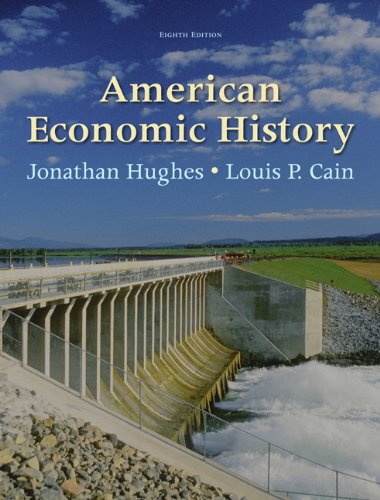 | Hardcover: 720
Pages
(2010-01-13)
list price: US$180.00 -- used & new: US$99.81 (price subject to change: see help) Asin: 0137037414 Average Customer Review:
Canada | United Kingdom | Germany | France | Japan |
|
Editorial Review Product Description Customer Reviews (3)
| |
| 5. A Concise Economic History of the World: From Paleolithic Times to the Present by Rondo Cameron, Larry Neal | |
 | Paperback: 480
Pages
(2002-05-30)
list price: US$69.95 -- used & new: US$45.00 (price subject to change: see help) Asin: 0195127056 Average Customer Review:
Canada | United Kingdom | Germany | France | Japan |
|
Editorial Review Product Description Customer Reviews (7)
Nevertheless, the book is quite interesting, as it progresses from the dawn of human civilization with very concise and brief summaries well in to the twentieth century becoming more desciptive and detailed.If you are interested in how the world economy arrived to its current level, then I would suggest that this book is a good read and worth your while.Since this edition was published in 1997, it is excusable for the author to omit the economic consequences of the Euro, the rise of China and the rest of Asia, and the economic implications of Septemer 11.The author also refuses to offer his speculative view on the future of the world economies, thereby leaving the reader to do his or her on guess work.Although the introduction of the book, on the current inequality of world economies, is quite interesting, it is not elaborated upon towards the end of the book, and causes a lack of continuity.If you wish to understand better the world economy, you would be better off reading the encyclopedia, Lonely Planet travel guides, or perhaps even better, (what I have done) which is to travel and see these countries for yourself with your own eyes.
| |
| 6. Structure and Change in Economic History by Douglass C. North | |
 | Paperback: 240
Pages
(1982-10-17)
-- used & new: US$15.80 (price subject to change: see help) Asin: 039395241X Average Customer Review:
Canada | United Kingdom | Germany | France | Japan |
|
Editorial Review Product Description At the core of Professor North's investigation is the question of property rights, the arrangements individuals and groups have made through history to deal with the fundamental economic problem of scarce resources. In six theoretical chapters, Professor North examines the structure of economic systems, outlines an economic theory of the state and the ideologies that undergird various modes of economic organization, and then explores the dynamic forces such as new technologies that cause institutions to adapt in order to survive. With this analytical framework in place, major phases in Western history come under careful reappraisal, from the origins of agriculture and the neolithic revolution through the political economy of the ancient and medieval worlds to the industrial revolution and the economic transformations of the twentieth century. Structure and Change in Economic History is a work that will reshape many established explanations of the growth of the west. Customer Reviews (8)
But here North runs into a problem with the infamous structure/agency dichotomy.That is, he means to rise above methodological individualism by incorporating a broad, deterministic social "structure" into his analysis -- "by structure I mean those characteristics of a society which we believe to be the basic determinants of performance" (3).However, he also seems to chalk a great deal of explanatory power up to individual leadership, calculation and rationality:the state specifying rules of the game to maximize rents (24) and also:"throughout history, individuals given a choice between a state-however exploitative it might be-and anarchy, have decided for the former" (24).But if there's such a powerful structure, then can individuals really "choose" their fate?How much leeway is there for strategic calculation?On page 32 he seems to say that the masses have no power to choose:"institutional innovation will always come from rulers rather than constituents since the latter would always face the free rider problem".Is North's structure (and institutions) merely an aggregation of the choices of masses of agents, or is it the strategic choices of a few ruling principals and their agents, or is it the evolution of an impersonal body of culture, ideas, law, etc., or is it all three?And if it's all three, then is he trying to incorporate too much into the concept of "institutions", until they become tautological?What CANNOT be an institution under his definition, and if everything is an institution, then how can we formulate testable, falsifiable hypotheses about social change? North defines institutions as "the humanly devised constrains that construct human interaction" (p. 344); or, the rules of the game in a society.Thus, it is clear that North is trying to provide an explanation of the dynamic interaction among many factors, which is always a difficult task.But he is to be commended for modifying neoclassical thought in this provocative new way, potentially opening a path for a whole new research agenda in the social sciences. ... Read more | |
| 7. A Farewell to Alms: A Brief Economic History of the World (Princeton Economic History of the Western World) by Gregory Clark | |
 | Paperback: 432
Pages
(2008-12-29)
list price: US$19.95 -- used & new: US$12.64 (price subject to change: see help) Asin: 0691141282 Average Customer Review:
Canada | United Kingdom | Germany | France | Japan |
|
Editorial Review Product Description Customer Reviews (46)
| |
| 8. A History of Economic Thought by Lionel Robbins | |
 | Paperback: 393
Pages
(2000-11-15)
list price: US$39.95 -- used & new: US$29.61 (price subject to change: see help) Asin: 0691070148 Average Customer Review:
Canada | United Kingdom | Germany | France | Japan |
|
Editorial Review Product Description Lord Robbins (1898-1984) was a remarkably accomplished thinker, writer, and public figure. He made important contributions to economic theory, methodology, and policy analysis, directed the economic section of Winston Churchill's War Cabinet, and served as chairman of the Financial Times. As a historian of economic ideas, he ranks with Joseph Schumpeter and Jacob Viner as one of the foremost scholars of the century. These lectures, delivered at the London School of Economics between 1979 and 1981 and tape-recorded by Robbins's grandson, display his mastery of the intellectual history of economics, his infectious enthusiasm for the subject, and his eloquence and incisive wit. They cover a broad chronological range, beginning with Plato, Aristotle, and Aquinas, focusing extensively on Adam Smith, Thomas Malthus and the classicals, and finishing with a discussion of moderns and marginalists from Marx to Alfred Marshall. Robbins takes a varied and inclusive approach to intellectual history. As he says in his first lecture: "I shall go my own sweet way--sometimes talk about doctrine, sometimes talk about persons, sometimes talk about periods." The lectures are united by Robbins's conviction that it is impossible to understand adequately contemporary institutions and social sciences without understanding the ideas behind their development. Authoritative yet accessible, combining the immediacy of the spoken word with Robbins's exceptional talent for clear, well-organized exposition, this volume will be welcomed by anyone interested in the intellectual origins of the modern world. Customer Reviews (5)
I did not find the language in it frustrating, it just made the book seem like a personal lecture with Robbins (minus the questions) which added to my enjoyment. He stops at Fisher, so if you were hoping for ideas and icons after that, you will be disappointed. The book is split into five sections. The first deals with those philosophers that preceded the formal study of economics; Plato, Aristotle, Aquinas etc... Very interesting stuff, especially if you aren't familiar with the relationship between the ancients and economics. The second to the fourth sections deal with famous economists, from Adam Smith to Karl Marx. His treatment of Marx is brief so don't expect anything more than a few pages. While he goes into some length about Adam Smith and the other classical economists. Finally he lectures on Jevons, Menger and others of the "Marginal Revolution", ending his series of lectures with Fisher. A good read, I would recommend it to undergraduates in Economics or any one else who is interested in the history of economic ideas.
| |
| 9. The Cambridge Economic History of Modern Europe: Volume 1, 1700-1870 by Stephen Broadberry, Kevin H. O'Rourke | |
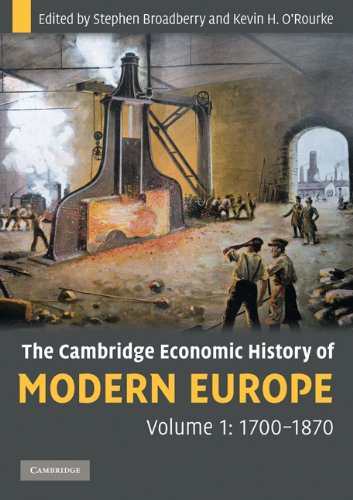 | Paperback: 344
Pages
(2010-07-26)
list price: US$40.00 -- used & new: US$33.98 (price subject to change: see help) Asin: 0521708389 Canada | United Kingdom | Germany | France | Japan |
|
Editorial Review Product Description | |
| 10. History of the American Economy (with InfoTrac College Edition 2-Semester and Economic Applications Printed Access Card) by Gary M. Walton, Hugh Rockoff | |
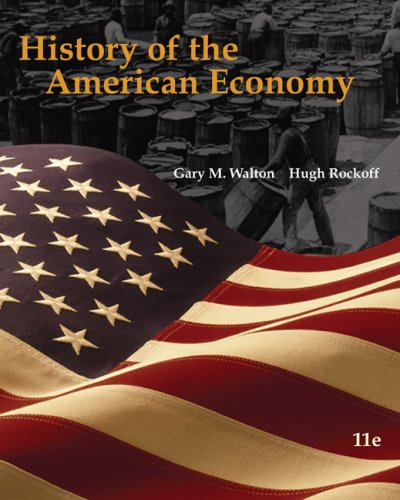 | Hardcover: 624
Pages
(2009-06-05)
list price: US$211.95 -- used & new: US$136.00 (price subject to change: see help) Asin: 032478662X Average Customer Review:
Canada | United Kingdom | Germany | France | Japan |
|
Editorial Review Product Description Customer Reviews (5)
| |
| 11. General Economic History (Cosimo Classics) by Max Weber | |
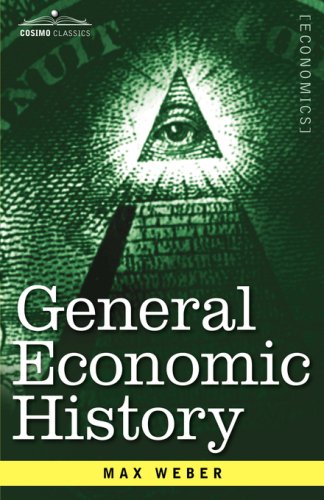 | Hardcover: 428
Pages
(2007-11-01)
list price: US$34.95 -- used & new: US$20.00 (price subject to change: see help) Asin: 1602069727 Canada | United Kingdom | Germany | France | Japan |
|
Editorial Review Product Description | |
| 12. The Cambridge Economic History of Modern Britain, Volume 1 | |
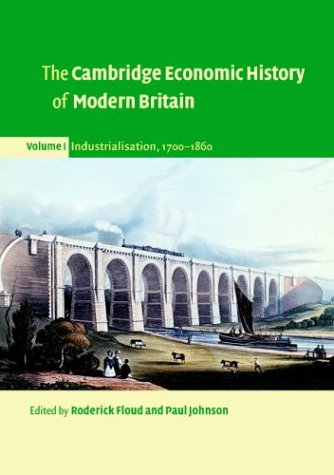 | Paperback: 556
Pages
(2004-03-01)
list price: US$52.00 -- used & new: US$40.00 (price subject to change: see help) Asin: 0521527368 Average Customer Review: 
Canada | United Kingdom | Germany | France | Japan |
|
Editorial Review Product Description Customer Reviews (1)
| |
| 13. The Federal Landscape: An Economic History of the Twentieth-Century West (The Modern American West) by Gerald D. Nash | |
 | Paperback: 224
Pages
(1999-08-01)
list price: US$18.95 -- used & new: US$14.94 (price subject to change: see help) Asin: 0816519889 Average Customer Review:
Canada | United Kingdom | Germany | France | Japan |
|
Editorial Review Product Description Customer Reviews (1)
| |
| 14. Japan to 1600: A Social and Economic History by William Wayne Farris | |
 | Paperback: 227
Pages
(2009-07)
list price: US$22.00 -- used & new: US$18.66 (price subject to change: see help) Asin: 0824833791 Canada | United Kingdom | Germany | France | Japan |
| 15. The Oxford Encyclopedia of Economic History: 5-Volume Set | |
 | Hardcover: 2824
Pages
(2003-10-16)
list price: US$750.00 -- used & new: US$329.95 (price subject to change: see help) Asin: 0195105079 Average Customer Review:
Canada | United Kingdom | Germany | France | Japan |
|
Editorial Review Product Description Customer Reviews (2)
| |
| 16. Argentina: An Economic Chronicle. How one of the richest countries in the world lost its wealth by Vito Tanzi | |
 | Paperback: 164
Pages
(2007-09-01)
list price: US$19.95 -- used & new: US$17.84 (price subject to change: see help) Asin: 0979557607 Average Customer Review:
Canada | United Kingdom | Germany | France | Japan |
|
Editorial Review Product Description Customer Reviews (5)
| |
| 17. An Economic History of the United States: From 1607 to the Present by Ronald Seavoy | |
 | Paperback: 368
Pages
(2006-09-07)
list price: US$39.95 -- used & new: US$39.92 (price subject to change: see help) Asin: 0415979811 Average Customer Review:
Canada | United Kingdom | Germany | France | Japan |
|
Editorial Review Product Description Customer Reviews (2)
| |
| 18. An Economic and Social History of Later Medieval Europe, 1000-1500 by Steven A. Epstein | |
 | Paperback: 302
Pages
(2009-04-27)
list price: US$28.99 -- used & new: US$24.66 (price subject to change: see help) Asin: 052170653X Canada | United Kingdom | Germany | France | Japan |
|
Editorial Review Product Description | |
| 19. History of Economic Thought by Harry Landreth, David C. Colander | |
 | Hardcover: 544
Pages
(2001-10-18)
list price: US$185.95 -- used & new: US$120.00 (price subject to change: see help) Asin: 0618133941 Average Customer Review:
Canada | United Kingdom | Germany | France | Japan |
|
Editorial Review Product Description An upper-level text, History of Economic Thought continues to offer a lively, accessible discussion of ideas that have shaped modern economics. The Fourth Edition has been thoroughly revised to reflect new scholarship and research, as well as a more pointed focus on modern economic thought. The text remains a highly understandable and opinionated—but fair—presentation of the history of economic thought. Customer Reviews (4)
| |
| 20. The Penguin History of Economics by Roger E. Backhouse | |
 | Paperback: 384
Pages
(2002-01-31)
list price: US$18.60 -- used & new: US$10.73 (price subject to change: see help) Asin: 0140260420 Canada | United Kingdom | Germany | France | Japan |
|
Editorial Review Product Description | |
| 1-20 of 97 | Next 20 |
 Simple history lacking theory
 Are we still talking about Malthus?