e99 Online Shopping Mall

Geometry.Net - the online learning center Help  
Home  - Basic F - Functional Languages Programming (Books)

  1-20 of 100 | Next 20
A  B  C  D  E  F  G  H  I  J  K  L  M  N  O  P  Q  R  S  T  U  V  W  X  Y  Z  

click price to see details     click image to enlarge     click link to go to the store

$49.95
1. Functional Programming Languages
 
2. The Implementation of Functional
$110.00
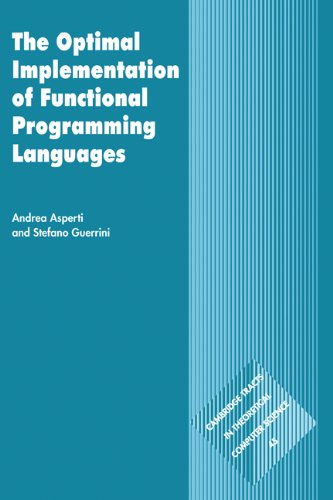
3. The Optimal Implementation of
$34.18
4. Functional Programming Languages
$102.00
5. Functional Programming Languages
 
$17.00
6. Fpca '93, Conference on Functional
 
7. Combinators and functional programming
$21.90
8. Combinators and Functional Programming
 
9. Functional Programming: Languages,
 
10. Functional Programming Languages
 
11. Fpca '89: The Fourth International
$49.95
12. Functional Programming Languages
 
$12.84
13. The Handbook of Programming Languages
 
14. Inductively defined functions
 
15. FPCA '89: The Fourth International
 
16. Fpca '89: The Fourth International
 
17. A combined logical and functional
 
18. Introduction to the functional
 
19. IDRIL: An interrupt driven functional
 
20. Fourth International Conference

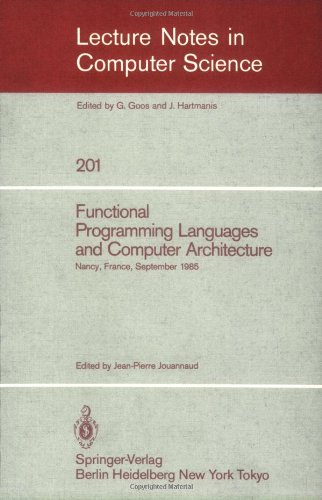
1. Functional Programming Languages and Computer Architecture: Proceedings, Nancy, France, September 16-19, 1985 (Lecture Notes in Computer Science)
Paperback: 424 Pages (1986-08-27)
list price: US$69.95 -- used & new: US$49.95
(price subject to change: see help)
Asin: 3540159754
Canada | United Kingdom | Germany | France | Japan

2. The Implementation of Functional Programming Languages (Prentice-Hall International Series in Computer Science)
by Simon L. Peyton Jones
 Hardcover: 500 Pages (1987-05)
list price: US$61.00
Isbn: 013453333X
Canada | United Kingdom | Germany | France | Japan

3. The Optimal Implementation of Functional Programming Languages (Cambridge Tracts in Theoretical Computer Science)
by Andrea Asperti, Stefano Guerrini
Hardcover: 404 Pages (1999-01-28)
list price: US$110.00 -- used & new: US$110.00
(price subject to change: see help)
Asin: 0521621127
Canada | United Kingdom | Germany | France | Japan
Editorial Review

Book Description
All traditional implementation techniques for functional languages fail to avoid useless repetition of work. They are not "optimal" in their implementation of sharing, often causing a catastrophic, exponential explosion in reduction time. Optimal reduction is an innovative graph reduction technique for functional expressions, introduced by Lamping in 1990, that solves the sharing problem. This work, the first on the subject, is a comprehensive account by two of its leading exponents. Practical implementation aspects are fully covered as are the mathematical underpinnings of the subject. The relationship to the pioneering work of Lévy and to Girard's more recent "Geometry of Interaction" are explored; optimal reduction is thereby revealed as a prime example of how a beautiful mathematical theory can lead to practical benefit. The book is essentially self-contained, requiring no more than basic familiarity with functional languages. It will be welcomed by graduate students and research workers in lambda calculus, functional programming or linear logic. ... Read more


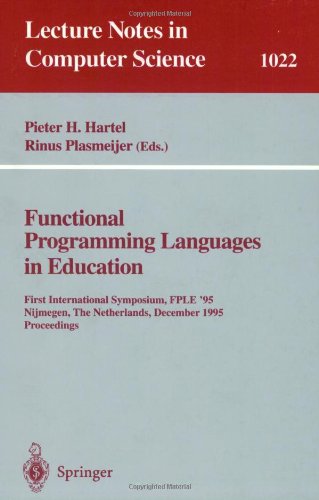
4. Functional Programming Languages in Education: 1st International Symposium FPLE '95 Nijmegen, The Netherlands, December 4-6, 1995. Proceedings (Lecture Notes in Computer Science)
Paperback: 309 Pages (1995-12-06)
list price: US$69.95 -- used & new: US$34.18
(price subject to change: see help)
Asin: 3540606750
Canada | United Kingdom | Germany | France | Japan
Editorial Review

Book Description
This book constitutes the refereed proceedings of the First International Symposium on Functional Programming Languages in Education, FPLE '95, held in Nijmegen, The Netherlands in December 1995.
The 17 revised full papers included represent the current state-of-the-art in using functional languages in computer science education. Most papers report teaching experience in some detail, however, the emphasis is generally on technical issues. Functional languages are increasingly used for teaching in a number of important areas such as algorithms, data structures, compiler construction, computer architecture, computer graphics, mathematics, problem solving and the semantics of programming languages. ... Read more


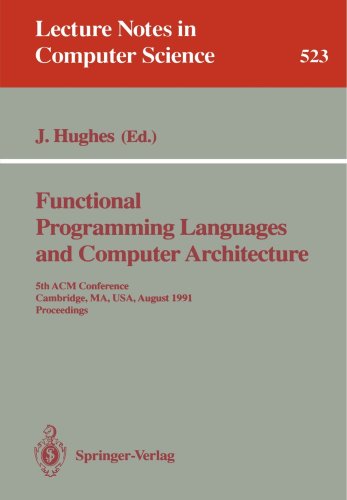
5. Functional Programming Languages and Computer Architecture: 5th ACM Conference. Cambridge, MA, USA, August 26-30, 1991 Proceedings (Lecture Notes in Computer Science)
Paperback: 666 Pages (1991-09-12)
list price: US$102.00 -- used & new: US$102.00
(price subject to change: see help)
Asin: 3540543961
Canada | United Kingdom | Germany | France | Japan
Editorial Review

Book Description
This book offers a comprehensive view of the best and the latest work infunctional programming. It is the proceedings of a major internationalconference and contains 30 papers selected from 126 submitted. A number ofthemes emerge. One is a growing interest in types: powerful type systemsor type checkers supporting overloading, coercion, dynamic types, and incremental inference; linear types to optimize storage, and polymorphictypes to optimize semantic analysis. The hot topic of partial evaluation is well represented: techniques for higher-order binding-time analysis,assuring termination of partial evaluation, and improving the residualprograms a partial evaluator generates. The thorny problem of manipulatingstate in functional languages is addressed: one paper even argues thatparallel programs with side-effects can be "more declarative" than purely functional ones. Theoretical work covers a new model of types based onprojections, parametricity, a connection between strictness analysisand logic, and a discussion of efficient implementations of the lambda-calculus. The connection with computer architecture and avariety of other topics are also addressed. ... Read more


6. Fpca '93, Conference on Functional Programming Languages and Computer Architecture: Copenhagen, Denmark, 9-11 June 1993
 Paperback: 350 Pages (1993-01)
list price: US$51.00 -- used & new: US$17.00
(price subject to change: see help)
Asin: 089791595X
Canada | United Kingdom | Germany | France | Japan

7. Combinators and functional programming languages: Thirteenth Spring School of the LITP, Val d'Ajol, France, May 6-10, 1985, proceedings (Lecture notes in computer science)
 Paperback: 208 Pages (1986)

Isbn: 0387171843
Canada | United Kingdom | Germany | France | Japan

8. Combinators and Functional Programming Languages: Thirteenth Spring School of the LITP, Val d'Ajol, France, May 6-10, 1985. Proceedings (Lecture Notes in Computer Science)
Paperback: 208 Pages (1986-12-01)
list price: US$22.00 -- used & new: US$21.90
(price subject to change: see help)
Asin: 3540171843
Canada | United Kingdom | Germany | France | Japan

9. Functional Programming: Languages, Tools, and Architectures (Ellis Horwood Series in Geology)
 Paperback: 174 Pages (1987-01)
list price: US$41.95
Isbn: 0470203919
Canada | United Kingdom | Germany | France | Japan

10. Functional Programming Languages and Computer Architecture
 Paperback: 341 Pages (1995-04)
list price: US$48.00
Isbn: 0897917197
Canada | United Kingdom | Germany | France | Japan

11. Fpca '89: The Fourth International Conference on Functional Programming Languages and Computer Architecture
by Association for Computing Machinery
 Paperback: 401 Pages (1989-06)
list price: US$39.95
Isbn: 0201513897
Canada | United Kingdom | Germany | France | Japan

12. Functional Programming Languages and Computer Architecture: Portland, Oregon, USA, September 14-16, 1987. Proceedings (Lecture Notes in Computer Science)
Paperback: 470 Pages (1987-10-05)
list price: US$49.95 -- used & new: US$49.95
(price subject to change: see help)
Asin: 3540183175
Canada | United Kingdom | Germany | France | Japan
Editorial Review

Book Description
This volume contains the proceedings of the Third Conference on Functional Programming Languages and Computer Architecture held in Portland, Oregon, September 14-16, 1987. This conference was a successor to two highly successful conferences on the same topics held at Wentworth, New Hampshire, in October 1981 and in Nancy, in September 1985. Papers were solicited on all aspects of functional languages and particularly implementation techniques for functional programming languages and computer architectures to support the efficient execution of functional programs. The contributions collected in this volume show that many issues regarding the implementation of Functional Programming Languages are now far better understood. ... Read more


13. The Handbook of Programming Languages (HPL): Functional, Concurrent and Logic Programming Languages
by Peter Salus
 Textbook Binding: 250 Pages (1998-05-08)
list price: US$49.99 -- used & new: US$12.84
(price subject to change: see help)
Asin: 1578700116
Average Customer Review: 2.5 out of 5 stars
Canada | United Kingdom | Germany | France | Japan
Editorial Review

Amazon.com
The final volume of the Handbook of Programming Languages series, Functional, Concurrent and Logic Programming Languages, discusses languages that work with data based on the high-level operations to be performed. This volume interprets what the data mean instead of precisely how to perform the computations. These languages are natural choices for developers of artificial intelligence and knowledge-based applications.

This book opens with a brief general description of Lisp and devotes a chapter to Emacs Lisp. Sections on Scheme, Guile, and CLOS follow.

The volume wraps up with a long chapter on Prolog--a key logic programming language that is highly expressive and useful for knowledge systems and artificial intelligence development. Though knowledge-based applications still make up only a small portion of the overall programming landscape, there's little doubt that they will play an increasingly important role in the future. This volume chronicles the roots of the evolution of knowledge-based applications. --Stephen Plain Book Description
Volume IV begins with the Logic Programming group, all descended from John McCarthy's LISP of the late 1960s.The Volume begins with a few pages from the LISP 1.5 Programmer's Manual, a vital token of things to come and moves on to LISP's offspring: LISP, Scheme, Guile, and CLOS. Finally, Jamie Andrews provides a substantial essay on the most important Functional programming language, Prolog. The contributions are designed to enable the programmer to evaluate the languages and to understand the ways in which each works.* Bob Chassell on Emacs LISP,* Brian Harvey on Scheme,* Jim Blandy on Guile,* Jim Veitch on CLOS,* Jamie Andrews on Prolog.

  • Unique leaders in the field of functional, concurrent and logic programming provide insightful information about the language that they helped to create
  • A complete handbook covering the most widely used functional, concurrent and logic programming languages
  • Comprehensive coverage of each language includes history, syntax, variables, tips and traps
  • Unique introductory material enables professional programmers to evaluate whether a specific language is appropriate for his or her use
... Read more

Customer Reviews (2)

4-0 out of 5 stars Fairly good overview
This book is the last of the HPL series and covers some of the morepopular logic and functional programming languages. It is however somewhat outdated, since some up-and-coming functional programming languages, such as Haskell, are only mentioned and not treated in detail.

The first chapter is a quick introduction to Lisp (2 pages) and is put into to set up the next chapter on Emacs Lisp. This chapter is written by R.J. Chassell, and gives a general overview of the main features of Emacs Lisp. The author does a good job of explaining the language, and how it fits into the functional programming paradigm. He uses an interesting diagrammatic representation, which he calls "chest of drawers" to explain how printed representations of Emacs Lisp are different from the internal representation in the computer. One can also see very clearly the lambda calculus origins of Lisp in this chapter. The definition of a function in Lisp clearly illustrates the effectiveness of functional programming in emulating the concept from mathematics. A function is thought of as a rule for computation that takes several arguments and returns a value. It can however have a "side effect" of changing the values of variables or the contents of data structures. It is this later pr

operty of a function in programming languages that can cause confusion to a mathematician-turned-programmer. Mathematicians are not accustomed to worrying about these side effects, only concerning themselves with the result of the function.But the author does give a good explanation as to the importance of side effects in building programs. He is also careful to explain the different types of functions in Lisp, namely defined, anonymous, and primitive ones. The later are built-in ones that are written in C and provide performance enhancement. In addition, macros are distinguished from functions in that they merely serve as translators from user expressions to expressions to be evaluated by the Lisp interpreter. The "fundamental" functions "car", "cdr", and "cons" are also explained in detail, as functions that create and operate on lists.

In chapter 3, the author Brian Harvey discusses the language Scheme, and he endeavors to illustrate the simplicity of Scheme as a programming language. Because of its simplicity, Scheme has been used as a teaching tool in courses on computer languages and general programming. The author shows how Scheme is related to Lisp, and most importantly, he emphasizes the composition of functions (recursion) as being the primary control mechanism in Scheme. He makes a good case for the use of functional programming as a methodology for obtaining clarity and economy of thought in writing programs. The ability of Scheme to perform garbage collection contributes greatly to Scheme's ease of use. For example, Scheme employs lists in preference to arrays, with lists being dynamically allocated data structures, and the elements of the list can themselves be lists. In addition, and also very important, is the capability of Scheme to implement untyped variables. Mixing data types is a very powerful capability when attempting to write programs that are written to study complicated ideas and constructions from pure mathematics. The author also outlines the ability of Scheme to do tail call elimination, emphasizing that Scheme is the first language in which to guarantee this as part of its language specification. Recursive calls can be expensive for performance, but this capability allows conventional "for" and "while" processing to take place. For the beginner to Scheme, or functional programming, the author gives a useful discussion on common programming problems at the end of the chapter.

In the next chapter, the author Jim Blandy gives an overview of Guile. I did not read this chapter so I will omit its review.

In chapter 5, Jim Vietch discusses Common Lisp Object System (CLOS), which is an attempt to make Common Lisp an object-oriented programming language. The author gives a good historical introduction to CLOS and outlines its main features. The author compares CLOS with C++ and Smalltalk at various places in the chapter, which is helpful to programmers who are familiar with these latter languages and want to learn about how to do OO-programming in a functional programming language. The author does a good job of explaining the metaobject protocol (MOP), which allows overriding of the standard CLOS semantics. The author is convincing in his arguments of how MOP can add clarity and efficiency in OO-programmming. In addition, an effective discussion, using various code examples, is given of the power of dependency tracking and lazy evaluation. For me personally, lazy evaluation has been the tour-de-force behind functional programming and one of its most powerful features. Towards the end of the chapter, the author gives a good overview of performance issues with CLOS and a few hints on how to improve it.

The last chapter of the book covers Prolog, and is written by James Andrews. From the standpoint of mathematical logic, Prolog is based on the theory of Horn clauses, instead of the lambda calculus. Thus it could be described as a logic programming language, and this is the characterization given by the author in this book. Commercial Prolog compilers are now available, but the use of Prolog has executed a sort of random walk since its invention in the early 1970s. The author discusses, objectively I think, the misconceptions and problems with the use of Prolog. The main properties of Prolog are summarized very well in the article, with rules and recursion being the main expressive and computational strategies employed in Prolog. A program in Prolog is a sequence of (Horn) clauses, and the author shows how a Prolog program is able to arrive at a conclusion (or output) based on the rules and facts given in the program, which is effectively a depth-first search algorithm. The author also gives a nice discussion on the advanced features of Prolog, including negation, cuts, and predicates.

1-0 out of 5 stars not recommended
My first impressions about this handbook are not very favourable.

Although the first volume claims to be a handbook of object oriented languagesit does not cover object oriented languages of NiklausWirth's group, e.g. Oberon-2 or its commercial dialect Component Pascal.

Additionally to that, a descendant of Wirth's languages, Modula 3, isclaimed to be one=of the smallest OO-languages. Due to the ignorancegiven to Oberon-2, this is only true for the OO languages covered in thishandbook. In comparison to Oberon-2, Modula-3 is bloated (language reportsize is 60 pages vs 2E 20 pages).

The language family tree on the insidecovers do not give the correctdescendants/ancestors for some of thelanguages.

Scrolling through the second volume on imperative languagesreveals similar prob=lems: Pascal is only mentioned with its commercialdialect "Turbo Pascal", which -- at least in its lastincarnation-- is anOO-language and not imperative one, and shouldtherefore be covered in the first volume. It misses the ISO/ANSI standards(ISO 7185: Standard Pascal and IS10206: Extended Pascal). It misses tomention Modula-2 (as I recall from memory, since I didnot buy thebook).

Since - IMHO - a handbook should be some objective reference, the first two volumes do not meet my criteria for a handbook. ... Read more


14. Inductively defined functions in functional programming languages (LFCS report series. University of Edinburgh. Department of Computer Science. Laboratory of Foundations of Computer Science)
by Rod M Burstall
 Unknown Binding: 12 Pages (1987)

Asin: B0007BFA8O
Canada | United Kingdom | Germany | France | Japan

15. FPCA '89: The Fourth International Conference on Functional Programming Languages and Computer Architecture, Imperial College, London, September 11-13, 1989
 Unknown Binding: 395 Pages (1989)

Isbn: 0897913280
Canada | United Kingdom | Germany | France | Japan

16. Fpca '89: The Fourth International Conference on Functional Programming Languages and Computer Architecture
by Association for Computing Machinery
 Paperback: Pages (1989)

Asin: B000OLK9JM
Canada | United Kingdom | Germany | France | Japan

17. A combined logical and functional programming language (Technical report. California Institute of Technology. Computer Science Dept)
by Michael O Newton
 Unknown Binding: 40 Pages (1985)

Asin: B00071A7MI
Canada | United Kingdom | Germany | France | Japan

18. Introduction to the functional programming language "Ponder" (TR. University of Cambridge, Computer Laboratory)
by Mark Tillotson
 Unknown Binding: 57 Pages (1985)

Asin: B0007BFA16
Canada | United Kingdom | Germany | France | Japan

19. IDRIL: An interrupt driven functional programming language (Technical report. Texas A & M University. Computer Science Dept)
by Stanley T Shebs
 Unknown Binding: Pages (1982)

Asin: B00071G3Z8
Canada | United Kingdom | Germany | France | Japan

20. Fourth International Conference on Functional Programming Languages and Computer Architure
 Hardcover: Pages (1989-12)
list price: US$35.50
Isbn: 9991823468
Canada | United Kingdom | Germany | France | Japan

  1-20 of 100 | Next 20
A  B  C  D  E  F  G  H  I  J  K  L  M  N  O  P  Q  R  S  T  U  V  W  X  Y  Z  

Prices listed on this site are subject to change without notice.
Questions on ordering or shipping? click here for help.

site stats