e99 Online Shopping Mall

Geometry.Net - the online learning center Help  
Home  - Basic J - Jamaica Culture (Books)

  Back | 21-40 of 76 | Next 20
A  B  C  D  E  F  G  H  I  J  K  L  M  N  O  P  Q  R  S  T  U  V  W  X  Y  Z  

click price to see details     click image to enlarge     click link to go to the store

 
$25.00
21. The Black Trans-Atlantic Experience:
$22.00
22. Downtown Ladies: Informal Commercial
 
23. Jamaica Labrish
 
24. Alas, Alas, Kongo: A Social History
$21.98
25. Modern Blackness: Nationalism,
 
26. The black trans-Atlantic experience
 
$30.00
27. The Economy and Material Culture
 
$7.50
28. Culture is more important than
 
$25.00
29. Itations of Jamaica and I Rastafari
 
$25.95
30. The Birth of Cool: Dress Culture
 
31. An economic assessment of Jamaica's
 
32. Reggae Bloodlines: In Search of
 
33. Rastafarian music in contemporary
 
34. Beekeeping in Jamaica
 
35. The Black Trans-Atlantic Experience:
 
36. Bee-keeping in Jamaica
$14.99
37. Noises in the Blood: Orality,
$9.29
38. Journey To Enlightenment: Revealed
$14.78
39. The Problem of Freedom: Race,
$2.39
40. Psychic Phenomena of Jamaica

21. The Black Trans-Atlantic Experience: Street Life and Culture in Ghana, Jamaica, England, and the United States
by Stephen Marc
 Hardcover: Pages (1992-11-01)
list price: US$50.00 -- used & new: US$25.00
(price subject to change: see help)
Asin: 0252019555
Canada | United Kingdom | Germany | France | Japan

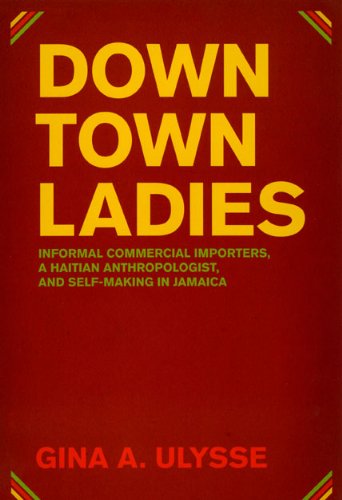
22. Downtown Ladies: Informal Commercial Importers, a Haitian Anthropologist and Self-Making in Jamaica (Women in Culture and Society Series)
by Gina A. Ulysse
Paperback: 304 Pages (2008-03-15)
list price: US$22.00 -- used & new: US$22.00
(price subject to change: see help)
Asin: 0226841227
Canada | United Kingdom | Germany | France | Japan
Editorial Review

Book Description

The Caribbean “market woman” is ingrained in the popular imagination as the archetype of black womanhood in countries throughout the region. Challenging this stereotype and other outdated images of black women, Downtown Ladies offers a more complex picture by documenting the history of independent international traders—known as informal commercial importers, or ICIs—who travel abroad to import and export a vast array of consumer goods sold in the public markets of Kingston, Jamaica.

Both by-products of and participants in globalization, ICIs operate on multiple levels and, since their emergence in the 1970s, have made significant contributions to the regional, national, and global economies. Gina Ulysse carefully explores how ICIs, determined to be self-employed, struggle with government regulation and other social tensions to negotiate their autonomy. Informing this story of self-fashioning with reflections on her own experience as a young Haitian anthropologist, Ulysse combines the study of political economy with the study of individual and collective identity to reveal the uneven consequences of disrupting traditional class, color, and gender codes in individual societies and around the world.
... Read more

23. Jamaica Labrish
 Paperback: Pages (1991)

Asin: B000BXGZYG
Canada | United Kingdom | Germany | France | Japan
Editorial Review

Product Description
Interesting Jamaica dialect poems. ... Read more


24. Alas, Alas, Kongo: A Social History of Indentured African Immigration into Jamaica, 1841-1865 (Study in Atlantic History & Culture)
by Monica Schuler
 Hardcover: 200 Pages (1980-09)
list price: US$24.50
Isbn: 0801823080
Canada | United Kingdom | Germany | France | Japan

25. Modern Blackness: Nationalism, Globalization, and the Politics of Culture in Jamaica (Latin America Otherwise)
by Deborah A. Thomas
Paperback: 357 Pages (2004-11)
list price: US$23.95 -- used & new: US$21.98
(price subject to change: see help)
Asin: 0822334194
Average Customer Review: 4.5 out of 5 stars
Canada | United Kingdom | Germany | France | Japan
Editorial Review

Book Description
Modern Blackness is a rich ethnographic exploration of Jamaican identity in the late twentieth century and early twenty-first. Analyzing nationalism, popular culture, and political economy in relation to one another, Deborah A. Thomas illuminates an ongoing struggle in Jamaica between the values associated with the postcolonial state and those generated in and through popular culture. Following independence in 1962, cultural and political policies in Jamaica were geared toward the development of a multiracial creole nationalism reflected in the country’s motto: “Out of many, one people.” As Thomas shows, by the late 1990s, creole nationalism was superseded by “modern blackness”—an urban blackness rooted in youth culture and influenced by African American popular culture. Expressions of blackness that had been marginalized in national cultural policy became paramount in contemporary understandings of what it was to be Jamaican.

Thomas combines historical research with fieldwork she conducted in Jamaica between 1993 and 2003. Drawing on her research in a rural hillside community just outside Kingston, she looks at how Jamaicans interpreted and reproduced or transformed on the local level nationalist policies and popular ideologies about progress. With detailed descriptions of daily life in Jamaica set against a backdrop of postcolonial nation-building and neoliberal globalization, Modern Blackness is an important examination of the competing identities that mobilize Jamaicans locally and represent them internationally. ... Read more

Customer Reviews (3)

4-0 out of 5 stars Music for a new generation
Forget your troubles and dance!
Forget your sorrows and dance!
Forget your sickness and dance!
Forget your weakness and dance!

Lyrics to Them Belly Full (But We Hungry).(1974) Composed by Legon Cogill and Carlton Barrett.

Bob Marley's music helped define a generation of Jamaican culture through reggae.In Modern Blackness, Deborah Thomas proposes that the reggae "soundtrack" for Jamaica has been succeeded by dancehall, just as cultural identity has evolved to fit a new vision of blackness.She suggests that the "modern blackness of late-twentieth century. . . is urban, migratory, based in youth-oriented popular culture, and influenced by African American popular style" (p. 229).Thomas also asserts that black identity in Jamaica is not post-modern, which suggests a break with the past, rather connected to the development of an identity rooted in the local and historical yet dependent on national and transnational pressures.Thomas explores modern blackness by dissecting these influences on culture in Jamaica.She breaks her analysis into three sections: the global-national, the national-local, and the local-global.This separation allows for a critical analysis of the various influences while displaying both the connections and dissonances.

In order to guide her analysis of modern blackness in Jamaica, Thomas uses two years of ethnographic research conducted between 1993 and 2003.In this book, she brings us to a real community outside Kingston, fictitiously named Mango Mount, as a means of illustrating the concepts of modern blackness on a local community.Using this community as an example of the influence of modern blackness and a source of information provides a tangible illustration of how modern blackness is set in the everyday, yet linked to a national and global community. In addition to information about Mango Mount, Thomas delves into the historical influences on Jamaica prior to independence, as a new state, and within the context of a transnational society.She looks at modern blackness in the context of race issues, gender identity, socioeconomic differences and as an aspect of Jamaican culture.Her research also pulls in national and international institutions and their influences within Jamaica and Mango Mount.This wide scope provides the reader with a comprehensive yet contextualized understanding of cultural influences in Jamaica while illustrating that "culture is both the problem to solve and the recipe to follow" (p. 87).

Thomas begins her book with the global-national.She illustrates how the modern identity and culture are connected to pre-independence institutions, norms, and social hierarchies.Here she connects Jamaican identify to religious doctrines, emancipation literature, and the remnants of colonialism.In providing a historical context for her book, she links "blackness (a racial identity) and Jamaicanness (a national identify)" in order to elucidate the complex origins of the modern blackness (p. 30).In her focus on race and nationality, Thomas explores how concepts of blackness and brownness as well as notions of what it means to be Jamaican have contributed to national and global influences in the creation of modern blackness.

In understanding the national-local, Thomas' discussion of the reemergence of state-supported Emancipation Day celebrations provides insight into community connections to national policies.She pairs sections from the Report on National Symbols and Observations with quotes from Mango Mount community members regarding the renewed state interested in the celebration of Emancipation Day.She notes that "the dominant sense among nationalist elites was that the removal of Emancipation Day as a public holiday had left Jamaican youth without an awareness of their heritage and the steps in Jamaica's evolution toward modern statehood" (p. 162).However, community members generally did not see the Emancipation Day celebration as an educational movement, rather they viewed it as related to political maneuvering, as a distraction from "the government's ability to implement successful economic policies," or as "meaningless and irrelevant" to the average person (p. 168-169).Thomas also shows how the local celebration of Emancipation Day celebrations did not escape contemporary influences; inclusion of traditional kumina dance rhythm into the Emancipation Day play in Mango Mount was replaced by steps to a dancehall beat (p. 172).Thomas' illustration of the contrasting visions regarding the purpose of the reinstatement of Emancipation Day reflects the greater disparity between national and local views of modernity.

As Thomas explores the local-global, she places Mango Mount within the global economy.She illustrates the influences of global institutions and marketing in local choices and looks at how trends at the local level reflect global influences.She notes, the "entrepreneurial zeal with which people in Mango Mount seek to take advantage of migratory possibilities has facilitated their relative success within a global labor market," yet it has contributed to leadership deficits at the local level, problems for those unable to migrate, and "perpetuated an outward outlook whereby local ambitions require foreign realization" (p. 261).Nevertheless, in interviewing people in Mango Mount, Thomas finds that many people feel that "the United States was the place to make a living while Jamaica was the place to make life," illustrating that while economic opportunities necessitate global movement, local lifestyles continue to define aspects of national identity (p. 224). She also identifies the influences of the global on local music choices (such as dancehall rather than drumming) and culture.For example, she notes that dancehall music is a function of global influences tempered by Jamaican underclass definitions. Thomas notes, "Dancehall is not merely a response to hegemonic power but marks the changing aesthetic and political space that both contests and (re)produces broader relations of power" (p. 243).

Thomas provides a readable, enjoyable, yet critical look at modernity in Jamaica that bridges the past to connect to the future.She demonstrates that the global society has complex influences on blackness that are intertwined within Jamaica's historical context and national identity. Thus, Bob Marley's command, "You're gonna dance to Jah music" continues to push people to dance, even as the background music of modern blackness has changed from reggae to dancehall.

5-0 out of 5 stars Redefining Jamaicanness in the Evolving Global Climate
"Feel the rhythm, feel the rhyme, gear on up, it's bobsled time!"This quote from the all-too forgettable movie Cool Runnings about a team of Jamaicans that made it to the Olympics accentuates how music becomes a part of the transnational Jamaican identity through global popular culture.An association to identity, such as music, reflects what Deborah Thomas refers to as "modern blackness," which has superceded the postcolonial identity of a creole nation with the motto "Out of many, one people."By ethnographically exploring Jamaican nationalism from the end of the 19th century to the present, Thomas sorts out the complex effects of colonialism and globalization on inequalities of race, class, and gender in her inspiring work Modern Blackness.Cultural practices, such as reggae, which were developed by lower class Jamaicans are unrecognized as part of the broader national identity.
Deborah Thomas structure's the text in an interesting way by outlining the relationships between the global-national, national-local, and local-global.By contextualizing the evolution of Jamaican identity, Thomas' argument flows from historical perspective during the "Crown Colony rule" to a contemporary understanding that effectively "clarifies the links between global processes, nationalist visions, and local practices (p. 31, then 19)."The capstone of her fieldwork is in Mango Mount where she uncovers the culture being shaped under neoliberal policies that continue to economically restrain the community.
The diasporal feeling of nationalism before Jamaica's independence from Britain in 1962 is based on the ongoing struggle of asserting an identity of the "respectable state."The early works by black Jamaicans such as Jamaican's Jubilee highlight their attempt to prove advancements in the black community, both morally and culturally.Asserting various aspects of Jamaicanness was an effort to unite one people with values held by the middle-class.Thomas posits, "As black intellectuals, the Jubilee writers insisted that they articulated important mass concerns on the basis of their shared blackness, but they distanced themselves from lower-class blacks and African-derived cultural expressions (pg. 48)."Jamaican pride was racially characterized through forms of artistic expression and reflections of Creole multiracialism.The author adds that this identity "more closely resembled classical European nationalism (which) was founded on a concept of common history and culture rather than race and, as in Europe, obscured the conflation of class with race (pg. 55)."By embracing Jamaican heritage, the country demarcated themselves from historical representations of Africanness, as well as the practices of the poorer urban class.This reflected the attitudes of many previously enslaved individuals coming from rural areas with "values" and "respectable" culture.Thomas argues that references to "values" emulate the history of colonialism and reinvent the inequalities of power and class.
The national-local relationship is displayed by the author through the cultural politics of a tiny village with the fictitious name Mango Mount, just outside of Kingston.Throughout the end of the twentieth century, the leadership of the national government followed global economic policies through democracy and capitalism; therefore disconnecting themselves from the indigenous localities, one of which is Mango Mount.Thomas explains, "It has remained difficult for many Jamaicans to sustain the imagination of a community whose primary political, economic, and sociocultural institutions have been developed by black lower-class Jamaicans (pg. 91)."In her work in Mango Mount, the author demonstrates the practices that distinguish lower-class and local youth culture as forthcoming in flamboyant ways, especially during celebrations in the town square.The square becomes a noisy dancehall that is routinely scrutinized by middle-class residences.Thomas describes her experience and the comments of a participant in the following way: "Rhythm and blues and reggae gave way to hardcore dancehall toward the wee hours of the morning...and (unfortunately) were never as good as in other communities because the "rich people" would always call the police to `lock down the music' because `dem nuh like fi see wi do wha we a do' (pg. 114)."Although I do not understand exactly what this Jamaican was trying to express, it is valid to see how the shift to youthful urban blackness has been influenced by American popular culture and has redefined what it means to be "very, very, Jamaican."The ordinary lower class is challenging the previously held Afro-Jamaican identities of their postemancipation history.Thomas justifies these contradicting attitudes by stating, "Their worlds were increasingly urban and transnational and because they had apprehended the fundamental disjuncture between political and economic development strategies and cultural development initiatives they had to (look back, take pride, but move forward) (pg. 190)."Moving forward has caused a transition of political hegemony and has been characterized by activism and agency at the local level.
The racialized version of nationalism, which excluded urban culture, is now personified as contemporary `modern blackness'.Distinctions are being made between definitions of black and brown, as well as what constitutes Africanness and Blackness.Thomas adds, "If consciousness of an African heritage operated primarily on a symbolic level, even within popular expressive culture, racial consciousness was continually through day to day experiences of color prejudice and discrimination, both in Jamaica and abroad (pg. 183)."The relationship between local and international now bypasses state efforts that hold identities of British imperialism and further define Jamaicanness in terms of globalization and popular style.Thomas focuses on the influences of America on Jamaican culture, as well as Jamaica's ability to influence American culture.The irony of this "two-way process" is the size of Jamaica as a country and their power to impose Jamaicanness globally.The author states, "The frequency of these invocations also suggests a need to carve out spaces in which Jamaicans feel, and indeed have, power and recognition within a global public sphere (pg. 250)."Many Jamaican immigrants have spread this power and presented future possibilities for `moving ahead.'
Deborah Thomas' work is important in understanding the lasting effects of colonial rule, as well as the changing socio-political climates of globalization.What is clear is that Jamaicanness is not American, European, African, black, white, or brown.It is its own evolving identity that has become shaped by all these identities within the global environment.Finally, Modern Blackness presents possibilities for change and improvement where dreams become realized in the context of Jamaica's future.

5-0 out of 5 stars Simply a superb ethnography
Deborah A. Thomas is a cartographer of culture who maps the topography of Jamaican culture through time, across class, between urban and rural locales, and over a variety political landscapes.What emerges from her work is a detailed analysis of the various contours of culture that follow the shifting fault lines of Jamaica's political economy. Deborah Thomas has written a beautiful ethnography. Central to her analysis are several questions: what does it mean to be Jamaican? what role does culture play for a black and brown nation? and, what role does a black and brown nation play in shaping Jamaica's culture?

Dr. Thomas frames her important study by documenting the way a multi-racial creole culture was significantly eclipsed, during the late 1990s,by a culture of blackness forged in modernity but produced and re-produced in decidedly post-modern ways.Aligning this shift with shifts in the global economy, she 'reads' these changes through a variety of performances. Some of the performances she explores explicitly claim to represent Jamaica's national culture, but other performances she describes explicitly claim to counter notions of respectability to represent a sort of in-your-face booty grinding blackness, which ends up emerging as the cultural practices of the nation's people.


Thomas brilliantly illustrates how culture, nation, and the ideology of progress are implicated in an understanding of what blackness and Jamaican identity actually mean in various contexts. As she notes, "context is everything" and she takes the reader inside a variety of institutions that seek to define and redefine both race and culture in turn-of-the-century Jamaica. This approach is refreshing. She not only identifies structural entities that dictates cultural policy in Jamaica, but she identifies the agents within those structures, actually putting a name to both the powerful and the powerless,who constantly jostle over who gets to claim and name what constitutes Jamaican culture.From the organized and powerful National Dance Theater Company to the unorganized and entertaining"roots" theater performances, she allows the reader to experience the way theparticipants (dancers/actors and audience) perform, respond, and contest ideologies of race, nation, and progress. She does not stop there, however, weddings and dance hall session, movies and newspaper clippings are each scrutinized in an effort to buttress her argument that the multi-racial creole nationalism is waning as a modern blackness tied to the global economy waxes and the meaning of what it means to be Jamaican hangs in the balance.

Deborah Thomas has written a bold, refreshing, and powerful ethnography that grapples with some of the most sticky theoretical issues in contemporary theory today -- blackness, globalization, modernity, and the idea progress. ... Read more


26. The black trans-Atlantic experience : street life and culture in Ghana, Jamaica, England, and the United States / photographs by Stephen Marc ; foreword by Marilyn Houlberg ; interview by Alan Cohen
by Stephen Marc
 Hardcover: Pages (1992)

Asin: B000VZML0G
Canada | United Kingdom | Germany | France | Japan

27. The Economy and Material Culture of Slaves: Goods and Chattels on the Sugar Plantations of Jamaica and Louisiana
by Roderick A. McDonald
 Hardcover: 400 Pages (1994-01)
list price: US$60.00 -- used & new: US$30.00
(price subject to change: see help)
Asin: 0807117943
Canada | United Kingdom | Germany | France | Japan

28. Culture is more important than you think
by Earl Vendryes Campbell
 Paperback: 308 Pages (2000)
-- used & new: US$7.50
(price subject to change: see help)
Asin: B0006S5W68
Canada | United Kingdom | Germany | France | Japan

29. Itations of Jamaica and I Rastafari
by Millard Faristzaddi
 Mass Market Paperback: 204 Pages (1987)
list price: US$20.00 -- used & new: US$25.00
(price subject to change: see help)
Asin: 0951222201
Average Customer Review: 4.5 out of 5 stars
Canada | United Kingdom | Germany | France | Japan

Customer Reviews (7)

4-0 out of 5 stars PRETTY PICTURES
THIS BOOK IS FULL OF PRETTY PICTURES THAT GIVE YOU THE FEELING THAT YOUR RIGHT THERE IN JAMAICA. ONE THING I DIDNT LIKE ABOUT THE BOOK IS HOW LITTLE INFORMATION IT HAD IN IT. THERE WERE SECTIONS IN THERE THAT WERE VERY INFORMATIVE BUT IT WAS PREDOMINATELY A PICTURE BOOK. ANOTHER THING IS THE LAYOUT AND OVERALL SIZE OF THE BOOK, ITS KIND OF SMALL I WAS EXPECTING SOMETHING A LITTLE BIT BIGGER. BUT STILL A GOOD BOOK OVERALL! READ IT AND LIVE IT!
ONE LOVE
JAH BLESS

5-0 out of 5 stars Jah Beauty
This a lovely book to read for anyone interested in RastafarI or a Rastafarian themselves.The pictures only add to the beautiful images that the poems create in the reader's mind.

5-0 out of 5 stars JAH LOVES, more Itations......
Just wanted to let u know that there are at least to more books in this set, Itation 2+3, i have Book 1, a great read, mainly composedf of poems and spiritual words, has a section on the Arawaks, and loads of beautiful pictures of Jahs Work (Flowers!!) lovely, a must to all Rasta's or anyone interested.<br /> Pete,N.Wales,UK

5-0 out of 5 stars Goin'Home
Reading the Itations books is always like goin' home, comforting and blessed with words and images of Jah.Like no other book I have ever read, I use quotes from it to help my friends when they are in need of spiritual advice.Give Thanks and Praise to Millard for sharing these works.

5-0 out of 5 stars yes I
this book is truly living. the first time i saw it i realized i had to own a copy. beautiful photographs printed on quality paper; pictures that actually live and breathe, and words that sing themselves off the pages. after "stumbling" upon this book twice in my travels and actually having an opportunity to read it once through before i obtained my own copy, i began to feel dreadlocks growing from the top of my head. since i purchased mine from amazon.com i've read it several times and use it as a reference and meditation guide. i am never without it in my journeys. i recommend itations to any one interested in rastafarianism, one love, world peace and unity; to anyone with dreadlocks or even thinking of cultivating them this book will begin to show you what it is all about. from the heart- Jah Rastafari! ... Read more


30. The Birth of Cool: Dress Culture of the African Diaspora (Materializing Culture)
by Carol Tulloch
 Paperback: 256 Pages (2008-05-01)
list price: US$25.95 -- used & new: US$25.95
(price subject to change: see help)
Asin: 1859734707
Canada | United Kingdom | Germany | France | Japan
Editorial Review

Book Description
From the zoot suit and Black dandy through to Rastafarianism and beyond, Black style has had a profound influence on the history of dress in the twentieth century. Yet despite this high profile, the dress styles worn by men and women of the African diaspora have received scant attention, even though the culture itself has been widely documented from historical, sociological and political perspectives.Focusing on counter- and sub-cultural contexts, this book investigates the role of dress in the creation and assertion of Black identity. From the home-dressmaking of Jamaican women, through to the Harlem Renaissance and contemporary streetstyles such as Hip Hop and Raggamuffin, Black Britons, African Americans and Jamaicans have been at the forefront of establishing a variety of Black identities. In their search for a self-image that expresses their diaspora experience, members of these groups have embraced the cultural shapers of modernity and postmodernity in their dress.Drawing on materials from the United States, Britain and Jamaica, this book fills a gap in both the history of Black culture and the history of dress, which has until recently focused on high fashion in Europe. Because dress can both initiate and confirm change, it provides an especially useful tool for analyzing identity and resistance. ... Read more


31. An economic assessment of Jamaica's fish culture program (Research and development series)
by Donald R Street
 Unknown Binding: Pages (1978)

Asin: B0006YFDW0
Canada | United Kingdom | Germany | France | Japan

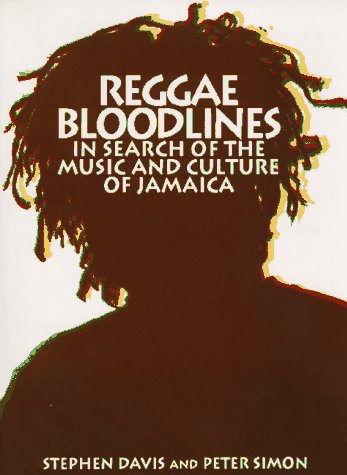
32. Reggae Bloodlines: In Search of the Music and Culture of Jamaica
by Stephen Davis
 Paperback: Pages (1992)

Asin: B000OSVHJ6
Canada | United Kingdom | Germany | France | Japan

33. Rastafarian music in contemporary Jamaica: A study of socioreligious music of the Rastafarian movement in Jamaica (Performance in culture)
by Yoshiko S Nagashima
 Unknown Binding: 227 Pages (1984)

Asin: B0006EJQMS
Canada | United Kingdom | Germany | France | Japan

34. Beekeeping in Jamaica
by Jeannine K Bianco
 Unknown Binding: 108 Pages (1985)

Asin: B0007C8JAO
Canada | United Kingdom | Germany | France | Japan

35. The Black Trans-Atlantic Experience: Street Life and Culture in Ghana, Jamaica, England, and the United States
by Stephen Marc
 Paperback: Pages (1992)

Asin: B000OQCB2K
Canada | United Kingdom | Germany | France | Japan

36. Bee-keeping in Jamaica
by F. A Hooper
 Unknown Binding: Pages (1902)

Asin: B0008BQRL2
Canada | United Kingdom | Germany | France | Japan

37. Noises in the Blood: Orality, Gender, and the "Vulgar" Body of Jamaican Popular Culture
by Carolyn Cooper, Carolyn Cooper
Paperback: 214 Pages (1995-12)
list price: US$21.95 -- used & new: US$14.99
(price subject to change: see help)
Asin: 0822315955
Canada | United Kingdom | Germany | France | Japan
Editorial Review

Book Description
The language of Jamaican popular culture—its folklore, idioms, music, poetry, song—even when written is based on a tradition of sound, an orality that has often been denigrated as not worthy of serious study. In Noises in the Blood, Carolyn Cooper critically examines the dismissed discourse of Jamaica’s vibrant popular culture and reclaims these cultural forms, both oral and textual, from an undeserved neglect.
Cooper’s exploration of Jamaican popular culture covers a wide range of topics, including Bob Marley’s lyrics, the performance poetry of Louise Bennett, Mikey Smith, and Jean Binta Breeze, Michael Thelwell’s novelization of The Harder They Come, the Sistren Theater Collective’s Lionheart Gal, and the vitality of the Jamaican DJ culture. Her analysis of this cultural "noise" conveys the powerful and evocative content of these writers and performers and emphasizes their contribution to an undervalued Caribbean identity. Making the connection between this orality, the feminized Jamaican "mother tongue," and the characterization of this culture as low or coarse or vulgar, she incorporates issues of gender into her postcolonial perspective. Cooper powerfully argues that these contemporary vernacular forms must be recognized as genuine expressions of Jamaican culture and as expressions of resistance to marginalization, racism, and sexism.
With its focus on the continuum of oral/textual performance in Jamaican culture, Noises in the Blood, vividly and stylishly written, offers a distinctive approach to Caribbean cultural studies.
... Read more


38. Journey To Enlightenment: Revealed
by Juliet Christie Murray
Paperback: 110 Pages (2005-04-28)
list price: US$13.04 -- used & new: US$9.29
(price subject to change: see help)
Asin: 1412036232
Canada | United Kingdom | Germany | France | Japan
Editorial Review

Book Description
This is a book of poems that covers a wide number of topics. The title of the book is named off one of the poems a scenario of likening literacy to the dark passages of a ship packed with slaves. This book covers a number of social issues both in the U.S.A and in the West Indies in which the Author resides.

At present there is an increase in crimes in Jamaica since the return of criminals from abroad. (Deportees) The poems Great Big U.S.A. and Train The Child seek to address that issue. For Jamaicans who have had Prime Ministers who were in most parts fair skinned sought for a change by making colour an issue in order to obtain majority votes in a fairly recent general election. The poem 'No Easy Choice', addresses issues and the social spin off, arising from globalization.

The author seeks to promote good values and attitudes as in the piece Children of The King. Journey To Enlightenment provides good reading since it contains some humor too. The underlying theme of this book is one that gives encouragement to individuals who are feeling despondent and pessimistic about issues of life, it seeks to find an answer through poetry.

As said before it covers a wide range of topics, love spirituality, social issues, and nature; a good book to be added to a collection to be used in schools for choral speaking and literature. The best part of this book is, the poems are easily understood, relevant and recent. Attached to many of the pieces are the circumstances and situations that gave the inspiration to the author for writing the piece. Most teachers who saw the unpublished copy requested a copy. Two pieces from the book were used to enter the Jamaica Festival of arts speech competition for schools, 2004 in Hanover. ... Read more


39. The Problem of Freedom: Race, Labor, and Politics in Jamaica and Britain, 1832-1938 (Johns Hopkins Studies in Atlantic History and Culture)
by Thomas C. Holt
Paperback: 552 Pages (1991-11-01)
list price: US$24.95 -- used & new: US$14.78
(price subject to change: see help)
Asin: 0801842913
Average Customer Review: 5.0 out of 5 stars
Canada | United Kingdom | Germany | France | Japan
Editorial Review

Book Description

"A spirited and absorbing history of emancipation, oppression, and rebellion in the British empire."--C. Vann Woodward.

"Holt greatly extends and deepens our understanding of the emancipation experience when, for just over a century, the people of Jamaica struggled to achieve their own vision of freedom and autonomy against powerful conservative forces."--David Barry Gaspar.

... Read more

Customer Reviews (1)

5-0 out of 5 stars Big Book, Big Implications
Holt studies Jamaica,from the emanicpation of the slaves to the labor problems faced by ex-slaves in the 1930s.But the narrow focus is misleading - really Holt writes about "the problem of freedom:"the tast of socializing ex-slaves into becoming productive laborers - theproblem of convincing freedpeople that it's in their best interest to laborfor tiny wages, for the profit of the wealthy. Another major focus is theinherent contradictions of classical liberalism - economic freedom does andalways has required brutal and blatent inequalities in the political andsocial spheres.

Certainly not everyone will agree with Holt, but hisargumentation and analysis are impeccable. If you believe thatself-determination and free enterprise are practically the same thing - orif you think that capitalism and democracy are one and the same - you mustread Holt's book. ... Read more


40. Psychic Phenomena of Jamaica
by S.J. JOSEPH J. WILLIAMS
Kindle Edition: Pages (2008-02-14)
list price: US$2.99 -- used & new: US$2.39
(price subject to change: see help)
Asin: B00140G4GE
Canada | United Kingdom | Germany | France | Japan
Editorial Review

Book Description
The authorship of this book (by a Jesuit ethnologist) makes some of the editorial content suspect. However, the author spent time in the field in Jamaica. His library research was extensive and used rare and unique sources such as contemporary newspapers, legal archives and early accounts. Williams keeps his skepticism active while remaining open-minded. On the downside there are some passages which could be interpreted as racist (in hindsight), so the usual disclaimers apply.

122 pages.

All that said, this book remains a good introduction to the outlines of this subject. If you've ever listened to a Reggae song about 'Duppies' and wondered what they were talking about, now you'll know. ... Read more


  Back | 21-40 of 76 | Next 20
A  B  C  D  E  F  G  H  I  J  K  L  M  N  O  P  Q  R  S  T  U  V  W  X  Y  Z  

Prices listed on this site are subject to change without notice.
Questions on ordering or shipping? click here for help.

site stats