e99 Online Shopping Mall

Geometry.Net - the online learning center Help  
Home  - Basic J - Japanese Culture (Books)

  1-20 of 100 | Next 20
A  B  C  D  E  F  G  H  I  J  K  L  M  N  O  P  Q  R  S  T  U  V  W  X  Y  Z  

click price to see details     click image to enlarge     click link to go to the store

$9.02
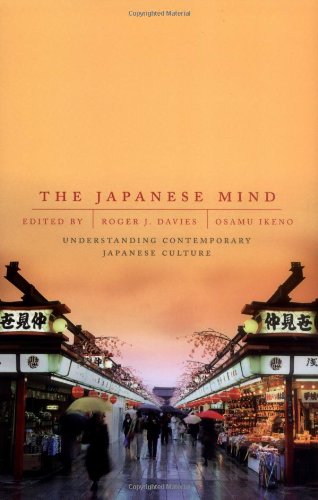
1. The Japanese Mind: Understanding
$20.00
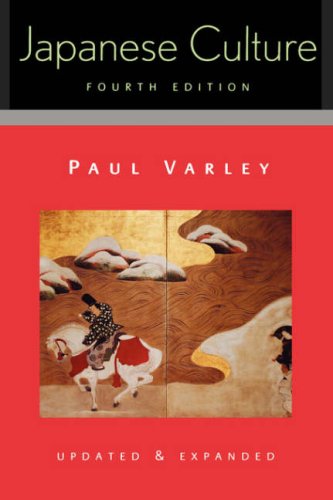
2. Japanese Culture, 4th Edition
 
$127.00
3. Nakama 1: Japanese Communication,
 
$39.44
4. Zen and Japanese Culture
$23.78
5. The Worlds of Japanese Popular
$10.11
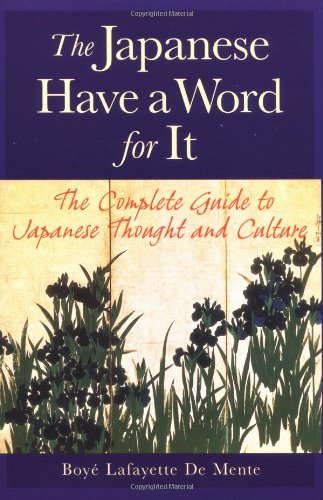
6. The Japanese Have a Word for It:
$9.95
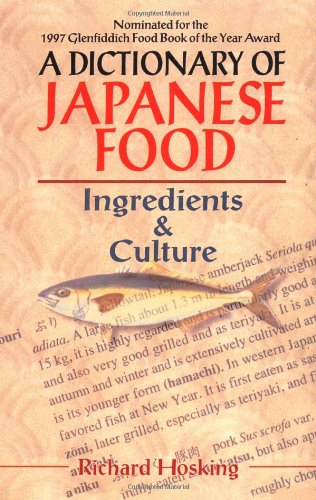
7. A Dictionary of Japanese Food:
$17.85
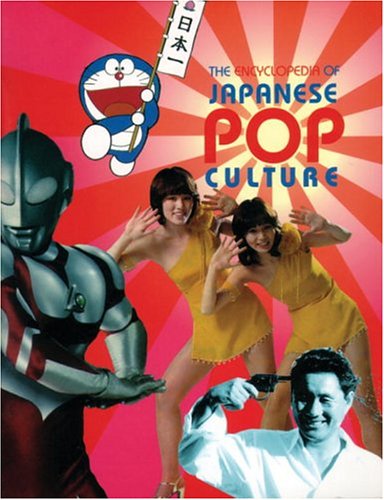
8. The Encyclopedia of Japanese Pop
$19.50
9. Japan Pop!: Inside the World of
$8.97
10. Japanamerica: How Japanese Pop
$17.04
11. Japanese Business Culture and
$29.00
12. Traditional Japanese Arts And
$7.54
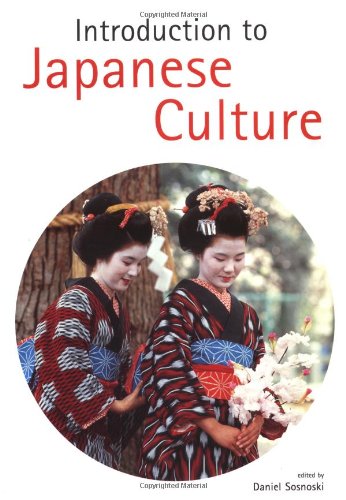
13. Introduction to Japanese Culture
$29.95
14. Power and Culture : The Japanese-American
$53.10
15. Japanese Visual Culture: Explorations
$89.47
16. Religion in Japanese Culture:
$158.95
17. Experiencing Japanese Culture:
$12.99
18. Japanese Culture and Behavior:
$13.99
19. Japanese Today: Change and Continuity,
$36.35
20. Culture Shock and Japanese-american

1. The Japanese Mind: Understanding Contemporary Culture
Paperback: 270 Pages (2002-03-15)
list price: US$14.95 -- used & new: US$9.02
(price subject to change: see help)
Asin: 0804832951
Average Customer Review: 4.0 out of 5 stars
Canada | United Kingdom | Germany | France | Japan
Editorial Review

Book Description
In The Japanese Mind, Roger Davies offers Westerners an invaluable key to the unique aspects of Japanese culture. Readers of this book will gain a clear understanding of what really makes the Japanese, and their society, tick.
Among the topics explored:aimai (ambiguity), amae (dependence upon others' benevolence), amakudari (the nation's descent from heaven), chinmoku (silence in communication), gambari (perseverence), giri (social obligation), haragei (literally, "belly art"; implicit, unspoken communication), kenkyo (the appearance of modesty), sempai-kohai (seniority), wabi-sabi (simplicity and elegance), and zoto (gift giving), as well as discussions of childrearing, personal space, and the roles of women in Japanese society. Includes discussion topics and questions after each chapter. ... Read more

Customer Reviews (9)

4-0 out of 5 stars Only an introduction, but a pretty good one
Both editors are professors at Ehime University in Matsuyama, both working in fields relating to England language education, and they have put together a collection of twenty-eight relatively brief essays -- all written by fourth-year students and then polished with the help of the faculty -- on such key attitudes, patterns of behavior, traditions, and social underpinnings. These include group consciousness, the Japanese and ambiguity, personal space, childrearing, the Japanese sense of beauty, male/female relationships, seniority, and other topics that often are puzzling to Westerners. The writing is uniformly clear, even when explaining complex concepts, and there's a detailed bibliography (much of it to works in Japanese, however). A very informative resource for any American trying to figure out the Japanese.

3-0 out of 5 stars academic in nature
This book is well written. It was written to be used in a class room setting (the book states this) If I would have know I wouldn't have purchased it. I was looking for a more personal,engaging insight on the way of life in Japan. The book is laid out nicely and still a good read, just a bit too text like.

5-0 out of 5 stars Well-written, literate, useful...
My wife and I found this book very helpful, prior to our first trip to Japan.We have been somewhat fearful of this trip, because of langugage and obvious cultural differences.Nevertheless, thisbook added to our understanding of current cultural traits, ideas, and ideals in Japan; their historical origins; their meaning to both Japanese and first-visit foreigners; and the countervailing Western forces eroding at the "pure strain" traits or ideals.All in all, this book is a fascinating synopsis of Japanese thinking about unique Japanese traits.

We also liked the fact that at the end of each brief chapter, the editors have written a number of thought-provoking questions.These questions ask the reader to expand one's thinking and make clear cross-cultural distinctions.Besides making the book even more useful to persons like us, these questions also make this book a sure winner in any advanced high school or college class on Japan.

5-0 out of 5 stars Exploring tolerance and understanding
I stumbled upon this thoroughly enlightening book at the end of my third year of living in a small bucolic town in the mountains of rural Japan.While it is intended as an overview and introduction to various things that can make the Japanese seem different and enigmatic to outsiders, many of the topics are discussed from their historical evolution, which helps to construct them in a much fuller and as a more complete figure. Moreover, the subjects covered are often unobservable to the casual visitor and neophytic foreign transplant, yet are central to understanding the Japanese character.Where I had just simply witnessed and pondered over many baffling and seemingly contradictory actions of the people whom I was residing amongst at first, after reading this book I came to understand them in a much clearer and tolerant way.Another result, incidentally, was it also helped ease me through an extremely delayed case of culture shock.We should note that problems arise not through stereotyping (which, despite our fanatical political correctness at times does tend to be accurate more often than not), but when we use these generalizations to assert a cultural superiority, or inferiority as the case may be, and to define differences as being anything other than such.

This wonderful little book is clearly written by Japanese college students, and edited by the professors who guided them, in a style that makes even opaque concepts accessible. Ritualistic behavior is deconstructed in plain and precise language, in a conciseness that is also equally typical of the Japanese.It is organized into twenty-eight mostly interconnected chapters, though you can read them in any order you prefer.Some are perhaps too brief and would require explorations elsewhere for those serious inquisitors, still, like pieces to a puzzle, if you accurately connect them, they do render a thorough image in their totality.The editors, however, are careful to remind us that many of these topics continue to be debated and controversial even within Japanese society today.Nevertheless, the keen observer should, for example, be able to meld chapters like Uchi to Soto (literally translated as inside and outside), Honne to Tatemae (actual intentions and superficial words/actions, in a chapter I wished was more developed), Haragei (the implicit way of communication), Aimai (ambiguity), and Nemawashi (laying the groundwork) to better understand the Japanese "ways" in intercultural dealings and discern why they have often been regarded as remaining isolated inside their own country and outside of the responsibilities in world affairs that many would like to attribute to one of the world's strongest economic powers.

This book is filled with informative and insightful essays and should be mandatory reading for anyone interested in the Japanese mentality, for those who study the language, and for even those Japanese who have a good enough command of English and wish to understand and communicate more about their culture than the trite aspects that are so often regurgitated in films and popular pulp. At the end of each chapter there are discussion activities that not only probe further into the respective topic and often attempt to relate it to contemporary Japan, but should also help facilitate one of the main purposes of this project, intercultural dialogue leading to mutual understanding.Even if you are lucky enough to engage in these conversations with some Japanese be forewarned, like the many Americans who have a hard time explaining our traditions of Halloween or saying "(God) bless you" after a sneeze for instance, much in this book is so entrenched in and forms the undercurrent of normal everyday life in Japan that many Japanese have trouble recognizing and explaining it themselves. Kudos to both the Ehime University students and teachers for producing such a well-written, thought provoking, and helpful analysis--its value far exceeds its cost.

5-0 out of 5 stars Highly enlightening...
First of all let me correct one somewhat negative reviewer who states that `The Japanese Mind' is `how one British professor interpreted Japanese culture'. This comment I assume refers to Roger J. Davies who I believe is indeed British by birth (more precisely Welsh) but was actually brought up and educated in Canada and has only recently continued his studies back in Wales. He is Professor of Applied Linguistics at Ehime University in Matsuyama, Japan, and also Academic Director of that University's English Education Centre. This book is also edited by Osamu Ikeno, who is Associate Professor of English Education in the Faculty of Education at Ehime University. So this is far from just one British Professor's interpretation. This is a book of some authority.
Also, if another reviewer's assertion that the book has a `lack of depth in the analysis, frequent non-sequiturs' (and who even goes so far as to recommend that you `use at your peril') is a truly fair assessment of the standard of work produced by Roger Davies and Osamu Ikeno, then I doubt if those two gentlemen would occupy the prestigious positions they do.
As a European and `general reader' I found the book gave a fascinating insight into what can at first appear to the layman to be a baffling and unfathomable culture, given extra credence by the fact that, as the introduction states, the information presented is from the perspective of the Japanese people themselves. The format allows for casual study as the chapters can be read in any order you wish.
I would consider this an invaluable guide for anyone visiting Japan and/or who wishes to better understand the complexities of Japanese customs and behaviour. No book could possibly explain all the intricate facets of Japanese society, and certainly not to everyone's satisfaction, but `The Japanese Mind' goes a long way toward doing so. ... Read more


2. Japanese Culture, 4th Edition (Updated and Expanded)
by H. Paul Varley
Paperback: 400 Pages (2000-05-28)
list price: US$22.00 -- used & new: US$20.00
(price subject to change: see help)
Asin: 0824821521
Average Customer Review: 4.5 out of 5 stars
Canada | United Kingdom | Germany | France | Japan
Editorial Review

Book Description
For nearly three decades Japanese Culture has garnered high praise as an accurate and well-written introduction to Japanese history and culture.This widely used undergraduate text is now available in a new edition.Thoroughly updated, the fourth edition includes expanded sections on numerous topics, among which are samurai values, Zen Buddhism, the tea ceremony, Confucianism in the Tokugawa period, the story of the forty-seven ronin, Mito scholarship in the early nineteenth century, and mass culture and comics in contemporary times. ... Read more

Customer Reviews (7)

4-0 out of 5 stars I think Japanese should cherish the culture as Japanese too.
I have lived in Tokyo, Japan since I was born here. Though I can say about the case in Tokyo only, even I can not look at the Japanese historical things in my ordinaly Tokyo life. Tokyo is same as another big town over the world, developed town with high stores building, the imported fashion from mainly U.S.A etc. Certainly, the modern life in Tokyo may be comfortable, but I think that the life is not truth things, that is, that may be physical comfot, not mental.

If I say honestly, in fact, I am very tired in Tokyo life since my birth, especially mental part: the overpopulated city, dirt air from the rannning cars, people followed with benefit.

In such condition, I think that Japanese should get back the vanished Japanese history again. Japanese long history and cultures is not just culture, I think, they have been made on the reasonable means, for instance Japanese Buddhism would be born on the tender mind that take care of other person. But in modern Japanese city, there are little people that beleive in reliegions.

Thank you for reading poor writing.

5-0 out of 5 stars 10,000 Years In 300 Pages
The tracings of Japanese culture go back some 10,000 years - speaking conservatively.Since then there has been a remarkable continuity of inhabitation on the Japanese islands, which has resulted in one of the richest and complex cultures in the world today.Originally heavily influenced by the neighboring Chinese culture in the period from 300 BC to 300 AD, the islands quickly found their own way and over the ensuing years have developed a breadth of integrated experience that is often baffling to the outsider or curious student.

Paul Varley's book, in it's fourth edition and showing no signs of losing its value, is an attempt to present the significant cultural and historical developments, covering the past two millennia.OF course, most of the focus is from the eighth century on as Japanese civilization shifted from day to day survival to a complex political framework with a great flourishing of substantive creative art.

Considering that my standard historical reference on Japan has some seven volumes and thousands of (often tedious) pages, Varley's task is considerable and his success worthy of note.In a mere three hundred pages of tiny print Varley manages to draw a picture of the Japanese people that, while far from complete, misses none of the key culture moments.

He does this in a plain, business-like writing style that pours out unending amounts of information with merciless patience.He is very readable, but not what I would call enjoyable, since the sheer quantity of information can be overwhelming.If simply read straight through, it is easy to lose track of the thread of ideas.But the book rewards repeated study and the reader will soon find that all this information contributes much towards an understanding of the Japanese experience.

4-0 out of 5 stars Typical history
This book is good.I'm not going to call it great, nor will I say that it isn't a worthwhile read; however, it gets wordy at points.It could be improved with an overview of each chapter and then have the in-depth information to follow.Regardless, there is a wealth of information within!I personally love the history parts because I fell asleep when I took east asian history, and this is a good way of refreshing my memory to prepare for my college major of East Asian Studies come 2005 ;).

5-0 out of 5 stars Amazing detail in such a small amount of space
I wasn't sure what to expect when i bought this book - after all the title does seem a little generic and it is a pretty small book, but i was pleasantly surprised. Varley's style is incredibly terse yet still very accessible. He deals with Japanese culture chronologically, giving the reader a clear picture of the state of the country at the time any major cultural events took place, although avoiding any unecessarily long forays into the history of Japan which do not relate to cultural happenings. Overall, an extremely diverse and useful introduction to Japanese culture which could provide a thorough grounding in the subject prior to further study, or equally serve as a useful reference book to anyone with a casual interest in the culture of Japan

5-0 out of 5 stars Great introduction to Japanese history and culture
This book is fantastic for a thorough introduction to Japanese culture.It was a pleasure to read. This was the textbook used for my Japanese Life and Culture university class, and I was extremely pleased with it.Varley's writing style is straightforward and extremely interesting.What I especially liked about the book was its mixture of history and all aspects of Japanese culture, from the literature to the art to the religions.I can't recommend this book highly enough for anyone interested in learning about Japanese culture. ... Read more


3. Nakama 1: Japanese Communication, Culture, Context
by Seiichi Makino
 Hardcover: Pages (1998-08)
list price: US$138.76 -- used & new: US$127.00
(price subject to change: see help)
Asin: 0395912504
Average Customer Review: 2.5 out of 5 stars
Canada | United Kingdom | Germany | France | Japan

Customer Reviews (3)

5-0 out of 5 stars I have fun learning Japanese!
I think Nakama is an excellent Japanese textbook for a college student like me. It has a total of 12 chapters, each featuring a main topic such as daily routine, family, health, restaurant, department store etc.Yes the book does work better in a classroom with the guidance of a teacher. It has many interesting activities to be done in a group with other classmates. When I just started learning hiragana and katakana, I really appreciate the mnemonic diagrams which are rather funny and therefore easy to remember. For example, it says that the hiragana の looks like a "No smoking" sign and is therefore pronounced as "no". The book also has many pictures which make learning Japanese fun. Besides, it also introduces Japanese culture in the beginning of each chapter.

The workbook is not as bad as described by other reviewers, at least it is great to me. I have been taking Japanese class for 3 quarters (~9 months) and finally finish studying the book and doing the workbook. I can now speak some Japanese and write a short essay with some kanji.

I love Nakama and also love learning Japanese very much. I am going to take more Japanese classes definitely and I am going to buy Nakama 2!! The only bad thing about this book is its price. I bought Nakama 1 for about $80, but considering the knowlegde I gain from it, I will probably keep the book. I recommend this book to everyone interested in learning Japanese.

2-0 out of 5 stars Not a good book - Are there better out there?
I think your response to this book depends on how you like to learn a foreign language. Personally, I prefer 'direct method' teaching, which means that you learn a foreign language in that language with very little translation into your native tongue. Nakama is not designed for direct method and in fact is far too laden with English directions, translations, cultural explanations, etc. While this is understandable, to a limited extent, with a beginner level textbook it would be better to at least begin to incorporate the Japanese introduced in the course into the text. I find that all the English limits the rate at which I 'absorb' the language.

The book itself is structured well enough, beginning with simple phrases and hiragana and moving on to katakana then kanji. However, it might make itself more adaptable for classroom use by adding role-plays or other such speaking activities. Basically, the book feels overdetermined and slightly like a cram-school approach to language acquisition.

As for the other materials, the cassettes that accompany the Workbook are terrible quality - so much so that the Japanese members of my family cannot understand what is being said at times. The workbook itself is printed on very low grade paper that really must be photocopied before it is usuable (unless you work on a separate sheet and simple write your answers on the workbook page).

Overall, I don't think the Nakama series presents value for money or education. You will end up forking out ~$200 for the set of books and tapes that really, at the end of the day, don't really give much educational return... Unless you have a good teacher and friends/family to help you - which I did.

1-0 out of 5 stars Most unhelpful
This is a poor excuse for a textbook. Let's start with the poor and scatterbrained grammar explanations. Not only do the authors succeed in obfuscating what should be simple grammatical rules by introducing multiple grammar concepts simultaneously, but they often offer only a single example as an illustration.
In addition, the authors introduce conjugated verbs several chapters before the infinitives.
The grammar exercises serve only to confuse students because they are often used to introduce exceptions without explanation.
The cursory treatment of katakana (introduced in "Chapter 3.5") also creates handicaps for students that last throughout their second semester of using this book.
The accompanying workbook is next to useless due to the number of typos, the amateurish layout, and completely fictional concordance (for example, there is one place in the notebook where they refer to a family tree illustration on page 95, but there is no illustration to be found on that page).
The accompanying audio (I tried the CDs, but I understand that the tapes are even worse) is of poor quality. There is a lot of background noise that muffles the speakers. The speakers themselves were apparently challenged to speak as fast as they could so that even native speakers would have a hard time discerning their meaning. For beginning students who need clarity and patience, this was most discouraging.

In short, I would strongly discourage students from taking Japanese at their college if this text is being used and I would hope that Japanese programs realize the low quality of this so-called instructional text. ... Read more


4. Zen and Japanese Culture
by Daisetz Teitaro Suzuki
 Paperback: 478 Pages (1997-07)
list price: US$9.98 -- used & new: US$39.44
(price subject to change: see help)
Asin: 1567311245
Average Customer Review: 4.5 out of 5 stars
Canada | United Kingdom | Germany | France | Japan
Editorial Review

Book Description
From one of the most influential books ever written on Zen's influence on JapanOne of the leading twentieth-century works on Zen by D.T. Suzuki, Zen and the Art of Japanese Culture was originally released on audio as four separate programs-What Is Zen, Zen and the Love of Nature, Zen and the Art of Tea, and Zen and the Samurai. Now, for the first time, they are available in one edition.After briefly explaining what Zen is, Dr. Suzuki considers in detail various aspects of Japanese art and life that this Buddhist discipline has influenced: the cult of swordsmanship, the tea ceremony, the haiku form of poetry, and the Japanese love of nature. Other essays are devoted to the relationship of Zen and Confucianism, to the role of Zen in the tradition of the Samurai, and to Japanese art.In simple, often poetic, language enhanced by anecdotes and poetry, D. T. Suzuki describes how Zen evolved, and how its emphasis on primitive simplicity and self-effacement have helped to shape an aesthetic found throughout Japanese culture. ... Read more

Customer Reviews (17)

5-0 out of 5 stars Nothing to say, just a point in the right direction
Suzuki's writing is a warm embrace, and is not only easy to read and comprehend, but full of subtle and delicious humor.If it were not for him, I would still think elightenment was merely illumination.If you enjoy this sort of thing, you MUST read Alan Watts.The Way Of Zen is a wonderful companion to this book, and is written from the same semi-detatched, yet delightfully perceptive point of view, and Mr. Watts was both a contemporary of Mr. Suzuki, and also much influenced.I would almost recommend reading Suzuki's "Introduction to Zen" first, as it makes it even more enjoyable.Follow with Douglas Adams.Thank you for your time.

5-0 out of 5 stars Zen can not be learned only experienced.
Through this delightful and profound text the concept of Zen is presented as the facets in a diamond. Suzuki does so by presenting Zen in a variety of ways: from a swordsman's perspective, painting and other art forms.

The simplicity of Suzuki's style never cheapens nor detracts from the teachings; on the contrary, it seamlessly guides us through all the nuances and difficult to explain concepts.Hiswriting style contributes to the "feeling",if I may say so, of the flow of Zen.

It is not dogma.It does not pretend to give answers.It is
a guide or portal to the way of Zen and gives us an awareness that may help us find our own way to it.

If organized religion does not do it for you this may be the path you are looking for.

5-0 out of 5 stars Zen in a broader context
DT Suzuki sometimes is dismissed for having a somewhat abstract approach to Zen rather than a zazen-centered approach.I love his books because they celebrate the ancient Chinese masters for whom every act and perception was nothing less than the totality of the universe.

4-0 out of 5 stars Look smart feel great
If you'd like to look like you are all fancy and smart then I suggest buying this book. It will give you an air of authority when the conversation inevitably turns to zen things. The chapter on swordsmanship is (as the British might say) spot on. Oh, and get you some of that sweet, sweet haiku analysis from a zenorific perspective. After you read this book you will be prepared to quickly forget all of the knowledge that the tome contained and empty your mind in the style of the zen masters. Really, you must read about the tea ceremony and consider for yourself the zenishness of setting some tea leaves in some hot water. In short, I applaud this book loudly with one hand.

5-0 out of 5 stars Clear, Poetic, and all Quality.
This is the best book I have ever read on any subject.This is a beautiful book, Suzuki's clear explanation is unique and fluid.Every facet of this book is intriguing.I especiialy appreciate Suzuki's chapters on The Art of Tea.A book everyone should study!. ... Read more


5. The Worlds of Japanese Popular Culture: Gender, Shifting Boundaries and Global Cultures (Contemporary Japanese Society)
Paperback: 228 Pages (1998-10-13)
list price: US$31.99 -- used & new: US$23.78
(price subject to change: see help)
Asin: 0521637295
Average Customer Review: 3.5 out of 5 stars
Canada | United Kingdom | Germany | France | Japan
Editorial Review

Book Description
This is a lively discussion of Japanese popular culture from an anthropological perpective. An international team of authors considers a broad range of topics, including sumo, karaoke, manga, women's magazines, soccer and morning television. Through these topics--many of which have never previously been addressed by scholars--the contributors also explore several deeper themes: the construction of gender in Japan; the impact of globalization and modern consumerism; and the rapidly shifting boundaries of Japanese culture and identity. ... Read more

Customer Reviews (4)

3-0 out of 5 stars for study only
I bought this for my university course in Cultural Expressions in Modern ASia and it was very helpful and insightful but should only be used in an academic way. Not really that fun to read but useful.

4-0 out of 5 stars As an introduction...
As an introduction into what "Japanese popular culture" can entail, this is a good book; the articles written may not be as in-depth as wanted or needed, but this is not a book by one scholar alone. It is simply a collection of useful articles, that explore different aspects in Japanese popular culture and act as a sort of "grounding point" for further study.

There are themes of comparative study (American superheroes v. Japanese superheroes) and also themes of changing roles and changing identities (or the converse; that in some popular images, like in manga/comics, the perception that some roles DON'T or SHOULDN'T change).

But for anyone seeking a good introduction, it is a good book and worth having on your bookshelf.

2-0 out of 5 stars Totally Circular
I'm probably not being fair to this book, since I have only skimmed (some of) it, but it seemed rather poor to me.To take a concrete example the essay on superheroes and monsters (by Tom Gill) was especially problematic.It uses the example of Superman vs Ultraman and states that (1) Superman is a total loner with no family or attachments (His family in Kansas? Supergirl?Lois Lane?don't count I guess) whereas Ultraman has a large number of companions (somewhat more true).(2) Superman's colors are like the colors of the American flag, whereas Ultraman's are like the "lucky colors" red and white (Q: has Tom Gill looked at the Japanese flag?).He then uses these and some better thought out characteristics of the characters to show that Superman is an American hero (individualistic) and Ultraman a Japanese hero (more like a kami).The problem is that (1) shows a lack of research, and (2) a lack of thought.This totally undercuts any later conclusions in the article.

The other articles I looked at seems a bit better, but this is not a very select selection.

5-0 out of 5 stars For pleasure and easy reference
This is an exellent book for the beginner in studies of japanese culture. It deals with different matters such as: sumo, manga/anime, karaoke, horse-racing and womens magazines - all in a scientific but relaxed tone. Maybe you want what bosozoku-driving is??? In short - comprehensive and informative. A must for your bookshelf!! ... Read more


6. The Japanese Have a Word for It: The Complete Guide to Japanese Thought and Culture
by Boye Lafayette De Mente
Paperback: 400 Pages (1997-10-11)
list price: US$17.95 -- used & new: US$10.11
(price subject to change: see help)
Asin: 0844283169
Average Customer Review: 4.5 out of 5 stars
Canada | United Kingdom | Germany | France | Japan

Customer Reviews (6)

5-0 out of 5 stars Explains every situation I come up against
I bought this book last year in preparation for coming to Japan and enjoyed it greatly. Then, on arrival, I continued reading it and found it helpful in avoiding many of the pitfalls one experiences when trying to do business in Japan. Now, 10 months on, reading it again, the hairs on the back of my neck stand up. It's as if the author has been following me around and written about my daily experiences here. I have many books about Japan and the Japanese Way, but none express so succinctly or directly the day-to-day experience of working in a Japanese context. You must read this book if you are working or doing business in Japan.

4-0 out of 5 stars Dense but impressive
The Japanese have a much more complex, almost religious, relationship with their own language than speakers of European languages, and they tend to believe that no non-Japanese can learn it. (The fact that some do tends to upset them, as being out of the natural order.) There are many words and phrases in Japanese that encapsulate attitudes and built-in beliefs and the author selects 230 for investigation and explanation, relating them to attitudes and actions by Japanese-speakers and explaining how English-speakers can best deal with the situations they relate to. This includes numerous aspects of the Japanese dependence on form and formality, cultural control and conformity, group-think as opposed to individuality, group responsibility and social guaranty, reverence toward government, and other parts of the Japanese psyche that are difficult for foreigners to understand. In most cases, he also discusses the applications of a concept to business negotiations, but the possibility of the reader becoming enlightened about all things Japanese is much wider than that. This is a book you should take notes on.

5-0 out of 5 stars Excellent Book!!!
Boye De Mente is an author who is able to convey the mindset and cultural translation between Japan and the Western way of thinking like no one I have read before! Alot of people might give him greif! But you really have to be open and honest with yourself to fully absorbe what Mr. Boye De Mente has to say! I recommend everyone of his books! At the very least you will gain a little insight into a different way of looking at the world! Thank you Mr. Boye De Mente for your courage to be so honest and your skill to convey it!!!

5-0 out of 5 stars A Window into a Unique World
This book demystifies the Japanese culture.

What does it mean when a Japanese person offers to 'show you their stomach'? (P120) How do they 'take the pulse of the situation'? (p268) What is 'a life without a soul?' (p148)

There's so much packed into the 394 pages to digest. Luckily each word or phrase is a short chapter. The reader can chew it over in a leasurely manner.

Essential reading.

5-0 out of 5 stars Excellent roundtrip into Japanese spoken lifestyles.
Knowing that Japan uses it language differently than English, but not why, I found this presentation provided numerous insights. ... Read more


7. A Dictionary of Japanese Food: Ingredients & Culture
by Richard Hosking
Paperback: 239 Pages (1997-01-15)
list price: US$16.95 -- used & new: US$9.95
(price subject to change: see help)
Asin: 0804820422
Average Customer Review: 5.0 out of 5 stars
Canada | United Kingdom | Germany | France | Japan
Editorial Review

Book Description
At last, what every Westerner in a Japanese restaurant or market needs: the first truly comprehensive dictionary of Japanese food and ingredients.Standard dictionaries can often mislead us--with akebia for akebi, sea cucumber for namako, plum for ume. Hosking's dictionary includes not only dishes and ingredients, everything from the delicate mitsuba leaf to the dreadful okoze fish: colorful appendices disclose such aspects of Japanese culture as the making of miso to the tea ceremony and the influence of vegetarianism.
With Japanese-English and English-Japanese sections, A Dictionary of Japanese Food explains the nuances and eliminates the mysteries of Japanese food. ... Read more

Customer Reviews (10)

5-0 out of 5 stars A valueable pocket guide to take shopping
This ten-year old dictionary remains unsurpassed
as a guide to the ingredients, methods and utensils
used in japanese cooking. It is a portable volume
with romanized, kana and kanji versions of all the
names and so is ideal for a trip to the market
where many unfamilar ingredients may be presented
to the english--speaking food lover.

There are seventeen useful appendices that cover
topics like:
Chopsticks
Katsuoboshi
The kitchen and its utensils
Kombu
The Meal
Miso
Sake
Salt
Sansai
Soy sauce
Sushi
Tea
The tea ceremony
Umami and Flavor
Vegetarianism
Wasabi
Wasabon Sugar

In addition, many of the entries have enough
detail to be useful to the Western chef who
wants to incorporate Japanese ideas into his
or her cooking. Hoskins is an admirably concise
writer who packs a lot of information into a
small amount of graceful prose.

Be aware that this is not an encyclopedia. If
you use the English-Japanese section to look
up `mushroom' for instance, you'llfind the
translation `kinoko' but not a comprehensive
list of Japanese mushrooms or techniques for
cooking them.

So leave the browsing to other books and keep
this one for trips to the market You'll be glad
to have it.

--Lynn Hoffman, author of THE NEW SHORT COURSE IN WINE and the forthcoming novel bang-BANG from Kunati Books. ISBN 9781601640005

4-0 out of 5 stars Very useful book
I recently spent a month in Tokyo and I enjoy cooking.I found this book along with a good Japanese cookbook to be very useful both in the market and the kitchen.I would have like it to included a kana (Japanese syllabic writing) to English section, but understand most English speakers are not familiar with this Japanese syllabic writing. Luckily all Japanese know our alphabet and my fellow shoppers were always happy to help me find what I wanted.In fact, I believe they appreciated my interest in their food and culture.

5-0 out of 5 stars Essential if you plan to shop in oriental markets
This book was the connection I needed between the recipes in my Japanese cookbooks and the local Asianmarket.Many of the packages have no English word on the package.I have used this book every time I have shopped; when I can't figure out what I am looking for, I take the Japanese word (the book cross references in English and Japanese) to the service desk.The young Japanese woman takes me to exactly what I am looking for.It has saved hours of decoding the ingredients.

This is great for descriptions and translations, not for cooking assistance; it discusses pairings of flavors for ingredients you look up.It is the perfect dictionary to keep close to the Asian cookbooks.

5-0 out of 5 stars Super Tool for Japanese Food Lovers
For those people who love Japanese cuisine but don't know much about the Japanese language, this pocket size dictionary is a wonderful tool. It focuses on most terms and words used in Japanese cuisine including drinks, entrees, ingredients, food terms, even some cooking and food container names. The dictionary allows readers easy to look up information. It is arranged in three sections: Japanese-English, English-Japanese, and Appendices with some interesting topics in Japanese cuisine.Each entry in the Japanese-English section provides the Japanese term in Roman script, Japanese character, as well as Kanji, along with the English definition details and possibly some additional culture notes. Truly, this dictionary is a MUST!

(Reviewed by Otto Yuen, 19-Jan-2006)

5-0 out of 5 stars Authentic, resourceful, handy and enjoyable
As a Japanese native and a food enthusiast, I first approached this book skeptically.I must say that I am impressed.Another reviewer says that this book does not contain everything, but hey, it covers much more than I expected.I keep it handy when I cook Japanese food for guests, so I can answer questions without guessing all the time.Finding books like this one --straightforward and packed with trustworthy, interesting information -- is a joy. ... Read more


8. The Encyclopedia of Japanese Pop Culture
by Mark Schilling
Paperback: 344 Pages (1997-05-01)
list price: US$29.95 -- used & new: US$17.85
(price subject to change: see help)
Asin: 0834803801
Average Customer Review: 3.5 out of 5 stars
Canada | United Kingdom | Germany | France | Japan
Editorial Review

Amazon.com
In the West, Japanese culture comes in the form of Power Rangers, Godzillamovies, and Sanrio products, but of course the indigenous pop culture is much richer.Rather than focus on what the rest of the world has already encountered, Mark Schillingprovides an encyclopedic compendium of books, movies, music, comedians, and culturalscandals that have had the greatest impact in Japan. Thus, for the outsider, TheEncyclopedia of Japanese Pop Culture is an insider's guide to post-war Japan. Notcontent to simply catalog his entries, Schilling provides real depth and analysis in hisarticles, opening up Japan's rich pop heritage to the world at large.Book Description
In the West, Japanese culture comes in the form of Power Rangers, Godzilla movies, and Sanrio products, but of course the indigenous pop culture is much richer. Rather than focus on what the rest of the world has already encountered, Mark Schilling provides an encyclopedic compendium of books, movies, music, comedians, and cultural scandals that have had the greatest impact in Japan. Thus, for the outsider, The Encyclopedia of Japanese Pop Culture is an insider's guide to post-war Japan. Not content to simply catalog his entries, Schilling provides real depth and analysis in his articles, opening up Japan's rich pop heritage to the world at large. ... Read more

Customer Reviews (8)

4-0 out of 5 stars Japan is always not anime culture.
Everybody of the world may know Hayao Miyazaki's animation movies because his movie won an Academy Award. On the other hands, forigners may have the thought that Japan is a developing country on animation genre. But true Japan charm never finish by only that off course.

The Japanese uniqueness expand to many genres, anime, TV culture, movie, manga, music...

Comics are called Manga in Japan. The manga culture started after World War 2 mainly, the flame work as manga was made by Osamu Teduka(he is no alive now). His famouse manga is Tetsuwan Atomu. The main story is very simple that the main character Atom(robot) beat the evil character. But the age that the manga was published was 1950'. At those days, people worked very hard in debris because the time after WW2 had finished was very short. Atomu was a hero for such hard workers in poverty.
Even now Teduka is a hero for all Japanese manga or anime creaters, for all Japanese even. That reason is always not just the pioneer on the genre, he included hisself messages to his mangas always, for instance anti war philosophy, the opinion for environmental destruction and so on.. By doing such things, manga became to be not just fun genre.

Or as Japanese unique comic genre, there are Syoujo comic(comics for girls). The genre is very unique Japan only. The most famouse manga may be Berusaiyu No Bara. The main theme was Europian knights story in the Middle Ages of France. By using beautiful atmosphere like old France style or pure love story of knights, the creaters tempted girls very well. Japanese girls want such pure love story manga in some cases. Though I do not know the detail emotion because of a man, they may do the imaginary romance in such manga. The tendency have not change until now.

Japanese movies are unique genre in Japan too. Some foreigners may know the name Takeshi Kitano who won Europian movie awards. Japanese movie genre is variouse so that I can not explain by one word. When I dare to explain, the most famouse theme is Yakuza story(Japanese gangu). Off course some Japanese feel fears to Yakuza. But on the other hands, some Japanese watch Yakuza movies. On Yakuza world, the relationship between up and down posiion is very important. For instance, in the some movie, low position yakuza say"I can die for senior yakuzas", that is, absolute loyalty exict in Yakuza world.
Such unique stance will tempt some Japanese watcher, in the age that such stance is being lost, whether the stance is bad or not.

Thank you for reading poor English.

5-0 out of 5 stars pop culture encyclopedia = contradiction in terms
it's not possible.It just is -not- possible to do a pop culture encyclopedia no matter how hard one tries to.If you're going to do one, though, the key ingredients are to pick the lasting phenomenas and to assure your reader there's a depth in it worth covering.

Schilling doesn't cover most of what I remember from Japan.He doesn't cover rock music.He doesn't cover kogaru.He doesn't cover ramune or pocky.Honestly, on an encounter level with other similar books I've found myself insulted by the lack of knowledge presented in their so-called "encyclopedia".But with what he covers, he covers it well and authoratatively and with an expressed but not hideously overt sense of irony about the entire situation.

I've found myself keeping it for a reference piece because what he does cover tends to get incorporated into a lot of what he doesn't.

3-0 out of 5 stars A good attempt
Before you purchase this book, as yourself, "when have I ever seen a review of popular culture that covered everything?" The answer, probably, is never, and if so, this book won't change that. The author states as much in the introduction. Having said that, the book is very good at what it attempts to do, namely give novice readers a basic understanding of the key elements of Japanese popular culture in the post-War era. A book which covered every fad, popular music group, TV program and movie during that time period would be larger than several phone books and would have a hard time selling. What this book does well is describe, in a fair amount of detail, the important cultural icons, from Misora Hibari and Sazae-san, through Pink Lady and Doraemon, ending with SMAP and Sailor Moon. If you're looking for a primer on Japanese pop culture over the last 50 years, this is the book. If you already have deep personal knowledge or are interested in only one thing (like anime), you may be disappointed.One other small problem with the book is that because it is in print form, the information is fixed in time, but Japanese culture goes on. In other words, some of the stuff in this book is dated. The concept of the book might better be served by a web site, but I doubt that Mr. Schilling could make a profit with such a site. If anybody decides to try though, please let me know.I'd visit!

4-0 out of 5 stars Japanese popular culture you might not know about
Instead of cataloging the people and subcultures on the commercial fringe that Americans and other non-Japanese may be more familiar with, Schilling takes care to give the reader a broad view of actual Japanese pop culture from the post-WWII period through the mid-nineties.As to the criticism that Schiller chose to leave many things out of his encyclopedia: any other 320 page encylopedia on pop culture that spanned fifty years would be much the same.As Schiller says himself in the Introduction, "The book could easily have contained twice as many articles, but I tried to put more emphasis on depth than breadth of coverage ..."I feel I now have a better understanding of Japanese 20th century pop culture, not just of the quirky, fringe, or subcultural elements that happen to make their way to other countries or have a large presence on the internet.

1-0 out of 5 stars Terrible
This book is a disgrace to Japanese pop culture. I lived in Japan for 28 years before I moved here to America last year, and I remember there being a lot more than that. There was no color, some pictures were difficult to make out, and the author was very sloppy on the outline. I would rate this book a zero if I could. ... Read more


9. Japan Pop!: Inside the World of Japanese Popular Culture
Paperback: 360 Pages (2000-06)
list price: US$27.95 -- used & new: US$19.50
(price subject to change: see help)
Asin: 0765605619
Average Customer Review: 4.0 out of 5 stars
Canada | United Kingdom | Germany | France | Japan

Customer Reviews (7)

1-0 out of 5 stars an academic tired of bad academics
In a word, this book is a mess.Methodologically suspect and theoretically uninformed, it relies on antiquated Orientalist assumptions of essential cultural identity and unchanging social forms to make the multifarious sources it cites all sound the same, which is too bad, because it is the only English-language 'scholarship' available at present on many of the topics covered.A wasted opportunity that makes me sad and mad.

5-0 out of 5 stars Japan Pop! Fascinating and entertaining
For anyone who has noticed the ubiquity of anime, sushi shops, Japanese style and other aspects of Japanese culture, this book provides a welcome and readable introduction to what Japanese popular culture is and where it comes from.I particularly liked the chapters on music but I probably learned more about Japanese culture and the mind set behind it from the chapters on television and anime.This book explains not only that there is a Japanese poular culture, but why it is the way it is.Highly recommended.

1-0 out of 5 stars Very poor introduction to the subject
Claiming to be a book which bridges the divide between the worlds of academia and populism, Japan Pop! gets off to a poor start with an absurdly high cover price likely to put it out of reach of the casual J-Pop Culture fan. The price might have been justified had this been a glossy, photo-packed book, but seems ludicrous given that it is merely a collection of 17 essays. The essays dwell on four major areas of contemporary J-Pop Culture: music, manga and animation, TV & film and the popularity of J-Pop Culture outside of the country. It comes as little surprise that Mark Schilling's contribution, about the Tora-san character in the Otoko wa Tsurai yo (It's Tough Being a Man) film series, is the most interesting - not necessarily because of the topic, but because Schilling is the only contributor who is a writer of any repute. The majority of these essays are written by academics and it shows: footnotes abound, the Mighty Morphin Power Rangers get analysed to the nth degree and claims are made that "Sailor Moon's rearrangement of the traditional superhero myth bears hints of not only a new social order, but also the kind of moral struggles, alliances, and identities that may create and accompany it." The book also contains a number of confidence-sapping factual errors (example: Osaka band Shonen Knife "started playing in the mid-1980s" which is not true, they started playing in December 1981). Schilling's Encyclopedia of Japanese Pop Culture (Weatherhill) remains the definitive starting point for those seeking a good, accessible introduction to the subject; Japan Pop! is only for the otaku completist, and a wealthy one at that.

5-0 out of 5 stars fascinating read
A fascinating and enjoyable read. "Japan pop" gave me a fresh and informitive insight into Japans modern culture and and in to the psychology of its people. Loved this book and I highly recommed it. ray brooks

5-0 out of 5 stars A "must" for students of Japanese studies & popular culture.
Japan Pop! considers various forms of Japanese popular culture, from popmusic and animated cartoons to films and television. The result is ananalysis of Japanese society, cultural identity, and daily life whichprovide absorbing surveys into Japanese psychology. A 'must' for anycollege-level student of Japanese studies. ... Read more


10. Japanamerica: How Japanese Pop Culture Has Invaded the U.S.
by Roland Kelts
Paperback: 256 Pages (2007-11-13)
list price: US$14.95 -- used & new: US$8.97
(price subject to change: see help)
Asin: 140398476X
Average Customer Review: 5.0 out of 5 stars
Canada | United Kingdom | Germany | France | Japan
Editorial Review

Book Description

Japanamerica is the first book that directly addresses the American experience with the Japanese pop culture craze--including anime from Hayao Miyazaki's epics to the burgeoning world of hentai, or violent pornographic anime to Haruki Murakami's fiction. Including interviews with the inventor of Pac-man and executives from TokyoPop, GDH, and other major Japanese and American production companies, this book highlights the shared conflicts both countries face as anime and manga become a global form of entertainment and change both the United States and Japan in the process.
... Read more

Customer Reviews (6)

4-0 out of 5 stars Pretty good introduction to the cultural phenomenon of anime -- but not much else
I've been interested in popular Japanese culture for a long time, so I was pleased to see this new exploration of the interface between Japan and America, . . . though I was somewhat put off by the use of the pejorative word "invaded" in the title. That seems to have been a marketer's contribution, though, because the half-Japanese author, who has become something of a professional explainer of Japanese and Americans to each other, seems not to reach value judgments about the wide popularity of manga and anime in this country, nor about the much more longstanding popularity of everything American in Japan. It's largely a generational thing, though; most Americans over the age of thirty have no idea what Gundam is, nor what "otaku" and "cosplay" mean. And while anime has become increasingly popular in the U.S., it remains deeply Japanese. There's really no such thing as "American anime." Though he comes to no strikingly original conclusions, Kelts does a good job of explaining things to those who are new to the subject.

5-0 out of 5 stars Pop culture rocks
Mr. Kelts' book about the popularity of Japanese culture in America is first rate.He discusses more than just anime and manga and provides the reader with an easy to understand analysis of Japanese popular culture both in Japan and as it appears in the US.It should be in the collection of any Japanophile.

5-0 out of 5 stars Excellently Written!
For those who have been to Japan or have an interest in anything Japan, I highly recommend this book.The author does a wonderful job explainingJapanese pop culture and how it relates to Japanese society and culture.IT was a very easy, entertaining, and insightful read.

5-0 out of 5 stars Excellent
I read this book after a Village Voice critic called it "a Wired Magazine article on steroids," and Ain't It Cool News said that it was "an imperative resource."Then Bookforum called it "an amazing ride," and The Boston Globe raved.
Then: Even Pete Townshend of The Who endorsed it!
I am skeptical of books trying to capitalize on trends, and very skeptical of books on Japan.But the chorus of praise from so many different voices was enough for me.
This book is written in lucid, carefully crafted prose--telling you everything you need to know about transcultural entertainment and the psychological and spiritual traumas embedded in pop culture, and also precisely what makes Japan so sexy to Westerners in the 21st Century.It is also hip and smart, and very accessible.I only wished it were longer.
The author is no geek, but a writer of considerable talent and range.Get Japanamericaa now.

5-0 out of 5 stars Beyond Anime
Americans like to think that our culture sets the standard for the rest of the world; however, Kelts takes us beyond our narrow cultural lens to understand the pervasive influence of Japanese aesthetics on the US. Kelts has an engaging and provocative writing style that educates and entertains. This book will satisfy a wide group of readers, including students of popular culture, Japanophiles, and "otaku." As a member of the first group, I couldn't put it down. ... Read more


11. Japanese Business Culture and Practices: A Guide to Twenty-First Century Japanese Business
by John P. Alston
Paperback: 184 Pages (2005-06-16)
list price: US$17.95 -- used & new: US$17.04
(price subject to change: see help)
Asin: 0595355471
Canada | United Kingdom | Germany | France | Japan
Editorial Review

Book Description
Japanese Business Culture and Practices: A Guide to Twenty-first Century Japanese Business presents valuable insight on the proper ways to conduct business in Japan. It focuses on the principles of Japanese culture that influence business-related behavior, including the ways Japanese executives develop loyalty among workers.

Drawing on their practical real-life experiences, authors Jon P. Alston and Isao Takei describe not only how Japanese work, entertain, make decisions, and use language in unique ways, but they also offer practical advice on how to work for and with Japanese. The combination of cultural facts and extensive descriptions of behavior provide an easy-to-understand guide to conducting business in contemporary Japan. Because the Japanese are loyal to those they trust and respect, foreigners will gain respect and facilitate success by knowing and adhering to the minutiae of Japanese social etiquette and business protocols.

From advice on how to avoid cultural misunderstandings to the proper techniques for negotiations, Japanese Business Culture and Practices is your guide to forming productive work relationships the "Japanese way." ... Read more

12. Traditional Japanese Arts And Culture: An Illustrated Sourcebook
Paperback: 253 Pages (2006-02)
list price: US$29.00 -- used & new: US$29.00
(price subject to change: see help)
Asin: 0824820185
Canada | United Kingdom | Germany | France | Japan
Editorial Review

Book Description
Music, poetry, the visual arts, literature, and theater have played a vital part in Japanese society.But, although Japanese artists, musicians, actors, and authors have written much over the centuries about the creation, meaning, and appreciation of these various arts, most of these works are scattered among countless hard-to-find sources or make only a fleeting appearance in books devoted to other subjects. Compiled in this volume is a wealth of original material on Japanese arts and culture from the prehistoric era to the Meiji Restoration (1867). These carefully selected sources, including many translated here for the first time, are placed in their historical context and outfitted with brief commentaries, allowing the reader to make connections to larger concepts and values found in Japanese culture.

Although the book focuses on the visual and literary arts, it contains material on topics not easily classified in Western categories, such as the martial and culinary arts, the art of tea, and flower arranging. More than 60 color and black and white illustrations enrich the collection and provide further insights into Japanese artistic and cultural values. Included as well are a bibliography of English-language and Japanese sources and an extensive list of suggested further readings.

Traditional Japanese Arts and Culture offers an authentic look at the conceptual richness, diversity, and continuity of the Japanese cultural traditions. Rather than impose a thick layer of interpretation, this inspired and diverse collection allows the original writers and artists to speak directly to people in all areas of Japanese studies interested in what lies beneath the surface of Japanese arts and culture. ... Read more


13. Introduction to Japanese Culture
Paperback: 104 Pages (1996-12)
list price: US$18.95 -- used & new: US$7.54
(price subject to change: see help)
Asin: 0804820562
Canada | United Kingdom | Germany | France | Japan

14. Power and Culture : The Japanese-American War, 1941-1945
by Akira Iriye
Paperback: 318 Pages (2004-01-23)
list price: US$32.00 -- used & new: US$29.95
(price subject to change: see help)
Asin: 0674695828
Canada | United Kingdom | Germany | France | Japan

15. Japanese Visual Culture: Explorations in the World of Manga and Anime (East Gate Book)
Hardcover: 384 Pages (2008-01-15)
list price: US$76.95 -- used & new: US$53.10
(price subject to change: see help)
Asin: 0765616017
Canada | United Kingdom | Germany | France | Japan

16. Religion in Japanese Culture: Where Living Traditions Meet a Changing World
Hardcover: 238 Pages (1996-08)
list price: US$28.00 -- used & new: US$89.47
(price subject to change: see help)
Asin: 4770020546
Average Customer Review: 5.0 out of 5 stars
Canada | United Kingdom | Germany | France | Japan

Customer Reviews (1)

5-0 out of 5 stars A quality textbook on real-life Japanese religion
"Religion in Japanese Culture: Where Living Traditions Meet a Changing World" is an excellent book addressing real-life religion in Japan, and how the "average" Japanese person approaches religion, rather than just theory and practice of a particular religion.

The bulk of the book is made up of the government-sponsored survey into the religious life of Japan including cataloging observances, devoutness, beliefs and other aspects of religion. This survey is essential to understanding the Japanese religious character and is a core to anyone studying the topic.

The remainder of the book is the religious situation today, and deals with such subjects as religion and the state, religion and education, Urbanization, depopulation and religion, and the aspects or rebirth of religion.

The book is quite academic in nature, and indeed is intended to be a textbook.It is not recommended for those with a casual interest, but is essential for those pursuing a serious study of modern Japanese culture and the role religion plays in it. ... Read more


17. Experiencing Japanese Culture: An Activity and Q-A Based Approach
by KEK Editorial
Paperback: 285 Pages (1992-07)
list price: US$32.95 -- used & new: US$158.95
(price subject to change: see help)
Asin: 4905737095
Average Customer Review: 5.0 out of 5 stars
Canada | United Kingdom | Germany | France | Japan

Customer Reviews (1)

5-0 out of 5 stars A perfect gem ý let's hope it's reprinted
I was lucky to stumble across this 1989 book in a used bookstore. It's full of wonderful, practical cultural info: what kinds of documents folks bring along to arranged meetings with prospective marriage partners;protocol for bathing at the Sento; guidelines for conduct inworship at ashrine; the correct wrapping of gifts of cash, and lots more -- photos,calendars, games, recipes. It's printed in Japanese and English, and wasproduced in Japan. Would be great to see this title go back into print --bet updating it would be a grueling process -- but until then, it's wellworth seeking out in libraries. ... Read more


18. Japanese Culture and Behavior: Selected Readings (Revised)
by Takie Sugiyama Lebra
Paperback: 452 Pages (1986-08-01)
list price: US$19.00 -- used & new: US$12.99
(price subject to change: see help)
Asin: 0824810554
Average Customer Review: 4.0 out of 5 stars
Canada | United Kingdom | Germany | France | Japan

Customer Reviews (1)

4-0 out of 5 stars Good balanced perspective
Twenty-three selected articles on Japanese values and beliefs, patterns of interaction, socialization and psycho-social development, and cultural stress. The articles are
written by Japanese and Western social scientists and psychiatrists, achieving a balance of Perspectives for a complex and provocative subject. ... Read more


19. Japanese Today: Change and Continuity, Enlarged Edition
by Edwin O. Reischauer, Marius B. Jansen
Paperback: 438 Pages (2004-01-07)
list price: US$23.50 -- used & new: US$13.99
(price subject to change: see help)
Asin: 0674471849
Average Customer Review: 3.5 out of 5 stars
Canada | United Kingdom | Germany | France | Japan
Editorial Review

Book Description

With the two-thousand-year history of the Japanese experience as his foundation, Edwin O. Reischauer brings us an incomparable description of Japan today in all its complexity and uniqueness, both material and spiritual. His description and analysis present us with the paradox that is present-day Japan: thoroughly international, depending for its livelihood almost entirely on foreign trade, its products coveted everywhere--yet not entirely liked or trusted, still feared for its past military adventurism and for its current economic aggressiveness.

Reischauer begins with the rich heritage of the island nation, identifying incidents and trends that have significantly affected Japan's modern development. Much of the geographic and historical material on Japan's earlier years is drawn from his renowned study The Japanese, but the present book deepens and broadens that earlier interpretation: our knowledge of Japan has increased enormously in the intervening decade and our attitudes have become more ambivalent, while Japan too has changed, often not so subtly.

Moving to contemporary Japanese society, Reischauer explores both the constants in Japanese life and the aspects that are rapidly changing. In the section on government and politics he gives pithy descriptions of the formal workings of the various organs of government and the decision-making process, as well as the most contentious issues in Japanese life-pollution, nuclear power, organized labor-and the elusive matter of political style.

In what will become classic statements on business management and organization, Reischauer sketches the early background of trade and commerce in Japan, contrasts the struggling prewar economy with today's assertive manufacturing, and brilliantly characterizes the remarkable postwar economic miracle of Japanese heavy industry, consumer product development, and money management. In a final section, "Japan and the World' he attempts to explain to skeptical Westerners that country's growing and painful dilemma between neutrality and alignment, between trade imbalance and "fair" practices, and the ever-vexing issue of that embodiment of Japanese specialness, a unique and difficult language that affects personal and national behavior.

... Read more

Customer Reviews (5)

1-0 out of 5 stars yet another apologist for Japan
This is one of the most superficial and ridiculous books on Japan that I came across.Though a Harvard scholar, Reischauer has such a flimsy grasp of modern Japan that it is simply and utterly appalling.It is like he wants the Japanese to love him and so writes only about the nicest things that he can find, while ignoring anything untoward - or even baselessly asserting that all problems like the Yakuza (!) will simply disappear as the country "matures".Well, if you've lived there and seen that there is much ugliness beneath the veneer of democracy and politness, this book will disgust you to no end.

Not recommended.It is a pathetic performance and deeply disappointing.

1-0 out of 5 stars Very superficial
Having lived for more than six years in Japan, and being fluent in Japanese, I have a quite clear idea of the society there. This book is not only too old, but it shows that Reischauer (like the other members of the Chrysantemum Club) has a one-sided point of view, and is still ganging with the American "reformists" that put Japan back on the rails (so to say...) during the occupation. Of course Reishauer knows quite a lot about Japan, but he tells only what he thinks is important to him and to his old-fashion Orientalist group. Read any Murakami or Yoshimoto to understand on your own how this book is very superficial. There are much better and objective introductions to the complex Japanese reality.

5-0 out of 5 stars This book is an excellent way to learn all about Japan.
This book discusses all aspects of Japanese society very well. It is a great mix of the present and history and of the average person and the people in power.

5-0 out of 5 stars The best single source on Japan and the Japanese.
I highly recommend this book to students, business people, and anyone who needs information on Japan and the Japanese.I have yet to find any single volume work on the subject of contemporary Japan as comprehensive as "The Japanese Today."I found the volume well organized and easy to read.

5-0 out of 5 stars Great Introduction to Japan
This book is one of the best general introductions to Japan that exists. It is meant for the layman and because of that, stays away from a scholarly bent.For anyone who has an interest in Japan, while this should not be the only book you read, it should definitely be the first. ... Read more


20. Culture Shock and Japanese-american Relations: Historical Essays
by Sadao Asada
Hardcover: 304 Pages (2007-07-16)
list price: US$44.95 -- used & new: US$36.35
(price subject to change: see help)
Asin: 0826217451
Canada | United Kingdom | Germany | France | Japan
Editorial Review

Product Description
Ever since Commodore Perry sailed into Uraga Channel, relations between the United States and Japan have been characterized by culture shock. Now a distinguished Japanese historian critically analyzes contemporary thought, public opinion, and behavior in the two countries over the course of the twentieth century, offering a binational perspective on culture shock as it has affected their relations. In these essays, Sadao Asada examines the historical interaction between these two countries from 1890 to 2006, focusing on naval strategy, transpacific racism, and the atomic bomb controversy. For each topic, he offers a rigorous analysis of both American and Japanese perceptions, showing how cultural relations and the interchange of ideas have been complex and occasionally destructive. ... Read more


  1-20 of 100 | Next 20
A  B  C  D  E  F  G  H  I  J  K  L  M  N  O  P  Q  R  S  T  U  V  W  X  Y  Z  

Prices listed on this site are subject to change without notice.
Questions on ordering or shipping? click here for help.

site stats