e99 Online Shopping Mall

Geometry.Net - the online learning center Help  
Home  - Basic J - Japanese Language (Books)

  1-20 of 100 | Next 20
A  B  C  D  E  F  G  H  I  J  K  L  M  N  O  P  Q  R  S  T  U  V  W  X  Y  Z  

click price to see details     click image to enlarge     click link to go to the store

$9.18
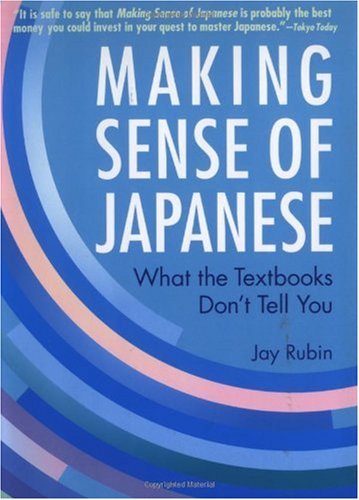
1. Making Sense of Japanese: What
$12.54
2. Drive Time: Japanese (CD): Learn
 
$21.01
3. Japanese: The Written Language
 
$12.95
4. Visual Japanese Verbs (Language
$14.79
5. Complete Japanese: The Basics
$14.72
6. Basic Japanese: Learn to Speak
$16.00
7. Japanese: The Spoken Language:
$8.69
8. Japanese Step by Step : An Innovative
$32.11
9. Teaching Chinese, Japanese, and
$49.01
10. Ultimate Japanese Beginner-Intermediate
$5.32
11. Easy Kana Workbook: Basic Practice
$10.04
12. Living Japanese, Revised (cd/book)
$11.00
13. Essential Kanji: 2,000 Basic Japanese
$3.00
14. The Everything Conversational
$3.95
15. Japanese: Lonely Planet Phrasebook
$13.00
16. Conversational Japanese: Learn
$29.99
17. Japanese, The Spoken Language:
$140.00
18. Japanese I - 3rd Ed.: Learn to
$6.16
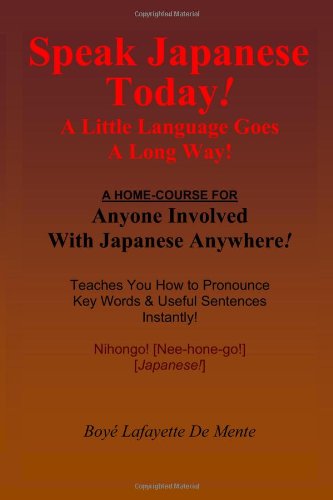
19. Speak Japanese Today: A Self-Study
$16.99
20. Learn Japanese Verbs and Adjectives

1. Making Sense of Japanese: What the Textbooks Don't Tell You (Power Japanese Series) (Kodansha's Children's Classics)
by Jay Rubin
Paperback: 144 Pages (2002-03-01)
list price: US$16.00 -- used & new: US$9.18
(price subject to change: see help)
Asin: 4770028024
Average Customer Review: 5.0 out of 5 stars
Canada | United Kingdom | Germany | France | Japan
Editorial Review

Book Description
Making Sense of Japanese is the fruit of one foolhardy American's thirty-year struggle to learn and teach the Language of the Infinite. Previously known as Gone Fishin', this book has brought Jay Rubin more feedback than any of his literary translations or scholarly tomes, "even if," he says,
"you discount the hate mail from spin-casters and the stray gill-netter."

To convey his conviction that "the Japanese language is not vague," Rubin has dared to explain how some of the most challenging Japanese grammatical forms work in terms of everyday English. Reached recently at a recuperative center in the hills north of Kyoto, Rubin declared, "I'm still pretty sure
that Japanese is not vague. Or at least, it's not as vague as it used to be. Probably."

The notorious "subjectless sentence" of Japanese comes under close scrutiny in Part One. A sentence can't be a sentence without a subject, so even in cases where the subject seems to be lost or hiding, the author provides the tools to help you find it. Some attention is paid as well to the rest of
the sentence, known technically to grammarians as "the rest of the sentence."

Part Two tackles a number of expressions that have baffled students of Japanese over the decades, and concludes with Rubin's patented technique of analyzing upside-down Japanese sentences right-side up, which, he claims, is "far more restful" than the traditional way, inside-out.

"The scholar," according to the great Japanese novelist Soseki Natsume, is "one who specializes in making the comprehensible incomprehensible." Despite his best scholarly efforts, Rubin seems to have done just the opposite.

Previously published in the Power Japanese series under the same title and originally as Gone Fishin' in the same series. ... Read more

Customer Reviews (16)

5-0 out of 5 stars Greasing the transition from intermediate to advanced...
This book is lots of fun. Rubin is witty, his turns of phrase are memorable, and overall the book will certainly put a smile on your face.

It's only useful once you've been studying Japanese for a couple of years, though.

Before then, it'll go over your head.

I mean, I can only wish for the day when figuring out the passive-causative is the biggest problem I have in Japanese. I bet this book will be all kinds of useful that day, but I'm sure not there yet.

5-0 out of 5 stars Good information and a good read
This book is exactly as advertised; complete, concise information about Japanese grammar.It really fills in the holes in my college Japanese textbook.The auther has a way with words, he had me laughing and remembering language structures I had been struggling with

5-0 out of 5 stars Such an awesome book for third-years
I've been studying Japanese for three years now and I've been hitting real walls to my understanding. Jay Rubin is awesome! I had the worst trouble understanding giving and receiving verbs, but he explains them in a way that I can finally understand. The same goes for his section on causatives and passives.
If you are an intermediate Japanese student, BUY THIS BOOK!!! I was blown away.

5-0 out of 5 stars The only one that...
I own numerous fantastic Japanese grammar reference volumes on Japanese (most of which are available through amazon.) All of them allude to the points that Rubin tackles in this deceivingly slender yet startlingly informative volume. Despite avid interest in grammar and having studied countless hours huddled over cup after cup of espresso, I had questions to which I could not seem to find adequate answers. That changed when I finally tracked down a copy of this book.

If it is credibility you're looking for, Jay Rubin has it: besides a position as a professor of Japanese at an ivy league, he is a famous translator whose works read like English rather than an attempt to superimpose foreign syntax upon each sentence. In other words, this is someone who is comfortable with Japanese and can explain it both as an expert and as one who at one time studied it in school (and struggled, as he explains briefly.)

As for content, the book is concise, funny (I laughed out loud a dozen times,) and incredibly helpful.The content is focused upon the greatest ills of English-speaking students of the Japanese language.The book begins with a fun introduction in which Rubin assaults the myth that Japanese is somehow vague or alien in comparison to other languages of the world. He begins by debunking the tale oft-perpetuated by well-meaning Japanese instructors. You know what I'm talking about: the subjectless sentence. In actuality, these are NOT subjectless anymore than an English sentence using a pronoun or demonstrative is subjectless. Rubin spends time warning the reader to re-evaluate his/her understanding of what it means to have a passive/intransitive verb versus one with an agent and helps to once and for all expell the confusion.

Next comes the reason I purchased the book: an explanation of WA versus GA. Certainly, one may go through years of study believing one's understanding of these particles is moving in the right direction, but Rubin separates them in a way this reviewer certainly has never been taught. Regardless of the mound of linguistic texts and the thousands of grammar drills that have turned my eyes bloodshot over the years, I have never found a single person/book/textbook that has been able to adequately explain which particle is grammatically correct given a specific linguistic environment.

The giving and receiving verbs, passives, causatives, causative-passives, multiple particles, and so on are all discussed in part one. Part two concerns specific problems, including TAME (its uses and distinction between the two), TUMORI (if you just said to yourself "that just means 'i intend...' I suggest checking out the book!), and so on.

It's an inexpensive title and it provides one with so much wonderful information. It's easily some of the best money I've ever spent on my education. I recommend it and could scarcely recommend it with more enthusiasm. I've purchased volumes heavier and much more expensive that have offered less in a half a thousand pages than this one does in far fewer.

5-0 out of 5 stars Buy this book
Ahh, the wonderful world of particles. Especially wa and ga. If you were confused as I was with the use of these two, fear not for this book will save you. Somebody finally took the time to thoroughly explain these in a perfectly clear fashion, and gives you a whole chapter on them no less.
I am so glad I found this book, the title doesn't lie. Everything is explained in an interesting and sometimes humorous way, and focuses on the topics that most English speakers struggle with while learning Japanese. I highly recommend this book, it will pay for itself 100 times over. ... Read more


2. Drive Time: Japanese (CD): Learn Japanese While You Drive (LL(R) All-Audio Courses)
by Living Language
Audio CD: 64 Pages (2006-05-16)
list price: US$21.95 -- used & new: US$12.54
(price subject to change: see help)
Asin: 1400021286
Average Customer Review: 4.0 out of 5 stars
Canada | United Kingdom | Germany | France | Japan
Editorial Review

Book Description
Now anyone can learn a foreign language while commuting to work, running errands, or even taking a trip with the family. The new all-audio Drive Time series starts with an ingenious “On-Ramp” CD that eases language learners into Spanish, French, Italian, German, or Japanese with simple, practical expressions and engaging warm-up exercises. Three additional CDs contain 18 lessons that cover all of the essentials—vocabulary, pronunciation, grammar, and basic conversation.

Drive Time also includes a 64-page reference guide for anyone who would like to see spellings or read dialogues as a review—from the passenger seat, of course! ... Read more

Customer Reviews (11)

5-0 out of 5 stars perfect for drivers
this is a perfect japanese learning tool for when you are in a car and a beginners. one of things that i like about it is, it repeats words all the time, it just make you memorize it even if you are in the next chapter. highly recommended!

4-0 out of 5 stars Excellent in the car
Basically hear and repeat.Best if you have had at least some intro to Japanese pronounciation.Occasionally reference to the book also helps, but you don't have to be looking at anything to do the drills.

3-0 out of 5 stars Fast and thorough
Coming from the Pimsleur method of learning Japanese, this audio course felt rushed, and I felt I couldn't absorb as much information.

The vocabulary words are shot at you 10-15 at a time, and there is little review before the next set of vocab, causing me to have to listen to each 1-minute-long "mile marker" over and over again.

This is to Pimsleur as trying to memorize a dictionary is to learning from a textbook.

It just doesn't seem prudent to listen to in the car because I find myself either listening to the 1-minute tracks on repeat until they sink in, or listen to a bunch at a time, and retaining nothing because the quizzing and recall flies by so quickly.

Also, the response time is extremely short. I can barely answer the question in English in that amount of time.

ALL THAT SAID, a strong vocabulary is necessary obviously, and I am eager to get to a level where this tape will be useful for me. For right now, I'm going to settle for the Pimsleur method of simple vocabulary, and focusing on grammar and sentence structure.

5-0 out of 5 stars decent intro to the language
Disc one is a very basic intro to Japanese sounds.The other three discs are more technical, covering a lot of grammar and a handful of vocabulary.If you want to learn Japanese and don't know anything about it yet, this is a great set to start with.

5-0 out of 5 stars Excellent course for beginners
This is an excellent beginners course for Japanese language.The title does not represent the real value of this package.Although it can stand alone as an independent course you need to combine it with another course with more in depth coverage of the Japanese grammar (Living Language courses are very good).The concept is excellent and I wish the authors could consider expanding this approach.The conversational part of this course is the real value to the student.You are not going to learn how to read or write Japanese using this course.That is a much more complex undertaking.Strongly recommend it to the business people trying to quickly build the basic communication skills in Japanese. ... Read more


3. Japanese: The Written Language (Japanese)
by Eleanor Harz Jorden
 Paperback: 256 Pages (1994-08)
list price: US$29.95 -- used & new: US$21.01
(price subject to change: see help)
Asin: 0887272037
Average Customer Review: 3.0 out of 5 stars
Canada | United Kingdom | Germany | France | Japan
Editorial Review

Book Description
This writing companion to the best-selling Japanese: The Spoken Language begins with the two kana syllabaries and introduces approximately 300 kanji, following the Spoken Language text lesson by lesson. It is appropriate for beginning and intermediate students in a college or self-study program. ... Read more

Customer Reviews (2)

1-0 out of 5 stars this book != fine wine
As in, it hasn't gotten better with age.

It says right on the cover that this is a field test edition. So perhaps I should forgive the spelling mistakes and instances of characters being used in samples sentences before they have been introduced.

And perhaps I should forgive the lack of an index. Forget how to write a certain character? Have fun thumbing thru the entire book trying to find it again.

Or how about the fact that the characters are shown, and then the stroke charts are pages away in a separate section at the end of the chapter? What a lovely idea!

And then my absolute favorite feature. Once you finally do get to the kanji, they don't give you all, or most, or even some of the readings. You get one. And there doesn't seem to be a pattern as to whether you get the ON or Kun reading. Nor does it tell you which of the readings you are getting, much less what ON and Kun readings are. If another reading is given, the same character will be brought back later in the book to introduce the new reading.

There is also precious little discussion of radicals, and the important part they play in understanding kanji.

If you have to buy this book for a class which uses it, and the equally odious JSL companion, hold your nose and dive right in. But you may soon finding yourself in need of a proper kanji dictionary as well. If you're thinking of picking this up for self study, look elsewhere.

5-0 out of 5 stars Good textbook for learning to write Japanese
This is an excellent book for the beginning student of Japanese. It takes you step-by-step, starting with katakana, then hiragana, and finally starts on kanji, beginning with some of the most common. There is second volume of this work, which introduces more kanji. Highly recommended. ... Read more


4. Visual Japanese Verbs (Language Express Cards) (Language Express Cards)
by Inc. Penton Overseas
 Ring-bound: 100 Pages (1993-06-01)
list price: US$12.95 -- used & new: US$12.95
(price subject to change: see help)
Asin: 1889950017
Average Customer Review: 4.5 out of 5 stars
Canada | United Kingdom | Germany | France | Japan
Editorial Review

Book Description
Visual Japanese Verbs are lightweight, durable flash cards thatcontain 100 basic Japanese verbs in a fully portable package. On thefront of each card is an illustration and the verb in English.On theback is the corresponding Japanese verb in 3 useful forms.

VisualJapanese Verbs are bound together by a small ring so cards can be addedor removed as needed.They have a tough, plastic cover on the frontand back so they can slip into your pocket or purse and go anywhere. Visual Japanese Verbs help you learn Japanese more effectively byturning wasted moments into study time. ... Read more

Customer Reviews (5)

4-0 out of 5 stars Not bad
Pro's:Everything you need to memorize Katakana and Hiragana at a great price, especially compared to all the alternatives; keyring; bookmarks.

Con's:Paper construction is not conducive to carrying in bookbag or pocket; needs to be laminated, made of plastic, or to come with hard carrying case.

5-0 out of 5 stars A great aid to begin learning a good slew of Japanese verbs
These Language Express Cards contain 105 different Japanese verbs on 105 numbered cards about 2" by 1.5".They have holes punched top and center and come on metal rings that can be opened to allow you to remove, shuffle or organize the cards as needed.On the front is a small cartoon image, and the English verb.On the rear is the Indicative, -masu, and -te forms of the verb with Kanji/katakana written underneath, and the card number (sometimes a negative form of the verb is thrown on as well).

Using these cards is convenient.Once learning these 105 verbs, you get the hang of basic Japanese verbs to allow you to approach conjugation and wider vocabulary studies in other books centered on broader rules of japanese verbs.

5-0 out of 5 stars Very impressive set of cards!
On the surface, this seemed like a cheap little set of flash cards to help me learn Japanese.When I got the cards I was amazed!They are hole-punched and on 2 easily opened keyrings.The set also included 2 bookmark cards.The cards show both translation and the pen stroke.They are even numbered so that you can shuffel them yet retain the original order!They thought of everything...A+A+A+

5-0 out of 5 stars I can't recommend these highly enough
if you are trying to study Japanese and you're not in Japan, you know that the odds are stacked against you - without hearing it constantly, and reading it everywhere, the learning process is much more arduous.Well, imagine having these little cards that you can carry ANYWHERE because they're so small and are conveniently bound together with a steel keyring!They even have durable plastic covers to keep the face and front cards from getting grungy.If you carry these cards around, glancing at them while waiting for a train, standing on line at the supermarket, or between commercials, I GUARANTEE you'll pick up three or four - at the bare minimum - vocabulary words every day.Let that sink in, then buy these cards while you can.Why couldn't the Tuttle kanji cards have been presented so neatly?

4-0 out of 5 stars Learning Kana with Cards
My first reaction when I saw the package was, "Can they be thatsmall?"Yes!They are small, and a full set of the 51 cards (each ofthe two alphabets contains 51 cards) fits nicely into my pocket without ahuge bulge or weight.In just three days, I've gotten half the harikanamemorized and expect that I will be done by the end of the week and readyto start on the next set.I love the convienience of having them alwaysthere, ready to use in those wasted minutes in lines and waiting rooms.

The characters on the cards are done in very nice calligraphy, whichdoesn't always match what you will find in printed material.The onlynegative comment is that the characters formed with the addition of dots orcircles (I don't remember the official name!) are lumped five to a card. Simple and easy to use, the ring allows you to re-order the cards so thatyou don't memorize the actual sequences.

I would recommend them to anyoneattempting to master these new alphabets. ... Read more


5. Complete Japanese: The Basics (CD) (LL(R) Complete Basic Courses)
by Living Language
Paperback: Pages (2005-07-12)
list price: US$24.95 -- used & new: US$14.79
(price subject to change: see help)
Asin: 1400021480
Average Customer Review: 4.0 out of 5 stars
Canada | United Kingdom | Germany | France | Japan
Editorial Review

Book Description
The top-selling Complete series has been fully revised, with all new supplemental material and a bonus wallet phrase card for travelers. Each program contains everything a beginner needs—a coursebook with 40 lessons, three hours of recordings on three CDs, a quick-reference learner’s dictionary, and an all-new indispensable wallet phrase card, all in a convenient and compact package.

The courses still use the popular and effective conversation building-block method, but all content has been thoroughly updated and now includes e-mail essentials and internet resources for each of the eight languages in the series. In addition, 18 supplemental vocabulary sections, covering such topics as “Family and Relationships,” “On the Job,” “Sports and Recreation,” and “Around Town,” are now included. As an added bonus, the new handy wallet phrase card with 300 essential words and phrases is the perfect reference for on-the-go learners, travelers, and businesspeople.

With a fresh look, great new features, and the same rock-solid approach to language learning, the best-selling Complete series is better than ever! ... Read more

Customer Reviews (4)

4-0 out of 5 stars Okay for certain uses
As a beginner of Japanese, I have found that this package is best as a grammatical reference.Most of the basics of Japanese grammar are very well outlined and explained in the booklet, and when I want to see how to form a particular sentence I can usually go to the booklet and find it easily.The material has been very helpful in this regard.

This set includes 3 audio CDs; however I did not find them particularly useful for a few reasons.First, the CDs only consist of Japanese sentences taken from the coursebook, with no English accompanying it, so you are hearing Japanese speech only with the idea that you will be using the book along with it.Also, Japanese pronunciation is generally pretty straightforward, so if you know how to read the Romaji system (the system in which Japanese words are written with English letters, and is not difficult at all to learn) it's easy to pronounce sentences correctly on your own.Now the first CD goes over pronunciation basics, and I found that part helpful, but after I learned that I didn't really need anything else on the CDs.

One drawback to this package is that, except for a small amount presented in the back, there is no Japanese kana writing accompanying the Romaji text in the material, either in the coursebook or the dictionary.Since this is a basic course I doubt the company wanted to include that.However if I want to learn to read and write the Japanese sentences presented I often have to look up the words separately in another dictionary.On the other hand, there is a chart in the back that teaches you how to write hiragana and katakana correctly, and this is a good reference if you are wanting to learn that.

So this is kind of a mixed bag, in actuality.I wouldn't recommend it as an audio resource, as I think there are probably more thorough ones out there.I think it would be a much better deal to purchase the coursebook separately (the Japanese Coursebook: Basic-Intermediate (LL(R) Complete Basic Courses)), which you can do, and a good dictionary, such as the Random House Japanese-English English-Japanese Dictionary.

3-0 out of 5 stars Good place to start...
When I was preparing to leave for Japan this was the first book I picked up to help with my language preparation.Imagine how surprised I was to find out when I got there and use some of the phrases on my new Japanese friends they said "Yes, we understand what you want to say but that's not what real Japanese people say."Later on in my study, my Japanese friend found the book, got a pen, and started changing the phrases around to suit a more natural style.
In short; this book is a good starting off point for learning Japanese but in no way should be considered modern or comprehensive.

IMPORTANT NOTE!If your are going to get this book, make sure you are getting the CD's too.Japanese in a language where the vowel sounds are totally different from English and a long vowel sound can totally change the meaning of a word. (EG.The words "hospital" and "hair salon" in Japanese have VERY similar pronunciation, you need to hear the words spoken it to produce it correctly.)

4-0 out of 5 stars Good book for beginners
I started this course book and cd collection and I really like it. Unlike most tutorials it starts off with the basics of grammer: understanding vowel and consonant pronounciation. Starts off with everyday words for each, very short lesson to show you how to pronounce all the vowels and consonants and then you listen to the CD after every lesson to hear exactly what you are reading.Just like learning our own native language it teaches everyday words first, just like we learned apple, Monday, dollar etc first and then sentences.It also explains syllabary.I've picked up many tutorials trying to learn Japanese and so far this has been the easiest to understand and relate to. It's not repition from a tape/CD it's actual learning how to understand and speak it.THEN you can go on to learning kana, kanji,writing etc.Some complaints I read is that it doesn't use the Japanese characters or real-world sentences and situations. Well this is like learning in elementary school. You learn letters, then the words, then the sentences and essays and so on. You don't just jump into writing long words and sentences when you don't even know how to read yet.My only complaint is that with this and all the tutorials is that it's difficult for me to hear some of the words so I have to keep playing back the entire lesson just to replay one word that I have trouble with (on a CD).

4-0 out of 5 stars Helpful but not perfect
I am in the process of studying Japanese to prepare for living in Tokyo next year. Learning Japanese through the Living Language series is helpful but also has some drawbacks. The biggest drawback is that the writers fail to include pronunciation helps in the text itself, however they do indeed provide native Japanese speakers to help in the accompanying three CDs. Also, they spend the first four or five lessons on various grammatical topics, which can actually be a little confusing when trying to learn a new language. Other language series jump into learning words and phrases by repetition, citing the fact that to really learn any new language you must practice repeating it over and over out loud and not worry at first about grammar and syntax. That being said, I will seek to finish the 40 lesson in this course and hope it better prepare me for my year that will be spend in Japan. ... Read more


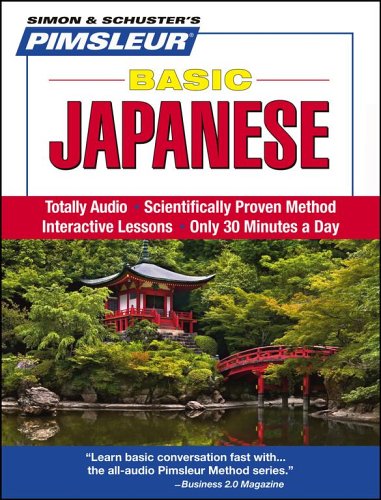
6. Basic Japanese: Learn to Speak and Understand Japanese with Pimsleur Language Programs (Simon & Schuster's)
by Pimsleur
Audio CD: Pages (2005-11-01)
list price: US$24.95 -- used & new: US$14.72
(price subject to change: see help)
Asin: 0743550722
Average Customer Review: 5.0 out of 5 stars
Canada | United Kingdom | Germany | France | Japan

Customer Reviews (14)

5-0 out of 5 stars Perfect for beginners!
I got the discs yesterday and listened to the first one last night. I can't believe how much I've already learned. I've always learned better with visuals so I was skeptical about learning with CDs and no book to follow but it hasn't been a problem.I can't wait to start disc 2 tonight. I've been practicing today what I learned from disc 1 and am thrilled that I remember it all.This program is both easy and fun and I highly recommend it to anyone that wants to give Japanese a try but doesn't want to invest too much money just yet.I'll be buying the next set in the series for sure!

5-0 out of 5 stars Great beginner book
I bought this for my 11-year-old who is obsessed with learning Japanese - and for that matter, becoming Japanese!He practices every day.The new lessons repeat items from previous lessons which helps to remember.My older son received a different book for Christmas from a friend studying linguistics.My son has listened to them both and said this book is better for the beginning student.I intend to stick with the Pimsleur Programs based on this positive experience.

5-0 out of 5 stars Japanese Language Course
The Pimsleur Japanese Course is top notch.This course enables a person to learn a new language without having to memorize alot of information that is soon forgotten. Thirty minutes a day is all it takes.From the first CD I was able to pick up Japanese very quickly.I would highly recommend this product to anyone wanting to learn a foreign language.

5-0 out of 5 stars Best Way to Learn Spoken Japanese Fast!
I went to Japan for 2 weeks this summer and the Pimsleur audio CDs were a life saver. I only got through 8 of the lessons before going, but they gave me the confidence to use between 10 and 20 phrases with ease while traveling in Japan. Most Japanese understand and even speak very functional English. Starting with at least one sentence in Japanese will encourage them to try much harder to work with you in English. Speaking a little Japanese is a must because, in Japan, the Kanji makes a Westerner essentially illiterate.

4-0 out of 5 stars Learn Japanese on your daily comute.
As a novice, I felt confident with sentence structure and pronounciation in just a few simple lessons.Each lesson builds on what you have learned in previous lessons and encourages you to develop your own sentences and phrases.I would have liked a printed guide with which to review what I have learned, as I am a visual learner.A great value. ... Read more


7. Japanese: The Spoken Language: Faculty Guide (Yale Language Series)
by Mari Noda
Paperback: 104 Pages (1998-05-25)
list price: US$16.00 -- used & new: US$16.00
(price subject to change: see help)
Asin: 0300075685
Average Customer Review: 3.0 out of 5 stars
Canada | United Kingdom | Germany | France | Japan
Editorial Review

Book Description
These audio cassette recordings are designed to accompany the Japanese: The Spoken Language textbook and include Drills, Core Conversations, and Eavesdropping Exercises. This revised edition contains 14 cassettes with built-in pauses for students to repeat after the model. Japanese: The Spoken Language textbook includes brief and natural core conversations, drills, and explanations of linguistic analysis and of how the language is used within Japanese society today. The core conversations cover situations in which foreigners typically find themselves interacting with Japanese. Hundreds of drills are presented in a response format, so that each exchange constitutes a mini-conversation. Instead of overwhelming students with the unfamiliar Japanese writing system, the authors intentionally use romaji, or alphabetized Japanese, throughout the texts so students can concentrate on developing their Japanese communication skills. ... Read more

Customer Reviews (56)

5-0 out of 5 stars Good in class, bad for self study
There are a lot of good reviews here and a lot of bad ones, but mainly there are a lot that are far too long to be helpful.If you're discovering JSL for the first time, here is the real story:

PEOPLE WHO SHOULD USE JSL: Linguists, smart people, adults, people in intensive language programs with good teachers

PEOPLE WHO SHOULD AVOID JSL: 13 year-olds, stupid people, anyone doing self-study, non-native speakers of English (unless you are very nerdy)

GOOD POINTS ABOUT JSL: good grammar explanations, pronunciation guides, written in formal academic English

BAD POINTS ABOUT JSL: limited vocabulary, no writing component, written in formal academic English

1-0 out of 5 stars worst.book.ever.
do not buy this book unless you absolutely have to for class.if you are learning japanese on your own, i highly recommend using the genki series for a beginner.i have studied japanese for 6 years and started using this book at my university (OSU) and it is beyond frustrating.any book that uses romaji beyond the first chapter is horrible.i understand that this is to be used with the written language book which i also use for class.even both books when used together with the language tapes come nowhere near the genki series, which combines written japanese with spoken japanese.
you will learn very little vocabulary with this book, the grammar explanations are overly complicated (one need not be a linguist to learn a language) and there is an intense emphasis on rote memorization of drills.
bad book.if you go to hell and there are japanese classes there, this is the text satan will use.

1-0 out of 5 stars Do not buy unless you absolutely have to.
My school (University of Maryland) uses this book as its primary Japanese text. It is, at best, pitiful.

Try learning modern Japanese and Japanese culture from a book whose latest revision was published 20 years ago. Just look inside and amongst the sparse vocabulary you'll find names of countries in Japanese; "Sovieto" stood out as the USSR has not existed for over a decade.

The speech and examples all focus on a very business atmosphere - you start out speaking the difficult formal language of Japanese, with extreme emphasis on politeness. Now, I don't know about you, but when I go to Japan I don't intend to be a shopkeeper nor work as a salaryman in an office. I would like to know those forms for completeness' sake, but I'd rather learn in the more natural style of casual speech that progresses to formal rather than the other way around. I've even heard stories of travelers to Japan who have been snubbed because they talk like a grandmother as a result of this book.

The book even seems a bit insulting to my intelligence at times: it will bring up structures to use and then withhold their explanation. The text claims to "analyze [the structures] in a later lesson," but does not say which lesson such that I might figure it out myself. I am, in this book's opinion, not just not ready, but too dumb to figure it out (which may be true, but if anyone's fault it's the book's poor explanation of simple topics).

The only enjoyment you will get out of this book is remembering really silly and awkward conversations, such as the one that involves two men looking at a girl's picture from a dating service. "Is she pretty?" One asks. "Well now... she's not very pretty, is she?" says the other. "How unfortunate," the first replies.

If you have the CD this will be even better, as the videos employ bad 80s acting and film quality. All Americans will be played by Japanese people, because real Americans who spoke Japanese weren't good enough for them. You'll get deliveries of dire warnings that U-turns may not be feasible, because they are so inherently dangerous, followed by a with a brilliantly anticlimactic smooth U-turn in an uncrowded street.

Please, if at all possible, do not buy this book. Get it from a library, borrow it from a friend, share it with someone - anything but pay money for it. I payed a scant 30 dollars and regret every penny.

5-0 out of 5 stars A very good book for people learning in a class
I highly recommend this book for people learning Japanese with a Japanese teacher, in a classroom, and with audio files. This is not a book for self-study, it can only be used for self-study after you have already started using it with a teacher and if you have the audio files. I think that the kunrei-shiki writing in the book is much better than the Hepburn translitteration, and I think that if you use this book with another book for kana and kanji, it will give you a good knowledge of the structure of Japanese, contrary to other books where you learn sentence patterns without understanding how they were created. The lessons are also well done, they always present real life situations, and the drills are a must. It lacks probably a bit of vocabulary, but you can learn more by simply buying a Japanese vocabulary book.

4-0 out of 5 stars great series for someone like me
I am someone who cannot take Japanese classes from the regular academic setting because of schedule conflicts.

My first Japanese class used "Japanese for busy people". I liked it very much but I could not find any other classes which would pick up from where I left off. My second class used JSL. After 2 months, the teacher moved out of state.

Well, then I moved too. I called all the Japanese teaching centers listed in Japanese advertisements, but could only find one private tutor who suited my schedule. Well, this teacher was trained in JSL but used her own materials. I had to quit after 32 sessions and then I was out of luck again.

After 3 different teachers with 3 different materials I was kind of fed up with always having to start from the beginning. I needed a series which I can easily find a trained teacher who can always start from where I left off last time.

JSL is my solution. The local unversity here uses JSL and produces enough JSL trained teachers. I hired one as my private tutor and started from L1 again. However, I feel so much more at ease becuase I know I can always find another teacher to continue in case this teacher can no longer teach me.

Now about the series:
With a great tutor this series is excellent. I bought everything that goes with it: the CD-ROM, the questsion and answer supplement (really helpful for grammar), the typescript (very helpful to know how each word looks like in real life), as well as JWL and its workbook. The romanization was kind of hard at the beginning but I'm used to it and really like the way the pronounciation is marked. It really helps me to have very accurate Japanese Tokyo accent.

This series is going to help me build a solid foundation in pronounciation, grammar, and writing. After finishing it with the help of my tutor, I think I'll be able to self-teach later on.
... Read more


8. Japanese Step by Step : An Innovative Approach to Speaking and Reading Japanese
by Gene Nishi
Paperback: 256 Pages (2001-04-17)
list price: US$16.95 -- used & new: US$8.69
(price subject to change: see help)
Asin: 0658014900
Average Customer Review: 4.0 out of 5 stars
Canada | United Kingdom | Germany | France | Japan
Editorial Review

Book Description

This self-study text offers a breakthrough approach for beginning learners of Japanese, as well as an indispensable reference for intermediate students. The unique study method in Japanese Step By Step teaches how to construct Japanese sentences, from the simplest to the most complex, using an easy-to-follow, step-by-step method. Also contains flow charts for verb conjugations and derivations.

... Read more

Customer Reviews (40)

5-0 out of 5 stars Best Book
This is the best book for learning Japanese on your own, that I have bought.It is as good or better than most textbooks that I have read.
There are lots of examples and vocab as well as grammer.Only complaint is that the book uses different size letters to teach you the correct pitch for each word, but it is nothing you can't get used to.

4-0 out of 5 stars Great for beginners
This book was also a pretty good add to my collection. Although I found some parts of the book to be rather dry and somewhat boring, I feel that this it would prove to be a rather excellent tool for beginners.

3-0 out of 5 stars The book is all right, I don't
Well, I think that if you are a computer engenier you will learn Japanese in no time with such a book.
I was completely lost with the do-re lullabies in order to get the proper tone when I say bridge or chopsticks in Japanese, and then I find awful to encourage people to use kanji, when the book itself has most of the examples in romaji.
I think the author should anyway have to show the stroke order, but that is superfluos for Ibm professionals, perhaps.
An interesting experience, anyway

4-0 out of 5 stars Awesome Book, But a Few Quirks
This book is overall a great book and covers all of the areas that you will ever need in learning Japanese grammar. I am very happy with it, but it may not be for some people, because it has an odd way of presenting the material.

The verbs are given in a long list of five to six pages. In fact, there are many lists of random vocab (no nouns), and you will find most of these at the beginning, so if you do indeed wish to read the book to learn Japanese "step by step" you will have to wade through lots of vocab before you get the real grammar. Otherwise, You will have to find a way to review it and organize the learning process yourself, because this book presents it in such a way that it would be silly to go in order.

There are plenty of examples that illustrate every concept, along with kanji. However, this is another quirk. The use of kanji is not consistent. Kanji only appears in the examples (and the section on kanji) and is relatively non-existent other wise. There are many tables and lists of words that have no kanji at all. This is frustrating, because I find the kanji very helpful when remembering the word, and I have to look most of it up myself.

The portions that are written in romaji use an odd style to inform you of the tones. Capital letters and underlining are supposed to show you how you should increase the pitch, and this will easily through you in to accenting the capital letters instead of raising the pitch which is not terribly important in the first place.

All that said, this is the best book I've found that touches on all of the points you will need to know. I recommend it for those who have studied Japanese before, but are still looking for a concrete method to go by. Beginners should probably read something else first and late intermediate will probably not find this book necessary unless as a reference.

4/5

5-0 out of 5 stars useful supplement: cheap, relevant, organized
I used this book in the very beginning of my Nihongo self study 8 months ago. The 1st pass through the text was difficult --- the kanji gave me nightmares :) So I put it aside and learned 500+ kanji (definitions in English and some readings) then picked this up again from the library and it was a lot more helpful the 2nd time around! It's fairly well organized and if you copy the sentences by hand ... the grammar and kanji do stick. However I didnt like how the romaji was presented (strange capitalization). Ive spent 100s of dollars on Japanese texts from Amazon, Kinokuniya and Cheng Tsui and this is 1 of the better deals out there.


... Read more


9. Teaching Chinese, Japanese, and Korean Heritage Language Students: Curriculum Needs, Materials, and Assessment (Esl & Applied Linguistics Professional)
Paperback: 368 Pages (2007-08-29)
list price: US$35.00 -- used & new: US$32.11
(price subject to change: see help)
Asin: 0805858784
Canada | United Kingdom | Germany | France | Japan
Editorial Review

Book Description
This book contributes to building the research knowledge that language teaching professionals need in developing curriculum for the large population of East Asian heritage students (including Chinese, Japanese, and Korean) in countries like the United States, Canada, and Australia, where speakers of East Asian languages are among the fastest growing populations. Heritage learners are defined as those who initially acquired certain levels of linguistic and cultural competence in a non-dominant language mainly through interaction with foreign-born parents and other family members at home. Heritage language instruction is currently a hot topic and is becoming a sub-discipline within the fields of foreign language education and applied linguistics. Special instruction for heritage language learners is on the rise, particularly in the U.S. and Canada. Providing theoretical and practical information about heritage-language instruction in terms of curriculum design, learner needs, materials development, and assessment procedures, the goal of this book is not only to promote research about heritage students in East Asian languages but also to improve the teaching of these students in various educational settings and all over the world, especially in English speaking countries. Teaching Chinese, Japanese, and Korean Heritage Language Students is intended as a primary text or reference for researchers, educators, and students in the areas of curriculum, pedagogy, and assessment studies related to teaching bilingual and heritage students in general and East Asian heritage students in particular. ... Read more


10. Ultimate Japanese Beginner-Intermediate (CD/Book) (LL(R) Ultimate Basic-Intermed)
by Living Language
Paperback: 528 Pages (2004-09-21)
list price: US$79.95 -- used & new: US$49.01
(price subject to change: see help)
Asin: 1400021138
Average Customer Review: 4.5 out of 5 stars
Canada | United Kingdom | Germany | France | Japan
Editorial Review

Book Description
Ultimate Japanese has everything you need to learn Japanese from scratch or to revive the Japanese that you learned years ago. This course combines conversation and culture in an easy-to-follow, enjoyable, and effective format. It's the perfect way to learn Japanese for school, travel, work, or personal enrichment.

Ultimate Japanese Beginner-Intermediate includes:

•40 lessons in a comprehensive 416-page textbook:

Each lesson contains a lively and authentic dialogue, vocabulary, grammar and usage, step-by-step character writing, cultural highlights, and plenty of practice. The first ten lessons also include special pronunciation sections that will have you speaking right from the beginning. The book also contains review sections, readings, supplemental vocabulary sections, appendixes on essential Japanese grammar, and a Japanese-English/English-Japanese glossary.

•8 hours of recordings with an ingenious two-step approach:

Learn at home: Listen to the first set of recordings as you follow along in your textbook. Immerse yourself in Japanese while you listen and repeat with the all-Japanese recordings, and learn conversation, grammar, vocabulary, and more

Learn on the go: Then practice, review, and expand upon what you’ve learned with the second set of recordings. An instructor will guide you through each lesson, and since no reading is required, you can listen in the car, on the train, at the gym…anywhere! ... Read more

Customer Reviews (6)

5-0 out of 5 stars Wow!
I just received this today and I can tell you I am very impressed. It is a lot more than I thought it would be. The book is about the size of a standard book, and 500 pages long. From the first lesson there are very good grammar lessons, vocabulary words, and dialog. This is my fifth foreign language, and I can tell you this course will be very useful for learning Japanese up to an intermediate to advanced level, depending on your level of effort. I have become fairly fluent before with much less to go by. I am very impressed, amazed really, at what I got for fifty dollars. Some have said the female voices are infantile, and not spoken by Japanese natives. I listened to part of the first disc so far and the male and female speakers sounded just like the natives I have heard in countless movies and on the streets of Seattle. Both sexes had normal sounding voices also. I don't know if all of the discs are the same, but it sounds perfectly normal so far. This is an amazing set for fifty dollars. It looks much better than the other sets I have seen. If you want interactive computer programs go with Rosetta Stone for a small fortune. If you want a book with CD's, this is the best one I have found.

4-0 out of 5 stars Very Good for Beginner-Intermediate Learners
I am admittedly new to learning Japanese (but not, however, new to foreign language study), and these may be caveats to readers of this review.
I have found this book to be very enlightening, and see that a lot of thought and effort have been put into making it.Its forty lessons, eight reviews, and 5 readings provide a wealth of material in considerable breadth and depth, and it presents the student with plenty of Japanese in a methodical, progressive teaching method.Both kana syllabaries are taught, as well as 174 kanji.There is even an interesting article near the end of each article presenting a little bit about Japanese culture.
This is not a college freshman Japanese textbook, and so it goes less into language theory and so forth than that to which college or university students may be accustomed.If there were more I would wish for, it would be more drill.A workbook may have been a good companion for this book.
I mistakenly ordered the text only (and had to order cassettes separately), and would recommend that more serious students considering purchasing this that they get the book and cassettes as a package.
It's a quality book.For as much as it has to offer, considering the reasonableness of its price, I think few who are interested in Japanese language and culture would be disappointed with it.
(From this onward is an amendment of my previous comments):
I still stand by what I wrote above.I may have neglected to note that I am studying Japanese independently, i.e., through self-study.With that qualification having been made, I point out that I have become marginally more aware of Japanese and its usage, nuances, etc., and thus would point out that the author seems to focus on colloquial spoken Japanese, as opposed to written form.I have no vested interest in selling this book, but I still have zero regrets for having purchased it.I hope those interested in Japanese find this review helpful.

4-0 out of 5 stars good course, if you can stomach the baby talk on the CDs
While the course book is well organized and comprehensive (although you will need your own dictionary.The Living Language books have terrible glossaries which do not even contain all of the words from the vocabulary lists), it is very difficult to get past the ridiculously childish, affected way in which the narrators--particularly the women--speak. You will not hear and adult woman's voice except in lesson 30.All the others sound as if they are breathing helium and talking to you as if you were in a nursery.

Japan is notorious for the infantile "women's speech," but not all Japanese women behave this way.I have lived there and speak from experience.

The narration on courses produced in Japan, such as Kodansha's "Japanese For Busy People" or Gakken's "Japanese For Today" are far more natural and actually sound like mature adults.

5-0 out of 5 stars Great way to learn a language
This CD/Book was a Christmas present for my son. He really loves the CDs and the book. He says the book is very helpful and especially likes the chapter reveiws that are in the book. The CDs help perfect your accent and also help to get your ear used to hearing the language. Was well woth the price.

4-0 out of 5 stars Wonderful!
The format of the book teaches not only words, but sentence structure, formal/informal word usage and the culture behind the Japanese language. The CD's and exercise allow you apply the knowledge you just learned. ... Read more


11. Easy Kana Workbook: Basic Practice in Hiragana and Katakana for Japanese Language Students (Language - Japanese)
by Rita Lampkin
Paperback: 104 Pages (1990-07-30)
list price: US$9.95 -- used & new: US$5.32
(price subject to change: see help)
Asin: 0844285323
Average Customer Review: 5.0 out of 5 stars
Canada | United Kingdom | Germany | France | Japan

Customer Reviews (5)

5-0 out of 5 stars Excellent Workbook.
Simply put, if you get this book and work through it, you will learn Kana.

I'm a busy guy and have had the book for a little over a month. I learned hiragana and am halfway through katakana. No flash cards neccesary, just write the characters over and over.

The reading exercises are especially excellent and will have your eyes tuned to reading speedily in no time.

A+.

5-0 out of 5 stars Excellent way to learn hiragana and katakana
Primarily, this book teaches the proper way to write hiragana and katakana.It excels at this because it gets you to practice, practice, practice and practice some more. Personally, I made photocopies of all the practice pages so I could more easily practice.

Secondarily, it covers basic pronunciation, reading, and writing sentances.Just the basics, concepts are explained simply and it provides a good platform for further study.I'm certain the authors intended readers to study other books for these skills.

Its one minor drawback is not including info on why machine-made characters sometimes look significantly different than hand-written characters.

5-0 out of 5 stars Excellent Book :)!
This is a great book! Many people who learn the Kana. Think that once they memorize all the characters. They can fully read the Kana. Which is wrong!!!! This is why I love this book. It teaches kana grammar with kana writing, and has plenty of exerices.So by the end of the book you won't forget anything. I really recommend this book to anyone wanting to learn kana.
I never thought I could read and write kana, until I bought this book. Now it's off to kanji :(.

Also, don't be afraid of kana grammar. It is 100 times easier than english grammar.

5-0 out of 5 stars Good for self-paced course or in a classroom
This is a practical and useful workbook that teaches the hiragana and katakana characters.It uses a combination of learning by rote practice in tandem with self-test examples.The self-test examples have good variety and range from writing down sentences in kana to correcting sentences that have deliberate errors in them.I found the book's approach of practicing the kana along with reinforcement of what I learned to be an effective one-two combination.It helped me avoid that dreaded "I did it and then promptly forgot what I did" syndrome that some language students tend to have.I am glad that the authors recognized this.Of course, the authors have experience in teaching and their practical experience was reflected in the design of the book.

The book does have effective physical design.The lessons conveniently fit on each page and have enough space on them for you to write down the kana exercises.Each page can be easily photocopied onto another regular-size paper for repeated practice so that you don't damage the original book's pages.Each lesson also fits nicely on each side of a page so that you don't get a example that fits halfway on one side and continues on the other side of a page.That is very thoughtful of the authors.

Importantly, the book starts out by teaching hiragana as it is the most important of the two kana.I've seen other books start with the katakana simply because it had fewer brush strokes.I think that is a mistake.The brush stroke order is prominently shown on each rote lesson page which is a plus as it makes each lesson page self-contained and useful to practice if you are on a bus, in the library, or elsewhere so that you only need the individual sheets you are practicing with (no need for the rest of the book to serve as reference material).

If not for the additional thoughtfulness of the authors in providing an effective physical design of the book so that you can use it in versatile approaches, I would award FOUR stars.

4-0 out of 5 stars Does the Buisiness
Methodically works through all the charachters. good writing guide. if followed through, you will be able to read and write in hirigana and katakana, quickly and painlessly. includes translations of text. ... Read more


12. Living Japanese, Revised (cd/book) (Living Language)
by Hiroko Storm
Paperback: Pages (1993-04-06)
list price: US$30.00 -- used & new: US$10.04
(price subject to change: see help)
Asin: 0517590654
Canada | United Kingdom | Germany | France | Japan
Editorial Review

Book Description
Revised and updated best-sellers since 1946, the complete Living Language Basic Courses have been revised, updated, and expanded for the '90s. Package includes 3 hours of instruction on cassette or CD; conversation manual, and revised dictionary. ... Read more


13. Essential Kanji: 2,000 Basic Japanese Characters Systematically Arranged For Learning And Reference
by P. G. O'Neill
Paperback: 328 Pages (1987-11-01)
list price: US$19.95 -- used & new: US$11.00
(price subject to change: see help)
Asin: 0834802228
Average Customer Review: 4.0 out of 5 stars
Canada | United Kingdom | Germany | France | Japan
Editorial Review

Book Description
Essential Kanji is an integrated course for learning to read and write the 2,000 basic Japanese characters. It introduces the kanji that are now in everyday use, a mastery of which makes it possible to read most modern Japanese. Devised for either home or classroom use, the book has been tested and refined by years of use in university classes taught by the author. ... Read more

Customer Reviews (45)

5-0 out of 5 stars Excellent for moderate level learns
Before I purchased this book I was pretty well into the Japanese language. That being said, I think that people at the beginning level should make sure that they're, at the very least, up to par on their vocabulary before purchasing this book (let alone delving into any type of kanji based text). Also, make sure that you're able to use and understand hiragana and katakana. Once you're comfortable with your skills and knowledge of the Japanese language (perhaps on a moderate level), then you should most definitely try to get your hands on this. It's very easy to follow, gives you a break down on both the Japanese and Chinese pronunciation for each character, and also gives you several examples on how each character is used in conjunction with others. I loved this book and I am very glad that I purchased it.

4-0 out of 5 stars So far, so good!
I have many Kanji & Kana books. Some of them have type so small that I cannot really see the stroke order. Sometimes, the books do not even display stroke orders; and it is frustrating. This book gives a big picture of the characters, with stroke order, tells the meaning of the character, and so on. It is a pretty complete guide. I trust it, so far; and it has really helped me. However, it is not a beginner-friendly guide. I started my Kanji & Kana with "Making out in Japanese" and Rosetta Stone. Those conduits were much more beginner-friendly. This book pretty well assumes that you have the basics down. Overall, if you are really trying to delve into your Kanji, it is an invaluable reference.

5-0 out of 5 stars Wonderful!
Great resource if you are learning your "letters".Stroke guide included.Clear illustrations.

5-0 out of 5 stars Great book
This is really useful book - I don't know how could I lived without it.

3-0 out of 5 stars Excellent Beginner's Kanji Reference
I have had this book for 13 years. It is an excellent first kanji book. For mastery of the kanji, use this book first and then go into a detailed kanji book as you gain more confidence.

Excellent first book. ... Read more


14. The Everything Conversational Japanese Book: Basic Instruction For Speaking This Fascinating Language In Any Setting (Everything: Language and Literature)
by Molly Hakes
Paperback: 321 Pages (2004-12-31)
list price: US$19.95 -- used & new: US$3.00
(price subject to change: see help)
Asin: 1593371470
Canada | United Kingdom | Germany | France | Japan
Editorial Review

Book Description
With the globalization of business and the advancement of international trade, learning a foreign language is quickly becoming more and more essential for advancement in today's world. The Everything Conversational Japanese Book, with a companion CD, teaches you how to master one of the most predominant languages in business and secure you an unparalleled edge in the job market.

Understanding cultural references, learning correct pronunciation, and giving an effective introduction are all a cinch with this all-inclusive guide. Featuring exercises and quizzes at the end of each chapter, The Everything Conversational Japanese Book prepares you for any situation and enables you to carry on a basic conversation in very little time.

The Everything Conversational Japanese Book helps you:

  • Use appropriate tone
  • Master vocabulary
  • Communicate in a business or casual setting
  • Respond effectively
  • Understand and appreciate Japanese culture

    Whether you're just visiting Japan or wish to further your career opportunities by learning another language, The Everything Conversational Japanese Book and companion CD is your jumpstart to speaking Japanese quickly and with confidence. ... Read more


  • 15. Japanese: Lonely Planet Phrasebook
    by Yoshi Abe, Lonely Planet Phrasebooks
    Paperback: 255 Pages (2004-09-15)
    list price: US$7.99 -- used & new: US$3.95
    (price subject to change: see help)
    Asin: 1740591631
    Average Customer Review: 4.0 out of 5 stars
    Canada | United Kingdom | Germany | France | Japan
    Editorial Review

    Book Description
    Order the freshest fugu, survive a karaoke session and know how deep to bow.Go beyond the shrines, sushi and subway and discover Japan through its language and people. ... Read more

    Customer Reviews (11)

    4-0 out of 5 stars Great for travel
    This book was invaluable to us in Japan. The size made it easy to carry around and it had all of the basic words and phrases that we needed to communicate. (We did supplement with a English-Japanese dictionary for some words, so that's why I've given it 4 stars instead of 5.)

    The English was spelled out to make it easier to pronounce the Japanese words. In cases when I butchered the pronounciation and was not understood, I could show the book to someone who would read the Kanji symbols to see what I was trying to say.

    The book was organized in a way that made it easy to find the phrase you were looking for. I bookmarked frequently used pages so I could access them even quicker. This was definitely a great reference for traveling to Japan.

    4-0 out of 5 stars Very good in the beginning, but after that, it's ok
    Just like I said. The first part of this phrasebook helps you understand grammar, small phrases, and many words, but after that it just tells you a lot of the things like sentences and more questions and answers.

    I recommend this if you are travelling, but if you are just trying to learn the language, I would not recommend it because it's hard to remember all of the questions, answers, and phrases it contains from about the 1/4 to the end of the book.

    But it was really good in explaining grammar, pronouns, and many other things. So buy it if you want.

    5-0 out of 5 stars I was able to communicate!!!
    I feel this book is not only usefull for comunication with other people during my travel but also very well prepare to be user friendly. It was exellent in my trip to Japan have it with me.

    4-0 out of 5 stars A must buy
    I found this very easy to understand, as did my husband who had no prior knowledge of the Japanese language. I read it many times before our trip, in order to remember important basic words.
    We referred to it many times during our trip, and it was very usefull. I would suggest everyone purchase it.
    Its small size is also great, easy to put in a pocket, backpack or handbag.

    3-0 out of 5 stars Useful inspite of itself.
    I bought this on my first flight back from Japan after taking my first semester in Japanese.I thought that it supplied a ton of useful auxillary vocabulary to run with at the level of grammar I was capable of using.The book also has many slight mistakes, even I, a first year student, was able to pick out.It's got a few cute but dumb, potentially racist but we'll say ignorant drawings included.But so few that it cues one in as to how cheaply produced this probably was.I give it three stars though because I learned it forward and backward and broke it out numerous times to meet my needs in bars and train stations (never in restaurants for some reasons).And, to get me comic leverage in many conversations where I was not privy to the Japanese side of the chatter. ... Read more


    16. Conversational Japanese: Learn to Speak and Understand Japanese with Pimsleur Language Programs (Simon & Schuster's Pimsleur)
    by Pimsleur
    Audio CD: Pages (2005-12-05)
    list price: US$49.95 -- used & new: US$13.00
    (price subject to change: see help)
    Asin: 0743550463
    Average Customer Review: 4.5 out of 5 stars
    Canada | United Kingdom | Germany | France | Japan
    Editorial Review

    Book Description
    This Conversational program contains 8 hours of interactive audio-only instruction, effective language learning with real-life spoken practice sessions.

    HEAR IT, LEARN IT, SPEAK IT

    What is the Pimsleur® difference?

    The Pimsleur Method provides the most effective language-learning program ever developed. The Pimsleur Method gives you quick command of Japanese structure without tedious drills. Learning to speak Japanese can actually be enjoyable and rewarding.

    The key reason most people struggle with new languages is that they aren't given proper instruction, only bits and pieces of a language. Other language programs sell only these pieces -- dictionaries; grammar books and instructions; lists of hundreds or thousands words and definitions; audios containing useless drills. They leave it to you to assemble these pieces as you try to speak. Pimsleur enables you to spend your time learning to speak the language rather than just studying its parts.

    When you were learning English, could you speak before you knew how to conjugate verbs? Of course you could. That learning process is what Pimsleur replicates. Pimsleur presents the whole language as one integrated piece so you can succeed.

    With Pimsleur you get:

    • Grammar and vocabulary taught together in everyday conversation,
    • Interactive audio-only instruction that teaches spoken language organically,
    • The flexibility to learn anytime, anywhere,
    • 30-minute lessons designed to optimize the amount of language you can learn in one sitting.

    Millions of people have used Pimsleur to gain real conversational skills in new languages quickly and easily, wherever and whenever -- without textbooks, written exercises, or drills.

    Conversational Japanese includes the 10 lessons from Pimsleur's Basic Japanese plus an additional 6 lessons.

    The 16 lessons in Conversational Japanese are the same first 16 lessons in the Pimsleur Comprehensive Japanese Level 1.

    ... Read more

    Customer Reviews (14)

    5-0 out of 5 stars christmas present
    Purchased this product for a christmas present for our daughter.She has tried different books and such trying to learn Japanese.Within the first hour of listening she has already mastered a few sentacnes.I would highly recomend this product to anyone who is interested in learning it.

    1-0 out of 5 stars Defective Pimsleur Conversational Japanese CDs
    DO NOT BUY THIS PRODUCT-IT IS DEFECTIVE.It is a set of 8 CDs, each of which contains two language lessons.Lesson 14 on CD 7 of the set was defective; specifically, the last 2-3 minutes of the lesson would not play properly (it skipped, popped, and was generally unintelligible).Per Amazon's recommendation, I first called Pimsleur directly and spoke with a customer service rep, who would not replace the CD without charging me a $20 shipping fee--not acceptable, since the CD was defective.I then called Amazon and spoke with a customer service rep, who sent me a replacement set free of charge, but lesson 14 on CD 7 of the second set was also defective.Since this appears to be a problem with an entire run of this product, I do not recommend buying it.

    5-0 out of 5 stars worth it
    The best part about these CD's is that there is no pressure- just follow along and it is amazing how much you will learn. It's not automatic but it is pretty fun.

    5-0 out of 5 stars Great for under $35
    I picked it up for $23 with shipping and handling but still good under $35.I picked up the Russian, Italian, Spanish, and Brazilian Portuguese in the store years ago for $50 a piece.Cool to see the price is down here at amazon.I picked up nice greetings and casual conversation in about a week.I listen to it when I walk each day and it is nice as my skills grow in a nice easy manner without the need of a book.Great job Pimsleur.

    4-0 out of 5 stars Good but could be better
    I tried this system first for Russian, and I was surprised it was pretty effective because I'm not a particularly aural person. But I did find that tracking down transliterations of the language (in this case Japanese) made it a lot easier to figure out what was actually being said. So the "better" part would be to provide those transliterations in a workbook. ... Read more


    17. Japanese, The Spoken Language: Part 3 (Yale Language Series)
    by Eleanor Harz Jorden
    Paperback: 416 Pages (1990-09-10)
    list price: US$34.00 -- used & new: US$29.99
    (price subject to change: see help)
    Asin: 0300041918
    Average Customer Review: 4.0 out of 5 stars
    Canada | United Kingdom | Germany | France | Japan

    Customer Reviews (6)

    3-0 out of 5 stars Pros and Cons
    Pros: Good grammatical structure, and just enough vocabulary necessary for a beginner to learn japanese. The book starts with a conversation in Romaji, then the translations, including vocabularies that must be memorized. The onversation is thouroughly explained later. Sentence structures and grammar lessons, and drills comes afterwards.
    Cons: Too much unecessary information about the conversations sometimes, and... the vacbularies and book itself could be more organized. Overall, I give it a 3, or a four.

    4-0 out of 5 stars Great tool for understanding the logic behind the language, however...
    As a student taking Japanese in a well-known University that uses the JSL series in its Spoken Language track, this book has become my CRUCH in speaking Japanese. It uses conversations as models to learn from, drills to teach you ways to utilize your new vocabulary and grammar tools, a listening section and translation section (unfortunately without an answer key). The most helpful aspect of the book though are the in-depth grammar explanations; they really help you internalize the meanings and usages of honorifics, conjugations, special words and compounds, speech styles (careful/casual, direct/distal, gentle/blunt...) and so forth. The idea is to help you learn to create these sentences yourself, to the point where it seems natural (although this ideal cannot be achieved without an extended stay in Japan), or at least to the point where you will know the right thing to say in certain social contexts.

    While the grammar explanations are stellar and offer students a chance to construct new sentences through logic (a very linguistical approach to language-learning), I have found some problems with the series:

    1) It's all in romaaji. Let's face it. When you go to Japan, almost everything will be in evil but beautiful scribbles called 'kanji' -- even with JWL - the written language accompaniment - you won't even have the reading capability of a 1st grader.

    2) You NEED a GOOD teacher to help you through the series. I did the entire third book myself (by far the most difficult) and I didn't learn it nearly as well as I learned the previous lessons.

    3) The slow but exponential learning curve. Things won't "click" until you're more than half-way through the series. There are 30 lessons and around lesson 19 I was able to start constructing complex thoughts in a managable time-frame. However, after that I could start to have basic conversations pertaining to everyday life.

    4) This series was originally written for DIPLOMATS during Japan's bubble-economy era, and it really shows. You learn American Consulate in Lesson 7 and air in Lesson 30. Subsequently, you're language will be EXTREMELY formal and stiff compared to today's standards, but it's better to be polite than rude, right? Moreover, slight problem, a few words here and there are outdated (ie Monbusho should be Monbukagakusho, or Monkasho for short).

    5) Although the grammar explanations are great, you will probably need a tool to fully understand it... I suggest google-ing Tae Kim's Japanese page. Amazing.

    In response to the 'huji' review: Jorden has a very good reason for changing a couple spellings for consistency's sake. It will limit the number of exceptions to the already-overloaded conjugation rules. Just deal with it. English has 37 vowel sounds and only 5 vowels!

    Conclusion:
    If you're learning this in a class-setting, I say go for it, but still make sure that you're getting a good bit of writing in on your own; luckily, there's a writing portion added to our class. If you're attempting to learn the language alone (um good luck!) you should use a WIDE VARIETY of sources. No single textbook will be your cure-all. Furthermore, make sure you have good listening materials: JSL can provide that. In finishing the third book of this series alone, I have found it useful to do all the drills and use other textbooks to help me. This includes Miura's 'An Integrated Approach to Intermediate Japanese' and 'Breaking into Japanese Literature' by Giles Murray. In addition, it wouldn't hurt to have a good kanji dictionary (I suggest 'Kanji Learner's Dictionary' by Jack Halpern).

    Finally, I hope I have been fair in my review of this book, and more so, I hope that this helped!

    ganbatte kudasai!

    4-0 out of 5 stars doumo
    Such a simple little word "doumo". Yet when I came to Japan 13 and a bit years ago it started to bug me. Why? Well becasue I knew that it meant "thank you"- everyone knows that right?

    But the strange thing was that as my ears became more attuned to what people around me were saying, I realized that they were using "doumo" in sometimes very strange ways. When they greeted one another or parted for example. So I thought- well maybe they just use "thank-you" somewhat more broadly than we do in English. But then you hear things like "doumo henn" and "doumo omoshiroi". What on Earth is that all about? So I went to the bookshops and checked every Japanese text I could find and all agreed that "doumo" means thank-you. Seems everyone knew that except for the Japanese.

    Some time later I chanced upon a copy of JSL and, never having seen it before, looked to see what it had to say about "doumo". Lo and behold- there it was. A simple account that explained all the seemingly disconected uses of "doumo" that I had heard.

    The series provides plenty of other similarly insightful accounts of Japanese usage that assist with the process of learning to manipulate the language at a fine-grained level.

    It gets four stars instead of 5 as there is a lack of practice with extended sequences and the recording quality of the tapes is poor.

    3-0 out of 5 stars Okay but not great
    At this level of study not having kana and kanji is an absurd blunder.The only way to get the non-romanized versions of the text is to buy a very ugly teacher's edition of the core conversations and drills, whichthemselves become a bit too much like brute memorization here.

    This bookis great for polishing your knowledge and tiny grammar subtleties, butsomething extra is needed in order to prepare yourself for making your ownsentances, not ones you memorize from a book.(This could be provided bysay, a teacher)

    So in this sense, a book more geared towardsself-learning and adaptation would be the second half of the Yookososeries, Yookoso: A Continuation of Contemporary Japanese.This book isJSL2,3 and JWL2+more combined into one.

    5-0 out of 5 stars Superior conclusion of 3-volume text series.