e99 Online Shopping Mall

Geometry.Net - the online learning center Help  
Home  - Basic M - Macedonia History (Books)

  Back | 21-40 of 100 | Next 20
A  B  C  D  E  F  G  H  I  J  K  L  M  N  O  P  Q  R  S  T  U  V  W  X  Y  Z  

click price to see details     click image to enlarge     click link to go to the store

 
21. GREEK LANDS IN HISTORY: MACEDONIA:
$27.64
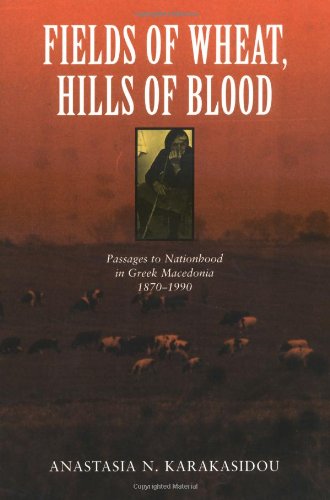
22. Fields of Wheat, Hills of Blood:
 
$192.46
23. Macedonia and Greece in Late Classical
$14.95
24. Macedonia to America and Back
 
$5.95
25. Social cleavages and national
$16.99
26. Macedonia: The Politics of Identity
$16.75
27. The Past in Question: Modern Macedonia
 
28. Rise of the Macedonian Empire
 
$59.99
29. The Miracle That Was Macedonia
$64.50
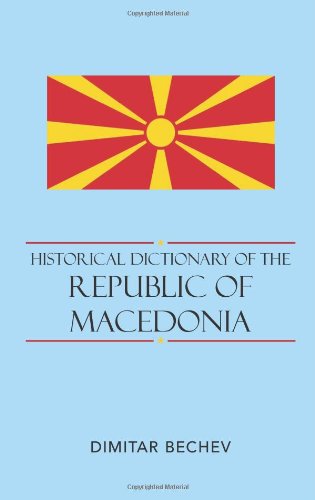
30. Historical Dictionary of the Republic
 
31. Nationalism and communism in Macedonia
 
32. Bright Balkan Morning: Romani
$22.70
33. The Ancient History of the East:
 
34. On Scientific Truth About Macedonia
 
35. The falsification of Macedonian
 
36. Macedon, 401-301 B.C. (Cambridge
 
37. The falsification of Macedonian
 
38. Hellenistic Queens: A Study of
 
39. Nationalism and Communism in MacEdonia:
 
40. Macedonia: Its Place in Balkan

21. GREEK LANDS IN HISTORY: MACEDONIA: 4000 YEARS OF GREEK HISTORY AND CIVILIZATION.
 Hardcover: Pages (1988)

Asin: B000HKHV1O
Canada | United Kingdom | Germany | France | Japan

22. Fields of Wheat, Hills of Blood: Passages to Nationhood in Greek Macedonia, 1870-1990
by Anastasia N. Karakasidou
Paperback: 358 Pages (1997-10-15)
list price: US$30.00 -- used & new: US$27.64
(price subject to change: see help)
Asin: 0226424944
Average Customer Review: 3.0 out of 5 stars
Canada | United Kingdom | Germany | France | Japan
Editorial Review

Book Description

Deftly combining archival sources with evocative life histories, Anastasia Karakasidou brings welcome clarity to the contentious debate over ethnic identities and nationalist ideologies in Greek Macedonia. Her vivid and detailed account demonstrates that contrary to official rhetoric, the current people of Greek Macedonia ultimately derive from profoundly diverse ethnic and cultural backgrounds. Throughout the last century, a succession of regional and world conflicts, economic migrations, and shifting state formations has engendered an intricate pattern of population movements and refugee resettlements across the region. Unraveling the complex social, political, and economic processes through which these disparate peoples have become culturally amalgamated within an overarchingly Greek national identity, this book provides an important corrective to the Macedonian picture and an insightful analysis of the often volatile conjunction of ethnicities and nationalisms in the twentieth century.

"Combining the thoughtful use of theory with a vivid historical ethnography, this is an important, courageous, and pioneering work which opens up the whole issue of nation-building in northern Greece."—Mark Mazower, University of Sussex
... Read more

Customer Reviews (12)

1-0 out of 5 stars Where are my human rights?
Where are our human rights as Hellenic makedonians who lived in the region before the 6th and 8th century?
My ancestors spoke a greek dialect and eight hundred years after our leader died, Alexander the Great, slavic and mongulian minorities are falsifying my history. I once again ask the author where are my rights?
The author's claim of a Macedonian Question, is more than a mere squabble over a name. It is a well-designed scheme for annexing the northern Greek provinces of Macedonia and Thrace. It started during the inter-war period, by the decisions of the Comintern and the Balkan communist parties seeking to establish a united (Macedonian and Thracian) State. Subsequently it was Tito, in 1944, who tried to establish such a State within Yugoslavia. He changed the name of Southern Serbia (which had been known as Vardashka since 1913) to "Macedonia" and then proceeded to establish, out of the Slavs of the region (Bulgarians and Serbs), a new Slavic nation inappropriately called "Macedonian".
To transform this theoretical concept into a political reality Tito:
Concocted in 1944 a "Macedonian government" as a first step to the setting up of a Socialist Republic of Macedonia".
Dubbed the local Slavonic dialect "Macedonian language". A special committee worked for years to turn this dialect into the "official Macedonian language".
In 1968 the "Macedonian Church" came into being irregularly, by a government coup. As a result, it was not recognized as a formal Church by any Orthodox Patriarchs or by the Vatican.
In 1969, the "History of the Macedonian nation" was published. Any reference in the world's archives to Macedonia and to historical figures and historical events connected in any way with Macedonia over the millennia, was manipulated and forcibly given a "Macedonian (Slavic) identity".
Thus, politicians and historians collaborated:
to usurp the name, the emblems, and the history of Macedonia;
to set in motion expansionist aspirations, by renaming Greek Macedonia as "Aegean Macedonia", i.e. part of a united Macedonia and issued maps limiting Greece's northern frontiers to Mount Olympus;to allege the existence of a "Macedonian minority" in Greece.
Their theoretical basis for these claims was based on the assertion that:
The ancient Macedonians, Alexander the Great, the Ptolemies, etc. were not Greeks (an allegation which is repeated in the recent FYROM's school textbooks for 1992-3).
After the arrival of Slavic tribes in the Balkans in the 6th century AD those Slavs, that managed to reach the Byzantine Provinces of Ancient Macedonia, intermarried with the local non-Greek Macedonians and thus they formed a new ethnic group, the "Slavo Macedonians" who subsequently were simply referred to as "Macedonians".
Unfortunately for the author, World history does not record a similar case of usurpation of a people's name and history by another group of people.
Lack of the slightest credibility on the part of the pseudo-Macedonian "nation" of Skopje is furthermore revealed by the single fact that Skopje's Bulgarians and Serbs discovered only after 1944 that back in the sixth century they had been transformed from Slavs into Macedonians. (The Albanian Kossovarians are going to ask for their independence in the coming months. Will this uprise encourage the oppressed Albanians living in FYROM?)
To claim that the Ancient Macedonians were not Greeks, however, and to use the term "Slav" with reference to the creation of the "Macedonian nation" is a trick that the author has used.
The "Macedonian Nation" does not, nor did it ever exist. The Macedonians were Greeks, they spoke the same language and worshipped the same gods (who were inhabiting the Macedonian mountain of Olympus) and performed the same sacrifices, in the same sanctuaries as all the other Greeks. Only, if the author had a better understanding of city-states would she realise this.
The Macedonians, together with the rest of Greeks, possess according to Herodotus, the kind and constituent element that composed a nation:
"And next the kinship of all Greeks in blood and speech, and the shrines of gods and the sacrifices that we have in common and the likeness of our way of life " Herodotus, History VIII, 144,2 (Loeb, A.D. Godley).
Unfortunately, the author has re-written propaganda and has forgotten to mention that the Slavic dialect spoken in Central and Western Macedonia (Northern Greece) is an ancient Greek language. It contains 1164 Homeric words. Due to the long coexistence of Greeks, Serbs and Bulgarians, this dialect has been enriched with Bulgarian words and endings and has nothing to do with the so-called "Macedonian language" invented in 1944-45, which is a mixture of the Bulgarian and the Serbo-Croatian languages.

5-0 out of 5 stars Exelent Book!!
I was amaized to find(and read) book like MS Karakasidou's.It is not so offten that book is writen without prejudice and with bearing the facts of the existence of the Macedonian minority in Republic of Greece. Not Slavophonic Greeks, but Slavic Macedonians, natives to the Northen Greece, the teritory of Makedonia.
We can debate here, of how well,or indepth, of acurate the book is, nothing is perfect in this world, and if it is, it will be boring, so for me this book done its justice. And told the story of forgotten Nation (minority) who's existance can not be forgotten and left on the mercy of the official Athens.
The book its self reise lot of questions and in the same time give lots of answers, wich,person who for first time exopsed to the intricate history of the Balkans and specialy Macedonia, have more clearer picture of things.
I can only aplaude to the honesty, determination and curage of MS Karakasidou, to publish this book.
It is time for the world, to hear about the Macedonian struglle for recognition in Republic of Greece.And Greece's extended eforts of assimilation, and above all the "Democracy" wich eluded this people from 1913 to this day.

4-0 out of 5 stars WELL researched an UNBIASED
It is interesting to see what other write for reviews based solely on their OWN BIAS and a even mentioned that the author is of Turkish origin . . .NEWS FLASH the war has been over YEARS ago! This book is very much the truth. It is hard understand the views of those who are RACIST, BIASED, and want to have us take their opinion when their do not look from the outside. I have reseached this FOR YEARS, from INSIDE and OUT and I will have to agree with this book, though some parts I do not, very few. SO if your looking to learn more about this "territory" read this and more. And yes I AM Greek! Proud of it everyday as I walk the streets of Athens. But "Pride" here goes TOO far whith more of a definition of BIAS, RACISM . . .

1-0 out of 5 stars Old style propaganda
It's always interesting to see an author of Turkish descent to write a book about Greek territories. Yet, the result was the expected one. "Macedonia is not exclusively Greek", "her obsession with the truth had brought to her death threats, apparently from outraged Greeks", "nation-building in northern greece (Macedonia)" etc. etc. and Karakasidu found of course protection from Anglo-Americans.
Does this reminds a bit of the preparations for the Cyprus 1974 invasion?
Yes! I vote 1 on this propaganda book.

5-0 out of 5 stars Good piece of scolarship.
This book is a work on (historical?) anthropology and in that field my qualifications are non existent: at best I am an amatuer (in the french sense). That said, I found the arguments of the book rather convincing. The book is obviously well researched and well thought out. I highly recommend it to anybody but esspecially to Greeks like myself who would like to have a look at (a part of) the history of modern Greece, more objective than the myths presented in official textbook-history writing. It is a good start.I can't refrain from commenting on the other reviews.Firstly I dont think that the author chose to participate in "politically charged debates", rather, she was drawn into them. Secondly it is unfair (not to say stupid) to criticise such a book for its limited scope, it is like criticising an encyclopaedia for having a very broad scope!Finally this is an anthropological book and it should be judged as such. To endorse or codemn (!) it based on whether it agrees or not with your "ideology" is an act that says something about the reviewer, but nothing about the book itself. ... Read more


23. Macedonia and Greece in Late Classical and Early Hellenistic Times (Studies in the History of Art)
 Paperback: 268 Pages (1982-01-01)
list price: US$45.00 -- used & new: US$192.46
(price subject to change: see help)
Asin: 0894680056
Canada | United Kingdom | Germany | France | Japan

24. Macedonia to America and Back : A Biographical History of Dimitri Nasos
by Thomay Nestor
Paperback: 335 Pages (1996-09)
list price: US$18.95 -- used & new: US$14.95
(price subject to change: see help)
Asin: 1880222256
Average Customer Review: 3.0 out of 5 stars
Canada | United Kingdom | Germany | France | Japan
Editorial Review

Book Description
Historical biography of Dimitri Nasos, a Macedonian ... Read more

Customer Reviews (6)

5-0 out of 5 stars Greek Biography
The subtitle of this book, "A Biographical History of Dimitri Nasos", is a very telling statement of the contents. Mr. Nestor has taken the story of his father and placed it within a fictional context. Most likely this was done because it is difficult to tell the life of one who is no longer alive and able to add to what one has been told.Too many other reviews of this book get into the politics of a region of the world where blood has been shed over and over again for national politics. The beauty of this story is the description of the life and character of Dimitri Nasos who displays the best of teachings of an Orthodox Christian who emigrated to America and embraced the great opportunities offered here.It tells a story of the early Greek American who has not often found a voice.Dimitri Nasos is mirrored in other Greeks who arrived here before 1920, worked hard, helped their extended families in Greece and friends in America. Dimitri Nasos in speaking to his child tells her, " I've done everything I could to help our people here, from the first day I came back from America.It didn't matter who they were or what they believed. If they needed help--money, jobs,a good word--I gave it to them. It is not right to talk about the good things one does, but I am telling you this so you'll understand what I stand for and how I feel." This sentence explains why the author wrote this book and what it makes it a very good read.

1-0 out of 5 stars not about macedonia or the macedonians
this book is about the asian christians that were brought into aegean macedonia, to assimilate with the native macedonians, to give them a feeeling of greekness, after the greeks occupied the southern half of the kingdom of macedonia after the second balken war. this person(author?)is having an internal conflict themselves after having a sex change. interesting though, that they have the same problem about their identity, since they were brought into macedonia as greeks from turkey in the 1920 s , they know deep down they cannot be real greeks so they try to steal the native macedonians identity and make it their own. confusing, yes, just as the writer he/she is. I doubt that any of these stories are real infact thats all they maybe is just that stories, pitifull!!!!!

5-0 out of 5 stars Interesting biography
An interesting story which, althought from a personal point of view as any biography, it provides a good description of macedonia during the 20th century. I have read this book and I may say that some of the previous reviewers rated it only based on its title and the sort description provided. Thus I attribute the attacks to misunderstanding. This book refers to the province of macedonia in northern greece (the ancient kingdom) and it's relation to bulgaria and NOT to the slavs (of bulgarian blood) and their civil war with the minotiry of albanians in the modern-slavic-macedonia (the ancient kingdom of Paeonia).
This common 'macedonia' name tends to confuse a lot of people.

PS. I know that albanians hate this name, please forgive me, but this is the name that the ex-yugoslavian state selected since 1991.

1-0 out of 5 stars author confuses facts
as a person whose family is from aegean macedonia (where this story takes place)i know first hand what atrocities happened to the natives of all of macedonia by the turks the serbs the bulgars and especially the greeks. this author is confused about who are the real macedonians and what is the real macedonia. people who fought for true independence of macedonia did not side with any of their "liberators" and if they did they were known to be traitors of macedonia or as locals called them "speown". when somewon was killed for this it was always blamed on the "other side" but more likely by someone in their own village or even by their own family. nice story but that all it is just a story. real i doubt it . in future when writing of macedonia please be factual and not just political mombojumbo for the greek government . remember up intill 9-10 years ago the greek stance was no such thing as macedonia.

1-0 out of 5 stars Certainly not an "Angela's Ashes"
This is not a good book, in fact, it is a dreadful book. The problem is not so much the subject matter (D. Nasos), rather, it is the way it is written. The author unfortunately does an injustice to the life of her father by the inclusion of pan-Hellenic nonsense throughout much of the book. References to Greek gods, heroes and morality is fine, but in this case it was grossly over-done and verging on the ridiculous. The total disregard to the Macedonian-speaking population in northern Greece is tragic. Perhaps she did not have enough information to write a comprehensive account of her father's life. This is a pity as I was quite seduced by small framents of his life, especially in America. His early years in the "new world" when he was struggling to earn a few dollars were most moving and I feel much, much more could have been said. This book appears to be nothing more than a Greek ethnocentric view of life written by a person who should have left the writing to someone who has something interesting to say. To the reviewer who claimed that this book is better than ANGELA'S ASHES - you have got to be joking! ... Read more


25. Social cleavages and national "awakening" in Ottoman Macedonia.: An article from: East European Quarterly
by Basil G. Gounaris
 Digital: 27 Pages (1995-12-22)
list price: US$5.95 -- used & new: US$5.95
(price subject to change: see help)
Asin: B00093TUTK
Canada | United Kingdom | Germany | France | Japan
Editorial Review

Book Description
This digital document is an article from East European Quarterly, published by East European Quarterly on December 22, 1995. The length of the article is 8085 words. The page length shown above is based on a typical 300-word page. The article is delivered in HTML format and is available in your Amazon.com Digital Locker immediately after purchase. You can view it with any web browser.

From the supplier: The existence of various Christian ethnic groups in Ottoman Macedonia at the turn of the 19th century led to social cleavages in the country. These ethnic groups elicited strong feelings of solidarity arising from common historical and cultural ties, thus promoting loyalty and unity within the groups but wedging gaps between and among them. They also robbed Macedonia of an ethnic identity.

Citation Details
Title: Social cleavages and national "awakening" in Ottoman Macedonia.
Author: Basil G. Gounaris
Publication: East European Quarterly (Refereed)
Date: December 22, 1995
Publisher: East European Quarterly
Volume: v29Issue: n4Page: p409(18)

Distributed by Thomson Gale ... Read more


26. Macedonia: The Politics of Identity and Difference (Anthropology, Culture and Society Series)
Paperback: 192 Pages (2000-12-01)
list price: US$22.95 -- used & new: US$16.99
(price subject to change: see help)
Asin: 0745315895
Canada | United Kingdom | Germany | France | Japan

27. The Past in Question: Modern Macedonia and the Uncertainties of Nation
by Keith Brown
Paperback: 320 Pages (2003-03-17)
list price: US$24.95 -- used & new: US$16.75
(price subject to change: see help)
Asin: 0691099952
Canada | United Kingdom | Germany | France | Japan
Editorial Review

Book Description

This book examines the relationship between national history, identity, and politics in twentieth-century Macedonia. It focuses on the reverberating power of events surrounding an armed uprising in August 1903, when a revolutionary organization challenged the forces of the Ottoman Empire by seizing control of the mountain town of Krusevo. A century later, Krusevo is part of the Republic of Macedonia and a site for yearly commemorations of 1903. In the course of the intervening hundred years, various communities have vied to establish an authoritative account of what happened in 1903--and to weave those events into a longer and wider narrative of social, cultural, and national evolution.

Keith Brown examines how Krusevo's residents, refugees, and exiles have participated--along with scholars, journalists, artists, bureaucrats, and politicians--in a conversation about their vexed past. By tracing different approaches to understanding, commemorating, and narrating the events of 1903, he shows how in this small mountain town the "magic of nationalism" by which destiny is written into particular historical events has neither failed nor wholly succeeded. Stories of heroism, self-sacrifice, and unity still rub against tales of treachery, score settling, and disaster as people come to terms with the legacies of imperialism, socialism, and nationalism. The efforts of Krusevo's successive generations to transcend a past of intercommunal violence reveal how rival claims to knowledge and truth acquire vital significance during rapid social, economic, and political change.

... Read more

28. Rise of the Macedonian Empire (Epochs of ancient history)
by Arthur M Curteis
 Unknown Binding: 224 Pages (1911)

Asin: B000885EJG
Canada | United Kingdom | Germany | France | Japan

29. The Miracle That Was Macedonia (Great Civilizations Series)
by N.G.L. Hammond
 Hardcover: 320 Pages (1991-06-20)
-- used & new: US$59.99
(price subject to change: see help)
Asin: 0283999101
Canada | United Kingdom | Germany | France | Japan

30. Historical Dictionary of the Republic of Macedonia
by Georgieva Valentina
Hardcover: 400 Pages (1998-08-13)
list price: US$75.00 -- used & new: US$64.50
(price subject to change: see help)
Asin: 0810833360
Canada | United Kingdom | Germany | France | Japan
Editorial Review

Book Description
Assists interested readers in learning more about the recent events in the development of this newly independent state, as well as its more distant past. The Dictionary traces the history of Macedonia from the cAontext of the Ancient Macedonian Kingdom, through its control by the Roman, Byzantine, and Ottoman Empires, up to the present day. ... Read more


31. Nationalism and communism in Macedonia (Hidryma Meletōn Chersonēsou tou Haimou)
by Euangelos Kōphos
 Unknown Binding: 251 Pages (1964)

Asin: B0007J4I3O
Canada | United Kingdom | Germany | France | Japan

32. Bright Balkan Morning: Romani Lives and the Power of Music in Greek Macedonia
by Charles Keil, Dick Blau, Angeliki V. Keil, Steven Feld
 Paperback: Pages (2003-04)

Isbn: 0819564893
Average Customer Review: 5.0 out of 5 stars
Canada | United Kingdom | Germany | France | Japan
Editorial Review

Book Description
A stunningly-illustrated interweaving of first person narratives, photographs, cultural commentary and soundscapes, Bright Balkan Morning provides an unprecedented view of settled Romani lives in the Balkans and the unique roles of "Gypsy" instrument players in the region. These Romani instrumentalists from Iraklia, an ancient Greek Macedonian crossroads and market town that is home to about 2,000 Roma, provide the sounds that facilitate parties and rites of passage, performing an essential and highly valued service for their multicultural neighbors.

At the heart of the book are ten first-person Romani life stories. Charles and Angeliki Keil situate these personal accounts within the cultural, historical and economic setting of Greek Macedonia, and provide an overview of musical events in diverse localities. The 161 black and white photographs by Dick Blau include parades, parties, weddings and wrestling matches; portraits of the musicians and their families; studies of domestic life in the Romani neighborhood; reproductions from Romani family albums and other historic images. Steven Feld's soundscape CD features the voices and instruments of people whose stories are told in the book. Familiar sounds of markets, church, neighborhood and countryside set the context for exuberant performances at home and at parties, cafes and nightclubs.

CONTRIBUTORS: Angeliki Vellow Keil, Charles Keil, Steven Feld, Ian Hancock. ... Read more

Customer Reviews (5)

5-0 out of 5 stars Extraordinary
This book is, in a word, extraordinary; so is the accompanying CD recording, which gives in addition to music of the Macedonian Romany people, a slice of their life in cafes and markets. One hears their daily activities, the sale of pita, and various wares, as well as juke boxes and street sounds as the Mahala awakens.

Mahala, for those unaware, is the village ghetto to which Rom people are generally confined, although the anthropologists who compiled this book do not seem to know that it is Arabic for ghetto, and the same word used in North Africa and other Middle Eastern Muslim nations to describe the Jewish and Christian ghettos in which those dhimmi groups are similarly confined. Dhimmis are the non-Muslim minorities in Muslim lands, and their treatment (and in Muslim nation remains) generally described and defined by the Islamic laws of jihad.

Unlike most other recent books about the Rom, this one contains a massive amount of research on the lives and music of these people, as they live it; but what I like the most are the oral histories that provide readers with a real sense of the hardships suffered by the Rom in Greek Macedonia. While the book mentions the great and disastrous Turkish invasion of Greece in 1922, it does not note the great massacre of an estimated 150,000 Christian Greeks and Armenians in Smyrna on the Aegean coast that year. Thisundoubtedly included some Rom, as the town was then (as now) central on the Turkish coast.

But without knowing it, the authors have demonstrated some of the ill effects of Muslim rule, for they do discuss, via oral histories, the great liberation experienced by Greek Roma in 1924, when Turks were repatriated to Turkey and 1 million Greeks from Turkey to Greece. The latter may have lost some territory, but she gained liberation from Muslim oppression.

As Greeks from Turkey poured into Greece, the town fathers in Jumaya, for example, and presumably everywhere else the Roma then lived in Greece, began to allow the Roma to go to school with Greeks. Beforehand, the Turks had imposed separation on non-Muslim peoples. But with Turks gone, Greeks exiled the old cast system too, thereby relinquishing the system that had helped imprison Greek Roma in lives without equal education. Now, suddenly, the Rom could attend the same school as everyone else.

There are many wonderful features of this book, including the photographs and the music CD at its end. But make no mistake, the oral histories are the best feature, making this one of the best books on the Rom I have read to date.

--Alyssa A. Lappen

5-0 out of 5 stars Bright Balkan Morning = Late Chicago Night!
Last night I planned to read this book for just a few minutes before going to sleep.Hours later, instead of sleeping I was transformed into the world of the Balkan Roma musicians and their incredible culture!I simply couldn't put this amazing book down.I love the stories and interviews with the old musicians, the informative history of the Roma people and their culture, the full-of-life photos, and the CD with soundscapes.All these pieces combine to give the reader a great view of a people and their heritage, and one that has been largely overlooked in the past.I found the work ethic of the musicians described in this book to be very inspirational.To be able to play all kinds of requests for days on end is really something to admire.Musicians of any genre could learn a whole lot from reading about the musicians in this book.Years ago, these authors turned me on to the subculture of polka in the USA (and made a polkaholic out of me) with their super "Polka Happiness" book.They have clearly done it again - informed the world about an incredibly rich culture that was largely hidden from view.

5-0 out of 5 stars Big Fat Roma Music Book
This book responds to my interest in the social context of folk music and dance. The focus was on the lives of the people who make the music, in this case the Roma of Jumaya (Iriklia) in Greek Macedonia. The writers give you quite a rounded view, describing how the music is performed, at what kinds of events, how people relate to the music and each other, how the musicians see themselves and their occupation and how making a living as a Roma musician fits into Greek society. There is also a strong sense of history and how things have changed over time in many ways - the history of Roma in Greece and other Balkan countries, the specific history of Roma in Jumaya, and the stories of individual musicians and their families. The consistently positive way that the writers approach their subject is also refreshing - they describe how Roma have used music to survive and, in some cases, prosper, and how in doing so they have contributed to the multi-layered fabric of Greek-Macedonian ethnic identities.

What is especially interesting to me is the authors' view of how multi-ethnic society works in Greek Macedonia as compared to Bulgaria or Former Yugoslavia, and how the strategy of Roma musicians is different in these different countries. In Greek Macedonia the musicians play the music of all ethnic groups in order to maximize their flexibility and income. During multi-ethnic celebrations the musicians follow a strict policy of playing everyone's requests in the order requested, so that no one feels that they have priority. There is a fascinating description of an ethnically mixed wedding where the families have to adjust their various wedding traditions to accommodate each other, making it up as they go along to some extent.

The authors compare and contrast this with the approach taken by Roma musicians in other areas of the Balkans. In Kosovo in the 1980s the Roma musicians are said to have purposely selected music from traditions from other than Serbian and Albanian in order to avoid conflicts. In Bulgaria the wedding band tradition is described as leading to a new pan-Balkan "fusion" style which borrows from many cultures but still feels Bulgarian. Ultimately the motivation behind each strategy is the need of musicians to make a living.

The book is interesting reading from a North American perspective as well.Keil contrasts the multi-ethnic consciousness of Greeks, where the same person may have several types of ethnic and national identities simultaneously, with the concept of "multiculturalism" which he describes as slices of a pizza in which there are lots of ethnicities but everyone is either one thing or another. This raise the question of what is really going on in such immigrant nations as Canada and the United States.

The accompanying CD is a potpourri of sounds, including music of various types, and there is a section of the book describing the contents of the CD. Some of the track titles are Market Day in Jumaya, Afternoon at a Mahala Café, At Home in the Mahala, New Year's Party in Serres, Taverna Party at Nikisiani.The combination of the text, the many high quality black and white photos and the soundscape are successful in putting you into the experience, as much as this is possible. There was also a nice balance between Angeliki Keil's straight-forward and very readable reporting of the lives of the musicians and Charles Keil's more theoretical musings about ethnicity, the music and the role of the musicians. My only complaint about the book is its weight - it's printed on very heavy, glossy stock, no doubt adding to the quality of photographic reproductions, but it is so big and heavy that you pretty well have to read it sitting up.An alternate title could be, "Your Big Fat Roma Music Book."

5-0 out of 5 stars Evocative, Engrossing, Encompassing
When you get Bright Balkan Morning you are likely to open it up and then leaf through it, looking at the photographs.After a few minutes of this you'll remove the CD from the inside back cover and put it on.Then you continue looking at the photos while listening to the sounds.

That in itself is a rich and satisfying experience.But don't stop there.Read the text!

It tells of Roma (aka Gypsy) musicians who have cornered the market on live music in polyglot Greek Macedonia.While they are at the bottom of the social order, anyone who wishes a proper wedding, festival, or party of any kind hires these musicians. The musicians generally perform in trios, one playing a bass drum while the other two play the zurna - a double-reed woodwind found throughout Eurasia and Africa. Their repertoire is drawn from the peoples who live in the area, or passed through at one time, and is sometimes more Oriental, sometimes more European - whatever the customer wants.

Keil and Keil give detailed accounts of several performances - a baptism, a wedding, and a saint's day festival - tell the life stories of a dozen or so musicians & family, and recount the broad history of the Roma in the Mediterranean as well as presenting a more focused account of their sojourn in Greek Macedonia.Blau's photographs range from intimate portraits, to dancers in full party whirl, through street scenes jumbled or measured, to serene landscapes.Some of his shots are so strikingly composed - the cover image, for example - that the effect is both subjective (Blau's aesthetic) and objective (we're looking at things, out there, in the world).Steven Feld's soundscapes give us the living flow of sound. Not only do we hear the twin zurnas flying through drum rhythms, but dancing feet, shouts of joy and exertion, motors churning, sheep braying, and Stevie Wonder piped in through a tinny sound system.

Bright Balkan Morning is a milestone.See it, hear it, read it.Take pleasure in it.

5-0 out of 5 stars THEY'LL STEAL YOUR HEART, TOO
In the rich and wonderful BRIGHT BALKAN MORNING:Romani Lives and the Power of Music in Greek Macedonia(Wesleyan University Press.Includes a CD), Charles and Angeliki Vellou Keil write of how, since the earliest days of Byzantium, commentators have remarked, sometimes positively and sometimes negatively, on the power of the Romani people to "steal your heart."With its stunning photographs by Dick Blau and its evocative CD produced by Steven Feld, this book is just one more instance of stolen hearts.The Romani, who are sometimes called gypsies, have stolen the authors' hearts and are well on their way to stealing my heart as well.

I urge you to buy this book.I say so as someone who almost never reads anything published by an academic press.I am definitely not an anthropologist or a social scientist of any kind.What I know about the raw and the cooked doesn't get very far beyond my kitchen, but I couldn't put BRIGHT BALKAN MORNING down.This book ought to be that rare thing:an academic book with popular appeal.

The easiest way into the riches of BRIGHT BALKAN MORNING are Blau's black-and-white photographs of the Romani playing their instruments for weddings, wrestling matches, and the little parades that apparently form wherever they go.When the dances started up, I have a feeling that Blau joined in, for these pictures just pulled me along.I could smell the perfume in the grandmother's handkerchief as she held it out to Blau and, through him, to me, as we all danced together.I could see the textures of the road when I took my place in the wedding parade; I could almost hear the sound of the zurna (a kind of outdoor oboe) being played in my ear.

Of course Steven Feld's CD brings the actual sounds to life.The CD begins oh so slyly by introducing Romani music emerging from the ambient sounds of twentieth-century Macedonia.The Romani are, if nothing else, great survivors of history's cultural wars, and you can hear so many diverse musical strains-from the Muslim to the techno pop.Eerily enough, the rhythm of the dauli (a two-headed bass drum) being played sounds exactly like the bass-drum pounding at a high-school football pep rally.

I wasn't as happy with the book's writing style, but then the authors seem to be wrestling with shaping this heartfelt information of theirs into all the requirements of academic publishing, and that struggle oddly mirrors the lives of the Romani.This sometimes awkward prose becomes just one more instance of the dance the Romani inspire everywhere they go as they blend in and out of the moment's culture.

--R. M. Ryan
Duncans Mills, CA ... Read more


33. The Ancient History of the East: From the earliest times to the conquest by Alexander the Great. Including Egypt, Assyria, Babylonia, Media, Persia, Asia Minor, and Phoenicia
by Philip Smith
Paperback: 620 Pages (2001-01-24)
list price: US$32.99 -- used & new: US$22.70
(price subject to change: see help)
Asin: 1402186436
Canada | United Kingdom | Germany | France | Japan
Editorial Review

Product Description
This Elibron Classics book is a facsimile reprint of a 1876 edition by John Murray, London. ... Read more


34. On Scientific Truth About Macedonia
by F.K. Voros
 Paperback: Pages (1993)

Isbn: 9602540621
Canada | United Kingdom | Germany | France | Japan
Editorial Review

Product Description
A collection of articles on the ancient and recent history of Macedonia. Including a historical survey of the "Macedonian Question". Also "The Macedonian Question of our neighbors. A discussion on the different uses of the term Macedonia in the centuries of history, which is a possible source of misunderstanding. An interesting discussion on the Truth about the leaflet "Les Aroumains" (Les Macedo-Romains 1989) Wonderful color artwork and old world maps adorn this work. ... Read more


35. The falsification of Macedonian history
by Nicolaos K Martis
 Paperback: Pages (1988)

Asin: B0007BW9DI
Canada | United Kingdom | Germany | France | Japan

36. Macedon, 401-301 B.C. (Cambridge Ancient History Series, Vol 6)
 Hardcover: 672 Pages (1927-01-02)
list price: US$100.00
Isbn: 052104488X
Canada | United Kingdom | Germany | France | Japan

37. The falsification of Macedonian history
by Nikolaos K Martees
 Unknown Binding: Pages (1983)

Asin: B0007B757I
Canada | United Kingdom | Germany | France | Japan

38. Hellenistic Queens: A Study of Woman-Power in Macedonia, Seleucid Syria, and Ptolemaic Egypt (The Johns Hopkins University Studies in Archaeology)
by Grace Harriet Macurdy
 Hardcover: 250 Pages (1975-10-02)
list price: US$35.00
Isbn: 0837182719
Average Customer Review: 5.0 out of 5 stars
Canada | United Kingdom | Germany | France | Japan

Customer Reviews (1)

5-0 out of 5 stars A very thorough study
This is an excellent study of the Hellenistic Queens.Coverage is extremely thorough, and the analysis is very balanced.I'm quite impressed with the amount of information that the author makes available to the reader.The text is aimed a little more at scholars than at the layperson, but it is still accessible to the non-expert.This is a good resource especially for people who need to write article-lenght pieces in the field. ... Read more


39. Nationalism and Communism in MacEdonia: Civil Conflict, Politics of Mutation, National Identity (Hellenism--Ancient, Mediaeval, Modern, 12th V)
by Euangelos Kophos, Evangelos Kofos
 Hardcover: 336 Pages (1993-03)
list price: US$40.00
Isbn: 0892415401
Average Customer Review: 3.5 out of 5 stars
Canada | United Kingdom | Germany | France | Japan

Customer Reviews (3)

5-0 out of 5 stars Excellent presentation
Kofos is one the few scholars with a deep knowledge of the Macedonian Question. In a question overloaded by conflicting propagandas this book is a valuable companion to separate the facts from the myths.

5-0 out of 5 stars An EXCELLENT study regarding the troubled Balkan region!
Recent events in the Balkans have shown that due to the ethnological, geopolitical and historical complexity of the region, serious in depth analysis is of paramount importance in understanding the truth.
Apart from the thousands that have died as a result of the breakup of Yugoslavia in the 1990's, another victim has been the truth, as is the case in most wars, especially in the 20th century.
The fact is that the truth is based on undisputed facts (dates, events etc).Moreover, in relation to opinion, the truth always lies somewhere in the middle.Unfortunately, the previous "reviewer," instead of treating this book for what it is, i.e. a valuable primary source from the Greek point of view, he dismisses it on the grounds that is written by Greek scholars, while adding irrelevant and unsupported assumptions from an unknown origin.The "reviewer" states: "Official Greek government policy was that Macedonia did not exist". The question is how can Greece, of all countries, deny the existence of her own history?A rather childish and yet dangerous reaction coming as a result of Yugoslav communist propaganda and indoctrination aiming at conditioning the majority Bulgarian-Slavic population of South Serbia into believing they belong to a fictitious "Macedonian" nationality.What's next? Did the Vikings build the Parthenon, were the Spartans African spearmen or was Alexander the Great a Slav?
Let's be serious.In a democracy all voices should be heard instead of being immediately disregarded on the basis of their origin.One cannot and should not silence another just because they disagree with them!At the same time, however, the truth should be protected at all cost and not be left to be sacrificed inpursuit of political agendas.
This book provides a valuable insight in the study of Macedonia.It is a "must" for any serious historian or political analyst interested in the Balkan region.

1-0 out of 5 stars Greek Denial of the MACEDONIAN Name!
The most important thing to remember about the "Macedonian conflict" is that the Greek position has changed dramatically over the past decade. Official Greek government policy was that Macedonia did not exist. When Greece took over Aegean Macedonia in 1913, they killed, tortured and ethnically cleansed hundreds of thousands of Macedonians. They changed the names of people, villages, and landmarks from Macedonian to Greek in their attempts to eradicate the Macedonian name. Two things to remember:

1. It is ironic that Greeks now "love Macedonia" when they tried to eradicate its very existence.

2. If Macedonia has always been Greek, why did the Greek government deny its existence until the 1980's? ... Read more


40. Macedonia: Its Place in Balkan Power Politics
by Elisabeth Barker
 Hardcover: 129 Pages (1980-08-22)
list price: US$35.00
Isbn: 0313225877
Canada | United Kingdom | Germany | France | Japan

  Back | 21-40 of 100 | Next 20
A  B  C  D  E  F  G  H  I  J  K  L  M  N  O  P  Q  R  S  T  U  V  W  X  Y  Z  

Prices listed on this site are subject to change without notice.
Questions on ordering or shipping? click here for help.

site stats