e99 Online Shopping Mall

Geometry.Net - the online learning center Help  
Home  - Basic Math - Number System (Books)

  1-20 of 100 | Next 20

click price to see details     click image to enlarge     click link to go to the store

$19.95
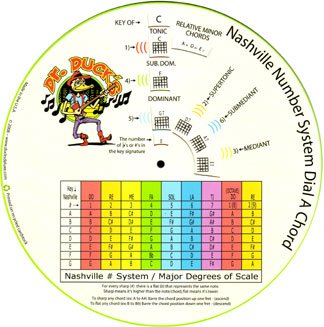
1. The Nashville Number System (with
 
2. The Number Systems: Foundations
$5.87
3. The Number System (Dover Books
4. The Number Systems: Foundations
$20.18
5. Numbers and the Number System:
$6.74
6. Can You Count in Greek?: Exploring
$10.00
7. The Universal History of Numbers:
$46.64
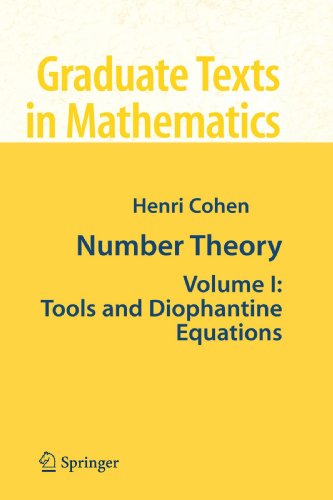
8. Number Theory: Volume I: Tools
 
9. Symbolic logic and the real number
$4.46
10. Math Made Nice & Easy #1 (REA):
$19.75
11. The Book of Numbers: The Secret
 
12. Realm of Numbers
$60.52
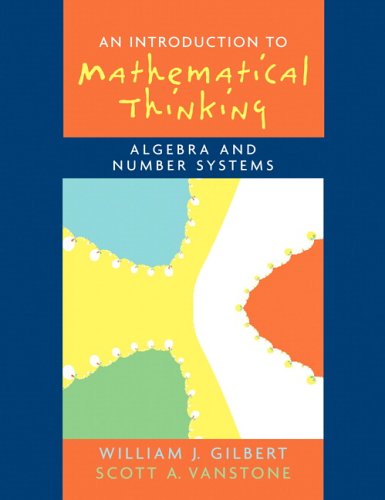
13. Introduction to Mathematical Thinking:
$38.33
14. Complex Numbers from A to ...Z
$67.33
15. Random Number Generation and Monte
 
16. The structure of the real number
 
17. Symbolic Logic and the Real Number
 
$0.64
18. Building number sense: The number
 
19. Mathematical Thinking at Grade
$46.00
20. The Number Systems of Analysis

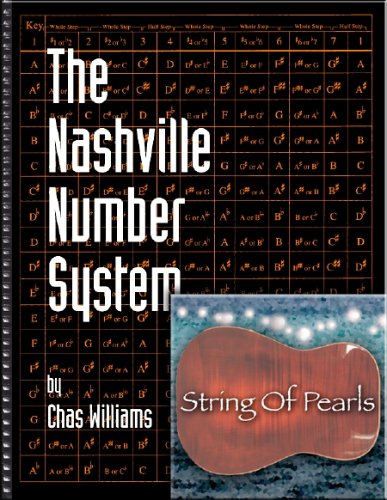
1. The Nashville Number System (with cd/cd rom: String Of Pearls)
by Chas Williams
Spiral-bound: 130 Pages (2005-07-15)
list price: US$19.95 -- used & new: US$19.95
(price subject to change: see help)
Asin: 0963090674
Average Customer Review: 5.0 out of 5 stars
Canada | United Kingdom | Germany | France | Japan
Editorial Review

Product Description
THE NASHVILLE NUMBER SYSTEM
In the late 50's, Neil Matthews devised a musical number system for the Jordanaires to use in the studio. Charlie McCoy and fellow studio musicians began adapting Matthews' number system into chord charts. The Nashville Number System has evolved into a complete method of writing chord charts and melodies---combining Nashville shorthand with formal notation standards.  
The Nashville Number System is 130 pages with a step by step method of how to write a Nashville number chart for any song. Included with each NNS book in Edition 7 is the cd, "String Of Pearls". This is a 10 song cd of  instrumentals, including, Amazing Grace. I walk you through the details of each song and explain the Number System tools used to write the charts. Now, while listening to the cd, you can see and hear how Nashville number charts work.
THE NASHVILLE NUMBER SYSTEM includes a collection of handwritten number charts for the songs on the cd, String Of Pearls. Each song is charted by hand from the cd by:
  • Charlie McCoy (Hee-Haw)  • David Briggs (Session Keyboardist/Arranger)• Eddie Bayers (Session drummer)  • Jimmy Capps (Studio guitarist, Grand Ole Opry Staff Band) • Brent Rowan (Studio guitarist/Producer)• Lura Foster (Charts for TV shows: Nashville Now, Music City Tonight, Primetime Country)• John Hobbs (Session Keyboardist)• Mike Chapman (Session Bassist)• Biff Watson (Session Guitarist)• Chris Farren (Producer/Guitarist)• Tony Harrell (Session Keyboardist/Studio Owner)
Each of these musicians wrote 5 number charts in his or her style from the String Of Pearls cd.
For example, the song, String Of Pearls, has charts written by: Charlie McCoy, Brent Rowan, John Hobbs, Jimmy Capps and Biff Watson.
The song, Waylon, has charts written by Tony Harrell, Lura Foster, Chris Farren, Biff Watson and Eddie Bayers.
The idea is that you’ll be able to compare, side by side, some of the different styles of notation and symbols you can use to chart the same piece of music. So, as you listen to a song on the cd, you can flip between different charts written of the same song.
These different charts represent the kinds of numbering techniques that you are liable to run into in almost all of the major recording and television studios, clubs, showcases, rehearsal halls, and other situations where music is performed in Nashville. ... Read more

Customer Reviews (4)

5-0 out of 5 stars It's easier than it looks!
After reading the book I was a little hesitant about using the number system. The next time I went to the studio to record a new demo of my song I sat with some of Nashville's "A" list players and watched as they quickly and easily charted my song and from reading the book, I was understanding what they were doing. Even they tweeked their first chart of the song
Next time I'll try it myself and let them tweek it if necessary!
Don't be afraid but do get this book and CD to help you understand The Nashville Number System!

5-0 out of 5 stars well-defined
The book was accurately described and will prove very helpful to me in my musical pursuits.Just what I was looking for in a book of this type.

5-0 out of 5 stars A Nashville Cat Who Knows the Nashville Technique!
Charles does it right ... if you want to understand the Nashville Number System, in plain simple english, this is the book I recommend in my tutorial at GuitarNotes.Com and at my site.

~~Alan Horvath

5-0 out of 5 stars An excellent resource for an excellent tool!
So, what happens is, you're playin' with a bunch of Nashville dudes, see? They're cuttin' this song, and the big-shot says, "progression is 1, 4, 5 ... the chorus goes: 4, 5, 6minor - three times; fourth time, it goes4, 5, 1." What do you do? You go, "what key is it in?"'Course, you should be able to figure that out by a quick listen, and a tapor two on your guitar ... but even if you don't, someone's bound to thinkyou're just lazy, and blurt out, "It's in G, man!" So, okay ...big deal. You can count! You know the song goes G, C, D ... exept in thechorus, which goes C, D, Em - three times, and then C, D, G the fourthtime. The cool thing about it, is when the vocalist arrives and he/shecan't sing in the key of G! ... it has to be in the key of D! Nothingchanges. The progression is still 1, 4, 5, etc. -- only now you're startingfrom D as #1 and counting. So, now we're gonna play D, G, A ... and thechorus goes G, A, Bm - three times; fourth time is G, A, D. Pretty simple,huh? Everybody can do their private math, quietly, and, in ten minutes whenthe tape starts to roll, everybody sounds like they knew what was up allthe time. The vocalist is very impressed! And, most of all, the guy cuttingthe checks is smiling. ... Read more


2. The Number Systems: Foundations of Algebra and Analysis
by Solomon Feferman
 Hardcover: Pages (2005-01)
list price: US$25.00
Isbn: 0821829157
Canada | United Kingdom | Germany | France | Japan
Editorial Review

Book Description
The subject of this book is the successive construction anddevelopment of the basic number systems of mathematics: positiveintegers, integers, rational numbers, real numbers, and complexnumbers. This second edition expands upon the list ofsuggestions for further reading in Appendix III.

From the Preface: "The present book basically takes for grantedthe non-constructive set-theoretical foundation of mathematics,which is tacitly if not explicitly accepted by most workingmathematicians but which I have since come to reject. Still,whatever one's foundational views, students must be trained inthis approach in order to understand modern mathematics.Moreover, most of the material of the present book can bemodified so as to be acceptable under alternative constructiveand semi-constructive viewpoints, as has been demonstrated inmore advanced texts and research articles." ... Read more


3. The Number System (Dover Books on Mathematics)
by H. A. Thurston
Paperback: 144 Pages (2007-04-19)
list price: US$9.95 -- used & new: US$5.87
(price subject to change: see help)
Asin: 0486458067
Canada | United Kingdom | Germany | France | Japan
Editorial Review

Book Description

This book explores arithmetic's underlying concepts and their logical development. It offers an informal and intuitive understanding of the rigorous logical approach, in addition to a detailed, systematic construction of the number systems of rational, real, and complex numbers. Numerous exercises help students test their progress and practice concepts. 1956 edition.
... Read more

4. The Number Systems: Foundations of Algebra and Analysis (Addison-Wesley Series in Mathematics)
by Solomon Feferman
Hardcover: Pages (1964)

Asin: B000GSQ9JM
Canada | United Kingdom | Germany | France | Japan

5. Numbers and the Number System: Year 5 (Developing Numeracy)
by Steve Mills, Hilary Koll
Paperback: 64 Pages (2000-02-29)
list price: US$33.35 -- used & new: US$20.18
(price subject to change: see help)
Asin: 0713652357
Canada | United Kingdom | Germany | France | Japan

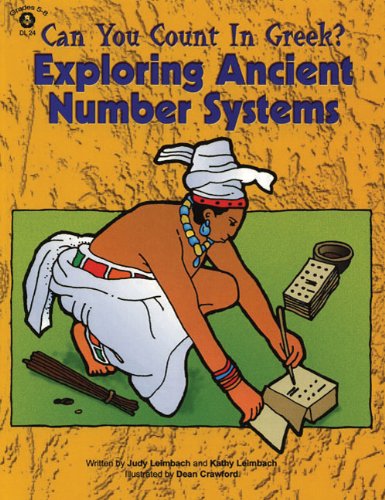
6. Can You Count in Greek?: Exploring Ancient Number Systems
by Judy Leimbach
Paperback: 64 Pages (2005-06-01)
list price: US$11.95 -- used & new: US$6.74
(price subject to change: see help)
Asin: 1593630565
Canada | United Kingdom | Germany | France | Japan
Editorial Review

Product Description
Discovering the way people in ancient cultures conducted their lives is fascinating for young people, and learning how these people counted and calculated is a part of understanding these cultures. This book offers a concise, but thorough, introduction to ancient number systems. Students won't just learn to count like the ancient Greeks; they'll learn about the number systems of the Mayans, Babylonians, Egyptians, Romans, and Hindu-Arabic cultures, and also about quinary and binary systems. Symbols and rules regarding the use of the symbols in each number system are introduced and demonstrated with examples. Activity pages provide problems for the students to apply their understanding of each system. Can You Count in Greek? is a great resource for math, as well as a supplement for social studies units on ancient civilizations.

This valuable resource builds understanding of place value, number theory, and reasoning. It includes everything you need to easily incorporate these units in math or social studies classes. Whether you use all of the units or a selected few, your students will gain a better understanding and appreciation of our number system.

Grades 5–8 ... Read more


7. The Universal History of Numbers: From Prehistory to the Invention of the Computer
by Georges Ifrah
Paperback: 656 Pages (2000-10-09)
list price: US$22.95 -- used & new: US$10.00
(price subject to change: see help)
Asin: 0471393401
Average Customer Review: 4.5 out of 5 stars
Canada | United Kingdom | Germany | France | Japan
Editorial Review

Amazon.com
The title doesn't lie. Mathematician Georges Ifrah's masterpiece, The Universal History of Numbers, is a wonderfully comprehensive overview of numbers and counting spanning all the inhabited continents as far back in time as records will allow us to look.Beyond the ancient Babylonians, Sumerians, and Indians, Ifrah takes us farther south into Africa to examine an early decimal counting system and into ancient Mexico to reconstruct what we can of the Mayan calendar and numerical system.The 27 chapters are chiefly organized by culture, though there are some cross-cultural overviews of topics like letters and numbers.

The author's aim was grand: "to provide in simple and accessible terms the full and complete answer to all and any questions ... about the history of numbers and counting, from prehistory to the age of computers."This led him to wander the world for 10 years, studying and learning; this scholastic pilgrim has returned with amazing stories to tell. Toward the end of the book, Ifrah makes the book truly universal by refuting alien-intervention theories of cultural origins--surely our benefactors would have given us an efficient decimal counting system, zero and all, before helping us build pyramids and such. Such charming ideas, combined with such rigorously researched facts, make The Universal History of Numbers a uniquely important and fascinating volume. --Rob LightnerBook Description
"Georges Ifrah is the man. This book, quite simply, rules. . . . It is outstanding . . . a mind-boggling and enriching experience." -The Guardian (London) "Monumental. . . . a fascinating journey taking us through many different cultures."-The Times (London)"Ifrah's book amazes and fascinates by the scope of its scholarship. It is nothing less than the history of the human race told through figures." -International Herald Tribune Now in paperback, here is Georges Ifrah's landmark international bestseller-the first complete, universal study of the invention and evolution of numbers the world over. A riveting history of counting and calculating, from the time of the cave dwellers to the twentieth century, this fascinating volume brings numbers to thrilling life, explaining their development in human terms, the intriguing situations that made them necessary, and the brilliant achievements in human thought that they made possible. It takes us through the numbers story from Europe to China, via ancient Greece and Rome, Mesopotamia, Latin America, India, and the Arabiccountries. Exploring the many ways civilizations developed and changed their mathematical systems, Ifrah imparts a unique insight into the nature of human thought-and into how our understanding of numbers and the ways they shape our lives have changed and grown over thousands of years. "Dazzling."-Kirkus Reviews "Sure to transfix readers."-PublishersWeekly ... Read more

Customer Reviews (10)

5-0 out of 5 stars The Universal History of Numbers: From Prehistory to the Invention of the Computer
I believe for many amateurs interested in the history of numbers, this is the only book they ever need. Amazingly thorough! Numbers being the fiber of any civilization, the book touches on some number-related areas like writing systems, astronomy, etc, and is beyond just covering pure numbers. It explains very well the reasons and ramifications of different number systems, with good coverage of their operational aspects. Its views are verywell researched and very balanced!!

It should be a collection book for ANY history buff.

5-0 out of 5 stars math history you can use
I am a teacher and I love this book. I use it to teach counting systems to young children. I like having access to all kinds of math of the past. How to write it, how it was used, the subtleties of each language. I personally love it for myself as well - I am a math teacher and this is the best I have found for getting lots of great info on the history of math.I like to know when things happened in the intellectual development of mathematics.

3-0 out of 5 stars Like Reading an Encyclopedia
This book is subtitled "from Prehistory to the invention of the computer", which is a little misleading.The text really ends about the stage of Europe's adoption of "Arabic numerals".
This reader thought there were three main trends within the book.
1st. A history of how every culture formed its counting system, from Polynesians islanders, to Tierra del Fuego, various African tribes to ancient and extinct cultures, cuneiform, hieroglyphics, knot tying, tally sticks to body counting.The author's blurb says the author Georges Ifrah spent 10 years in a worldwide quest recording different culture's counting systems.The author is a truly unique man, nothing escapes this author.
2ndThe overall views are interesting, and the illustrations are suburb. The different systems explained from a historical perspective are though provoking.The author does a wonderful job explaining how each system works.
3rd This book is really at the encyclopedia level.The minutiae between the different counting systems of Polynesian body counting systems is of little concern, but this is how precise this book gets.The info is there if its needed.
4thThere is no mention of mathematicians, Pythagoreans, ancient trigonometry or algebra in the book, just an expose' of numbering systems.Thw author sticks with numbering systems.
The reader will be in awe of this book's informational overload.I found the secret is to know what to read and what to skim and it makes a rewarding book to give one an appreciation of the numbering system we have today, and surprisingly other systems that have not been entirely retired such as tally sticks, and abacuses.

4-0 out of 5 stars A great book to browse through
I was intrigued enough by Mr. Peterson's review here to look at the review by Dauben that he mentions. My conclusion is that the Dauben review should be treated with a grain of salt. It's not particularly balanced. In some of the criticism of Ifrah from people with more degrees than he has, one gets just a whiff of jealousy that the reviewers didn't have the endurance to write the book themselves.

If they had, I doubt they would have done any better of a job. Ifrah's book isn't perfect, but one can't expect such a book to be. This book is huge, folks. Ifrah is only one human being who tried to synthesize dozens of fields in none of which he could expect to become an expert. I think he did his best and I find his writing style companionable. Of course he makes errors, but he says a lot more things very well. We should be mindful of the book's limitations. But we also have to be grateful for what Ifrah managed to do.

2-0 out of 5 stars A deception?
This book is getting raves from intelligent readers who are not
experts in the history of numbers. But it sure isn't getting good reviews from experts. A group of scholars in France was disturbed by the uncritical popularity of the French edition,
and released a report calling the French edition "historically
unacceptable, a deception." [Bulletin de l'Association des
Professeurs de Mathematiques de l'Enseignement Publique 399 June 1995)] (I got this quote from Joseph Dauben's book review.)
More recently, in the January 2002 and February 2002 issues of
the Notices of the American Mathematical Society, Joseph Dauben
of Lehman College at CUNY critiqued the English tranlations of this book and its companion, "The Universal History of Computing." Professor Dauben consulted a number of experts in specialties such as the history of Arabic mathematics, Hindu mathematics, Mesopotamian mathematics, Chinese mathematics, and Mayan mathematics. His review is skeptical.

I'll quote various lines from Dauben's January review:

"...he[Ifrah]either wrote to the wrong experts, was indifferent to their responses, or was not prepared to settle for their inconclusive results and the tentative nature of their research."

"...Ifrah offers nothing but certainties." (when writing about
the Hindu-Arabic number system)

"[James]Ritter simply declares all of this to be false, due to an erroneous conflation of sources. First of all, he takes Ifrah's list to be a contrived amalgamation of names coming from
all epochs." (James Ritter is an Assyriologist at Universite de Paris VIII, the quote is about Ifrah's conclusions about Sumerian numbers.)

Read Professor Dauben's review. Afterwards, George Ifrah's fun-to-read, plausible book won't count for as much. ... Read more


8. Number Theory: Volume I: Tools and Diophantine Equations (Graduate Texts in Mathematics)
by Henri Cohen
Hardcover: 650 Pages (2007-05-23)
list price: US$59.95 -- used & new: US$46.64
(price subject to change: see help)
Asin: 0387499229
Canada | United Kingdom | Germany | France | Japan
Editorial Review

Book Description

The central theme is the solution of Diophantine equations, i.e., equations or systems of polynomial equations which must be solved in integers, rational numbers or more generally in algebraic numbers. This theme, in particular, is the central motivation for the modern theory of arithmetic algebraic geometry. In this text, this is considered through three of its most basic aspects.

The first is the local aspect: one can do analysis in p-adic fields, and here the author starts by looking at solutions in finite fields, then proceeds to lift these solutions to local solutions using Hensel lifting. The second aspect is the global aspect: the use of number fields, and in particular of class groups and unit groups. The third aspect is the theory of zeta and L-functions. This last aspect can be considered as a unifying theme for the whole subject, and embodies in a beautiful way the local and global aspects of Diophantine problems. In fact, these functions are defined through the local aspects of the problems, but their analytic behavior is intimately linked to the global aspects.

Much more sophisticated techniques have been brought to bear on the subject of Diophantine equations, and for this reason, the author has included 5 appendices on these techniques. These appendices were written by Henri Cohen, Yann Bugeaud, Maurice Mignotte, Sylvain Duquesne, and Samir Siksek, and contain material on the use of Galois representations, the superfermat equation, Mihailescus proof of Catalans Conjecture, and applications of linear forms in logarithms.

... Read more

9. Symbolic logic and the real number system: An introduction to the foundations of number systems
by A. H Lighstone
 Hardcover: 225 Pages (1965)

Asin: B0007I6FBI
Average Customer Review: 5.0 out of 5 stars
Canada | United Kingdom | Germany | France | Japan

Customer Reviews (1)

5-0 out of 5 stars Mastering Mathematics
This book is intended for students with enough mathematical maturity to tackle abstract mathematics. Generally, two years of university mathematics prepares a student for this sort of mathematics, where it is the mathematics itself, as contrasted to applications, that is under scrutiny.

Chapter 1 is devoted to logical connectives.
The notion of a mathematical object is presented in chapter 2.
The ground is now ready for an elementary discussion of abstract algebra. In short, Capter 3 is an introduction to modern abstract algebra.
In Chapter 4 the usual number systems are constructed on the basis of the Peano Postulates.
In Chapter 5 we come to grips with the real number system.
In Chapter 6 the limit concept, the basic idea of analysis is developed.
The two appendixes contain elementary discussions of cardinal numbers and the complex number system.

The exercise lists are an integral part of this book and serve two functions: first, to provide some practice in handling the concepts and techniques of the text; secondly, to penetrate further into the topic by presernting additional material and notions. - excerpts from book's preface ... Read more


10. Math Made Nice & Easy #1 (REA): Number Systems, Sets, Integers, Fractions and Decimals (Math Made Nice & Easy)
by The Staff of REA
Paperback: 160 Pages (1999-07-15)
list price: US$6.95 -- used & new: US$4.46
(price subject to change: see help)
Asin: 0878912002
Canada | United Kingdom | Germany | France | Japan

11. The Book of Numbers: The Secret of Numbers and How They Changed the World
by Peter J. Bentley
Paperback: 272 Pages (2008-02-15)
list price: US$29.95 -- used & new: US$19.75
(price subject to change: see help)
Asin: 1554073618
Canada | United Kingdom | Germany | France | Japan
Editorial Review

Book Description

Unraveling the secrets of numbers, from the discovery of zero to infinity.

In clear language, The Book of Numbers cuts through the mystery and fear surrounding numbers to reveal their fascinating nature and roles in architecture, quantum mechanics, computer technology, biology, commerce, philosophy, art, music, religion and more. Indeed, numbers are part of every discipline in the sciences and the arts.

With 350 illustrations, including diagrams, photographs and computer imagery, the book chronicles the centuries-long search for the meaning of numbers by famous and lesser-known mathematicians, and explains the puzzling aspects of the mathematical world. Topics include:

  • The earliest ideas of numbers and counting
  • Patterns, logic, calculating
  • Natural, perfect, amicable and prime numbers
  • Numerology, the power of numbers, superstition
  • The computer, the Enigma Code
  • Infinity, the speed of light, relativity
  • Complex numbers
  • The Big Bang and Chaos theories
  • The Philosopher's Stone.

The Book of Numbers shows enthusiastically that numbers are neither boring nor dull but rather involve intriguing connections, rivalries, secret documents and even mysterious deaths.

... Read more

12. Realm of Numbers
by Isaac Asimov
 Hardcover: Pages (1959-06)
list price: US$4.95
Isbn: 0395065666
Average Customer Review: 3.5 out of 5 stars
Canada | United Kingdom | Germany | France | Japan

Customer Reviews (3)

4-0 out of 5 stars A non-technical introduction to the progression of numbers
In this book, Asimov takes you through the development of numbers, from the initial set of positive integers through the transfinite alephs. The progression is logical, he first establishes the infinitude of the positive integers and then explains the reasons why negative numbers are needed. Along with the negative integers, he explains the basic rules of addition, subtraction, multiplication and division as applied to integers. Subtraction is used to justify the need for negative integers and then division to explain the need for fractions. Asimov uses the applications for commerce to describe how negative numbers and fractions came to be accepted.
At one point, he argues that the most powerful force driving the development of early mathematics was the need for the rulers of civilization to assess the values of land and collect the appropriate taxes. Interesting thought, and quite likely true. Negative numbers no doubt have their origin in the computation of back taxes and plane geometry and fractions arose from the need to measure and subdivide land. The more complicated computations of the areas of non-rectangular regions also led to the development of a great deal of geometry.
After fractions are covered, he then goes on to explain infinite decimals, starting with those that repeat and then to the ones that do not. Complex numbers are next, although here, he is somewhat limited in the explanation of the details in how arithmetic is done on complex numbers.
Written at the level of the middle school student, Asimov is once again at his best, explaining the various categories of numbers and showing why they are needed in the modern world. This book is very suitable reading for students at that level.

2-0 out of 5 stars text book
Hello, I'm a Pima Community College student. I choose this book to read to junior high students. This book reads a lot like an old text book, it was very dull and boring. I found it very hard to read and I also found it hard to keep the attention of the 7th grader that I read the few chapters to.

5-0 out of 5 stars A MUST HAVE FOR THE ILNUMERATE
Asimov as usual turns the complex into the easy.This book starts with the first thoughts of math and how it logically evovled.A must for anyone who lacks number sense.Invaluable for the elementary school teacher. ... Read more


13. Introduction to Mathematical Thinking: Algebra and Number Systems
by Will J. Gilbert, Scott A. Vanstone
Paperback: 312 Pages (2004-08-01)
list price: US$71.20 -- used & new: US$60.52
(price subject to change: see help)
Asin: 0131848682
Canada | United Kingdom | Germany | France | Japan
Editorial Review

Book Description
Besides giving readers the techniques for solving polynomial equations and congruences, An Introduction to Mathematical Thinking provides preparation for understanding more advanced topics in Linear and Modern Algebra, as well as Calculus. This book introduces proofs and mathematical thinking while teaching basic algebraic skills involving number systems, including the integers and complex numbers. Ample questions at the end of each chapter provide opportunities for learning and practice; the Exercises are routine applications of the material in the chapter, while the Problems require more ingenuity, ranging from easy to nearly impossible.Topics covered in this comprehensive introduction range from logic and proofs, integers and diophantine equations, congruences, induction and binomial theorem, rational and real numbers, and functions and bijections to cryptography, complex numbers, and polynomial equations.With its comprehensive appendices, this book is an excellent desk reference for mathematicians and those involved in computer science. ... Read more


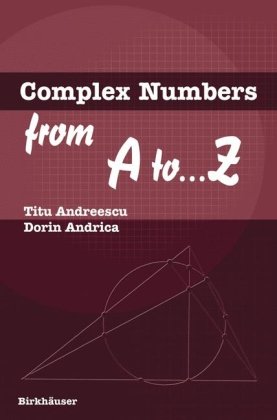
14. Complex Numbers from A to ...Z
by Titu Andreescu, Dorin Andrica
Paperback: 321 Pages (2005-10-03)
list price: US$49.95 -- used & new: US$38.33
(price subject to change: see help)
Asin: 0817643265
Average Customer Review: 5.0 out of 5 stars
Canada | United Kingdom | Germany | France | Japan
Editorial Review

Book Description

It is impossible to imagine modern mathematics without complex numbers. Complex Numbers from A to . . . Z introduces the reader to this fascinating subject that, from the time of L. Euler, has become one of the most utilized ideas in mathematics.

The exposition concentrates on key concepts and then elementary results concerning these numbers. The reader learns how complex numbers can be used to solve algebraic equations and to understand the geometric interpretation of complex numbers and the operations involving them.

The theoretical parts of the book are augmented with rich exercises and problems at various levels of difficulty. A special feature of the book is the last chapter, a selection of outstanding Olympiad and other important mathematical contest problems solved by employing the methods already presented.

The book reflects the unique experience of the authors. It distills a vast mathematical literature, most of which is unknown to the western public, and captures the essence of an abundant problem culture. The target audience includes undergraduates, high school students and their teachers, mathematical contestants (such as those training for Olympiads or the W. L. Putnam Mathematical Competition) and their coaches, as well as anyone interested in essential mathematics.

... Read more

Customer Reviews (3)

5-0 out of 5 stars Amazing book on complex numbers
This is a complete work about complex numbers. Perfect for Mathematical Olympiads. A lot of difficult problems.

5-0 out of 5 stars lots of unusual and challenging problems on complex numbers
Comprehensive and yet concise enough to cover lots of material. Lots of wonderful questions to challenge any math problem lovers.
Highly recommended.

5-0 out of 5 stars A very useful book on complex numbers
Mathematics is amazing not only in its power and beauty, but also in the way that it has applications in so many areas. The aim of this book is to stimulate young people to become interested in mathematics, to enthuse, inspire, and challenge them, their parents and their teachers with the wonder, excitement, power, and relevance of mathematics.
This book is a very well written introduction to the fascinating theory of complex numbers and it
contains a fine collection of excellent exercises ranging in difficulty from the fairly easy, if calculational, to the more challenging.As stated
by the authors, the targeted audience is not standard and it "includes high school students and their teachers,
undergraduates, mathematics contestants such as those training for Olympiads or the William Lowell Putnam Mathematical Competition, their coaches, and any person interested in essential mathematics."
The book is mainly devoted to complex numbers and to their wide applications in various fields, such as geometry, trigonometry or algebraic operations. An important feature of this marvelous book is that
it presents a wide range ofproblems of all degrees of difficulties, but also
that it includes easy proofs and natural generalizations of many theorems in elementary geometry.
The authors show how to approach the solution of such problems, emphasizing the use of methods rather than the mere use of formulas. Of course, the more sophisticated the problems become, the more specific this approach has to be chosen.

The book is self-contained; no background in complex numbers is assumed and complete
solutions to routine problems and to olympiad-caliber problems are presented in the last chapter of the book.
The aim of the core part of each chapter is to develop key mathematical ideas and to place them in the context of novel, interesting, and unexpected applications to real-world problems.
The first chapter deals with complex numbers in algebraic form and leads up to the geometric interpretations of the modulus and of the algebraic operations. The second chapter deals with various applications to trigonometry,
starting with elementary facts on the polar representation of complex numbers
and going up to more sophisticated properties related to $n$th roots of unity and their applications in solving
binomial equations. Chapter 3 is devoted to the applications of complex numbers in solving problems in Plane and Analytic Geometry. This chapter includes a lot of interesting properties related to collinearity, orthogonality, concyclicity, similar triangles, as well as very useful analytic formulas for the geometry of a triangle and of a circle in the complex plane. Chapter 4 contains much more powerful results such as: the nine-point circle of Euler, some important distances in a triangle, barycentric coordinates, orthopolar triangles, Lagrange's theorem, geometric transformations in the complex plane. This chapter also includes a marvelous theorem known in the mathematical
folklore under the name of "Morley's Miracle" and which simply states that "the three points of intersection
of the adjacent trisectors of any triangle form an equilateral triangle". As stated in the book, this theorem
was mistakenly attributed to Napoleon Bonaparte. The proof of this theorem follows directly from Theorem 3 on page 155, a deep result which was obtained by the celebrated French mathematician Alain Connes (Fields Medal in
1982 and Clay Research Award in 2000),
in connection with his revolutionary results in Noncommutative Geometry.Chapter 5illustrates the force of the
method of complex numbers in solving several Olympiad-caliber problems where this technique works very efficiently.

This very successful book is the fruit of the prodigious activity of two well-known creators of mathematics problems in various mathematical journals. The big experience of the authors in preparing students for various mathematical competitions allowed them to present a big collection of beautiful problems. This book continues the tradition making national and international mathematical competition problems available to a wider audience and is bound to appeal to anyone interested in mathematical problem solving.
I very strongly recommend this book to all students curious about elementary mathematics, especially those who are bored at school and ready for a challenge. Teachers would find this book to be a welcome resource, as will contest organizers.
This book is meant both to be read and to be used.
All in all, an excellent book for its intended audience!
... Read more


15. Random Number Generation and Monte Carlo Methods (Statistics and Computing)
by James E. Gentle
Hardcover: 264 Pages (2004-09-14)
list price: US$89.95 -- used & new: US$67.33
(price subject to change: see help)
Asin: 0387001786
Average Customer Review: 4.0 out of 5 stars
Canada | United Kingdom | Germany | France | Japan
Editorial Review

Book Description
Monte Carlo simulation has become one of the most important tools in all fields of science. Simulation methodology relies on a good source of numbers that appear to be random. These "pseudorandom" numbers must pass statistical tests just as random samples would. Methods for producing pseudorandom numbers and transforming those numbers to simulate samples from various distributions are among the most important topics in statistical computing. This book surveys techniques of random number generation and the use of random numbers in Monte Carlo simulation. The book covers basic principles, as well as newer methods such as parallel random number generation, nonlinear congruential generators, quasi Monte Carlo methods, and Markov chain Monte Carlo. The best methods for generating random variates from the standard distributions are presented, but also general techniques useful in more complicated models and in novel settings are described. The emphasis throughout the book is on practical methods that work well in current computing environments. The book includes exercises and can be used as a test or supplementary text for various courses in modern statistics. It could serve as the primary test for a specialized course in statistical computing, or as a supplementary text for a course in computational statistics and other areas of modern statistics that rely on simulation. The book, which covers recent developments in the field, could also serve as a useful reference for practitioners. Although some familiarity with probability and statistics is assumed, the book is accessible to a broad audience. The second edition is approximately 50% longer than the first edition. It includes advances in methods for parallel random number generation, universal methods for generation of nonuniform variates, perfect sampling, and software for random number generation. The material on testing of random number generators has been expanded to include a discussion of newer software for testing, as well as more discussion about the tests themselves. The second edition has more discussion of applications of Monte Carlo methods in various fields, including physics and computational finance. James Gentle is University Professor of Computational Statistics at George Mason University. During a thirteen-year hiatus from academic work before joining George Mason, he was director of research and design at the world's largest independent producer of Fortran and C general-purpose scientific software libraries. These libraries implement several random number generators, and are widely used in Monte Carlo studies. He is a Fellow of the American Statistical Association and a member of the International Statistical Institute. He has held several national offices in the American Statistical Association and has served as an associate editor for journals of the ASA as well as for other journals in statistics and computing. Recent activities include serving as program director of statistics at the National Science Foundation and as research fellow at the Bureau of Labor Statistics. ... Read more

Customer Reviews (3)

5-0 out of 5 stars Great Reference Book !
Very useful book if you plan to use Monte Carlo methods in your work. A timely topic + a highly respected authority in the field + good writing style = a great reference book !

2-0 out of 5 stars Not good for the beginner
Even though this book contains a lot of things,but you can not konw exactly how to do them from the book.The whole book is something like introduction and result.If you are interested at random number algorithm, this book is OK.The best book of Monte Carlo Methods for the beginner is Basics, Volume 1, Monte Carlo Methods,though this book is quite expensive.

5-0 out of 5 stars Random number algorithms
Software developers will find this book very useful. It gives a thoroughintroduction to the types of RNGs available (linear congruential, laggedFibonacci, etc.), as well as a thorough analysis of the strengths andweaknesses of each. The math is complete, but not intimidating. Algorithmsare included for sampling from many different types of distributions (Beta,Weibull, etc.). A helpful discussion of generating independent streams ofrandom numbers (i.e., on parallel processors or machines) is included.

Also useful: a chapter on assessing the quality of RNGs, discussions ofGibbs and Latin Hypercube sampling, and bootstrapping.

This book is"non-denominational". Many MC books focus on simulation inparticular fields (such as physics). The focus here is on the science ofrandom numbers itself.

This short book has been extremely helpful in myimplementation of Monte Carlo methods. The first 40 pages are virtually adaily reference for me. Any developer needing assistance and understandingof the types of random number generators available will find this smallbook extremely helpful. ... Read more


16. The structure of the real number system
by Leon Warren Cohen
 Unknown Binding: 114 Pages (1977)
list price: US$11.00
Isbn: 0882753967
Canada | United Kingdom | Germany | France | Japan

17. Symbolic Logic and the Real Number System
by A. H. Lightstone
 Hardcover: Pages (1965)

Asin: B000IXW368
Canada | United Kingdom | Germany | France | Japan

18. Building number sense: The number system (Investigations in number, data, and space)
by Marlene Kliman
 Unknown Binding: 236 Pages (1998)
-- used & new: US$0.64
(price subject to change: see help)
Asin: 1572324678
Canada | United Kingdom | Germany | France | Japan

19. Mathematical Thinking at Grade 5: Landmarks in the Number System (Student Activity Book) (TERC Investigations in Number, Data, and Space)
 Paperback: Pages (1998)

Isbn: 1572328053
Canada | United Kingdom | Germany | France | Japan
Editorial Review

Product Description
Student activity workbook for the classroom. ... Read more


20. The Number Systems of Analysis
by C. H. C. Little, K. L. Teo, B. Van Brunt
Hardcover: 240 Pages (2003-09)
list price: US$46.00 -- used & new: US$46.00
(price subject to change: see help)
Asin: 9812386068
Average Customer Review: 5.0 out of 5 stars
Canada | United Kingdom | Germany | France | Japan
Editorial Review

Book Description
Although students of analysis are familiar with real and complex numbers,few treatments of analysis deal with the development of such numbers inany depth. ... Read more

Customer Reviews (1)

5-0 out of 5 stars Where do numbers come from?
That question is absolutely fundamental to mathematics and philosophy, and this book deserves to become the classic answer for our time. Everyone specializing in analysis, fields, foundations, or the philosophy of mathematics should learn this material.

A little over 100 years ago, Dedekind, Frege, Peano, and Russell-Whitehead tackled this fundamental intellectual question. The culimination of these endeavours was Principia Mathematica, the mathematical equivalent of Battlestar Galactica. What came out of this vast enterprise was numbers as equivalence classes, given some flavour of set theory.

In 1930, the Gottingen mathematician Edmund Landau published a little book, whose preface read "my daughters are chemistry majors and haven't a clue as to why ab=ba, or why that might need proving. Hence this book." Landau began with the Peano axioms. Landau's book is an aging classic, badly typeset; the same holds for the 1951 English translation.

Suppes's 1960 book on ZF set theory includes a fine derivation of the integers, rationals as equivalence classes, and the reals as Dedekind cuts. But the development of the natural numbers required the axiom of choice. This is the abstract equivalent of equipping the police with nuclear weapons. Something is amiss here. Quine's Set Theory and Its Logic tells this story from a much leaner set of axioms, one not including Choice. But his prose and Principia notation make for hard going, and his approach has no following.

In 2003, along come Little, Teo, and Van Brunt, who do a superb job of deriving the numbers from natural to complex, build some nice bridges to elementary analysis, and prove the fundamental theorem of algebra. The reals are developed as Cauchy sequences rather than Dedekind cuts. The presentation is elegant and well thought out. My only objection is that the authors are coy about having grounded their story in ZF; the axioms are there, but are not called axioms and are buried in narrative prose. Nevertheless, it can be deciphered that the minimalist ontological grounding for this marvelous exercise is as follows: the null set exists and seeds an inductive set. For better or worse, the names Dedekind, Peano, and von Neumann do not appear in the index.
... Read more


  1-20 of 100 | Next 20

Prices listed on this site are subject to change without notice.
Questions on ordering or shipping? click here for help.

site stats