e99 Online Shopping Mall

Geometry.Net - the online learning center Help  
Home  - Basic P - Paleontology & Evolution (Books)

  Back | 41-60 of 100 | Next 20
A  B  C  D  E  F  G  H  I  J  K  L  M  N  O  P  Q  R  S  T  U  V  W  X  Y  Z  

click price to see details     click image to enlarge     click link to go to the store

$100.90
41. The Evolution of Plant Physiology
 
$330.00
42. Geology and Mineralogy, Considered
43. Evolution: A Biological and Palaeontological
$2.70
44. The Science Times Book of Fossils
$52.54
45. Meat-Eating and Human Evolution
$8.43
46. Understanding Human Evolution
$72.29
47. Evolution on Planet Earth: Impact
 
$350.00
48. On the Origin of Species; The
 
$320.00
49. Man's Place in Nature; The Evolution
 
50. The geological evidence of evolution
$142.50
51. Special Papers in Palaeontology,
 
52. Phylogeny Reconstruction in Paleontology
 
53. The proofs of evolution (Good
 
$9.95
54. Fossil Evidence for Human Evolution
 
55. Fossil Evidence for Human Evolution:
 
$8.47
56. Exploring the Borderlands: Documents
 
57. Evolution, from stellar dust to
$16.26
58. Evolucion Para Todos/ Introducing
 
59. Rates of Evolution
$69.27
60. Ecology and Evolution in Anoxic

41. The Evolution of Plant Physiology (Linnean Society Symposium, Number 21)
Hardcover: 512 Pages (2004-01-27)
list price: US$123.00 -- used & new: US$100.90
(price subject to change: see help)
Asin: 0123395526
Canada | United Kingdom | Germany | France | Japan
Editorial Review

Book Description
Coupled with biomechanical data, organic geochemistry and cladistic analyses utilizing abundant genetic data, scientific studies are revealing new facets of how plants have evolved over time. This collection of papers examines these early stages of plant physiology evolution by describing the initial physiological adaptations necessary for survival as upright structures in a dry, terrestrial environment. The Evolution of Plant Physiology also encompasses physiology in its broadest sense to include biochemistry, histology, mechanics, development, growth, reproduction and with an emphasis on the interplay between physiology, development and plant evolution.

* Contributions from leading neo- and palaeo-botanists from the Linnean Society
* Focus on how evolution shaped photosynthesis, respiration, reproduction and metabolism.
* Coverage of the effects of specific evolutionary forces -- variations in water and nutrient availability, grazing pressure, and other environmental variables ... Read more


42. Geology and Mineralogy, Considered with Reference to Natural Theology, Volume II; The Evolution Debate, 1813-1870 (Volume III)
by Willia Buckland
 Hardcover: 400 Pages (2003-12-17)
list price: US$330.00 -- used & new: US$330.00
(price subject to change: see help)
Asin: 0415289254
Canada | United Kingdom | Germany | France | Japan
Editorial Review

Book Description
Moving away from his earlier belief in a short, catastrophic history of the Earth, Buckland's Treatise envisages instead propounds the theory of a course of progressive change that occured as the Earth gradually cooled and became ready for human occupation. During this time, the creatures that first walked the earth did not die out because they were poorly designed; God loved the dinosaurs and had adapted them to their various circumstances. ... Read more


43. Evolution: A Biological and Palaeontological Approach
by P. W. Skelton, Iain Gilmour
Textbook Binding: 997 Pages (1993-03)
list price: US$51.00
Isbn: 0201544237
Average Customer Review: 3.0 out of 5 stars
Canada | United Kingdom | Germany | France | Japan

Customer Reviews (1)

3-0 out of 5 stars Easy read.
This is an excellent book to get an introduction into the world of evolution.Skelton cites many examples and not an overwhelming amount of statistics.But, this is not the best book to use to get an in-depthunderstanding into the ever-changing world of evolution.You would need touse other text to get a complete and comprehensive picture. ... Read more


44. The Science Times Book of Fossils and Evolution (Science Times)
Hardcover: 252 Pages (1998-04-01)
list price: US$25.00 -- used & new: US$2.70
(price subject to change: see help)
Asin: 1558216529
Canada | United Kingdom | Germany | France | Japan
Editorial Review

Amazon.com
Readers of the Science Times section on Tuesdays in the New York Times are familiar with the high-quality features to be found there.Now the best science and nature articles have been collected in a series of books on Fish, Birds, Fossils and Evolution, and The Brain.

Fossils and Evolution covers topics like the evolution of "bigness," fossil finds, and the origin of life. A chapter on the evolution of humans explores much of the recent paleontological research into this controversial subject. These articles are a great overview of the research highlights that made splashes in the media, as well as the quiet discoveries that make science fascinating. --Therese Littleton ... Read more


45. Meat-Eating and Human Evolution (Human Evolution Series)
Hardcover: 384 Pages (2001-06-14)
list price: US$97.00 -- used & new: US$52.54
(price subject to change: see help)
Asin: 0195131398
Average Customer Review: 4.0 out of 5 stars
Canada | United Kingdom | Germany | France | Japan
Editorial Review

Book Description
When, why, and how early humans began to eat meat are three of the most fundamental unresolved questions in the study of human origins. Before 2.5 million years ago the presence and importance of meat in the hominid diet is unknown. After stone tools appear in the fossil record it seems clear that meat was eaten in increasing quantities, but whether it was obtained through hunting or scavenging remains a topic of intense debate. This book takes a novel and strongly interdisciplinary approach to the role of meat in the early hominid diet, inviting well-known researchers who study the human fossil record, modern hunter-gatherers, and nonhuman primates to contribute chapters to a volume that integrates these three perspectives. Stanford's research has been on the ecology of hunting by wild chimpanzees. Bunn is an archaeologist who has worked on both the fossil record and modern foraging people. This will be a reconsideration of the role of hunting, scavenging, and the uses of meat in light of recent data and modern evolutionary theory. There is currently no other book, nor has there ever been, that occupies the niche this book will create for itself. ... Read more

Customer Reviews (1)

4-0 out of 5 stars "Love said, come taste my meate..."
"Love said, come taste my meate,
So I did sit and eate."John Donne's verse has endeared itself to countless undergraduates, not least through suspicion of a triple-entendre (at the very least).Be that as it may, the book under review is about ordinary eating of ordinary meat, specifically wild mammal meat.It supports the traditional consensus view that humans evolved from a mostly-vegetarian ape-like ancestor with a small brain, with the evolution of sociability, intelligence, and cooperation being due in large part to the exigencies of meat-eating.Meat is good food for the growing brain, among other things, but hunting--in an animal lacking fangs and claws--tends to require a great deal of cooperation.(In fact, even such fanged creatures as lions and wolves depend on exquisite cooperation within complex social systems.)Humans evolved in Africa, which seems less well endowed with easily exploited vegetable foods than some other continents, forcing more dependence on hunting and scavenging.The present book summarizes the enormous recent advances in our understanding of human evolution.A combination of archaeology, nutrition studies, and comparative studies of other primates have provided new proofs for the old model.It looks as if humans progressed (if that is the word) from near-vegetarians two million years ago to people who, at the dawn of agriculture 10,000 or 12,000 years ago, were eating anywhere from 10% to nearly 100% animal foods--average perhaps 20%.Neither the view of humans as natural vegetarians nor the view of humans as savage "killer apes" can be supported.
The book suffers from two flaws: first, over-reliance on a very few contemporary hunter-gatherer groups--especially the Hadza, who hunt with bows and metal-tipped poisoned arrows.These are a far cry from the crude stone tools of early hominids.Second, the authors seem a bit unclear on whether human advance was due more to meat as a food, or hunting as an activity, or omnivorous foraging (with hunting as only one part).I vote for the last alternative.We have evidence enough to make it reasonably clear that human skills in finding and processing vegetable food went right along with improvements in hunting.By widening their ethnographic net, the authors would have had to deal with hunter-gatherers who relied overwhelmingly on vegetable foods, often cooperatively produced, harvested, and/or processed.The Australian aboriginals and the Native Americans of what is now the western US come to mind.
The serious student of human foodways should definitely read this book!And the less serious meat-lover can revel in shoving it under the noses of those vegetarians who insist that theirs is the "natural" way. ... Read more


46. Understanding Human Evolution (4th Edition)
by Frank E. Poirier, Jeffrey K. McKee
Paperback: 386 Pages (1998-12-16)
list price: US$64.40 -- used & new: US$8.43
(price subject to change: see help)
Asin: 0130961523
Average Customer Review: 5.0 out of 5 stars
Canada | United Kingdom | Germany | France | Japan
Editorial Review

Book Description
This book provides a complete, unbiased, relativelynon-technical overview and state-of-the-art discussion of therapidly changing field of paleoanthropology. It features an abundanceof illustrations and photographs from the authors' visits to fossilsites, and views skeletal remains in light of what they can revealabout the populations they represent -- not only their anatomy butalso their behavior and social organization. Features rather extensive discussions on the use of genetic data --particularly that of mtDNA. Covers: Fossils, Fossilization, and DatingMethods; Determining Evolutionary Relationships; Our Place in theAnimal Kingdom; Reconstructing Human Behavioral Patterns and SocialOrganizations: Use of the Comparative Approach; Early PrimateEvolution; The Transition to Apes; Trends in Human Evolution; TheEarliest Hominids; The Hominid Divergence; Homo Erectus; EarlyHomo Sapiens; Neandertals and Their Immediate Predecessors; andThe Appearance of Homo sapiens sapiens.For anyoneinterested in a state-of-the-art discussion of paleoanthropology. ... Read more

Customer Reviews (1)

5-0 out of 5 stars Complete, comprehensive and compelling
Poirier and McKee present a wealth of information on the history of human evolution.They outline the methods of dating, identifying and assembling hominid fossils.Dating is shown to be, within the ranges of accuracy, nearly an absolute with today's technology.With the age of the fossil[s] established and the parts identified, the fossil may then be placed in its proper location on the human family tree.Poirier and McKee spend the remainder of the book describing the concepts, controversies and resolutions associated with that final step.The material requires attentive perusal, but the interested reader will be richly rewarded.

Early hominid fossils were chronologically located by stratigraphy - the position of the fossil in the rocks in relation to other, known, remnants.The early finds were often located in poorly identified areas, or mistakenly dated for a variety of reasons.Paleoanthropologists of an earlier day lacked the technology available today.Worse, they were often unaware of the need to examine the likely environment of the time the fossil was laid down.As the authors point out, this misunderstanding led to misinterpretation of how evolutionary relationships were structured.Today's "digs" are the subject of multi-discipline effort, with botanists, geologists and other fields represented.The more comprehensive picture laid out by these environment associated with the find allow a firmer footing on our ancestral lineage.

While that assertion sounds promising and our heritage is now viewed with confidence, nothing could be further from the truth.Where the human evolutionary tree once looked rather simple, with but a few offshoots extending from the central trunk, the improved accuracy of dating shows many branches.How many of these truly belong on the main branch and how many led to the dead end of extinction is what gives this book its real value.

Paleoanthropology has been among the liveliest of sciences.The debates and controversies have left academic halls and achieved public exposure.Poirier and McKee present the contentions of most of the major figures in the field with circumspection and clarity.With each new find, various interpretations arose, researchers attacking and defending positions from various foundations.The authors give each assertion its due, with resolution occasionally based on their own assessment.They have no hesitation in stating their own position, but it's given with justifications.Counter arguments are made with confirming data.Evidence is shown, but not nearly as strongly as the need for new results.This book, in many respects, reads like an academic work, but that in no small part is due to the authors'
call for more work in the field.

It would be unfair to say that every hominid fossil is given the authors' personal scrutiny, but the impression is proximate.Nearly every major site, with many of the associated prime fossils are described, sometimes with maps and photographs.The illustrative material, maps, diagrams and photographs are invaluable.About the only missing element is a single skeleton and skull with the bones frequently discussed in the book labeled.While many are, they must be examined out of context in many cases.If you have the anatomy, you won't need the information, but the rest of us require the crutch.

For anyone wishing to keep abreast of the research in determining where humanity comes from, this book is a treasure.Given the amount of information the authors had to cope with, the work is clear, unequivocal and immensely valuable.While not a light read, there's little to obstruct even the novice reader.The material is well organized and presented with a clear, straightforward style.Since the authors' aim is to explain [and recruit!] without perplexing the reader or seeking adherence to positions, they have produced a book that will endure. ... Read more


47. Evolution on Planet Earth: Impact of the Physical Environment
Hardcover: 448 Pages (2003-04)
list price: US$88.95 -- used & new: US$72.29
(price subject to change: see help)
Asin: 0125986556
Average Customer Review: 5.0 out of 5 stars
Canada | United Kingdom | Germany | France | Japan
Editorial Review

Book Description
Driving evolution forward, the Earth's physical environment has challenged the very survival of organisms and ecosystems throughout the ages. With a fresh new perspective, Evolution on Planet Earth shows how these physical realities and hurdles shaped the primary phases of life on the planet. The book's thorough coverage also includes chapters on more proximate factors and paleoenvironmental events that influenced the diversity of life.A team of notable ecologists, evolutionary biologists, and paleontologists join forces to describe drifting continents, extinction events, and climate change -- important topics that continue to shape Earth's inhabitants to this very day.In a world where global change has become an international issue, this book provides a several billion-year evolutionary perspective on what the environment and environmental change means to life.

* Provides thorough background information on each topic while introducing cutting-edge research
* Features original material solicited from the leading minds in evolutionary biology and geology today
* Emphasizes the influence of massive geological forces - continental drift, volcanic activity, sea and tides ... Read more

Customer Reviews (1)

5-0 out of 5 stars Evolution on Planet Earth
The authors have done a splendid job of bringing the physical environment back into evolutionary studies. Geared toward educated laymen and high school through graduate level scholars, each chapter looks at a different physical environment, e.g., radiation, plate tectonics. Instead of all evolution being caused only by genetics, this book reminds us that all the forces of the universe shape life! ... Read more


48. On the Origin of Species; The Evolution Debate, 1813-1870 (Volume V)
by Charles Darwin
 Hardcover: 400 Pages (2003-12-16)
list price: US$350.00 -- used & new: US$350.00
(price subject to change: see help)
Asin: 0415289270
Canada | United Kingdom | Germany | France | Japan
Editorial Review

Book Description
This volume is a facsimile of one of the original copies sent to the eminent geologist Leonard Horner. The volume also includes sample pages from Darwin's original handwritten manuscript; the exclusive property of the Natural History Museum. ... Read more


49. Man's Place in Nature; The Evolution Debate, 1813-1870 (Volume VII)
by Thomas H Huxley
 Hardcover: 400 Pages (2003-12-17)
list price: US$320.00 -- used & new: US$320.00
(price subject to change: see help)
Asin: 0415289297
Canada | United Kingdom | Germany | France | Japan
Editorial Review

Book Description
Huxley was one of the first adherents to Darwin's theory of evolution by natural selection and advanced its acceptance by scientists and the public. ... Read more


50. The geological evidence of evolution
by Angelo Heilprin
 Unknown Binding: 3 Pages (1888)

Asin: B00085O8IW
Canada | United Kingdom | Germany | France | Japan

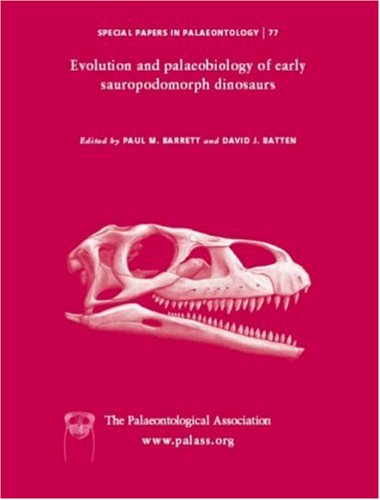
51. Special Papers in Palaeontology, Evolution and Palaeobiology of Early Sauropodomorph Dinosaurs (Special Papers in Palaeontology)
Paperback: 288 Pages (2007-03-30)
list price: US$150.00 -- used & new: US$142.50
(price subject to change: see help)
Asin: 1405169338
Canada | United Kingdom | Germany | France | Japan
Editorial Review

Book Description
Special Papers in Palaeontology, published by The Palaeontological Association, is a series of substantial separate works conforming to the style of the Palaeontology journal. Two issues are published each year and feature high standard illustrations.


  • An analysis of Sauropoda which includes many of the most familiar dinosaurs, such as Apatosaurus (formerly ‘Brontosaurus’), Diplodocus and Brachiosaurus (the latter finding fame in the Jurassic Park movies)

  • Advances our knowledge of sauropod phylogeny, biomechanics, physiology and ecology and offers insights into the limits of life at large body size

  • An active and constructive debate in dinosaur studies that will serve as a benchmark for future work on prosauropods and basal sauropods

  • Includes 107 text-figures and 24 tables
... Read more

52. Phylogeny Reconstruction in Paleontology
by Robert Schoch
 Hardcover: 416 Pages (1986-09)
list price: US$59.95
Isbn: 0442279671
Canada | United Kingdom | Germany | France | Japan

53. The proofs of evolution (Good read)
by Jean Pierre Lehman
 Unknown Binding: 156 Pages (1977)

Isbn: 0860330559
Canada | United Kingdom | Germany | France | Japan

54. Fossil Evidence for Human Evolution
by Sir Wilfrid Edward Le Gros Clark
 Paperback: 248 Pages (1979-03)
-- used & new: US$9.95
(price subject to change: see help)
Asin: 0226109380
Canada | United Kingdom | Germany | France | Japan

55. Fossil Evidence for Human Evolution: An Introduction to the Study of Paleoanthropology
by Wilfrid Edward Le Gros, Sir Clark
 Hardcover: 231 Pages (1979-04)
list price: US$16.00
Isbn: 0226109372
Canada | United Kingdom | Germany | France | Japan

56. Exploring the Borderlands: Documents Of The Committee On Common Problems Of Genetics, Paleontology, And Systematics (Transactions of the American Philosophical ... of the American Philosophical Society)
 Paperback: 160 Pages (2004-08)
list price: US$24.00 -- used & new: US$8.47
(price subject to change: see help)
Asin: 0871699427
Canada | United Kingdom | Germany | France | Japan

57. Evolution, from stellar dust to technological society
by Halsey Wilkinson Miller
 Unknown Binding: 197 Pages (1975)

Isbn: 0875630901
Canada | United Kingdom | Germany | France | Japan

58. Evolucion Para Todos/ Introducing Evolution
by Dylan Evans
Paperback: 174 Pages (2005-10-30)
list price: US$15.95 -- used & new: US$16.26
(price subject to change: see help)
Asin: 8449317827
Canada | United Kingdom | Germany | France | Japan

59. Rates of Evolution
by K. S. W. Campbell
 Hardcover: 384 Pages (1987-04)
list price: US$90.00
Isbn: 0045750300
Canada | United Kingdom | Germany | France | Japan

60. Ecology and Evolution in Anoxic Worlds (Oxford Series in Ecology and Evolution)
by Tom Fenchel, Bland J. Finlay
Paperback: 288 Pages (1995-04-20)
list price: US$149.00 -- used & new: US$69.27
(price subject to change: see help)
Asin: 0198548370
Average Customer Review: 5.0 out of 5 stars
Canada | United Kingdom | Germany | France | Japan
Editorial Review

Book Description
Anoxic conditions--the environments in which life began--still persist in many places on Earth, such as in lake sediments, the guts of ruminants, and the deep waters of some marine basins. Ecology and Evolution in Anoxic Worlds offers a current and unified natural history of oxygen-free
environments and their microbial inhabitants. Drawing on evidence from a variety of scientific disciplines, the authors--two leading researchers in the field--describe the forces known to shape the structure, function, heterogeneity, and evolution of anaerobic communities.Topics range from the
origin and maintenance of anoxic habitats throughout Earth's history to the origin of prokaryotes, eukaryotes, and eukaryotic organelles to the development of microbial communities.Particular emphasis is placed on how energy-yielding pathways which have evolved in anaerobic microorganisms dictate
the syntrophic and competitive interactions that shape anaerobic microbial community development.The ecological and evolutionary significance of the arrival of oxygen in the Proterozoic is discussed in detail.Splendidly readable, Ecology and Evolution in Anoxic Worlds brings an interdisciplinary
topic of growing interest up-to-date. It will be sought after by students and researchers in ecology, microbiology, biochemistry, zoology, evolutionary biology, geology, marine biology, and oceanography. ... Read more

Customer Reviews (2)

5-0 out of 5 stars Best introduction to anoxic worlds
Ecologyand evolution in anoxic worlds is one of the best introductions into the subject. I was recommended it by a research physician and I passed it on to a research palaeontologist. Not a bad coverage considering the fact that I am a tectonic geologist.

5-0 out of 5 stars Review of Ecology and Evolution in Anoxic Worlds
This book is very clearly written.It provides detailed information about anaerobes and places it in the broader context of the evolution of life's cellular pathways.It serves as an excellent compliment to Zehnder'sBiology of Anaerobic Microorganisms, which is a very difficult book tofind. ... Read more


  Back | 41-60 of 100 | Next 20
A  B  C  D  E  F  G  H  I  J  K  L  M  N  O  P  Q  R  S  T  U  V  W  X  Y  Z  

Prices listed on this site are subject to change without notice.
Questions on ordering or shipping? click here for help.

site stats