e99 Online Shopping Mall

Geometry.Net - the online learning center Help  
Home  - Basic P - Palynology Paleontology (Books)

  1-20 of 35 | Next 20
A  B  C  D  E  F  G  H  I  J  K  L  M  N  O  P  Q  R  S  T  U  V  W  X  Y  Z  

click price to see details     click image to enlarge     click link to go to the store

 
1. Palynology of the Miocene formations
 
2. Palynology of Arid Lands
3. Stratigraphic Palynology of the
 
4. Palynology and stratigraphy
 
5. Palynology and the Independence
 
6. Report - Israel Geological Survey,
 
$45.95
7. Palynomorph preparation procedures
 
8. Aspects of Palynology
$99.01
9. Paleopalynology: Second Edition
$66.15
10. Sedimentation of Organic Particles
$116.85
11. Amazon Pollen Manual and Atlas
 
$427.78
12. Antarctic Paleobiology: Its Role
 
13. Anthropogenic Indicators in Pollen
$147.31
14. First Floridians and Last Mastodons:
 
$9.50
15. Key to the Quaternary Pollen and
 
16. The paleontology of Rhodesia (Bulletin
 
17. Palynology of the Almond Formation
 
18. Second supplement, annotated references,
 
19. Palynological data from a 989-ft
 
20. Jurassic biostratigraphy of three

1. Palynology of the Miocene formations in the Yeoungill Bay District, Korea (Palaeontographica : Abt. B)
by Kiyoshi Takahashi
 Unknown Binding: Pages (1979)

Asin: B0007ARSX0
Canada | United Kingdom | Germany | France | Japan

2. Palynology of Arid Lands
by Aharon Horowitz
 Hardcover: 546 Pages (1992-07-01)
list price: US$230.50
Isbn: 0444882774
Average Customer Review: 3.0 out of 5 stars
Canada | United Kingdom | Germany | France | Japan
Editorial Review

Book Description
The main theme of this book is the reconstruction of past arid environments, with the help of palynology. Palynology was for a long time rarely practised in arid lands due to both technical and conceptual difficulties, mainly centered around poverty in pollen grains and different approaches necessary for treating the spectra, as compared with forested regions. However, recent developments in extraction techniques, along with new concepts applied for analysis of data, show the great potential lying in reconstructing past arid environments, along with a variety of ensuing ramifications. The book provides an update of the state of the art in this branch of science.

Firstly, it deals with natural agents relevant to palynology in arid lands, from pollen release by parent plants through transportation, deposition and preservation in various types of rocks. Then it describes sampling strategies, various treatments for extracting microfossils from ... Read more

Customer Reviews (1)

3-0 out of 5 stars Finding pollen in a desert
Since the early 1900s, more than 90% of all Quaternary-age pollen analyses have come from sediments with well-preserved fossil pollen such as peat bogs or related type deposits; furthermore, until the 1960s, many palynologists considered sediments from deserts and other arid-like environments a waste of processing and analysis time. Horowitz's book on arid lands is his attempt to change our minds about the potentials for recovering fossil pollen data from arid environments.He admits that although arid land sediments pose many special problems for sampling, processing, and recovering fossil pollen for analyses, they are, nevertheless, worthy of our attention and analysis. To date, Horowitz's book is the most thorough coverage written on the subject of fossil palynomorph sampling, processing, and recovery from arid environments. Thirty years earlier, Paul S. Martin of the University of Arizona wrote a now classic monograph called the Last 10,000 Years.During the 1960s his book served as a "wake-up call" to archaeologists, geologists, ecologists, and palynologists, and demonstrated that deposits collected from highly alkaline arroyo soils, from arid land archaeological sites, from playa lakes, and from desert surface transcets should be examined and utilized for interpretive purposes.It was the pioneering efforts of Martin and some of his graduate students that encouraged others to rethink their attitudes about fossil pollen recovery from arid lands, and go on to develop new techniques that would conquer the special palynological problems posed by arid land deposits.One of these other people was Aharon Horowitz.During the past 25-30 years as a palynologist he has tried to solve some of the sampling, processing, and interpretive problems created by arid land environments. Palynology of Arid Lands...is a book most of us should own as a handy reference.It is divided into 11 chapters with half of them covering a host of narrow topics such as sampling, extraction, identification, and interpretation.The rest address broader topics related to vegetational reconstructions, special problems created by archaeological sites, and the constraints and precautions that one should heed when examining arid land samples. One of the strong points of the book is that for many topics Horowitz discusses many different points of view, whether he agrees with them or not.Also included in the book is an extensive bibliography, a reference index of authors cited, and a subject index. As a palynologist who studied under Paul S. Martin, and who has also spent most of my career working with pollen records from arid lands, I found one major point in Horowitz's book with which I could not agree.In the United States, one major focus of current fossil pollen research in arid lands is trying to determine the interpretive importance of pollen influx, pollen concentration, and the ratio of identifiable vs. indeterminate pollen grains per unit volume (or weight) of sediment.Horowitz admits that this is not one of his major concerns.He says he is more concerned with knowing what "is still identifiable" in an arid land sample than he is in determining how many palynomorphs, or which taxa, may have been present originally.Also, he doesn't state whether or not he counts, or includes in his statistical data, the number of pollen grains in each sample that are no longer recognizable as anything more than just being a palynomorph of some indeterminate type.My major research thrust, and the research of a number of others working in the arid regions of the United States, have focused more on trying to understand the elements that cause pollen destruction in arid land sediments.Our efforts center on trying to determine what the total palynomorph assemblage of an arid land sediment may have been at the time of deposition, and how the palynomorph assemblage has changed in composition through time.We believe that knowing "only" what palynomorphs remain in a deposit is only part of the needed answer.We feel that, to interpret our fossil data correctly, we must first gain an understanding of how many palynomorphs and how many different taxa may have been deposited originally.In a recent article, Dr. Stephen Hall and I noted that in one large study of fossil pollen samples from arid land sediments in the U.S. we found that 70% of the deposited pollen "disappeared" between the time it was deposited and the time it became preserved and that 60% of the individual pollen types could no longer be found in the buried deposits. Thus, I question the validity of trying to interpret any fossil record based on only 30% of the original palynomorph assemblage and 40% of the originally deposited pollen taxa. Horowitz, on the other hand, believes that "any" pollen data from arid land samples is important for interpretative purposes.He does add that the level of interpretation and reliability of the data may vary depending on the amount of pollen recovered. Perhaps it is the many problems of trying to extract and identify fossil pollen records from arid land deposits that has created several distinct "schools" of thought as to how one should interpret "what is left" of the fossil pollen record.These same problems also create different views about how one should extract palynomorphs safely from arid land sediments.Horowitz, for example, believes in using only minimal extraction techniques and then counts "dirty" slides.As he says on page 172, "Counting such slides is in a way a matter of getting used to."I believe that one can sometimes make more counting errors trying to find and identify palynomorphs on a "dirty" slide than they might make if the slide were cleaner.However, I would agree with Horowitz that extreme care must be exercised during extraction or one might "process" away many of the fragile and badly deteriorated grains in an arid land deposit. Most of us who work with arid land sediments would agree that the extraction process is perhaps the single most important step in determining the eventual reliability of the fossil pollen data. In spite of my disagreements with some of the ideas expressed in Horowitz's book, I respect his views and can appreciate the effort and long hours that went into the data gathering and writing of this book. I would also agree with what one of my early mentors once told me, "It is far easier to criticize someone else's work than it is to produce your own work for someone else to criticize." ... Read more


3. Stratigraphic Palynology of the Palaeozoic of Saudi Arabia
by Gulf Petrolink, B. Owens
Hardcover: 232 Pages (2000-09-01)
list price: US$273.00
Isbn: 0444504907
Canada | United Kingdom | Germany | France | Japan
Editorial Review

Book Description
This volume describes in detail the results of a decade of collaboration between stratigraphers from Saudi Aramco and palynologists from the Commission Internationale de Microflore du Paleozoique (CIMP) on a programme to document the unique character of palynomorph assemblages recovered from the Ordovician to Permian sequences in the Arabian Peninsula. Not only are the assemblages described in detail for the first time but their potential as an exploration tool for regional correlation and palaeoenvironmental interpretation are fully realised. The Arabian Peninsula with its major hydrocarbon resources in the Palaeozoic, has long been dependant on long range comparisons to achieve effective correlations of deposits in the absence of a proven regional palynostratigraphic database. Despite the fact that independent biostratigraphic calibration of the sections still remain absent, the results from this study, based on data from more than ... Read more


4. Palynology and stratigraphy
by A. K Ghosh
 Unknown Binding: 366 Pages (1964)

Asin: B0007JSDSK
Canada | United Kingdom | Germany | France | Japan

5. Palynology and the Independence Shale of Iowa, (Bulletins of American paleontology)
by James B Urban
 Unknown Binding: 189 Pages (1971)

Asin: B0006C0SPY
Canada | United Kingdom | Germany | France | Japan

6. Report - Israel Geological Survey, Paleontology Division ; no. Pal/1/66
by A Gorni
 Unknown Binding: Pages (1966)

Asin: B0007JB6QG
Canada | United Kingdom | Germany | France | Japan

7. Palynomorph preparation procedures currently used in the paleontology and stratigraphy laboratories, U.S. Geological Survey (Geological Survey circular)
by L. Imogene Doher
 Unknown Binding: 29 Pages (1980)
-- used & new: US$45.95
(price subject to change: see help)
Asin: B0006XMQDK
Canada | United Kingdom | Germany | France | Japan

8. Aspects of Palynology
by Robert H. Tschudy, Richard A. Scott
 Hardcover: 518 Pages (1970-03-18)
list price: US$79.95
Isbn: 0471892203
Canada | United Kingdom | Germany | France | Japan

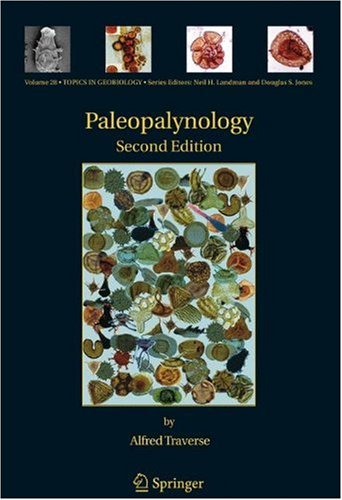
9. Paleopalynology: Second Edition (Topics in Geobiology)
by Alfred Traverse
Paperback: 813 Pages (2007-11-14)
list price: US$129.00 -- used & new: US$99.01
(price subject to change: see help)
Asin: 1402066848
Canada | United Kingdom | Germany | France | Japan
Editorial Review

Book Description

Paleopalynology, second edition, provides profusely illustrated treatment of fossil palynomorphs, including spores, pollen, dinoflagellate cysts, acritarchs, chitinozoans, scolecodonts, and various microscopic fungal and algal dispersal bodies. The book serves both as a student text and general reference work. Palynomorphs yield information about age, geological and biological environment, climate during deposition, and other significant factors about the enclosing rocks.

Extant spores and pollen are treated first, preparing the student for more difficult work with fossil sporomorphs and other kinds of palynomorphs. Recognizing that palynomorphs occur together in rocks because of chemical robustness and stratigraphic distribution, not biological relationship, the central sections are organized stratigraphically. Among many other topics presented are the sedimentation and geothermal alteration of palynomorphs, and palynofacies analysis. An appendix describes laboratory methods. The glossary, bibliographies and index are useful tools for study of the literature.

... Read more

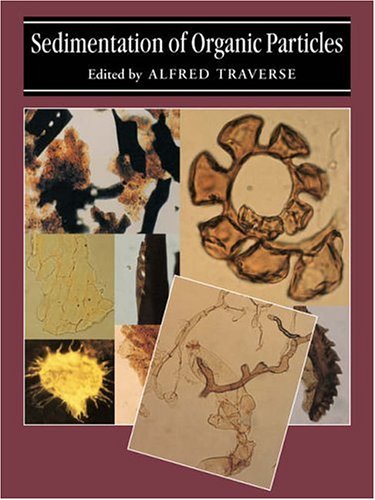
10. Sedimentation of Organic Particles
Paperback: 556 Pages (2005-07-14)
list price: US$90.00 -- used & new: US$66.15
(price subject to change: see help)
Asin: 0521675502
Canada | United Kingdom | Germany | France | Japan
Editorial Review

Book Description
This book presents research work on the sedimentation of components of palynofacies and details their importance for sequence stratigraphy and the interpretation of ancient biologic and geologic environments.After a comprehensive introduction, later chapters look at palynosedimentation in modern environments, the reconstruction of terrestrial vegetation, the application of the data to sequence stratigraphy and several chapters deal with various quantitative methods and their specific applications in the subject. ... Read more


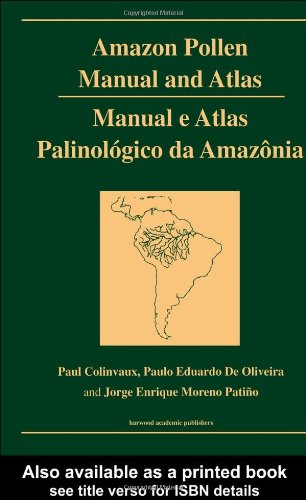
11. Amazon Pollen Manual and Atlas
by Paul A Collinvaux, Paulo E. De Oliveira, Enrique Moreno
Hardcover: 344 Pages (1999-12-01)
list price: US$139.95 -- used & new: US$116.85
(price subject to change: see help)
Asin: 9057025876
Canada | United Kingdom | Germany | France | Japan
Editorial Review

Book Description
Ecologist Paul Colinvaux's past several years in the Amazon yield this important manual written both in English and Portuguese. Consisting, in large part, of illustrations of the principal pollen types that have been found and identified in the sediments of Amazonian lakes, Amazon Pollen Manual and Atlas will prove a powerful tool for ecologists and climate modelers. The manual also contains brief reviews of pioneering pollen work in the Amazon to date, as well as sections on pollen methods, pollen statistics, paleoecology, and lake coring methods. ... Read more


12. Antarctic Paleobiology: Its Role in the Reconstruction of Gondwana
by Thomas N. Taylor
 Hardcover: 261 Pages (1990-01)
list price: US$225.00 -- used & new: US$427.78
(price subject to change: see help)
Asin: 0387970061
Canada | United Kingdom | Germany | France | Japan
Editorial Review

Book Description
Antarctic Paleobiology discusses the current status of paleobiology, principally paleobotany and palynology in Antarctica, and the interrelationship of Antarctic floras to those of other Gondwana continents. It provides a broad coverage of the major groups of plants on the one hand, while on the other seeking to evaluate the vegetational history and the physical and biological parameters that influence the distribution of floras through time and space. The biologic activity is discussed within a framework of the geologic history, including the tectonic and paleogeographic history of the region. Finally, the reader will find a comprehensive bibliography of Gondwana paleobotany and palynology. ... Read more


13. Anthropogenic Indicators in Pollen Diagr
 Hardcover: 232 Pages (1986-12-31)
list price: US$157.95
Isbn: 9061916739
Canada | United Kingdom | Germany | France | Japan

14. First Floridians and Last Mastodons: The Page-Ladson Site in the Aucilla River (Topics in Geobiology)
Hardcover: 613 Pages (2006-11-10)
list price: US$199.00 -- used & new: US$147.31
(price subject to change: see help)
Asin: 1402043252
Canada | United Kingdom | Germany | France | Japan
Editorial Review

Product Description

This book reveals the remarkable wealth of prehistoric evidence recovered during twenty years delving into an ancient sinkhole in the remote swamps of north Florida. The authors describe the new methods of precise underwater excavations by which they survived hurricanes and worked in dark water. The deepest strata produced powerful evidence of the first Floridians, some 14,000 years ago, butchering tusks from American Mastodon in order to manufacture at least nine kinds of ivory tools. They also utilized at least a dozen other large terrestrial species of the late Ice Ages. Clever studies of stable isotopes tell that the Mastodons migrated north out of Florida into glacial terrain during the winter and spring. They also show which of the megafauna were browsers and which grazers. Digesta of the Mastodon display their rich summer diet and also contain steroids and epithelial cells. Pollen studies and sediments trace the environmental history of the region through eight millenia beginning more than 14,000 years ago.

... Read more

15. Key to the Quaternary Pollen and Spores of the Great Lakes Region (Royal Ontario Museum life sciences miscellaneous publication)
by John H. McAndrews, A. A. Berti, G. Norris
 Paperback: 61 Pages (1973-06)
list price: US$10.00 -- used & new: US$9.50
(price subject to change: see help)
Asin: 088854149X
Canada | United Kingdom | Germany | France | Japan

16. The paleontology of Rhodesia (Bulletin - Rhodesia Geological Survey)
by Geoffrey Bond
 Unknown Binding: 121 Pages (1973)

Asin: B0007AQQFG
Canada | United Kingdom | Germany | France | Japan

17. Palynology of the Almond Formation (Upper Cretaceous), Rock Springs uplift, Wyoming, (Bulletins of American paleontology)
by J. Fred Stone
 Unknown Binding: 135 Pages (1973)

Asin: B0006C9VNY
Canada | United Kingdom | Germany | France | Japan

18. Second supplement, annotated references, Precambrian to Tertiary palynological literature (Paleo data banks)
by Gerhard O. W Kremp
 Unknown Binding: 128 Pages (1982)

Asin: B0006YSDCC
Canada | United Kingdom | Germany | France | Japan

19. Palynological data from a 989-ft (301-M) core of Pliocene and early Pleistocene sediments from Bruneau, Idaho (Open-file report)
by Robert S Thompson
 Unknown Binding: Pages (1993)

Asin: B0006OXC3W
Canada | United Kingdom | Germany | France | Japan

20. Jurassic biostratigraphy of three borings in NW Scania: A brief palynological report (Rapporter och meddelanden / Sveriges geologiska undersökning)
by Dorothy Guy-Ohlson
 Unknown Binding: 41 Pages (1978)

Asin: B0007B3BMQ
Canada | United Kingdom | Germany | France | Japan

  1-20 of 35 | Next 20
A  B  C  D  E  F  G  H  I  J  K  L  M  N  O  P  Q  R  S  T  U  V  W  X  Y  Z  

Prices listed on this site are subject to change without notice.
Questions on ordering or shipping? click here for help.

site stats