
|
Help |
| Home - Basic R - Racism (Books) | |
e99 Online Shopping Mall
|
|
Help |
| Home - Basic R - Racism (Books) | |
| 1-20 of 98 | Next 20 |
click price to see details click image to enlarge click link to go to the store
| 1. A Practical Guide to Racism by C. H. Dalton | |
 | Paperback: 224
Pages
(2008-12-30)
list price: US$14.00 -- used & new: US$4.75 (price subject to change: see help) Asin: B002QGSVS4 Average Customer Review: 
Canada | United Kingdom | Germany | France | Japan |
|
Editorial Review Product Description Customer Reviews (27)
| |
| 2. Racism without Racists: Color-Blind Racism and the Persistence of Racial Inequality in America by Eduardo Bonilla-Silva | |
 | Paperback: 318
Pages
(2009-11-16)
list price: US$28.95 -- used & new: US$24.75 (price subject to change: see help) Asin: 1442202181 Average Customer Review: 
Canada | United Kingdom | Germany | France | Japan |
|
Editorial Review Product Description Customer Reviews (17)
| |
| 3. The End of Racism: Principles for a Multiracial Society by Dinesh D'Souza | |
| Paperback: 756
Pages
(1995-09-30)
list price: US$18.00 -- used & new: US$2.56 (price subject to change: see help) Asin: 0684825244 Average Customer Review:
Canada | United Kingdom | Germany | France | Japan | |
|
Editorial Review Product Description Much of what D'Souza says flies in the face of liberal doctrine. Hemaintains that there are cultural differences that account fordistinct levels of achievement among races, and that racism cannot beblamed for "black failure." He argues that racism is not auniversal phenomenon but a relatively recent Western intellectualconcept, and because we can trace racism's beginning we can likewisebring about its demise. He deals blow after blow to longstanding"myths" about race, criticizing the "civil rightsindustry," rejecting "misguided" solutions such asmulticulturalism and proportional representation as "fightingdiscrimination by practicing it," and even calls for a repeal ofthe near-sacred Civil Rights Act of 1964. This is not an easy book to read, but it is an important one. Even ifmore than a few disagree with D'Souza's assumptions and arguments, allshould welcome his well-considered, insightful treatment of thisimmensely difficult topic. --Uma Kukathas Customer Reviews (104)
| |
| 4. Uprooting Racism: How White People Can Work for Racial Justice by Paul Kivel | |
 | Paperback: 272
Pages
(2002-05-01)
list price: US$18.95 -- used & new: US$8.99 (price subject to change: see help) Asin: 0865714592 Average Customer Review: 
Canada | United Kingdom | Germany | France | Japan |
|
Editorial Review Product Description Customer Reviews (12)
| |
| 5. Overcoming Our Racism: The Journey to Liberation by Derald Wing Sue | |
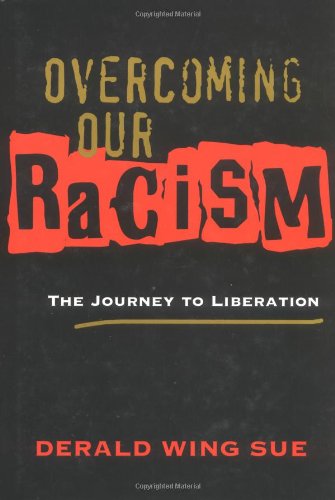 | Hardcover: 320
Pages
(2003-07-11)
list price: US$24.95 -- used & new: US$13.89 (price subject to change: see help) Asin: 0787967440 Average Customer Review:
Canada | United Kingdom | Germany | France | Japan |
|
Editorial Review Product Description "This book is intended to provoke and challenge, and it succeeds admirably. Sometimes it even made me angry, but it always forced me to think about myself and assess the way I behave." — Arthur Levine, Ph.D., president, Teachers College, Columbia University "Dr. Sue is mapping a warrior's path with a compassionate heart.This book will take the discussion of racism in our society to a new level in which we can finally begin to address it in a manner that will bring deep changes and not just more rhetoric." —Eduardo Duran, Ph.D., Apache/Tewa, author, Buddha in Redface "Most of us have internalized attitudes that affect our actions in negative and unfair ways toward people of color. Sue's book allows us to understand those attitudes as well as the white privilege most White Americans do not realize they possess! All thinking people who wish to increase integrity in their interactions with others should read this book!" —Melba J. T. Vasquez, Ph.D., ABPP, past president, American Psychological Association's Society for the Psychology of Women "This singular book provides racially clueless and sometimes well-meaning people with the tools and context to liberate themselves— and the rest of us— from their destructive ways. Though the book centers on racism and whiteness, it also gives an insightful approach to other biased behavior, whether based on gender, sexual orientation, age, disability, or other common markers of prejudice. Most important, this book offers all of us the hope that constructive change is not only possible but within our capacity to achieve." —Helen Zia, author, Asian American Dreams: The Emergence of An American People Customer Reviews (8)
| |
| 6. Challenging Racism in Higher Education: Promoting Justice by Mark Chesler | |
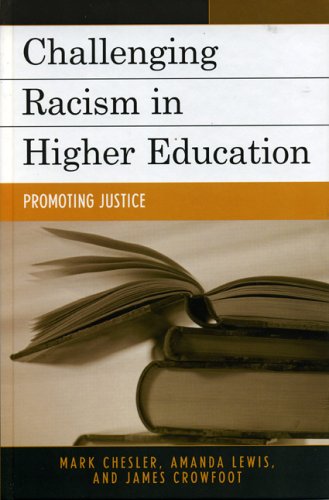 | Hardcover: 352
Pages
(2005-08-11)
list price: US$103.00 -- used & new: US$90.37 (price subject to change: see help) Asin: 0742524566 Canada | United Kingdom | Germany | France | Japan |
|
Editorial Review Product Description | |
| 7. Racism on Trial: The Chicano Fight for Justice by Ian F. Haney López | |
 | Paperback: 336
Pages
(2004-09-01)
list price: US$21.50 -- used & new: US$12.04 (price subject to change: see help) Asin: 0674016297 Average Customer Review:
Canada | United Kingdom | Germany | France | Japan |
|
Editorial Review Product Description In 1968, ten thousand students marched in protest over the terrible conditions prevalent in the high schools of East Los Angeles, the largest Mexican community in the United States. Chanting ""Chicano Power,"" the young insurgents not only demanded change but heralded a new racial politics. Frustrated with the previous generation's efforts to win equal treatment by portraying themselves as racially white, the Chicano protesters demanded justice as proud members of a brown race. The legacy of this fundamental shift continues to this day. Ian Haney López tells the compelling story of the Chicano movement in Los Angeles by following two criminal trials, including one arising from the student walkouts. He demonstrates how racial prejudice led to police brutality and judicial discrimination that in turn spurred Chicano militancy. He also shows that legal violence helped to convince Chicano activists that they were nonwhite, thereby encouraging their use of racial ideas to redefine their aspirations, culture, and selves. In a groundbreaking advance that further connects legal racism and racial politics, Haney López describes how race functions as ""common sense,"" a set of ideas that we take for granted in our daily lives. This racial common sense, Haney López argues, largely explains why racism and racial affiliation persist today. By tracing the fluid position of Mexican Americans on the divide between white and nonwhite, describing the role of legal violence in producing racial identities, and detailing the commonsense nature of race, Haney López offers a much needed, potentially liberating way to rethink race in the United States. Customer Reviews (7)
To get at this legacy, the author looks at the way the police and the courts mistreated Mexican Americans, and offers a theory of what he calls "common sense racism."This theory really helps explain how racism is tied into to taken-for-granted ideas as well as the way our world has been structured by centuries of racism. Lopez may overclaim when he says most racism is now of the common sense variety, but he certainly contributes an important way of thinking about how racism continues even when there is no individual racist. On the whole, this is a great book. It tells an amazing story about Chicano activism. It gives a concise history about how Mexicans have been treated as a race in this country, and about how they have responded. And it offers a sophisticated way of thinking about how race operates as social knowledge, both in the hands of racists and those opposed to racism. I would definitely recommend this book. ... Read more | |
| 8. Racism: A Short History by George M. Fredrickson | |
 | Paperback: 224
Pages
(2003-07-02)
list price: US$22.95 -- used & new: US$15.00 (price subject to change: see help) Asin: 0691116520 Average Customer Review:
Canada | United Kingdom | Germany | France | Japan |
|
Editorial Review Product Description With a rare blend of learning, economy, and cutting insight, George Fredrickson surveys the history of Western racism from its emergence in the late Middle Ages to the present. Beginning with the medieval antisemitism that put Jews beyond the pale of humanity, he traces the spread of racist thinking in the wake of European expansionism and the beginnings of the African slave trade. And he examines how the Enlightenment and nineteenth-century romantic nationalism created a new intellectual context for debates over slavery and Jewish emancipation. Fredrickson then makes the first sustained comparison between the color-coded racism of nineteenth-century America and the antisemitic racism that appeared in Germany around the same time. He finds similarity enough to justify the common label but also major differences in the nature and functions of the stereotypes invoked. The book concludes with a provocative account of the rise and decline of the twentieth century's overtly racist regimes--the Jim Crow South, Nazi Germany, and apartheid South Africa--in the context of world historical developments. This illuminating work is the first to treat racism across such a sweep of history and geography. It is distinguished not only by its original comparison of modern racism's two most significant varieties--white supremacy and antisemitism--but also by its eminent readability. Customer Reviews (10)
| |
| 9. Understanding and Dismantling Racism: The Twenty-First Century Challenge to White America (Facets) by Joseph Barndt | |
 | Paperback: 244
Pages
(2007-10-01)
list price: US$17.00 -- used & new: US$11.41 (price subject to change: see help) Asin: 0800662229 Average Customer Review: 
Canada | United Kingdom | Germany | France | Japan |
|
Editorial Review Product Description With great clarity Barndt traces the history of racism, especially in white America, revealing its various personal, institutional, and cultural forms. Without demonizing anyone or any race, he offers specific, positive ways in which people in all walks, including churches, can work to bring racism to an end. He includes the newest data on continuing conditions of People of Color, including their progress relative to the minimal standards of equality in housing, income and wealth, education, and health. He discusses current dimensions of race as they appear in controversies over 9/11, New Orleans, and undocumented workers. Includes analytical charts, definitions, bibliography, and exercises for readers. Customer Reviews (5)
| |
| 10. The First R: How Children Learn Race and Racism by Debra Van Ausdale | |
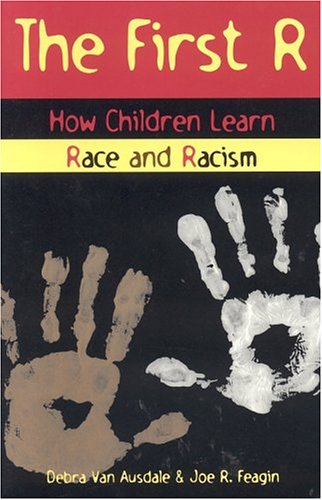 | Paperback: 240
Pages
(2001-12-11)
list price: US$21.95 -- used & new: US$10.99 (price subject to change: see help) Asin: 0847688623 Average Customer Review:
Canada | United Kingdom | Germany | France | Japan |
|
Editorial Review Product Description Customer Reviews (3)
| |
| 11. The Skin I'm In: A First Look at Racism by Pat Thomas | |
 | Paperback: 32
Pages
(2003-04)
list price: US$6.99 -- used & new: US$3.24 (price subject to change: see help) Asin: 0764124595 Average Customer Review:
Canada | United Kingdom | Germany | France | Japan |
|
Editorial Review Product Description Customer Reviews (5)
| |
| 12. The Everyday Language of White Racism (Blackwell Studies in Discourse and Culture) by Jane H. Hill | |
 | Hardcover: 240
Pages
(2008-11-12)
list price: US$94.95 -- used & new: US$79.48 (price subject to change: see help) Asin: 140518454X Average Customer Review:
Canada | United Kingdom | Germany | France | Japan |
|
Editorial Review Product Description Customer Reviews (2)
| |
| 13. Anatomy Of Racism by David Goldberg | |
 | Paperback: 384
Pages
(1990-08-20)
list price: US$26.00 -- used & new: US$23.17 (price subject to change: see help) Asin: 0816618046 Canada | United Kingdom | Germany | France | Japan |
| 14. The Invention of Racism in Classical Antiquity by Benjamin Isaac | |
 | Paperback: 592
Pages
(2006-02-13)
list price: US$31.95 -- used & new: US$24.26 (price subject to change: see help) Asin: 0691125988 Average Customer Review: 
Canada | United Kingdom | Germany | France | Japan |
|
Editorial Review Product Description Customer Reviews (1)
| |
| 15. Einstein on Race and Racism by Fred Jerome | |
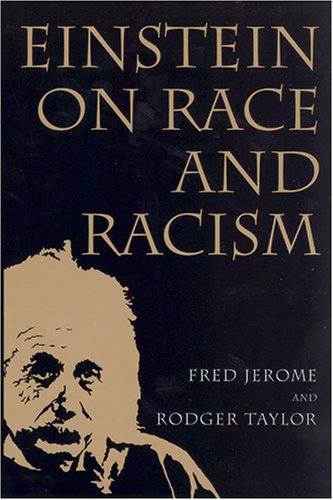 | Paperback: 224
Pages
(2006-07-25)
list price: US$17.95 -- used & new: US$14.99 (price subject to change: see help) Asin: 0813539528 Average Customer Review:
Canada | United Kingdom | Germany | France | Japan |
|
Editorial Review Product Description This unique book is the first to bring together a wealth of writings by Einstein on the topic of race. Although his activism in this area is less well known than his efforts on behalf of international peace and scientific cooperation, he spoke out vigorously against racism both in the United States and around the world. Combining the scientist’s letters, speeches, and articles with an engaging narrative that places his public statements in the context of his life and times, this important collection not only brings attention to Einstein’s antiracist public activities, but also provides insight into antiracist struggles in America. Customer Reviews (6)
| |
| 16. Racism: A Very Short Introduction (Very Short Introductions) by Ali Rattansi | |
 | Paperback: 144
Pages
(2007-05-01)
list price: US$11.95 -- used & new: US$6.20 (price subject to change: see help) Asin: 0192805908 Average Customer Review:
Canada | United Kingdom | Germany | France | Japan |
|
Editorial Review Product Description Customer Reviews (2)
| |
| 17. Conservatism and Racism, and Why in America They Are the Same (Suny Series in African American Studies) by Robert C. Smith | |
 | Hardcover: 273
Pages
(2010-09)
list price: US$85.00 -- used & new: US$85.00 (price subject to change: see help) Asin: 143843233X Canada | United Kingdom | Germany | France | Japan |
|
Editorial Review Product Description | |
| 18. White Logic, White Methods: Racism and Methodology by Tukufu Zuberi, Eduardo Bonilla-Silva | |
 | Paperback: 416
Pages
(2008-05-02)
list price: US$42.95 -- used & new: US$36.97 (price subject to change: see help) Asin: 0742542815 Canada | United Kingdom | Germany | France | Japan |
|
Editorial Review Product Description | |
| 19. From Racism to Genocide: Anthropology in the Third Reich by Gretchen E. Schafft | |
 | Paperback: 320
Pages
(2007-02-05)
list price: US$25.00 -- used & new: US$20.96 (price subject to change: see help) Asin: 025207453X Average Customer Review:
Canada | United Kingdom | Germany | France | Japan |
|
Editorial Review Product Description In paperback for the first time, From Racism to Genocide is an explosive, richly detailed account of how Nazi anthropologists justified racism, developed practical applications of racist theory, and eventually participated in every phase of the Holocaust. Using original sources and previously unpublished documentation, Gretchen E. Schafft shows the total range of anti-human activity from within the confines of a particular discipline. Based on seven years of archival research in the United States and abroad, the work includes many original photos and documents, most of which have never before been published. It uses primary data and original texts whenever possible, including correspondence written by perpetrators. The book also reveals that the United States was not merely a bystander in this research, but instead contributed professional and financial support to early racial research that continued through the first five years of Hitler’s regime. Customer Reviews (2)
| |
| 20. Living with Racism: The Black Middle-Class Experience by Joe R. Feagin, Melvin P. Sikes | |
 | Paperback: 416
Pages
(1995-07-31)
list price: US$30.00 -- used & new: US$3.02 (price subject to change: see help) Asin: 0807009253 Canada | United Kingdom | Germany | France | Japan |
|
Editorial Review Product Description | |
| 1-20 of 98 | Next 20 |
 maybe he should
 disappointed.