e99 Online Shopping Mall

Geometry.Net - the online learning center Help  
Home  - Basic R - Rationalism Philosophy (Books)

  1-20 of 100 | Next 20
A  B  C  D  E  F  G  H  I  J  K  L  M  N  O  P  Q  R  S  T  U  V  W  X  Y  Z  

click price to see details     click image to enlarge     click link to go to the store

$35.90
1. The Renaissance and 17th Century
$105.56
2. A Companion to Rationalism (Blackwell
$53.48
3. Historical Dictionary of Descartes
$11.77
4. Reading Bayle (Toronto Studies
 
5. Rationalism in Greek Philosophy
$106.99
6. Criticism and the History of Science:
 
$5.95
7. Socratic Rationalism and Political
 
8. Irrationalism and rationalism
 
$40.00
9. Rationalism, Platonism and God:
 
$59.00
10. The Roots Of Critical Rationalism.(Schriftenreihe
$60.00
11. A Critical Rationalist Aesthetics.
 
12. A Philosopher's Apprentice: In
$67.93
13. Between Rationalism and Empiricism:
 
$14.87
14. The Great Arnauld and Some of
$209.97
15. Rational Changes in Science: Essays
 
$22.50
16. Socratic Rationalism and Political
$93.45
17. The Oxford Handbook of Rationality
 
$30.95
18. Mensch Und Gesellschaft Aus Der
$99.00
19. In Defense of Pure Reason: A Rationalist
 
$225.00
20. Routledge History of Philosophy:

1. The Renaissance and 17th Century Rationalism: Routledge History of Philosophy Volume 4
by H. Parkinson
Paperback: 480 Pages (2003-05-01)
list price: US$41.95 -- used & new: US$35.90
(price subject to change: see help)
Asin: 0415308763
Canada | United Kingdom | Germany | France | Japan
Editorial Review

Book Description
This volume covers a period of three hundred and fifty years, from the middle of the fourteenth century to the early years of the eighteenth century: the birth of modern philosophy. ... Read more


2. A Companion to Rationalism (Blackwell Companions to Philosophy)
Hardcover: 512 Pages (2006-01-03)
list price: US$145.95 -- used & new: US$105.56
(price subject to change: see help)
Asin: 1405109092
Canada | United Kingdom | Germany | France | Japan
Editorial Review

Book Description
This book is a wide-ranging examination of rationalist thought in philosophy from ancient times to the present day.

  • Written by a superbly qualified cast of philosophers.
  • Critically analyses the concept of rationalism.
  • Focuses principally on the golden age of rationalism in the seventeenth and early eighteenth centuries.
  • Also covers ancient rationalism, nineteenth-century rationalism, and rationalist themes in recent thought.
  • Organised chronologically.
  • Various philosophical methods and viewpoints are represented.
  • ... Read more

    3. Historical Dictionary of Descartes and Cartesian Philosophy (Historical Dictionaries of Religions, Philosophies and Movements)
    by Roger Ariew
    Hardcover: 320 Pages (2003-11-28)
    list price: US$72.00 -- used & new: US$53.48
    (price subject to change: see help)
    Asin: 0810848333
    Canada | United Kingdom | Germany | France | Japan
    Editorial Review

    Book Description
    This is a dictionary of Descartes and Cartesian philosophy, primarily covering philosophy in the 17th century, with a chronology and biography of Descartes's life and times and a bibliography of primary and secondary works related to Descartes and to Cartesians. ... Read more


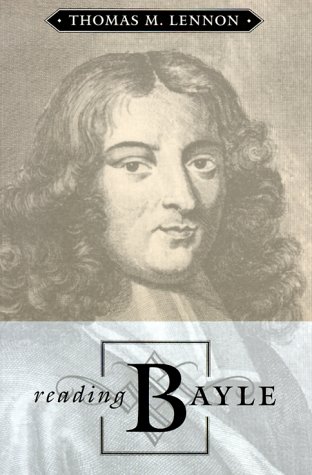
    4. Reading Bayle (Toronto Studies in Philosophy)
    by Thomas M. Lennon
    Paperback: 240 Pages (1999-08-07)
    list price: US$20.95 -- used & new: US$11.77
    (price subject to change: see help)
    Asin: 0802082661
    Average Customer Review: 2.0 out of 5 stars
    Canada | United Kingdom | Germany | France | Japan
    Editorial Review

    Book Description

    Pierre Bayle (1647-1706) has been described by Richard Popkin as the key intellectual figure at the outset of the eighteenth century. Examinations of libraries from the period show him to have been by far the most successful author of the century, and his Historical and Critical Dictionary is in fact the philosophy best-seller of all time. The concepts, distinctions, and arguments found in his work were so widely adopted by later authors that Bayle came to be known as the 'Arsenal of the Enlightenment'.Despite his universally acknowledged importance, however, there has been from his own time to the present much disagreement about how Bayle is to be interpreted.

    The title of this work is deliberately ambiguous, reflecting the multiple levels on which its argument is conducted. One aim is to indicate how a reading of Bayle might be made possible-how the initial impenetrability of his writings and their world might be overcome. On another level, the book offers an interpretation of Bayle's writings. Finally, it is a record of the author's own thoughts upon reading Bayle-what he finds himself thinking about as he looks at Bayle and his world.

    This work is a critical but sympathetic treatment of this neglected thinker. It will engage anyone interested in the history of modern philosophy, the history of ideas, literary criticism, and the history of seventeenth-century French culture. ... Read more

    Customer Reviews (1)

    2-0 out of 5 stars Now I'm even more confused...
    I bought this book because I found Bayle's works confusing and difficult to approach.This book - with its very promissing title - is just as confusing and unapproachable.It certainly was of no help to me. ... Read more


    5. Rationalism in Greek Philosophy
    by George Boas
     Hardcover: 514 Pages (1961-11-01)
    list price: US$27.50
    Isbn: 080180079X
    Canada | United Kingdom | Germany | France | Japan

    6. Criticism and the History of Science: Kuhn'S, Lakatos's and Feyerabend's Criticisms of Critical Rationalism (Philosophy of History and Culture)
    by Gunnar Andersson
    Hardcover: 161 Pages (1994-07)
    list price: US$107.00 -- used & new: US$106.99
    (price subject to change: see help)
    Asin: 9004100504
    Canada | United Kingdom | Germany | France | Japan
    Editorial Review

    Book Description
    Criticism and the History of Science deals with Thomas Kuhn's,ImreLakatos's and Paul Feyerabend's criticism of Karl Popper'sfalsificationistconception of science. It argues that this criticismis based on two importantmethodological problems: the problem thatobservations and tests statementsare fallible and impregnated withtheory, and the problem of how to testcomplex theoretical systems. Inorder to solve these problems it shows howproblematic test statementscan be criticised and whole theoretical systemsfalsified. In this waythe falsificationist conception of science is developedand defendedin a way making a deeper understanding of science and its history possible. ... Read more


    7. Socratic Rationalism and Political Philosophy: An Interpretation of Plato's 'Phaedo.': An article from: The Review of Metaphysics
    by William S. Cobb
     Digital: 3 Pages (1994-12-01)
    list price: US$5.95 -- used & new: US$5.95
    (price subject to change: see help)
    Asin: B00092XVMI
    Canada | United Kingdom | Germany | France | Japan
    Editorial Review

    Book Description
    This digital document is an article from The Review of Metaphysics, published by Philosophy Education Society, Inc. on December 1, 1994. The length of the article is 614 words. The page length shown above is based on a typical 300-word page. The article is delivered in HTML format and is available in your Amazon.com Digital Locker immediately after purchase. You can view it with any web browser.

    Citation Details
    Title: Socratic Rationalism and Political Philosophy: An Interpretation of Plato's 'Phaedo.'
    Author: William S. Cobb
    Publication: The Review of Metaphysics (Refereed)
    Date: December 1, 1994
    Publisher: Philosophy Education Society, Inc.
    Volume: v48Issue: n2Page: p428(2)

    Article Type: Book Review

    Distributed by Thomson Gale ... Read more


    8. Irrationalism and rationalism in contemporary philosophy of western Europe and America (World congress of philosophy)
    by G. A Kursanov
     Unknown Binding: 19 Pages (1963)

    Asin: B0007KFTD6
    Canada | United Kingdom | Germany | France | Japan

    9. Rationalism, Platonism and God: A Symposium on Early Modern Philosophy (Proceedings of the British Academy)
     Hardcover: 160 Pages (2008-03-26)
    list price: US$40.00 -- used & new: US$40.00
    (price subject to change: see help)
    Asin: 0197264204
    Canada | United Kingdom | Germany | France | Japan
    Editorial Review

    Book Description
    Rationalism, Platonism and God comprises three main papers on Descartes, Spinoza and Leibniz, with extensive responses.It provides a significant contribution to the exploration of the common ground of the great early-modern Rationalist theories, and an examination of the ways in which the mainstream Platonic tradition permeates these theories. John Cottingham identifies characteristically Platonic themes in Descartes's cosmology and metaphysics, finding them associated with two distinct, even opposed attitudes to nature and the human condition, one ancient and 'contemplative', the other modern and 'controlling'.He finds the same tension in Descartes's moral theory, and believes that it remains unresolved in present-day ethics.Was Spinoza a Neoplatonist theist, critical Cartesian, or naturalistic materialist?Michael Ayers argues that he was all of these.Analysis of his system reveals how Spinoza employed Neoplatonist monism against Descartes's Platonist pluralism. Yet the terminology - like the physics - is Cartesian.And within this Platonic-Cartesian shell Spinoza developed a rigorously naturalistic metaphysics and even, Ayers claims, an effectually empiricist epistemology.Robert Merrihew Adams focuses on the Rationalists' arguments for the Platonist, anti-Empiricist principle of 'the priority of the perfect', i.e. the principle that finite attributes are to be understood through corresponding perfections of God, rather than the reverse.He finds the given arguments unsatisfactory but stimulating, and offers a development of one of Leibniz's for consideration. These papers receive informed and constructive criticism and development at the hands of, respectively, Douglas Hedley, Sarah Hutton and Maria Rosa Antognazza. ... Read more


    10. The Roots Of Critical Rationalism.(Schriftenreihe zur Philosophie Karl R. Poppers und des Kritischen Rationalismus/Series in the Philosophy of Karl R. Popper and Critical Rationalism 3)
    by John R. Wettersten
     Library Binding: 254 Pages (1992-01)
    list price: US$59.00 -- used & new: US$59.00
    (price subject to change: see help)
    Asin: 9051833520
    Canada | United Kingdom | Germany | France | Japan

    11. A Critical Rationalist Aesthetics. (Series in the Philosophy of Karl R.Popper & Critical Rationalism)
    Paperback: 204 Pages (2008-02-05)
    list price: US$60.00 -- used & new: US$60.00
    (price subject to change: see help)
    Asin: 9042023678
    Canada | United Kingdom | Germany | France | Japan
    Editorial Review

    Book Description
    This book is a first attempt to cover the whole area of aesthetics from the point of view of critical rationalism.It takes up and expands upon the more narrowly focused work of E. H. Gombrich, Sheldon Richmond, and Raphael Sassower and Louis Ciccotello. The authors integrate the arts into the scientific world view and acknowledge that there is an aesthetic aspect to anything whatsoever. They pay close attention to the social situatedness of the arts.Their aesthetics treats art as emerging from craft in the form of luxurious and playful challenge to the audience.In developing it they place emphasis on the number of questions and claims that can be settled by appeal to empirical facts; on the historical character of aesthetic judgements; and on the connection of aesthetic truth to true love and true friendship, i.e. fidelity and integrity, not to informative truth. ... Read more


    12. A Philosopher's Apprentice: In Karl Popper's Workshop (Series in the Philosophy of Karl R. Popper and Critical Rationalism, 5)
    by Joseph Agassi
     Paperback: 260 Pages (1993-01)
    list price: US$53.57
    Isbn: 9051835639
    Average Customer Review: 5.0 out of 5 stars
    Canada | United Kingdom | Germany | France | Japan
    Editorial Review

    Book Description
    This book - the author calls it "a melancholic account" - is an intellectual autobiography of Joseph Agassi, which especially focusses on his relation to Karl R. Popper. Moreover it affords interesting insights into philosophical discussion within the Popper-circle in London as well as into relations among his students of that time (Imre Lakatos, William W. Bartley, Paul Feyerabend a.s.o.)
    ... Read more

    Customer Reviews (1)

    5-0 out of 5 stars A courageous account of Agassi's studies with Popper
    Joseph Agassi, The Philosopher's Apprentice:In Karl Popper's Workshop.Series in the Philosophy of Karl R. Popper, Volume V.Edited by Kurt Salamun.Editions Rodopi, Amsterdam and Atlanta GA, 1993. xx + 252 pp. -- Agassi describes himself as "the foremost exponent and leading critic"(p. ix) of his teacher, Sir Karl Popper, who, he claims, is "the greatest philosopher of the mid-century" (p. xiv).Thisaccount of his studies under Popper applies the idea that criticism is an expression of respect, so forcefully preached by Popper, and notes Popper's tragic failure both as teacher and as a leader.Agassi does not hold much back, not even the charges of treason voiced by insiders provoked by the circulation of earlier drafts of this work. To discourage those who might dismiss this work as mere gossip, we may observe the rule proposed herein:discuss a book's importance before considering whether its message is true (p. 182). Agassi succeeds in applying the idea, so forcefully preached by Popper, that criticism expresses respect.And we learn here of Popper's failure to practice his own teachings, of Agassi's loss due to a repeated failure to communicate, and the public's loss of Popper's intellectual leadership.The importance of this work is in the unblinking courage with which it presents this record of failures. In addition to the "melancholy" (p. ix) story, the "wild" (p. xi) narrative structure of this book, which is sometimes chronological, sometimes thematic and always open to an interesting digression, makes it hard to summarize or characterize.It opens thus:Popper's (Einsteinian) view of science dispenses with the authority of science and with the demand to defend views.Why then do scientists and philosophers -- including Popper -- continue this defense?The problem receives its face from embarrassingly detailed descriptions of the tensions between Popper and his associates, the harshness of their personal dealings, their defensiveness and their intrigues.As the story unfolds we see Popper's unbecoming sides, his cult of hard work, his maudlin Christianity and his anti-semitism(p. 25), and his resentment of willful distortions and dishonest dismissals.The estrangement between Agassi and Popper haunts this book. Gratitude, admiration and discipleship do not overwhelm his autonomy, nor do they mute his criticism.He views Popper's thought as the best expression of the morality of critical autonomy.Yet his efforts to secure his autonomy create the rift never to be mended.Indeed the most crucial source of the rift is Popper's refusal to discuss ethics.Agassi criticizes Popper's retreat from traditional positivism as "not sufficiently open" and as concealed under his constant (and just) disavowal of "logical" positivism (p. 173).This conduct is at variance with his own strong condemnation of "surreptitious" changes of opinion (p. 174). When Agassi criticized Popper's theory of corroboration,he generously conceded in a footnote that here Agassi may be right, as he may have correctly detected in Popper a "whiff of inductivism" (p. 6). This, he suggested, should satisfy Agassi's desire for recognition and silence his further criticism.Agassi, on his part, rejects the acknowledgment as far too generous (p. 7). How could Popper, the philosopher of critical rationalism, be so apparently closed to criticism? Agassi' s answer is the central lesson here: "... no one can judge how open to criticism one is and no one can declare adequate one's acceptance of a criticism and one's subsequent alteration of an opinion" (p. 69).One can never be one's own judge.Popper's personal failures should be seen as a shortcoming not of the critical standards he espoused but of the view of oneself as able to judge oneself in one's sincere efforts to be severe with oneself. Popper's life in the intellectual community, his reputation there and its sources are discussed in a series of vignettes that concern some of themost important figures in mid-century philosophy:Wittgenstein, Ayer, Carnap, Isaiah Berlin, Bar-Hillel, Bartley, Lakatos and more.Carnap and Lakatos emerge as villains.The latter was an ambitious and treacherous schemer who, appealing to Popper's vanity and defensiveness, isolated and manipulated him.Carnap's distorted version of Popper's views became canonic for a generation and blocked their public exposure.His Testability and Meaning(1936) identifies Popper's view as concerning not science but its language.The difference is this:the negation of a scientific theory is not scientific, yet the negation of a sentence is a sentence.So while science does not include the negation of the theories that it includes, any language does.Confusing the two leads to confusing refutation with verification:the refutation of a theory is confused with the verification of its negation.Thus verifiabilityand refutability, Carnap's view of science and Popper's, would appear symmetrical.The novelty and significance of Popper's vision are thus lost. In the final chapter we find an insightful critique of Popper's theory of leadership and a discussion of Popper's mistreatment at the hands of the philosophical leadership(p. 235).The epilogue is a call for the "grass root revolution in philosophy" (p. 246) implicit in Popper's views.This explains the resistance to them:leaders tend to be conservative.Yet "the present global crises which threaten our very survival" (p. 244) and the inability of philosophy to "join the action" (ibid. )make the revolution imperative.Agassi suggests that discussion of the issues raised in this volume, particularly among students, is a contribution to this revolution.Being myself a former student of his, I wishedto test his suggestion.I did, and I agree.I hope this important book is widely read and discussed, and that we begin an open debate onthe criteria of what is serious philosophy.This would indeed be the start of a philosophical revolution. -- Michael Chiariello, St. Bonaventure University. ... Read more


    13. Between Rationalism and Empiricism: Selected Papers in the Philosophy of Physics
    by Erhard Scheibe
    Hardcover: 850 Pages (2002-12-06)
    list price: US$139.00 -- used & new: US$67.93
    (price subject to change: see help)
    Asin: 0387985204
    Canada | United Kingdom | Germany | France | Japan
    Editorial Review

    Book Description
    Erhard Scheibe is one of the most outstanding German philosophers of science. He has written extensively on all the problems that confront the philosophy of mathematics and physics: rationalism versus empiricism, the laws of nature, and reductionism. He has published books on the logical foundations of quantum mechanics and on the reduction of physical theories. Little of his work has been translated into English. This collection of 38 essays is intended to remedy this omission and to help to make Erhard Scheibe's philosophical ideas better known to an international audience. ... Read more


    14. The Great Arnauld and Some of His Philosophical Correspondents (Toronto Studies in Philosophy)
     Hardcover: 249 Pages (1994-12)
    list price: US$65.00 -- used & new: US$14.87
    (price subject to change: see help)
    Asin: 0802005233
    Canada | United Kingdom | Germany | France | Japan

    15. Rational Changes in Science: Essays on Scientific Reasoning (Boston Studies in the Philosophy of Science)
    Hardcover: 248 Pages (1987-06-30)
    list price: US$210.00 -- used & new: US$209.97
    (price subject to change: see help)
    Asin: 9027724172
    Canada | United Kingdom | Germany | France | Japan

    16. Socratic Rationalism and Political Philosophy: An Interpretation of Plato's Phaedo
    by Paul Stern
     Hardcover: 240 Pages (1993-08)
    list price: US$22.50 -- used & new: US$22.50
    (price subject to change: see help)
    Asin: 0791415732
    Canada | United Kingdom | Germany | France | Japan

    17. The Oxford Handbook of Rationality (Oxford Handbooks in Philosophy)
    Hardcover: 496 Pages (2004-01-08)
    list price: US$93.50 -- used & new: US$93.45
    (price subject to change: see help)
    Asin: 0195145399
    Canada | United Kingdom | Germany | France | Japan
    Editorial Review

    Book Description
    Rationality has long been a central topic in philosophy, crossing standard divisions and categories. It continues to attract much attention in published research and teaching by philosophers as well as scholars in other disciplines, including economics, psychology, and law. The Oxford Handbook of Rationality is an indispensable reference to the current state of play in this vital and interdisciplinary area of study. Twenty-two newly commissioned chapters by a roster of distinguished philosophers provide an overview of the prominent views on rationality, with each author also developing a unique and distinctive argument. ... Read more


    18. Mensch Und Gesellschaft Aus Der Sicht Des Kritischen Rationalismus.(Schriftenreihe zur Philosophie Karl R. Poppers und des Kritischen Rationalismus/Series in the Philosophy of Karl R. Popper and Critical Rationalism 4)
    by Hans Albert
     Paperback: Pages (1993-01)
    list price: US$30.95 -- used & new: US$30.95
    (price subject to change: see help)
    Asin: 9051834004
    Canada | United Kingdom | Germany | France | Japan
    Editorial Review

    Book Description
    Inhalt: I. AUSEINANDERSETZUNG MIT GRUNDPOSITIONEN DER KRITISCHEN GESELLSCHAFTSTHEORIE DER FRANKFURTER SCHULE. Hans ALBERT: Dialektische Denkwege. JÜrgen Habermas und der Kritische Rationalismus. William D. FUSFIELD: Some Pseudoscientific Features of Transcendental-Pragmatic Grounding Projects. Evelyn GRÖBL-STEINBACH: Reflektierte versus naive AufklÄrung? Kritische Theorie und Kritischer Rationalismus - Versuch einer Bestandsaufnahme. Kurt SALAMUN: Befriedetes Dasein und offene Gesellschaft. Gesellschaftliche Zielvorstellungen in Kritischer Theorie und Kritischem Rationalismus. II. DAS LEIB-SEELE-PROBLEM UND DIE KONZEPTION DER OFFENEN GESELLSCHAFT. Volker GADENNE: Ist der Leib-Seele-Dualismus widerlegt? Arpad SÖLTER: Der europÄische Sonderweg zur offenen Gesellschaft. Miroslav PROKOPIJEVIC: Justice in the "Open Society". Wojciech DOMALEWSKI: Zwei Toleranzbegriffe. III. VON DER TOTALITÄREN DER OFFENEN GESELLSCHAFT IN DER EHEMALIGEN SOZIALISTISCHEN LÄNDERN. Dieter WITTRICH: Alltagserfahrung als Politikum. Dariusz ALEKSANDROWICZ: Die sich Öffnende Gesellschaft und ihre Feinde. Andreas PICKEL: Schocktherapie als rationale Reformstrategie? Eine Kritik der theoretischen Grundlagen radikaler Marktkonzepte und ein PlÄdoyer fÜr Reformgradualismus. IV. METHODISCHE PROBLEME DER GESELLSCHAFTSWISSENSCHAFTEN. Herbert KEUTH: Sozialwissenschaften, Werturteile und Verantwortung. Michael SCHMID: Die Logik institutioneller Analyse aus der Sicht des Kritischen Rationalismus. Peter V. ZIMA: Framework ist kein Mythos. Zu Karl R. Poppers Thesen Über wissenschaftliche Kommunikation. ... Read more


    19. In Defense of Pure Reason: A Rationalist Account of A Priori Justification (Cambridge Studies in Philosophy)
    by Laurence BonJour
    Hardcover: 246 Pages (1998-01-13)
    list price: US$99.00 -- used & new: US$99.00
    (price subject to change: see help)
    Asin: 0521592364
    Average Customer Review: 4.0 out of 5 stars
    Canada | United Kingdom | Germany | France | Japan
    Editorial Review

    Book Description
    This book is concerned with the alleged capacity of the human mind to arrive at beliefs and knowledge about the world on the basis of pure reason without any dependence on sensory experience.Most recent philosophers reject the view and argue that all substantive knowledge must be sensory in origin. Laurence BonJour provocatively reopens the debate by presenting the most comprehensive exposition and defense of the rationalist view that a priori insight is a genuine basis for knowledge. ... Read more

    Customer Reviews (6)

    5-0 out of 5 stars Refreshing Rationalism
    Laurence Bonjour provides a refreshingly insightful defense of "moderate rationalism" and a priori justification. Bonjour persuasively argues against empiricical "write offs" of the a priori by saying that objections to a priori knowledge are either groundless or presuppose the very a priori justification they claim to reject.

    Well done and worth a second read.

    4-0 out of 5 stars formidable defense of rationalism.
    The rationalist position, essentially that knowledge is possible purely on the basis of thinking, would never have required much defense a few hundred years ago. It had always been taken for granted that knowledge could be given a priori justification, without appeal to sensory perception. The anti-rationalist position is a difficult one: indeed, it seems that any meaningful denial of this claim would itself be a priori. Yet this fact has not dissuaded countless intellectuals from either severely disarming a priori justification or rejecting it outright. So, in my view the primary strength of BonJour's work here is to show that all rejections of synthetic a priori justification implicitly depend on synthetic a priori arguments themselves. This is apparent in BonJour's challenges to moderate empiricism, linguistic analysis, and the radical repudiation of apriorism by Professor Quine and his followers. The defensive aspect of this book demonstrates that a rejection of a priori reasoning results in a rejection of reason itself, a position that is untenable if not an outright performative contradiction. Some critics will ultimately latch on to the argument that appeals to a priori justification are ultimately question-begging. I do not find this view plausible, since such objections are also principally a priori in nature.

    BonJour's critique of Kant's epistemology, showing him to be closer to empiricism than rationalism, is pretty much on the mark, because Kant's theory of knowledge applies only to one's own subjective categories and not reality in sich. (I believe a constructivist defense of Kant's philosophy can be made, but it requires that a bridge be made between the mind and external reality, something not established by Kant himself.) He also spends considerable time withering away at the all too prevalently held view of the symbolic conception of thought, which in my view is one of the more powerful arguments against the a priori. His argument, in a nutshell, is that the symbolic conception of thought renders thoughts internally inaccessible, and any metaphysical theory which does so must be untenable.

    Ultimately, BonJour's thesis is that a priori justification is fallible, but undeniably possible. BonJour feels secure with the position of moderate rationalism he has a adopted, although I believe this conception of reason is a bit weaker than he does, simply because, on my interpretation, BonJour requires less certainty than I would deem necessary to justify a given proposition a priori. A priori justification requires axioms, without it is clearly weaker than it would be otherwise. In his moderate view, there is also the possibility of empirical data refuting a priori justification, and I cannot accept this. If empirical information really "refutes" a priori justification (which I am not convinced is possible), then I would definitely refrain from calling the a priori argument truly _justified_. Furthermore, I think BonJour misses an essential part of a priori justification-that it logically precedes all empirical knowledge. Yet this takes little away from the essence of BonJour's position, which I would accept.

    Bear in mind I am most certainly an extreme rationalist, albeit not quite the kind Mr. BonJour has in mind when he discusses the "extreme" rationalist in his book. Therefore, I may sound more critical than I would prefer. Regardless of my own criticism, this is an excellent, fair, and highly-welcome defense of the most maligned source of knowledge in our time.

    1-0 out of 5 stars Interesting but it conflicts with reality.
    I have not read all the book but noticed in the propositions assumed as reliable, for example that something cannot be "red all over and green all over", that this has turned out not to be correct as determined by science. Investigations into the nature of our physical universe has given us the strange conclusion that a small subatomic particle such as an electron or a photon of light can indeed be "both red all over and green all over", e.g., be both a particle (a point) and a wave (extending indefinitely). This is not understandable to our reason but has been confirmed by experiment. Thus making the logical assumptions as given in the beginning of this book in conflict with what has been determined as the nature of reality and though it seems commonsense and logical to state that something cannot be in two states at once, it does seem indeed to be the way the world is constructed.

    5-0 out of 5 stars Reason Vindicated
    Laurence BonJour has written an outstanding defense of "pure reason", i.e., the idea that the human mind can, by way of rational insight, arrive at certain truths about the nature of reality.These truths are known "a priori" and do not rely on the senses for their justification.The most obvious examples of a priori knowledge are the laws of logic and mathematics.Although certain a priori truths may have some empirical content (for example, the statement that something can't be all red and all green at the same time), even these truths are not justified on empirical grounds.

    This view is, broadly speaking, called rationalism and is the dominant position in the history of philosophy.Not only was it advocated by explicit rationalists such as Plato, but also philosophers considered empiricists, such as Locke and Aristotle, were rationalists.It wasn't until Hume and his followers that rationalism went challenged.(Prof. BonJour has an interesting take on Kant, whom he places within the empiricist tradition.)In our day, rationalism has been defended by many distinguished (and diverse) philosophers such as Brand Blanshard, A. C. Ewing, Gordon Clark, and Roderick Chisolm.

    Prof. BonJour elaborates on the standard rationalist argument that any attempt to build a rigorously empirical epistemology must ultimately depend on a priori insight.Take the above statement that something can't be all red and all green at the same time.How many examples of red and green objects would we have to observe to come to that conclusion?How would we know that we have made enough observations to be confident in our conclusion?In addition, how can we come to the conclusion given that nothing is entirely red or entirely green?As Brand Blanshard notes somewhere, even a not particularly bright person can cut to the heart of such matters by viewing just one object and applying his rather limited abilities of reflection.

    Prof. BonJour's book is quite comprehensive and refutes many of the standard critiques of rationalism.In addition, he has a particularly devastating chapter on W.V.O Quine and his "naturalized epistemology."I highly recommend Prof. BonJour's other books, THE STRUCTURE OF EMPIRICAL KNOWLEDGE and EPISTEMOLOGY.

    5-0 out of 5 stars An Incredible Book
    My only qualm with this book is that only a reader who has read some philosophy will find it truly accessible.It's length and scope doesn't allow the author to fully discuss many of the issues surrounding the topic of rational insight.

    What is rational insight?One of the simplest examples is the syllogism: "All men are mortal.Socrates is a man.Socrates is mortal."Another example is the statement: "Something cannot be both green all over and red all over."I think that only the hardcore skeptic would deny the certainty of such insights.How do we justify/explain such insights?Here comes the rub - to justify such insights, the ability to grasp them must already be possessed by those who are justifying them and those to whom they must be justified.A point later defended by the author, and which has been defended by many rationalists, is that the structure of the world must such that these relationships are given in reality in some form.

    Rather than list and categorize these insights, Bonjour mounts a wonderful defence for these insights, which he categorizes, like other rationalist philosophers, as "apriori" knowledge, or in his better term, "apriori justification".He, like other rationalists, describes them as a grasp of necessity: once thier nature is grasped and understood, people defend them by thinking and reasoning, rather than pointing to specific data given in experience.

    The book has many wonderful points: a careful and reasoned exposition of why Kant was not a rationalist in the true sense of the word (this has been known to quite a few rationalists in the Aristotleian tradition, but Bonjour's criticism leaves little to the imagination), a defence of view of a priori knowledge as fallible, but fallible only in the sense that it answers to new and better apriori insights when found to be mistaken, and a nice and careful discussion of the major analytic school's objections against a priori knowledge.

    A great part of this book is well made and much needed distinctions between the a priori and the a posteriori, the analytic and the synthetic, and the necessary and the contingent.His defence and qualification of these terms are worth the cost of the book alone, and he shows how misrepresentaions of these terms, and thier implications are, have led to the acceptance of weak arguments against them being considered conclusive rejections of them.

    Finally, the author gives both the nice defenceand the beginnings of an a priori theory of induction.The good thing about his defence is that it validates induction, and it will probably be easy to incorporate the best work that has been done into this field since I believe that Bonjour has silenced the greatest oppositions to induction as a source of knowledge.

    It is a short book, and is quite limited in scope, but it was a page turner for me.I believe the influence of this book's arguments will be far reaching, once the required critical mass of intellectuals inculcate the ideas contained within this book.

    I think my review is understated, so I will only say this: get the book if you have the philiosophical background, and be prepared for one of the best defences of Reason in philosophical history. ... Read more


    20. Routledge History of Philosophy: The Renaissance and Seventeenth Century Rationalism (Routledge History of Philosophy)
    by G. Parkinson
     Hardcover: 448 Pages (1993-11-15)
    list price: US$225.00 -- used & new: US$225.00
    (price subject to change: see help)
    Asin: 0415053781
    Canada | United Kingdom | Germany | France | Japan
    Editorial Review

    Book Description
    The Routledge History of Philosophy, Volume 4 covers a period of three hundred and fifty years, from the middle of the fourteenth century to the early years of the eighteenth century and the birth of modern philosophy. The focus of this volume is on Renaissance philosophy and seventeenth-century rationalism, particularly that of Descartes, Spinoza, and Leibniz.

    Science was ascendant during the Renaissance and beyond, and the Copernican revolution represented the philosophical climax of the middle ages. This volume is unique in its emphasis on the relationship between science and philosophy. Placing the philosophy of the age into its scientific, social and cultural context, it examines the scholastic thought which Renaissance philosophy both interacted with and reacted against. A grasp of the intellectual context of the rationalists is also critical to an understanding of this philosophical movement, and the writings of Bacon, Gassendi, Hobbes, and others are analyzed here.

    The Routledge History of Philosophy, Volume 4 provides a broad, scholarly introduction to this period for students of philosophy and related disciplines, as well as some original interpretations of these authors. It will be important reading both for the specialist and the general reader. It includes a glossary of over one hundred technical terms and a chronological table of philosophical, scientific, and other cultural events. ... Read more


      1-20 of 100 | Next 20
    A  B  C  D  E  F  G  H  I  J  K  L  M  N  O  P  Q  R  S  T  U  V  W  X  Y  Z  

    Prices listed on this site are subject to change without notice.
    Questions on ordering or shipping? click here for help.

    site stats