e99 Online Shopping Mall

Geometry.Net - the online learning center Help  
Home  - Basic R - Renewable Energy (Books)

  1-20 of 100 | Next 20
A  B  C  D  E  F  G  H  I  J  K  L  M  N  O  P  Q  R  S  T  U  V  W  X  Y  Z  

click price to see details     click image to enlarge     click link to go to the store

$15.70
1. The Homeowner's Guide to Renewable
$45.29
2. Renewable Energy
$18.50
3. The Renewable Energy Handbook:
$20.00
4. Careers in Renewable Energy: Get
$16.89
5. Renewable Energy Policy
$77.26
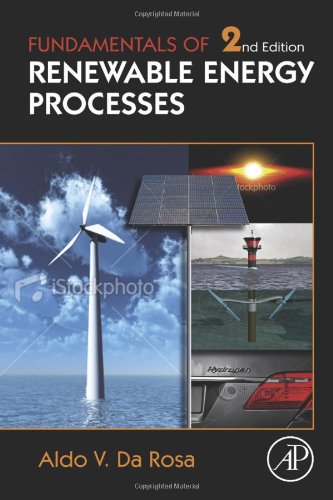
6. Fundamentals of Renewable Energy
$49.00
7. Renewable Energy Cannot Sustain
$73.99
8. Renewable Energy, Third Edition
$14.99
9. Energies: An Illustrated Guide
$18.00
10. Real Goods Solar Living Sourcebook:
$54.19
11. Energy Systems and Sustainability
$47.25
12. Wind Power, Revised Edition: Renewable
 
$94.91
13. Fundamentals of Renewable Energy
$183.22
14. Renewable Energy From the Ocean:
$56.00
15. Renewable Energy Policy and Politics:
$10.38
16. The Energy Construct: Achieving
$80.22
17. Renewable Energy: Technology,
$94.35
18. Renewable and Efficient Electric
$48.85
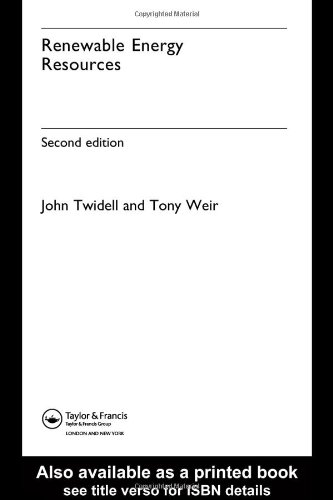
19. Renewable Energy Resources
$73.40
20. Biofuels for Transport: Global

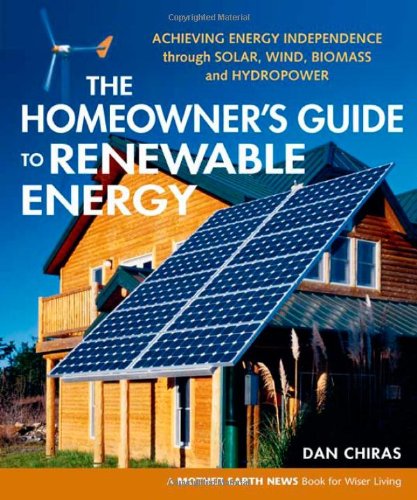
1. The Homeowner's Guide to Renewable Energy: Achieving Energy Independence Through Solar, Wind, Biomass And Hydropower (Mother Earth News Wiser Living)
by Daniel D. Chiras
Paperback: 335 Pages (2006-05-31)
list price: US$27.95 -- used & new: US$15.70
(price subject to change: see help)
Asin: 086571536X
Average Customer Review: 4.5 out of 5 stars
Canada | United Kingdom | Germany | France | Japan
Editorial Review

Book Description

The coming energy crisis caused by a peak in global oil and natural gas production will profoundly affect the lives of all North Americans. As the price of these vital fuels rises, homeowners will scramble to cut their fuel bills. Two options for meeting the upcoming challenge are dramatic improvements in home energy efficiency and efforts to tap into clean, affordable, renewable energy resources to heat and cool homes, to provide hot water and electricity, and even to cook. These measures can result in huge savings and a level of energy independence.

The Homeowner's Guide to Renewable Energy tells you how. It starts by outlining the likely impacts of fossil fuel shortages and some basic facts about energy. It then discusses energy conservation to slash energy bills and prepare for renewable energy options. Focusing carefully on specific strategies needed to replace specific fuels, the book then examines each practical energy option available to homeowners:

  • solar hot water, cooking and water purification
  • space heat: passive and active solar retrofits
  • wood heat
  • passive cooling
  • solar electricity
  • wind-generated electricity
  • electricity from microhydropower sources, and
  • emerging technologies -- hydrogen, fuel cells, methane digesters and biodiesel.

The Homeowner's Guide to Renewable Energy gives readers sufficient knowledge to hire and communicate effectively with contractors and, for those wanting do installations themselves, it recommends more detailed manuals. With a complete resource listing, this well-illustrated and accessible guide is a perfect companion for illuminating the coming dark age.

Mother Earth News Wiser Living Series

... Read more

Customer Reviews (10)

5-0 out of 5 stars Good review to renewable energy
I found this book to be more satisfying that the author's more popular book, "The Solar House".Of course, they aren't functional substitutes for each other.This book goes deeper into renewable energy systems available to address the energy needs of residential buildings and related topics.I appreciate his discussion on conservation, the breakdown of the energy consumption of a 'typical' residence, etc.This book goes deeper into energy than "The Solar House" goes into passive design, providing almost enough information to evaluate and size some systems.The amount of information presented varies by system, as solar photovoltaic and wind power get a more detailed treatment than biomass.For someone wanting enough information to select, size and/or design systems -- or more realistically to evaluate the proposals generated by a systems provider -- supplemental information will probably be required.

3-0 out of 5 stars A decent overview; left me wanting more details.
I read this book cover-to-cover over the course of a couple of weeks.I'm new to the field of renewable energy, so you'll have to take my criticisms for what they are, a critique of the writing:

1)The author frequently repeats himself, and sometimes goes so far to state that he is repeating himself, and that the reader should refer back to a previous section.

2)Many of the references are "so and so claims such and such" or references to the Home Power magazine.It's great that the author cites his sources, but it often left me wondering if the author placed any stock in the claim being reported.

3)The author frequently refers to his own house, which was designed from the ground up to use renewable energy.While this is neat, it doesn't seem applicable to readers who already own houses (with a 99% chance that they're not nearly as efficient, and that it's not possible to convert them).

4)I would have enjoyed more information on solar power, since it seems to be the most applicable in urban and suburban areas.Instead, it received basically equal treatment alongside micro-hydroelectric and wind power.

Still, it's a good book - 3.5 stars - and contains a number of references to other sources of information on the topic.

5-0 out of 5 stars Very informative book.
I found this book to be very informative.It provides a wealth of knowledge about being self-sufficient.I am particularly interested in solar and wind power and this book provided some very good information about each of these subjects.Would highly recommend this book to anyone who is thinking about living green.

5-0 out of 5 stars The Homeowner's Guide to Renewable Energy: Achievi...
This is an excellent book, because it has much information in general, different green ideas for your home. And that is important for you and the Planet today and future.

4-0 out of 5 stars Great Direction
My wife and I are in the process of designing our retirement home here in the Colorado foothills.We want to build one that is both energy efficient/independent and retain that "curb appeal".This book has provided us with a great many ideas that will help us achieve that goal. ... Read more


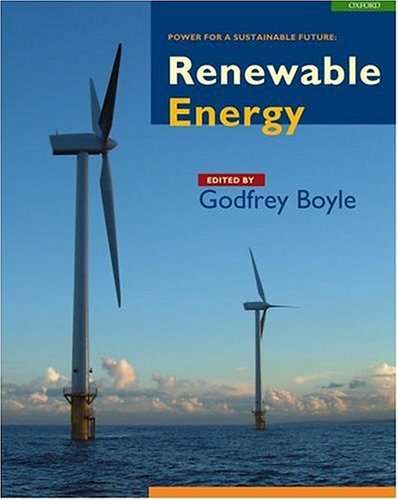
2. Renewable Energy
Paperback: 464 Pages (2004-05-06)
list price: US$59.95 -- used & new: US$45.29
(price subject to change: see help)
Asin: 0199261784
Average Customer Review: 5.0 out of 5 stars
Canada | United Kingdom | Germany | France | Japan
Editorial Review

Book Description
The prospect of producing clean, sustainable power in substantial quantities from renewable energy sources is now arousing interest world-wide, stimulated by recent technological developments that have improved the cost-effectiveness of many of the 'renewables' and by increasing concern over the environmental impact and sustainability of conventional fossil and nuclear fuel use. This book provides a comprehensive overview of the principal renewable energy sources including: DT Solar thermalDT PhotovoltaicsDT BioenergyDT HydroDT TidalDT WindDT WaveDT GeothermalWith the aid of over 350 detailed illustrations, more than 50 tables of data and a wide range of case studies it explains, for each source, the underlying physical and technological principles, and examines its environmental impact and future prospects. The overall approach is interdisciplinary, covering the economic, social, environmental and policy issues raised by renewable energy as well as the physical and engineering aspects. The book will therefore appeal strongly to non-specialist readers who wish to improve their understanding of this complex, fascinating and increasingly important subject. New to this Edition- Full colour design- Updated to reflect developments in technology. policy and attitudes- Complemented by a new book on traditional sources of energy, Energy Systems and Sustainability edited by Godfrey Boyle, Bob Everett and Janet Ramage of the Open University ... Read more

Customer Reviews (3)

5-0 out of 5 stars Excellent Resource
This book is an excellent resource for those interested in a good initial exposure to renewable energy. Concepts are clearly explained, and the colorful graphics add to the overall appeal. Although the book centers on implementation of technologies in Britain, this should not limit its relevance. In fact, many of the technologies that may not be as economically viable in the U.S. and other countries, such as wave and tidal power, receive a thorough treatment in this book.

5-0 out of 5 stars Excellent Book
See my review of the companion book "Energy Systems and Sustainability".These two books are excellent and I highly recommend them.

5-0 out of 5 stars Comprehensive book on all modern renewable energy sources
I used this book as a primary text for a course on "Energy & the Environment" where we dealt with all current and future methods of energy production and their effect on the environment.

This book is by far the best and easiest to read, whilst still containing accurate and complete information and data (though most of the data is based on the UK). It contains relevant formulas and mathematical information but is not too technical as to leave the reader jumping through numbers.

I've given this book 5 stars, because I couldn't find any flaw in it. It's a MUST have for any one interested in renewable energy.
... Read more


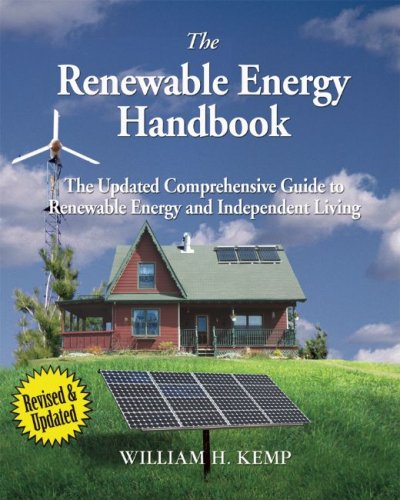
3. The Renewable Energy Handbook: A Guide to Rural Energy Independence, Off-grid And Sustainable Living
by William H. Kemp
Paperback: 567 Pages (2006-03)
list price: US$29.95 -- used & new: US$18.50
(price subject to change: see help)
Asin: 0973323329
Average Customer Review: 5.0 out of 5 stars
Canada | United Kingdom | Germany | France | Japan
Editorial Review

Book Description

As oil prices continue to rise, many people are starting to think about how to unhook from the power grid. The Renewable Energy Handbook focuses completely on off-grid, sustainable living and energy independence in a rural setting.

Author William Kemp and his wife designed their own high-efficiency off-grid home in 1991. They worked methodically to produce a home which has all of the standard "middle-class" creature comforts while using six times less heating, cooling, and electrical energy than the average Ontario home. Soon they were inundated with inquiries and decided to put their experience into book form in 2003.

This updated edition focuses specifically on off-grid concerns and contains chapters on:

  • Energy conservation
  • Heating and cooling
  • Photovoltaic, wind and microhydro energy generation
  • Battery selection, voltage regulation and inverters
  • Backup power

Twice the page count of the first edition, it also includes enhanced chapters on home and domestic water heating, wireless communications and biofuels. A "Showcase of Homes" chapter provides a tour of various off-grid cottages and homes, and details the type of lifestyle that can be achieved for a given capital cost. The book is augmented with appendices and hundreds of illustrations, line drawings and photographs.

... Read more

Customer Reviews (9)

4-0 out of 5 stars Good overview of reducing dependance on the Grid

I'm building a new house and I want to make sure it's the most energy efficient house I can afford to build, so I got this book to help look at some of the decisions like Solar PV, Solar water heating, Wind and Micro hydroelectric.I have been happy so far, the discussion on insulating so far has been geared toward existing houses but it's interesting to note that insulating the basement may give you a higher payback than more insulation in the attic.

I didn't understand what net-metering allows you to do before reading this book, although living in Georgia makes a PV system cost prohibitive since there are no state rebates.

Solar hot water looks very feasible and should have a pretty quick payback.

5-0 out of 5 stars Excellent book for layperson designing home
I bought this book because I wanted a book with more detail than some of the other introductory books.I was not disappointed.Quite good depth for a layman's book, with the necessary equations, tables, charts, etc. Some portions of the book could have some more detail, but the subject matter is so broad, it wasn't so much of a drawback as a stimulus to find more in depth material.The author gives lots of examples and links to further info.I especially liked his introduction of hot water/thermal storage in large tanks for heating domestic hot water or home heating.

5-0 out of 5 stars A very informative guide to renewable energy.
I found this book to contain very good information about living the self-sufficient lifestyle.This book contains vast amounts of information about renewable energy and the various methods available.I will definetly use this information as a guide to building our self-sustaining home.I would recommend this book to anyone interested in learning about green living.

5-0 out of 5 stars The Renewable Energy Handbook: A Guide to Rural Energy Independence, Off-grid And Sustainable Living
This is an excellent book, because it has much information in general, different green ideas for your home. And that is important for you and the Planet, today and future.

5-0 out of 5 stars A "must-have" for homeowners everywhere.
Consulting electronics and software designer and green technology advocate William H. Kemp presents The Renewable Energy Handbook: A Guide to Rural Energy Independence, Off-Grid and Sustainable Living, a handbook to home improvement via stretching one's energy dollars and supporting environmental concerns through powering one's home with clean, dependable, renewable energy. Especially valuable for homeowners who live far from utility poles and power grids, but useful for all homeowners, The Renewable Energy Handbook covers energy-efficient home design considerations, especially factors that should be taken into account when renovating an older home; tips for appliance selection; an in-depth primer for off-grid living; electrical production through photovoltaic means, wind turbines, micro hydro electricity production, batteries, and fossil fuel backup power sources; how to apply and connect all the different aspects of green power safely; and much more. Black-and-white photographs illustrate this home improvement guide for readers of all backgrounds. The Renewable Energy Handbook is for both energy-conscious do-it-yourselfers and homeowners seeking to educate themselves on what exactly they need to know before they call in a professional. In today's world of oil crises, electrical blackouts, high gas prices and increasing environmental depredations, The Renewable Energy Handbook is a "must-have" for homeowners everywhere. ... Read more


4. Careers in Renewable Energy: Get a Green Energy Job
by Gregory McNamee
Paperback: 208 Pages (2008-03-01)
list price: US$20.00 -- used & new: US$20.00
(price subject to change: see help)
Asin: 097737243X
Canada | United Kingdom | Germany | France | Japan
Editorial Review

Product Description
Numerous job opportunities await in the fast-growing field of renewable energy. Grab this handy book and discover how green energy can be a part of your future. Job sectors include solar and wind energy, biofuels, hydrogen energy and fuel cells, geothermal energy, hydro energy, green building, climate study, energy management and efficiency, and much more. Various jobs within each sector (engineering and technical positions, project management, R&D and sales/marketing) are discussed, and the appendix is loaded with resource materials for further education and training, professional associations, reference Web sites and more. ... Read more


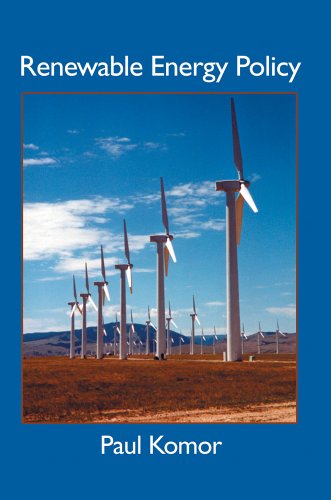
5. Renewable Energy Policy
by Paul Komor
Paperback: 194 Pages (2004-03-15)
list price: US$17.95 -- used & new: US$16.89
(price subject to change: see help)
Asin: 0595312187
Average Customer Review: 5.0 out of 5 stars
Canada | United Kingdom | Germany | France | Japan
Editorial Review

Book Description
Renewable energy is the key to the future of humankind.Wind power, solar (photovoltaic) energy, geothermal power, and other forms of renewables can help solve our most pressing environmental problems, including global climate change.But how do we move these promising technologies out of the laboratory and into widespread use?Renewable Energy Policy shows what public policy can—and cannot—do to help tap renewables' promise.

Renewable Energy Policy takes a pragmatic, nuts-and-bolts look at the myriad government efforts to promote renewables, and reports back on what works, what doesn't, and why.In clear, jargon-free language, Renewable Energy Policy shows how and why some policies have achieved impressive results, and others have failed. Skillfully interweaving technology, economics, and politics, Paul Komor reveals how the best of policy ideas often end up with unintended results.

If you want to know how much wind power really costs (Chapter 2), why Germany's renewables laws are "crude but effective" (Chapter 8), or the three reasons why the UK's green energy market is a flop (Chapter 4), then you need to read Renewable Energy Policy.

"Mr. Komor's writing style is both clear and engaging. This book works well as a primer for any energy analyst not already deeply involved in renewable energy policy matters or as a textbook for college courses on energy policy or renewable energy economics."
Blair G. Swezey, Principal Policy Advisor, National Renewable Energy Laboratory, Golden, CO.

Download Description
Renewable energy is the key to the future of humankind.Wind power, solar (photovoltaic) energy, geothermal power, and other forms of renewables can help solve our most pressing environmental problems, including global climate change.But how do we move these promising technologies out of the laboratory and into widespread use?Renewable Energy Policy shows what public policy can ... Read more

Customer Reviews (3)

5-0 out of 5 stars Very instructive and helpful
This book reviews the different ways the US, Germany and other countries have use to promote the use of renewables. From PVs to wind, and from Renewable Portfolio Standards to Green pricing... Also, this book has a very objective standpoint which makes it even more valuable.

5-0 out of 5 stars Clear, balanced writing
A clear, unbiased look at the world of Renewable Energy Policy.Required reading for anyone who wants to know how things actually work, instead of simple advocacy for renewables.

5-0 out of 5 stars Not the usual shrill advocacy
Much of the literature on renewable energy is based on exaggerated claims, simplistic analyses, and naked advocacy.Not this book, however - the author provides a refreshingly balanced and objective look at renewable technologies and policies.If you want information you can trust and believe, rather than the usual polemics, then buy this book. ... Read more


6. Fundamentals of Renewable Energy Processes
by Aldo V. da Rosa
Hardcover: 712 Pages (2005-08-03)
list price: US$97.95 -- used & new: US$77.26
(price subject to change: see help)
Asin: 0120885107
Average Customer Review: 5.0 out of 5 stars
Canada | United Kingdom | Germany | France | Japan
Editorial Review

Book Description
Fundamentals of Renewable Energy Processes contains the technical detail necessary to understand the engineering principles that govern renewable energy application at many different levels. Focused on the fundamental mechanisms and processes that underpin energy management, it provides students with the foundation for all energy process courses.This text is organized according to the main forms of energy - heat engines, hydrogen energy, energy from the sun, and wind and water energy - with an introductory chapter of basic energy terms.From fuel cells, electrolyzers and processes for hydrogen production to biomass and windmills the author provides the most thorough examination of all aspects of renewable energy processes.

* Examines the fundamentals of some non-traditional energy processes and illustrates the best way to implement these processes in our modern world.

* Appropriate for all students and professionals studying the basic mechanisms of renewable energies.

* Clear theory and physical examples of all principles relevant to the study of renewable energy.

* Written by an internationally recognized pioneer researcher ... Read more

Customer Reviews (2)

5-0 out of 5 stars Insightful and wonderfully written
Da Rosa's book is so extraordinarily interesting that it's hard to put down.It's packed with enough insights and interesting facts that professionals will also find much that is new and stimulating here.Unlike energy texts that target a general audience, this one aims high, at bright junior or senior engineering or physical science majors.(The only comparable text I know of is Gilbert Masters' "Renewable and Efficient Electric Power Systems."Masters and da Rosa are both faculty emeriti at Stanford.)From the table of contents:

Ch. 1 Generalities
Ch. 2 A minimum of thermodynamics and of kinetic theory of gases
Ch. 3 Mechanical heat engines
Ch. 4 Ocean thermal energy converters
Ch. 5 Thermoelectricity
Ch. 6 Thermionics
Ch. 7 AMTEC
Ch. 8 Radio-noise generators
Ch. 9 Fuel cells
Ch. 10 Hydrogen production
Ch. 11 Hydrogen storage
Ch. 12 Solar radiation
Ch. 13 Biomass
Ch. 14 Photovoltaic converters

Non-majors have several very well written alternatives to choose from:

Energy: Its Use and the Environment, Hinrichs and Kleinbach, 4th, 2006, ISBN 0495010855

Energy : Physical, Environmental, and Social Impact, Aubrecht, 3rd, 2005, ISBN 0130932221

Energy Systems and Sustainability, Boyle/Everett/Ramage, 2003, ISBN 0199261792

Potential drawbacks of the last book for American audiences are the lack of end-of-chapter questions and exercises and the natural bias toward British examples.

5-0 out of 5 stars The Book is finally in print!
Took Dr. da Rosa's classes at Stanford last year (EE293A and B).These classes were based on this text in "reader" format, or perhaps better said, this book represents the lectures and the knowledge that was given to the students in these classes.

Dr. da Rosa is a recogonized expert in renewable energy.The classes were structured not only to make you learn about renewable energy sources, but also to think about other energy sources that are in vogue, and hyped as the future.

I'm finished with the classes, but I feel that I need a copy of the text as a reference so that I can have a source to defend my arguements to others about renewable energy sources.

If you are really interested in renewable energy processes from a practical, engineering standpoint, you must review this book. Even better would be to take the classes!(They are offered as Distance Learning on the internet.) ... Read more


7. Renewable Energy Cannot Sustain a Consumer Society
by Ted Trainer
Hardcover: 200 Pages (2007-09-26)
list price: US$59.95 -- used & new: US$49.00
(price subject to change: see help)
Asin: 140205548X
Canada | United Kingdom | Germany | France | Japan
Editorial Review

Book Description

It is widely assumed that our consumer society can move from using fossil fuels to using renewable energy sources while maintaining the high levels of energy use to which we have become accustomed. This book details the reasons why this almost unquestioned assumption is seriously mistaken.

Chapters on wind, photovoltaic and solar thermal sources argue that these are not able to meet present electricity demands, let alone future demands. Even more impossible will be meeting the demand for liquid fuel. The planets capacity to produce biomass is far below what would be required. Chapter 6 explains why it is not likely that there will ever be a hydrogen economy, in view of the difficulties in generating sufficient hydrogen and especially considering the losses and inefficiencies in distributing it. Chapter 9 explains why nuclear energy is not the answer.

The discussion is then extended beyond energy to deal with the ways in which our consumer society is grossly unsustainable and unjust. Its fundamental twin commitments to affluent living standards and economic growth have inevitably generated a range of alarming and accelerating global problems. These can only be solved by a transition to The Simpler Way, a society based more on simpler, self-sufficient and cooperative ways, within a zero-growth economy. The role renewable energy might play in enabling such a society is outlined.

... Read more

8. Renewable Energy, Third Edition
by Bent Sorensen (Sørensen)
Hardcover: 952 Pages (2004-07-16)
list price: US$92.95 -- used & new: US$73.99
(price subject to change: see help)
Asin: 0126561532
Average Customer Review: 3.0 out of 5 stars
Canada | United Kingdom | Germany | France | Japan
Editorial Review

Book Description
This third edition of Renewable Energy is undoubtedly one of the most complete accounts of the subject, from source through to extraction and use. The book is academically rigorous, but accessible.

The author first describes the effect of the sun on the atmosphere and the creation of wind and waves, including the effects of global warming. For each type of renewable energy, from direct solar radiation to wind and biomass, there follows a technical description of the devices that can be used to transform the energy into useful forms. The author explores new solar cell types, including polymer and organic cells, new biofuel processes and new wave energy devices.

The final part of the book loos at social and economic aspects of renewable energythe costs of our current fuel bills versus new energy sources, and the difference it could make to developing as well as developed countries. The concept of whole new energy systems based around wind, solar, and other energies is put into a real-life context. Key features include:
· Reference paths: the reader may follow the general process from source through to distribution, or concentrate on a specific type of energy.
· The material is divided into undergraduate text and advanced options.
· Details the significant expansion of the field since the publication of the previous edition.
· Updated material includes offshore wind technologies, polymer and organic solar cells, new developments in hydrogen storage, pipeline transmission, biofuel processes, and wave energy devices, evaluation of biomass options, and an outlook on the renewable energy market.

*The only rigorous theory and applications book available

*Provides the principles of renewable energy flows/sources and energy conversion processes

*Details the significant expansion of the field since the publication of the previous editions ... Read more

Customer Reviews (1)

3-0 out of 5 stars Essentially just like the 2nd edition. Fine if you like to read dry encyclopediae.
A few sparse additions and some reorganization, but too "fundamental" to make the effort worthwhile. This is a classic, ultimately frustrating encyclopedia written in a very dry style. Basically, a drag to get through even single topics. There may be errors but who cares? ... Read more


9. Energies: An Illustrated Guide to the Biosphere and Civilization
by Vaclav Smil
Paperback: 228 Pages (2000-02-28)
list price: US$20.95 -- used & new: US$14.99
(price subject to change: see help)
Asin: 026269235X
Average Customer Review: 4.0 out of 5 stars
Canada | United Kingdom | Germany | France | Japan
Editorial Review

Amazon.com
The energy of solar radiation reaching the earth clocks in at 5,500,000 exajoules, an exajoule being one watt per second taken to 10 to the 18th power. The energy used to strike a typewriter key is 20 millijoules, a millijoule being one watt per second taken to 10 to the negative 3rd power; that keyboard-striking energy is a full order of magnitude larger than the energy a flea expends in hopping from one spot to another. Such is the sort of information that geographer Vaclav Smil delights in presenting in his endlessly interesting handbook of the various energy technologies of nature and culture. "Energy is the only universal currency," Smil writes, but, he notes, it is little understood. Beginning with a grand tour of the solar system and the terrestrial biosphere, and taking into account such matters as the movement and latent heat of waves, Smil moves on to consider the energy of natural food chains, the efficiency of human growth, the energy requirements of agriculture, and the terrible force of modern weapons, among hundreds of other subjects. His heavily illustrated book is one of a kind, and it makes for both entertaining bedside reading and a highly useful reference. --Gregory McNamee Book Description
In this highly original book, ecologist Vaclav Smil presents a comprehensive and integrated survey of all the forms of energy that shape our world, from the sun to the human body, from bread to microchips. Written in a scientifically sophisticated yet accessible style, Energies consists of eighty-two short essays organized under six headings: Sun and Earth, Plants and Animals, People and Food, Preindustrial Societies, Fossil-Fueled Civilization, and Transportation and Information. Each essay explains the science of the energy form as well as its implications for the functioning of the universe, life, or human society. ... Read more

Customer Reviews (3)

5-0 out of 5 stars Excellent -- a joule of a book
This is an incredibly easy book to read and understand, amply illustrated by clear graphics. This is not a simple book. It is an encyclopedia of energy, from sunlight, to the biology produced by sunlight, to the energy we gain from using our environment as fuel. Reading through each section (they are clear and cogent) is an exercisein connecting simple inputs with complex outputs. The section on transportation takes you from walking to running to riding the bicycle, all the way to trains, planes, and rocket boosters, all of which developed differently and use energy very differently.

The book is packed with wonderful essays that are well written, ideas that jump off the page, and graphic illustrations that make sense.It's one of those books you can actually flop open at random and get engrossed in all over again. If there's a criticism to this book, it is that it is only a sampler. It could easily have been twice as long.

2-0 out of 5 stars Not a book for the layperson
I recently bought this item after reading the review for this book. I found this to be a mistake. I am an engineer by trade, and I found myself reading old school books so I could understand what this book was talkingabout.This book covers a wide variety of information and is difficult toread.This is not a book for the layman.....

5-0 out of 5 stars A reference book for energy
This is a fascinating book. It provides a comprehensive and integrated survey of the energies shaping our world. It is filled with diagrams, graphs, maps, drawings and photographs to support the text.

This bookcan't be described. It has to be experienced: energy production of the sun,global patterns of latent heat flux, a horse's suspensory and checkligaments that allow it to use hardly any additional energy for standing,preindustrial societies, cars and computers and much more.

Use this bookfor reference and for browsing. Spend an afternoon with a calculator andthe figures listed in the tables in this book. You will begin to appreciatethe complex relationships involving the energies that shape our world. ... Read more


10. Real Goods Solar Living Sourcebook: Your Complete Guide To Renewable Energy Technologies And Sustainable Living (Real Goods Solar Living Sourcebook)
Paperback: 564 Pages (2005-03-18)
list price: US$35.00 -- used & new: US$18.00
(price subject to change: see help)
Asin: 091657105X
Average Customer Review: 4.5 out of 5 stars
Canada | United Kingdom | Germany | France | Japan
Editorial Review

Book Description

Do you want to harvest sunlight, wind or falling water to power your home? Or sell that renewable energy back to your utility company? Are you looking to build your dream eco-home? Or to convert to biodiesel and minimize your fossil fuel use?

This fully-updated classic of sustainable living technology tells how and gives you access to the world's most extensive selection of hardware to make it all happen. The Solar Living Sourcebook - 12th Edition is the ultimate resource on renewable energy, sustainable living, alternative construction, green building, homesteading, off-the-grid living, and alternative transportation, written by experts with decades of personal experience and a passion for sharing their knowledge. In print and regularly updated since 1982, the Sourcebook has sold over 600,000 copies in 44 countries. This 12th edition includes brand new sections on Solar Utility Intertie, Alternative Sources of Fuel (including biodiesel and hydrogen fuel cells) and Hybrid Vehicles, and completely rewritten sections on Land & Shelter, Emergency Preparedness, and Energy Conservation, as well as in-depth sections on:

  • Sunshine to Electricity
  • From Panel to Plug
  • Water Systems
  • Water Heating
  • Water & Air Purification
  • Composting Toilets & Graywater Systems
  • Off-the-Grid Living & Homesteading Tools
  • Mobility
- plus over 150 pages of maps, wiring diagrams, formulae, charts, electrical code, solar sizing worksheets and much more.

Whether you're a layperson or a professional, novice or longtime aficionado, the Sourcebook puts the latest research and newest products at your fingertips - all the information you need to make sustainable living a reality.

... Read more

Customer Reviews (11)

4-0 out of 5 stars great
My husband who has an avid interest in sustainable energy really enjoyed this book.He liked it so much he bought one for a realator friend of ours who is also into sustainable energy.

3-0 out of 5 stars This is an enhanced catalog
This book does have much useful information, but it still a catalog.

5-0 out of 5 stars Best Of The Bunch
This book is the absolute best for covering renewable energy on a residential-sized scale. It covers all things solar/renewable energy: converting solar energy to electricity, wind generators, solar water heating, solar water pumping, energy conservation, off-the-electrical grid and grid intertie applications. There's an appendix with charts, maps and worksheets that help you design your own solar home and energy system. It is well written, with the information easy to follow. There is just enough theory included so you can follow the technical descriptions of the system components. It's got 564 pages and there's not much wasted space.
I have lived off-grid for six years and teach a renewable energy class at a nearby community college. I tell my students that if they are going to buy just one book on renewable energy, to buy this, the latest edition of the Solar Living Sourcebook.
Keep in mind, this is a catalog for Giam/Real Goods. Products and services are described and prices are listed. They would like you to do business with them. I have found that many of the products listed can be found cheaper elsewhere, but having the prices listed is a plus...you can put together a system and get a ball-park figure on how much the system will cost you. In my opinion, Real Goods is a reputable company, very service oriented, and very knowledgeable.
If you want more information on residential sized renewable energy systems, the magazine Home Power (www.homepower.com) is superb. They publish six issues a year, with a hands-on type format that makes you want to get out there and build something!
If you are interested in using solar energy to make electricity, but want the advantages of being tied to the grid, the book Got Sun? Go Solar by Rex Ewing and Doug Pratt is excellent. If living off-the-grid is your interest, The Renewable Energy Handbook by William Kemp is very good.

5-0 out of 5 stars Great book
Boy, if you want to know not only the theory of alternative energy, but how to implement it in your home, this is the book.Each chapter tells you the pros and cons of each type (solar, wind, microhydroelectric, geothermal...) and then gives you real products available today to buy and install.One tip: You may be able to get the products cheaper somewhere else, though.Shop around.Well done.

5-0 out of 5 stars Essential Information
Essential catalog of energy related items punctuated with non commercial advice and information. ... Read more


11. Energy Systems and Sustainability
Paperback: 640 Pages (2003-12-04)
list price: US$59.95 -- used & new: US$54.19
(price subject to change: see help)
Asin: 0199261792
Average Customer Review: 5.0 out of 5 stars
Canada | United Kingdom | Germany | France | Japan
Editorial Review

Book Description
Today energy and sustainability are areas of primary concern. Energy Systems and Sustainability provides a thorough introduction to the economic, social, environmental and policy issues raised by current systems of energy use, as well as describing their key physical and engineering features. The book begins with an introductory account of the present world energy situation. This is followed by chapters explaining basic energy concepts and describing the magnitudes and patterns of human energy needs. The central part of the book deals with the historical evolution and present status of the conventional fossil and nuclear fuelled energy systems that, along with hydropower and traditional biofuels, currently supply the majority of the world's commercial energy needs. A section on economics describes the basic methods by which the monetary costs of energy are calculated, and discusses the issue of the 'external' costs of energy production.The concluding sections then deal with the sustainability problems associated with both fossil and nuclear fuel use, and ways in which these might be ameliorated by various technological developments. The interdisciplinary approach of the book will appeal not only to specialists but also to non-specialist readers who wish to improve their understanding of these complex and increasingly important issues.This book will be an ideal companion to the forthcoming second edition of Renewable Energy by Godfrey Boyle, which deals with the different forms of renewable energy and how these can be utilised. ... Read more

Customer Reviews (1)

5-0 out of 5 stars Excellent Resource
This book, and its companion "Renewable Energy", are excellent introductory books to the topic of energy.The basics are explained in clear language, the references are up-to-date and the graphics are colorful and very helpful.These two books take a HUGE topic and make it understandable and interesting. I hope that new editions continue to be published.

If I had to make one complaint, it's that it's focused on the UK, which in terms of energy is a relatively small country.But in today's world, that is a minor issue. The book gives you the tools you need evaluate other sources of information. ... Read more


12. Wind Power, Revised Edition: Renewable Energy for Home, Farm, and Business
by Paul Gipe
Hardcover: 512 Pages (2004-09-30)
list price: US$75.00 -- used & new: US$47.25
(price subject to change: see help)
Asin: 1931498601
Average Customer Review: 5.0 out of 5 stars
Canada | United Kingdom | Germany | France | Japan

Customer Reviews (8)

4-0 out of 5 stars Zero to Sixty (mph) in One Week
Are you starting from zero knowledge regarding wind energy? Do you want to get up to full speed in a reasonable amount of time? If yes, then this is definitely the book for you. Paul Gipe has captured the essence of not only the fundamental technology but also the industry in general. Once done with this book, you will have the cranial capital to dig deeper into the engineering, the municipal or national scene, or the fundamentals of financing including energy-cash flow analysis. There is plenty of nitty-gritty for whatever side of the technology you prefer to understand, including building your own system. And there are many specific and anecdotal examples to support the many scenarios described. Yours is sure to be one of them. To paraphrase the late Abby Hoffman - *Buy This Book* You'll be up to 60 mph (26.8 meters/second) in no time.

4-0 out of 5 stars Wind Power
Wind Power, Revised Edition: Renewable Energy for Home, Farm, and Business

This book is the bible for learning the history and current configurations of wind power and a welth of information as to how to set up your windmill and problems you may run into with your utility company. It is required reading for anyone thinking about setting up a wind generator.

5-0 out of 5 stars Make This Your 1st Book on Wind Power
Paul Gipe truly knows his industry. Whether you're thinking about installing a small wind turbine or want to invest in a megawatt model, you should make this your first purchase. You'll feel like you've completed a college course on wind power after reading this book.

5-0 out of 5 stars Buy this book before investing in wind power!
Unless you already work in the wind industry (and even if you do) this book is invaluable.It contains very detailed information of nearly all aspects of wind power.I've only had this book several weeks and have not yet purchased a wind mill.I especially like the sections on towers, safety and the comparison charts for many models of turbines.

5-0 out of 5 stars Great book
Its bulk information & know-how represented in the most fluent manner possible. Its like getting a course of wind energy.
Fully recommend for wind passionates. ... Read more


13. Fundamentals of Renewable Energy Sources
by G. N. Tiwari, M. K. Ghosal
 Hardcover: 668 Pages (2007-07-05)
list price: US$99.95 -- used & new: US$94.91
(price subject to change: see help)
Asin: 1842653970
Canada | United Kingdom | Germany | France | Japan

14. Renewable Energy From the Ocean: A Guide to OTEC (Johns Hopkins University/Applied Laboratory Series in Science and Engineering)
by William H. Avery, Chih Wu
Hardcover: 480 Pages (1994-03-17)
list price: US$262.00 -- used & new: US$183.22
(price subject to change: see help)
Asin: 0195071999
Average Customer Review: 5.0 out of 5 stars
Canada | United Kingdom | Germany | France | Japan
Editorial Review

Book Description
Scientists and engineers around the world are striving to develop new sources of energy.One source, ocean thermal energy conversion, has virtually unlimited potential.It is based on techniques that exploit heat produced by solar energy that may, in turn, be used to produce fuel and electricity.This book reviews the status and background of this promising technology. William H. Avery is the leading expert in this field, and his co-author Chih Wu is an authority on heat engine performance.Together they describe the workings of an OTEC power plant and how such a system might be implemented as part of a futuristic national energy strategy.The book is the only detailed presentation of basic OTEC technology, its testing and improvement. It is based on extensive development initiatives undertaken internationally during the period from 1974 through 1985.The book offers a thorough assessment of the economics of OTEC in comparison with other energy production methods.It will be of interest to a wide range of professionals in energy research, power and mechanical engineering, and to upper-level undergraduate students taking courses in these fields. ... Read more

Customer Reviews (1)

5-0 out of 5 stars CEO of Freedom Energy, LLC
This is the most comprehensive resource of the science of OTEC.It is only for those who are serious in exploring this science of continuous solar energy from the oceans.It is presented as a science textbook at the college level. Simply excellent! ... Read more


15. Renewable Energy Policy and Politics: A Handbook for Decision-Making
Paperback: 288 Pages (2006-03)
list price: US$75.00 -- used & new: US$56.00
(price subject to change: see help)
Asin: 184407126X
Canada | United Kingdom | Germany | France | Japan
Editorial Review

Book Description
* Examines the renewable energy sector and its stakeholders, analyzing the reasons for past failures and the key features of successful policies
* Written in clear terms, this book contains the experience of world leaders in this field
* Including an executive summary, it will be an essential reference for decision-makers, offering a deep understanding of the underlying mechanisms

At a time when renewable energy attracts varying degrees of political support and mixed success in policy implementation, clear information on why and how to promote renewable energy markets is much needed, for decision-makers in particular. This book meets that need.

The reason for exploiting renewable energy sources should not be because they are cheap, or because fossil fuels are running out. The crucial reasons are: saving the environment, developing new industries and establishing more secure sources of energy. This book outlines how renewable energies can be promoted at a political level, encouraging the expansion of current markets and the establishment of new industries. Critical pathways are made clear, and key stakeholders are identified and described.

Acknowledging the importance of the media and the interaction between public and private bodies, this book sets out the rules of the game, the stakes and the strategies for success. Contributing authors include: Randy Swisher and Kevin Porter, Rakesh Bakshi, Gordon Edge, Sven Teske and Volker Hoffmann, Jose Luis Garcia and Emelio Menendez. ... Read more


16. The Energy Construct: Achieving a Clean, Domestic, and Economical Energy Future
by Ben Cipiti
Paperback: 192 Pages (2007-08-15)
list price: US$12.99 -- used & new: US$10.38
(price subject to change: see help)
Asin: 1419669788
Average Customer Review: 5.0 out of 5 stars
Canada | United Kingdom | Germany | France | Japan
Editorial Review

Product Description
The Energy Construct establishes an energy strategy for the United States to achieve a clean, domestic, and economical energy future.Our continued reliance on fossil fuels is having drastic consequences to the environment, and our continued reliance on foreign oil threatens our national security and economic well-being.Biofuels, hydrogen, and electric vehicles are examined to find a truly green transportation alternative to oil.The economic challenges of renewable energy options are explored to determine which have the most promise for short and long term growth.A new look at nuclear energy examines its safety compared to other sources.Finally, carbon sequestration technologies are investigated as a way to achieve zero emission coal and natural gas plants.The various technologies are examined from the standpoints of economics, environmental impact, domestic resource potential, public acceptability, and reliability to find a realistic path forward. ... Read more

Customer Reviews (3)

5-0 out of 5 stars Simple and organized - excellent...
The technology, economics, environmental concerns, public acceptability, etc. of energy alternatives are presented in this fantastic piece.With a focus on both transportation and electricity, the author clearly constructs a viable energy solution.

5-0 out of 5 stars Plan of Action Timeline for Individuals and Government
In answering what we as a society can do and what we as individuals can do, "The Energy Construct" lays out an evaluation of all current and developing energy sources and further ofers a plan based on what I consider to be the most important issues for Americans, the environment and economic impacts of Cipiti's plan.

5-0 out of 5 stars Cipiti hits nail on the head
"The Energy Construct..." Helps bring to light where we should be focusing our efforts and finances. ... Read more


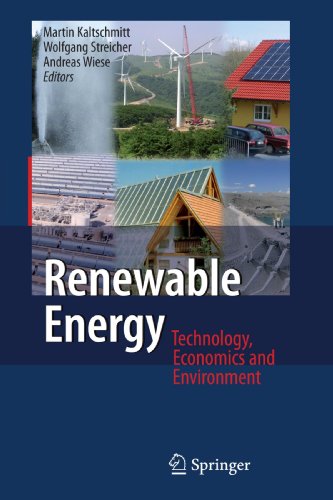
17. Renewable Energy: Technology, Economics and Environment
Hardcover: 564 Pages (2007-09-10)
list price: US$99.00 -- used & new: US$80.22
(price subject to change: see help)
Asin: 3540709479
Canada | United Kingdom | Germany | France | Japan

18. Renewable and Efficient Electric Power Systems
by Gilbert M. Masters
Hardcover: 680 Pages (2004-08-11)
list price: US$140.00 -- used & new: US$94.35
(price subject to change: see help)
Asin: 0471280607
Average Customer Review: 5.0 out of 5 stars
Canada | United Kingdom | Germany | France | Japan
Editorial Review

Book Description
This is a comprehensive textbook for the new trend of distributed power generation systems and renewable energy sources in electric power systems. It covers the complete range of topics from fundamental concepts to major technologies as well as advanced topics for power consumers.

An Instructor's Manual presenting detailed solutions to all the problems in the book is available from the Wiley editorial department.Download Description
This is a comprehensive textbook for the new trend of distributed power generation systems and renewable energy sources in electric power systems. It covers the complete range of topics from fundamental concepts to major technologies as well as advanced topics for power consumers. ... Read more

Customer Reviews (2)

5-0 out of 5 stars An Important Book on Renewable Electric Power Systems
Here is a book that is needed by those (especially engineers) interested in energy systems for the future.It has broad coverage and yet enough depth to allow design of new systems.Professor Masters' casual writing style and his sense of humor make the book fun to read.

The book covers wind systems, photovoltaic cells(PV) and PV systems, distributed generation (concentrating solar power, microhydro, fuel cells, biomass), and economics of renewable electric power generation and comparison with conventional thermal power plants.This book is important as the engineering world moves into the era of rising energy prices and is compelled to provide alternatives to fossil and nuclear fueled generation. There are abundant very helpful examples worked out in the text.

We used this book in a one semester introduction to renewable power taught as an elective for senior and first year graduate students.Since this was the first time the course was taught by the Electrical and Computer Engineering Department at the University of NH, and our first time through the book, the course covered only a subset of chapters.

The book provides solid engineering background for topics discussed in applied "how to" books on renewable energy systems.It will appeal to that person who wants deeper understanding of principles.The ideas - both theoretical and practical - are carefully developed.

We read a good number of the problems at the end of the chapters we covered and assigned a subset of those.We found the book problems to be very enlightening and carefully thought out.Many of the problems provided profound insight and preparation for understanding and using the material studied.Even the first chapter on basic electrical and magnetic circuits has problems involving models for photovoltaic modules.

Michael J. Carter, Associate Professor of ECE at UNH
Filson H. Glanz, Professor Emeritus of ECE at UNH

5-0 out of 5 stars A gem of a book
Gil Masters is a master teacher, as every page in this book makes clear.The best summary is found in the preface:

"Engineering for sustainability is an emerging theme for the twenty-first century, and the need for more environmentally benign electric power systems is a critical part of this new thrust. Renewable energy systems that take advantage of energy sources that won't diminish over time and are independent of fluctuations in price and availability are playing an ever-increasing role in modern power systems. Wind farms in the United States and Europe have become the fastest growing source of electric power; solar-powered photovoltaic systems are entering the marketplace; fuel cells that will generate electricity without pollution are on the horizon. Moreover, the newest fossil-fueled power plants approach twice the efficiency of the old coal burners that they are replacing while emitting only a tiny fraction of the pollution.

There are compelling reasons to believe that the traditional system of large, central power stations connected to their customers by hundreds or thousands of miles of transmission lines will likely be supplemented and eventually replaced with cleaner, smaller plants located closer to their loads. Not only do such distributed generation systems reduce transmission line losses and costs, but the potential to capture and utilize waste heat on site greatly increases their overall efficiency and economic advantages. Moreover, distributed generation systems offer increased reliability and reduced threat of massive and widespread power failures of the sort that blacked out much of the northeastern United States in the summer of 2003.

It is an exciting time in the electric power industry, worldwide. New technologies on both sides of the meter leading to structural changes in the way that power is provided and used, an emerging demand for electricity in the developing countries where some two billion people now live without any access to power, and increased attention being paid to the environmental impacts of power production are all leading to the need for new books, new courses, and a new generation of engineers who will find satisfying, productive careers in this newly transformed industry.

This book has been written primarily as a textbook for new courses on renewable and efficient electric power systems. It has been designed to encourage self-teaching by providing numerous completely worked examples throughout.Virtually every topic that lends itself to quantitative analysis is illustrated with such examples. Each chapter ends with a set of problems that provide added practice for the student and that should facilitate the preparation of homework assignments by the instructor.

While the book has been written with upper division engineering students in mind, it could easily be moved up or down in the curriculum as necessary. Since courses covering this subject are initially likely to have to stand more or less on their own, the book has been written to be quite self-sufficient. That is, it includes some historical, regulatory, and utility industry context as well as most of the electricity, thermodynamics, and engineering economy background needed to understand these new power technologies.

Engineering students want to use their quantitative skills, and they want to design things. This text goes well beyond just introducing how energy technologies work; it also provides enough technical background to be able to do first-order calculations on how well such systems will actually perform. That is, for example, given certain windspeed characteristics, how can we estimate the energy delivered from a wind turbine? How can we predict solar insolation and from that estimate the size of a photovoltaic system needed to deliver the energy needed by a water pump, a house, or an isolated communication relay station? How would we size a fuel cell to provide both electricity and heat for a building, and at what rate would hydrogen have to be supplied to be able to do so? How would we evaluate whether investments in these systems are rational economic decisions? That is, the book is quantitative and applications oriented with an emphasis on resource estimation, system sizing, and economic evaluation." ... Read more


19. Renewable Energy Resources
by John Twidell
Paperback: 601 Pages (2005-12-16)
list price: US$70.00 -- used & new: US$48.85
(price subject to change: see help)
Asin: 0419253300
Canada | United Kingdom | Germany | France | Japan
Editorial Review

Book Description
Retaining the successful format of the first edition and building on its solid grounding in the principles of renewable energy resources, this second edition has been revised in line with the latest advances in the field to include new technologies and an assessment of their impact. Considering each technology in depth from both scientific and environmental perspectives, the book covers solar energy, photovoltaic, wind, wave, tidal and hydro power, biofuels, geothermals and more, and also features a new chapter on institutional factors, including ergonomics. In addition, extra worked problems and case studies are provided to help readers put theory into practice.After each chapter, reading and web-based material is indicated for further study, making this text ideal not only for practitioners but also for students on multi-disciplinary masters degrees in science and engineering as well specialist modules in science and engineering first degrees. ... Read more


20. Biofuels for Transport: Global Potential and Implications for Energy and Agriculture
by The Worldwatch Institute
Hardcover: 480 Pages (2007-08)
list price: US$95.00 -- used & new: US$73.40
(price subject to change: see help)
Asin: 1844074226
Canada | United Kingdom | Germany | France | Japan
Editorial Review

Book Description
*A unique global assessment of the potential opportunities and risks of biofuels

*A comprehensive analysis, that takes the reader from an introduction to specific biofuels, through the prospects for technology and agriculture, to the economic, social and environmental implications

*Explores and analyzes the debates surrounding biofuels, offering authoritative conclusions

The world is on the verge of an unprecedented increase in the production and use of biofuels for transport. The combination of rising oil prices, issues of security, climate instability and pollution, deepening poverty in rural and agricultural areas, and a host of improved technologies, is propelling governments to enact powerful incentives for the use of these fuels, which is in turn sparking investment.

Biofuels for Transport is a unique and comprehensive assessment of the opportunities and risks of the large-scale production of biofuels, which demystifies complex questions and concerns, such as the food v. fuel debate. Global in scope, it is further informed by five country studies from Brazil, China, Germany, India and Tanzania. The authors conclude that biofuels will play a significant role in our energy future, but warn that the large-scale use of biofuels carries risks that require focused and immediate policy initiatives. ... Read more


  1-20 of 100 | Next 20
A  B  C  D  E  F  G  H  I  J  K  L  M  N  O  P  Q  R  S  T  U  V  W  X  Y  Z  

Prices listed on this site are subject to change without notice.
Questions on ordering or shipping? click here for help.

site stats